OBJECTIVES
• Explain pre-employmentscreening
• Discuss matching people with jobs
• Enumerate employment tests
• Describe employment interviews
• Examine selection decisions
3.
PRE-EMPLOYMENT SCREENING
• isa component of the employee selection process that involves evaluating and verifying an applicant’s job-
related qualifications and identifying potential hiring risks, the result of which can be used to make better
hiring decisions.
• enlightens hiring decisions with a holistic view of an applicant’s past that is tempered by the risk profile and
requirements of the job
• process of investing the backgrounds of potential employees and is commonly used to verify the accuracy of
an applicant’s claim as well as to discover any possible criminal history, workers compensation claims, or
employer sanctions
• can be used to confirm an applicant’s identity, nationality and immigration status, and to verify their declared
skills and employment history.
4.
• may alsoraise concerns about the integrity and reliability of an applicant, for example
1. involvement in illegal activities
2. unspent criminal convictions relevant to the role, particularly if not volunteered by
the applicant and only revealed by other checks
3. false or unsubstantiated claims on the CV or application form
4. unsubstantiated qualifications
5. unexplained gaps in employment history
6. adverse references
7. questionable documentation
8. evasiveness or unwillingness to provide information on the part of the candidate
PRE-EMPLOYMENT SCREENING
5.
REASONS FOR PRE-EMPLOYMENTSCREENING
1. Better Candidates Lead to Better Employees- Employers who utilize pre-
employment screening as a part of their recruitment process realize a number of
important benefits. One of those benefits is a general improvement in the quality of
applicants which ultimately leads to better workers, higher productivity, increased quality,
and lower employee turnover. Simply announcing to all applicants the intention to conduct
background checks will discourage some candidates from applying.The announcement will
encourage some high risk candidates with criminal backgrounds to eliminate themselves in
recruitment process. Conversely, the announcement does not discourage good qualified
applicants who know their background check will not reveal significant problems.
6.
2. Reduction inNon-Violent Employee Misconduct – Non-violent employees misconduct can
include theft of company or customer assets, fraud, drug possession or solicitation and identify theft or
other confidential information abuses. In addition to the obvious financial impact, these acts can
result in lost customers, deflated employee morale, and company brand and image destruction.
3. Reduction in Risk of Negligence Hiring Litigation – Negligent hiring is a legal theory under
which employers are held responsible for inquiries caused by their employees if the employer failed to
take reasonable care in the employment selection process.The employer can be held liable even if
they did not know about the employee’s history it if is determined that they should have known.An
employer may be found liable if the employee injuries a co-worker, customer, or member of the
general public even if the employee is not acting within the scope of their job duties when the injury
occurs.
REASONS FOR PRE-EMPLOYMENT SCREENING
7.
MATCHING PEOPLE ANDJOBS
• Matching people to jobs is critical for superior performance and retention. It is difficult and aggravating to hire the
wrong candidate. Poor job fit results in lost productivity.
• Employers don’t want to have to advertise their jobs and job seekers don’t want to have to search through job
postings to find employment. Both of them would just have to wave a magic wand and be connected with the
perfect match of a job or employee.This wand is the future of hiring and emerging today in something called job
matching.
• JOB MATCHING –science of carefully defining superior performance in each position and using objective criteria
to determine who is hired.The process goes deeper than conventional employment methods to create the most
comprehensive definition possible of why a job exists. It is the science and the art of carefully matching the right
person to the job that’s ideally suited for them.The result is someone who is happier on the job and has a head
start towards meeting aggressive performance goals.
8.
• JOB MATCHINGstarts with the comprehensive definition of why a job exists; and based on the three to five
key accountabilities of the position, it assures hiring someone who can get results. No matter who occupies a
position, they will need a uniquely specific set of traits to excel in that position. By defining those traits and skills
in a benchmark, HR systematically calibrate each position for superior performance.
• When an entire organization is job matched, the results are dramatic. High performance becomes the norm. be
carefully matching each person to the job that’s right for them, the organization benefits from employees who
can ramp up quickly to be productive and who can be superior performers. Each employee occupies a job that
they most naturally have a passion for and are successful in, which makes for an engaged, happy employee. Higher
levels of engagement and productivity, less turnover-related expense, and employees who have good things to say
about what it’s like to work at the company are the positive outcomes of well-matched jobs.With the right
system in place everyone is ready for anything.
MATCHING PEOPLE AND JOBS
9.
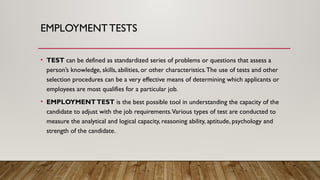
EMPLOYMENT TESTS
• TESTcan be defined as standardized series of problems or questions that assess a
person’s knowledge, skills, abilities, or other characteristics.The use of tests and other
selection procedures can be a very effective means of determining which applicants or
employees are most qualifies for a particular job.
• EMPLOYMENTTEST is the best possible tool in understanding the capacity of the
candidate to adjust with the job requirements.Various types of test are conducted to
measure the analytical and logical capacity, reasoning ability, aptitude, psychology and
strength of the candidate.
10.
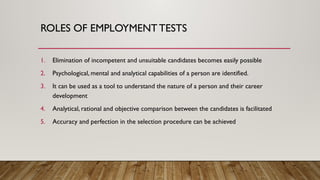
ROLES OF EMPLOYMENTTESTS
1. Elimination of incompetent and unsuitable candidates becomes easily possible
2. Psychological, mental and analytical capabilities of a person are identified.
3. It can be used as a tool to understand the nature of a person and their career
development
4. Analytical, rational and objective comparison between the candidates is facilitated
5. Accuracy and perfection in the selection procedure can be achieved
11.
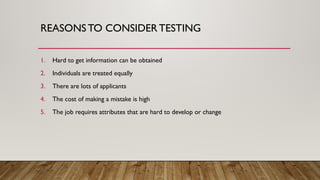
REASONSTO CONSIDER TESTING
1.Hard to get information can be obtained
2. Individuals are treated equally
3. There are lots of applicants
4. The cost of making a mistake is high
5. The job requires attributes that are hard to develop or change
12.
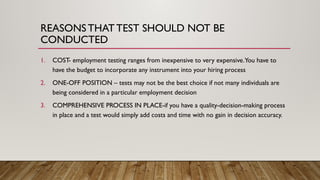
REASONSTHAT TEST SHOULDNOT BE
CONDUCTED
1. COST- employment testing ranges from inexpensive to very expensive.You have to
have the budget to incorporate any instrument into your hiring process
2. ONE-OFF POSITION – tests may not be the best choice if not many individuals are
being considered in a particular employment decision
3. COMPREHENSIVE PROCESS IN PLACE-if you have a quality-decision-making process
in place and a test would simply add costs and time with no gain in decision accuracy.
13.
ASSESSMENT CENTERS
• AssessmentCenters can be designed to measure many different types of job related
skills and abilities, but often used to assess interpersonal skills, communication skills,
planning and organizing, and analytical skills
• Typically consists of exercises that reflect job content and types of problems faced on
the job.
• For example, individuals might be evaluated on their ability to make sales presentation
or on their behavior in a simulated meeting. In addition to these simulation exercises,
assessment center often include other kind of tests.
14.
ADVANTAGES OF ASSESSMENTCENTERS
1. Have been demonstrated to produce valid inferences for a number of organizational
outcomes
2. Can reduce business costs by identifying individuals for hiring, promotion or training who
possess the needed skills and abilities.
3. Can provide useful feedback to test takers regarding needed training and development.
4. Focus more heavily on behavior demonstration than simply assessing characteristics
5. Used trained raters.
6. Are typically led likely to differ in results by gender and race than other types of tests.
15.
DISADVANTAGES OF ASSESSMENTCENTERS
1. Can be costly to create and administer
2. Require more labor(e.g. assessors, role-players, etc,) to administer than most other
methods
3. Require more time to administer than most other methods.
4. Can be difficult to keep calibrated or standardized across time and locations
16.
BIOGRAPHICAL DATA
• Thecontent of biographical data instruments varies widely, and may include such areas as
leadership, teamwork skills, specific job knowledge and specific skills, interpersonal skills,
extraversion, creativity.
• Typically uses questions about education, training, work experience and interest to
predict success on the job.
• Some biological data instruments also ask about an individual’s attitudes, personal
assessments of skills and personality.
17.
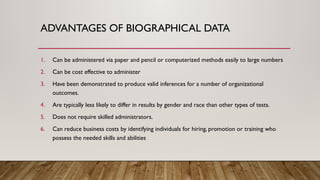
ADVANTAGES OF BIOGRAPHICALDATA
1. Can be administered via paper and pencil or computerized methods easily to large numbers
2. Can be cost effective to administer
3. Have been demonstrated to produce valid inferences for a number of organizational
outcomes.
4. Are typically less likely to differ in results by gender and race than other types of tests.
5. Does not require skilled administrators.
6. Can reduce business costs by identifying individuals for hiring, promotion or training who
possess the needed skills and abilities
18.
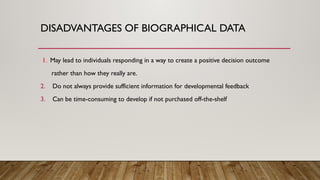
DISADVANTAGES OF BIOGRAPHICALDATA
1. May lead to individuals responding in a way to create a positive decision outcome
rather than how they really are.
2. Do not always provide sufficient information for developmental feedback
3. Can be time-consuming to develop if not purchased off-the-shelf
19.
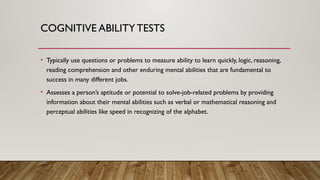
COGNITIVE ABILITY TESTS
•Typically use questions or problems to measure ability to learn quickly, logic, reasoning,
reading comprehension and other enduring mental abilities that are fundamental to
success in many different jobs.
• Assesses a person’s aptitude or potential to solve-job-related problems by providing
information about their mental abilities such as verbal or mathematical reasoning and
perceptual abilities like speed in recognizing of the alphabet.
20.
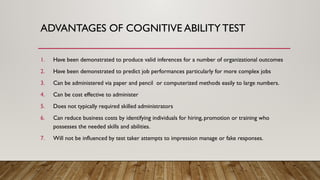
ADVANTAGES OF COGNITIVEABILITYTEST
1. Have been demonstrated to produce valid inferences for a number of organizational outcomes
2. Have been demonstrated to predict job performances particularly for more complex jobs
3. Can be administered via paper and pencil or computerized methods easily to large numbers.
4. Can be cost effective to administer
5. Does not typically required skilled administrators
6. Can reduce business costs by identifying individuals for hiring, promotion or training who
possesses the needed skills and abilities.
7. Will not be influenced by test taker attempts to impression manage or fake responses.
21.
1. Are typicallymore likely to differ in results by gender and race than other types of
tests.
2. Can be tine-consuming to develop if not purchased off-to-shelf.
DISADVANTAGES OF COGNITIVE ABILITYTEST
22.
INTEGRITY TESTS
• IntegrityTests assess attitudes and experience related to a person’s honesty,
dependability, trustworthiness, reliability and pro-social behavior.
• Theses tests typically ask direct questions about previous experiences related to ethics
and integrity or ask questions about preferences and interests from which inferences are
drawn about future behavior in these areas.
• They are used to identify individuals who are likely to engage in inappropriate, dishonest
and antisocial behavior of work
23.
1. Have beendemonstrated to produce valid inferences for a number of organizational outcomes.
2. Can reduce business costs by identifying individuals who are less likely to be absent or engage in
other counterproductive behavior.
3. Send the message to test takers that integrity is an important corporate value.
4. Are typically less likely to differ in results by gender and race than other types of tests.
5. Can be administered via paper and pencil or computerized methods easily to large numbers.
6. Can be cost effective to administer.
7. Does not require skilled adminsitrators.
ADVANTAGES OF INTEGRITYTEST
24.
1. May leadto individuals responding in a way to create a positive decision outcome
rather than how they really are.
2. May be disliked by test takers if questions are intrusive or seen as unrelated to the job.
DISADVANTAGES OF INTEGRITYTEST
25.
INTERVIEWS
• Interviews varygreatly in their content, but are often used to assess such things as
interpersonal skills, communication skills, and teamwork skills and can be used to assess
job knowledge.
• Well-designed interviews typically use a standard set of questions to evaluate knowledge
skills, abilities and other qualities required for the job.
• The interview is the most commonly used type of test.
• Employers generally conduct interviews either face to face or by phone.
26.
1. Are expectedand accepted by many job applicants.
2. Provide an opportunity for a two-way exchange of information.
3. Provide a measure of skills such as oral communication skills not measured via paper and
pencil or computerized tools.
4. Have been demonstrated to produce valid inference for a number of organizational
outcomes, if properly developed and administered.
5. Can reduce business costs by identifying for hiring, promotion or training that possess
the needed skills and abilities.
ADVANTAGES OF INTERVIEWS
27.
1. May beaffected by different kinds of rating errors and biases by interviewers.
2. Are often more time-consuming to administer than paper and pencil or computerized tools.
3. May be practically less useful when a large number of individuals must be evaluated because
of administration time.
4. Can be costly to train interviewers.
5. May be difficult to keep interviewers calibrated and the interview process standardized.
6. May lead to individuals responding in a away to create a positive decision.
DISADVANTAGES OF INTERVIEWS
28.
PERSONALITY TESTS
• Somecommonly measured personality traits in work settings are extraversion,
conscientiousness, openness to new experiences, optimism, agreeableness, service
orientation, stress tolerance, emotional stability, and initiative or proactivity.
• Personality Tests measure traits related to behavior at work, interpersonal interactions,
and satisfaction with different aspects of work.
• Personality Tests are often used to assess whether individuals have the potential to be
successful in jobs where performance requires a great deal of interpersonal interaction
or work in team settings.
29.
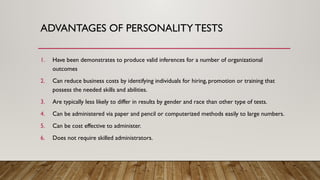
ADVANTAGES OF PERSONALITYTESTS
1. Have been demonstrates to produce valid inferences for a number of organizational
outcomes
2. Can reduce business costs by identifying individuals for hiring, promotion or training that
possess the needed skills and abilities.
3. Are typically less likely to differ in results by gender and race than other type of tests.
4. Can be administered via paper and pencil or computerized methods easily to large numbers.
5. Can be cost effective to administer.
6. Does not require skilled administrators.
30.
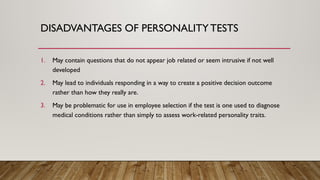
DISADVANTAGES OF PERSONALITYTESTS
1.May contain questions that do not appear job related or seem intrusive if not well
developed
2. May lead to individuals responding in a way to create a positive decision outcome
rather than how they really are.
3. May be problematic for use in employee selection if the test is one used to diagnose
medical conditions rather than simply to assess work-related personality traits.
31.
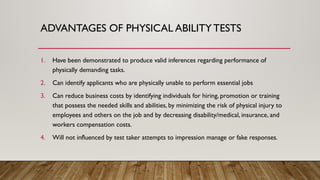
ADVANTAGES OF PHYSICALABILITY TESTS
1. Have been demonstrated to produce valid inferences regarding performance of
physically demanding tasks.
2. Can identify applicants who are physically unable to perform essential jobs
3. Can reduce business costs by identifying individuals for hiring, promotion or training
that possess the needed skills and abilities, by minimizing the risk of physical injury to
employees and others on the job and by decreasing disability/medical, insurance, and
workers compensation costs.
4. Will not influenced by test taker attempts to impression manage or fake responses.
32.
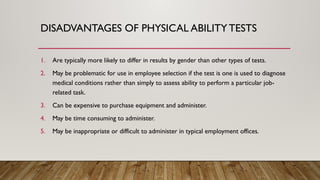
DISADVANTAGES OF PHYSICALABILITYTESTS
1. Are typically more likely to differ in results by gender than other types of tests.
2. May be problematic for use in employee selection if the test is one is used to diagnose
medical conditions rather than simply to assess ability to perform a particular job-
related task.
3. Can be expensive to purchase equipment and administer.
4. May be time consuming to administer.
5. May be inappropriate or difficult to administer in typical employment offices.
33.
WORK SAMPLES ANDSIMULATION
• These tests typically focus on measuring specific job skills or job knowledge, but can also
assess more general skills such as organizational skill, analytic skills, and interpersonal
skills.
• Work samples and simulations typically require performance of tasks that are the same
or similar to those performed on the job to assess their level of skill or competence. For
example, work samples might involve installing a telephone line, creating a document
word or tuning an engine
34.
ADVANTAGES OFWORK SAMPLESAND
SIMULATIONS
1. Have been demonstrated to produce valid inferences regarding ability to perform the job.
2. Can reduce business costs by identifying individuals for hiring, promotion or training that possess
the needed skills and abilities.
3. Are less likely to differ in results by gender and race than other types of tests.
4. May be more accepted by test takers due to the obvious link between the test and the job.
5. Less likely to be influenced by test taker attempts to impression manage or fake responses.
6. Can be used to provide specific developmental feedback.
7. Can provide test takers with a realistic preview of the job and the organization.
35.
1. Does notassess aptitude to perform more complex tasks that may be encountered on the job.
2. May not assess the ability to learn new tasks quickly.
3. Often not conducive to group administration.
4. May require some level of job knowledge and therefore may be inappropriate for jobs where
knowledge may be obtained via a short training period.
5. May be difficult to keep updated.
6. May be expensive to administer.
7. May be time consuming to develop and to administer.
DISADVANTAGES OF WORK SAMPLES AND
SIMULATIONS
36.
EMPLOYMENT INTERVIEWS
• Thereare a variety of different types of interviews that employers use to screen candidate for employment
including behavioral interviews, group interviews, phone interviews, video interviews, second interviews and
dining interviews.
1. ONE-ON-ONE INTERVIEWS
A typical job interview between a candidate for employment and a hiring manager
2. BEHAVIORAL INTERVIEW
Behavioral based interviewing is interviewing based on discovering how the interviewee acted in specific
employment-related situations.The logic is that how the applicant behaved in the past will predict how will
behave in the future. In behavioral interview, an employer has decided what skills are needed in the person they
hire and will ask questions to find out if the candidate has those skills
37.
3. DINING INTERVIEW
Interviewsare often stressful-even for job seekers who have interviewed many
times. Interviewing can be even more stressful when you are expected to eat and talk at the
same time. One of the reasons employees take job candidates out to lunch or dinner is to evaluate
their social skills and to see if they can handle themselves gracefully under pressure. Dining
with a prospective employee allows employers to review the applicant’ communication and
interpersonal skills, as well as his table manners, in a more relaxed environment.Table manners
do matter. Good manners may give you the edge over another candidate, so take time to brush up
ones dining etiquette skills.
TYPES OF EMPLOYMENT INTERVIEWS
38.
4. GROUP PANELINTERVIEW
A panel job interview takes place when an applicant for employment is interviewed by a panel or
group of interviews.There may be one candidate and multiple interviewers, multiple candidates and
one interviewer or several candidates and several interviewers.
5. INTERVIEWS IN A PUBLIC PLACE
Employers sometimes schedule job interviews in a public place, like a coffee shop or
restaurant. It could be because they are hiring for a field position and they don’t have a local
office. Or, it be more convenient to interview candidates in a setting other than the office,
especially if companies don’t want their current employees to know that they are hiring.
TYPES OF EMPLOYMENT INTERVIEWS
39.
6. OPEN JOINTERVIEW
An open interview is an interview for employment where companies accept job applications during
a block of time when all applicants can attend. Interviews are held to know that they are hiring.
7. PHONE INTERVIEW
Employers use phone interviews as a way of identifying and recruiting candidates for employment.
Phone interviews are often used to screen candidates in order to narrow the pool of applicants who will be
invited for in-person interviews
8. SCREENING INTERVIEW
A screening interview is a type of job interview that is conducted to determine if the applicant has the
qualifications needed to do the job for which the company is hiring.A screening interview is typically the
first interview in the hiring process.
TYPES OF EMPLOYMENT INTERVIEWS
40.
9. SECOND INTERVIEW
Sometimes,a second interview is one-on-one interview with the person the applicant
originally interviewed with, other staff, or it can be a day-long interview. Applicant may meet
with management, staff members, executives and other company employees.
10.THIRD INTERVIEW
When the applicant has made it through the first interview, then a second interview
might think his done with the interview process and soon find out whether he’ll be receiving a
job offer.That’s not necessarily the case. He may have to endure a third interview and
possible more interviews after that.
TYPES OF EMPLOYMENT INTERVIEWS
41.
SELECTION DECISIONS
• Certainly,one of the most important sets of decisions an organization makes is the decision to employ
personnel.All aspects of an organization’s activities are directed and enacted by the people that comprise
the organization. It is also not the case that just any person’s activity will optimize organizational functioning.
Nearly a century of work on the use of various employment procedures has documented that there are
substantial individual difference in job performance and that the use of good selection procedures results in
the employment of better performing individuals and greater practical utility for organizations.
• There’s no such thing as a perfect recruitment process, but HR can certainly reduce the risk of hiring wrong
people.That can be an expensive mistake. It’s not just the cost of hiring, paying, training and exciting them.
There are also business opportunities they might miss and the damage they might do to the company's
brand while they’re in the role.Then, there’s disruption they’ll create, the negative impact they might have on
other staff, the cost of replacing them and the loss of productivity while new recruits get up to speed.
42.
STEPSTHAT CAN HELPBETTER SELECTION
DECISIONS IN LESSTIME
1. UNDERSTAND THE REQUIREMENT OFTHE ROLE
Conduct a thorough job analysis to undercover the key competencies that predict
successful performance.This may involve interviewing staff, running focus group and
conducting quantitative analysis to determine exactly what “good” looks like in the role.
Once HR has pinpointed the skills, competencies and attributes that are likely to lead to
success, it will “removed the blindfold” and are ij position to run a targeted attraction
campaign and focused selection process.
43.
2. SHOW THEREALITIES OF THE JOB
Give potential applicants an honest account of what the job will entail by using
realistic job previews on the careers site.These provide an insight into the kind of scenarios
the post-holder will find themselves in, as well as immediate feedback on their responses to
those scenarios.This enables candidates to judge for themselves whether the role and
organization are right for them.Another advantage is that they help create a good impression
and build a rapport with people before new hires meet them. Research also shows that if you
point out the less attractive elements of a role before someone applies, they’ll respond more
positively when those elements come up.
STEPSTHAT CAN HELP BETTER SELECTION
DECISIONS IN LESSTIME
44.
3. BUILD PREDICTIVEASSESSMENTS THAT ARE ALIGNED TO THE REQUIRED COMPETENCIES
To identify the best-fit candidates in the applicant pool, HR need to assess them against the key
competencies for the role, which is thoroughly researched at analysis phase. Online situational
judgment tests(SJTs) offer a robust and effective way of measuring behaviors that people will show at
work and how they would handle typical workplace situations. Most SJTs have fixed scenarios. In other
words, every applicant sees the same situations. However, the latest development in psychometric
assessment in “adaptive” SJTs, in which the situations evolve, based on the actions selected by the
candidate.The benefit of this approach is that HR can assess key competencies and hone in on a
candidate’s behavioral tendencies in a more engaging and realistic way.These tests take 15-20 minutes
to complete.They can be undertaken prior to any interview stage of the selection process and the
results can be integrated with applicant tracking system.
STEPSTHAT CAN HELP BETTER SELECTION
DECISIONS IN LESSTIME
45.
4.ALIGN ASSESSMENTS WITHEMPLOYER BRAND
When possible, embed organization’s terminology, imagery and tone of voice into
any assessments that are used, to reinforce values and brand. Conduct a pilot with current
job holders, to ensure assessments are effective and aligned to both the requirement of the
role and culture. Used effectively, assessments can showcase the brand and accurately
reflect the workplace and life within the organization.
STEPSTHAT CAN HELP BETTER SELECTION
DECISIONS IN LESSTIME
46.
5.PROVIDE A CONSISTENT,FRIENDLY AND ENGAGING CANDIDATE EXPERIENCE.
It is important to provide candidates with a positive recruitment experience,
regardless of whether or not the organization offer them a job.Applicants could be current
or potential customers – and the organization will reject many more of them than it will
recruit. Keep candidates informed at all stages of their application.Aim to respond quickly
and ensure that the tone of communication is encouraging and supportive. Make the process
interesting to complete, so even if someone decides not to apply their experience of dealing
with the organization will be positive.Try to give them feedback so they can take something
away that will help them in the future
STEPSTHAT CAN HELP BETTER SELECTION
DECISIONS IN LESSTIME
47.
Hire people whoare better than you are, then leave them to get on with it. Look for
people who will aim for the remarkable