Chapter 9: South Asia
South Asia’s Physical & Human Contexts Monsoon climate Flat topography with elevated features on its edge Hinduism Islam introduced through invasions Transformation through British imperialism Post-World War II independence
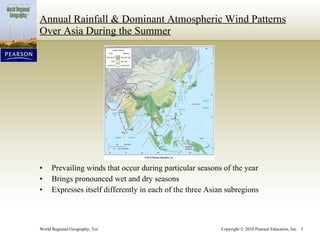
Annual Rainfall & Dominant Atmospheric Wind Patterns Over Asia During the Summer Prevailing winds that occur during particular seasons of the year Brings pronounced wet and dry seasons Expresses itself differently in each of the three Asian subregions
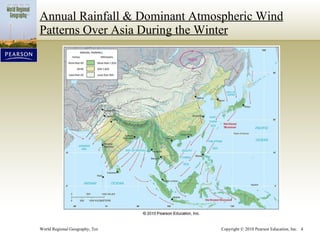
Annual Rainfall & Dominant Atmospheric Wind Patterns Over Asia During the Winter
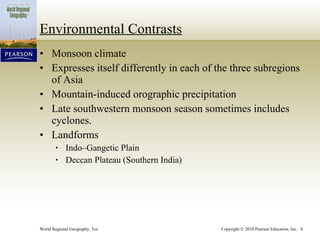
Monsoon Contrasts
Environmental Contrasts Monsoon climate Expresses itself differently in each of the three subregions of Asia Mountain-induced orographic precipitation Late southwestern monsoon season sometimes includes cyclones. Landforms Indo–Gangetic Plain Deccan Plateau (Southern India)
The Indo–Gangetic Plain Annual precipitation levels increase west to east Much of Indus plain is arid. Humid Bangladesh characterized by semideciduous and tropical rainforest vegetation Water supply is seasonal. Summer or west monsoon provides 85% of annual rainfall totals.
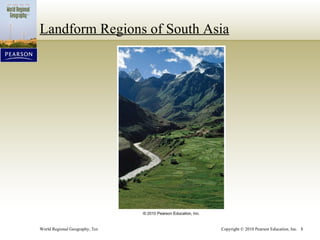
Landform Regions of South Asia
South Asia Often referred to as the “Indian subcontinent” Territorial dominance of India Substantial population density Primarily a rural region Tradition of state control of industry Divisive role of ethnicity, religion, and politics in economic development process
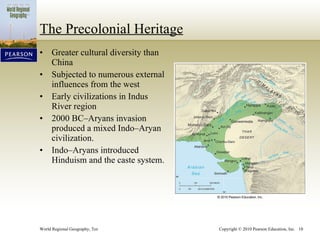
The Precolonial Heritage Greater cultural diversity than China Subjected to numerous external influences from the west Early civilizations in Indus River region 2000 BC–Aryans invasion produced a mixed Indo–Aryan civilization. Indo–Aryans introduced Hinduism and the caste system.
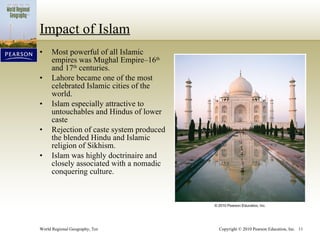
Impact of Islam Most powerful of all Islamic empires was Mughal Empire–16 th  and 17 th  centuries. Lahore became one of the most celebrated Islamic cities of the world. Islam especially attractive to untouchables and Hindus of lower caste Rejection of caste system produced the blended Hindu and Islamic religion of Sikhism. Islam was highly doctrinaire and closely associated with a nomadic conquering culture.
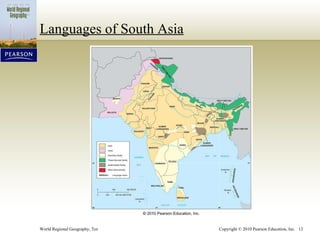
Languages of South Asia
Colonial Transformation Early British influence British East India Company Indirectly came to control up to two-thirds of country Replaced native administration Took actions to decimate textile industry in 19 th  century By 1900s, South Asia was a total colonial possession. Economic contours totally altered Industrial development slow-paced
Independence and Nation-State Building British engaged in divide and conquer strategy. Caste system remained rigid. Communalism persisted.
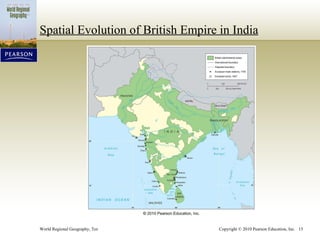
Spatial Evolution of British Empire in India
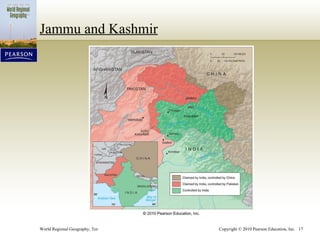
Pakistan Created in 1947 A west and east formed West–Closer to the West East–Closer to southeast Asia Tenuous from the beginning East gained independence in 1971 (renamed Bangladesh). Tensions with India Jammu and Kashmir Joint nuclear ambitions Post-9/11/2001 relationship with US in al Qaeda fight
Jammu and Kashmir
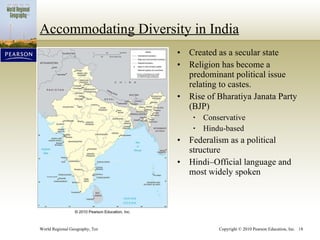
Accommodating Diversity in India Created as a secular state Religion has become a predominant political issue relating to castes. Rise of Bharatiya Janata Party (BJP) Conservative Hindu-based Federalism as a political structure Hindi–Official language and most widely spoken
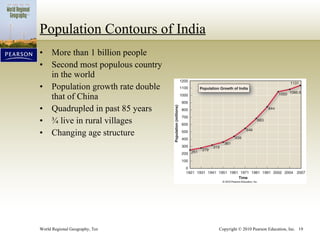
Population Contours of India More than 1 billion people Second most populous country in the world Population growth rate double that of China Quadrupled in past 85 years ¾ live in rural villages Changing age structure
Explaining the Decline in Population Growth Rates Growth rates vary between ethnic, religious, and caste groups. In general, Hindus have fewer children than Muslims. Unequal gender relationships Heading toward stage three of demographic transformation model
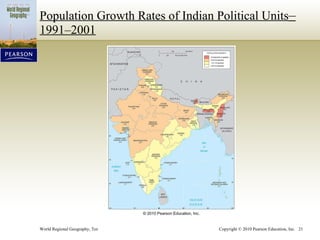
Population Growth Rates of Indian Political Units – 1991–2001
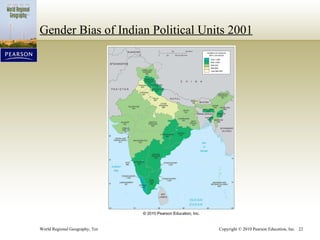
Gender Bias of Indian Political Units 2001
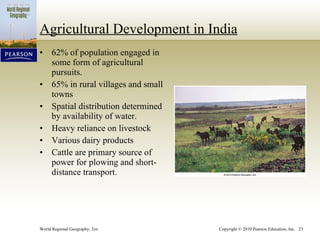
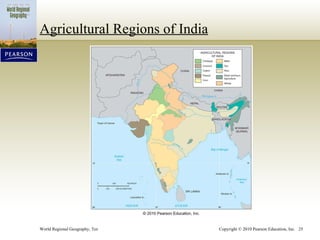
Agricultural Development in India 62% of population engaged in some form of agricultural pursuits. 65% in rural villages and small towns Spatial distribution determined by availability of water. Heavy reliance on livestock Various dairy products Cattle are primary source of power for plowing and short-distance transport.
Agricultural Productivity and Change Sources of rural poverty are many. Lack of health access and other social services Lack of meaningful land reform Average size of household plot is 6.5 acres. Negative impact of Green Revolution Negative impact of government economic policies Technology impact Hasn’t solved problems Has exacerbated economic inequalities
Agricultural Regions of India
India’s Industrial Economy Railroads Strong industrial resource base Fossil fuels can adequately power the industrial base. Iron ore counts for 6% of world production and 5% of world reserves. Government has constructed hydroelectric facilities to make up for shortages in commercial energy. Carefully planned economy by government
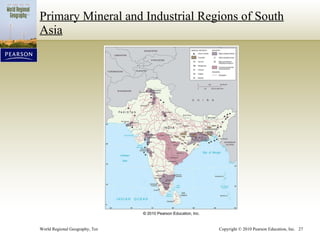
Primary Mineral and Industrial Regions of South Asia
Industrial Regions Diversified industrial sector is emerging–Damodar Valley Mumbai is second most important industrial region. Cotton textile manufacturing Automobile production Aircraft Pharmaceuticals Plastics Chemicals Bangalore– “Silicon Valley of India” Texas Instruments IBM Compaq Other computer software firms
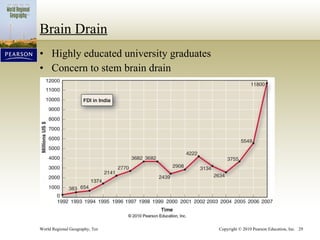
Brain Drain Highly educated university graduates Concern to stem brain drain
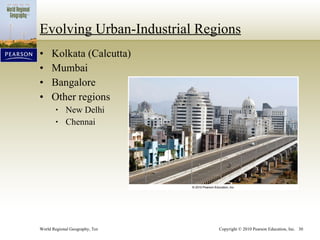
Evolving Urban-Industrial Regions Kolkata (Calcutta) Mumbai Bangalore Other regions New Delhi Chennai
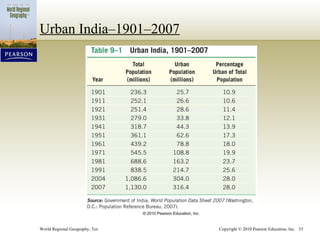
Urban India Stark contrasts between urban and rural world Prosperity gap has widened in the postindustrial economy. Greater levels of rural to urban migration Stream of urban migrants has exceeded urban employment opportunities.
Urban Growth Urbanization levels low into the mid-20 th  century Growth indicators Rural to urban migration Natural increase of urban population Most population growth in large cities Thirty-five cities with more than 1 million population Some are megacities, but not “world cities” Delhi–17.3 million Mumbai–17.3 million Kolkata–14.3 Insufficient finance, transport, and telecommunications
Urban India–1901–2007
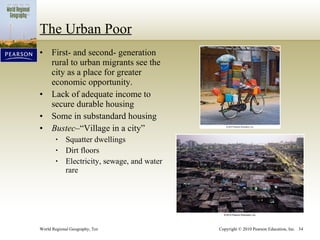
The Urban Poor First- and second- generation rural to urban migrants see the city as a place for greater economic opportunity. Lack of adequate income to secure durable housing Some in substandard housing Bustec –“Village in a city” Squatter dwellings Dirt floors Electricity, sewage, and water rare
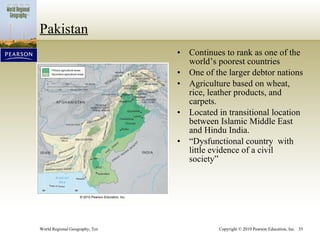
Pakistan Continues to rank as one of the world’s poorest countries One of the larger debtor nations Agriculture based on wheat, rice, leather products, and carpets. Located in transitional location between Islamic Middle East and Hindu India. “ Dysfunctional country  with little evidence of a civil society”
Pakistan in the Crossroads 169 million population 96% Islamic Formerly East and West Pakistan until 1970s, when East Pakistan became Bangladesh. Language is 96% Punjab. Parts of Sharia in legal system Tension among civil society, religious elements, and military rule. Madrasahs helped to support militant Islam. Supported Pushtuns and Taliban government in Afghanistan prior to 9/11/2001
Nepal Landlocked country Physical and cultural transition between Tibet in north and India to south Most populated part is central foothills–Kathmandu Valley Worldwide success in marketing its natural and cultural heritage Adventure tourism Tourism industry creates substantial domestic employment opportunities. 90% involved in subsistence agriculture Exacerbated demands on women in economy
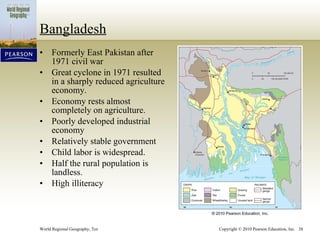
Bangladesh Formerly East Pakistan after 1971 civil war Great cyclone in 1971 resulted in a sharply reduced agriculture economy. Economy rests almost completely on agriculture. Poorly developed industrial economy Relatively stable government Child labor is widespread. Half the rural population is landless. High illiteracy
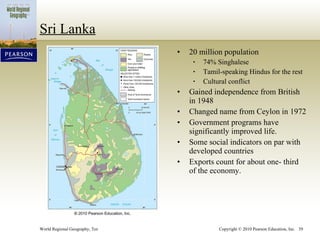
Sri Lanka 20 million population 74% Singhalese Tamil-speaking Hindus for the rest Cultural conflict Gained independence from British in 1948 Changed name from Ceylon in 1972 Government programs have significantly improved life. Some social indicators on par with developed countries Exports count for about one- third of the economy.

Chapter 9 notes india

  • 1.
  • 2.
    South Asia’s Physical& Human Contexts Monsoon climate Flat topography with elevated features on its edge Hinduism Islam introduced through invasions Transformation through British imperialism Post-World War II independence
  • 3.
    Annual Rainfall &Dominant Atmospheric Wind Patterns Over Asia During the Summer Prevailing winds that occur during particular seasons of the year Brings pronounced wet and dry seasons Expresses itself differently in each of the three Asian subregions
  • 4.
    Annual Rainfall &Dominant Atmospheric Wind Patterns Over Asia During the Winter
  • 5.
  • 6.
    Environmental Contrasts Monsoonclimate Expresses itself differently in each of the three subregions of Asia Mountain-induced orographic precipitation Late southwestern monsoon season sometimes includes cyclones. Landforms Indo–Gangetic Plain Deccan Plateau (Southern India)
  • 7.
    The Indo–Gangetic PlainAnnual precipitation levels increase west to east Much of Indus plain is arid. Humid Bangladesh characterized by semideciduous and tropical rainforest vegetation Water supply is seasonal. Summer or west monsoon provides 85% of annual rainfall totals.
  • 8.
  • 9.
    South Asia Oftenreferred to as the “Indian subcontinent” Territorial dominance of India Substantial population density Primarily a rural region Tradition of state control of industry Divisive role of ethnicity, religion, and politics in economic development process
  • 10.
    The Precolonial HeritageGreater cultural diversity than China Subjected to numerous external influences from the west Early civilizations in Indus River region 2000 BC–Aryans invasion produced a mixed Indo–Aryan civilization. Indo–Aryans introduced Hinduism and the caste system.
  • 11.
    Impact of IslamMost powerful of all Islamic empires was Mughal Empire–16 th and 17 th centuries. Lahore became one of the most celebrated Islamic cities of the world. Islam especially attractive to untouchables and Hindus of lower caste Rejection of caste system produced the blended Hindu and Islamic religion of Sikhism. Islam was highly doctrinaire and closely associated with a nomadic conquering culture.
  • 12.
  • 13.
    Colonial Transformation EarlyBritish influence British East India Company Indirectly came to control up to two-thirds of country Replaced native administration Took actions to decimate textile industry in 19 th century By 1900s, South Asia was a total colonial possession. Economic contours totally altered Industrial development slow-paced
  • 14.
    Independence and Nation-StateBuilding British engaged in divide and conquer strategy. Caste system remained rigid. Communalism persisted.
  • 15.
    Spatial Evolution ofBritish Empire in India
  • 16.
    Pakistan Created in1947 A west and east formed West–Closer to the West East–Closer to southeast Asia Tenuous from the beginning East gained independence in 1971 (renamed Bangladesh). Tensions with India Jammu and Kashmir Joint nuclear ambitions Post-9/11/2001 relationship with US in al Qaeda fight
  • 17.
  • 18.
    Accommodating Diversity inIndia Created as a secular state Religion has become a predominant political issue relating to castes. Rise of Bharatiya Janata Party (BJP) Conservative Hindu-based Federalism as a political structure Hindi–Official language and most widely spoken
  • 19.
    Population Contours ofIndia More than 1 billion people Second most populous country in the world Population growth rate double that of China Quadrupled in past 85 years ¾ live in rural villages Changing age structure
  • 20.
    Explaining the Declinein Population Growth Rates Growth rates vary between ethnic, religious, and caste groups. In general, Hindus have fewer children than Muslims. Unequal gender relationships Heading toward stage three of demographic transformation model
  • 21.
    Population Growth Ratesof Indian Political Units – 1991–2001
  • 22.
    Gender Bias ofIndian Political Units 2001
  • 23.
    Agricultural Development inIndia 62% of population engaged in some form of agricultural pursuits. 65% in rural villages and small towns Spatial distribution determined by availability of water. Heavy reliance on livestock Various dairy products Cattle are primary source of power for plowing and short-distance transport.
  • 24.
    Agricultural Productivity andChange Sources of rural poverty are many. Lack of health access and other social services Lack of meaningful land reform Average size of household plot is 6.5 acres. Negative impact of Green Revolution Negative impact of government economic policies Technology impact Hasn’t solved problems Has exacerbated economic inequalities
  • 25.
  • 26.
    India’s Industrial EconomyRailroads Strong industrial resource base Fossil fuels can adequately power the industrial base. Iron ore counts for 6% of world production and 5% of world reserves. Government has constructed hydroelectric facilities to make up for shortages in commercial energy. Carefully planned economy by government
  • 27.
    Primary Mineral andIndustrial Regions of South Asia
  • 28.
    Industrial Regions Diversifiedindustrial sector is emerging–Damodar Valley Mumbai is second most important industrial region. Cotton textile manufacturing Automobile production Aircraft Pharmaceuticals Plastics Chemicals Bangalore– “Silicon Valley of India” Texas Instruments IBM Compaq Other computer software firms
  • 29.
    Brain Drain Highlyeducated university graduates Concern to stem brain drain
  • 30.
    Evolving Urban-Industrial RegionsKolkata (Calcutta) Mumbai Bangalore Other regions New Delhi Chennai
  • 31.
    Urban India Starkcontrasts between urban and rural world Prosperity gap has widened in the postindustrial economy. Greater levels of rural to urban migration Stream of urban migrants has exceeded urban employment opportunities.
  • 32.
    Urban Growth Urbanizationlevels low into the mid-20 th century Growth indicators Rural to urban migration Natural increase of urban population Most population growth in large cities Thirty-five cities with more than 1 million population Some are megacities, but not “world cities” Delhi–17.3 million Mumbai–17.3 million Kolkata–14.3 Insufficient finance, transport, and telecommunications
  • 33.
  • 34.
    The Urban PoorFirst- and second- generation rural to urban migrants see the city as a place for greater economic opportunity. Lack of adequate income to secure durable housing Some in substandard housing Bustec –“Village in a city” Squatter dwellings Dirt floors Electricity, sewage, and water rare
  • 35.
    Pakistan Continues torank as one of the world’s poorest countries One of the larger debtor nations Agriculture based on wheat, rice, leather products, and carpets. Located in transitional location between Islamic Middle East and Hindu India. “ Dysfunctional country with little evidence of a civil society”
  • 36.
    Pakistan in theCrossroads 169 million population 96% Islamic Formerly East and West Pakistan until 1970s, when East Pakistan became Bangladesh. Language is 96% Punjab. Parts of Sharia in legal system Tension among civil society, religious elements, and military rule. Madrasahs helped to support militant Islam. Supported Pushtuns and Taliban government in Afghanistan prior to 9/11/2001
  • 37.
    Nepal Landlocked countryPhysical and cultural transition between Tibet in north and India to south Most populated part is central foothills–Kathmandu Valley Worldwide success in marketing its natural and cultural heritage Adventure tourism Tourism industry creates substantial domestic employment opportunities. 90% involved in subsistence agriculture Exacerbated demands on women in economy
  • 38.
    Bangladesh Formerly EastPakistan after 1971 civil war Great cyclone in 1971 resulted in a sharply reduced agriculture economy. Economy rests almost completely on agriculture. Poorly developed industrial economy Relatively stable government Child labor is widespread. Half the rural population is landless. High illiteracy
  • 39.
    Sri Lanka 20million population 74% Singhalese Tamil-speaking Hindus for the rest Cultural conflict Gained independence from British in 1948 Changed name from Ceylon in 1972 Government programs have significantly improved life. Some social indicators on par with developed countries Exports count for about one- third of the economy.