CHAPTER 8
Immunoglobulin:
Structure and Function
Learning Objectives
Up on completion of this chapter the student will be able to:
Discuss the general properties of all immunoglobulin's
Describe the basic structure of immunoglobulin's
Relate immunoglobulin structure with function
Define immunoglobulin hypervarialble regions
Define and describe immunoglobulin classes, subclasses,
types and subtypes
Describe B cell receptor
Explain antibody diversity and class switching
Outline
8.1. Introduction to Immunoglobulins and antibodies
8.2. General Functions of Immunoglobulins
8.3. Basic immunoglobulin Structure
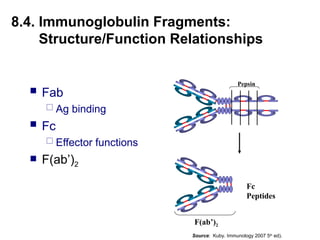
8.4. Immunoglobulin Fragments: Structure/Function
Relationships
8.5. Human immunoglobulin classes
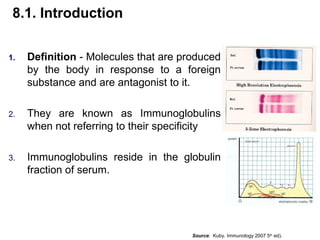
8.1. Introduction
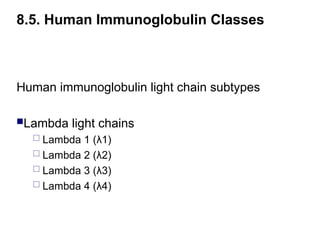
1. Definition - Molecules that are produced
by the body in response to a foreign
substance and are antagonist to it.
2. They are known as Immunoglobulins
when not referring to their specificity
3. Immunoglobulins reside in the globulin
fraction of serum.
Source: Kuby. Immunology 2007 5th
ed).
8.2. General Functions of Immunoglobulins
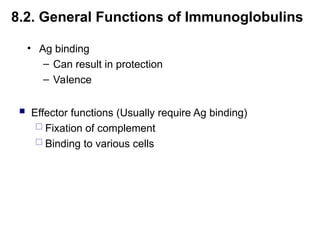
 Effector functions (Usually require Ag binding)
 Fixation of complement
 Binding to various cells
• Ag binding
– Can result in protection
– Valence
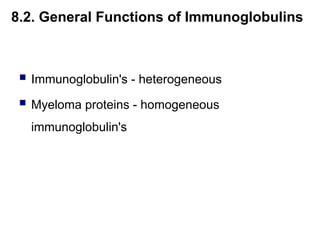
 Immunoglobulin's - heterogeneous
 Myeloma proteins - homogeneous
immunoglobulin's
8.2. General Functions of Immunoglobulins
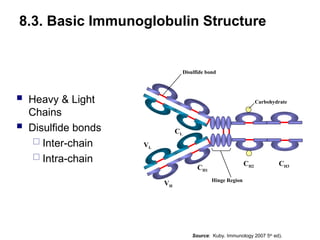
 Heavy & Light
Chains
 Disulfide bonds
 Inter-chain
 Intra-chain
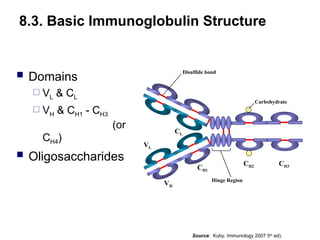
8.3. Basic Immunoglobulin Structure
CH1
VL
CL
VH
CH2 CH3
Hinge Region
Carbohydrate
Disulfide bond
Source: Kuby. Immunology 2007 5th
ed).
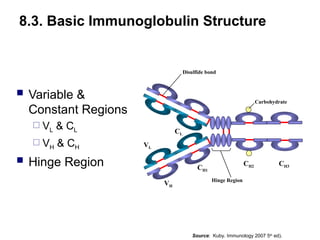
 Variable &
Constant Regions
 VL & CL
 VH & CH
 Hinge Region CH1
VL
CL
VH
CH2 CH3
Hinge Region
Carbohydrate
Disulfide bond
8.3. Basic Immunoglobulin Structure
Source: Kuby. Immunology 2007 5th
ed).
 Domains
 VL & CL
 VH & CH1 - CH3
(or
CH4)
 Oligosaccharides
CH1
VL
CL
VH
CH2 CH3
Hinge Region
Carbohydrate
Disulfide bond
8.3. Basic Immunoglobulin Structure
Source: Kuby. Immunology 2007 5th
ed).
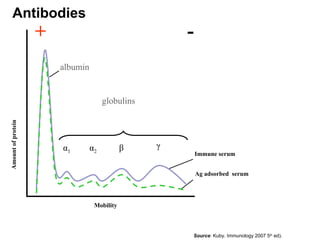
Immune serum
Ag adsorbed serum
α1 α2 β γ
+ -
albumin
globulins
Mobility
Amount
of
protein
Antibodies
Source: Kuby. Immunology 2007 5th
ed).
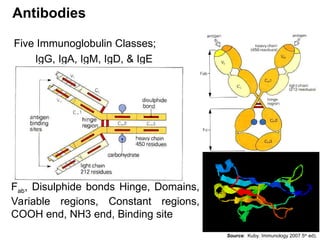
Five Immunoglobulin Classes;
IgG, IgA, IgM, IgD, & IgE
Fab, Disulphide bonds Hinge, Domains,
Variable regions, Constant regions,
COOH end, NH3 end, Binding site
Antibodies
Source: Kuby. Immunology 2007 5th
ed).
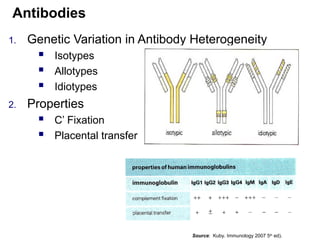
1. Genetic Variation in Antibody Heterogeneity
 Isotypes
 Allotypes
 Idiotypes
2. Properties
 C’ Fixation
 Placental transfer
Antibodies
Source: Kuby. Immunology 2007 5th
ed).
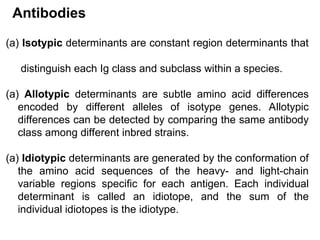
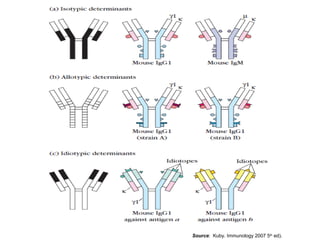
(a) Isotypic determinants are constant region determinants that
distinguish each Ig class and subclass within a species.
(a) Allotypic determinants are subtle amino acid differences
encoded by different alleles of isotype genes. Allotypic
differences can be detected by comparing the same antibody
class among different inbred strains.
(a) Idiotypic determinants are generated by the conformation of
the amino acid sequences of the heavy- and light-chain
variable regions specific for each antigen. Each individual
determinant is called an idiotope, and the sum of the
individual idiotopes is the idiotype.
Antibodies
Source: Kuby. Immunology 2007 5th
ed).
8.4. Immunoglobulin Fragments:
Structure/Function Relationships
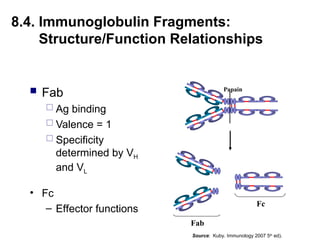
 Fab
 Ag binding
 Valence = 1
 Specificity
determined by VH
and VL
Papain
Fc
Fab
• Fc
– Effector functions
Source: Kuby. Immunology 2007 5th
ed).
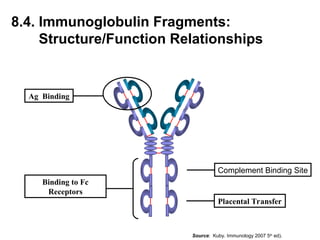
Ag Binding
Complement Binding Site
Placental Transfer
Binding to Fc
Receptors
8.4. Immunoglobulin Fragments:
Structure/Function Relationships
Source: Kuby. Immunology 2007 5th
ed).
 Fab
 Ag binding
 Fc
 Effector functions
 F(ab’)2
Pepsin
Fc
Peptides
F(ab’)2
8.4. Immunoglobulin Fragments:
Structure/Function Relationships
Source: Kuby. Immunology 2007 5th
ed).
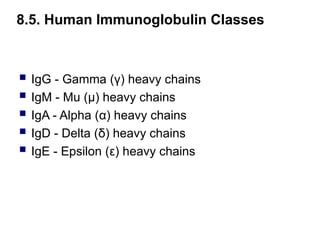
8.5. Human Immunoglobulin Classes
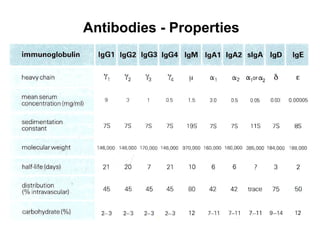
 IgG - Gamma (γ) heavy chains
 IgM - Mu (µ) heavy chains
 IgA - Alpha (α) heavy chains
 IgD - Delta (δ) heavy chains
 IgE - Epsilon (ε) heavy chains
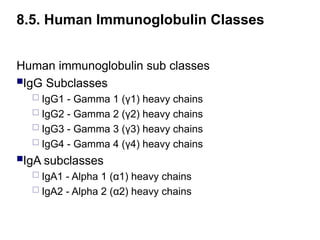
Human immunoglobulin sub classes
IgG Subclasses
 IgG1 - Gamma 1 (γ1) heavy chains
 IgG2 - Gamma 2 (γ2) heavy chains
 IgG3 - Gamma 3 (γ3) heavy chains
 IgG4 - Gamma 4 (γ4) heavy chains
IgA subclasses
 IgA1 - Alpha 1 (α1) heavy chains
 IgA2 - Alpha 2 (α2) heavy chains
8.5. Human Immunoglobulin Classes
Human immunoglobulin light chain types
Kappa (κ)
Lambda (λ)
8.5. Human Immunoglobulin Classes
Human immunoglobulin light chain subtypes
Lambda light chains
 Lambda 1 (λ1)
 Lambda 2 (λ2)
 Lambda 3 (λ3)
 Lambda 4 (λ4)
8.5. Human Immunoglobulin Classes
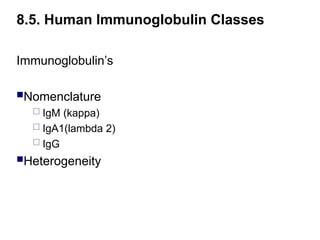
Immunoglobulin’s
Nomenclature
 IgM (kappa)
 IgA1(lambda 2)
 IgG
Heterogeneity
8.5. Human Immunoglobulin Classes
Antibodies - Properties
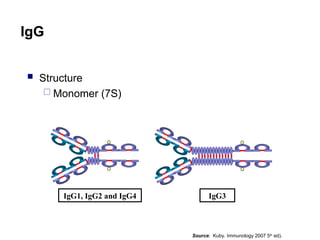
 Structure
 Monomer (7S)
IgG1, IgG2 and IgG4 IgG3
IgG
Source: Kuby. Immunology 2007 5th
ed).
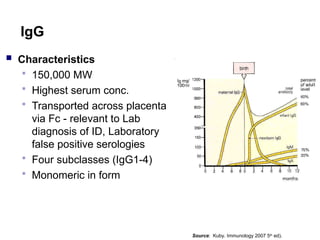
IgG
 Characteristics
 150,000 MW
 Highest serum conc.
 Transported across placenta
via Fc - relevant to Lab
diagnosis of ID, Laboratory
false positive serologies
 Four subclasses (IgG1-4)
 Monomeric in form
Source: Kuby. Immunology 2007 5th
ed).
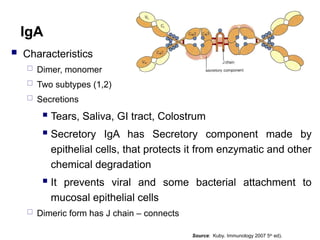
 Characteristics
 Dimer, monomer
 Two subtypes (1,2)
 Secretions
 Tears, Saliva, GI tract, Colostrum
 Secretory IgA has Secretory component made by
epithelial cells, that protects it from enzymatic and other
chemical degradation
 It prevents viral and some bacterial attachment to
mucosal epithelial cells
 Dimeric form has J chain – connects
IgA
Source: Kuby. Immunology 2007 5th
ed).
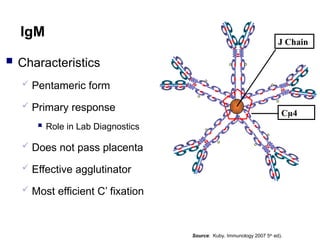
 Characteristics
 Pentameric form
 Primary response
 Role in Lab Diagnostics
 Does not pass placenta
 Effective agglutinator
 Most efficient C’ fixation
IgM
Cµ4
J Chain
Source: Kuby. Immunology 2007 5th
ed).
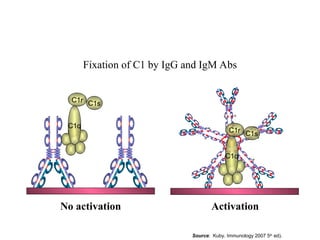
Fixation of C1 by IgG and IgM Abs
C1r C1s
C1q
C1r C1s
C1q
No activation Activation
Source: Kuby. Immunology 2007 5th
ed).
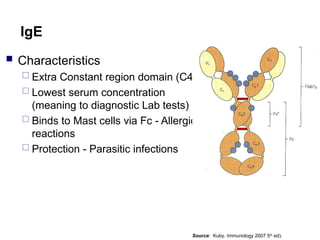
 Characteristics
 Extra Constant region domain (C4)
 Lowest serum concentration
(meaning to diagnostic Lab tests)
 Binds to Mast cells via Fc - Allergic
reactions
 Protection - Parasitic infections
IgE
Source: Kuby. Immunology 2007 5th
ed).
 Low concentration in serum (<1%)
 Function largely unknown - may act as Antigen receptor for
B cells
 No clinical need to measure - clue to physician competence
& clerical error
IgD
Antibody - Antigen Interactions
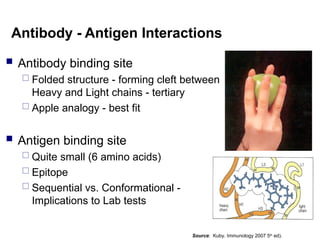
 Antibody binding site
 Folded structure - forming cleft between
Heavy and Light chains - tertiary
 Apple analogy - best fit
 Antigen binding site
 Quite small (6 amino acids)
 Epitope
 Sequential vs. Conformational -
Implications to Lab tests
Source: Kuby. Immunology 2007 5th
ed).
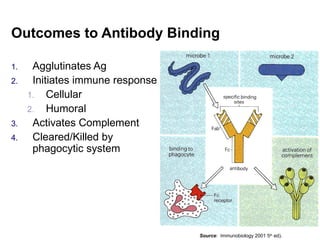
Outcomes to Antibody Binding
1. Agglutinates Ag
2. Initiates immune response
1. Cellular
2. Humoral
3. Activates Complement
4. Cleared/Killed by
phagocytic system
Source: Immunobiology 2001 5th
ed).
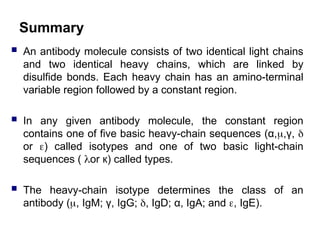
Summary
 An antibody molecule consists of two identical light chains
and two identical heavy chains, which are linked by
disulfide bonds. Each heavy chain has an amino-terminal
variable region followed by a constant region.
 In any given antibody molecule, the constant region
contains one of five basic heavy-chain sequences (α,,γ, 
or ) called isotypes and one of two basic light-chain
sequences ( or к) called types.
 The heavy-chain isotype determines the class of an
antibody (, IgM; γ, IgG; , IgD; α, IgA; and , IgE).
Review questions
Explain the general properties of all immunoglobulin's
Draw roughly basic structure of immunoglobulin's and label
it correctly
Discus immunoglobulin structure with function
Define and describe immunoglobulin classes, subclasses,
types and subtypes
Explain antibody diversity and class switching
Reference
1. Kuby; Goldsby et. al. Immunology. 2007 (5th
ed)
2. Tizard. Immunology an introduction,4th
edition ,Saunders publishing,1994
3. Naville J. Bryant Laboratory Immunology and Serology 3rd
edition.
Serological services Ltd.Toronto,Ontario,Canada,1992
4. Abul K. Abbas and Andrew H. Lichtman. Cellular And Molecular
Immunology 2008, 5th
edition
5. Mary T. Keogan, Eleanor M. Wallace and Paula O’Leary Concise clinical
immunology for health professionals , 2006
6. Ivan M. Roitt and Peter J. Delves Essential immunology 2001, 3rd
ed
7. Reginald Gorczynski and Jacqueline Stanley, Clinical immunology 1990.

Chapter 8 Basic immunology ppts DZ 2011.ppt

  • 1.
  • 2.
    Learning Objectives Up oncompletion of this chapter the student will be able to: Discuss the general properties of all immunoglobulin's Describe the basic structure of immunoglobulin's Relate immunoglobulin structure with function Define immunoglobulin hypervarialble regions Define and describe immunoglobulin classes, subclasses, types and subtypes Describe B cell receptor Explain antibody diversity and class switching
  • 3.
    Outline 8.1. Introduction toImmunoglobulins and antibodies 8.2. General Functions of Immunoglobulins 8.3. Basic immunoglobulin Structure 8.4. Immunoglobulin Fragments: Structure/Function Relationships 8.5. Human immunoglobulin classes
  • 4.
    8.1. Introduction 1. Definition- Molecules that are produced by the body in response to a foreign substance and are antagonist to it. 2. They are known as Immunoglobulins when not referring to their specificity 3. Immunoglobulins reside in the globulin fraction of serum. Source: Kuby. Immunology 2007 5th ed).
  • 5.
    8.2. General Functionsof Immunoglobulins  Effector functions (Usually require Ag binding)  Fixation of complement  Binding to various cells • Ag binding – Can result in protection – Valence
  • 6.
     Immunoglobulin's -heterogeneous  Myeloma proteins - homogeneous immunoglobulin's 8.2. General Functions of Immunoglobulins
  • 7.
     Heavy &Light Chains  Disulfide bonds  Inter-chain  Intra-chain 8.3. Basic Immunoglobulin Structure CH1 VL CL VH CH2 CH3 Hinge Region Carbohydrate Disulfide bond Source: Kuby. Immunology 2007 5th ed).
  • 8.
     Variable & ConstantRegions  VL & CL  VH & CH  Hinge Region CH1 VL CL VH CH2 CH3 Hinge Region Carbohydrate Disulfide bond 8.3. Basic Immunoglobulin Structure Source: Kuby. Immunology 2007 5th ed).
  • 9.
     Domains  VL& CL  VH & CH1 - CH3 (or CH4)  Oligosaccharides CH1 VL CL VH CH2 CH3 Hinge Region Carbohydrate Disulfide bond 8.3. Basic Immunoglobulin Structure Source: Kuby. Immunology 2007 5th ed).
  • 10.
    Immune serum Ag adsorbedserum α1 α2 β γ + - albumin globulins Mobility Amount of protein Antibodies Source: Kuby. Immunology 2007 5th ed).
  • 11.
    Five Immunoglobulin Classes; IgG,IgA, IgM, IgD, & IgE Fab, Disulphide bonds Hinge, Domains, Variable regions, Constant regions, COOH end, NH3 end, Binding site Antibodies Source: Kuby. Immunology 2007 5th ed).
  • 12.
    1. Genetic Variationin Antibody Heterogeneity  Isotypes  Allotypes  Idiotypes 2. Properties  C’ Fixation  Placental transfer Antibodies Source: Kuby. Immunology 2007 5th ed).
  • 13.
    (a) Isotypic determinantsare constant region determinants that distinguish each Ig class and subclass within a species. (a) Allotypic determinants are subtle amino acid differences encoded by different alleles of isotype genes. Allotypic differences can be detected by comparing the same antibody class among different inbred strains. (a) Idiotypic determinants are generated by the conformation of the amino acid sequences of the heavy- and light-chain variable regions specific for each antigen. Each individual determinant is called an idiotope, and the sum of the individual idiotopes is the idiotype. Antibodies
  • 14.
  • 15.
    8.4. Immunoglobulin Fragments: Structure/FunctionRelationships  Fab  Ag binding  Valence = 1  Specificity determined by VH and VL Papain Fc Fab • Fc – Effector functions Source: Kuby. Immunology 2007 5th ed).
  • 16.
    Ag Binding Complement BindingSite Placental Transfer Binding to Fc Receptors 8.4. Immunoglobulin Fragments: Structure/Function Relationships Source: Kuby. Immunology 2007 5th ed).
  • 17.
     Fab  Agbinding  Fc  Effector functions  F(ab’)2 Pepsin Fc Peptides F(ab’)2 8.4. Immunoglobulin Fragments: Structure/Function Relationships Source: Kuby. Immunology 2007 5th ed).
  • 18.
    8.5. Human ImmunoglobulinClasses  IgG - Gamma (γ) heavy chains  IgM - Mu (µ) heavy chains  IgA - Alpha (α) heavy chains  IgD - Delta (δ) heavy chains  IgE - Epsilon (ε) heavy chains
  • 19.
    Human immunoglobulin subclasses IgG Subclasses  IgG1 - Gamma 1 (γ1) heavy chains  IgG2 - Gamma 2 (γ2) heavy chains  IgG3 - Gamma 3 (γ3) heavy chains  IgG4 - Gamma 4 (γ4) heavy chains IgA subclasses  IgA1 - Alpha 1 (α1) heavy chains  IgA2 - Alpha 2 (α2) heavy chains 8.5. Human Immunoglobulin Classes
  • 20.
    Human immunoglobulin lightchain types Kappa (κ) Lambda (λ) 8.5. Human Immunoglobulin Classes
  • 21.
    Human immunoglobulin lightchain subtypes Lambda light chains  Lambda 1 (λ1)  Lambda 2 (λ2)  Lambda 3 (λ3)  Lambda 4 (λ4) 8.5. Human Immunoglobulin Classes
  • 22.
    Immunoglobulin’s Nomenclature  IgM (kappa) IgA1(lambda 2)  IgG Heterogeneity 8.5. Human Immunoglobulin Classes
  • 23.
  • 24.
     Structure  Monomer(7S) IgG1, IgG2 and IgG4 IgG3 IgG Source: Kuby. Immunology 2007 5th ed).
  • 25.
    IgG  Characteristics  150,000MW  Highest serum conc.  Transported across placenta via Fc - relevant to Lab diagnosis of ID, Laboratory false positive serologies  Four subclasses (IgG1-4)  Monomeric in form Source: Kuby. Immunology 2007 5th ed).
  • 26.
     Characteristics  Dimer,monomer  Two subtypes (1,2)  Secretions  Tears, Saliva, GI tract, Colostrum  Secretory IgA has Secretory component made by epithelial cells, that protects it from enzymatic and other chemical degradation  It prevents viral and some bacterial attachment to mucosal epithelial cells  Dimeric form has J chain – connects IgA Source: Kuby. Immunology 2007 5th ed).
  • 27.
     Characteristics  Pentamericform  Primary response  Role in Lab Diagnostics  Does not pass placenta  Effective agglutinator  Most efficient C’ fixation IgM Cµ4 J Chain Source: Kuby. Immunology 2007 5th ed).
  • 28.
    Fixation of C1by IgG and IgM Abs C1r C1s C1q C1r C1s C1q No activation Activation Source: Kuby. Immunology 2007 5th ed).
  • 29.
     Characteristics  ExtraConstant region domain (C4)  Lowest serum concentration (meaning to diagnostic Lab tests)  Binds to Mast cells via Fc - Allergic reactions  Protection - Parasitic infections IgE Source: Kuby. Immunology 2007 5th ed).
  • 30.
     Low concentrationin serum (<1%)  Function largely unknown - may act as Antigen receptor for B cells  No clinical need to measure - clue to physician competence & clerical error IgD
  • 31.
    Antibody - AntigenInteractions  Antibody binding site  Folded structure - forming cleft between Heavy and Light chains - tertiary  Apple analogy - best fit  Antigen binding site  Quite small (6 amino acids)  Epitope  Sequential vs. Conformational - Implications to Lab tests Source: Kuby. Immunology 2007 5th ed).
  • 32.
    Outcomes to AntibodyBinding 1. Agglutinates Ag 2. Initiates immune response 1. Cellular 2. Humoral 3. Activates Complement 4. Cleared/Killed by phagocytic system Source: Immunobiology 2001 5th ed).
  • 33.
    Summary  An antibodymolecule consists of two identical light chains and two identical heavy chains, which are linked by disulfide bonds. Each heavy chain has an amino-terminal variable region followed by a constant region.  In any given antibody molecule, the constant region contains one of five basic heavy-chain sequences (α,,γ,  or ) called isotypes and one of two basic light-chain sequences ( or к) called types.  The heavy-chain isotype determines the class of an antibody (, IgM; γ, IgG; , IgD; α, IgA; and , IgE).
  • 34.
    Review questions Explain thegeneral properties of all immunoglobulin's Draw roughly basic structure of immunoglobulin's and label it correctly Discus immunoglobulin structure with function Define and describe immunoglobulin classes, subclasses, types and subtypes Explain antibody diversity and class switching
  • 35.
    Reference 1. Kuby; Goldsbyet. al. Immunology. 2007 (5th ed) 2. Tizard. Immunology an introduction,4th edition ,Saunders publishing,1994 3. Naville J. Bryant Laboratory Immunology and Serology 3rd edition. Serological services Ltd.Toronto,Ontario,Canada,1992 4. Abul K. Abbas and Andrew H. Lichtman. Cellular And Molecular Immunology 2008, 5th edition 5. Mary T. Keogan, Eleanor M. Wallace and Paula O’Leary Concise clinical immunology for health professionals , 2006 6. Ivan M. Roitt and Peter J. Delves Essential immunology 2001, 3rd ed 7. Reginald Gorczynski and Jacqueline Stanley, Clinical immunology 1990.

Editor's Notes

  • #11 The main structure of IgG is shown with the Fab (antibody binding site) with variable regions (V1) and constant regions (C1,C2 and C3) shown.
  • #12 The orange regions in this picture show the similarities with other immunoglobulins. Idiotypic are most unique. IgM and IgG3 fix complement the strongest. IgG1,3 and 4 have the most maternal-fetal transfer. Definitions on the next page.
  • #27 IgM is useful to determine if the infection is newly acquired and in the primary immune response. Ie. Rubella virus- IgM is current infection while Rubella virus-IgG is recovery stage or secondary response.