CHAPTER-7
COMPETENCY BASED
MANAGEMENT
TRAINING
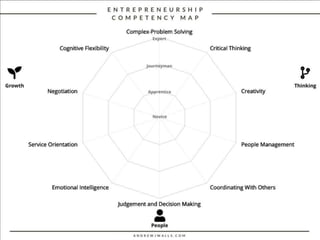
What is a Competency
• Simply defined, a competency is a specific skill, trait or attribute that meets the
following criteria:
• Is behavioral
• Is part of a larger skill set or discipline
• Can be learned or developed –
• Identifies “what can be done” vs. “what is known”
• The competency is a link between the role and the role holder.
• It enables the role holder to perform competently, proficiently, productively,
creatively, innovatively to assure quality of products and services at minimum price,
without waste, on right time, with minimum efforts and without stress.
• Competency is ability to do or perform or take responsibility. [Phil Race]
• There are two principal types of competencies-
• General Competencies: Address skills relevant to broad groups of individuals,
regardless of job role. For example, communication and leadership skills.
• Technical Competencies: Address skills relevant to specific job roles or families of
job roles.
4
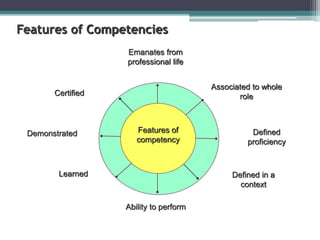
Features of Competencies
Features of
competency
Emanates from
professional life
Defined
proficiency
Defined in a
context
Ability to perform
Demonstrated
Certified
Associated to whole
role
Learned
5
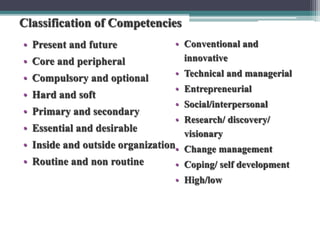
Classification of Competencies
• Present and future
• Core and peripheral
• Compulsory and optional
• Hard and soft
• Primary and secondary
• Essential and desirable
• Inside and outside organization
• Routine and non routine
• Conventional and
innovative
• Technical and managerial
• Entrepreneurial
• Social/interpersonal
• Research/ discovery/
visionary
• Change management
• Coping/ self development
• High/low
6
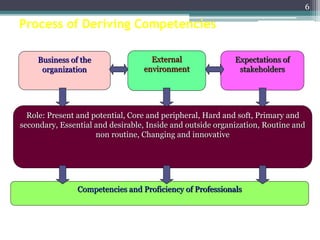
Process of Deriving Competencies
Role: Present and potential, Core and peripheral, Hard and soft, Primary and
secondary, Essential and desirable, Inside and outside organization, Routine and
non routine, Changing and innovative
Competencies and Proficiency of Professionals
Business of the
organization
External
environment
Expectations of
stakeholders
MEANING
• When adults join a training program, they bring with them two
elements: they have varying levels of knowledge and they learn at
varying paces.
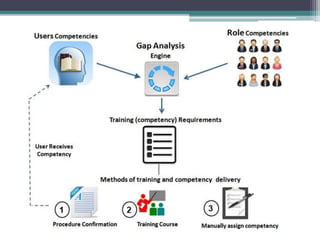
• Competency-based training programs recognize these differences and
match the training with the learner.
• Unlike the content-based training, competency-based training
programs focus on the trainer. This enables learners to move through
topics on an as-needed basis.
• It also means that the adult learners can progress through the training
program quickly, without spending time on material they are already
familiar with. They can focus on new content longer.
• Competency-based training saves time and money for you as a
training manager.
• The basic feature of any competency-based training is that it measures
learning that occurs in a training program, rather than time.
• Simply put, your employees would progress through training based
on their skills and competencies regardless of the time needed to
complete the course.
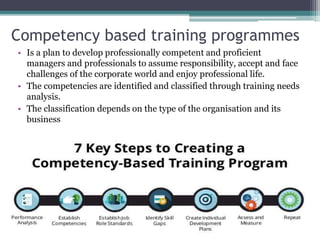
Competency based training programmes
• Is a plan to develop professionally competent and proficient
managers and professionals to assume responsibility, accept and face
challenges of the corporate world and enjoy professional life.
• The competencies are identified and classified through training needs
analysis.
• The classification depends on the type of the organisation and its
business
Benefits of Competency-Based
Training
• Time management. This can make it easier to fit into already
busy work schedules—allowing your employees to gain skills
without taking them awayfrom other tasks for too long.
• User-directed. These types of modules are often self-paced,
which means they can be completed at the user’s discretion.
• Reduced cost. Less money is wasted on components of a
program that are not as useful.
• Allows personalization. One individual may be able to skip
modules in which he or she is already knowledgeable, thus saving
everyone’s time and effort.
• Flexible use. It can be used on its own or in conjunction with
other learning methodologies, depending on the overall training
goals.
• Better retention. Learners can be more focused since they are
able to take the training units at times that best suit them.
• Workplace integration. This can be tied to career progression
or to receiving pay raises in some cases.
NEED AND IMPORATANCE OF COMPETENCY
BASED TRAINING PROGRAMMES
• Objectivity
• Tool of communication
• Unity of actions
• Alignment of actions
• Organisation of resources
• HRD
• Marketing the products and services of the
organisation
• Comparability
• Universal acceptability
• Valid and reliable certification
• Establishing equivalence
• Flexibility in achieving competencies
PURPOSE OF COMPETENCY
BASED MANAGEMENT TRAINING
• Base for communication with internal and external stakeholders
• Unity in action is maintained among management training
implementers.
• Provide sense of order and direction for implementation
• Ensure cooperation, commitment and support from various
stakeholders.
• The resources can be deployed at right time to minimize wastage.
• Implementation crisis can be prevented.
• Learning challenges can be designed and implemented.
• Guide to focus on training processes.
• Role clarity of implementers.
• Reveal future opportunities.
• Instrument for collaborationg,networking and expanding the
business area of the organisation.
CHARACTERISTICS OF COMPETENCY
BASED TRAINING PROGRAMMES
• Professionally designed
• Logically driven
• Research based
• Focus on present as well as future
• Entry behaviour of the managers
• Focus on core competencies
• Benchmarked
• No wastage
• Flexible behaviour
• Self-explanatory
• Scope for creativity and innovation
• Continously updated
• Certification
16
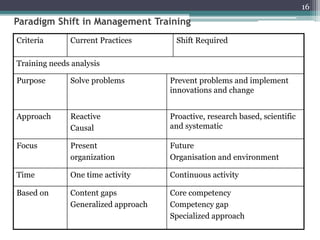
Paradigm Shift in Management Training
Criteria Current Practices Shift Required
Training needs analysis
Purpose Solve problems Prevent problems and implement
innovations and change
Approach Reactive
Causal
Proactive, research based, scientific
and systematic
Focus Present
organization
Future
Organisation and environment
Time One time activity Continuous activity
Based on Content gaps
Generalized approach
Core competency
Competency gap
Specialized approach
17
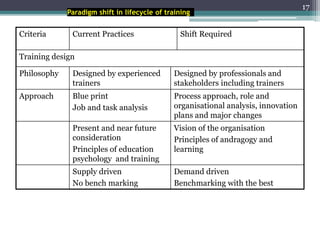
Paradigm shift in lifecycle of training
Criteria Current Practices Shift Required
Training design
Philosophy Designed by experienced
trainers
Designed by professionals and
stakeholders including trainers
Approach Blue print
Job and task analysis
Process approach, role and
organisational analysis, innovation
plans and major changes
Present and near future
consideration
Principles of education
psychology and training
Vision of the organisation
Principles of andragogy and
learning
Supply driven
No bench marking
Demand driven
Benchmarking with the best
18
Paradigm shift in lifecycle of training
Criteria Current Practices Shift Required
Training design
Focus Trainer
Content
Content and skills
testing
Broad based
Trainees
Competency development
Demonstration of competency
specific
Duration Rigid
Fixed
Flexible
Responsibility
of learning
Trainer Trainee
19
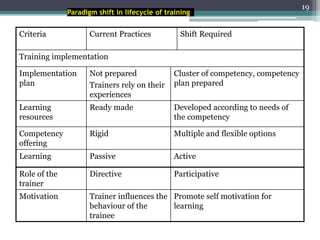
Paradigm shift in lifecycle of training
Criteria Current Practices Shift Required
Training implementation
Implementation
plan
Not prepared
Trainers rely on their
experiences
Cluster of competency, competency
plan prepared
Learning
resources
Ready made Developed according to needs of
the competency
Competency
offering
Rigid Multiple and flexible options
Learning Passive Active
Role of the
trainer
Directive Participative
Motivation Trainer influences the
behaviour of the
trainee
Promote self motivation for
learning
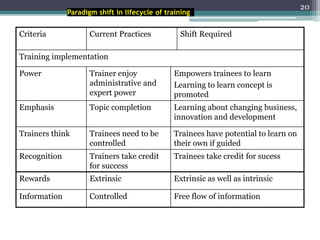
20
Paradigm shift in lifecycle of training
Criteria Current Practices Shift Required
Training implementation
Power Trainer enjoy
administrative and
expert power
Empowers trainees to learn
Learning to learn concept is
promoted
Emphasis Topic completion Learning about changing business,
innovation and development
Trainers think Trainees need to be
controlled
Trainees have potential to learn on
their own if guided
Recognition Trainers take credit
for success
Trainees take credit for sucess
Rewards Extrinsic Extrinsic as well as intrinsic
Information Controlled Free flow of information
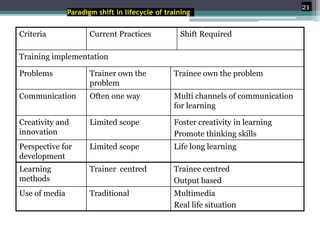
21
Paradigm shift in lifecycle of training
Criteria Current Practices Shift Required
Training implementation
Problems Trainer own the
problem
Trainee own the problem
Communication Often one way Multi channels of communication
for learning
Creativity and
innovation
Limited scope Foster creativity in learning
Promote thinking skills
Perspective for
development
Limited scope Life long learning
Learning
methods
Trainer centred Trainee centred
Output based
Use of media Traditional Multimedia
Real life situation
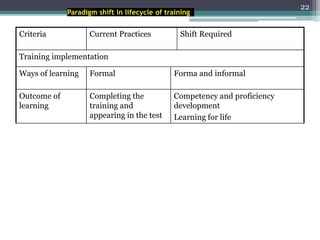
22
Paradigm shift in lifecycle of training
Criteria Current Practices Shift Required
Training implementation
Ways of learning Formal Forma and informal
Outcome of
learning
Completing the
training and
appearing in the test
Competency and proficiency
development
Learning for life
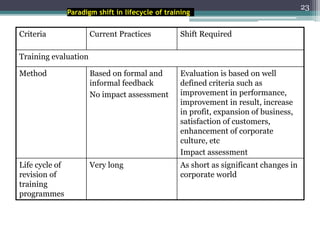
23
Paradigm shift in lifecycle of training
Criteria Current Practices Shift Required
Training evaluation
Method Based on formal and
informal feedback
No impact assessment
Evaluation is based on well
defined criteria such as
improvement in performance,
improvement in result, increase
in profit, expansion of business,
satisfaction of customers,
enhancement of corporate
culture, etc
Impact assessment
Life cycle of
revision of
training
programmes
Very long As short as significant changes in
corporate world

CHAPTER-7.pptx Competency Based Management Training

  • 1.
  • 2.
    What is aCompetency • Simply defined, a competency is a specific skill, trait or attribute that meets the following criteria: • Is behavioral • Is part of a larger skill set or discipline • Can be learned or developed – • Identifies “what can be done” vs. “what is known” • The competency is a link between the role and the role holder. • It enables the role holder to perform competently, proficiently, productively, creatively, innovatively to assure quality of products and services at minimum price, without waste, on right time, with minimum efforts and without stress. • Competency is ability to do or perform or take responsibility. [Phil Race] • There are two principal types of competencies- • General Competencies: Address skills relevant to broad groups of individuals, regardless of job role. For example, communication and leadership skills. • Technical Competencies: Address skills relevant to specific job roles or families of job roles.
  • 4.
    4 Features of Competencies Featuresof competency Emanates from professional life Defined proficiency Defined in a context Ability to perform Demonstrated Certified Associated to whole role Learned
  • 5.
    5 Classification of Competencies •Present and future • Core and peripheral • Compulsory and optional • Hard and soft • Primary and secondary • Essential and desirable • Inside and outside organization • Routine and non routine • Conventional and innovative • Technical and managerial • Entrepreneurial • Social/interpersonal • Research/ discovery/ visionary • Change management • Coping/ self development • High/low
  • 6.
    6 Process of DerivingCompetencies Role: Present and potential, Core and peripheral, Hard and soft, Primary and secondary, Essential and desirable, Inside and outside organization, Routine and non routine, Changing and innovative Competencies and Proficiency of Professionals Business of the organization External environment Expectations of stakeholders
  • 7.
    MEANING • When adultsjoin a training program, they bring with them two elements: they have varying levels of knowledge and they learn at varying paces. • Competency-based training programs recognize these differences and match the training with the learner. • Unlike the content-based training, competency-based training programs focus on the trainer. This enables learners to move through topics on an as-needed basis. • It also means that the adult learners can progress through the training program quickly, without spending time on material they are already familiar with. They can focus on new content longer. • Competency-based training saves time and money for you as a training manager. • The basic feature of any competency-based training is that it measures learning that occurs in a training program, rather than time. • Simply put, your employees would progress through training based on their skills and competencies regardless of the time needed to complete the course.
  • 8.
    Competency based trainingprogrammes • Is a plan to develop professionally competent and proficient managers and professionals to assume responsibility, accept and face challenges of the corporate world and enjoy professional life. • The competencies are identified and classified through training needs analysis. • The classification depends on the type of the organisation and its business
  • 9.
    Benefits of Competency-Based Training •Time management. This can make it easier to fit into already busy work schedules—allowing your employees to gain skills without taking them awayfrom other tasks for too long. • User-directed. These types of modules are often self-paced, which means they can be completed at the user’s discretion. • Reduced cost. Less money is wasted on components of a program that are not as useful. • Allows personalization. One individual may be able to skip modules in which he or she is already knowledgeable, thus saving everyone’s time and effort. • Flexible use. It can be used on its own or in conjunction with other learning methodologies, depending on the overall training goals. • Better retention. Learners can be more focused since they are able to take the training units at times that best suit them. • Workplace integration. This can be tied to career progression or to receiving pay raises in some cases.
  • 10.
    NEED AND IMPORATANCEOF COMPETENCY BASED TRAINING PROGRAMMES • Objectivity • Tool of communication • Unity of actions • Alignment of actions • Organisation of resources • HRD • Marketing the products and services of the organisation • Comparability • Universal acceptability • Valid and reliable certification • Establishing equivalence • Flexibility in achieving competencies
  • 12.
    PURPOSE OF COMPETENCY BASEDMANAGEMENT TRAINING • Base for communication with internal and external stakeholders • Unity in action is maintained among management training implementers. • Provide sense of order and direction for implementation • Ensure cooperation, commitment and support from various stakeholders. • The resources can be deployed at right time to minimize wastage. • Implementation crisis can be prevented. • Learning challenges can be designed and implemented. • Guide to focus on training processes. • Role clarity of implementers. • Reveal future opportunities. • Instrument for collaborationg,networking and expanding the business area of the organisation.
  • 13.
    CHARACTERISTICS OF COMPETENCY BASEDTRAINING PROGRAMMES • Professionally designed • Logically driven • Research based • Focus on present as well as future • Entry behaviour of the managers • Focus on core competencies • Benchmarked • No wastage • Flexible behaviour • Self-explanatory • Scope for creativity and innovation • Continously updated • Certification
  • 15.
    16 Paradigm Shift inManagement Training Criteria Current Practices Shift Required Training needs analysis Purpose Solve problems Prevent problems and implement innovations and change Approach Reactive Causal Proactive, research based, scientific and systematic Focus Present organization Future Organisation and environment Time One time activity Continuous activity Based on Content gaps Generalized approach Core competency Competency gap Specialized approach
  • 16.
    17 Paradigm shift inlifecycle of training Criteria Current Practices Shift Required Training design Philosophy Designed by experienced trainers Designed by professionals and stakeholders including trainers Approach Blue print Job and task analysis Process approach, role and organisational analysis, innovation plans and major changes Present and near future consideration Principles of education psychology and training Vision of the organisation Principles of andragogy and learning Supply driven No bench marking Demand driven Benchmarking with the best
  • 17.
    18 Paradigm shift inlifecycle of training Criteria Current Practices Shift Required Training design Focus Trainer Content Content and skills testing Broad based Trainees Competency development Demonstration of competency specific Duration Rigid Fixed Flexible Responsibility of learning Trainer Trainee
  • 18.
    19 Paradigm shift inlifecycle of training Criteria Current Practices Shift Required Training implementation Implementation plan Not prepared Trainers rely on their experiences Cluster of competency, competency plan prepared Learning resources Ready made Developed according to needs of the competency Competency offering Rigid Multiple and flexible options Learning Passive Active Role of the trainer Directive Participative Motivation Trainer influences the behaviour of the trainee Promote self motivation for learning
  • 19.
    20 Paradigm shift inlifecycle of training Criteria Current Practices Shift Required Training implementation Power Trainer enjoy administrative and expert power Empowers trainees to learn Learning to learn concept is promoted Emphasis Topic completion Learning about changing business, innovation and development Trainers think Trainees need to be controlled Trainees have potential to learn on their own if guided Recognition Trainers take credit for success Trainees take credit for sucess Rewards Extrinsic Extrinsic as well as intrinsic Information Controlled Free flow of information
  • 20.
    21 Paradigm shift inlifecycle of training Criteria Current Practices Shift Required Training implementation Problems Trainer own the problem Trainee own the problem Communication Often one way Multi channels of communication for learning Creativity and innovation Limited scope Foster creativity in learning Promote thinking skills Perspective for development Limited scope Life long learning Learning methods Trainer centred Trainee centred Output based Use of media Traditional Multimedia Real life situation
  • 21.
    22 Paradigm shift inlifecycle of training Criteria Current Practices Shift Required Training implementation Ways of learning Formal Forma and informal Outcome of learning Completing the training and appearing in the test Competency and proficiency development Learning for life
  • 22.
    23 Paradigm shift inlifecycle of training Criteria Current Practices Shift Required Training evaluation Method Based on formal and informal feedback No impact assessment Evaluation is based on well defined criteria such as improvement in performance, improvement in result, increase in profit, expansion of business, satisfaction of customers, enhancement of corporate culture, etc Impact assessment Life cycle of revision of training programmes Very long As short as significant changes in corporate world