MANAGEMENT
SCIENCE
The Art of Modeling with Spreadsheets
STEPHEN G. POWELL
KENNETH R. BAKER
Compatible with Analytic Solver Platform
FOURTH EDITION
CHAPTER 6 POWERPOINT
CLASSIFICATION AND PREDICTION METHODS
INTRODUCTION
• Analysts engage in three types of tasks: 1) descriptive, 2)
predictive and 3) prescriptive.
• Predictive methods include:
– Classification, to predict which class an individual record
will occupy (e.g., will a particular customer buy?)
– Prediction, to predict a numerical outcome for an
individual record (e.g., how much will that customer
spend?)
• Now that data is plentiful, data mining enables more
accurate prediction.
Chapter 6 Copyright © 2013 John Wiley & Sons, Inc. 2
THE PROBLEM OF OVER-FITTING
• Data includes both patterns (stable, underlying relationships) and noise
(transient, random effects).
• Noise has no predictive value; so a model is over-fit when it incorporates
noise.
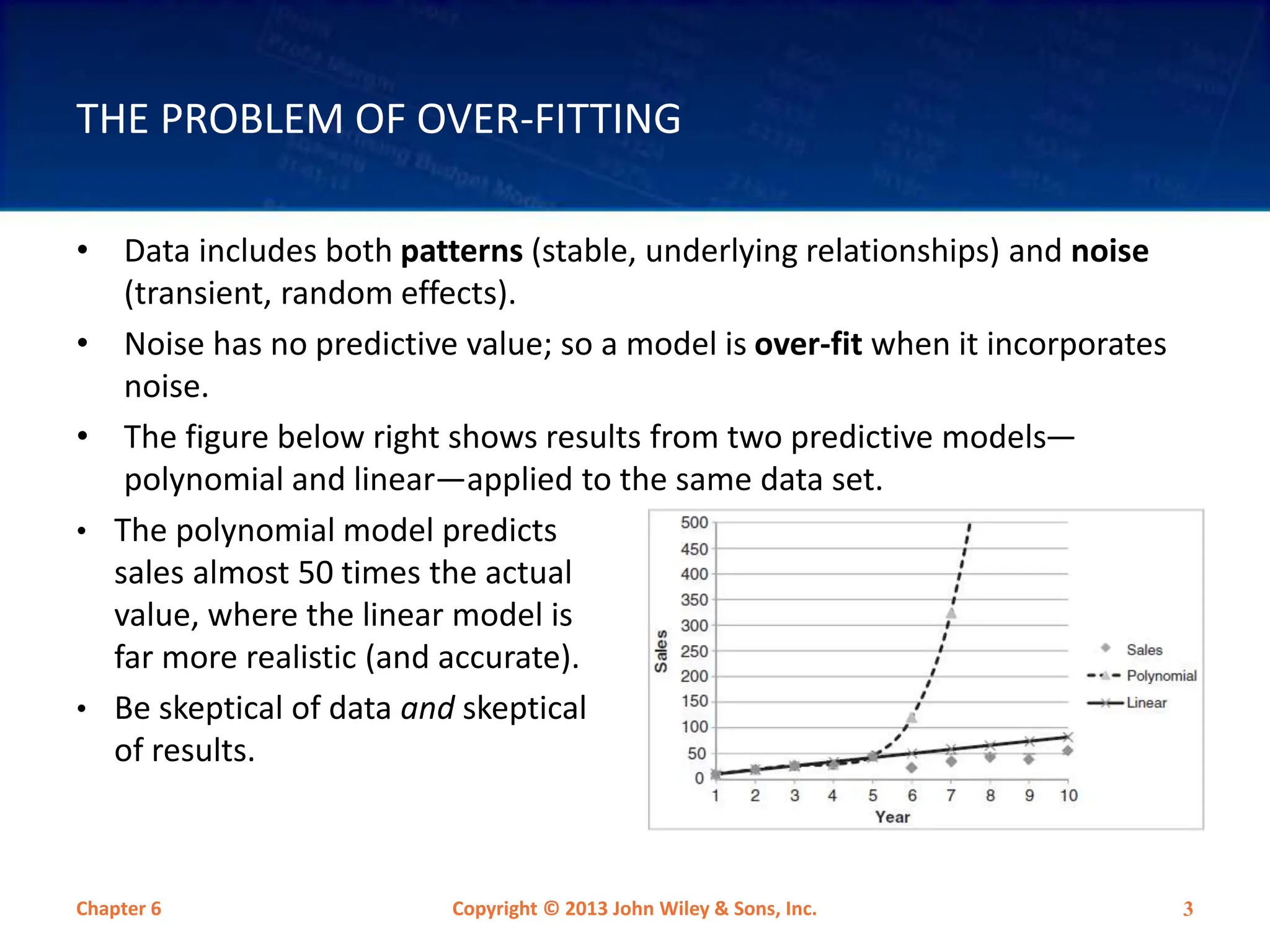
• The figure below right shows results from two predictive models—
polynomial and linear—applied to the same data set.
Chapter 6 Copyright © 2013 John Wiley & Sons, Inc. 3
• The polynomial model predicts
sales almost 50 times the actual
value, where the linear model is
far more realistic (and accurate).
• Be skeptical of data and skeptical
of results.
PARTITIONING THE DATABASE
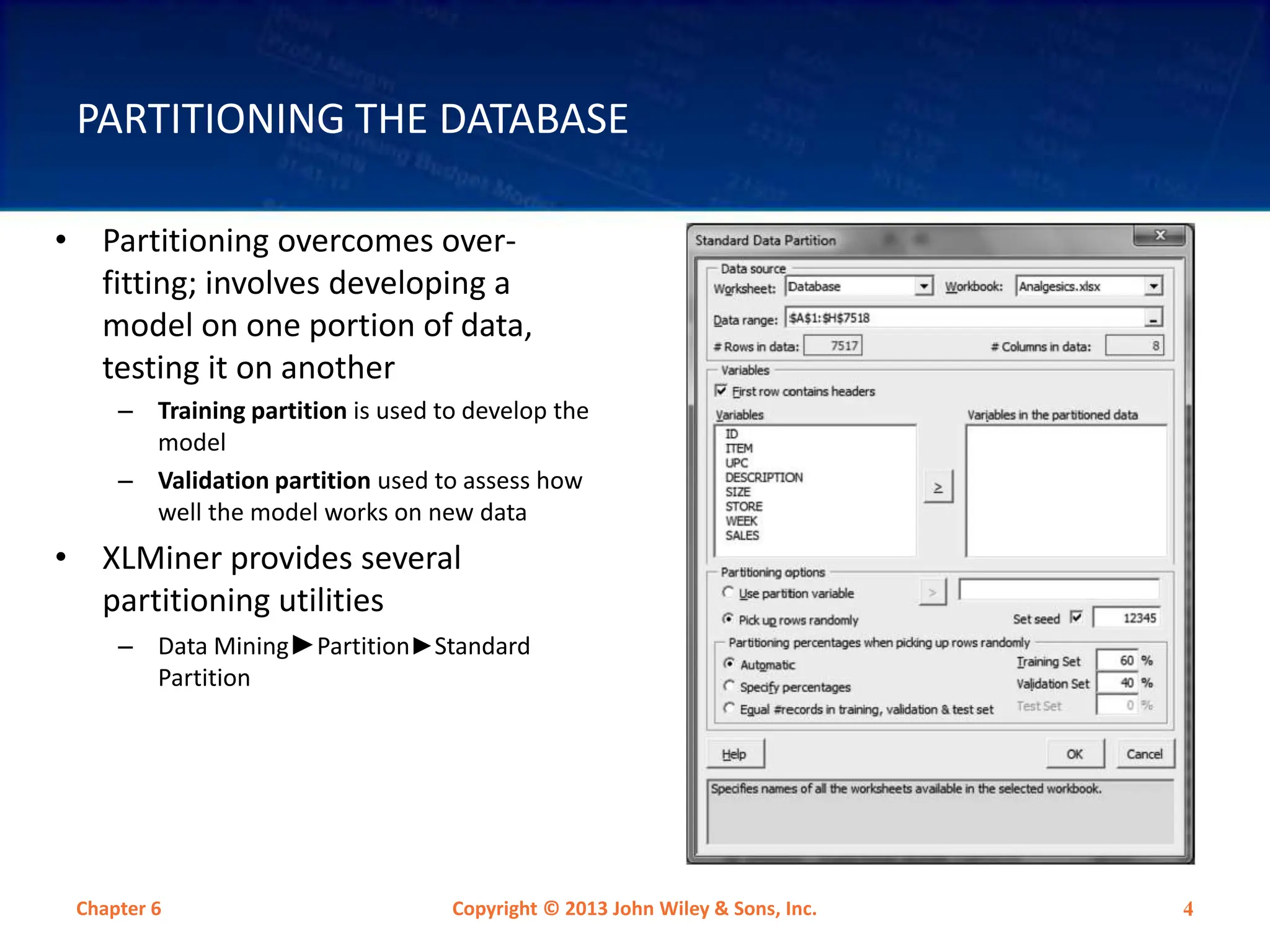
• Partitioning overcomes over-
fitting; involves developing a
model on one portion of data,
testing it on another
– Training partition is used to develop the
model
– Validation partition used to assess how
well the model works on new data
• XLMiner provides several
partitioning utilities
– Data Mining►Partition►Standard
Partition
Chapter 6 Copyright © 2013 John Wiley & Sons, Inc. 4
PERFORMANCE MEASURES
• The ultimate goal of data analysis is to predict the future.
• To classify new instances (e.g., whether a registered voter
will vote)
– We measure predictive accuracy by instances correctly
classified
• For numerical predictions (e.g., number of votes received
by the winner in each state)
– Accuracy measured by differences between predicted and
actual outcomes
Chapter 6 Copyright © 2013 John Wiley & Sons, Inc. 5
SIX WIDELY-USED CLASSIFICATION/PREDICTION METHODS
• k-Nearest Neighbor
• Naïve Bayes
• Classification and Prediction Trees
• Multiple Linear Regression
• Logistic Regression
• Neural Networks
Chapter 6 Copyright © 2013 John Wiley & Sons, Inc. 6
GENERAL CAVEAT
• No one model is perfect, universally applicable
• Data mining analysts will typically build several
competing models (e.g., multiple linear regression, k-
Nearest Neighbor, Prediction Trees and Neural Networks)
and implement the one that proves most effective.
Chapter 6 Copyright © 2013 John Wiley & Sons, Inc. 7
THE K-NEAREST NEIGHBOR METHOD
• Bases classification of a new case on records most similar
to the new case
– E.g., by Pandora’s Music Genome Project to identify songs
that appeal to a user
• Answers three major questions:
– How to define similarity between records?
– How many neighboring records to use?
– What classification or prediction rule to use?
Chapter 6 Copyright © 2013 John Wiley & Sons, Inc. 8
STRENGTHS AND WEAKNESSES OF THE K-NEAREST NEIGHBOR
ALGORITHM
• Strengths:
– Simplicity. Requires no assumptions as to the form of the
model, few assumptions about parameters.
– Only one parameter estimated (k)
– Performs well where there is a large training database, or many
combinations of predictor variables
• Weaknesses:
– Provides no information on which predictors are most effective
in making a good classification
– Long computational times; number of records required
increases faster than linearly
Chapter 6 Copyright © 2013 John Wiley & Sons, Inc. 9
THE NAÏVE BAYES METHOD
• Similar to k-Nearest Neighborhood but, restricted to
situations in which all predictor variables are categorical
• Example: Spam filtering, based on categorical values
Word Appeared and Word did not Appear.
Chapter 6 Copyright © 2013 John Wiley & Sons, Inc. 10
STRENGTHS AND WEAKNESSES OF THE NAÏVE BAYES
ALGORITHM
• Strengths:
– Remarkably simple, but often gives classification accuracy as
good as or better than more sophisticated algorithms
– Requires no assumptions other than class-conditional
independence
• Weaknesses:
– Requires large number of records for good results
– Estimates a probability of zero for new cases with a predictor
value missing from the training database
– Suitable only for classification, not for estimating class
probabilities
Chapter 6 Copyright © 2013 John Wiley & Sons, Inc. 11
CLASSIFICATION AND PREDICTION TREES
• Based on the observation that there are subsets of
records in a database that contain mostly 1s or 0s
• Identify the subsets, and we can classify a new record
based on majority outcome in the subset it most
resembles
• Example: Predict purchasing behavior of individuals for
whom we know three variables, being age, income and
education
Chapter 6 Copyright © 2013 John Wiley & Sons, Inc. 12
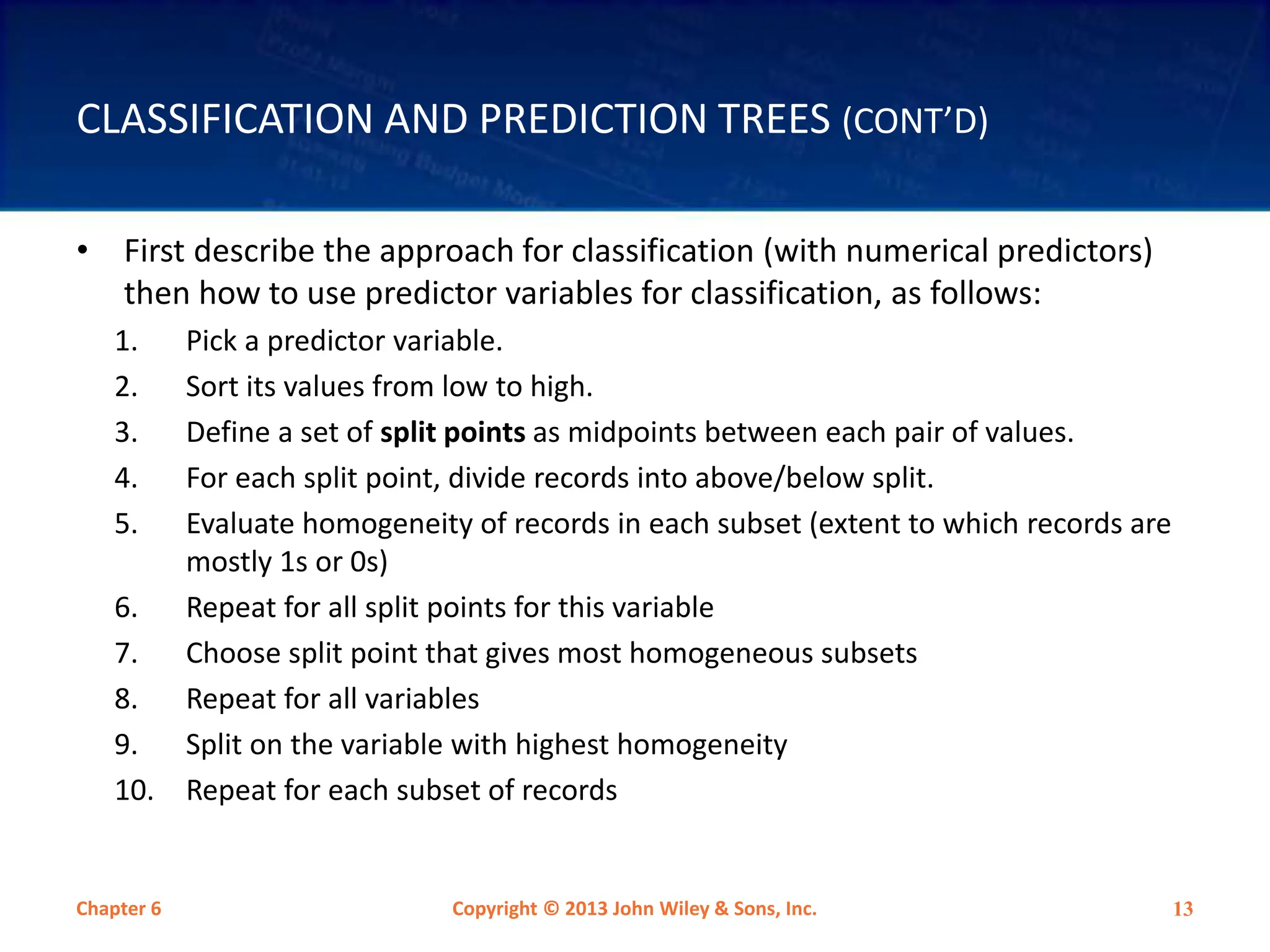
CLASSIFICATION AND PREDICTION TREES (CONT’D)
• First describe the approach for classification (with numerical predictors)
then how to use predictor variables for classification, as follows:
1. Pick a predictor variable.
2. Sort its values from low to high.
3. Define a set of split points as midpoints between each pair of values.
4. For each split point, divide records into above/below split.
5. Evaluate homogeneity of records in each subset (extent to which records are
mostly 1s or 0s)
6. Repeat for all split points for this variable
7. Choose split point that gives most homogeneous subsets
8. Repeat for all variables
9. Split on the variable with highest homogeneity
10. Repeat for each subset of records
Chapter 6 Copyright © 2013 John Wiley & Sons, Inc. 13
STRENGTHS AND WEAKNESSES OF CLASSIFICATION AND
PREDICTION TREES
• Strengths:
– Easy to understand and explain
– Transparent results, can be interpreted as explicit If-Then rules
– Based on few assumptions, works well even with missing data
and outliers
• Weaknesses:
– Accurate results require very large databases
– Allows partitioning of only individual variables, not pairs or
groups
– Specific to XLMiner: only binary categorical variables allowed.
Chapter 6 Copyright © 2013 John Wiley & Sons, Inc. 14
MULTIPLE LINEAR REGRESSION
• One of the most widely-used tools from classical statistics
• Used widely in natural and social sciences, more often for
explanatory than predictive modeling
– To determine if specific variables influence outcome variable
• Answers questions like:
– Do the data support the claim that women are paid less than men in
comparable jobs?
– Is there evidence that price discounts and rebates lead to higher long-
term sales?
– Do data support the idea that firms that outsource manufacturing
overseas have higher profits?
Chapter 6 Copyright © 2013 John Wiley & Sons, Inc. 15
STRENGTHS AND WEAKNESSES OF MULTIPLE LINEAR
REGRESSION
• Strengths:
– Well-known and well-accepted model for prediction
– Easy to implement and interpret
– Inferential statistics (p-values and R2) are available
• Weaknesses:
– Possible for regression model to exhibit high R2 but low predictive
accuracy
Chapter 6 Copyright © 2013 John Wiley & Sons, Inc. 16
LOGISTIC REGRESSION
• A statistical approach to classification of categorical
outcome variables
• Similar to multiple linear regression, but can be used
when the outcome has more than two values
• Uses data to produce a probability that a given case will
fall into one of two classes (e.g., flights that leave on
time/delayed, companies that will/will not default on
bonds, employees who will/will not be promoted)
Chapter 6 Copyright © 2013 John Wiley & Sons, Inc. 17
STRENGTHS AND WEAKNESSES OF LOGISTIC
REGRESSION
• Strengths:
– Well-known, widely used, especially in marketing
– Easy to implement and fairly straightforward
• Weaknesses:
– A facility with concept of odds often necessary
– If a large number of predictor values, then often necessary to
reduce them to most important through pre-processing,
inferential statistics, best subset selection
Chapter 6 Copyright © 2013 John Wiley & Sons, Inc. 18
NEURAL NETWORKS
• An outgrowth of research within artificial intelligence into
how the brain works
• Used for classification and prediction
• Applied to extremely wide variety of areas (e.g., from financial
applications to controlling robots)
• In finance:
– To predict bankruptcy of firms
– To trade on currency, stock or bond markets
– To predict credit card fraud
• Complex and difficult to understand but high predictive
accuracy
Chapter 6 Copyright © 2013 John Wiley & Sons, Inc. 19
STRENGTHS AND WEAKNESSES OF NEURAL NETWORKS
• Strengths:
– Highly successful in many applications (thought unsuccessful in
many more)
– Very flexible because the fundamental structure (the number of
hidden layers and nodes) is chosen by the user
– Capture complex relationships between inputs and outputs
• Weaknesses:
– Difficult to interpret, thus hard to justify
– Limited insight into underlying relationships
– Requires modeler to carefully pre-process predictor variables,
experiment with different sets of predictors
Chapter 6 Copyright © 2013 John Wiley & Sons, Inc. 20
SUMMARY
• Classification methods apply when the task is to predict
which class an individual record may occupy (e.g.,
whether a customer will buy a certain product).
• Prediction methods apply when the task is to predict a
numerical outcome (e.g., how much a customer will buy).
• It is quite common for analysts to construct models using
competing of the six methods, then select the most
effective.
Chapter 6 Copyright © 2013 John Wiley & Sons, Inc. 21
All rights reserved. Reproduction or translation of
this work beyond that permitted in section 117 of the 1976
United States Copyright Act without express permission of
the copyright owner is unlawful. Request for further
information should be addressed to the Permissions
Department, John Wiley & Sons, Inc. The purchaser may
make back-up copies for his/her own use only and not for
distribution or resale. The Publisher assumes no
responsibility for errors, omissions, or damages caused by
the use of these programs or from the use of the information
herein.
COPYRIGHT © 2013 JOHN WILEY & SONS, INC.

Chapter 6- Classification and Prediction Methods

  • 1.
    MANAGEMENT SCIENCE The Art ofModeling with Spreadsheets STEPHEN G. POWELL KENNETH R. BAKER Compatible with Analytic Solver Platform FOURTH EDITION CHAPTER 6 POWERPOINT CLASSIFICATION AND PREDICTION METHODS
  • 2.
    INTRODUCTION • Analysts engagein three types of tasks: 1) descriptive, 2) predictive and 3) prescriptive. • Predictive methods include: – Classification, to predict which class an individual record will occupy (e.g., will a particular customer buy?) – Prediction, to predict a numerical outcome for an individual record (e.g., how much will that customer spend?) • Now that data is plentiful, data mining enables more accurate prediction. Chapter 6 Copyright © 2013 John Wiley & Sons, Inc. 2
  • 3.
    THE PROBLEM OFOVER-FITTING • Data includes both patterns (stable, underlying relationships) and noise (transient, random effects). • Noise has no predictive value; so a model is over-fit when it incorporates noise. • The figure below right shows results from two predictive models— polynomial and linear—applied to the same data set. Chapter 6 Copyright © 2013 John Wiley & Sons, Inc. 3 • The polynomial model predicts sales almost 50 times the actual value, where the linear model is far more realistic (and accurate). • Be skeptical of data and skeptical of results.
  • 4.
    PARTITIONING THE DATABASE •Partitioning overcomes over- fitting; involves developing a model on one portion of data, testing it on another – Training partition is used to develop the model – Validation partition used to assess how well the model works on new data • XLMiner provides several partitioning utilities – Data Mining►Partition►Standard Partition Chapter 6 Copyright © 2013 John Wiley & Sons, Inc. 4
  • 5.
    PERFORMANCE MEASURES • Theultimate goal of data analysis is to predict the future. • To classify new instances (e.g., whether a registered voter will vote) – We measure predictive accuracy by instances correctly classified • For numerical predictions (e.g., number of votes received by the winner in each state) – Accuracy measured by differences between predicted and actual outcomes Chapter 6 Copyright © 2013 John Wiley & Sons, Inc. 5
  • 6.
    SIX WIDELY-USED CLASSIFICATION/PREDICTIONMETHODS • k-Nearest Neighbor • Naïve Bayes • Classification and Prediction Trees • Multiple Linear Regression • Logistic Regression • Neural Networks Chapter 6 Copyright © 2013 John Wiley & Sons, Inc. 6
  • 7.
    GENERAL CAVEAT • Noone model is perfect, universally applicable • Data mining analysts will typically build several competing models (e.g., multiple linear regression, k- Nearest Neighbor, Prediction Trees and Neural Networks) and implement the one that proves most effective. Chapter 6 Copyright © 2013 John Wiley & Sons, Inc. 7
  • 8.
    THE K-NEAREST NEIGHBORMETHOD • Bases classification of a new case on records most similar to the new case – E.g., by Pandora’s Music Genome Project to identify songs that appeal to a user • Answers three major questions: – How to define similarity between records? – How many neighboring records to use? – What classification or prediction rule to use? Chapter 6 Copyright © 2013 John Wiley & Sons, Inc. 8
  • 9.
    STRENGTHS AND WEAKNESSESOF THE K-NEAREST NEIGHBOR ALGORITHM • Strengths: – Simplicity. Requires no assumptions as to the form of the model, few assumptions about parameters. – Only one parameter estimated (k) – Performs well where there is a large training database, or many combinations of predictor variables • Weaknesses: – Provides no information on which predictors are most effective in making a good classification – Long computational times; number of records required increases faster than linearly Chapter 6 Copyright © 2013 John Wiley & Sons, Inc. 9
  • 10.
    THE NAÏVE BAYESMETHOD • Similar to k-Nearest Neighborhood but, restricted to situations in which all predictor variables are categorical • Example: Spam filtering, based on categorical values Word Appeared and Word did not Appear. Chapter 6 Copyright © 2013 John Wiley & Sons, Inc. 10
  • 11.
    STRENGTHS AND WEAKNESSESOF THE NAÏVE BAYES ALGORITHM • Strengths: – Remarkably simple, but often gives classification accuracy as good as or better than more sophisticated algorithms – Requires no assumptions other than class-conditional independence • Weaknesses: – Requires large number of records for good results – Estimates a probability of zero for new cases with a predictor value missing from the training database – Suitable only for classification, not for estimating class probabilities Chapter 6 Copyright © 2013 John Wiley & Sons, Inc. 11
  • 12.
    CLASSIFICATION AND PREDICTIONTREES • Based on the observation that there are subsets of records in a database that contain mostly 1s or 0s • Identify the subsets, and we can classify a new record based on majority outcome in the subset it most resembles • Example: Predict purchasing behavior of individuals for whom we know three variables, being age, income and education Chapter 6 Copyright © 2013 John Wiley & Sons, Inc. 12
  • 13.
    CLASSIFICATION AND PREDICTIONTREES (CONT’D) • First describe the approach for classification (with numerical predictors) then how to use predictor variables for classification, as follows: 1. Pick a predictor variable. 2. Sort its values from low to high. 3. Define a set of split points as midpoints between each pair of values. 4. For each split point, divide records into above/below split. 5. Evaluate homogeneity of records in each subset (extent to which records are mostly 1s or 0s) 6. Repeat for all split points for this variable 7. Choose split point that gives most homogeneous subsets 8. Repeat for all variables 9. Split on the variable with highest homogeneity 10. Repeat for each subset of records Chapter 6 Copyright © 2013 John Wiley & Sons, Inc. 13
  • 14.
    STRENGTHS AND WEAKNESSESOF CLASSIFICATION AND PREDICTION TREES • Strengths: – Easy to understand and explain – Transparent results, can be interpreted as explicit If-Then rules – Based on few assumptions, works well even with missing data and outliers • Weaknesses: – Accurate results require very large databases – Allows partitioning of only individual variables, not pairs or groups – Specific to XLMiner: only binary categorical variables allowed. Chapter 6 Copyright © 2013 John Wiley & Sons, Inc. 14
  • 15.
    MULTIPLE LINEAR REGRESSION •One of the most widely-used tools from classical statistics • Used widely in natural and social sciences, more often for explanatory than predictive modeling – To determine if specific variables influence outcome variable • Answers questions like: – Do the data support the claim that women are paid less than men in comparable jobs? – Is there evidence that price discounts and rebates lead to higher long- term sales? – Do data support the idea that firms that outsource manufacturing overseas have higher profits? Chapter 6 Copyright © 2013 John Wiley & Sons, Inc. 15
  • 16.
    STRENGTHS AND WEAKNESSESOF MULTIPLE LINEAR REGRESSION • Strengths: – Well-known and well-accepted model for prediction – Easy to implement and interpret – Inferential statistics (p-values and R2) are available • Weaknesses: – Possible for regression model to exhibit high R2 but low predictive accuracy Chapter 6 Copyright © 2013 John Wiley & Sons, Inc. 16
  • 17.
    LOGISTIC REGRESSION • Astatistical approach to classification of categorical outcome variables • Similar to multiple linear regression, but can be used when the outcome has more than two values • Uses data to produce a probability that a given case will fall into one of two classes (e.g., flights that leave on time/delayed, companies that will/will not default on bonds, employees who will/will not be promoted) Chapter 6 Copyright © 2013 John Wiley & Sons, Inc. 17
  • 18.
    STRENGTHS AND WEAKNESSESOF LOGISTIC REGRESSION • Strengths: – Well-known, widely used, especially in marketing – Easy to implement and fairly straightforward • Weaknesses: – A facility with concept of odds often necessary – If a large number of predictor values, then often necessary to reduce them to most important through pre-processing, inferential statistics, best subset selection Chapter 6 Copyright © 2013 John Wiley & Sons, Inc. 18
  • 19.
    NEURAL NETWORKS • Anoutgrowth of research within artificial intelligence into how the brain works • Used for classification and prediction • Applied to extremely wide variety of areas (e.g., from financial applications to controlling robots) • In finance: – To predict bankruptcy of firms – To trade on currency, stock or bond markets – To predict credit card fraud • Complex and difficult to understand but high predictive accuracy Chapter 6 Copyright © 2013 John Wiley & Sons, Inc. 19
  • 20.
    STRENGTHS AND WEAKNESSESOF NEURAL NETWORKS • Strengths: – Highly successful in many applications (thought unsuccessful in many more) – Very flexible because the fundamental structure (the number of hidden layers and nodes) is chosen by the user – Capture complex relationships between inputs and outputs • Weaknesses: – Difficult to interpret, thus hard to justify – Limited insight into underlying relationships – Requires modeler to carefully pre-process predictor variables, experiment with different sets of predictors Chapter 6 Copyright © 2013 John Wiley & Sons, Inc. 20
  • 21.
    SUMMARY • Classification methodsapply when the task is to predict which class an individual record may occupy (e.g., whether a customer will buy a certain product). • Prediction methods apply when the task is to predict a numerical outcome (e.g., how much a customer will buy). • It is quite common for analysts to construct models using competing of the six methods, then select the most effective. Chapter 6 Copyright © 2013 John Wiley & Sons, Inc. 21
  • 22.
    All rights reserved.Reproduction or translation of this work beyond that permitted in section 117 of the 1976 United States Copyright Act without express permission of the copyright owner is unlawful. Request for further information should be addressed to the Permissions Department, John Wiley & Sons, Inc. The purchaser may make back-up copies for his/her own use only and not for distribution or resale. The Publisher assumes no responsibility for errors, omissions, or damages caused by the use of these programs or from the use of the information herein. COPYRIGHT © 2013 JOHN WILEY & SONS, INC.