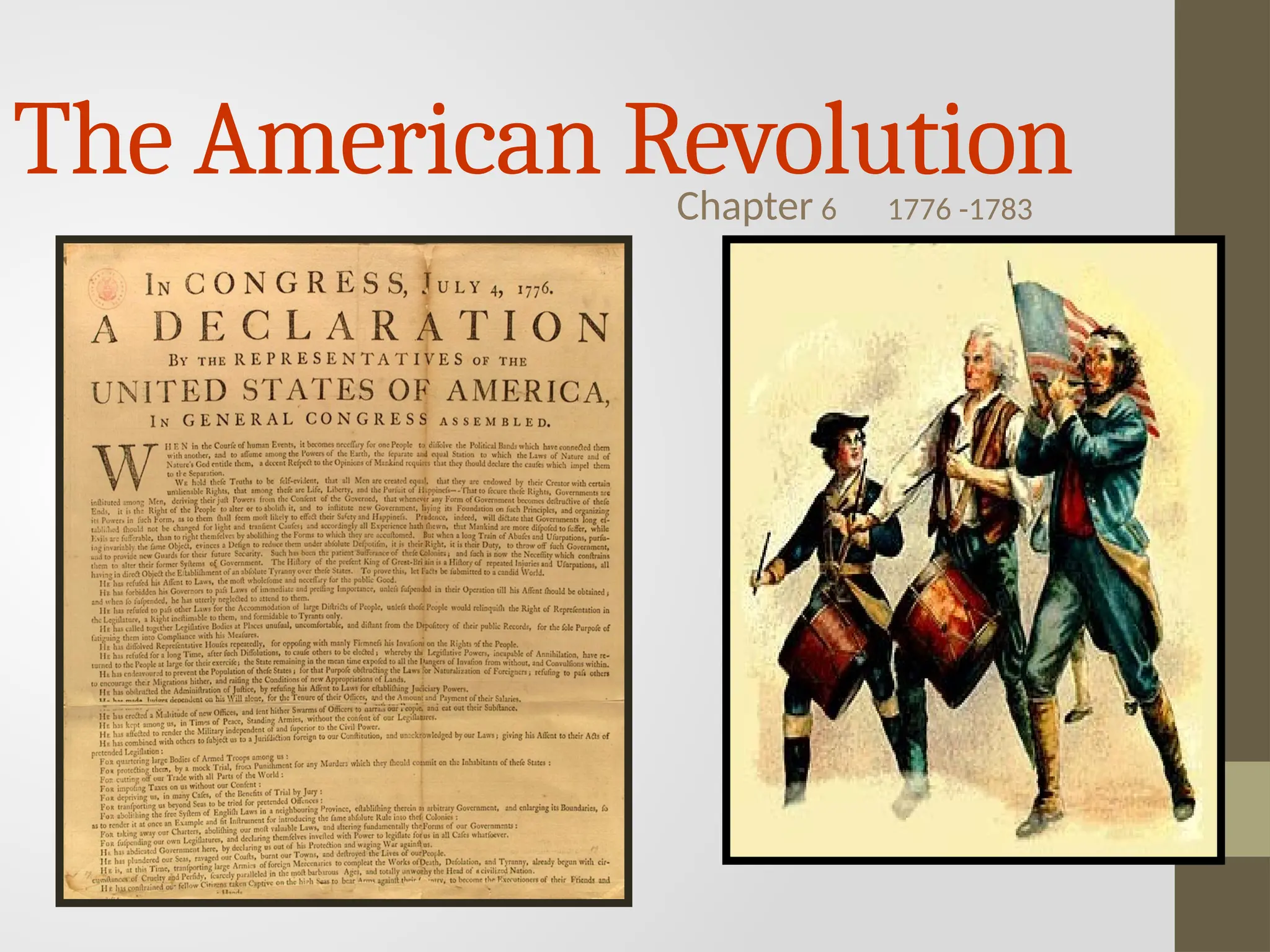
The American Revolution
Chapter 6 1776 -1783
Chapter 6 – The American Revolution
8.H.5 -The ideas of the Enlightenment and
dissatisfaction with colonial rule led English
colonists to write the Declaration of Independence
and launch the American Revolution.
Chapter 6 – Vocabulary
Proclamation - an order issued by a government
Ally - a country that helps another country in time of war
Blockade - a military action that closes a port
Mercenary - a soldier hired into foreign service, ex.
Hessians/Germans
Deserter - leave army without permission
Privateer - private ship used in war
Guerrilla Warfare - irregular soldier, usually politically
motivated
Ambush - surprise attack
Ratify – formally approve
Neutral – taking no sides in a conflict
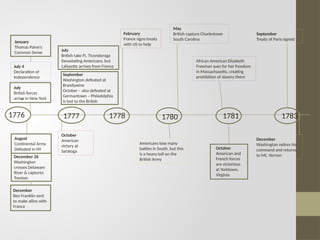
July 4
Declaration of
Independence
October
American
victory at
Saratoga
1776 1778
February
France signs treaty
with US to help
1780 1781 1783
Americans lose many
battles in South, but this
is a heavy toll on the
British Army
May
British capture Charlestown
South Carolina
African American Elizabeth
Freeman sues for her freedom
in Massachusetts, creating
prohibition of slavery there
September
Treaty of Paris signed
December
Washington retires his
command and returns
to Mt. Vernon
1777
-
January
Thomas Paine’s
Common Sense
July
British forces
arrive in New York
August
Continental Army
Defeated in NY
December 26
Washington
crosses Delaware
River & captures
Trenton
December
Ben Franklin sent
to make allies with
France
July
British take Ft. Ticonderoga
Devastating Americans, but
Lafayette arrives from France
September
Washington defeated at
Brandywine
October – also defeated at
Germantown – Philadelphia
is lost to the British
October
American and
French forces
are victorious
at Yorktown,
Virginia
EXTRA! EXTRA! Read all about it!
Revolutionary War Reporters
In the 1700’s there were no computers, TV, or
radio. People usually communicate either by
word of mouth or by reading the newspapers
of the day. Below are links to examples of
newspapers of the day.
Ben Franklin's Pennsylvania Gazette -January
2, 1750
http://www.earlyamerica.com/earlyamerica/
past/past.html
The Boston Gazette -Monday, October 7, 1776
http://www.earlyamerica.com/earlyamerica/
past/past2.html
The Massachusetts Centinel -Saturday, April
24, 1790
http://www.earlyamerica.com/earlyamerica/
past/past3.html
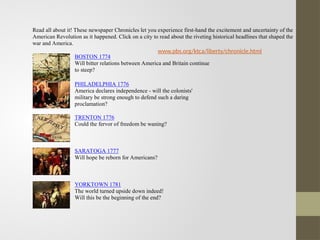
Read all about it! These newspaper Chronicles let you experience first-hand the excitement and uncertainty of the
American Revolution as it happened. Click on a city to read about the riveting historical headlines that shaped the
war and America.
BOSTON 1774
Will bitter relations between America and Britain continue
to steep?
PHILADELPHIA 1776
America declares independence - will the colonists'
military be strong enough to defend such a daring
proclamation?
TRENTON 1776
Could the fervor of freedom be waning?
SARATOGA 1777
Will hope be reborn for Americans?
YORKTOWN 1781
The world turned upside down indeed!
Will this be the beginning of the end?
www.pbs.org/ktca/liberty/chronicle.html
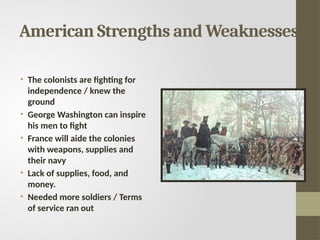
American Strengths and Weaknesses
• The colonists are fighting for
independence / knew the
ground
• George Washington can inspire
his men to fight
• France will aide the colonies
with weapons, supplies and
their navy
• Lack of supplies, food, and
money.
• Needed more soldiers / Terms
of service ran out
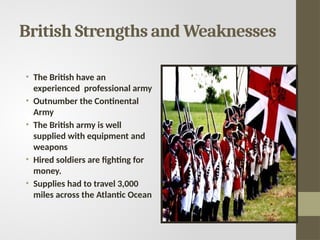
British Strengths and Weaknesses
• The British have an
experienced professional army
• Outnumber the Continental
Army
• The British army is well
supplied with equipment and
weapons
• Hired soldiers are fighting for
money.
• Supplies had to travel 3,000
miles across the Atlantic Ocean
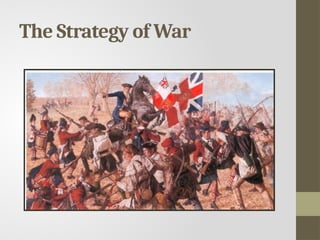
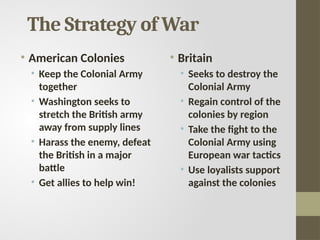
The Strategy of War
The Strategy of War
• American Colonies
• Keep the Colonial Army
together
• Washington seeks to
stretch the British army
away from supply lines
• Harass the enemy, defeat
the British in a major
battle
• Get allies to help win!
• Britain
• Seeks to destroy the
Colonial Army
• Regain control of the
colonies by region
• Take the fight to the
Colonial Army using
European war tactics
• Use loyalists support
against the colonies
Phase I: The Northern Campaign
[1775-1776]
Phase II:
NY & PA
[1777-1778]
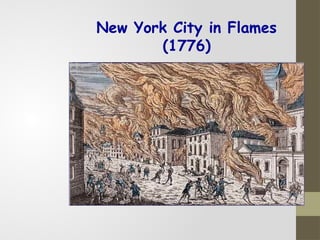
New York City in Flames
(1776)
Nathan Hale
• Acted as a spy for Patriots (disguised himself as Dutch
schoolteacher)
• Caught and hung
• Last words: “I only regret that I have but one life to lose for my
country.”
“These are the times that try men’s souls”
Thomas Paine, “The Crisis”
The Crisis
“These are the times that try men’s souls.
The summer soldier and the sunshine
patriot will in this crisis shrink from the
service of their country; but he that stands
it now deserves the love and thanks of
man and woman.”
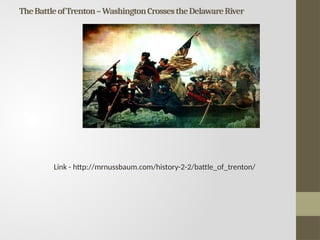
TheBattleofTrenton–WashingtonCrossestheDelawareRiver
Link - http://mrnussbaum.com/history-2-2/battle_of_trenton/
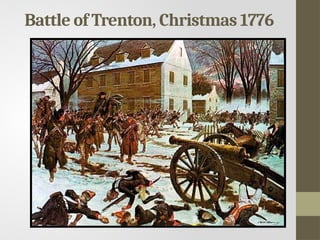
Battle of Trenton, Christmas 1776
Battle of Trenton
• British settle into New York for the winter of 1776-1777
• Left some troops in Princeton and Trenton, New Jersey
• Washington and men stationed across Delaware River
• Christmas night Washington takes 2,400 troops across the river and surprise
attacks the Hessians the next day.
• Captured 900 Hessians
• Before British reinforcements arrive, Washington takes troops to Princeton and
drives out British there, as well.
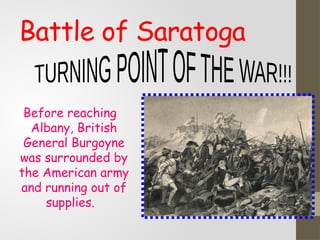
Battle of Saratoga
Before reaching
Albany, British
General Burgoyne
was surrounded by
the American army
and running out of
supplies.
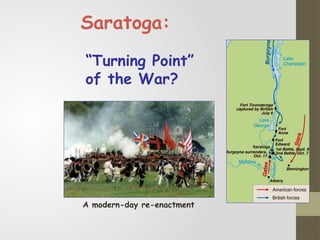
Saratoga:
“Turning Point”
of the War?
A modern-day re-enactment
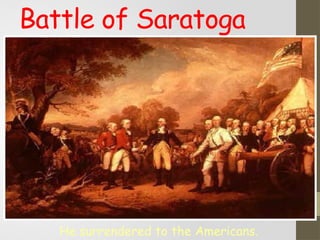
Battle of Saratoga
He surrendered to the Americans.
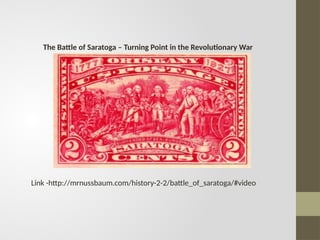
The Battle of Saratoga – Turning Point in the Revolutionary War
Link -http://mrnussbaum.com/history-2-2/battle_of_saratoga/#video
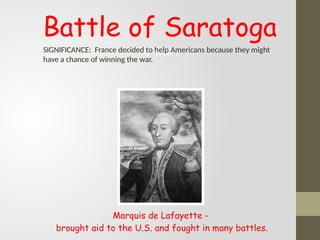
Marquis de Lafayette -
brought aid to the U.S. and fought in many battles.
e war.
Battle of Saratoga
SIGNIFICANCE: France decided to help Americans because they might
have a chance of winning the war.
Notes
Saratoga
• “Turning point” of the American Revolution
• Benjamin Franklin persuaded France and Spain to join the fight
against Great Britain
• Motivation….revenge!
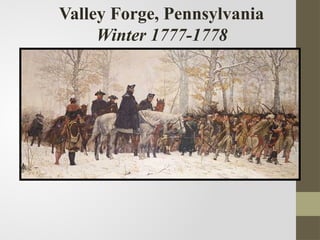
Valley Forge, Pennsylvania
Winter 1777-1778
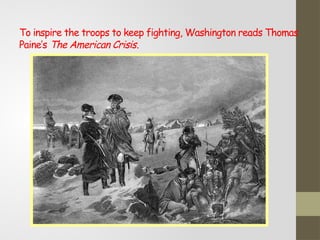
To inspire the troops to keep fighting, Washington reads Thomas
Paine’s The American Crisis.
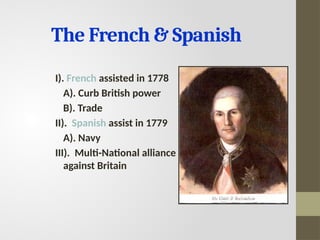
The French & Spanish
I). French assisted in 1778
A). Curb British power
B). Trade
II). Spanish assist in 1779
A). Navy
III). Multi-National alliance
against Britain
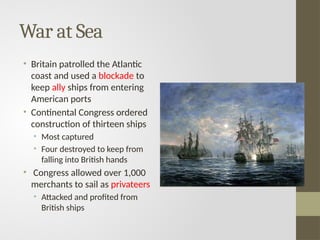
War at Sea
• Britain patrolled the Atlantic
coast and used a blockade to
keep ally ships from entering
American ports
• Continental Congress ordered
construction of thirteen ships
• Most captured
• Four destroyed to keep from
falling into British hands
• Congress allowed over 1,000
merchants to sail as privateers
• Attacked and profited from
British ships
Patriot Victories
• King’s Mountain
• British tried to invade North Carolina
• 1,000 loyalists attack group of Patriot sharpshooters and are turned back
• In 1780, Nathaniel Green takes over for Horatio Gates
• In January 1781, he splits army in two
• Cowpens
• First division, led by Daniel Morgan, defeats British at Cowpens
• Second division joins Francis Marion’s guerrilla raids
• Two divisions rejoin to face Cornwallis at Guilford Courthouse
• British victorious but suffer heavy casualties
• Cornwallis retreats to Yorktown, Virginia in April 1781
Britain’s “Southern Strategy”
• British now realize defeating the Continental Army will not be easy.
• Plan a final, massive attack in the South to end the war.
• Rely on sea power and loyalist support.
• 1778 British send General Henry Clinton with 3,500 men from New York to
Savannah, GA.
• May 1780, attack Charlestown, SC and take thousands of prisoners
• Americans worst defeat of the war
• General Charles Cornwallis takes over for Clinton and defeats American
General Horatio Gates at Camden, SC
• As British travel through SC, they lack loyalists support and are harassed by
American strategy of guerrilla warfare
• American leader, Francis Marion aka Swamp Fox, perfects this strategy
Phase III: The Southern
Strategy [1780-1781]
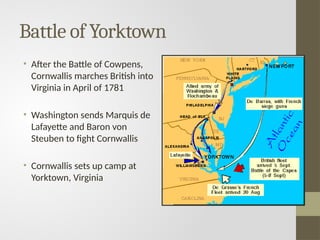
Battle of Yorktown
• After the Battle of Cowpens,
Cornwallis marches British into
Virginia in April of 1781
• Washington sends Marquis de
Lafayette and Baron von
Steuben to fight Cornwallis
• Cornwallis sets up camp at
Yorktown, Virginia
Battle of Yorktown (Cont.)
• July 1780, General Jean Baptiste de Rochambeau arrives from
France with 5,000 soldiers
• Autumn of 1780, Washington is just north of New York City
waiting for second French fleet of ships
• In August 1781, Washington learns the second French fleet is
close but headed to Chesapeake Bay instead of New York City.
• Decides to attack British at Yorktown instead of New York City.
• Sent fake dispatches saying Washington was going to attack British at
New York.
• British capture these messages, meanwhile Washington sneaks his
army away from New York and heads south to Yorktown
Battle of Yorktown (Cont.)
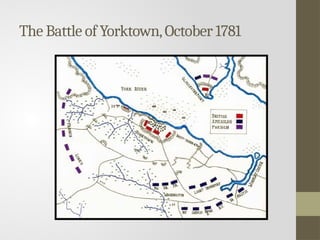
• At the end of September, Washington reaches Yorktown with 17,000
American and French troops compared to 8,000 British
• Second French fleet blocks a naval escape
• British trapped against the York River
• October 11th
, Washington begins bombarding Yorktown with artillery
• October 14th
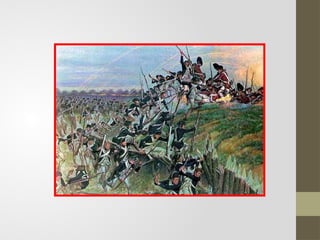
, American-French forces storm British defenses
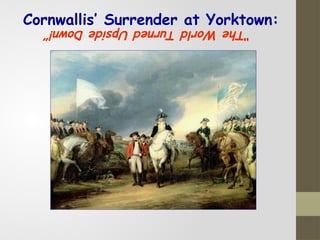
• Cornwallis surrenders on October 19, 1781
The Battle of Yorktown,October 1781
Cornwallis’ Surrender at Yorktown:
“The
World
Turned
Upside
Down!”
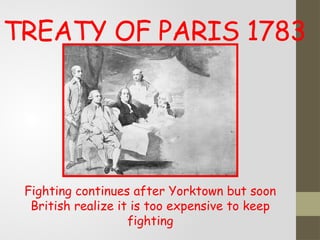
TREATY OF PARIS 1783
Fighting continues after Yorktown but soon
British realize it is too expensive to keep
fighting
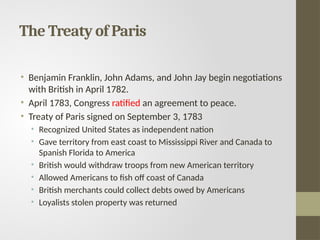
The Treaty of Paris
• Benjamin Franklin, John Adams, and John Jay begin negotiations
with British in April 1782.
• April 1783, Congress ratified an agreement to peace.
• Treaty of Paris signed on September 3, 1783
• Recognized United States as independent nation
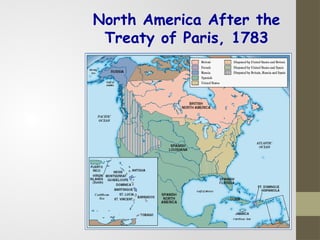
• Gave territory from east coast to Mississippi River and Canada to
Spanish Florida to America
• British would withdraw troops from new American territory
• Allowed Americans to fish off coast of Canada
• British merchants could collect debts owed by Americans
• Loyalists stolen property was returned
North America After the
Treaty of Paris, 1783
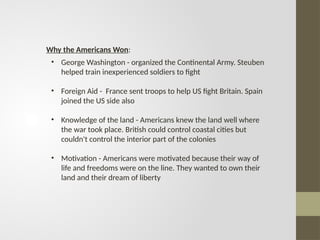
• George Washington - organized the Continental Army. Steuben
helped train inexperienced soldiers to fight
• Foreign Aid - France sent troops to help US fight Britain. Spain
joined the US side also
• Knowledge of the land - Americans knew the land well where
the war took place. British could control coastal cities but
couldn't control the interior part of the colonies
• Motivation - Americans were motivated because their way of
life and freedoms were on the line. They wanted to own their
land and their dream of liberty
Why the Americans Won:
Legacy for Indians
• Generally thought it was not their war
• War for liberty and independence took liberty
and independence away from Indians
• War against colonial oppression led to
colonization and oppression of Indians by the
U.S. government
• Soldiers paid with Indian land, not free land
• Indians erased from history due to Paris Peace
Treaty and the idea that the war was fought
ONLY between colonists and British
Women & African Americans
• Worked in camps on the lines
• Molly Pitcher
• Spies, messengers
• Promises of freedom
• 5,000 for U.S., workers, few soldiers
• Rarely armed
• South feared of rebellions
Revolutionary War
Newspaper Project
• Write and report the complete paper from Loyalist view
OR Patriot view
• Collaborate with Newspaper Staff on helping one another
while working on your assignment: War Correspondent,
Personalities Reporter, Lifestyles Reporter, Business/Ads
Editor, Opinion/Editorial

American Revolution- Causes and Timeline

  • 1.
  • 2.
    Chapter 6 –The American Revolution 8.H.5 -The ideas of the Enlightenment and dissatisfaction with colonial rule led English colonists to write the Declaration of Independence and launch the American Revolution.
  • 3.
    Chapter 6 –Vocabulary Proclamation - an order issued by a government Ally - a country that helps another country in time of war Blockade - a military action that closes a port Mercenary - a soldier hired into foreign service, ex. Hessians/Germans Deserter - leave army without permission Privateer - private ship used in war Guerrilla Warfare - irregular soldier, usually politically motivated Ambush - surprise attack Ratify – formally approve Neutral – taking no sides in a conflict
  • 4.
    July 4 Declaration of Independence October American victoryat Saratoga 1776 1778 February France signs treaty with US to help 1780 1781 1783 Americans lose many battles in South, but this is a heavy toll on the British Army May British capture Charlestown South Carolina African American Elizabeth Freeman sues for her freedom in Massachusetts, creating prohibition of slavery there September Treaty of Paris signed December Washington retires his command and returns to Mt. Vernon 1777 - January Thomas Paine’s Common Sense July British forces arrive in New York August Continental Army Defeated in NY December 26 Washington crosses Delaware River & captures Trenton December Ben Franklin sent to make allies with France July British take Ft. Ticonderoga Devastating Americans, but Lafayette arrives from France September Washington defeated at Brandywine October – also defeated at Germantown – Philadelphia is lost to the British October American and French forces are victorious at Yorktown, Virginia
  • 5.
    EXTRA! EXTRA! Readall about it! Revolutionary War Reporters In the 1700’s there were no computers, TV, or radio. People usually communicate either by word of mouth or by reading the newspapers of the day. Below are links to examples of newspapers of the day. Ben Franklin's Pennsylvania Gazette -January 2, 1750 http://www.earlyamerica.com/earlyamerica/ past/past.html The Boston Gazette -Monday, October 7, 1776 http://www.earlyamerica.com/earlyamerica/ past/past2.html The Massachusetts Centinel -Saturday, April 24, 1790 http://www.earlyamerica.com/earlyamerica/ past/past3.html
  • 6.
    Read all aboutit! These newspaper Chronicles let you experience first-hand the excitement and uncertainty of the American Revolution as it happened. Click on a city to read about the riveting historical headlines that shaped the war and America. BOSTON 1774 Will bitter relations between America and Britain continue to steep? PHILADELPHIA 1776 America declares independence - will the colonists' military be strong enough to defend such a daring proclamation? TRENTON 1776 Could the fervor of freedom be waning? SARATOGA 1777 Will hope be reborn for Americans? YORKTOWN 1781 The world turned upside down indeed! Will this be the beginning of the end? www.pbs.org/ktca/liberty/chronicle.html
  • 7.
    American Strengths andWeaknesses • The colonists are fighting for independence / knew the ground • George Washington can inspire his men to fight • France will aide the colonies with weapons, supplies and their navy • Lack of supplies, food, and money. • Needed more soldiers / Terms of service ran out
  • 8.
    British Strengths andWeaknesses • The British have an experienced professional army • Outnumber the Continental Army • The British army is well supplied with equipment and weapons • Hired soldiers are fighting for money. • Supplies had to travel 3,000 miles across the Atlantic Ocean
  • 9.
  • 10.
    The Strategy ofWar • American Colonies • Keep the Colonial Army together • Washington seeks to stretch the British army away from supply lines • Harass the enemy, defeat the British in a major battle • Get allies to help win! • Britain • Seeks to destroy the Colonial Army • Regain control of the colonies by region • Take the fight to the Colonial Army using European war tactics • Use loyalists support against the colonies
  • 11.
    Phase I: TheNorthern Campaign [1775-1776]
  • 12.
    Phase II: NY &PA [1777-1778]
  • 13.
    New York Cityin Flames (1776)
  • 14.
    Nathan Hale • Actedas a spy for Patriots (disguised himself as Dutch schoolteacher) • Caught and hung • Last words: “I only regret that I have but one life to lose for my country.”
  • 15.
    “These are thetimes that try men’s souls” Thomas Paine, “The Crisis”
  • 16.
    The Crisis “These arethe times that try men’s souls. The summer soldier and the sunshine patriot will in this crisis shrink from the service of their country; but he that stands it now deserves the love and thanks of man and woman.”
  • 17.
  • 18.
    Battle of Trenton,Christmas 1776
  • 19.
    Battle of Trenton •British settle into New York for the winter of 1776-1777 • Left some troops in Princeton and Trenton, New Jersey • Washington and men stationed across Delaware River • Christmas night Washington takes 2,400 troops across the river and surprise attacks the Hessians the next day. • Captured 900 Hessians • Before British reinforcements arrive, Washington takes troops to Princeton and drives out British there, as well.
  • 20.
    Battle of Saratoga Beforereaching Albany, British General Burgoyne was surrounded by the American army and running out of supplies.
  • 21.
    Saratoga: “Turning Point” of theWar? A modern-day re-enactment
  • 22.
    Battle of Saratoga Hesurrendered to the Americans.
  • 23.
    The Battle ofSaratoga – Turning Point in the Revolutionary War Link -http://mrnussbaum.com/history-2-2/battle_of_saratoga/#video
  • 24.
    Marquis de Lafayette- brought aid to the U.S. and fought in many battles. e war. Battle of Saratoga SIGNIFICANCE: France decided to help Americans because they might have a chance of winning the war.
  • 25.
    Notes Saratoga • “Turning point”of the American Revolution • Benjamin Franklin persuaded France and Spain to join the fight against Great Britain • Motivation….revenge!
  • 26.
  • 27.
    To inspire thetroops to keep fighting, Washington reads Thomas Paine’s The American Crisis.
  • 28.
    The French &Spanish I). French assisted in 1778 A). Curb British power B). Trade II). Spanish assist in 1779 A). Navy III). Multi-National alliance against Britain
  • 29.
    War at Sea •Britain patrolled the Atlantic coast and used a blockade to keep ally ships from entering American ports • Continental Congress ordered construction of thirteen ships • Most captured • Four destroyed to keep from falling into British hands • Congress allowed over 1,000 merchants to sail as privateers • Attacked and profited from British ships
  • 30.
    Patriot Victories • King’sMountain • British tried to invade North Carolina • 1,000 loyalists attack group of Patriot sharpshooters and are turned back • In 1780, Nathaniel Green takes over for Horatio Gates • In January 1781, he splits army in two • Cowpens • First division, led by Daniel Morgan, defeats British at Cowpens • Second division joins Francis Marion’s guerrilla raids • Two divisions rejoin to face Cornwallis at Guilford Courthouse • British victorious but suffer heavy casualties • Cornwallis retreats to Yorktown, Virginia in April 1781
  • 31.
    Britain’s “Southern Strategy” •British now realize defeating the Continental Army will not be easy. • Plan a final, massive attack in the South to end the war. • Rely on sea power and loyalist support. • 1778 British send General Henry Clinton with 3,500 men from New York to Savannah, GA. • May 1780, attack Charlestown, SC and take thousands of prisoners • Americans worst defeat of the war • General Charles Cornwallis takes over for Clinton and defeats American General Horatio Gates at Camden, SC • As British travel through SC, they lack loyalists support and are harassed by American strategy of guerrilla warfare • American leader, Francis Marion aka Swamp Fox, perfects this strategy
  • 32.
    Phase III: TheSouthern Strategy [1780-1781]
  • 33.
    Battle of Yorktown •After the Battle of Cowpens, Cornwallis marches British into Virginia in April of 1781 • Washington sends Marquis de Lafayette and Baron von Steuben to fight Cornwallis • Cornwallis sets up camp at Yorktown, Virginia
  • 34.
    Battle of Yorktown(Cont.) • July 1780, General Jean Baptiste de Rochambeau arrives from France with 5,000 soldiers • Autumn of 1780, Washington is just north of New York City waiting for second French fleet of ships • In August 1781, Washington learns the second French fleet is close but headed to Chesapeake Bay instead of New York City. • Decides to attack British at Yorktown instead of New York City. • Sent fake dispatches saying Washington was going to attack British at New York. • British capture these messages, meanwhile Washington sneaks his army away from New York and heads south to Yorktown
  • 35.
    Battle of Yorktown(Cont.) • At the end of September, Washington reaches Yorktown with 17,000 American and French troops compared to 8,000 British • Second French fleet blocks a naval escape • British trapped against the York River • October 11th , Washington begins bombarding Yorktown with artillery • October 14th , American-French forces storm British defenses • Cornwallis surrenders on October 19, 1781
  • 36.
    The Battle ofYorktown,October 1781
  • 38.
    Cornwallis’ Surrender atYorktown: “The World Turned Upside Down!”
  • 39.
    TREATY OF PARIS1783 Fighting continues after Yorktown but soon British realize it is too expensive to keep fighting
  • 40.
    The Treaty ofParis • Benjamin Franklin, John Adams, and John Jay begin negotiations with British in April 1782. • April 1783, Congress ratified an agreement to peace. • Treaty of Paris signed on September 3, 1783 • Recognized United States as independent nation • Gave territory from east coast to Mississippi River and Canada to Spanish Florida to America • British would withdraw troops from new American territory • Allowed Americans to fish off coast of Canada • British merchants could collect debts owed by Americans • Loyalists stolen property was returned
  • 41.
    North America Afterthe Treaty of Paris, 1783
  • 43.
    • George Washington- organized the Continental Army. Steuben helped train inexperienced soldiers to fight • Foreign Aid - France sent troops to help US fight Britain. Spain joined the US side also • Knowledge of the land - Americans knew the land well where the war took place. British could control coastal cities but couldn't control the interior part of the colonies • Motivation - Americans were motivated because their way of life and freedoms were on the line. They wanted to own their land and their dream of liberty Why the Americans Won:
  • 44.
    Legacy for Indians •Generally thought it was not their war • War for liberty and independence took liberty and independence away from Indians • War against colonial oppression led to colonization and oppression of Indians by the U.S. government • Soldiers paid with Indian land, not free land • Indians erased from history due to Paris Peace Treaty and the idea that the war was fought ONLY between colonists and British
  • 45.
    Women & AfricanAmericans • Worked in camps on the lines • Molly Pitcher • Spies, messengers • Promises of freedom • 5,000 for U.S., workers, few soldiers • Rarely armed • South feared of rebellions
  • 46.
    Revolutionary War Newspaper Project •Write and report the complete paper from Loyalist view OR Patriot view • Collaborate with Newspaper Staff on helping one another while working on your assignment: War Correspondent, Personalities Reporter, Lifestyles Reporter, Business/Ads Editor, Opinion/Editorial