INHERITANCE
5.1 CONCEPT OF INHERITANCE
BASED ON MENDEL’S
EXPERIMENT
5.2 INHERITANCE OF TRAITS IN
HUMANS
5.3 GENES AND CHROMOSOMES
KHAIRIN KHAIRUDIN
5.1 CONCEPT OF INHERITANCE
BASED ON MENDEL’S
EXPERIMENT
STATE WHAT IS MEANT BY
INHERITANCE?
INHERITANCE is the transmission
of particular characteristics from
generation to generation by
means of the genetic code on the
DNA of a chromosomes
TRAITS ?...........CHARACTERISTICS?
TRAITS
• Each variant for a
spesific characteristic
• Examples:
a)Purple and white
b)Round and wrinkle
c) Inflated and
constricted
CHARACTERISTICS
• A distinctive
inherited feature of
an organism
• Examples:
a)Flower colour
b)Seed shape
c)Pod shape
MENDEL’S LAW
There is a pair of hereditary factor
that determines a particular
character which may be dominant
or recessive
FIRST LAW
•The law of segregation
•Each individual characteristic
of an organism is determined
by a pair of alleles.
•The pair of alleles segregate
during meiosis and only one of
each pair of alleles can be
present in a single gamete.
SECOND LAW
•The law independent
assortment
•During gamete formation,
each member of a pair of
alleles may combine
randomly with either member
of another pair of alleles.
• Mendel’s performed cross-pollination with pure
breed tall plants (TT) and pure breed short plants
(tt) to study one characteristics known as
monohybrid cross
• The original parents are called the parental
generation/ P generation
• The results of parental cross appeared in the first
generation called the first filial/ F1 generation
• The plants of the F1 gen. allowed to self pollinate
to produce the second filial / F2 generation
P generation Plant A X Plant B
Phenotype Tall X Short
Genotype TT X tt
………………………………………………………………………….Meiosis
F1 genotype Tt
F1 phenotype Tall
…………………………………………………………………………………………Meiosis
F1 Gametes
………………………………………………………………………………….Random
fertilisation
F2 Genotype
F2 Phenotype Tall Tall Tall Short
F2 Phenotypic ratio 3 1
• When he planted the seeds of the F2 gen. the
ratio of tall to short plants of the offspring was
3 : 1
• Mendel called the trait manifested in the F2
plants (tall trait) the dominant trait and the
trait that not expressed (short trait) as the
recessive trait
• The inheritance involved a genetic cross
between two parents that are differed in only
one characteristics called monohybrid
inheritance
Q
K
a
G
Q
K
a
g
Gene locus
Alleles
Homozygous dominant
Homozygous recessive
Heterozygous
Homologous chromosomes carries the same gene, one
chromosome is from the male (paternal) and another
one from the female (maternal)
TERMS MEANING
Genotype The genetic constituent of an organism
Phenotype The observable characteristics which determined by the spesific
genotype that can be influenced by environmental factors
Dominant allele The allele that produces the phenotype
Recessive allele The allele that produces the phenotype only when there is no dominant
allele present
Homozygote Both the allele of a particular gene of pair of homologous chromosome
are identical
Heterozygote Both the allele of a particular gene of a pair of homologous
chromosome are different
Gene A basic unit of inheritance that determines a particular characteristics
consists of DNA on a specific locus of a chromosomes that control a
particular trait (factor)
Allele Alternative form of a gene that has the same locus on homologous
chromosomes
Do you understand about Mendel’s first
law?..............Find it now by answering question
below
1. What would be the results of these cross?
a) A homozygous long-tailed monkey is crossed with
homozygous short tailed monkey.Long-tailed is dominant
trait.
b) A heterozygous white-haired rabbit is crossed with a
heterozygous white-haired rabbit ,where white is dominant.
c) A heterozygous red-flowered plant is crossed with a
homozygous pink-flowered plant,where red is dominant.
2. In peas, the allele P,is inflated pods is dominant over p for
constricted pods.2000 heterozygous plant were self
pollinated and 1500 inflated pod were collected. How many
contricted pods were collected
ANSWERS…………………..
1. What would be the results of these cross?
a) A homozygous long-tailed monkey is crossed with
homozygous short tailed monkey.Long-tailed is dominant
trait. ( All similar)
b) A heterozygous white-haired rabbit is crossed with a (3 :1)
heterozygous white-haired rabbit ,where white is
dominant.
c) A heterozygous red-flowered plant is crossed with a (1 :1)
homozygous pink-flowered plant,where red is dominant.
2. In peas, the allele P,is inflated pods is dominant over p for
constricted pods.2000 heterozygous plant were self
pollinated and 1500 inflated pod were collected. How
many contricted pods were collected (500)
Dihybrid Inheritance
• The inheritance of two characteristics ,each
controlled by a different gene at a different
locus
• Mendel crossed the pea plants from two pure
breeding characteristics : one tall with purple
flowers (TTPP),the other short with white
flowers(ttpp)
• All the offspring in the F1 generation were tall
with purple flowers and the ratio in F2
generation were 9 tall-purple flowered:3 tall
white flowered:3 short purple flowered : 1
short white flowered.
Diagram dihybrid cross
5.2 : INHERITANCE OF TRAITS IN HUMANS
• Alleles IA and IB are codominant (both are
expressed equally in phenotype)
Phenotype
(Blood group )
Types of antigen on
red blood cell
Antibody in the
blood plasma
Genotypes
Blood group A A Anti-B IA IA, IA IO
Blood group B B Anti-A IB IB, IB IO
Blood groupAB A and B None IA IB
Blood group O None Anti-A and anti-B IO IO
Rhesus Factor
• The condition called erythroblastosis fetalis
could occur when the mother and the child
has different rhesus factor(mother-negative
and child-positive)
• Mother’s anti-rhesus antibodies may cause
agglutination and haemolysis of the foetal red
blood cells
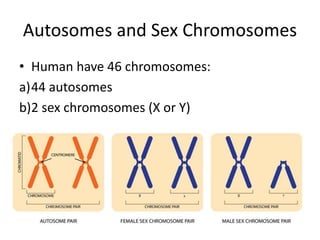
Autosomes and Sex Chromosomes
• Human have 46 chromosomes:
a)44 autosomes
b)2 sex chromosomes (X or Y)
Sex determination in offspring
• The sex of the offspring is determined by the
male parent , the probability of having boy is
50% and the probability of having girl is 50%
• Sex chromosomes abnormalities:
Syndrome Genotype Sex Characteristics
Turner XO Females Lack of ovaries : no
sexual maturity
Klinefelter XXY Males No secondary
sexual
characteristics
Sex-linked inheritance
• The genes on the sex chromosomes which are
not involved in sex determination are called
sex-linked genes
• Diseases related to sex-linked inheritance such
as haemophilia and colour blindness are
caused by recessive gene carried by X-
chromosomes.
• Since males have only one X chromosomes,
they are more likely to suffer from the
diseases while female are carries of the
diseases.
Genetic diagram to show sex-linked inheritance:
• haemophilia
• Colour blindness
5.3 GENES AND CHROMOSOMES
• State the unit of inheritance
• State the location of genes
• Describe the structure of deoxyribonucleic acid
• Describe the simple terms manisfestation of a trait of
an organism from the basic unit of inheritance
• Explain importance of genetic to mankind
• Describe the application and abuse of knowledge in
genetics
• Argue on the need for ethics and morals in the
application of genetics.
5.3 GENES AND CHROMOSOMES
1. Chromosome is a thread-like twisted sructure
in the nucleus and carries genetic
information (gi).
2. It consists of hundreds or thousands
gene(basic unit of inheritance)
3. It can be divided into :
a) Protein molecule – called histones (x gi)
b) DNA molecule – carry genetic information
Q
K
a
G
Q
K
a
g
Gene locus
Alleles
Homozygous dominant
Homozygous recessive
Heterozygous
Homologous chromosomes carries the same gene, one
chromosome is from the male (paternal) and another
one from the female (maternal)
•DNA molecule consists of two
polynucleotide strands coiled
together by hydrogen bonds
between the pairs of bases to form
a double helix
• The two strands are anti parallel,
adenine paired with thymine,
cytosine-guanine
•A gene is a DNA segment
containing a particular sequences
of nucleotides that code for the
synthesis of a specific protein in an
organism by controlling the types
of protein to be synthesised in cells
•Gene control the
traits of an
organism
Application of knowledge in genetics
1.Selective breeding – to produce offspring that
possess desirable characteristics of both
parents.
DURA
•thick shell
•Low oil content
•Fruits do not fall off easily
PISIFERA
•thin shell
•High oil content
•Fruits fall off easily
TENERA
•thin shell
•High oil content
•Fruits do not fall off easily
2. Genetic engineering
a) Gene theraphy
the patient is given a healthy gene to replace
a defective gene and it used to correct the
genetic defect.
b) Genetically modified organism (GMO)
-Microorganism
are used to
produced proteins
- animal are used
to produce useful
protein in their milk
to treat diseases
sech as
haemophilia and
grow human
organs such as
kidney
Recombinant DNA
c) Genetically modified food
• The plant will become more resistant to pests
• To slow down the ripening process
• Herbicide resistant
GMO make the yield increase……..low cost……….
3. Stem cell research
• Stem cells are cells that are capable of dividing and
renewing themselves
• There are two types of stem cells:
a)Embryonic stem cells – can be isolated from
embryos at the blastula stage,that can yield up to
millions of cells.
b)Adult stem cells – can divide to become certain
types of cells such as brain tissues, skeletal tissues,
liver and blood tissues.
• Scientists hope to use this method for generate
cells and tissues that can be used to treat injury or
disease
4. DNA fingerprints
Application Advantages Disadvantages
•To identify an
individual such as
a suspect in
criminal activity
•To identify genes
that causes
genetic disease
•To test the
compatibility of
petential organs
donors with
patient
•More accurate
•Very small
quantities
needed for
speciment
•Last longer
•Evidence is
much harder to
clean up
•Different sets of
procedures and
standard may
differ the result
•Possibility of
human errors
•Innocent people
may be convicted
of crimes they
did not commit
5. Human genome project
• A genome is an organisms complete set
of genes made up of DNA nucleotide
bases
• The purpose of genome project is to
detect, map and determine the sequence
of all base pairs in the DNA of human
genes
• The information is used to help treat and
prevent human diseases influenced by
genes
Social and Ethical Implications of Gene
Technology
Example Potential benefits Potential risks
Gene
theraph
y
- Relieving suffering and prolonging
life for cystic fibrosis patient
-May lead to discrimination
-Possible ‘designer babies’
GMO - Could remove harmful chemicals
and solve environmental problems
such as oil spill
-Alter the natural ecology
-Can be used as bioweapons for
the wrong purpose
GM
food
-Cheaper food and reduction in
food shortages
-Could save cost
-side-effects (allergic reaction)
-Original species extinct
-Long term side effect still
unknown
-May cause genetic pollution
Chapter 5 inheritance

Chapter 5 inheritance

  • 1.
    INHERITANCE 5.1 CONCEPT OFINHERITANCE BASED ON MENDEL’S EXPERIMENT 5.2 INHERITANCE OF TRAITS IN HUMANS 5.3 GENES AND CHROMOSOMES KHAIRIN KHAIRUDIN
  • 2.
    5.1 CONCEPT OFINHERITANCE BASED ON MENDEL’S EXPERIMENT
  • 3.
    STATE WHAT ISMEANT BY INHERITANCE? INHERITANCE is the transmission of particular characteristics from generation to generation by means of the genetic code on the DNA of a chromosomes
  • 4.
    TRAITS ?...........CHARACTERISTICS? TRAITS • Eachvariant for a spesific characteristic • Examples: a)Purple and white b)Round and wrinkle c) Inflated and constricted CHARACTERISTICS • A distinctive inherited feature of an organism • Examples: a)Flower colour b)Seed shape c)Pod shape
  • 6.
    MENDEL’S LAW There isa pair of hereditary factor that determines a particular character which may be dominant or recessive FIRST LAW •The law of segregation •Each individual characteristic of an organism is determined by a pair of alleles. •The pair of alleles segregate during meiosis and only one of each pair of alleles can be present in a single gamete. SECOND LAW •The law independent assortment •During gamete formation, each member of a pair of alleles may combine randomly with either member of another pair of alleles.
  • 7.
    • Mendel’s performedcross-pollination with pure breed tall plants (TT) and pure breed short plants (tt) to study one characteristics known as monohybrid cross • The original parents are called the parental generation/ P generation • The results of parental cross appeared in the first generation called the first filial/ F1 generation • The plants of the F1 gen. allowed to self pollinate to produce the second filial / F2 generation
  • 8.
    P generation PlantA X Plant B Phenotype Tall X Short Genotype TT X tt ………………………………………………………………………….Meiosis F1 genotype Tt F1 phenotype Tall …………………………………………………………………………………………Meiosis F1 Gametes ………………………………………………………………………………….Random fertilisation F2 Genotype F2 Phenotype Tall Tall Tall Short F2 Phenotypic ratio 3 1
  • 10.
    • When heplanted the seeds of the F2 gen. the ratio of tall to short plants of the offspring was 3 : 1 • Mendel called the trait manifested in the F2 plants (tall trait) the dominant trait and the trait that not expressed (short trait) as the recessive trait • The inheritance involved a genetic cross between two parents that are differed in only one characteristics called monohybrid inheritance
  • 11.
    Q K a G Q K a g Gene locus Alleles Homozygous dominant Homozygousrecessive Heterozygous Homologous chromosomes carries the same gene, one chromosome is from the male (paternal) and another one from the female (maternal)
  • 14.
    TERMS MEANING Genotype Thegenetic constituent of an organism Phenotype The observable characteristics which determined by the spesific genotype that can be influenced by environmental factors Dominant allele The allele that produces the phenotype Recessive allele The allele that produces the phenotype only when there is no dominant allele present Homozygote Both the allele of a particular gene of pair of homologous chromosome are identical Heterozygote Both the allele of a particular gene of a pair of homologous chromosome are different Gene A basic unit of inheritance that determines a particular characteristics consists of DNA on a specific locus of a chromosomes that control a particular trait (factor) Allele Alternative form of a gene that has the same locus on homologous chromosomes
  • 15.
    Do you understandabout Mendel’s first law?..............Find it now by answering question below 1. What would be the results of these cross? a) A homozygous long-tailed monkey is crossed with homozygous short tailed monkey.Long-tailed is dominant trait. b) A heterozygous white-haired rabbit is crossed with a heterozygous white-haired rabbit ,where white is dominant. c) A heterozygous red-flowered plant is crossed with a homozygous pink-flowered plant,where red is dominant. 2. In peas, the allele P,is inflated pods is dominant over p for constricted pods.2000 heterozygous plant were self pollinated and 1500 inflated pod were collected. How many contricted pods were collected
  • 16.
    ANSWERS………………….. 1. What wouldbe the results of these cross? a) A homozygous long-tailed monkey is crossed with homozygous short tailed monkey.Long-tailed is dominant trait. ( All similar) b) A heterozygous white-haired rabbit is crossed with a (3 :1) heterozygous white-haired rabbit ,where white is dominant. c) A heterozygous red-flowered plant is crossed with a (1 :1) homozygous pink-flowered plant,where red is dominant. 2. In peas, the allele P,is inflated pods is dominant over p for constricted pods.2000 heterozygous plant were self pollinated and 1500 inflated pod were collected. How many contricted pods were collected (500)
  • 17.
    Dihybrid Inheritance • Theinheritance of two characteristics ,each controlled by a different gene at a different locus • Mendel crossed the pea plants from two pure breeding characteristics : one tall with purple flowers (TTPP),the other short with white flowers(ttpp) • All the offspring in the F1 generation were tall with purple flowers and the ratio in F2 generation were 9 tall-purple flowered:3 tall white flowered:3 short purple flowered : 1 short white flowered.
  • 18.
  • 20.
    5.2 : INHERITANCEOF TRAITS IN HUMANS • Alleles IA and IB are codominant (both are expressed equally in phenotype) Phenotype (Blood group ) Types of antigen on red blood cell Antibody in the blood plasma Genotypes Blood group A A Anti-B IA IA, IA IO Blood group B B Anti-A IB IB, IB IO Blood groupAB A and B None IA IB Blood group O None Anti-A and anti-B IO IO
  • 22.
    Rhesus Factor • Thecondition called erythroblastosis fetalis could occur when the mother and the child has different rhesus factor(mother-negative and child-positive) • Mother’s anti-rhesus antibodies may cause agglutination and haemolysis of the foetal red blood cells
  • 23.
    Autosomes and SexChromosomes • Human have 46 chromosomes: a)44 autosomes b)2 sex chromosomes (X or Y)
  • 26.
    Sex determination inoffspring • The sex of the offspring is determined by the male parent , the probability of having boy is 50% and the probability of having girl is 50% • Sex chromosomes abnormalities: Syndrome Genotype Sex Characteristics Turner XO Females Lack of ovaries : no sexual maturity Klinefelter XXY Males No secondary sexual characteristics
  • 27.
    Sex-linked inheritance • Thegenes on the sex chromosomes which are not involved in sex determination are called sex-linked genes • Diseases related to sex-linked inheritance such as haemophilia and colour blindness are caused by recessive gene carried by X- chromosomes. • Since males have only one X chromosomes, they are more likely to suffer from the diseases while female are carries of the diseases.
  • 28.
    Genetic diagram toshow sex-linked inheritance: • haemophilia
  • 29.
  • 30.
    5.3 GENES ANDCHROMOSOMES • State the unit of inheritance • State the location of genes • Describe the structure of deoxyribonucleic acid • Describe the simple terms manisfestation of a trait of an organism from the basic unit of inheritance • Explain importance of genetic to mankind • Describe the application and abuse of knowledge in genetics • Argue on the need for ethics and morals in the application of genetics.
  • 31.
    5.3 GENES ANDCHROMOSOMES 1. Chromosome is a thread-like twisted sructure in the nucleus and carries genetic information (gi). 2. It consists of hundreds or thousands gene(basic unit of inheritance) 3. It can be divided into : a) Protein molecule – called histones (x gi) b) DNA molecule – carry genetic information
  • 32.
    Q K a G Q K a g Gene locus Alleles Homozygous dominant Homozygousrecessive Heterozygous Homologous chromosomes carries the same gene, one chromosome is from the male (paternal) and another one from the female (maternal)
  • 33.
    •DNA molecule consistsof two polynucleotide strands coiled together by hydrogen bonds between the pairs of bases to form a double helix • The two strands are anti parallel, adenine paired with thymine, cytosine-guanine •A gene is a DNA segment containing a particular sequences of nucleotides that code for the synthesis of a specific protein in an organism by controlling the types of protein to be synthesised in cells •Gene control the traits of an organism
  • 35.
    Application of knowledgein genetics 1.Selective breeding – to produce offspring that possess desirable characteristics of both parents. DURA •thick shell •Low oil content •Fruits do not fall off easily PISIFERA •thin shell •High oil content •Fruits fall off easily TENERA •thin shell •High oil content •Fruits do not fall off easily
  • 37.
    2. Genetic engineering a)Gene theraphy the patient is given a healthy gene to replace a defective gene and it used to correct the genetic defect.
  • 38.
    b) Genetically modifiedorganism (GMO) -Microorganism are used to produced proteins - animal are used to produce useful protein in their milk to treat diseases sech as haemophilia and grow human organs such as kidney Recombinant DNA
  • 39.
  • 40.
    • The plantwill become more resistant to pests • To slow down the ripening process • Herbicide resistant GMO make the yield increase……..low cost……….
  • 42.
    3. Stem cellresearch • Stem cells are cells that are capable of dividing and renewing themselves • There are two types of stem cells: a)Embryonic stem cells – can be isolated from embryos at the blastula stage,that can yield up to millions of cells. b)Adult stem cells – can divide to become certain types of cells such as brain tissues, skeletal tissues, liver and blood tissues. • Scientists hope to use this method for generate cells and tissues that can be used to treat injury or disease
  • 45.
  • 46.
    Application Advantages Disadvantages •Toidentify an individual such as a suspect in criminal activity •To identify genes that causes genetic disease •To test the compatibility of petential organs donors with patient •More accurate •Very small quantities needed for speciment •Last longer •Evidence is much harder to clean up •Different sets of procedures and standard may differ the result •Possibility of human errors •Innocent people may be convicted of crimes they did not commit
  • 47.
  • 48.
    • A genomeis an organisms complete set of genes made up of DNA nucleotide bases • The purpose of genome project is to detect, map and determine the sequence of all base pairs in the DNA of human genes • The information is used to help treat and prevent human diseases influenced by genes
  • 50.
    Social and EthicalImplications of Gene Technology Example Potential benefits Potential risks Gene theraph y - Relieving suffering and prolonging life for cystic fibrosis patient -May lead to discrimination -Possible ‘designer babies’ GMO - Could remove harmful chemicals and solve environmental problems such as oil spill -Alter the natural ecology -Can be used as bioweapons for the wrong purpose GM food -Cheaper food and reduction in food shortages -Could save cost -side-effects (allergic reaction) -Original species extinct -Long term side effect still unknown -May cause genetic pollution