EVALUATING
EMPLOYEE
PERFORMANCE
INDUSTRIAL/ORGANIZATIONAL PSYCHOLOGY
1
2
Steps in
Employee
Appraisal
1. Determine the Reason for Evaluating
Employee Performance
2. Identify Environmental & Cultural
Limitations
3. Determine who will evaluate performance
4. Select the best Appraisal methods
5. Train Raters
6. Observe and document performance
7. Evaluate Performance
8. Communicate Appraisal Results to
Employees
9. Terminate Employees
10. Monitor the legality and fairness of the
appraisal system
3
1. Determine the
reason for evaluating
employee
Goals for performance appraisal:
Providing employee feedback and
training
Determining salary increases
Make promotion decisions
Making termination decisions
Conducting personnel research.
4
Performance appraisal review- meeting
between a supervisor and a subordinate
for the purpose of discussing
performance appraisal results
Peter principle- organizations tend to
promote the good employees until they
reach the highest level of incompetence
1. Determine the
reason for
evaluating employee
5
Identify the environmental and cultural
factors that could affect the system. 2:Identify
environmental
and cultural
limitations
6
360 degree feedback- feedback is obtained from
multiple sources such as supervisor, subordinates and
peers.
Multiple source feedback- an employee receives
feedback from sources (clients, subordimates, peers)
other than his or her supervisor
Supervisors
Peers
Subordinates
Customers
Self appraisal
3: Determine
who will
evaluate
performance
7
Decision 1: Focus of the Appraisal Dimensions
Decision 2: Should Dimensions Be Weighted?
Decision 3: Use of Employee Comparisons,
Objective Measures, or Ratings
4: Select the
best appraisal
methods
8
criteria- ways of describing employee success
1. Trait focused performance dimensions- focus on
employee attributes
2. Competency focused performance dimensions-
employee’s knowledge, skills and abilities
3. Task focused performance dimensions- similarity of
tasks that are performed
4. Goal focused performance dimension- on the basis
of goals to be accomplished
5. Contextual performance- being good organizational
citizens
4: Select the
best appraisal
methods
9
Ranking method
10
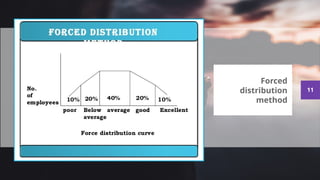
11
Forced
distribution
method
12
Objective Measures:
1. Quantity of Work- simply counting the number of
relevant job behaviors that take place.
2. Quality of Work- Quality is usually measured in terms
of errors, which are defined as deviations from a
standard.
3. Attendance- Can be separated into three distinct
criteria: absenteeism, tardiness, and tenure.
4. Safety- Employees who follow safety rules and who
have no occupational accidents do not cost an
organization as much money as those who break rules,
equipment, and possibly their own bodies.
4: Select the
best appraisal
methods
13
Frame of reference training- a
method of training raters in which
the rater is provided with job-
related information, a chance to
practice ratings, examples of
ratings, made by experts, and the
rationale behind the expert ratings.
5. Train raters
14
Critical incidents- a method of
performance appraisal in which the
supervisor records employee
behaviors that were observed on
the job and rates the employee on
the basis of that record.
6. Observe
and Document
Performance
15
Critical incidents- a method of
performance appraisal in which the
supervisor records employee
behaviors that were observed on
the job and rates the employee on
the basis of that record.
6. Observe
and Document
Performance
16
Supervisors tend to remember the
following:
• First impressions
• Recent behaviors
• Unusual or extreme behaviors
• Behavior consistent with supervisor’s
opinion
17
Distribution errors:
• Leniency error
• Central Tendency error
• Strictness error
• Proximity error
• Halo error
• Contrast error
7. Evaluate
Performance
18
8. Communicate
Appraisal
Results to
Employees
PRIOR THE INTERVIEW
• Allocating time
• Scheduling the Interview
• Preparing for the interview
DURING THE INTERVIEW
o Role of the performance appraisal
o How the appraisal was conducted
o How the evaluation process was accomplished
o The expectation that the appraisal interview will be
interactive
o The goal of understanding and improving performance
19
9. Terminate
employees
LEGAL REASONS FOR
TERMINATING EMPLOYEES:
1. Probationary period
2. Violation of Company rules
3. Inability to perform
4. Reduction in force (layoff)
20
10. Monitor the
Legality and
Fairness of the
Appraisal system
JOB PERFORMANCE- the record of
outcomes produced on a specified job
function during a specified time period
(Bernadin and Beatty 2001; Hechanova)
25
Roles in Performance Management
26
TOP
EXECUTIVES
LINE
MANAGERS
EMPLOYEES IN
PARTNERSHIP
WITH THEIR
SUPERVISORS
HUMAN
RESOURCES
Chapter 5 Evaluating-Employee-Performance.pptx

Chapter 5 Evaluating-Employee-Performance.pptx

  • 1.
  • 2.
    2 Steps in Employee Appraisal 1. Determinethe Reason for Evaluating Employee Performance 2. Identify Environmental & Cultural Limitations 3. Determine who will evaluate performance 4. Select the best Appraisal methods 5. Train Raters 6. Observe and document performance 7. Evaluate Performance 8. Communicate Appraisal Results to Employees 9. Terminate Employees 10. Monitor the legality and fairness of the appraisal system
  • 3.
    3 1. Determine the reasonfor evaluating employee Goals for performance appraisal: Providing employee feedback and training Determining salary increases Make promotion decisions Making termination decisions Conducting personnel research.
  • 4.
    4 Performance appraisal review-meeting between a supervisor and a subordinate for the purpose of discussing performance appraisal results Peter principle- organizations tend to promote the good employees until they reach the highest level of incompetence 1. Determine the reason for evaluating employee
  • 5.
    5 Identify the environmentaland cultural factors that could affect the system. 2:Identify environmental and cultural limitations
  • 6.
    6 360 degree feedback-feedback is obtained from multiple sources such as supervisor, subordinates and peers. Multiple source feedback- an employee receives feedback from sources (clients, subordimates, peers) other than his or her supervisor Supervisors Peers Subordinates Customers Self appraisal 3: Determine who will evaluate performance
  • 7.
    7 Decision 1: Focusof the Appraisal Dimensions Decision 2: Should Dimensions Be Weighted? Decision 3: Use of Employee Comparisons, Objective Measures, or Ratings 4: Select the best appraisal methods
  • 8.
    8 criteria- ways ofdescribing employee success 1. Trait focused performance dimensions- focus on employee attributes 2. Competency focused performance dimensions- employee’s knowledge, skills and abilities 3. Task focused performance dimensions- similarity of tasks that are performed 4. Goal focused performance dimension- on the basis of goals to be accomplished 5. Contextual performance- being good organizational citizens 4: Select the best appraisal methods
  • 9.
  • 10.
  • 11.
  • 12.
    12 Objective Measures: 1. Quantityof Work- simply counting the number of relevant job behaviors that take place. 2. Quality of Work- Quality is usually measured in terms of errors, which are defined as deviations from a standard. 3. Attendance- Can be separated into three distinct criteria: absenteeism, tardiness, and tenure. 4. Safety- Employees who follow safety rules and who have no occupational accidents do not cost an organization as much money as those who break rules, equipment, and possibly their own bodies. 4: Select the best appraisal methods
  • 13.
    13 Frame of referencetraining- a method of training raters in which the rater is provided with job- related information, a chance to practice ratings, examples of ratings, made by experts, and the rationale behind the expert ratings. 5. Train raters
  • 14.
    14 Critical incidents- amethod of performance appraisal in which the supervisor records employee behaviors that were observed on the job and rates the employee on the basis of that record. 6. Observe and Document Performance
  • 15.
    15 Critical incidents- amethod of performance appraisal in which the supervisor records employee behaviors that were observed on the job and rates the employee on the basis of that record. 6. Observe and Document Performance
  • 16.
    16 Supervisors tend toremember the following: • First impressions • Recent behaviors • Unusual or extreme behaviors • Behavior consistent with supervisor’s opinion
  • 17.
    17 Distribution errors: • Leniencyerror • Central Tendency error • Strictness error • Proximity error • Halo error • Contrast error 7. Evaluate Performance
  • 18.
    18 8. Communicate Appraisal Results to Employees PRIORTHE INTERVIEW • Allocating time • Scheduling the Interview • Preparing for the interview DURING THE INTERVIEW o Role of the performance appraisal o How the appraisal was conducted o How the evaluation process was accomplished o The expectation that the appraisal interview will be interactive o The goal of understanding and improving performance
  • 19.
    19 9. Terminate employees LEGAL REASONSFOR TERMINATING EMPLOYEES: 1. Probationary period 2. Violation of Company rules 3. Inability to perform 4. Reduction in force (layoff)
  • 20.
    20 10. Monitor the Legalityand Fairness of the Appraisal system
  • 21.
    JOB PERFORMANCE- therecord of outcomes produced on a specified job function during a specified time period (Bernadin and Beatty 2001; Hechanova)
  • 25.
  • 26.
    Roles in PerformanceManagement 26 TOP EXECUTIVES LINE MANAGERS EMPLOYEES IN PARTNERSHIP WITH THEIR SUPERVISORS HUMAN RESOURCES

Editor's Notes

  • #6 Employee self-appraisals tend to suffer from leniency 
  • #14 Such documentation is usually written in a critical incident log—formal accounts of excellent and poor employee performance that were observed by the supervisor. Critical incidents should be communicated to the employee at the time they occur 
  • #15 Such documentation is usually written in a critical incident log—formal accounts of excellent and poor employee performance that were observed by the supervisor. Critical incidents should be communicated to the employee at the time they occur