World religions and
belief systems
September 15, 2021
HUMSS
LIFE PERFORMANCE OUTCOME
I am a conscientious, adept
performer and achiever,
competently pursuing my
mission in life.
essential PERFORMANCE OUTCOME
Devote focused time to developing the
competencies required for sound
achievement in a chosen field and for
functioning effectively in the face of
life’s diverse challenges.
INTENDED LEARNING OUTCOME
Devote focused time to
developing the competencies
required in understanding the
history of Islam.
TRIVIA QUIZ ABOUT
islam
https://youtu.be/xkjx5Q2ZYbk
Discussion on islam
(an excerpt from the
qur’an)
In the Name of God, the Merciful, the
Compassionate
Recite: In the Name of thy Lord who created,
created Man of a blood-clot.
Recite: And thy Lord is the Most Generous,
who taught by the Pen,
taught Man that he knew not.
No indeed; surely Man waxes insolent,
for he thinks himself self-sufficient.
Surely unto thy Lord is the Returning.
What thinkest thou? He who forbids
a servant when he prays-
What thinkest thou? If he were upon guidance
or bade to godfearing-
What thinkest thou? If he cries lies, and turns away-
Did he not know that God sees?
No indeed; surely Man waxes insolent,
for he thinks himself self-sufficient.
Surely unto thy Lord is the Returning.
What thinkest thou? He who forbids
a servant when he prays-
What thinkest thou? If he were upon guidance
or bade to godfearing-
What thinkest thou? If he cries lies, and turns away-
Did he not know that God sees?
No indeed; surely, if he gives not over,
We shall seize him by the forelock,
a lying, sinful forelock.
So let him call on his concourse!
We shall call on the guards of Hell.
No indeed; do thou not obey him,
and bow thyself, and draw nigh.
PROCESSING QUESTIONS:
What is the poem about?
What does it tell us about
Islam?
What is valuable about this?
islam
https://youtu.be/wgP_OSOS3IA
islam
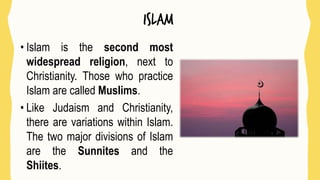
• Islam is the second most
widespread religion, next to
Christianity. Those who practice
Islam are called Muslims.
• Like Judaism and Christianity,
there are variations within Islam.
The two major divisions of Islam
are the Sunnites and the
Shiites.
islam
• Islam seems to be the third and the
final revelation of the Abrahamic
monotheistic tradition and it
constitutes the third and major branch
of monotheism.
• It is, therefore, a religion that
somehow necessitates the study of
the whole religious family to which
Jews and Christians belongs.
islam
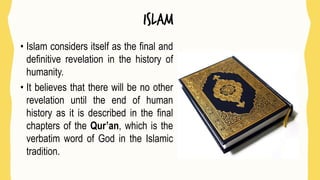
• Islam considers itself as the final and
definitive revelation in the history of
humanity.
• It believes that there will be no other
revelation until the end of human
history as it is described in the final
chapters of the Qur’an, which is the
verbatim word of God in the Islamic
tradition.
islam
• Muhammad is the Prophet of
Islam and he is often referred
to as ‘the Seal of Prophets’;
he is the last prophet.
islam
• Islam considers itself as the final revelation in the
chain of prophecy that begins with Adam, who they
consider as the father of humankind and also as the
first prophet.
• The Islamic message is none other than the
acceptance of God as the One and submission to
Him, which results in peace.
islam
•Hence the name of Islam
means surrender to the
Will of the One God,
and He is called Allah in
Arabic” (Nasr 1993,
428).
islam
• The primordial character of the Islamic message is
reflected not only in its essentiality, universality, and
simplicity but also in its inclusive attitude toward the
religions that preceded it.
• As every veritable Omega is also the alpha, Islam is the
terminal religion but also is the primordial religion, and
this is discernible in the Qur’an.
Qur’an
https://youtu.be/WhIJX92Ovn0
• The Qur’an, sacred text of Islam,
is believed to be the literal Word
of Allah. They being learning it at
an early age; the Qur’an is read to
babies, and toddlers who can
already speak are asked to
memorize and recite Qur’anic
verses.
• People who manage to
memorize the book are held in
high regard by the
communities.
• Since the Qur’an is written in
Arabic, the language is
respected by the Muslims.
• For them, the book is a unique
event in the history of
humankind, held as eternal
and unchangeable, just like
Allah.
• The Qur’an consists of 114
chapters, or surahs, each
composed of verses, or
ayahs.
• The shorter chapters are
called Meccan surahs
because they are believed to
have been revealed to
Muhammad in Mecca, while
the longer ones are called
Medinan chapters, believed
to have been revealed later
when Muhammad was in
Medina.
• The Qur’an condemns any
association of a person or
thing with God. They believe
that it violates a fundamental
Islamic principle--that there is
just one God. That is why
they reject the divinity of
Jesus Christ.
• An important branch of Islam
is the proper interpretation of
Qur’an, and the intellectual
explanation of Qur’an is called
Tafsir, written by Mufassir.
(Gordon, 1991:51)
• Again, like Judaism and
Christianity, Islam is a religion that
emphasizes on the community.
According to the Qur’an, God
made the Muslims into a particular
community, the ummah, and a
devout Muslim is both loyal to
Allah and the ummah. “The goal
of the Muslim society is to create
a just society.”
5 pillars of islam
https://youtu.be/YlflvwwtZbU?list=PLXmK8UU2fiTf8pyIqGHt9pAY
XcjBl2Fw4
• “There is no God but Allah, and Muhammad is his
messenger.” This creed summarizes the faith of a
Muslim. “It is the first sentence whispered into the
ears of a newborn infant; it is recited daily in prayer;
and it is written in Arabic everywhere inside the
domes of mosques and over their doors.” (Molloy,
2005: 440).
Shahadah (Creed)
• In this very short and simple creed, we see its
contrast to the Christian creed, which is long and
emphasizes belief in the Trinity, and belief that Jesus
is divine. Muslims reject this, because for them there
is only one God, and Muhammad is just a
messenger, and not divine like Jesus.
Shahadah (Creed)
• “Muslims pray five times a day:
before dawn, midday, mid
afternoon, sunset, and nighttime.
• Before prayer, there is an
individual cleansing ritual with
water, washing the hands, arms,
face, neck, and feet.
Salat (Prayer)
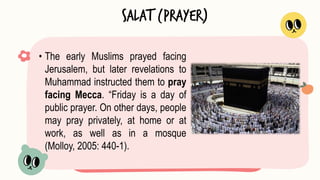
• Muslims pray facing Mecca;
there is a special arched niche
called mihrab inside the
mosque that indicates the
qibla—the direction of the
Kaaba in Mecca.
Salat (Prayer)
• The early Muslims prayed facing
Jerusalem, but later revelations to
Muhammad instructed them to pray
facing Mecca. “Friday is a day of
public prayer. On other days, people
may pray privately, at home or at
work, as well as in a mosque
(Molloy, 2005: 440-1).
Salat (Prayer)
• Muslims donate certain
percentages of their wages
to the poor.
Zakat (charity)
• In Islamic countries, the
government is involved in
imposing taxes for zakat. “In
addition to established yearly
donations, a good Muslim is
expected to perform isolated
acts of generosity and charity
for the poor when such acts are
called for in everyday life”.
Zakat (charity)
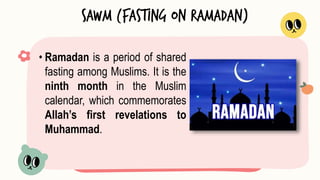
• Ramadan is a period of shared
fasting among Muslims. It is the
ninth month in the Muslim
calendar, which commemorates
Allah’s first revelations to
Muhammad.
Sawm (Fasting on Ramadan)
• During the month-long Ramadan, people abstain from
food, drinks, tobacco and sex from dawn until dusk,
except for travelers, pregnant women, and the sick.
• “The purpose of fasting is to discipline oneself, to
develop sympathy for the poor and hungry, and to give to
others what one would have eaten. Fasting is thought to
be good for individual spiritual growth”
Sawm (Fasting on Ramadan)
• Pilgrimage is a “religious
journey by a believer to a
sacred city or site. All Muslims
(unless prevented by poverty or
sickness) are expected to visit
Mecca at least once in their
lifetime (Molloy, 2005: 443).”
Hajj (Pilgrimage to Mecca)
• Hajj is already a practice before Muhammad’s time.
When he went back to Mecca after preaching in Medina,
he continued several practices of the pilgrimage,
including veneration of the black meteorite--which is
believed to be a special gift from Allah, carried to earth
by the angel Gabriel.”
Hajj (Pilgrimage to Mecca)
INTENDED LEARNING OUTCOME
Devote focused time to
developing the competencies
required in understanding the
history of Islam.
essential PERFORMANCE OUTCOME
Devote focused time to developing the
competencies required for sound
achievement in a chosen field and for
functioning effectively in the face of
life’s diverse challenges.
LIFE PERFORMANCE OUTCOME
I am a conscientious, adept
performer and achiever,
competently pursuing my
mission in life.

Chapter 4 Islam.....................pptx

  • 1.
    World religions and beliefsystems September 15, 2021 HUMSS
  • 2.
    LIFE PERFORMANCE OUTCOME Iam a conscientious, adept performer and achiever, competently pursuing my mission in life.
  • 3.
    essential PERFORMANCE OUTCOME Devotefocused time to developing the competencies required for sound achievement in a chosen field and for functioning effectively in the face of life’s diverse challenges.
  • 4.
    INTENDED LEARNING OUTCOME Devotefocused time to developing the competencies required in understanding the history of Islam.
  • 5.
  • 6.
    Discussion on islam (anexcerpt from the qur’an)
  • 7.
    In the Nameof God, the Merciful, the Compassionate Recite: In the Name of thy Lord who created, created Man of a blood-clot. Recite: And thy Lord is the Most Generous, who taught by the Pen, taught Man that he knew not.
  • 8.
    No indeed; surelyMan waxes insolent, for he thinks himself self-sufficient. Surely unto thy Lord is the Returning. What thinkest thou? He who forbids a servant when he prays- What thinkest thou? If he were upon guidance or bade to godfearing- What thinkest thou? If he cries lies, and turns away- Did he not know that God sees?
  • 9.
    No indeed; surelyMan waxes insolent, for he thinks himself self-sufficient. Surely unto thy Lord is the Returning. What thinkest thou? He who forbids a servant when he prays- What thinkest thou? If he were upon guidance or bade to godfearing- What thinkest thou? If he cries lies, and turns away- Did he not know that God sees?
  • 10.
    No indeed; surely,if he gives not over, We shall seize him by the forelock, a lying, sinful forelock. So let him call on his concourse! We shall call on the guards of Hell. No indeed; do thou not obey him, and bow thyself, and draw nigh.
  • 11.
    PROCESSING QUESTIONS: What isthe poem about? What does it tell us about Islam? What is valuable about this?
  • 12.
  • 13.
    islam • Islam isthe second most widespread religion, next to Christianity. Those who practice Islam are called Muslims. • Like Judaism and Christianity, there are variations within Islam. The two major divisions of Islam are the Sunnites and the Shiites.
  • 14.
    islam • Islam seemsto be the third and the final revelation of the Abrahamic monotheistic tradition and it constitutes the third and major branch of monotheism. • It is, therefore, a religion that somehow necessitates the study of the whole religious family to which Jews and Christians belongs.
  • 15.
    islam • Islam considersitself as the final and definitive revelation in the history of humanity. • It believes that there will be no other revelation until the end of human history as it is described in the final chapters of the Qur’an, which is the verbatim word of God in the Islamic tradition.
  • 16.
    islam • Muhammad isthe Prophet of Islam and he is often referred to as ‘the Seal of Prophets’; he is the last prophet.
  • 17.
    islam • Islam considersitself as the final revelation in the chain of prophecy that begins with Adam, who they consider as the father of humankind and also as the first prophet. • The Islamic message is none other than the acceptance of God as the One and submission to Him, which results in peace.
  • 18.
    islam •Hence the nameof Islam means surrender to the Will of the One God, and He is called Allah in Arabic” (Nasr 1993, 428).
  • 19.
    islam • The primordialcharacter of the Islamic message is reflected not only in its essentiality, universality, and simplicity but also in its inclusive attitude toward the religions that preceded it. • As every veritable Omega is also the alpha, Islam is the terminal religion but also is the primordial religion, and this is discernible in the Qur’an.
  • 20.
  • 21.
    • The Qur’an,sacred text of Islam, is believed to be the literal Word of Allah. They being learning it at an early age; the Qur’an is read to babies, and toddlers who can already speak are asked to memorize and recite Qur’anic verses.
  • 22.
    • People whomanage to memorize the book are held in high regard by the communities. • Since the Qur’an is written in Arabic, the language is respected by the Muslims.
  • 23.
    • For them,the book is a unique event in the history of humankind, held as eternal and unchangeable, just like Allah. • The Qur’an consists of 114 chapters, or surahs, each composed of verses, or ayahs.
  • 24.
    • The shorterchapters are called Meccan surahs because they are believed to have been revealed to Muhammad in Mecca, while the longer ones are called Medinan chapters, believed to have been revealed later when Muhammad was in Medina.
  • 25.
    • The Qur’ancondemns any association of a person or thing with God. They believe that it violates a fundamental Islamic principle--that there is just one God. That is why they reject the divinity of Jesus Christ.
  • 26.
    • An importantbranch of Islam is the proper interpretation of Qur’an, and the intellectual explanation of Qur’an is called Tafsir, written by Mufassir. (Gordon, 1991:51)
  • 27.
    • Again, likeJudaism and Christianity, Islam is a religion that emphasizes on the community. According to the Qur’an, God made the Muslims into a particular community, the ummah, and a devout Muslim is both loyal to Allah and the ummah. “The goal of the Muslim society is to create a just society.”
  • 28.
    5 pillars ofislam https://youtu.be/YlflvwwtZbU?list=PLXmK8UU2fiTf8pyIqGHt9pAY XcjBl2Fw4
  • 29.
    • “There isno God but Allah, and Muhammad is his messenger.” This creed summarizes the faith of a Muslim. “It is the first sentence whispered into the ears of a newborn infant; it is recited daily in prayer; and it is written in Arabic everywhere inside the domes of mosques and over their doors.” (Molloy, 2005: 440). Shahadah (Creed)
  • 30.
    • In thisvery short and simple creed, we see its contrast to the Christian creed, which is long and emphasizes belief in the Trinity, and belief that Jesus is divine. Muslims reject this, because for them there is only one God, and Muhammad is just a messenger, and not divine like Jesus. Shahadah (Creed)
  • 31.
    • “Muslims prayfive times a day: before dawn, midday, mid afternoon, sunset, and nighttime. • Before prayer, there is an individual cleansing ritual with water, washing the hands, arms, face, neck, and feet. Salat (Prayer)
  • 32.
    • Muslims prayfacing Mecca; there is a special arched niche called mihrab inside the mosque that indicates the qibla—the direction of the Kaaba in Mecca. Salat (Prayer)
  • 33.
    • The earlyMuslims prayed facing Jerusalem, but later revelations to Muhammad instructed them to pray facing Mecca. “Friday is a day of public prayer. On other days, people may pray privately, at home or at work, as well as in a mosque (Molloy, 2005: 440-1). Salat (Prayer)
  • 34.
    • Muslims donatecertain percentages of their wages to the poor. Zakat (charity)
  • 35.
    • In Islamiccountries, the government is involved in imposing taxes for zakat. “In addition to established yearly donations, a good Muslim is expected to perform isolated acts of generosity and charity for the poor when such acts are called for in everyday life”. Zakat (charity)
  • 36.
    • Ramadan isa period of shared fasting among Muslims. It is the ninth month in the Muslim calendar, which commemorates Allah’s first revelations to Muhammad. Sawm (Fasting on Ramadan)
  • 37.
    • During themonth-long Ramadan, people abstain from food, drinks, tobacco and sex from dawn until dusk, except for travelers, pregnant women, and the sick. • “The purpose of fasting is to discipline oneself, to develop sympathy for the poor and hungry, and to give to others what one would have eaten. Fasting is thought to be good for individual spiritual growth” Sawm (Fasting on Ramadan)
  • 38.
    • Pilgrimage isa “religious journey by a believer to a sacred city or site. All Muslims (unless prevented by poverty or sickness) are expected to visit Mecca at least once in their lifetime (Molloy, 2005: 443).” Hajj (Pilgrimage to Mecca)
  • 39.
    • Hajj isalready a practice before Muhammad’s time. When he went back to Mecca after preaching in Medina, he continued several practices of the pilgrimage, including veneration of the black meteorite--which is believed to be a special gift from Allah, carried to earth by the angel Gabriel.” Hajj (Pilgrimage to Mecca)
  • 40.
    INTENDED LEARNING OUTCOME Devotefocused time to developing the competencies required in understanding the history of Islam.
  • 41.
    essential PERFORMANCE OUTCOME Devotefocused time to developing the competencies required for sound achievement in a chosen field and for functioning effectively in the face of life’s diverse challenges.
  • 42.
    LIFE PERFORMANCE OUTCOME Iam a conscientious, adept performer and achiever, competently pursuing my mission in life.