GEOGRAPHY
WHAT IS GEOGRAPHY?
•From the Greek geo, which means “Earth”,
and graphein, which means “to write”.
•The study of places and relatioships between
people and their environments.
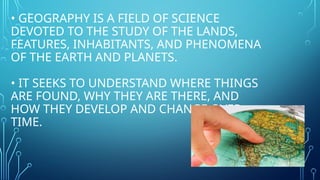
• GEOGRAPHY IS A FIELD OF SCIENCE
DEVOTED TO THE STUDY OF THE LANDS,
FEATURES, INHABITANTS, AND PHENOMENA
OF THE EARTH AND PLANETS.
• IT SEEKS TO UNDERSTAND WHERE THINGS
ARE FOUND, WHY THEY ARE THERE, AND
HOW THEY DEVELOP AND CHANGE OVER
TIME.
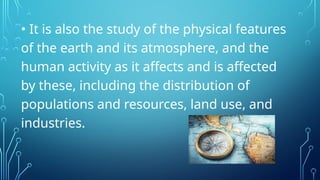
• It is also the study of the physical features
of the earth and its atmosphere, and the
human activity as it affects and is affected
by these, including the distribution of
populations and resources, land use, and
industries.
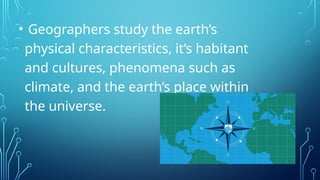
• Geographers study the earth’s
physical characteristics, it’s habitant
and cultures, phenomena such as
climate, and the earth’s place within
the universe.
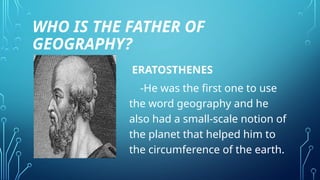
WHO IS THE FATHER OF
GEOGRAPHY?
ERATOSTHENES
-He was the first one to use
the word geography and he
also had a small-scale notion of
the planet that helped him to
the circumference of the earth.
TOOLS USED BY GEOGRAPHERS
• Maps • Satellite images • Spreadshits
• Globes • Historical records • Sketch maps
• Internet • Field maps • Reports
• Remote sensing • Databases • Research
papers
• News media • Statistic tables • Oral
presentations
• Direct Observation • Graphs diagrams
• Interviews • Summaries
HOW IS GEOGRAPHY USED TODAY?
• Geography can help us to understand the
planet’s movement, changes, and systems. Topics
that are relevant to today such as climate change,
water availability, and natural resources.
FIVE THEMES OF GEOGRAPHY
LOCATION – Pertains to a place or position.
•Absolute location – is defined using it’s
exact address.
•Relative location – describes where a place
is in relation to other location.
PLACE – pertains to the physical and human attributes
or characteristics of a location.
HUMAN-ENVIRONMENTAL INTERARCTION – This
theme examines all how we have done and continue to
do such things.
MOVEMENT – It deals with the examination of
immigration, emigration, populations, and distribution
in the region, and the countries of the world.
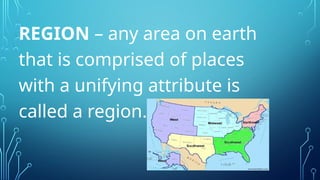
REGION – any area on earth
that is comprised of places
with a unifying attribute is
called a region.
SIGNIFICANCE OF GEOGRAPHY
•Geography helps us understand basic physical
systems that affect everyday life.
•To learn the location of places and the physical and
cultural characteristics of those places in order to
function more effectively in our increasingly
interdependent world.
• To understand the spatial organisation of society and
see order in what often appears to be random
scattering of people and places.
• To appreciate Earth as the homeland of humankind
and provide insight for wise management decisions
about how the planet's resources should be used.
• To understand global interdependence and to
become a better global citizen.
BRANCHES OF
GEOGRAPHY
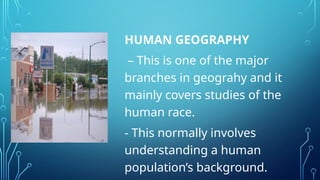
HUMAN GEOGRAPHY
– This is one of the major
branches in geograhy and it
mainly covers studies of the
human race.
- This normally involves
understanding a human
population’s background.
EXAMPLES OF HUMAN
GEOGRAPHY
CULTURAL GEOGRAPHY
-Studies the relationship between different cultures and
place.
DEVELOPMENT GEOGRAPHY
- Studies the quality of life and standards of living within
different communities around the world.
ECONOMIC GEOGRAPHY
-Geographers under this branch normally study the
manner in which products are usually produced and
consiquently distributed in their respective niche
markets.
HEALTH GEOGRAPHY
- Healthy geography looks at the distribution and access
to healthcare as well as the overall health of the
populations.
HISTORICAL GEOGRAPHY
- This geography looks at how a place and
people that live there have changed over
time.
POPULATION GEOGRAPHY
- Geographers who are involved in this
discipline normally study the population of
regions in much more detail.
MEDICAL GEOGRAPHY
- Study the patterns in which particular
diseases spread.
MILITARY GEOGRAPHY
- Geographers who practice this discipline
normally coduct their research and studies
within the military fraternity.
POLITICAL GEOGRAPHY
- It is involved in the in the investigation of every
aspect of politics.
TRANSPORTATION GEOGRAPHY
- Geographers who are involved in this branch of
geography are usually involved in the research of
the available networks for transportation.
SETTLEMENT GEOGRAPHY
-The study over time and space of areas where
humans have or currently reside.
URBAN GEOGRAPHY
- With the development of urban cities worldwide,
the branch of urban geography came into play
since it enables researchers to study these trends
much more effectively.
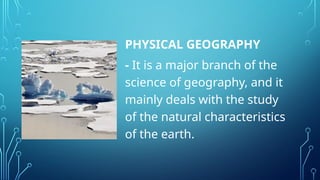
PHYSICAL GEOGRAPHY
- It is a major branch of the
science of geography, and it
mainly deals with the study
of the natural characteristics
of the earth.
EXAMPLES OF PHYSICAL
GEOGRAPHY
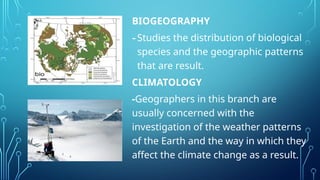
BIOGEOGRAPHY
-Studies the distribution of biological
species and the geographic patterns
that are result.
CLIMATOLOGY
-Geographers in this branch are
usually concerned with the
investigation of the weather patterns
of the Earth and the way in which they
affect the climate change as a result.
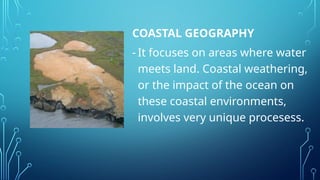
COASTAL GEOGRAPHY
- It focuses on areas where water
meets land. Coastal weathering,
or the impact of the ocean on
these coastal environments,
involves very unique procesess.
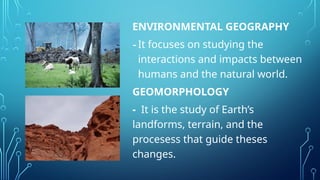
ENVIRONMENTAL GEOGRAPHY
-It focuses on studying the
interactions and impacts between
humans and the natural world.
GEOMORPHOLOGY
- It is the study of Earth’s
landforms, terrain, and the
procesess that guide theses
changes.
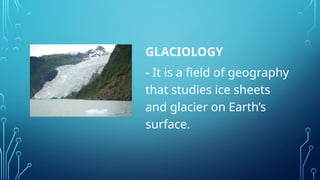
GLACIOLOGY
- It is a field of geography
that studies ice sheets
and glacier on Earth’s
surface.
HYDROLOGY
- The study of hydraulics concerns the
amount of quality of water and its
movement across Earth’s surface.
LANDSCAPE ECOLOGY
- Landscape ecology blends ecology and
geography to show ecological procesess.
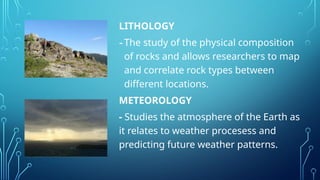
LITHOLOGY
-The study of the physical composition
of rocks and allows researchers to map
and correlate rock types between
different locations.
METEOROLOGY
- Studies the atmosphere of the Earth as
it relates to weather procesess and
predicting future weather patterns.
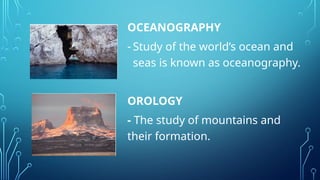
OCEANOGRAPHY
- Study of the world’s ocean and
seas is known as oceanography.
OROLOGY
- The study of mountains and
their formation.
PALAEOGEOGRAPHY
- Studies materials that has been
preserved in the soil record, or
stratigraphic record, of Earth’s crust.
GEOGRAPHY OF THE
PHILIPPINES
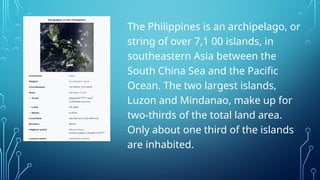
The Philippines is an archipelago, or
string of over 7,1 00 islands, in
southeastern Asia between the
South China Sea and the Pacific
Ocean. The two largest islands,
Luzon and Mindanao, make up for
two-thirds of the total land area.
Only about one third of the islands
are inhabited.
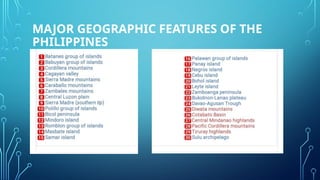
MAJOR GEOGRAPHIC FEATURES OF THE
PHILIPPINES
TOURIST ATTRACTIONS IN
THE PHILIPPINES
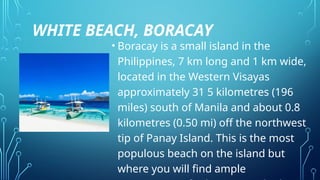
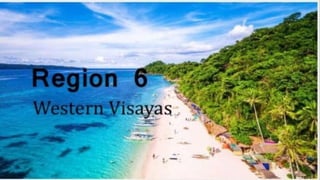
WHITE BEACH, BORACAY
• Boracay is a small island in the
Philippines, 7 km long and 1 km wide,
located in the Western Visayas
approximately 31 5 kilometres (196
miles) south of Manila and about 0.8
kilometres (0.50 mi) off the northwest
tip of Panay Island. This is the most
populous beach on the island but
where you will find ample
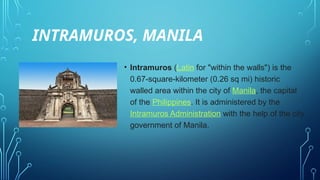
INTRAMUROS, MANILA
• Intramuros (Latin for "within the walls") is the
0.67-square-kilometer (0.26 sq mi) historic
walled area within the city of Manila, the capital
of the Philippines. It is administered by the
Intramuros Administration with the help of the city
government of Manila.
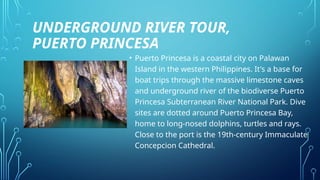
UNDERGROUND RIVER TOUR,
PUERTO PRINCESA
• Puerto Princesa is a coastal city on Palawan
Island in the western Philippines. It's a base for
boat trips through the massive limestone caves
and underground river of the biodiverse Puerto
Princesa Subterranean River National Park. Dive
sites are dotted around Puerto Princesa Bay,
home to long-nosed dolphins, turtles and rays.
Close to the port is the 19th-century Immaculate
Concepcion Cathedral.
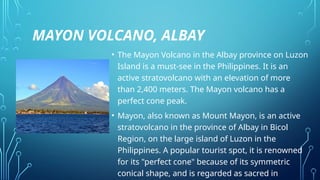
MAYON VOLCANO, ALBAY
• The Mayon Volcano in the Albay province on Luzon
Island is a must-see in the Philippines. It is an
active stratovolcano with an elevation of more
than 2,400 meters. The Mayon volcano has a
perfect cone peak.
• Mayon, also known as Mount Mayon, is an active
stratovolcano in the province of Albay in Bicol
Region, on the large island of Luzon in the
Philippines. A popular tourist spot, it is renowned
for its "perfect cone" because of its symmetric
conical shape, and is regarded as sacred in
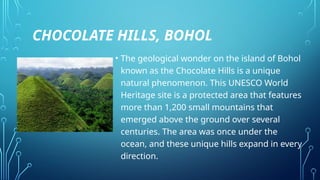
CHOCOLATE HILLS, BOHOL
• The geological wonder on the island of Bohol
known as the Chocolate Hills is a unique
natural phenomenon. This UNESCO World
Heritage site is a protected area that features
more than 1,200 small mountains that
emerged above the ground over several
centuries. The area was once under the
ocean, and these unique hills expand in every
direction.
CLIMATE OF THE
PHILIPPINES
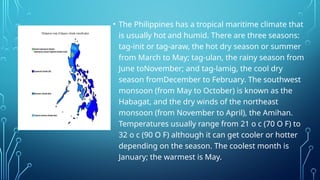
• The Philippines has a tropical maritime climate that
is usually hot and humid. There are three seasons:
tag-init or tag-araw, the hot dry season or summer
from March to May; tag-ulan, the rainy season from
June toNovember; and tag-lamig, the cool dry
season fromDecember to February. The southwest
monsoon (from May to October) is known as the
Habagat, and the dry winds of the northeast
monsoon (from November to April), the Amihan.
Temperatures usually range from 21 o c (70 O F) to
32 o c (90 O F) although it can get cooler or hotter
depending on the season. The coolest month is
January; the warmest is May.
THE WAY OF LIVING IN
THE PHILIPPINES
• Those with more family members are more at risk
of poverty in the philippines. An estimated four out
of 10 people that are poor have jobs but they are
usually paid less due to the lack of proper
education.
• Farming, fishing, and forestry are the primary
occupations in rural areas but most urban residents
are employed in the service sector or in
manufacturing.
• More service and modern facilities are available in
town or cities.
• Weather festival fare or everyday food, major meals in
most filipino society are built around boiled or steamed
rice or rice noodles, vegetables, fresh or salted fish, and
fruits.
• Those facing poverty conditions sometimes have no
access to electrity. Water and proper sanitation facilities,
just a few of the basic necessities Human beings need.
CULTURE OF EVERY
REGION IN THE
PHILIPPINES
REGION 2
CAGAYAN VALLEY
MATERIAL CULTURE
People in the valley dressed very simply. Old women used
the saya and kimono while men used the camisa de chino
or the barong tagalog. Some of the houses that withstood
the Japanese occupation were historical houses made of
hard wood. Some were bahay-kubo. Most typical homes
were strong and typhoon-resistant.
For agriculture, today, there are only a few have modern
agricultural implements. The majority still use traditional
implements like animal-drawn tools.
NON-MATERIAL CULTURE
Filipinos are characterized by its close family ties such that
majority of married couples with children lived with their
parents. The value of bayanihan, sharing, cooperation,
brotherhood, self-responsibility, respect, love, peace, and
dignity, are still very much alive in Cagayan.
REGION 4A
CALABARZON
REGION 4B
MIMAROPA
ARTS AND CULTURE IN MIMAROPA
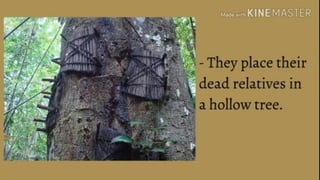
Because Mimaropa is ancient, it is home to
indigenous peoples. The Mangyans survive in
Mindoro (they speak seven different languages:
Irava, Alangan, Tambuid, Hanunuo, Tadyawan,
Buhid and Ratagnon).
REGION 5
BICOL
The Bicol are largely an agricultural and rural
people, producing rice, coconuts, and hemp.
Nearly all of them are Roman Catholics. Their
language is closely related to others of the
central Philippines, all of which belong to the
Austronesian (Malayo-Polynesian) family of
languages.
CAR REGION
Cordillera Administrative Region (CAR) is rich
in ancient culture. It is the home of the
indigenous tribe called the Igorot. The way
of life of the people in this region existed
way back to ancient Filipinos before the
Spanish colonization.
NCR REGION
Manila's wide range of cultural influences
spanning different historical and cultural
periods - American, Spanish, Chinese, and
Malay — clearly reflect the turbulent history of
the city and country as binds the rich cultural
heritage towards the latest contemporary art
developments.
Zamboanga always throbs with the colorful
cultures, traditions, and lifestyles of people
shaped by the confluence of native
Subano, Malay, Islamic (Yakan, Samal,
Tausug and Badjao), Spanish and American
cultures that spanned the course of
centuries.
REGION 10
NORTHERN MINDANAO
Northern Mindanao is a region rich in culture,
which can be seen in their numerous festivals. One
of the most popular festivals in the region is the
Higalaay Festival in Cagayan de Oro City. They
celebrate the feast day of St. Augustine every 28th
day of August. Another festival is Kaamulan
festival in Bukidnon. It is an ethnic cultural festival
wherein people allocate a relative amount of their
time to remember the culture and traditions of the
seven ethnic tribes in their area.
REGION 11
DAVAO REGION
Davao City is a melting pot for all cultures;
its geography and surroundings, its colorful
history, the rich diversity of its culture and
tradition, the gathering and festivities like
the Kadayawan Festival, make Davao City an
exciting place to visit.
A pair of agungs is one of the instruments found
in the kulintang ensemble, and Region XII is home
to a fascinating culture that revolves around
kulintang music, a specific type of gong music
found among both Muslim groups (such as the
Maguindanao) and non-Muslim groups (such as
the Tiruray) of the Southern Philippines
Majority of the inhabitants of the region are of
Visayan lineage. The ethnic residents include the
Manobo, the Mamanwa and other tribes. It is
reported that during the early years of the Caraga
region, its inhabitants came from mainland Asia,
followed by Malayans, Arabs, Chinese, Japanese,
Spanish and Americans.
ARMM
WHILE Muslims around the world reflect, pray and fast
during the Islamic holy month of Ramadan, the
Autonomous Region in Muslim Mindanao (ARMM)
augments these customs with a celebration of the
Bangsamoro culture. A history and lifestyle exhibition,
called Discover ARMM in 100 Days Journey, runs through
September 22 at the ARMM Compound in Cotabato City.
Cultural villages that represent the architecture and
lifestyle of the ARMM’s tribes—Maguindanaon, Tausug,
Sama, Maranao, Yakan, Iranon and Tedura—highlight the
event.
THANK YOU

CHAPTER 4 GEOGRAPHY. WITH GAMES THAT CONNECTED TO LESSON

  • 17.
  • 18.
    WHAT IS GEOGRAPHY? •Fromthe Greek geo, which means “Earth”, and graphein, which means “to write”. •The study of places and relatioships between people and their environments.
  • 19.
    • GEOGRAPHY ISA FIELD OF SCIENCE DEVOTED TO THE STUDY OF THE LANDS, FEATURES, INHABITANTS, AND PHENOMENA OF THE EARTH AND PLANETS. • IT SEEKS TO UNDERSTAND WHERE THINGS ARE FOUND, WHY THEY ARE THERE, AND HOW THEY DEVELOP AND CHANGE OVER TIME.
  • 20.
    • It isalso the study of the physical features of the earth and its atmosphere, and the human activity as it affects and is affected by these, including the distribution of populations and resources, land use, and industries.
  • 21.
    • Geographers studythe earth’s physical characteristics, it’s habitant and cultures, phenomena such as climate, and the earth’s place within the universe.
  • 22.
    WHO IS THEFATHER OF GEOGRAPHY? ERATOSTHENES -He was the first one to use the word geography and he also had a small-scale notion of the planet that helped him to the circumference of the earth.
  • 23.
    TOOLS USED BYGEOGRAPHERS • Maps • Satellite images • Spreadshits • Globes • Historical records • Sketch maps • Internet • Field maps • Reports • Remote sensing • Databases • Research papers • News media • Statistic tables • Oral presentations • Direct Observation • Graphs diagrams • Interviews • Summaries
  • 24.
    HOW IS GEOGRAPHYUSED TODAY? • Geography can help us to understand the planet’s movement, changes, and systems. Topics that are relevant to today such as climate change, water availability, and natural resources.
  • 25.
    FIVE THEMES OFGEOGRAPHY LOCATION – Pertains to a place or position. •Absolute location – is defined using it’s exact address. •Relative location – describes where a place is in relation to other location.
  • 26.
    PLACE – pertainsto the physical and human attributes or characteristics of a location. HUMAN-ENVIRONMENTAL INTERARCTION – This theme examines all how we have done and continue to do such things. MOVEMENT – It deals with the examination of immigration, emigration, populations, and distribution in the region, and the countries of the world.
  • 27.
    REGION – anyarea on earth that is comprised of places with a unifying attribute is called a region.
  • 28.
    SIGNIFICANCE OF GEOGRAPHY •Geographyhelps us understand basic physical systems that affect everyday life. •To learn the location of places and the physical and cultural characteristics of those places in order to function more effectively in our increasingly interdependent world.
  • 29.
    • To understandthe spatial organisation of society and see order in what often appears to be random scattering of people and places. • To appreciate Earth as the homeland of humankind and provide insight for wise management decisions about how the planet's resources should be used. • To understand global interdependence and to become a better global citizen.
  • 30.
  • 31.
    HUMAN GEOGRAPHY – Thisis one of the major branches in geograhy and it mainly covers studies of the human race. - This normally involves understanding a human population’s background.
  • 32.
    EXAMPLES OF HUMAN GEOGRAPHY CULTURALGEOGRAPHY -Studies the relationship between different cultures and place. DEVELOPMENT GEOGRAPHY - Studies the quality of life and standards of living within different communities around the world.
  • 33.
    ECONOMIC GEOGRAPHY -Geographers underthis branch normally study the manner in which products are usually produced and consiquently distributed in their respective niche markets. HEALTH GEOGRAPHY - Healthy geography looks at the distribution and access to healthcare as well as the overall health of the populations.
  • 34.
    HISTORICAL GEOGRAPHY - Thisgeography looks at how a place and people that live there have changed over time. POPULATION GEOGRAPHY - Geographers who are involved in this discipline normally study the population of regions in much more detail.
  • 35.
    MEDICAL GEOGRAPHY - Studythe patterns in which particular diseases spread. MILITARY GEOGRAPHY - Geographers who practice this discipline normally coduct their research and studies within the military fraternity.
  • 36.
    POLITICAL GEOGRAPHY - Itis involved in the in the investigation of every aspect of politics. TRANSPORTATION GEOGRAPHY - Geographers who are involved in this branch of geography are usually involved in the research of the available networks for transportation.
  • 37.
    SETTLEMENT GEOGRAPHY -The studyover time and space of areas where humans have or currently reside. URBAN GEOGRAPHY - With the development of urban cities worldwide, the branch of urban geography came into play since it enables researchers to study these trends much more effectively.
  • 38.
    PHYSICAL GEOGRAPHY - Itis a major branch of the science of geography, and it mainly deals with the study of the natural characteristics of the earth.
  • 39.
  • 40.
    BIOGEOGRAPHY -Studies the distributionof biological species and the geographic patterns that are result. CLIMATOLOGY -Geographers in this branch are usually concerned with the investigation of the weather patterns of the Earth and the way in which they affect the climate change as a result.
  • 41.
    COASTAL GEOGRAPHY - Itfocuses on areas where water meets land. Coastal weathering, or the impact of the ocean on these coastal environments, involves very unique procesess.
  • 42.
    ENVIRONMENTAL GEOGRAPHY -It focuseson studying the interactions and impacts between humans and the natural world. GEOMORPHOLOGY - It is the study of Earth’s landforms, terrain, and the procesess that guide theses changes.
  • 43.
    GLACIOLOGY - It isa field of geography that studies ice sheets and glacier on Earth’s surface.
  • 44.
    HYDROLOGY - The studyof hydraulics concerns the amount of quality of water and its movement across Earth’s surface. LANDSCAPE ECOLOGY - Landscape ecology blends ecology and geography to show ecological procesess.
  • 45.
    LITHOLOGY -The study ofthe physical composition of rocks and allows researchers to map and correlate rock types between different locations. METEOROLOGY - Studies the atmosphere of the Earth as it relates to weather procesess and predicting future weather patterns.
  • 46.
    OCEANOGRAPHY - Study ofthe world’s ocean and seas is known as oceanography. OROLOGY - The study of mountains and their formation.
  • 47.
    PALAEOGEOGRAPHY - Studies materialsthat has been preserved in the soil record, or stratigraphic record, of Earth’s crust.
  • 48.
  • 49.
    The Philippines isan archipelago, or string of over 7,1 00 islands, in southeastern Asia between the South China Sea and the Pacific Ocean. The two largest islands, Luzon and Mindanao, make up for two-thirds of the total land area. Only about one third of the islands are inhabited.
  • 50.
    MAJOR GEOGRAPHIC FEATURESOF THE PHILIPPINES
  • 51.
  • 52.
    WHITE BEACH, BORACAY •Boracay is a small island in the Philippines, 7 km long and 1 km wide, located in the Western Visayas approximately 31 5 kilometres (196 miles) south of Manila and about 0.8 kilometres (0.50 mi) off the northwest tip of Panay Island. This is the most populous beach on the island but where you will find ample
  • 53.
    INTRAMUROS, MANILA • Intramuros(Latin for "within the walls") is the 0.67-square-kilometer (0.26 sq mi) historic walled area within the city of Manila, the capital of the Philippines. It is administered by the Intramuros Administration with the help of the city government of Manila.
  • 54.
    UNDERGROUND RIVER TOUR, PUERTOPRINCESA • Puerto Princesa is a coastal city on Palawan Island in the western Philippines. It's a base for boat trips through the massive limestone caves and underground river of the biodiverse Puerto Princesa Subterranean River National Park. Dive sites are dotted around Puerto Princesa Bay, home to long-nosed dolphins, turtles and rays. Close to the port is the 19th-century Immaculate Concepcion Cathedral.
  • 55.
    MAYON VOLCANO, ALBAY •The Mayon Volcano in the Albay province on Luzon Island is a must-see in the Philippines. It is an active stratovolcano with an elevation of more than 2,400 meters. The Mayon volcano has a perfect cone peak. • Mayon, also known as Mount Mayon, is an active stratovolcano in the province of Albay in Bicol Region, on the large island of Luzon in the Philippines. A popular tourist spot, it is renowned for its "perfect cone" because of its symmetric conical shape, and is regarded as sacred in
  • 56.
    CHOCOLATE HILLS, BOHOL •The geological wonder on the island of Bohol known as the Chocolate Hills is a unique natural phenomenon. This UNESCO World Heritage site is a protected area that features more than 1,200 small mountains that emerged above the ground over several centuries. The area was once under the ocean, and these unique hills expand in every direction.
  • 57.
  • 58.
    • The Philippineshas a tropical maritime climate that is usually hot and humid. There are three seasons: tag-init or tag-araw, the hot dry season or summer from March to May; tag-ulan, the rainy season from June toNovember; and tag-lamig, the cool dry season fromDecember to February. The southwest monsoon (from May to October) is known as the Habagat, and the dry winds of the northeast monsoon (from November to April), the Amihan. Temperatures usually range from 21 o c (70 O F) to 32 o c (90 O F) although it can get cooler or hotter depending on the season. The coolest month is January; the warmest is May.
  • 59.
    THE WAY OFLIVING IN THE PHILIPPINES
  • 60.
    • Those withmore family members are more at risk of poverty in the philippines. An estimated four out of 10 people that are poor have jobs but they are usually paid less due to the lack of proper education. • Farming, fishing, and forestry are the primary occupations in rural areas but most urban residents are employed in the service sector or in manufacturing.
  • 61.
    • More serviceand modern facilities are available in town or cities. • Weather festival fare or everyday food, major meals in most filipino society are built around boiled or steamed rice or rice noodles, vegetables, fresh or salted fish, and fruits. • Those facing poverty conditions sometimes have no access to electrity. Water and proper sanitation facilities, just a few of the basic necessities Human beings need.
  • 62.
    CULTURE OF EVERY REGIONIN THE PHILIPPINES
  • 67.
  • 68.
    MATERIAL CULTURE People inthe valley dressed very simply. Old women used the saya and kimono while men used the camisa de chino or the barong tagalog. Some of the houses that withstood the Japanese occupation were historical houses made of hard wood. Some were bahay-kubo. Most typical homes were strong and typhoon-resistant. For agriculture, today, there are only a few have modern agricultural implements. The majority still use traditional implements like animal-drawn tools.
  • 69.
    NON-MATERIAL CULTURE Filipinos arecharacterized by its close family ties such that majority of married couples with children lived with their parents. The value of bayanihan, sharing, cooperation, brotherhood, self-responsibility, respect, love, peace, and dignity, are still very much alive in Cagayan.
  • 73.
  • 78.
  • 79.
    ARTS AND CULTUREIN MIMAROPA Because Mimaropa is ancient, it is home to indigenous peoples. The Mangyans survive in Mindoro (they speak seven different languages: Irava, Alangan, Tambuid, Hanunuo, Tadyawan, Buhid and Ratagnon).
  • 80.
  • 81.
    The Bicol arelargely an agricultural and rural people, producing rice, coconuts, and hemp. Nearly all of them are Roman Catholics. Their language is closely related to others of the central Philippines, all of which belong to the Austronesian (Malayo-Polynesian) family of languages.
  • 82.
  • 83.
    Cordillera Administrative Region(CAR) is rich in ancient culture. It is the home of the indigenous tribe called the Igorot. The way of life of the people in this region existed way back to ancient Filipinos before the Spanish colonization.
  • 84.
  • 85.
    Manila's wide rangeof cultural influences spanning different historical and cultural periods - American, Spanish, Chinese, and Malay — clearly reflect the turbulent history of the city and country as binds the rich cultural heritage towards the latest contemporary art developments.
  • 93.
    Zamboanga always throbswith the colorful cultures, traditions, and lifestyles of people shaped by the confluence of native Subano, Malay, Islamic (Yakan, Samal, Tausug and Badjao), Spanish and American cultures that spanned the course of centuries.
  • 94.
  • 95.
    Northern Mindanao isa region rich in culture, which can be seen in their numerous festivals. One of the most popular festivals in the region is the Higalaay Festival in Cagayan de Oro City. They celebrate the feast day of St. Augustine every 28th day of August. Another festival is Kaamulan festival in Bukidnon. It is an ethnic cultural festival wherein people allocate a relative amount of their time to remember the culture and traditions of the seven ethnic tribes in their area.
  • 96.
  • 97.
    Davao City isa melting pot for all cultures; its geography and surroundings, its colorful history, the rich diversity of its culture and tradition, the gathering and festivities like the Kadayawan Festival, make Davao City an exciting place to visit.
  • 99.
    A pair ofagungs is one of the instruments found in the kulintang ensemble, and Region XII is home to a fascinating culture that revolves around kulintang music, a specific type of gong music found among both Muslim groups (such as the Maguindanao) and non-Muslim groups (such as the Tiruray) of the Southern Philippines
  • 101.
    Majority of theinhabitants of the region are of Visayan lineage. The ethnic residents include the Manobo, the Mamanwa and other tribes. It is reported that during the early years of the Caraga region, its inhabitants came from mainland Asia, followed by Malayans, Arabs, Chinese, Japanese, Spanish and Americans.
  • 102.
  • 103.
    WHILE Muslims aroundthe world reflect, pray and fast during the Islamic holy month of Ramadan, the Autonomous Region in Muslim Mindanao (ARMM) augments these customs with a celebration of the Bangsamoro culture. A history and lifestyle exhibition, called Discover ARMM in 100 Days Journey, runs through September 22 at the ARMM Compound in Cotabato City. Cultural villages that represent the architecture and lifestyle of the ARMM’s tribes—Maguindanaon, Tausug, Sama, Maranao, Yakan, Iranon and Tedura—highlight the event.
  • 104.