Chapter 3
Mini Case
Global Remittances
© 2016 Pearson Education, Inc. All rights reserved.
3-‹#›
Mini-Case: Global Remittances
© 2016 Pearson Education, Inc. All rights reserved.
3-‹#›
Global Remittances
One area within the balance of payments that has received
intense interest in the past decade is that of remittances.
The term remittance is a bit tricky. According to the
International Monetary Fund (IMF), remittances are
international transfers of funds sent by migrant workers from
the country where they are working to people, typically family
members, in the country from which they originated.
According to the IMF, a migrant is a person who comes to a
country and stays, or intends to stay, for a year or more.
As illustrated by Exhibit A, it is estimated that nearly $600
billion was remitted across borders in 2014.
Remittances make up a very small, often negligible cash
outflow from sending countries like the United States. They do,
however, represent a more significant volume, for example as a
percent of GDP, for smaller receiving countries, typically
developing countries, sometimes more than 25%. In many cases,
this is greater than all development capital and aid flowing to
these same countries.
And although the historical record on global remittances is
short, as illustrated in Exhibit A, it has shown dramatic growth
in the post-2000 period. Its growth has been rapid and dramatic,
falling back only temporarily with the global financial crisis of
2008–2009, before returning to its rapid growth path once again
from 2010 on.
Remittances largely reflect the income that is earned by migrant
or guest workers in one country (source country) and then
returned to families or related parties in their home countries
(receiving countries). Therefore it is, not surprising that
although there are more migrant worker flows between
developing countries, the high income developed economies
remain the main source of remittances.
© 2016 Pearson Education, Inc. All rights reserved.
3-‹#›
Exhibit A Global Remittance Inflows, 1970–2014 (millions of
U.S. dollars)
© 2016 Pearson Education, Inc. All rights reserved.
3-‹#›
Global Remittances
The global economic recession of 2009 resulted in reduced
economic activities like construction and manufacturing in the
major source countries; as a result, remittance cash flows fell in
2009 but rebounded slightly in 2010.
Most remittances occur as frequent small payments made
through wire transfers or a variety of informal channels (some
even carried by hand).
The United States Bureau of Economic Analysis (BEA), which
is responsible for the compilation and reporting of U.S. balance
of payments statistics, classifies migrant remittances as “current
transfers” in the current account.
Wider definitions of remittances may also include capital assets
that migrants take with them to host countries and similar assets
that migrants bring back with them to their home countries.
These values, when compiled, are generally reported under the
capital account of the balance of payments.
However, discerning exactly who is a “migrant,” is also an area
of some debate. Transfers back to their home country made by
individuals who may be working in a foreign country (for
example, an expat working for a multinational organization) but
who are not considered residents” of that country, may also be
considered global remittances under current transfers in the
current account.
© 2016 Pearson Education, Inc. All rights reserved.
3-‹#›
Remittances Prices
A number of organizations have devoted significant effort in the
past five years to better understanding the costs borne by
migrants in transferring funds back to their home countries. The
primary concern has been excessive remittance charges—the
imposition of what many consider exploitive charges related to
the transfer of these frequent small payments.
The G8 countries launched an initiative in 2008 entitled “5 x 5”,
to reduce transfer costs from a global average of 10% to 5% in
five years (by 2014).
The World Bank supported this initiative by creating
Remittance Prices Worldwide (RPW), a global database to
monitor remittance price activity across geographic regions.
It was hoped that, through greater transparency and access to
transfer cost information, market forces would drive these costs
down.
Although the global average cost had fallen to a low of 7.90%
in the fall 2014, the program was still clearly far from its goal
of 5%.
Funds remitted from the G8 countries themselves fell to 7.49%
in 2014, 7.98% for the G20 countries in the same period.
This was particularly relevant given that these are the source
countries of a large proportion of all funds remitted.
Little was known of global remittance costs until the World
Bank began collecting data in the RPW database. The database
collects data on the average cost of transactions conducted
along a variety of country corridors globally (country pairs).
Exhibit B provides one sample of what these cost surveys look
like. This corridor transaction, the transfer of ZAR 1370 (South
African Rand, equivalent to about USD 200 at that time) from
South Africa to Malawi was the highest cost corridor in the
RPW.
© 2016 Pearson Education, Inc. All rights reserved.
3-‹#›
Exhibit B Remittance Price Comparison for Transfer from South
Africa to Malawi
© 2016 Pearson Education, Inc. All rights reserved.
3-‹#›
Remittances Prices
Remittance costs shown in Exhibit B are of two types:
a transaction fee, which in this case ranges between ZAR 43 and
390; and
an exchange rate margin, which is an added cost over and above
the organization’s own cost of currency. The resulting total cost
per transaction can be seen to rise as high as 30.6% for this
specific corridor.
Given that most transfers are by migrant or guest workers back
to their home countries and families, and they are members
usually of the lowest income groups, these charges—30%—are
seen as exploitive.
It should also be noted that these are charges imposed upon the
sender, at the origin.
Other fees or charges may occur to the receiver at the point of
destination.
It is also obvious from the survey data in Exhibit B that fees
and charges may differ dramatically across institutions.
Hence the objective of the program—to provide more
information that is publicly available to people remitting funds
thereby adding transparency to the process—is clear.
Other results from the RPW cost survey initiative include the
following.
China is the most expensive country in the G20 to send money
to, while South Africa continues to be the mostly costly G20
country to send money from.
South Asia is the least costly region to send money to, while
Sub-Saharan Africa continues to be the most expensive region
to send money to globally.
The five highest cost corridors (always available on the RPW
Web site) continue to be intra-Africa.
In 2013, India received foreign exchange remittances worth $70
billion from its migratory workforce to retain the top spot in the
world amid a broad slowdown caused by regulatory hindrances
on both movement of people and capital.
© 2016 Pearson Education, Inc. All rights reserved.
3-‹#›
Exhibit C Remittance Product Use and Cost
© 2016 Pearson Education, Inc. All rights reserved.
3-‹#›
Growing Controversies
With the growth in global remittances has come a growing
debate as to what role they do or should play in a country’s
balance of payments, and more importantly, economic
development.
In some cases, like India, there is growing resistance from the
central bank and other banking institutions to allow online
payment services like PayPal to process remittances. In other
countries, like Honduras, Guatemala, and Mexico, there is
growing debate on whether the remittances flow to families, or
are actually payments made to a variety of Central American
human trafficking smugglers.
In Mexico for example, remittances now make up the second
largest source of foreign exchange earnings, second only to oil
exports. The Mexican government has increasingly viewed
remittances as an integral component of its balance of
payments, and in some ways, a “plug” to replace declining
export competition and dropping foreign direct investment.
But there is also growing evidence that remittances flow to
those who need it most, the lowest income component of the
Mexican population, and therefore mitigate poverty and support
consumer spending. Former President Vicente Fox was quoted
as saying that Mexico’s workers in other countries remitting
income home to Mexico are “heroes.”
Mexico’s own statistical agencies also disagree on the size of
the funds remittances received, as well as to whom the income
is returning (family or non-family interests).
© 2016 Pearson Education, Inc. All rights reserved.
3-‹#›
Global Remittances: Case/Discussion Questions
Where are remittances across borders included within the
balance of payments? Are they current or financial account
components?
Under what conditions—for example, for which countries
currently—are remittances significant contributors to the
economy and overall balance of payments?
Why is the cost of remittances the subject of such intense
international scrutiny?
What potential do new digital currencies—cryptocurrencies like
Bitcoin—have for cross-border remittances?
© 2016 Pearson Education, Inc. All rights reserved.
3-‹#›
11
Instructor’s Resource Manual
For
Multinational Business Finance
Fourteenth Edition
David K. Eiteman
University of California, Los Angeles
Arthur I. Stonehill
Oregon State University and University of Hawaii at Manoa
Michael H. Moffett
Thunderbird School of Global Management
at Arizona State University
Copyright 2016 Pearson Education, Inc.
Vice President, Product Management: Donna Battista
Acquisitions Editor: Kate Fernandes
Program Manager: Kathryn Dinovo
Team Lead, Project Management: Jeff Holcomb
Project Manager: Meredith Gertz
Copyright © 2016, 2013, 2010 Pearson Education, Inc., or its
affiliates. All Rights Reserved.
Manufactured in the United States of America. This publication
is protected by copyright, and permission
should be obtained from the publisher prior to any prohibited
reproduction, storage in a retrieval system,
or transmission in any form or by any means, electronic,
mechanical, photocopying, recording, or
otherwise. For information regarding permissions, request
forms, and the appropriate contacts within the
Pearson Education Global Rights and Permissions department,
please visit
www.pearsoned.com/permissions/.
www.pearsonhighered.com
ISBN-13: 978-0-13-387987-2
ISBN-10: 0-13-387987-9
©2016 Pearson Education, Inc.
Contents
Chapter 1 Multinational Financial Management: Opportunities
and Challenges .......................... 1
Chapter 2 The International Monetary System
.............................................................................. 7
Chapter 3 The Balance of Payments
............................................................................................
12
Chapter 4 Financial Goals and Corporate Governance
................................................................ 20
Chapter 5 The Foreign Exchange Market
.................................................................................... 25
Chapter 6 International Parity Conditions
................................................................................... 31
Chapter 7 Foreign Currency Derivatives: Futures and Options
................................................... 38
Chapter 8 Interest Rate Risk and Swaps
...................................................................................... 43
Chapter 9 Foreign Exchange Rate Determination
....................................................................... 48
Chapter 10 Transaction Exposure
...............................................................................................
. 55
Chapter 11 Translation Exposure
...............................................................................................
.. 60
Chapter 12 Operating Exposure
...............................................................................................
..... 64
Chapter 13 The Global Cost and Availability of Capital
............................................................. 68
Chapter 14 Raising Equity and Debt Globally
............................................................................. 72
Chapter 15 Multinational Tax Management
................................................................................ 79
Chapter 16 International Trade Finance
....................................................................................... 85
Chapter 17 Foreign Direct Investment and Political Risk
........................................................... 89
Chapter 18 Multinational Capital Budgeting and Cross-Border
Acquisitions ........................... 101
© 2016 Pearson Education, Inc.
CHAPTER 1
MULTINATIONAL FINANCIAL MANAGEMENT:
OPPORTUNITIES AND CHALLENGES
1. Globalization Risks in Business. What are some of the risks
that come with the growing
globalization of business?
Exchange rates. The international monetary system, an eclectic
mix of floating and managed
fixed exchange rates, is constantly changing. For example, the
growth of the Chinese yuan is now
changing the global currency landscape.
Interest rates. Large fiscal deficits, including the current
eurozone crisis, plague most of the major
trading countries of the world, complicating fiscal and monetary
policies, and ultimately, interest
rates and exchange rates.
Many countries experience continuing balance of payments
imbalances, and in some cases,
dangerously large deficits and surpluses, all will inevitably
move exchange rates.
Ownership, control, and governance vary radically across the
world. The publicly traded
company is not the dominant global business organization—the
privately held or family-owned
business is the prevalent structure—and their goals and
measures of performance vary
dramatically.
Global capital markets that normally provide the means to
lower a firm’s cost of capital, and even
more critically, increase the availability of capital, have in
many ways shrunk in size and have
become less open and accessible to many of the world’s
organizations.
Financial globalization has resulted in the ebb and flow of
capital in and out of both industrial and
emerging markets, greatly complicating financial management
(Chapters 5 and 8).
2. Globalization and the MNE. The term globalization has
become widely used in recent years. How
would you define it?
Narayana Murthy’s quote is a good place to start any
discussion of globalization:
“I define globalization as producing where it is most cost-
effective, selling where it is most
profitable, and sourcing capital where it is cheapest, without
worrying about national
boundaries.”
Narayana Murthy, President and CEO, Infosys
3. Assets, Institutions, and Linkages. Which assets play the
most critical role in linking the major
institutions that make up the global financial marketplace?
The debt securities issued by governments. These low risk or
risk-free assets form the foundation for
the creation, trading, and pricing of other financial assets like
bank loans, corporate bonds, and
equities (stock). In recent years, a number of additional
securities have been created from the existing
2 Eiteman/Stonehill/Moffett | Multinational Business Finance,
14th Edition
© 2016 Pearson Education, Inc.
securities—derivatives, whose value is based on market value
changes in the underlying securities.
The health and security of the global financial system relies on
the quality of these assets.
4. Currencies and Symbols. What technological change is even
changing the symbols we use in the
representation of different country currencies?
As currency trading has shifted from verbal telephone
conversations to electronic and digital trading,
currency symbols (many of which were not common across
alphabetic platforms, like the British
pound, £) have been replaced with the ISO-4217 codes, three-
letter currency codes like USD, EUR,
and GBP.
5. Eurocurrencies and LIBOR. Why have eurocurrencies and
LIBOR remained the centerpiece of the
global financial marketplace for so long?
Eurocurrencies and LIBOR (and there are LIBOR rates for all
eurocurrencies) reflect the “purest” of
market-driven currencies and instrument rates. They are largely
unregulated and, therefore, reflect
freely traded assets whose value is set by the daily global
marketplace.
6. Theory of Comparative Advantage. Define and explain the
theory of comparative advantage.
The theory of comparative advantage provides a basis for
explaining and justifying international trade
in a model world assumed to enjoy free trade, perfect
competition, no uncertainty, costless
information, and no government interference. The theory
contains the following features:
Exporters in Country A sell goods or services to unrelated
importers in Country B.
Firms in Country A specialize in making products that can be
produced relatively efficiently,
given Country A’s endowment of factors of production: that is,
land, labor, capital, and
technology. Firms in Country B do likewise, given the factors
of production found in Country B.
In this way, the total combined output of A and B is maximized.
Because the factors of production cannot be moved freely from
Country A to Country B, the
benefits of specialization are realized through international
trade.
The way the benefits of the extra production are shared
depends on the terms of trade, the ratio at
which quantities of the physical goods are traded. Each
country’s share is determined by supply
and demand in perfectly competitive markets in the two
countries. Neither Country A nor
Country B is worse off than before trade, and typically both are
better off, albeit perhaps
unequally.
7. Limitations of Comparative Advantage. Key to understanding
most theories is what they say and
what they don’t. Name four or five key limitations to the theory
of comparative advantage.
Although international trade might have approached the
comparative advantage model during the
nineteenth century, it certainly does not today, for the following
reasons:
Countries do not appear to specialize only in those products
that could be most efficiently
produced by that country’s particular factors of production.
Instead, governments interfere with
comparative advantage for a variety of economic and political
reasons, such as to achieve full
employment, economic development, national self-sufficiency
in defense-related industries, and
Chapter 1 Multinational Financial Management: Opportunities
and Challenges 3
© 2016 Pearson Education, Inc.
protection of an agricultural sector’s way of life. Government
interference takes the form of
tariffs, quotas, and other non-tariff restrictions.
At least two of the factors of production, capital and
technology, now flow directly and easily
between countries, rather than only indirectly through traded
goods and services. This direct flow
occurs between related subsidiaries and affiliates of
multinational firms, as well as between
unrelated firms via loans and license and management contracts.
Even labor flows between
countries, such as immigrants into the United States (legal and
illegal), immigrants within the
European Union and other unions.
Modern factors of production are more numerous than in this
simple model. Factors considered in
the location of production facilities worldwide include local and
managerial skills, a dependable
legal structure for settling contract disputes, research and
development competence, educational
levels of available workers, energy resources, consumer demand
for brand name goods, mineral
and raw material availability, access to capital, tax differentials,
supporting infrastructure (roads,
ports, communication facilities), and possibly others.
Although the terms of trade are ultimately determined by
supply and demand, the process by
which the terms are set is different from that visualized in
traditional trade theory. They are
determined partly by administered pricing in oligopolistic
markets.
Comparative advantage shifts over time as less developed
countries become more developed and
realize their latent opportunities. For example, during the past
150 years, comparative advantage
in producing cotton textiles has shifted from the United
Kingdom to the United States to Japan to
Hong Kong to Taiwan and to China.
The classical model of comparative advantage did not really
address certain other issues, such as
the effect of uncertainty and information costs, the role of
differentiated products in imperfectly
competitive markets, and economies of scale.
Nevertheless, although the world is a long way from the
classical trade model, the general principle of
comparative advantage is still valid. The closer the world gets
to true international specialization, the
more world production and consumption can be increased,
provided the problem of equitable
distribution of the benefits can be solved to the satisfaction of
consumers, producers, and political
leaders. Complete specialization, however, remains an
unrealistic limiting case, just as perfect
competition is a limiting case in microeconomic theory.
8. International Financial Management. What is different about
international financial management?
Multinational financial management requires an understanding
of cultural, historical, and institutional
differences, such as those affecting corporate governance.
Although both domestic firms and MNEs
are exposed to foreign exchange risks, MNEs alone face certain
unique risks, such as political risks,
that are not normally a threat to domestic operations.
MNEs also face other risks that can be classified as extensions
of domestic finance theory. For
example, the normal domestic approach to the cost of capital,
sourcing debt and equity, capital
budgeting, working capital management, taxation, and credit
analysis needs to be modified to
accommodate foreign complexities. Moreover, a number of
financial instruments that are used in
domestic financial management have been modified for use in
international financial management.
Examples are foreign currency options and futures, interest rate
and currency swaps, and letters of
credit.
4 Eiteman/Stonehill/Moffett | Multinational Business Finance,
14th Edition
© 2016 Pearson Education, Inc.
9. Ganado’s Globalization. After reading the chapter’s
description of Ganado’s globalization process,
how would you explain the distinctions between international,
multinational, and global companies?
The difference in definitions for these three terms is subjective,
with different writers using different
terms at different times. No single definition can be considered
definitive, although as a general
matter the following probably reflect general usage.
International simply means that the company has some form of
business interest in more than one
country. That international business interest may be no more
than exporting and importing, or it may
include having branches or incorporated subsidiaries in other
countries. International trade is usually
the first step in becoming “international,” but the term also
encompasses foreign subsidiaries created
for the single purpose of marketing, distribution, or financing.
The term international is also used to
encompass what are defined as multinational and global in the
following two paragraphs.
Multinational is usually taken to mean a company that has
operating subsidiaries and performs a full
set of its major operations in a number of countries, i.e., in
“many nations.” “Operations” in this
context includes both manufacturing and selling, as well as
other corporate functions, and a
multinational company is often presumed to operate in a greater
number of countries than simply an
international company. A multinational company is presumed to
operate with each foreign unit
“standing on its own,” although that term does not preclude
specialization by country or supplying
parts from one country operation to another.
Global is a newer term that essentially means about the same as
“multinational,” i.e., operating
around the globe. Global has tended to replace other terms
because of its use by demonstrators at the
international meetings (“global forums?”) of the International
Monetary Fund and World Bank that
took place in Seattle in 1999 and Rome in 2001. Terrorist
attacks on the World Trade Center and the
Pentagon in 2001 led politicians to refer to the need to
eliminate “global terrorism.”
10. Ganado, the MNE. At what point in the globalization
process did Ganado become a multinational
enterprise (MNE)?
Ganado became a multinational enterprise (MNE) when it began
to establish foreign sales and service
subsidiaries, followed by creation of manufacturing operations
abroad or by licensing foreign firms to
produce and service Trident’s products. This multinational
phase usually follows the international
phase, which involved the import and/or export of goods and/or
services.
11. Role of Market Imperfections. What is the role of market
imperfections in the creation of
opportunities for the multinational firm?
MNEs strive to take advantage of imperfections in national
markets for products, factors of
production, and financial assets.
Imperfections in the market for products translate into market
opportunities for MNEs. Large
international firms are better able to exploit such competitive
factors as economies of scale,
managerial and technological expertise, product differentiation,
and financial strength than their
local competitors are.
MNEs thrive best in markets characterized by international
oligopolistic competition, where these
factors are particularly critical.
Chapter 1 Multinational Financial Management: Opportunities
and Challenges 5
© 2016 Pearson Education, Inc.
Once MNEs have established a physical presence abroad, they
are in a better position than purely
domestic firms are to identify and implement market
opportunities through their own internal
information network.
12. Why Go. What do firms become multinational?
1. Entry into new markets, not currently served by the firm,
which in turn allow the firm to grow
and possibly to acquire economies of scale
2. Acquisition of raw materials, not available elsewhere
3. Achievement of greater efficiency, by producing in countries
where one or more of the factors of
production are underpriced relative to other locations
4. Acquisition of knowledge and expertise centered primarily in
the foreign location
5. Location of the firms’ foreign operations in countries deemed
politically safe
13. Multinational Versus International. What is the difference
between an international firm and a
multinational firm?
A multinational firm goes beyond simply selling to or trading
with firms in foreign countries
(international), by expanding its intellectual capital and
acquiring a physical presence in foreign
countries. This allows the firm to expand and deepen its core
competitiveness and global reach to
more markets, customers, suppliers, and partners.
14. Ganado’s Phases. What are the main phases that Ganado
passed through as it evolved into a truly
global firm? What are the advantages and disadvantages of
each?
a. International trade. Two advantages are finding out if the
firms’ products are desired in the
foreign country and learning about the foreign market. Two
disadvantages are lack of control
over the final sale and service to final customer (many exports
are to distributors or other types of
firms that in turn resell to the final customer) and the
possibility that costs and thus final customer
sales prices will be greater than those of competitors that
manufacture locally.
b. Foreign sales and service offices. The greatest advantage is
that the firm has a physical presence
in the country, allowing it great control over sales and service
as well as allowing it to learn more
about the local market. The disadvantage is the final local sales
prices, based on home country
plus transportation costs, may be greater than competitors that
manufacture locally.
c. Licensing a foreign firm to manufacture and sell. The
advantages are that product costs are based
on local costs and that the local licensed firm has the knowledge
and expertise to operate
efficiently in the foreign country. The major disadvantages are
that the firm might lose control of
valuable proprietary technology and that the goals of the foreign
partner might differ from those
of the home country firm. Two common problems in the latter
category are whether the foreign
firm (that is manufacturing the product under license) is a
shareholder wealth or corporate wealth
maximizer, which in turn often leads to disagreements about
reinvesting earning to achieve
greater future growth versus making larger current dividends to
owners and payments to other
stakeholders.
d. Part ownership of a foreign, incorporated, subsidiary, i.e., a
joint venture. The advantages and
disadvantages are similar to those for licensing: Product costs
are based on local costs and that the
local joint owner presumably has the knowledge and expertise
to operate efficiently in the foreign
6 Eiteman/Stonehill/Moffett | Multinational Business Finance,
14th Edition
© 2016 Pearson Education, Inc.
country. The major disadvantages are that the firm might lose
control of valuable proprietary
technology to its joint venture partner, and that the goals of the
foreign owners might differ from
those of the home country firm.
e. Direct ownership of a foreign, incorporated, subsidiary. If
fully owned, the advantage is that the
foreign operations may be fully integrated into the global
activities of the parent firm, with
products resold to other units in the global corporate family
without questions as to fair transfer
prices or too great specialization. (Example: the Ford
transmission factory in Spain is of little use
as a self-standing operation; it depends on its integration into
Ford’s European operations.) The
disadvantage is that the firm may come to be identified as a
“foreign exploiter” because
politicians find it advantageous to attack foreign-owned
businesses.
15. Financial Globalization. How do the motivations of
individuals, both inside and outside the
organization or business, define the limits of financial
globalization?
If influential insiders in corporations and sovereign states
continue to pursue the increase in firm
value, there will be a definite and continuing growth in
financial globalization. But if these same
influential insiders pursue their own personal agendas, which
may increase their personal power,
influence, or wealth, then capital will not flow into these
sovereign states and corporations. The result
is the growth of financial inefficiency and the segmentation of
globalization outcomes creating
winners and losers.
The three fundamental elements—financial theory, global
business, management beliefs and
actions—combine to present either the problem or the solution
to the growing debate over the benefits
of globalization to countries and cultures worldwide.
© 2016 Pearson Education, Inc.
CHAPTER 2
THE INTERNATIONAL MONETARY SYSTEM
1. The Rules of the Game. Under the gold standard, all national
governments promised to follow the
“rules of the game.” What did this mean?
A country’s money supply was limited to the amount of gold
held by its central bank or treasury. For
example, if a country had 1,000,000 ounces of gold and its fixed
rate of exchange was 100 local
currency units per ounce of gold, that country could have
100,000,000 local currency units
outstanding. Any change in its holdings of gold needed to be
matched by a change in the number of
local currency units outstanding.
2. Defending a Fixed Exchange Rate. What did it mean under
the gold standard to “defend a fixed
exchange rate,” and what did this imply about a country’s
money supply?
Under the gold standard, a country’s central bank was
responsible for preserving the exchange value
of the country’s currency by being willing and able to exchange
its currency for gold reserves upon
the demand by a foreign central bank. This required the country
to restrict the rate of growth in its
money supply to a rate that would prevent inflationary forces
from undermining the country’s own
currency value.
3. Bretton Woods. What was the foundation of the Bretton
Woods international monetary system, and
why did it eventually fail?
Bretton Woods, the fixed exchange rate regime of 1945–73,
failed because of widely diverging
national monetary and fiscal policies, differential rates of
inflation, and various unexpected external
shocks. The U.S. dollar was the main reserve currency held by
central banks and was the key to the
web of exchange rate values. The United States ran persistent
and growing deficits in its balance of
payments requiring a heavy outflow of dollars to finance the
deficits. Eventually the heavy overhang
of dollars held by foreigners forced the United States to devalue
the dollar because it was no longer
able to guarantee conversion of dollars into its diminishing
store of gold.
4. Technical Float. What specifically does a floating rate of
exchange mean? What is the role of
government?
A truly floating currency value means that the government does
not set the currency’s value or
intervene in the marketplace, allowing the supply and demand
of the market for its currency to
determine the exchange value.
5. Fixed versus Flexible. What are the advantages and
disadvantages of fixed exchange rates?
Fixed rates provide stability in international prices for the
conduct of trade. Stable prices aid in
the growth of international trade and lessen risks for all
businesses.
Fixed exchange rates are inherently anti-inflationary, requiring
the country to follow restrictive
monetary and fiscal policies. This restrictiveness, however, can
often be a burden to a country
8 Eiteman/Stonehill/Moffett | Multinational Business Finance,
14th Edition
© 2016 Pearson Education, Inc.
wishing to pursue policies that alleviate continuing internal
economic problems, such as high
unemployment or slow economic growth.
Fixed exchange rate regimes necessitate that central banks
maintain large quantities of
international reserves (hard currencies and gold) for use in the
occasional defense of the fixed
rate. As international currency markets have grown rapidly in
size and volume, increasing reserve
holdings has become a significant burden to many nations.
Fixed rates, once in place, may be maintained at rates that are
inconsistent with economic
fundamentals. As the structure of a nation’s economy changes,
and as its trade relationships and
balances evolve, the exchange rate itself should change.
Flexible exchange rates allow this to
happen gradually and efficiently, but fixed rates must be
changed administratively—usually too
late, too highly publicized, and at too large a one-time cost to
the nation’s economic health.
6. De facto and de jure. What do the terms de facto and de jure
mean in reference to the International
Monetary Fund’s use of the terms?
A country’s actual exchange rate practices is the de facto
system. This may or may not be what the
“official” or publicly and officially system commitment, the de
jure system.
7. Crawling Peg. How does a crawling peg fundamentally differ
from a pegged exchange rate?
In a crawling peg system, the government will make occasional
small adjustments in its fixed rate of
exchange in response to changes in a variety of quantitative
indicators, such as inflation rates or
economic growth. In a truly pegged exchange rate regime, no
such changes or adjustments are made
to the official fixed rate of exchange.
8. Global Eclectic. What does it mean to say the international
monetary system today is a global
eclectic?
The current global market in currency is dominated by two
major currencies, the U.S. dollar and the
European euro, and after that, a multitude of systems,
arrangements, currency areas, and zones.
9. The Impossible Trinity. Explain what is meant by the term
impossible trinity and why it is in fact
“impossible.”
Countries with floating rate regimes can maintain monetary
independence and financial
integration but must sacrifice exchange rate stability.
Countries with tight control over capital inflows and outflows
can retain their monetary
independence and stable exchange rate but surrender being
integrated with the world’s capital
markets.
Countries that maintain exchange rate stability by having fixed
rates give up the ability to have an
independent monetary policy.
10. The Euro. Why is the formation and use of the euro
considered to be of such a great
accomplishment? Was it really needed? Has it been successful?
The creation of the euro required a near-Herculean effort to
merge the monetary institutions of
separate sovereign states. This required highly disparate
cultures and countries to agree to combine,
Chapter 2 The International Monetary System 9
© 2016 Pearson Education, Inc.
giving up a large part of what defines an independent state.
Member states were so highly integrated
in terms of trade and commerce that maintaining separate
currencies and monetary policies was an
increasing burden on both business and consumers, adding cost
and complexity, which added sizable
burdens to global competitiveness. The euro is widely
considered to have been extremely successful
since its launch.
11. Currency Board or Dollarization. Fixed exchange rate
regimes are sometimes implemented through
a currency board (Hong Kong) or dollarization (Ecuador). What
is the difference between the two
approaches?
In a currency board arrangement, the country issues its own
currency but that currency is backed
100% by foreign exchange holdings of a hard …
52 Academy of Management Perspedives August
S Y P O S I U
Political Markets and Regulatory Uncertainty:
Insights and Implications for Integrated Strategy
by Allison F. Kingsley, Richard G. Vanden Bergh, and Jean-
Philippe Bonardi
Executive Overview
Managers can craft effective integrated strategy by properly
assessing regulatory uncertainty. Leveraging the
existing political markets literature, we predict regulatory
uncertainty from the novel interaction of
demand- and supply-side rivairies across a range of political
markets. We argue for cwo primary drivers of
regulatory uncertainty: ideology-motivated interests opposed to
the firm and a lack of competition for
power among political actors supplying public policy. We align
three previously disparate dimensions of
nonmarket strategy—profile level, coalition breadth, and pivotal
target—to levels of tegulatory uncer-
tainty. Through this framework we demonstrate how and when
firms employ different nonmarket strategies.
To illustrate variation in nonmarket strategy across levels of
regulatory uncertainty, we analyze several
market entry decisions of foreign firms operating in the global
telecommunications sector.
F
irms know that entering a new industry or
geographic market involves market risk. Com-
mitting to that investment may also suhject
flrms to a critical nonmarket risk: regulatory un-
certainty. Firms entering new markets are often
required to gain approval from a regulator, and
once approved the firm's investments are typically
suhject to ongoing scrutiny hy a regulator over
issues such as product safety, pricing, rate of re-
turn, competition, and access to distrihution
channels. The uncertainty associated with
changes in regulation or public policy can reduce
the firm's profitability or block the firm from
meeting other performance objectives.
This applies, of course, to developed countries
but also to emerging economies. Consider for in-
stance the case of the German wholesaler Metro
Cash and Carry when it enteced India in 2003
(Khanna, Palepu, Knoop, & Lane, 2009). Al-
though Metro's distribution processes could be of
value in India, where getting fresh fruits and veg-
etables was often challenging for local restaurants
and hotels, the firm struggled to obtain regulatory
approval. Several years after obtaining initial reg-
ulatory approval to enter the market, shelves in
Metro's large stores were still half-empty because
of local governments' interpretation of the Agri-
cultural Produce Marketing Committee Act. This
act, in effect, prevented the company from sourc-
ing from farmers directly. Metro also faced much
stronger local opposition, particularly from local
retailers, than it had expected. Overall, regulatory
uncertainty was the major reason a multinational
like Metro struggled in India.
In a similar spirit, more than 300 multinational
executives from diverse firms, industries, and host
* Allison F. Kingsley ([email protected]) is Assistant Professor
of Management at the University of Vermont School of
Business
Administration.
Richard G. Vanden Bergh ([email protected]) is Associate
Professor of Management at the University of Vermont School
of
Business Administration.
Jean-Philippe Bonardi ([email protected]) is Professor at the
Faculty of Business and Economics of the University of
Lausanne.
Copyright of the Academy of Manogement, all rights reserved.
lontents may not be copied, emoiled, posted to a listserv, or
otherwise tronsmitted without the copyright holder's express
written permission.
Users may print, downlood, or email articles for individuol use
only. http://dx.doi.org/10.5465/amp.2012.0042
2012 Kingsley, Vanden Bergh, and Banardi 53
countries were asked in July 2011 to assess the
salience of political risks in their emerging market
investments (World Bank, 2011). Among the re-
spondents, 54% rated adverse regulatory change as
a political risk of most concem, a significantly
more pressing concem than either risk of expro-
priation (34%) or risk of war (31%). About one in
five executives regarded war (23%) and expropri-
ation (18%) risk as having "no impact" on their
risk perception; fewer than 1 in 25 regarded reg-
ulatory uncertainty as such (3%). Indeed, 35% of
multinational companies have experienced finan-
cial losses in the past three years due to adverse
regulatory changes. In the past 12 months alone,
43% of surveyed multinationals withdrew existing
or canceled planned investments due to unfavor-
able changes in regulation. To manage ongoing
investments with regulatory uncertainty, execu-
tives closely monitor the risk (27%) but also find
that the most effective strategy relies on engaging
with local public entities (10%), local enterprises
(14%), or key political leaders (25%). Nonmarket
strategies matter to executives. When firms fail to
align nonmarket strategies to the regulatory un-
certainty they face, struggles like those experi-
enced by Metro Cash and Carry in India occur.
Understandably, both market and regulatory un-
certainty will vary from one industry or geographic
region to the next but are not exclusive to any one
industry or region. Thus firms need to develop an
understanding of the key factors affecting both types
of uncertainty, and from this understanding craft an
integrated strategy (Baron, 1995a, 1995b) that min-
imizes the costs associated with the regulatory un-
certainty while complementing the firm's market
investments. Crafting strategy to manage market
uncertainty is important and highly developed in the
business field. In this paper we focus our analysis on
designing nonmarket strategies to manage regulatory
uncertainty and discuss ways for firms to integrate
this with their market strategy. Our empirical con-
text centers on firms' market entry strategies, al-
though our analysis can be applied across multiple
market strategies.
We propose a practical and novel framework
for managers to predict the level of regulatory
uncertainty. The framework we develop builds
from what are referred to as "political markets," a
term first coined by Nobel laureates in economics
James Buchanan and Gordon TuUock (1962) and
later applied to the study of firms' nonmarket
activities (Bonardi, Hillman, & Keim, 2005). Ac-
cording to the framework, political markets con-
sist of demanders of public policy such as firms,
consumers, and special-interest groups. Demand-
ers have a stake in regulatory policy. For example,
a firm's stake reflects the incremental effect a
regulation will have on profitability, while a con-
sumer's stake reflects the effect a regulation will
have on the value-to-price ratio of the product.
Political markets also consist of suppliers of public
policy such as legislators and the executive, regu-
lators, and courts. Similar to demanders, suppliers
also have interests in regulatory outcomes. Sup-
plier interests, in contrast to firms', are assumed to
reflect their own ideology and/or the interests of
their constituents (Kalt & Zupan, 1984).
Demanders and suppliers interact with each
other by exchanging information, votes, and/or
other valuable resources. Erom this exchange be-
tween demanders and suppliers a regulatory policy
emerges; predicting the level of regulatory uncer-
tainty, however, remains elusive. Whereas the po-
litical market approach has already been used to
study firms' ability to influence policy-making, we
propose that a similar approach can be used to
predict regulatory uncertainty and how firms can
manage the regulatory uncertainty through the
design of an integrated strategy.
In jointly analyzing political markets and regula-
tory uncertainty, we make several meaningful con-
tributions. We provide a flexible framework that
applies to the range of nonmarket settings by trans-
lating the political markets framework developed in
more mature and formal institutional settings (e.g.,
the United States and Westem Europe) to the
emerging-market and developing-country context.
Specifically, we analyze the supply-side interaction
among multiple political actors, including autocratic
sovereigns. We also develop new insights into the
key characteristics of demand-side interest groups.
Eurthermore, we explore how the characteristics of
both the demand- and supply-side actors interact
with each other to affect the degree of regulatory
uncertainty a firm faces.
We offer an innovative perspective on the
54 Academy af Management Perspetiives August
three dimensions of firms' nonmarket strategies,
effectively synthesizing several previously dispa-
rate nonmarket choices. In addition, we integrate
this nonmarket analysis with one of a firm's most
critical market strategies: market entry. In show-
ing how firms can assess regulatory uncertainty in
the context of entering new markets, we contrib-
ute to several literatures on market, nonmarket,
and integrated strategy. In addition, our insights
on nonmarket strategies offer managers clear, ex-
ecutable strategies with direct overall performance
implications for firms.
The paper is organized as follows. Overall we
propose a simple two-by-two framework in two parts.
In the "Political Markets and Regulatory Uncer-
tainty" section, we develop the first part of the
framework, which derives predictions about regula-
tory uncertainty. In the 'TSIonmarket Strategies" sec-
tion, we propose the second part of the framework,
which develops strategic implications for firms to
manage regulatory uncertainty in the context of
their expected and/or existing market investments.
To create an integrated strategy, we suggest the
dimensions of a nonmarket strategy that fit well with
the characteristics of the political market, that is,
activities and tactics in which market decisions such
as market entries are aligned with nonmarket ones
such as campaign contributions, lobbying, or coali-
tion building (Baron, 1995a; de Figueiredo &. Ed-
wards, 2007; Hillman & Hitt, 1999). In the "Discus-
sion" section, we provide various examples from
firms' market entry choices in the global telecom-
munications sector that involve different nonmarket
strategies; we argue that the observed integrated
strategy fits well with our framework. Finally, in the
"Gonclusions" section, we discuss our contribution
and the critical open questions that need to be
addressed to develop a deeper understanding of reg-
ulatory uncertainty and the implications for firms as
they develop their integrated strategy.
Political Markets and Regulatory Uncertainty
P
olitical markets are different from economic
markets (Boddewyn &. Brewer, 1994; Bonardi
et a l , 2005; Bonardi, 2011; Buchanan & TuU-
ock, 1962; Hillman & Keim, 1995; Weingast &
Marshall, 1988). This is why managers pursue
market strategies to improve the firm's economic
performance and nonmarket strategies to improve
the firm's political performance. For the best over-
all firm performance, managers integrate market
and nonmarket strategies (Bach &. Allen, 2010;
Baron, 1995a, 1995b). In this section of the paper,
we focus mainly on the nonmarket environment
of business, specifically the political market for
regulation, and we analyze a key nonmarket issue
confronting managers: regulatory uncertainty.
The magnitude of regulatory uncertainty is
critical to the performance of firms in many in-
dustries, including oil, natural gas, electric utili-
ties, airlines, pharmaceuticals, and telecommuni-
cations. Research has shown that heavily
regulated (e.g., banking, telecommunications, nu-
clear power) and government-dependent (e.g., de-
fense) industries necessarily spend the most cor-
porate resources managing regulatory uncertainty
(Baron, 1995a; Goates, 2011; Grier, Munger, &.
Roberts, 1994; Stigler, 1971). However, the re-
cent growth of social and environmental interest
groups has spread regulatory uncertainty to indus-
tries not traditionally considered highly regulated
(Holbum & Vanden Bergh, 2008; King & Lenox,
2000). Such uncertainty is difficult for business
(Ryan, Swanson, &. Buchholz, 1987), and execut-
ing nonmarket strategies is increasingly seen as
"the cost of doing business" (Kwak, 2012). That
cost derives in part from regulators' leaming
curve—their need to learn how to regulate new
business models and/or technologies—and from
the political games taking place among the various
players involved in the regulatory process, such as
firms, regulators, politicians, consumers, and in-
terest groups (Holbum & Vanden Bergh, 2004,
2008). Whereas authors in the international busi-
ness literature typically have focused on the bar-
gaining power of multinational firms vis-à-vis lo-
cal govemments (Blumentritt & Rehbein, 2008;
Lecraw, 1984; Luo & Zhao, in press), we consider
here the interactions among a much larger poten-
tial set of institutional players.
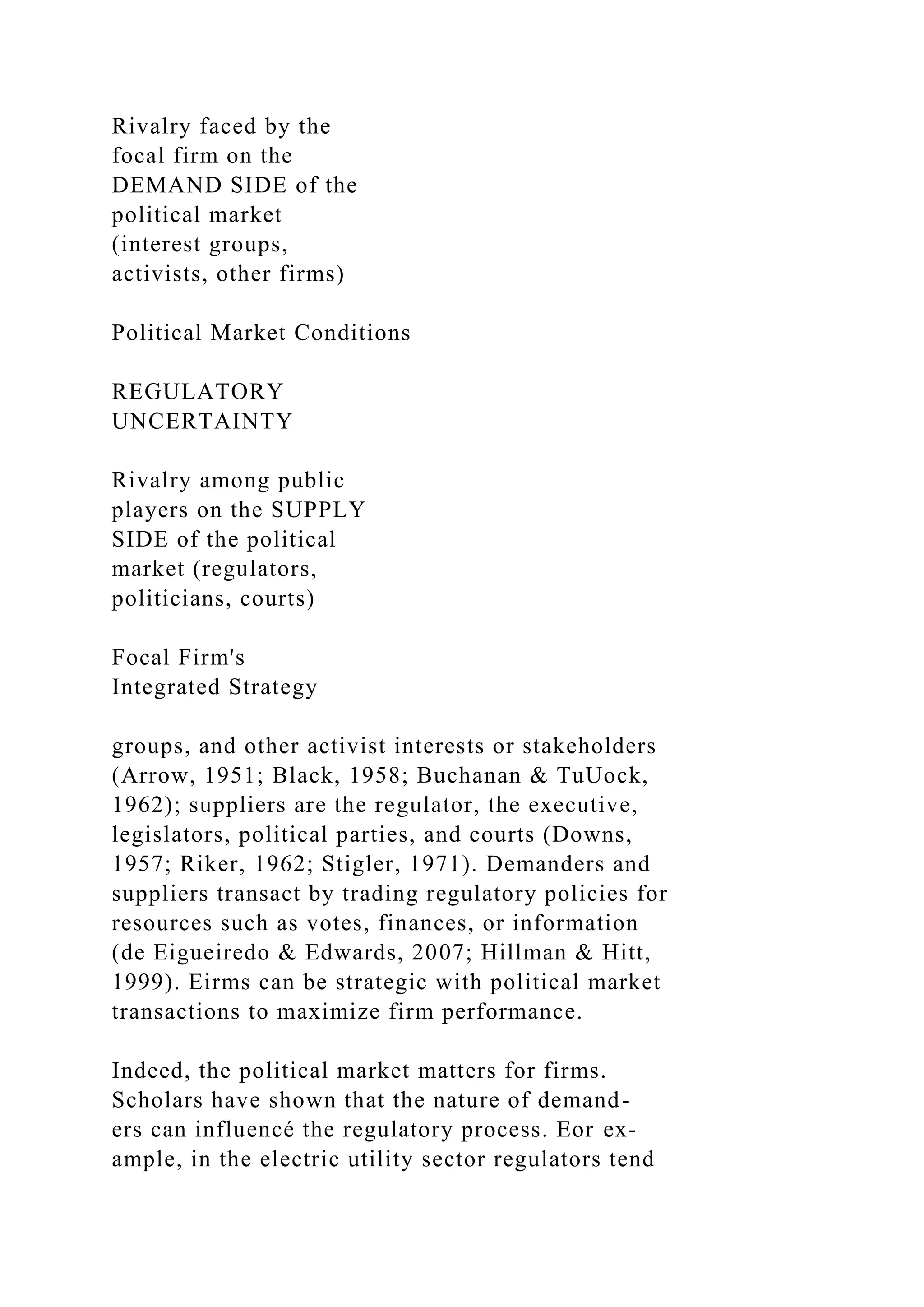
Managers will find it useful to view regulation
in the context of a political market where there
are demanders of regulation and suppliers of regu-
lation. See Figure 1 for an illustration. As expli-
cated in the introduction of this paper, demanders
are the regulated firm, other firms, consumer
2012 Kingsley, Vanden Bergh, and Banardi 55
Figure 1
Political Markets, Regulatory Uncertainty, and Integrated
Strategy
Rivalry faced by the
focal firm on the
DEMAND SIDE of the
political market
(interest groups,
activists, other firms)
Political Market Conditions
REGULATORY
UNCERTAINTY
Rivalry among public
players on the SUPPLY
SIDE of the political
market (regulators,
politicians, courts)
Focal Firm's
Integrated Strategy
groups, and other activist interests or stakeholders
(Arrow, 1951; Black, 1958; Buchanan & TuUock,
1962); suppliers are the regulator, the executive,
legislators, political parties, and courts (Downs,
1957; Riker, 1962; Stigler, 1971). Demanders and
suppliers transact by trading regulatory policies for
resources such as votes, finances, or information
(de Eigueiredo & Edwards, 2007; Hillman & Hitt,
1999). Eirms can be strategic with political market
transactions to maximize firm performance.
Indeed, the political market matters for firms.
Scholars have shown that the nature of demand-
ers can influencé the regulatory process. Eor ex-
ample, in the electric utility sector regulators tend
to reduce the allowed rates charged to consumers
when a competing interest group advocates for
consumers within the political market (Bonardi,
Holbum, & Vanden Bergh, 2006). Researchers
have also shown that the nature of suppliers
shapes regulatory outcomes. In the political econ-
omy literature, for example, scholars have shown
that elected regulators tend to have a negative
effect on tiie profitability of firms (Besley &.
Coate, 2003). There are thus factors in the polit-
ical market that tend to bias regulation in predict-
able directions. However, there are also factors
that create greater uncertainty for firms subject to
regulation over their market investments.
To predict the relative magnitude of regulatory
uncertainty, managers must understand their spe-
cific political market context, notably the nature
of demand-side rivalry and the nature of supply-
side rivalry. Drawing from the political markets
literature we focus on two drivers of regulatory
uncertainty: political motivation/level of ideology
(on the demand side) and level of competition for
power among political decision makers (on the
supply side). Eurthermore, we argue that this reg-
ulatory uncertainty makes political markets less
attractive for business investment.
Nature off Demand-Side Rivalry
The political markets literature identifies demanders
of regulation as firms in the industry, consumer
groups affected by regulatory policy, and other activ-
ist interest groups with a stake in the policy outcome
(Bonardi et al., 2005; Hardin, 1982; Moe, 1980;
Olsen, 1965). Demanders can originate locally or
intemationally. In developing-country contexts, ex-
ternal or foreign interests tend to assume a larger
role, capitalizing on foreign firms' vulnerabilities
and/or vocalizing local groups' interests. We exam-
ine regulatory uncertainty from the perspective of
regulated firms, whereby the focal firm is opposed by
either another firm or an interest group representing
stakeholders or affected interests. The firm's rival on
the demand side is characterized by its motivation
for regulatory change, either ideology or efficiency
motivations.
Ideology-motivated interests generate the most
regulatory uncertainty. Demanders with ideologi-
cal agendas are difficult to manage (Bonardi et al.,
2006; Bonardi & Keim, 2005) and tend to lever-
age public pressure effectively through tactics such
as mailings, campaigns, boycotts, reports, and/or
advocacy advertising (Baron, 2010; Holbum &
56 Academy oí Management Perspectives August
Vanden Bergh, 2004). Nonmarket issues that
have an ideological underpinning also tend to be
uniquely partisan and widely salient, which corre-
lates with more unattractive political markets
(Bonardi et a l , 2006; Bonardi & Keim, 2005).
Intensified rivalry among competing demanders
makes markets even more unattractive. Research
finds that rivalry increases with election issues,
concentrated costs or benefits, and attempts to
change existing regulation (Bonardi et al., 2005;
Bonardi et al., 2006; Bonardi & Keim, 2005; Hill-
man &. Hitt, 1999; Lowi, 1964; Wilson, 1980), all
of which arguably accompany ideological opposi-
tion. In addition, the coalition of voter interests
tied to ideology-motivated opponents likely holds
more strongly felt preferences with greater indi-
vidual stakes, and thus they make more durable
opponents than efficiency-motivated interests
(Stigler, 1971; Weingast & Marshall, 1988).
Efficiency-motivated interests, by contrast, tend
to be associated with narrower issues that are not
defined along partisan lines but rather reflect bot-
tom-line concerns. With efficiency-motivated ri-
vals, the regulated firm is better able to identify
rivals and has more substitute actions available to
trade, which, in tum, lowers transaction costs of
negotiation relative to ideology-motivated rivals
(Coase, 1960). Thus, from the regulated firm's
perspective, the political market is more attractive
(Bonardi et al., 2006) when there is less intense
rivalry among demanders (Bonardi et al., 2005;
Bonardi et al., 2006; Bonardi & Keim, 2005) and
less saliency in the eyes of suppliers. All else being
equal, if demand-side rivalry exists, regulatory pol-
icy outcomes are more predictable and regulatory
uncertainty lower when the rival is an efficiency-
motivated interest.
Nature of Supply-Side Rivalry
Suppliers of regulation are the regulator, execu-
tive, legislators, political parties, courts, and other
institutional decision makers. Previous work has
tended to concentrate analysis on select roles. Eor
instance, much of the literature on foreign invest-
ment and bargaining power focuses on only one
aggregate supplier: the host government (Brewer,
1992; Dunning, 1993). In the nonmarket strategy
literature, Bonardi et al. (2005) focused on two
types of suppliers, bureaucrats and elected officials;
Holbum and Vanden Bergh (2004) and Bonardi
et al. (2006) focused on regulatory agencies, rep-
resentatives and senators, and executives; and
Spiller and Gely (1990) and Spiller and Vanden
Bergh (2003) focused on courts. Eollowing this
work, we focus on how the regulator supplies
regulatory policy jointly with politicians.
Competition among political actors creates a
more attractive political market for firms (Anso-
labehere, de Eigueiredo, &. Snyder, 2003; Baron,
2001; Bonardi et al., 2006). Eundamentally this is
because competitive elections increase rivalry
(Bonardi et al., 2006), which makes politicians
more willing to trade policy favors (Baron, 2001)
and more responsive to satisfying constituent in-
terests (Keim & Zeithaml, 1986). As Stigler
(1971, p. 13) noted, "If entry into politics is ef-
fectively controlled, we should expect one-party
dominance to lead that party to solicit requests for
protective legislation but to exact a higher price
for the legislation." Thus competition among
elected politicians creates opportunities for corpo-
rate political strategies to work (Hillman &. Keim,
1995; Keim &. Zeithaml, 1986), including in a
regulatory setting. We note, however, that in de-
veloped countries such political actors are typi-
cally elected, whereas in developing countries
elections may be less potent or even nonexistent.
There are fewer actors, potentially only one piv-
otal decision maker, less delegation of power from
the executive, and thus signiflcantly less compe-
tition. We incorporate this important distinction
explicitly in our framework.
Competition may be defined beyond rivalry
for power. When competition among political
actors is driven also by heterogeneous prefer-
ences (Bonardi et a l , 2006; Vanden Bergh &.
Holburn, 2007) instead of or in addition to
checks and balances, the logic holds: More com-
petition creates a more attractive (and oppor-
tunistic) political market, which corresponds
with less regulatory uncertainty.
The political markets literature uses several
empirical measures to capture this idea of compe-
tition among political actors. In Bonardi et al.
(2006), the degree of supply-side rivalry is opera-
tionalized as the margin of winning votes for the
2012 Kingsley, Vanden Bergh, and Banardi 57
executive (governor or president) or the legislator
(or party). Rivalry is considered intense if there is
a greater than 5% difference between votes. In.
Holbum and Vanden Bergh (2012), legislative
competitiveness is also measured by the degree of
partisan control of the legislature. Rivalry is most
intense when political parties hold equal shares of
the legislative seats. In addition, a country's gov-
emance environment has been measured by the
political constraint index (POLCON) compiled
by Henisz (2000) and tested successfully against
intematiorial infrastructure data (2002) and
across a wide range of developed and developing
countries. POLCON measures the feasibility of
policy change based on a simple spatial model of
veto players, party alignment, and preferences
across branches of government.^ The index ranges
from 0 to 1, with higher scores indicating more
political constraints. The more political con-
straints there are, the less feasible policy change
but the more potential leverage or pivot points. In
political markets with no delegation of power
from the executive (e.g., autocratic regimes),
there are no constraints against the executive. In
all measures of political competition, the funda-
mental idea remains the same: Competition
makes political markets more attractive and less
uncertain for the regulated firm.
Predicting Regulatory Policy Uncertainty
I ntegrating these insights on the nature of de-mand-side rivalry
and the nature of supply-siderivalry, we can predict regulatory
uncertainty.
Figure 2 suinmarizes these insights in the first part
of our simple two-by-two framework.^
Figure 2
Predicting Regulatory Uncertainty
' POLCON I measures the feasibility of policy change, that is,
the
extent to which a change in the preferences of any one political
actor may
lead to a changé in govemment policy. The index is composed
from the
following information: the number of independent branches of
govemment
with veto power over policy change, counting the executive and
the
presence of an effective lower and upper house in the
legislature (mote
branches leading to more constraint); the extent of party
alignment across
branches of govemment, measured as the extent to which the
same party
or coalition of parties controls each branch (decreasing the level
of con-
straint); and the extent of preference heterogeneity within each
legislative
branch, measured as legislative fractionalization in the relevant
house
(increasing constraint for aligned executives, decreasing it for
opposed
executives).
We recognize that differences among political markets are more
aptly
represented as continua of competition and ideology.
I
Ideology-
Motivated
Opponent(s) I
Efficiency-
Motivated
Opponent(s)
Highly Uncerlairi
"NC/E"
Uncertain
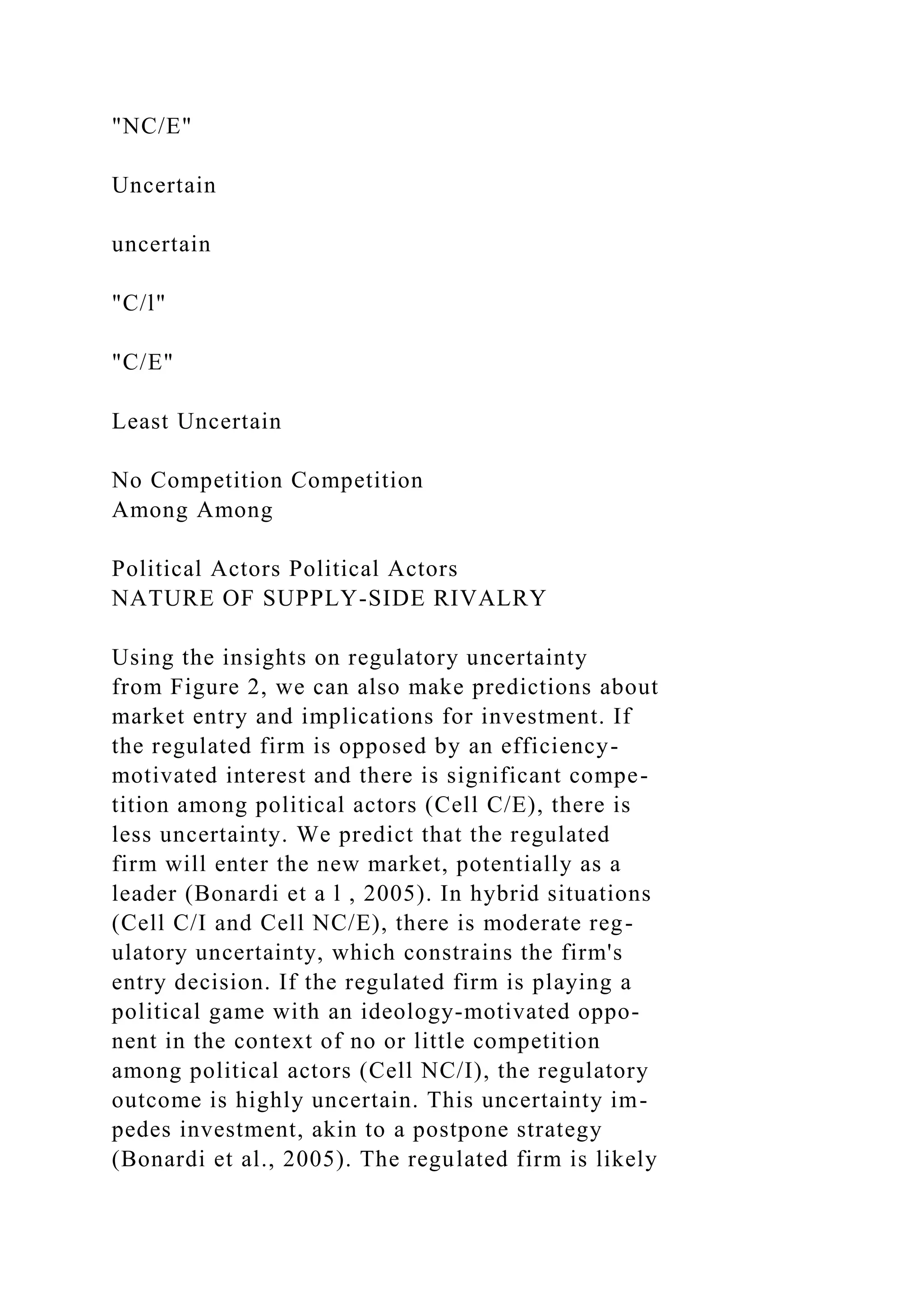
uncertain
"C/l"
"C/E"
Least Uncertain
No Competition Competition
Among Among
Political Actors Political Actors
NATURE OF SUPPLY-SIDE RIVALRY
Using the insights on regulatory uncertainty
from Figure 2, we can also make predictions about
market entry and implications for investment. If
the regulated firm is opposed by an efficiency-
motivated interest and there is significant compe-
tition among political actors (Cell C/E), there is
less uncertainty. We predict that the regulated
firm will enter the new market, potentially as a
leader (Bonardi et a l , 2005). In hybrid situations
(Cell C/I and Cell NC/E), there is moderate reg-
ulatory uncertainty, which constrains the firm's
entry decision. If the regulated firm is playing a
political game with an ideology-motivated oppo-
nent in the context of no or little competition
among political actors (Cell NC/I), the regulatory
outcome is highly uncertain. This uncertainty im-
pedes investment, akin to a postpone strategy
(Bonardi et al., 2005). The regulated firm is likely
to not enter a new market (or further invest in an
existing market) if it cannot foresee the value of
its investment over time or anticipate opportuni-
ties to influence the political market. Generally
this results in a net loss for society but may be the
best outcome for the individual firm. Accordingly,
when considering entry into a new market and
when regulatory uncertainty exists, firms have two
stark choices: if uncertainty is too great, delay
investment, or develop and implement a nonmar-
ket strategy that sufficiently mitigates the negative
effects of the uncertainty. We now focus our at-
tention on the latter.
SB Academy af Management Perspedives August
Nonmarket Strategies
D
ifferent types of regulatory uncertainty require
different strategies (Bonardi &. Keim, 2005).
As uncertainty increases so too does the cost
of implementing a nonmarket strategy. We iden-
tify three dimensions previously treated dispa-
rately in the literature to guide how a regulated
firm should allocate incremental resources to mit-
igate uncertainty. The strategies differ in terms of
profile level, coalition breadth, and pivotal tar-
get—and, ultimately, cost. Variation in firm strat-
egies is driven by changes in the nature of both
demand-side and supply-side rivalries, and we ar-
gue that the demand side explains more of the
variation. Eigure 3 summarizes these strategic im-
plications for firms.
Profile Level
Corporate political strategies can be divided into
low- and high-proflle strategies. Low-profile strat-
egies occur without public involvement, whereas
high-profile strategies engage the public. High-
profile strategies are significantly more costly be-
cause the firm needs to invest more in publicity
and runs a greater risk of suffering reputational
damage.
Using the taxonomy of political strategies iden-
tifled in Hillman and Hitt (1999) and further
discussed in Hillman (2003) and Bonardi and
Keim (2005), low-profile strategies include but
are not limited to information strategies such as
lobbying, commissioning research projects and re-
porting research results, and supplying position
papers or technical reports; financial incentive
strategies such as honoraria for speaking and paid
travel; and constituency-building strategies such
as political education programs. High-profile strat-
egies can include information strategies such as
testifying as an expert witness; financial-incentive
strategies such as contributions to politicians and
political parties and personal service (hiring peo-
ple with political experience or having a firm
member run for office); and constituency-building
strategies such as grassroots mobilization (of em-
ployees, suppliers, and customers), advocacy ad-
vertising, public relations, and press conferences.
We can find numerous examples of high-profile
strategies in the literature. They include engaging
in public corporate social responsibility programs
to signal information to consumers and potential
coalition partners (Siegel &. Vitaliano, 2007) as
well as other demanders and suppliers, attending
to political ties and personal relations between the
multinational corporation (MNC) and its host
government (evaluated at length in bargaining
power and political connection theories); strate-
gically increasing political connections between
the firm and high-level govemment officials (Blu-
mentritt, 2003; Blumentritt & Rehbein, 2008;
Dieleman & Boddewyn, 2012; Faccio, 2006; Law-
rence, 2010; Luo &. Peng, 1999); and preemptive
self-regulation (Bonardi &. Keim, 2005; Maxwell,
Lyon, & Hackett, 2000),
Firms tailor the profile of their strategy based
on the nature of opposing demand. For example, if
the firm is opposed by an ideology-motivated in-
terest, it will deploy high-profile political strate-
gies that actively engage the public as well as
political actors. In cases of extreme regulatory
uncertainty (Cell NC/I), the firm will also need
low-profile strategies thai go behind the scenes to
provide information and financial incentives to
key decision makers. With efficiency-motivated
opponents, and thus less uncertainty, the firm
need pursue only low-profile strategies.
Coalition Breadth
Much work on market strategy centers on the
question of corporate scope, whether a firm should
integrate …
J. Account. Public Policy 32 (2013) 1–25
Contents lists available at SciVerse ScienceDirect
J. Account. Public Policy
j o u r n a l h o m e p a g e : w w w . e l s e v i e r . c o m / l o c
a t e / j a c c p u b p o l
Analyst coverage, earnings management and financial
development: An international study
François Degeorge a, Yuan Ding b,⇑ , Thomas Jeanjean c, Hervé
Stolowy d
a Swiss Finance Institute, University of Lugano, Switzerland
b China Europe International Business School (CEIBS),
Shanghai, China
c ESSEC Business School, France
d HEC Paris, France
a b s t r a c t
0278-4254/$ - see front matter � 2012 Elsevier In
http://dx.doi.org/10.1016/j.jaccpubpol.2012. 10.003
⇑ Corresponding author. Address: Department
(CEIBS), 699, Hongfeng Road, Pudong, Shanghai 20
E-mail addresses: [email protected]
s[email protected] (H. Stolowy).
Using data from 21 countries, this paper analyzes the relation
among analyst coverage, earnings management and financial
development in an international context. We document that the
effectiveness of financial analysts as monitors increases with a
country’s financial development (FD). We find that in high-FD
countries, increased within-firm analyst coverage results in less
earnings management. Such is not the case in low-FD countries.
Our results are economically significant and robust to reverse
cau-
sality checks. Our findings illustrate one mechanism through
which financial development mitigates the cost of monitoring
firms and curbs earnings management.
� 2012 Elsevier Inc. All rights reserved.
1. Introduction
A large body of research explores the differences between
financial systems worldwide and docu-
ments the positive effects of financial development: It boosts
industry growth, the formation of new
establishments, and capital allocation (Beck and Levine, 2002).
It predicts capital accumulation and
productivity improvements (Levine and Zervos, 1998). It is
especially important for firms that depend
on external financing (Demirgüç-Kunt and Maksimovic, 1998;
Rajan and Zingales, 1998).
While the benefits of financial development appear to be well
established, the detailed mecha-
nisms through which these benefits are brought to bear are still
largely unknown. Levine (1997) lists
c. All rights reserved.
of Finance and Accounting, China Europe International
Business School
1206, China. Tel.: +86 21 2890 5606; fax: +86 21 2890 5620.
(F. Degeorge), [email protected] (Y. Ding), [email protected]
(T. Jeanjean),
http://dx.doi.org/10.1016/j.jaccpubpol.2012. 10.003
mailto:[email protected]
http://dx.doi.org/10.1016/j.jaccpubpol.2012. 10.003
http://www.sciencedirect.com/science/journal/02784254
http://www.elsevier.com/locate/jaccpubpol
2 F. Degeorge et al. / J. Account. Public Policy 32 (2013) 1–25
five basic functions of a financial system: (1) to facilitate risk
sharing; (2) to allocate resources; (3) to
monitor managers; (4) to mobilize savings; and (5) to facilitate
the exchange of goods and services.
Our paper’s contribution is to focus on the monitoring function;
specifically, on financial analysts as
monitors of firms. We find that higher financial development is
associated with a greater effectiveness
of monitoring by financial analysts. Using a sample of 21
countries from 1994 to 2002, we find that in
countries with highly developed financial systems (hereafter
‘‘high-FD countries’’), increased within-
firm coverage results in less earnings management. Such is not
the case in countries with less well-
developed financial systems (hereafter ‘‘low-FD countries’’).
There is evidence, both systematic and anecdotal, that financial
analysts perform an important
monitoring role, at least in the United States. Dyck et al. (2010)
document that, in the US, financial
analysts are among the quickest detectors of fraud. For example,
in the mid-1990s Sunbeam, an appli-
ance manufacturer, engaged in ‘‘bill-and-hold’’ deals with
retailers: The retailers bought Sunbeam
products at large discounts, but the products were then stored by
the manufacturer at third-party
warehouses for later delivery. In effect, Sunbeam was shifting
revenue from the future to the present.
The first warning to shareholders that Sunbeam was engaging in
extensive earnings management
came from a PaineWebber analyst, who noticed unusually large
increases in sales of Sunbeam electric
blankets in the summer and outdoor barbecue grills around
Christmas time (Byrne, 1998).
The Sunbeam example illustrates a broader pattern. Using US
data, Yu (2008) finds that earnings
management tends to be lower in companies followed by more
financial analysts. It is not hard to
see why this might be so. Analysts have plenty of opportunities
to probe a company’s accounts to
see whether they paint a fair picture of the company’s true
health. Provided they perform their duties
with a modicum of diligence, the very fact that they are
watching can in itself be a deterrent to earn-
ings management and other activities that might embarrass
corporate management. All else being
equal, a company followed by financial analysts has less leeway
to manipulate its earnings.
Findings based on US data, however, do not necessarily apply to
countries with lower levels of
financial development. To monitor company managers, analysts
must overcome severe hidden infor-
mation and hidden action problems: Managers might hide
negative information about the company’s
prospects; they might hide some of their actions if they fear
retribution from investors; they might be
unable to reveal positive information about the firm to
investors. We expect these difficulties to be
easier to overcome in more financially developed countries like
the United States. Holding constant
incentives to manage earnings, we discuss possible reasons for
this difference: Greater transparency
may facilitate analyst monitoring in high-FD countries; investor
demand for analyst monitoring
may be greater; firms’ incentives to facilitate analyst
monitoring may be larger; and the quality and
depth of the financial analyst pool may be improved.
We measure the effectiveness of analyst coverage of managers
by the impact of that coverage on
earnings management by companies. We posit that if more
analyst coverage results in less earnings
management, then analysts are useful monitors of managers’
actions; this leads to our first testable
hypothesis. If a country’s level of financial development
enhances analyst monitoring, then the asso-
ciation between analyst coverage and earnings management
should be more negative in more finan-
cially developed countries.
Not everyone shares the view that the presence of financial
analysts reduces earnings manage-
ment. On the contrary, financial analysts in the United States
have been accused of encouraging earn-
ings management by setting company managers targets that are
impossible to meet – except by
manipulating company performance (Levitt, 1998; Fuller and
Jensen, 2002). If the weight of analyst
opinion is greater in more financially developed countries, the
analyst’s target-setting role, and the
associated pressure on companies to meet those targets, may
also be greater (Brown and Higgins,
2001, 2005). According to this view, as one moves from low-FD
to high-FD countries, companies
would become more fixated on trying to meet or beat the analyst
consensus benchmark; this reason-
ing produces our second testable hypothesis: Analyst coverage
leads to more earnings management in
more financially developed countries.
Using a sample of 21 countries from 1994 to 2002 and
controlling both for firm incentives to man-
age earnings (through various firm characteristics like size,
leverage and growth) and for earnings
management variation among countries and industries (through
firm fixed effects), we find support
for our first hypothesis: Financial development is associated
with more effective monitoring
F. Degeorge et al. / J. Account. Public Policy 32 (2013) 1–25 3
effectiveness by analysts. In high-FD countries, increased
within-firm analyst coverage is associated
with less earnings management: as analyst coverage moves from
zero to one analyst (and respectively
from zero to two analysts) earnings management falls by about
5% (respectively, 8%). By contrast, in
low-FD countries analyst coverage is not associated with a
reduction in earnings management. Our
results are robust to corrections for reverse causality. We find
no support for our second hypothesis.
Our paper is at the intersection of two streams of literature. The
first one considers the influence of
analysts on earnings management. Degeorge et al. (1999) and
Burgstahler and Eames (2006) show
that in the US managers tend to manipulate earnings in order to
reach the analysts’ consensus. Both
studies are limited to a sample of firms actually covered by
analysts, and they only consider the role of
analysts when firms are near the consensus. Yu (2008) extends
the scope of these studies by analyzing
US firms both covered and not covered by analysts. He finds
that firms with high analyst coverage
have a lower level of discretionary accruals than firms with low
coverage. His findings, however, can-
not automatically be applied to other countries. We contribute
to this field of literature by showing
that analyst coverage reduces earnings management only in
highly financially developed countries.
Our paper also contributes to the literature that analyzes the
country-level determinants of earn-
ings management. Past literature shows that earnings
management decreases with investor protec-
tion (Leuz et al., 2003; Haw et al., 2004) and that financial
development is positively correlated
with investor protection (see Beck et al., 2003; Beck and
Levine, 2005). We find that private monitor-
ing activity (analyst following) complements country-level
institutional characteristics. In other
words, previous country-level work may actually have
underestimated the costs of poor institutions
(i.e., weak investor protection) by failing to take into account
this complementarity between firm-
level and country-level mechanisms.
The remainder of this paper is organized as follows: Section 2
develops our research hypotheses.
Section 3 discusses our research design. Section 4 presents our
main empirical findings. Section 5 takes
a deeper look at the link between analyst coverage and financial
development and Section 6 concludes.
2. Hypothesis development
In their seminal article, Jensen and Meckling (1976) hint at the
role of financial analysts in promot-
ing good corporate governance:
We would expect monitoring activities to become specialized to
those institutions and individuals
who possess comparative advantages in these activities. One of
the groups who seem to play a large
role in these activities is composed of the security analysts
employed by institutional investors, bro-
kers, and investment advisory services [. . .] To the extent that
security analysts’ activities reduce the
agency costs associated with the separation of ownership and
control they are indeed socially produc-
tive. (Jensen and Meckling, 1976, p. 354).
Analysts have the means to be monitors. Unlike most investors,
they are trained to analyze the
numbers produced by companies and they enjoy privileged
access to company management. Analysts
also have a motive to be monitors. They could look foolish and
see their reputations suffer if their re-
search reports and recommendations were based on manipulated
numbers. Anecdotal evidence, such
as the Sunbeam example given above, suggests that financial
analysts do sometimes perform an
important monitoring role. Dyck et al. (2010) document that in
the United States analysts are among
the quickest monitors of fraud. Yu (2008) finds that US firms
followed by more analysts manage their
earnings less.
Our goal is to assess empirically whether analyst coverage also
functions as a curb on earnings
management in countries that are less financially developed
than the United States. Beck and Levine
(2002) define financial development as ‘‘the degree to which
national financial systems assess firms,
monitor managers, facilitate risk management, and mobilize
savings’’ (p. 160).1 Analysts are more
likely to be effective monitors in curbing earnings management
in high-FD countries than in low-FD
countries for at least four reasons: in high-FD countries:
1 Note that financial development is a concept distinct from
legal origin, investor protection or legal enforcement, see
Section
3.2, Sample and data.
4 F. Degeorge et al. / J. Account. Public Policy 32 (2013) 1–25
– The supply of information is likely to be better.
– The demand for information by investors is likely higher.
– Followed firms have higher incentives to be monitored.
– Financial analysts are likely to be of higher quality.
First, financial analysts may be better able to perform their
monitoring role when information is
more diffuse. Dyck et al. (2010), for instance, discuss the
importance of Hayek’s ‘‘diffuse information’’
concept in the context of fraud detection. Consider two possible
stylized environments in which an
analyst might operate. In one environment, which we associate
with high-FD countries, analysts have
several sources of information at their disposal to use to check
the plausibility of statements made by
the companies they follow. This diffuseness of information is
partly due to stricter and better-enforced
disclosure requirements and partly to the existence of an active
and competitive financial community
of investors, journalists, and information sources. An analyst
following firm A can obtain data on A’s
activities, projections, strategies, and financial policies, and can
then compare that information with
information about companies B and C, comparable firms in the
same industry, in effect benchmarking
A’s actions and performance.
In the other environment, which we associate with low-FD
countries, disclosure requirements are
minimal and are not enforced. An analyst following firm X has
to rely on voluntary and unverifiable
disclosures by X to make an assessment of the firm’s quality
and prospects. It is hard to compare com-
pany X with companies Y and Z, for information about all three
companies is patchy and unreliable.2
Hope (2003a) finds that across countries, the level of disclosure
about accounting policies is inversely
related to forecast errors and dispersion. This finding suggests
that the work of analysts is facilitated
in high-disclosure environments typical of high-FD countries.3
Second, the incentives for investors to monitor firms may be
greater in high-FD countries. La Porta
et al. (2002) find that firms in countries with more investor
protection enjoy stronger market valua-
tions. Investors may have more to lose from misjudging the
health of a company in such countries.
Accordingly, investor demand for sophisticated analysis and
information is likely to be greater in
high-FD countries, and brokers may dedicate more resources to
meet this demand. This suggests that
‘‘coverage’’ does not have the same meaning in different
countries with different levels of financial
development: Coverage initiation by an analyst is a significant
event for a company operating in a
high-FD country. It is not so for a low-FD country, where
analyst time may be too thinly spread.4
Third, firms have a greater incentive to be properly monitored
by analysts in high-FD countries.
Firms in high-FD countries enjoy greater access to outside
capital than firms in low-FD countries, at
least potentially; that is, provided they succeed in convincing
outside investors to purchase their secu-
rities. We would then expect firms in high-FD countries to do
more to facilitate the work of the finan-
cial analysts monitoring them – by organizing company visits,
being responsive to analysts’ requests
for clarifications, and giving analysts access to top management
– since these firms stand to lose sub-
stantially due to analyst distrust. By contrast, firms in low-FD
countries have little to gain from favor-
able analyst opinion, since access to outside finance is limited
anyway.
Finally, the pool of financial analysts may be of better quality
in high-FD countries. Financial ana-
lysts there may be better paid and better trained. This could
explain why some financial analysts enjoy
star status in the United States, while no such phenomenon
exists in continental Europe. As a first pass
on this issue, we gathered the number of CFA-certified analysts
in each of our sample countries, using
the online database at www.cfa.institute.com. We scaled it by
the number of listed companies in each
country. The correlation between this ratio and our measure of
financial development is positive and
2 These arguments do not assume, even implicitly, that firms
are covered exclusively by local analysts, i.e., analysts located
in
the same country as the firm. Bae et al. (2008) provide data
suggesting the opposite.
3 For a related study suggesting that the quality of analysts’
work is superior in countries with high-quality financial
reporting
environments, see Barniv et al. (2005).
4 In his account of his career as a financial analyst in the US,
Reingold (in Reingold and Reingold, 2006) states that he took
9 months to write his first report when he started working as a
financial analyst at Morgan Stanley. By contrast, in a similar
book
about his experience as an analyst in France, Tétreau estimates
that a typical French analyst can devote less than 40 h a year of
actual research time to each of the companies he covers
(Tétreau, 2005). France is in the middle range of our measure of
financial
development.
F. Degeorge et al. / J. Account. Public Policy 32 (2013) 1–25 5
statistically significant at the 5% level. If we assume that CFA
certification is a proxy for financial ana-
lyst quality, this result suggests that average analyst quality
tends to be better in high-FD countries.
All of these arguments suggest that analyst coverage may be
more effective in high-FD countries
and lead to our first testable hypothesis:
Hypothesis 1. If a country’s level of financial development
enhances analyst monitoring, then the
association of analyst coverage on earnings management should
be more negative in more financially
developed countries. We call this the FD enhancement
hypothesis.
But the role of financial analysts as corporate monitors has been
questioned lately, especially in the
United States – hardly an example of low financial
development. Financial analysts have been accused
of fostering earnings management by effectively setting
company managers targets that are impossi-
ble to meet – except by manipulating company performance (see
Levitt, 1998; Collingwood, 2001;
Fuller and Jensen, 2002). In Michael Jensen’s words:
‘‘Indeed, ‘‘earnings management’’ has been considered an
integral part of every top manager’s job
for at least the last two decades. But when managers smooth
earnings to meet market projections,
they are not creating value for the firm; they are both lying and
making poor decisions that destroy
value’’ (Jensen, 2005, p. 8).
Systematic evidence supports these claims. Using US data,
Degeorge et al. (1999) document sharp
discontinuities in the forecast error distribution at zero,
suggesting that firms strive to meet or exceed
analysts’ consensus forecasts for quarterly earnings. Graham et
al. (2005) find that top US executives
admit that they pass up positive NPV projects to meet earnings
benchmarks. This suggests that in a
financially developed country such as the US, analyst coverage
might actually increase earnings
management.5
We would expect the same four factors that enhance the quality
of analyst coverage in high-FD
countries (better supply of information, greater demand for
information, higher incentives to be mon-
itored, higher quality of financial analysts) to give greater
weight to analyst opinion in those countries.
High-FD countries might then be associated with a greater role
for analysts in setting targets, and
companies there might engage in more earnings management to
reach the consensus forecast than
they do in low-FD countries.
According to this view, as one moves from low-FD to high-FD
countries, companies would become
more fixated on trying to meet or beat the analyst forecast; this
produces our second testable
hypothesis:
Hypothesis 2. The association between analyst coverage and
earnings management is more positive
in high financially developed countries than in low financially
developed countries. We call this the FD
analyst consensus fixation hypothesis.
Thus, the effect of financial development on the quality of
analyst coverage is a priori ambiguous.
The relation of earnings management and analyst coverage is
jointly determined by the four factors:
managerial incentives of earnings management, managerial
ability of earnings management, incen-
tives of high-quality monitoring by analysts and the ability of
high-quality monitoring by analysts.6
In our previous hypothesis development, while a higher level of
financial development may enhance
analysts’ ability to perform their monitoring tasks, the increased
company fixation on meeting the ana-
lysts’ forecast targets in high-FD countries might create
earnings management incentives that would not
exist in low-FD countries. Ultimately, the question of whether
financial development tends to facilitate
the analysts’ monitoring role or whether it encourages a
dysfunctional game of manipulation to meet
analysts’ earnings targets is an empirical issue.
5 Jumps in the earnings forecast error distribution could be due
both to earnings management and to forecast management
(Brown and Higgins, 2001, 2005), that is, managers attempting
to downplay analysts’ earnings expectations to make them
easier to
beat. Several US-based studies report findings consistent with
both interpretations. Hirst et al. (2008) provide a framework in
which to view management earnings forecasts.
6 We thank an anonymous reviewer for bringing up this point.
6 F. Degeorge et al. / J. Account. Public Policy 32 (2013) 1–25
3. Research design
3.1. Methodology
We use the following regression to assess the impact of
financial development on the enhancement
of analyst monitoring for firm i in country j in year t:
7 Hop
studies
institut
this iss
valuatio
EM Activityijt ¼ a0 þ a1Analyst Coverageijt þ a2Analyst
Coverageijt � Medium FDj
þ a3 Analyst Coverageijt � High FDj þ a4 Control variablesijt þ
eijt ð1Þ
The dependent variable, EM Activity, is the amount of earnings
management by a company in a
year. Medium FD (resp. High FD) is a dummy variable equal to
one if the company is in a medium-
FD country (resp. high-FD country), and zero otherwise. We
explain the details of the construction
of our variables below and provide the exact definitions of all
variables in Appendix A.
To test the FD enhancement hypothesis, the coefficients of
interest to us are a1, a2, and a3. If finan-
cial development is associated with analyst coverage, then a
given amount of incremental analyst cov-
erage should result in a greater reduction in earnings
management as we move up in the level of
financial development. a1 measures the effect of analyst
coverage on earnings management in low-
FD countries. a1 + a2 measures the impact of analyst coverage
on earnings management in med-
ium-FD countries, while a1 + a3 measures it in high-FD
countries. As we have discussed, two opposite
effects may be at work for a2 and a3:
– According to the FD enhancement hypothesis (Hypothesis 1),
higher financial development may
facilitate the analysts’ monitoring role, so that we should have
a1 + a3 < a1 + a2 < a1 and a1 + a3
should be negative, i.e., analyst coverage reduces earnings
management in high-FD countries.
We form no expectations about the sign of a1 + a2 and a1.
– According to the FD analyst consensus fixation hypothesis
(Hypothesis 2), higher financial develop-
ment may result in companies being more pushed to manage
earnings to meet consensus expec-
tations, so that we should have a1 + a3 > a1 + a2 > a1 and a1 +
a3 should be positive under analyst
consensus fixation hypothesis, i.e., analyst coverage increases
earnings management in high-FD
countries. We form no expectations about the sign of a1 + a2
and a1 under Hypothesis 2.
This formulation clarifies our contribution relative to Yu (2008)
who only uses US data. Yu’s mon-
itoring effect hypothesis, for which he finds empirical support,
predicts that a1 + a3 < 0. His pressure
effect hypothesis, which is rejected by the data, predicts that a1
+ a3 > 0. We focus on assessing
whether financial development is associated with the
effectiveness of analyst monitoring across
countries.
Several factors might simultaneously influence analyst coverage
and earnings management, poten-
tially creating an omitted variable bias. For example, the quality
of a firm’s accounting policy might
impact the decision by analysts to follow it and also determine
the leeway that managers have in
reporting income. Similarly, the ownership structure of the firm
might affect analyst coverage (firms
with small float and trading volume might offer little
inducement to analysts to follow them), as well
as the potential and incentives for earnings management. Firms
with better corporate governance
might manage their earnings less and at the same time attract
more coverage by analysts.7
To take into account this possible bias, we need to control for
heterogeneity across observations.
We, therefore, estimate our model using a panel fixed-effects
regression, using the firm as the panel
unit. This estimation technique reduces the bias generated by a
simple pooled OLS estimation (see
Wooldridge, 2002, p. 421).
e (2003b) finds evidence consistent with disclosures being more
important when analyst following is low. While these
do not directly address the link between firm governance
characteristics and analyst coverage, it is plausible that larger
US
ional stockholdings would encourage financial analysts to
follow a company. Lang et al. (2004) provide indirect evidence
on
ue. They analyze the relationship between the quality of
corporate governance, the extent of analyst coverage, and
n. They find that analysts are less likely to follow firms with
potential incentives to manipulate information.
F. Degeorge et al. / J. Account. Public Policy 32 (2013) 1–25 7
We use the firm fixed effect to control for all time constant
factors at the firm level that may influ-
ence earnings management. In other words, this term accounts
for country, industry and firm effects
(see Wooldridge, 2002, p. 441; Dal Bó and Rossi, 2007; Blalock
and Simon, 2009, p. 1100).
The GAAP is a time constant factor and we control for it by
including a firm fixed effect. Doing so,
we are in particular assuming that all factors (firm-level
governance characteristics, GAAP, institu-
tions. . .) that simultaneously influence analyst coverage and
earnings management are fixed over
our 1994–2002 sample period. While surely not strictly correct,
this assumption is a rough but reason-
able approximation. If it holds, fixed-effect panel estimation
will produce consistent estimates.8
Reverse causality is another potential concern in our setting.
For example, analysts may shun firms
that they believe have recently started to engage in earnings
management. Our fixed-effect procedure
would not correct for this problem. At least two techniques may
mitigate this concern: (1) using the
1-year-lagged value of analyst coverage as an instrument for
analyst coverage (see Chang et al., 2006);
(2) estimating a two-stage least squares regression (Wooldridge,
2002, p. 461). The lagged value of
analyst coverage is plausibly uncorrelated with the error term in
our regression, since analysts made
their coverage decisions before they learned about the firm’s
accounting practices or its incentives to
manage its earnings for the current year.
In order to implement a 2SLS regression, we would first need to
identify valid instruments, i.e.,
instruments that are uncorrelated with the error term in Eq. (1)
but highly correlated with analyst
coverage (Wooldridge, 2002, p. 470). Since using weak
instruments may result in biased estimates
(Larcker and Rusticus, 2010), we prefer not to implement a
2SLS regression, given the difficulty of
identifying valid instruments.
We provide definitions of all variables in Appendix A.
3.2. Sample and data
Our initial sample includes listed firms from 42 countries, a
subset of that used in La Porta et al.
(1997). Seven countries out of the 49 in their sample are not
covered in our primary database sources.
We obtain financial accounting information from the Global
(Standard and Poor’s) database, and infor-
mation on analyst coverage from the I/B/E/S database. We use
Global data from 1993 to 2002.
Healy and Wahlen (1999) define earnings management as the
alteration of firms’ reported eco-
nomic performance by insiders, either to mislead stakeholders
or to influence contractual outcome,
for instance to avoid the violation of debt covenants or …
Week 2 - Assignment: Interpret the Significance of the Balance
of Payments
After completing external research, write a paper to summarize,
analyze, and interpret the significance of the Balance of
Payments (BOP). Please organize your paper as follows:
1. Define the BOP, and discuss the general accounting that goes
into the development of the statement.
2. Access the Current Account for the US from the International
Monetary Fund web site, and report these figures in both tables,
and graphic format for the years 2007 to present. Explain the
nature of the metrics that are presented. Access the Financial
Account for the US from the International Monetary Fund web
site, and report these figures in both tablular and graphic format
for the years 2007 to present. Explain the nature of the metrics
presented.
3. Using the data that you constructed in Part 2 above, describe
the meaning that you would take from these metrics and trends
for a multinational business manager. Further, discuss how the
BOP data is related to exchange rates. Discuss the meaning of
the J-curve and what that can mean for the business manager at
a Multinational firm.
Support your paper with at least five (5) resources. In addition
to these specified resources, other appropriate scholarly
resources, including older articles, may be included. Your paper
should demonstrate thoughtful consideration of the ideas and
concepts that are presented in the course and provide new
thoughts and insights relating directly to this topic. Your
response should reflect scholarly writing and current APA
standards.
Length: 5-7 pages (not including title and reference pages).
Balance of Payments
The measurement of international economic transactions
between the locals and the foreigners is called the balance of
payments (BOP). Business managers as well as government
policy officials should be familiar with and be guided by the
BOP data. There are two important accounts that make up the
BOP: the Current Account and the Financial Account.
Moreover, the BOP metrics are related to exchange rate
movements, and this week’s activity is designed to understand
that important relationship. This week you will have an
opportunity to summarize, analyze, and interpret the
significance of BOP.

Chapter 3Mini CaseGlobal Remittances© 2016 Pearson E.docx

  • 1.
    Chapter 3 Mini Case GlobalRemittances © 2016 Pearson Education, Inc. All rights reserved. 3-‹#› Mini-Case: Global Remittances © 2016 Pearson Education, Inc. All rights reserved. 3-‹#› Global Remittances One area within the balance of payments that has received intense interest in the past decade is that of remittances. The term remittance is a bit tricky. According to the International Monetary Fund (IMF), remittances are international transfers of funds sent by migrant workers from the country where they are working to people, typically family members, in the country from which they originated. According to the IMF, a migrant is a person who comes to a country and stays, or intends to stay, for a year or more. As illustrated by Exhibit A, it is estimated that nearly $600 billion was remitted across borders in 2014. Remittances make up a very small, often negligible cash outflow from sending countries like the United States. They do, however, represent a more significant volume, for example as a percent of GDP, for smaller receiving countries, typically
  • 2.
    developing countries, sometimesmore than 25%. In many cases, this is greater than all development capital and aid flowing to these same countries. And although the historical record on global remittances is short, as illustrated in Exhibit A, it has shown dramatic growth in the post-2000 period. Its growth has been rapid and dramatic, falling back only temporarily with the global financial crisis of 2008–2009, before returning to its rapid growth path once again from 2010 on. Remittances largely reflect the income that is earned by migrant or guest workers in one country (source country) and then returned to families or related parties in their home countries (receiving countries). Therefore it is, not surprising that although there are more migrant worker flows between developing countries, the high income developed economies remain the main source of remittances. © 2016 Pearson Education, Inc. All rights reserved. 3-‹#› Exhibit A Global Remittance Inflows, 1970–2014 (millions of U.S. dollars) © 2016 Pearson Education, Inc. All rights reserved. 3-‹#› Global Remittances The global economic recession of 2009 resulted in reduced economic activities like construction and manufacturing in the major source countries; as a result, remittance cash flows fell in 2009 but rebounded slightly in 2010. Most remittances occur as frequent small payments made through wire transfers or a variety of informal channels (some
  • 3.
    even carried byhand). The United States Bureau of Economic Analysis (BEA), which is responsible for the compilation and reporting of U.S. balance of payments statistics, classifies migrant remittances as “current transfers” in the current account. Wider definitions of remittances may also include capital assets that migrants take with them to host countries and similar assets that migrants bring back with them to their home countries. These values, when compiled, are generally reported under the capital account of the balance of payments. However, discerning exactly who is a “migrant,” is also an area of some debate. Transfers back to their home country made by individuals who may be working in a foreign country (for example, an expat working for a multinational organization) but who are not considered residents” of that country, may also be considered global remittances under current transfers in the current account. © 2016 Pearson Education, Inc. All rights reserved. 3-‹#› Remittances Prices A number of organizations have devoted significant effort in the past five years to better understanding the costs borne by migrants in transferring funds back to their home countries. The primary concern has been excessive remittance charges—the imposition of what many consider exploitive charges related to the transfer of these frequent small payments. The G8 countries launched an initiative in 2008 entitled “5 x 5”, to reduce transfer costs from a global average of 10% to 5% in five years (by 2014). The World Bank supported this initiative by creating Remittance Prices Worldwide (RPW), a global database to monitor remittance price activity across geographic regions. It was hoped that, through greater transparency and access to

  • 4.
    transfer cost information,market forces would drive these costs down. Although the global average cost had fallen to a low of 7.90% in the fall 2014, the program was still clearly far from its goal of 5%. Funds remitted from the G8 countries themselves fell to 7.49% in 2014, 7.98% for the G20 countries in the same period. This was particularly relevant given that these are the source countries of a large proportion of all funds remitted. Little was known of global remittance costs until the World Bank began collecting data in the RPW database. The database collects data on the average cost of transactions conducted along a variety of country corridors globally (country pairs). Exhibit B provides one sample of what these cost surveys look like. This corridor transaction, the transfer of ZAR 1370 (South African Rand, equivalent to about USD 200 at that time) from South Africa to Malawi was the highest cost corridor in the RPW. © 2016 Pearson Education, Inc. All rights reserved. 3-‹#› Exhibit B Remittance Price Comparison for Transfer from South Africa to Malawi © 2016 Pearson Education, Inc. All rights reserved. 3-‹#› Remittances Prices Remittance costs shown in Exhibit B are of two types: a transaction fee, which in this case ranges between ZAR 43 and 390; and an exchange rate margin, which is an added cost over and above
  • 5.
    the organization’s owncost of currency. The resulting total cost per transaction can be seen to rise as high as 30.6% for this specific corridor. Given that most transfers are by migrant or guest workers back to their home countries and families, and they are members usually of the lowest income groups, these charges—30%—are seen as exploitive. It should also be noted that these are charges imposed upon the sender, at the origin. Other fees or charges may occur to the receiver at the point of destination. It is also obvious from the survey data in Exhibit B that fees and charges may differ dramatically across institutions. Hence the objective of the program—to provide more information that is publicly available to people remitting funds thereby adding transparency to the process—is clear. Other results from the RPW cost survey initiative include the following. China is the most expensive country in the G20 to send money to, while South Africa continues to be the mostly costly G20 country to send money from. South Asia is the least costly region to send money to, while Sub-Saharan Africa continues to be the most expensive region to send money to globally. The five highest cost corridors (always available on the RPW Web site) continue to be intra-Africa. In 2013, India received foreign exchange remittances worth $70 billion from its migratory workforce to retain the top spot in the world amid a broad slowdown caused by regulatory hindrances on both movement of people and capital. © 2016 Pearson Education, Inc. All rights reserved. 3-‹#›
  • 6.
    Exhibit C RemittanceProduct Use and Cost © 2016 Pearson Education, Inc. All rights reserved. 3-‹#› Growing Controversies With the growth in global remittances has come a growing debate as to what role they do or should play in a country’s balance of payments, and more importantly, economic development. In some cases, like India, there is growing resistance from the central bank and other banking institutions to allow online payment services like PayPal to process remittances. In other countries, like Honduras, Guatemala, and Mexico, there is growing debate on whether the remittances flow to families, or are actually payments made to a variety of Central American human trafficking smugglers. In Mexico for example, remittances now make up the second largest source of foreign exchange earnings, second only to oil exports. The Mexican government has increasingly viewed remittances as an integral component of its balance of payments, and in some ways, a “plug” to replace declining export competition and dropping foreign direct investment. But there is also growing evidence that remittances flow to those who need it most, the lowest income component of the Mexican population, and therefore mitigate poverty and support consumer spending. Former President Vicente Fox was quoted as saying that Mexico’s workers in other countries remitting income home to Mexico are “heroes.” Mexico’s own statistical agencies also disagree on the size of the funds remittances received, as well as to whom the income is returning (family or non-family interests). © 2016 Pearson Education, Inc. All rights reserved.
  • 7.
    3-‹#› Global Remittances: Case/DiscussionQuestions Where are remittances across borders included within the balance of payments? Are they current or financial account components? Under what conditions—for example, for which countries currently—are remittances significant contributors to the economy and overall balance of payments? Why is the cost of remittances the subject of such intense international scrutiny? What potential do new digital currencies—cryptocurrencies like Bitcoin—have for cross-border remittances? © 2016 Pearson Education, Inc. All rights reserved. 3-‹#› 11 Instructor’s Resource Manual For
  • 8.
    Multinational Business Finance FourteenthEdition David K. Eiteman University of California, Los Angeles Arthur I. Stonehill Oregon State University and University of Hawaii at Manoa Michael H. Moffett Thunderbird School of Global Management at Arizona State University Copyright 2016 Pearson Education, Inc. Vice President, Product Management: Donna Battista Acquisitions Editor: Kate Fernandes Program Manager: Kathryn Dinovo Team Lead, Project Management: Jeff Holcomb Project Manager: Meredith Gertz
  • 9.
    Copyright © 2016,2013, 2010 Pearson Education, Inc., or its affiliates. All Rights Reserved. Manufactured in the United States of America. This publication is protected by copyright, and permission should be obtained from the publisher prior to any prohibited reproduction, storage in a retrieval system, or transmission in any form or by any means, electronic, mechanical, photocopying, recording, or otherwise. For information regarding permissions, request forms, and the appropriate contacts within the Pearson Education Global Rights and Permissions department, please visit www.pearsoned.com/permissions/. www.pearsonhighered.com ISBN-13: 978-0-13-387987-2 ISBN-10: 0-13-387987-9 ©2016 Pearson Education, Inc. Contents Chapter 1 Multinational Financial Management: Opportunities and Challenges .......................... 1 Chapter 2 The International Monetary System
  • 10.
    .............................................................................. 7 Chapter 3The Balance of Payments ............................................................................................ 12 Chapter 4 Financial Goals and Corporate Governance ................................................................ 20 Chapter 5 The Foreign Exchange Market .................................................................................... 25 Chapter 6 International Parity Conditions ................................................................................... 31 Chapter 7 Foreign Currency Derivatives: Futures and Options ................................................... 38 Chapter 8 Interest Rate Risk and Swaps ...................................................................................... 43 Chapter 9 Foreign Exchange Rate Determination ....................................................................... 48 Chapter 10 Transaction Exposure ............................................................................................... . 55 Chapter 11 Translation Exposure ............................................................................................... .. 60 Chapter 12 Operating Exposure ............................................................................................... ..... 64
  • 11.
    Chapter 13 TheGlobal Cost and Availability of Capital ............................................................. 68 Chapter 14 Raising Equity and Debt Globally ............................................................................. 72 Chapter 15 Multinational Tax Management ................................................................................ 79 Chapter 16 International Trade Finance ....................................................................................... 85 Chapter 17 Foreign Direct Investment and Political Risk ........................................................... 89 Chapter 18 Multinational Capital Budgeting and Cross-Border Acquisitions ........................... 101 © 2016 Pearson Education, Inc. CHAPTER 1 MULTINATIONAL FINANCIAL MANAGEMENT: OPPORTUNITIES AND CHALLENGES 1. Globalization Risks in Business. What are some of the risks that come with the growing
  • 12.
    globalization of business? Exchangerates. The international monetary system, an eclectic mix of floating and managed fixed exchange rates, is constantly changing. For example, the growth of the Chinese yuan is now changing the global currency landscape. Interest rates. Large fiscal deficits, including the current eurozone crisis, plague most of the major trading countries of the world, complicating fiscal and monetary policies, and ultimately, interest rates and exchange rates. Many countries experience continuing balance of payments imbalances, and in some cases, dangerously large deficits and surpluses, all will inevitably move exchange rates. Ownership, control, and governance vary radically across the world. The publicly traded company is not the dominant global business organization—the privately held or family-owned business is the prevalent structure—and their goals and measures of performance vary dramatically. Global capital markets that normally provide the means to lower a firm’s cost of capital, and even
  • 13.
    more critically, increasethe availability of capital, have in many ways shrunk in size and have become less open and accessible to many of the world’s organizations. Financial globalization has resulted in the ebb and flow of capital in and out of both industrial and emerging markets, greatly complicating financial management (Chapters 5 and 8). 2. Globalization and the MNE. The term globalization has become widely used in recent years. How would you define it? Narayana Murthy’s quote is a good place to start any discussion of globalization: “I define globalization as producing where it is most cost- effective, selling where it is most profitable, and sourcing capital where it is cheapest, without worrying about national boundaries.” Narayana Murthy, President and CEO, Infosys 3. Assets, Institutions, and Linkages. Which assets play the most critical role in linking the major institutions that make up the global financial marketplace?
  • 14.
    The debt securitiesissued by governments. These low risk or risk-free assets form the foundation for the creation, trading, and pricing of other financial assets like bank loans, corporate bonds, and equities (stock). In recent years, a number of additional securities have been created from the existing 2 Eiteman/Stonehill/Moffett | Multinational Business Finance, 14th Edition © 2016 Pearson Education, Inc. securities—derivatives, whose value is based on market value changes in the underlying securities. The health and security of the global financial system relies on the quality of these assets. 4. Currencies and Symbols. What technological change is even changing the symbols we use in the representation of different country currencies? As currency trading has shifted from verbal telephone conversations to electronic and digital trading, currency symbols (many of which were not common across alphabetic platforms, like the British pound, £) have been replaced with the ISO-4217 codes, three- letter currency codes like USD, EUR, and GBP.
  • 15.
    5. Eurocurrencies andLIBOR. Why have eurocurrencies and LIBOR remained the centerpiece of the global financial marketplace for so long? Eurocurrencies and LIBOR (and there are LIBOR rates for all eurocurrencies) reflect the “purest” of market-driven currencies and instrument rates. They are largely unregulated and, therefore, reflect freely traded assets whose value is set by the daily global marketplace. 6. Theory of Comparative Advantage. Define and explain the theory of comparative advantage. The theory of comparative advantage provides a basis for explaining and justifying international trade in a model world assumed to enjoy free trade, perfect competition, no uncertainty, costless information, and no government interference. The theory contains the following features: Exporters in Country A sell goods or services to unrelated importers in Country B. Firms in Country A specialize in making products that can be produced relatively efficiently, given Country A’s endowment of factors of production: that is, land, labor, capital, and technology. Firms in Country B do likewise, given the factors
  • 16.
    of production foundin Country B. In this way, the total combined output of A and B is maximized. Because the factors of production cannot be moved freely from Country A to Country B, the benefits of specialization are realized through international trade. The way the benefits of the extra production are shared depends on the terms of trade, the ratio at which quantities of the physical goods are traded. Each country’s share is determined by supply and demand in perfectly competitive markets in the two countries. Neither Country A nor Country B is worse off than before trade, and typically both are better off, albeit perhaps unequally. 7. Limitations of Comparative Advantage. Key to understanding most theories is what they say and what they don’t. Name four or five key limitations to the theory of comparative advantage. Although international trade might have approached the comparative advantage model during the nineteenth century, it certainly does not today, for the following reasons: Countries do not appear to specialize only in those products
  • 17.
    that could bemost efficiently produced by that country’s particular factors of production. Instead, governments interfere with comparative advantage for a variety of economic and political reasons, such as to achieve full employment, economic development, national self-sufficiency in defense-related industries, and Chapter 1 Multinational Financial Management: Opportunities and Challenges 3 © 2016 Pearson Education, Inc. protection of an agricultural sector’s way of life. Government interference takes the form of tariffs, quotas, and other non-tariff restrictions. At least two of the factors of production, capital and technology, now flow directly and easily between countries, rather than only indirectly through traded goods and services. This direct flow occurs between related subsidiaries and affiliates of multinational firms, as well as between unrelated firms via loans and license and management contracts. Even labor flows between countries, such as immigrants into the United States (legal and illegal), immigrants within the European Union and other unions.
  • 18.
    Modern factors ofproduction are more numerous than in this simple model. Factors considered in the location of production facilities worldwide include local and managerial skills, a dependable legal structure for settling contract disputes, research and development competence, educational levels of available workers, energy resources, consumer demand for brand name goods, mineral and raw material availability, access to capital, tax differentials, supporting infrastructure (roads, ports, communication facilities), and possibly others. Although the terms of trade are ultimately determined by supply and demand, the process by which the terms are set is different from that visualized in traditional trade theory. They are determined partly by administered pricing in oligopolistic markets. Comparative advantage shifts over time as less developed countries become more developed and realize their latent opportunities. For example, during the past 150 years, comparative advantage in producing cotton textiles has shifted from the United Kingdom to the United States to Japan to Hong Kong to Taiwan and to China. The classical model of comparative advantage did not really address certain other issues, such as
  • 19.
    the effect ofuncertainty and information costs, the role of differentiated products in imperfectly competitive markets, and economies of scale. Nevertheless, although the world is a long way from the classical trade model, the general principle of comparative advantage is still valid. The closer the world gets to true international specialization, the more world production and consumption can be increased, provided the problem of equitable distribution of the benefits can be solved to the satisfaction of consumers, producers, and political leaders. Complete specialization, however, remains an unrealistic limiting case, just as perfect competition is a limiting case in microeconomic theory. 8. International Financial Management. What is different about international financial management? Multinational financial management requires an understanding of cultural, historical, and institutional differences, such as those affecting corporate governance. Although both domestic firms and MNEs are exposed to foreign exchange risks, MNEs alone face certain unique risks, such as political risks, that are not normally a threat to domestic operations. MNEs also face other risks that can be classified as extensions of domestic finance theory. For example, the normal domestic approach to the cost of capital, sourcing debt and equity, capital budgeting, working capital management, taxation, and credit
  • 20.
    analysis needs tobe modified to accommodate foreign complexities. Moreover, a number of financial instruments that are used in domestic financial management have been modified for use in international financial management. Examples are foreign currency options and futures, interest rate and currency swaps, and letters of credit. 4 Eiteman/Stonehill/Moffett | Multinational Business Finance, 14th Edition © 2016 Pearson Education, Inc. 9. Ganado’s Globalization. After reading the chapter’s description of Ganado’s globalization process, how would you explain the distinctions between international, multinational, and global companies? The difference in definitions for these three terms is subjective, with different writers using different terms at different times. No single definition can be considered definitive, although as a general matter the following probably reflect general usage. International simply means that the company has some form of business interest in more than one country. That international business interest may be no more than exporting and importing, or it may
  • 21.
    include having branchesor incorporated subsidiaries in other countries. International trade is usually the first step in becoming “international,” but the term also encompasses foreign subsidiaries created for the single purpose of marketing, distribution, or financing. The term international is also used to encompass what are defined as multinational and global in the following two paragraphs. Multinational is usually taken to mean a company that has operating subsidiaries and performs a full set of its major operations in a number of countries, i.e., in “many nations.” “Operations” in this context includes both manufacturing and selling, as well as other corporate functions, and a multinational company is often presumed to operate in a greater number of countries than simply an international company. A multinational company is presumed to operate with each foreign unit “standing on its own,” although that term does not preclude specialization by country or supplying parts from one country operation to another. Global is a newer term that essentially means about the same as “multinational,” i.e., operating around the globe. Global has tended to replace other terms because of its use by demonstrators at the international meetings (“global forums?”) of the International Monetary Fund and World Bank that took place in Seattle in 1999 and Rome in 2001. Terrorist attacks on the World Trade Center and the Pentagon in 2001 led politicians to refer to the need to eliminate “global terrorism.”
  • 22.
    10. Ganado, theMNE. At what point in the globalization process did Ganado become a multinational enterprise (MNE)? Ganado became a multinational enterprise (MNE) when it began to establish foreign sales and service subsidiaries, followed by creation of manufacturing operations abroad or by licensing foreign firms to produce and service Trident’s products. This multinational phase usually follows the international phase, which involved the import and/or export of goods and/or services. 11. Role of Market Imperfections. What is the role of market imperfections in the creation of opportunities for the multinational firm? MNEs strive to take advantage of imperfections in national markets for products, factors of production, and financial assets. Imperfections in the market for products translate into market opportunities for MNEs. Large international firms are better able to exploit such competitive factors as economies of scale, managerial and technological expertise, product differentiation, and financial strength than their local competitors are.
  • 23.
    MNEs thrive bestin markets characterized by international oligopolistic competition, where these factors are particularly critical. Chapter 1 Multinational Financial Management: Opportunities and Challenges 5 © 2016 Pearson Education, Inc. Once MNEs have established a physical presence abroad, they are in a better position than purely domestic firms are to identify and implement market opportunities through their own internal information network. 12. Why Go. What do firms become multinational? 1. Entry into new markets, not currently served by the firm, which in turn allow the firm to grow and possibly to acquire economies of scale 2. Acquisition of raw materials, not available elsewhere 3. Achievement of greater efficiency, by producing in countries where one or more of the factors of production are underpriced relative to other locations
  • 24.
    4. Acquisition ofknowledge and expertise centered primarily in the foreign location 5. Location of the firms’ foreign operations in countries deemed politically safe 13. Multinational Versus International. What is the difference between an international firm and a multinational firm? A multinational firm goes beyond simply selling to or trading with firms in foreign countries (international), by expanding its intellectual capital and acquiring a physical presence in foreign countries. This allows the firm to expand and deepen its core competitiveness and global reach to more markets, customers, suppliers, and partners. 14. Ganado’s Phases. What are the main phases that Ganado passed through as it evolved into a truly global firm? What are the advantages and disadvantages of each? a. International trade. Two advantages are finding out if the firms’ products are desired in the foreign country and learning about the foreign market. Two disadvantages are lack of control over the final sale and service to final customer (many exports are to distributors or other types of firms that in turn resell to the final customer) and the possibility that costs and thus final customer
  • 25.
    sales prices willbe greater than those of competitors that manufacture locally. b. Foreign sales and service offices. The greatest advantage is that the firm has a physical presence in the country, allowing it great control over sales and service as well as allowing it to learn more about the local market. The disadvantage is the final local sales prices, based on home country plus transportation costs, may be greater than competitors that manufacture locally. c. Licensing a foreign firm to manufacture and sell. The advantages are that product costs are based on local costs and that the local licensed firm has the knowledge and expertise to operate efficiently in the foreign country. The major disadvantages are that the firm might lose control of valuable proprietary technology and that the goals of the foreign partner might differ from those of the home country firm. Two common problems in the latter category are whether the foreign firm (that is manufacturing the product under license) is a shareholder wealth or corporate wealth maximizer, which in turn often leads to disagreements about reinvesting earning to achieve greater future growth versus making larger current dividends to owners and payments to other stakeholders. d. Part ownership of a foreign, incorporated, subsidiary, i.e., a
  • 26.
    joint venture. Theadvantages and disadvantages are similar to those for licensing: Product costs are based on local costs and that the local joint owner presumably has the knowledge and expertise to operate efficiently in the foreign 6 Eiteman/Stonehill/Moffett | Multinational Business Finance, 14th Edition © 2016 Pearson Education, Inc. country. The major disadvantages are that the firm might lose control of valuable proprietary technology to its joint venture partner, and that the goals of the foreign owners might differ from those of the home country firm. e. Direct ownership of a foreign, incorporated, subsidiary. If fully owned, the advantage is that the foreign operations may be fully integrated into the global activities of the parent firm, with products resold to other units in the global corporate family without questions as to fair transfer prices or too great specialization. (Example: the Ford transmission factory in Spain is of little use as a self-standing operation; it depends on its integration into Ford’s European operations.) The disadvantage is that the firm may come to be identified as a “foreign exploiter” because politicians find it advantageous to attack foreign-owned
  • 27.
    businesses. 15. Financial Globalization.How do the motivations of individuals, both inside and outside the organization or business, define the limits of financial globalization? If influential insiders in corporations and sovereign states continue to pursue the increase in firm value, there will be a definite and continuing growth in financial globalization. But if these same influential insiders pursue their own personal agendas, which may increase their personal power, influence, or wealth, then capital will not flow into these sovereign states and corporations. The result is the growth of financial inefficiency and the segmentation of globalization outcomes creating winners and losers. The three fundamental elements—financial theory, global business, management beliefs and actions—combine to present either the problem or the solution to the growing debate over the benefits of globalization to countries and cultures worldwide. © 2016 Pearson Education, Inc. CHAPTER 2
  • 28.
    THE INTERNATIONAL MONETARYSYSTEM 1. The Rules of the Game. Under the gold standard, all national governments promised to follow the “rules of the game.” What did this mean? A country’s money supply was limited to the amount of gold held by its central bank or treasury. For example, if a country had 1,000,000 ounces of gold and its fixed rate of exchange was 100 local currency units per ounce of gold, that country could have 100,000,000 local currency units outstanding. Any change in its holdings of gold needed to be matched by a change in the number of local currency units outstanding. 2. Defending a Fixed Exchange Rate. What did it mean under the gold standard to “defend a fixed exchange rate,” and what did this imply about a country’s money supply? Under the gold standard, a country’s central bank was responsible for preserving the exchange value of the country’s currency by being willing and able to exchange its currency for gold reserves upon the demand by a foreign central bank. This required the country to restrict the rate of growth in its money supply to a rate that would prevent inflationary forces
  • 29.
    from undermining thecountry’s own currency value. 3. Bretton Woods. What was the foundation of the Bretton Woods international monetary system, and why did it eventually fail? Bretton Woods, the fixed exchange rate regime of 1945–73, failed because of widely diverging national monetary and fiscal policies, differential rates of inflation, and various unexpected external shocks. The U.S. dollar was the main reserve currency held by central banks and was the key to the web of exchange rate values. The United States ran persistent and growing deficits in its balance of payments requiring a heavy outflow of dollars to finance the deficits. Eventually the heavy overhang of dollars held by foreigners forced the United States to devalue the dollar because it was no longer able to guarantee conversion of dollars into its diminishing store of gold. 4. Technical Float. What specifically does a floating rate of exchange mean? What is the role of government? A truly floating currency value means that the government does not set the currency’s value or intervene in the marketplace, allowing the supply and demand of the market for its currency to
  • 30.
    determine the exchangevalue. 5. Fixed versus Flexible. What are the advantages and disadvantages of fixed exchange rates? Fixed rates provide stability in international prices for the conduct of trade. Stable prices aid in the growth of international trade and lessen risks for all businesses. Fixed exchange rates are inherently anti-inflationary, requiring the country to follow restrictive monetary and fiscal policies. This restrictiveness, however, can often be a burden to a country 8 Eiteman/Stonehill/Moffett | Multinational Business Finance, 14th Edition © 2016 Pearson Education, Inc. wishing to pursue policies that alleviate continuing internal economic problems, such as high unemployment or slow economic growth. Fixed exchange rate regimes necessitate that central banks maintain large quantities of international reserves (hard currencies and gold) for use in the occasional defense of the fixed
  • 31.
    rate. As internationalcurrency markets have grown rapidly in size and volume, increasing reserve holdings has become a significant burden to many nations. Fixed rates, once in place, may be maintained at rates that are inconsistent with economic fundamentals. As the structure of a nation’s economy changes, and as its trade relationships and balances evolve, the exchange rate itself should change. Flexible exchange rates allow this to happen gradually and efficiently, but fixed rates must be changed administratively—usually too late, too highly publicized, and at too large a one-time cost to the nation’s economic health. 6. De facto and de jure. What do the terms de facto and de jure mean in reference to the International Monetary Fund’s use of the terms? A country’s actual exchange rate practices is the de facto system. This may or may not be what the “official” or publicly and officially system commitment, the de jure system. 7. Crawling Peg. How does a crawling peg fundamentally differ from a pegged exchange rate? In a crawling peg system, the government will make occasional small adjustments in its fixed rate of
  • 32.
    exchange in responseto changes in a variety of quantitative indicators, such as inflation rates or economic growth. In a truly pegged exchange rate regime, no such changes or adjustments are made to the official fixed rate of exchange. 8. Global Eclectic. What does it mean to say the international monetary system today is a global eclectic? The current global market in currency is dominated by two major currencies, the U.S. dollar and the European euro, and after that, a multitude of systems, arrangements, currency areas, and zones. 9. The Impossible Trinity. Explain what is meant by the term impossible trinity and why it is in fact “impossible.” Countries with floating rate regimes can maintain monetary independence and financial integration but must sacrifice exchange rate stability. Countries with tight control over capital inflows and outflows can retain their monetary independence and stable exchange rate but surrender being integrated with the world’s capital markets. Countries that maintain exchange rate stability by having fixed
  • 33.
    rates give upthe ability to have an independent monetary policy. 10. The Euro. Why is the formation and use of the euro considered to be of such a great accomplishment? Was it really needed? Has it been successful? The creation of the euro required a near-Herculean effort to merge the monetary institutions of separate sovereign states. This required highly disparate cultures and countries to agree to combine, Chapter 2 The International Monetary System 9 © 2016 Pearson Education, Inc. giving up a large part of what defines an independent state. Member states were so highly integrated in terms of trade and commerce that maintaining separate currencies and monetary policies was an increasing burden on both business and consumers, adding cost and complexity, which added sizable burdens to global competitiveness. The euro is widely considered to have been extremely successful since its launch. 11. Currency Board or Dollarization. Fixed exchange rate regimes are sometimes implemented through
  • 34.
    a currency board(Hong Kong) or dollarization (Ecuador). What is the difference between the two approaches? In a currency board arrangement, the country issues its own currency but that currency is backed 100% by foreign exchange holdings of a hard … 52 Academy of Management Perspedives August S Y P O S I U Political Markets and Regulatory Uncertainty: Insights and Implications for Integrated Strategy by Allison F. Kingsley, Richard G. Vanden Bergh, and Jean- Philippe Bonardi Executive Overview Managers can craft effective integrated strategy by properly assessing regulatory uncertainty. Leveraging the existing political markets literature, we predict regulatory uncertainty from the novel interaction of demand- and supply-side rivairies across a range of political markets. We argue for cwo primary drivers of regulatory uncertainty: ideology-motivated interests opposed to the firm and a lack of competition for power among political actors supplying public policy. We align three previously disparate dimensions of nonmarket strategy—profile level, coalition breadth, and pivotal target—to levels of tegulatory uncer- tainty. Through this framework we demonstrate how and when firms employ different nonmarket strategies. To illustrate variation in nonmarket strategy across levels of
  • 35.
    regulatory uncertainty, weanalyze several market entry decisions of foreign firms operating in the global telecommunications sector. F irms know that entering a new industry or geographic market involves market risk. Com- mitting to that investment may also suhject flrms to a critical nonmarket risk: regulatory un- certainty. Firms entering new markets are often required to gain approval from a regulator, and once approved the firm's investments are typically suhject to ongoing scrutiny hy a regulator over issues such as product safety, pricing, rate of re- turn, competition, and access to distrihution channels. The uncertainty associated with changes in regulation or public policy can reduce the firm's profitability or block the firm from meeting other performance objectives. This applies, of course, to developed countries but also to emerging economies. Consider for in- stance the case of the German wholesaler Metro Cash and Carry when it enteced India in 2003 (Khanna, Palepu, Knoop, & Lane, 2009). Al- though Metro's distribution processes could be of value in India, where getting fresh fruits and veg- etables was often challenging for local restaurants and hotels, the firm struggled to obtain regulatory approval. Several years after obtaining initial reg- ulatory approval to enter the market, shelves in Metro's large stores were still half-empty because of local governments' interpretation of the Agri- cultural Produce Marketing Committee Act. This
  • 36.
    act, in effect,prevented the company from sourc- ing from farmers directly. Metro also faced much stronger local opposition, particularly from local retailers, than it had expected. Overall, regulatory uncertainty was the major reason a multinational like Metro struggled in India. In a similar spirit, more than 300 multinational executives from diverse firms, industries, and host * Allison F. Kingsley ([email protected]) is Assistant Professor of Management at the University of Vermont School of Business Administration. Richard G. Vanden Bergh ([email protected]) is Associate Professor of Management at the University of Vermont School of Business Administration. Jean-Philippe Bonardi ([email protected]) is Professor at the Faculty of Business and Economics of the University of Lausanne. Copyright of the Academy of Manogement, all rights reserved. lontents may not be copied, emoiled, posted to a listserv, or otherwise tronsmitted without the copyright holder's express written permission. Users may print, downlood, or email articles for individuol use only. http://dx.doi.org/10.5465/amp.2012.0042 2012 Kingsley, Vanden Bergh, and Banardi 53 countries were asked in July 2011 to assess the salience of political risks in their emerging market investments (World Bank, 2011). Among the re-
  • 37.
    spondents, 54% ratedadverse regulatory change as a political risk of most concem, a significantly more pressing concem than either risk of expro- priation (34%) or risk of war (31%). About one in five executives regarded war (23%) and expropri- ation (18%) risk as having "no impact" on their risk perception; fewer than 1 in 25 regarded reg- ulatory uncertainty as such (3%). Indeed, 35% of multinational companies have experienced finan- cial losses in the past three years due to adverse regulatory changes. In the past 12 months alone, 43% of surveyed multinationals withdrew existing or canceled planned investments due to unfavor- able changes in regulation. To manage ongoing investments with regulatory uncertainty, execu- tives closely monitor the risk (27%) but also find that the most effective strategy relies on engaging with local public entities (10%), local enterprises (14%), or key political leaders (25%). Nonmarket strategies matter to executives. When firms fail to align nonmarket strategies to the regulatory un- certainty they face, struggles like those experi- enced by Metro Cash and Carry in India occur. Understandably, both market and regulatory un- certainty will vary from one industry or geographic region to the next but are not exclusive to any one industry or region. Thus firms need to develop an understanding of the key factors affecting both types of uncertainty, and from this understanding craft an integrated strategy (Baron, 1995a, 1995b) that min- imizes the costs associated with the regulatory un- certainty while complementing the firm's market investments. Crafting strategy to manage market uncertainty is important and highly developed in the business field. In this paper we focus our analysis on
  • 38.
    designing nonmarket strategiesto manage regulatory uncertainty and discuss ways for firms to integrate this with their market strategy. Our empirical con- text centers on firms' market entry strategies, al- though our analysis can be applied across multiple market strategies. We propose a practical and novel framework for managers to predict the level of regulatory uncertainty. The framework we develop builds from what are referred to as "political markets," a term first coined by Nobel laureates in economics James Buchanan and Gordon TuUock (1962) and later applied to the study of firms' nonmarket activities (Bonardi, Hillman, & Keim, 2005). Ac- cording to the framework, political markets con- sist of demanders of public policy such as firms, consumers, and special-interest groups. Demand- ers have a stake in regulatory policy. For example, a firm's stake reflects the incremental effect a regulation will have on profitability, while a con- sumer's stake reflects the effect a regulation will have on the value-to-price ratio of the product. Political markets also consist of suppliers of public policy such as legislators and the executive, regu- lators, and courts. Similar to demanders, suppliers also have interests in regulatory outcomes. Sup- plier interests, in contrast to firms', are assumed to reflect their own ideology and/or the interests of their constituents (Kalt & Zupan, 1984). Demanders and suppliers interact with each other by exchanging information, votes, and/or other valuable resources. Erom this exchange be- tween demanders and suppliers a regulatory policy
  • 39.
    emerges; predicting thelevel of regulatory uncer- tainty, however, remains elusive. Whereas the po- litical market approach has already been used to study firms' ability to influence policy-making, we propose that a similar approach can be used to predict regulatory uncertainty and how firms can manage the regulatory uncertainty through the design of an integrated strategy. In jointly analyzing political markets and regula- tory uncertainty, we make several meaningful con- tributions. We provide a flexible framework that applies to the range of nonmarket settings by trans- lating the political markets framework developed in more mature and formal institutional settings (e.g., the United States and Westem Europe) to the emerging-market and developing-country context. Specifically, we analyze the supply-side interaction among multiple political actors, including autocratic sovereigns. We also develop new insights into the key characteristics of demand-side interest groups. Eurthermore, we explore how the characteristics of both the demand- and supply-side actors interact with each other to affect the degree of regulatory uncertainty a firm faces. We offer an innovative perspective on the 54 Academy af Management Perspetiives August three dimensions of firms' nonmarket strategies, effectively synthesizing several previously dispa- rate nonmarket choices. In addition, we integrate this nonmarket analysis with one of a firm's most
  • 40.
    critical market strategies:market entry. In show- ing how firms can assess regulatory uncertainty in the context of entering new markets, we contrib- ute to several literatures on market, nonmarket, and integrated strategy. In addition, our insights on nonmarket strategies offer managers clear, ex- ecutable strategies with direct overall performance implications for firms. The paper is organized as follows. Overall we propose a simple two-by-two framework in two parts. In the "Political Markets and Regulatory Uncer- tainty" section, we develop the first part of the framework, which derives predictions about regula- tory uncertainty. In the 'TSIonmarket Strategies" sec- tion, we propose the second part of the framework, which develops strategic implications for firms to manage regulatory uncertainty in the context of their expected and/or existing market investments. To create an integrated strategy, we suggest the dimensions of a nonmarket strategy that fit well with the characteristics of the political market, that is, activities and tactics in which market decisions such as market entries are aligned with nonmarket ones such as campaign contributions, lobbying, or coali- tion building (Baron, 1995a; de Figueiredo &. Ed- wards, 2007; Hillman & Hitt, 1999). In the "Discus- sion" section, we provide various examples from firms' market entry choices in the global telecom- munications sector that involve different nonmarket strategies; we argue that the observed integrated strategy fits well with our framework. Finally, in the "Gonclusions" section, we discuss our contribution and the critical open questions that need to be addressed to develop a deeper understanding of reg- ulatory uncertainty and the implications for firms as
  • 41.
    they develop theirintegrated strategy. Political Markets and Regulatory Uncertainty P olitical markets are different from economic markets (Boddewyn &. Brewer, 1994; Bonardi et a l , 2005; Bonardi, 2011; Buchanan & TuU- ock, 1962; Hillman & Keim, 1995; Weingast & Marshall, 1988). This is why managers pursue market strategies to improve the firm's economic performance and nonmarket strategies to improve the firm's political performance. For the best over- all firm performance, managers integrate market and nonmarket strategies (Bach &. Allen, 2010; Baron, 1995a, 1995b). In this section of the paper, we focus mainly on the nonmarket environment of business, specifically the political market for regulation, and we analyze a key nonmarket issue confronting managers: regulatory uncertainty. The magnitude of regulatory uncertainty is critical to the performance of firms in many in- dustries, including oil, natural gas, electric utili- ties, airlines, pharmaceuticals, and telecommuni- cations. Research has shown that heavily regulated (e.g., banking, telecommunications, nu- clear power) and government-dependent (e.g., de- fense) industries necessarily spend the most cor- porate resources managing regulatory uncertainty (Baron, 1995a; Goates, 2011; Grier, Munger, &. Roberts, 1994; Stigler, 1971). However, the re- cent growth of social and environmental interest groups has spread regulatory uncertainty to indus-
  • 42.
    tries not traditionallyconsidered highly regulated (Holbum & Vanden Bergh, 2008; King & Lenox, 2000). Such uncertainty is difficult for business (Ryan, Swanson, &. Buchholz, 1987), and execut- ing nonmarket strategies is increasingly seen as "the cost of doing business" (Kwak, 2012). That cost derives in part from regulators' leaming curve—their need to learn how to regulate new business models and/or technologies—and from the political games taking place among the various players involved in the regulatory process, such as firms, regulators, politicians, consumers, and in- terest groups (Holbum & Vanden Bergh, 2004, 2008). Whereas authors in the international busi- ness literature typically have focused on the bar- gaining power of multinational firms vis-à-vis lo- cal govemments (Blumentritt & Rehbein, 2008; Lecraw, 1984; Luo & Zhao, in press), we consider here the interactions among a much larger poten- tial set of institutional players. Managers will find it useful to view regulation in the context of a political market where there are demanders of regulation and suppliers of regu- lation. See Figure 1 for an illustration. As expli- cated in the introduction of this paper, demanders are the regulated firm, other firms, consumer 2012 Kingsley, Vanden Bergh, and Banardi 55 Figure 1 Political Markets, Regulatory Uncertainty, and Integrated Strategy
  • 43.
    Rivalry faced bythe focal firm on the DEMAND SIDE of the political market (interest groups, activists, other firms) Political Market Conditions REGULATORY UNCERTAINTY Rivalry among public players on the SUPPLY SIDE of the political market (regulators, politicians, courts) Focal Firm's Integrated Strategy groups, and other activist interests or stakeholders (Arrow, 1951; Black, 1958; Buchanan & TuUock, 1962); suppliers are the regulator, the executive, legislators, political parties, and courts (Downs, 1957; Riker, 1962; Stigler, 1971). Demanders and suppliers transact by trading regulatory policies for resources such as votes, finances, or information (de Eigueiredo & Edwards, 2007; Hillman & Hitt, 1999). Eirms can be strategic with political market transactions to maximize firm performance. Indeed, the political market matters for firms. Scholars have shown that the nature of demand- ers can influencé the regulatory process. Eor ex- ample, in the electric utility sector regulators tend
  • 44.
    to reduce theallowed rates charged to consumers when a competing interest group advocates for consumers within the political market (Bonardi, Holbum, & Vanden Bergh, 2006). Researchers have also shown that the nature of suppliers shapes regulatory outcomes. In the political econ- omy literature, for example, scholars have shown that elected regulators tend to have a negative effect on tiie profitability of firms (Besley &. Coate, 2003). There are thus factors in the polit- ical market that tend to bias regulation in predict- able directions. However, there are also factors that create greater uncertainty for firms subject to regulation over their market investments. To predict the relative magnitude of regulatory uncertainty, managers must understand their spe- cific political market context, notably the nature of demand-side rivalry and the nature of supply- side rivalry. Drawing from the political markets literature we focus on two drivers of regulatory uncertainty: political motivation/level of ideology (on the demand side) and level of competition for power among political decision makers (on the supply side). Eurthermore, we argue that this reg- ulatory uncertainty makes political markets less attractive for business investment. Nature off Demand-Side Rivalry The political markets literature identifies demanders of regulation as firms in the industry, consumer groups affected by regulatory policy, and other activ- ist interest groups with a stake in the policy outcome (Bonardi et al., 2005; Hardin, 1982; Moe, 1980;
  • 45.
    Olsen, 1965). Demanderscan originate locally or intemationally. In developing-country contexts, ex- ternal or foreign interests tend to assume a larger role, capitalizing on foreign firms' vulnerabilities and/or vocalizing local groups' interests. We exam- ine regulatory uncertainty from the perspective of regulated firms, whereby the focal firm is opposed by either another firm or an interest group representing stakeholders or affected interests. The firm's rival on the demand side is characterized by its motivation for regulatory change, either ideology or efficiency motivations. Ideology-motivated interests generate the most regulatory uncertainty. Demanders with ideologi- cal agendas are difficult to manage (Bonardi et al., 2006; Bonardi & Keim, 2005) and tend to lever- age public pressure effectively through tactics such as mailings, campaigns, boycotts, reports, and/or advocacy advertising (Baron, 2010; Holbum & 56 Academy oí Management Perspectives August Vanden Bergh, 2004). Nonmarket issues that have an ideological underpinning also tend to be uniquely partisan and widely salient, which corre- lates with more unattractive political markets (Bonardi et a l , 2006; Bonardi & Keim, 2005). Intensified rivalry among competing demanders makes markets even more unattractive. Research finds that rivalry increases with election issues, concentrated costs or benefits, and attempts to change existing regulation (Bonardi et al., 2005; Bonardi et al., 2006; Bonardi & Keim, 2005; Hill-
  • 46.
    man &. Hitt,1999; Lowi, 1964; Wilson, 1980), all of which arguably accompany ideological opposi- tion. In addition, the coalition of voter interests tied to ideology-motivated opponents likely holds more strongly felt preferences with greater indi- vidual stakes, and thus they make more durable opponents than efficiency-motivated interests (Stigler, 1971; Weingast & Marshall, 1988). Efficiency-motivated interests, by contrast, tend to be associated with narrower issues that are not defined along partisan lines but rather reflect bot- tom-line concerns. With efficiency-motivated ri- vals, the regulated firm is better able to identify rivals and has more substitute actions available to trade, which, in tum, lowers transaction costs of negotiation relative to ideology-motivated rivals (Coase, 1960). Thus, from the regulated firm's perspective, the political market is more attractive (Bonardi et al., 2006) when there is less intense rivalry among demanders (Bonardi et al., 2005; Bonardi et al., 2006; Bonardi & Keim, 2005) and less saliency in the eyes of suppliers. All else being equal, if demand-side rivalry exists, regulatory pol- icy outcomes are more predictable and regulatory uncertainty lower when the rival is an efficiency- motivated interest. Nature of Supply-Side Rivalry Suppliers of regulation are the regulator, execu- tive, legislators, political parties, courts, and other institutional decision makers. Previous work has tended to concentrate analysis on select roles. Eor instance, much of the literature on foreign invest- ment and bargaining power focuses on only one
  • 47.
    aggregate supplier: thehost government (Brewer, 1992; Dunning, 1993). In the nonmarket strategy literature, Bonardi et al. (2005) focused on two types of suppliers, bureaucrats and elected officials; Holbum and Vanden Bergh (2004) and Bonardi et al. (2006) focused on regulatory agencies, rep- resentatives and senators, and executives; and Spiller and Gely (1990) and Spiller and Vanden Bergh (2003) focused on courts. Eollowing this work, we focus on how the regulator supplies regulatory policy jointly with politicians. Competition among political actors creates a more attractive political market for firms (Anso- labehere, de Eigueiredo, &. Snyder, 2003; Baron, 2001; Bonardi et al., 2006). Eundamentally this is because competitive elections increase rivalry (Bonardi et al., 2006), which makes politicians more willing to trade policy favors (Baron, 2001) and more responsive to satisfying constituent in- terests (Keim & Zeithaml, 1986). As Stigler (1971, p. 13) noted, "If entry into politics is ef- fectively controlled, we should expect one-party dominance to lead that party to solicit requests for protective legislation but to exact a higher price for the legislation." Thus competition among elected politicians creates opportunities for corpo- rate political strategies to work (Hillman &. Keim, 1995; Keim &. Zeithaml, 1986), including in a regulatory setting. We note, however, that in de- veloped countries such political actors are typi- cally elected, whereas in developing countries elections may be less potent or even nonexistent. There are fewer actors, potentially only one piv- otal decision maker, less delegation of power from
  • 48.
    the executive, andthus signiflcantly less compe- tition. We incorporate this important distinction explicitly in our framework. Competition may be defined beyond rivalry for power. When competition among political actors is driven also by heterogeneous prefer- ences (Bonardi et a l , 2006; Vanden Bergh &. Holburn, 2007) instead of or in addition to checks and balances, the logic holds: More com- petition creates a more attractive (and oppor- tunistic) political market, which corresponds with less regulatory uncertainty. The political markets literature uses several empirical measures to capture this idea of compe- tition among political actors. In Bonardi et al. (2006), the degree of supply-side rivalry is opera- tionalized as the margin of winning votes for the 2012 Kingsley, Vanden Bergh, and Banardi 57 executive (governor or president) or the legislator (or party). Rivalry is considered intense if there is a greater than 5% difference between votes. In. Holbum and Vanden Bergh (2012), legislative competitiveness is also measured by the degree of partisan control of the legislature. Rivalry is most intense when political parties hold equal shares of the legislative seats. In addition, a country's gov- emance environment has been measured by the political constraint index (POLCON) compiled by Henisz (2000) and tested successfully against intematiorial infrastructure data (2002) and
  • 49.
    across a widerange of developed and developing countries. POLCON measures the feasibility of policy change based on a simple spatial model of veto players, party alignment, and preferences across branches of government.^ The index ranges from 0 to 1, with higher scores indicating more political constraints. The more political con- straints there are, the less feasible policy change but the more potential leverage or pivot points. In political markets with no delegation of power from the executive (e.g., autocratic regimes), there are no constraints against the executive. In all measures of political competition, the funda- mental idea remains the same: Competition makes political markets more attractive and less uncertain for the regulated firm. Predicting Regulatory Policy Uncertainty I ntegrating these insights on the nature of de-mand-side rivalry and the nature of supply-siderivalry, we can predict regulatory uncertainty. Figure 2 suinmarizes these insights in the first part of our simple two-by-two framework.^ Figure 2 Predicting Regulatory Uncertainty ' POLCON I measures the feasibility of policy change, that is, the extent to which a change in the preferences of any one political actor may lead to a changé in govemment policy. The index is composed from the following information: the number of independent branches of govemment
  • 50.
    with veto powerover policy change, counting the executive and the presence of an effective lower and upper house in the legislature (mote branches leading to more constraint); the extent of party alignment across branches of govemment, measured as the extent to which the same party or coalition of parties controls each branch (decreasing the level of con- straint); and the extent of preference heterogeneity within each legislative branch, measured as legislative fractionalization in the relevant house (increasing constraint for aligned executives, decreasing it for opposed executives). We recognize that differences among political markets are more aptly represented as continua of competition and ideology. I Ideology- Motivated Opponent(s) I Efficiency- Motivated Opponent(s) Highly Uncerlairi
  • 51.
    "NC/E" Uncertain uncertain "C/l" "C/E" Least Uncertain No CompetitionCompetition Among Among Political Actors Political Actors NATURE OF SUPPLY-SIDE RIVALRY Using the insights on regulatory uncertainty from Figure 2, we can also make predictions about market entry and implications for investment. If the regulated firm is opposed by an efficiency- motivated interest and there is significant compe- tition among political actors (Cell C/E), there is less uncertainty. We predict that the regulated firm will enter the new market, potentially as a leader (Bonardi et a l , 2005). In hybrid situations (Cell C/I and Cell NC/E), there is moderate reg- ulatory uncertainty, which constrains the firm's entry decision. If the regulated firm is playing a political game with an ideology-motivated oppo- nent in the context of no or little competition among political actors (Cell NC/I), the regulatory outcome is highly uncertain. This uncertainty im- pedes investment, akin to a postpone strategy (Bonardi et al., 2005). The regulated firm is likely
  • 52.
    to not entera new market (or further invest in an existing market) if it cannot foresee the value of its investment over time or anticipate opportuni- ties to influence the political market. Generally this results in a net loss for society but may be the best outcome for the individual firm. Accordingly, when considering entry into a new market and when regulatory uncertainty exists, firms have two stark choices: if uncertainty is too great, delay investment, or develop and implement a nonmar- ket strategy that sufficiently mitigates the negative effects of the uncertainty. We now focus our at- tention on the latter. SB Academy af Management Perspedives August Nonmarket Strategies D ifferent types of regulatory uncertainty require different strategies (Bonardi &. Keim, 2005). As uncertainty increases so too does the cost of implementing a nonmarket strategy. We iden- tify three dimensions previously treated dispa- rately in the literature to guide how a regulated firm should allocate incremental resources to mit- igate uncertainty. The strategies differ in terms of profile level, coalition breadth, and pivotal tar- get—and, ultimately, cost. Variation in firm strat- egies is driven by changes in the nature of both demand-side and supply-side rivalries, and we ar- gue that the demand side explains more of the variation. Eigure 3 summarizes these strategic im-
  • 53.
    plications for firms. ProfileLevel Corporate political strategies can be divided into low- and high-proflle strategies. Low-profile strat- egies occur without public involvement, whereas high-profile strategies engage the public. High- profile strategies are significantly more costly be- cause the firm needs to invest more in publicity and runs a greater risk of suffering reputational damage. Using the taxonomy of political strategies iden- tifled in Hillman and Hitt (1999) and further discussed in Hillman (2003) and Bonardi and Keim (2005), low-profile strategies include but are not limited to information strategies such as lobbying, commissioning research projects and re- porting research results, and supplying position papers or technical reports; financial incentive strategies such as honoraria for speaking and paid travel; and constituency-building strategies such as political education programs. High-profile strat- egies can include information strategies such as testifying as an expert witness; financial-incentive strategies such as contributions to politicians and political parties and personal service (hiring peo- ple with political experience or having a firm member run for office); and constituency-building strategies such as grassroots mobilization (of em- ployees, suppliers, and customers), advocacy ad- vertising, public relations, and press conferences. We can find numerous examples of high-profile
  • 54.
    strategies in theliterature. They include engaging in public corporate social responsibility programs to signal information to consumers and potential coalition partners (Siegel &. Vitaliano, 2007) as well as other demanders and suppliers, attending to political ties and personal relations between the multinational corporation (MNC) and its host government (evaluated at length in bargaining power and political connection theories); strate- gically increasing political connections between the firm and high-level govemment officials (Blu- mentritt, 2003; Blumentritt & Rehbein, 2008; Dieleman & Boddewyn, 2012; Faccio, 2006; Law- rence, 2010; Luo &. Peng, 1999); and preemptive self-regulation (Bonardi &. Keim, 2005; Maxwell, Lyon, & Hackett, 2000), Firms tailor the profile of their strategy based on the nature of opposing demand. For example, if the firm is opposed by an ideology-motivated in- terest, it will deploy high-profile political strate- gies that actively engage the public as well as political actors. In cases of extreme regulatory uncertainty (Cell NC/I), the firm will also need low-profile strategies thai go behind the scenes to provide information and financial incentives to key decision makers. With efficiency-motivated opponents, and thus less uncertainty, the firm need pursue only low-profile strategies. Coalition Breadth Much work on market strategy centers on the question of corporate scope, whether a firm should integrate …
  • 55.
    J. Account. PublicPolicy 32 (2013) 1–25 Contents lists available at SciVerse ScienceDirect J. Account. Public Policy j o u r n a l h o m e p a g e : w w w . e l s e v i e r . c o m / l o c a t e / j a c c p u b p o l Analyst coverage, earnings management and financial development: An international study François Degeorge a, Yuan Ding b,⇑ , Thomas Jeanjean c, Hervé Stolowy d a Swiss Finance Institute, University of Lugano, Switzerland b China Europe International Business School (CEIBS), Shanghai, China c ESSEC Business School, France d HEC Paris, France a b s t r a c t 0278-4254/$ - see front matter � 2012 Elsevier In http://dx.doi.org/10.1016/j.jaccpubpol.2012. 10.003 ⇑ Corresponding author. Address: Department (CEIBS), 699, Hongfeng Road, Pudong, Shanghai 20 E-mail addresses: [email protected] s[email protected] (H. Stolowy). Using data from 21 countries, this paper analyzes the relation among analyst coverage, earnings management and financial development in an international context. We document that the effectiveness of financial analysts as monitors increases with a country’s financial development (FD). We find that in high-FD countries, increased within-firm analyst coverage results in less earnings management. Such is not the case in low-FD countries.
  • 56.
    Our results areeconomically significant and robust to reverse cau- sality checks. Our findings illustrate one mechanism through which financial development mitigates the cost of monitoring firms and curbs earnings management. � 2012 Elsevier Inc. All rights reserved. 1. Introduction A large body of research explores the differences between financial systems worldwide and docu- ments the positive effects of financial development: It boosts industry growth, the formation of new establishments, and capital allocation (Beck and Levine, 2002). It predicts capital accumulation and productivity improvements (Levine and Zervos, 1998). It is especially important for firms that depend on external financing (Demirgüç-Kunt and Maksimovic, 1998; Rajan and Zingales, 1998). While the benefits of financial development appear to be well established, the detailed mecha- nisms through which these benefits are brought to bear are still largely unknown. Levine (1997) lists c. All rights reserved. of Finance and Accounting, China Europe International Business School 1206, China. Tel.: +86 21 2890 5606; fax: +86 21 2890 5620. (F. Degeorge), [email protected] (Y. Ding), [email protected] (T. Jeanjean), http://dx.doi.org/10.1016/j.jaccpubpol.2012. 10.003 mailto:[email protected] mailto:[email protected] mailto:[email protected]
  • 57.
    mailto:[email protected] http://dx.doi.org/10.1016/j.jaccpubpol.2012. 10.003 http://www.sciencedirect.com/science/journal/02784254 http://www.elsevier.com/locate/jaccpubpol 2F. Degeorge et al. / J. Account. Public Policy 32 (2013) 1–25 five basic functions of a financial system: (1) to facilitate risk sharing; (2) to allocate resources; (3) to monitor managers; (4) to mobilize savings; and (5) to facilitate the exchange of goods and services. Our paper’s contribution is to focus on the monitoring function; specifically, on financial analysts as monitors of firms. We find that higher financial development is associated with a greater effectiveness of monitoring by financial analysts. Using a sample of 21 countries from 1994 to 2002, we find that in countries with highly developed financial systems (hereafter ‘‘high-FD countries’’), increased within- firm coverage results in less earnings management. Such is not the case in countries with less well- developed financial systems (hereafter ‘‘low-FD countries’’). There is evidence, both systematic and anecdotal, that financial analysts perform an important monitoring role, at least in the United States. Dyck et al. (2010) document that, in the US, financial analysts are among the quickest detectors of fraud. For example, in the mid-1990s Sunbeam, an appli- ance manufacturer, engaged in ‘‘bill-and-hold’’ deals with retailers: The retailers bought Sunbeam products at large discounts, but the products were then stored by the manufacturer at third-party warehouses for later delivery. In effect, Sunbeam was shifting revenue from the future to the present.
  • 58.
    The first warningto shareholders that Sunbeam was engaging in extensive earnings management came from a PaineWebber analyst, who noticed unusually large increases in sales of Sunbeam electric blankets in the summer and outdoor barbecue grills around Christmas time (Byrne, 1998). The Sunbeam example illustrates a broader pattern. Using US data, Yu (2008) finds that earnings management tends to be lower in companies followed by more financial analysts. It is not hard to see why this might be so. Analysts have plenty of opportunities to probe a company’s accounts to see whether they paint a fair picture of the company’s true health. Provided they perform their duties with a modicum of diligence, the very fact that they are watching can in itself be a deterrent to earn- ings management and other activities that might embarrass corporate management. All else being equal, a company followed by financial analysts has less leeway to manipulate its earnings. Findings based on US data, however, do not necessarily apply to countries with lower levels of financial development. To monitor company managers, analysts must overcome severe hidden infor- mation and hidden action problems: Managers might hide negative information about the company’s prospects; they might hide some of their actions if they fear retribution from investors; they might be unable to reveal positive information about the firm to investors. We expect these difficulties to be easier to overcome in more financially developed countries like the United States. Holding constant incentives to manage earnings, we discuss possible reasons for this difference: Greater transparency
  • 59.
    may facilitate analystmonitoring in high-FD countries; investor demand for analyst monitoring may be greater; firms’ incentives to facilitate analyst monitoring may be larger; and the quality and depth of the financial analyst pool may be improved. We measure the effectiveness of analyst coverage of managers by the impact of that coverage on earnings management by companies. We posit that if more analyst coverage results in less earnings management, then analysts are useful monitors of managers’ actions; this leads to our first testable hypothesis. If a country’s level of financial development enhances analyst monitoring, then the asso- ciation between analyst coverage and earnings management should be more negative in more finan- cially developed countries. Not everyone shares the view that the presence of financial analysts reduces earnings manage- ment. On the contrary, financial analysts in the United States have been accused of encouraging earn- ings management by setting company managers targets that are impossible to meet – except by manipulating company performance (Levitt, 1998; Fuller and Jensen, 2002). If the weight of analyst opinion is greater in more financially developed countries, the analyst’s target-setting role, and the associated pressure on companies to meet those targets, may also be greater (Brown and Higgins, 2001, 2005). According to this view, as one moves from low-FD to high-FD countries, companies would become more fixated on trying to meet or beat the analyst consensus benchmark; this reason- ing produces our second testable hypothesis: Analyst coverage leads to more earnings management in
  • 60.
    more financially developedcountries. Using a sample of 21 countries from 1994 to 2002 and controlling both for firm incentives to man- age earnings (through various firm characteristics like size, leverage and growth) and for earnings management variation among countries and industries (through firm fixed effects), we find support for our first hypothesis: Financial development is associated with more effective monitoring F. Degeorge et al. / J. Account. Public Policy 32 (2013) 1–25 3 effectiveness by analysts. In high-FD countries, increased within-firm analyst coverage is associated with less earnings management: as analyst coverage moves from zero to one analyst (and respectively from zero to two analysts) earnings management falls by about 5% (respectively, 8%). By contrast, in low-FD countries analyst coverage is not associated with a reduction in earnings management. Our results are robust to corrections for reverse causality. We find no support for our second hypothesis. Our paper is at the intersection of two streams of literature. The first one considers the influence of analysts on earnings management. Degeorge et al. (1999) and Burgstahler and Eames (2006) show that in the US managers tend to manipulate earnings in order to reach the analysts’ consensus. Both studies are limited to a sample of firms actually covered by analysts, and they only consider the role of analysts when firms are near the consensus. Yu (2008) extends the scope of these studies by analyzing US firms both covered and not covered by analysts. He finds
  • 61.
    that firms withhigh analyst coverage have a lower level of discretionary accruals than firms with low coverage. His findings, however, can- not automatically be applied to other countries. We contribute to this field of literature by showing that analyst coverage reduces earnings management only in highly financially developed countries. Our paper also contributes to the literature that analyzes the country-level determinants of earn- ings management. Past literature shows that earnings management decreases with investor protec- tion (Leuz et al., 2003; Haw et al., 2004) and that financial development is positively correlated with investor protection (see Beck et al., 2003; Beck and Levine, 2005). We find that private monitor- ing activity (analyst following) complements country-level institutional characteristics. In other words, previous country-level work may actually have underestimated the costs of poor institutions (i.e., weak investor protection) by failing to take into account this complementarity between firm- level and country-level mechanisms. The remainder of this paper is organized as follows: Section 2 develops our research hypotheses. Section 3 discusses our research design. Section 4 presents our main empirical findings. Section 5 takes a deeper look at the link between analyst coverage and financial development and Section 6 concludes. 2. Hypothesis development In their seminal article, Jensen and Meckling (1976) hint at the role of financial analysts in promot- ing good corporate governance:
  • 62.
    We would expectmonitoring activities to become specialized to those institutions and individuals who possess comparative advantages in these activities. One of the groups who seem to play a large role in these activities is composed of the security analysts employed by institutional investors, bro- kers, and investment advisory services [. . .] To the extent that security analysts’ activities reduce the agency costs associated with the separation of ownership and control they are indeed socially produc- tive. (Jensen and Meckling, 1976, p. 354). Analysts have the means to be monitors. Unlike most investors, they are trained to analyze the numbers produced by companies and they enjoy privileged access to company management. Analysts also have a motive to be monitors. They could look foolish and see their reputations suffer if their re- search reports and recommendations were based on manipulated numbers. Anecdotal evidence, such as the Sunbeam example given above, suggests that financial analysts do sometimes perform an important monitoring role. Dyck et al. (2010) document that in the United States analysts are among the quickest monitors of fraud. Yu (2008) finds that US firms followed by more analysts manage their earnings less. Our goal is to assess empirically whether analyst coverage also functions as a curb on earnings management in countries that are less financially developed than the United States. Beck and Levine (2002) define financial development as ‘‘the degree to which national financial systems assess firms, monitor managers, facilitate risk management, and mobilize savings’’ (p. 160).1 Analysts are more
  • 63.
    likely to beeffective monitors in curbing earnings management in high-FD countries than in low-FD countries for at least four reasons: in high-FD countries: 1 Note that financial development is a concept distinct from legal origin, investor protection or legal enforcement, see Section 3.2, Sample and data. 4 F. Degeorge et al. / J. Account. Public Policy 32 (2013) 1–25 – The supply of information is likely to be better. – The demand for information by investors is likely higher. – Followed firms have higher incentives to be monitored. – Financial analysts are likely to be of higher quality. First, financial analysts may be better able to perform their monitoring role when information is more diffuse. Dyck et al. (2010), for instance, discuss the importance of Hayek’s ‘‘diffuse information’’ concept in the context of fraud detection. Consider two possible stylized environments in which an analyst might operate. In one environment, which we associate with high-FD countries, analysts have several sources of information at their disposal to use to check the plausibility of statements made by the companies they follow. This diffuseness of information is partly due to stricter and better-enforced disclosure requirements and partly to the existence of an active and competitive financial community of investors, journalists, and information sources. An analyst following firm A can obtain data on A’s activities, projections, strategies, and financial policies, and can then compare that information with information about companies B and C, comparable firms in the same industry, in effect benchmarking
  • 64.
    A’s actions andperformance. In the other environment, which we associate with low-FD countries, disclosure requirements are minimal and are not enforced. An analyst following firm X has to rely on voluntary and unverifiable disclosures by X to make an assessment of the firm’s quality and prospects. It is hard to compare com- pany X with companies Y and Z, for information about all three companies is patchy and unreliable.2 Hope (2003a) finds that across countries, the level of disclosure about accounting policies is inversely related to forecast errors and dispersion. This finding suggests that the work of analysts is facilitated in high-disclosure environments typical of high-FD countries.3 Second, the incentives for investors to monitor firms may be greater in high-FD countries. La Porta et al. (2002) find that firms in countries with more investor protection enjoy stronger market valua- tions. Investors may have more to lose from misjudging the health of a company in such countries. Accordingly, investor demand for sophisticated analysis and information is likely to be greater in high-FD countries, and brokers may dedicate more resources to meet this demand. This suggests that ‘‘coverage’’ does not have the same meaning in different countries with different levels of financial development: Coverage initiation by an analyst is a significant event for a company operating in a high-FD country. It is not so for a low-FD country, where analyst time may be too thinly spread.4 Third, firms have a greater incentive to be properly monitored by analysts in high-FD countries.
  • 65.
    Firms in high-FDcountries enjoy greater access to outside capital than firms in low-FD countries, at least potentially; that is, provided they succeed in convincing outside investors to purchase their secu- rities. We would then expect firms in high-FD countries to do more to facilitate the work of the finan- cial analysts monitoring them – by organizing company visits, being responsive to analysts’ requests for clarifications, and giving analysts access to top management – since these firms stand to lose sub- stantially due to analyst distrust. By contrast, firms in low-FD countries have little to gain from favor- able analyst opinion, since access to outside finance is limited anyway. Finally, the pool of financial analysts may be of better quality in high-FD countries. Financial ana- lysts there may be better paid and better trained. This could explain why some financial analysts enjoy star status in the United States, while no such phenomenon exists in continental Europe. As a first pass on this issue, we gathered the number of CFA-certified analysts in each of our sample countries, using the online database at www.cfa.institute.com. We scaled it by the number of listed companies in each country. The correlation between this ratio and our measure of financial development is positive and 2 These arguments do not assume, even implicitly, that firms are covered exclusively by local analysts, i.e., analysts located in the same country as the firm. Bae et al. (2008) provide data suggesting the opposite. 3 For a related study suggesting that the quality of analysts’ work is superior in countries with high-quality financial reporting
  • 66.
    environments, see Barnivet al. (2005). 4 In his account of his career as a financial analyst in the US, Reingold (in Reingold and Reingold, 2006) states that he took 9 months to write his first report when he started working as a financial analyst at Morgan Stanley. By contrast, in a similar book about his experience as an analyst in France, Tétreau estimates that a typical French analyst can devote less than 40 h a year of actual research time to each of the companies he covers (Tétreau, 2005). France is in the middle range of our measure of financial development. F. Degeorge et al. / J. Account. Public Policy 32 (2013) 1–25 5 statistically significant at the 5% level. If we assume that CFA certification is a proxy for financial ana- lyst quality, this result suggests that average analyst quality tends to be better in high-FD countries. All of these arguments suggest that analyst coverage may be more effective in high-FD countries and lead to our first testable hypothesis: Hypothesis 1. If a country’s level of financial development enhances analyst monitoring, then the association of analyst coverage on earnings management should be more negative in more financially developed countries. We call this the FD enhancement hypothesis. But the role of financial analysts as corporate monitors has been questioned lately, especially in the United States – hardly an example of low financial
  • 67.
    development. Financial analystshave been accused of fostering earnings management by effectively setting company managers targets that are impossi- ble to meet – except by manipulating company performance (see Levitt, 1998; Collingwood, 2001; Fuller and Jensen, 2002). In Michael Jensen’s words: ‘‘Indeed, ‘‘earnings management’’ has been considered an integral part of every top manager’s job for at least the last two decades. But when managers smooth earnings to meet market projections, they are not creating value for the firm; they are both lying and making poor decisions that destroy value’’ (Jensen, 2005, p. 8). Systematic evidence supports these claims. Using US data, Degeorge et al. (1999) document sharp discontinuities in the forecast error distribution at zero, suggesting that firms strive to meet or exceed analysts’ consensus forecasts for quarterly earnings. Graham et al. (2005) find that top US executives admit that they pass up positive NPV projects to meet earnings benchmarks. This suggests that in a financially developed country such as the US, analyst coverage might actually increase earnings management.5 We would expect the same four factors that enhance the quality of analyst coverage in high-FD countries (better supply of information, greater demand for information, higher incentives to be mon- itored, higher quality of financial analysts) to give greater weight to analyst opinion in those countries. High-FD countries might then be associated with a greater role for analysts in setting targets, and companies there might engage in more earnings management to
  • 68.
    reach the consensusforecast than they do in low-FD countries. According to this view, as one moves from low-FD to high-FD countries, companies would become more fixated on trying to meet or beat the analyst forecast; this produces our second testable hypothesis: Hypothesis 2. The association between analyst coverage and earnings management is more positive in high financially developed countries than in low financially developed countries. We call this the FD analyst consensus fixation hypothesis. Thus, the effect of financial development on the quality of analyst coverage is a priori ambiguous. The relation of earnings management and analyst coverage is jointly determined by the four factors: managerial incentives of earnings management, managerial ability of earnings management, incen- tives of high-quality monitoring by analysts and the ability of high-quality monitoring by analysts.6 In our previous hypothesis development, while a higher level of financial development may enhance analysts’ ability to perform their monitoring tasks, the increased company fixation on meeting the ana- lysts’ forecast targets in high-FD countries might create earnings management incentives that would not exist in low-FD countries. Ultimately, the question of whether financial development tends to facilitate the analysts’ monitoring role or whether it encourages a dysfunctional game of manipulation to meet analysts’ earnings targets is an empirical issue. 5 Jumps in the earnings forecast error distribution could be due
  • 69.
    both to earningsmanagement and to forecast management (Brown and Higgins, 2001, 2005), that is, managers attempting to downplay analysts’ earnings expectations to make them easier to beat. Several US-based studies report findings consistent with both interpretations. Hirst et al. (2008) provide a framework in which to view management earnings forecasts. 6 We thank an anonymous reviewer for bringing up this point. 6 F. Degeorge et al. / J. Account. Public Policy 32 (2013) 1–25 3. Research design 3.1. Methodology We use the following regression to assess the impact of financial development on the enhancement of analyst monitoring for firm i in country j in year t: 7 Hop studies institut this iss valuatio EM Activityijt ¼ a0 þ a1Analyst Coverageijt þ a2Analyst Coverageijt � Medium FDj þ a3 Analyst Coverageijt � High FDj þ a4 Control variablesijt þ eijt ð1Þ The dependent variable, EM Activity, is the amount of earnings management by a company in a year. Medium FD (resp. High FD) is a dummy variable equal to one if the company is in a medium- FD country (resp. high-FD country), and zero otherwise. We explain the details of the construction of our variables below and provide the exact definitions of all
  • 70.
    variables in AppendixA. To test the FD enhancement hypothesis, the coefficients of interest to us are a1, a2, and a3. If finan- cial development is associated with analyst coverage, then a given amount of incremental analyst cov- erage should result in a greater reduction in earnings management as we move up in the level of financial development. a1 measures the effect of analyst coverage on earnings management in low- FD countries. a1 + a2 measures the impact of analyst coverage on earnings management in med- ium-FD countries, while a1 + a3 measures it in high-FD countries. As we have discussed, two opposite effects may be at work for a2 and a3: – According to the FD enhancement hypothesis (Hypothesis 1), higher financial development may facilitate the analysts’ monitoring role, so that we should have a1 + a3 < a1 + a2 < a1 and a1 + a3 should be negative, i.e., analyst coverage reduces earnings management in high-FD countries. We form no expectations about the sign of a1 + a2 and a1. – According to the FD analyst consensus fixation hypothesis (Hypothesis 2), higher financial develop- ment may result in companies being more pushed to manage earnings to meet consensus expec- tations, so that we should have a1 + a3 > a1 + a2 > a1 and a1 + a3 should be positive under analyst consensus fixation hypothesis, i.e., analyst coverage increases earnings management in high-FD countries. We form no expectations about the sign of a1 + a2 and a1 under Hypothesis 2. This formulation clarifies our contribution relative to Yu (2008)
  • 71.
    who only usesUS data. Yu’s mon- itoring effect hypothesis, for which he finds empirical support, predicts that a1 + a3 < 0. His pressure effect hypothesis, which is rejected by the data, predicts that a1 + a3 > 0. We focus on assessing whether financial development is associated with the effectiveness of analyst monitoring across countries. Several factors might simultaneously influence analyst coverage and earnings management, poten- tially creating an omitted variable bias. For example, the quality of a firm’s accounting policy might impact the decision by analysts to follow it and also determine the leeway that managers have in reporting income. Similarly, the ownership structure of the firm might affect analyst coverage (firms with small float and trading volume might offer little inducement to analysts to follow them), as well as the potential and incentives for earnings management. Firms with better corporate governance might manage their earnings less and at the same time attract more coverage by analysts.7 To take into account this possible bias, we need to control for heterogeneity across observations. We, therefore, estimate our model using a panel fixed-effects regression, using the firm as the panel unit. This estimation technique reduces the bias generated by a simple pooled OLS estimation (see Wooldridge, 2002, p. 421). e (2003b) finds evidence consistent with disclosures being more important when analyst following is low. While these do not directly address the link between firm governance characteristics and analyst coverage, it is plausible that larger US
  • 72.
    ional stockholdings wouldencourage financial analysts to follow a company. Lang et al. (2004) provide indirect evidence on ue. They analyze the relationship between the quality of corporate governance, the extent of analyst coverage, and n. They find that analysts are less likely to follow firms with potential incentives to manipulate information. F. Degeorge et al. / J. Account. Public Policy 32 (2013) 1–25 7 We use the firm fixed effect to control for all time constant factors at the firm level that may influ- ence earnings management. In other words, this term accounts for country, industry and firm effects (see Wooldridge, 2002, p. 441; Dal Bó and Rossi, 2007; Blalock and Simon, 2009, p. 1100). The GAAP is a time constant factor and we control for it by including a firm fixed effect. Doing so, we are in particular assuming that all factors (firm-level governance characteristics, GAAP, institu- tions. . .) that simultaneously influence analyst coverage and earnings management are fixed over our 1994–2002 sample period. While surely not strictly correct, this assumption is a rough but reason- able approximation. If it holds, fixed-effect panel estimation will produce consistent estimates.8 Reverse causality is another potential concern in our setting. For example, analysts may shun firms that they believe have recently started to engage in earnings management. Our fixed-effect procedure would not correct for this problem. At least two techniques may mitigate this concern: (1) using the 1-year-lagged value of analyst coverage as an instrument for
  • 73.
    analyst coverage (seeChang et al., 2006); (2) estimating a two-stage least squares regression (Wooldridge, 2002, p. 461). The lagged value of analyst coverage is plausibly uncorrelated with the error term in our regression, since analysts made their coverage decisions before they learned about the firm’s accounting practices or its incentives to manage its earnings for the current year. In order to implement a 2SLS regression, we would first need to identify valid instruments, i.e., instruments that are uncorrelated with the error term in Eq. (1) but highly correlated with analyst coverage (Wooldridge, 2002, p. 470). Since using weak instruments may result in biased estimates (Larcker and Rusticus, 2010), we prefer not to implement a 2SLS regression, given the difficulty of identifying valid instruments. We provide definitions of all variables in Appendix A. 3.2. Sample and data Our initial sample includes listed firms from 42 countries, a subset of that used in La Porta et al. (1997). Seven countries out of the 49 in their sample are not covered in our primary database sources. We obtain financial accounting information from the Global (Standard and Poor’s) database, and infor- mation on analyst coverage from the I/B/E/S database. We use Global data from 1993 to 2002. Healy and Wahlen (1999) define earnings management as the alteration of firms’ reported eco- nomic performance by insiders, either to mislead stakeholders or to influence contractual outcome,
  • 74.
    for instance toavoid the violation of debt covenants or … Week 2 - Assignment: Interpret the Significance of the Balance of Payments After completing external research, write a paper to summarize, analyze, and interpret the significance of the Balance of Payments (BOP). Please organize your paper as follows: 1. Define the BOP, and discuss the general accounting that goes into the development of the statement. 2. Access the Current Account for the US from the International Monetary Fund web site, and report these figures in both tables, and graphic format for the years 2007 to present. Explain the nature of the metrics that are presented. Access the Financial Account for the US from the International Monetary Fund web site, and report these figures in both tablular and graphic format for the years 2007 to present. Explain the nature of the metrics presented. 3. Using the data that you constructed in Part 2 above, describe the meaning that you would take from these metrics and trends for a multinational business manager. Further, discuss how the BOP data is related to exchange rates. Discuss the meaning of the J-curve and what that can mean for the business manager at a Multinational firm. Support your paper with at least five (5) resources. In addition to these specified resources, other appropriate scholarly resources, including older articles, may be included. Your paper should demonstrate thoughtful consideration of the ideas and concepts that are presented in the course and provide new thoughts and insights relating directly to this topic. Your response should reflect scholarly writing and current APA standards. Length: 5-7 pages (not including title and reference pages). Balance of Payments The measurement of international economic transactions between the locals and the foreigners is called the balance of
  • 75.
    payments (BOP). Businessmanagers as well as government policy officials should be familiar with and be guided by the BOP data. There are two important accounts that make up the BOP: the Current Account and the Financial Account. Moreover, the BOP metrics are related to exchange rate movements, and this week’s activity is designed to understand that important relationship. This week you will have an opportunity to summarize, analyze, and interpret the significance of BOP.