Download free for 30 days
Sign in
Upload
Language (EN)
Support
Business
Mobile
Social Media
Marketing
Technology
Art & Photos
Career
Design
Education
Presentations & Public Speaking
Government & Nonprofit
Healthcare
Internet
Law
Leadership & Management
Automotive
Engineering
Software
Recruiting & HR
Retail
Sales
Services
Science
Small Business & Entrepreneurship
Food
Environment
Economy & Finance
Data & Analytics
Investor Relations
Sports
Spiritual
News & Politics
Travel
Self Improvement
Real Estate
Entertainment & Humor
Health & Medicine
Devices & Hardware
Lifestyle
Change Language
Language
English
Español
Português
Français
Deutsche
Cancel
Save
EN
Uploaded by
2220521
5 views
Chapter 21 - Monetary and Fiscal Policy.pdf
Economical monetoary and fiscal policies
Economy & Finance
◦
Read more
0
Save
Share
Embed
Embed presentation
Download
Download to read offline
1
/ 47
2
/ 47
3
/ 47
4
/ 47
5
/ 47
6
/ 47
7
/ 47
8
/ 47
9
/ 47
10
/ 47
11
/ 47
12
/ 47
13
/ 47
14
/ 47
15
/ 47
16
/ 47
17
/ 47
18
/ 47
19
/ 47
20
/ 47
21
/ 47
22
/ 47
23
/ 47
24
/ 47
25
/ 47
26
/ 47
27
/ 47
28
/ 47
29
/ 47
30
/ 47
31
/ 47
32
/ 47
33
/ 47
34
/ 47
35
/ 47
36
/ 47
37
/ 47
38
/ 47
39
/ 47
40
/ 47
41
/ 47
42
/ 47
43
/ 47
44
/ 47
45
/ 47
46
/ 47
47
/ 47
More Related Content
PPT
Fiscal Policy
by
Hashan S. Wimalasiri
PPT
Etp econ lecture note 34 winter 2013
by
AJIT DHAR DUBEY
PPTX
Monetary policy
by
cmsrahaman
PPTX
Monetary and fiscal policy
by
Jaquani Radicalchick Jacks
PPTX
Lecture+2+econ+221+spring+14
by
musirah
PPTX
Premium_Ch_33_Aggregate_Demand_and_Aggregate_Supply.pptx
by
Victor Firmana
PDF
Macroeconomics 11th Edition Arnold Solutions Manual
by
cadiemajokzo
PPT
34
by
Max Scott
Fiscal Policy
by
Hashan S. Wimalasiri
Etp econ lecture note 34 winter 2013
by
AJIT DHAR DUBEY
Monetary policy
by
cmsrahaman
Monetary and fiscal policy
by
Jaquani Radicalchick Jacks
Lecture+2+econ+221+spring+14
by
musirah
Premium_Ch_33_Aggregate_Demand_and_Aggregate_Supply.pptx
by
Victor Firmana
Macroeconomics 11th Edition Arnold Solutions Manual
by
cadiemajokzo
34
by
Max Scott
Similar to Chapter 21 - Monetary and Fiscal Policy.pdf
PPT
34_4E - The Influence of Monetary and Fiscal Policy on Aggregate Demand.ppt
by
Chanh27
PPT
MACROECONOMICS-CH11
by
kkjjkevin03
PPTX
(f) AS and AD curves and determination of Output.pptx
by
daradediya
PPT
The Influence of Monetary and Fiscal Policy on Aggregate Demand
by
Tuul Tuul
PDF
Macroeconomics 11th Edition Arnold Solutions Manual
by
aevvxxw096
PDF
20120930 mankiw economics chapter34
by
FED事務局
PPT
The Influence of Monetary and Fiscal Policy on Aggregate Demand
by
Chris Thomas
PPT
15 the influence of monetary & fiscal policy on ad
by
Baterdene Batchuluun
PDF
Aggregate Demand and aggregate supply.pdf
by
SonalSharma662387
PPT
Monetary policy
by
telliott876
PDF
Note classical
by
ranil2010
PPTX
Lecture 13-14-Aggregate Demand Curve.pptx
by
BhavyaJain250614
PDF
Macroeconomics 11th Edition Arnold Solutions Manual
by
sahfuagjoka
PPT
Common Mistakes On The AP Macro Exam
by
MrRed
PPT
-influence of Fiscal and Monetary Policy on Aggregate Demand for Second Batch...
by
TarYar3
PPT
Chapter 15 monetary theory-and-policy
by
telliott876
PPT
Interest Rates Presentation.ppt
by
waqastayyab
PDF
Basics
by
rezwanlive
PDF
Drugs of despair
by
Adam Jones
PDF
Macro 19
by
Gale Pooley
34_4E - The Influence of Monetary and Fiscal Policy on Aggregate Demand.ppt
by
Chanh27
MACROECONOMICS-CH11
by
kkjjkevin03
(f) AS and AD curves and determination of Output.pptx
by
daradediya
The Influence of Monetary and Fiscal Policy on Aggregate Demand
by
Tuul Tuul
Macroeconomics 11th Edition Arnold Solutions Manual
by
aevvxxw096
20120930 mankiw economics chapter34
by
FED事務局
The Influence of Monetary and Fiscal Policy on Aggregate Demand
by
Chris Thomas
15 the influence of monetary & fiscal policy on ad
by
Baterdene Batchuluun
Aggregate Demand and aggregate supply.pdf
by
SonalSharma662387
Monetary policy
by
telliott876
Note classical
by
ranil2010
Lecture 13-14-Aggregate Demand Curve.pptx
by
BhavyaJain250614
Macroeconomics 11th Edition Arnold Solutions Manual
by
sahfuagjoka
Common Mistakes On The AP Macro Exam
by
MrRed
-influence of Fiscal and Monetary Policy on Aggregate Demand for Second Batch...
by
TarYar3
Chapter 15 monetary theory-and-policy
by
telliott876
Interest Rates Presentation.ppt
by
waqastayyab
Basics
by
rezwanlive
Drugs of despair
by
Adam Jones
Macro 19
by
Gale Pooley
Recently uploaded
PDF
Microeconomics Made Easy: Concepts, Markets & Real-World Applications
by
IPS Team
PDF
SUB-SAHARAN AFRICA'S OIL SECTOR: SITUATION, DEVELOPMENTS AND PROSPECTS.pdf
by
Aurélie Dupassieux
DOCX
Step-by-Step Guide to Buy Google Ads Accounts Securely.docx
by
marketing
PDF
Best Sites to Buy Verified Remitly Account Online (1).pdf
by
marketing
PDF
"Customs & Excise Amendments from Budget 2026 - Key Changes Explained by CA S...
by
CA Suvidha Chaplot
PDF
AI Communities Develop "Conventions" and Biases: Slickorps Explains the Socio...
by
odejmfxs
DOCX
7 Step-by-Step Blueprints for Buying a Verified Venmo Accounts.docx
by
Digital Accounts Service Provider TOPSELLERIT
PPTX
Dr. D. Sundari PRICING STRATEGIES ppt.pptx
by
DrSundariD
PDF
"Excel Tips by CA Suvidha Chaplot: Master Excel Functions with Easy-to-Follow...
by
CA Suvidha Chaplot
DOCX
Step by Step Guide to Buying a Old or Aged Verified Paxful Accounts in US.docx
by
TopSelleriTDotCom
DOCX
Top 10 Tips To Buy Verified Binance Accounts_ An Educational Guide topselleri...
by
sofon20277
PDF
TriStar Gold Corporate Presentation - 2026.Feb.pdf
by
Adnet Communications
PPTX
Choosing The Right Business Structure For SMEs
by
Jordan Arvanitakis
PDF
TRADE AGREEMENTS, PETROLEUM AND ENERGY POLICIES.pdf
by
Aurélie Dupassieux
PDF
Monitoring implementation of the IMF program and EU assistance (January 2026)
by
Інститут економічних досліджень та політичних консультацій
PDF
"India Budget 2026-2027: Key Economic Reforms, Growth Strategies & Fiscal Pri...
by
CA Suvidha Chaplot
PPTX
MSME Roles (1).pptx PPT ON MICRO SMALL AND MEDIUM ENTERPRISES
by
MeenakshiPIET
DOCX
Buy A Verified Remitly Account for Freelancers & Businesses.docx
by
marketing
PDF
Tisza Párt programjának makroökonómiai elemzése ( EN )
by
Gábor Nagymajtényi
PPTX
Globalisation populism Brexit Varblane2024.pptx
by
varblane
Microeconomics Made Easy: Concepts, Markets & Real-World Applications
by
IPS Team
SUB-SAHARAN AFRICA'S OIL SECTOR: SITUATION, DEVELOPMENTS AND PROSPECTS.pdf
by
Aurélie Dupassieux
Step-by-Step Guide to Buy Google Ads Accounts Securely.docx
by
marketing
Best Sites to Buy Verified Remitly Account Online (1).pdf
by
marketing
"Customs & Excise Amendments from Budget 2026 - Key Changes Explained by CA S...
by
CA Suvidha Chaplot
AI Communities Develop "Conventions" and Biases: Slickorps Explains the Socio...
by
odejmfxs
7 Step-by-Step Blueprints for Buying a Verified Venmo Accounts.docx
by
Digital Accounts Service Provider TOPSELLERIT
Dr. D. Sundari PRICING STRATEGIES ppt.pptx
by
DrSundariD
"Excel Tips by CA Suvidha Chaplot: Master Excel Functions with Easy-to-Follow...
by
CA Suvidha Chaplot
Step by Step Guide to Buying a Old or Aged Verified Paxful Accounts in US.docx
by
TopSelleriTDotCom
Top 10 Tips To Buy Verified Binance Accounts_ An Educational Guide topselleri...
by
sofon20277
TriStar Gold Corporate Presentation - 2026.Feb.pdf
by
Adnet Communications
Choosing The Right Business Structure For SMEs
by
Jordan Arvanitakis
TRADE AGREEMENTS, PETROLEUM AND ENERGY POLICIES.pdf
by
Aurélie Dupassieux
Monitoring implementation of the IMF program and EU assistance (January 2026)
by
Інститут економічних досліджень та політичних консультацій
"India Budget 2026-2027: Key Economic Reforms, Growth Strategies & Fiscal Pri...
by
CA Suvidha Chaplot
MSME Roles (1).pptx PPT ON MICRO SMALL AND MEDIUM ENTERPRISES
by
MeenakshiPIET
Buy A Verified Remitly Account for Freelancers & Businesses.docx
by
marketing
Tisza Párt programjának makroökonómiai elemzése ( EN )
by
Gábor Nagymajtényi
Globalisation populism Brexit Varblane2024.pptx
by
varblane
Chapter 21 - Monetary and Fiscal Policy.pdf
1.
© 2015 Cengage
Learning. All Rights Reserved. May not be copied, scanned, or duplicated, in whole or in part, except for use as permitted in a license distributed with a certain product or service or otherwise on a password-protected website for classroom use. Seventh Edition Macroeconomics Principles of N. Gregory Mankiw CHAPTER 21 The Influence of Monetary and Fiscal Policy on Aggregate Demand Wojciech Gerson (1831-1901)
2.
In this chapter, look
for the answers to these questions • How does the interest-rate effect help explain the slope of the aggregate-demand curve? • How can the central bank use monetary policy to shift the AD curve? • In what two ways does fiscal policy affect aggregate demand? • What are the arguments for and against using policy to try to stabilize the economy? © 2015 Cengage Learning. All Rights Reserved. May not be copied, scanned, or duplicated, in whole or in part, except for use as permitted in a license distributed with a certain product or service or otherwise on a password-protected website for classroom use.
3.
2 © 2015 Cengage
Learning. All Rights Reserved. May not be copied, scanned, or duplicated, in whole or in part, except for use as permitted in a license distributed with a certain product or service or otherwise on a password-protected website for classroom use. Introduction ▪ Earlier chapters covered: ▪ the long-run effects of fiscal policy on interest rates, investment, economic growth ▪ the long-run effects of monetary policy on the price level and inflation rate ▪ This chapter focuses on the short-run effects of fiscal and monetary policy, which work through aggregate demand.
4.
3 © 2015 Cengage
Learning. All Rights Reserved. May not be copied, scanned, or duplicated, in whole or in part, except for use as permitted in a license distributed with a certain product or service or otherwise on a password-protected website for classroom use. Aggregate Demand ▪ Recall, the AD curve slopes downward for three reasons: ▪ The wealth effect ▪ The interest-rate effect ▪ The exchange-rate effect ▪ Next: A supply-demand model that helps explain the interest-rate effect and how monetary policy affects aggregate demand. the most important of these effects for the U.S. economy
5.
4 © 2015 Cengage
Learning. All Rights Reserved. May not be copied, scanned, or duplicated, in whole or in part, except for use as permitted in a license distributed with a certain product or service or otherwise on a password-protected website for classroom use. The Theory of Liquidity Preference ▪ A simple theory of the interest rate (denoted r). ▪ r adjusts to balance supply and demand for money. ▪ Money supply: assume fixed by central bank, does not depend on interest rate.
6.
5 © 2015 Cengage
Learning. All Rights Reserved. May not be copied, scanned, or duplicated, in whole or in part, except for use as permitted in a license distributed with a certain product or service or otherwise on a password-protected website for classroom use. The Theory of Liquidity Preference ▪ Money demand reflects how much wealth people want to hold in liquid form. ▪ For simplicity, suppose household wealth includes only two assets: ▪ Money – liquid but pays no interest ▪ Bonds – pay interest but not as liquid ▪ A household’s “money demand” reflects its preference for liquidity. ▪ The variables that influence money demand: Y, r, and P.
7.
6 © 2015 Cengage
Learning. All Rights Reserved. May not be copied, scanned, or duplicated, in whole or in part, except for use as permitted in a license distributed with a certain product or service or otherwise on a password-protected website for classroom use. Money Demand ▪ Suppose real income (Y) rises. Other things equal, what happens to money demand? ▪ If Y rises: ▪ Households want to buy more g&s, so they need more money. ▪ To get this money, they attempt to sell some of their bonds. ▪ I.e., an increase in Y causes an increase in money demand, other things equal.
8.
A C T
I V E L E A R N I N G 1 The determinants of money demand A. Suppose r rises, but Y and P are unchanged. What happens to money demand? B. Suppose P rises, but Y and r are unchanged. What happens to money demand? © 2015 Cengage Learning. All Rights Reserved. May not be copied, scanned, or duplicated, in whole or in part, except for use as permitted in a license distributed with a certain product or service or otherwise on a password-protected website for classroom use.
9.
A C T
I V E L E A R N I N G 1 Answers A. Suppose r rises, but Y and P are unchanged. What happens to money demand? r is the opportunity cost of holding money. An increase in r reduces money demand: households attempt to buy bonds to take advantage of the higher interest rate. Hence, an increase in r causes a decrease in money demand, other things equal. © 2015 Cengage Learning. All Rights Reserved. May not be copied, scanned, or duplicated, in whole or in part, except for use as permitted in a license distributed with a certain product or service or otherwise on a password-protected website for classroom use.
10.
A C T
I V E L E A R N I N G 1 Answers B. Suppose P rises, but Y and r are unchanged. What happens to money demand? If Y is unchanged, people will want to buy the same amount of g&s. Since P is higher, they will need more money to do so. Hence, an increase in P causes an increase in money demand, other things equal. © 2015 Cengage Learning. All Rights Reserved. May not be copied, scanned, or duplicated, in whole or in part, except for use as permitted in a license distributed with a certain product or service or otherwise on a password-protected website for classroom use.
11.
10 © 2015 Cengage
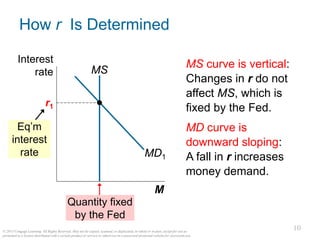
Learning. All Rights Reserved. May not be copied, scanned, or duplicated, in whole or in part, except for use as permitted in a license distributed with a certain product or service or otherwise on a password-protected website for classroom use. 10 How r Is Determined MS curve is vertical: Changes in r do not affect MS, which is fixed by the Fed. MD curve is downward sloping: A fall in r increases money demand. M Interest rate MS MD1 r1 Quantity fixed by the Fed Eq’m interest rate
12.
11 © 2015 Cengage
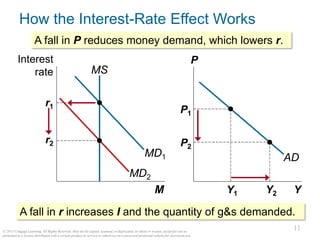
Learning. All Rights Reserved. May not be copied, scanned, or duplicated, in whole or in part, except for use as permitted in a license distributed with a certain product or service or otherwise on a password-protected website for classroom use. 11 How the Interest-Rate Effect Works Y P M Interest rate AD MS MD1 MD2 P2 P1 Y1 Y2 r2 r1 A fall in P reduces money demand, which lowers r. A fall in r increases I and the quantity of g&s demanded.
13.
12 © 2015 Cengage
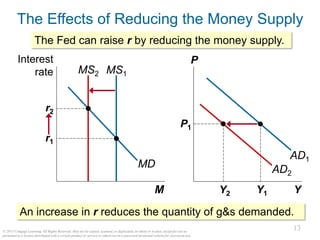
Learning. All Rights Reserved. May not be copied, scanned, or duplicated, in whole or in part, except for use as permitted in a license distributed with a certain product or service or otherwise on a password-protected website for classroom use. Monetary Policy and Aggregate Demand ▪ To achieve macroeconomic goals, the Fed can use monetary policy to shift the AD curve. ▪ The Fed’s policy instrument is MS. ▪ The news often reports that the Fed targets the interest rate. ▪ More precisely, the federal funds rate, which banks charge each other on short-term loans ▪ To change the interest rate and shift the AD curve, the Fed conducts open market operations to change MS.
14.
13 © 2015 Cengage
Learning. All Rights Reserved. May not be copied, scanned, or duplicated, in whole or in part, except for use as permitted in a license distributed with a certain product or service or otherwise on a password-protected website for classroom use. 13 The Effects of Reducing the Money Supply Y P M Interest rate AD1 MS1 MD P1 Y1 r1 MS2 r2 AD2 Y2 The Fed can raise r by reducing the money supply. An increase in r reduces the quantity of g&s demanded.
15.
A C T
I V E L E A R N I N G 2 Monetary policy For each of the events below, - determine the short-run effects on output - determine how the Fed should adjust the money supply and interest rates to stabilize output A. Congress tries to balance the budget by cutting govt spending. B. A stock market boom increases household wealth. C. War breaks out in the Middle East, causing oil prices to soar. © 2015 Cengage Learning. All Rights Reserved. May not be copied, scanned, or duplicated, in whole or in part, except for use as permitted in a license distributed with a certain product or service or otherwise on a password-protected website for classroom use.
16.
A C T
I V E L E A R N I N G 2 Answers A. Congress tries to balance the budget by cutting govt spending. This event would reduce agg demand and output. To stabilize output, the Fed should increase MS and reduce r to increase agg demand. © 2015 Cengage Learning. All Rights Reserved. May not be copied, scanned, or duplicated, in whole or in part, except for use as permitted in a license distributed with a certain product or service or otherwise on a password-protected website for classroom use.
17.
A C T
I V E L E A R N I N G 2 Answers B. A stock market boom increases household wealth. This event would increase agg demand, raising output above its natural rate. To stabilize output, the Fed should reduce MS and increase r to reduce agg demand. © 2015 Cengage Learning. All Rights Reserved. May not be copied, scanned, or duplicated, in whole or in part, except for use as permitted in a license distributed with a certain product or service or otherwise on a password-protected website for classroom use.
18.
A C T
I V E L E A R N I N G 2 Answers C. War breaks out in the Middle East, causing oil prices to soar. This event would reduce agg supply, causing output to fall. To stabilize output, the Fed should increase MS and reduce r to increase agg demand. © 2015 Cengage Learning. All Rights Reserved. May not be copied, scanned, or duplicated, in whole or in part, except for use as permitted in a license distributed with a certain product or service or otherwise on a password-protected website for classroom use.
19.
18 © 2015 Cengage
Learning. All Rights Reserved. May not be copied, scanned, or duplicated, in whole or in part, except for use as permitted in a license distributed with a certain product or service or otherwise on a password-protected website for classroom use. Liquidity traps ▪ Monetary policy stimulates aggregate demand by reducing the interest rate. ▪ Liquidity trap: when the interest rate is zero ▪ In a liquidity trap, monetary policy may not work, since nominal interest rates cannot be reduced further. ▪ However, central bank can make real interest rates negative by raising inflation expectations. ▪ Also, central bank can conduct open-market ops using other assets—like mortgages and corporate debt— thereby lowering rates on these kinds of loans. The Fed pursued this option in 2008–2009.
20.
19 © 2015 Cengage
Learning. All Rights Reserved. May not be copied, scanned, or duplicated, in whole or in part, except for use as permitted in a license distributed with a certain product or service or otherwise on a password-protected website for classroom use. Fiscal Policy and Aggregate Demand ▪ Fiscal policy: the setting of the level of govt spending and taxation by govt policymakers ▪ Expansionary fiscal policy ▪ an increase in G and/or decrease in T, shifts AD right ▪ Contractionary fiscal policy ▪ a decrease in G and/or increase in T, shifts AD left ▪ Fiscal policy has two effects on AD...
21.
20 © 2015 Cengage
Learning. All Rights Reserved. May not be copied, scanned, or duplicated, in whole or in part, except for use as permitted in a license distributed with a certain product or service or otherwise on a password-protected website for classroom use. 20 1. The Multiplier Effect ▪ If the govt buys $20b of planes from Boeing, Boeing’s revenue increases by $20b. ▪ This is distributed to Boeing’s workers (as wages) and owners (as profits or stock dividends). ▪ These people are also consumers and will spend a portion of the extra income. ▪ This extra consumption causes further increases in aggregate demand. Multiplier effect: the additional shifts in AD that result when fiscal policy increases income and thereby increases consumer spending
22.
21 © 2015 Cengage
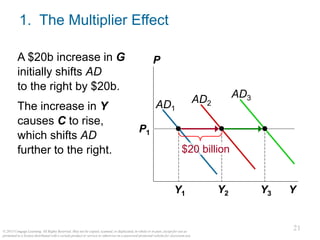
Learning. All Rights Reserved. May not be copied, scanned, or duplicated, in whole or in part, except for use as permitted in a license distributed with a certain product or service or otherwise on a password-protected website for classroom use. 21 1. The Multiplier Effect A $20b increase in G initially shifts AD to the right by $20b. The increase in Y causes C to rise, which shifts AD further to the right. Y P AD1 P1 AD2 AD3 Y1 Y3 Y2 $20 billion
23.
22 © 2015 Cengage
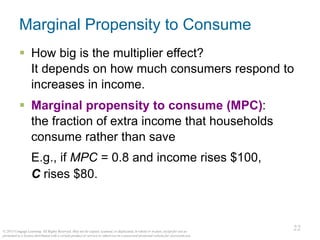
Learning. All Rights Reserved. May not be copied, scanned, or duplicated, in whole or in part, except for use as permitted in a license distributed with a certain product or service or otherwise on a password-protected website for classroom use. 22 Marginal Propensity to Consume ▪ How big is the multiplier effect? It depends on how much consumers respond to increases in income. ▪ Marginal propensity to consume (MPC): the fraction of extra income that households consume rather than save E.g., if MPC = 0.8 and income rises $100, C rises $80.
24.
23 © 2015 Cengage
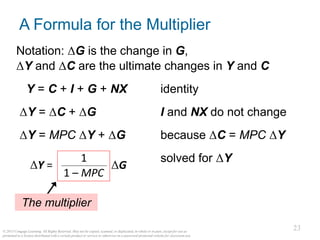
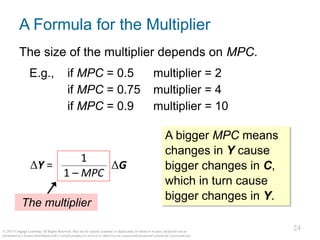
Learning. All Rights Reserved. May not be copied, scanned, or duplicated, in whole or in part, except for use as permitted in a license distributed with a certain product or service or otherwise on a password-protected website for classroom use. 23 Notation: ΔG is the change in G, ΔY and ΔC are the ultimate changes in Y and C Y = C + I + G + NX identity ΔY = ΔC + ΔG I and NX do not change ΔY = MPC ΔY + ΔG because ΔC = MPC ΔY solved for ΔY 1 1 – MPC ΔY = ΔG A Formula for the Multiplier The multiplier
25.
24 © 2015 Cengage
Learning. All Rights Reserved. May not be copied, scanned, or duplicated, in whole or in part, except for use as permitted in a license distributed with a certain product or service or otherwise on a password-protected website for classroom use. 24 The size of the multiplier depends on MPC. E.g., if MPC = 0.5 multiplier = 2 if MPC = 0.75 multiplier = 4 if MPC = 0.9 multiplier = 10 A Formula for the Multiplier 1 1 – MPC ΔY = ΔG The multiplier A bigger MPC means changes in Y cause bigger changes in C, which in turn cause bigger changes in Y.
26.
25 © 2015 Cengage
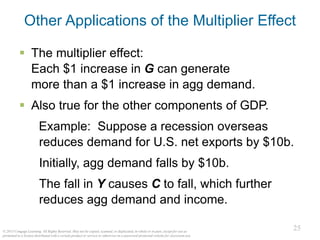
Learning. All Rights Reserved. May not be copied, scanned, or duplicated, in whole or in part, except for use as permitted in a license distributed with a certain product or service or otherwise on a password-protected website for classroom use. 25 Other Applications of the Multiplier Effect ▪ The multiplier effect: Each $1 increase in G can generate more than a $1 increase in agg demand. ▪ Also true for the other components of GDP. Example: Suppose a recession overseas reduces demand for U.S. net exports by $10b. Initially, agg demand falls by $10b. The fall in Y causes C to fall, which further reduces agg demand and income.
27.
26 © 2015 Cengage
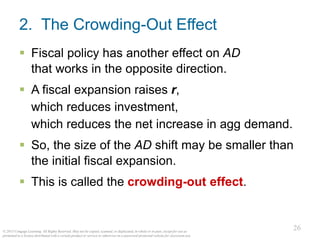
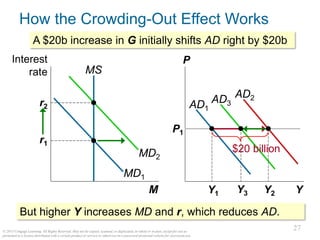
Learning. All Rights Reserved. May not be copied, scanned, or duplicated, in whole or in part, except for use as permitted in a license distributed with a certain product or service or otherwise on a password-protected website for classroom use. 26 2. The Crowding-Out Effect ▪ Fiscal policy has another effect on AD that works in the opposite direction. ▪ A fiscal expansion raises r, which reduces investment, which reduces the net increase in agg demand. ▪ So, the size of the AD shift may be smaller than the initial fiscal expansion. ▪ This is called the crowding-out effect.
28.
27 © 2015 Cengage
Learning. All Rights Reserved. May not be copied, scanned, or duplicated, in whole or in part, except for use as permitted in a license distributed with a certain product or service or otherwise on a password-protected website for classroom use. 27 How the Crowding-Out Effect Works Y P M Interest rate AD1 MS MD2 MD1 P1 r1 r2 A $20b increase in G initially shifts AD right by $20b But higher Y increases MD and r, which reduces AD. AD3 AD2 Y1 Y2 $20 billion Y3
29.
28 © 2015 Cengage
Learning. All Rights Reserved. May not be copied, scanned, or duplicated, in whole or in part, except for use as permitted in a license distributed with a certain product or service or otherwise on a password-protected website for classroom use. 28 Changes in Taxes ▪ A tax cut increases households’ take-home pay. ▪ Households respond by spending a portion of this extra income, shifting AD to the right. ▪ The size of the shift is affected by the multiplier and crowding-out effects. ▪ Another factor: whether households perceive the tax cut to be temporary or permanent. ▪ A permanent tax cut causes a bigger increase in C—and a bigger shift in the AD curve—than a temporary tax cut.
30.
A C T
I V E L E A R N I N G 3 Fiscal policy effects © 2015 Cengage Learning. All Rights Reserved. May not be copied, scanned, or duplicated, in whole or in part, except for use as permitted in a license distributed with a certain product or service or otherwise on a password-protected website for classroom use. The economy is in recession. Shifting the AD curve rightward by $200b would end the recession. A. If MPC = .8 and there is no crowding out, how much should Congress increase G to end the recession? B. If there is crowding out, will Congress need to increase G more or less than this amount?
31.
A C T
I V E L E A R N I N G 3 Answers © 2015 Cengage Learning. All Rights Reserved. May not be copied, scanned, or duplicated, in whole or in part, except for use as permitted in a license distributed with a certain product or service or otherwise on a password-protected website for classroom use. The economy is in recession. Shifting the AD curve rightward by $200b would end the recession. A. If MPC = .8 and there is no crowding out, how much should Congress increase G to end the recession? Multiplier = 1/(1 – .8) = 5 Increase G by $40b to shift agg demand by 5 x $40b = $200b.
32.
A C T
I V E L E A R N I N G 3 Answers © 2015 Cengage Learning. All Rights Reserved. May not be copied, scanned, or duplicated, in whole or in part, except for use as permitted in a license distributed with a certain product or service or otherwise on a password-protected website for classroom use. The economy is in recession. Shifting the AD curve rightward by $200b would end the recession. B. If there is crowding out, will Congress need to increase G more or less than this amount? Crowding out reduces the impact of G on AD. To offset this, Congress should increase G by a larger amount.
33.
32 © 2015 Cengage
Learning. All Rights Reserved. May not be copied, scanned, or duplicated, in whole or in part, except for use as permitted in a license distributed with a certain product or service or otherwise on a password-protected website for classroom use. Fiscal Policy and Aggregate Supply ▪ Most economists believe the short-run effects of fiscal policy mainly work through agg demand. ▪ But fiscal policy might also affect agg supply. ▪ Recall one of the Ten Principles from Chapter 1: People respond to incentives. ▪ A cut in the tax rate gives workers incentive to work more, so it might increase the quantity of g&s supplied and shift AS to the right. ▪ People who believe this effect is large are called “Supply-siders.”
34.
33 © 2015 Cengage
Learning. All Rights Reserved. May not be copied, scanned, or duplicated, in whole or in part, except for use as permitted in a license distributed with a certain product or service or otherwise on a password-protected website for classroom use. Fiscal Policy and Aggregate Supply ▪ Govt purchases might affect agg supply. Example: ▪ Govt increases spending on roads. ▪ Better roads may increase business productivity, which increases the quantity of g&s supplied, shifts AS to the right. ▪ This effect is probably more relevant in the long run: it takes time to build the new roads and put them into use.
35.
34 © 2015 Cengage
Learning. All Rights Reserved. May not be copied, scanned, or duplicated, in whole or in part, except for use as permitted in a license distributed with a certain product or service or otherwise on a password-protected website for classroom use. Using Policy to Stabilize the Economy ▪ Since the Employment Act of 1946, economic stabilization has been a goal of U.S. policy. ▪ Economists debate how active a role the govt should take to stabilize the economy.
36.
35 © 2015 Cengage
Learning. All Rights Reserved. May not be copied, scanned, or duplicated, in whole or in part, except for use as permitted in a license distributed with a certain product or service or otherwise on a password-protected website for classroom use. The Case for Active Stabilization Policy ▪ Keynes: “Animal spirits” cause waves of pessimism and optimism among households and firms, leading to shifts in aggregate demand and fluctuations in output and employment. ▪ Also, other factors cause fluctuations, e.g., ▪ booms and recessions abroad ▪ stock market booms and crashes ▪ If policymakers do nothing, these fluctuations are destabilizing to businesses, workers, consumers.
37.
36 © 2015 Cengage
Learning. All Rights Reserved. May not be copied, scanned, or duplicated, in whole or in part, except for use as permitted in a license distributed with a certain product or service or otherwise on a password-protected website for classroom use. The Case for Active Stabilization Policy ▪ Proponents of active stabilization policy believe the govt should use policy to reduce these fluctuations: ▪ When GDP falls below its natural rate, use expansionary monetary or fiscal policy to prevent or reduce a recession. ▪ When GDP rises above its natural rate, use contractionary policy to prevent or reduce an inflationary boom.
38.
37 © 2015 Cengage
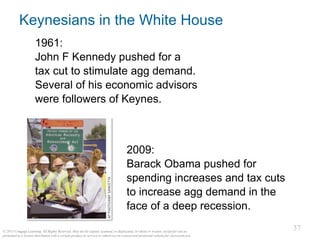
Learning. All Rights Reserved. May not be copied, scanned, or duplicated, in whole or in part, except for use as permitted in a license distributed with a certain product or service or otherwise on a password-protected website for classroom use. 37 Keynesians in the White House 1961: John F Kennedy pushed for a tax cut to stimulate agg demand. Several of his economic advisors were followers of Keynes. 2009: Barack Obama pushed for spending increases and tax cuts to increase agg demand in the face of a deep recession.
39.
38 © 2015 Cengage
Learning. All Rights Reserved. May not be copied, scanned, or duplicated, in whole or in part, except for use as permitted in a license distributed with a certain product or service or otherwise on a password-protected website for classroom use. 38 The Case Against Active Stabilization Policy ▪ Monetary policy affects economy with a long lag: ▪ Firms make investment plans in advance, so I takes time to respond to changes in r. ▪ Most economists believe it takes at least 6 months for mon policy to affect output and employment. ▪ Fiscal policy also works with a long lag: ▪ Changes in G and T require acts of Congress. ▪ The legislative process can take months or years.
40.
39 © 2015 Cengage
Learning. All Rights Reserved. May not be copied, scanned, or duplicated, in whole or in part, except for use as permitted in a license distributed with a certain product or service or otherwise on a password-protected website for classroom use. 39 The Case Against Active Stabilization Policy ▪ Due to these long lags, critics of active policy argue that such policies may destabilize the economy rather than help it: By the time the policies affect agg demand, the economy’s condition may have changed. ▪ These critics contend that policymakers should focus on long-run goals like economic growth and low inflation.
41.
40 © 2015 Cengage
Learning. All Rights Reserved. May not be copied, scanned, or duplicated, in whole or in part, except for use as permitted in a license distributed with a certain product or service or otherwise on a password-protected website for classroom use. Automatic Stabilizers ▪ Automatic stabilizers: changes in fiscal policy that stimulate agg demand when economy goes into recession, without policymakers having to take any deliberate action
42.
41 © 2015 Cengage
Learning. All Rights Reserved. May not be copied, scanned, or duplicated, in whole or in part, except for use as permitted in a license distributed with a certain product or service or otherwise on a password-protected website for classroom use. 41 Automatic Stabilizers: Examples ▪ The tax system ▪ In recession, taxes fall automatically, which stimulates agg demand. ▪ Govt spending ▪ In recession, more people apply for public assistance (welfare, unemployment insurance). ▪ Govt spending on these programs automatically rises, which stimulates agg demand.
43.
42 © 2015 Cengage
Learning. All Rights Reserved. May not be copied, scanned, or duplicated, in whole or in part, except for use as permitted in a license distributed with a certain product or service or otherwise on a password-protected website for classroom use. CONCLUSION ▪ Policymakers need to consider all the effects of their actions. For example, ▪ When Congress cuts taxes, it should consider the short-run effects on agg demand and employment, and the long-run effects on saving and growth. ▪ When the Fed reduces the rate of money growth, it must take into account not only the long-run effects on inflation but the short-run effects on output and employment.
44.
Summary • In the
theory of liquidity preference, the interest rate adjusts to balance the demand for money with the supply of money. • The interest-rate effect helps explain why the aggregate-demand curve slopes downward: an increase in the price level raises money demand, which raises the interest rate, which reduces investment, which reduces the aggregate quantity of goods & services demanded. © 2015 Cengage Learning. All Rights Reserved. May not be copied, scanned, or duplicated, in whole or in part, except for use as permitted in a license distributed with a certain product or service or otherwise on a password-protected website for classroom use.
45.
Summary • An increase
in the money supply causes the interest rate to fall, which stimulates investment and shifts the aggregate demand curve rightward. • Expansionary fiscal policy—a spending increase or tax cut—shifts aggregate demand to the right. Contractionary fiscal policy shifts aggregate demand to the left. © 2015 Cengage Learning. All Rights Reserved. May not be copied, scanned, or duplicated, in whole or in part, except for use as permitted in a license distributed with a certain product or service or otherwise on a password-protected website for classroom use.
46.
Summary • When the
government alters spending or taxes, the resulting shift in aggregate demand can be larger or smaller than the fiscal change: • The multiplier effect tends to amplify the effects of fiscal policy on aggregate demand. • The crowding-out effect tends to dampen the effects of fiscal policy on aggregate demand. © 2015 Cengage Learning. All Rights Reserved. May not be copied, scanned, or duplicated, in whole or in part, except for use as permitted in a license distributed with a certain product or service or otherwise on a password-protected website for classroom use.
47.
Summary • Economists disagree
about how actively policymakers should try to stabilize the economy. • Some argue that the government should use fiscal and monetary policy to combat destabilizing fluctuations in output and employment. • Others argue that policy will end up destabilizing the economy because policies work with long lags. © 2015 Cengage Learning. All Rights Reserved. May not be copied, scanned, or duplicated, in whole or in part, except for use as permitted in a license distributed with a certain product or service or otherwise on a password-protected website for classroom use.
Download