System Requirment
MOEEZ AHMAD (18661556-012)
1
Requirements
 A system cannot be:
▪ Analyzed,
▪ designed,
▪ implemented and
▪ evaluated
 unless the problem is understood and requirements elicited.
 Requirements are fundamental basis of all the system development
processes.
2
Core learning outcomes:
1. Compare and contrast the various requirements modeling techniques.
2. Distinguish between non-functional and functional requirements.
3. Identify and classify the roles played by external users of a system.
4. Explain how requirements gathering fits into a system development lifecycle.
3
What are requirements?
 Requirements are statements that identify the essential needs of a
system
 in order for it to have value and utility.
4
IEEE Definition
 A condition or capability that must be met or possessed by a system...to
satisfy a contract, standard, specification, or other formally imposed
document.
IEEE Std 729
5
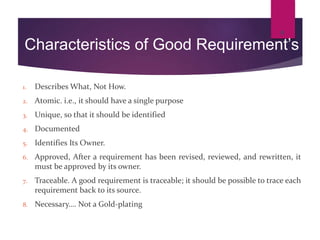
Characteristics of Good Requirement’s
1. Describes What, Not How.
2. Atomic. i.e., it should have a single purpose
3. Unique, so that it should be identified
4. Documented
5. Identifies Its Owner.
6. Approved, After a requirement has been revised, reviewed, and rewritten, it
must be approved by its owner.
7. Traceable. A good requirement is traceable; it should be possible to trace each
requirement back to its source.
8. Necessary…. Not a Gold-plating
6
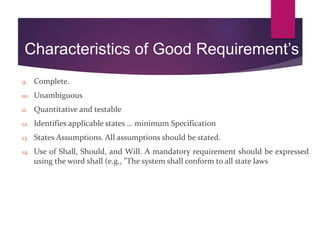
Characteristics of Good Requirement’s
9. Complete.
10. Unambiguous
11. Quantitative and testable
12. Identifies applicable states … minimum Specification
13. States Assumptions. All assumptions should be stated.
14. Use of Shall, Should, and Will. A mandatory requirement should be expressed
using the word shall (e.g., "The system shall conform to all state laws
7
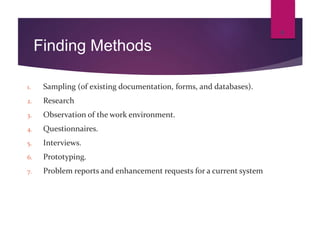
Finding Methods
1. Sampling (of existing documentation, forms, and databases).
2. Research
3. Observation of the work environment.
4. Questionnaires.
5. Interviews.
6. Prototyping.
7. Problem reports and enhancement requests for a current system
8
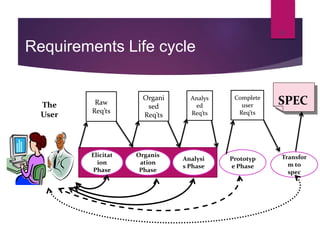
Requirements Life cycle
9
The
User
Elicitat
ion
Phase
Organis
ation
Phase
Analysi
s Phase
Prototyp
e Phase
Transfor
m to
spec
Raw
Req’ts
Organi
sed
Req’ts
Analys
ed
Req’ts
Complete
user
Req’ts
SPEC
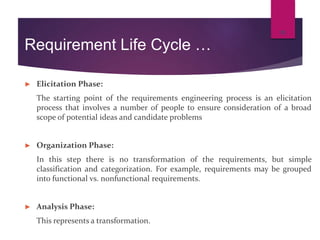
Requirement Life Cycle …
► Elicitation Phase:
The starting point of the requirements engineering process is an elicitation
process that involves a number of people to ensure consideration of a broad
scope of potential ideas and candidate problems
► Organization Phase:
In this step there is no transformation of the requirements, but simple
classification and categorization. For example, requirements may be grouped
into functional vs. nonfunctional requirements.
► Analysis Phase:
This represents a transformation.
10
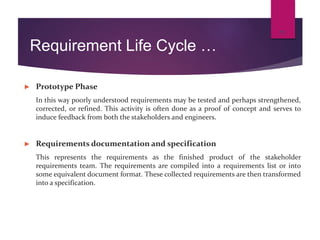
Requirement Life Cycle …
► Prototype Phase
In this way poorly understood requirements may be tested and perhaps strengthened,
corrected, or refined. This activity is often done as a proof of concept and serves to
induce feedback from both the stakeholders and engineers.
► Requirements documentation and specification
This represents the requirements as the finished product of the stakeholder
requirements team. The requirements are compiled into a requirements list or into
some equivalent document format. These collected requirements are then transformed
into a specification.
11
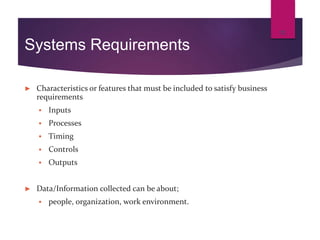
Systems Requirements
► Characteristics or features that must be included to satisfy business
requirements
 Inputs
 Processes
 Timing
 Controls
 Outputs
► Data/Information collected can be about;
 people, organization, work environment.
12
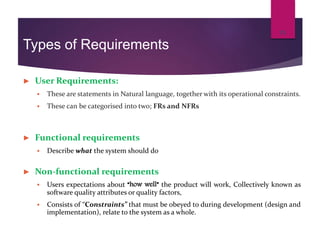
Types of Requirements
► User Requirements:
 These are statements in Natural language, together with its operational constraints.
 These can be categorised into two; FRs and NFRs
► Functional requirements
 Describe what the system should do
► Non-functional requirements
 Users expectations about “how well” the product will work, Collectively known as
software quality attributes or quality factors,
 Consists of “Constraints” that must be obeyed to during development (design and
implementation), relate to the system as a whole.
13
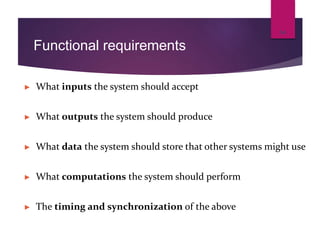
Functional requirements
► What inputs the system should accept
► What outputs the system should produce
► What data the system should store that other systems might use
► What computations the system should perform
► The timing and synchronization of the above
14
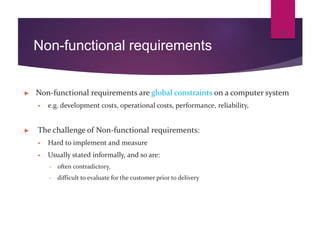
Non-functional requirements
► Non-functional requirements are global constraints on a computer system
 e.g. development costs, operational costs, performance, reliability,
► The challenge of Non-functional requirements:
 Hard to implement and measure
 Usually stated informally, and so are:
• often contradictory,
• difficult to evaluate for the customer prior to delivery
15
Non-functional requirements
 Define system properties and constraints e.g. reliability, response
time.
 Non-functional requirements may be more critical than functional
requirements.
 If these are not met, the system is useless.
16
Examples of NFR
► Interface requirements
 how will the new system interface with its environment?
• User interfaces and “user-friendliness”
• Interfaces with other systems
► Performance requirements
 Time - response time
 Throughput - transactions per second
17
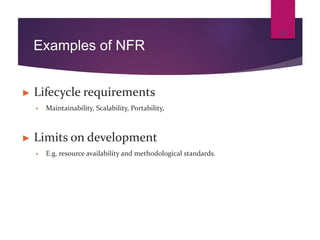
Examples of NFR
► Lifecycle requirements
 Maintainability, Scalability, Portability,
► Limits on development
 E.g. resource availability and methodological standards.
18
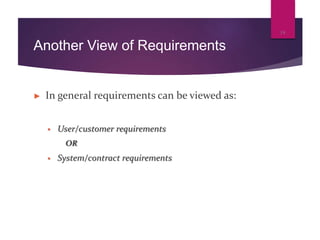
Another View of Requirements
► In general requirements can be viewed as:
 User/customer requirements
OR
 System/contract requirements
19
User/Customer Requirements
• FRs & NFRs should be stated in:
“natural language with the help of
forms or simple diagrams describing
the expected services of a system
under certain constraints”
20
System Contract Requirements
► Sets out the System services and constraints in detail.
► May serve as the basis of contract for implementation of the system
 Should be complete and consistent
21
Requirements Documentation
 There are basically two types of documents realized from the requirements
elicitation phase. These include;
 User Requirements Specification Document
 System requirements specification Document
22
User Requirements Specification –URS
 The URS document outlines precisely what the User (or customer) is
expecting from this system.
 User Requirement Specification may incorporate the functional requirements
of the system or may be in a separate document labelled the Functional
Requirements Specification - the FRS.
 The FRS has the following information:
1. Functional Requirements
2. Non-Functional Requirements
23
System Requirements Specification
Document
► A detailed description of the system services.
 What do we agree to provide?
 A structured document setting out detailed descriptions of the system
services.
 Written as a contract between client and contractor.
24

Requirement Analysis

  • 1.
  • 2.
    Requirements  A systemcannot be: ▪ Analyzed, ▪ designed, ▪ implemented and ▪ evaluated  unless the problem is understood and requirements elicited.  Requirements are fundamental basis of all the system development processes. 2
  • 3.
    Core learning outcomes: 1.Compare and contrast the various requirements modeling techniques. 2. Distinguish between non-functional and functional requirements. 3. Identify and classify the roles played by external users of a system. 4. Explain how requirements gathering fits into a system development lifecycle. 3
  • 4.
    What are requirements? Requirements are statements that identify the essential needs of a system  in order for it to have value and utility. 4
  • 5.
    IEEE Definition  Acondition or capability that must be met or possessed by a system...to satisfy a contract, standard, specification, or other formally imposed document. IEEE Std 729 5
  • 6.
    Characteristics of GoodRequirement’s 1. Describes What, Not How. 2. Atomic. i.e., it should have a single purpose 3. Unique, so that it should be identified 4. Documented 5. Identifies Its Owner. 6. Approved, After a requirement has been revised, reviewed, and rewritten, it must be approved by its owner. 7. Traceable. A good requirement is traceable; it should be possible to trace each requirement back to its source. 8. Necessary…. Not a Gold-plating 6
  • 7.
    Characteristics of GoodRequirement’s 9. Complete. 10. Unambiguous 11. Quantitative and testable 12. Identifies applicable states … minimum Specification 13. States Assumptions. All assumptions should be stated. 14. Use of Shall, Should, and Will. A mandatory requirement should be expressed using the word shall (e.g., "The system shall conform to all state laws 7
  • 8.
    Finding Methods 1. Sampling(of existing documentation, forms, and databases). 2. Research 3. Observation of the work environment. 4. Questionnaires. 5. Interviews. 6. Prototyping. 7. Problem reports and enhancement requests for a current system 8
  • 9.
    Requirements Life cycle 9 The User Elicitat ion Phase Organis ation Phase Analysi sPhase Prototyp e Phase Transfor m to spec Raw Req’ts Organi sed Req’ts Analys ed Req’ts Complete user Req’ts SPEC
  • 10.
    Requirement Life Cycle… ► Elicitation Phase: The starting point of the requirements engineering process is an elicitation process that involves a number of people to ensure consideration of a broad scope of potential ideas and candidate problems ► Organization Phase: In this step there is no transformation of the requirements, but simple classification and categorization. For example, requirements may be grouped into functional vs. nonfunctional requirements. ► Analysis Phase: This represents a transformation. 10
  • 11.
    Requirement Life Cycle… ► Prototype Phase In this way poorly understood requirements may be tested and perhaps strengthened, corrected, or refined. This activity is often done as a proof of concept and serves to induce feedback from both the stakeholders and engineers. ► Requirements documentation and specification This represents the requirements as the finished product of the stakeholder requirements team. The requirements are compiled into a requirements list or into some equivalent document format. These collected requirements are then transformed into a specification. 11
  • 12.
    Systems Requirements ► Characteristicsor features that must be included to satisfy business requirements  Inputs  Processes  Timing  Controls  Outputs ► Data/Information collected can be about;  people, organization, work environment. 12
  • 13.
    Types of Requirements ►User Requirements:  These are statements in Natural language, together with its operational constraints.  These can be categorised into two; FRs and NFRs ► Functional requirements  Describe what the system should do ► Non-functional requirements  Users expectations about “how well” the product will work, Collectively known as software quality attributes or quality factors,  Consists of “Constraints” that must be obeyed to during development (design and implementation), relate to the system as a whole. 13
  • 14.
    Functional requirements ► Whatinputs the system should accept ► What outputs the system should produce ► What data the system should store that other systems might use ► What computations the system should perform ► The timing and synchronization of the above 14
  • 15.
    Non-functional requirements ► Non-functionalrequirements are global constraints on a computer system  e.g. development costs, operational costs, performance, reliability, ► The challenge of Non-functional requirements:  Hard to implement and measure  Usually stated informally, and so are: • often contradictory, • difficult to evaluate for the customer prior to delivery 15
  • 16.
    Non-functional requirements  Definesystem properties and constraints e.g. reliability, response time.  Non-functional requirements may be more critical than functional requirements.  If these are not met, the system is useless. 16
  • 17.
    Examples of NFR ►Interface requirements  how will the new system interface with its environment? • User interfaces and “user-friendliness” • Interfaces with other systems ► Performance requirements  Time - response time  Throughput - transactions per second 17
  • 18.
    Examples of NFR ►Lifecycle requirements  Maintainability, Scalability, Portability, ► Limits on development  E.g. resource availability and methodological standards. 18
  • 19.
    Another View ofRequirements ► In general requirements can be viewed as:  User/customer requirements OR  System/contract requirements 19
  • 20.
    User/Customer Requirements • FRs& NFRs should be stated in: “natural language with the help of forms or simple diagrams describing the expected services of a system under certain constraints” 20
  • 21.
    System Contract Requirements ►Sets out the System services and constraints in detail. ► May serve as the basis of contract for implementation of the system  Should be complete and consistent 21
  • 22.
    Requirements Documentation  Thereare basically two types of documents realized from the requirements elicitation phase. These include;  User Requirements Specification Document  System requirements specification Document 22
  • 23.
    User Requirements Specification–URS  The URS document outlines precisely what the User (or customer) is expecting from this system.  User Requirement Specification may incorporate the functional requirements of the system or may be in a separate document labelled the Functional Requirements Specification - the FRS.  The FRS has the following information: 1. Functional Requirements 2. Non-Functional Requirements 23
  • 24.
    System Requirements Specification Document ►A detailed description of the system services.  What do we agree to provide?  A structured document setting out detailed descriptions of the system services.  Written as a contract between client and contractor. 24