Software Development
Approaches and Process
Models
Chapter 2: Software development approaches
and process models
What is software development
process?
• A structured set of activities required to
develop a software.
• Many different software processes, but
ALL involve:
Specification
Development (Design and
implementation)
Validation
Evolution
Plan-driven VS Agile development
approach VS DevOps approach
• Plan-driven approach, is a practice where ALL
development activities planned in advance and
progress is measured against that plan.
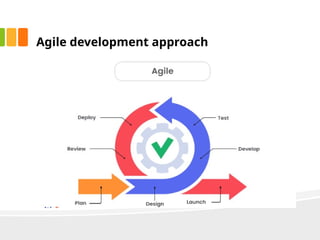
• Agile approach (continuous delivery), is a
practice where planning incrementally
achieved and easier to change the process to
reflect changing customer requirements.
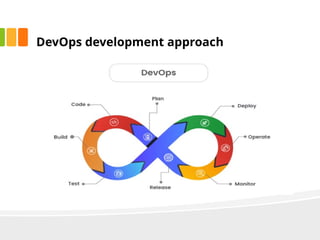
• DevOps approach (continuous deployment), is
a practice that aims at merging development,
quality assurance, and operations
(deployment and integration) into a single,
continuous set of processes. This methodology
is a natural extension of Agile and continuous
delivery approaches.
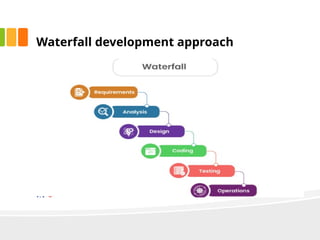
Waterfall development approach
Agile development approach
DevOps development approach
In practice, no right or
wrong software
development approach
Software development process models
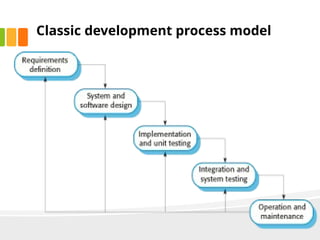
• The classic development process model
 Plan-driven approach.
 Separate and distinct phases of specification and
development.
• Evolutionary development process model
 Specification, development and validation are interleaved.
 Could be agile or DevOps.
• Reuse-oriented development process model
 The system is assembled from existing reusable
components, rather than developing them from scratch.
 May be plan-driven or agile.
In practice, most large systems are developed using a
process that incorporates elements from ALL of these
models.
Classic development process model
Limitations of the classic
development process model
• In practice, requirements are changed
frequently.
• Never go back to previous phase to fix
errors or problems.
• The customer can not use the
software UNTIL the entire system is
complete.
• The model implies that once the
software is completed, everything else
is maintenance cost.
When the classic development
process model is appropriate to use?
• Requirements must be well-
understood and identified.
• No changes in requirements
during the development process.
• Large scale software projects
where a software project is
developed at several sites.
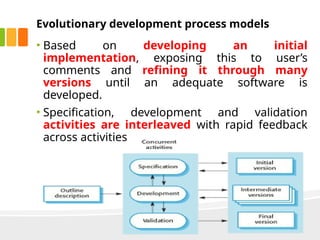
Evolutionary development process models
• Based on developing an initial
implementation, exposing this to user’s
comments and refining it through many
versions until an adequate software is
developed.
• Specification, development and validation
activities are interleaved with rapid feedback
across activities
Types of evolutionary development
process model
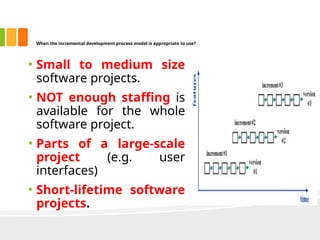
Incremental development approach:
This approach works with the customer to
explore their requirements and deliver a
final software step by step. The
development starts with the
requirements of the software that are
well-understood.
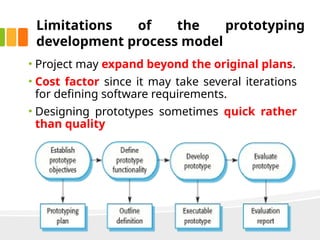
Prototyping development approach:
This approach emphasizes on
experimenting with the customer
requirements that are poorly
understood. The development follows
proof of concept method.
Limitations of the incremental
development process model
• Lack of process visibility.
• Software is usually poorly
structured.
• Special skills (e.g. technical
skills) may be required for rapid
prototyping.
When the incremental development process model is appropriate to use?
• Small to medium size
software projects.
• NOT enough staffing is
available for the whole
software project.
• Parts of a large-scale
project (e.g. user
interfaces)
• Short-lifetime software
projects.
Limitations of the prototyping
development process model
• Project may expand beyond the original plans.
• Cost factor since it may take several iterations
for defining software requirements.
• Designing prototypes sometimes quick rather
than quality
When the prototyping development
process model is appropriate to use?
• When the customer has poor
information about the software.
• When the software project needs to
have a lot of interaction with end
users.
• Web user interfaces.
• High technology software
projects.
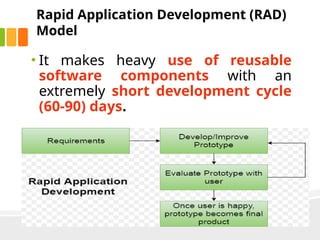
Rapid Application Development (RAD)
Model
• It makes heavy use of reusable
software components with an
extremely short development cycle
(60-90) days.
Limitations of the RAD development
process model
• Requires sufficient human
resources, particularly for large scale
projects.
• Projects committed in a much-
shortened time-frame.
• Problematic if system can not be
modularized.
• Not appropriate when technical
risks are high (heavy use of new
technology).
When the RAD development process
model is appropriate to use?
• If software requirements are well
understood and project time is
constrained.
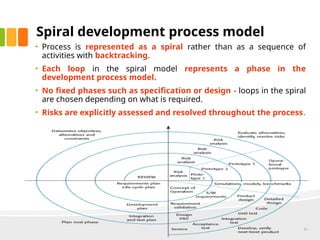
Spiral development process model
• Process is represented as a spiral rather than as a sequence of
activities with backtracking.
• Each loop in the spiral model represents a phase in the
development process model.
• No fixed phases such as specification or design - loops in the spiral
are chosen depending on what is required.
• Risks are explicitly assessed and resolved throughout the process.
21
Limitations of the spiral development
process model
• It is difficult to convince
customers (particularly in contract
situations) that the model is
controllable.
• Risk assessment expertise is
required to succeed.
22
When the spiral development process
model is appropriate to use?
• Good for large and critical-
mission software projects.
• When the risk and costs
evaluation is important.
• Additional functionality can be
added at a later date.
• When requirements are unclear
and complex.
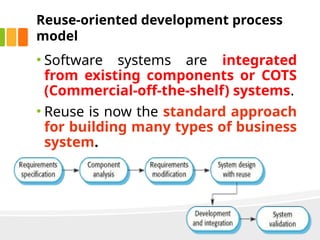
Reuse-oriented development process
model
• Software systems are integrated
from existing components or COTS
(Commercial-off-the-shelf) systems.
• Reuse is now the standard approach
for building many types of business
system.
The Rational unified development
process model (RUP)
• RUP is a generic process derived from the
work on the UML and associated process.
• Brings together aspects of the 3 generic
process models discussed previously.
• Normally described from 3 perspectives
A dynamic perspective that shows
phases over time;
A static perspective that shows process
activities;
A proactive perspective that suggests
good practice.
25
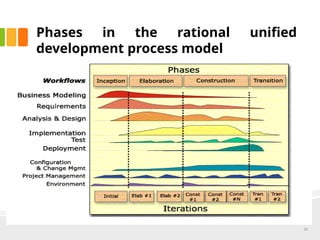
Phases in the rational unified
development process model
26
RUP good practice
• Develop software iteratively
Plan increments based on customer
priorities and deliver highest priority
increments first.
• Manage requirements
Explicitly document customer
requirements and keep track of changes
to these requirements.
• Use component-based architectures
Organize the system architecture as a
set of reusable components.
27
RUP good practice
• Visually model software
Use graphical UML models to present
static and dynamic views of the software.
• Verify software quality
Ensure that the software meets
organizational quality standards.
• Control changes to software
Manage software changes using a
change management system and
configuration management tools.
28

Chapter 2 Intro to SE(SW Process Models.pptx)

  • 1.
    Software Development Approaches andProcess Models Chapter 2: Software development approaches and process models
  • 2.
    What is softwaredevelopment process? • A structured set of activities required to develop a software. • Many different software processes, but ALL involve: Specification Development (Design and implementation) Validation Evolution
  • 3.
    Plan-driven VS Agiledevelopment approach VS DevOps approach • Plan-driven approach, is a practice where ALL development activities planned in advance and progress is measured against that plan. • Agile approach (continuous delivery), is a practice where planning incrementally achieved and easier to change the process to reflect changing customer requirements. • DevOps approach (continuous deployment), is a practice that aims at merging development, quality assurance, and operations (deployment and integration) into a single, continuous set of processes. This methodology is a natural extension of Agile and continuous delivery approaches.
  • 4.
  • 5.
  • 6.
  • 7.
    In practice, noright or wrong software development approach
  • 8.
    Software development processmodels • The classic development process model  Plan-driven approach.  Separate and distinct phases of specification and development. • Evolutionary development process model  Specification, development and validation are interleaved.  Could be agile or DevOps. • Reuse-oriented development process model  The system is assembled from existing reusable components, rather than developing them from scratch.  May be plan-driven or agile. In practice, most large systems are developed using a process that incorporates elements from ALL of these models.
  • 9.
  • 10.
    Limitations of theclassic development process model • In practice, requirements are changed frequently. • Never go back to previous phase to fix errors or problems. • The customer can not use the software UNTIL the entire system is complete. • The model implies that once the software is completed, everything else is maintenance cost.
  • 11.
    When the classicdevelopment process model is appropriate to use? • Requirements must be well- understood and identified. • No changes in requirements during the development process. • Large scale software projects where a software project is developed at several sites.
  • 12.
    Evolutionary development processmodels • Based on developing an initial implementation, exposing this to user’s comments and refining it through many versions until an adequate software is developed. • Specification, development and validation activities are interleaved with rapid feedback across activities
  • 13.
    Types of evolutionarydevelopment process model Incremental development approach: This approach works with the customer to explore their requirements and deliver a final software step by step. The development starts with the requirements of the software that are well-understood. Prototyping development approach: This approach emphasizes on experimenting with the customer requirements that are poorly understood. The development follows proof of concept method.
  • 14.
    Limitations of theincremental development process model • Lack of process visibility. • Software is usually poorly structured. • Special skills (e.g. technical skills) may be required for rapid prototyping.
  • 15.
    When the incrementaldevelopment process model is appropriate to use? • Small to medium size software projects. • NOT enough staffing is available for the whole software project. • Parts of a large-scale project (e.g. user interfaces) • Short-lifetime software projects.
  • 16.
    Limitations of theprototyping development process model • Project may expand beyond the original plans. • Cost factor since it may take several iterations for defining software requirements. • Designing prototypes sometimes quick rather than quality
  • 17.
    When the prototypingdevelopment process model is appropriate to use? • When the customer has poor information about the software. • When the software project needs to have a lot of interaction with end users. • Web user interfaces. • High technology software projects.
  • 18.
    Rapid Application Development(RAD) Model • It makes heavy use of reusable software components with an extremely short development cycle (60-90) days.
  • 19.
    Limitations of theRAD development process model • Requires sufficient human resources, particularly for large scale projects. • Projects committed in a much- shortened time-frame. • Problematic if system can not be modularized. • Not appropriate when technical risks are high (heavy use of new technology).
  • 20.
    When the RADdevelopment process model is appropriate to use? • If software requirements are well understood and project time is constrained.
  • 21.
    Spiral development processmodel • Process is represented as a spiral rather than as a sequence of activities with backtracking. • Each loop in the spiral model represents a phase in the development process model. • No fixed phases such as specification or design - loops in the spiral are chosen depending on what is required. • Risks are explicitly assessed and resolved throughout the process. 21
  • 22.
    Limitations of thespiral development process model • It is difficult to convince customers (particularly in contract situations) that the model is controllable. • Risk assessment expertise is required to succeed. 22
  • 23.
    When the spiraldevelopment process model is appropriate to use? • Good for large and critical- mission software projects. • When the risk and costs evaluation is important. • Additional functionality can be added at a later date. • When requirements are unclear and complex.
  • 24.
    Reuse-oriented development process model •Software systems are integrated from existing components or COTS (Commercial-off-the-shelf) systems. • Reuse is now the standard approach for building many types of business system.
  • 25.
    The Rational unifieddevelopment process model (RUP) • RUP is a generic process derived from the work on the UML and associated process. • Brings together aspects of the 3 generic process models discussed previously. • Normally described from 3 perspectives A dynamic perspective that shows phases over time; A static perspective that shows process activities; A proactive perspective that suggests good practice. 25
  • 26.
    Phases in therational unified development process model 26
  • 27.
    RUP good practice •Develop software iteratively Plan increments based on customer priorities and deliver highest priority increments first. • Manage requirements Explicitly document customer requirements and keep track of changes to these requirements. • Use component-based architectures Organize the system architecture as a set of reusable components. 27
  • 28.
    RUP good practice •Visually model software Use graphical UML models to present static and dynamic views of the software. • Verify software quality Ensure that the software meets organizational quality standards. • Control changes to software Manage software changes using a change management system and configuration management tools. 28

Editor's Notes

  • #24 COTS are stand-alone software systems that are configured for use in a particular environment. Reused components could be collections of objects that are developed as a package to be integrated with a component framework such as .NET or J2EE.
  • #26 Inception: defines the scope and budget of the project and develop business case. Elaboration: Plan project, specify features, assessing risks and baseline the architecture. Construction: Build the product. Transition: the final project phase which delivers the new system to its end-users.