Overview
• There arevarious approaches to system development.
• Each one offers a unique set of principles for
designing, building, and maintaining information
systems.
• Selecting an approach depends on various factors,
including the type of the system under development,
organisational culture, and project requirements.
3.
System Development Methods
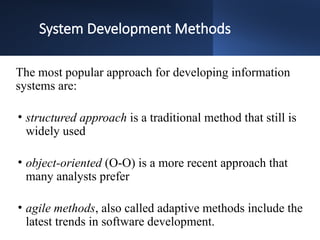
Themost popular approach for developing information
systems are:
• structured approach is a traditional method that still is
widely used
• object-oriented (O-O) is a more recent approach that
many analysts prefer
• agile methods, also called adaptive methods include the
latest trends in software development.
4.
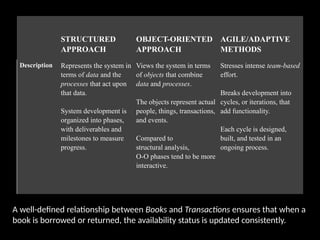
STRUCTURED
APPROACH
OBJECT-ORIENTED
APPROACH
AGILE/ADAPTIVE
METHODS
Description Represents thesystem in
terms of data and the
processes that act upon
that data.
System development is
organized into phases,
with deliverables and
milestones to measure
progress.
Views the system in terms
of objects that combine
data and processes.
The objects represent actual
people, things, transactions,
and events.
Compared to
structural analysis,
O-O phases tend to be more
interactive.
Stresses intense team-based
effort.
Breaks development into
cycles, or iterations, that
add functionality.
Each cycle is designed,
built, and tested in an
ongoing process.
A well-defined relationship between Books and Transactions ensures that when a
book is borrowed or returned, the availability status is updated consistently.
5.
STRUCTURED
APPROACH
OBJECT-
ORIENTED
APPROACH
AGILE/ADAPTIVE
METHODS
Modelling
tools
Data flow diagrams
DFDs)and process
descriptions.
Also, business
process modelling.
Various object-
oriented
diagrams depict
system actors,
methods, and
messages.
Also, business
process modelling.
Tools that enhance
communication, such as
collaborative software,
brainstorming, and
whiteboards.
Business process
modelling works well
with agile methods.
6.
Structured Development Approach
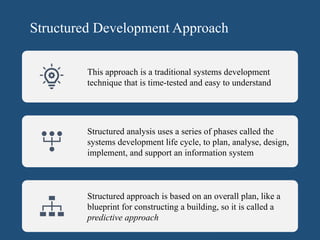
Thisapproach is a traditional systems development
technique that is time-tested and easy to understand
Structured analysis uses a series of phases called the
systems development life cycle, to plan, analyse, design,
implement, and support an information system
Structured approach is based on an overall plan, like a
blueprint for constructing a building, so it is called a
predictive approach
7.
Structured Development Approachcont…
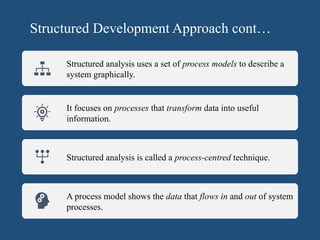
Structured analysis uses a set of process models to describe a
system graphically.
It focuses on processes that transform data into useful
information.
Structured analysis is called a process-centred technique.
A process model shows the data that flows in and out of system
processes.
8.
The system developmentlife cycle (SDLC) is a framework
that identifies all the activities required to research, build,
deploy, and maintain an information system.
Normally, the SDLC includes all activities needed for the
planning, systems analysis, systems design, programming,
testing, and user training stages of information systems
development.
The System Development Life Cycle
9.
The System DevelopmentLife Cycle cont…
• Identify the problem or need and obtain approval to proceed
with the project
• Plan and monitor the project—what to do, how to do it, and
who does it
• Discover and understand the details of the problem or the need
—what is required?
• Design the system components that solve the problem or
satisfy the need—how will it work?
• Build, test, and integrate system components—lots of
programming and component integration
• Complete system tests and then deploy the solution—the need
now is satisfied
10.
Structured Development /Predictive Approach to SDLC
• A predictive approach to the SDLC assumes that the development
project can be planned and organized, and that the new
information system can be developed according to the plan
• Predictive SDLCs are useful for building systems that are well
understood and defined
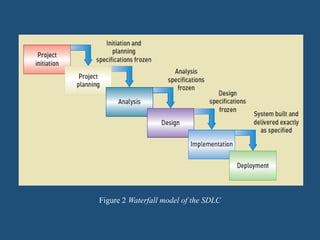
• These six groups of activities—project initiation, project planning,
analysis, design, implementation, and deployment—are referred to
as phases of the system development project, and they provide the
framework for managing the project
• The most predictive SDLC approach is called a waterfall model,
with the phases of the project flowing down, one after another
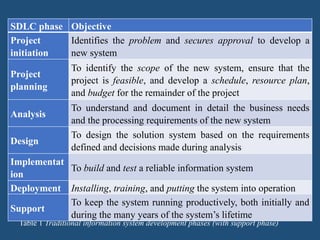
Table 1 Traditionalinformation system development phases (with support phase)
SDLC phase Objective
Project
initiation
Identifies the problem and secures approval to develop a
new system
Project
planning
To identify the scope of the new system, ensure that the
project is feasible, and develop a schedule, resource plan,
and budget for the remainder of the project
Analysis
To understand and document in detail the business needs
and the processing requirements of the new system
Design
To design the solution system based on the requirements
defined and decisions made during analysis
Implementat
ion
To build and test a reliable information system
Deployment Installing, training, and putting the system into operation
Support
To keep the system running productively, both initially and
during the many years of the system’s lifetime
13.
Figure 3 illustrateshow these activities can overlap.
Figure 3 Overlap of system development phases
14.
Adaptive Approach toSDLC
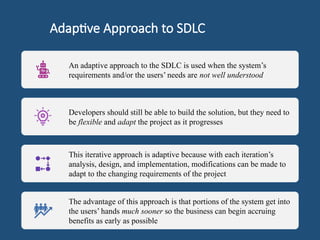
An adaptive approach to the SDLC is used when the system’s
requirements and/or the users’ needs are not well understood
Developers should still be able to build the solution, but they need to
be flexible and adapt the project as it progresses
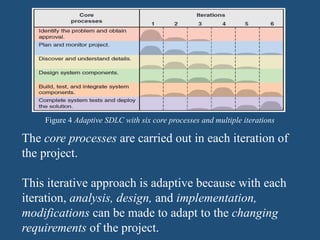
This iterative approach is adaptive because with each iteration’s
analysis, design, and implementation, modifications can be made to
adapt to the changing requirements of the project
The advantage of this approach is that portions of the system get into
the users’ hands much sooner so the business can begin accruing
benefits as early as possible
15.
Figure 4 AdaptiveSDLC with six core processes and multiple iterations
The core processes are carried out in each iteration of
the project.
This iterative approach is adaptive because with each
iteration, analysis, design, and implementation,
modifications can be made to adapt to the changing
requirements of the project.
16.
Object-Oriented Analysis
• Object-orientedanalysis describes an information system by
identifying things called objects
• Whereas structured analysis treats processes and data as
separate components, object-oriented analysis combines data
and the processes that act on the data into things called
objects
• In O-O design, built-in processes called methods can change
an object's properties
• O-O analysis uses object models to represent data and
behaviour, and to show how objects affect other objects
• Object-oriented methods usually follow a series of planning,
analysis and design phases that are similar to the SDLC.
17.
An object isa member of a class, which is a collection of
similar objects.
Objects possess characteristics called properties, which the
object inherits from its class or possesses on its own.
Figure 6 The PERSON class includes INSTRUCTOR and STUDENT objects, which have
their own properties and inherited properties
18.
Agile Development
Highly volatilebusiness environment has forced businesses to respond rapidly
to new opportunities.
The basic philosophy of Agile development is that neither team members nor
the users completely understand the problems and complexities of a new
system, so the project plan and the execution of the project must be responsive
to unanticipated issues
Agile development is an information system development process that
emphasizes flexibility and rapid response to anticipate new and changing
requirements during development.
Agile methods attempt to develop a system incrementally, by building a series
of prototypes and constantly adjusting them to user requirements.
An agile approach emphasizes continuous feedback, and each incremental step
is affected by what was learned in the prior steps
Developers revise, extend, and merge earlier versions into the final product
based on continuous feedback.
19.
Alternative System BuildingApproach: Prototyping
•Prototyping produces an early, rapidly constructed
working version of the proposed information system,
called a prototype.
•Prototyping involves a repetitive sequence of analysis,
design, modelling, and testing.
20.
PROTOTYPING METHODS
Systems analystsuse two different prototyping methods: system
prototyping and design prototyping
System prototyping produces a full-featured, working model of the
information system.
Systems analysts also use prototyping to verify user requirements,
after which the prototype is discarded, and implementation
continues
This approach is called design prototyping, or throwaway
prototyping.
21.
Advantages of Prototyping
Thepotential for changing the system early
in its development
The opportunity to stop development of a
system that is not working
The possibility of developing a system that
more closely addresses users’ needs and
expectations
22.
Disadvantages of Prototyping
Itcan be quite difficult to manage
prototyping as a project in the larger
systems effort
Users and analysts may adopt a prototype
as a completed system when it is in fact
inadequate and was never intended to
serve as a finished system
23.
The following typesof applications can be considered as
candidate applications for the prototype development
approach:
• System incorporating novel technologies and
procedures, which requires user’s approval.
• High-cost and high-risk type of systems.
• Requirements of the systems to be developed are not
known.
• Systems that required to be checked for their
feasibilities.