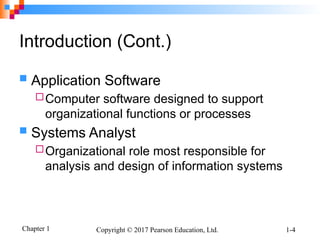
#4 Another category of software is systems software.
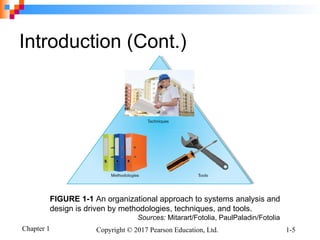
#5 As a systems analyst, you fill the organizational role most responsible for the analysis and design of information systems. To do this you’ll apply methodologies, techniques, and software tools.
Methodologies are comprehensive, multiple-step approaches to systems development that will guide your work and influence the quality of your final product—the information system.
Techniques are particular processes that you, as an analyst, will follow to help ensure that your work is well thought out, complete, and comprehensible to others on your project team.
Tools are typically computer programs that make it easy to use and benefit from techniques and to faithfully follow the guidelines of the overall development methodology.
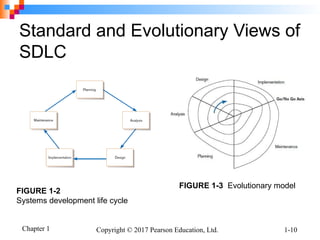
#9 The SDLC is a particular form of business problem-solving cycles. A common feature of cycles is that they tend to loop and repeat. And each involves some sort of up-front planning and feasibility assessment, followed by more detailed and meticulous exploration and analysis of the problem, which typically result in some set of solution alternatives from which to pick and implement. After that, there should be continuous monitoring and adjustment, which often leads to earlier steps, thus making it a cycle.
#10 The traditional SDLC is very detailed and meticulous, and originally came about in the early years of IT when legacy mainframe systems were the norm, and requirements had to be very well known in order to code the final solution. But as more tools and techniques came along, this enabled a more organic, evolutionary approach. In the following slides we’ll look at some of these differences.
Some people consider the life cycle to be a spiral, in which we constantly cycle through the phases at different levels of detail, and figure 1.3 illustrates this idea.
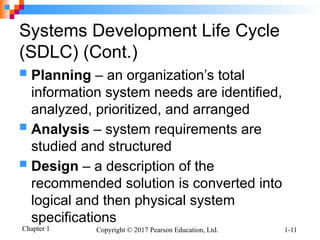
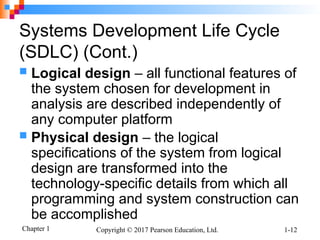
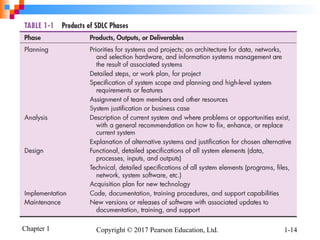
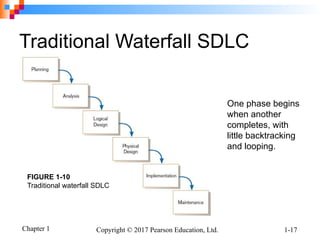
#14 The products of each phase become inputs and resources for the next phase.
Shortly we’ll see that this traditional SDLC follows a “waterfall” approach, where one phase “flows” into the next.
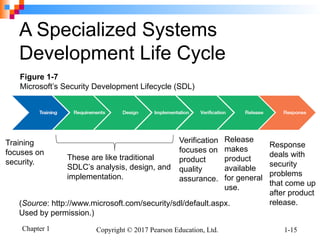
#15 Note that different companies may have their own special SDLC methodologies for certain types of information systems problems. For example, Microsoft has a method they call “security development lifecycle (SDL)” which includes these steps: training, requirements, design, implementation, verification, release, response. Although these are not exactly identical to SDLC, there is a lot of overlap. In this case, the cycle is for ensuring security in the software products Microsoft develops. In particular, the verification and release stages reflect Microsoft as a product vendor. By contrast, traditional SDLC (which include planning and maintenance) tends to apply to business or organizational applications. So, the sort of problem and the type of industry can affect your choice of SDLC methodology.
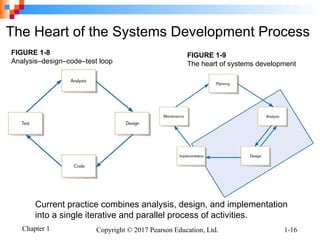
#16 We’re going to talk about eXtreme programming and Agile methodologies shortly. This is the current approach to software development. In a sense you can think of replacing one big SDLC cycle in which extensive time spend in analysis and design before programming. Instead, you have with newer approaches lots of short-term cycles involving some analysis, design, and coding, followed by another stage of analysis, design, and coding, etc. As I mentioned earlier, this is a much more evolutionary and free-flow process. And it’s possible because of the great advance in modeling, design and CASE tools, as well as software framework APIs.
#17 Here again we see the more traditional SDLC. As a waterfall, you don’t see cycling back. An earlier picture shows SDLC as a cycle, but although it’s a cycle, the idea is to avoid cycling back unless we encounter some problem at a particular stage. For example, if in the design phase we see that we can’t go forward without more analysis, we may go back to analysis. But the hope is to keep surging forward.
#18 As you can see, this has its disadvantages. In general, the traditional SDLC approach is not very flexible and adaptive. It was the only plausible approach back in the days of legacy systems. But now it’s an outdated methodology. Nevertheless, it has evolved and mutated to other more timely approaches, which we’ll be discussing next.
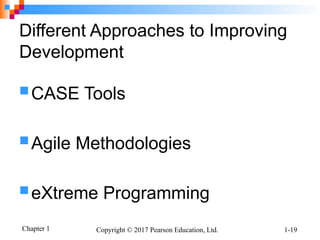
#19 Remember when we talked about the use of tools, methodologies, and techniques? These are three of these. We’ll discuss each in turn.
#20 IBM’s Rational products are a popular example of CASE tools.
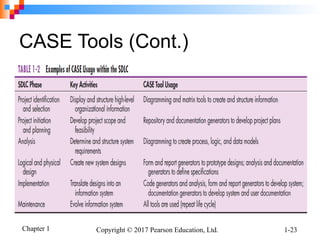
#23 As you can see, CASE tools are used throughout the SDLC process.
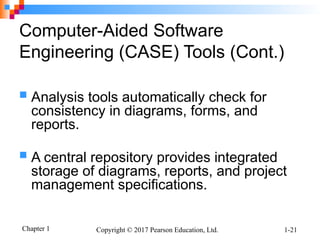
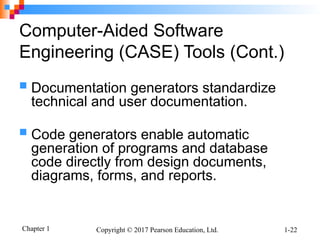
CASE helps programmers and analysts do their jobs more efficiently and more effectively by automating routine tasks. However, many organizations that use CASE tools don’t use them to support all phases of the SDLC. For example, some organizations may extensively use the diagramming features but not the code generators.
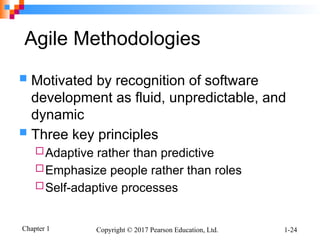
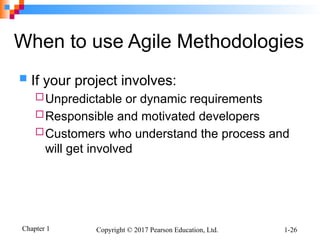
#24 Another buzzword with a similar idea is “Rapid Application Development (RAD)”. This phrase has gone out of favor, and “Agile” is more in vogue. Also coming into vogue is SCRUM.
These ideas are variations on a theme of bringing adaptive techniques into the SDLC methodology. A very early “adaptive SDLC” approach in that vein was called “prototyping”.
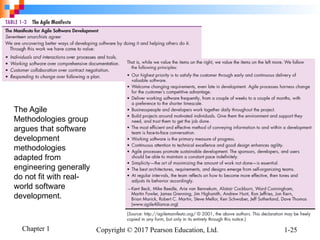
#25 The agile approach emphasizes people as individuals over their roles. In a way it humanizes software development and allows for change over time, whereas the traditional SDLC is more formal and structured.
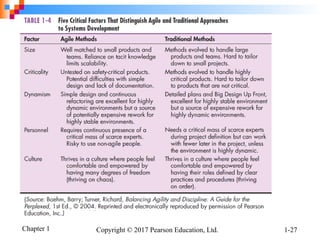
#27 Again, you see the distinction between the agile and traditional approaches. The agile approach comes with its risks, as you can see with the statement regarding criticality. The traditional SDLC is better suited to large enterprise-wide projects whereas agile methods are better for ad hoc needs and smaller projects. It fosters creativity, but also requires people who are comfortable thinking outside the box, as you can see in the statement regarding culture.
Most companies use both methods, focusing more on agile in some projects and more on traditional SDLC in others.
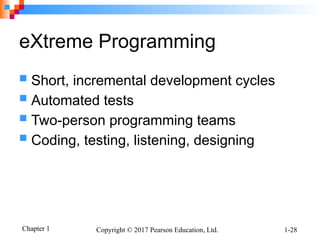
#28 eXtreme Programming was developed by Kent Beck., who co-wrote this book referenced by our textbook:
Beck, K., and C. Andres. 2004. eXtreme Programming eXplained.
Upper Saddle River, NJ: Addison-Wesley.
Note the emphasis on small two-person teams. Also note the short development cycles. So this is definitely an example of an agile methodology.
#29 In traditional SDLC on large scale systems, coders and testers are often two different and specialized roles. Here there is a code/test/code/test cycle that both members of the team iterate through,
In the old days (when traditional SDLC was developed), testing a program was a much more laborious process than it is now with modern IDEs (integrated development environments). Now there are many sophisticated debugging and testing tools that make the code/test/code/test cycle easy.
The emphasis on high-quality code has some implications here, Whereas a first-draft code may result in something that works, the code may not be flexible or elegant, and could contain extraneous code. Part of the programming effort involves continuously improving the code.
#30 Object orientation is currently the most common software development paradigm. The previous paradigm can be described as “task decomposition”. With this approach, you have an overall program and divide it into tasks, which can further be decomposed into subtasks, etc. In this approach modularity is achieved by creating functions or subroutines to do commonly-performed tasks.
With object-orientation you have a different perspective. Here you have classes (or categories) of objects that each contain a certain state (the contents of its data) and perform certain behaviors (often called “methods”). This approach enables creation of “components” that can be grouped together in various ways to accomplish a variety of problems. Object-orientation fosters code-reusability and it also leads to more flexible software libraries. In this sense, object-orientation is very conducive with agile methodologies.
#31 The notion of inheritance is important in OOAD. Classes can inherit properties and behaviors from superclasses, and then add specialized behaviors of their own. Conceptually, an object of a certain class is also a member of its superclass. For example, a dog is a mammal which is an animal. Therefore a dog is also an animal. Animal is a superclass of mammal which is a superclass of dog.
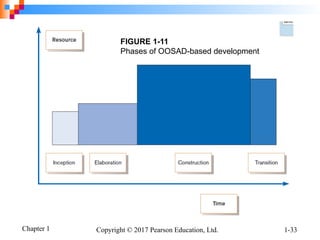
#32 RUP is a popular approach to object-oriented system development. A development project is broken into phases, each of which go through a set of iterations.
#33 This graph shows the four phases: inception, elaboration, construction, and transition. As you can see, the most time-consuming and resource-intensive phase is construction. Inception is a lot like planning in the traditional SDLC. Elaboration in RUP is like a combination of SDLC’s analysis and design. Construction has elements of physical design and implementation. And transition is a lot like maintenance.
So the various tasks of SDLC are also being done in RUP, but with different emphases and sequences.