17
RESPONSIVE WEB DESIGN
OVERVIEW
• What RWD is
• Fluid layouts
• Media queries
• Design strategies and patterns
• Testing options
Introduction to RWD
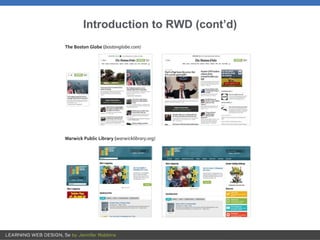
• RWD is a design and production approach that allows a web
page to adapt to the screen it is viewed on.
• The same HTML source is styled differently based on the
width of the screen.
• It ensures mobile users get the same content as other users,
with a presentation that optimizes usability.
• The term was coined by Ethan Marcotte in 2010 in his article
“Responsive Web Design” for A List Apart.
Introduction to RWD (cont’d)
The Components of RWD
Ethan Marcotte defines the three core components as follows:
• A flexible grid
Elements are sized so they squeeze and flow into the
available browser space.
• Flexible images
Images and other embedded media scale to fit their
containing elements.
• CSS media queries
These are a way to test for browser features such as
viewport width and deliver styles accordingly.
Setting the Viewport
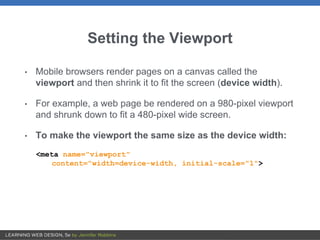
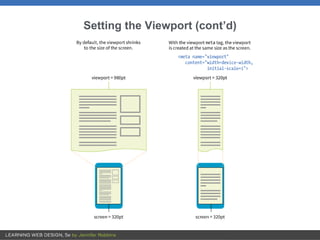
• Mobile browsers render pages on a canvas called the
viewport and then shrink it to fit the screen (device width).
• For example, a web page be rendered on a 980-pixel viewport
and shrunk down to fit a 480-pixel wide screen.
• To make the viewport the same size as the device width:
<meta name="viewport"
content="width=device-width, initial-scale="1">
Setting the Viewport (cont’d)
Flexible Grids (Fluid Layout)
Flexible Grid (Fluid Layout )
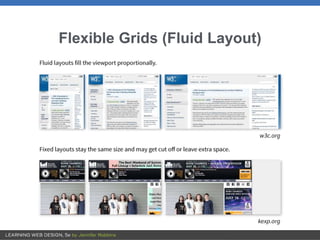
• Fluid layouts are the best approach for designing for a wide
range of screen widths
• For flexibility, use:
• fr and minmax() and content-based grid track values
• flex in Flexbox
• percentage measurements
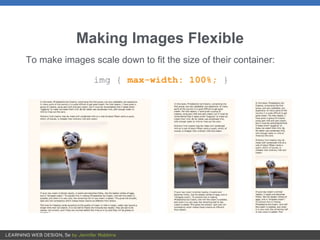
Making Images Flexible
To make images scale down to fit the size of their container:
img { max-width: 100%; }
Media Queries
A media query is a special rule that tests for certain conditions
before applying the styles it contains:
@media type and (feature: value) {
/* styles for browsers that meet this criteria */
}
A few query examples:
• Is it on a screen or printed?
• Is the browser at least a certain width?
• Is the orientation landscape or portrait?
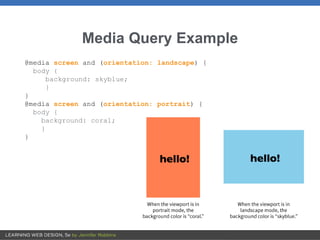
Media Query Example
@media screen and (orientation: landscape) {
body {
background: skyblue;
}
}
@media screen and (orientation: portrait) {
body {
background: coral;
}
}
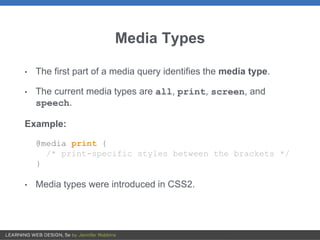
Media Types
• The first part of a media query identifies the media type.
• The current media types are all, print, screen, and
speech.
Example:
@media print {
/* print-specific styles between the brackets */
}
• Media types were introduced in CSS2.
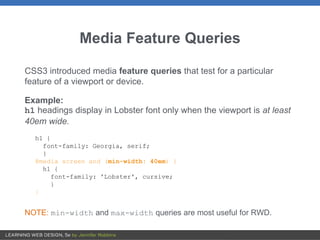
Media Feature Queries
CSS3 introduced media feature queries that test for a particular
feature of a viewport or device.
Example:
h1 headings display in Lobster font only when the viewport is at least
40em wide.
h1 {
font-family: Georgia, serif;
}
@media screen and (min-width: 40em) {
h1 {
font-family: 'Lobster', cursive;
}
}
NOTE: min-width and max-width queries are most useful for RWD.
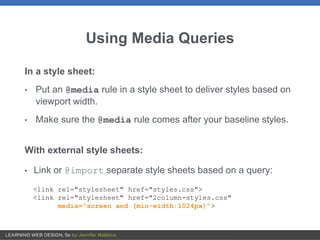
Using Media Queries
In a style sheet:
• Put an @media rule in a style sheet to deliver styles based on
viewport width.
• Make sure the @media rule comes after your baseline styles.
With external style sheets:
• Link or @import separate style sheets based on a query:
<link rel="stylesheet" href="styles.css">
<link rel="stylesheet" href="2column-styles.css"
media="screen and (min-width:1024px)">
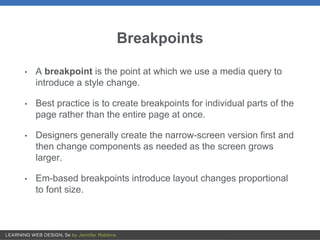
Breakpoints
• A breakpoint is the point at which we use a media query to
introduce a style change.
• Best practice is to create breakpoints for individual parts of the
page rather than the entire page at once.
• Designers generally create the narrow-screen version first and
then change components as needed as the screen grows
larger.
• Em-based breakpoints introduce layout changes proportional
to font size.
Breakpoints (cont’d.)
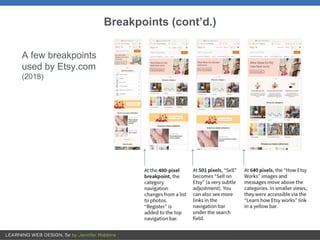
A few breakpoints
used by Etsy.com
(2018)
Designing Responsively
You need to pay attention to the following aspects of the
page in a responsive design:
• Content hierarchy
• Layout
• Typography
• Navigation
• Images
• Special content like tables and forms
Content Hierarchy
• The biggest challenge is deciding what is visible in the
first screen on small devices.
• You should strive for content parity across devices.
Everyone should have access to the same information,
even if it’s not in exactly the same place.
• Content organization is the most important part of site
planning. It’s often handled by information architects or
content strategists.
Layout
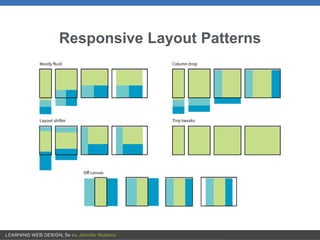
• RWD is based on fluid layouts.
• The most common approach is to start with one column
on small devices and add columns as space is
available.
• The optimum width of a text element should be based on a
line length of 45 to 75 characters. If lines are much
longer, introduce a breakpoint.
Responsive Layout Patterns
Typography
• Typography should be optimized for different screen sizes.
• Avoid complicated font styles on small screens.
• Set font size to keep line lengths between 45 to 75
characters.
• Line height should generally be larger on larger screens.
• Left and right margins can increase on larger screens.
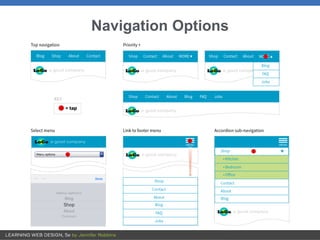
Navigation Options
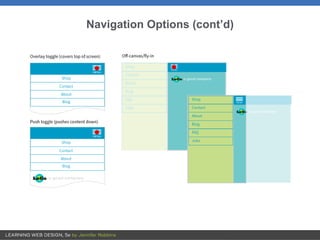
Navigation Options (cont’d)
Images
• Use responsive image markup techniques.
• Serve the smallest file size version by default.
• Make sure important image detail isn’t lost at smaller sizes.
Allow zooming or provide a cropped version.
• Avoid text in graphics or provide alternative versions with
larger type for small screens.
Special Content
• Forms
Design for efficiency and flexibility (Flexbox)
• Tables
Research responsive table patterns
• Interactive elements
— Scale videos proportionally.
— Explore alternatives that work better on small screens (for
example, linking to a map app instead of just providing a small
embedded map).
Site Testing
Testing sites in a wide variety of browsing environments is
critical:
• Real devices
The best way to test is on actual smartphones, tablets, etc.
• Emulators
Use a desktop application that simulates device hardware and
software.
• Browser testing services
Subscription-based services show how your site looks on a
huge variety of browsers.

Chapter 17: Responsive Web Design

  • 1.
  • 2.
    OVERVIEW • What RWDis • Fluid layouts • Media queries • Design strategies and patterns • Testing options
  • 3.
    Introduction to RWD •RWD is a design and production approach that allows a web page to adapt to the screen it is viewed on. • The same HTML source is styled differently based on the width of the screen. • It ensures mobile users get the same content as other users, with a presentation that optimizes usability. • The term was coined by Ethan Marcotte in 2010 in his article “Responsive Web Design” for A List Apart.
  • 4.
  • 5.
    The Components ofRWD Ethan Marcotte defines the three core components as follows: • A flexible grid Elements are sized so they squeeze and flow into the available browser space. • Flexible images Images and other embedded media scale to fit their containing elements. • CSS media queries These are a way to test for browser features such as viewport width and deliver styles accordingly.
  • 6.
    Setting the Viewport •Mobile browsers render pages on a canvas called the viewport and then shrink it to fit the screen (device width). • For example, a web page be rendered on a 980-pixel viewport and shrunk down to fit a 480-pixel wide screen. • To make the viewport the same size as the device width: <meta name="viewport" content="width=device-width, initial-scale="1">
  • 7.
  • 8.
  • 9.
    Flexible Grid (FluidLayout ) • Fluid layouts are the best approach for designing for a wide range of screen widths • For flexibility, use: • fr and minmax() and content-based grid track values • flex in Flexbox • percentage measurements
  • 10.
    Making Images Flexible Tomake images scale down to fit the size of their container: img { max-width: 100%; }
  • 11.
    Media Queries A mediaquery is a special rule that tests for certain conditions before applying the styles it contains: @media type and (feature: value) { /* styles for browsers that meet this criteria */ } A few query examples: • Is it on a screen or printed? • Is the browser at least a certain width? • Is the orientation landscape or portrait?
  • 12.
    Media Query Example @mediascreen and (orientation: landscape) { body { background: skyblue; } } @media screen and (orientation: portrait) { body { background: coral; } }
  • 13.
    Media Types • Thefirst part of a media query identifies the media type. • The current media types are all, print, screen, and speech. Example: @media print { /* print-specific styles between the brackets */ } • Media types were introduced in CSS2.
  • 14.
    Media Feature Queries CSS3introduced media feature queries that test for a particular feature of a viewport or device. Example: h1 headings display in Lobster font only when the viewport is at least 40em wide. h1 { font-family: Georgia, serif; } @media screen and (min-width: 40em) { h1 { font-family: 'Lobster', cursive; } } NOTE: min-width and max-width queries are most useful for RWD.
  • 15.
    Using Media Queries Ina style sheet: • Put an @media rule in a style sheet to deliver styles based on viewport width. • Make sure the @media rule comes after your baseline styles. With external style sheets: • Link or @import separate style sheets based on a query: <link rel="stylesheet" href="styles.css"> <link rel="stylesheet" href="2column-styles.css" media="screen and (min-width:1024px)">
  • 16.
    Breakpoints • A breakpointis the point at which we use a media query to introduce a style change. • Best practice is to create breakpoints for individual parts of the page rather than the entire page at once. • Designers generally create the narrow-screen version first and then change components as needed as the screen grows larger. • Em-based breakpoints introduce layout changes proportional to font size.
  • 17.
    Breakpoints (cont’d.) A fewbreakpoints used by Etsy.com (2018)
  • 18.
    Designing Responsively You needto pay attention to the following aspects of the page in a responsive design: • Content hierarchy • Layout • Typography • Navigation • Images • Special content like tables and forms
  • 19.
    Content Hierarchy • Thebiggest challenge is deciding what is visible in the first screen on small devices. • You should strive for content parity across devices. Everyone should have access to the same information, even if it’s not in exactly the same place. • Content organization is the most important part of site planning. It’s often handled by information architects or content strategists.
  • 20.
    Layout • RWD isbased on fluid layouts. • The most common approach is to start with one column on small devices and add columns as space is available. • The optimum width of a text element should be based on a line length of 45 to 75 characters. If lines are much longer, introduce a breakpoint.
  • 21.
  • 22.
    Typography • Typography shouldbe optimized for different screen sizes. • Avoid complicated font styles on small screens. • Set font size to keep line lengths between 45 to 75 characters. • Line height should generally be larger on larger screens. • Left and right margins can increase on larger screens.
  • 23.
  • 24.
  • 25.
    Images • Use responsiveimage markup techniques. • Serve the smallest file size version by default. • Make sure important image detail isn’t lost at smaller sizes. Allow zooming or provide a cropped version. • Avoid text in graphics or provide alternative versions with larger type for small screens.
  • 26.
    Special Content • Forms Designfor efficiency and flexibility (Flexbox) • Tables Research responsive table patterns • Interactive elements — Scale videos proportionally. — Explore alternatives that work better on small screens (for example, linking to a map app instead of just providing a small embedded map).
  • 27.
    Site Testing Testing sitesin a wide variety of browsing environments is critical: • Real devices The best way to test is on actual smartphones, tablets, etc. • Emulators Use a desktop application that simulates device hardware and software. • Browser testing services Subscription-based services show how your site looks on a huge variety of browsers.