In the previouslecture we learned about the concept
of project financing. We also mentioned the concept
of Public-Private Partnerships (PPPs), special
purpose vehicle and Risk Management in projects. In
this lecture, we are going to introduce you to
financing development Projects, we shall also learn
venture capital, the instruments used in venture
capital and its characteristics.
Introduction
3.
Development projectsrefer to a special kind of
investment. The term connotes purposefulness, some
minimum size, specific location, the introduction of
something qualitatively new, the expectation that a
sequence of further development moves will be set in
motion. If they are in the public sector, development
projects may additionally be defined as those units or
aggregates of public investments that however, small, still
evoke direct involvement by high usually the highest
political authorities. Development projects, then , are
privileged particles of the development process, and the
Defining Development Projects
4.
feeling that theirbehaviour warrants watching at
close range lead to the assessment to see how they are
improving the living standards of the people.
Development projects therefore are those projects
which are undertaken to improve the live of the
people. These may include: Basic industrial projects,
irrigation projects to enhance agricultural activities,
electric power for transmission and distribution of
power, telecommunication projects to enhance
communication in the country, and transportation.
Defining Development Projects cont….
5.
Venture capital refersto a form of “risk capital”. It is
invested in a project where there is a substantial element
of risk relating to the future creation of profits and cash
flows. Risk capital is invested as shares (equity) rather
than as a loan and the investor requires a higher rate of
return to compensate him for his risk. The main sources
of venture capital are venture capital firms and business
angels i.e. private investors. The attributes that both
venture capital firms and business angels look for in
potential project investments are often the same or
similar.
What is Venture Capital?
6.
Venture capitalprovides long-term, committed share capital, to
help unquoted companies grow and succeed. If an entrepreneur is
looking to start-up , expand, buy-into a business, buy-out a
business in which he works, turn around or revitalize a company,
venture capital could help to do this. Obtaining venture capital is
substantially different from raising debt or loan from a lender.
Lenders have a legal right to interest on a loan and repayment of
the capital, irrespective of the success or failure of a business.
Venture capital is invested in exchange for an equity stake in the
business. As a shareholder, the venture capitalist’s return is
dependent on the growth and profitability of the business. This
return is generally earned when the venture capitalist exits by
selling its share holdings when the business is sold to another
owner.
What is Venture Capital?
7.
Venture capitalists preferto invest in ‘ entrepreneurial
businesses’ This does not necessarily mean small or
new businesses. Rather, it is more about the
investment’s aspirations and potential for growth,
rather than by current size. Such businesses are
aiming to grow rapidly to a significant size. As a rule
of thumb, unless a business can offer the prospect of
significant turn over growth within five years, it is
unlikely to be of interest to a venture capital firm.
Businesses attractive to venture capitalists
8.
Venture capital investorsare only interested in
companies with high growth prospects, which are
managed by experienced and ambitious teams who
are capable of turning their business plan into reality.
Businesses attractive to venture capitalists
cont…
9.
Venture capital firmsusually look to retain their
investment for between three and seven years or
more. The term of investment is often linked to the
growth profile of businesses, where the business
performance can be improved quicker and easier, are
often sold sooner than investments in early stages or
technology companies where it takes time to develop
the business model.
How long the venture capitalist invest in a
business
10.
Just as managementteams compete for finance, so do
venture firms. They raise their funds from sources. To
obtain their funds, venture capital firms have to
demonstrate a good track record and the prospect of
producing returns greater than can be achieved
through fixed interest or quoted equity investments.
Most Kenyan and UK venture capital firms raise their
funds for investment from external sources, mainly
institutional investors such as pension funds and
insurance companies.
Where do venture capital firms obtain
their money?
11.
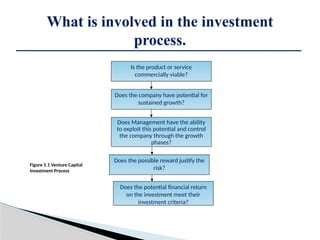
The investment processstarts from reviewing the
business plan to actually Investing in a proposition, can
take a venture capitalist from one to six months. There
are always exceptions to the rule and deals can be done
in extremely short time. The key stage of investment
process is the initial evaluation of the business plan.
Most approaches to venture capitalists are usually
rejected at this stage. In considering the business plan,
the venture capitalist will consider several principal
aspects. The process can be illustrated by a figure as
follows:
What is involved in the investment
process.
12.
What is involvedin the investment
process.
Is the product or service
commercially viable?
Does the company have potential for
sustained growth?
Does Management have the ability
to exploit this potential and control
the company through the growth
phases?
Does the possible reward justify the
risk?
Figure 5.1 Venture Capital
Investment Process
Does the potential financial return
on the investment meet their
investment criteria?
13.
The rationale forventure capital is that the investor
will expect a return on his money either by the sale of
the company or by offering to sell the shares in the
company to the public.
Rationale for Venture Capital
14.
There are threemain types of venture capital that can
be used in financing capital projects. These includes:
early stage financing, expansion financing, and
acquisition financing. These can further be explained
in detail as follows:
Types of Venture Capital
15.
This type offinancing consists of: seed financing,
start-up financing and first stage financing. These can
be further explained as follows:
Seed financing- refers to small amount of venture
capital given to an entrepreneur or investor who
wishes to start up a business. It may be used to
build a management, market research or
developing a business plan.
Start-up financing- refers to venture capital that is
given when a business has been in existence for
Early stage financing
16.
less than ayear. In this situation the product of
the company may not have been sold
commercially and yet they will just be ready to
start doing so.
First stage financing- is used when companies
wish to expand their capital and to proceed full
scale and enter the public business arena.
Early stage financing cont….
17.
This typeof financing
Consist of second stage financing, third stage
financing and bridge financing respectively.
These can be explained as follows:
Second stage financing- refers to an
investment used to expand a company that is
already on its feet. That company in this case
is trading and has growing accounts and
inventories, although it may not be showing a
profit.
Early stage financing cont….
18.
Third stagefinancing- refers to an investment
to companies that are break even or becoming
profitable. The venture capital is used to
expand the business. It may be used in the
acquisition of real estate or for further in –
depth product development.
Bridge financing- covers a variety of different
meanings. It is a short term, interest only
investment. It is used when company
restructuring is taking place. The money can
also be used if an initial investor wants to
liquidate his position and sell his stock
Early stage financing cont….
19.
This type ofventure capital refers to the used to
acquire a percentage or the whole of another
company. This type of finance can also be used by a
management group to buy out another line of product
or business regardless of their stage of development.
The company they buy out can either be a private or a
public company.
Acquisition Financing
20.
In structuringits investment, the venture capitalist may use one
or more of the following types of share capital:
Ordinary shares- These are equity shares that are entitled
to all income and capital after the rights of all other classes
of capital and creditors have been satisfied. Ordinary
shares have votes. In venture capital deal these are share
capital typically held by the management and family
shareholders rather than the venture capital firm.
Preferred Ordinary Shares- These are equity shares with
special rights. For example, they may be entitled to a fixed
dividends or share of the profits. Preferred ordinary shares
have votes.
Instruments for Venture Capital
21.
Preference Shares-These are non- equity shares.
They rank ahead of all classes of ordinary shares
for both income and capital. Their income rights
are defined and they are usually entitled to a fixed
dividend (e.g.10 percent fixed). The shares may
be redeemed on fixed dates or they may be
irredeemable. Sometimes they may be
redeemable at a premium (120 percent of cost).
They may be convertible into a class of ordinary
shares.
Instruments for Venture Capital cont…
22.
Loan Capital-Venture capital loans typically are entitled
to interest and are usually though not necessarily
repayable. Loans may be secured on the company’s assets
or may be unsecured. A secured loan will rank a head of
unsecured loans and certain other creditors of the
company. A loan may be convertible into equity shares.
Alternatively, it may have a warrant attached which gives
the loan holder the option to subscribe for new equity
shares on terms fixed in the warrant. Typically, they carry
a higher rate of interest than bank term loans and rank
behind the banks for payment of interest and repayment of
capital.
Instruments for Venture Capital cont…
23.
Venture capitalinvestments are often
accompanied by additional financing at the point
of investment. This is nearly always the case
where business in which the investment is being
made relatively mature or well established
Instruments for Venture Capital cont…
24.
Venture capital hasthe following characteristics:
The investment in venture capital is usually for a
period of five to seven years.
The investor expects to hold a position in the Board
of Directors
The investor can demand repayments through the sale
of the company.
The investor may want to receive a percentage in the
company’s equity.
Features of Venture Capital.
25.
In this sectionwe explain what is meant by micro-
financing is. In this part of the world micro financing
play a significant role in mobilizing funds from and for
low income groups who would have otherwise been left
out of the traditional capital markets. So, what is micro
financing? Micro finance can be defined as the supply of
loans, savings, and other basic financial services to the
low income groups. In practice, the term is often used to
refer to loans and other services from providers that
identify themselves as “microfinance institutions”
(MFIs).
Micro Financing
26.
Low income earners,like everyone else, need a diverse
range of financial instruments to run their businesses,
build assets, stabilize consumption, and shield
themselves against risks. Financial services needed by
the poor include working capital loans, consumer credit,
and savings, pensions, insurance, and money transfer
services.
The MFIs commonly tend to use new methods developed
over the last 30 years to deliver very small loans to
unsalaried borrowers, taking little or no collateral.
Micro Financing cont…
27.
These methods includegroup lending and liability,
pre-loan savings requirements, gradually increasing
loan sizes, and an implicit guarantee of ready access
to future loans if present loans are repaid fully and
promptly. Together with providing financial services,
many microfinance institutions work for social
development in the areas in which they operate.
Microfinance institutions generally have the
following characteristics:
Micro Financing cont…
28.
Providing small loansfor the working capital
requirements of the low income groups.
Minimal appraisal of borrowers and investments as
compared to commercial banks.
No collateral demanded; however, these institutions
impose compulsory savings and group guarantees.
Based on the loan repayment history of the members,
microfinance institutions extend larger loans to the
members repeatedly.
Micro Financing cont…
29.
Through microfinance institutionsprovide the
necessary monetary support and try to increase social
development. Microfinance is a poverty instrument
against poverty. It is meant to facilitate access to
sustainable financial services, increase income, build
assets, reduce vulnerability, better nutrition, health,
education etc.
Micro Financing cont…
30.
Typical microfinance clientsare low-income people
that do not have access to other formal financial
institutions. Microfinance clients are usually self-
employed, household-based entrepreneurs. Their
diverse “microenterprises” include small retail shops,
street vending, artisanal manufacture, and service
provision. In rural areas, micro entrepreneurs often
have small income-generating activities such as food
processing and trade; some but far from all are
farmers.
Micro Financing cont…
31.
The most commonform of microfinance is
microcredit, the extension of small loans to
entrepreneurs who cannot qualify for conventional
bank loans. Therefore microcredit refers to very
small loans for unsalaried borrowers with little or no
collateral, provided by legally registered institutions.
It is characterized by:
Small size loans;
Shorter repayment periods;
Microcredit
32.
Flexible andeasy to understand regulations and
needs;
Small scale activities based on local conditions
and needs;
Clients are small entrepreneurs and low-income
households;
Loans used to generate income, develop
enterprises and used by the community for social
services such as health and education.
Microcredit cont…
33.
This is wherethe Microloan foundation comes in.
Microfinance and microcredit have two distinct
advantages over charitable giving. Firstly, it is
sustainable and creates independence from aid, not
dependence on it. By giving a small loan to an
individual, we hope to give them the ability to work
their own way out of poverty. Microloan lends to
groups of about 10 to 15 people, allowing individuals
to support, encourage, and provide assistance to each
other if things go wrong.
Microcredit cont…
34.
Secondly, it meansthat the money goes directly to the
people who need it - bypassing the bureaucracy and
corruption that can compromise traditional methods
of charitable giving. Moreover, Microloan never
lends to individuals without first providing them with
the expertise and training to build a business plan that
is likely to succeed.
Microcredit cont…