
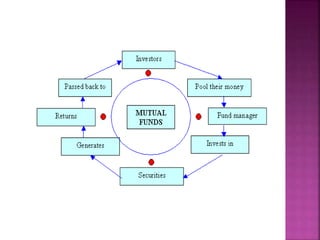
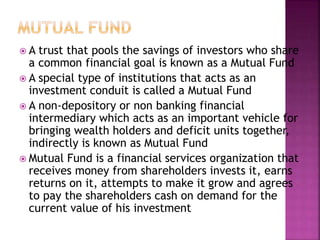

 A trust that pools the savings of investors who share
a common financial goal is known as a Mutual Fund
 A special type of institutions that acts as an
investment conduit is called a Mutual Fund
 A non-depository or non banking financial
intermediary which acts as an important vehicle for
bringing wealth holders and deficit units together,
indirectly is known as Mutual Fund
 Mutual Fund is a financial services organization that
receives money from shareholders invests it, earns
returns on it, attempts to make it grow and agrees
to pay the shareholders cash on demand for the
current value of his investment
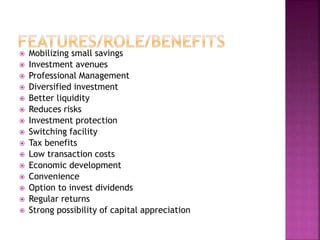
 Mobilizing small savings
 Investment avenues
 Professional Management
 Diversified investment
 Better liquidity
 Reduces risks
 Investment protection
 Switching facility
 Tax benefits
 Low transaction costs
 Economic development
 Convenience
 Option to invest dividends
 Regular returns
 Strong possibility of capital appreciation
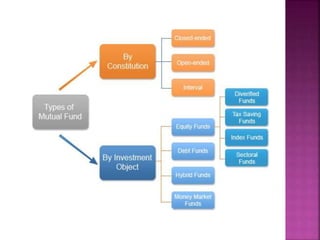
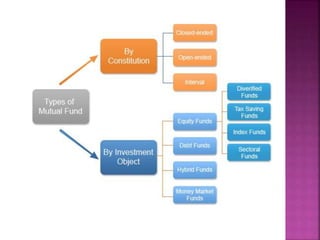
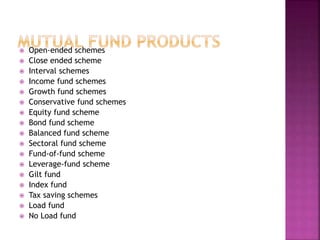
 Open-ended schemes
 Close ended scheme
 Interval schemes
 Income fund schemes
 Growth fund schemes
 Conservative fund schemes
 Equity fund scheme
 Bond fund scheme
 Balanced fund scheme
 Sectoral fund scheme
 Fund-of-fund scheme
 Leverage-fund scheme
 Gilt fund
 Index fund
 Tax saving schemes
 Load fund
 No Load fund
 Interval schemes - A fund that combines the features of open-ended and
closed-ended schemes, making the fund open for sale or redemption during
pre-determined intervals.
 Income fund schemes - A mutual fund that primarily seeks current income
rather than growth of capital. It will tend to invest in stocks and bonds that
normally pay high dividends and interest.
 Equity fund scheme - A mutual fund that invests principally in stocks. It can
be actively or passively (index fund) managed.
 Bond fund scheme - A mutual fund whose portfolio consists primarily of
corporate, municipal or government bonds. These funds generally emphasize
income rather than growth.
A fund invested primarily in bonds and other debt instruments. The exact type
of debt the fund invests in will depend on its focus, but investments may
include government, corporate, municipal and convertible bonds, along with
other debt securities like mortgage-backed securities.
 Balanced fund scheme - A mutual
fund that buys a combination of common stock, preferred stock, bonds,
and short-term bonds, to provide both income and capital
appreciation while avoiding excessive risk. The purpose of
balanced funds (also sometimes called hybrid funds) is to
provide investors with a single mutual fund that combines both growth and
income objectives, by investing in both stocks (for growth) and bonds (for
income).
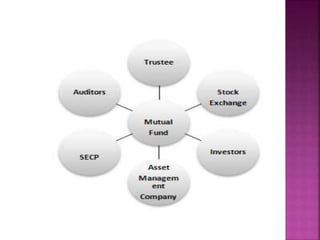
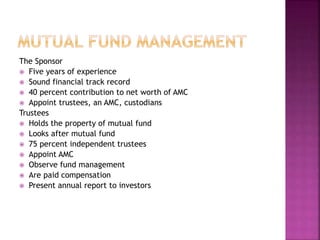
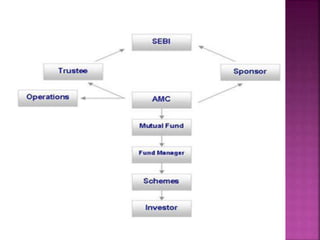
The Sponsor
 Five years of experience
 Sound financial track record
 40 percent contribution to net worth of AMC
 Appoint trustees, an AMC, custodians
Trustees
 Holds the property of mutual fund
 Looks after mutual fund
 75 percent independent trustees
 Appoint AMC
 Observe fund management
 Are paid compensation
 Present annual report to investors
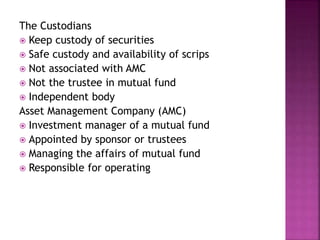
The Custodians
 Keep custody of securities
 Safe custody and availability of scrips
 Not associated with AMC
 Not the trustee in mutual fund
 Independent body
Asset Management Company (AMC)
 Investment manager of a mutual fund
 Appointed by sponsor or trustees
 Managing the affairs of mutual fund
 Responsible for operating
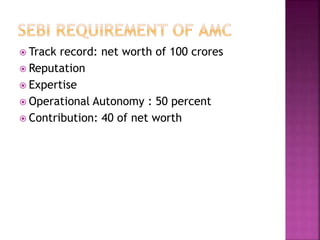
 Track record: net worth of 100 crores
 Reputation
 Expertise
 Operational Autonomy : 50 percent
 Contribution: 40 of net worth
 Registrars and Transfer Agents
 Fund Accountants
 Lead Managers
 Investment Advisors
 Legal Advisors
 Auditors
 Underwriters
 Creating fund manager
 Research and Planning
 Creating dealers
 Selecting investment goals
 Identification of specific securities
 Portfolio designing
 Portfolio revision
 Net Returns
 Net Asset Value
 Load
 Disclosures
 Voting rights to investors
 Investors’ protection
 http://www.amfiindia.com/
 http://www.sebi.gov.in/faq/mf_faq.html
 Indian mutual fund industry at a glance :
https://www.pwc.in/en_IN/in/assets/pdfs/p
ublications/2013/indian-mutual-fund-
industry-fv.pdf
Presentation on Mutual funds

Presentation on Mutual funds

  • 4.
     A trustthat pools the savings of investors who share a common financial goal is known as a Mutual Fund  A special type of institutions that acts as an investment conduit is called a Mutual Fund  A non-depository or non banking financial intermediary which acts as an important vehicle for bringing wealth holders and deficit units together, indirectly is known as Mutual Fund  Mutual Fund is a financial services organization that receives money from shareholders invests it, earns returns on it, attempts to make it grow and agrees to pay the shareholders cash on demand for the current value of his investment
  • 5.
     Mobilizing smallsavings  Investment avenues  Professional Management  Diversified investment  Better liquidity  Reduces risks  Investment protection  Switching facility  Tax benefits  Low transaction costs  Economic development  Convenience  Option to invest dividends  Regular returns  Strong possibility of capital appreciation
  • 7.
     Open-ended schemes Close ended scheme  Interval schemes  Income fund schemes  Growth fund schemes  Conservative fund schemes  Equity fund scheme  Bond fund scheme  Balanced fund scheme  Sectoral fund scheme  Fund-of-fund scheme  Leverage-fund scheme  Gilt fund  Index fund  Tax saving schemes  Load fund  No Load fund
  • 8.
     Interval schemes- A fund that combines the features of open-ended and closed-ended schemes, making the fund open for sale or redemption during pre-determined intervals.  Income fund schemes - A mutual fund that primarily seeks current income rather than growth of capital. It will tend to invest in stocks and bonds that normally pay high dividends and interest.  Equity fund scheme - A mutual fund that invests principally in stocks. It can be actively or passively (index fund) managed.  Bond fund scheme - A mutual fund whose portfolio consists primarily of corporate, municipal or government bonds. These funds generally emphasize income rather than growth. A fund invested primarily in bonds and other debt instruments. The exact type of debt the fund invests in will depend on its focus, but investments may include government, corporate, municipal and convertible bonds, along with other debt securities like mortgage-backed securities.  Balanced fund scheme - A mutual fund that buys a combination of common stock, preferred stock, bonds, and short-term bonds, to provide both income and capital appreciation while avoiding excessive risk. The purpose of balanced funds (also sometimes called hybrid funds) is to provide investors with a single mutual fund that combines both growth and income objectives, by investing in both stocks (for growth) and bonds (for income).
  • 10.
    The Sponsor  Fiveyears of experience  Sound financial track record  40 percent contribution to net worth of AMC  Appoint trustees, an AMC, custodians Trustees  Holds the property of mutual fund  Looks after mutual fund  75 percent independent trustees  Appoint AMC  Observe fund management  Are paid compensation  Present annual report to investors
  • 12.
    The Custodians  Keepcustody of securities  Safe custody and availability of scrips  Not associated with AMC  Not the trustee in mutual fund  Independent body Asset Management Company (AMC)  Investment manager of a mutual fund  Appointed by sponsor or trustees  Managing the affairs of mutual fund  Responsible for operating
  • 13.
     Track record:net worth of 100 crores  Reputation  Expertise  Operational Autonomy : 50 percent  Contribution: 40 of net worth
  • 14.
     Registrars andTransfer Agents  Fund Accountants  Lead Managers  Investment Advisors  Legal Advisors  Auditors  Underwriters
  • 15.
     Creating fundmanager  Research and Planning  Creating dealers
  • 16.
     Selecting investmentgoals  Identification of specific securities  Portfolio designing  Portfolio revision
  • 17.
     Net Returns Net Asset Value  Load  Disclosures  Voting rights to investors  Investors’ protection
  • 18.
     http://www.amfiindia.com/  http://www.sebi.gov.in/faq/mf_faq.html Indian mutual fund industry at a glance : https://www.pwc.in/en_IN/in/assets/pdfs/p ublications/2013/indian-mutual-fund- industry-fv.pdf