CHAPTER 10 –
HUMAN
RESOURCES
Y. Abhinav Bharadwaz
S.V. Sivaram
INTRODUC
TION
The people of a country are its
greatest wealth because they are
responsible for the development of a
nation.
Doctors, engineers, teachers,
scientists, writers, and artists form
the skilled, trained and creative
human power of our society. People
engaged in all kinds of useful
activities are known as human
resources.
DISTRIBUTION OF
POPULATION
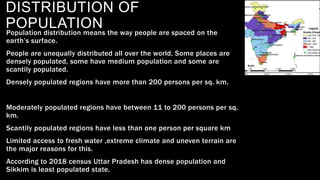
Population distribution means the way people are spaced on the
earth’s surface.
People are unequally distributed all over the world. Some places are
densely populated, some have medium population and some are
scantily populated.
Densely populated regions have more than 200 persons per sq. km.
Moderately populated regions have between 11 to 200 persons per sq.
km.
Scantily populated regions have less than one person per square km
Limited access to fresh water ,extreme climate and uneven terrain are
the major reasons for this.
According to 2018 census Uttar Pradesh has dense population and
Sikkim is least populated state.
People are influenced by the geographical factors which
affect the distribution of population.
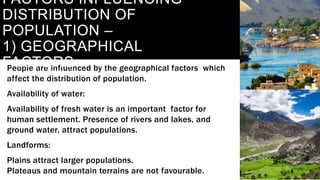
Availability of water:
Availability of fresh water is an important factor for
human settlement. Presence of rivers and lakes, and
ground water, attract populations.
Landforms:
Plains attract larger populations.
Plateaus and mountain terrains are not favourable.
FACTORS INFLUENCING
DISTRIBUTION OF
POPULATION –
1) GEOGRAPHICAL
FACTORS
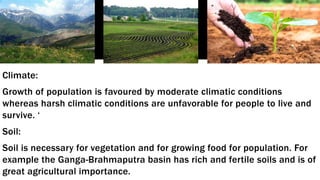
Climate:
Growth of population is favoured by moderate climatic conditions
whereas harsh climatic conditions are unfavorable for people to live and
survive. ‘
Soil:
Soil is necessary for vegetation and for growing food for population. For
example the Ganga-Brahmaputra basin has rich and fertile soils and is of
great agricultural importance.
2) ECONOMIC
FACTORS
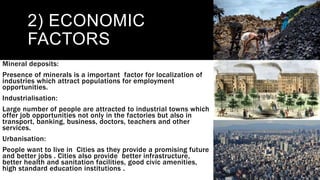
Mineral deposits:
Presence of minerals is a important factor for localization of
industries which attract populations for employment
opportunities.
Industrialisation:
Large number of people are attracted to industrial towns which
offer job opportunities not only in the factories but also in
transport, banking, business, doctors, teachers and other
services.
Urbanisation:
People want to live in Cities as they provide a promising future
and better jobs . Cities also provide better infrastructure,
better health and sanitation facilities, good civic amenities,
high standard education institutions .
3) RELIGIOUS AND
CULTURAL
FACTORS
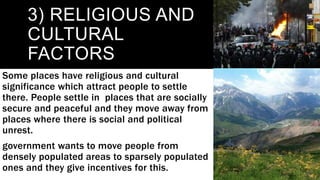
Some places have religious and cultural
significance which attract people to settle
there. People settle in places that are socially
secure and peaceful and they move away from
places where there is social and political
unrest.
government wants to move people from
densely populated areas to sparsely populated
ones and they give incentives for this.
COMPOSITION OF HUMAN
RESOURCES
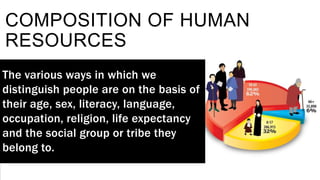
The various ways in which we
distinguish people are on the basis of
their age, sex, literacy, language,
occupation, religion, life expectancy
and the social group or tribe they
belong to.
SEX COMPOSITION
One of the most important factor in the study of population of a place is the number of
women and men in that place.
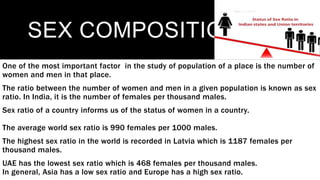
The ratio between the number of women and men in a given population is known as sex
ratio. In India, it is the number of females per thousand males.
Sex ratio of a country informs us of the status of women in a country.
The average world sex ratio is 990 females per 1000 males.
The highest sex ratio in the world is recorded in Latvia which is 1187 females per
thousand males.
UAE has the lowest sex ratio which is 468 females per thousand males.
In general, Asia has a low sex ratio and Europe has a high sex ratio.
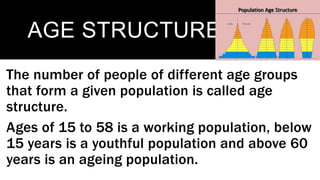
AGE STRUCTURE
The number of people of different age groups
that form a given population is called age
structure.
Ages of 15 to 58 is a working population, below
15 years is a youthful population and above 60
years is an ageing population.
LITERACY
Proportion of literate population in a country indicates its
socio-economic condition
Unless the population is literate, a country's economic
development cannot take place.
In India, literacy rate is indicated by the percentage of
population which includes people who are above 7 years of age
who can both read and write with understanding in any
language.
RURAL –
URBAN
POPULATION
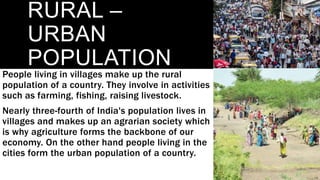
People living in villages make up the rural
population of a country. They involve in activities
such as farming, fishing, raising livestock.
Nearly three-fourth of India's population lives in
villages and makes up an agrarian society which
is why agriculture forms the backbone of our
economy. On the other hand people living in the
cities form the urban population of a country.
GROWTH OF
POPULATION
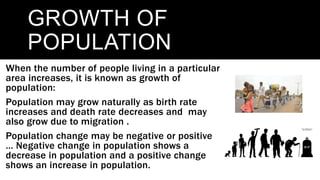
When the number of people living in a particular
area increases, it is known as growth of
population:
Population may grow naturally as birth rate
increases and death rate decreases and may
also grow due to migration .
Population change may be negative or positive
… Negative change in population shows a
decrease in population and a positive change
shows an increase in population.
WE LEARNT
THAT
• Humans are the most important resource on Earth.
• Distribution of population tells us where people live.
• Geographic and human factors influence population
distribution.
• Population has been growing at a very fast pace because of
improved amenities.
• Population is composed of males and females of different
age groups.
• Literary levels are indication for the country’s economic
development.
• population may grow naturally as birth rate increases and
death rate decreases and also due to Migration .
Chapter 10 – Human resources for Human Sustainability

Chapter 10 – Human resources for Human Sustainability

  • 1.
    CHAPTER 10 – HUMAN RESOURCES Y.Abhinav Bharadwaz S.V. Sivaram
  • 2.
    INTRODUC TION The people ofa country are its greatest wealth because they are responsible for the development of a nation. Doctors, engineers, teachers, scientists, writers, and artists form the skilled, trained and creative human power of our society. People engaged in all kinds of useful activities are known as human resources.
  • 3.
    DISTRIBUTION OF POPULATION Population distributionmeans the way people are spaced on the earth’s surface. People are unequally distributed all over the world. Some places are densely populated, some have medium population and some are scantily populated. Densely populated regions have more than 200 persons per sq. km. Moderately populated regions have between 11 to 200 persons per sq. km. Scantily populated regions have less than one person per square km Limited access to fresh water ,extreme climate and uneven terrain are the major reasons for this. According to 2018 census Uttar Pradesh has dense population and Sikkim is least populated state.
  • 4.
    People are influencedby the geographical factors which affect the distribution of population. Availability of water: Availability of fresh water is an important factor for human settlement. Presence of rivers and lakes, and ground water, attract populations. Landforms: Plains attract larger populations. Plateaus and mountain terrains are not favourable. FACTORS INFLUENCING DISTRIBUTION OF POPULATION – 1) GEOGRAPHICAL FACTORS
  • 5.
    Climate: Growth of populationis favoured by moderate climatic conditions whereas harsh climatic conditions are unfavorable for people to live and survive. ‘ Soil: Soil is necessary for vegetation and for growing food for population. For example the Ganga-Brahmaputra basin has rich and fertile soils and is of great agricultural importance.
  • 6.
    2) ECONOMIC FACTORS Mineral deposits: Presenceof minerals is a important factor for localization of industries which attract populations for employment opportunities. Industrialisation: Large number of people are attracted to industrial towns which offer job opportunities not only in the factories but also in transport, banking, business, doctors, teachers and other services. Urbanisation: People want to live in Cities as they provide a promising future and better jobs . Cities also provide better infrastructure, better health and sanitation facilities, good civic amenities, high standard education institutions .
  • 7.
    3) RELIGIOUS AND CULTURAL FACTORS Someplaces have religious and cultural significance which attract people to settle there. People settle in places that are socially secure and peaceful and they move away from places where there is social and political unrest. government wants to move people from densely populated areas to sparsely populated ones and they give incentives for this.
  • 8.
    COMPOSITION OF HUMAN RESOURCES Thevarious ways in which we distinguish people are on the basis of their age, sex, literacy, language, occupation, religion, life expectancy and the social group or tribe they belong to.
  • 9.
    SEX COMPOSITION One ofthe most important factor in the study of population of a place is the number of women and men in that place. The ratio between the number of women and men in a given population is known as sex ratio. In India, it is the number of females per thousand males. Sex ratio of a country informs us of the status of women in a country. The average world sex ratio is 990 females per 1000 males. The highest sex ratio in the world is recorded in Latvia which is 1187 females per thousand males. UAE has the lowest sex ratio which is 468 females per thousand males. In general, Asia has a low sex ratio and Europe has a high sex ratio.
  • 10.
    AGE STRUCTURE The numberof people of different age groups that form a given population is called age structure. Ages of 15 to 58 is a working population, below 15 years is a youthful population and above 60 years is an ageing population.
  • 11.
    LITERACY Proportion of literatepopulation in a country indicates its socio-economic condition Unless the population is literate, a country's economic development cannot take place. In India, literacy rate is indicated by the percentage of population which includes people who are above 7 years of age who can both read and write with understanding in any language.
  • 12.
    RURAL – URBAN POPULATION People livingin villages make up the rural population of a country. They involve in activities such as farming, fishing, raising livestock. Nearly three-fourth of India's population lives in villages and makes up an agrarian society which is why agriculture forms the backbone of our economy. On the other hand people living in the cities form the urban population of a country.
  • 13.
    GROWTH OF POPULATION When thenumber of people living in a particular area increases, it is known as growth of population: Population may grow naturally as birth rate increases and death rate decreases and may also grow due to migration . Population change may be negative or positive … Negative change in population shows a decrease in population and a positive change shows an increase in population.
  • 14.
    WE LEARNT THAT • Humansare the most important resource on Earth. • Distribution of population tells us where people live. • Geographic and human factors influence population distribution. • Population has been growing at a very fast pace because of improved amenities. • Population is composed of males and females of different age groups. • Literary levels are indication for the country’s economic development. • population may grow naturally as birth rate increases and death rate decreases and also due to Migration .