Chapter 10
 Example 1
 A researcher is studying the effect of sleep on
aggression, thinking that less sleep will lead to
more aggression. She has some people sleep 6
hours per night, some people sleep 3 hours per
night and some people sleep as much as they want.
She then monitors aggressive behavior during
basketball games among participants.

 IV:
 Levels:
 DV:
Chapter 10 Complex Designs Sisson
2013 2
 Example 2
 A researcher is curious to find out what effect classical
music has on people’s level of relaxation (as measured
by heart rate). He suspects that listening to classical
music will make people feel more calm and relaxed.
He lets one group listen to classical music for one hour.
He lets another group sit in a quiet room for one hour
(i.e they hear no music). After one hour, he monitors
the heart rate of each participant to measure their level
of relaxation.

 IV:
 Levels:
 DV:
Chapter 10 Complex Designs Sisson
2013 3
 Example 3
 A researcher conducts an experiment to assess the effects of
alcohol on people's sense of balance. He divides his subjects
into three groups: in one group the participants drink one
ounce of alcohol, in another they drink two ounces of
alcohol and in a third group the participants drink soda. He
then watches as each participant tries to walk on a straight
line from one corner of the room to the next and notes how
many times they stumble outside the line.

 IV:
 Levels:
 DV:
Chapter 10 Complex Designs Sisson
2013 4
 Simple design: One independent variable at 2
levels. One dependent variable.
 E.g. effect of sugar on activity level
 Effect of television on concentration level
 Effect of bad smells on mood
 Effect of temperature on test performance
 Effect of eating rotten melon or gourd on
digestion comfort.
Chapter 10 Complex Designs Sisson
2013 5
 We may want more defined amounts than
No sugar vs. 3 cups of sugar
50◦ temp room vs. 90◦ temp room
1 slice of bacon vs. 1 pound bacon
E.g.
Chapter 10 Complex Designs Sisson
2013 6
 Remember studies on emotional arousal and
performance on a task? Draw the shape.
Is it Monotonic or nonmonotonic?
 By increasing the number of levels, we can find out
more detailed information.
 E.g. Maybe some caffeine is helpful for mood, but
too much is harmful.
 Give an example of something that may have a
different effect based on the level.
Chapter 10 Complex Designs Sisson
2013 7
 Increasing the levels does not mean we are
adding another independent variable.
 But what if we want to add another variable?
 Isn’t that more typical of LIFE?
 We want to look at temperature of room (50◦ or
90◦) on test taking AS WELL AS test difficulty
(easy, hard).
 Test difficulty is QUALITATIVELY different
from temperature! Therefore, new IV.
Chapter 10 Complex Designs Sisson
2013 8
 A factorial design has more than one
independent variable:
• type of music, volume of music
• Amount of calories, time of consumption
• Tone of compliments, number of compliments
• E.g.
 All levels of IV are combined with all levels of
other IV.
Chapter 10 Complex Designs Sisson
2013 9
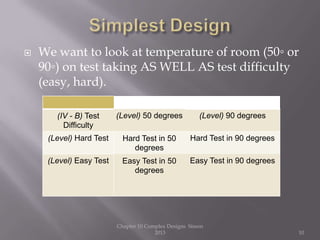
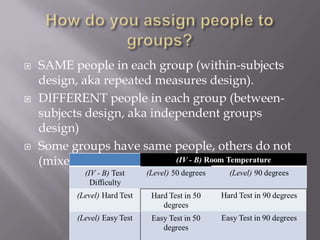
 We want to look at temperature of room (50◦ or
90◦) on test taking AS WELL AS test difficulty
(easy, hard).
Chapter 10 Complex Designs Sisson
2013 10
(IV - B) Room Temperature
(IV - B) Test
Difficulty
(Level) 50 degrees (Level) 90 degrees
(Level) Hard Test Hard Test in 50
degrees
Hard Test in 90 degrees
(Level) Easy Test Easy Test in 50
degrees
Easy Test in 90 degrees
Chapter 10 Complex Designs Sisson
2013 11
It Depends….
 We are looking at how scores vary between the
different groups
 "way" refers to the number of independent variables in
an analysis.
 a "one-way" ANOVA refers to an ANOVA with one
independent variable,
 a two-way ANOVA would be used to analyze an
experiment with two independent variables.
 Mathematically, we can analyze data with as many
independent variables as we want. BUT:
 Very complex to interpret. Rare beyond a three-way
ANOVA.
Chapter 10 Complex Designs Sisson
2013 12
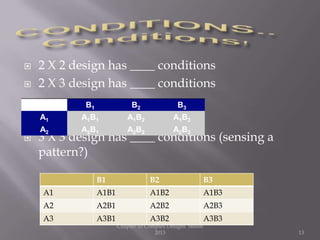
 2 X 2 design has ____ conditions
 2 X 3 design has ____ conditions
 3 X 3 design has ____ conditions (sensing a
pattern?)
Chapter 10 Complex Designs Sisson
2013 13
B1 B2 B3
A1 A1B1 A1B2 A1B3
A2 A2B1 A2B2 A2B3
B1 B2 B3
A1 A1B1 A1B2 A1B3
A2 A2B1 A2B2 A2B3
A3 A3B1 A3B2 A3B3
 We can do as many conditions as we want,
however, it gets very complicated (and need
lots of subjects). So usually it is kept at 3.
Chapter 10 Complex Designs Sisson
2013 14
 Participant variables (PV) are personal
attributes (IQ, age, ethnicity, ________).
 Must have at least 2 levels.
 IV X PV (2 by 2)
 Caffeine intake: 0 cups 8 cups
 Sex: Male Female
 Still 4 combinations.
 Same idea as the IV and IV
Chapter 10 Complex Designs Sisson
2013 15
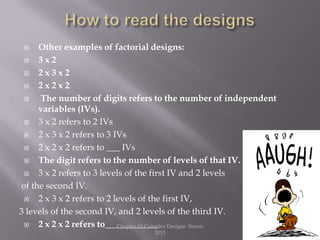
 Other examples of factorial designs:
 3 x 2
 2 x 3 x 2
 2 x 2 x 2
 The number of digits refers to the number of independent
variables (IVs).
 3 x 2 refers to 2 IVs
 2 x 3 x 2 refers to 3 IVs
 2 x 2 x 2 refers to ___ IVs
 The digit refers to the number of levels of that IV.
 3 x 2 refers to 3 levels of the first IV and 2 levels
of the second IV.
 2 x 3 x 2 refers to 2 levels of the first IV,
3 levels of the second IV, and 2 levels of the third IV.
 2 x 2 x 2 refers to____________Chapter 10 Complex Designs Sisson
2013 16
 Statistically: two-way ANOVA has three basic
types of effects that are tested:
 main effect for independent variable A (
temperature)
 main effect for independent variable B (test
difficulty)
 effect for the interaction of A and B
 2 IV = ___ main effects
 3 IV = ___ main effects
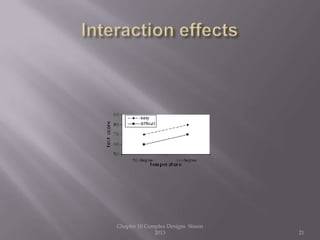
 Then have Interaction effects
Chapter 10 Complex Designs Sisson
2013 17
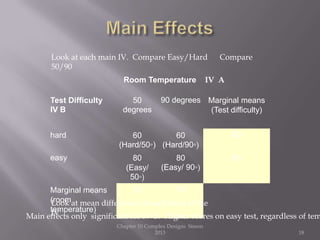
Room Temperature IV A
Test Difficulty
IV B
50
degrees
90 degrees Marginal means
(Test difficulty)
hard 60
(Hard/50◦)
60
(Hard/90◦)
60
easy 80
(Easy/
50◦)
80
(Easy/ 90◦)
80
Marginal means
(room
temperature)
70 70
Chapter 10 Complex Designs Sisson
2013 18
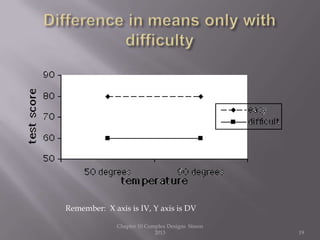
Main effects only significant for IV-B. Higher scores on easy test, regardless of tem
Look at mean differences at each level of the
IV
Look at each main IV. Compare Easy/Hard Compare
50/90
Chapter 10 Complex Designs Sisson
2013 19
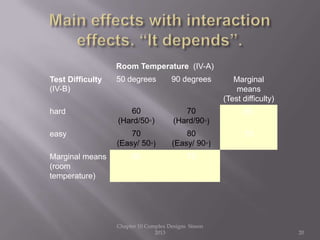
Remember: X axis is IV, Y axis is DV
Room Temperature (IV-A)
Test Difficulty
(IV-B)
50 degrees 90 degrees Marginal
means
(Test difficulty)
hard 60
(Hard/50◦)
70
(Hard/90◦)
65
easy 70
(Easy/ 50◦)
80
(Easy/ 90◦)
75
Marginal means
(room
temperature)
65 75
Chapter 10 Complex Designs Sisson
2013 20
Chapter 10 Complex Designs Sisson
2013 21
 SAME people in each group (within-subjects
design, aka repeated measures design).
 DIFFERENT people in each group (between-
subjects design, aka independent groups
design)
 Some groups have same people, others do not
(mixed design).
Chapter 10 Complex Designs Sisson
2013 22
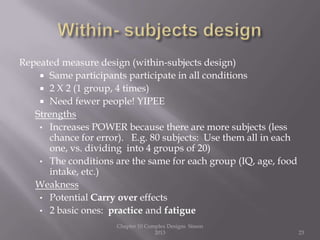
Repeated measure design (within-subjects design)
 Same participants participate in all conditions
 2 X 2 (1 group, 4 times)
 Need fewer people! YIPEE
Strengths
• Increases POWER because there are more subjects (less
chance for error). E.g. 80 subjects: Use them all in each
one, vs. dividing into 4 groups of 20)
• The conditions are the same for each group (IQ, age, food
intake, etc.)
Weakness
• Potential Carry over effects
• 2 basic ones: practice and fatigue
Chapter 10 Complex Designs Sisson
2013 23
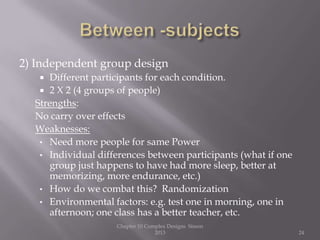
2) Independent group design
 Different participants for each condition.
 2 X 2 (4 groups of people)
Strengths:
No carry over effects
Weaknesses:
• Need more people for same Power
• Individual differences between participants (what if one
group just happens to have had more sleep, better at
memorizing, more endurance, etc.)
• How do we combat this? Randomization
• Environmental factors: e.g. test one in morning, one in
afternoon; one class has a better teacher, etc.
Chapter 10 Complex Designs Sisson
2013 24
 Mixed factorial design
 Some advantages and disadvantages of other
designs
 (e.g. need more participants but not as
many…)
 More complicated!
 Nuff said!
Chapter 10 Complex Designs Sisson
2013 25
Chapter 10 Complex Designs Sisson
2013 26
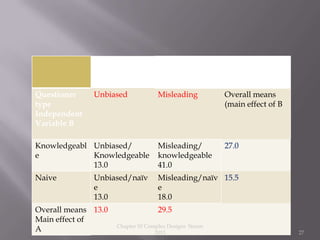
Type of
Question
Independant
Variable A
Questioner
type
Independent
Variable B
Unbiased Misleading Overall means
(main effect of B
Knowledgeabl
e
Unbiased/
Knowledgeable
13.0
Misleading/
knowledgeable
41.0
27.0
Naive Unbiased/naïv
e
13.0
Misleading/naïv
e
18.0
15.5
Overall means
Main effect of
A
13.0 29.5
Chapter 10 Complex Designs Sisson
2013 27
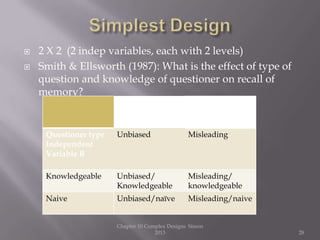
 2 X 2 (2 indep variables, each with 2 levels)
 Smith & Ellsworth (1987): What is the effect of type of
question and knowledge of questioner on recall of
memory?
Chapter 10 Complex Designs Sisson
2013 28
Type of Question Independant
Variable 2
Questioner type
Independent
Variable B
Unbiased Misleading
Knowledgeable Unbiased/
Knowledgeable
Misleading/
knowledgeable
Naive Unbiased/naïve Misleading/naive

Chapter 10 complex designs 2013

  • 1.
  • 2.
     Example 1 A researcher is studying the effect of sleep on aggression, thinking that less sleep will lead to more aggression. She has some people sleep 6 hours per night, some people sleep 3 hours per night and some people sleep as much as they want. She then monitors aggressive behavior during basketball games among participants.   IV:  Levels:  DV: Chapter 10 Complex Designs Sisson 2013 2
  • 3.
     Example 2 A researcher is curious to find out what effect classical music has on people’s level of relaxation (as measured by heart rate). He suspects that listening to classical music will make people feel more calm and relaxed. He lets one group listen to classical music for one hour. He lets another group sit in a quiet room for one hour (i.e they hear no music). After one hour, he monitors the heart rate of each participant to measure their level of relaxation.   IV:  Levels:  DV: Chapter 10 Complex Designs Sisson 2013 3
  • 4.
     Example 3 A researcher conducts an experiment to assess the effects of alcohol on people's sense of balance. He divides his subjects into three groups: in one group the participants drink one ounce of alcohol, in another they drink two ounces of alcohol and in a third group the participants drink soda. He then watches as each participant tries to walk on a straight line from one corner of the room to the next and notes how many times they stumble outside the line.   IV:  Levels:  DV: Chapter 10 Complex Designs Sisson 2013 4
  • 5.
     Simple design:One independent variable at 2 levels. One dependent variable.  E.g. effect of sugar on activity level  Effect of television on concentration level  Effect of bad smells on mood  Effect of temperature on test performance  Effect of eating rotten melon or gourd on digestion comfort. Chapter 10 Complex Designs Sisson 2013 5
  • 6.
     We maywant more defined amounts than No sugar vs. 3 cups of sugar 50◦ temp room vs. 90◦ temp room 1 slice of bacon vs. 1 pound bacon E.g. Chapter 10 Complex Designs Sisson 2013 6
  • 7.
     Remember studieson emotional arousal and performance on a task? Draw the shape. Is it Monotonic or nonmonotonic?  By increasing the number of levels, we can find out more detailed information.  E.g. Maybe some caffeine is helpful for mood, but too much is harmful.  Give an example of something that may have a different effect based on the level. Chapter 10 Complex Designs Sisson 2013 7
  • 8.
     Increasing thelevels does not mean we are adding another independent variable.  But what if we want to add another variable?  Isn’t that more typical of LIFE?  We want to look at temperature of room (50◦ or 90◦) on test taking AS WELL AS test difficulty (easy, hard).  Test difficulty is QUALITATIVELY different from temperature! Therefore, new IV. Chapter 10 Complex Designs Sisson 2013 8
  • 9.
     A factorialdesign has more than one independent variable: • type of music, volume of music • Amount of calories, time of consumption • Tone of compliments, number of compliments • E.g.  All levels of IV are combined with all levels of other IV. Chapter 10 Complex Designs Sisson 2013 9
  • 10.
     We wantto look at temperature of room (50◦ or 90◦) on test taking AS WELL AS test difficulty (easy, hard). Chapter 10 Complex Designs Sisson 2013 10 (IV - B) Room Temperature (IV - B) Test Difficulty (Level) 50 degrees (Level) 90 degrees (Level) Hard Test Hard Test in 50 degrees Hard Test in 90 degrees (Level) Easy Test Easy Test in 50 degrees Easy Test in 90 degrees
  • 11.
    Chapter 10 ComplexDesigns Sisson 2013 11 It Depends….
  • 12.
     We arelooking at how scores vary between the different groups  "way" refers to the number of independent variables in an analysis.  a "one-way" ANOVA refers to an ANOVA with one independent variable,  a two-way ANOVA would be used to analyze an experiment with two independent variables.  Mathematically, we can analyze data with as many independent variables as we want. BUT:  Very complex to interpret. Rare beyond a three-way ANOVA. Chapter 10 Complex Designs Sisson 2013 12
  • 13.
     2 X2 design has ____ conditions  2 X 3 design has ____ conditions  3 X 3 design has ____ conditions (sensing a pattern?) Chapter 10 Complex Designs Sisson 2013 13 B1 B2 B3 A1 A1B1 A1B2 A1B3 A2 A2B1 A2B2 A2B3 B1 B2 B3 A1 A1B1 A1B2 A1B3 A2 A2B1 A2B2 A2B3 A3 A3B1 A3B2 A3B3
  • 14.
     We cando as many conditions as we want, however, it gets very complicated (and need lots of subjects). So usually it is kept at 3. Chapter 10 Complex Designs Sisson 2013 14
  • 15.
     Participant variables(PV) are personal attributes (IQ, age, ethnicity, ________).  Must have at least 2 levels.  IV X PV (2 by 2)  Caffeine intake: 0 cups 8 cups  Sex: Male Female  Still 4 combinations.  Same idea as the IV and IV Chapter 10 Complex Designs Sisson 2013 15
  • 16.
     Other examplesof factorial designs:  3 x 2  2 x 3 x 2  2 x 2 x 2  The number of digits refers to the number of independent variables (IVs).  3 x 2 refers to 2 IVs  2 x 3 x 2 refers to 3 IVs  2 x 2 x 2 refers to ___ IVs  The digit refers to the number of levels of that IV.  3 x 2 refers to 3 levels of the first IV and 2 levels of the second IV.  2 x 3 x 2 refers to 2 levels of the first IV, 3 levels of the second IV, and 2 levels of the third IV.  2 x 2 x 2 refers to____________Chapter 10 Complex Designs Sisson 2013 16
  • 17.
     Statistically: two-wayANOVA has three basic types of effects that are tested:  main effect for independent variable A ( temperature)  main effect for independent variable B (test difficulty)  effect for the interaction of A and B  2 IV = ___ main effects  3 IV = ___ main effects  Then have Interaction effects Chapter 10 Complex Designs Sisson 2013 17
  • 18.
    Room Temperature IVA Test Difficulty IV B 50 degrees 90 degrees Marginal means (Test difficulty) hard 60 (Hard/50◦) 60 (Hard/90◦) 60 easy 80 (Easy/ 50◦) 80 (Easy/ 90◦) 80 Marginal means (room temperature) 70 70 Chapter 10 Complex Designs Sisson 2013 18 Main effects only significant for IV-B. Higher scores on easy test, regardless of tem Look at mean differences at each level of the IV Look at each main IV. Compare Easy/Hard Compare 50/90
  • 19.
    Chapter 10 ComplexDesigns Sisson 2013 19 Remember: X axis is IV, Y axis is DV
  • 20.
    Room Temperature (IV-A) TestDifficulty (IV-B) 50 degrees 90 degrees Marginal means (Test difficulty) hard 60 (Hard/50◦) 70 (Hard/90◦) 65 easy 70 (Easy/ 50◦) 80 (Easy/ 90◦) 75 Marginal means (room temperature) 65 75 Chapter 10 Complex Designs Sisson 2013 20
  • 21.
    Chapter 10 ComplexDesigns Sisson 2013 21
  • 22.
     SAME peoplein each group (within-subjects design, aka repeated measures design).  DIFFERENT people in each group (between- subjects design, aka independent groups design)  Some groups have same people, others do not (mixed design). Chapter 10 Complex Designs Sisson 2013 22
  • 23.
    Repeated measure design(within-subjects design)  Same participants participate in all conditions  2 X 2 (1 group, 4 times)  Need fewer people! YIPEE Strengths • Increases POWER because there are more subjects (less chance for error). E.g. 80 subjects: Use them all in each one, vs. dividing into 4 groups of 20) • The conditions are the same for each group (IQ, age, food intake, etc.) Weakness • Potential Carry over effects • 2 basic ones: practice and fatigue Chapter 10 Complex Designs Sisson 2013 23
  • 24.
    2) Independent groupdesign  Different participants for each condition.  2 X 2 (4 groups of people) Strengths: No carry over effects Weaknesses: • Need more people for same Power • Individual differences between participants (what if one group just happens to have had more sleep, better at memorizing, more endurance, etc.) • How do we combat this? Randomization • Environmental factors: e.g. test one in morning, one in afternoon; one class has a better teacher, etc. Chapter 10 Complex Designs Sisson 2013 24
  • 25.
     Mixed factorialdesign  Some advantages and disadvantages of other designs  (e.g. need more participants but not as many…)  More complicated!  Nuff said! Chapter 10 Complex Designs Sisson 2013 25
  • 26.
    Chapter 10 ComplexDesigns Sisson 2013 26
  • 27.
    Type of Question Independant Variable A Questioner type Independent VariableB Unbiased Misleading Overall means (main effect of B Knowledgeabl e Unbiased/ Knowledgeable 13.0 Misleading/ knowledgeable 41.0 27.0 Naive Unbiased/naïv e 13.0 Misleading/naïv e 18.0 15.5 Overall means Main effect of A 13.0 29.5 Chapter 10 Complex Designs Sisson 2013 27
  • 28.
     2 X2 (2 indep variables, each with 2 levels)  Smith & Ellsworth (1987): What is the effect of type of question and knowledge of questioner on recall of memory? Chapter 10 Complex Designs Sisson 2013 28 Type of Question Independant Variable 2 Questioner type Independent Variable B Unbiased Misleading Knowledgeable Unbiased/ Knowledgeable Misleading/ knowledgeable Naive Unbiased/naïve Misleading/naive

Editor's Notes