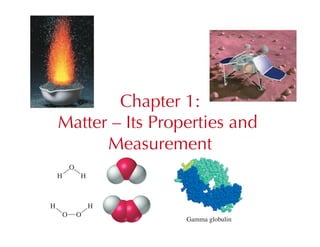
Chapter 1:
Matter – Its Properties and
      Measurement
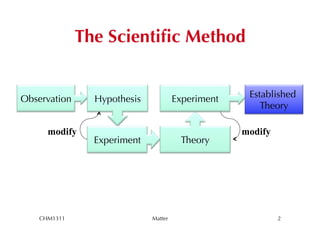
The Scientific Method


Observation     Hypothesis            Experiment    Established
                                                       Theory

      modify                                       modify
                Experiment             Theory


    CHM1311                  Matter                         2
Properties of Matter

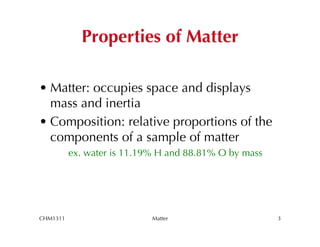
• Matter: occupies space and displays
  mass and inertia
• Composition: relative proportions of the
  components of a sample of matter
          ex. water is 11.19% H and 88.81% O by mass


CHM1311                     Matter                     3
Properties of Matter
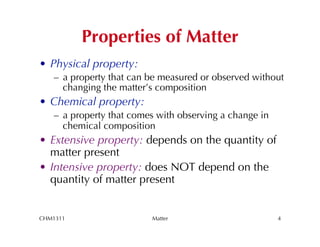
•  Physical property:
   –  a property that can be measured or observed without
      changing the matter’s composition
•  Chemical property:
   –  a property that comes with observing a change in
      chemical composition
•  Extensive property: depends on the quantity of
   matter present
•  Intensive property: does NOT depend on the
   quantity of matter present


CHM1311                   Matter                         4
Elements and Compounds
•  Element:
   –  cannot be decomposed into a simpler substance
      through chemical processes; distinguished by the
      unit of the atom
•  Compound:
   –  a substance made from the atoms of two or more
      elements bonded chemically in defined proportions


•  Compounds can only be decomposed into
   their respective elements via chemical
   processes

CHM1311                   Matter                         5
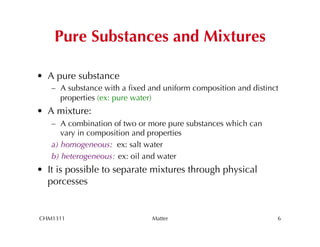
Pure Substances and Mixtures

•  A pure substance
   –  A substance with a fixed and uniform composition and distinct
      properties (ex: pure water)
•  A mixture:
   –  A combination of two or more pure substances which can
      vary in composition and properties
   a) homogeneous: ex: salt water
   b) heterogeneous: ex: oil and water
•  It is possible to separate mixtures through physical
   porcesses


CHM1311                       Matter                             6
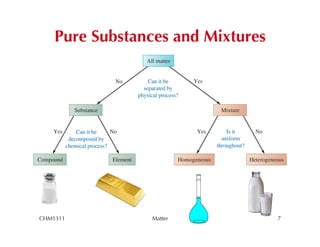
Pure Substances and Mixtures


CHM1311         Matter             7
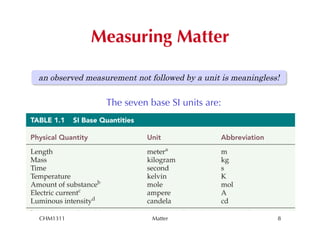
Measuring Matter

an observed measurement not followed by a unit is meaningless!


                 The seven base SI units are:


CHM1311                      Matter                          8
Who cares about units anyway?
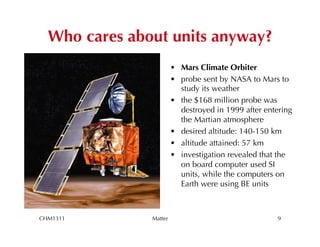
                        •  Mars Climate Orbiter
                        •  probe sent by NASA to Mars to
                           study its weather
                        •  the $168 million probe was
                           destroyed in 1999 after entering
                           the Martian atmosphere
                        •  desired altitude: 140-150 km
                        •  altitude attained: 57 km
                        •  investigation revealed that the
                           on board computer used SI
                           units, while the computers on
                           Earth were using BE units


CHM1311        Matter                                 9
SI Prefixes
   Value
       	

   Prefix
                 	

              Symbol
                                       	

    1012
       	

   tera-
                 	

                 T	

    109
      	

    giga-
                 	

                 G	

    106
      	

    mega-
                 	

                M	

    103
      	

     kilo-
                  	

                k
                                     	

    102
      	

    hecto-
                  	

                h
                                     	

    101
      	

    deca-
                 	

                da
                                     	

    10-1
       	

   deci-
                 	

                 d
                                     	

    10-2
       	

   centi-
                  	

                c
                                     	

    10-3
       	

    milli-
                   	

              m	

    10-6
       	

   micro-
                  	

                µ	

    10-9
       	

   nano-
                 	

                 n
                                     	

   10-12
       	

   pico-
                 	

                 p


CHM1311                  Matter              10
Mass versus Weight

  •  mass:
      –  measures the quantity of matter in an object
  •  weight:
      –  the force of gravity on an object

The kilogram (kg) is the official SI unit, but we will most often
use the gram (g): 	


                     1 kg = 1000 g

  CHM1311                     Matter                         11
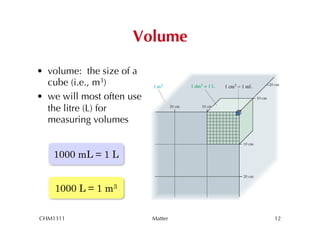
Volume

•  volume: the size of a
   cube (i.e., m3)
•  we will most often use
   the litre (L) for
   measuring volumes


    1000 mL = 1 L


    1000 L = 1 m3

CHM1311                     Matter   12
Temperature

•  the SI unit is the kelvin (K)

•  absolute zero temperature is 0 K or -273.15oC

•  the freezing point of water is 273.15 K or 0oC

•  the boiling point of water is 373.15 K or 100oC


 always use the temperature in K in your calculations!

CHM1311                       Matter                 13
Accuracy and Precision

• Accuracy:
   –  indicates how close a measured value is to
      the actual (or accepted) value


• Precision:
   –  indicates the degree of reproducibility of a
      measured quantity


CHM1311                 Matter                       14
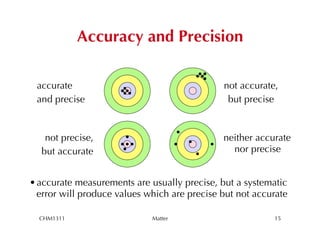
Accuracy and Precision

 accurate                                     not accurate,
 and precise                                   but precise


   not precise,                               neither accurate
  but accurate                                  nor precise


• accurate measurements are usually precise, but a systematic
  error will produce values which are precise but not accurate

  CHM1311                    Matter                       15
Scientific measurements

•  Scientific notation: N x 10n
 6.022 045 x 1023 instead of 602 204 500 000 000 000 000 000
                     N=6.022 045 and n=23
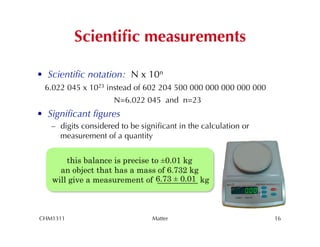
•  Significant figures
   –  digits considered to be significant in the calculation or
      measurement of a quantity


       this balance is precise to ±0.01 kg
     an object that has a mass of 6.732 kg
   will give a measurement of 6.73 ± 0.01 kg
                                 __________


CHM1311                          Matter                          16
Rules for sig figs…

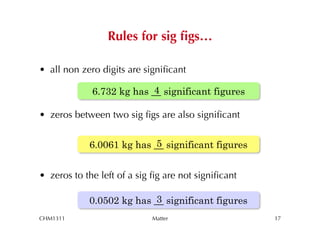
•  all non zero digits are significant

                           4
             6.732 kg has __ significant figures

•  zeros between two sig figs are also significant

                           5
            6.0061 kg has __ significant figures


•  zeros to the left of a sig fig are not significant

                           3
            0.0502 kg has __ significant figures
CHM1311                      Matter                   17
Rules for sig figs…

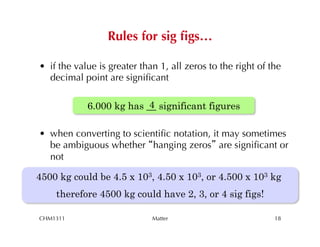
•  if the value is greater than 1, all zeros to the right of the
   decimal point are significant

                          4
            6.000 kg has __ significant figures

•  when converting to scientific notation, it may sometimes
   be ambiguous whether hanging zeros are significant or
   not

4500 kg could be 4.5 x 10³, 4.50 x 10³, or 4.500 x 10³ kg
    therefore 4500 kg could have 2, 3, or 4 sig figs!

CHM1311                      Matter                           18
Rules for sig figs


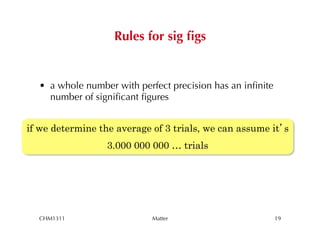
  •  a whole number with perfect precision has an infinite
     number of significant figures


if we determine the average of 3 trials, we can assume it s
                  3.000 000 000 … trials


  CHM1311                   Matter                          19
Rules for sig figs…
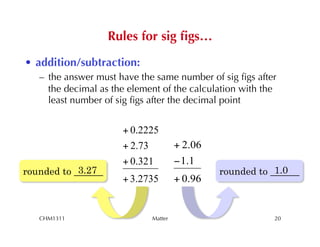
•  addition/subtraction:
   –  the answer must have the same number of sig figs after
      the decimal as the element of the calculation with the
      least number of sig figs after the decimal point


                       + 0.2225
                       + 2.73          + 2.06
                       + 0.321         ! 1.1
            3.27
rounded to ______                                           1.0
                                                rounded to ______
                       + 3.2735        + 0.96


   CHM1311                    Matter                       20
Rules for sig figs…

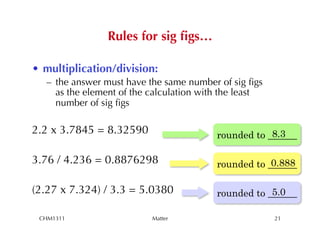
•  multiplication/division:
   –  the answer must have the same number of sig figs
      as the element of the calculation with the least
      number of sig figs

2.2 x 3.7845 = 8.32590                                 8.3
                                           rounded to ______

3.76 / 4.236 = 0.8876298                               0.888
                                           rounded to ______

(2.27 x 7.324) / 3.3 = 5.0380                          5.0
                                           rounded to ______

 CHM1311                   Matter                        21
Rules for sig figs…
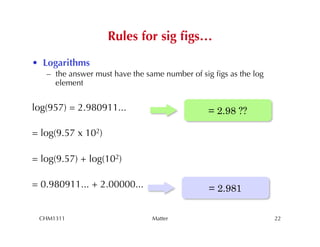
•  Logarithms
   –  the answer must have the same number of sig figs as the log
      element


log(957) = 2.980911...                          = 2.98 ??

= log(9.57 x 10²)

= log(9.57) + log(102)

= 0.980911... + 2.00000...                      = 2.981

 CHM1311                        Matter                             22
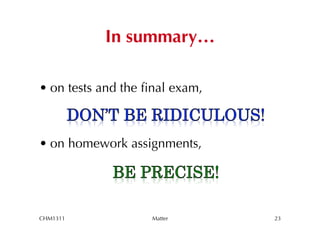
In summary…

• on tests and the final exam,


• on homework assignments,


CHM1311             Matter      23
Conversion Factors

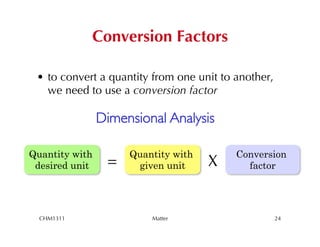
 •  to convert a quantity from one unit to another,
    we need to use a conversion factor

                Dimensional Analysis

Quantity with        Quantity with         Conversion
 desired unit    =    given unit     X       factor


  CHM1311                Matter                       24
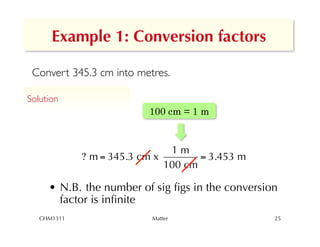
Example 1: Conversion factors

 Convert 345.3 cm into metres.

Solution	

                           100 cm = 1 m


                                1m
              ? m = 345.3 cm x        = 3.453 m
                               100 cm

       •  N.B. the number of sig figs in the conversion
          factor is infinite
   !
   CHM1311                  Matter                   25
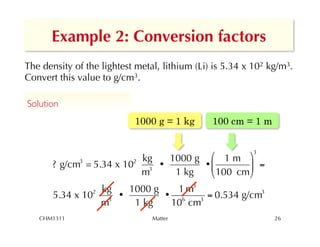
Example 2: Conversion factors
The density of the lightest metal, lithium (Li) is 5.34 x 10² kg/m3.
Convert this value to g/cm3.

Solution	

                           1000 g = 1 kg       100 cm = 1 m


              3           2 kg   1000 g   1 m %3
        ? g/cm = 5.34 x 10   3
                               •        •$        ' =
                            m     1 kg   # 100 cm 
                 2kg   1000 g   1 m3
        5.34 x 10    •        • 6     = 0.534 g/cm3
                  m3    1 kg   10 cm3
   CHM1311                      Matter                         26
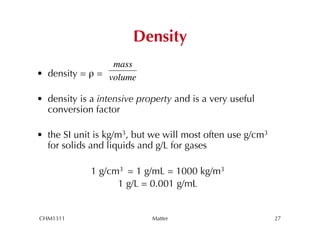
Density
                  mass
•  density = ρ = volume

•  density is a intensive property and is a very useful
   conversion factor
        !
•  the SI unit is kg/m3, but we will most often use g/cm3
   for solids and liquids and g/L for gases

             1 g/cm3 = 1 g/mL = 1000 kg/m3
                   1 g/L = 0.001 g/mL


CHM1311                      Matter                         27
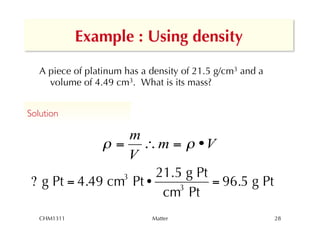
Example : Using density

   A piece of platinum has a density of 21.5 g/cm3 and a
     volume of 4.49 cm3. What is its mass?


Solution	


                   m
               = ! m =  •V
                   V
                 3     21.5 g Pt
 ? g Pt = 4.49 cm Pt •     3
                                 = 96.5 g Pt
                        cm Pt
   CHM1311                   Matter                        28
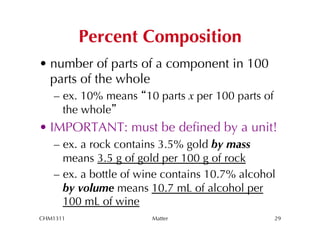
Percent Composition
• number of parts of a component in 100
  parts of the whole
   –  ex. 10% means 10 parts x per 100 parts of
      the whole
• IMPORTANT: must be defined by a unit!
   –  ex. a rock contains 3.5% gold by mass
      means 3.5 g of gold per 100 g of rock
   –  ex. a bottle of wine contains 10.7% alcohol
      by volume means 10.7 mL of alcohol per
      100 mL of wine
CHM1311                Matter                     29
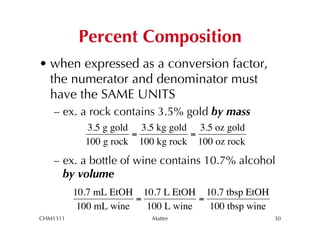
Percent Composition
• when expressed as a conversion factor,
  the numerator and denominator must
  have the SAME UNITS
     –  ex. a rock contains 3.5% gold by mass
            3.5 g gold 3.5 kg gold 3.5 oz gold
                      =           =
            100 g rock 100 kg rock 100 oz rock
     –  ex. a bottle of wine contains 10.7% alcohol
        by volume
 !
          10.7 mL EtOH 10.7 L EtOH 10.7 tbsp EtOH
                       =            =
           100 mL wine   100 L wine   100 tbsp wine
CHM1311                   Matter                      30
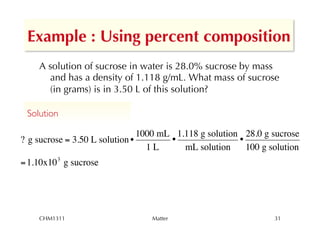
Example : Using percent composition
     A solution of sucrose in water is 28.0% sucrose by mass
       and has a density of 1.118 g/mL. What mass of sucrose
       (in grams) is in 3.50 L of this solution?

 Solution	


                                1000 mL 1.118 g solution 28.0 g sucrose
? g sucrose = 3.50 L solution •        •                •
                                  1L      mL solution     100 g solution
= 1.10x10 3 g sucrose


     CHM1311                      Matter                         31
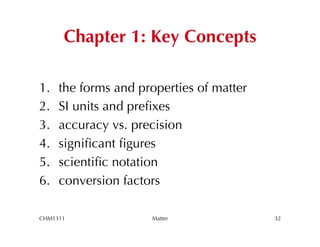
Chapter 1: Key Concepts

1.    the forms and properties of matter
2.    SI units and prefixes
3.    accuracy vs. precision
4.    significant figures
5.    scientific notation
6.    conversion factors

CHM1311               Matter               32
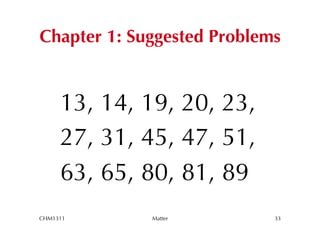
Chapter 1: Suggested Problems


     13, 14, 19, 20, 23,
     27, 31, 45, 47, 51,
     63, 65, 80, 81, 89
CHM1311      Matter         33

Chapter 1 review

  • 1.
    Chapter 1: Matter –Its Properties and Measurement
  • 2.
    The Scientific Method Observation Hypothesis Experiment Established Theory modify modify Experiment Theory CHM1311 Matter 2
  • 3.
    Properties of Matter • Matter:occupies space and displays mass and inertia • Composition: relative proportions of the components of a sample of matter ex. water is 11.19% H and 88.81% O by mass CHM1311 Matter 3
  • 4.
    Properties of Matter • Physical property: –  a property that can be measured or observed without changing the matter’s composition •  Chemical property: –  a property that comes with observing a change in chemical composition •  Extensive property: depends on the quantity of matter present •  Intensive property: does NOT depend on the quantity of matter present CHM1311 Matter 4
  • 5.
    Elements and Compounds • Element: –  cannot be decomposed into a simpler substance through chemical processes; distinguished by the unit of the atom •  Compound: –  a substance made from the atoms of two or more elements bonded chemically in defined proportions •  Compounds can only be decomposed into their respective elements via chemical processes CHM1311 Matter 5
  • 6.
    Pure Substances andMixtures •  A pure substance –  A substance with a fixed and uniform composition and distinct properties (ex: pure water) •  A mixture: –  A combination of two or more pure substances which can vary in composition and properties a) homogeneous: ex: salt water b) heterogeneous: ex: oil and water •  It is possible to separate mixtures through physical porcesses CHM1311 Matter 6
  • 7.
    Pure Substances andMixtures CHM1311 Matter 7
  • 8.
    Measuring Matter an observedmeasurement not followed by a unit is meaningless! The seven base SI units are: CHM1311 Matter 8
  • 9.
    Who cares aboutunits anyway? •  Mars Climate Orbiter •  probe sent by NASA to Mars to study its weather •  the $168 million probe was destroyed in 1999 after entering the Martian atmosphere •  desired altitude: 140-150 km •  altitude attained: 57 km •  investigation revealed that the on board computer used SI units, while the computers on Earth were using BE units CHM1311 Matter 9
  • 10.
    SI Prefixes Value Prefix Symbol 1012 tera- T 109 giga- G 106 mega- M 103 kilo- k 102 hecto- h 101 deca- da 10-1 deci- d 10-2 centi- c 10-3 milli- m 10-6 micro- µ 10-9 nano- n 10-12 pico- p CHM1311 Matter 10
  • 11.
    Mass versus Weight •  mass: –  measures the quantity of matter in an object •  weight: –  the force of gravity on an object The kilogram (kg) is the official SI unit, but we will most often use the gram (g): 1 kg = 1000 g CHM1311 Matter 11
  • 12.
    Volume •  volume: thesize of a cube (i.e., m3) •  we will most often use the litre (L) for measuring volumes 1000 mL = 1 L 1000 L = 1 m3 CHM1311 Matter 12
  • 13.
    Temperature •  the SIunit is the kelvin (K) •  absolute zero temperature is 0 K or -273.15oC •  the freezing point of water is 273.15 K or 0oC •  the boiling point of water is 373.15 K or 100oC always use the temperature in K in your calculations! CHM1311 Matter 13
  • 14.
    Accuracy and Precision • Accuracy: –  indicates how close a measured value is to the actual (or accepted) value • Precision: –  indicates the degree of reproducibility of a measured quantity CHM1311 Matter 14
  • 15.
    Accuracy and Precision accurate not accurate, and precise but precise not precise, neither accurate but accurate nor precise • accurate measurements are usually precise, but a systematic error will produce values which are precise but not accurate CHM1311 Matter 15
  • 16.
    Scientific measurements •  Scientificnotation: N x 10n 6.022 045 x 1023 instead of 602 204 500 000 000 000 000 000 N=6.022 045 and n=23 •  Significant figures –  digits considered to be significant in the calculation or measurement of a quantity this balance is precise to ±0.01 kg an object that has a mass of 6.732 kg will give a measurement of 6.73 ± 0.01 kg __________ CHM1311 Matter 16
  • 17.
    Rules for sigfigs… •  all non zero digits are significant 4 6.732 kg has __ significant figures •  zeros between two sig figs are also significant 5 6.0061 kg has __ significant figures •  zeros to the left of a sig fig are not significant 3 0.0502 kg has __ significant figures CHM1311 Matter 17
  • 18.
    Rules for sigfigs… •  if the value is greater than 1, all zeros to the right of the decimal point are significant 4 6.000 kg has __ significant figures •  when converting to scientific notation, it may sometimes be ambiguous whether hanging zeros are significant or not 4500 kg could be 4.5 x 10³, 4.50 x 10³, or 4.500 x 10³ kg therefore 4500 kg could have 2, 3, or 4 sig figs! CHM1311 Matter 18
  • 19.
    Rules for sigfigs •  a whole number with perfect precision has an infinite number of significant figures if we determine the average of 3 trials, we can assume it s 3.000 000 000 … trials CHM1311 Matter 19
  • 20.
    Rules for sigfigs… •  addition/subtraction: –  the answer must have the same number of sig figs after the decimal as the element of the calculation with the least number of sig figs after the decimal point + 0.2225 + 2.73 + 2.06 + 0.321 ! 1.1 3.27 rounded to ______ 1.0 rounded to ______ + 3.2735 + 0.96 CHM1311 Matter 20
  • 21.
    Rules for sigfigs… •  multiplication/division: –  the answer must have the same number of sig figs as the element of the calculation with the least number of sig figs 2.2 x 3.7845 = 8.32590 8.3 rounded to ______ 3.76 / 4.236 = 0.8876298 0.888 rounded to ______ (2.27 x 7.324) / 3.3 = 5.0380 5.0 rounded to ______ CHM1311 Matter 21
  • 22.
    Rules for sigfigs… •  Logarithms –  the answer must have the same number of sig figs as the log element log(957) = 2.980911... = 2.98 ?? = log(9.57 x 10²) = log(9.57) + log(102) = 0.980911... + 2.00000... = 2.981 CHM1311 Matter 22
  • 23.
    In summary… • on testsand the final exam, • on homework assignments, CHM1311 Matter 23
  • 24.
    Conversion Factors • to convert a quantity from one unit to another, we need to use a conversion factor Dimensional Analysis Quantity with Quantity with Conversion desired unit = given unit X factor CHM1311 Matter 24
  • 25.
    Example 1: Conversionfactors Convert 345.3 cm into metres. Solution 100 cm = 1 m 1m ? m = 345.3 cm x = 3.453 m 100 cm •  N.B. the number of sig figs in the conversion factor is infinite ! CHM1311 Matter 25
  • 26.
    Example 2: Conversionfactors The density of the lightest metal, lithium (Li) is 5.34 x 10² kg/m3. Convert this value to g/cm3. Solution 1000 g = 1 kg 100 cm = 1 m 3 2 kg 1000 g 1 m %3 ? g/cm = 5.34 x 10 3 • •$ ' = m 1 kg # 100 cm 2kg 1000 g 1 m3 5.34 x 10 • • 6 = 0.534 g/cm3 m3 1 kg 10 cm3 CHM1311 Matter 26
  • 27.
    Density mass •  density = ρ = volume •  density is a intensive property and is a very useful conversion factor ! •  the SI unit is kg/m3, but we will most often use g/cm3 for solids and liquids and g/L for gases 1 g/cm3 = 1 g/mL = 1000 kg/m3 1 g/L = 0.001 g/mL CHM1311 Matter 27
  • 28.
    Example : Usingdensity A piece of platinum has a density of 21.5 g/cm3 and a volume of 4.49 cm3. What is its mass? Solution m = ! m = •V V 3 21.5 g Pt ? g Pt = 4.49 cm Pt • 3 = 96.5 g Pt cm Pt CHM1311 Matter 28
  • 29.
    Percent Composition • number ofparts of a component in 100 parts of the whole –  ex. 10% means 10 parts x per 100 parts of the whole • IMPORTANT: must be defined by a unit! –  ex. a rock contains 3.5% gold by mass means 3.5 g of gold per 100 g of rock –  ex. a bottle of wine contains 10.7% alcohol by volume means 10.7 mL of alcohol per 100 mL of wine CHM1311 Matter 29
  • 30.
    Percent Composition • when expressedas a conversion factor, the numerator and denominator must have the SAME UNITS –  ex. a rock contains 3.5% gold by mass 3.5 g gold 3.5 kg gold 3.5 oz gold = = 100 g rock 100 kg rock 100 oz rock –  ex. a bottle of wine contains 10.7% alcohol by volume ! 10.7 mL EtOH 10.7 L EtOH 10.7 tbsp EtOH = = 100 mL wine 100 L wine 100 tbsp wine CHM1311 Matter 30
  • 31.
    Example : Usingpercent composition A solution of sucrose in water is 28.0% sucrose by mass and has a density of 1.118 g/mL. What mass of sucrose (in grams) is in 3.50 L of this solution? Solution 1000 mL 1.118 g solution 28.0 g sucrose ? g sucrose = 3.50 L solution • • • 1L mL solution 100 g solution = 1.10x10 3 g sucrose CHM1311 Matter 31
  • 32.
    Chapter 1: KeyConcepts 1.  the forms and properties of matter 2.  SI units and prefixes 3.  accuracy vs. precision 4.  significant figures 5.  scientific notation 6.  conversion factors CHM1311 Matter 32
  • 33.
    Chapter 1: SuggestedProblems 13, 14, 19, 20, 23, 27, 31, 45, 47, 51, 63, 65, 80, 81, 89 CHM1311 Matter 33