Learning Outcomes:
1. Evaluate current critical issues and challenges in
your profession;
2. Reflect on research processes within a specific
context ; and
3. Formulate a working research title or topic and
develop research questions.
Chapter 1
Concepts of Research
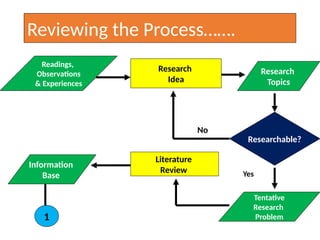
Reviewing the Process…….
Readings,
Observations
& Experiences
Research
Idea
Literature
Review
Information
Base
Research
Topics
Tentative
Research
Problem
Researchable?
1
Yes
No
Choosing Your Topic
• Breadth. You may need to start broad and let your
research take you narrower.
• Originality. Choose a topic that will allow you to
contribute to the field, rather than just regurgitate
facts.
• Sources. On the other hand, also choose a topic that
has scholarly grounding.
What makes a good topic
proposal?
• It is interesting
• Topicality; the topic tackles a novel yet interesting
issue in today’s research agenda
• Feasible, i.e., within the time frame & available
resources
• Workability; ease of generating data
Topic Identification
Two resources of Research topics
1. CQ Researcher: a series of weekly research studies on
current news themes and issues of broad interest in
public policy. Health, social trends, criminal justice,
foreign affairs, education, the environment, technology,
and the economy are among the topics covered in
reports.
2. CRED Reference: in-text or parenthetical citation as
cited in other research papers or publications, often
seen in the reference page section of a research paper
or publication.
Other Sources of Ideas for the
TOPIC
• An idea or a statement in a textbook or journal
article; recommendations from thesis/dissertation
• Replication research
• Re-do an important survey done 5 or 10 years ago –
are the findings still true? Or target a specific
industry
• Test a conceptual model which was never tested in
the research literature
• Call for papers
• Newspaper article
• Tackle a controversial issue with a rigorous
research approach
• There is a need or gap identified
Narrowing Your Topic
• Focus on a specific TYPE or CLASS
• Focus on a particular PLACE or REGION
• Focus on a certain TIME PERIOD
• Focus on a certain ASPECT
o
Social, legal, medical, ethical, biological, psychological,
economic, political, philosophical, etc.
• Focus on a specific POPULATION
o
Gender, age, occupation, ethnicity, nationality,
educational attainment, species, etc.
• Focus on a RELATIONSHIP with two or more topics
• COMBINE different kinds of focuses
ACTIVITY 1
A. Formulate at least three research topics that
addresses critical issues in your work place or
in the business industry.
B. Submit 5 possible references of your selected
topic
C. Present your output in class
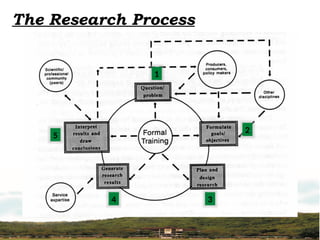
The Research Process
1
2
3
4
5
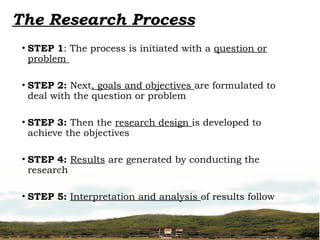
The Research Process
• STEP 1: The process is initiated with a question or
problem
• STEP 2: Next, goals and objectives are formulated to
deal with the question or problem
• STEP 3: Then the research design is developed to
achieve the objectives
• STEP 4: Results are generated by conducting the
research
• STEP 5: Interpretation and analysis of results follow
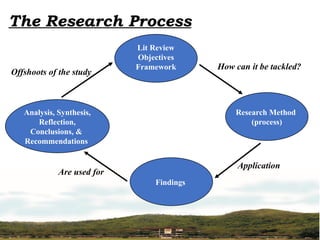
The Research Process
Lit Review
Objectives
Framework
Analysis, Synthesis,
Reflection,
Conclusions, &
Recommendations
Findings
Research Method
(process)
Are used for
Application
How can it be tackled?
Offshoots of the study
Creativity in the Research Process
• Research is a creative process
• “…research includes far more than mere logic … It
includes insight, genius, groping, pondering –
‘sense’ … The logic we can teach; the art we
cannot”
• Research requires (or at least works best) with
imagination, initiative, intuition, and curiosity.
• There are different types of creativity,
characteristic of different situations – “applied”
and “theoretical” most closely associate with
economic research
How to Foster Creativity
a. Gather and use previously developed knowledge
b. Exchange ideas
c. Apply deductive logic
d. Look at things alternate ways
e. Question or challenge assumptions
f. Search for patterns or relationships
g. Take risks
h. Cultivate tolerance for uncertainty
How to Foster Creativity
i. Allow curiosity to grow
j. Set problems aside … and come back to them
k. Write down your thoughts
“… frequently I don’t know what I think until
I write it”
l. Freedom from distraction … some time to think.
Creativity may provide the difference between
satisfactory and outstanding research.
How to Foster Creativity
i. Allow curiosity to grow
j. Set problems aside … and come back to them
k. Write down your thoughts
“… frequently I don’t know what I think until
I write it”
l. Freedom from distraction … some time to think.
Creativity may provide the difference between
satisfactory and outstanding research.
RESEARCH GAP
◦A research gap refers to a missing or insufficient area
of knowledge or understanding in a particular field of
research or study. It is a discrepancy or a need for
further investigation that is identified through an
analysis of existing literature or empirical evidence.
Research gaps can occur due to limitations in
previous research, changes in the field, or emerging
trends that have not yet been explored.
RESEARCH GAP
◦Identifying research gaps is an essential step in
conducting research as it helps researchers to focus
their efforts and contribute to the existing body of
knowledge. Addressing research gaps may involve
designing new studies, developing new theories or
frameworks, or re-evaluating existing research. By
addressing research gaps, researchers can make
meaningful contributions to their field and improve
the quality of their research.
TYPES OF RESEARCH GAP
Common types of research gap:
1. Theoretical Gap
2. Empirical Gap
3. Methodological Gap
4. Practical Gap
5. Literature Gap
6. Historical Gap
7. Cultural Gap
8. Conceptual Gap
THEORETICAL GAP
o Theoretical gap refers to a gap in the theoretical
knowledge or understanding of a particular research
area or topic. It occurs when there is a lack of
theoretical explanations or frameworks to explain a
particular phenomenon or when there are
inconsistencies or contradictions in existing theories.
EXAMPLE OF THEORETICAL GAP
o Let's say a researcher wants to study the relationship between
personality traits and job satisfaction. While there is existing
literature on both personality traits and job satisfaction, there may
be a theoretical gap in the understanding of how these two
concepts are related. In other words, there may not be a
theoretical model that fully explains the relationship between
personality traits and job satisfaction.
EMPIRICAL GAP
o Empirical gaps can occur due to various reasons
such as limited data availability, lack of research in a
particular area, methodological limitations, or
inconsistencies in research findings. Identifying and
addressing empirical gaps is essential to advance
knowledge in the field and to develop a more
comprehensive and accurate understanding of the
phenomenon under study.
EXAMPLES OF EMPIRICAL GAP
Lack of data: A researcher may want to investigate
the effects of a new medication on a specific health
condition, but there is a lack of empirical data on the
medication's effectiveness. To address this gap, the
researcher may need to conduct a clinical trial or
collect data from patient records.
EXAMPLES OF EMPIRICAL GAP
Inconsistent results: A researcher may find conflicting results in
the existing literature on the relationship between exercise and
mental health. Some studies may suggest that exercise has a
positive effect on mental health, while others may show no
significant effect. To address this gap, the researcher may need to
conduct a meta-analysis of the existing studies or design a new
study that controls for other factors that may influence the
relationship between exercise and mental health.
EXAMPLES OF EMPIRICAL GAP
Limited scope: A researcher may want to investigate the effects
of a particular teaching method on student learning outcomes.
However, existing studies may only focus on a narrow range of
learning outcomes, such as test scores, and may not consider other
important factors, such as student motivation or engagement.
METHODOLOGICAL GAP
o Methodological gap refers to a gap in the research
methodology used in a particular research area or
topic. It occurs when there are limitations or flaws
in the research methods used to collect, analyze or
interpret data, resulting in incomplete or inaccurate
findings.
Lack of appropriate measurement tools: A
researcher may want to investigate the effects of a
particular intervention on cognitive functioning in
older adults. However, there may not be appropriate
measurement tools to assess cognitive functioning in
this population. To address this gap, the researcher
may need to develop or adapt measurement tools that
are appropriate for older adults.
EXAMPLES OF
METHODOLIGICAL GAP
 Inadequate sampling methods: A researcher may
want to investigate the experiences of individuals with
a particular health condition. However, the existing
research may have relied on convenience sampling
methods, which may not be representative of the
population of interest. To address this gap, the
researcher may need to use more rigorous sampling
methods, such as random sampling, to ensure that
the sample is representative of the population of
interest.
EXAMPLES OF
METHODOLIGICAL GAP
 Insufficient statistical methods: The researcher
may have non-normal data or may need to control for
other factors that may influence the relationship. To
address this gap, the researcher may need to use more
advanced statistical methods, such as non-parametric
tests or regression analysis with covariates.
EXAMPLES OF
METHODOLIGICAL GAP
PRACTICAL GAP
◦Practical gap refers to a gap between theoretical or
empirical findings and their application in practice. It
occurs when the knowledge generated by research is
not effectively translated or applied in real-world
settings, resulting in a gap between research findings
and practical outcomes.
Implementation challenges: A researcher may have
developed a new intervention that has been shown to
be effective in improving patient outcomes in a clinical
trial setting. However, there may be practical
challenges in implementing the intervention in real-
world clinical settings, such as lack of resources, staff
training, or patient acceptance. To address this gap,
the researcher may need to work with stakeholders
to develop a plan for implementing the intervention
and addressing these practical challenges.
EXAMPLES OF PRACTICAL GAP
Limited dissemination: A researcher may have
conducted a study that has important implications
for policy or practice. However, the study findings may
not have been disseminated widely enough to reach
the policymakers or practitioners who could use the
information to make decisions. To address this gap,
the researcher may need to work with stakeholders to
develop a dissemination plan that targets the relevant
audience.
EXAMPLES OF PRACTICAL GAP
Lack of collaboration: A researcher may have
developed a new technology or innovation that has
the potential to improve outcomes in a particular
industry. However, there may be a lack of
collaboration between the academic and industry
sectors, which may hinder the translation of the
innovation into practical applications. To address this
gap, the researcher may need to establish
partnerships or collaborations with industry
stakeholders to facilitate the translation of the
innovation into practice.
LITERATURE GAP
◦Literature gap refers to a gap in the existing literature or previous
research on a particular research area or topic. It occurs when
there is a lack of research or limited research on a particular
aspect of a phenomenon, resulting in an incomplete or inadequate
understanding of the phenomenon.
EXAMPLES OF LITERATURE GAP
Limited research on a specific population: There
may be a lack of research on a particular population,
such as individuals with a specific health condition,
minority groups, or individuals living in a particular
geographic area. This gap may result in limited
understanding of the needs and experiences of these
populations, and may hinder the development of
effective interventions or policies that are tailored to
their needs.
EXAMPLES OF LITERATURE GAP
Insufficient attention to emerging issues: There
may be a lack of research on emerging issues, such
as new technologies, new health threats, or changes
in social or economic conditions. This gap may
result in limited understanding of the implications of
these emerging issues, and may hinder the
development of effective strategies to address them.
EXAMPLES OF LITERATURE GAP
Inadequate attention to a particular aspect of a
topic: There may be a lack of research on a
particular aspect of a topic, such as the long-term
effects of a treatment, the social determinants of
health, or the ethical implications of a particular
practice. This gap may result in a limited
understanding of the broader implications of the topic,
and may hinder the development of comprehensive
policies or interventions.
HISTORICAL GAP
o A historical gap refers to a gap in knowledge or
understanding of a specific event, period, or
phenomenon in history due to a lack of available
information, biased sources, or limited perspectives.
Historical gaps can occur when information is lost or
destroyed over time, or when dominant narratives
exclude or marginalize certain perspectives.
EXAMPLES OF HISTORICAL GAP
Limited information about the daily lives of
marginalized groups: Many historical records focus
on the experiences of dominant groups, such as
wealthy or powerful individuals, while providing little
information about the daily lives of marginalized
groups, such as women, people of color, or the
working class.
EXAMPLES OF HISTORICAL GAP
Incomplete records of important events: Historical
records may be incomplete or biased, leading to
gaps in our understanding of important events or
phenomena. For example, records of colonialism or
slavery may not accurately reflect the experiences of
the colonized or enslaved populations.
CULTURAL
GAP
o Cultural gap refers to a gap in understanding
between individuals or groups from different cultural
backgrounds. It occurs when there is a lack of
knowledge or awareness of the cultural norms,
values, beliefs, and practices of another group,
leading to miscommunication, misunderstandings,
and cultural clashes.
EXAMPLES OF CULTURAL GAP
Misunderstanding of cultural values and beliefs: A
cultural gap may arise when individuals from
different cultures have different values and beliefs that
are not well understood or appreciated. For example,
some cultures may place a higher value on
collectivism rather than individualism, which can
lead to misunderstandings or conflicts in cross-
cultural interactions.
EXAMPLES OF CULTURAL GAP
Lack of knowledge about cultural practices:
Cultural gaps may also arise when individuals lack
knowledge about cultural practices or customs. For
example, visitors to a foreign country may not be
aware of appropriate dress codes or greeting customs,
which can lead to misunderstandings or offense.
EXAMPLES OF CULTURAL GAP
Underrepresentation of cultural perspectives:
Cultural gaps can also arise when certain cultural
perspectives are underrepresented or marginalized in
society. For example, the experiences and perspectives
of indigenous communities may be overlooked or
undervalued in mainstream society.
EXAMPLES OF CULTURAL GAP
Stereotyping and prejudice: Stereotyping and
prejudice based on cultural differences can also
contribute to cultural gaps. For example, assuming
that all members of a particular culture share the
same values or behaviors can lead to
misunderstandings and perpetuate harmful
stereotypes.
CONCEPTUAL GAP
o A conceptual gap refers to a lack of understanding or
agreement about the fundamental concepts,
theories, or ideas that are relevant to a particular
research area or topic. It occurs when there is
confusion or disagreement about the meaning or
application of key concepts, leading to a lack of
coherence or consistency in research findings.
EXAMPLES OF CONCEPTUAL GAP
Lack of agreement on the definition of a key
concept: In a study on leadership, for example, there
may be disagreement among researchers on the
definition of "leadership." Some may view leadership
as a trait or characteristic of an individual, while
others may view it as a process or behavior.
EXAMPLES OF CONCEPTUAL GAP
Conflicting theoretical perspectives: Different
theoretical perspectives may provide conflicting
explanations for a phenomenon, resulting in a
conceptual gap. For example, in a study on
motivation, one theory may emphasize the importance
of extrinsic rewards, while another theory may focus
on intrinsic motivation.
EXAMPLES OF CONCEPTUAL GAP
Ambiguity in research design or methodology: A
conceptual gap can also arise when there is
ambiguity in the research design or methodology. For
example, in a study on the effectiveness of a new
teaching method, the research design may not clearly
define the criteria for measuring effectiveness, leading
to inconsistent or unclear results.
EXAMPLES OF CONCEPTUAL GAP
Lack of clarity in research objectives: If the
research objectives are unclear or ambiguous, it can
lead to a conceptual gap in the research. For example,
if the research objective is to explore the impact of
social media on mental health, it may be unclear what
specific aspects of social media are being examined
and how they relate to mental health.
ACTIVITY 2
A. From the selected topics formulated in Activity 1
– narrow your choice to one particular topic of
interest and formulate possible questions that
could arise from the topic.
B. Look for 20 possible references (use reputable
journals only) and identify possible gaps in your
chosen topic.
C. Present your output in class
CHAPTER 1 RESEARCH METHODOLOGY . pptx

  • 1.
    Learning Outcomes: 1. Evaluatecurrent critical issues and challenges in your profession; 2. Reflect on research processes within a specific context ; and 3. Formulate a working research title or topic and develop research questions. Chapter 1 Concepts of Research
  • 2.
    Reviewing the Process……. Readings, Observations &Experiences Research Idea Literature Review Information Base Research Topics Tentative Research Problem Researchable? 1 Yes No
  • 3.
    Choosing Your Topic •Breadth. You may need to start broad and let your research take you narrower. • Originality. Choose a topic that will allow you to contribute to the field, rather than just regurgitate facts. • Sources. On the other hand, also choose a topic that has scholarly grounding.
  • 4.
    What makes agood topic proposal? • It is interesting • Topicality; the topic tackles a novel yet interesting issue in today’s research agenda • Feasible, i.e., within the time frame & available resources • Workability; ease of generating data
  • 5.
    Topic Identification Two resourcesof Research topics 1. CQ Researcher: a series of weekly research studies on current news themes and issues of broad interest in public policy. Health, social trends, criminal justice, foreign affairs, education, the environment, technology, and the economy are among the topics covered in reports. 2. CRED Reference: in-text or parenthetical citation as cited in other research papers or publications, often seen in the reference page section of a research paper or publication.
  • 6.
    Other Sources ofIdeas for the TOPIC • An idea or a statement in a textbook or journal article; recommendations from thesis/dissertation • Replication research • Re-do an important survey done 5 or 10 years ago – are the findings still true? Or target a specific industry • Test a conceptual model which was never tested in the research literature • Call for papers • Newspaper article • Tackle a controversial issue with a rigorous research approach • There is a need or gap identified
  • 7.
    Narrowing Your Topic •Focus on a specific TYPE or CLASS • Focus on a particular PLACE or REGION • Focus on a certain TIME PERIOD • Focus on a certain ASPECT o Social, legal, medical, ethical, biological, psychological, economic, political, philosophical, etc. • Focus on a specific POPULATION o Gender, age, occupation, ethnicity, nationality, educational attainment, species, etc. • Focus on a RELATIONSHIP with two or more topics • COMBINE different kinds of focuses
  • 8.
    ACTIVITY 1 A. Formulateat least three research topics that addresses critical issues in your work place or in the business industry. B. Submit 5 possible references of your selected topic C. Present your output in class
  • 9.
  • 10.
    The Research Process •STEP 1: The process is initiated with a question or problem • STEP 2: Next, goals and objectives are formulated to deal with the question or problem • STEP 3: Then the research design is developed to achieve the objectives • STEP 4: Results are generated by conducting the research • STEP 5: Interpretation and analysis of results follow
  • 11.
    The Research Process LitReview Objectives Framework Analysis, Synthesis, Reflection, Conclusions, & Recommendations Findings Research Method (process) Are used for Application How can it be tackled? Offshoots of the study
  • 12.
    Creativity in theResearch Process • Research is a creative process • “…research includes far more than mere logic … It includes insight, genius, groping, pondering – ‘sense’ … The logic we can teach; the art we cannot” • Research requires (or at least works best) with imagination, initiative, intuition, and curiosity. • There are different types of creativity, characteristic of different situations – “applied” and “theoretical” most closely associate with economic research
  • 13.
    How to FosterCreativity a. Gather and use previously developed knowledge b. Exchange ideas c. Apply deductive logic d. Look at things alternate ways e. Question or challenge assumptions f. Search for patterns or relationships g. Take risks h. Cultivate tolerance for uncertainty
  • 14.
    How to FosterCreativity i. Allow curiosity to grow j. Set problems aside … and come back to them k. Write down your thoughts “… frequently I don’t know what I think until I write it” l. Freedom from distraction … some time to think. Creativity may provide the difference between satisfactory and outstanding research.
  • 15.
    How to FosterCreativity i. Allow curiosity to grow j. Set problems aside … and come back to them k. Write down your thoughts “… frequently I don’t know what I think until I write it” l. Freedom from distraction … some time to think. Creativity may provide the difference between satisfactory and outstanding research.
  • 16.
    RESEARCH GAP ◦A researchgap refers to a missing or insufficient area of knowledge or understanding in a particular field of research or study. It is a discrepancy or a need for further investigation that is identified through an analysis of existing literature or empirical evidence. Research gaps can occur due to limitations in previous research, changes in the field, or emerging trends that have not yet been explored.
  • 17.
    RESEARCH GAP ◦Identifying researchgaps is an essential step in conducting research as it helps researchers to focus their efforts and contribute to the existing body of knowledge. Addressing research gaps may involve designing new studies, developing new theories or frameworks, or re-evaluating existing research. By addressing research gaps, researchers can make meaningful contributions to their field and improve the quality of their research.
  • 18.
    TYPES OF RESEARCHGAP Common types of research gap: 1. Theoretical Gap 2. Empirical Gap 3. Methodological Gap 4. Practical Gap 5. Literature Gap 6. Historical Gap 7. Cultural Gap 8. Conceptual Gap
  • 19.
    THEORETICAL GAP o Theoreticalgap refers to a gap in the theoretical knowledge or understanding of a particular research area or topic. It occurs when there is a lack of theoretical explanations or frameworks to explain a particular phenomenon or when there are inconsistencies or contradictions in existing theories.
  • 20.
    EXAMPLE OF THEORETICALGAP o Let's say a researcher wants to study the relationship between personality traits and job satisfaction. While there is existing literature on both personality traits and job satisfaction, there may be a theoretical gap in the understanding of how these two concepts are related. In other words, there may not be a theoretical model that fully explains the relationship between personality traits and job satisfaction.
  • 21.
    EMPIRICAL GAP o Empiricalgaps can occur due to various reasons such as limited data availability, lack of research in a particular area, methodological limitations, or inconsistencies in research findings. Identifying and addressing empirical gaps is essential to advance knowledge in the field and to develop a more comprehensive and accurate understanding of the phenomenon under study.
  • 22.
    EXAMPLES OF EMPIRICALGAP Lack of data: A researcher may want to investigate the effects of a new medication on a specific health condition, but there is a lack of empirical data on the medication's effectiveness. To address this gap, the researcher may need to conduct a clinical trial or collect data from patient records.
  • 23.
    EXAMPLES OF EMPIRICALGAP Inconsistent results: A researcher may find conflicting results in the existing literature on the relationship between exercise and mental health. Some studies may suggest that exercise has a positive effect on mental health, while others may show no significant effect. To address this gap, the researcher may need to conduct a meta-analysis of the existing studies or design a new study that controls for other factors that may influence the relationship between exercise and mental health.
  • 24.
    EXAMPLES OF EMPIRICALGAP Limited scope: A researcher may want to investigate the effects of a particular teaching method on student learning outcomes. However, existing studies may only focus on a narrow range of learning outcomes, such as test scores, and may not consider other important factors, such as student motivation or engagement.
  • 25.
    METHODOLOGICAL GAP o Methodologicalgap refers to a gap in the research methodology used in a particular research area or topic. It occurs when there are limitations or flaws in the research methods used to collect, analyze or interpret data, resulting in incomplete or inaccurate findings.
  • 26.
    Lack of appropriatemeasurement tools: A researcher may want to investigate the effects of a particular intervention on cognitive functioning in older adults. However, there may not be appropriate measurement tools to assess cognitive functioning in this population. To address this gap, the researcher may need to develop or adapt measurement tools that are appropriate for older adults. EXAMPLES OF METHODOLIGICAL GAP
  • 27.
     Inadequate samplingmethods: A researcher may want to investigate the experiences of individuals with a particular health condition. However, the existing research may have relied on convenience sampling methods, which may not be representative of the population of interest. To address this gap, the researcher may need to use more rigorous sampling methods, such as random sampling, to ensure that the sample is representative of the population of interest. EXAMPLES OF METHODOLIGICAL GAP
  • 28.
     Insufficient statisticalmethods: The researcher may have non-normal data or may need to control for other factors that may influence the relationship. To address this gap, the researcher may need to use more advanced statistical methods, such as non-parametric tests or regression analysis with covariates. EXAMPLES OF METHODOLIGICAL GAP
  • 29.
    PRACTICAL GAP ◦Practical gaprefers to a gap between theoretical or empirical findings and their application in practice. It occurs when the knowledge generated by research is not effectively translated or applied in real-world settings, resulting in a gap between research findings and practical outcomes.
  • 30.
    Implementation challenges: Aresearcher may have developed a new intervention that has been shown to be effective in improving patient outcomes in a clinical trial setting. However, there may be practical challenges in implementing the intervention in real- world clinical settings, such as lack of resources, staff training, or patient acceptance. To address this gap, the researcher may need to work with stakeholders to develop a plan for implementing the intervention and addressing these practical challenges. EXAMPLES OF PRACTICAL GAP
  • 31.
    EXAMPLES OF PRACTICALGAP Limited dissemination: A researcher may have conducted a study that has important implications for policy or practice. However, the study findings may not have been disseminated widely enough to reach the policymakers or practitioners who could use the information to make decisions. To address this gap, the researcher may need to work with stakeholders to develop a dissemination plan that targets the relevant audience.
  • 32.
    EXAMPLES OF PRACTICALGAP Lack of collaboration: A researcher may have developed a new technology or innovation that has the potential to improve outcomes in a particular industry. However, there may be a lack of collaboration between the academic and industry sectors, which may hinder the translation of the innovation into practical applications. To address this gap, the researcher may need to establish partnerships or collaborations with industry stakeholders to facilitate the translation of the innovation into practice.
  • 33.
    LITERATURE GAP ◦Literature gaprefers to a gap in the existing literature or previous research on a particular research area or topic. It occurs when there is a lack of research or limited research on a particular aspect of a phenomenon, resulting in an incomplete or inadequate understanding of the phenomenon.
  • 34.
    EXAMPLES OF LITERATUREGAP Limited research on a specific population: There may be a lack of research on a particular population, such as individuals with a specific health condition, minority groups, or individuals living in a particular geographic area. This gap may result in limited understanding of the needs and experiences of these populations, and may hinder the development of effective interventions or policies that are tailored to their needs.
  • 35.
    EXAMPLES OF LITERATUREGAP Insufficient attention to emerging issues: There may be a lack of research on emerging issues, such as new technologies, new health threats, or changes in social or economic conditions. This gap may result in limited understanding of the implications of these emerging issues, and may hinder the development of effective strategies to address them.
  • 36.
    EXAMPLES OF LITERATUREGAP Inadequate attention to a particular aspect of a topic: There may be a lack of research on a particular aspect of a topic, such as the long-term effects of a treatment, the social determinants of health, or the ethical implications of a particular practice. This gap may result in a limited understanding of the broader implications of the topic, and may hinder the development of comprehensive policies or interventions.
  • 37.
    HISTORICAL GAP o Ahistorical gap refers to a gap in knowledge or understanding of a specific event, period, or phenomenon in history due to a lack of available information, biased sources, or limited perspectives. Historical gaps can occur when information is lost or destroyed over time, or when dominant narratives exclude or marginalize certain perspectives.
  • 38.
    EXAMPLES OF HISTORICALGAP Limited information about the daily lives of marginalized groups: Many historical records focus on the experiences of dominant groups, such as wealthy or powerful individuals, while providing little information about the daily lives of marginalized groups, such as women, people of color, or the working class.
  • 39.
    EXAMPLES OF HISTORICALGAP Incomplete records of important events: Historical records may be incomplete or biased, leading to gaps in our understanding of important events or phenomena. For example, records of colonialism or slavery may not accurately reflect the experiences of the colonized or enslaved populations.
  • 40.
    CULTURAL GAP o Cultural gaprefers to a gap in understanding between individuals or groups from different cultural backgrounds. It occurs when there is a lack of knowledge or awareness of the cultural norms, values, beliefs, and practices of another group, leading to miscommunication, misunderstandings, and cultural clashes.
  • 41.
    EXAMPLES OF CULTURALGAP Misunderstanding of cultural values and beliefs: A cultural gap may arise when individuals from different cultures have different values and beliefs that are not well understood or appreciated. For example, some cultures may place a higher value on collectivism rather than individualism, which can lead to misunderstandings or conflicts in cross- cultural interactions.
  • 42.
    EXAMPLES OF CULTURALGAP Lack of knowledge about cultural practices: Cultural gaps may also arise when individuals lack knowledge about cultural practices or customs. For example, visitors to a foreign country may not be aware of appropriate dress codes or greeting customs, which can lead to misunderstandings or offense.
  • 43.
    EXAMPLES OF CULTURALGAP Underrepresentation of cultural perspectives: Cultural gaps can also arise when certain cultural perspectives are underrepresented or marginalized in society. For example, the experiences and perspectives of indigenous communities may be overlooked or undervalued in mainstream society.
  • 44.
    EXAMPLES OF CULTURALGAP Stereotyping and prejudice: Stereotyping and prejudice based on cultural differences can also contribute to cultural gaps. For example, assuming that all members of a particular culture share the same values or behaviors can lead to misunderstandings and perpetuate harmful stereotypes.
  • 45.
    CONCEPTUAL GAP o Aconceptual gap refers to a lack of understanding or agreement about the fundamental concepts, theories, or ideas that are relevant to a particular research area or topic. It occurs when there is confusion or disagreement about the meaning or application of key concepts, leading to a lack of coherence or consistency in research findings.
  • 46.
    EXAMPLES OF CONCEPTUALGAP Lack of agreement on the definition of a key concept: In a study on leadership, for example, there may be disagreement among researchers on the definition of "leadership." Some may view leadership as a trait or characteristic of an individual, while others may view it as a process or behavior.
  • 47.
    EXAMPLES OF CONCEPTUALGAP Conflicting theoretical perspectives: Different theoretical perspectives may provide conflicting explanations for a phenomenon, resulting in a conceptual gap. For example, in a study on motivation, one theory may emphasize the importance of extrinsic rewards, while another theory may focus on intrinsic motivation.
  • 48.
    EXAMPLES OF CONCEPTUALGAP Ambiguity in research design or methodology: A conceptual gap can also arise when there is ambiguity in the research design or methodology. For example, in a study on the effectiveness of a new teaching method, the research design may not clearly define the criteria for measuring effectiveness, leading to inconsistent or unclear results.
  • 49.
    EXAMPLES OF CONCEPTUALGAP Lack of clarity in research objectives: If the research objectives are unclear or ambiguous, it can lead to a conceptual gap in the research. For example, if the research objective is to explore the impact of social media on mental health, it may be unclear what specific aspects of social media are being examined and how they relate to mental health.
  • 50.
    ACTIVITY 2 A. Fromthe selected topics formulated in Activity 1 – narrow your choice to one particular topic of interest and formulate possible questions that could arise from the topic. B. Look for 20 possible references (use reputable journals only) and identify possible gaps in your chosen topic. C. Present your output in class