CONTENT
o About theauthor
o Introduction
o Chap1: Why Study the Design Process
o Chap2: Understanding Mechanical Design
o Chap3: Designers and Design Teams
o Chap4: The Design Process and Product Discovery
o Chap5: Planning for Design
o Chap6: Understanding the Problem and the Development of Engineering Specifications
o Chap7: Concept Generation
o Chap8: Concept Evaluation and Selection
o Chap9: Product Generation
o Chap10: Product Evaluation for Performance and the Effects of Variation
o Chap11: Product Evaluation: Design For Cost, Manufacture & Assembly
o Chap12: Wrapping Up the Design Process and Supporting the Product
3.
ABOUT THE AUTHOR
DavidG. Ullman is an:
o active product designer
o taught, researched, and written about design for over thirty years.
o president of Robust Decisions, Inc., a supplier of software products and training for
product development and decision support.
o Emeritus Professor of Mechanical Design at Oregon State University.
o professionally designed fluid/thermal, control, and transportation systems.
o published over twenty papers focused on understanding the mechanical product
design process and the development of tools to support it.
o founder of the American Society Mechanical Engineers (ASME)—Design Theory and
Methodology Committee and is a Fellow in the ASME.
4.
INTRODUCTION
o designer allmy life. I have designed bicycles, medical equipment,
furniture, and sculpture, both static and dynamic. Designing objects has
come easy for me. having whatever talents are necessary to be a
successful designer.
o However, after years of teaching mechanical design courses, I came to
the realization that I didn’t know how to teach what I knew so well.
o I could show students examples of good-quality design and poor
quality design. I could give them case histories of designers in action. I
could suggest design ideas. But I could not tell them what to do to solve
a design problem.
INTRODUCTION
o The onlyway to learn about design is to do design.
o Knowledge about the design process is largely independent
of domain-specific knowledge.
o A design process that results in a quality product can be
learned
o A design process should be learned in an academic
environment and, in an environment of industrial realities.
KEY QUESTIONS
o Whatcan be done to design quality mechanical products on
time and within budget?
o What are the key features of design best practice that will
lead to better products?
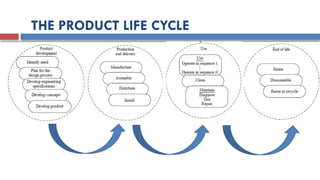
o What are the phases of a product’s life cycle?
o How are design problems different from analysis
problems?
o Why is it during design, the more you know, the less design
freedom you have?
9.
INTRODUCTION
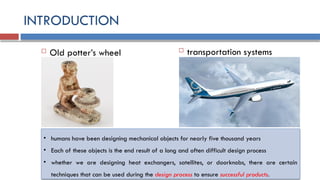
Old potter’swheel transportation systems
• humans have been designing mechanical objects for nearly five thousand years
• Each of these objects is the end result of a long and often difficult design process
• whether we are designing heat exchangers, satellites, or doorknobs, there are certain
techniques that can be used during the design process to ensure successful products.
10.
INTRODUCTION
QUESTION???
If people havebeen designing for five
thousand years and there are literally millions
of mechanical objects that work and work
well, why study the design process???
INTRODUCTION
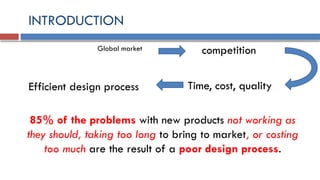
Global market competition
Time,cost, quality
Efficient design process
85% of the problems with new products not working as
they should, taking too long to bring to market, or costing
too much are the result of a poor design process.
MEASURING THE DESIGNPROCESS
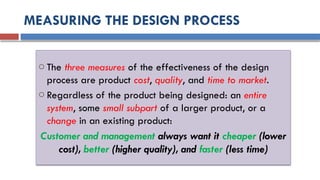
o The three measures of the effectiveness of the design
process are product cost, quality, and time to market.
o Regardless of the product being designed: an entire
system, some small subpart of a larger product, or a
change in an existing product:
Customer and management always want it cheaper (lower
cost), better (higher quality), and faster (less time)
16.
MEASURING THE DESIGNPROCESS
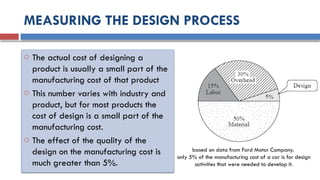
o The actual cost of designing a
product is usually a small part of the
manufacturing cost of that product
o This number varies with industry and
product, but for most products the
cost of design is a small part of the
manufacturing cost.
o The effect of the quality of the
design on the manufacturing cost is
much greater than 5%.
based on data from Ford Motor Company.
only 5% of the manufacturing cost of a car is for design
activities that were needed to develop it.
17.
MEASURING THE DESIGNPROCESS
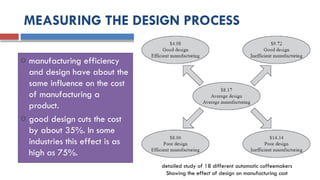
o manufacturing efficiency
and design have about the
same influence on the cost
of manufacturing a
product.
o good design cuts the cost
by about 35%. In some
industries this effect is as
high as 75%.
detailed study of 18 different automatic coffeemakers
Showing the effect of design on manufacturing cost
18.
MEASURING THE DESIGNPROCESS
o Until early 1970s, Xerox controlled the copier market. However,
by 1980 Xerox realized that some producers were able to sell a
copier for less than Xerox was able to manufacture one.
o In one study of the problem, comparing plastic parts from their
machines and ones that performed a similar function, they found
that Japanese firms could produce a part for 50% less than
American firms.
o 25% of the difference was attributable to how the parts were
designed.
19.
MEASURING THE DESIGNPROCESS
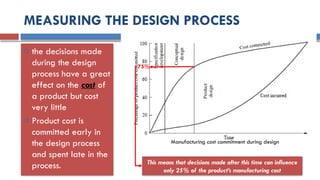
o the decisions made
during the design
process have a great
effect on the cost of
a product but cost
very little
o Product cost is
committed early in
the design process
and spent late in the
process.
Manufacturing cost commitment during design
75%
This means that decisions made after this time can influence
only 25% of the product’s manufacturing cost
20.
MEASURING THE DESIGNPROCESS
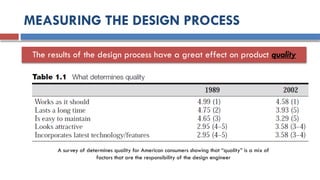
The results of the design process have a great effect on product quality
A survey of determines quality for American consumers showing that “quality” is a mix of
factors that are the responsibility of the design engineer
21.
MEASURING THE DESIGNPROCESS
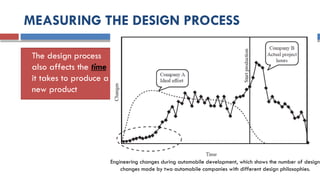
The design process
also affects the time
it takes to produce a
new product
Engineering changes during automobile development, which shows the number of design
changes made by two automobile companies with different design philosophies.
22.
MEASURING THE DESIGNPROCESS
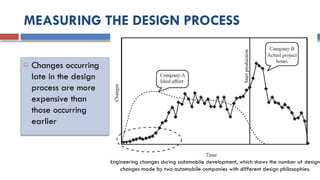
o Changes occurring
late in the design
process are more
expensive than
those occurring
earlier
Engineering changes during automobile development, which shows the number of design
changes made by two automobile companies with different design philosophies.
23.
MEASURING THE DESIGNPROCESS
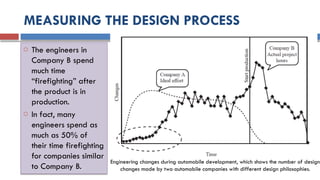
o The engineers in
Company B spend
much time
“firefighting” after
the product is in
production.
o In fact, many
engineers spend as
much as 50% of
their time firefighting
for companies similar
to Company B.
Engineering changes during automobile development, which shows the number of design
changes made by two automobile companies with different design philosophies.
24.
THE HISTORY OFTHE DESIGN PROCESS
Definition:
The design process is the organization
and management of people and the
information they develop in the
evolution of a product.
History:
In simpler times, one person could
design and manufacture an entire
product. Even for a large project such
as the design of a ship or a bridge.
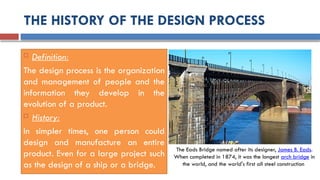
The Eads Bridge named after its designer, James B. Eads.
When completed in 1874, it was the longest arch bridge in
the world, and the world's first all steel construction
25.
THE HISTORY OFTHE DESIGN PROCESS
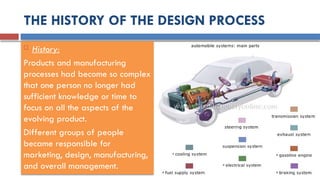
History:
Products and manufacturing
processes had become so complex
that one person no longer had
sufficient knowledge or time to
focus on all the aspects of the
evolving product.
Different groups of people
became responsible for
marketing, design, manufacturing,
and overall management.
26.
THE HISTORY OFTHE DESIGN PROCESS
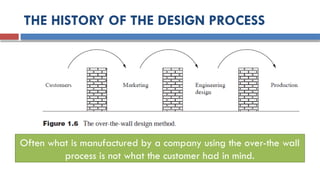
Often what is manufactured by a company using the over-the wall
process is not what the customer had in mind.
27.
THE HISTORY OFTHE DESIGN PROCESS
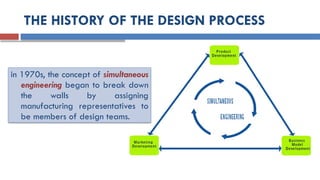
in 1970s, the concept of simultaneous
engineering began to break down
the walls by assigning
manufacturing representatives to
be members of design teams.
28.
THE HISTORY OFTHE DESIGN PROCESS
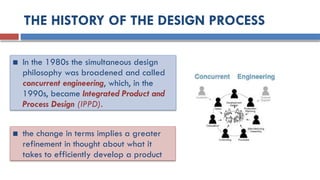
■ In the 1980s the simultaneous design
philosophy was broadened and called
concurrent engineering, which, in the
1990s, became Integrated Product and
Process Design (IPPD).
■ the change in terms implies a greater
refinement in thought about what it
takes to efficiently develop a product
29.
THE HISTORY OFTHE DESIGN PROCESS
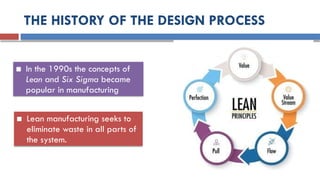
■ In the 1990s the concepts of
Lean and Six Sigma became
popular in manufacturing
■ Lean manufacturing seeks to
eliminate waste in all parts of
the system.
30.
THE HISTORY OFTHE DESIGN PROCESS
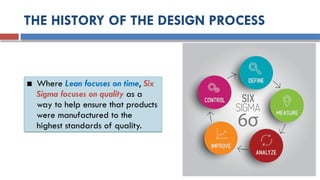
■ Where Lean focuses on time, Six
Sigma focuses on quality as a
way to help ensure that products
were manufactured to the
highest standards of quality.
31.
THE HISTORY OFTHE DESIGN PROCESS
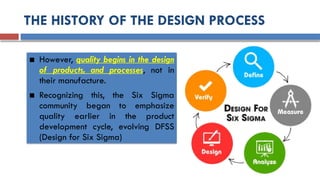
■ However, quality begins in the design
of products, and processes, not in
their manufacture.
■ Recognizing this, the Six Sigma
community began to emphasize
quality earlier in the product
development cycle, evolving DFSS
(Design for Six Sigma)
THE HISTORY OFTHE DESIGN PROCESS
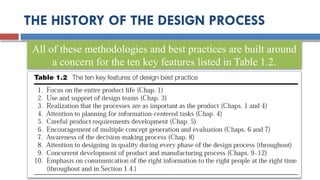
All of these methodologies and best practices are built around
a concern for the ten key features listed in Table 1.2.
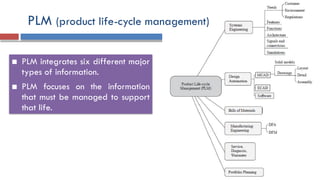
■ PLM integratessix different major
types of information.
■ PLM focuses on the information
that must be managed to support
that life.
PLM (product life-cycle management)
36.
MANY SOLUTIONS FORDESIGN PROBLEMS
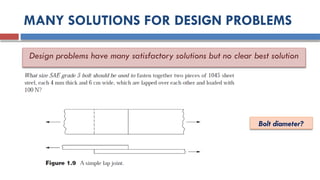
Design problems have many satisfactory solutions but no clear best solution
Bolt diameter?
37.
MANY SOLUTIONS FORDESIGN PROBLEMS
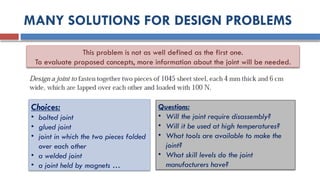
This problem is not as well defined as the first one.
To evaluate proposed concepts, more information about the joint will be needed.
Choices:
• bolted joint
• glued joint
• joint in which the two pieces folded
over each other
• a welded joint
• a joint held by magnets …
Questions:
• Will the joint require disassembly?
• Will it be used at high temperatures?
• What tools are available to make the
joint?
• What skill levels do the joint
manufacturers have?
38.
MANY SOLUTIONS FORDESIGN PROBLEMS
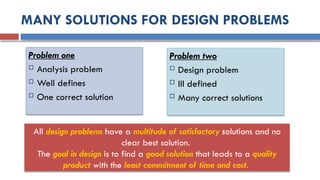
Problem one
Analysis problem
Well defines
One correct solution
Problem two
Design problem
Ill defined
Many correct solutions
All design problems have a multitude of satisfactory solutions and no
clear best solution.
The goal in design is to find a good solution that leads to a quality
product with the least commitment of time and cost.
39.
THE BASIC ACTIONSOF PROBLEM SOLVING
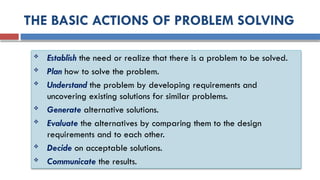
Establish the need or realize that there is a problem to be solved.
Plan how to solve the problem.
Understand the problem by developing requirements and
uncovering existing solutions for similar problems.
Generate alternative solutions.
Evaluate the alternatives by comparing them to the design
requirements and to each other.
Decide on acceptable solutions.
Communicate the results.
40.
KNOWLEDGE AND LEARNINGDURING DESIGN
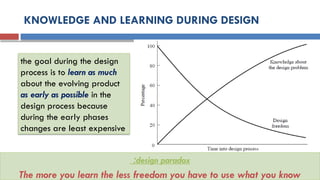
the goal during the design
process is to learn as much
about the evolving product
as early as possible in the
design process because
during the early phases
changes are least expensive
design paradox
:
The more you learn the less freedom you have to use what you know
Editor's Notes
#21 Iteration, or change, is an essential part of the design process. However, changes occurring late in the design process are more expensive than those occurring earlier.
The curve for Company B shows that the company was still making changes after the design had been released for production. In fact company B was still designing the automobile as it was being sold as a product. This causes tooling and assembly-line changes during production and the possibility of recalling cars for retrofit, both of which would necessitate significant expense, to say nothing about the loss of customer confidence.
Company A, on the other hand, made many changes early in the design process and finished the design of the car before it went into production. Early design changes require more engineering time and effort but do not require changes in hardware or documentation.
A change that would cost $1000 in engineering time if made early in the design process may cost $10,000 later during product refinement and $1,000,000 or more in tooling, sales, and goodwill expenses if made after production has begun.
#22 Figure 1.5 also indicates that Company A took less time to design the automobile than Company B. This is due to differences in the design philosophies of the companies. Company A assigns a large engineering staff to the project early in product development and encourages these engineers to utilize the latest in design techniques and to explore all the options early to preclude the need for changes later on. Company B, on the other hand, assigns a small staff and pressures them for quick results, in the form of hardware, discouraging the engineers from exploring all options (the region in the oval in the figure). The design axiom, fail early, fail often, applies to this example. Changes are required in order to find a good design, and early changes are easier and less expensive than changes made later. The engineers in Company B spend much time “firefighting” after the product is in production. In fact, many engineers spend as much as 50% of their time firefighting for companies similar to Company B.
#23 Finally, for many years it was believed that there was a trade-off between
high-quality products and low costs or time—namely, that it costs more and
takes more time to develop and produce high-quality products. However, recent
experience has shown that increasing quality and lowering costs and time can go
hand in hand.
#26 This is because of the many weaknesses in this product development process. First, marketing may not be able to communicate to engineering a clear picture of what the customers want. Since the design engineers have no contact with the customers and limited communication with marketing, there is much room for poor understanding of the design problem. Second, design engineers do not know as much about the manufacturing processes as manufacturing specialists, and therefore some parts may not be able to be manufactured as drawn or manufactured on existing equipment. Further, manufacturing experts may know less-expensive methods to produce the product. Thus, this single-direction over-the-wall approach is inefficient and costly and may result in poor-quality products. Although many companies still use this method, most are realizing its weaknesses and are moving away from its use.
#27 This is because of the many weaknesses in this product development process. First, marketing may not be able to communicate to engineering a clear picture of what the customers want. Since the design engineers have no contact with the customers and limited communication with marketing, there is much room for poor understanding of the design problem. Second, design engineers do not know as much about the manufacturing processes as manufacturing specialists, and therefore some parts may not be able to be manufactured as drawn or manufactured on existing equipment. Further, manufacturing experts may know less-expensive methods to produce the product. Thus, this single-direction over-the-wall approach is inefficient and costly and may result in poor-quality products. Although many companies still use this method, most are realizing its weaknesses and are moving away from its use.
#28 This is because of the many weaknesses in this product development process. First, marketing may not be able to communicate to engineering a clear picture of what the customers want. Since the design engineers have no contact with the customers and limited communication with marketing, there is much room for poor understanding of the design problem. Second, design engineers do not know as much about the manufacturing processes as manufacturing specialists, and therefore some parts may not be able to be manufactured as drawn or manufactured on existing equipment. Further, manufacturing experts may know less-expensive methods to produce the product. Thus, this single-direction over-the-wall approach is inefficient and costly and may result in poor-quality products. Although many companies still use this method, most are realizing its weaknesses and are moving away from its use.
#29 The five steps in the lean manufacturing cycle are:
Identify value (define what the value to the end customer is)
Map the value stream (identify all steps in your process and eliminate those that don’t create value)
Create flow (make the value steps occur in tight sequence to provide as much value to the customer as quickly as possible)
Establish pull (make it so that customers are demanding or seeking out the product rather than you having to push it on them)
Seek perfection (strive for perfection by using continuous improvement, eliminating waste, making reliable processes, and generally following the principles we covered earlier)
#30 This is because of the many weaknesses in this product development process. First, marketing may not be able to communicate to engineering a clear picture of what the customers want. Since the design engineers have no contact with the customers and limited communication with marketing, there is much room for poor understanding of the design problem. Second, design engineers do not know as much about the manufacturing processes as manufacturing specialists, and therefore some parts may not be able to be manufactured as drawn or manufactured on existing equipment. Further, manufacturing experts may know less-expensive methods to produce the product. Thus, this single-direction over-the-wall approach is inefficient and costly and may result in poor-quality products. Although many companies still use this method, most are realizing its weaknesses and are moving away from its use.
#31 This is because of the many weaknesses in this product development process. First, marketing may not be able to communicate to engineering a clear picture of what the customers want. Since the design engineers have no contact with the customers and limited communication with marketing, there is much room for poor understanding of the design problem. Second, design engineers do not know as much about the manufacturing processes as manufacturing specialists, and therefore some parts may not be able to be manufactured as drawn or manufactured on existing equipment. Further, manufacturing experts may know less-expensive methods to produce the product. Thus, this single-direction over-the-wall approach is inefficient and costly and may result in poor-quality products. Although many companies still use this method, most are realizing its weaknesses and are moving away from its use.
#33 This is because of the many weaknesses in this product development process. First, marketing may not be able to communicate to engineering a clear picture of what the customers want. Since the design engineers have no contact with the customers and limited communication with marketing, there is much room for poor understanding of the design problem. Second, design engineers do not know as much about the manufacturing processes as manufacturing specialists, and therefore some parts may not be able to be manufactured as drawn or manufactured on existing equipment. Further, manufacturing experts may know less-expensive methods to produce the product. Thus, this single-direction over-the-wall approach is inefficient and costly and may result in poor-quality products. Although many companies still use this method, most are realizing its weaknesses and are moving away from its use.
#36 In this problem the need is very clear, and if we know the methods for analyzing
shear stress in bolts, the problem is easily understood. There is no necessity to
design the joint because a design solution is already given, namely, a grade 5
bolt, with one parameter to be determined—its diameter. The product evaluation
is straight from textbook formulas, and the only decision made is in determining
whether we did the problem correctly.
#40 When a new design problem is begun, very little may be known about the solution, especially if the problem is a new one for the designer
Throughout the solution process knowledge about the problem and its potential solutions is gained and, conversely, design freedom is lost