Chapter - 1
FLEXOGRAPHY
& Packaging
Over the last three decade, the use of the flexographic printing process has been growing
approximately eight percent a year, a rate unparalleled by any other printing technology.
Although some of this growth can be attributed to a greater need for packaging, flexography is
increasingly used in markets traditionally served by gravure and offset.
Since advances in technology have significantly improved flexography’s ability to print accurate
type, color, and halftone images, manufacturers and print buyers are recognizing flexography
as a high-quality,economical alternative to gravure and offset lithographic printing.
Flexography, a progressing printing technology, is suitable for printing on coated and uncoated
paper materials, non-porous substrates including metallised and paper foils, and plastic films,
used especially in the packaging industry. Flexographic printing is an efficient and cost effective
printing method that owes its growth to the continuous improvements in the quality of the
printed work produced.
Introduction
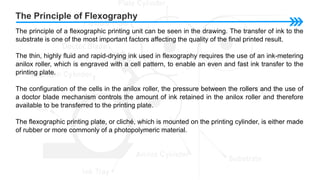
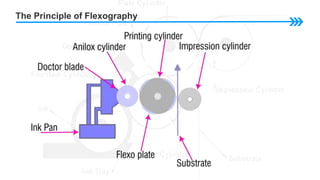
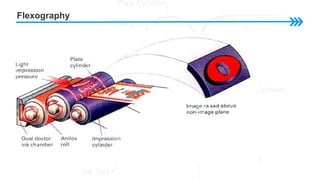
The principle of a flexographic printing unit can be seen in the drawing. The transfer of ink to the
substrate is one of the most important factors affecting the quality of the final printed result.
The thin, highly fluid and rapid-drying ink used in flexography requires the use of an ink-metering
anilox roller, which is engraved with a cell pattern, to enable an even and fast ink transfer to the
printing plate.
The configuration of the cells in the anilox roller, the pressure between the rollers and the use of
a doctor blade mechanism controls the amount of ink retained in the anilox roller and therefore
available to be transferred to the printing plate.
The flexographic printing plate, or cliché, which is mounted on the printing cylinder, is either made
of rubber or more commonly of a photopolymeric material.
The Principle of Flexography
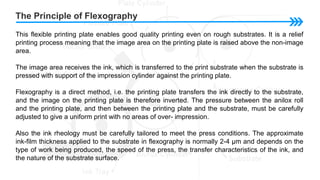
This flexible printing plate enables good quality printing even on rough substrates. It is a relief
printing process meaning that the image area on the printing plate is raised above the non-image
area.
The image area receives the ink, which is transferred to the print substrate when the substrate is
pressed with support of the impression cylinder against the printing plate.
Flexography is a direct method, i.e. the printing plate transfers the ink directly to the substrate,
and the image on the printing plate is therefore inverted. The pressure between the anilox roll
and the printing plate, and then between the printing plate and the substrate, must be carefully
adjusted to give a uniform print with no areas of over- impression.
Also the ink rheology must be carefully tailored to meet the press conditions. The approximate
ink-film thickness applied to the substrate in flexography is normally 2-4 µm and depends on the
type of work being produced, the speed of the press, the transfer characteristics of the ink, and
the nature of the substrate surface.
The Principle of Flexography
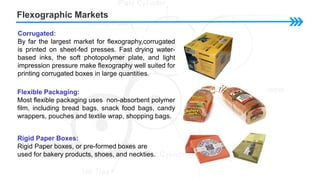
Corrugated:
By far the largest market for flexography,corrugated
is printed on sheet-fed presses. Fast drying water-
based inks, the soft photopolymer plate, and light
impression pressure make flexography well suited for
printing corrugated boxes in large quantities.
Flexible Packaging:
Most flexible packaging uses non-absorbent polymer
film, including bread bags, snack food bags, candy
wrappers, pouches and textile wrap, shopping bags.
Rigid Paper Boxes:
Rigid Paper boxes, or pre-formed boxes are
used for bakery products, shoes, and neckties.
Flexographic Markets
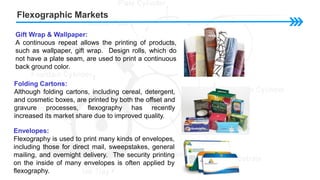
Gift Wrap & Wallpaper:
A continuous repeat allows the printing of products,
such as wallpaper, gift wrap. Design rolls, which do
not have a plate seam, are used to print a continuous
back ground color.
Folding Cartons:
Although folding cartons, including cereal, detergent,
and cosmetic boxes, are printed by both the offset and
gravure processes, flexography has recently
increased its market share due to improved quality.
Envelopes:
Flexography is used to print many kinds of envelopes,
including those for direct mail, sweepstakes, general
mailing, and overnight delivery. The security printing
on the inside of many envelopes is often applied by
flexography.
Flexographic Markets
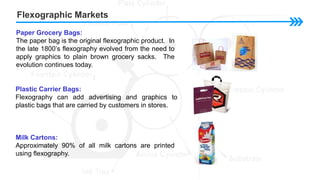
Paper Grocery Bags:
The paper bag is the original flexographic product. In
the late 1800’s flexography evolved from the need to
apply graphics to plain brown grocery sacks. The
evolution continues today.
Plastic Carrier Bags:
Flexography can add advertising and graphics to
plastic bags that are carried by customers in stores.
Milk Cartons:
Approximately 90% of all milk cartons are printed
using flexography.
Flexographic Markets
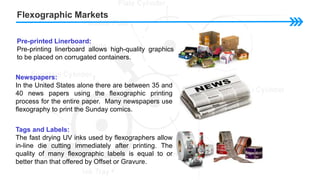
Pre-printed Linerboard:
Pre-printing linerboard allows high-quality graphics
to be placed on corrugated containers.
Newspapers:
In the United States alone there are between 35 and
40 news papers using the flexographic printing
process for the entire paper. Many newspapers use
flexography to print the Sunday comics.
Tags and Labels:
The fast drying UV inks used by flexographers allow
in-line die cutting immediately after printing. The
quality of many flexographic labels is equal to or
better than that offered by Offset or Gravure.
Flexographic Markets
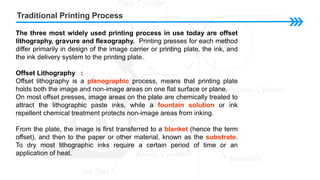
The three most widely used printing process in use today are offset
lithography, gravure and flexography. Printing presses for each method
differ primarily in design of the image carrier or printing plate, the ink, and
the ink delivery system to the printing plate.
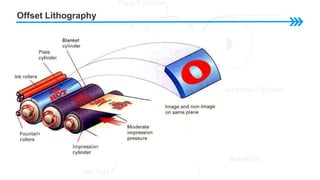
Offset Lithography :
Offset lithography is a planographic process, means that printing plate
holds both the image and non-image areas on one flat surface or plane.
On most offset presses, image areas on the plate are chemically treated to
attract the lithographic paste inks, while a fountain solution or ink
repellent chemical treatment protects non-image areas from inking.
From the plate, the image is first transferred to a blanket (hence the term
offset), and then to the paper or other material, known as the substrate.
To dry most lithographic inks require a certain period of time or an
application of heat.
Traditional Printing Process
Offset Lithography
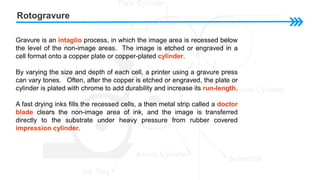
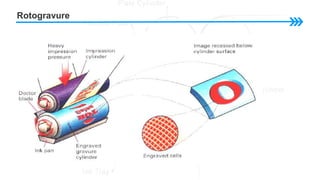
Gravure is an intaglio process, in which the image area is recessed below
the level of the non-image areas. The image is etched or engraved in a
cell format onto a copper plate or copper-plated cylinder.
By varying the size and depth of each cell, a printer using a gravure press
can vary tones. Often, after the copper is etched or engraved, the plate or
cylinder is plated with chrome to add durability and increase its run-length.
A fast drying inks fills the recessed cells, a then metal strip called a doctor
blade clears the non-image area of ink, and the image is transferred
directly to the substrate under heavy pressure from rubber covered
impression cylinder.
Rotogravure
Rotogravure
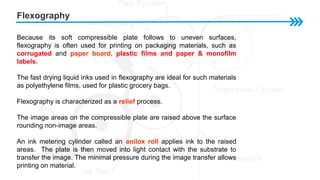
Because its soft compressible plate follows to uneven surfaces,
flexography is often used for printing on packaging materials, such as
corrugated and paper board, plastic films and paper & monofilm
labels.
The fast drying liquid inks used in flexography are ideal for such materials
as polyethylene films, used for plastic grocery bags.
Flexography is characterized as a relief process.
The image areas on the compressible plate are raised above the surface
rounding non-image areas.
An ink metering cylinder called an anilox roll applies ink to the raised
areas. The plate is then moved into light contact with the substrate to
transfer the image. The minimal pressure during the image transfer allows
printing on material.
Flexography
Flexography
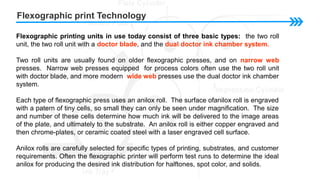
Flexographic printing units in use today consist of three basic types: the two roll
unit, the two roll unit with a doctor blade, and the dual doctor ink chamber system.
Two roll units are usually found on older flexographic presses, and on narrow web
presses. Narrow web presses equipped for process colors often use the two roll unit
with doctor blade, and more modern wide web presses use the dual doctor ink chamber
system.
Each type of flexographic press uses an anilox roll. The surface ofanilox roll is engraved
with a patern of tiny cells, so small they can only be seen under magnification. The size
and number of these cells determine how much ink will be delivered to the image areas
of the plate, and ultimately to the substrate. An anilox roll is either copper engraved and
then chrome-plates, or ceramic coated steel with a laser engraved cell surface.
Anilox rolls are carefully selected for specific types of printing, substrates, and customer
requirements. Often the flexographic printer will perform test runs to determine the ideal
anilox for producing the desired ink distribution for halftones, spot color, and solids.
Flexographic print Technology
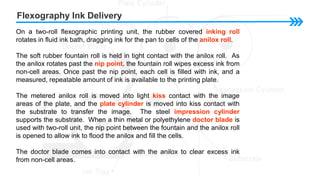
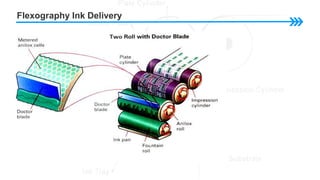
On a two-roll flexographic printing unit, the rubber covered inking roll
rotates in fluid ink bath, dragging ink for the pan to cells of the anilox roll.
The soft rubber fountain roll is held in tight contact with the anilox roll. As
the anilox rotates past the nip point, the fountain roll wipes excess ink from
non-cell areas. Once past the nip point, each cell is filled with ink, and a
measured, repeatable amount of ink is available to the printing plate.
The metered anilox roll is moved into light kiss contact with the image
areas of the plate, and the plate cylinder is moved into kiss contact with
the substrate to transfer the image. The steel impression cylinder
supports the substrate. When a thin metal or polyethylene doctor blade is
used with two-roll unit, the nip point between the fountain and the anilox roll
is opened to allow ink to flood the anilox and fill the cells.
The doctor blade comes into contact with the anilox to clear excess ink
from non-cell areas.
Flexography Ink Delivery
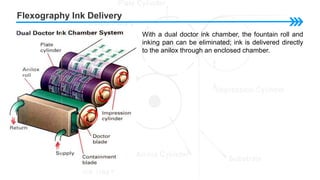
With a dual doctor ink chamber, the fountain roll and
inking pan can be eliminated; ink is delivered directly
to the anilox through an enclosed chamber.
Flexography Ink Delivery
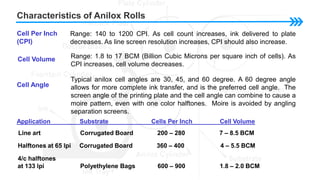
Cell Per Inch
(CPI)
Range: 140 to 1200 CPI. As cell count increases, ink delivered to plate
decreases. As line screen resolution increases, CPI should also increase.
Cell Volume Range: 1.8 to 17 BCM (Billion Cubic Microns per square inch of cells). As
CPI increases, cell volume decreases.
Cell Angle
Typical anilox cell angles are 30, 45, and 60 degree. A 60 degree angle
allows for more complete ink transfer, and is the preferred cell angle. The
screen angle of the printing plate and the cell angle can combine to cause a
moire pattern, even with one color halftones. Moire is avoided by angling
separation screens.
Application Substrate Cells Per Inch Cell Volume
Line art Corrugated Board 200 – 280 7 – 8.5 BCM
Halftones at 65 lpi Corrugated Board 360 – 400 4 – 5.5 BCM
4/c halftones
at 133 lpi Polyethylene Bags 600 – 900 1.8 – 2.0 BCM
Characteristics of Anilox Rolls
To be continued………
Author : Mohammed Abdul Haleem
Email : ah.flexomaster@gmail.com
With almost 29 years of experience in the Printing industry, he offers proactive recommendations on anilox roll
specifications, testing, inventory management, flexographic equipments applications,training, drawing from experience in
technical sales,marketing,production,technical service,parts and supplies. His experience covers the spectrum of
flexographic markets including: wide web film, narrow web, tag & labels,foil, folding carton, corrugated packaging
applications

Chapter -1 - Flexography & Packaging-MAH- 12-2022.ppt

  • 1.
  • 2.
    Over the lastthree decade, the use of the flexographic printing process has been growing approximately eight percent a year, a rate unparalleled by any other printing technology. Although some of this growth can be attributed to a greater need for packaging, flexography is increasingly used in markets traditionally served by gravure and offset. Since advances in technology have significantly improved flexography’s ability to print accurate type, color, and halftone images, manufacturers and print buyers are recognizing flexography as a high-quality,economical alternative to gravure and offset lithographic printing. Flexography, a progressing printing technology, is suitable for printing on coated and uncoated paper materials, non-porous substrates including metallised and paper foils, and plastic films, used especially in the packaging industry. Flexographic printing is an efficient and cost effective printing method that owes its growth to the continuous improvements in the quality of the printed work produced. Introduction
  • 3.
    The principle ofa flexographic printing unit can be seen in the drawing. The transfer of ink to the substrate is one of the most important factors affecting the quality of the final printed result. The thin, highly fluid and rapid-drying ink used in flexography requires the use of an ink-metering anilox roller, which is engraved with a cell pattern, to enable an even and fast ink transfer to the printing plate. The configuration of the cells in the anilox roller, the pressure between the rollers and the use of a doctor blade mechanism controls the amount of ink retained in the anilox roller and therefore available to be transferred to the printing plate. The flexographic printing plate, or cliché, which is mounted on the printing cylinder, is either made of rubber or more commonly of a photopolymeric material. The Principle of Flexography
  • 4.
    This flexible printingplate enables good quality printing even on rough substrates. It is a relief printing process meaning that the image area on the printing plate is raised above the non-image area. The image area receives the ink, which is transferred to the print substrate when the substrate is pressed with support of the impression cylinder against the printing plate. Flexography is a direct method, i.e. the printing plate transfers the ink directly to the substrate, and the image on the printing plate is therefore inverted. The pressure between the anilox roll and the printing plate, and then between the printing plate and the substrate, must be carefully adjusted to give a uniform print with no areas of over- impression. Also the ink rheology must be carefully tailored to meet the press conditions. The approximate ink-film thickness applied to the substrate in flexography is normally 2-4 µm and depends on the type of work being produced, the speed of the press, the transfer characteristics of the ink, and the nature of the substrate surface. The Principle of Flexography
  • 5.
    The Principle ofFlexography
  • 6.
    Corrugated: By far thelargest market for flexography,corrugated is printed on sheet-fed presses. Fast drying water- based inks, the soft photopolymer plate, and light impression pressure make flexography well suited for printing corrugated boxes in large quantities. Flexible Packaging: Most flexible packaging uses non-absorbent polymer film, including bread bags, snack food bags, candy wrappers, pouches and textile wrap, shopping bags. Rigid Paper Boxes: Rigid Paper boxes, or pre-formed boxes are used for bakery products, shoes, and neckties. Flexographic Markets
  • 7.
    Gift Wrap &Wallpaper: A continuous repeat allows the printing of products, such as wallpaper, gift wrap. Design rolls, which do not have a plate seam, are used to print a continuous back ground color. Folding Cartons: Although folding cartons, including cereal, detergent, and cosmetic boxes, are printed by both the offset and gravure processes, flexography has recently increased its market share due to improved quality. Envelopes: Flexography is used to print many kinds of envelopes, including those for direct mail, sweepstakes, general mailing, and overnight delivery. The security printing on the inside of many envelopes is often applied by flexography. Flexographic Markets
  • 8.
    Paper Grocery Bags: Thepaper bag is the original flexographic product. In the late 1800’s flexography evolved from the need to apply graphics to plain brown grocery sacks. The evolution continues today. Plastic Carrier Bags: Flexography can add advertising and graphics to plastic bags that are carried by customers in stores. Milk Cartons: Approximately 90% of all milk cartons are printed using flexography. Flexographic Markets
  • 9.
    Pre-printed Linerboard: Pre-printing linerboardallows high-quality graphics to be placed on corrugated containers. Newspapers: In the United States alone there are between 35 and 40 news papers using the flexographic printing process for the entire paper. Many newspapers use flexography to print the Sunday comics. Tags and Labels: The fast drying UV inks used by flexographers allow in-line die cutting immediately after printing. The quality of many flexographic labels is equal to or better than that offered by Offset or Gravure. Flexographic Markets
  • 10.
    The three mostwidely used printing process in use today are offset lithography, gravure and flexography. Printing presses for each method differ primarily in design of the image carrier or printing plate, the ink, and the ink delivery system to the printing plate. Offset Lithography : Offset lithography is a planographic process, means that printing plate holds both the image and non-image areas on one flat surface or plane. On most offset presses, image areas on the plate are chemically treated to attract the lithographic paste inks, while a fountain solution or ink repellent chemical treatment protects non-image areas from inking. From the plate, the image is first transferred to a blanket (hence the term offset), and then to the paper or other material, known as the substrate. To dry most lithographic inks require a certain period of time or an application of heat. Traditional Printing Process
  • 11.
  • 12.
    Gravure is anintaglio process, in which the image area is recessed below the level of the non-image areas. The image is etched or engraved in a cell format onto a copper plate or copper-plated cylinder. By varying the size and depth of each cell, a printer using a gravure press can vary tones. Often, after the copper is etched or engraved, the plate or cylinder is plated with chrome to add durability and increase its run-length. A fast drying inks fills the recessed cells, a then metal strip called a doctor blade clears the non-image area of ink, and the image is transferred directly to the substrate under heavy pressure from rubber covered impression cylinder. Rotogravure
  • 13.
  • 14.
    Because its softcompressible plate follows to uneven surfaces, flexography is often used for printing on packaging materials, such as corrugated and paper board, plastic films and paper & monofilm labels. The fast drying liquid inks used in flexography are ideal for such materials as polyethylene films, used for plastic grocery bags. Flexography is characterized as a relief process. The image areas on the compressible plate are raised above the surface rounding non-image areas. An ink metering cylinder called an anilox roll applies ink to the raised areas. The plate is then moved into light contact with the substrate to transfer the image. The minimal pressure during the image transfer allows printing on material. Flexography
  • 15.
  • 16.
    Flexographic printing unitsin use today consist of three basic types: the two roll unit, the two roll unit with a doctor blade, and the dual doctor ink chamber system. Two roll units are usually found on older flexographic presses, and on narrow web presses. Narrow web presses equipped for process colors often use the two roll unit with doctor blade, and more modern wide web presses use the dual doctor ink chamber system. Each type of flexographic press uses an anilox roll. The surface ofanilox roll is engraved with a patern of tiny cells, so small they can only be seen under magnification. The size and number of these cells determine how much ink will be delivered to the image areas of the plate, and ultimately to the substrate. An anilox roll is either copper engraved and then chrome-plates, or ceramic coated steel with a laser engraved cell surface. Anilox rolls are carefully selected for specific types of printing, substrates, and customer requirements. Often the flexographic printer will perform test runs to determine the ideal anilox for producing the desired ink distribution for halftones, spot color, and solids. Flexographic print Technology
  • 17.
    On a two-rollflexographic printing unit, the rubber covered inking roll rotates in fluid ink bath, dragging ink for the pan to cells of the anilox roll. The soft rubber fountain roll is held in tight contact with the anilox roll. As the anilox rotates past the nip point, the fountain roll wipes excess ink from non-cell areas. Once past the nip point, each cell is filled with ink, and a measured, repeatable amount of ink is available to the printing plate. The metered anilox roll is moved into light kiss contact with the image areas of the plate, and the plate cylinder is moved into kiss contact with the substrate to transfer the image. The steel impression cylinder supports the substrate. When a thin metal or polyethylene doctor blade is used with two-roll unit, the nip point between the fountain and the anilox roll is opened to allow ink to flood the anilox and fill the cells. The doctor blade comes into contact with the anilox to clear excess ink from non-cell areas. Flexography Ink Delivery
  • 18.
  • 19.
    With a dualdoctor ink chamber, the fountain roll and inking pan can be eliminated; ink is delivered directly to the anilox through an enclosed chamber. Flexography Ink Delivery
  • 20.
    Cell Per Inch (CPI) Range:140 to 1200 CPI. As cell count increases, ink delivered to plate decreases. As line screen resolution increases, CPI should also increase. Cell Volume Range: 1.8 to 17 BCM (Billion Cubic Microns per square inch of cells). As CPI increases, cell volume decreases. Cell Angle Typical anilox cell angles are 30, 45, and 60 degree. A 60 degree angle allows for more complete ink transfer, and is the preferred cell angle. The screen angle of the printing plate and the cell angle can combine to cause a moire pattern, even with one color halftones. Moire is avoided by angling separation screens. Application Substrate Cells Per Inch Cell Volume Line art Corrugated Board 200 – 280 7 – 8.5 BCM Halftones at 65 lpi Corrugated Board 360 – 400 4 – 5.5 BCM 4/c halftones at 133 lpi Polyethylene Bags 600 – 900 1.8 – 2.0 BCM Characteristics of Anilox Rolls
  • 21.
    To be continued……… Author: Mohammed Abdul Haleem Email : ah.flexomaster@gmail.com With almost 29 years of experience in the Printing industry, he offers proactive recommendations on anilox roll specifications, testing, inventory management, flexographic equipments applications,training, drawing from experience in technical sales,marketing,production,technical service,parts and supplies. His experience covers the spectrum of flexographic markets including: wide web film, narrow web, tag & labels,foil, folding carton, corrugated packaging applications