Methods of Printing
A.RELIEF PRINTING (LETTERPRESS)
In this method of printing, the image characters are raised above the level of the non-
printing areas. The ink is applied to a raised surface that in turn is applied to paper. The
letterpress process is the oldest of all printing procedures. It prints with cleaner and sharper
letters.
After the type has been set, the next step is the actual printing which is made on one of
three principles:
1. The platen or "flatbed press" opens and closes like a clam shaft; it has raised type on one flat
surface and paper on another flat surface and the two are pressed together. Small hand
presses are generally platen presses.
2. Cylinder presses roll the paper around a cylinder and then across the flat surface of inked type
3. Rotary presses pass the paper between two cylinders, one of which holds the curved printing
plates.
3.
B. INTAGLIO (GRAVUREPRINTING)- There are four types of printing
which employ the Intaglio principle of placing ink in an area, which
has been cut out or etched.
1.Gravure - This is a process in which the ink in recessed or
sunken letters is drawn out or sucked out under pressure. The
process produces high quality reproduction of photographs
and half- tone illustrations, but the letters of type reproduced
have slightly fuzzy edges. The printing is done from large
copper plates or copper covered cylinders on presses of two
kinds; sheet-fed gravure presses and web-fed rotogravure
presses for longer runs. The copper plates or cylinders are
produced by making film positives of the art work to be
reproduced.
4.
2. Engraving-The paperher is forced into the sunken areas of a metal plate where the
ink is. A special plate is made by the artist who removes or scratches areas in the
metal itself into which the ink is placed. The actual printing process is very slow, and
after the paper is removed from the plate, time must be allowed for the drying of the
ink to prevent smudging.
3. Planographic - Lithography is the most well known printing process which employs
the principle of putting ink on a chemically treated surface. The commercial
application of lithography is known as offset. In this process, the copy is placed in
front of a big camera and photographed so that the film is the exact size that the final
result is to be. The film is in turn placed over a sensitized plate make of paper,
albumen or chemically treated metal) and exposed to a strong light.
4. Stencil-Stencil sheets on which the copy is typed or drawn are made of a porous
lease tissue, covered with a coating which is impervious to ink. The typing or drawing
pushes the coating aside and exposes the porous tissue. This stencil wrapped around
an inked cylinder and the cylinder is rolled across the paper, forcing the ink through
the porous parts of the stencil.
5.
C. PLANOGRAPHIC (LITHOGRAPHICPRINTING) - In planographic printing, the
image characters are in the same general plane as the non-printing areas.
The ink is applied to a dead level plate which has been chemically treated
such as lithograph and offset.
D.STENCIL-It is a process where the letters or image are holes cut in a sheet,
or a sheet is made more porous in the area of the letters and ink is applied
to paper through the holes or porous areas such as mimeograph.
E. HALFTONE BLOCK PRINTING - This is offset-related and is used for the
reproduction of pictures and illustrations in little covers. To prepare a
halftone block, the model is photograph and its image is transferred to a
metal surface by photo-printing.
6.
Identifying Characteristics ofPrinting
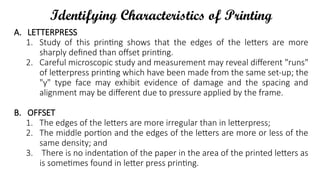
A. LETTERPRESS
1. Study of this printing shows that the edges of the letters are more
sharply defined than offset printing.
2. Careful microscopic study and measurement may reveal different "runs"
of letterpress printing which have been made from the same set-up; the
"y" type face may exhibit evidence of damage and the spacing and
alignment may be different due to pressure applied by the frame.
B. OFFSET
1. The edges of the letters are more irregular than in letterpress;
2. The middle portion and the edges of the letters are more or less of the
same density; and
3. There is no indentation of the paper in the area of the printed letters as
is sometimes found in letter press printing.
7.
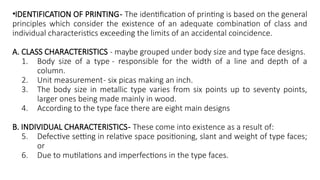
•IDENTIFICATION OF PRINTING-The identification of printing is based on the general
principles which consider the existence of an adequate combination of class and
individual characteristics exceeding the limits of an accidental coincidence.
A. CLASS CHARACTERISTICS - maybe grouped under body size and type face designs.
1. Body size of a type - responsible for the width of a line and depth of a
column.
2. Unit measurement- six picas making an inch.
3. The body size in metallic type varies from six points up to seventy points,
larger ones being made mainly in wood.
4. According to the type face there are eight main designs
B. INDIVIDUAL CHARACTERISTICS- These come into existence as a result of:
5. Defective setting in relative space positioning, slant and weight of type faces;
or
6. Due to mutilations and imperfections in the type faces.