Product and
Service Design
McGraw-Hill/Irwin
Copyright © 2012 by The McGraw-Hill Companies, Inc. All rights reserved.
Chapter 4: Learning Objectives
#prof_evad
 You should be able to:
1. Explain the strategic importance of product and service design
2. Identify some key reasons for design or redesign
3. Recognize the key questions of product and service design
4. List some of the main sources of design ideas
5. Discuss the importance of legal, ethical, and sustainability
considerations in product and service design
6. Explain the purpose and goal of life cycle assessment
7. Explain the phrase “the 3 Rs”
8. Briefly describe the phases in product design and development
9. Name several key issues in manufacturing design
10. Recognize several key issues in service design
11. Name the phases in service design
12. List the characteristics of well-designed service systems
13. Assess some of the challenges of service design
Strategic Product and Service Design
 The essence of an organization is the goods and services it
offers
 Every aspect of the organization is structured around
them
 Product and service design – or redesign – should be
closely tied to an organization’s strategy
#prof_evad
What Does Product & Service Design Do?
#prof_evad
1. Translate customer wants and needs into product and service
requirements
2. Refine existing products and services
3. Develop new products and services
4. Formulate quality goals
5. Formulate cost targets
6. Construct and test prototypes
7. Document specifications
8. Translate product and service specifications into process
specifications
Involve Inter-functional Collaboration
Reasons Design or Re-Design
 The driving forces for product and service design or
redesign are market opportunities or threats:
 Economic
 Social and Demographic
 Political, Liability, or Legal
 Competitive
 Cost or Availability
 Technological
#prof_evad
Key Questions
#prof_evad
1. Is there a demand for it?
 Market size
 Demand profile
2. Can we do it?
 Manufacturability - the capability of an organization to
produce an item at an acceptable profit
 Serviceability - the capability of an organization to provide
a service at an acceptable cost or profit
3. What level of quality is appropriate?
 Customer expectations
 Competitor quality
 Fit with current offering
4. Does it make sense from an economic standpoint?
 Liability issues, ethical considerations, sustainability issues,
costs and profits
Idea Generation - Supply-Chain
Based
#prof_evad
 Ideas can come from anywhere in the supply chain:
 Customers
 Suppliers
 Distributors
 Employees
 Maintenance and repair personnel
Idea Generation - Competitor-
Based
 By studying how a competitor operates and its
products and services, many useful ideas can be
generated
 Reverse engineering
 Dismantling and inspecting a competitor’s product to
discover product improvements
#prof_evad
Idea Generation - Research Based
#prof_evad
 Research and Development (R&D)
 Organized efforts to increase scientific knowledge or product
innovation
 Basic research
 Has the objective of advancing the state of knowledge about a
subject without any near-term expectation of commercial
applications
 Applied research
 Has the objective of achieving commercial applications
 Development
 Converts the results of applied research into useful commercial
applications.
Design Considerations - Legal
#prof_evad
 Legal Considerations
 Product liability
 The responsibility a manufacturer has for any injuries or
damages caused by as faulty product
 Some of the concomitant costs
 Litigation
 Legal and insurance costs
 Settlement costs
 Costly product recalls
 Reputation effects
 Uniform Commercial Code
 Under the UCC, products carry an implication of
merchantability and fitness
Design Considerations - Ethics
#prof_evad
 Designers are often under pressure to
 Speed up the design process
 Cut costs
 These pressures force trade-off decisions
 What if a product has bugs?
 Release the product and risk damage to your reputation
 Work out the bugs and forego revenue
Sustainability
 Sustainability
 Using resources in ways that do not harm ecological systems that
support human existence
 Key aspects of designing for sustainability
 Cradle-to-grave assessment (Life-Cycle assessment)
 End-of-life programs
 The 3-Rs
 Reduction of costs and materials used
 Re-using parts of returned products
 Recycling
#prof_evad
Cradle-to-Grave Assessment
#prof_evad
 Cradle-to-Grave Assessment
 aka Life-Cycle Assessment (LCA)
 The assessment of the environmental impact of a
product or service throughout its useful life
 Focuses on such factors as
 Global warming
 Smog formation
 Oxygen depletion
 Solid waste generation
 LCA procedures are part of the ISO 14000 environmental
management procedures
End-of-Life (EOL) Programs
#prof_evad
 EOL programs deal with products (business and
consumer) that have reached the end of their useful
lives
 The goal of such programs is to reduce the dumping
or incineration of products (e.g., electronics) which
may pose hazards to the environment
Reduce: Costs and Materials
#prof_evad
 Value analysis
 Examination of the function of parts and materials in an effort to
reduce the cost and/or improve the performance of a product
 Common questions used in value analysis
 Is the item necessary; does it have value; could it be eliminated?
 Are there alternative sources for the item?
 Could another material, part, or service be used instead?
 Can two or more parts be combined?
 Can specifications be less stringent to save time or money?
 Do suppliers/providers have suggestions for improvements?
 Can packaging be improved or made less costly?
Re-Use: Remanufacturing
#prof_evad
 Remanufacturing
 Refurbishing used products by replacing worn-out or defective
components
 Can be performed by the original manufacturer or another company
 Reasons to remanufacture:
 Remanufactured products can be sold for about 50% of the cost of a
new product
 The process requires mostly unskilled and semi-skilled workers
 In the global market, European lawmakers are increasingly requiring
manufacturers to take back used products
 Design for disassembly (DFD)
 Designing a product to that used products can be easily taken apart
Recycle
#prof_evad
 Recycling
 Recovering materials for future use
 Applies to manufactured parts
 Also applies to materials used during production
 Why recycle?
 Cost savings
 Environmental concerns
 Environmental regulations
 Companies doing business in the EU must show that a specified
proportion of their products are recyclable
 Design for recycling (DFR)
 Product design that takes into account the ability to
disassemble a used product to recover the recyclable parts
Other Design Considerations
 Strategies for product or service life stages
 Standardization
 Product or service reliability
 Product or service robustness
 Degree of newness
#prof_evad
Product or service life stages
#prof_evad
Standardization
 Standardization
 Extent to which there is an absence of variety in a
product, service, or process
 Products are made in large quantities of identical items
 Every customer or item processed receives essentially the same
service
#prof_evad
Advantages & Disadvantages of
Standardization
#prof_evad
Advantages
1. Fewer parts to deal with in inventory and in manufacturing
2. Reduced training costs and time
3. More routine purchasing, handling, and inspection procedures
4. Orders fillable from inventory
5. Opportunities for long production runs and automation
6. Need for fewer parts justifies expenditures on perfecting designs
and improving quality control procedures
Disadvantages
1. Designs may be frozen with too many imperfections remaining.
2. High cost of design changes increases resistance to improvements
3. Decreased variety results in less consumer appeal
Designing for Mass Customization
#prof_evad
 Mass customization
 A strategy of producing basically standardized goods or
services, but incorporating some degree of
customization in the final product or service
 Facilitating Techniques
 Delayed differentiation
 Modular design
Delayed Differentiation
#prof_evad
 Delayed Differentiation
 The process of producing, but not quite completing, a
product or service until customer preferences are
known
 It is a postponement tactic
 Produce a piece of furniture, but do not stain it; the customer
chooses the stain
Modular Design
 Modular Design
 A form of standardization in which component parts are grouped
into modules that are easily replaced or interchanged
 Advantages
 easier diagnosis and remedy of failures
 easier repair and replacement
 simplification of manufacturing and assembly
 training costs are relatively low
 Disadvantages
 Limited number of possible product configurations
 Limited ability to repair a faulty module; the entire module must
often be scrapped
#prof_evad
Reliability
#prof_evad
 Reliability
 The ability of a product, part, or system to perform its
intended function under a prescribed set of conditions
 Failure
 Situation in which a product, part, or system does not
perform as intended
 Reliabilities are always specified with respect to certain
conditions
 Normal operating conditions
 The set of conditions under which an item’s reliability is
specified
Robust Design
#prof_evad
 Robust design
 A design that results in products or services that can
function over a broad range of conditions
 The more robust a product or service, the less likely it will fail due
to a change in the environment in which it is used or in which it is
performed
 Pertains to product as well as process design
 Consider the following automobiles:
 Ferrari Enzo
 Toyota Avalon
 Which is design is more robust?
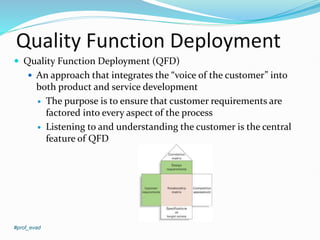
Quality Function Deployment
 Quality Function Deployment (QFD)
 An approach that integrates the “voice of the customer” into
both product and service development
 The purpose is to ensure that customer requirements are
factored into every aspect of the process
 Listening to and understanding the customer is the central
feature of QFD
#prof_evad
Kano Model
#prof_evad
 Basic quality
 Refers to customer requirements that have only limited effect on
customer satisfaction if present, but lead to dissatisfaction if
absent
 Performance quality
 Refers to customer requirements that generate satisfaction or
dissatisfaction in proportion to their level of functionality and
appeal
 Excitement quality
 Refers to a feature or attribute that was unexpected by the
customer and causes excitement
Phases in Design & Development
#prof_evad
1. Feasibility analysis
2. Product specifications
3. Process specifications
4. Prototype development
5. Design review
6. Market test
7. Product introduction
8. Follow-up evaluation
Designing for Production
#prof_evad
 Concurrent engineering
 Computer-assisted design
 Production requirements
 Component commonality
Concurrent Engineering
#prof_evad
 Concurrent engineering
 Bringing engineering design and manufacturing
personnel together early in the design phase
 Also may involve manufacturing, marketing and purchasing
personnel in loosely integrated cross-functional teams
 Views of suppliers and customers may also be sought
 The purpose is to achieve product designs that reflect
customer wants as well as manufacturing capabilities
Production Requirements
#prof_evad
 Designers must take into account production
capabilities
 Equipment
 Skills
 Types of materials
 Schedules
 Technologies
 Special abilities
DFM and DFA
 Design for manufacturing (DFM)
 The designing of products that are compatible with an
organization’s abilities
 Design for assembly (DFA)
 Design that focuses on reducing the number of parts in
a product and on assembly methods and sequence
#prof_evad
Manufacturability
 A more general term
 Manufacturability
 Ease of fabrication and/or assembly
 It has important implications for
 Cost
 Productivity
 Quality
#prof_evad
Component Commonality
#prof_evad
 When products have a high degree of similarity in features
and components, a part can be used in multiple products
 Benefits:
 Savings in design time
 Standard training for assembly and installation
 Opportunities to buy in bulk from suppliers
 Commonality of parts for repair
 Fewer inventory items must be handled
Service Design Definitions
#prof_evad
 Service
 Something that is done to, or for, a customer
 Service delivery system
 The facilities, processes, and skills needed to provide a
service
 Product bundle
 The combination of goods and services provided to a
customer
 Service package
 The physical resources needed to perform the service,
accompanying goods, and the explicit (core features)
and implicit (ancillary features) services included
Service Design
 Begins with a choice of service strategy, which
determines the nature and focus of the service, and
the target market
 Key issues in service design
 Degree of variation in service requirements
 Degree of customer contact and involvement
#prof_evad
Differences between Service
and Product Design
1. Products are generally tangible, services intangible
2. Services are created and delivered at the same time
3. Services cannot be inventoried
4. Services are highly visible to consumers
5. Some services have low barriers to entry and exit
6. Location is often important to service design, with convenience
as a major factor
7. Service systems range from those with little or no customer
contact to those that have a very high degree of customer
contact
8. Demand variability alternately creates waiting lines or idle
service resources
#prof_evad
#prof_evad
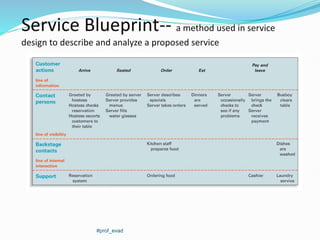
Service Blueprint-- a method used in service
design to describe and analyze a proposed service
Operations Strategy
 Effective product and service design can help the
organization achieve competitive advantage:
 Packaging products and ancillary services to increase sales
 Using multiple-use platforms
 Implementing tactics that will achieve the benefits of high volume
while satisfying customer needs for variety
 Continually monitoring products and services for small
improvement opportunities
 Reducing the time it takes to get a new or redesigned product or
service to the market
#prof_evad

Chapter 04 Slides.pptx

  • 1.
    Product and Service Design McGraw-Hill/Irwin Copyright© 2012 by The McGraw-Hill Companies, Inc. All rights reserved.
  • 2.
    Chapter 4: LearningObjectives #prof_evad  You should be able to: 1. Explain the strategic importance of product and service design 2. Identify some key reasons for design or redesign 3. Recognize the key questions of product and service design 4. List some of the main sources of design ideas 5. Discuss the importance of legal, ethical, and sustainability considerations in product and service design 6. Explain the purpose and goal of life cycle assessment 7. Explain the phrase “the 3 Rs” 8. Briefly describe the phases in product design and development 9. Name several key issues in manufacturing design 10. Recognize several key issues in service design 11. Name the phases in service design 12. List the characteristics of well-designed service systems 13. Assess some of the challenges of service design
  • 3.
    Strategic Product andService Design  The essence of an organization is the goods and services it offers  Every aspect of the organization is structured around them  Product and service design – or redesign – should be closely tied to an organization’s strategy #prof_evad
  • 4.
    What Does Product& Service Design Do? #prof_evad 1. Translate customer wants and needs into product and service requirements 2. Refine existing products and services 3. Develop new products and services 4. Formulate quality goals 5. Formulate cost targets 6. Construct and test prototypes 7. Document specifications 8. Translate product and service specifications into process specifications Involve Inter-functional Collaboration
  • 5.
    Reasons Design orRe-Design  The driving forces for product and service design or redesign are market opportunities or threats:  Economic  Social and Demographic  Political, Liability, or Legal  Competitive  Cost or Availability  Technological #prof_evad
  • 6.
    Key Questions #prof_evad 1. Isthere a demand for it?  Market size  Demand profile 2. Can we do it?  Manufacturability - the capability of an organization to produce an item at an acceptable profit  Serviceability - the capability of an organization to provide a service at an acceptable cost or profit 3. What level of quality is appropriate?  Customer expectations  Competitor quality  Fit with current offering 4. Does it make sense from an economic standpoint?  Liability issues, ethical considerations, sustainability issues, costs and profits
  • 7.
    Idea Generation -Supply-Chain Based #prof_evad  Ideas can come from anywhere in the supply chain:  Customers  Suppliers  Distributors  Employees  Maintenance and repair personnel
  • 8.
    Idea Generation -Competitor- Based  By studying how a competitor operates and its products and services, many useful ideas can be generated  Reverse engineering  Dismantling and inspecting a competitor’s product to discover product improvements #prof_evad
  • 9.
    Idea Generation -Research Based #prof_evad  Research and Development (R&D)  Organized efforts to increase scientific knowledge or product innovation  Basic research  Has the objective of advancing the state of knowledge about a subject without any near-term expectation of commercial applications  Applied research  Has the objective of achieving commercial applications  Development  Converts the results of applied research into useful commercial applications.
  • 10.
    Design Considerations -Legal #prof_evad  Legal Considerations  Product liability  The responsibility a manufacturer has for any injuries or damages caused by as faulty product  Some of the concomitant costs  Litigation  Legal and insurance costs  Settlement costs  Costly product recalls  Reputation effects  Uniform Commercial Code  Under the UCC, products carry an implication of merchantability and fitness
  • 11.
    Design Considerations -Ethics #prof_evad  Designers are often under pressure to  Speed up the design process  Cut costs  These pressures force trade-off decisions  What if a product has bugs?  Release the product and risk damage to your reputation  Work out the bugs and forego revenue
  • 12.
    Sustainability  Sustainability  Usingresources in ways that do not harm ecological systems that support human existence  Key aspects of designing for sustainability  Cradle-to-grave assessment (Life-Cycle assessment)  End-of-life programs  The 3-Rs  Reduction of costs and materials used  Re-using parts of returned products  Recycling #prof_evad
  • 13.
    Cradle-to-Grave Assessment #prof_evad  Cradle-to-GraveAssessment  aka Life-Cycle Assessment (LCA)  The assessment of the environmental impact of a product or service throughout its useful life  Focuses on such factors as  Global warming  Smog formation  Oxygen depletion  Solid waste generation  LCA procedures are part of the ISO 14000 environmental management procedures
  • 14.
    End-of-Life (EOL) Programs #prof_evad EOL programs deal with products (business and consumer) that have reached the end of their useful lives  The goal of such programs is to reduce the dumping or incineration of products (e.g., electronics) which may pose hazards to the environment
  • 15.
    Reduce: Costs andMaterials #prof_evad  Value analysis  Examination of the function of parts and materials in an effort to reduce the cost and/or improve the performance of a product  Common questions used in value analysis  Is the item necessary; does it have value; could it be eliminated?  Are there alternative sources for the item?  Could another material, part, or service be used instead?  Can two or more parts be combined?  Can specifications be less stringent to save time or money?  Do suppliers/providers have suggestions for improvements?  Can packaging be improved or made less costly?
  • 16.
    Re-Use: Remanufacturing #prof_evad  Remanufacturing Refurbishing used products by replacing worn-out or defective components  Can be performed by the original manufacturer or another company  Reasons to remanufacture:  Remanufactured products can be sold for about 50% of the cost of a new product  The process requires mostly unskilled and semi-skilled workers  In the global market, European lawmakers are increasingly requiring manufacturers to take back used products  Design for disassembly (DFD)  Designing a product to that used products can be easily taken apart
  • 17.
    Recycle #prof_evad  Recycling  Recoveringmaterials for future use  Applies to manufactured parts  Also applies to materials used during production  Why recycle?  Cost savings  Environmental concerns  Environmental regulations  Companies doing business in the EU must show that a specified proportion of their products are recyclable  Design for recycling (DFR)  Product design that takes into account the ability to disassemble a used product to recover the recyclable parts
  • 18.
    Other Design Considerations Strategies for product or service life stages  Standardization  Product or service reliability  Product or service robustness  Degree of newness #prof_evad
  • 19.
    Product or servicelife stages #prof_evad
  • 20.
    Standardization  Standardization  Extentto which there is an absence of variety in a product, service, or process  Products are made in large quantities of identical items  Every customer or item processed receives essentially the same service #prof_evad
  • 21.
    Advantages & Disadvantagesof Standardization #prof_evad Advantages 1. Fewer parts to deal with in inventory and in manufacturing 2. Reduced training costs and time 3. More routine purchasing, handling, and inspection procedures 4. Orders fillable from inventory 5. Opportunities for long production runs and automation 6. Need for fewer parts justifies expenditures on perfecting designs and improving quality control procedures Disadvantages 1. Designs may be frozen with too many imperfections remaining. 2. High cost of design changes increases resistance to improvements 3. Decreased variety results in less consumer appeal
  • 22.
    Designing for MassCustomization #prof_evad  Mass customization  A strategy of producing basically standardized goods or services, but incorporating some degree of customization in the final product or service  Facilitating Techniques  Delayed differentiation  Modular design
  • 23.
    Delayed Differentiation #prof_evad  DelayedDifferentiation  The process of producing, but not quite completing, a product or service until customer preferences are known  It is a postponement tactic  Produce a piece of furniture, but do not stain it; the customer chooses the stain
  • 24.
    Modular Design  ModularDesign  A form of standardization in which component parts are grouped into modules that are easily replaced or interchanged  Advantages  easier diagnosis and remedy of failures  easier repair and replacement  simplification of manufacturing and assembly  training costs are relatively low  Disadvantages  Limited number of possible product configurations  Limited ability to repair a faulty module; the entire module must often be scrapped #prof_evad
  • 25.
    Reliability #prof_evad  Reliability  Theability of a product, part, or system to perform its intended function under a prescribed set of conditions  Failure  Situation in which a product, part, or system does not perform as intended  Reliabilities are always specified with respect to certain conditions  Normal operating conditions  The set of conditions under which an item’s reliability is specified
  • 26.
    Robust Design #prof_evad  Robustdesign  A design that results in products or services that can function over a broad range of conditions  The more robust a product or service, the less likely it will fail due to a change in the environment in which it is used or in which it is performed  Pertains to product as well as process design  Consider the following automobiles:  Ferrari Enzo  Toyota Avalon  Which is design is more robust?
  • 27.
    Quality Function Deployment Quality Function Deployment (QFD)  An approach that integrates the “voice of the customer” into both product and service development  The purpose is to ensure that customer requirements are factored into every aspect of the process  Listening to and understanding the customer is the central feature of QFD #prof_evad
  • 28.
    Kano Model #prof_evad  Basicquality  Refers to customer requirements that have only limited effect on customer satisfaction if present, but lead to dissatisfaction if absent  Performance quality  Refers to customer requirements that generate satisfaction or dissatisfaction in proportion to their level of functionality and appeal  Excitement quality  Refers to a feature or attribute that was unexpected by the customer and causes excitement
  • 29.
    Phases in Design& Development #prof_evad 1. Feasibility analysis 2. Product specifications 3. Process specifications 4. Prototype development 5. Design review 6. Market test 7. Product introduction 8. Follow-up evaluation
  • 30.
    Designing for Production #prof_evad Concurrent engineering  Computer-assisted design  Production requirements  Component commonality
  • 31.
    Concurrent Engineering #prof_evad  Concurrentengineering  Bringing engineering design and manufacturing personnel together early in the design phase  Also may involve manufacturing, marketing and purchasing personnel in loosely integrated cross-functional teams  Views of suppliers and customers may also be sought  The purpose is to achieve product designs that reflect customer wants as well as manufacturing capabilities
  • 32.
    Production Requirements #prof_evad  Designersmust take into account production capabilities  Equipment  Skills  Types of materials  Schedules  Technologies  Special abilities
  • 33.
    DFM and DFA Design for manufacturing (DFM)  The designing of products that are compatible with an organization’s abilities  Design for assembly (DFA)  Design that focuses on reducing the number of parts in a product and on assembly methods and sequence #prof_evad
  • 34.
    Manufacturability  A moregeneral term  Manufacturability  Ease of fabrication and/or assembly  It has important implications for  Cost  Productivity  Quality #prof_evad
  • 35.
    Component Commonality #prof_evad  Whenproducts have a high degree of similarity in features and components, a part can be used in multiple products  Benefits:  Savings in design time  Standard training for assembly and installation  Opportunities to buy in bulk from suppliers  Commonality of parts for repair  Fewer inventory items must be handled
  • 36.
    Service Design Definitions #prof_evad Service  Something that is done to, or for, a customer  Service delivery system  The facilities, processes, and skills needed to provide a service  Product bundle  The combination of goods and services provided to a customer  Service package  The physical resources needed to perform the service, accompanying goods, and the explicit (core features) and implicit (ancillary features) services included
  • 37.
    Service Design  Beginswith a choice of service strategy, which determines the nature and focus of the service, and the target market  Key issues in service design  Degree of variation in service requirements  Degree of customer contact and involvement #prof_evad
  • 38.
    Differences between Service andProduct Design 1. Products are generally tangible, services intangible 2. Services are created and delivered at the same time 3. Services cannot be inventoried 4. Services are highly visible to consumers 5. Some services have low barriers to entry and exit 6. Location is often important to service design, with convenience as a major factor 7. Service systems range from those with little or no customer contact to those that have a very high degree of customer contact 8. Demand variability alternately creates waiting lines or idle service resources #prof_evad
  • 39.
    #prof_evad Service Blueprint-- amethod used in service design to describe and analyze a proposed service
  • 40.
    Operations Strategy  Effectiveproduct and service design can help the organization achieve competitive advantage:  Packaging products and ancillary services to increase sales  Using multiple-use platforms  Implementing tactics that will achieve the benefits of high volume while satisfying customer needs for variety  Continually monitoring products and services for small improvement opportunities  Reducing the time it takes to get a new or redesigned product or service to the market #prof_evad