1
Chapter I
An Overview of
The Financial System
Prepared by Ibrahim J( M.Sc.) 3/28/2022
Learning Objectives
2
After studying this chapter, you should be able to;
1.Define a financial system
2.Identify the components of a financial system
3.Understand the role of financial system in the economy
4.Diffentiate financial assets and their features
5.Explain financial markets: role, classifications and
participants.
6.Articulate the lending and borrowing activities in the
financial system.
Prepared by Ibrahimj(Msc) 3/28/2022
1.0. Introduction
3
 The economic development of a nation is reflected by the progress
of the various economic units.
 These units are broadly classified into:
 corporate sector,
 government and
 household sector.
 While performing their activities these units will be placed in a
surplus/deficit/balanced budgetary situations.
There are areas or people with surplus funds and there are those
with a deficit.
This course provides answers to these questions by examining
how financial markets and financial institutions work.

Prepared by Ibrahimj(Msc) 3/28/2022
1.0. Introduction Cont.
4
Financial markets and institutions not only affect our everyday
life but also involve huge flows of funds trillions of dollars
throughout our economy, which in turn affect business profits,
the production of goods and services, and even the economic
well-being of countries.
“The only certainty in financial markets is uncertainty”(Credit
Swiss, 2007)
The study of financial markets and institutions will reward you
with an understanding of many exciting issues.
Thus in this chapter we are going to learn why financial
markets and institutions are worth studying by exploring
exciting issues.
Prepared by Ibrahimj(Msc) 3/28/2022
1.1. What is Financial System?
5
 In this first chapter we want to find a preliminary answer to two
questions: (1)what is meant by the expression the ‘financial system’
and (2)what such a system does.
 For the purposes of this course, we shall define a financial system
fairly narrowly, to consist of a set of financial markets, financial
assets and financial institutions which trade/traded in those
markets and the supervisory bodies responsible for their regulation.
 In a broader view:
 financial assets and instruments,
 economic agents (individuals, households, and firms),
 governments and
 Financial institutions are also parts of the financial system.
Prepared by Ibrahimj(Msc) 3/28/2022
1.1. What is Financial System?
6
 In this first chapter we want to find a preliminary answer to
two questions: (1)what is meant by the expression the
‘financial system’ and (2)what such a system does?
 For the purposes of this course, we shall define a financial
system fairly narrowly, to consist of a set of financial markets,
financial assets and financial institutions which trade/traded
in those markets and the supervisory bodies responsible for
their regulation.
 It is the process by which money flows from savers to users.
 The financial system provides for efficient flow of funds from
saving to investment by bringing savers and borrowers
together via financial markets and financial institutions.
Prepared by Ibrahimj(Msc) 3/28/2022
1.1. What is Financial System?
 A financial system is a network of financial
institutions – such as insurance companies,
stock exchanges, and investment banks – that
work together to exchange and transfer capital
from one place to another.
 Through the financial system, investors receive
capital to fund projects and receive a return on
their investments.
7
Prepared by Ibrahimj(Msc) 3/28/2022
1.1. What is Financial System?
8
The end-users of the system are people and firms whose desire
is to lend and to borrow money.
Faced with a desire to lend or borrow, the end-users of most
financial systems have a choice between three broad
approaches:
Firstly, they may decide to deal directly with one another,
though this, as we shall see, is costly, risky, inefficient and,
consequently, not very likely.
Secondly, More typically they may decide to use one or more of
many organized markets.
In these markets, lenders buy the liabilities issued by
Prepared by Ibrahimj(Msc) 3/28/2022
1.1. What is Financial System?
9
 More frequently, however, a lender will buy an existing
liability from another lender.
 In effect, this refinances the original loan, though the borrower
is completely unaware of this ‘secondary’ transaction.
• Thirdly, borrowers and lenders may decide to deal via
institutions or ‘intermediaries’.
• In this case lenders have an asset- a bank or Savings and Loan
Associations (S&Ls) and Mutual Savings Banks, or
contributions to a life assurance or pension fund which cannot
be traded but can only be returned to the intermediary.
• They remain in the intermediaries’ balance sheets until they are
repaid.
Prepared by Ibrahimj(Msc) 3/28/2022
1.1. What is Financial System?
10
• Intermediaries themselves will also make use of markets,
issuing securities to finance some of their activities and buying
shares and bonds as part of their asset portfolio.
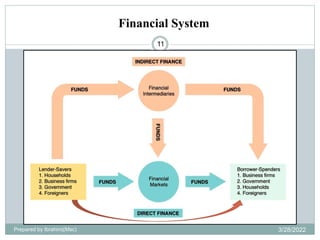
• The main components of a financial systems: Financial assets
(loans, deposits, bonds, equities, etc.), Financial institutions
(banks, mutual funds, insurance companies,etc.)and Financial
markets (money market, capital market, forex market, etc.)
form a financial system.
• The following diagram shows the interaction of the 3 parts of
financial systems and the options dealing directly, through
intermediaries or dealing through markets.
Prepared by Ibrahimj(Msc) 3/28/2022
Financial System
11
Prepared by Ibrahimj(Msc) 3/28/2022
1.1. What is Financial System?
12
 Notice that the above description of what a financial system does
is only one way of answering our second question.
 It is the answer that most economists would give because the
activities on which it focuses are important to the functioning of
the economy as a whole.
 Making borrowing and lending cheap and easy makes it easier
for firms to invest and should, therefore, increase the rate of
economic growth.
 An efficient payments system makes it easier to carry out
transactions and encourages trade and exchange.
 The quantity of money in circulation, how wealthy people feel
and the liquidity of their wealth are all potential influences upon
the level of aggregate demand.
Prepared by Ibrahimj(Msc) 3/28/2022
1.1. What is Financial System?
13
 Generally, a financial system is described as:
 Channels funds from lenders to borrowers
 Creates liquidity and money.
 Provides a payments mechanism.
 Provides financial services such as insurance and pensions.
 Offers portfolio adjustment facilities
• Portfolio: A collection of assets (or liabilities).
Prepared by Ibrahimj(Msc) 3/28/2022
1.2.The role of financial system in the economy
14
 The financial system plays the key role in the economy by
stimulating economic growth, influencing economic
performance of the actors, affecting economic welfare.
 This is achieved through financial infrastructure, in which
entities with funds allocate those funds to those who have
potentially more productive ways to invest those funds.
 A financial system makes it possible a more efficient transfer
of funds.
Prepared by Ibrahimj(Msc) 3/28/2022
1.2. The function/role of financial systems(Cont.)
15
• The financial system perform the following types of financial
service that reduce the costs of moving funds between
borrowers and lenders, leading to a more efficient allocation of
resources and faster economic growth.
1. Saving and investment functions
2. Liquidity function
3. Payment function
4. Risk diversification function
5. Policy function
Prepared by Ibrahimj(Msc) 3/28/2022
1.2. Functions /role of the Financial System(Cont.)
16
1. Saving and investment function
 The functioning of an economy depends on the financial
system of a country.
 The financial system includes banks as a central entity along
with other financial services providers.
 The financial system of a country is deeply entrenched in the
society and provides employment to a large population.
 The major functions of the financial system are Public
saving find their way into the hands of those in production
through the financial system.
 The funds with the producers result in production of goods
and services thereby increasing society living standards.
Prepared by Ibrahimj(Msc) 3/28/2022
1.2. Functions /role of the Financial System(Cont.)
17
2. Liquidity function
 Liquidity is the speed and convenience with which an asset can
be converted into money for a certain value.
 Liquidity is the ability to sell an asset within reasonable time at
current market prices and for reasonable transaction costs
 The financial markets provide the investor with the opportunity
to liquidate investments like stocks, bonds, debentures, and etc
whenever they need the fund.
 Financial institutions offer to buy or sell securities as per need
and often in large volumes to fulfill sudden cash requirements of
the stakeholders.
 They provide credit and overdraft facility to businesses protect
businesses against sudden cash needs.
Prepared by Ibrahimj(Msc) 3/28/2022
1.2. Functions /role of the Financial System(Cont.)
18
3. Payment function
 The financial system offers a very convenient mode for
payment of goods and services.
 Check system, credit card system and etc are the easiest
methods of payments.
 The cost and time of transactions are drastically reduced.
Prepared by Ibrahimj(Msc) 3/28/2022
1.2. Functions /role of the Financial System(Cont.)
19
4. Risk Diversification function
 Financial systems perform this function in at least two ways.
 First, they can enhance risk diversification
 Diversification entails investing in a collection (portfolio) of
assets whose returns do not always move together, with the
result that overall risk is lower than for individual assets.
 Second, they resolve an information asymmetry problem that
may otherwise prevent the exchange of goods and services, in
this case the provision of capital.
 Financial systems facilitate risk-sharing by reducing
information and transactions costs.
Prepared by Ibrahimj(Msc) 3/28/2022
1.2. Functions /role of the Financial System(Cont.)
20
 Intermediaries perform this role by taking advantage of
economies of scale; markets do so by facilitating the broad
offer and trade of assets comprising investors’ portfolios.
 The financial system provide protection against life, health and
income risks.
 These are accomplished through the sale of life and health
insurance and property insurance policies.
 The financial markets provide immense opportunities for the
investor to hedge himself against or reduce the possible risks
involved in various investments.
Prepared by Ibrahimj(Msc) 3/28/2022
21
5. Policy function
The government intervenes in the financial system to influence
macroeconomic variables like interest rates or inflation
If country needs more money government would cut rate of
interest through various financial instruments and if inflation is
high and too much money is there in the system then
government would increase rate of interest.
1.2. Functions /role of the Financial System(Cont.)
Prepared by Ibrahimj(Msc) 3/28/2022
The Link between Financial systems and Economic growth
22
 There are two main channels through which financial systems
can have an effect on economic growth:
1) Capital Accumulation
2) Technological innovation
1). Capital Accumulation
 Financial systems affect capital accumulation in three ways.
 First, financial systems lower the cost of channeling funds
between borrowers and lenders, by reducing information and
transaction costs.
 A decline in the cost of accessing finance frees up resources
for other uses, including consumption, investment and capital
accumulation.
Prepared by Ibrahimj(Msc) 3/28/2022
The Link between Financial systems and Economic growth
23
 Second, they can alter individuals ‘and households ‘saving
decisions by making long term investments more attractive.
 If financial intermediaries and markets are unable to convince
savers of the soundness of the investment projects that they are
planning for funding, savers may choose to consume rather than
save or place their savings in other, less productive forms.
 Third, financial intermediation affects capital accumulation by
reallocating funds to their most productive uses, which raises the
rate of return to saving.
 However, the effects of a change in the rate of return on saving
are ambiguous.
 This is because higher rates of return increase the cost of
consumption today or the cost of not saving, leading to more
saving.
Prepared by Ibrahimj(Msc) 3/28/2022
The Link between Financial systems and Economic growth
24
2) Technological innovation
 Financial systems may affect technological innovation by
allowing diversification.
 Financial systems allow savers to obtain their desired level of
exposure to high risk/reward firms, potentially increasing the
level of finance directed at such activities.
 Financial intermediaries are well suited to provide external
finance to new firms that require dramatic finance because they
can credibly commit to additional funding based on key
benchmarks.
Prepared by Ibrahimj(Msc) 3/28/2022
The Link between Financial systems and Economic
growth
25
 Specialized intermediaries can improve the willingness of
savers to provide finance to firms with innovative or novel
business plans through monitoring and oversight activities.
 Financial markets are effective at financing industries where
relatively little information or few data are available or where a
diversity of opinion is persistent.
 This is because markets allow investors with similar views to
form coalitions to finance a particular investment project.
 New investment financed by financial intermediaries or
markets is a channel for the diffusion of new technologies and
productivity gains.
Prepared by Ibrahimj(Msc) 3/28/2022
1.3.Financial Instruments (Assets)
26
 Financial instruments are defined as cash, an ownership
interest, or a contractual right to receive or obligation to deliver
cash or another financial instrument.
 They claims by lenders against income or wealth of borrowers,
represented usually by a certificate, created in the lending of
money, and eventually destroyed upon returning of money.
 E.g., stocks, bonds, insurance policies, bank loans, notes, bank
deposits, national savings certificates, treasury bills,
commercial bills, Eurobonds, Certificates of deposit and etc.
 Financial instruments specify certain conditions under which a
payment will be made at some future date.
Prepared by Ibrahimj(Msc) 3/28/2022
Uses of Financial Instruments
27
 Three functions:
I. Financial instruments act as a means of payment (like
money).
Employees take stock options as payment for working.
II. Financial instruments act as stores of value (like money).
Financial instruments generate increases in wealth that are
larger than from holding money.
Financial instruments can be used to transfer purchasing
power into the future.
iii. Financial instruments allow for the transfer of risk (unlike
money).
 Futures and insurance contracts allows one person to
Prepared by Ibrahimj(Msc) 3/28/2022
Characteristics of Financial Assets
28
• Do not provide physical services to owners, instead provide a
stream of (expected) cash flows.
• Do not depreciate unlike physical goods,
• Their physical condition or form is usually not relevant in
determining their market value.
• Their cost of transportation and storage is low, such that they
have little or no value as a commodity.
• Financial assets are fungible-they can easily be changed in
form and substituted for other assets.
Prepared by Ibrahimj(Msc) 3/28/2022
Characteristics of Financial Assets
29
 Moneyness:-Some Financial assets are used as a medium of
exchange or to effect payment. These assets are called money and
consist of currency and demand (checking) deposit.
 Other assets such as Treasury bill, saving and time deposits are
referred to as near money because they can be transformed into
money at little cost, delay, or risk.
 Divisibility and Denomination:- Divisibility relates to the
minimum size in which a financial asset can be liquidated and
exchanged for money.
 The smaller the size, the more the financial asset is divisible.
 Different A financial assets have varying degrees of divisibility
depending on their denomination, which is the money value of the
amount that each unit of the asset will pay at maturity.
Prepared by Ibrahimj(Msc) 3/28/2022
Characteristics of Financial Assets
30
 Reversibility:-is the round-trip cost or turnaround cost
because it is the cost of buying a security and then selling
the security when circumstances motivate or force you to do
so.
 In other words, in buying and selling a security there are
transaction costs which affect the reversibility of the
financial asset.
 The higher the round- trip cost (transaction cost), the lower
is the reversibility of the financial asset.
 A financial asset such as a deposit at a bank is obviously
highly reversible because usually there is no charge for
adding to or withdrawing from it.
 Financial assets that are highly reversible are more desirable
Prepared by Ibrahimj(Msc) 3/28/2022
Characteristics of Financial Assets
31
 Cash Flow:- Every financial asset provides a return to the
investor which is measured by considering all the cash
distributions that the financial asset will pay its owners.
 This cash distribution includes dividends on shares and coupon
payments on bonds, repayment of principal and interest for a debt
security.
 Term to Maturity: is the length of the period until the date at
which the instrument is scheduled to make its final payment, or
the owner is entitled to demand liquidation.
 Debt securities do have specified maturity dates ranging from
one day to a few decades.
 Equity securities and perpetual bond have no maturity.
Prepared by Ibrahimj(Msc) 3/28/2022
Characteristics of Financial Assets
32
 Convertibility:-Some financial assets are convertible into other
types of financial assets.
 The conversion could take place within one class of assets, as
when a bond is converted in to another bond or
 It may involve converting in to a different class of assets, as
when a bond is converted into equity securities.
 Currency:- Because of the volatile exchange rates among
currencies, the currency in which the financial asset will make
cash flow payments is an important factor in determining the
attractiveness of a security.
 In order to reduce currency risk, some issuers have issued dual-
currency securities.
Prepared by Ibrahimj(Msc) 3/28/2022
Characteristics of Financial Assets
33
 Liquidity:- A useful way to think of liquidity and illiquidity is
in terms of how much sellers stand to lose if they wish to sell
immediately as against engaging in a costly and time
consuming search.
 The most important factor affecting the liquidity of a financial
asset is the thickness of the market.
 Thick market unlike thin market has many buyers and sellers.
 Thus, financial assets which have thick market are more liquid
than those having thin market.
 For many other financial assets, liquidity is determined by
contractual arrangements
Prepared by Ibrahimj(Msc) 3/28/2022
Characteristics of Financial Assets
34
 Return Predictability: is associated with the uncertainty of
returns of a financial asset.
 Uncertainty varies greatly across financial assets.
 The value of a financial asset depends on the cash flow expected
and on the interest rate used to discount this cash flow.
 Hence, risk will be a consequence of the uncertainty about future
interest rates and future cash flow.
 For some financial assets, the future cash flow may be
contractual in which case the sole source of its uncertainty is the
reliability of the debtor with regard to fulfilling the obligation.
Prepared by Ibrahimj(Msc) 3/28/2022
Characteristics of Financial Assets
35
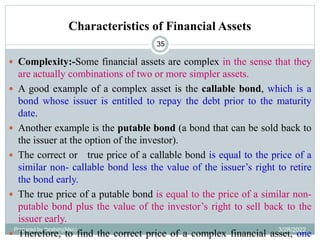
 Complexity:-Some financial assets are complex in the sense that they
are actually combinations of two or more simpler assets.
 A good example of a complex asset is the callable bond, which is a
bond whose issuer is entitled to repay the debt prior to the maturity
date.
 Another example is the putable bond (a bond that can be sold back to
the issuer at the option of the investor).
 The correct or true price of a callable bond is equal to the price of a
similar non- callable bond less the value of the issuer’s right to retire
the bond early.
 The true price of a putable bond is equal to the price of a similar non-
putable bond plus the value of the investor’s right to sell back to the
issuer early.
 Therefore, to find the correct price of a complex financial asset, one
Prepared by Ibrahimj(Msc) 3/28/2022
Characteristics of Financial Assets
36
 Tax Status:- Governmental regulations for taxing the income
from the ownership or sale of financial assets vary widely.
 Tax rates differ from year to year, from county to county, and
even among municipal units with in a country.
 The rates may also differ from financial asset to financial asset,
depending on the type of the issuer, the length of time the asset
is held, the nature of the owner, and so on.
 For example, income from Treasury bills and coupon payments
on municipal bonds are tax exempted.
Prepared by Ibrahimj(Msc) 3/28/2022
Underlying Versus Derivative Instruments
37
 Two fundamental classes of financial instruments.
 Underlying instruments are used by savers/lenders to transfer
resources directly to investors/borrowers.
 This improves the efficient allocation of resources.
 Divided into equity and debt
Prepared by Ibrahimj(Msc) 3/28/2022
Underlying Versus Derivative Instruments (Cont.)
38
 Equity instruments
 Ownership interest in an asset
 Residual claim on earnings and assets
Dividend
Liquidation
 Types
Ordinary share
Preference shares
Convertible notes
Prepared by Ibrahimj(Msc) 3/28/2022
Underlying Versus Derivative Instruments (Cont.)
39
 Debt instruments.
 Contractual claim to
Periodic interest payments and
Repayment of principal
 Ranks ahead of equity
 Can be secured or unsecured
 E.g notes, bonds and etc.
Prepared by Ibrahimj(Msc) 3/28/2022
Underlying Versus Derivative Instruments(Cont.)
40
 Derivatives
 A synthetic security providing specific future rights that
derives its price from a
Physical market commodity such as Gold and oil
Financial security
Interest rate-sensitive debt instruments, currencies and
equities
 Used mainly to manage price risk exposure, and to speculate
 Examples: futures, options, etc.
Prepared by Ibrahimj(Msc) 3/28/2022
A Primer for Valuing Financial Instruments
Four fundamental characteristics influence the value of a
financial instrument:
1. Size of the payment:
 Larger payment - more valuable.
2. Timing of payment:
 Payment is sooner - more valuable.
3. Likelihood payment is made:
 More likely to be made - more valuable.
4. Conditions under which payment is made:
 Made when we need them - more valuable.
41
Prepared by Ibrahimj(Msc) 3/28/2022
1.3.Financial Markets
42
Financial markets are places where financial instruments are
bought and sold.
Financial markets: are organizational framework within which
financial instruments can be bought and sold.
These markets are the economy’s central nervous system.
These markets enable both firms and individuals to find
financing for their activities.
These markets promote economic efficiency:
 They ensure resources are available to those who put them to
their best use.
Prepared by Ibrahimj(Msc) 3/28/2022
The Role of Financial Markets
 Borrowing and Lending: Financial markets permit the transfer
of funds (purchasing power) from one agent to another for
either investment or consumption purposes.
 Price Determination: Financial markets provide vehicles by
which prices are set both for newly issued financial assets and
for the existing stock of financial assets.
 Information Aggregation and Coordination: Financial
markets act as collectors and aggregators of information about
financial asset values and the flow of funds from lenders to
borrowers.
43
Prepared by Ibrahimj(Msc) 3/28/2022
The Role of Financial Markets(Cont.)
44
 Risk Sharing: Financial markets allow a transfer of risk from
those who undertake investments to those who provide funds
for those investments.
 Liquidity: Financial markets provide the holders of financial
assets with a chance to resell or liquidate these assets.
 Efficiency: Financial markets reduce transaction costs and
information costs.
Prepared by Ibrahimj(Msc) 3/28/2022
Structure of Financial Markets
45
1. Debt and Equity Markets
• Firms and individuals can obtain funds in a financial market in
two ways:
• A. Issue a debt instrument (e.g. bond, notes and etc) by which
the borrower pays the holder of the instrument specified
amounts in the future.
• Debt instruments are defined by their maturity as follows:
• Short term Instruments: instruments that mature in 3 to 12
months.
• Long term Instruments: Instruments that mature in more than
one year.
Prepared by Ibrahimj(Msc) 3/28/2022
Structure of Financial Markets(Cont.)
46
B. Issue equities (e.g. common stocks), which are claims to
share in the net income and assets of a business.
The owner of the equity receives dividends (fraction of profits)
at specified periods plus receiving part of the business assets if
it goes bankrupt.
Disadvantage: equity holder is a residual claimant (i.e. is paid
whatever lefts paying debt holders)
Prepared by Ibrahimj(Msc) 3/28/2022
Structure of Financial Markets(Cont.)
47
2. Primary and Secondary Markets
I. A primary market is a financial market in which new issues
of a security (e.g. bond, stock) are sold to initial buyers.
II. A secondary market is a financial market in which securities
that have been previously issued are resold.
• Secondary markets serve two functions:
 They make financial instruments more liquid.
 They determine the price of the security (through supply and
demand).
Prepared by Ibrahimj(Msc) 3/28/2022
Structure of Financial Markets(Cont.)
48
3. Exchanges and Over the Counter
• Secondary markets can be organized in two ways:
I. Exchanges: Trades are conducted in central locations where
sellers and buyers (or their agents or brokers) meet.
II. Over-the-Counter Markets: Dealers at different locations,
connected by computers, buy and sell securities.
Prepared by Ibrahimj(Msc) 3/28/2022
Structure of Financial Markets(Cont.)
49
4. Money and Capital Markets
• Another way of distinguishing between markets is on the basis
of the maturity of the securities traded in each market.
I. Money Market: Financial market in which only short-term
debt instruments are traded.
• Example: Treasury Bills, Commercial Papers.
II. Capital Market: Financial market in which longer-term debt
and equity instruments are traded.
• Example: Government Bonds, Corporate Bonds, Stocks.
Prepared by Ibrahimj(Msc) 3/28/2022
Financial Market Participants
50
 Brokers and dealers
 Households
 Business firms
 Federal, state, and local governments & their agencies
 Regulators
Prepared by Ibrahimj(Msc) 3/28/2022
1.4.Lending and Borrowing in the Financial System
51
• Business firms, households and governments play a wide
variety of roles in modern financial system.
• It is quite common for an individual/institution to be a lender
of funds in one period and a borrower in the other, or to do
both simultaneously.
• Indeed financial intermediaries, such as banks and insurance
agencies operate on both sides of the financial market;
borrowing funds from customers by issuing attractive financial
claims and simultaneously making loan available to other
customers.
• Thus the lending and borrowing activities in the financial
system are a prerequisite for the existence of money and
Prepared by Ibrahimj(Msc) 3/28/2022
Lending and Borrowing in the Financial
System(Cont.)
52
 Lending and borrowing are exist because the savings of
various individuals, corporations, and government units during
a period of time differ from their investment in real assets.
 Saving is the difference between income (revenue) and
consumption (expense).
 By real assets, we mean thing such as houses, buildings,
equipment, inventories and durable goods.
 If savings equaled investment in real assets for all economic
units in an economy over all periods of time, there would be no
external financing, no financial assets and no money and
capital markets.
Prepared by Ibrahimj(Msc) 3/28/2022
Lending and Borrowing in the Financial
System(Cont.)
53
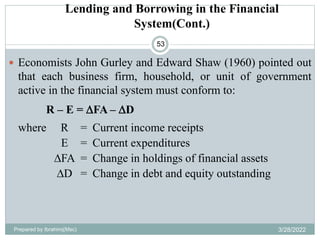
 Economists John Gurley and Edward Shaw (1960) pointed out
that each business firm, household, or unit of government
active in the financial system must conform to:
R – E = FA – D
where R = Current income receipts
E = Current expenditures
FA = Change in holdings of financial assets
D = Change in debt and equity outstanding
Prepared by Ibrahimj(Msc) 3/28/2022
Lending and Borrowing in the
FinancialSystem(Cont.)
54
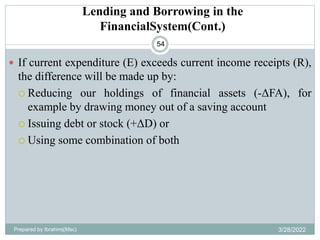
 If current expenditure (E) exceeds current income receipts (R),
the difference will be made up by:
 Reducing our holdings of financial assets (-ΔFA), for
example by drawing money out of a saving account
 Issuing debt or stock (+ΔD) or
 Using some combination of both
Prepared by Ibrahimj(Msc) 3/28/2022
Lending and Borrowing in the Financial
System(Cont.)
55
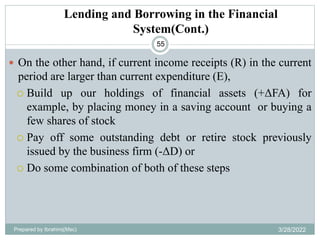
 On the other hand, if current income receipts (R) in the current
period are larger than current expenditure (E),
 Build up our holdings of financial assets (+ΔFA) for
example, by placing money in a saving account or buying a
few shares of stock
 Pay off some outstanding debt or retire stock previously
issued by the business firm (-ΔD) or
 Do some combination of both of these steps
Prepared by Ibrahimj(Msc) 3/28/2022
Lending and Borrowing in the Financial
System(Cont.)
56
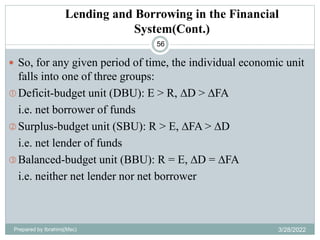
 So, for any given period of time, the individual economic unit
falls into one of three groups:
Deficit-budget unit (DBU): E > R, D > FA
i.e. net borrower of funds
Surplus-budget unit (SBU): R > E, FA > D
i.e. net lender of funds
Balanced-budget unit (BBU): R = E, D = FA
i.e. neither net lender nor net borrower
Prepared by Ibrahimj(Msc) 3/28/2022
Lending and Borrowing in the Financial
System(Cont.)
57
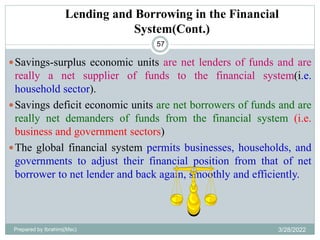
Savings-surplus economic units are net lenders of funds and are
really a net supplier of funds to the financial system(i.e.
household sector).
Savings deficit economic units are net borrowers of funds and are
really net demanders of funds from the financial system (i.e.
business and government sectors)
The global financial system permits businesses, households, and
governments to adjust their financial position from that of net
borrower to net lender and back again, smoothly and efficiently.
Prepared by Ibrahimj(Msc) 3/28/2022
58
Prepared by Ibrahimj(Msc) 3/28/2022

Chap1 financial institution ppt

  • 1.
    1 Chapter I An Overviewof The Financial System Prepared by Ibrahim J( M.Sc.) 3/28/2022
  • 2.
    Learning Objectives 2 After studyingthis chapter, you should be able to; 1.Define a financial system 2.Identify the components of a financial system 3.Understand the role of financial system in the economy 4.Diffentiate financial assets and their features 5.Explain financial markets: role, classifications and participants. 6.Articulate the lending and borrowing activities in the financial system. Prepared by Ibrahimj(Msc) 3/28/2022
  • 3.
    1.0. Introduction 3  Theeconomic development of a nation is reflected by the progress of the various economic units.  These units are broadly classified into:  corporate sector,  government and  household sector.  While performing their activities these units will be placed in a surplus/deficit/balanced budgetary situations. There are areas or people with surplus funds and there are those with a deficit. This course provides answers to these questions by examining how financial markets and financial institutions work.  Prepared by Ibrahimj(Msc) 3/28/2022
  • 4.
    1.0. Introduction Cont. 4 Financialmarkets and institutions not only affect our everyday life but also involve huge flows of funds trillions of dollars throughout our economy, which in turn affect business profits, the production of goods and services, and even the economic well-being of countries. “The only certainty in financial markets is uncertainty”(Credit Swiss, 2007) The study of financial markets and institutions will reward you with an understanding of many exciting issues. Thus in this chapter we are going to learn why financial markets and institutions are worth studying by exploring exciting issues. Prepared by Ibrahimj(Msc) 3/28/2022
  • 5.
    1.1. What isFinancial System? 5  In this first chapter we want to find a preliminary answer to two questions: (1)what is meant by the expression the ‘financial system’ and (2)what such a system does.  For the purposes of this course, we shall define a financial system fairly narrowly, to consist of a set of financial markets, financial assets and financial institutions which trade/traded in those markets and the supervisory bodies responsible for their regulation.  In a broader view:  financial assets and instruments,  economic agents (individuals, households, and firms),  governments and  Financial institutions are also parts of the financial system. Prepared by Ibrahimj(Msc) 3/28/2022
  • 6.
    1.1. What isFinancial System? 6  In this first chapter we want to find a preliminary answer to two questions: (1)what is meant by the expression the ‘financial system’ and (2)what such a system does?  For the purposes of this course, we shall define a financial system fairly narrowly, to consist of a set of financial markets, financial assets and financial institutions which trade/traded in those markets and the supervisory bodies responsible for their regulation.  It is the process by which money flows from savers to users.  The financial system provides for efficient flow of funds from saving to investment by bringing savers and borrowers together via financial markets and financial institutions. Prepared by Ibrahimj(Msc) 3/28/2022
  • 7.
    1.1. What isFinancial System?  A financial system is a network of financial institutions – such as insurance companies, stock exchanges, and investment banks – that work together to exchange and transfer capital from one place to another.  Through the financial system, investors receive capital to fund projects and receive a return on their investments. 7 Prepared by Ibrahimj(Msc) 3/28/2022
  • 8.
    1.1. What isFinancial System? 8 The end-users of the system are people and firms whose desire is to lend and to borrow money. Faced with a desire to lend or borrow, the end-users of most financial systems have a choice between three broad approaches: Firstly, they may decide to deal directly with one another, though this, as we shall see, is costly, risky, inefficient and, consequently, not very likely. Secondly, More typically they may decide to use one or more of many organized markets. In these markets, lenders buy the liabilities issued by Prepared by Ibrahimj(Msc) 3/28/2022
  • 9.
    1.1. What isFinancial System? 9  More frequently, however, a lender will buy an existing liability from another lender.  In effect, this refinances the original loan, though the borrower is completely unaware of this ‘secondary’ transaction. • Thirdly, borrowers and lenders may decide to deal via institutions or ‘intermediaries’. • In this case lenders have an asset- a bank or Savings and Loan Associations (S&Ls) and Mutual Savings Banks, or contributions to a life assurance or pension fund which cannot be traded but can only be returned to the intermediary. • They remain in the intermediaries’ balance sheets until they are repaid. Prepared by Ibrahimj(Msc) 3/28/2022
  • 10.
    1.1. What isFinancial System? 10 • Intermediaries themselves will also make use of markets, issuing securities to finance some of their activities and buying shares and bonds as part of their asset portfolio. • The main components of a financial systems: Financial assets (loans, deposits, bonds, equities, etc.), Financial institutions (banks, mutual funds, insurance companies,etc.)and Financial markets (money market, capital market, forex market, etc.) form a financial system. • The following diagram shows the interaction of the 3 parts of financial systems and the options dealing directly, through intermediaries or dealing through markets. Prepared by Ibrahimj(Msc) 3/28/2022
  • 11.
    Financial System 11 Prepared byIbrahimj(Msc) 3/28/2022
  • 12.
    1.1. What isFinancial System? 12  Notice that the above description of what a financial system does is only one way of answering our second question.  It is the answer that most economists would give because the activities on which it focuses are important to the functioning of the economy as a whole.  Making borrowing and lending cheap and easy makes it easier for firms to invest and should, therefore, increase the rate of economic growth.  An efficient payments system makes it easier to carry out transactions and encourages trade and exchange.  The quantity of money in circulation, how wealthy people feel and the liquidity of their wealth are all potential influences upon the level of aggregate demand. Prepared by Ibrahimj(Msc) 3/28/2022
  • 13.
    1.1. What isFinancial System? 13  Generally, a financial system is described as:  Channels funds from lenders to borrowers  Creates liquidity and money.  Provides a payments mechanism.  Provides financial services such as insurance and pensions.  Offers portfolio adjustment facilities • Portfolio: A collection of assets (or liabilities). Prepared by Ibrahimj(Msc) 3/28/2022
  • 14.
    1.2.The role offinancial system in the economy 14  The financial system plays the key role in the economy by stimulating economic growth, influencing economic performance of the actors, affecting economic welfare.  This is achieved through financial infrastructure, in which entities with funds allocate those funds to those who have potentially more productive ways to invest those funds.  A financial system makes it possible a more efficient transfer of funds. Prepared by Ibrahimj(Msc) 3/28/2022
  • 15.
    1.2. The function/roleof financial systems(Cont.) 15 • The financial system perform the following types of financial service that reduce the costs of moving funds between borrowers and lenders, leading to a more efficient allocation of resources and faster economic growth. 1. Saving and investment functions 2. Liquidity function 3. Payment function 4. Risk diversification function 5. Policy function Prepared by Ibrahimj(Msc) 3/28/2022
  • 16.
    1.2. Functions /roleof the Financial System(Cont.) 16 1. Saving and investment function  The functioning of an economy depends on the financial system of a country.  The financial system includes banks as a central entity along with other financial services providers.  The financial system of a country is deeply entrenched in the society and provides employment to a large population.  The major functions of the financial system are Public saving find their way into the hands of those in production through the financial system.  The funds with the producers result in production of goods and services thereby increasing society living standards. Prepared by Ibrahimj(Msc) 3/28/2022
  • 17.
    1.2. Functions /roleof the Financial System(Cont.) 17 2. Liquidity function  Liquidity is the speed and convenience with which an asset can be converted into money for a certain value.  Liquidity is the ability to sell an asset within reasonable time at current market prices and for reasonable transaction costs  The financial markets provide the investor with the opportunity to liquidate investments like stocks, bonds, debentures, and etc whenever they need the fund.  Financial institutions offer to buy or sell securities as per need and often in large volumes to fulfill sudden cash requirements of the stakeholders.  They provide credit and overdraft facility to businesses protect businesses against sudden cash needs. Prepared by Ibrahimj(Msc) 3/28/2022
  • 18.
    1.2. Functions /roleof the Financial System(Cont.) 18 3. Payment function  The financial system offers a very convenient mode for payment of goods and services.  Check system, credit card system and etc are the easiest methods of payments.  The cost and time of transactions are drastically reduced. Prepared by Ibrahimj(Msc) 3/28/2022
  • 19.
    1.2. Functions /roleof the Financial System(Cont.) 19 4. Risk Diversification function  Financial systems perform this function in at least two ways.  First, they can enhance risk diversification  Diversification entails investing in a collection (portfolio) of assets whose returns do not always move together, with the result that overall risk is lower than for individual assets.  Second, they resolve an information asymmetry problem that may otherwise prevent the exchange of goods and services, in this case the provision of capital.  Financial systems facilitate risk-sharing by reducing information and transactions costs. Prepared by Ibrahimj(Msc) 3/28/2022
  • 20.
    1.2. Functions /roleof the Financial System(Cont.) 20  Intermediaries perform this role by taking advantage of economies of scale; markets do so by facilitating the broad offer and trade of assets comprising investors’ portfolios.  The financial system provide protection against life, health and income risks.  These are accomplished through the sale of life and health insurance and property insurance policies.  The financial markets provide immense opportunities for the investor to hedge himself against or reduce the possible risks involved in various investments. Prepared by Ibrahimj(Msc) 3/28/2022
  • 21.
    21 5. Policy function Thegovernment intervenes in the financial system to influence macroeconomic variables like interest rates or inflation If country needs more money government would cut rate of interest through various financial instruments and if inflation is high and too much money is there in the system then government would increase rate of interest. 1.2. Functions /role of the Financial System(Cont.) Prepared by Ibrahimj(Msc) 3/28/2022
  • 22.
    The Link betweenFinancial systems and Economic growth 22  There are two main channels through which financial systems can have an effect on economic growth: 1) Capital Accumulation 2) Technological innovation 1). Capital Accumulation  Financial systems affect capital accumulation in three ways.  First, financial systems lower the cost of channeling funds between borrowers and lenders, by reducing information and transaction costs.  A decline in the cost of accessing finance frees up resources for other uses, including consumption, investment and capital accumulation. Prepared by Ibrahimj(Msc) 3/28/2022
  • 23.
    The Link betweenFinancial systems and Economic growth 23  Second, they can alter individuals ‘and households ‘saving decisions by making long term investments more attractive.  If financial intermediaries and markets are unable to convince savers of the soundness of the investment projects that they are planning for funding, savers may choose to consume rather than save or place their savings in other, less productive forms.  Third, financial intermediation affects capital accumulation by reallocating funds to their most productive uses, which raises the rate of return to saving.  However, the effects of a change in the rate of return on saving are ambiguous.  This is because higher rates of return increase the cost of consumption today or the cost of not saving, leading to more saving. Prepared by Ibrahimj(Msc) 3/28/2022
  • 24.
    The Link betweenFinancial systems and Economic growth 24 2) Technological innovation  Financial systems may affect technological innovation by allowing diversification.  Financial systems allow savers to obtain their desired level of exposure to high risk/reward firms, potentially increasing the level of finance directed at such activities.  Financial intermediaries are well suited to provide external finance to new firms that require dramatic finance because they can credibly commit to additional funding based on key benchmarks. Prepared by Ibrahimj(Msc) 3/28/2022
  • 25.
    The Link betweenFinancial systems and Economic growth 25  Specialized intermediaries can improve the willingness of savers to provide finance to firms with innovative or novel business plans through monitoring and oversight activities.  Financial markets are effective at financing industries where relatively little information or few data are available or where a diversity of opinion is persistent.  This is because markets allow investors with similar views to form coalitions to finance a particular investment project.  New investment financed by financial intermediaries or markets is a channel for the diffusion of new technologies and productivity gains. Prepared by Ibrahimj(Msc) 3/28/2022
  • 26.
    1.3.Financial Instruments (Assets) 26 Financial instruments are defined as cash, an ownership interest, or a contractual right to receive or obligation to deliver cash or another financial instrument.  They claims by lenders against income or wealth of borrowers, represented usually by a certificate, created in the lending of money, and eventually destroyed upon returning of money.  E.g., stocks, bonds, insurance policies, bank loans, notes, bank deposits, national savings certificates, treasury bills, commercial bills, Eurobonds, Certificates of deposit and etc.  Financial instruments specify certain conditions under which a payment will be made at some future date. Prepared by Ibrahimj(Msc) 3/28/2022
  • 27.
    Uses of FinancialInstruments 27  Three functions: I. Financial instruments act as a means of payment (like money). Employees take stock options as payment for working. II. Financial instruments act as stores of value (like money). Financial instruments generate increases in wealth that are larger than from holding money. Financial instruments can be used to transfer purchasing power into the future. iii. Financial instruments allow for the transfer of risk (unlike money).  Futures and insurance contracts allows one person to Prepared by Ibrahimj(Msc) 3/28/2022
  • 28.
    Characteristics of FinancialAssets 28 • Do not provide physical services to owners, instead provide a stream of (expected) cash flows. • Do not depreciate unlike physical goods, • Their physical condition or form is usually not relevant in determining their market value. • Their cost of transportation and storage is low, such that they have little or no value as a commodity. • Financial assets are fungible-they can easily be changed in form and substituted for other assets. Prepared by Ibrahimj(Msc) 3/28/2022
  • 29.
    Characteristics of FinancialAssets 29  Moneyness:-Some Financial assets are used as a medium of exchange or to effect payment. These assets are called money and consist of currency and demand (checking) deposit.  Other assets such as Treasury bill, saving and time deposits are referred to as near money because they can be transformed into money at little cost, delay, or risk.  Divisibility and Denomination:- Divisibility relates to the minimum size in which a financial asset can be liquidated and exchanged for money.  The smaller the size, the more the financial asset is divisible.  Different A financial assets have varying degrees of divisibility depending on their denomination, which is the money value of the amount that each unit of the asset will pay at maturity. Prepared by Ibrahimj(Msc) 3/28/2022
  • 30.
    Characteristics of FinancialAssets 30  Reversibility:-is the round-trip cost or turnaround cost because it is the cost of buying a security and then selling the security when circumstances motivate or force you to do so.  In other words, in buying and selling a security there are transaction costs which affect the reversibility of the financial asset.  The higher the round- trip cost (transaction cost), the lower is the reversibility of the financial asset.  A financial asset such as a deposit at a bank is obviously highly reversible because usually there is no charge for adding to or withdrawing from it.  Financial assets that are highly reversible are more desirable Prepared by Ibrahimj(Msc) 3/28/2022
  • 31.
    Characteristics of FinancialAssets 31  Cash Flow:- Every financial asset provides a return to the investor which is measured by considering all the cash distributions that the financial asset will pay its owners.  This cash distribution includes dividends on shares and coupon payments on bonds, repayment of principal and interest for a debt security.  Term to Maturity: is the length of the period until the date at which the instrument is scheduled to make its final payment, or the owner is entitled to demand liquidation.  Debt securities do have specified maturity dates ranging from one day to a few decades.  Equity securities and perpetual bond have no maturity. Prepared by Ibrahimj(Msc) 3/28/2022
  • 32.
    Characteristics of FinancialAssets 32  Convertibility:-Some financial assets are convertible into other types of financial assets.  The conversion could take place within one class of assets, as when a bond is converted in to another bond or  It may involve converting in to a different class of assets, as when a bond is converted into equity securities.  Currency:- Because of the volatile exchange rates among currencies, the currency in which the financial asset will make cash flow payments is an important factor in determining the attractiveness of a security.  In order to reduce currency risk, some issuers have issued dual- currency securities. Prepared by Ibrahimj(Msc) 3/28/2022
  • 33.
    Characteristics of FinancialAssets 33  Liquidity:- A useful way to think of liquidity and illiquidity is in terms of how much sellers stand to lose if they wish to sell immediately as against engaging in a costly and time consuming search.  The most important factor affecting the liquidity of a financial asset is the thickness of the market.  Thick market unlike thin market has many buyers and sellers.  Thus, financial assets which have thick market are more liquid than those having thin market.  For many other financial assets, liquidity is determined by contractual arrangements Prepared by Ibrahimj(Msc) 3/28/2022
  • 34.
    Characteristics of FinancialAssets 34  Return Predictability: is associated with the uncertainty of returns of a financial asset.  Uncertainty varies greatly across financial assets.  The value of a financial asset depends on the cash flow expected and on the interest rate used to discount this cash flow.  Hence, risk will be a consequence of the uncertainty about future interest rates and future cash flow.  For some financial assets, the future cash flow may be contractual in which case the sole source of its uncertainty is the reliability of the debtor with regard to fulfilling the obligation. Prepared by Ibrahimj(Msc) 3/28/2022
  • 35.
    Characteristics of FinancialAssets 35  Complexity:-Some financial assets are complex in the sense that they are actually combinations of two or more simpler assets.  A good example of a complex asset is the callable bond, which is a bond whose issuer is entitled to repay the debt prior to the maturity date.  Another example is the putable bond (a bond that can be sold back to the issuer at the option of the investor).  The correct or true price of a callable bond is equal to the price of a similar non- callable bond less the value of the issuer’s right to retire the bond early.  The true price of a putable bond is equal to the price of a similar non- putable bond plus the value of the investor’s right to sell back to the issuer early.  Therefore, to find the correct price of a complex financial asset, one Prepared by Ibrahimj(Msc) 3/28/2022
  • 36.
    Characteristics of FinancialAssets 36  Tax Status:- Governmental regulations for taxing the income from the ownership or sale of financial assets vary widely.  Tax rates differ from year to year, from county to county, and even among municipal units with in a country.  The rates may also differ from financial asset to financial asset, depending on the type of the issuer, the length of time the asset is held, the nature of the owner, and so on.  For example, income from Treasury bills and coupon payments on municipal bonds are tax exempted. Prepared by Ibrahimj(Msc) 3/28/2022
  • 37.
    Underlying Versus DerivativeInstruments 37  Two fundamental classes of financial instruments.  Underlying instruments are used by savers/lenders to transfer resources directly to investors/borrowers.  This improves the efficient allocation of resources.  Divided into equity and debt Prepared by Ibrahimj(Msc) 3/28/2022
  • 38.
    Underlying Versus DerivativeInstruments (Cont.) 38  Equity instruments  Ownership interest in an asset  Residual claim on earnings and assets Dividend Liquidation  Types Ordinary share Preference shares Convertible notes Prepared by Ibrahimj(Msc) 3/28/2022
  • 39.
    Underlying Versus DerivativeInstruments (Cont.) 39  Debt instruments.  Contractual claim to Periodic interest payments and Repayment of principal  Ranks ahead of equity  Can be secured or unsecured  E.g notes, bonds and etc. Prepared by Ibrahimj(Msc) 3/28/2022
  • 40.
    Underlying Versus DerivativeInstruments(Cont.) 40  Derivatives  A synthetic security providing specific future rights that derives its price from a Physical market commodity such as Gold and oil Financial security Interest rate-sensitive debt instruments, currencies and equities  Used mainly to manage price risk exposure, and to speculate  Examples: futures, options, etc. Prepared by Ibrahimj(Msc) 3/28/2022
  • 41.
    A Primer forValuing Financial Instruments Four fundamental characteristics influence the value of a financial instrument: 1. Size of the payment:  Larger payment - more valuable. 2. Timing of payment:  Payment is sooner - more valuable. 3. Likelihood payment is made:  More likely to be made - more valuable. 4. Conditions under which payment is made:  Made when we need them - more valuable. 41 Prepared by Ibrahimj(Msc) 3/28/2022
  • 42.
    1.3.Financial Markets 42 Financial marketsare places where financial instruments are bought and sold. Financial markets: are organizational framework within which financial instruments can be bought and sold. These markets are the economy’s central nervous system. These markets enable both firms and individuals to find financing for their activities. These markets promote economic efficiency:  They ensure resources are available to those who put them to their best use. Prepared by Ibrahimj(Msc) 3/28/2022
  • 43.
    The Role ofFinancial Markets  Borrowing and Lending: Financial markets permit the transfer of funds (purchasing power) from one agent to another for either investment or consumption purposes.  Price Determination: Financial markets provide vehicles by which prices are set both for newly issued financial assets and for the existing stock of financial assets.  Information Aggregation and Coordination: Financial markets act as collectors and aggregators of information about financial asset values and the flow of funds from lenders to borrowers. 43 Prepared by Ibrahimj(Msc) 3/28/2022
  • 44.
    The Role ofFinancial Markets(Cont.) 44  Risk Sharing: Financial markets allow a transfer of risk from those who undertake investments to those who provide funds for those investments.  Liquidity: Financial markets provide the holders of financial assets with a chance to resell or liquidate these assets.  Efficiency: Financial markets reduce transaction costs and information costs. Prepared by Ibrahimj(Msc) 3/28/2022
  • 45.
    Structure of FinancialMarkets 45 1. Debt and Equity Markets • Firms and individuals can obtain funds in a financial market in two ways: • A. Issue a debt instrument (e.g. bond, notes and etc) by which the borrower pays the holder of the instrument specified amounts in the future. • Debt instruments are defined by their maturity as follows: • Short term Instruments: instruments that mature in 3 to 12 months. • Long term Instruments: Instruments that mature in more than one year. Prepared by Ibrahimj(Msc) 3/28/2022
  • 46.
    Structure of FinancialMarkets(Cont.) 46 B. Issue equities (e.g. common stocks), which are claims to share in the net income and assets of a business. The owner of the equity receives dividends (fraction of profits) at specified periods plus receiving part of the business assets if it goes bankrupt. Disadvantage: equity holder is a residual claimant (i.e. is paid whatever lefts paying debt holders) Prepared by Ibrahimj(Msc) 3/28/2022
  • 47.
    Structure of FinancialMarkets(Cont.) 47 2. Primary and Secondary Markets I. A primary market is a financial market in which new issues of a security (e.g. bond, stock) are sold to initial buyers. II. A secondary market is a financial market in which securities that have been previously issued are resold. • Secondary markets serve two functions:  They make financial instruments more liquid.  They determine the price of the security (through supply and demand). Prepared by Ibrahimj(Msc) 3/28/2022
  • 48.
    Structure of FinancialMarkets(Cont.) 48 3. Exchanges and Over the Counter • Secondary markets can be organized in two ways: I. Exchanges: Trades are conducted in central locations where sellers and buyers (or their agents or brokers) meet. II. Over-the-Counter Markets: Dealers at different locations, connected by computers, buy and sell securities. Prepared by Ibrahimj(Msc) 3/28/2022
  • 49.
    Structure of FinancialMarkets(Cont.) 49 4. Money and Capital Markets • Another way of distinguishing between markets is on the basis of the maturity of the securities traded in each market. I. Money Market: Financial market in which only short-term debt instruments are traded. • Example: Treasury Bills, Commercial Papers. II. Capital Market: Financial market in which longer-term debt and equity instruments are traded. • Example: Government Bonds, Corporate Bonds, Stocks. Prepared by Ibrahimj(Msc) 3/28/2022
  • 50.
    Financial Market Participants 50 Brokers and dealers  Households  Business firms  Federal, state, and local governments & their agencies  Regulators Prepared by Ibrahimj(Msc) 3/28/2022
  • 51.
    1.4.Lending and Borrowingin the Financial System 51 • Business firms, households and governments play a wide variety of roles in modern financial system. • It is quite common for an individual/institution to be a lender of funds in one period and a borrower in the other, or to do both simultaneously. • Indeed financial intermediaries, such as banks and insurance agencies operate on both sides of the financial market; borrowing funds from customers by issuing attractive financial claims and simultaneously making loan available to other customers. • Thus the lending and borrowing activities in the financial system are a prerequisite for the existence of money and Prepared by Ibrahimj(Msc) 3/28/2022
  • 52.
    Lending and Borrowingin the Financial System(Cont.) 52  Lending and borrowing are exist because the savings of various individuals, corporations, and government units during a period of time differ from their investment in real assets.  Saving is the difference between income (revenue) and consumption (expense).  By real assets, we mean thing such as houses, buildings, equipment, inventories and durable goods.  If savings equaled investment in real assets for all economic units in an economy over all periods of time, there would be no external financing, no financial assets and no money and capital markets. Prepared by Ibrahimj(Msc) 3/28/2022
  • 53.
    Lending and Borrowingin the Financial System(Cont.) 53  Economists John Gurley and Edward Shaw (1960) pointed out that each business firm, household, or unit of government active in the financial system must conform to: R – E = FA – D where R = Current income receipts E = Current expenditures FA = Change in holdings of financial assets D = Change in debt and equity outstanding Prepared by Ibrahimj(Msc) 3/28/2022
  • 54.
    Lending and Borrowingin the FinancialSystem(Cont.) 54  If current expenditure (E) exceeds current income receipts (R), the difference will be made up by:  Reducing our holdings of financial assets (-ΔFA), for example by drawing money out of a saving account  Issuing debt or stock (+ΔD) or  Using some combination of both Prepared by Ibrahimj(Msc) 3/28/2022
  • 55.
    Lending and Borrowingin the Financial System(Cont.) 55  On the other hand, if current income receipts (R) in the current period are larger than current expenditure (E),  Build up our holdings of financial assets (+ΔFA) for example, by placing money in a saving account or buying a few shares of stock  Pay off some outstanding debt or retire stock previously issued by the business firm (-ΔD) or  Do some combination of both of these steps Prepared by Ibrahimj(Msc) 3/28/2022
  • 56.
    Lending and Borrowingin the Financial System(Cont.) 56  So, for any given period of time, the individual economic unit falls into one of three groups: Deficit-budget unit (DBU): E > R, D > FA i.e. net borrower of funds Surplus-budget unit (SBU): R > E, FA > D i.e. net lender of funds Balanced-budget unit (BBU): R = E, D = FA i.e. neither net lender nor net borrower Prepared by Ibrahimj(Msc) 3/28/2022
  • 57.
    Lending and Borrowingin the Financial System(Cont.) 57 Savings-surplus economic units are net lenders of funds and are really a net supplier of funds to the financial system(i.e. household sector). Savings deficit economic units are net borrowers of funds and are really net demanders of funds from the financial system (i.e. business and government sectors) The global financial system permits businesses, households, and governments to adjust their financial position from that of net borrower to net lender and back again, smoothly and efficiently. Prepared by Ibrahimj(Msc) 3/28/2022
  • 58.