
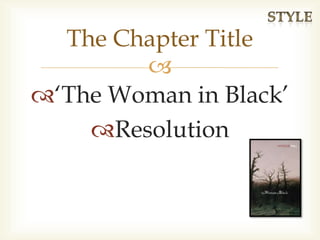
‘The Woman in Black’
Resolution
The Chapter Title

Comrade
Relationship comes to
an end
Loyalty
Samuel Daily

Short sentence
Intense atmosphere
Reflects delicateness
Sentence structures reflect
meaning
“Nothing has happened yet”
“A child – a child in Crythin Gifford has
always died”
(pg.193 line.17)

Central and dominant theme
“Revenge can never be good, can
never succeed ultimately, and will
never pay” – Susan Hill
Revenge

 Powerful adjectives
 Vivid imagery
 ‘Desire for revenge’
 Hatred and desires
“She had been a
poor, crazed, troubled
woman, dead of grief and
distress, filled with hatred and
desire for revenge.”
(pg.194 line.9)

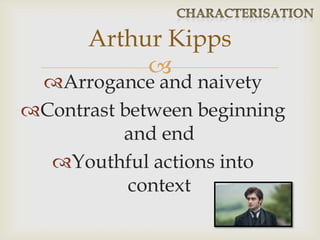
Arrogance and naivety
Contrast between beginning
and end
Youthful actions into
context
Arthur Kipps
Emotion change
Able to feel intensity and fear
simultaneously
Chapter 12 conveys the most
powerful use of the
homodiegetic narrative
Immediate and
realistic emotion
First Person Narrative

 Remorse
 Oxymoron
 Understandable yet unforgivable
“Her bitterness was understandable, the
wickedness that led her to take away
other women’s children because she had
lost her own understandable too but not
forgivable.”
(pg.194 line.11)

Contradiction
Sentence structure
“There was nothing
anyone could do to help
her, except perhaps pray
for her soul, I thought.”
(pg.194 line.15)

 Sentence structure reflects meaning of sentence
 Emotional release
 Experienced along side Kipps
“With a sigh- indeed
almost a sob- of relief, I
was driven away from
Crythin Gifford.”
(pg.194 line.25)

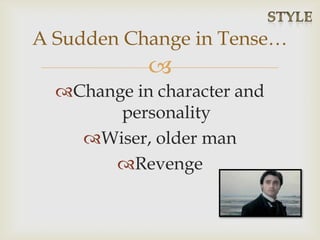
Change in character and
personality
Wiser, older man
Revenge
A Sudden Change in Tense…

 Three short sentences
 Conveys dramatic effect and suspense throughout
“My story is almost done.
There is only one thing left to
tell. And I can scarcely bring
myself to write about it.”
(pg.195 line.1)

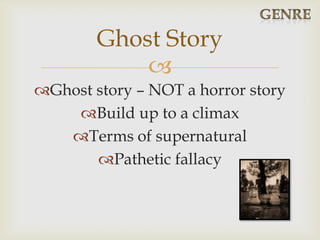
Ghost story – NOT a horror story
Build up to a climax
Terms of supernatural
Pathetic fallacy
Ghost Story

 Sentence Structure
 Six commas
 Represent urgency
 Words associate to meaning
“I now had an urgent sense of
time, a certainty that we should
not delay, but seize upon joy, and
good fortune, any opportunity, at
once, and hold fast to it.”
(pg.196 line.2)

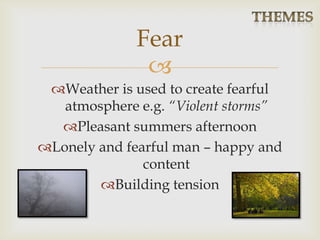
Weather is used to create fearful
atmosphere e.g. “Violent storms”
Pleasant summers afternoon
Lonely and fearful man – happy and
content
Building tension
Fear

“And then, quite suddenly I
saw her.”
 ‘her’
 Comma
 Significance

 Contrast
 Change in emotion
 First person narrative
“For a second, I simply stared
in incredulity and
astonishment, then in cold
fear.”
(pg.198 line.13)

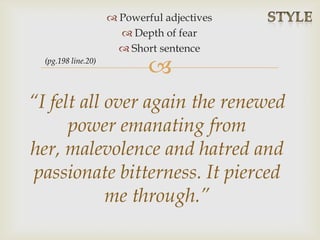
 Powerful adjectives
 Depth of fear
 Short sentence
“I felt all over again the renewed
power emanating from
her, malevolence and hatred and
passionate bitterness. It pierced
me through.”
(pg.198 line.20)

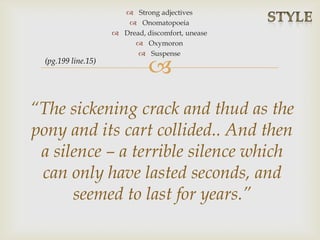
 Strong adjectives
 Onomatopoeia
 Dread, discomfort, unease
 Oxymoron
 Suspense
“The sickening crack and thud as the
pony and its cart collided.. And then
a silence – a terrible silence which
can only have lasted seconds, and
seemed to last for years.”
(pg.199 line.15)

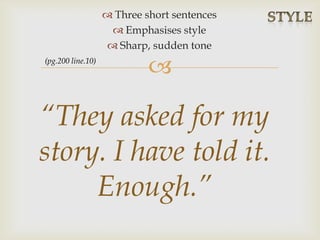
 Three short sentences
 Emphasises style
 Sharp, sudden tone
“They asked for my
story. I have told it.
Enough.”
(pg.200 line.10)

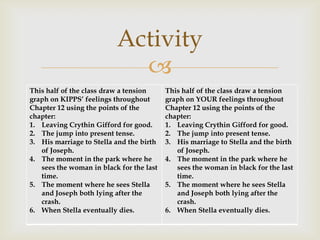
This half of the class draw a tension
graph on KIPPS’ feelings throughout
Chapter 12 using the points of the
chapter:
1. Leaving Crythin Gifford for good.
2. The jump into present tense.
3. His marriage to Stella and the birth
of Joseph.
4. The moment in the park where he
sees the woman in black for the last
time.
5. The moment where he sees Stella
and Joseph both lying after the
crash.
6. When Stella eventually dies.
This half of the class draw a tension
graph on YOUR feelings throughout
Chapter 12 using the points of the
chapter:
1. Leaving Crythin Gifford for good.
2. The jump into present tense.
3. His marriage to Stella and the birth
of Joseph.
4. The moment in the park where he
sees the woman in black for the last
time.
5. The moment where he sees Stella
and Joseph both lying after the
crash.
6. When Stella eventually dies.
Activity

Activity
Both tension graphs should look the
same
If so, this is done by Hills techniques of
building tension from a first person
narrative and other techniques we have
looked at.
chap 12

chap 12

  • 2.
     ‘The Woman inBlack’ Resolution The Chapter Title
  • 3.
     Comrade Relationship comes to anend Loyalty Samuel Daily
  • 4.
     Short sentence Intense atmosphere Reflectsdelicateness Sentence structures reflect meaning “Nothing has happened yet” “A child – a child in Crythin Gifford has always died” (pg.193 line.17)
  • 5.
     Central and dominanttheme “Revenge can never be good, can never succeed ultimately, and will never pay” – Susan Hill Revenge
  • 6.
      Powerful adjectives Vivid imagery  ‘Desire for revenge’  Hatred and desires “She had been a poor, crazed, troubled woman, dead of grief and distress, filled with hatred and desire for revenge.” (pg.194 line.9)
  • 7.
     Arrogance and naivety Contrastbetween beginning and end Youthful actions into context Arthur Kipps
  • 8.
    Emotion change Able tofeel intensity and fear simultaneously Chapter 12 conveys the most powerful use of the homodiegetic narrative Immediate and realistic emotion First Person Narrative
  • 9.
      Remorse  Oxymoron Understandable yet unforgivable “Her bitterness was understandable, the wickedness that led her to take away other women’s children because she had lost her own understandable too but not forgivable.” (pg.194 line.11)
  • 10.
     Contradiction Sentence structure “There wasnothing anyone could do to help her, except perhaps pray for her soul, I thought.” (pg.194 line.15)
  • 11.
      Sentence structurereflects meaning of sentence  Emotional release  Experienced along side Kipps “With a sigh- indeed almost a sob- of relief, I was driven away from Crythin Gifford.” (pg.194 line.25)
  • 12.
     Change in characterand personality Wiser, older man Revenge A Sudden Change in Tense…
  • 13.
      Three shortsentences  Conveys dramatic effect and suspense throughout “My story is almost done. There is only one thing left to tell. And I can scarcely bring myself to write about it.” (pg.195 line.1)
  • 14.
     Ghost story –NOT a horror story Build up to a climax Terms of supernatural Pathetic fallacy Ghost Story
  • 15.
      Sentence Structure Six commas  Represent urgency  Words associate to meaning “I now had an urgent sense of time, a certainty that we should not delay, but seize upon joy, and good fortune, any opportunity, at once, and hold fast to it.” (pg.196 line.2)
  • 16.
     Weather is usedto create fearful atmosphere e.g. “Violent storms” Pleasant summers afternoon Lonely and fearful man – happy and content Building tension Fear
  • 17.
     “And then, quitesuddenly I saw her.”  ‘her’  Comma  Significance
  • 18.
      Contrast  Changein emotion  First person narrative “For a second, I simply stared in incredulity and astonishment, then in cold fear.” (pg.198 line.13)
  • 19.
      Powerful adjectives Depth of fear  Short sentence “I felt all over again the renewed power emanating from her, malevolence and hatred and passionate bitterness. It pierced me through.” (pg.198 line.20)
  • 20.
      Strong adjectives Onomatopoeia  Dread, discomfort, unease  Oxymoron  Suspense “The sickening crack and thud as the pony and its cart collided.. And then a silence – a terrible silence which can only have lasted seconds, and seemed to last for years.” (pg.199 line.15)
  • 21.
      Three shortsentences  Emphasises style  Sharp, sudden tone “They asked for my story. I have told it. Enough.” (pg.200 line.10)
  • 22.
     This half ofthe class draw a tension graph on KIPPS’ feelings throughout Chapter 12 using the points of the chapter: 1. Leaving Crythin Gifford for good. 2. The jump into present tense. 3. His marriage to Stella and the birth of Joseph. 4. The moment in the park where he sees the woman in black for the last time. 5. The moment where he sees Stella and Joseph both lying after the crash. 6. When Stella eventually dies. This half of the class draw a tension graph on YOUR feelings throughout Chapter 12 using the points of the chapter: 1. Leaving Crythin Gifford for good. 2. The jump into present tense. 3. His marriage to Stella and the birth of Joseph. 4. The moment in the park where he sees the woman in black for the last time. 5. The moment where he sees Stella and Joseph both lying after the crash. 6. When Stella eventually dies. Activity
  • 23.
     Activity Both tension graphsshould look the same If so, this is done by Hills techniques of building tension from a first person narrative and other techniques we have looked at.

Editor's Notes

  • #3 When reading chapter twelve, even though it is the last chapter, the sense of resolution also comes from the poignant title, being the same as the name of the book. This also represents how important Susan Hill felt this last chapter was to the story. It is interesting to think whether Susan Hill named the book after her last chapter, or later named the chapter after the book. The name of the chapter also stands out from the rest, as all the others are oblique, “The Woman in Black” is much more elliptical, as unlike the others it doesn’t reveal what shall actually happen, showcasing Hills skill of building tension.
  • #4 Initially continuing with the past tense, Kipps’ time in Crythin Gifford come to an end, however this is not before he talk to Samuel Daily- his comradeAlready known to be a companion to Kipps- this is where their relationship comes to the end in Crythin Gifford, Kipps promising to himself he shall never return.However, the relationship between them isn’t over, as Kipp’s gets Samuels dog and Sam becomes a godfather to Kipps’ son. This shows Sam’s loyalty towards Kipps, as even though Kipps has caused torment for Sam, he still stays constant in their battle together; determined to resolve The Woman in Black’s reign.
  • #5 Starting with a short sentence to gain the readers attention, and create an intense atmosphere, “Samuel Daily looked at me sharply.” Follows the first explanation of Jennet Humphrey’s revenge: “A child- a child in Crythin Gifford has always died.” “yes”- a short sharp answer, reflecting the delicateness of the matter. Here, we see Hills common use of sentence structure reflecting the meanings within the sentence. Using short answers to reflect the intensity and repetition of child to annunciate the delicacy and seriousness of the matter. However, this chapter speaks of Jennet Humphrey’s true revenge as “Nothing has happened yet”.
  • #6 Throughout woman in black revenge is a central and dominant theme. Seeking the revenge for her lost child, we learn of Jennets true vendetta within this chapter from Kipps’ comrade Samuel Daily, as he has explained. The main point about the Woman in Black is that revenge can never be good, can never succeed ultimately, and will never pay. Said by Susan HillJustice is one thing, revenge is very different. The Woman in black never lets go, and continues to wreak revenge on the innocent for what has happened to her.She has never let go, can never move on. As she could not in life, so she cannot in after life.
  • #7 Here, Hill uses a wide range of powerful adjectives to describe the Woman in black as Kipps sees her again, offering a vivid image in the readers mind of both her look and her evil personality as Hill describes her twisted ‘desire for revenge.’ However, Hill still presents the reader with an oxymoron; as the description ‘poor crazed troubled woman’ could evoke the reader to feel sorry for her, yet he quickly rids the idea when explain her hatred and desires.
  • #8 HIS ARROGANCE AS AN OLD MAN AND NAIVETY BEFORE THIS CHAPTER, WHERE WE ONLY NOW BEGIN TO SEE HIM FAULTER AND GIVE IN TO HIS EMOTION AND FEAR?HILL PRESENTS ANOTHER CONTRAST BETWEEN THE MAN Kipps is at the beginning and THE MAN his has now become at the end AT THE END!He now puts his youthful actions into context and this makes the reader believe his judgement and his account of events.
  • #9 As it is written in first person, the reader can get a true sense of how Kipps emotion change throughout. This then means as the story progressed they are able to feel the intensity and fear of TWIB.Within our chapter, and chapter 1, using a first person narrative allows the reader to feel his sadness and desperation as he goes through catastrophic events (the death of Esmé and his son).Possibly however, Chapter 12 conveys the most powerful use of the first person narrative within this book, as towards the end we see Kipps anger and exasperation. It allows the reader to experience immediate and realistic emotion from what is perceived as a normal everyday man.
  • #10 Here Kipps is aware of the feeling of remorse and deep sadness regarding a child’s death but still cannot condone the fact that she has and will take other children including his own. Once again using an oxymoron comparing the understandable with the unforgivable Hill emphasises to the reader that Kipps does in fact have an understanding but will never forget it.
  • #11 Here, we almost see Kipps contradict himself, as he cuts himself short. Hill uses this interesting sentence structure to annunciate the mental state of the Woman in black, as the simple ‘I thought’ allows the reader to also diminish any idea of saving her, and her sanity. Here, with the ’I thought’ the reader is unknowingly introduced to the books finale as, He is here referring to his son and Esmé’s death.
  • #12 Using this sentence structure, we see Hill displaying the pure ’relief’ as the hyphens used within the first person narrative represent the emotional release Kipps feels as he finally leaves, and allow the reader to experience this alongside Kipps.
  • #13 The change in Kipps character and personality is also shown through a sudden change in tense as the reader only now begins to see Kipps falter.The present tense is used to show the emotions and fears he experiences as an older man recounting, from his now older and possibly wiser point of view; something that so far hasn’t been referred to. To gain the revenge of her sons’ death, the reader feels Kipps’ true emotion as he desperately struggles to come to terms with the past.
  • #14 Three short sentences once again using the power of three and these combined make the reader aware of how difficult, stressful and emotional Kipps finds it to put into words or onto paper how he felt and how he feels even these many years on. This is obviously a technique that Hill uses to convey dramatic effect, and suspense to the reader throughout the ‘ghost story’.
  • #15 The woman in black follows the traditional convention of a ghost story and NOT a horror story. Although in both ghost and horror there is a constant build up to a climax in tended to terrify the reader, a ghost story can only be understood in terms of the super natural.In the woman in black, the use of a ghost, and exploration of the afterlife applies this rule. As well as constant use of pathetic fallacy to represent both normality and the supernatural.
  • #16 Within this sentence, Hill uses an interesting sense of sentence structure to reflect the meaning of the sentence. Breaking the sentence up with 6 commas, with each section becoming smaller, represents the sense of urgency that Kipps here speaks of, allowing the reader understand but also experience the emotion and desperate nature of Kipps. Also, the use of words representing passing time are time are used throughout: urgent, delay, at once, fast. This also gives urgency to the sentence, as the words correspond to the overall message conveyed.
  • #17 From now on within the chapter, Hill changes her technique. So far she has used weather to create a fearful atmosphere e.g. violent storms. However, now she uses the opposite technique by setting the scene in a pleasant summers after noon in a London park.Instead of the lonely and fearful man we know, Kipps is now happy and content, Hill creating a relaxed atmosphere.But can the reader truly relax, knowing that something shall happen as Kipps earlier relieved- a technique Hill has deliberately used to build tension.
  • #18 The reader does not need to be told who ‘her’ is, they know! The use of commas within the sentence structure chills the spine, as the sighting is lengthened becoming greatly significant.
  • #19 Here we see a use of contrast, as Kipps emotions quickly change from ‘incredulity and astonishment’ to ‘fear’, a drastic and unexpected drop. This, allows the reader also to feel the fear within this scene as Kipps sees the woman in Black once again, and by speaking in a first person narrative, allows the audience to feel this sudden change in emotion.
  • #20 Here Hill uses other certain adjectives such as ‘malevolence’ which in definition is to ‘have or show a wish to do evil to others’. This illustrates the depth of fear and raw emotion that Kipps is feeling which is also conveyed in a short sentence directly afterwards.
  • #21 Here Hill uses a strong adjective in “sickening” which amplifies the onomatopoeic effects. The adjective has connotations of dread, discomfort and unease which then is said to lead on to a prolonged silence in which Hill utilises the power of an oxymoron to give the reader a sense of suspense.
  • #22 Three short sentences at the end of the entire novel finish an eerie ghost story with a powerful, chilling effect and the reader an idea of how connected Hill felt to the book, and by ending it in this way emphasises her style and technique which is used throughout the story. Each sentence gets shorter as they progress; the sharp sudden tone suggests Kipps wants rid of the event and to abolish it from his memory.