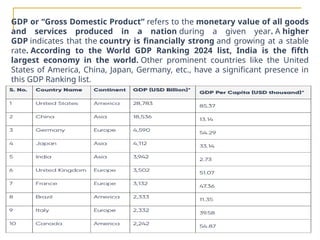
GDP or “GrossDomestic Product” refers to the monetary value of all goods
and services produced in a nation during a given year. A higher
GDP indicates that the country is financially strong and growing at a stable
rate. According to the World GDP Ranking 2024 list, India is the fifth
largest economy in the world. Other prominent countries like the United
States of America, China, Japan, Germany, etc., have a significant presence in
this GDP Ranking list.
3.
Foundations of Economics
Economics:
Is not a difficult subject.
Is a fundamental science.
Is about decision making.
Everybody makes decisions.
So everybody applies economics.
Decision making is about making a choice
from various alternatives available.
4.
Foundations of Economics
Economics is derived from the word economy.
Economy - The wealth and resources of a nation,
especially in terms of the production and
consumption of goods and services.
Economics - A social science that studies how
individuals, households, firms and governments,
make choices about allocating scarce resources
to satisfy their unlimited wants.
5.
Foundations of Economics
To produce any product we need resources:
Resources:
Land.
Labour.
Capital.
Enterprise.
All these resources are limited or scarce.
If these resources were not scarce, there
would be no need of studying economics.
6.
Foundations of Economics
Land – Common name given to all Natural
Resources. (Forests, Fisheries, Farms &
Mines. )
Labour – Common name given to all Human
Resources.
Capital – Common name given to all man –
made productive assets.
Enterprise – Common name given to all
enterprising (risk taking) skills.
7.
Basic economic problem
Scarcity - means that society has limited
resources and therefore cannot produce all
the goods and services people wish to have.
Choice
Needs and wants of human beings are
unlimited and resources to fulfill these needs
and wants are limited.
So, economics is the study of how society
manages its scarce resources.
8.
8 of 40
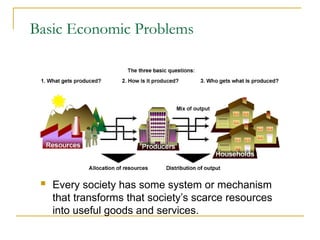
BasicEconomic Problems
Human wants are unlimited, but
resources are not.
Three basic questions must be
answered in order to understand
an economic system:
What to produce?
How to produce?
How to distribute what is produced?
9.
Basic Economic Problems
Every society has some system or mechanism
that transforms that society’s scarce resources
into useful goods and services.
10.
Basic Economic Problems
Production is the process that
transforms scarce resources into
useful goods and services.
Resources or factors of production
are the inputs into the process of
production; goods and services of
value to households are the
outputs of the process of
production.
11.
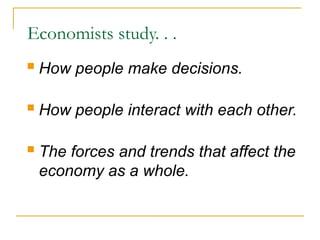
Economists study. ..
How people make decisions.
How people interact with each other.
The forces and trends that affect the
economy as a whole.
12.
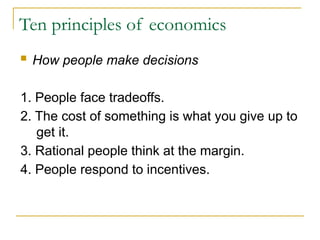
Ten principles ofeconomics
How people make decisions
1. People face tradeoffs.
2. The cost of something is what you give up to
get it.
3. Rational people think at the margin.
4. People respond to incentives.
13.
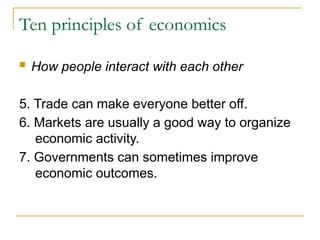
Ten principles ofeconomics
How people interact with each other
5. Trade can make everyone better off.
6. Markets are usually a good way to organize
economic activity.
7. Governments can sometimes improve
economic outcomes.
14.
Ten principles ofeconomics
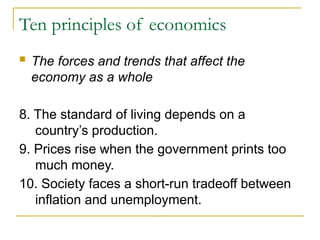
The forces and trends that affect the
economy as a whole
8. The standard of living depends on a
country’s production.
9. Prices rise when the government prints too
much money.
10. Society faces a short-run tradeoff between
inflation and unemployment.
15.
Scope of Economics
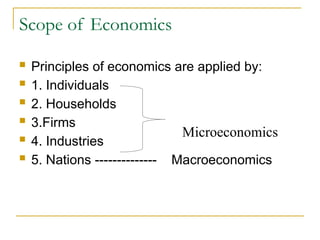
Principles of economics are applied by:
1. Individuals
2. Households
3.Firms
4. Industries
5. Nations -------------- Macroeconomics
Microeconomics
16.
MICRO ECONOMICS
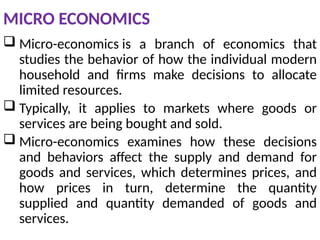
Micro-economicsis a branch of economics that
studies the behavior of how the individual modern
household and firms make decisions to allocate
limited resources.
Typically, it applies to markets where goods or
services are being bought and sold.
Micro-economics examines how these decisions
and behaviors affect the supply and demand for
goods and services, which determines prices, and
how prices in turn, determine the quantity
supplied and quantity demanded of goods and
services.
17.
MACRO ECONOMICS
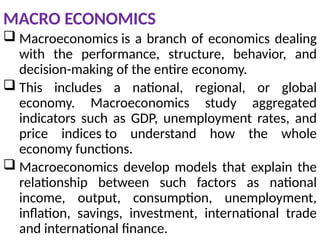
Macroeconomicsis a branch of economics dealing
with the performance, structure, behavior, and
decision-making of the entire economy.
This includes a national, regional, or global
economy. Macroeconomics study aggregated
indicators such as GDP, unemployment rates, and
price indices to understand how the whole
economy functions.
Macroeconomics develop models that explain the
relationship between such factors as national
income, output, consumption, unemployment,
inflation, savings, investment, international trade
and international finance.
18.
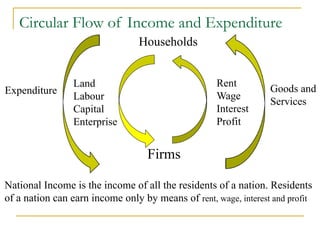
Circular Flow ofIncome and Expenditure
Households
Firms
Land
Labour
Capital
Enterprise
Rent
Wage
Interest
Profit
Goods and
Services
Expenditure
National Income is the income of all the residents of a nation. Residents
of a nation can earn income only by means of rent, wage, interest and profit
19.
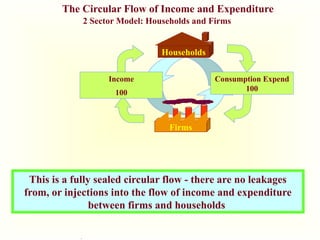
.
The Circular Flowof Income and Expenditure
2 Sector Model: Households and Firms
Households
Firms
Income
100
Consumption Expend
100
This is a fully sealed circular flow - there are no leakages
from, or injections into the flow of income and expenditure
between firms and households
20.
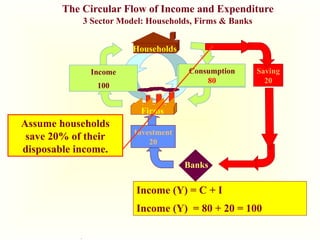
.
Households
Firms
Income
100
Consumption
Expend 100
The CircularFlow of Income and Expenditure
3 Sector Model: Households, Firms & Banks
Saving
20
Consumption
80
Banks
Investment
20
Assume households
save 20% of their
disposable income.
Income (Y) = C + I
Income (Y) = 80 + 20 = 100
21.
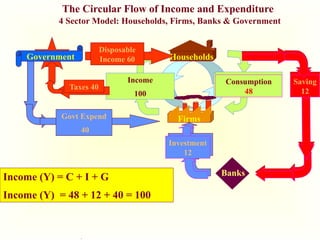
.
Households
Firms
Income
100
Consumption
Expend 100
The CircularFlow of Income and Expenditure
4 Sector Model: Households, Firms, Banks & Government
Saving
20
Consumption
80
Banks
Investment
20
Government
Taxes 40
Disposable
Income 60
Saving
12
Consumption
48
Investment
12
Govt Expend
40
Income (Y) = C + I + G
Income (Y) = 48 + 12 + 40 = 100
22.
.
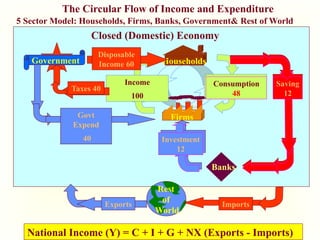
The Circular Flowof Income and Expenditure
5 Sector Model: Households, Firms, Banks, Government& Rest of World
Households
Firms
Income
100
Consumption
Expend 100
Saving
20
Consumption
80
Banks
Investment
20
Government
Taxes 40
Disposable
Income 60
Saving
12
Consumption
48
Investment
12
Govt
Expend
40
Closed (Domestic) Economy
Rest
of
World
Imports
Exports
National Income (Y) = C + I + G + NX (Exports - Imports)
23.
.
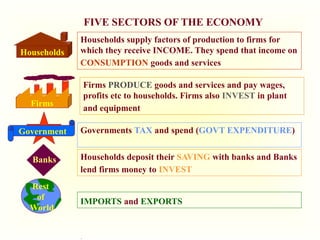
FIVE SECTORS OFTHE ECONOMY
Households
Households supply factors of production to firms for
which they receive INCOME. They spend that income on
CONSUMPTION goods and services
Firms
Firms PRODUCE goods and services and pay wages,
profits etc to households. Firms also INVEST in plant
and equipment
Government Governments TAX and spend (GOVT EXPENDITURE)
Banks Households deposit their SAVING with banks and Banks
lend firms money to INVEST
Rest
of
World
IMPORTS and EXPORTS
24.
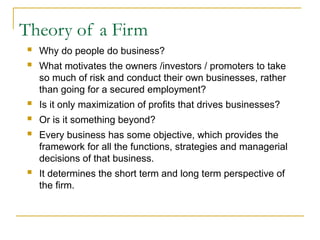
Theory of aFirm
Why do people do business?
What motivates the owners /investors / promoters to take
so much of risk and conduct their own businesses, rather
than going for a secured employment?
Is it only maximization of profits that drives businesses?
Or is it something beyond?
Every business has some objective, which provides the
framework for all the functions, strategies and managerial
decisions of that business.
It determines the short term and long term perspective of
the firm.
25.
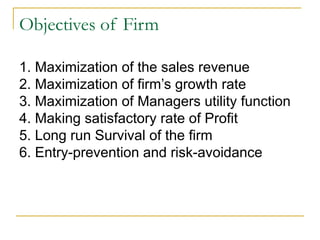
Objectives of Firm
1.Maximization of the sales revenue
2. Maximization of firm’s growth rate
3. Maximization of Managers utility function
4. Making satisfactory rate of Profit
5. Long run Survival of the firm
6. Entry-prevention and risk-avoidance
26.
26
A Firm’s Objectives
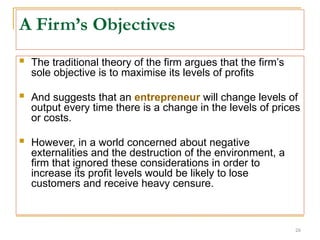
The traditional theory of the firm argues that the firm’s
sole objective is to maximise its levels of profits
And suggests that an entrepreneur will change levels of
output every time there is a change in the levels of prices
or costs.
However, in a world concerned about negative
externalities and the destruction of the environment, a
firm that ignored these considerations in order to
increase its profit levels would be likely to lose
customers and receive heavy censure.
27.
27
A Firm’s Objectives
The theory of profit maximisation can be
criticised and challenged on a number of
grounds and a number of competing
alternatives have been advanced.
28.
28
The Divorce ofOwnership and
Control
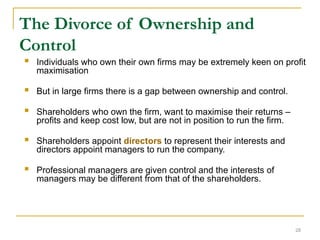
Individuals who own their own firms may be extremely keen on profit
maximisation
But in large firms there is a gap between ownership and control.
Shareholders who own the firm, want to maximise their returns –
profits and keep cost low, but are not in position to run the firm.
Shareholders appoint directors to represent their interests and
directors appoint managers to run the company.
Professional managers are given control and the interests of
managers may be different from that of the shareholders.
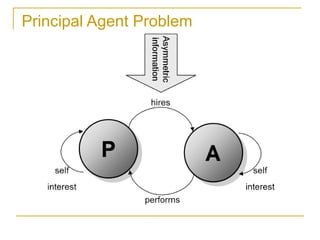
The principal–agent problem,occurs when one person or
entity (the "agent") is able to make decisions on behalf of, or
that impact, another person or entity: the "principal".
This dilemma exists in circumstances where the agent is
motivated to act in his own best interests, which are contrary
to those of the principal, and is an example of moral hazard.
Common examples of this relationship include corporate
management (agent) and shareholders (principal), or
politicians (agent) and voters (principal).
Principal Agent Problem
31.
31
The Divorce ofOwnership
and Control
Directors and managers salaries are determined more
by the size of the business than the profitability of the
firm
This may colour their actions and they may seek market
size in terms of its output, sales and employment rather
than profitability.
This would suggest that the sales growth will be an
important objective of the board of directors
32.
32
Satisficing
Means thefirm is producing satisfactorily but not
maximum profit.
Firms are more likely to satisfice than maximise, that is,
they will make what is acceptable and satisfactory rather
than achieve the optimal solution.
This means that the firm will make sufficient profits in
order to keep shareholders happy but will not waste time
and resources seeking the optimal solution.
A firm that is satisficing may produce a range of outputs
that are within its target level of profits rather than the
specific profit-maximising output.
33.
33
Sales Maximisation Theory
A further argument is that sales are the key to
market share and possibly market power,
and that growth is the key to future profits
and managerial security.
Managers may be reluctant to undertake
short-term risky ventures, even if the profits
are large as failure to achieve success could
terminate their careers.
34.
Economic Profit versusAccounting Profit
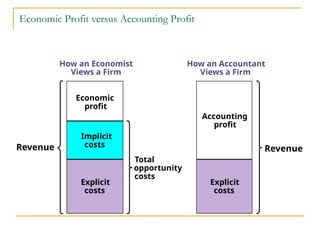
Economists measure a firm’s economic
profit as total revenue minus all the
opportunity costs (explicit and implicit).
Accountants measure the accounting profit
as the firm’s total revenue minus only the
firm’s explicit costs. In other words, they
ignore the implicit costs.
35.
Economic Profit versusAccounting
Profit
When total revenue exceeds both
explicit and implicit costs, the firm
earns economic profit.
Economic profit is smaller than
accounting profit.
36.
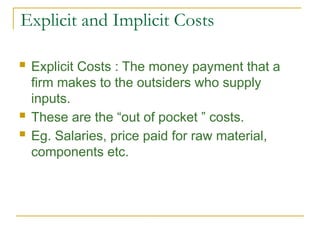
Explicit and ImplicitCosts
Explicit Costs : The money payment that a
firm makes to the outsiders who supply
inputs.
These are the “out of pocket ” costs.
Eg. Salaries, price paid for raw material,
components etc.
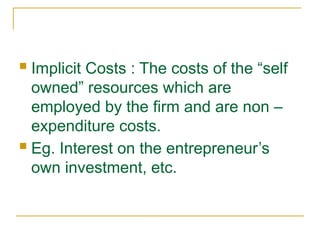
37.
Implicit Costs: The costs of the “self
owned” resources which are
employed by the firm and are non –
expenditure costs.
Eg. Interest on the entrepreneur’s
own investment, etc.
38.
Economic Profit versusAccounting Profit
Revenue
Total
opportunity
costs
How an Economist
Views a Firm
Explicit
costs
Economic
profit
Implicit
costs
Explicit
costs
Accounting
profit
How an Accountant
Views a Firm
Revenue
39.
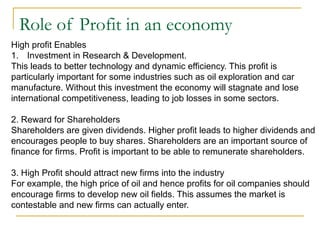
Role of Profitin an economy
High profit Enables
1. Investment in Research & Development.
This leads to better technology and dynamic efficiency. This profit is
particularly important for some industries such as oil exploration and car
manufacture. Without this investment the economy will stagnate and lose
international competitiveness, leading to job losses in some sectors.
2. Reward for Shareholders
Shareholders are given dividends. Higher profit leads to higher dividends and
encourages people to buy shares. Shareholders are an important source of
finance for firms. Profit is important to be able to remunerate shareholders.
3. High Profit should attract new firms into the industry
For example, the high price of oil and hence profits for oil companies should
encourage firms to develop new oil fields. This assumes the market is
contestable and new firms can actually enter.
40.
4. Risk BearingEconomies
Profit can be saved and provide insurance for an unexpected downturn,
such as recession or rapid appreciation in the exchange rate.
5. Tax Revenues
Governments charge corporation tax on company profits and this
provides crores of rupees of tax revenue per year.
6. Acts as Incentive
Higher profit acts as an incentive for entrepreneurs to set up a business.
Without the reward of profit, there would be less investment and less
people willing to take risks. For example, it is argued higher corporation
tax, which reduces a firms post tax income may deter inward investment.
41.
Adam Smith andthe Invisible Hand
The unobservable market force that helps
the demand and supply of goods in a free
market to reach equilibrium automatically is
the invisible hand.
The phrase invisible hand was introduced by
Adam Smith in his book 'The Wealth of
Nations'.