Changing the Way We
Develop Content for the
Web
1
2
TheYear 2000?
3
20th Century Futuristic
Bandwagons
• 1910—Electricity
• 1920—Radio
• 1940—Atomics
• 1950—Transistor
• 1960—Lasers
• 1970—Computers
• 2000—Nanotechnology
• What’s next?
4
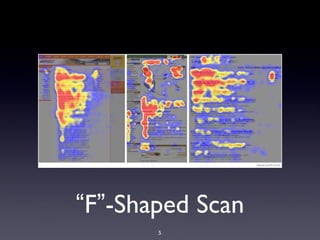
“F”-Shaped Scan
5
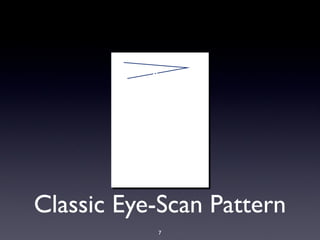
Classic Eye-Scan Pattern
6
Classic Eye-Scan Pattern
a
7
Classic Eye-Scan Pattern
a
a
8
Classic Eye-Scan Pattern
∂
a
9
Trend:Automation
• Movable type—Making shapes of letters
• Printing press—Reproducing books
• SGML—Composing content
• Wikis—Collecting data
• CMSs—Implementing templates
• What’s next?
10
Trend:Automation
• Physical to abstract
• Straightforward to subtle
• Sophisticated skills not immune
11
Content Generation
Model
• Demographic survey
• Headline generation
• Handoff to writer
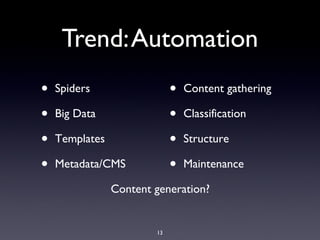
Trend:Automation
13
• Spiders • Content gathering
• Big Data • Classification
• Templates • Structure
• Metadata/CMS • Maintenance
Content generation?
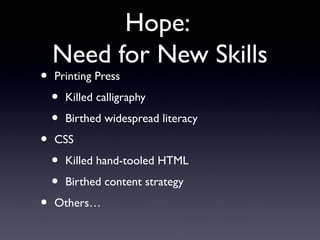
Hope:
Need for New Skills
• Printing Press
• Killed calligraphy
• Birthed widespread literacy
• CSS
• Killed hand-tooled HTML
• Birthed content strategy
• Others…
“Audience, audience,
audience”
15
“No plan survives
contact with the enemy.”
—Military Maxim
16
“No content strategy
survives contact with the
audience.”
—Me
17
Fin
18
“Bullets, bullets,
bullets.”
—Barbara Schonborn
19
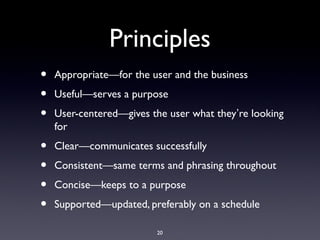
Principles
• Appropriate—for the user and the business
• Useful—serves a purpose
• User-centered—gives the user what they’re looking
for
• Clear—communicates successfully
• Consistent—same terms and phrasing throughout
• Concise—keeps to a purpose
• Supported—updated, preferably on a schedule
20
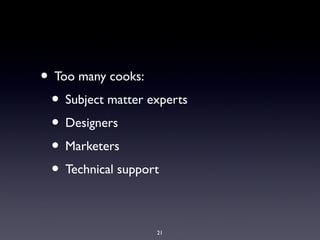
• Too many cooks:
• Subject matter experts
• Designers
• Marketers
• Technical support
21

Changing the Way We Develop Content for the Web

Editor's Notes

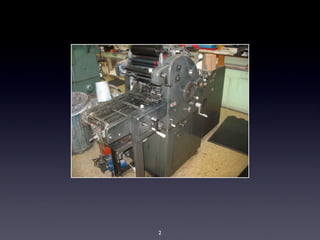
  • #3 When I attended college, one of my most useful classes was Industrial Studies 183, in which I learned about printing technology, including operating the device on this slide, an AB Dick offset duplicator. I have not touched such a printing press or duplicator since then, but the terminology of the printing business still suffuse the publishing business, and I use them every day.
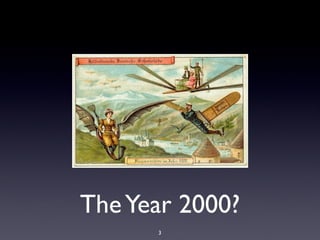
  • #4 Predicting the future is a perilous business. Case in point, this picture. It is one of a series of postcards made by a german chocolate company in 1900, predicting what the year 2000 would look like. That isn ’ t to say I wouldn ’ t mind having one of the pictured flying machines.
  • #5 Yet more perils of prediction: Bandwagons. It seems each era has its pet technology that will solve all our problems in the future.
  • #6 But all is not peril in future-prediction endeavors. For example, this is an eye-tracking heat map showing the F-shaped scan familiar to web designers.
  • #7 This is something else I learned in Industrial Studies 183: a traditional eye-scan pattern left-to-right readers tend to follow on a blank page. the next three slides show how this pattern, over multiple lines of text, easily distorts into the F-shaped scan. This demonstrates that, even as media change, the eyeballs and occipital lobes that perceive them are largely the same as they ’ ve always been. If we can stay grounded in things that don ’ t change readily, we might stand a chance of making predictions for the future that don ’ t end up being funny.
  • #11 Looking at the history that web development and content strategy in general are embedded in, I noticed a trend, and that trend is more and deeper automation of information manipulation. Movable type took a skill that involved fine motor control and took years to master and reduced it to pressing an inked die onto paper. The printing press took manuscript copying and reduced it to mechanical setup work and pulling a lever. SGML (the predecessor of XML) pioneered the separation of content from delivery, automating the repetitive work of setting recurring layout forms such as paragraphs. Wikis automated some aspects of information gathering that once required face-to-face communication. CMSs automate the implementing of document templates.
  • #12 Trends within this increasing automation: from the physical (letter forming) to the mental (data collecting), automation is being implemented for increasingly abstract, subtle, and sophisticated skills. At any of the stages of the preceding slide, no doubt you could have found people who were certain the next level skills could never be automated.
  • #13 A hint of possible things to come is in the headline-generation system used by Demand Studios for their content farm: - A spider-like program combs the web for information of interest to the target demographic. - Another program uses the information to generate headlines. - The headline list is handed off to a staff of writers.
  • #14 Expanding upon this idea, it may soon be possible for software to generate entire articles (or first drafts, at any rate.) - A spider gathers information relevant to the target topic from sites, forums, tweets, etc. - Big data analysis provides markup for the data (source, relevance, context, etc.) - An intelligent template pulls data and plugs it into an article structure (how data points fit together chronologically, which build upon others, etc.) - A CMS uses the metadata to automate updates, such as when data points are out of date, when sources update their content, etc. Could this be the future of content generation?
  • #15 Any transition involves some loss. All of the historical changes I have described here made certain skills or jobs irrelevant, but also unquestionably created substantial benefits. It ’ s worth noting that these skills live on, albeit as niche curiosities in most cases. In the case of this content auto-generation model, it is very likely that skilled writers will be needed at every stage of this process to ensure the output serves the needs of the audience. Which leads me to…
  • #16 This is the mantra of every responsible content developer.
  • #17 This is a guiding principle, not only of the military, but of every discipline that needs to be flexible.
  • #18 Combining the previous two sayings yields the following. We would be smart to keep an open mind on future developments, and be alert for ways we could adapt and fit into the emerging picture.
  • #20 This begins the extra slides that I didn ’ t use in the final presentation. Ms. Schonborn was my editing instructor at SJSU. In all the years since then, I ’ ve rarely done wrong by making bulleted lists. Just as walking is 90% of the exercise you need, creating bulleted lists is the low hanging fruit of organization and access.
  • #21 This discarded idea was to introduce some universal guiding principles for content.
  • #22 This discarded idea was to discuss the many interested parties who can influence content.