The WITS Programs: Changing the Context of Peer Victimizationwww.witsprogram.ca
What is peer victimization?Peer Victimization is the experience of being a target of a peer’s hurtful teasing and aggressive behaviorTwo subtypes of victimization:Physical Victimizationinvolves overt, direct actions aimed at causing a child bodily harm or threats of harmRelational Victimizationinvolves covert, indirect actions directed at damaging a child’s social status in the peer groupPrevalence of Peer VictimizationApproximately 1 in 10 children are persistently victimized by peersFrequency of victimization episodes is generally  higher in the early elementary gradesEpisodes of victimization become more chronic in the late elementary grades
WITS Classroom and Community Resources Emergency Services Personnel ManualUniversity Student/WITS RepresentativeWITS BooklistCurriculum for Teachers and LibrariansActivities for the Classroom and SchoolResource Pamphlets for Parents:Using Your WITS at HomeCyberbullying
What is Unique about the WITS Programs?The WITS Programs are community-based programs that:Call upon community champions including schools, families, and emergency services personnel to promote prosocial behaviors and to help children deal with peer victimizationTake a comprehensive, multi-setting approach to reducing peer victimization and enhancing social competence at the school- and classroom-levelGive a common language for children and adults to use to resolve conflicts peacefully
Indicators of SuccessWITS Program Evaluation 1 Participants & Data CollectionData were collected from eleven program schools and six control schools
Measures that were examined:Children’s ratings on:Physical VictimizationHow often are you hit by another kid at school?Relational VictimizationHow often does another kid tell lies about you to make other kids not like you anymore?
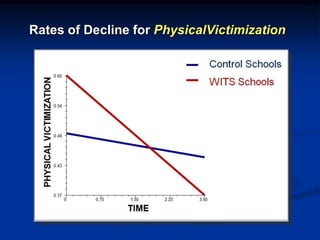
Rates of Decline for PhysicalVictimization
Rates of Decline for RelationalVictimization
Understanding the findingsChildren in the WITS schools report more victimization. Why?All of the WITS program schools had the WITS program by the time this study was under way. Higher levels of reporting may reflect the program children’s greater awareness of what victimization is and their willingness to report it or “Seek Help”.Rates of victimization reported decline over the three years of elementary school for these children in program schools but not in the control schools.
Indicators of SuccessFollow-Up StudyWITS Program Evaluation 2Goals:To assess the effectiveness of the WITS Program with a broader & more independent sample of schools
WITS Program Evaluation 2Participants & Data CollectionData were collected from six program schools and five control schools
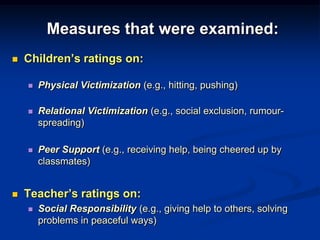
Measures that were examined:Children’s ratings on:Physical Victimization (e.g., hitting, pushing)Relational Victimization (e.g., social exclusion, rumour-spreading)Peer Support (e.g., receiving help, being cheered up by classmates)Teacher’s ratings on:Social Responsibility (e.g., giving help to others, solving problems in peaceful ways)
Average Levels of Physical & Relational VictimizationPhysical VictimizationThe rate of decline in physical victimization was significantly greater in program than control schoolsRelational VictimizationThe rate of decline in relational victimization was greater in program than control schoolsNote:Children in program schools reported higher initial levels of  physical & relational victimization, possibly due to a greater awareness of victimization created by the WITS Program
Average Levels of Peer Support & Social ResponsibilityPeer SupportLevels of peer support did not significantly differ in program and control schoolsSocial ResponsibilityTeachers of children in program schools reported higher average levels of social responsibility at each time point, compared to control schools.
ConclusionPeer Victimization can be reduced through:
multi-setting programs and multiple systems of support that include visible (uniformed) community members, school staff and parents

Changing The Social Context of Peer Victimization

  • 1.
    The WITS Programs:Changing the Context of Peer Victimizationwww.witsprogram.ca
  • 2.
    What is peervictimization?Peer Victimization is the experience of being a target of a peer’s hurtful teasing and aggressive behaviorTwo subtypes of victimization:Physical Victimizationinvolves overt, direct actions aimed at causing a child bodily harm or threats of harmRelational Victimizationinvolves covert, indirect actions directed at damaging a child’s social status in the peer groupPrevalence of Peer VictimizationApproximately 1 in 10 children are persistently victimized by peersFrequency of victimization episodes is generally higher in the early elementary gradesEpisodes of victimization become more chronic in the late elementary grades
  • 3.
    WITS Classroom andCommunity Resources Emergency Services Personnel ManualUniversity Student/WITS RepresentativeWITS BooklistCurriculum for Teachers and LibrariansActivities for the Classroom and SchoolResource Pamphlets for Parents:Using Your WITS at HomeCyberbullying
  • 4.
    What is Uniqueabout the WITS Programs?The WITS Programs are community-based programs that:Call upon community champions including schools, families, and emergency services personnel to promote prosocial behaviors and to help children deal with peer victimizationTake a comprehensive, multi-setting approach to reducing peer victimization and enhancing social competence at the school- and classroom-levelGive a common language for children and adults to use to resolve conflicts peacefully
  • 5.
    Indicators of SuccessWITSProgram Evaluation 1 Participants & Data CollectionData were collected from eleven program schools and six control schools
  • 6.
    Measures that wereexamined:Children’s ratings on:Physical VictimizationHow often are you hit by another kid at school?Relational VictimizationHow often does another kid tell lies about you to make other kids not like you anymore?
  • 7.
    Rates of Declinefor PhysicalVictimization
  • 8.
    Rates of Declinefor RelationalVictimization
  • 9.
    Understanding the findingsChildrenin the WITS schools report more victimization. Why?All of the WITS program schools had the WITS program by the time this study was under way. Higher levels of reporting may reflect the program children’s greater awareness of what victimization is and their willingness to report it or “Seek Help”.Rates of victimization reported decline over the three years of elementary school for these children in program schools but not in the control schools.
  • 10.
    Indicators of SuccessFollow-UpStudyWITS Program Evaluation 2Goals:To assess the effectiveness of the WITS Program with a broader & more independent sample of schools
  • 11.
    WITS Program Evaluation2Participants & Data CollectionData were collected from six program schools and five control schools
  • 12.
    Measures that wereexamined:Children’s ratings on:Physical Victimization (e.g., hitting, pushing)Relational Victimization (e.g., social exclusion, rumour-spreading)Peer Support (e.g., receiving help, being cheered up by classmates)Teacher’s ratings on:Social Responsibility (e.g., giving help to others, solving problems in peaceful ways)
  • 13.
    Average Levels ofPhysical & Relational VictimizationPhysical VictimizationThe rate of decline in physical victimization was significantly greater in program than control schoolsRelational VictimizationThe rate of decline in relational victimization was greater in program than control schoolsNote:Children in program schools reported higher initial levels of physical & relational victimization, possibly due to a greater awareness of victimization created by the WITS Program
  • 14.
    Average Levels ofPeer Support & Social ResponsibilityPeer SupportLevels of peer support did not significantly differ in program and control schoolsSocial ResponsibilityTeachers of children in program schools reported higher average levels of social responsibility at each time point, compared to control schools.
  • 15.
  • 16.
    multi-setting programs andmultiple systems of support that include visible (uniformed) community members, school staff and parents

Editor's Notes