The WITS Programs
    How is WITS different?
What does the research indicate?
Distinguishing
                  Features of WITS

      Typical Conflict                               WITS
    Resolution Programs                            Programs

•   Focused on improving              •   Invite participation from parents
    children’s social and emotional       and the community.
    competence.                       •   Implemented across several
•   Based on written curricula            contexts including
    delivered by classroom                schools, playgrounds and families’
    teachers.                             homes.
•   Focused on bullying behavior      •   Focused on preventing
    and the capacity to resist            victimization rather than bullying
    bullying.                             as bullies are often themselves
                                          victims.
What is Peer
                Victimization?
Peer victimization is the experience of being a target
of a peer’s hurtful teasing and aggressive behavior

Two subtypes of victimization:
1. Physical Victimization involves overt,
   direct actions aimed at causing a child
   bodily harm or threats of harm.

2. Relational Victimization involves
   covert indirect actions directed at
   damaging a child’s social status in the
   peer group.
Prevalence of Peer
             Victimization

• Approximately 1 in 10 children
  are persistently victimized by
  peers
• Frequency of victimization
  episodes is generally higher in
  the early elementary grades
• Episodes of victimization
  become more chronic in the
  late elementary grades
How is WITS
                     Different?
Provides resources to parents, the community and school staff
to promote common strategies and a consistent voice.

Resources for the Community
Manual and online resources for emergency services
personnel and university or high school athletes


Resources for Parents
Pamphlets and online resources


Resources for Teachers
Recommended book list, lesson plans and online
training
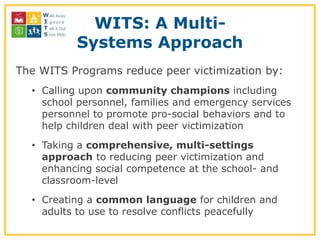
WITS: A Multi-
          Systems Approach
The WITS Programs reduce peer victimization by:
  • Calling upon community champions including
    school personnel, families and emergency services
    personnel to promote pro-social behaviors and to
    help children deal with peer victimization
  • Taking a comprehensive, multi-settings
    approach to reducing peer victimization and
    enhancing social competence at the school- and
    classroom-level
  • Creating a common language for children and
    adults to use to resolve conflicts peacefully
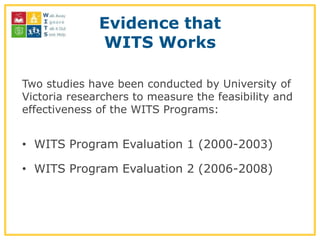
Evidence that
              WITS Works

Two studies have been conducted by University of
Victoria researchers to measure the feasibility and
effectiveness of the WITS Programs:


• WITS Program Evaluation 1 (2000-2003)

• WITS Program Evaluation 2 (2006-2008)
WITS Program
                Evaluation 1
Participants & Data Collection
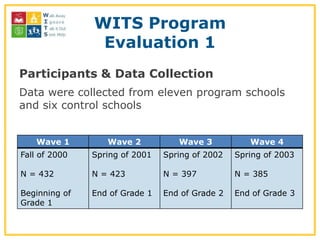
Data were collected from eleven program schools
and six control schools


    Wave 1        Wave 2           Wave 3           Wave 4
Fall of 2000   Spring of 2001   Spring of 2002   Spring of 2003

N = 432        N = 423          N = 397          N = 385

Beginning of   End of Grade 1   End of Grade 2   End of Grade 3
Grade 1
WITS Program
              Evaluation 1
       Measures that were examined

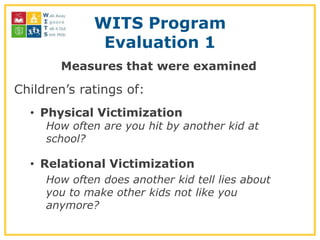
Children’s ratings of:
  • Physical Victimization
     How often are you hit by another kid at
     school?

  • Relational Victimization
     How often does another kid tell lies about
     you to make other kids not like you
     anymore?
WITS Program
                 Evaluation 1
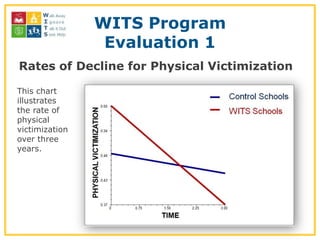
Rates of Decline for Physical Victimization

This chart
illustrates
the rate of
physical
victimization
over three
years.
WITS Program
                 Evaluation 1
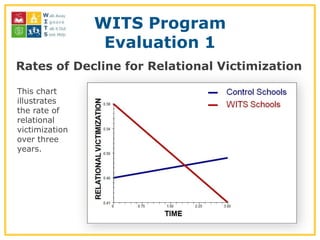
Rates of Decline for Relational Victimization

This chart
illustrates
the rate of
relational
victimization
over three
years.
WITS Program
                 Evaluation 1
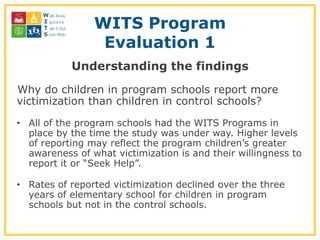
           Understanding the findings
Why do children in program schools report more
victimization than children in control schools?

• All of the program schools had the WITS Programs in
  place by the time the study was under way. Higher levels
  of reporting may reflect the program children’s greater
  awareness of what victimization is and their willingness to
  report it or “Seek Help”.

• Rates of reported victimization declined over the three
  years of elementary school for children in program
  schools but not in the control schools.
WITS Program
                   Evaluation 2
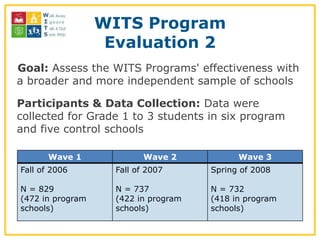
Goal: Assess the WITS Programs' effectiveness with
a broader and more independent sample of schools

Participants & Data Collection: Data were
collected for Grade 1 to 3 students in six program
and five control schools

       Wave 1              Wave 2           Wave 3
Fall of 2006        Fall of 2007      Spring of 2008

N = 829             N = 737           N = 732
(472 in program     (422 in program   (418 in program
schools)            schools)          schools)
WITS Program
                 Evaluation 2
        Measures that were examined
Children’s ratings of:
• Physical Victimization (e.g. hitting, pushing)
• Relational Victimization (e.g. exclusion, rumour-
  spreading)

• Peer Support (e.g. receiving help, being cheered up by
  classmates)


Teacher’s ratings of:
• Social Responsibility (e.g. giving help to others, solving
  problems in peaceful ways)
WITS Program
                     Evaluation 2
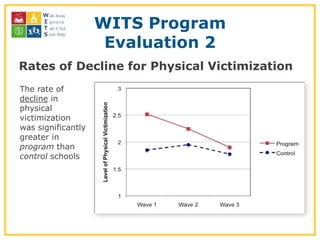
Rates of Decline for Physical Victimization
The rate of
decline in
physical
victimization
was significantly
greater in
program than
control schools
WITS Program
                   Evaluation 2
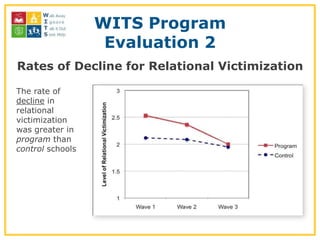
Rates of Decline for Relational Victimization

The rate of
decline in
relational
victimization
was greater in
program than
control schools
WITS Program
                   Evaluation 2
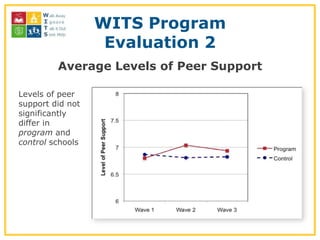
         Average Levels of Peer Support

Levels of peer
support did not
significantly
differ in
program and
control schools
WITS Program
                     Evaluation 2
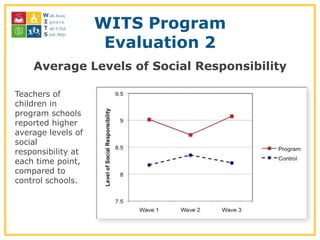
    Average Levels of Social Responsibility

Teachers of
children in
program schools
reported higher
average levels of
social
responsibility at
each time point,
compared to
control schools.
Conclusions

Peer victimization can be reduced through:
• Multi-setting programs and multiple
  systems of support that include visible
  (uniformed) community members, school
  staff and parents
• Strategies that convey consistent and
  developmentally appropriate messages for
  peaceful conflict resolution across contexts
Conclusions

   The WITS Program evaluations join a
   growing number of studies demonstrating
   the promise of involving schools, parents
   and communities in interventions to
   reduce peer victimization among
   elementary school children.
               For more info on WITS
            research & evaluation, visit:
http://www.witsprogram.ca/schools/research-evaluation/

The WITS Program: How is WITS different? What does the research indicate?

  • 1.
    The WITS Programs How is WITS different? What does the research indicate?
  • 2.
    Distinguishing Features of WITS Typical Conflict WITS Resolution Programs Programs • Focused on improving • Invite participation from parents children’s social and emotional and the community. competence. • Implemented across several • Based on written curricula contexts including delivered by classroom schools, playgrounds and families’ teachers. homes. • Focused on bullying behavior • Focused on preventing and the capacity to resist victimization rather than bullying bullying. as bullies are often themselves victims.
  • 3.
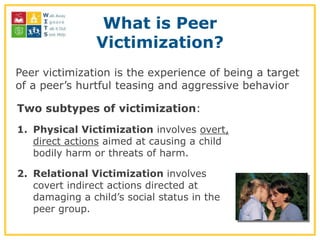
    What is Peer Victimization? Peer victimization is the experience of being a target of a peer’s hurtful teasing and aggressive behavior Two subtypes of victimization: 1. Physical Victimization involves overt, direct actions aimed at causing a child bodily harm or threats of harm. 2. Relational Victimization involves covert indirect actions directed at damaging a child’s social status in the peer group.
  • 4.
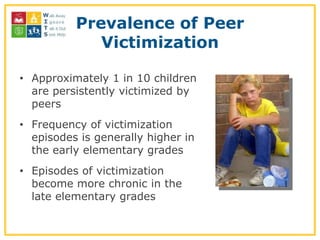
    Prevalence of Peer Victimization • Approximately 1 in 10 children are persistently victimized by peers • Frequency of victimization episodes is generally higher in the early elementary grades • Episodes of victimization become more chronic in the late elementary grades
  • 5.
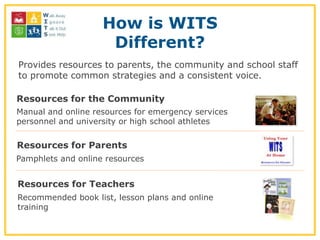
    How is WITS Different? Provides resources to parents, the community and school staff to promote common strategies and a consistent voice. Resources for the Community Manual and online resources for emergency services personnel and university or high school athletes Resources for Parents Pamphlets and online resources Resources for Teachers Recommended book list, lesson plans and online training
  • 6.
    WITS: A Multi- Systems Approach The WITS Programs reduce peer victimization by: • Calling upon community champions including school personnel, families and emergency services personnel to promote pro-social behaviors and to help children deal with peer victimization • Taking a comprehensive, multi-settings approach to reducing peer victimization and enhancing social competence at the school- and classroom-level • Creating a common language for children and adults to use to resolve conflicts peacefully
  • 7.
    Evidence that WITS Works Two studies have been conducted by University of Victoria researchers to measure the feasibility and effectiveness of the WITS Programs: • WITS Program Evaluation 1 (2000-2003) • WITS Program Evaluation 2 (2006-2008)
  • 8.
    WITS Program Evaluation 1 Participants & Data Collection Data were collected from eleven program schools and six control schools Wave 1 Wave 2 Wave 3 Wave 4 Fall of 2000 Spring of 2001 Spring of 2002 Spring of 2003 N = 432 N = 423 N = 397 N = 385 Beginning of End of Grade 1 End of Grade 2 End of Grade 3 Grade 1
  • 9.
    WITS Program Evaluation 1 Measures that were examined Children’s ratings of: • Physical Victimization How often are you hit by another kid at school? • Relational Victimization How often does another kid tell lies about you to make other kids not like you anymore?
  • 10.
    WITS Program Evaluation 1 Rates of Decline for Physical Victimization This chart illustrates the rate of physical victimization over three years.
  • 11.
    WITS Program Evaluation 1 Rates of Decline for Relational Victimization This chart illustrates the rate of relational victimization over three years.
  • 12.
    WITS Program Evaluation 1 Understanding the findings Why do children in program schools report more victimization than children in control schools? • All of the program schools had the WITS Programs in place by the time the study was under way. Higher levels of reporting may reflect the program children’s greater awareness of what victimization is and their willingness to report it or “Seek Help”. • Rates of reported victimization declined over the three years of elementary school for children in program schools but not in the control schools.
  • 13.
    WITS Program Evaluation 2 Goal: Assess the WITS Programs' effectiveness with a broader and more independent sample of schools Participants & Data Collection: Data were collected for Grade 1 to 3 students in six program and five control schools Wave 1 Wave 2 Wave 3 Fall of 2006 Fall of 2007 Spring of 2008 N = 829 N = 737 N = 732 (472 in program (422 in program (418 in program schools) schools) schools)
  • 14.
    WITS Program Evaluation 2 Measures that were examined Children’s ratings of: • Physical Victimization (e.g. hitting, pushing) • Relational Victimization (e.g. exclusion, rumour- spreading) • Peer Support (e.g. receiving help, being cheered up by classmates) Teacher’s ratings of: • Social Responsibility (e.g. giving help to others, solving problems in peaceful ways)
  • 15.
    WITS Program Evaluation 2 Rates of Decline for Physical Victimization The rate of decline in physical victimization was significantly greater in program than control schools
  • 16.
    WITS Program Evaluation 2 Rates of Decline for Relational Victimization The rate of decline in relational victimization was greater in program than control schools
  • 17.
    WITS Program Evaluation 2 Average Levels of Peer Support Levels of peer support did not significantly differ in program and control schools
  • 18.
    WITS Program Evaluation 2 Average Levels of Social Responsibility Teachers of children in program schools reported higher average levels of social responsibility at each time point, compared to control schools.
  • 19.
    Conclusions Peer victimization canbe reduced through: • Multi-setting programs and multiple systems of support that include visible (uniformed) community members, school staff and parents • Strategies that convey consistent and developmentally appropriate messages for peaceful conflict resolution across contexts
  • 20.
    Conclusions The WITS Program evaluations join a growing number of studies demonstrating the promise of involving schools, parents and communities in interventions to reduce peer victimization among elementary school children. For more info on WITS research & evaluation, visit: http://www.witsprogram.ca/schools/research-evaluation/