Marie Lynch & Bryan
Nolan
Dementia in Ireland
Time For Action
Sonas
11 May 2015
SUPPORTING PEOPLE
WITH DEMENTIA TO DIE
WELL
Presentation Outline
1. Irish Hospice Foundation
2. Dying at home with Dementia
3. Communicating on end of life with
people with dementia
IHF Vision & Mission
Our Vision is that no one should face
death or bereavement without the care and
support they need
Our Mission is to achieve dignity, comfort
and choice for all people facing the end of
life. We do this by addressing, with our
partners and the public, critical matters
relating to death, dying and bereavement in
Ireland
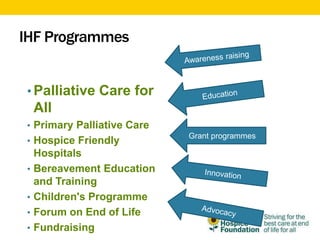
IHF Programmes
• Palliative Care for
All
• Primary Palliative Care
• Hospice Friendly
Hospitals
• Bereavement Education
and Training
• Children's Programme
• Forum on End of Life
• Fundraising
Grant programmes
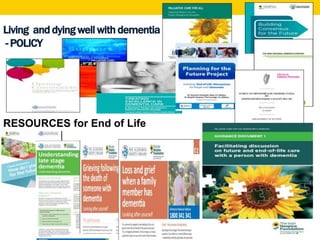
Living and dying well with dementia
- POLICY
RESOURCES for End of Life
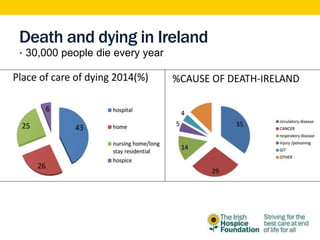
Death and dying in Ireland
• 30,000 people die every year
Dying at home with
dementia in Ireland1. WHAT THE LITERATURE SAYS
2. WHAT WE KNOW FROM THE
IHF NURSES FOR NIGHT CARE
SERVICE
3. IRISH INITIATIVES
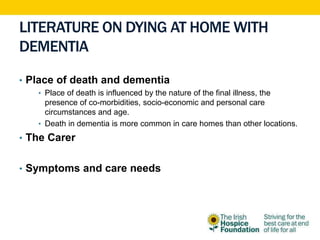
LITERATURE ON DYING AT HOME WITH
DEMENTIA
• Place of death and dementia
• Place of death is influenced by the nature of the final illness, the
presence of co-morbidities, socio-economic and personal care
circumstances and age.
• Death in dementia is more common in care homes than other locations.
• The Carer
• Symptoms and care needs
0
10
20
30
40
50
60
70
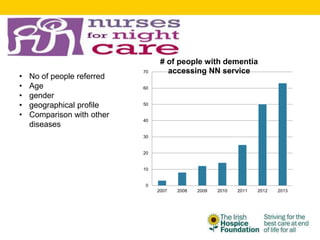
2007 2008 2009 2010 2011 2012 2013
# of people with dementia
accessing NN service
• No of people referred
• Age
• gender
• geographical profile
• Comparison with other
diseases
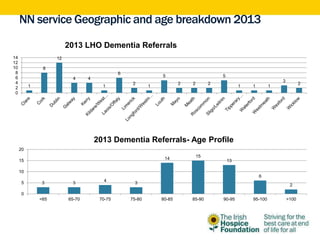
NN service Geographic and age breakdown 2013
1
8
12
4 4
1
6
2
1
5
2 2 2
5
1 1 1
3
2
0
2
4
6
8
10
12
14
2013 LHO Dementia Referrals
3 3
4
3
14
15
13
6
2
0
5
10
15
20
<65 65-70 70-75 75-80 80-85 85-90 90-95 95-100 >100
2013 Dementia Referrals- Age Profile
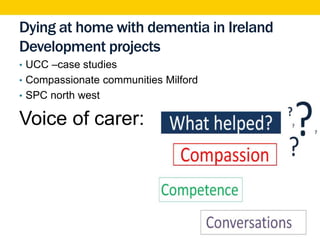
Dying at home with dementia in Ireland
Development projects
• UCC –case studies
• Compassionate communities Milford
• SPC north west
Voice of carer:
Presentation Outline
1. Irish Hospice Foundation
2. Dying at home with Dementia
3. Communicating on end of life with
people with dementia
Education and development
 The context for the Irish Hospice Foundation’s work is
end-of-life care
 The focus of Changing Minds is end-of-life care for
people with dementia
 So what is that, in ‘real life’?
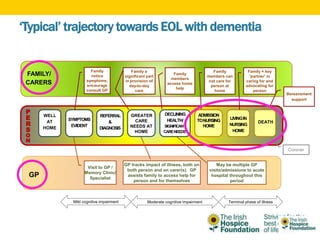
‘Typical’ trajectory towards EOL with dementia
P
E
R
S
O
N
FAMILY/
CARERS
GP
WELL
AT
HOME
REFERRAL
&
DIAGNOSIS
LIVINGIN
NURSING
HOME
DEATH
SYMPTOMS
EVIDENT
DECLINING
HEALTH/
SIGNIFICANT
CARENEEDS
ADMISSION
TONURSING
HOME
Family
notice
symptoms;
encourage
consult GP
Visit to GP /
Memory Clinic/
Specialist
Family a
significant part
in provision of
day-to-day
care
GP tracks impact of illness, both on
both person and on carer(s). GP
assists family to access help for
person and for themselves
Family
members
access home
help
Bereavement
support
Mild cognitive impairment Moderate cognitive impairment Terminal phase of illness
Family
members can
not care for
person at
home
Family = key
‘partner’ in
caring for and
advocating for
person
May be multiple GP
visits/admissions to acute
hospital throughout this
period
Coroner
GREATER
CARE
NEEDS AT
HOME
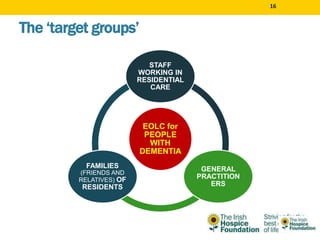
The ‘target groups’
EOLC for
PEOPLE
WITH
DEMENTIA
STAFF
WORKING IN
RESIDENTIAL
CARE
GENERAL
PRACTITION
ERS
FAMILIES
(FRIENDS AND
RELATIVES) OF
RESIDENTS
16
17
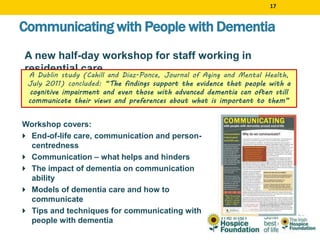
Workshop covers:
 End-of-life care, communication and person-
centredness
 Communication – what helps and hinders
 The impact of dementia on communication
ability
 Models of dementia care and how to
communicate
 Tips and techniques for communicating with
people with dementia
Communicating with People with Dementia
A new half-day workshop for staff working in
residential care
A Dublin study (Cahill and Diaz-Ponce, Journal of Aging and Mental Health,
July 2011) concluded: “The findings support the evidence that people with a
cognitive impairment and even those with advanced dementia can often still
communicate their views and preferences about what is important to them”
Targeted education and training
18
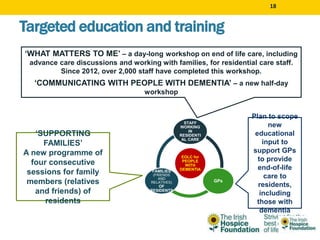
EOLC for
PEOPLE
WITH
DEMENTIA
STAFF
WORKING
IN
RESIDENTI
AL CARE
GPs
FAMILIES
(FRIENDS
AND
RELATIVES)
OF
RESIDENTS
‘WHAT MATTERS TO ME’ – a day-long workshop on end of life care, including
advance care discussions and working with families, for residential care staff.
Since 2012, over 2,000 staff have completed this workshop.
‘COMMUNICATING WITH PEOPLE WITH DEMENTIA’ – a new half-day
workshop
‘SUPPORTING
FAMILIES’
A new programme of
four consecutive
sessions for family
members (relatives
and friends) of
residents
Plan to scope
new
educational
input to
support GPs
to provide
end-of-life
care to
residents,
including
those with
dementia
Supporting Families
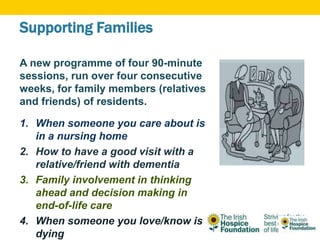
A new programme of four 90-minute
sessions, run over four consecutive
weeks, for family members (relatives
and friends) of residents.
1. When someone you care about is
in a nursing home
2. How to have a good visit with a
relative/friend with dementia
3. Family involvement in thinking
ahead and decision making in
end-of-life care
4. When someone you love/know is
dying
The rationale for trying to communicate
better with people with dementia
• To be human is to relate. Communication is core to good relationships.
Good relationship is core to person-centredness.
• It’s good practice and ensures better quality of care.
• Communication is central to palliative and end-of-life care, hence the IHF’s
interest in this issue. Good communication helps people to live well and to
die well.
• When you focus on the person rather than the disease you can find
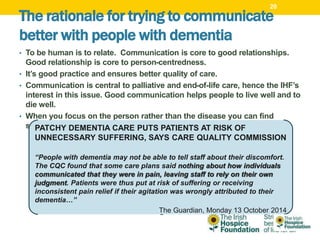
strengths ,abilities and a historyPATCHY DEMENTIA CARE PUTS PATIENTS AT RISK OF
UNNECESSARY SUFFERING, SAYS CARE QUALITY COMMISSION
“People with dementia may not be able to tell staff about their discomfort.
The CQC found that some care plans said nothing about how individuals
communicated that they were in pain, leaving staff to rely on their own
judgment. Patients were thus put at risk of suffering or receiving
inconsistent pain relief if their agitation was wrongly attributed to their
dementia…”
The Guardian, Monday 13 October 2014
20
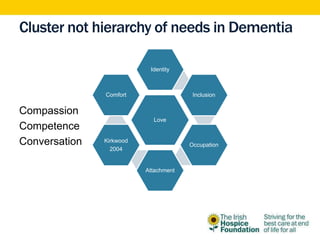
Cluster not hierarchy of needs in Dementia
Compassion
Competence
Conversation
Love
Identity
Inclusion
Occupation
Attachment
Kirkwood
2004
Comfort
Communication is key to meeting needs
People living with dementia are still people – mothers,
fathers, sisters, friends, partners. They still have basic
human needs and preferences and a desire to express
and make decisions for themselves.
“Not knowing where I am
doesn’t mean I don’t know
what I like.”
(Mozley et al., 1999)
22
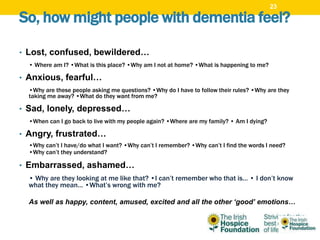
So, how might people with dementia feel?
23
• Lost, confused, bewildered…
• Where am I? •What is this place? •Why am I not at home? •What is happening to me?
• Anxious, fearful…
•Why are these people asking me questions? •Why do I have to follow their rules? •Why are they
taking me away? •What do they want from me?
• Sad, lonely, depressed…
•When can I go back to live with my people again? •Where are my family? • Am I dying?
• Angry, frustrated…
•Why can’t I have/do what I want? •Why can’t I remember? •Why can’t I find the words I need?
•Why can’t they understand?
• Embarrassed, ashamed…
• Why are they looking at me like that? •I can’t remember who that is… • I don’t know
what they mean… •What’s wrong with me?
As well as happy, content, amused, excited and all the other ‘good’ emotions…
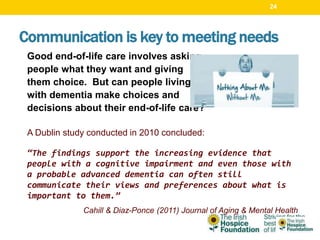
Good end-of-life care involves asking
people what they want and giving
them choice. But can people living
with dementia make choices and
decisions about their end-of-life care?
A Dublin study conducted in 2010 concluded:
“The findings support the increasing evidence that
people with a cognitive impairment and even those with
a probable advanced dementia can often still
communicate their views and preferences about what is
important to them.”
Cahill & Diaz-Ponce (2011) Journal of Aging & Mental Health
Communication is key to meeting needs
24
Communication in practice
• In reality, communication in any circumstance can easily go wrong.
• One of the biggest challenges in any interpersonal communication is
making wrong or unchecked assumptions…
• Common assumptions that have been made in the past about
people with dementia include:
• “That’s not my mother in there…”
• They’re beyond reach, ‘just an empty shell’
• Their dependence makes them children again
• ‘Once they’re gone, they’re gone’
• All people with dementia are pretty much the same
• They don’t or can’t know what they want
• Their dementia is the single source of all their problems and behaviours
25
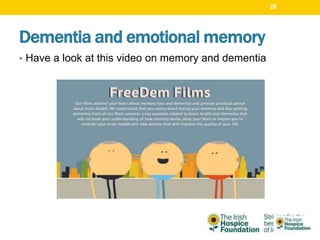
Dementia and emotional memory
• Have a look at this video on memory and dementia
26
Tips: communicating with someone with
dementiaBefore you speak – attending to the issues of
relationship and environment
• How you are will affect them. If you are rushing or
feeling stressed, take a moment to calm yourself.
Try to be patient, grounded and positive.
• Make sure you have the person's full attention. Use their name.
Try to make eye contact and to be at the same level (sitting,
standing) as they are.
• It may be useful to have an idea for a particular topic ready to
avoid awkward silence at the start. Also, it can be useful to have
pictorial cues or other visual communication aids and apps to
hand.
• Make sure that the person can see and hear you clearly. See if
you can minimise any competing noises or background activity if
they are getting in the way.
27
How to speak with someone who has dementia
• Speak clearly and calmly and at a slightly slower pace.
• Avoid speaking sharply or raising your voice
• Use short, simple sentences. Don’t ask double-ended
questions.
• Show respect. This person is an adult – don’t infantilise them.
• Try to laugh together about misunderstandings and mistakes –
it can help.
• Try to include the person in conversations with others.
Being included can reduce their feelings of exclusion
and isolation.
28
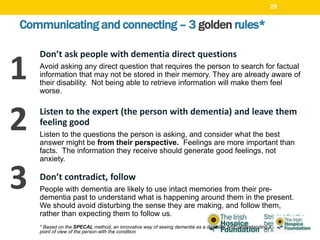
Communicating and connecting – 3 golden rules*
Don’t ask people with dementia direct questions
Avoid asking any direct question that requires the person to search for factual
information that may not be stored in their memory. They are already aware of
their disability. Not being able to retrieve information will make them feel
worse.
Listen to the expert (the person with dementia) and leave them
feeling good
Listen to the questions the person is asking, and consider what the best
answer might be from their perspective. Feelings are more important than
facts. The information they receive should generate good feelings, not
anxiety.
Don’t contradict, follow
People with dementia are likely to use intact memories from their pre-
dementia past to understand what is happening around them in the present.
We should avoid disturbing the sense they are making, and follow them,
rather than expecting them to follow us.
* Based on the SPECAL method, an innovative way of seeing dementia as a disability and understanding it from the
point of view of the person with the condition
1
2
3
29
IN
CONCLUSI
ON
Acknowledgements
- People with dementia and their families
- IHF Programme team
- Atlantic Philanthropies
For more information
Marie Lynch Bryan Nolan
Marie.lynch@hospicefoundation.ie
Bryan.Nolan@hospicefoundation.ie
Ph: 01 679 3188
living to the end
THANK YOU

Changing Minds Programme

  • 1.
    Marie Lynch &Bryan Nolan Dementia in Ireland Time For Action Sonas 11 May 2015 SUPPORTING PEOPLE WITH DEMENTIA TO DIE WELL
  • 2.
    Presentation Outline 1. IrishHospice Foundation 2. Dying at home with Dementia 3. Communicating on end of life with people with dementia
  • 3.
    IHF Vision &Mission Our Vision is that no one should face death or bereavement without the care and support they need Our Mission is to achieve dignity, comfort and choice for all people facing the end of life. We do this by addressing, with our partners and the public, critical matters relating to death, dying and bereavement in Ireland
  • 4.
    IHF Programmes • PalliativeCare for All • Primary Palliative Care • Hospice Friendly Hospitals • Bereavement Education and Training • Children's Programme • Forum on End of Life • Fundraising Grant programmes
  • 5.
    Living and dyingwell with dementia - POLICY RESOURCES for End of Life
  • 6.
    Death and dyingin Ireland • 30,000 people die every year
  • 7.
    Dying at homewith dementia in Ireland1. WHAT THE LITERATURE SAYS 2. WHAT WE KNOW FROM THE IHF NURSES FOR NIGHT CARE SERVICE 3. IRISH INITIATIVES
  • 8.
    LITERATURE ON DYINGAT HOME WITH DEMENTIA • Place of death and dementia • Place of death is influenced by the nature of the final illness, the presence of co-morbidities, socio-economic and personal care circumstances and age. • Death in dementia is more common in care homes than other locations. • The Carer • Symptoms and care needs
  • 9.
    0 10 20 30 40 50 60 70 2007 2008 20092010 2011 2012 2013 # of people with dementia accessing NN service • No of people referred • Age • gender • geographical profile • Comparison with other diseases
  • 10.
    NN service Geographicand age breakdown 2013 1 8 12 4 4 1 6 2 1 5 2 2 2 5 1 1 1 3 2 0 2 4 6 8 10 12 14 2013 LHO Dementia Referrals 3 3 4 3 14 15 13 6 2 0 5 10 15 20 <65 65-70 70-75 75-80 80-85 85-90 90-95 95-100 >100 2013 Dementia Referrals- Age Profile
  • 11.
    Dying at homewith dementia in Ireland Development projects • UCC –case studies • Compassionate communities Milford • SPC north west Voice of carer:
  • 12.
    Presentation Outline 1. IrishHospice Foundation 2. Dying at home with Dementia 3. Communicating on end of life with people with dementia
  • 13.
    Education and development The context for the Irish Hospice Foundation’s work is end-of-life care  The focus of Changing Minds is end-of-life care for people with dementia  So what is that, in ‘real life’?
  • 14.
    ‘Typical’ trajectory towardsEOL with dementia P E R S O N FAMILY/ CARERS GP WELL AT HOME REFERRAL & DIAGNOSIS LIVINGIN NURSING HOME DEATH SYMPTOMS EVIDENT DECLINING HEALTH/ SIGNIFICANT CARENEEDS ADMISSION TONURSING HOME Family notice symptoms; encourage consult GP Visit to GP / Memory Clinic/ Specialist Family a significant part in provision of day-to-day care GP tracks impact of illness, both on both person and on carer(s). GP assists family to access help for person and for themselves Family members access home help Bereavement support Mild cognitive impairment Moderate cognitive impairment Terminal phase of illness Family members can not care for person at home Family = key ‘partner’ in caring for and advocating for person May be multiple GP visits/admissions to acute hospital throughout this period Coroner GREATER CARE NEEDS AT HOME
  • 15.
    The ‘target groups’ EOLCfor PEOPLE WITH DEMENTIA STAFF WORKING IN RESIDENTIAL CARE GENERAL PRACTITION ERS FAMILIES (FRIENDS AND RELATIVES) OF RESIDENTS 16
  • 16.
    17 Workshop covers:  End-of-lifecare, communication and person- centredness  Communication – what helps and hinders  The impact of dementia on communication ability  Models of dementia care and how to communicate  Tips and techniques for communicating with people with dementia Communicating with People with Dementia A new half-day workshop for staff working in residential care A Dublin study (Cahill and Diaz-Ponce, Journal of Aging and Mental Health, July 2011) concluded: “The findings support the evidence that people with a cognitive impairment and even those with advanced dementia can often still communicate their views and preferences about what is important to them”
  • 17.
    Targeted education andtraining 18 EOLC for PEOPLE WITH DEMENTIA STAFF WORKING IN RESIDENTI AL CARE GPs FAMILIES (FRIENDS AND RELATIVES) OF RESIDENTS ‘WHAT MATTERS TO ME’ – a day-long workshop on end of life care, including advance care discussions and working with families, for residential care staff. Since 2012, over 2,000 staff have completed this workshop. ‘COMMUNICATING WITH PEOPLE WITH DEMENTIA’ – a new half-day workshop ‘SUPPORTING FAMILIES’ A new programme of four consecutive sessions for family members (relatives and friends) of residents Plan to scope new educational input to support GPs to provide end-of-life care to residents, including those with dementia
  • 18.
    Supporting Families A newprogramme of four 90-minute sessions, run over four consecutive weeks, for family members (relatives and friends) of residents. 1. When someone you care about is in a nursing home 2. How to have a good visit with a relative/friend with dementia 3. Family involvement in thinking ahead and decision making in end-of-life care 4. When someone you love/know is dying
  • 19.
    The rationale fortrying to communicate better with people with dementia • To be human is to relate. Communication is core to good relationships. Good relationship is core to person-centredness. • It’s good practice and ensures better quality of care. • Communication is central to palliative and end-of-life care, hence the IHF’s interest in this issue. Good communication helps people to live well and to die well. • When you focus on the person rather than the disease you can find strengths ,abilities and a historyPATCHY DEMENTIA CARE PUTS PATIENTS AT RISK OF UNNECESSARY SUFFERING, SAYS CARE QUALITY COMMISSION “People with dementia may not be able to tell staff about their discomfort. The CQC found that some care plans said nothing about how individuals communicated that they were in pain, leaving staff to rely on their own judgment. Patients were thus put at risk of suffering or receiving inconsistent pain relief if their agitation was wrongly attributed to their dementia…” The Guardian, Monday 13 October 2014 20
  • 20.
    Cluster not hierarchyof needs in Dementia Compassion Competence Conversation Love Identity Inclusion Occupation Attachment Kirkwood 2004 Comfort
  • 21.
    Communication is keyto meeting needs People living with dementia are still people – mothers, fathers, sisters, friends, partners. They still have basic human needs and preferences and a desire to express and make decisions for themselves. “Not knowing where I am doesn’t mean I don’t know what I like.” (Mozley et al., 1999) 22
  • 22.
    So, how mightpeople with dementia feel? 23 • Lost, confused, bewildered… • Where am I? •What is this place? •Why am I not at home? •What is happening to me? • Anxious, fearful… •Why are these people asking me questions? •Why do I have to follow their rules? •Why are they taking me away? •What do they want from me? • Sad, lonely, depressed… •When can I go back to live with my people again? •Where are my family? • Am I dying? • Angry, frustrated… •Why can’t I have/do what I want? •Why can’t I remember? •Why can’t I find the words I need? •Why can’t they understand? • Embarrassed, ashamed… • Why are they looking at me like that? •I can’t remember who that is… • I don’t know what they mean… •What’s wrong with me? As well as happy, content, amused, excited and all the other ‘good’ emotions…
  • 23.
    Good end-of-life careinvolves asking people what they want and giving them choice. But can people living with dementia make choices and decisions about their end-of-life care? A Dublin study conducted in 2010 concluded: “The findings support the increasing evidence that people with a cognitive impairment and even those with a probable advanced dementia can often still communicate their views and preferences about what is important to them.” Cahill & Diaz-Ponce (2011) Journal of Aging & Mental Health Communication is key to meeting needs 24
  • 24.
    Communication in practice •In reality, communication in any circumstance can easily go wrong. • One of the biggest challenges in any interpersonal communication is making wrong or unchecked assumptions… • Common assumptions that have been made in the past about people with dementia include: • “That’s not my mother in there…” • They’re beyond reach, ‘just an empty shell’ • Their dependence makes them children again • ‘Once they’re gone, they’re gone’ • All people with dementia are pretty much the same • They don’t or can’t know what they want • Their dementia is the single source of all their problems and behaviours 25
  • 25.
    Dementia and emotionalmemory • Have a look at this video on memory and dementia 26
  • 26.
    Tips: communicating withsomeone with dementiaBefore you speak – attending to the issues of relationship and environment • How you are will affect them. If you are rushing or feeling stressed, take a moment to calm yourself. Try to be patient, grounded and positive. • Make sure you have the person's full attention. Use their name. Try to make eye contact and to be at the same level (sitting, standing) as they are. • It may be useful to have an idea for a particular topic ready to avoid awkward silence at the start. Also, it can be useful to have pictorial cues or other visual communication aids and apps to hand. • Make sure that the person can see and hear you clearly. See if you can minimise any competing noises or background activity if they are getting in the way. 27
  • 27.
    How to speakwith someone who has dementia • Speak clearly and calmly and at a slightly slower pace. • Avoid speaking sharply or raising your voice • Use short, simple sentences. Don’t ask double-ended questions. • Show respect. This person is an adult – don’t infantilise them. • Try to laugh together about misunderstandings and mistakes – it can help. • Try to include the person in conversations with others. Being included can reduce their feelings of exclusion and isolation. 28
  • 28.
    Communicating and connecting– 3 golden rules* Don’t ask people with dementia direct questions Avoid asking any direct question that requires the person to search for factual information that may not be stored in their memory. They are already aware of their disability. Not being able to retrieve information will make them feel worse. Listen to the expert (the person with dementia) and leave them feeling good Listen to the questions the person is asking, and consider what the best answer might be from their perspective. Feelings are more important than facts. The information they receive should generate good feelings, not anxiety. Don’t contradict, follow People with dementia are likely to use intact memories from their pre- dementia past to understand what is happening around them in the present. We should avoid disturbing the sense they are making, and follow them, rather than expecting them to follow us. * Based on the SPECAL method, an innovative way of seeing dementia as a disability and understanding it from the point of view of the person with the condition 1 2 3 29
  • 29.
  • 30.
    Acknowledgements - People withdementia and their families - IHF Programme team - Atlantic Philanthropies For more information Marie Lynch Bryan Nolan Marie.lynch@hospicefoundation.ie Bryan.Nolan@hospicefoundation.ie Ph: 01 679 3188
  • 31.
    living to theend THANK YOU

Editor's Notes

  • #2 The aim of this programme is to enable more older people, particularly those with dementia, to live and to die with dignity at home (as most would prefer) or in residential care settings Acknowledge all IHF staff working on this programme and AP funding
  • #4 Not for profit / all funds for our programme from fundraising …. Pay tribute to Mary Redmond New strategic plan this year
  • #10  Very limited evidence concerning place of death and preferences for place of death in dementia THE Carer’s physical health wasn’t as important as mental health and determination to care for the patient. They looked at professional help, the carers found that the Old Age Psychiatrist was the only one of benefit, GPs not very helpful. Need for informed, educated useful carers – no benefit from help from neighbours etc. Hospice care in the home leads to longer time at home. Psychiatric care in the home leads to longer time at home. Burden on the caregiver and likelihood of using an institution based on psychiatric symptoms.  Symptoms, Medication, Problems:   Feeding a central issue in end of life care. Little benefit from opiates. Most useful: Anti-psychotics, anti-depressants, antibiotics. People dying at home with dementia are significantly older than people dying at home with other illnesses. People at home with Dementia are more dependent in terms of ADLs than people dying with other illnesses. More prone to incontinence and cough. Lower rate of nausea, vomiting. Non-cancer pulmonary disease is common cause of death. (aspiration pneumonia) Less likely to have a feeding tube at home. Conflicting reports on more or less pain at home. Less likely to have pressure ulcers at home.
  • #16 This is a very general mapping of the path of someone who gets dementia in older age – we meet the person (centre line of diagram) first when they are well at home and family life is normal and there is but minimal contact with the GP, assuming the person is otherwise well. Then the person starts showing symptoms, we begin to see the family getting more concerned and directly involved, and – of course, the GP becomes much more a ‘player’ in the life of this person. And this pattern of person-family-GP continues, even after the person is admitted to and resident in a nursing home, at which point the staff of that home become critical too. Helps to explain why we have targeted family (relatives and friends), staff of residential care, and GPs as these are the critical carers in the “typical” path or someone with dementia ( In the future, if more people are living at home with dementia we may also be targeting home care staff? ) Reminder that end of life does not just begin at the end of this path – for us in the IHF, good end-of-life care requires being able to live to the end. Another key project of our Changing Minds programme is helping people to ‘Think Ahead’, to have discussions with key people at a time when we are hale and hearty and in fully possession of our faculties about how we would like our care to be when we are older/more dependent.
  • #17 Ultimately, the outcome we are hoping for, through our Changing Minds education and training, is to improve the quality of end-of-life care for people with dementia. We are working with targeting these three broad groups of people to help deliver that outcome.
  • #18 Introducing new CwPwD workshop – communication is central to end-of-life care (see text box about people with dementia being able to communicate their end-of-life preferences). Dementia does not change this – we still need to communicate and we retain our personhood. This half-day workshop is largely presentation-based, with a few reflection exercises. Accompanied by a Prompt for Good Practice (see picture) available from our website
  • #19 So, how are we trying to meet the education/training needs of these three different groups? For staff WHAT MATTERS TO ME – we have been delivering this for the past few years and have passed the 2000 mark in terms of numbers of participants across the country. COMMUNICATING WITH PEOPLE WITH DEMENTIA – I’ll say a bit more about this one in a moment For Families SUPPORTING FAMILIES – a new four-session programme for families of residents – I’ll say a bit more about this one in the next slide For GPs Possibly our hardest ‘audience’, but our intention is to develop some educational intervention designed to help GPs to deliver end of life care to residents of nursing homes/long-stay settings. THE DETAILS OF THIS PROGRAMME HAVE YET TO BE DECIDED…
  • #20 A new offering that many of you may not know about… Four consecutive sessions for family members, loved ones, partners, friends, etc. Gentle session – largely presentation-based with one or two points of reflection and discussion. Hoping to begin trialling this in the next week or so.
  • #21 4 mins Communication is key to good person-centred care. It is also central to good palliative and end-of-life care – useful to remind people that end-of-life can be said to begin when we become aware of our mortality! Given that dementia is a terminal condition, all dementia care could be said to be end-of-life care. It’s also a way of mitigating risk (for example, suffering unnecessary pain) and ensuring quality. The quote from the Guardian newspaper arises from increased scrutiny by the Care Quality Commission (the UK equivalent of HIQA) following findings of very poor care in Mid-Staffordshire Hospital (2013). It is, of course, entirely possible that the same could be said of people with dementia in Ireland.
  • #22 Kitwood suggested that needs are better understood as a cluster very closely connected and functioning as a kind of cooperative. He noted that the overlapping needs include identity, comfort, occupation, inclusion and attachment. At the core is love. He recognised that these same needs are present in all human beings but due to vulnerability and lack of ability to pursue higher level needs they are more evident in persons with dementia.
  • #23 3 mins. A reminder that, even with dementia, we are still ourselves (personhood). The disease is difficult enough - none of us want to be any more disempowered by how we are treated because we have the disease. Our personhood, our sense of self, can be unnecessarily diminished by others who might ignore us, move past us, disempower us, patronise us, make decisions for us, etc. Full reference: Mozley, C.G., Huxley, P., Sutcliffe, C., Bagley, H, Burns, A., Huxley, P., & Cordingley, L. (1999). ‘Not knowing here I am doesn’t mean I don’t know what I like’: Cognitive impairment and quality of life responses in elderly people. International Journal of Geriatric 860 Psychiatry, 14, 776–783.
  • #24 5 mins Following from the last slide (symptoms associated with dementia), just show the title of this and give people a chance to name some of the emotions they think people with dementia might feel… If you have a flipchart to hand, make a note of them. If no flipchart, just reinforce the named emotions by repeating them back to the group. Then disclose the list above.
  • #25 5 mins. A core aspect of good end of life care for everybody is that people would have an opportunity to express their preferences for their own care and that these preferences would inform clinical decisions. So it is really important that this principle should govern end of life care for people with dementia too. Suzanne Cahill & Ana M. Diaz-Ponce, Trinity College, Dublin (2011) ‘I hate having nobody here. I’d like to know where they all are’: can qualitative research detect differences in quality of life among nursing home residents with different levels of cognitive impairment? Aging & Mental Health July Vol 15(5): pp. 562-72
  • #26 6 mins. Communication, in reality, often goes wrong (it’s one of the most frequently-mentioned issues in business and management, so it can go wrong at all levels of organisation and society!). Making assumptions is a common problem – even if everything in the model (previous slide) goes well, wrong assumptions can make for very poor communication. If appropriate, check with the group for what assumptions have been made in the past about residential care staff, or about carers? Then show them some of the common assumptions that have been made about people with dementia. They may be able to add other false assumptions that are made about people with dementia.
  • #27 5 mins Play the FreeDem video clip ‘Can your memory go completely?’ Film is available from www.freedemliving.com (it’s the first video on the home page) or from vimeo (http://vimeo.com/77213313) FreeDem Films were developed by the NEIL Programme at the Institute of Neuroscience, Trinity College, Dublin with support from GENIO. FreeDem Films aim to increase public and professional awareness around the important issues of memory loss and brain health while at the same time tackle the stigma and fear that can accompany a diagnosis of Alzheimer's disease and dementia in later life. Each film addresses a question relating to brain health or dementia that older people identified as important. While designed and scripted to be entertaining and engaging, each film is informed by and grounded in science and clinical evidence. We hope that you enjoy your FreeDem Films experience and share the films with your family and friends. The key message in this video is that people retain an emotional memory. So it is worthwhile treating them with kindness and with care as this is what will be remembered. It can also be very good to remind family members of this too – how many family members have finished a visit with their parent with dementia feeling as if the visit was pointless or, even worse, totally dispiriting because their parent couldn’t remember who they were? Their parent can remember the feelings associated with the visit.
  • #28 5 mins. This is the first of four slides of tips drawn from different sources. This one begins with getting our own preparation right, understanding the key concept that we affect them and that they affect us. If we go in full of task-orientation, busyness, hustle and bustle, we will probably generate a degree of anxiety and agitation in the person we are talking to – this applies to any interaction but especially one with someone with dementia who is likely to be more attuned to feelings than content or context. This slide picks up on some of the key ideas presented by the model earlier – including getting the attention of the person, paying attention to relationship and context and reducing environmental interference.
  • #29 10 mins. Before presenting these tips, stop after revealing the title (How to speak to someone who has dementia) and, time permitting, invite the group to reflect on their own experience of working with people with dementia and to generate some of their own thoughts on what works well when speaking with someone who has dementia. Capture thoughts on flipchart.
  • #30 5 mins. These Golden Rules run contrary to commonsense communication styles which are taken for granted when dementia is not an issue. They are counter-intuitive and those of us without dementia need to develop this entirely new set of communication skills. The Contented Dementia Trust, formerly known as SPECAL, is an independent UK charitable organisation with an innovative approach to the care of people with dementia. Their mission is to ensure that the person with dementia, and their carer, can lead as close an approximation to the life they would have wished to live without dementia. Webpage URL: www.contenteddementiatrust.org
  • #31 More awareness of end of life care needs of people with dementia – HCP and Public More resources to support good end of life care So that People with dementia in Ireland will have a better quality of life at the end of their life
  • #33 1 min.