Management Skills
• Interpersonalskills.
• Communication and motivation.
• Organisation and delegation.
• Forward planning and strategic thinking.
• Problem solving and decision-making.
• Commercial awareness.
• Mentoring.
3.
Management Tasks
• Motivatingteam members. This managerial
task is part of the leadership function of
management. ...
• Hiring. ...
• Training. ...
• Answering questions. ...
• Making predictions. ...
• Strategic planning. ...
• Delegating work. ...
• Facilitating performance evaluations.
2. Inputs andOutputs of a Good Leader
Inputs of a Good Leader Outputs of a Good Leader
• Empathy
• Good communication skills
• Ability to analyse
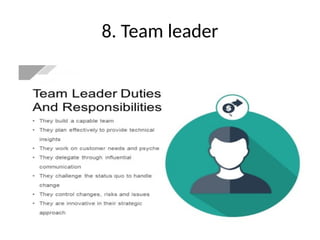
• Team leader
• Ability to see the big picture
• Assertiveness
• Management qualification
• Be able to make decisions
• Plan, organise, lead, control
• Ability to develop and use global
strategic skills
• Ability to manage change and
transition
• Ability to manage cultural and
workplace diversity
• Ability to design and function in
flexible organisation cultures
• Ability to work with others and in
teams
• Ability to communicate (using
emotional intelligence)
• Ability to learn and transfer knowledge
in an organisation
Team’s Performance
• Tiethe team's results to the organization's goals.
• Begin with the team's customers and the work process the team
follows to satisfy their needs.
• Measure both team and individual performance.
• Shoot for verifiability. Don't try to measure everything using numbers.
• Train the team to create its own measures.
• Productivity measures.
• Establish Metrics for Each Team Project. A manager cannot determine
if a project has been successful without predefined metrics. ...
• Meet Often with the Team. ...
• Talk to Other Managers at the Company. ...
• Meet One on One with Team Members. ...
16.
10. Importance ofinvolving team members
in goal setting process
• Involving your team in goal setting, rather than just telling them
what to do, can offer several benefits.
• It can increase their motivation and commitment, as they feel
more ownership and responsibility for their goals.
• Additionally, it can improve their performance and productivity, as
they have a clear direction and focus for their work.
• Furthermore, it can enhance their learning and development, as
they identify their strengths and areas for improvement, and seek
feedback and support.
• Finally, it can foster their collaboration and communication, as
they align their goals with the team and organizational objectives,
and share their progress and challenges
17.
Performance Standard, goaland objective
• Performance standards are used to measure if goals and
objectives have been met.
• Performance standards state the expectations for employee roles
and responsibilities as they relate to the agency’s mission, vision,
and values. Performance standards are written, measurable
criteria against which an employee’s effort is evaluated to
determine the level of functioning. They define how good is ‘good
enough.’
• In other words, a standard constitutes a yardstick against which
to evaluate progress. Performance standards should be presented
to an employee at the beginning of every rating period.
18.
Performance standards shouldbe: objective, measurable,
realistic,
and stated clearly in writing
• Quality addresses how well the work is performed. Quality refers to accuracy,
appearance, usefulness, or effectiveness.
• Quantity addresses how much work is produced. A quantity measure can be
expressed as a general result to be achieved.
• Timeliness addresses how quickly, when or by what date the work is produced.
The most common error made in setting timeliness standards is to allow no
margin for error. As with other standards, timeliness standards should be set
realistically in view of other performance requirements and needs of the
organization.
• Cost-Effectiveness addresses dollar savings to the [agency] or working within a
budget. Standards that address cost-effectiveness should be based on specific
resource levels (money, personnel, or time) that generally can be documented
and measured in [the agency’s] annual fiscal year budgets. Cost-effectiveness
standards may include such aspects of performance as maintaining or reducing unit costs, reducing
the time it takes to produce a product or service, or reducing waste.
• Process and product performance
12. Task andprocess roles of team members
Task Process
• Information giver
• Information seeker
• Initiator
• Opinion giver
• Elaborator
• Consensus seeker
• Clarifier
• Encouraging
• Listening
• Harmonising
• Yielding
• Accepting
• Supporting
21.
13. Behaviours thatcould hamper efficiency
in a team
• Dominator
• Avoider
• Blocker
• Self-confessor
22.
Strategies to improveand minimise the
impact on your team
• Counselling
• Give your team members ownership.
• Ensure proper communication.
• Identify your team's strengths and weaknesses.
• Team building activities.
• Use a project management tool.
• Wholesome work environment.
• Reward your employees.
• Give them room to work.




![Performance standards should be: objective, measurable,
realistic,
and stated clearly in writing
• Quality addresses how well the work is performed. Quality refers to accuracy,
appearance, usefulness, or effectiveness.
• Quantity addresses how much work is produced. A quantity measure can be
expressed as a general result to be achieved.
• Timeliness addresses how quickly, when or by what date the work is produced.
The most common error made in setting timeliness standards is to allow no
margin for error. As with other standards, timeliness standards should be set
realistically in view of other performance requirements and needs of the
organization.
• Cost-Effectiveness addresses dollar savings to the [agency] or working within a
budget. Standards that address cost-effectiveness should be based on specific
resource levels (money, personnel, or time) that generally can be documented
and measured in [the agency’s] annual fiscal year budgets. Cost-effectiveness
standards may include such aspects of performance as maintaining or reducing unit costs, reducing
the time it takes to produce a product or service, or reducing waste.
• Process and product performance](https://image.slidesharecdn.com/buildinghighperformanceteams-250327123036-8c0edc6a/85/Building-High-Performance-Teams-GGMpptx-18-320.jpg)