1.
2.
3.
4.
5.
6.
7.
8.

9.
10.

11.
12.
13.
14.
15.
16.
17.
18.
19.

20.
21.
22.

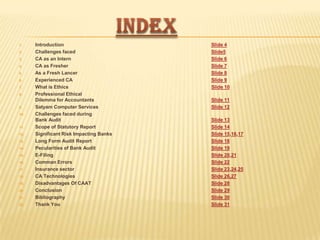
Introduction
Challenges faced
CA as an Intern
CA as Fresher
As a Fresh Lancer
Experienced CA
What is Ethics
Professional Ethical
Dilemma for Accountants
Satyam Computer Services
Challenges faced during
Bank Audit
Scope of Statutory Report
Significant Risk Impacting Banks
Long Form Audit Report
Pecularities of Bank Audit
E-Filing
Comman Errors
Insurance sector
CA Technologies
Disadvantages Of CAAT
Conclusion
Bibliography
Thank You

Slide 4
Slide5
Slide 6
Slide 7
Slide 8
Slide 9
Slide 10
Slide 11
Slide 12
Slide 13
Slide 14
Slide 15,16,17
Slide 18
Slide 19
Slide 20,21
Slide 22
Slide 23,24,25
Slide 26,27
Slide 28
Slide 29
Slide 30
Slide 31






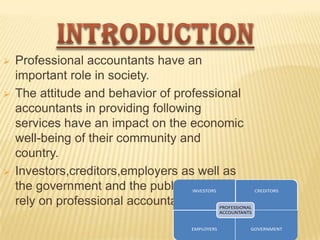
Professional accountants have an
important role in society.
The attitude and behavior of professional
accountants in providing following
services have an impact on the economic
well-being of their community and
country.
Investors,creditors,employers as well as
the government and the public at large
rely on professional accountants.
INVESTORS

CREDITORS

PROFESSIONAL
ACCOUNTANTS

EMPLOYERS

GOVERNMENT
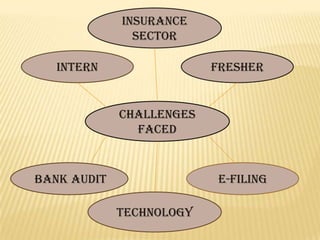
Insurance
sector
intern

fresher

Challenges
faced

Bank audit

E-Filing
Technology







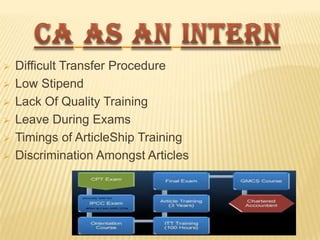
Difficult Transfer Procedure
Low Stipend
Lack Of Quality Training
Leave During Exams
Timings of ArticleShip Training
Discrimination Amongst Articles







As an Employee
CAs today face top challenge from MBAs who
are good at communication skills, know
finance and economy better.
MBAs have an edge over CAs in many fields
as the Indian economy is much closer to the
world economy now.
There is a need for CAs to take leadership by
virtue of their quality and have knowledge
over other matters besides accounting.
As a freelancer








Starting a practice is not possible for new graduates.
This is not an era when a CA can practice on his own.
Clients give work to specialized CAs who have earned
a good reputation and are experienced. However, this
is not possible for a fresh CA.
A fresher cannot hire a team for direct taxes, indirect
taxes, Sebi, NRIs etc as it requires a huge
investment.
The rising demand for CAs in the corporate sector will
result in competition between CAs in the job market.
Any CA who wants to remain successful has to
constantly upgrade his skills.
Following are the fields where
experienced CA face challenges : Ethics
 Bank Audit
 E-Filing
 Insurance sector
 Technology
Ethics is concerned with how
attitude,
action
Or
decision
determined as
„right or wrong or good or evil‟

an
is

ICAI Code of Ethics – key principles
Integrity
 Objectivity
 Professional Competence and Due Care
 Professional Behaviour
 Confidentiality








•



Monthly financial targets not likely to be met
and/or possible breach of bank covenants.
Possible manipulation of figures in financial
accounts
Pressure from client/bank if an audit report
needs to be signed today and there is
insufficient information to know whether
accounts show a true and fair view
Whether to make people aware of conflicts of
interest in business dealings.

Case study
“Double your money”.
“Silence is golden”.






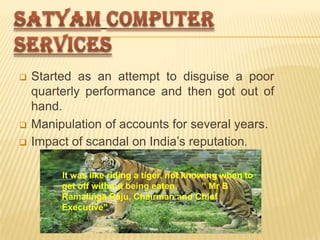
Started as an attempt to disguise a poor
quarterly performance and then got out of
hand.
Manipulation of accounts for several years.
Impact of scandal on India’s reputation.
“

It was like riding a tiger, not knowing when to
get off without being eaten.
” Mr B
Ramalinga Raju, Chairman and Chief
Executive”
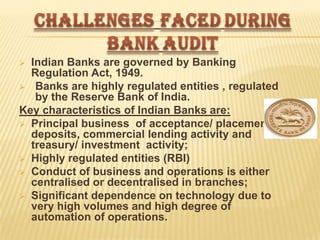
Indian Banks are governed by Banking
Regulation Act, 1949.
 Banks are highly regulated entities , regulated
by the Reserve Bank of India.
Key characteristics of Indian Banks are:
 Principal business of acceptance/ placement of
deposits, commercial lending activity and
treasury/ investment activity;
 Highly regulated entities (RBI)
 Conduct of business and operations is either
centralised or decentralised in branches;
 Significant dependence on technology due to
very high volumes and high degree of
automation of operations.








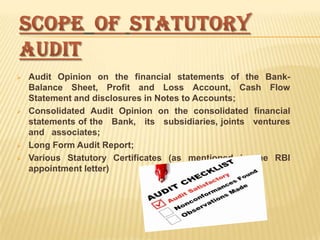
Audit Opinion on the financial statements of the BankBalance Sheet, Profit and Loss Account, Cash Flow
Statement and disclosures in Notes to Accounts;
Consolidated Audit Opinion on the consolidated financial
statements of the Bank, its subsidiaries, joints ventures
and associates;
Long Form Audit Report;
Various Statutory Certificates (as mentioned in the RBI
appointment letter)
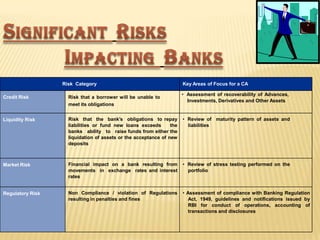
Risk Category

Key Areas of Focus for a CA
• Assessment of recoverability of Advances,
Investments, Derivatives and Other Assets

Credit Risk

Risk that a borrower will be unable to
meet its obligations

Liquidity Risk

Risk that the bank‟s obligations to repay
liabilities or fund new loans exceeds
the
banks ability to raise funds from either the
liquidation of assets or the acceptance of new
deposits

• Review of maturity pattern of assets and
liabilities

Market Risk

Financial impact on a bank resulting from
movements in exchange rates and interest
rates

• Review of stress testing performed on the
portfolio

Regulatory Risk

Non Compliance / violation of Regulations
resulting in penalties and fines

• Assessment of compliance with Banking Regulation
Act, 1949, guidelines and notifications issued by
RBI for conduct of operations, accounting of
transactions and disclosures
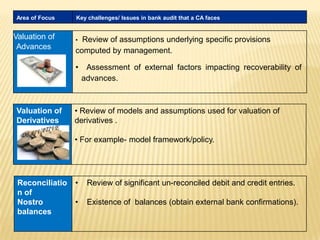
Area of Focus

Valuation of
Advances

Key challenges/ Issues in bank audit that a CA faces

Review of assumptions underlying specific provisions
computed by management.
•

•

Valuation of
Derivatives

Assessment of external factors impacting recoverability of
advances.

• Review of models and assumptions used for valuation of
derivatives .
• For example- model framework/policy.

Reconciliatio
n of
Nostro
balances

•

Review of significant un-reconciled debit and credit entries.

•

Existence of balances (obtain external bank confirmations).
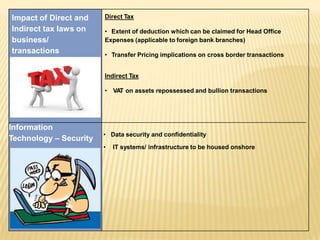
Impact of Direct and
Indirect tax laws on
business/
transactions

Direct Tax
• Extent of deduction which can be claimed for Head Office
Expenses (applicable to foreign bank branches)
• Transfer Pricing implications on cross border transactions

Indirect Tax
• VAT on assets repossessed and bullion transactions

Information
Technology – Security

• Data security and confidentiality
•

IT systems/ infrastructure to be housed onshore








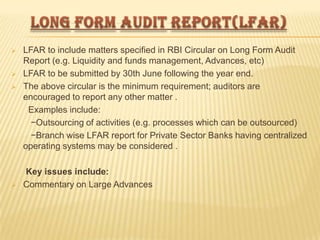
LFAR to include matters specified in RBI Circular on Long Form Audit
Report (e.g. Liquidity and funds management, Advances, etc)
LFAR to be submitted by 30th June following the year end.
The above circular is the minimum requirement; auditors are
encouraged to report any other matter .
Examples include:
−Outsourcing of activities (e.g. processes which can be outsourced)
−Branch wise LFAR report for Private Sector Banks having centralized
operating systems may be considered .
Key issues include:
Commentary on Large Advances
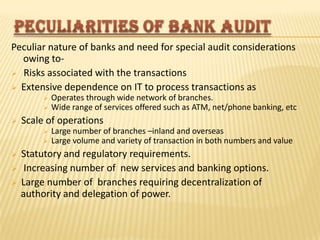
Peculiar nature of banks and need for special audit considerations
owing to Risks associated with the transactions
 Extensive dependence on IT to process transactions as





Scale of operations







Operates through wide network of branches.
Wide range of services offered such as ATM, net/phone banking, etc
Large number of branches –inland and overseas
Large volume and variety of transaction in both numbers and value

Statutory and regulatory requirements.
Increasing number of new services and banking options.
Large number of branches requiring decentralization of
authority and delegation of power.





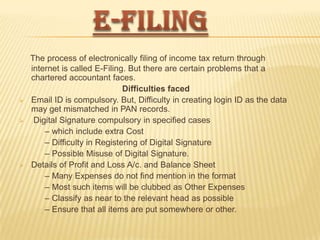
The process of electronically filing of income tax return through
internet is called E-Filing. But there are certain problems that a
chartered accountant faces.
Difficulties faced
Email ID is compulsory. But, Difficulty in creating login ID as the data
may get mismatched in PAN records.
Digital Signature compulsory in specified cases
– which include extra Cost
– Difficulty in Registering of Digital Signature
– Possible Misuse of Digital Signature.
Details of Profit and Loss A/c. and Balance Sheet
– Many Expenses do not find mention in the format
– Most such items will be clubbed as Other Expenses
– Classify as near to the relevant head as possible
– Ensure that all items are put somewhere or other.




Heavy Reliance on Software – any Mistake
in development of software can create
problems
– Example : Set off of unabsorbed losses
– Effect of Refund Received - which is to
be
repaid due to increase in tax liability
in 148 Return.
One needs to be careful
– while filing in correct and accurate details
– specially email address, mobile nos. etc.
–Exact amount paid in each challan should
be mentioned –
Rounding off leads to mismatches.









Entering Exempt Allowances in Salary
income.
Incomplete entries or lack of proper cross
linking of various schedules.
Mistake in mentioning date of payment of tax
– the date of payment of Tax deducted by
deduct or shouldn't be mentioned.
Non filing of details of Block of Assets in Sch.
DEP.
Entering negative value in Such DEP.
Negative value indicates that the Block has
ceased to exist and so depreciation will be
computed at NIL.
The present scenario of the Indian
insurance market has brought in new
challenges as well as opportunities.

Chartered Accountants are known for
their keen analytical ability, excellent
technical skills and meticulous working style. Their vast experience
in professional interaction with people bears testimony to their
effective communication and interpersonal skills. Chartered Accountants, as
professionals, can emerge as insurance specialists.
Chartered Accountants can face challenges in the field of risk management,
insurance management, insurance marketing, underwriting management,
claims management, loss adjustment, re-insurance, product development and
many allied areas such as:
Arbitration
• Arbitration is a procedure of settlement of dispute between two parties by an
authority called arbitrator.
• A CA would have to utilize his technical and analytical skills to assist the parties to a
dispute either as a counsel or he may decide on the dispute of the parties as an
Arbitrator.

New Product Creation
• CAs need to render appropriate customer understanding to design appropriate
products, determine price correctly and increase profitability.
• They challenge is to advise on premiums, rebates and the like for products unique
to specific industries/companies and suggest risk -mitigating measures.
Policy Owner Services
• It has been accepted fact that notable new insurance business are generated through
the existing policy holders and the principles of Customer Relationship Management
which professionals like CAs have to understand and provide their skilled knowledge
accordingly.

Underwriting
• Underwriting, a core insurance activity, involves classification of risks on the basis of
risk characteristics so that insured parties pay premiums proportionate to the risk.
• CAs would have to analyze the information to determine the right prospect and also
have to see and secure profitable business to the insurer.

Claims Administration
• This is a structured method of managing claims right from the initial report to the final
payment or appeal - typically following an existing system.
•Claims processing is highly data intensive and time sensitive.
•For this CAs would have to provide their services in effective management and
understand the system and interact with the concerned parties.
TECHNOLOGIES
The challenge faced in technology used by CA: Living in an “always-connected” world is one
of the major challenges that confronts CA
 Young people today-the Facebook
generation-interacts in a virtual world
 They expect the same transparency and
opportunity to share in their professional lives
which they are bound to continue lifelong.
 They have no inclination or patience for face
to face interaction and in getting their task
done.
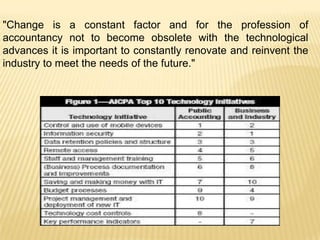
"Change is a constant factor and for the profession of
accountancy not to become obsolete with the technological
advances it is important to constantly renovate and reinvent the
industry to meet the needs of the future."


An accounting system, whether it be manual or
computer-based, is subject to mismanagement,
error, fraud, and general abuse. Hence to
combat these potential problems there is a need
for controls and auditing in a computerized
setup. But, every coin has two faces. CAAT is
subject to certain disadvantages as follows:



As a Audit Software
Embedded Program Code
Online Program Testing









The Chartered Accountancy forum identified a no. of existing
challenges based on future outcome that are desirable for sector as
a whole but what matters is to overcome those problems in the
dynamic environment where cut throat competition implements the
principle of " Survival of the Fittest " -:
Recognize the path to success by adapting to the changes and
acquiring skills to work with future environment challenges
influenced by technological and other challenges.
The role of CA shall be changed from the past historical focus to
more proactive role where finance professionals, strategic thinkers
& value adders will succeed.
CA's are required to seek continual professional education relating
to their areas of specialization and members in small business will
need to broaden their technology skills.
Challenging roles of a ca

Challenging roles of a ca

  • 2.
    1. 2. 3. 4. 5. 6. 7. 8. 9. 10. 11. 12. 13. 14. 15. 16. 17. 18. 19. 20. 21. 22. Introduction Challenges faced CA asan Intern CA as Fresher As a Fresh Lancer Experienced CA What is Ethics Professional Ethical Dilemma for Accountants Satyam Computer Services Challenges faced during Bank Audit Scope of Statutory Report Significant Risk Impacting Banks Long Form Audit Report Pecularities of Bank Audit E-Filing Comman Errors Insurance sector CA Technologies Disadvantages Of CAAT Conclusion Bibliography Thank You Slide 4 Slide5 Slide 6 Slide 7 Slide 8 Slide 9 Slide 10 Slide 11 Slide 12 Slide 13 Slide 14 Slide 15,16,17 Slide 18 Slide 19 Slide 20,21 Slide 22 Slide 23,24,25 Slide 26,27 Slide 28 Slide 29 Slide 30 Slide 31
  • 3.
       Professional accountants havean important role in society. The attitude and behavior of professional accountants in providing following services have an impact on the economic well-being of their community and country. Investors,creditors,employers as well as the government and the public at large rely on professional accountants. INVESTORS CREDITORS PROFESSIONAL ACCOUNTANTS EMPLOYERS GOVERNMENT
  • 4.
  • 5.
          Difficult Transfer Procedure LowStipend Lack Of Quality Training Leave During Exams Timings of ArticleShip Training Discrimination Amongst Articles
  • 6.
        As an Employee CAstoday face top challenge from MBAs who are good at communication skills, know finance and economy better. MBAs have an edge over CAs in many fields as the Indian economy is much closer to the world economy now. There is a need for CAs to take leadership by virtue of their quality and have knowledge over other matters besides accounting.
  • 7.
    As a freelancer      Startinga practice is not possible for new graduates. This is not an era when a CA can practice on his own. Clients give work to specialized CAs who have earned a good reputation and are experienced. However, this is not possible for a fresh CA. A fresher cannot hire a team for direct taxes, indirect taxes, Sebi, NRIs etc as it requires a huge investment. The rising demand for CAs in the corporate sector will result in competition between CAs in the job market. Any CA who wants to remain successful has to constantly upgrade his skills.
  • 8.
    Following are thefields where experienced CA face challenges : Ethics  Bank Audit  E-Filing  Insurance sector  Technology
  • 9.
    Ethics is concernedwith how attitude, action Or decision determined as „right or wrong or good or evil‟ an is ICAI Code of Ethics – key principles Integrity  Objectivity  Professional Competence and Due Care  Professional Behaviour  Confidentiality 
  • 10.
        •   Monthly financial targetsnot likely to be met and/or possible breach of bank covenants. Possible manipulation of figures in financial accounts Pressure from client/bank if an audit report needs to be signed today and there is insufficient information to know whether accounts show a true and fair view Whether to make people aware of conflicts of interest in business dealings. Case study “Double your money”. “Silence is golden”.
  • 11.
       Started as anattempt to disguise a poor quarterly performance and then got out of hand. Manipulation of accounts for several years. Impact of scandal on India’s reputation. “ It was like riding a tiger, not knowing when to get off without being eaten. ” Mr B Ramalinga Raju, Chairman and Chief Executive”
  • 12.
    Indian Banks aregoverned by Banking Regulation Act, 1949.  Banks are highly regulated entities , regulated by the Reserve Bank of India. Key characteristics of Indian Banks are:  Principal business of acceptance/ placement of deposits, commercial lending activity and treasury/ investment activity;  Highly regulated entities (RBI)  Conduct of business and operations is either centralised or decentralised in branches;  Significant dependence on technology due to very high volumes and high degree of automation of operations. 
  • 13.
        Audit Opinion onthe financial statements of the BankBalance Sheet, Profit and Loss Account, Cash Flow Statement and disclosures in Notes to Accounts; Consolidated Audit Opinion on the consolidated financial statements of the Bank, its subsidiaries, joints ventures and associates; Long Form Audit Report; Various Statutory Certificates (as mentioned in the RBI appointment letter)
  • 14.
    Risk Category Key Areasof Focus for a CA • Assessment of recoverability of Advances, Investments, Derivatives and Other Assets Credit Risk Risk that a borrower will be unable to meet its obligations Liquidity Risk Risk that the bank‟s obligations to repay liabilities or fund new loans exceeds the banks ability to raise funds from either the liquidation of assets or the acceptance of new deposits • Review of maturity pattern of assets and liabilities Market Risk Financial impact on a bank resulting from movements in exchange rates and interest rates • Review of stress testing performed on the portfolio Regulatory Risk Non Compliance / violation of Regulations resulting in penalties and fines • Assessment of compliance with Banking Regulation Act, 1949, guidelines and notifications issued by RBI for conduct of operations, accounting of transactions and disclosures
  • 15.
    Area of Focus Valuationof Advances Key challenges/ Issues in bank audit that a CA faces Review of assumptions underlying specific provisions computed by management. • • Valuation of Derivatives Assessment of external factors impacting recoverability of advances. • Review of models and assumptions used for valuation of derivatives . • For example- model framework/policy. Reconciliatio n of Nostro balances • Review of significant un-reconciled debit and credit entries. • Existence of balances (obtain external bank confirmations).
  • 16.
    Impact of Directand Indirect tax laws on business/ transactions Direct Tax • Extent of deduction which can be claimed for Head Office Expenses (applicable to foreign bank branches) • Transfer Pricing implications on cross border transactions Indirect Tax • VAT on assets repossessed and bullion transactions Information Technology – Security • Data security and confidentiality • IT systems/ infrastructure to be housed onshore
  • 17.
        LFAR to includematters specified in RBI Circular on Long Form Audit Report (e.g. Liquidity and funds management, Advances, etc) LFAR to be submitted by 30th June following the year end. The above circular is the minimum requirement; auditors are encouraged to report any other matter . Examples include: −Outsourcing of activities (e.g. processes which can be outsourced) −Branch wise LFAR report for Private Sector Banks having centralized operating systems may be considered . Key issues include: Commentary on Large Advances
  • 18.
    Peculiar nature ofbanks and need for special audit considerations owing to Risks associated with the transactions  Extensive dependence on IT to process transactions as    Scale of operations      Operates through wide network of branches. Wide range of services offered such as ATM, net/phone banking, etc Large number of branches –inland and overseas Large volume and variety of transaction in both numbers and value Statutory and regulatory requirements. Increasing number of new services and banking options. Large number of branches requiring decentralization of authority and delegation of power.
  • 19.
       The process ofelectronically filing of income tax return through internet is called E-Filing. But there are certain problems that a chartered accountant faces. Difficulties faced Email ID is compulsory. But, Difficulty in creating login ID as the data may get mismatched in PAN records. Digital Signature compulsory in specified cases – which include extra Cost – Difficulty in Registering of Digital Signature – Possible Misuse of Digital Signature. Details of Profit and Loss A/c. and Balance Sheet – Many Expenses do not find mention in the format – Most such items will be clubbed as Other Expenses – Classify as near to the relevant head as possible – Ensure that all items are put somewhere or other.
  • 20.
      Heavy Reliance onSoftware – any Mistake in development of software can create problems – Example : Set off of unabsorbed losses – Effect of Refund Received - which is to be repaid due to increase in tax liability in 148 Return. One needs to be careful – while filing in correct and accurate details – specially email address, mobile nos. etc. –Exact amount paid in each challan should be mentioned – Rounding off leads to mismatches.
  • 21.
          Entering Exempt Allowancesin Salary income. Incomplete entries or lack of proper cross linking of various schedules. Mistake in mentioning date of payment of tax – the date of payment of Tax deducted by deduct or shouldn't be mentioned. Non filing of details of Block of Assets in Sch. DEP. Entering negative value in Such DEP. Negative value indicates that the Block has ceased to exist and so depreciation will be computed at NIL.
  • 22.
    The present scenarioof the Indian insurance market has brought in new challenges as well as opportunities. Chartered Accountants are known for their keen analytical ability, excellent technical skills and meticulous working style. Their vast experience in professional interaction with people bears testimony to their effective communication and interpersonal skills. Chartered Accountants, as professionals, can emerge as insurance specialists. Chartered Accountants can face challenges in the field of risk management, insurance management, insurance marketing, underwriting management, claims management, loss adjustment, re-insurance, product development and many allied areas such as:
  • 23.
    Arbitration • Arbitration isa procedure of settlement of dispute between two parties by an authority called arbitrator. • A CA would have to utilize his technical and analytical skills to assist the parties to a dispute either as a counsel or he may decide on the dispute of the parties as an Arbitrator. New Product Creation • CAs need to render appropriate customer understanding to design appropriate products, determine price correctly and increase profitability. • They challenge is to advise on premiums, rebates and the like for products unique to specific industries/companies and suggest risk -mitigating measures.
  • 24.
    Policy Owner Services •It has been accepted fact that notable new insurance business are generated through the existing policy holders and the principles of Customer Relationship Management which professionals like CAs have to understand and provide their skilled knowledge accordingly. Underwriting • Underwriting, a core insurance activity, involves classification of risks on the basis of risk characteristics so that insured parties pay premiums proportionate to the risk. • CAs would have to analyze the information to determine the right prospect and also have to see and secure profitable business to the insurer. Claims Administration • This is a structured method of managing claims right from the initial report to the final payment or appeal - typically following an existing system. •Claims processing is highly data intensive and time sensitive. •For this CAs would have to provide their services in effective management and understand the system and interact with the concerned parties.
  • 25.
    TECHNOLOGIES The challenge facedin technology used by CA: Living in an “always-connected” world is one of the major challenges that confronts CA  Young people today-the Facebook generation-interacts in a virtual world  They expect the same transparency and opportunity to share in their professional lives which they are bound to continue lifelong.  They have no inclination or patience for face to face interaction and in getting their task done.
  • 26.
    "Change is aconstant factor and for the profession of accountancy not to become obsolete with the technological advances it is important to constantly renovate and reinvent the industry to meet the needs of the future."
  • 27.
     An accounting system,whether it be manual or computer-based, is subject to mismanagement, error, fraud, and general abuse. Hence to combat these potential problems there is a need for controls and auditing in a computerized setup. But, every coin has two faces. CAAT is subject to certain disadvantages as follows:  As a Audit Software Embedded Program Code Online Program Testing  
  • 28.
       The Chartered Accountancyforum identified a no. of existing challenges based on future outcome that are desirable for sector as a whole but what matters is to overcome those problems in the dynamic environment where cut throat competition implements the principle of " Survival of the Fittest " -: Recognize the path to success by adapting to the changes and acquiring skills to work with future environment challenges influenced by technological and other challenges. The role of CA shall be changed from the past historical focus to more proactive role where finance professionals, strategic thinkers & value adders will succeed. CA's are required to seek continual professional education relating to their areas of specialization and members in small business will need to broaden their technology skills.

Editor's Notes

  • #16 •A derivative is a financial instrument whose value changes in relation to changes in a variable, such as an interest rate, commodity price, credit rating, or foreign exchange rate• Nostro Account-A bank account held in a foreign country by a domestic bank, denominated in the currency of that country.