Challenge driven innovation
What will the Nordic business environment look like in the future?
                                     5-6 March 2013, Stockholm


                                         Jari Romanainen
                                            5 March 2013


                                                   DM 01-2013   Copyright © Tekes
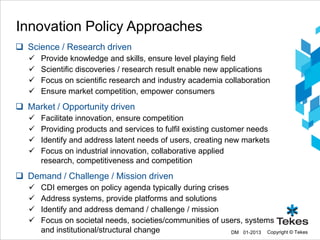
Innovation Policy Approaches
 Science / Research driven
      Provide knowledge and skills, ensure level playing field
      Scientific discoveries / research result enable new applications
      Focus on scientific research and industry academia collaboration
      Ensure market competition, empower consumers
 Market / Opportunity driven
      Facilitate innovation, ensure competition
      Providing products and services to fulfil existing customer needs
      Identify and address latent needs of users, creating new markets
      Focus on industrial innovation, collaborative applied
       research, competitiveness and competition
 Demand / Challenge / Mission driven
      CDI emerges on policy agenda typically during crises
      Address systems, provide platforms and solutions
      Identify and address demand / challenge / mission
      Focus on societal needs, societies/communities of users, systems
       and institutional/structural change                  DM 01-2013 Copyright © Tekes
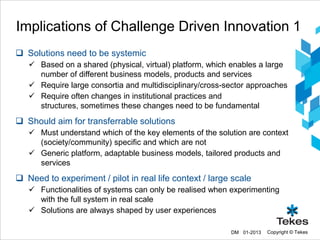
Implications of Challenge Driven Innovation 1
 Solutions need to be systemic
    Based on a shared (physical, virtual) platform, which enables a large
     number of different business models, products and services
    Require large consortia and multidisciplinary/cross-sector approaches
    Require often changes in institutional practices and
     structures, sometimes these changes need to be fundamental
 Should aim for transferrable solutions
    Must understand which of the key elements of the solution are context
     (society/community) specific and which are not
    Generic platform, adaptable business models, tailored products and
     services
 Need to experiment / pilot in real life context / large scale
    Functionalities of systems can only be realised when experimenting
     with the full system in real scale
    Solutions are always shaped by user experiences

                                                          DM 01-2013   Copyright © Tekes
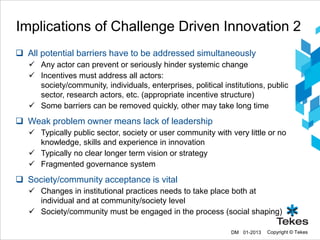
Implications of Challenge Driven Innovation 2
 All potential barriers have to be addressed simultaneously
    Any actor can prevent or seriously hinder systemic change
    Incentives must address all actors:
     society/community, individuals, enterprises, political institutions, public
     sector, research actors, etc. (appropriate incentive structure)
    Some barriers can be removed quickly, other may take long time
 Weak problem owner means lack of leadership
    Typically public sector, society or user community with very little or no
     knowledge, skills and experience in innovation
    Typically no clear longer term vision or strategy
    Fragmented governance system
 Society/community acceptance is vital
    Changes in institutional practices needs to take place both at
     individual and at community/society level
    Society/community must be engaged in the process (social shaping)

                                                               DM 01-2013   Copyright © Tekes
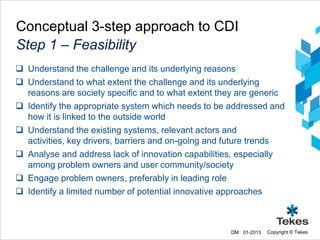
Conceptual 3-step approach to CDI
Step 1 – Feasibility
 Understand the challenge and its underlying reasons
 Understand to what extent the challenge and its underlying
  reasons are society specific and to what extent they are generic
 Identify the appropriate system which needs to be addressed and
  how it is linked to the outside world
 Understand the existing systems, relevant actors and
  activities, key drivers, barriers and on-going and future trends
 Analyse and address lack of innovation capabilities, especially
  among problem owners and user community/society
 Engage problem owners, preferably in leading role
 Identify a limited number of potential innovative approaches


                                                    DM 01-2013   Copyright © Tekes
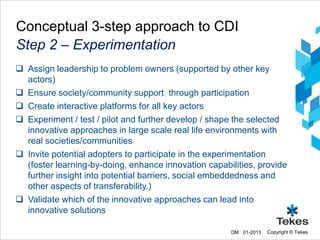
Conceptual 3-step approach to CDI
Step 2 – Experimentation
 Assign leadership to problem owners (supported by other key
  actors)
 Ensure society/community support through participation
 Create interactive platforms for all key actors
 Experiment / test / pilot and further develop / shape the selected
  innovative approaches in large scale real life environments with
  real societies/communities
 Invite potential adopters to participate in the experimentation
  (foster learning-by-doing, enhance innovation capabilities, provide
  further insight into potential barriers, social embeddedness and
  other aspects of transferability.)
 Validate which of the innovative approaches can lead into
  innovative solutions

                                                      DM 01-2013   Copyright © Tekes
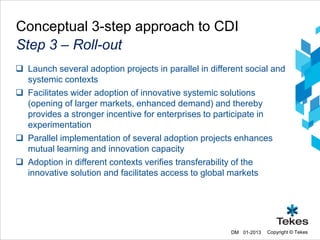
Conceptual 3-step approach to CDI
Step 3 – Roll-out
 Launch several adoption projects in parallel in different social and
  systemic contexts
 Facilitates wider adoption of innovative systemic solutions
  (opening of larger markets, enhanced demand) and thereby
  provides a stronger incentive for enterprises to participate in
  experimentation
 Parallel implementation of several adoption projects enhances
  mutual learning and innovation capacity
 Adoption in different contexts verifies transferability of the
  innovative solution and facilitates access to global markets


                                                       DM 01-2013   Copyright © Tekes
CDI and Innovation Policies Today
 Innovation policies are still mostly focused on facilitating
  innovation (science/research driven, market/opportunity driven)
 Demand driven innovation policies (and CDI) have emerged on
  the policy agenda, but remain mainly as part of rhetoric
 Most countries have started to experiment with demand side policy
  measures and initiatives (procurement, awards, consortia)
 Real systemic CDI policies are still missing
 Horizon 2020 may provide a new framework CDI in Europe
 The most difficult underlying barriers can be found from the
  governance system and from the incentive structures.
   o The governance failure can be addressed by strengthening strategic
     intelligence to allow the design of more evidence based, longer term
     and systemic policies, as well as breaking departmental walls.
   o Establishing appropriate and sustainable incentive structures to
     enhance the demand for innovations may require quite fundamental
     changes in traditions, organisational cultures, etc.
                                                          DM 01-2013   Copyright © Tekes
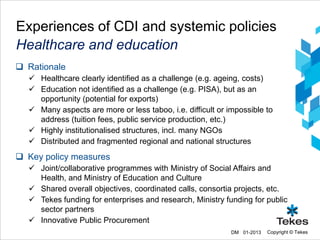
Experiences of CDI and systemic policies
Healthcare and education
 Rationale
   Healthcare clearly identified as a challenge (e.g. ageing, costs)
   Education not identified as a challenge (e.g. PISA), but as an
    opportunity (potential for exports)
   Many aspects are more or less taboo, i.e. difficult or impossible to
    address (tuition fees, public service production, etc.)
   Highly institutionalised structures, incl. many NGOs
   Distributed and fragmented regional and national structures
 Key policy measures
   Joint/collaborative programmes with Ministry of Social Affairs and
    Health, and Ministry of Education and Culture
   Shared overall objectives, coordinated calls, consortia projects, etc.
   Tekes funding for enterprises and research, Ministry funding for public
    sector partners
   Innovative Public Procurement
                                                            DM 01-2013   Copyright © Tekes
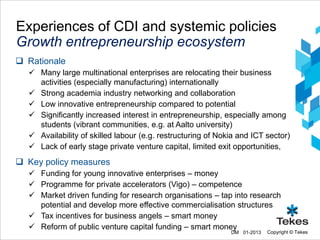
Experiences of CDI and systemic policies
Growth entrepreneurship ecosystem
 Rationale
   Many large multinational enterprises are relocating their business
    activities (especially manufacturing) internationally
   Strong academia industry networking and collaboration
   Low innovative entrepreneurship compared to potential
   Significantly increased interest in entrepreneurship, especially among
    students (vibrant communities, e.g. at Aalto university)
   Availability of skilled labour (e.g. restructuring of Nokia and ICT sector)
   Lack of early stage private venture capital, limited exit opportunities,
 Key policy measures
   Funding for young innovative enterprises – money
   Programme for private accelerators (Vigo) – competence
   Market driven funding for research organisations – tap into research
    potential and develop more effective commercialisation structures
   Tax incentives for business angels – smart money
   Reform of public venture capital funding – smart money
                                                             DM 01-2013   Copyright © Tekes
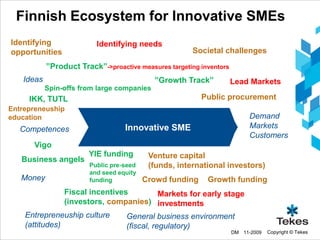
Finnish Ecosystem for Innovative SMEs
Identifying               Identifying needs
opportunities                                          Societal challenges
           ”Product Track”->proactive measures targeting inventors
   Ideas                                    ”Growth Track”           Lead Markets
           Spin-offs from large companies
     IKK, TUTL                                            Public procurement
Entrepreneuship
education                                                                  Demand
   Competences                     Innovative SME                          Markets
                                                                           Customers
      Vigo
                       YIE funding         Venture capital
   Business angels
                        Public pre-seed    (funds, international investors)
                        and seed equity
   Money                funding           Crowd funding    Growth funding
                Fiscal incentives           Markets for early stage
                (investors, companies) investments
    Entrepreneuship culture      General business environment
    (attitudes)                  (fiscal, regulatory)
                                                                     DM 11-2009   Copyright © Tekes
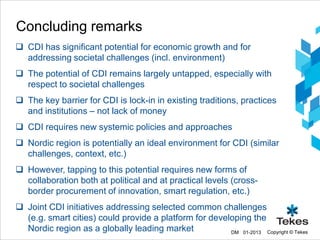
Concluding remarks
 CDI has significant potential for economic growth and for
  addressing societal challenges (incl. environment)
 The potential of CDI remains largely untapped, especially with
  respect to societal challenges
 The key barrier for CDI is lock-in in existing traditions, practices
  and institutions – not lack of money
 CDI requires new systemic policies and approaches
 Nordic region is potentially an ideal environment for CDI (similar
  challenges, context, etc.)
 However, tapping to this potential requires new forms of
  collaboration both at political and at practical levels (cross-
  border procurement of innovation, smart regulation, etc.)
 Joint CDI initiatives addressing selected common challenges
  (e.g. smart cities) could provide a platform for developing the
  Nordic region as a globally leading market            DM 01-2013 Copyright © Tekes

Conference_20130305_Jari Romanainen

  • 1.
    Challenge driven innovation Whatwill the Nordic business environment look like in the future? 5-6 March 2013, Stockholm Jari Romanainen 5 March 2013 DM 01-2013 Copyright © Tekes
  • 2.
    Innovation Policy Approaches Science / Research driven  Provide knowledge and skills, ensure level playing field  Scientific discoveries / research result enable new applications  Focus on scientific research and industry academia collaboration  Ensure market competition, empower consumers  Market / Opportunity driven  Facilitate innovation, ensure competition  Providing products and services to fulfil existing customer needs  Identify and address latent needs of users, creating new markets  Focus on industrial innovation, collaborative applied research, competitiveness and competition  Demand / Challenge / Mission driven  CDI emerges on policy agenda typically during crises  Address systems, provide platforms and solutions  Identify and address demand / challenge / mission  Focus on societal needs, societies/communities of users, systems and institutional/structural change DM 01-2013 Copyright © Tekes
  • 3.
    Implications of ChallengeDriven Innovation 1  Solutions need to be systemic  Based on a shared (physical, virtual) platform, which enables a large number of different business models, products and services  Require large consortia and multidisciplinary/cross-sector approaches  Require often changes in institutional practices and structures, sometimes these changes need to be fundamental  Should aim for transferrable solutions  Must understand which of the key elements of the solution are context (society/community) specific and which are not  Generic platform, adaptable business models, tailored products and services  Need to experiment / pilot in real life context / large scale  Functionalities of systems can only be realised when experimenting with the full system in real scale  Solutions are always shaped by user experiences DM 01-2013 Copyright © Tekes
  • 4.
    Implications of ChallengeDriven Innovation 2  All potential barriers have to be addressed simultaneously  Any actor can prevent or seriously hinder systemic change  Incentives must address all actors: society/community, individuals, enterprises, political institutions, public sector, research actors, etc. (appropriate incentive structure)  Some barriers can be removed quickly, other may take long time  Weak problem owner means lack of leadership  Typically public sector, society or user community with very little or no knowledge, skills and experience in innovation  Typically no clear longer term vision or strategy  Fragmented governance system  Society/community acceptance is vital  Changes in institutional practices needs to take place both at individual and at community/society level  Society/community must be engaged in the process (social shaping) DM 01-2013 Copyright © Tekes
  • 5.
    Conceptual 3-step approachto CDI Step 1 – Feasibility  Understand the challenge and its underlying reasons  Understand to what extent the challenge and its underlying reasons are society specific and to what extent they are generic  Identify the appropriate system which needs to be addressed and how it is linked to the outside world  Understand the existing systems, relevant actors and activities, key drivers, barriers and on-going and future trends  Analyse and address lack of innovation capabilities, especially among problem owners and user community/society  Engage problem owners, preferably in leading role  Identify a limited number of potential innovative approaches DM 01-2013 Copyright © Tekes
  • 6.
    Conceptual 3-step approachto CDI Step 2 – Experimentation  Assign leadership to problem owners (supported by other key actors)  Ensure society/community support through participation  Create interactive platforms for all key actors  Experiment / test / pilot and further develop / shape the selected innovative approaches in large scale real life environments with real societies/communities  Invite potential adopters to participate in the experimentation (foster learning-by-doing, enhance innovation capabilities, provide further insight into potential barriers, social embeddedness and other aspects of transferability.)  Validate which of the innovative approaches can lead into innovative solutions DM 01-2013 Copyright © Tekes
  • 7.
    Conceptual 3-step approachto CDI Step 3 – Roll-out  Launch several adoption projects in parallel in different social and systemic contexts  Facilitates wider adoption of innovative systemic solutions (opening of larger markets, enhanced demand) and thereby provides a stronger incentive for enterprises to participate in experimentation  Parallel implementation of several adoption projects enhances mutual learning and innovation capacity  Adoption in different contexts verifies transferability of the innovative solution and facilitates access to global markets DM 01-2013 Copyright © Tekes
  • 8.
    CDI and InnovationPolicies Today  Innovation policies are still mostly focused on facilitating innovation (science/research driven, market/opportunity driven)  Demand driven innovation policies (and CDI) have emerged on the policy agenda, but remain mainly as part of rhetoric  Most countries have started to experiment with demand side policy measures and initiatives (procurement, awards, consortia)  Real systemic CDI policies are still missing  Horizon 2020 may provide a new framework CDI in Europe  The most difficult underlying barriers can be found from the governance system and from the incentive structures. o The governance failure can be addressed by strengthening strategic intelligence to allow the design of more evidence based, longer term and systemic policies, as well as breaking departmental walls. o Establishing appropriate and sustainable incentive structures to enhance the demand for innovations may require quite fundamental changes in traditions, organisational cultures, etc. DM 01-2013 Copyright © Tekes
  • 9.
    Experiences of CDIand systemic policies Healthcare and education  Rationale  Healthcare clearly identified as a challenge (e.g. ageing, costs)  Education not identified as a challenge (e.g. PISA), but as an opportunity (potential for exports)  Many aspects are more or less taboo, i.e. difficult or impossible to address (tuition fees, public service production, etc.)  Highly institutionalised structures, incl. many NGOs  Distributed and fragmented regional and national structures  Key policy measures  Joint/collaborative programmes with Ministry of Social Affairs and Health, and Ministry of Education and Culture  Shared overall objectives, coordinated calls, consortia projects, etc.  Tekes funding for enterprises and research, Ministry funding for public sector partners  Innovative Public Procurement DM 01-2013 Copyright © Tekes
  • 10.
    Experiences of CDIand systemic policies Growth entrepreneurship ecosystem  Rationale  Many large multinational enterprises are relocating their business activities (especially manufacturing) internationally  Strong academia industry networking and collaboration  Low innovative entrepreneurship compared to potential  Significantly increased interest in entrepreneurship, especially among students (vibrant communities, e.g. at Aalto university)  Availability of skilled labour (e.g. restructuring of Nokia and ICT sector)  Lack of early stage private venture capital, limited exit opportunities,  Key policy measures  Funding for young innovative enterprises – money  Programme for private accelerators (Vigo) – competence  Market driven funding for research organisations – tap into research potential and develop more effective commercialisation structures  Tax incentives for business angels – smart money  Reform of public venture capital funding – smart money DM 01-2013 Copyright © Tekes
  • 11.
    Finnish Ecosystem forInnovative SMEs Identifying Identifying needs opportunities Societal challenges ”Product Track”->proactive measures targeting inventors Ideas ”Growth Track” Lead Markets Spin-offs from large companies IKK, TUTL Public procurement Entrepreneuship education Demand Competences Innovative SME Markets Customers Vigo YIE funding Venture capital Business angels Public pre-seed (funds, international investors) and seed equity Money funding Crowd funding Growth funding Fiscal incentives Markets for early stage (investors, companies) investments Entrepreneuship culture General business environment (attitudes) (fiscal, regulatory) DM 11-2009 Copyright © Tekes
  • 12.
    Concluding remarks  CDIhas significant potential for economic growth and for addressing societal challenges (incl. environment)  The potential of CDI remains largely untapped, especially with respect to societal challenges  The key barrier for CDI is lock-in in existing traditions, practices and institutions – not lack of money  CDI requires new systemic policies and approaches  Nordic region is potentially an ideal environment for CDI (similar challenges, context, etc.)  However, tapping to this potential requires new forms of collaboration both at political and at practical levels (cross- border procurement of innovation, smart regulation, etc.)  Joint CDI initiatives addressing selected common challenges (e.g. smart cities) could provide a platform for developing the Nordic region as a globally leading market DM 01-2013 Copyright © Tekes