Chayan Chakrabarti
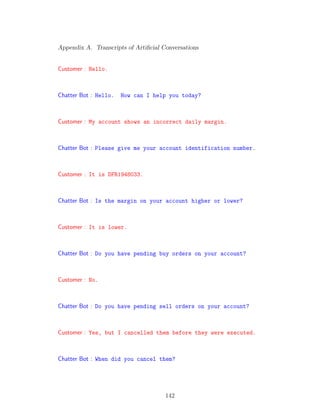
Candidate
Computer Science
Department
This dissertation is approved, and it is acceptable in quality and form for publication:
Approved by the Dissertation Committee:
George Luger , Chairperson
Thomas Caudell
Lydia Tapia
Chuck Wooters
Jessica Turner
Artificial Conversations for Chatter Bots
Using Knowledge Representation,
Learning, and Pragmatics
by
Chayan Chakrabarti
B.E., Computer Engineering, University of Mumbai, 2001
M.S., Computer Science, University of New Mexico, 2005
DISSERTATION
Submitted in Partial Fulfillment of the
Requirements for the Degree of
Doctor of Philosophy
Computer Science
The University of New Mexico
Albuquerque, New Mexico
May, 2014
c 2014, Chayan Chakrabarti
iii
Dedication
To my parents.
“A computer would deserve to be called intelligent if it could deceive a human into
believing that it was human” – Alan Turing
iv
Acknowledgments
My highest gratitude is for my advisor, Professor George Luger, for introducing me
to the world of Artificial Intelligence research and giving me an opportunity to be
part of it. He encouraged me to return to graduate school, taught me to have a
vision and philosophy, kept me focussed on the big picture, guided me through every
step of the dissertation process, and enriched my academic experience.
My committee members patiently helped me through all the phases of the dis-
sertation and gave me enthusiastic feedback at very short notice. I thank Professor
Thomas Caudell for always being a great mentor, Professor Lydia Tapia for her in-
valuable insights, Dr. Chuck Wooters for helping me germinate the ideas for this
dissertation, and Professor Jessica Turner for her constant support.
Several people helped me throughout the program. I thank Professor Caroline
Smith and Professor Joel Castellanos for their help with my dissertation. I thank
Professor Frank Gilfeather for supporting my early research. I have interacted with
several outstanding faculty and gained important skills under their tutelage. I will
forever be grateful to them. I especially thank Professor Deepak Kapur and Professor
David Ackley.
I feel I learned as much from my peers as I did from my classes. I sincerely thank
my lab mates at the AI Lab, Benjamin Gordon, Sunny Fugate, Thomas Jones, and
all the others for always being so supportive. I thank all my other colleagues and
friends for making me a better student, researcher, and person. I thank everyone at
the System Support Group and the Front Office for making my life so much easier.
The graduate school journey is an emotional roller coaster. I feel that my parents
experienced the highs and lows even more intensely than I did. I am so thankful to
my parents for always being there for me.
v
Artificial Conversations for Chatter Bots
Using Knowledge Representation,
Learning, and Pragmatics
by
Chayan Chakrabarti
B.E., Computer Engineering, University of Mumbai, 2001
M.S., Computer Science, University of New Mexico, 2005
Ph.D., Computer Science, University of New Mexico, 2014
Abstract
Chatter bots are software programs that engage in artificial conversations through
a text-based input medium. Many businesses have automated their online customer
service support by deploying chatter bots. These customer service chatter bots in-
teract with customers, answer their queries, and address service related issues.
Traditional chatter bots perform best in artificial conversations consisting of pairs
of utterance exchanges such as question-answer sessions, where the context may or
may not switch with every exchange pair. They perform poorly in longer conver-
sations, where the context is maintained over several pairs of utterance exchanges.
Existing approaches to artificial conversation generation focus on linguistic and gram-
matical modeling using natural language processing and computational linguistics
techniques to generate individual sentence-level utterances.
This research explores techniques to go beyond individual sentence-level inter-
actions to model the higher level conversation process. A conversation is a process
vi
that adheres to well-defined semantic conventions and is contextually grounded in
domain-specific knowledge. This dissertation presents a modular, robust, and scal-
able architecture that combines content semantics and pragmatic semantics to gen-
erate higher quality artificial conversations in the customer service domain. The
conversational process is modeled using stochastic finite state machines, where the
parameters of the model are learned from a corpus of human conversations.
This research leverages specific concepts from conversation theory and speech act
theory. For evaluation purposes, the artificial conversations are graded by a panel of
human judges using criteria that include Grice’s cooperative maxims.
vii
Contents
List of Figures xii
List of Tables xvii
1 Introduction to Chatter Bots and Artificial Conversations 1
1.1 Internet Chatting and Chatter Bots . . . . . . . . . . . . . . . . . . . 2
1.2 Limitations of Chatter Bots . . . . . . . . . . . . . . . . . . . . . . . 5
1.3 Customer Service Chatter Bots . . . . . . . . . . . . . . . . . . . . . 8
1.4 Artificial Conversations . . . . . . . . . . . . . . . . . . . . . . . . . . 16
1.5 Problem Scope . . . . . . . . . . . . . . . . . . . . . . . . . . . . . . 17
2 Conversation Engineering 22
2.1 The Stochastic Approach . . . . . . . . . . . . . . . . . . . . . . . . . 22
2.2 The Syntactic Approach . . . . . . . . . . . . . . . . . . . . . . . . . 26
2.3 The Semantic Approach . . . . . . . . . . . . . . . . . . . . . . . . . 27
2.4 Dialogue systems . . . . . . . . . . . . . . . . . . . . . . . . . . . . . 27
viii
Contents
2.5 Limitations of existing approaches . . . . . . . . . . . . . . . . . . . . 29
3 Modeling Content and Semantics 31
3.1 Analysis of Conversations . . . . . . . . . . . . . . . . . . . . . . . . 31
3.1.1 Structure in Conversations . . . . . . . . . . . . . . . . . . . . 32
3.1.2 Speech Act Theory . . . . . . . . . . . . . . . . . . . . . . . . 34
3.1.3 Semantics and Sentiment in a Conversation . . . . . . . . . . 35
3.2 Knowledge Representation for Conversations . . . . . . . . . . . . . . 37
3.2.1 Goal Fulfillment Maps . . . . . . . . . . . . . . . . . . . . . . 37
3.2.2 Ontologies . . . . . . . . . . . . . . . . . . . . . . . . . . . . . 40
4 Evaluation of Conversations 45
4.1 Theory of Pragmatics . . . . . . . . . . . . . . . . . . . . . . . . . . . 45
4.1.1 Grice’s Maxims . . . . . . . . . . . . . . . . . . . . . . . . . . 46
4.2 Domain and Situation Specific Conversations . . . . . . . . . . . . . . 47
5 The Chatter Bot Architecture 50
5.1 Important Definitions . . . . . . . . . . . . . . . . . . . . . . . . . . . 51
5.2 System Architecture . . . . . . . . . . . . . . . . . . . . . . . . . . . 54
5.3 Knowledge Engine . . . . . . . . . . . . . . . . . . . . . . . . . . . . 56
5.3.1 Speech Act Identifier . . . . . . . . . . . . . . . . . . . . . . . 57
5.3.2 Topics Hash Table . . . . . . . . . . . . . . . . . . . . . . . . 62
ix
Contents
5.4 Conversation Engine . . . . . . . . . . . . . . . . . . . . . . . . . . . 66
5.4.1 Probabilistic Finite State Automaton . . . . . . . . . . . . . . 68
5.4.2 Conversation Planner . . . . . . . . . . . . . . . . . . . . . . . 79
5.5 Chat Interface . . . . . . . . . . . . . . . . . . . . . . . . . . . . . . . 81
5.5.1 Utterance Bucket . . . . . . . . . . . . . . . . . . . . . . . . . 82
5.5.2 Stemmer . . . . . . . . . . . . . . . . . . . . . . . . . . . . . . 83
5.5.3 Speech Act Detector . . . . . . . . . . . . . . . . . . . . . . . 83
5.5.4 Sentiment Detector . . . . . . . . . . . . . . . . . . . . . . . . 83
5.5.5 Topic Detector . . . . . . . . . . . . . . . . . . . . . . . . . . 83
5.5.6 Interface . . . . . . . . . . . . . . . . . . . . . . . . . . . . . . 84
5.5.7 Anatomy of a Conversation . . . . . . . . . . . . . . . . . . . 84
5.6 Uniqueness of Architecture . . . . . . . . . . . . . . . . . . . . . . . . 87
6 Generation of Artificial Conversations 89
6.1 Corpus . . . . . . . . . . . . . . . . . . . . . . . . . . . . . . . . . . . 89
6.1.1 Chat Transcripts . . . . . . . . . . . . . . . . . . . . . . . . . 90
6.1.2 Pre-processing of the corpus . . . . . . . . . . . . . . . . . . . 91
6.2 Parameters of a Conversation . . . . . . . . . . . . . . . . . . . . . . 93
6.2.1 Learning Transition Probabilities . . . . . . . . . . . . . . . . 93
6.2.2 Learning Speech Acts . . . . . . . . . . . . . . . . . . . . . . . 94
6.2.3 Learning Topic Acts . . . . . . . . . . . . . . . . . . . . . . . 96
x
Contents
6.3 Conversation Creation . . . . . . . . . . . . . . . . . . . . . . . . . . 97
7 Results and Discussion 99
7.1 Evaluation Methodology . . . . . . . . . . . . . . . . . . . . . . . . . 100
7.1.1 Objective and Subjective Metrics . . . . . . . . . . . . . . . . 100
7.1.2 Experimental Setup . . . . . . . . . . . . . . . . . . . . . . . . 109
7.2 Analysis . . . . . . . . . . . . . . . . . . . . . . . . . . . . . . . . . . 111
8 Conclusions and Future Work 124
8.1 Unique contributions . . . . . . . . . . . . . . . . . . . . . . . . . . . 125
8.2 Limitations of the research . . . . . . . . . . . . . . . . . . . . . . . . 126
8.3 Possible future directions . . . . . . . . . . . . . . . . . . . . . . . . . 127
References 129
Appendix 138
A Transcripts of Artificial Conversations 139
B Goal-Fulfillment Maps 165
xi
List of Figures
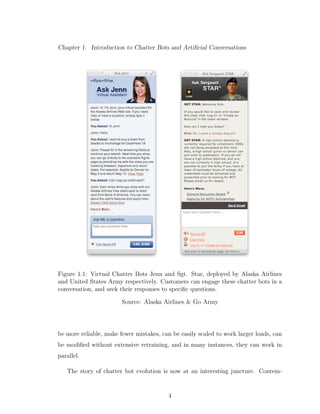
1.1 Virtual Chatter Bots Jenn and Sgt. Star, deployed by Alaska Airlines
and United States Army respectively. Customers can engage these
chatter bots in a conversation, and seek their responses to specific
questions. . . . . . . . . . . . . . . . . . . . . . . . . . . . . . . . . . 4
1.2 Classes of Conversations: Within scope denoting specific conversa-
tions within the domain, Beyond scope denoting non-specific open-
ended conversations within the domain, and Beyond domain denot-
ing conversations beyond the domain being considered. . . . . . . . 14
3.1 Building blocks of a goal-fulfillment map [58, 57, 60]. . . . . . . . . . 38
3.2 A Goal Fulfillment Map [58, 57, 60]: where a specific map encodes
the sequence of questions to be asked, whose responses will enable
fulfill a specific goal during the conversation. . . . . . . . . . . . . . 39
3.3 A Wine Ontology: represents knowledge about beverages. . . . . . . 41
xii
List of Figures
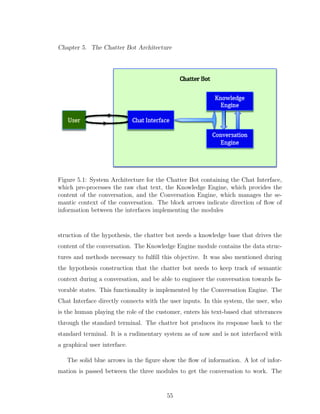
5.1 System Architecture for the Chatter Bot containing the Chat Inter-
face, which pre-processes the raw chat text, the Knowledge Engine,
which provides the content of the conversation, and the Conversation
Engine, which manages the semantic context of the conversation.
The block arrows indicate direction of flow of information between
the interfaces implementing the modules . . . . . . . . . . . . . . . . 55
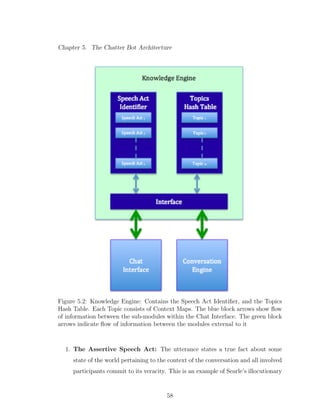
5.2 Knowledge Engine: Contains the Speech Act Identifier, and the Top-
ics Hash Table. Each Topic consists of Context Maps. The blue block
arrows show flow of information between the sub-modules within the
Chat Interface. The green block arrows indicate flow of information
between the modules external to it . . . . . . . . . . . . . . . . . . . 58
5.3 The bag of words captured by the Chat Interface is used by a Latent
Semantic Analysis Algorithm to determine the most probable Speech
Act associated with the utterance. . . . . . . . . . . . . . . . . . . . 61
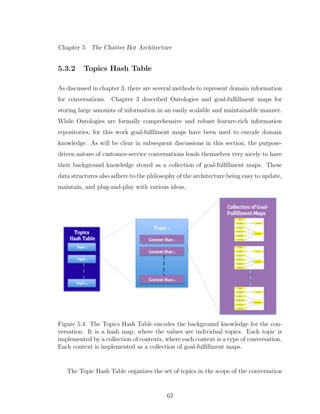
5.4 The Topics Hash Table encodes the background knowledge for the
conversation. It is a hash map, where the values are individual topics.
Each topic is implemented by a collection of contexts, where each
context is a type of conversation. Each context is implemented as a
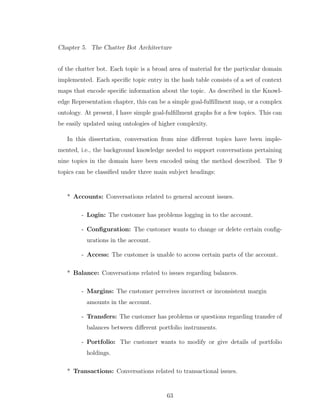
collection of goal-fulfillment maps. . . . . . . . . . . . . . . . . . . . 62
5.5 The bag of words captured by the Chat Interface is used by a Latent
Semantic Analysis Algorithm to determine the most probable Topic
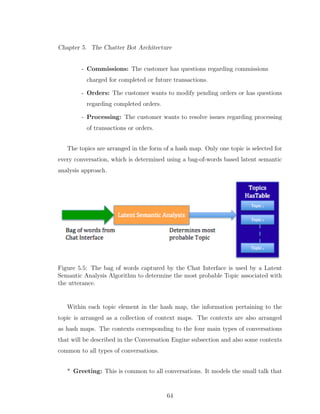
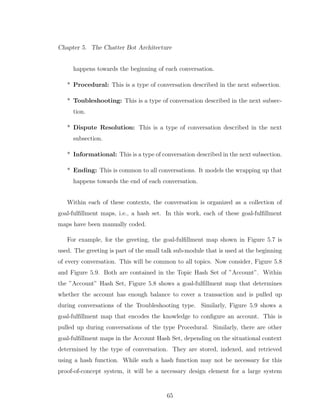
associated with the utterance. . . . . . . . . . . . . . . . . . . . . . 64
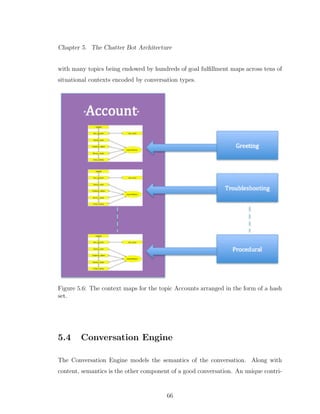
5.6 The context maps for the topic Accounts arranged in the form of a
hash set. . . . . . . . . . . . . . . . . . . . . . . . . . . . . . . . . . 66
5.7 A goal-fulfillment map [58, 57, 60] that encodes the small talk that
usually precedes every conversation. . . . . . . . . . . . . . . . . . . 67
xiii
List of Figures
5.8 A goal-fulfillment map [58, 57, 60] that encodes that segment of the
conversation which determines whether the margin in the customer’s
account is sufficient to cover the transaction requested. . . . . . . . . 68
5.9 A goal-fulfillment map [58, 57, 60] that encodes the segment of con-
versation required to offer the most suitable account configuration to
the customer. . . . . . . . . . . . . . . . . . . . . . . . . . . . . . . 69
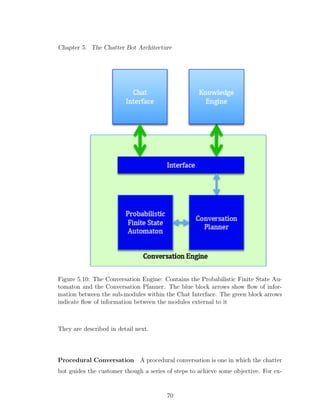
5.10 The Conversation Engine: Contains the Probabilistic Finite State
Automaton and the Conversation Planner. The blue block arrows
show flow of information between the sub-modules within the Chat
Interface. The green block arrows indicate flow of information be-
tween the modules external to it . . . . . . . . . . . . . . . . . . . . 70
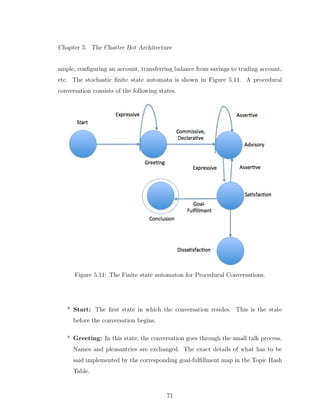
5.11 The Finite state automaton for Procedural Conversations. . . . . . . 71
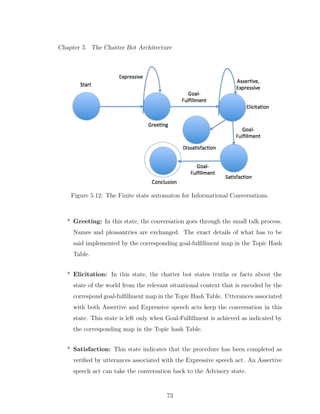
5.12 The Finite state automaton for Informational Conversations. . . . . 73
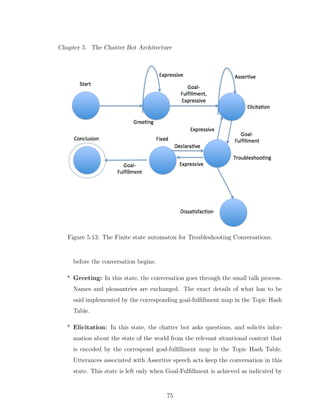
5.13 The Finite state automaton for Troubleshooting Conversations. . . . 75
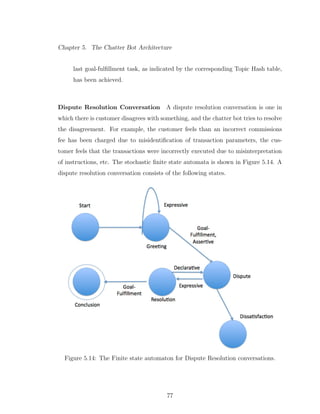
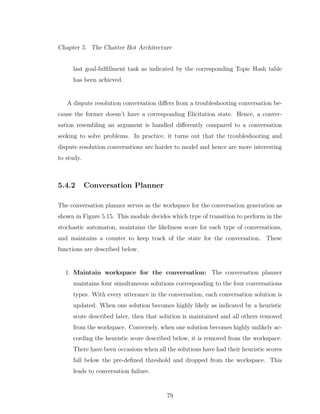
5.14 The Finite state automaton for Dispute Resolution conversations. . . 77
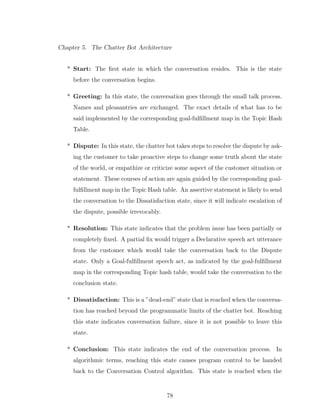
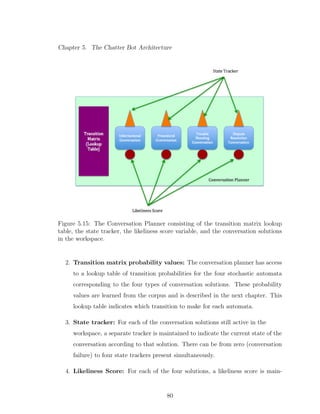
5.15 The Conversation Planner consisting of the transition matrix lookup
table, the state tracker, the likeliness score variable, and the conver-
sation solutions in the workspace. . . . . . . . . . . . . . . . . . . . 80
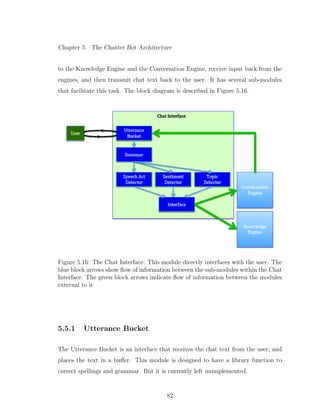
5.16 The Chat Interface: This module directly interfaces with the user.
The blue block arrows show flow of information between the sub-
modules within the Chat Interface. The green block arrows indicate
flow of information between the modules external to it . . . . . . . . 82
5.17 Goal-fulfillment map [58, 57, 60] selected by the Knowledge Engine
in the anatomy of a conversation. . . . . . . . . . . . . . . . . . . . 86
xiv
List of Figures
7.1 Relationship between successful and unsuccessful resolutions in the
artificial conversations and the average normalized score for the Qual-
ity Maxim. The x-axis shows each of the 48 artificial conversations,
and the y-axis shows the average normalized score. Blue indicates a
successful resolution and red indicates an unsuccessful resolution. . 116
7.2 Relationship between successful and unsuccessful resolutions in the
artificial conversations and the averaged normalized score for the
Quantity Maxim. The x-axis shows each of the 48 artificial conver-
sations, and the y-axis shows the average normalized score. The black
horizontal line indicates the score for the human generated natural
conversations, that is by definition 1.00. Blue indicates a successful
resolution and red indicates an unsuccessful resolution. . . . . . . . 117
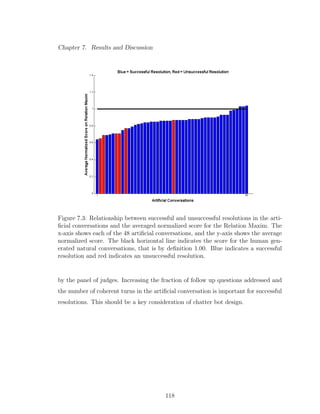
7.3 Relationship between successful and unsuccessful resolutions in the
artificial conversations and the averaged normalized score for the
Relation Maxim. The x-axis shows each of the 48 artificial conversa-
tions, and the y-axis shows the average normalized score. The black
horizontal line indicates the score for the human generated natural
conversations, that is by definition 1.00. Blue indicates a successful
resolution and red indicates an unsuccessful resolution. . . . . . . . 118
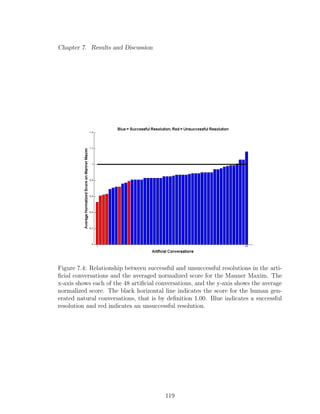
7.4 Relationship between successful and unsuccessful resolutions in the
artificial conversations and the averaged normalized score for the
Manner Maxim. The x-axis shows each of the 48 artificial conversa-
tions, and the y-axis shows the average normalized score. The black
horizontal line indicates the score for the human generated natural
conversations, that is by definition 1.00. Blue indicates a successful
resolution and red indicates an unsuccessful resolution. . . . . . . . 119
xv
List of Figures
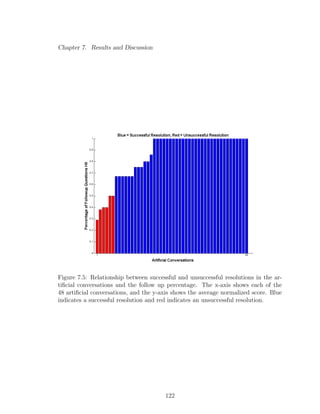
7.5 Relationship between successful and unsuccessful resolutions in the
artificial conversations and the follow up percentage. The x-axis
shows each of the 48 artificial conversations, and the y-axis shows
the average normalized score. Blue indicates a successful resolution
and red indicates an unsuccessful resolution. . . . . . . . . . . . . . 122
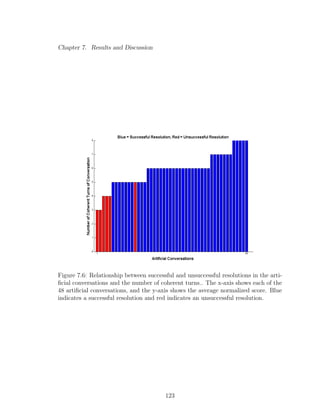
7.6 Relationship between successful and unsuccessful resolutions in the
artificial conversations and the number of coherent turns.. The x-axis
shows each of the 48 artificial conversations, and the y-axis shows the
average normalized score. Blue indicates a successful resolution and
red indicates an unsuccessful resolution. . . . . . . . . . . . . . . . 123
B.1 Goal-fulfillment map [58, 57, 60] of the procedure to verify if all the
conditions of a buy or sell order have been met.. . . . . . . . . . . . 166
B.2 Goal-fulfillment map [58, 57, 60] of the procedure to process trans-
actions. . . . . . . . . . . . . . . . . . . . . . . . . . . . . . . . . . . 167
xvi
List of Tables
7.1 Distribution of Human Conversations (Natural Conversations) and
Chatter Bot generated Conversations (Artificial Conversations). As
conversations of type Troubleshooting and Dispute Resolution were
more interesting as compared to conversations of type Informational
and Procedural, more of the former were included. . . . . . . . . . . 110
7.2 Identification of who generated the conversation as guessed by the
judges. Each conversation was guessed on by exactly 6 judges. . . . 112
7.3 Average Likert scores for human generated natural conversations.
For each conversation, scores are assigned on a continuous 0 to 5
scale and averaged across 6 judges . . . . . . . . . . . . . . . . . . . 113
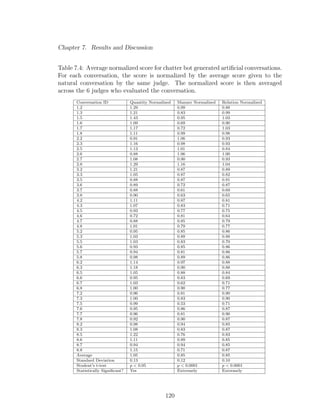
7.4 Average normalized score for chatter bot generated artificial conver-
sations. For each conversation, the score is normalized by the average
score given to the natural conversation by the same judge. The nor-
malized score is then averaged across the 6 judges who evaluated the
conversation. . . . . . . . . . . . . . . . . . . . . . . . . . . . . . . . 120
xvii
List of Tables
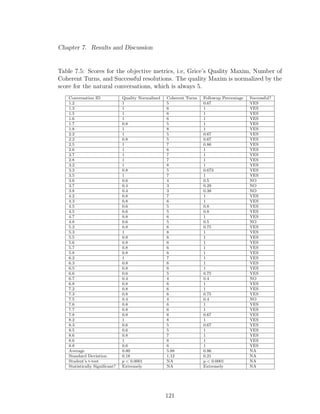
7.5 Scores for the objective metrics, i.e, Grice’s Quality Maxim, Number
of Coherent Turns, and Successful resolutions. The quality Maxim
is normalized by the score for the natural conversations, which is
always 5. . . . . . . . . . . . . . . . . . . . . . . . . . . . . . . . . . 121
xviii
Chapter 1
Introduction to Chatter Bots and
Artificial Conversations
Chatting with computer programs has come a long way, from pioneering artificial
intelligence demonstrations like ELIZA to modern intelligent personal assistant soft-
ware like Siri. Early chatter bots were designed as academic testing tools for natural
language processing theories. Lately, chatter bots have become more sophisticated.
They have found applications in interactive games, as website navigation tools, and
for simulating personal help desk assistants. It is estimated that by 2015, at least
50% of customer service will be realized via chatter bots, and this can result in cost
reductions up to 20% along with increased customer loyalty [24]. But have chatter
bots scaled the zenith of their ontogenesis, or are there opportunities to extend their
current capabilities? This thesis identifies a key limitation of current contemporary
chatter bots, and presents a solution to address it.
1
Chapter 1. Introduction to Chatter Bots and Artificial Conversations
1.1 Internet Chatting and Chatter Bots
To understand chatter bots, it is important to understand online chatting as a
medium of communication. Why is this medium so popular? It has gained pop-
ularity because it is non-invasive, unlike a phone call, and at the same time it is
inherently an instant medium of exchange. Communicators are not compelled to
respond instantly, but can carry on a conversation in near instant time if they desire.
The chat logs can be stored and easily referenced at a future point in time. The
medium is easily available to anyone with access to an internet enabled computer or
mobile device. The inherently informal nature of the medium lowers inhibitions, en-
courages spontaneity, and generally reduces the barriers to effective communication.
For these very reasons, enterprise applications started leveraging the medium of
online chatting. One of the earliest enterprise applications of chatting was in IT sup-
port [34]. System users could chat with their system administrators and get help with
their IT related issues. Network administrators could also chat with each other and
exchange information and advice. Computer programmers also extensively used chat
rooms to exchange information about bugs, give advice to newbie programmers, and
discuss pertinent programming issues. The chat logs were archived on servers and
could be easily retrieved in future for reference. The chat transcript logs contained
a wealth of information and served as a virtual FAQ for many IT and program-
ming related queries [34]. Many businesses capitalized on the growth of chat as a
communication medium and implemented their customer service support operations
through chat interfaces. Existing and potential customers could chat with customer
service representatives and resolve their customer service issues or seek information
about the business’ products and services [24].
It was not long before the artificial intelligence community started creating bots to
emulate human chatting. Classic chatterbots like ELIZA [98] and PARRY [12] were
2
Chapter 1. Introduction to Chatter Bots and Artificial Conversations
designed with academic intent, to understand and test theories in natural language
processing. Later efforts in chatter bot evolution focussed on making chatter bots
more human-like. The Loebner Prize contest began in 1990, rewarding chatter bots
considered to be the most human-like [48]. Many famous chatter bots like A.L.I.C.E.
[97], Albert One [23], George [4], Rosette [100], Chip Vivant [18], and Mitsuku [103]
were born out this effort [77]. These endeavors contributed to pushing the boundaries
of computational linguistics and natural language processing.
Of late, chatter bots have evolved to a sufficient level of maturity, and conse-
quently they have been leveraged in several real-world applications. Many businesses
and organizations have now implemented chatter bots to simulate human customer
service representatives. Customers can now chat directly with the chatter bot, with-
out any human intervention. These chatter bots often have virtual personalities and
can closely imitate a human representative during a conversation.
For example, when customers go to the Alaska Airlines homepage, they have
an option to ”Ask Jenn” (www.alaskaair.com). Jenn is a chatter bot who helps
customers purchase flight tickets on Alaska Airlines. She can answer a range of ques-
tions regarding Alaska Airlines like making reservations, payment options, changing
reservations, and general inquiries. Similarly, the US Army recruitment homepage
(www.goarmy.com) has a chatter bot named Sgt. Star. He can answer common
queries about joining the Army. In addition to answering questions, the chatter bots
can also open up relevant websites that might have the information that the customer
or inquirer is seeking. (See Figure 1.1)
Similarly, an electronics company can have a chatter bot helping a customer
troubleshoot problems with a gadget, or direct him to other resources to solve the
problem. An insurance company can help a potential customer select an insurance
plan customized to her unique needs. Businesses realize an economic benefit from
customer service chatter bots. Compared to human representatives, chatter bots can
3
Chapter 1. Introduction to Chatter Bots and Artificial Conversations
Figure 1.1: Virtual Chatter Bots Jenn and Sgt. Star, deployed by Alaska Airlines
and United States Army respectively. Customers can engage these chatter bots in a
conversation, and seek their responses to specific questions.
Source: Alaska Airlines & Go Army
be more reliable, make fewer mistakes, can be easily scaled to work larger loads, can
be modified without extensive retraining, and in many instances, they can work in
parallel.
The story of chatter bot evolution is now at an interesting juncture. Contem-
4
Chapter 1. Introduction to Chatter Bots and Artificial Conversations
porary chatter bots are sophisticated enough to leverage cutting age concepts like
semantic parsing [58] and sentiment analysis [99]. What could be the next step in
chatter bot evolution? Examining limitations of current chatter bots is the first step
in trying to answer this question. In the rest of this chapter, I will highlight with
examples some specific deficiencies of chatter bot technology. I will then formalize
what it means to design an appropriate solution.
1.2 Limitations of Chatter Bots
Using some examples, I differentiate the concept of chatting as in merely uttering
something, and holding a conversation, which implies something more involved. This
section develops this idea with some illustrations.
Consider the chatter bot Mitsuku [103] (http:/http://mitsuku.com), who was
the winner of the 2013 Loebner Prize. Observe some snippets of actual conversation
with Mitsuku.
Mitsuku : Good evening. My name is Mitsuku. What is your name?
Human : My name is Sally.
Mitsuku : Nice to meet you, Sally.
Human : Can you recommend a good store for designer clothing?
Mitsuku : I mostly wear jeans and a t-shirt.
5
Chapter 1. Introduction to Chatter Bots and Artificial Conversations
Human : But I need a dress for a formal reception I am attending.
Mitsuku : Do you tend to like most things?
Human : No.
Mitsuku : OK. So, what do you do for a living?
Human : I am an accountant.
Mitsuku : What do you predict for the economy this year - bad or
really bad?
While Mitsuku seems articulate enough, the conversation clearly did not go the
way Sally, the human, probably expected. So what exactly went wrong? Consider
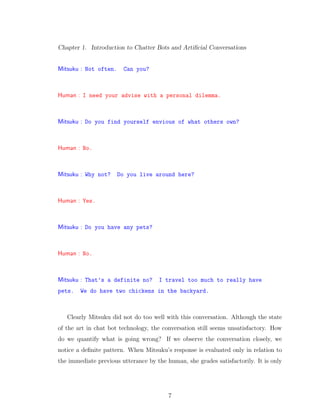
another actual conversation snippet with Mitsuku [103].
Mitsuku : Welcome back. How are you today?
Human : Not too good. I have to make a tough decision.
Mitsuku : That’s too bad.
Human : Can you help me?
6
Chapter 1. Introduction to Chatter Bots and Artificial Conversations
Mitsuku : Not often. Can you?
Human : I need your advise with a personal dilemma.
Mitsuku : Do you find yourself envious of what others own?
Human : No.
Mitsuku : Why not? Do you live around here?
Human : Yes.
Mitsuku : Do you have any pets?
Human : No.
Mitsuku : That’s a definite no? I travel too much to really have
pets. We do have two chickens in the backyard.
Clearly Mitsuku did not do too well with this conversation. Although the state
of the art in chat bot technology, the conversation still seems unsatisfactory. How
do we quantify what is going wrong? If we observe the conversation closely, we
notice a definite pattern. When Mitsuku’s response is evaluated only in relation to
the immediate previous utterance by the human, she grades satisfactorily. It is only
7
Chapter 1. Introduction to Chatter Bots and Artificial Conversations
when evaluated on a longer sustained conversation, that she grades poorly. Mitsuku
performs adequately in an isolated question-answer exchange. She does well even over
a series of several consecutive question-answer pairs. However, a series of question-
answer pairs, or a series of one-to-one utterances, does not constitute a conversation.
Holding a conversation would be the next step in the evolution of chatter bots, but
the current state of the art chatter bot is unable to perform this task.
1.3 Customer Service Chatter Bots
Chatter bots like Mitsuku [103] are general purpose chatter bots, i.e., they attempt
to hold open conversations in no specific area. Clearly this seems like a very difficult
task computationally. But what if the scope was restricted? Would chatter bots be
able to perform better?
Section 1.1 mentioned customer service chatter bots, with some examples. Indeed,
these chatter bots exist in many forms, from website navigation assistants, to software
virtual helpers, to gaming agents deployed extensively in massively multiplayer online
role playing gaming engines, to more recognizable ones like Siri on Apple’s mobile
platform. All of these are not strictly chatter bots by the convention we are following
here. Siri doesn’t merely chat, but speaks. But the basic task being performed
is still a conversation. Hence for illustration purposes if would be appropriate to
evaluate them and compare them to chatter bots like Mitsuku. These bots typically
would operate, i.e., hold conversations in a domain restricted to the company that
was deploying them. Thus, their task should appear to be less computationally
challenging than Mitsuku. So how well do they fare?
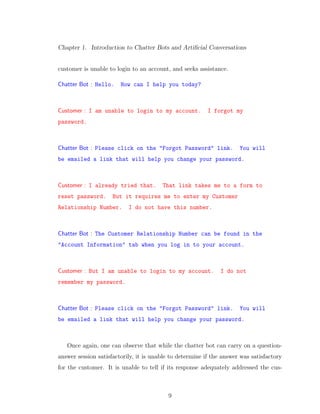
Let me illustrate another example from a real-world chatter bot application to
highlight this deficiency. Consider a snippet of conversation with a customer service
chatter bot that helps customers solve account access issues. In this exchange, the
8
Chapter 1. Introduction to Chatter Bots and Artificial Conversations
customer is unable to login to an account, and seeks assistance.
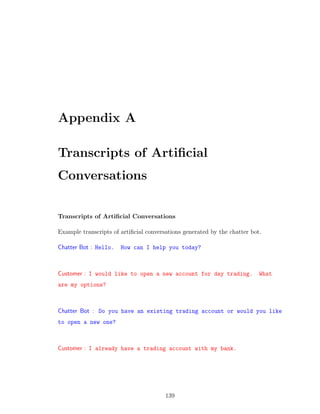
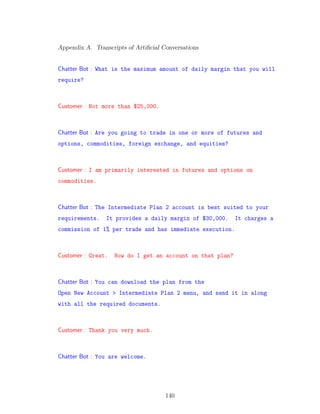
Chatter Bot : Hello. How can I help you today?
Customer : I am unable to login to my account. I forgot my
password.
Chatter Bot : Please click on the "Forgot Password" link. You will
be emailed a link that will help you change your password.
Customer : I already tried that. That link takes me to a form to
reset password. But it requires me to enter my Customer
Relationship Number. I do not have this number.
Chatter Bot : The Customer Relationship Number can be found in the
"Account Information" tab when you log in to your account.
Customer : But I am unable to login to my account. I do not
remember my password.
Chatter Bot : Please click on the "Forgot Password" link. You will
be emailed a link that will help you change your password.
Once again, one can observe that while the chatter bot can carry on a question-
answer session satisfactorily, it is unable to determine if the answer was satisfactory
for the customer. It is unable to tell if its response adequately addressed the cus-
9
Chapter 1. Introduction to Chatter Bots and Artificial Conversations
tomer’s query, or if the customer was confused by the response.
To a human representative, it would be clear that this conversation is not helping
address the customer’s issue. However, since chatter bots are programmed through
pattern-template pairs, they are more suited for question-answer type exchanges,
where there is a sequence of several question-answer pairs. They are unable to hold
a longer conversation, understand the conversation, gauge whether the conversation
is going in the desired direction, and act on it. In the above example, we expect the
chatter bot to recognize the deadlock situation for the customer and to resolve it,
or transfer the conversation to a human representative if the solution is beyond its
programmatic capabilities.
Let me use another example to illustrate the subtle failure of such customer service
chatter bots. In this example, a chatter bot deployed in customer service operations
of an online electronic trading website tries to help a customer resolve an unallocated
transaction, i.e., the customer’s margin account does not have enough balance to
service a pending buy order. (Acknowledgement: This corpus was provided by Next
IT Inc., Spokane, WA.)
Chatter Bot: Hello. How can I help you today?
Customer: I have a pending buy order and I am out of margin.
Chatter Bot: Buy orders are processed within 2 business days.
Customer: But I am out of margin. I am concerned that my buy order
will not execute.
10
Chapter 1. Introduction to Chatter Bots and Artificial Conversations
ChatterBot: Margin can be restored by a new allocation request from
your holding account. It takes 3 business days to execute.
Customer: But my buy order is already scheduled. I do not want to
lose it.
Chatter Bot: Buy orders are processed within 2 business days.
It is clear from these examples that the conversational performance of these chat-
ter bots does not live up to what we would expect from a human customer service
agent. Hence, there is clearly an opportunity to improve their conversational ability.
In addition, since chatter bots cannot actually follow a longer conversation, they
are also incapable of spotting opportunities in a conversation for providing unsolicited
but pertinent information. Consider the following exchange between a prospective
insurance customer and a chatter bot.(Acknowledgement: This corpus was provided
by Next IT Inc., Spokane, WA.)
Chatter Bot : Hello. How can I help you today?
Customer : I received an quote for home insurance last week. I
would like to purchase that policy.
Chatter Bot : All right. Do you remember the quote reference number?
Customer : No. I had printed it out but I left the printout in my
car.
11
Chapter 1. Introduction to Chatter Bots and Artificial Conversations
Chatter Bot : Not a problem. I can look it up by your last name and
date of birth. What is your last name?
Customer : Johnson
Chatter Bot : What is your date of birth?
Customer : April 21, 1973
Chatter Bot : Great. I found your quote. Would you like to purchase
the policy now?
It would seem that the chatter bot satisfactorily handled the conversation. How-
ever, there are some missed opportunities. The conversation indicates that the cus-
tomer possibly owns a car. A human representative would have noticed this, and
spotted an opportunity for another sale.
Human Representative : You mentioned that you have a car. Did you
know that if you get auto insurance in conjunction with your home
insurance, it could save you $500 over 6 months?
The next generation in the evolution of chatter bots should be able spot such
opportunities in a conversation, and act on it, either by disseminating relevant in-
formation, or by transferring the conversation to a human representative seamlessly.
The missing element in current chatter bots seems to be one of context. In a series of
12
Chapter 1. Introduction to Chatter Bots and Artificial Conversations
question-answer exchanges, or pairwise utterance, the context switches from one pair
to the next. But in most conversations, the context remains the same throughout the
exchange of utterances. Contemporary chatter bots are unable to adhere to context
in conversations. It is this limitation that I will explore further and address in this
research.
Conversations abound with uncertainties of various kinds that may lead to misun-
derstanding and other communication failures. These uncertainties permeate every
level of conversation, from attending to what was said and identifying what words
were spoken, to understanding the intentions behind the words. While human rep-
resentatives manage these multiple uncertainties with almost effortless ease, chatter
bots often break down in these situations. My aim is to improve the conversational
power of chatter bots. Instead of just being able to engage in question-answer ex-
changes, I would like them to be able to hold a longer conversation, be able to
semantically process it, and more closely to emulate the behavior of a human repre-
sentative.
In the rest of the chapter, I will highlight many relevant nuances to this problem
and formalize the definition of this problem. What exactly does it mean for the
chatter bot to better understand context? How exactly can context be represented
formally? What would be the evaluation parameters for this research endeavor?
What underlying assumptions about scope should be made to control the evaluation
parameters in this research? What other concepts from existing literature in natural
language processing, computational linguistics, and semantic learning can be lever-
aged for this research? The rest of the chapter will be dedicated to answering these
questions.
What are the types of conversation that chatter bots can carry out? Many
chatter bots have been deployed in real-life that can carry out conversations ranging
from open ended general chitchat to specific questions-answer sessions. In order
13
Chapter 1. Introduction to Chatter Bots and Artificial Conversations
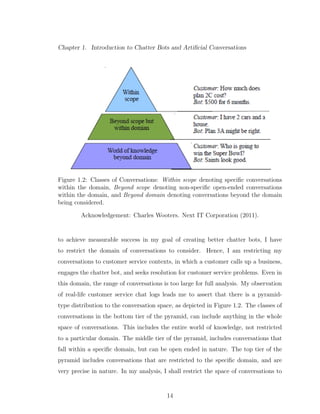
Figure 1.2: Classes of Conversations: Within scope denoting specific conversations
within the domain, Beyond scope denoting non-specific open-ended conversations
within the domain, and Beyond domain denoting conversations beyond the domain
being considered.
Acknowledgement: Charles Wooters. Next IT Corporation (2011).
to achieve measurable success in my goal of creating better chatter bots, I have
to restrict the domain of conversations to consider. Hence, I am restricting my
conversations to customer service contexts, in which a customer calls up a business,
engages the chatter bot, and seeks resolution for customer service problems. Even in
this domain, the range of conversations is too large for full analysis. My observation
of real-life customer service chat logs leads me to assert that there is a pyramid-
type distribution to the conversation space, as depicted in Figure 1.2. The classes of
conversations in the bottom tier of the pyramid, can include anything in the whole
space of conversations. This includes the entire world of knowledge, not restricted
to a particular domain. The middle tier of the pyramid, includes conversations that
fall within a specific domain, but can be open ended in nature. The top tier of the
pyramid includes conversations that are restricted to the specific domain, and are
very precise in nature. In my analysis, I shall restrict the space of conversations to
14
Chapter 1. Introduction to Chatter Bots and Artificial Conversations
the top two tiers of this pyramid.
Currently, when organizations deploy chatter bots for customer service, the chat-
ter bots are programmed with knowledge that is essential to perform its task of
customer service. This process involves encoding rules about the organization’s poli-
cies, products, and services. This can be generalized as a knowledge representation
problem. In the field of information organization and extraction, there are several
proven data structures for the effective knowledge representation. They range from
simple graphs to an ontology, where there is a formal representation of knowledge as
a set of concepts within a domain and the relationships between those concepts. It
is used to reason about the entities within that domain, and may be used to describe
the domain. An ontology provides a shared vocabulary, which can be used to model
a domain, the type of objects and/or concepts that exist, and their properties and
relations. Information retrieval using ontology engineering techniques automatically
extracts structured and categorized information that is contextually and semantically
well-defined from a specific domain from unstructured machine-readable documents.
These techniques are useful for richer extraction of information from sources that are
a combination of structured and unstructured data [21].
How exactly can a conversation be represented in formal terms? A conversation
can have specific states and progressively transition through these states. The states
can be indicators of the quality of the conversation, for example, is the customer
satisfied or dissatisfied, is the customer getting the relevant information, or getting
confused, is the conversation at a suitable point where it is advisable to reveal new
information to the customer, etc. [26, 89]. The sentiment analysis community tries
to gauge parameters like political opinion, favorability or unfavorability of products
or services, etc. based on twitter chatter or blog posts. However gauging sentiment
in a conversation is far more subtle. Generally customers do not explicitly use words
that signify positive or negative sentiment. The deduction that the customer is
15
Chapter 1. Introduction to Chatter Bots and Artificial Conversations
satisfied or unsatisfied can only be made by measuring the direction of flow of a
conversation through various states. In this research, I will define a conversation as
a state-based process. The conversation control algorithm will predict the flow of the
conversation through a transition probability matrix, and the chatter bot’s responses
will be engineered to steer the conversation to more favorable states [64, 65].
It is important to define a validation criterion for this research. It will help
determine if I have made progress and succeeded in the goals of this research. The
validation criterion will depend on a formal scheme to measure the suitability of
a conversation. I will define one such measurement scheme, Grice’s maxim’s of
conversations [30, 31, 32, 51], later in this document. These will be used to validate
the results of my research.
1.4 Artificial Conversations
The main aim of this research to explore and demonstrate techniques for solving the
problem of artificial conversations. This work defines artificial conversations as any
kind of simulated interactive conversation between a software entity and a human
user. While this research will restrict itself to text based chat conversations, in which
all interaction between the software chatting entity and the human will be through
simple text enabled media like a standard computer terminal, I expect that the
general principles arising out of this research will be applicable to all conversations,
including voice based conversations. There are additional complexities to voice based
conversations, which are beyond the scope of this research, as this work will restrict
itself to the analysis of conversational principles and abstract out other dynamics of
the conversation process.
One major task of this work is to design an integrated architecture for a chatter
bot. The architecture should enable the chatter bot go beyond mere question-answer
16
Chapter 1. Introduction to Chatter Bots and Artificial Conversations
exchanges and be able to hold a short conversation. It is assumed that the chatter
bot will be deployed to provide customer service, and will hold conversations with
existing and potential customers. It will answer FAQ type questions, try to re-
solve customer service issues, try to spot opportunities during the conversation to
disseminate unsolicited information, and be able to adjudge the semantic flow of a
conversation. If the flow of the conversation requires the chatter bot to pursue a
course of action beyond its programmatic capabilities, it will be able to realize this
and transfer the conversation to a human representative. The validation for these
will be based on Grice’s cooperative maxims of conversations [30, 31, 32, 51].
Thus, I list two specific hypotheses for this work.
* My knowledge representation framework will offer sufficient representational
power for the task of characterizing information and relationships in the domain
of customer service background knowledge.
* My semantic conversation control algorithm will be able to detect transitions in
the states of the conversations, predict probable outcomes of the conversation,
and use this knowledge to control the conversation.
1.5 Problem Scope
While the proposed research borrows ideas from several other works, it solves a
distinct problem. In this subsection, I want to make a clear distinction between the
class of problems that this work explores and the class of problems addressed by
other well defined areas of research.
Natural Language Processing (NLP) and Computational Linguistics are branches
of research that look at the interaction between computing platforms and human
languages. There is currently a heavy emphasis on statistical modeling of linguistic
17
Chapter 1. Introduction to Chatter Bots and Artificial Conversations
artifacts like grammar, parts of speech, and syntactic structures specific to that
language.
Some specific problems explored by these fields of research are automatic summa-
rization of a large chunk of text, resolution of reference or objects by several words in a
sentence, analysis the natural discourse relationships between sentences, recognizing
and classifying the speech acts in a chunk of text. Other NLP research involves au-
tomatically translating text from one human language to another, separating words
into individual morphemes and identifying the class of the morphemes. Related re-
search areas include performing named entity recognition, converting information
from computer databases into readable human language, converting chunks of text
into more formal representations such as first-order logic structures that are easier
for computer programs to manipulate, identifying parts of speech in a sentence, and
performing grammatical correctness analysis of a sentence using language-specific
parse trees.
The common theme among all these application problems is that the analysis
happens on the sentence level. Each sentence is considered a unit of data to be ana-
lyzed. Grammar, parts of speech, reference of pronouns, etc are important features
to be studied [47, 39].
However, in my research, I am not concerned with low level abstractions like
sentences, phrases, and words. I am taking artifacts like grammar, discourse resolu-
tion, and parts of speech to be given. For my proposed research, conversations are
the unit of analysis. Each conversation, comprising a series of exchanges, is a data
point. I am analyzing the conversation and not the individual components of the
conversation at a lower level of granularity. I am trying to determine progression
of a conversation over several states, probability of traversing between these states,
and exploiting a stored knowledge base to seed the conversation. I want to make a
clear distinction between analyzing whole segments of conversations as data units in
18
Chapter 1. Introduction to Chatter Bots and Artificial Conversations
my proposed work, and analyzing individual sentences, grammatical minutiae and
precise problems of discourse resolution as data units in tradition computational
linguistics research.
Topic Modeling is a branch of machine learning research that studies statistical
models for discovering the abstract topics that occur in a collection of documents,
most commonly using latent semantic analysis, latent Dirichlet allocation and super-
vised and unsupervised clustering [87]. While I will borrow these concepts for my
knowledge capturing task, my work will go several steps further. The topic modeling
techniques are used to drive the knowledge engine for the chatter bot as explained
in Chapter 4.
Sentiment analysis research tries to determine favorability / unfavorability of
sentences, degree of acceptance of themes, opinion and buzz regarding certain topics,
etc [64]. While I will be exploring the idea of changing sentiment over time, I will be
looking at sentiments in terms of transition of the conversation over several phases
represented by a state-based process.
Thus, in summary, these are the major questions that this research aims to an-
swer.
1. What is an artificial conversation? While this chapter illustrated several ex-
amples of artificial conversations, both in general purpose and domain specific
situations, it would be useful to develop a principled definition.
2. What does it mean to have better or higher quality conversations? It might
be obvious merely from reading the transcript of a conversation whether it is a
good conversation or a bad conversation. To develop a principled mechanism
of generating higher quality artificial conversations, it is necessary to develop
a principled notion of good and bad.
19
Chapter 1. Introduction to Chatter Bots and Artificial Conversations
3. What are consistent and principled metrics with which to evaluate artificial
conversations? Will these apply to general purpose conversations only or also
to domain specific conversations like virtual customer service agents?
4. What are the general design principles and tools that can be used to generate
artificial conversations in all domains?
5. What are the general design principles and tools that can be used for knowledge
representation needed to support artificial conversations?
6. What are the general design principles and tools that can be used to model the
semantic complexity of higher quality artificial conversations?
7. What are the general design principles required to combine the content modeled
by knowledge representation and the semantics necessary to ensure the human-
like natural quality of artificial conversations?
The rest of the document explores all these questions. Chapter 2 explores existing
literature in the area of conversation engineering, focusing on linguistic, statistical,
and semantic approaches. Chapter 3 talks about specific approaches in literature for
knowledge representation and semantic modeling in general, not specifically applied
to the problem of artificial conversations. Chapter 4 explores the traditional scien-
tific metrics used for conversations in general, not necessarily artificial conversations.
This chapter will also develop metrics used to evaluate the artificial conversations
produced by this work. Chapter 5 will describe the architecture designed to achieve
the goals of this research, i.e., generate higher quality artificial conversations. Chap-
ter 6 will talk about the generation of artificial conversations using the chatter bot
architecture and describe all the steps in detail. Chapter 7 talks about results and
their analysis and discussion. Chapter 8 talks about conclusion, some possible ap-
plications of this work, and suggests some future directions.
20
Chapter 1. Introduction to Chatter Bots and Artificial Conversations
The unique contribution of this dissertation is demonstrating a novel architectural
design to combine content semantics with pragmatic semantics to generate high
quality artificial conversations in a specific domain and a narrow situational context.
A set of relevant evaluation criteria will be defined and the artificial conversations
will be graded according to them. This work will borrow ideas from the literature on
conversation theory, knowledge representation, and the theory of pragmatics. This
dissertation is the first example of computational modeling of concepts from these
fields of research.
21
Chapter 2
Conversation Engineering
Chapter 2 discusses several studies in the literature that try to solve problems re-
lated to the task in this dissertation. These studies can be roughly classified into
three groups: the syntactic approach, the stochastic approach, and the semantic ap-
proach. Stochastic approaches use statistical frameworks like Bayesian theory, Hid-
den Markov models, and n-gram modeling to construct individual sentences. Syntac-
tic approaches use techniques from natural language processing and computational
linguistics to parse and model grammatical constructs of conversations. Semantic
approaches use models of meaning from a knowledge structure to drive sentence
analysis and construction. The most representative studies in each approach are
described here in detail. As with most research, studies under all three umbrellas
heavily leverage ideas from each other.
2.1 The Stochastic Approach
The earliest formal architecture designed for conversations was the Bayesian Recep-
tionist at Microsoft Inc [36]. The system maintained a domain of dialogues about
22
Chapter 2. Conversation Engineering
goals typically handled by receptionists at the front desks of the buildings on the
Microsoft corporate campus. The system employed a set of Bayesian user models to
interpret the goals of speakers given evidence gleaned from a natural language parse
of their utterances. Beyond linguistic features, the domain models took contextual
evidence into consideration, including visual findings.
The 3-level task abstraction hierarchy was the key feature of the system. Each
level modeled a different level of abstraction. Level 0, the highest level of abstraction,
modeled the task of discriminating the high-level goal of the user, given initial obser-
vations and an initial utterance. Level 1, the next lower level of abstraction, modeled
the refinement of the high-level goals into more specific goals. Level 2, the lowest
level of abstraction, modeled additional conditions for specific situational cases. Lev-
els more detailed than the highest level included an additional state representing the
proposition that the current level is inappropriate.
Inference about the belief assigned to each state was used to control backtrack-
ing in conversation. Decomposition of a user’s goals into several levels of detail
allowed for guiding conversation on a natural path of convergence toward shared
understanding at progressively greater levels of detail. Multiple levels also allowed
for the establishment of common ground [10] about uncertainties at each level. It
also allowed conversation regarding comprehension of misunderstandings before pro-
gressing to the next level of detail.
In the Microsoft system, users could be directed, as part of a natural dialog about
their goals, to implicitly or explicitly confirm or disconfirm misunderstanding at each
level. This lead to reduction of uncertainty to some tolerable level before progressing
to the next level. The limitation of this model was that it scaled poorly. It was unable
to model any conversation beyond asking for direction. But, it also introduced some
important ideas about leveraging probabilistic methods for inferencing at different
levels of abstraction.
23
Chapter 2. Conversation Engineering
Paek and Horovitz [62] then demonstrated how conversations could be modeled as
an inference and decision making problem under uncertainty. They designed Quar-
tet, a task independent, multimodal architecture for supporting robust continuous
spoken dialog. Their model had four levels of independent analysis. A channel level
established mere exchange of utterances. A signal level established intent. An inten-
tion level which modeled semantics of the conversation. Finally a conversation level,
modeled a tangible activity or behavior based on the conversation.
The Paek and Horovitz model also included learning the parameters of the in-
ference model using an expectation maximization type algorithm. The architecture
maintained a probability distribution function over communication failure modes,
and minimized this failure function at each level [15]. One limitation of this model
was that it relied on ad hoc policies to deal with failures at each level, and these
policies had to be designed independently for every class of conversations.
Li and Ji [42] used a probabilistic framework based on dynamic Bayesian net-
works to model an user’s affective states. Although they model general behaviors,
not conversations, they were one of the earlier works that introduced the concept of
state-based modeling for human behavior. They systematically modeled the uncer-
tainty, dynamics, and different types of knowledge associated with user affective state
using DBNs. They demonstrated an information-theoretic mechanism to perform
active behavior learning. They also demonstrated user affective state inference in a
timely and efficient manner, and proposed information-theoretic criteria to optimally
determine when and what assistance to provide to maximize the chance for returning
the user to its normal state while minimizing interference with the user’s workload
and annoyance. The main contribution lies in the integration of the proposed active
sensing mechanism into the DBN-based framework for user state inference and user
assistance.
Mishne et al. [53] introduced a novel method of estimating the domain-specific
24
Chapter 2. Conversation Engineering
importance of conversation fragments from call center telephone calls, based on di-
vergence of corpus statistics. The main novelty of their system was a method for
identifying the domain-specific importance levels of fragments in the call, and us-
age of this method for retrieving possible solutions to the problem presented in the
conversation, and for detecting abuse of the call-center resources. A simple way of
estimating the significance level of a fragment of a call is to estimate the significance
level of each word in the fragment and combine these individual values. In most text
analysis systems, the significance of words is inversely related to their frequency.
The more common a word is, the less significance it has. Estimating the significance
level of a word requires an evaluation of how characteristic the word is to a specific
domain, compared to other domains. Rather than global significance, they actually
estimated domain-specific word significance (and hence, domain-specific fragment
significance). They also used manually transcribed data for validating their results.
Ozyurt and Kose [61] used Naive Bayes, k-nearest neighbor, and support vector
machines to automatically mine chat conversation topics in Turkish language call
center conversations. Threads and endings of the topics were determined by making
analysis at the sentence level rather than the conversation level. They used a Dirichlet
prior distribution to initially model the distribution of topics across each sentence,
and then support vector machines to learn their final distributions.
Douglas et al. [17] designed a tool for mining customer care chats for news items
of importance. Relevant business and dialog features were extracted from the speech
logs of caller-system interactions and tracked by a trend analysis algorithm. Features
that moved outside their expected bounds on a given day generated headlines as part
of a web site generated completely automatically from each day’s logs.
25
Chapter 2. Conversation Engineering
2.2 The Syntactic Approach
Many researchers have tried to solve the specific problem of mining and modeling
conversations in the context of customer service agents using a variety of cookbook
techniques. I will describe the most prominent approaches.
Takeuchi et al. [91], designed a method to analyze transcripts of conversations
between customers and human agents at a service center. Their aim was to obtain
actionable insights from the conversations to improve agent performance using a three
step approach. First, they segmented the call into logical parts. Next they extracted
relevant phrases within different segments. Finally, they performed 2-dimensional
association analysis to identify actionable trends. They used real conversational
data from a service center to identify specific actions by agents that resulted in
positive outcomes. They showed that associations between agent utterances and
outcomes could be found by segmenting the calls and aggregating phrases within the
call segments. In particular they analyzed calls to answer some of the key questions
faced by question-answers with the objective of improving agent productivity.
In subsequent work, Takeuchi et al. [92] argued that the language patterns in the
final stages of electronic negotiations are more indicative of the outcomes, whereas
in face-to-face negotiations the initial stages of the negotiations are more useful for
predicting the outcome.
Roy and Venkata. [74] used unsupervised learning algorithms to generate do-
main models automatically from telephone conversation transcriptions. Their do-
main model was comprised primarily of a topic taxonomy where every node was
characterized by topics, typical questions and answers, typical actions, and call statis-
tics. This hierarchical domain model contained summarized topic specific details for
topics of different granularity. However they did not use any semantic features in
their taxonomy.
26
Chapter 2. Conversation Engineering
2.3 The Semantic Approach
Chai et al. [5] introduced a fine-grained semantic model that characterized the
meanings of user inputs and the overall conversation from multiple dimensions for
unified multi-modal input understanding. They also realized discourse interpretation
through an integrated interpretation approach that identified the semantics of user
inputs and the overall conversation using a wide variety of contexts. They achieved a
90 % accuracy in recognizing the meaning of user input. However the interpretation
rules were manually contracted for the models. The rules had to handcrafted each
time for different domains, and as a result scaled poorly.
Mehta and Corradini [49] demonstrated the representational power of ontologies
for a spoken dialog system. Their system focused on the categorization of ontological
resources in to domain independent, and domain specific components. These domains
were leveraged to augment the agents conversational capabilities and enhance the
systems reusability across conversational domains. They leveraged Google directory
categorization for a semi-automatic understanding of a user utterance on general
purpose topics like movies and games.
2.4 Dialogue systems
There has been a long history of research in dialogue systems, both speech-based
and text-based. Some dialogue systems also incorporate graphics, haptics, gestures,
and other mediums of communication. These systems have been deployed in a wide
range of applications like website navigation assistance, virtual receptionist, training
and tutorials, virtual concierge at hotels, etc.
One of the earliest research efforts was the GUS (Genial Understander System)
[3]. This was a virtual agent helping a customer make reservations. The knowledge
27
Chapter 2. Conversation Engineering
base about flights options, timings, costs, etc. were encoded in the form of frames.
Frames were used to represent collections of information at many levels within the
system. Some frames described the sequence of a normal dialog, others represented
the attributes of a date, a trip plan, or a traveller. While the system worked well
on handling reservations, it wasn’t particularly intelligent. It could handle only a
very restricted set of questions, and the domain knowledge of the question-answer
sequence had be encoded exactly in the frame in the same order in which the questions
would be asked.
The GALAXY Communicator system at MIT [81, 68] is a client-server architec-
ture for communicating online information like weather and flight information. It
has several components like database access, speech synthesizer, speech recognizer,
and a language understanding engine. It has achieved good results in travel reser-
vation domain, and is available as an API to build an end to end system [68]. The
knowledge is represented in terms of frames and it uses a turn management system
for dialog control. It can handle a very sophisticated range of conversations ranging
from yes-no questions to answering complex queries [19]. It’s main limitation is that
it is not set up to build the knowledge base using facts, but in terms of anticipated
questions [19].
FASIL [14] was an email summarization system for use in a voice-based virtual
personal assistant. It used an XML-based dialogue manager that used named-entity
recognition. It was optimized for email summarization, as email has distinct charac-
teristics as compared other forms of text.
The DARPA Communicator project [41] was an initiative to support advanced
conversational capabilities including negotiation, plan optimization, and complex ex-
planations. All the above mentioned dialog systems were part of a DARPA initiative.
Some metrics used to evaluate the system were the number of error messages, the
mean system turn duration, the mean user turn duration, the number of system
28
Chapter 2. Conversation Engineering
words to task end, the number of user words to task end, the mean response latency,
and the total duration of task [96].
State tracking is an important task in management of dialog systems. Several
belief based state tracking architectures handle this problem using stochastic meth-
ods. These include generative and discriminative models [16]. Some specialized
techniques leverage dialogue structure in specific context to improve accuracy by
encoding speech recognition patterns [50]. Neural networks have also been used for
deep-learning solutions to this problem [35].
Partially Observable Markov Decisions Processes (POMDPs) have also been used
to model conversations. They improve upon traditional conversational systems in
that they can better handle ambiguity from changing domains [25]. Reinforcement
learning techniques have also been used for this problem. [73]
2.5 Limitations of existing approaches
Although there has been a lot of progress made over the years in the design of
conversational engineering systems, there is one major limitation to most of them.
They do not make an explicit distinction to modeling the content required for the
conversation and the semantics inherent in the conversation process.
Most approaches either focus on just one of content modeling or conversation
semantics, or sub-aspects of these, or incorporate both of them together without
making an explicit distinction. This leads to blind spots in the application, in which
either one has to encode content and semantics to for a new domain from scratch,
or the system has to undergo substantial remodeling to handle conversations of a
different type.
This dissertation is based on the assumption (as shown in the next chapter)
29
Chapter 2. Conversation Engineering
that a conversation is a specific well-defined process, that follows certain explicit
conventions. These conventions almost always include content and semantics, and
in some cases may include additional features like sentiment and emotions. The
next chapter, which evaluates literature from the theory of conversation analysis,
not necessarily artificial conversations will strengthen the case for the assumption
that content and semantics are distinct features that need to be modeled separately
and then made to work in conjunction to generate artificial conversations.
30
Chapter 3
Modeling Content and Semantics
This chapter explores the problem of representing a conversation and the background
knowledge engine. One key aspect distinguishing this research from existing ap-
proaches is that I consider conversations to the unit of my analysis. I am modeling
various aspects of the conversation itself, without delving into lower-level grammat-
ical and linguistic minutiae.
3.1 Analysis of Conversations
What is a conversation? There is no scientifically accepted definition, but the liter-
ature enumerates several characteristics in general.
* Conversations are based on a series of reactions to previous utterances. They
have an interactive structure [26, 83].
* Conversations may be unpredictable, but they are rarely random. They tend
to exhibit some semi-structural characteristics based on established social con-
ventions. For example, a conversation between two or more friends may be
31
Chapter 3. Modeling Content and Semantics
spontaneous. A conversation between a doctor and a patient may be more
structured. A conversation between an interrogator and an interrogatee may
be very one sided with only the interrogator making most of the utterances
[26, 78].
* Conversations will often have a shared goal, towards which all participants of
the conversation try to proceed. The goal can be subjective, for example, to
agree on some point of view, or objective, for example, to negotiate to a specific
price point. The goal may shift over the course of the conversation. There may
not be any goal in case of idle gossip among friends. Small talk too has a goal,
that of increasing comfort level of the conversation participants [82, 83].
* Conversations are sometimes the ideal form of communication in customer
service situations, depending on the participants’ desired end goals. Conver-
sations may be ideal when, for example, each party desires a relatively equal
exchange of information, or when one party desires to query the other to solicit
information [78, 82].
3.1.1 Structure in Conversations
Conversation analysis is the study of talking interactions, in situations of everyday life
and is considered an important subfield of research by linguists, anthropologists, and
sociologists. It has been used as a tool for research in interactional sociolinguistics,
discourse analysis, discursive psychology, and phonetics [27, 46]. Basically, the goal
of conversation analysis is to find interesting patterns, structure, and order in specific
situational contexts like a classroom, a court of law, or a doctor’s office [22].
Some basic structures of a conversation according to conversation analysis are as
follows.
32
Chapter 3. Modeling Content and Semantics
* Turn-taking is often the most fundamental structure observed in conversations.
In a conversation between two individuals, each individual takes turns speaking.
The duration of the turns may be uneven, but they do take turns. Literature
defines this as having two sub-processes: allocation of turns and construction of
turns. Allocation of turns describes how the turns of individual speakers (two
or more) in a conversation is organized, either explicitly or implicitly. Turn
construction describes lexical, clausal, phrasal, and sentential conceptual units
that make up the turn [26, 82, 83].
* Conversations in which the participants are mostly agreeing with each other
may have a different structure than conversations in which the participants are
disagreeing with each other [70].
* Often conversations tend to drift away from the intentions of the participants.
This may be due to issues related to miscommunication, or due to the contents
of the conversation. Consequently, the participants may attempt to bring the
conversation back on course to align with intentions. This is known as the
process of conversation repair. The repair mechanism can be explicit or more
subtle, but it has some order and structure to it. This structure may depend
on social or institutional conventions [75, 78].
Gordon Pask’s conversation theory [67] describes how shared knowledge is con-
structed through conversation. This is dependent on the content of the conversation,
the behavior of the participants of the conversation, and the mutually agreed mean-
ing of the contents as defined by some social or institutional convention. This process
may be further dependent on narrow situational contexts, for example, a conversation
between a teacher and a student in a classroom [67]
33
Chapter 3. Modeling Content and Semantics
3.1.2 Speech Act Theory
Speech act theory asserts that with each utterance in a conversation, an action is
performed by the speaker [101, 102]. These actions, related to the utterance, can be
classified into several different profiles [95]. These profiles can be put together into
predefined patterns to constitute an entire conversation [28]. Winograd and Flores
[101, 102] show that conversation for action is an example of a pattern of speech
acts organized together to create a specific type of conversation [95]. Speech act
modeling can also be applied to logs of stored conversations by manual or automated
annotation of individual utterances [95]. The modified SWBD-DAMSL tag set [38]
is a comprehensive collection of all speech acts defined in the literature. These can
be modeled using hidden Markov models [72].
Speech acts can be broadly classified under three levels of language-action asso-
ciations. [2, 1, 90].
1. Locutionary: This refers to the actual utterance and its intended meaning,
where the utterance is meant to be taken completely literally, with no consid-
eration for context or conventions.
2. Illocutionary: This refers to the utterance and its real intended meaning,
i.e., what utterance actually means in a particular context as defined by some
convention of social linguistic usage.
3. Perlocutionary: This refers to the utterance and its possible unintended
consequences or effects, i.e., the utterance causes fear, anxiety, some rational
or irrational action, etc.
The illocutionary speech act is the most semantically meaningful of the three
levels as applicable to this research. The literature on illocutionary speech acts
broadly recognizes the following four taxonomies [54].
34
Chapter 3. Modeling Content and Semantics
1. Austin: Expositives, Exercitives, Verdictives, Commissives, Behabitives.
2. Searle: Representatives, Directives, Commissives, Expressives, Declarations,
Representative Declarations.
3. D’Andrade and Wish: Expositives, Interrogatives, Exercitives, Reactions,
Verdictives, Commissives, Behabitives.
4. VerbMobil: Request, Suggest, Convention, Inform, Feedback.
The choice of which taxonomy to use, or which subsets of taxonomies to use
depend on the application. It is also possible to mix and match between different
taxonomies depending on the application [54].
Dialogue acts are context-specific speech acts that have been defined for spe-
cific applications [88]. They can refer to speech acts in a narrow situational con-
text. Some common dialogue acts are: greetings, Meta-Questions, Yes-No Questions,
Statements, Requests, Wh-Question.
Just like speech acts, dialogue acts can have taxonomies too. A dialogue act
taxonomy must trade-off between two considerations. The definitions of the dialogue
act tags must be clear enough in order to be easily distinguishable in the specific
context where it’s being applied. They must also be general enough to be reusable
for other applications as well [20].
3.1.3 Semantics and Sentiment in a Conversation
Sentiment analysis research tries to identify emotions and attitudes from text. For
example, trying to determine if a newspaper article has a positive, negative, or
neutral connotation. A related area of research, opinion mining, tries to deduce
subjective information from pieces of text [64]. These tasks usually use sophisticated
35
Chapter 3. Modeling Content and Semantics
algorithms from natural language processing, computational linguistics, and text
analytics. The piece of text could be a document, a single sentence, or just a word.
Sentiment analysis in conversations tries to deduce the attitude or emotional state
of the speaker and how it influences the conversation, i.e., is the speaker angry, sad,
happy, unhappy, impatient, etc.
Pang [65] and Turney [94] applied sentiment analysis to film and product reviews
to determine if they were favorable or unfavorable. Pang and Lee [66] also ana-
lyzed documents for polarity of sentiment on a continuous rather than discrete scale.
Snyder [84] applied sentiment analysis to restaurant reviews and used it to predict
ratings on a star system for the food, service, and ambience of the restaurant. Fea-
ture or aspect-based sentiment analysis is more fine-grained and tries to determine
opinion polarity on specific entities mentioned in the text under review [37, 45, 44].
For example, the viewfinder of a digital camera, the service at a bank, etc.
The accuracy of a sentiment analysis system indicates how well the analysis agrees
with human judgments. This is usually measured by precision and recall. Pang and
Lee [64] showed that human raters typically agree with each other about 70% of the
time. Thus 70% is a good benchmark to test sentiment analysis methods. Pang and
Lee [64] also claim that correllation is a better measure than precision because it
takes into account how close the predicted value is to the target value.
The microblogging platform Twitter (http://www.twitter.com) provides an
ideal corpus for sentiment analysis. Pak and Paroubek [63] classified tweets as
positive negative or neural using a naive-Bayes classifier based on n-grams and a
parts-of-speech tagging algorithm.
36
Chapter 3. Modeling Content and Semantics
3.2 Knowledge Representation for Conversations
Conversation are usually based on a specific context. The participants of the conver-
sation usually possess the background knowledge upon which they make their utter-
ances. How is knowledge traditionally represented? This section gives an overview of
knowledge representation research, not necessarily for conversations, but in general
for modeling any task that requires some background knowledge.
3.2.1 Goal Fulfillment Maps
Text-based chatter bot scripts are implemented using hierarchical rules in the form
of scripts [56]. Each rule possesses a list of structural patterns of sentences and an
associated response. In some cases, text-based chatter bots are designed to work in
a goal-oriented manner with the aim to achieving a specific goal [52]. Since a single
chat utterance can be input in many different ways, a very large number of scripts
would have to be designed. This is an onerous task [59, 56]. Modification of the rules
would be difficult, since all rules might need to be changed for the sake of consistency.
The designer has to predict how each change would influence other rules [76]. It has
been highlighted that by employing sentence similarity measures, scripting can be
reduced to a few prototype sentences [43, 59, 56, 58, 57]. A goal-fulfillment map is
an effective way to represent the condensed knowledge in scripts. It is based on the
conversation agent semantic framework by O’Shea [56, 58, 57, 60]. The rules are
described in such a way that they can be sequentially combined to satisfy some goal.
The user must traverse some contexts to achieve the goal.
O’Shea [56, 58, 57, 60] explains that in a conversational context, ”the contexts
along the goal-fulfillment map express specific queries, which require specific answers
in order for progression to be made along one of possibly various routes. Users may
switch between contexts, traversing forwards or backwards along the goal-fulfillment
37
Chapter 3. Modeling Content and Semantics
map. Engaging in dialogue with a user, the chatter bot is able to capture specific
pieces of information from the user input in order to progress along the network of
contexts described by the goal-fulfillment map. Using a goal-oriented goal-fulfillment
map, the aim is to elicit a specific set of answers from the user in order to achieve
goal-fulfillment. As such, rules that pose a question possess a series of successor
rules, which seek to obtain an appropriate answer. If no relevant input is sent, that
is, no match found above that of a preset threshold, an associated default rule is
returned prompting the user for further input to satisfy the request.”
Figure 3.1: Building blocks of a goal-fulfillment map [58, 57, 60].
Each rule is assigned an activation level of one. Once a rule has fired its activation
level is reduced to zero and as such will fail to fire again from subsequent user input.
For example, if a rule has performed its task of eliciting a piece of information from
38
Chapter 3. Modeling Content and Semantics
the user, its purpose is no longer required. Figure 3.1 shows the building blocks of a
Goal Fulfillment Map [58, 57, 60].
The selected domain as described by the goal-fulfillment map in figure 3.2 is
concerned with advising credit card customers on debt management. The goal-
fulfillment map contains seven interconnected contexts. The contexts along the goal-
fulfillment map express specific queries, which require specific answers in order for
progression to be made along the designated route.
Figure 3.2: A Goal Fulfillment Map [58, 57, 60]: where a specific map encodes the
sequence of questions to be asked, whose responses will enable fulfill a specific goal
during the conversation.
Dialogue will traverse the goal-fulfillment map in a progression starting with the
base context named Initialize. It is possible to revert back to a previously visited
context in the case of a misinterpreted line of input. As such, the user has the option
39
Chapter 3. Modeling Content and Semantics
to alert the chatter bot that there has been a misunderstanding.
The following contexts are represented.
* Non Payment aims to elicit the reason for non-payment of the debt;
* Can Cover identifies that the customer has in fact paid the debt and as such
reached goal-fulfillment;
* Cannot Cover aims to elicit why a customer simply cannot afford even to pay
the proposed minimum payment of the debt;
* Customer Status identifies the status of the customer, for example,
* Regular Customer has fewer privileges and options to defer minimum pay-
ment.
* Elite Customer has more options to defer minimum payment.
* Borrow Margin determines whether the customer has applied for borrowing
margin from another account.
* Close Holding aims to identify if the Customer’s account should be closed or
suspended due to non-payment of debt.
* Default context is one in which the chatter bot will revert to if no content
within the current context is appropriate to that of the user input.
3.2.2 Ontologies
The formal study of ontologies has its roots in the philosophical and metaphysical
study of nature. An ontology can be considered to be a formally rigorous description
of a specific domain of knowledge. Philosophers consider this to be a systematic
40
Chapter 3. Modeling Content and Semantics
Figure 3.3: A Wine Ontology: represents knowledge about beverages.
Acknowledgement: Jessica Turner & Matthew Turner, Mind Research Network.
account of existence, because in a knowledge-based system, that which exists can be
represented. According to Gruber [33], ”when the knowledge of a domain is repre-
sented in a declarative formalism, the set of objects that can be represented is called
the universe of discourse. This set of objects, and the describable relationships among
them, are reflected in the representational vocabulary with which a knowledge-based
41
Chapter 3. Modeling Content and Semantics
program represents knowledge. Thus, we can describe the ontology of a program by
defining a set of representational terms. In such an ontology, definitions associate
the names of entities in the universe of discourse (e.g., classes, relations, functions,
or other objects) with human-readable text describing what the names are meant to
denote, and formal axioms that constrain the interpretation and well-formed use of
these terms” [33].
Ontology addresses the science of the most general properties of things, which
includes both the properties of the thing in question, and also the properties of every
a priori determined thing. In the field of information organization and extraction, an
ontology is a formal representation of knowledge as a set of concepts within a domain,
and the relationships between those concepts. It is used to reason about the entities
within that domain, and may be used to describe the domain. Gruber [33] defines
an ontology as a ”formal, explicit specification of a shared conceptualization”. An
ontology provides a shared vocabulary, which can be used to model a domain, i.e.,
the type of objects and/or concepts that exist, and their properties and relations.
A domain ontology describes a specific area of focus. Figure 3.3 shows a very
simple domain ontology representing knowledge about beverages. The atomic in-
stances are Mineral Water, Cola, Coffee, Herbal Tea, Beer, Wine, Whisky, Cham-
pagne, Vodka, Grains and Grapes, which are individual well-grounded concepts.
The classes, which are collections of individual concepts and sub-classes, are Alco-
holic Drinks, Non-alcoholic Drinks, Beverages and Plants. The relationships are is
a, costs less than, and made from.
The Web Ontology Language (OWL) is a family of knowledge representation
languages for authoring ontologies. The languages are characterized by formal se-
mantics and RDF/XML-based serializations for the Semantic Web. OWL is endorsed
by the World Wide Web Consortium (W3C) and has attracted academic, medical
and commercial interest.
42
Chapter 3. Modeling Content and Semantics
Similarly, conceptual graphs are a system of logic based on the existential graphs
and the semantic networks of artificial intelligence [85]. They express meaning in
a form that is logically precise, humanly readable, and computationally tractable.
With their direct mapping to language, conceptual graphs serve as an intermediate
language for translating computer-oriented formalisms to and from natural languages
[29]. With their graphic representation, they serve as a readable, but formal design
and specification language.
Conceptual graphs have been implemented in a variety of projects for information
retrieval, database design, expert systems, and natural language processing. [69, 86]
According to Obitko [55], ”although the formalism for conceptual graphs is based on
semantic networks, it has direct translation to the language of first order predicate
logic, from which it takes its semantics. The main feature is standardized graphical
representation that like in the case of semantic networks allows a human to get a quick
overview of what the graph means. A conceptual graph is a bipartite orientated graph
where instances of concepts are displayed as a rectangle and conceptual relations
are displayed as an ellipse. Oriented edges then link these vertices and denote the
existence and orientation of relation. A relation can have more than one edge, in
which case edges are numbered. Conceptual graphs have the same expressing power
as predicate logic”
Basically, a conceptual graph is a bipartite graph containing two kinds of nodes,
concepts and conceptual relations. Arcs link concepts to conceptual relations, and
each arc is said to belong to a conceptual relation. There are no arcs that link
concepts to concepts or relations to relations. Concepts have an associated type
and a referent. A referent is a way to denote the entity of the universe of discourse
to which the concept refers. It consists of a quantifier, a designator, which either
points to the referent or describes it, and a descriptor, which is a conceptual graph
describing some aspects of the referent. Note that a quantifier here may only be of
43
Chapter 3. Modeling Content and Semantics
existential kind or specify that a precise number of instances of the referent exist. A
descriptor is considered as a conceptual graph nested in to a concept. The concept
is said to be a context for the nested conceptual graph. Conceptual relations are are
also typed. A relation type associates to a conceptual relation a valence equal to the
number of arcs that belong to the relation, and a signature that constraint the types
of concepts linked to the relation [29, 69, 85, 86].
44
Chapter 4
Evaluation of Conversations
This chapter describes the theoretical background employed to validate the results
of my research. It is important to have a standard and consistent metric to measure
the quality of conversations. I borrow ideas from the theory of pragmatics to define
some metrics to evaluate conversations.
4.1 Theory of Pragmatics
Pragmatics is a subfield of linguistics which studies the ways in which context con-
tributes to meaning. Pragmatics encompasses speech act theory, conversational im-
plicature, talk in interaction and other approaches to language behavior in philos-
ophy, sociology, and linguistics [51]. It studies how the transmission of meaning
depends not only on the linguistic knowledge (for example, grammar, lexicon, etc.)
of the speaker and listener, but also on the context of the utterance, knowledge about
the status of those involved, and the inferred intent of the speaker. In this respect,
pragmatics explains how language users are able to overcome apparent ambiguity,
since meaning relies on the manner, place, time, etc. of an utterance.
45
Chapter 4. Evaluation of Conversations
Pragmatics is a systematic way of explaining language use in context. It seeks
to explain aspects of meaning which cannot be found in the plain sense of words or
structures, as explained by semantics. As a field of language study, pragmatics is
fairly new. Its origins lie in philosophy of language and the American philosophical
school of pragmatism. As a discipline within language science, its roots lie in the
work of Paul Grice on conversational implicature and the cooperative principles
[30, 31, 32, 51].
The cooperative principle describes how people interact with one another. As
phrased by Grice, who introduced it, ”Make your contribution such as it is required,
at the stage at which it occurs, by the accepted purpose or direction of the talk
exchange in which you are engaged.” Though phrased as a prescriptive command, the
principle is intended as a description of how people normally behave in conversation.
4.1.1 Grice’s Maxims
The cooperative principle can be divided into four maxims, called the Gricean max-
ims, describing specific rational principles observed by people who obey the coop-
erative principle that enable effective communication. Grice proposed four conver-
sational maxims that arise from the pragmatics of natural language. The Gricean
Maxims are a way to explain the link between utterances and what is understood
from them [30, 31, 32, 51].
Grice proposes that in ordinary conversation, speakers and hearers share a co-
operative principle. Speakers shape their utterances to be understood by hearers.
Grice analyzes cooperation as involving four maxims: quantity, quality, relation, and
manner. Speakers give enough and not too much information (quantity maxim).
They are genuine and sincere, speaking ”truth” or facts (quality maxim). Utter-
ances are relative to the context of the speech (relation maxim). Speakers try to
46
Chapter 4. Evaluation of Conversations
present meaning clearly and concisely, avoiding ambiguity (manner maxim).
Grice’s cooperative principles are a set of norms expected in conversation. Grice’s
maxims of cooperation can also be interpreted in conversations as follows:
* quality: speaker tells the truth or provable by adequate evidence
* quanity: speaker is as informative as required
* relation: response is relevant to topic of discussion
* manner: speaker’s avoids ambiguity or obscurity, is direct and straightforward
Saygin et al. [77] demonstrated that evaluating chatter bots using Grice’s cooper-
ative maxims is an effective way to compare chatter bots competing for the Loebner
prize. The maxims provide a scoring matrix, against which each artificial conversa-
tions can be graded for a specific criterion. Thus this is a good potential starting
point for evaluating the artificial conversations in this dissertation.
Since Grice’s maxims were proposed to initially evaluate human conversations
long before the advent of chatter bots, the chatter bot generated artificial conver-
sations in this dissertation will also be evaluated against this criterion. This will
form the basis of comparison of chatter bot performance, i.e., how human-like was
the performance of the chatter bot in engaging the customer in a service related
conversation.
4.2 Domain and Situation Specific Conversations
The previous section showed that Grice’s maxims can be a good ”proxy” metric
for evaluating artificial conversations, the question arises: given that most feasible
47
Chapter 4. Evaluation of Conversations
artificial conversations will take place in the domain or situation specific context,
as shown by Figure 1.2, are there other metrics of evaluation that can be defined?
The answer to this question will again depend on the domain. This research aims to
produce high quality artificial conversations in the customer-service domain. What
are the nature of these conversations that can give some idea about appropriate
evaluation metrics?
In customer service situations, a customer has a conversation with a chatter bot
via text chat, describes some issue, or seeks some information or guidance, and the
chatter bot helps resolve it. The issue is usually complicated enough that it can’t
be resolved in a single utterance-response exchange. Typically, the conversation will
have to go through a few utterance-response exchanges to fully address the issue.
Then a few more utterance-response exchanges may be required to carry out the
task of resolving the issue.
In order to comprehend a specific issue, the chatter bot must often ask a set of
follow up questions. The specific question would be completely dependent on the
situational context in the domain. But for a well-defined context, the number of
such followup questions will be fixed. For example, if the issue being discussed by
the customer has to do with incorrect allocation of margins in a financial account,
then to fully comprehend the issue, the chatter bot needs to know if the account is a
saving account or a trading account, what is the specific configuration of the account,
is the account set up for day trading or regular trading, and what is the minimum
margin required by the account. Hence, a good artificial conversation would be one
in which the chatter bot ask all or most of these followup questions.
Similarly, in helping the customer resolve an issue, the chatter bot might have to
lead the customer through a series of steps. For example, to change the configuration
of the account, the customer might have to change the login password, the transaction
password, change allocations, change trading frequencies, or reassign balances to
48
Chapter 4. Evaluation of Conversations
margins. In a good artificial conversation, the chatter bot should ask the customer
to perform all these steps in some order. Hence the fraction of follow up questions
asked by the chatter bot is an important evaluation metric.
It must also be noted that the ultimate function of a customer service chatter bot
is to help the customer resolve some issues. These issues could be simply providing
information, guiding the customer through some pre-defined procedure like closing an
account, troubleshoot some problems or issues and resolve it, or resolve some dispute
or argument or difference of opinion with the customer. In each of these tasks, the
ultimate goal is to successfully resolve some issue. Thus, one important evaluation
criteria could be how many times the chatter bot is actually able to successfully
resolve an issue.
Finally, as it has been mentioned several times, the objective of this dissertation
is to ultimately enable chatter bots to generate high quality artificial conversations
that go beyond simple question-answer or utterance-exchange pairs to a series of
utterance-exchange pairs where the context is maintained throughout. In chapter
1, it was demonstrated that contemporary state-of-the-art chatter bots like Mitsuku
and customer service bots can only perform well over single pairs of utterance ex-
changes. Since this research tries to overcome this limitation, it follows that scoring
the number of utterance-exchange pairs over which the artificial conversation can
maintain coherence is an important evaluation metric.
In this chapter we discussed several potential evaluation criteria. Some are of an
objective nature, which can be easily and unambiguously measured. Some of them
are subjective, and would need to evaluated in a consistent and rigorous manner.
These factors will be considered in the results and discussions chapters where I
describe the experimental methodology that performs these evaluations.
49
Chapter 5
The Chatter Bot Architecture
As demonstrated in chapter 3, a conversation is a process that is governed by certain
protocols, both social and functional. These governing protocols are applicable to all
general purpose conversations. In purpose driven conversations like customer service
interactions, a more restricted set of protocols applies. As such, chapter 4 demon-
strated that a good general purpose conversation usually satisfies the four Gricean
maxims of Quantity, Quality, Relation, and Manner. A purpose-driven conversation
must satisfy further criteria, which in the case of customer service conversations in-
clude but are not limited to the percentage of follow-up questions asked, number
of turns of utterance exchanges carried out while adhering to the context, and the
number of successful resolutions of customer service issues.
A general-purpose chatter bot that grades well against these criteria must es-
sentially have a strong underlying semantic model. The semantic model must cap-
ture the inherent underlying process-driven protocol of conversations. In addition, a
specific-purpose customer service chatter can leverage the inductive bias inherent in
targeted purpose-driven communication capturing the domain characteristics.
Also demonstrated in chapter 3 was the notion of a knowledge background that
50
Chapter 5. The Chatter Bot Architecture
is necessary for conversations. For general purpose conversations, knowledge of the
nature and relations governing the conversations was an integral part of the process.
For purpose-driven customer service conversations, a more comprehensive knowledge
base is essential. This would be true for any domain specific conversational chatter
bot. This is because a conversation is a process that is strongly rooted in content.
A conversation is a means of communication about situations and issues that arise
from the characteristics and peculiarities of the underlying content. This poses two
related challenges: storing the content, and efficiently retrieving the content. The
success of an artificial conversation is strongly dependent of being able to retrieve or
access the correct piece of content when required. Hence, an artificial conversation
system requires good knowledge engineering to store domain specific content that is
easy to access, maintain, and update when necessary.
Informally, we can say that a good chatter bot must know what to say as well
as how to say it. Essentially, what to say is defined by content, and how to say
it is defined by semantics. Artificial conversations thus must combine content and
semantics effectively. This chapter describes the system architecture and methodol-
ogy required to do this in an effective and principled way. The architecture borrows
several knowledge representation and conversation analysis ideas that were discussed
in chapter 3. The objective of the architecture is to engineer conversations that can
score well against the qualitative and quantitative metrics discussed in chapter 4.
5.1 Important Definitions
Throughout chapters, 1, 2, 3, and 4, several terms related to conversations have
been discussed informally. Before I begin describing the architecture, it will be
useful to state all the definitions and terminology in a formal principled manner.
These definitions apply only to the scope of this current work, i.e., text chat between
51
Chapter 5. The Chatter Bot Architecture
a chatter bot and a human in a turn-taking manner.
- Utterance: An utterance is everything that is said by either the chatter bot
or the human in a single turn. It could consist of one for more sentences. For
simplification, it is assumed that each utterance belongs to a single context.
Multiple contexts in the same utterance is beyond the scope of this research.
For Example, this is an example of one chatter bot utterance. (Acknowledge-
ment: This corpus was provided by Next IT Inc., Spokane, WA.)
Chatter Bot : Hello. How can I help you today?
This is an example of one human utterance.
Human : I am unable to login to my account. I forgot my
password.
This is an example of an utterance that consists of more than once sentence.
(Acknowledgement: This corpus was provided by Next IT Inc., Spokane, WA.)
Customer : Yes. I sold USD 750 worth of stock in JFD and along
with my previous balance of USD 350, I have sufficient margin
in my portfolio. Yet I am unable to process my transactions
due to insufficient margin error.
This is an example of a pair of utterances. The chatter bot and the human
take turns with their utterances. It is based on the the turn-taking model
of conversation discussed in chapter 3. (Acknowledgement: This corpus was
provided by Next IT Inc., Spokane, WA.)
Chatter Bot : Can you please provide your mother’s maiden name for
verification?
52
Chapter 5. The Chatter Bot Architecture
Customer : It is Parker.
- Conversation: A series of successive utterance pairs on the same context
constitutes a conversation. The number of utterance pairs in the conversation
can vary. But the entire series belongs to a single context. A conversation with
multiple contexts is beyond the scope of this work.
For example, the following is a conversation. (Acknowledgement: This corpus
was provided by Next IT Inc., Spokane, WA.)
Chatter Bot : Hello. How can I help you today?
Customer : I received an quote for home insurance last week. I
would like to purchase that policy.
Chatter Bot : All right. Do you remember the quote reference
number?
Customer : No. I had printed it out but I left the printout in my
car.
Chatter Bot : Not a problem. I can look it up by your last name
and date of birth. What is your last name?
Customer : Johnson
53
Chapter 5. The Chatter Bot Architecture
Chatter Bot : What is your date of birth?
Customer : April 21, 1973
Chatter Bot : Great. I found your quote. would you like to
purchase the policy now?
- Corpus: The corpus for this dissertation is a set of several conversations. Each
conversation is between a chatter bot and a human following the turn-taking
model. Each conversation constitutes a separate data point in the corpus.
Each data point in the corpus is obtained from the same domain. The de-
tails of the specific corpus used in this work will be described in chapter 6.
(Acknowledgement: This corpus was provided by Next IT Inc., Spokane, WA.)
5.2 System Architecture
The system architecture for the chatter bot consists of three main modules, namely,
the Knowledge Engine, the Conversation Engine, and the Chat Interface. The Knowl-
edge Engine handles what to say, while the Conversation Engine handles how to say
it. Thus these two modules handle distinct tasks for the artificial conversation pro-
cess. The Chat Interface module is the third component of the system architecture.
This module is the first layer of interface with the user. It carries out the first stage
of pre-processing of the raw chat data. The overview of the architecture is shown in
Figure 5.1. The actions of all these modules are explained in this chapter.
The chatter bot architecture has been designed to test the hypothesis that has
been developed incrementally in chapter 1, 2, 3, 4. As mentioned during the con-
54
Chapter 5. The Chatter Bot Architecture
Figure 5.1: System Architecture for the Chatter Bot containing the Chat Interface,
which pre-processes the raw chat text, the Knowledge Engine, which provides the
content of the conversation, and the Conversation Engine, which manages the se-
mantic context of the conversation. The block arrows indicate direction of flow of
information between the interfaces implementing the modules
struction of the hypothesis, the chatter bot needs a knowledge base that drives the
content of the conversation. The Knowledge Engine module contains the data struc-
tures and methods necessary to fulfill this objective. It was also mentioned during
the hypothesis construction that the chatter bot needs to keep track of semantic
context during a conversation, and be able to engineer the conversation towards fa-
vorable states. This functionality is implemented by the Conversation Engine. The
Chat Interface directly connects with the user inputs. In this system, the user, who
is the human playing the role of the customer, enters his text-based chat utterances
through the standard terminal. The chatter bot produces its response back to the
standard terminal. It is a rudimentary system as of now and is not interfaced with
a graphical user interface.
The solid blue arrows in the figure show the flow of information. A lot of infor-
mation is passed between the three modules to get the conversation to work. The
55
Chapter 5. The Chatter Bot Architecture
remaining sections in this chapter will go into the details. The black bidirectional
arrows denote the interaction with the user (human or customer) via the standard
terminal, but this could denote a graphical user interaction in a future version. The
architecture has been designed to be modular. The Knowledge Engine and the Con-
versation Engine can be implemented by any of the several concepts described in
Chapter 3. In this work they have been realized using specific techniques, which
will be described in detail in the next few sections. But the architecture has been
designed to be of a plug-and-play nature, where other techniques for representing
content and semantics can be substituted in and out to test and experiment with
them.
5.3 Knowledge Engine
The Knowledge Engine is the component of the chatter bot architecture that supplies
the content of the conversation. The design of the Knowledge Engine is extremely
domain dependent. In chapter 3, we discussed two main ways knowledge can be
represented: Goal-fulfillment maps and Ontologies.
The two main content defining characteristics of the conversation are the domain-
specific information about the subject matter being discussed in the conversation,
and the particular speech act being adhered to in the conversation. The former pro-
vides the meat-and-potatoes details about the conversation, i.e., the specific informa-
tion that the customer, or the agent is seeking or providing in the conversation. The
latter provides the situational context of the conversation, i.e., what are the qualifiers
of the information exchange in the conversation, that determines the conversation
engineering strategy of the chatter bot architecture. Without the former, the conver-
sation wouldn’t be grounded and would constitute just an abstract process. Without
the latter, the conversation would resemble the flawed conversations we discussed in
56
Chapter 5. The Chatter Bot Architecture
chapter 1. Thus, the combination of both of these defining characteristics is essential
to the conversation engineering process.
The next design question is the organization of these two components. In adher-
ence to our modular design principle for maintainability, the information organization
is optimized for ease of retrieval and update. Essentially, the algorithmic capabilities
of a hash-map data structure is leveraged, i.e., the constant time access, insertion,
and deletion, and the linear time space complexity. In this implementation, the
standard Java hash map as defined by the collections API is used. Specific hash
functions can be leveraged for optimization, but that is currently beyond the scope
of this work.
The subject matter information is organized in the form of a Topic Hash Map.
The speech act information is organized in the form of a Speech Act Identifier.
These hash map implementations are described in detail below, as they are essential
for the realization of the engineering goals of this work. The block diagram for the
Knowledge Engine is shown in Figure 5.2.
5.3.1 Speech Act Identifier
As explained in chapter 3, there are several differing specifications of speech acts
theory from the literature on linguistics and dialog systems. While a speech act is
an utterance with a general performative function, and can range from 5 to 10 in
number, a dialog act is a specialized speech act that is defined only the context of
specific dialog system. All the most commonly and universally defined 42 dialog acts
have been collect in the in the modified SWBD-DAMSL tag set [38].
From this collection of both speech and dialog acts, I have identified a specific
set of Speech Acts that are appropriate for this work.
57
Chapter 5. The Chatter Bot Architecture
Figure 5.2: Knowledge Engine: Contains the Speech Act Identifier, and the Topics
Hash Table. Each Topic consists of Context Maps. The blue block arrows show flow
of information between the sub-modules within the Chat Interface. The green block
arrows indicate flow of information between the modules external to it
1. The Assertive Speech Act: The utterance states a true fact about some
state of the world pertaining to the context of the conversation and all involved
participants commit to its veracity. This is an example of Searle’s illocutionary
58
Chapter 5. The Chatter Bot Architecture
speech act [80, 79].
For example, the following are examples of Assertive Speech Acts:
* This restaurant makes the best burritos.
* John is the boss of this team.
* Your password is invalid.
* You have $2,000 in your account.
2. The Directive Speech Act: The utterance that serves as a request, com-
mand, advice, or instruction from one participant to another in terms of a
specific action pertaining to the context of the conversation. This is an exam-
ple of Searle’s illocutionary speech act [80, 79].
For example, the following are examples of directive speech acts:
* Please bring me a breakfast burrito.
* Stop making large trades when you have small margins.
* Please close my account at the end of the month.
* You should update your password immediately for security reasons.
3. The Commissive Speech Act: The utterance that serves as a commitment
or promise to a future course of action that will change the state of the world
pertaining to the context of the conversation by a participant, and all other
participants commit to it’s veracity. This is an example of Searle’s illocutionary
speech act [80, 79].
For example, the following are examples of commissive speech acts:
* I am going to eat burritos for dinner tonight.
* I am going to update your account information.
* You margin will increase when your trades are realized in 48 hours.
59
Chapter 5. The Chatter Bot Architecture
* Your account will no longer be valid when your written request for change
of status is accepted.
4. The Expressive Speech Act:The utterance expresses some emotion or at-
titude about the context of the conversetion. For example, the emotion could
be gratitude, regret, excuse, etc. This is an example of Searle’s illocutionary
speech act [80, 79].
For example, the following are examples of expressive speech acts:
* Eating burritos at this restaurant makes me so happy.
* I am sorry that you lost access to your account.
* The process of canceling my trade requests is very cumbersome.
* It is not fair that I have to pay a commission of USD 200 on a transaction
that I did not explicitly authorize.
5. The Declarative Speech Act: The utterance causes the state of the world to
change, with full implicit or explicit acknowledgement of the participants of the
conversation .This is an example of Searle’s illocutionary speech act [80, 79].
For example, the following are examples of declarative speech acts:
* This restaurant just lost my business.
* John has been promoted to manager of the team.
* Your account has been upgraded to premium status.
* USD 3,000 has been credited to your account as your entire holdings in
ACN have been liquidated.
In addition to the above 5 speech acts from Searle’s illocutionary taxonomy
[80, 79], I define the one more dialogue act, specific to customer service con-
versations.
60
Chapter 5. The Chatter Bot Architecture
6. The Goal-Fulfillment Speech Act: The utterance causes the state of the
conversation to reach a conclusion, when all the issues raised in the conversation
have been resolved and acknowledged by the participants of the conversation
.This is an example of dialogue act specifically defined for this domain and
context, i.e., resolving customer-service issues.
For example, the following are examples of goal-fulfillment speech act::
* That will be all for now, thank you.
* Yes I am able to resolve the issue now.
Although only these 6 speech acts have been used in this implementation, the
architecture is general enough to use all 42 speech acts from the modified SWBD-
DAMSL tag set [38]. It can also use specialized dialogue acts, that are tailored
to the domain for which the conversations will be generated. The speech acts are
determined using a bag-of-words based latent semantic approach that is described
in detail in chapter 6. The module for determining the bag-of-words is part of the
Chat Interface, which will be described in detail later in this chapter.
Figure 5.3: The bag of words captured by the Chat Interface is used by a Latent
Semantic Analysis Algorithm to determine the most probable Speech Act associated
with the utterance.
61
Chapter 5. The Chatter Bot Architecture
5.3.2 Topics Hash Table
As discussed in chapter 3, there are several methods to represent domain information
for conversations. Chapter 3 described Ontologies and goal-fulfillment maps for
storing large amounts of information in an easily scalable and maintainable manner.
While Ontologies are formally comprehensive and robust feature-rich information
repositories, for this work goal-fulfilment maps have been used to encode domain
knowledge. As will be clear in subsequent discussions in this section, the purpose-
driven nature of customer-service conversations lends themselves very nicely to have
their background knowledge stored as a collection of goal-fulfillment maps. These
data structures also adhere to the philosophy of the architecture being easy to update,
maintain, and plug-and-play with various ideas.
Figure 5.4: The Topics Hash Table encodes the background knowledge for the con-
versation. It is a hash map, where the values are individual topics. Each topic is
implemented by a collection of contexts, where each context is a type of conversation.
Each context is implemented as a collection of goal-fulfillment maps.
The Topic Hash Table organizes the set of topics in the scope of the conversation
62
Chapter 5. The Chatter Bot Architecture
of the chatter bot. Each topic is a broad area of material for the particular domain
implemented. Each specific topic entry in the hash table consists of a set of context
maps that encode specific information about the topic. As described in the Knowl-
edge Representation chapter, this can be a simple goal-fulfillment map, or a complex
ontology. At present, I have simple goal-fulfillment graphs for a few topics. This can
be easily updated using ontologies of higher complexity.
In this dissertation, conversation from nine different topics have been imple-
mented, i.e., the background knowledge needed to support conversations pertaining
nine topics in the domain have been encoded using the method described. The 9
topics can be classified under three main subject headings:
* Accounts: Conversations related to general account issues.
- Login: The customer has problems logging in to the account.
- Configuration: The customer wants to change or delete certain config-
urations in the account.
- Access: The customer is unable to access certain parts of the account.
* Balance: Conversations related to issues regarding balances.
- Margins: The customer perceives incorrect or inconsistent margin
amounts in the account.
- Transfers: The customer has problems or questions regarding transfer of
balances between different portfolio instruments.
- Portfolio: The customer wants to modify or give details of portfolio
holdings.
* Transactions: Conversations related to transactional issues.
63
Chapter 5. The Chatter Bot Architecture
- Commissions: The customer has questions regarding commissions
charged for completed or future transactions.
- Orders: The customer wants to modify pending orders or has questions
regarding completed orders.
- Processing: The customer wants to resolve issues regarding processing
of transactions or orders.
The topics are arranged in the form of a hash map. Only one topic is selected for
every conversation, which is determined using a bag-of-words based latent semantic
analysis approach.
Figure 5.5: The bag of words captured by the Chat Interface is used by a Latent
Semantic Analysis Algorithm to determine the most probable Topic associated with
the utterance.
Within each topic element in the hash map, the information pertaining to the
topic is arranged as a collection of context maps. The contexts are also arranged
as hash maps. The contexts corresponding to the four main types of conversations
that will be described in the Conversation Engine subsection and also some contexts
common to all types of conversations.
* Greeting: This is common to all conversations. It models the small talk that
64
Chapter 5. The Chatter Bot Architecture
happens towards the beginning of each conversation.
* Procedural: This is a type of conversation described in the next subsection.
* Toubleshooting: This is a type of conversation described in the next subsec-
tion.
* Dispute Resolution: This is a type of conversation described in the next
subsection.
* Informational: This is a type of conversation described in the next subsection.
* Ending: This is common to all conversations. It models the wrapping up that
happens towards the end of each conversation.
Within each of these contexts, the conversation is organized as a collection of
goal-fulfillment maps, i.e., a hash set. In this work, each of these goal-fulfillment
maps have been manually coded.
For example, for the greeting, the goal-fulfillment map shown in Figure 5.7 is
used. The greeting is part of the small talk sub-module that is used at the beginning
of every conversation. This will be common to all topics. Now consider, Figure 5.8
and Figure 5.9. Both are contained in the Topic Hash Set of ”Account”. Within
the ”Account” Hash Set, Figure 5.8 shows a goal-fulfillment map that determines
whether the account has enough balance to cover a transaction and is pulled up
during conversations of the Troubleshooting type. Similarly, Figure 5.9 shows a
goal-fulfillment map that encodes the knowledge to configure an account. This is
pulled up during conversations of the type Procedural. Similarly, there are other
goal-fulfillment maps in the Account Hash Set, depending on the situational context
determined by the type of conversation. They are stored, indexed, and retrieved
using a hash function. While such a hash function may not be necessary for this
proof-of-concept system, it will be a necessary design element for a large system
65
Chapter 5. The Chatter Bot Architecture
with many topics being endowed by hundreds of goal fulfillment maps across tens of
situational contexts encoded by conversation types.
Figure 5.6: The context maps for the topic Accounts arranged in the form of a hash
set.
5.4 Conversation Engine
The Conversation Engine models the semantics of the conversation. Along with
content, semantics is the other component of a good conversation. An unique contri-
66
Chapter 5. The Chatter Bot Architecture
Figure 5.7: A goal-fulfillment map [58, 57, 60] that encodes the small talk that
usually precedes every conversation.
bution of this research is that the modular nature of the architecture allows content
to be distinctly modeled from semantics. While the previous section demonstrated
how the content can be implemented using goal-fulfillment maps, this section demon-
strates modeling the semantics of conversations in a modular fashion.
The Conversation Engine contains two modules, the Probabilistic Finite State
Automaton, which stores the four different types of conversations described later,
and the Conversation Planner, which decides the type of conversation to select, and
keep track of the state of the conversation. The block diagram for the Conversation
Engine is shown in Figure 15. The components of the Conversation Engine are
described in detail below.
67
Chapter 5. The Chatter Bot Architecture
Figure 5.8: A goal-fulfillment map [58, 57, 60] that encodes that segment of the con-
versation which determines whether the margin in the customer’s account is sufficient
to cover the transaction requested.
5.4.1 Probabilistic Finite State Automaton
The conversational semantics have been implemented using several probabilistic finite
state automata, where states represent semantic states of the conversation, transi-
tions represent the speech act associated with the customer utterances, accepting
states are the satisfaction and conclusion states, and non-accepting states are the
dissatisfaction states. The conversations states have been manually identified from
the corpus of human conversations in a customer service domain, i.e. transcripts
of chat conversations between a human customer and a human customer service
representative for an online electronic trading website. The transition probabilities
68
Chapter 5. The Chatter Bot Architecture
Figure 5.9: A goal-fulfillment map [58, 57, 60] that encodes the segment of conver-
sation required to offer the most suitable account configuration to the customer.
are learned from the corpus. The stochastic automata are conversational grammars,
which define the production rules for the particular type of conversation. This is
distinct from regular language grammars that proceed individual sentences. In this
research, the underlying mechanism to generate individual sentences is abstracted
out, i.e., it is assumed to exist, and the conversational grammars are built on top of
it. In this proof-of-concept work, the sentence producing mechanisms have not been
implemented. But they would be needed in a real conversational system. The con-
versation control algorithm the Conversation Planner is responsible to maintaining
track of the state of the conversation.
From analysis of the corpus, four distinct conversations have been identified.
69
Chapter 5. The Chatter Bot Architecture
Figure 5.10: The Conversation Engine: Contains the Probabilistic Finite State Au-
tomaton and the Conversation Planner. The blue block arrows show flow of infor-
mation between the sub-modules within the Chat Interface. The green block arrows
indicate flow of information between the modules external to it
They are described in detail next.
Procedural Conversation A procedural conversation is one in which the chatter
bot guides the customer though a series of steps to achieve some objective. For ex-
70
Chapter 5. The Chatter Bot Architecture
ample, configuring an account, transferring balance from savings to trading account,
etc. The stochastic finite state automata is shown in Figure 5.11. A procedural
conversation consists of the following states.
Figure 5.11: The Finite state automaton for Procedural Conversations.
* Start: The first state in which the conversation resides. This is the state
before the conversation begins.
* Greeting: In this state, the conversation goes through the small talk process.
Names and pleasantries are exchanged. The exact details of what has to be
said implemented by the corresponding goal-fulfillment map in the Topic Hash
Table.
71
Chapter 5. The Chatter Bot Architecture
* Advisory: In this state, the chatter bot instructs the customer though a series
of steps to be followed or vice versa. Since this is essentially the customer or
chatter bot asking each other to change the state of the world through actions,
the utterances associated with the Assertive speech act keeps the conversation
in the same state.
* Satisfaction: This state indicates that the procedure has been completed as
verified by utterances associated with the Expressive speech act. An Assertive
speech act can take the conversation back to the Advisory state.
* Dissatisfaction: This is a ”dead-end” state that is reached when the conversa-
tion has reached beyond the programmatic limits of the chatter bot. Reaching
this state indicates conversation failure, since it is not possible to leave this
state.
* Conclusion: This state indicates the end of the conversation process. In
algorithmic terms, reaching this state causes program control to be handed
back to the Conversation Control algorithm. This state is reached when the
last goal-fulfillment task as indicated by the corresponding Topic Hash table
has been achieved.
Informational Conversation An informational conversation is one in which the
chatter bot provides the customer with a series of facts or truths. For example, a
list of all the pricing options for an account, all the special features associated with
an account, the steps to be taken to conduct a transaction, etc. The stochastic finite
state automata is shown in Figure 5.12. An informational conversation consists of
the following states.
* Start: The first state in which the conversation resides. This is the state
before the conversation begins.
72
Chapter 5. The Chatter Bot Architecture
Figure 5.12: The Finite state automaton for Informational Conversations.
* Greeting: In this state, the conversation goes through the small talk process.
Names and pleasantries are exchanged. The exact details of what has to be
said implemented by the corresponding goal-fulfillment map in the Topic Hash
Table.
* Elicitation: In this state, the chatter bot states truths or facts about the
state of the world from the relevant situational context that is encoded by the
correspond goal-fulfillment map in the Topic Hash Table. Utterances associated
with both Assertive and Expressive speech acts keep the conversation in this
state. This state is left only when Goal-Fulfillment is achieved as indicated by
the corresponding map in the Topic hash Table.
* Satisfaction: This state indicates that the procedure has been completed as
verified by utterances associated with the Expressive speech act. An Assertive
speech act can take the conversation back to the Advisory state.
73
Chapter 5. The Chatter Bot Architecture
* Dissatisfaction: This is a ”dead-end” state that is reached when the conversa-
tion has reached beyond the programmatic limits of the chatter bot. Reaching
this state indicates conversation failure, since it is not possible to leave this
state.
* Conclusion: This state indicates the end of the conversation process. In
algorithmic terms, reaching this state causes program control to be handed
back to the Conversation Control algorithm. This state is reached when the
last goal-fulfillment task as indicated by the corresponding Topic Hash table
has been achieved.
Notice that there is a subtle difference between a procedural and informational
conversation. In procedural conversations, utterances belong to Expressive speech
act cause the conversation to leave the Advisory state. In informational conversa-
tions, utterances belonging to the Expressive speech act causes the conversation to
remain in the Elicitation state. This is an important consideration for the underlying
conversation semantics since this means the two types of conversations are generated
by different conversational grammars.
Troubleshooting Conversation A troubleshooting conversation in which the
customer has a problem, and the chatter bot takes steps to understand the na-
ture of the problem, and then guides the customer through a series of steps to either
find more information about the problem or try to resolve it. For example, trou-
bleshooting an incorrect balance showing in the trading account, trouble an issue
with incorrectly executed trades and transactions, etc. The stochastic finite state
automaton is shown in Figure 5.13. A troubleshooting conversation consists of the
following states.
* Start: The first state in which the conversation resides. This is the state
74
Chapter 5. The Chatter Bot Architecture
Figure 5.13: The Finite state automaton for Troubleshooting Conversations.
before the conversation begins.
* Greeting: In this state, the conversation goes through the small talk process.
Names and pleasantries are exchanged. The exact details of what has to be
said implemented by the corresponding goal-fulfillment map in the Topic Hash
Table.
* Elicitation: In this state, the chatter bot asks questions, and solicits infor-
mation about the state of the world from the relevant situational context that
is encoded by the correspond goal-fulfillment map in the Topic Hash Table.
Utterances associated with Assertive speech acts keep the conversation in this
state. This state is left only when Goal-Fulfillment is achieved as indicated by
75
Chapter 5. The Chatter Bot Architecture
the corresponding map in the Topic hash Table. Note that while an utterance
belonging to an Expressive speech act would keep the conversation in this state,
such an utterance is unlikely according to the probabilities learned from the
corpus. Encountering such an utterance would mean that the Conversation
has incorrectly identified the conversation to be of a troubleshooting type.
* Troubleshooting: In this state, the chatter bot makes the customer take
proactive steps to change the state of the world in an attempt to resolve the
problem issue. The set of steps is once again defined by the corresponding
goal-fulfillment map in the Topic Hash Table. Note that alternative utterances
belong to the Declarative and Expressive speech acts would take the conversa-
tion back and forth between the Troubleshooting and Fixed state. Any other
speech act utterance will likely take the conversation to the Dissatisfaction
state.
* Fixed: This state indicates that the problem issues has been partially or
completely fixed. A partial fix would trigger an Expressive speech act ut-
terance from the customer which would take the conversation back to the
Troubleshooting state. Only a Goal-fulfillment speech act, as indicated by
the goal-fulfillment map in the corresponding Topic hash table would take the
conversation to the conclusion state.
* Dissatisfaction: This is a ”dead-end” state that is reached when the conversa-
tion has reached beyond the programmatic limits of the chatter bot. Reaching
this state indicates conversation failure, since it is not possible to leave this
state.
* Conclusion: This state indicates the end of the conversation process. In
algorithmic terms, reaching this state causes program control to be handed
back to the Conversation Control algorithm. This state is reached when the
76
Chapter 5. The Chatter Bot Architecture
last goal-fulfillment task, as indicated by the corresponding Topic Hash table,
has been achieved.
Dispute Resolution Conversation A dispute resolution conversation is one in
which there is customer disagrees with something, and the chatter bot tries to resolve
the disagreement. For example, the customer feels than an incorrect commissions
fee has been charged due to misidentification of transaction parameters, the cus-
tomer feels that the transactions were incorrectly executed due to misinterpretation
of instructions, etc. The stochastic finite state automata is shown in Figure 5.14. A
dispute resolution conversation consists of the following states.
Figure 5.14: The Finite state automaton for Dispute Resolution conversations.
77
Chapter 5. The Chatter Bot Architecture
* Start: The first state in which the conversation resides. This is the state
before the conversation begins.
* Greeting: In this state, the conversation goes through the small talk process.
Names and pleasantries are exchanged. The exact details of what has to be
said implemented by the corresponding goal-fulfillment map in the Topic Hash
Table.
* Dispute: In this state, the chatter bot takes steps to resolve the dispute by ask-
ing the customer to take proactive steps to change some truth about the state
of the world, or empathize or criticize some aspect of the customer situation or
statement. These courses of action are again guided by the corresponding goal-
fulfillment map in the Topic Hash table. An assertive statement is likely to send
the conversation to the Dissatisfaction state, since it will indicate escalation of
the dispute, possible irrevocably.
* Resolution: This state indicates that the problem issue has been partially or
completely fixed. A partial fix would trigger a Declarative speech act utterance
from the customer which would take the conversation back to the Dispute
state. Only a Goal-fulfillment speech act, as indicated by the goal-fulfillment
map in the corresponding Topic hash table, would take the conversation to the
conclusion state.
* Dissatisfaction: This is a ”dead-end” state that is reached when the conversa-
tion has reached beyond the programmatic limits of the chatter bot. Reaching
this state indicates conversation failure, since it is not possible to leave this
state.
* Conclusion: This state indicates the end of the conversation process. In
algorithmic terms, reaching this state causes program control to be handed
back to the Conversation Control algorithm. This state is reached when the
78
Chapter 5. The Chatter Bot Architecture
last goal-fulfillment task as indicated by the corresponding Topic Hash table
has been achieved.
A dispute resolution conversation differs from a troubleshooting conversation be-
cause the former doesn’t have a corresponding Elicitation state. Hence, a conver-
sation resembling an argument is handled differently compared to a conversation
seeking to solve problems. In practice, it turns out that the troubleshooting and
dispute resolution conversations are harder to model and hence are more interesting
to study.
5.4.2 Conversation Planner
The conversation planner serves as the workspace for the conversation generation as
shown in Figure 5.15. This module decides which type of transition to perform in the
stochastic automaton, maintains the likeliness score for each type of conversations,
and maintains a counter to keep track of the state for the conversation. These
functions are described below.
1. Maintain workspace for the conversation: The conversation planner
maintains four simultaneous solutions corresponding to the four conversations
types. With every utterance in the conversation, each conversation solution is
updated. When one solution becomes highly likely as indicated by a heuristic
score described later, then that solution is maintained and all others removed
from the workspace. Conversely, when one solution becomes highly unlikely ac-
cording the heuristic score described below, it is removed from the workspace.
There have been occasions when all the solutions have had their heuristic scores
fall below the pre-defined threshold and dropped from the workspace. This
leads to conversation failure.
79
Chapter 5. The Chatter Bot Architecture
Figure 5.15: The Conversation Planner consisting of the transition matrix lookup
table, the state tracker, the likeliness score variable, and the conversation solutions
in the workspace.
2. Transition matrix probability values: The conversation planner has access
to a lookup table of transition probabilities for the four stochastic automata
corresponding to the four types of conversation solutions. These probability
values are learned from the corpus and is described in the next chapter. This
lookup table indicates which transition to make for each automata.
3. State tracker: For each of the conversation solutions still active in the
workspace, a separate tracker is maintained to indicate the current state of the
conversation according to that solution. There can be from zero (conversation
failure) to four state trackers present simultaneously.
4. Likeliness Score: For each of the four solutions, a likeliness score is main-
80
Chapter 5. The Chatter Bot Architecture
tained. This score is an indication of how likely it is that a solution is the
right one for the specific conversation being generated. This score is an integer
variable initialized to 0. When the conversation follows the most likely path
as indicated by the automata corresponding to the variable, it is incremented
by 3. Since initially, all conversations have the ”Greeting” stage that involves
small talk, each likeliness score variable is increased by 3 for every progression
of conversation state. When the next progression does not agree with the one
indicated by the automaton, the score is decreased by 1. Scores that fall below 0
are dropped from the workspace, since that indicates that the conversation has
drifted sufficiently from the path suggested by the corresponding automaton
and hence that solution is unlikely.
When one score becomes an n−th multiple of the next highest score, for n > 8,
where n indicates the number of turns of utterances, then all other solutions
are dropped front the workspace. This situation is an indication that one of
the solutions is overwhelmingly likely as compared to the others and should
be the only one considered. As of now, there is not a very principled way
to determine the value or n, or the heuristic values 3 and 0. It has been se-
lected purely through trial and error, and repeated tweaking. Such a solution
was implemented because there is some evidence that human being process
conversation in this way [9, 13]. Literature from linguistic neurobiology sug-
gests that human beings maintain several alternative solutions while processing
conversations [11, 102].
5.5 Chat Interface
The Chat Interface is the module that directly interfaces with the user. Its high-level
function is to receive chat text from the user, pre-process this text and pass it on
81
Chapter 5. The Chatter Bot Architecture
to the Knowledge Engine and the Conversation Engine, receive input back from the
engines, and then transmit chat text back to the user. It has several sub-modules
that facilitate this task. The block diagram is described in Figure 5.16.
Figure 5.16: The Chat Interface: This module directly interfaces with the user. The
blue block arrows show flow of information between the sub-modules within the Chat
Interface. The green block arrows indicate flow of information between the modules
external to it
5.5.1 Utterance Bucket
The Utterance Bucket is an interface that receives the chat text from the user, and
places the text in a buffer. This module is designed to have a library function to
correct spellings and grammar. But it is currently left unimplemented.
82
Chapter 5. The Chatter Bot Architecture
5.5.2 Stemmer
The Stemmer module reduces text to its root stems. For example, all the inflected
words troubles, troubled, and troublesome are reduced to the root form trouble. This is
implemented using an open-source version of the classic Porter Stemming Algorithm
[71]. Then the stemmed set of words is subjected to the NLTK parser that is part
of the open source NLTK suite. This extracts a set of discerning keywords.
5.5.3 Speech Act Detector
This module examines the keywords and detects the Speech Act associated with the
keywords. The module has access to a set of keywords stored in a hash set. It detects
which speech act keywords are present in the text, and puts them in a collection.
5.5.4 Sentiment Detector
This module detects sentiment associated with the utterance. The standard set of
bag of words pertaining to sentiments is used [64]. The set of sentiments pertaining
to customer service issues, which is stored in a searchable hash table. Currently, this
module is left unimplemented.
5.5.5 Topic Detector
This module detects the topic for the conversation. Like the Speech Act detector
module, the topic module simply detects which topic keywords are present by refer-
ring to a hash set of topic keywords and places these words into a collection.
83
Chapter 5. The Chatter Bot Architecture
5.5.6 Interface
This module collates the information from the Speech Act, Sentiment, and Topic de-
tectors, in to a single stream of arguments, and then passes it on to the Conversation
Engine, and the Knowledge Engine.
5.5.7 Anatomy of a Conversation
This section shows how a conversation is created in a step-by-step fashion through
the architecture.
1. The conversation starts with a human making a comment.
Customer : I would like to open a new account for day trading.
What are my options?
This message is entered from the standard terminal. The Utterance Bucket
directly collects the text in the form of a string. A standard spellchecker
and grammar checker autocorrects the spelling and grammatical errors in the
sentence if any
2. The correct sentence, free of spelling and grammatical error, is sent to the
Stemmer. Using Porter’s Stemming algorithm, the following stems are ob-
tained, ”account”, ”day trade”, ”open”, and ”options”.
3. The entire stemmed sentence is then passed on simultaneously to the Speech
Act Detector, the Sentiment detector, and the Topic Detector. The following
events then take place.
* The Speech Act Detector uses Latent Semantic Analysis to determine that
84
Chapter 5. The Chatter Bot Architecture
the type of speech act is ”Expressive”, since he bag of words included
”would” and ”like”.
* The Sentiment Detector detects that the sentiment is neutral, since none
of the words from the positive or negative bag of words is encountered.
* The Topic Detector determines using Latent Semantic analysis that the
topic is ”new account” using bag of words ”new”, ”account”, and ”open”.
4. The output of the Speech Act Detector, the Sentiment Detector, and the Topic
Detector is then sent to the interface. The Interface combines these into an ar-
ray list, and sends the array list to the Conversation Engine and the Knowledge
Engine simultaneously.
5. In the Knowledge Engine, the following steps take place.
* The Interface of the knowledge engine receives the array list and sends it
to the Speech Act Identifier. This module selects the correct speech act
from the list as ”expressive”.
* The interface also sends the bag of words to the topic hash table. The
hash table retrieves the topic as ”new account”. The appropriate context
map is then pulled out. This context map lists the steps for the encoded
knowledge for opening a new account in the form of a goal-fulfillment
map. The appropriate goal-fulfillment map, shown in Figure 5.17, is then
put in to the workspace and sent to the interface.
* A goal-fulfillment algorithm is initiated. A counter is initiated to keep
track of the progression of goals in the map.
6. In the Conversation Engine, the following steps take place.
* In the Probabilistic finite State Automata, initially all four possible so-
lutions are maintained. This is because initially the probabilities of each
85
Chapter 5. The Chatter Bot Architecture
Figure 5.17: Goal-fulfillment map [58, 57, 60] selected by the Knowledge Engine in
the anatomy of a conversation.
conversation type will be nearly equal. A counter is initialized to maintain
the current state of the conversation in each solution.
* The Conversation Planner will calculate the probabilities of transition
from one state to another depending upon the Speech Act being uttered.
These transitions are learned from the corpus and are stored in a lookup
table. The Conversation Planner is responsible for advancing the counter
indicating the current state of the conversation.
7. The information is sent back to the Chat Interface. The Utterance Bucket cor-
rects spelling (unlikely) and grammatical errors, and then outputs the response
of the chatter bot to the standard terminal.
86
Chapter 5. The Chatter Bot Architecture
Chatter Bot : Do you have an existing trading account or would you
like to open a new one?
8. This process is repeated until the end of the conversation is indicated by the
Conversation Planner counter being in an accepting state.
5.6 Uniqueness of Architecture
The review of the literature in Chapter 2 revealed some common themes.
* All three main approaches: syntactic, stochastic and semantic, perform their
analysis on a finer granular level, where each unit of data is a sentence. Topic
modeling and other learning approaches look at a chunk of text as whole,
without consideration of the transitory nature of the content.
* The literature doesn’t have a standardized approach to knowledge representa-
tion for a conversation. Each domain has a specific architecture for represent-
ing knowledge appropriate for that domain. This precludes easy translation of
techniques to other domains and scales poorly.
* No study in the literature represents conversations as a process that transitions
across a set of states.
* Semantic approaches like sentiment analysis consider the presence or absence
of certain words to determine polarity of a sentence. It is a static approach. It
also fails take into consideration that a conversation is a process that transitions
through several states.
The uniqueness of this work is that I demonstrate a modular, robust, and scalable
architecture for chatter bots [6, 7, 8]. The specific concepts of pragmatics, speech
87
Chapter 5. The Chatter Bot Architecture
acts, and dialogue acts are well known in the field of conversation theory [80, 79, 38,
30, 31, 32, 77, 26]. However, this dissertation is the first example of computationally
modeling these specific concepts to realize pragmatic semantics for chatter bots [6, 7,
8]. Similarly, specific concepts like goal-fulfillment maps [59, 56, 58, 57, 60] have been
explored previously in the knowledge representation literature. But this dissertation
is the first example of using goal-fulfillment maps for modeling content semantics
for a chatter bots in the form of a series of sub-contexts [6, 7, 8]. In addition,
this dissertation is the first example of combining pragmatic semantics and content
semantics to generate artificial conversations [6, 7, 8].
88
Chapter 6
Generation of Artificial
Conversations
This chapter describes the steps taken to generate artificial conversations using the
chatter bot architecture. The effort for generating artificial conversations was sup-
ported by a corpus of human to human conversations. The language parameters
required to model content semantics and pragmatic semantics were learned from
that corpus. Then the models were used to generate artificial conversations. Each
of these steps are described in the next three sections.
6.1 Corpus
Since modeling spoken conversation is inherently different from modeling typed chat
conversations, it was necessary to obtain a corpus of typed human to human chat
transcripts. Also, since the domain being modeled was customer service situations
where a human customer communicates with a chatter bot, it was necessary to have
a corpus from this domain.
89
Chapter 6. Generation of Artificial Conversations
6.1.1 Chat Transcripts
The corpus that was used by this research consists of chat transcripts taken from
logged chat sessions of an online electronic trading website called eTrade. The chat
transcripts were of a human customer of eTrade communicating with a human cus-
tomer service agent working for eTrade. The corpus was provided by Next IT Inc.
of Spokane, WA. Next IT Inc. is an organization that designs chatter bots for de-
ployment on client websites. eTrade was one such client, and agreed to release their
corpus for research purposes. The author of this dissertation or the dissertation
advisor should be contacted for access to the corpus.
Following were the characteristics of the corpus.
* The corpus consisted of 2,886 distinct conversations. Each conversation was in
the form of an Excel file and was clearly demarcated by a unique conversation
identifier.
* In each conversation, the utterances were marked by who was delivering it,
either the customer or the customer service agent.
* The shortest conversation had only 5 distinct utterances. The longest con-
versation had 82 distinct utterances. The median was 26 utterances and the
average was around 22 utterances.
* The utterances were mostly interleaved, i.e., alternating between the customer
and the customer service agent. There were a few conversations that were not
interleaved. But this wasn’t considered sufficiently significant to change the
analysis.
* Most of the conversations were related to single context. A few conversations
were related to more than one context and these were not analyzed.
90
Chapter 6. Generation of Artificial Conversations
This corpus was used to learn the parameters of the language models mentioned
in chapter 5.
6.1.2 Pre-processing of the corpus
The following pre-processing steps were carried out on the corpus, before it was
mined. The corpus was extensively studied through manual scanning and simple text
mining tools like counting words, nouns and verbs. This was aided by knowledge
about the domain, i.e., customer service chat logs for an online electronic trading
website. The following items were identified as a consequence of this analysis.
* The conversations in the corpus could be classified into four types: Procedural,
Informational, Troubleshooting, and Dispute Resolution. While these types
were not exhaustive, most of the conversation in the corpus belonged to one
of these categories. Some conversations were ambiguous and could have been
classified in more than one of these conversation types. Some conversations
were clearly could not be classified in any of these main types. These conversa-
tions were ignored. These four types of conversations were specifically selected
because distinct automata could be defined for them. These selections were
done manually.
* Again by studying the corpus, several topics were selected: login, configuration,
access, margins, transfers, portfolio, commissions, orders, and processing. For
each of these topics, specific contexts were manually identified as follows:
- Steps to recover a forgotten password. (Procedural, Troubleshooting)
- Steps to deactivate an account. (Procedural, Troubleshooting)
- Steps to reactivate a closed account. (Procedural, Troubleshooting, Dis-
pute resolution)
91
Chapter 6. Generation of Artificial Conversations
- Steps to configure a new account for daily margin trading mode .(Proce-
dural, Troubleshooting)
- Steps to configure a new account for regular margin trading mode. (Pro-
cedural, Troubleshooting)
- Steps to change instrument configuration for an existing account. (Pro-
cedural)
- Steps to access list of past transactions that were already executed. (Pro-
cedural, Troubleshooting, Dispute resolution)
- Steps to Increase the trading margin in the account. (Procedural, Trou-
bleshooting, Dispute resolution)
- Conditions for account to show a lower trading margin than expected.
(Troubleshooting, Dispute resolution)
- Conditions for fund transfers to show up in trading margin. (Trou-
bleshooting, Dispute resolution)
- Steps for adding options to a portfolio. (Procedural, Troubleshooting)
- Steps for removing options from a portfolio. (Procedural)
- Rules for determining how much commissions should be charged for a
transaction. (Informational, Troubleshooting, Dispute resolution)
- Conditions under which a higher commission can be charged. (Trou-
bleshooting, Dispute resolution)
- Rules for placing orders. (Dispute resolution)
- Conditions for execution of orders already placed. (Troubleshooting, Dis-
pute resolution)
- Steps for canceling orders already placed. (Dispute resolution)
92
Chapter 6. Generation of Artificial Conversations
- Rules for the margin to reflect the results of sell orders, i.e., how long it
takes for the amount to be added to the margin after the sell order has
been processed. (Informational, Troubleshooting, Dispute resolution)
- Rules for maintaining sufficient margin to execute buy orders. (Trou-
bleshooting, Dispute resolution)
- Steps to verify the details of the orders like number of units, date, or total
amount. (Informational, Troubleshooting, Dispute resolution)
* By referring to the actual human conversations in these contexts, the specific
domain knowledge was for the above contexts was manually obtained, i.e.,
the access protocols for logins, the specific number of days required to update
margin after transaction, the specific dollar amount for commissions charged,
etc.
* Using the information obtained in the previous steps, the goal-fulfillment maps
for all the above combination of contexts and conversation types were manually
created and encoded in the Topic Hash Table.
6.2 Parameters of a Conversation
The corpus was then used to learn the conversation parameters, i.e., the speech acts
and the transition probabilities.
6.2.1 Learning Transition Probabilities
* For each of the four conversation types, Procedural, Information, Troubleshoot-
ing, and Dispute Resolution, fifty conversations were selected from the corpus
for a total of 200 sample conversations. From these conversations, the states
93
Chapter 6. Generation of Artificial Conversations
of the conversation as defined by the finite state automata were annotated
manually.
* The transitions between each pair of states in the automata were then counted.
The speech act associated with the utterance that caused the transition was
also noted, as described in section 6.6.2.
* Using this information, the transition probability matrix for all four types of
conversations was calculated. This was preserved as a lookup table in the
Conversation Planner of the Conversation Engine.
* The conversations were generated using the probability values in these au-
tomata. See Figures 5.11, 5.12, 5.13, and 5.14 for the automata. In these
figures, each of the states, in theory, have six possible transition for each of
the six pre-defined Speech Acts. In theory, the transitions corresponding to
the Speech Acts other than the ones shown in the figure have a probability of
0. In practice, they have a small probability value very close to zero. While
generating a conversation, occasionally these low probability transitions would
occur. On such occasions, either that utterance step was regenerated, or the
transition matrix was manually tweaked to make the low probability transition
value exactly 0, and a corresponding change was made to the probability values
for the other transitions to preserve the rules of probability, i.e., make sure the
sum of the probability of all possible transitions is unity.
6.2.2 Learning Speech Acts
* For each of the Speech Acts, Assertive, Directive, Commissive, Expressive, and
Declarative, the standard bag of words list as defined in lexical taxonomy of
speech and dialogue acts [54] was used. In addition, this was supplemented by
more words as follows:
94
Chapter 6. Generation of Artificial Conversations
- Assertives {”good”, ”bad”, ”incorrect”, ”lower”, ”higher”, ”best”,
”worst”, ”invalid”, ”correct”, ”incorrect”, ”wrong”, ”right”, ”unable”,
”able”}
- Directives {”close account”, ”change mode”, ”configure account”, ”change
margin”, ”change portfolio”, ”change option”}
- Commissives {”will cancel account”, ”will reactivate account”, ”will de-
activate account”, ”orders will be reinstated”, ”margin will be restored”,
”commissions will be removed”}
- Expressives {”glad”, ”happy”, ”upset”, ”unhappy”, ”unacceptable, ”ac-
ceptable” }
- Declaratives {”account is closed”, , ”account is reactivated”, ”account is
deactivated”, ”configuration is changed”, ”orders are cancelled”, ”orders
are reinstated”, ”margin is restored”}
* Using these bags of words, each utterance in the sample of 200 conversations
selected in section 6.2.1 was tagged with the appropriate speed act using latent
semantic analysis.
* For the goal-fulfillment speech act, the bag of words {”Thanks”, ”Thank You”,
”Resolved”, ”Nothing Else”, ”That’s All”, ”I am Good” } was used to tag the
utterances. This was supplemented by some ad-hoc techniques as well. The
last utterances of every conversation in the entire corpus (not just the sample
of 200 conversations selected in the previous step) was tagged with the goal-
fulfillment speech act, and those words were added to the bag of words.
* Goal-fulfillment maps were created by hand to encode this domain knowledge.
This formed the base of the Knowledge Engine. This resulted in additional
phrases { ”Have a great day”, ”Have a good day”, ”You are welcome”}
95
Chapter 6. Generation of Artificial Conversations
* These bags of words were used to identify the speech acts in the Knowledge
Engine in the previous chapter.
6.2.3 Learning Topic Acts
* From the sample of 200 selected conversations described in 6.2.1, for each
of the topics, i.e., login, configuration, access, margins, transfers, portfolio,
commissions, orders, and processing, the following bags of words were identified
manually.
- Login: { ”Login”, ”Password”}
- Configuration: {”Configuration”, ”Upgrade”, ”Daily”, ”Regular” }
- Access: {”Access” }
- Margins: {”Margins”, ”Balance” }
- Transfers: {”Transfers”, ”Allocation” }
- Portfolio: {”Portfolio”, ”Commodity”, ”Equity”, ”Trade” }
- Commissions: {”Commissions”, ”Charge”, ”Cost” }
- Orders: {”Orders”, ”Buy”, ”Sell” }
- Processing: {”Processing”, ”Reinstate”, ”Cancel”, ”Execute” }
* This bag of words was used to define the topic model in the Knowledge Engine.
These bags of words were used as keywords to identify the correct topics in the
Topic Hash Table in the Knowledge Engine.
* On occasion, the bags of words were tweaked by hand in an ad-hoc fashion to
adjust the selection of topics if certain trends were noticed.
96
Chapter 6. Generation of Artificial Conversations
6.3 Conversation Creation
The next step is to actually generate the artificial conversation using the chatter
bot architecture. The conversations are generated by me, by interacting with the
chatter bot architecture via a standard terminal. These are the steps to generate a
conversation.
1. Play the role of the customer of the online electronic trading website. Pick out
an issue from the list in 6.1.2. ”Know” the responses to all the customer-side
details. For example, know that the account can have two different modes and
two different trading configurations.
2. Begin a conversation with the chatter bot by typing on the standard terminal.
3. The bot will then initiate a question. It will be displayed on to the terminal
window. This will almost always be small talk at the beginning of the con-
versation. Answer the questions the bot asks by typing back into the terminal
window.
4. The conversation will be lead by the bot, i.e.,
- the bot will either ask the question to which the customer will respond
(when did you put in the buy order?), or
- the bot will instruct the customer to perform some action (change the
configuration of the account) to which the customer will answer affirma-
tively that he / she has completed the action, or answer negatively that
he / she is unable to perform the action with a qualifier (I am unable to
access the reset password form. I do not have my customer relationship
number.) or
- The bot will ask a question that will require a Yes or No answer.
97
Chapter 6. Generation of Artificial Conversations
5. The responses of the customer has to be an exact match with the expected an-
swer in the goal fulfillment map, irrespective of the response that the customer
choses. For example, in response to a query from the bot: ”Do you remember
what kind of orders did you place?”
- The customer can either answer negatively ”No, I do not remember” or
- The customer can answer ”Yes, they were buy orders” or ”Buy orders” or
”Yes, buy orders”
- The customer can answer ”Yes, they were sell orders” or ”Sells orders” or
”Yes, sell orders”
But the customer cannot answer ”Very unlikely they were buy orders, but I am
not really sure”. This is because sentence similarity hasn’t been implemented
in this architecture. Sentence similarity is the area of research that reduces a
range of semantically similar sentences into a root sentence [59, 57]. Hence for
this dissertation, the responses need to have the exact words with only a slight
change in grammar.
6. The transcript of the conversation is written to a file, and is tagged with the
customer utterance and bot utterance. These transcripts can then be analyzed.
Using these steps, 48 conversations were generated. The breakdown was as fol-
lows: 8 Informational Conversations, 8 Procedural Conversations, 16 Troubleshoot-
ing Conversations, and 16 Dispute Resolution Conversations.
98
Chapter 7
Results and Discussion
In the introduction it was mentioned that the Loebner Prize is a competition in which
chatter bot designers compete to create the chatter bot that can be best passed off
as human [48]. It is based on the standard Turing test [93], where a chatter bot
and a human operator using a standard computer terminal hold textual conversa-
tions with a human judge. Based on the utterances, the judge decides which one
of the two is the human and which one is the computer. As elaborated in chapter
1, the winning chatter bots in the Loebner Prize competition do very well for pairs
of utterance exchanges, but perform poorly for longer conversations where the con-
text is maintained across several utterance-exchange pairs. This entire dissertation
described an architecture to overcome this problem. It must now be asked what is
the best method is to measure how successful has my approach been? This chapter
discusses evaluation methodology, results, and insights from the results.
99
Chapter 7. Results and Discussion
7.1 Evaluation Methodology
It has been shown throughout this dissertation, that conversations are inherently
noisy but yet principled processes. While there is a lot of randomness that can be
approximately stochastically as shown in chapter 5 and 6, conversations also adhere
to some conventional principles that are defined by social contracts and specific
contexts. It follows that evaluating conversions will essentially be a subjective as
well an objective endeavor. This chapter developed a principled way of doing this.
7.1.1 Objective and Subjective Metrics
Chapter 4 developed the idea of using Grice’s maxims from the theory of pragmatics
to evaluate computer conversations. It was shown in the literature that Grice’s max-
ims, forming the central tenets of the theory of meaning modeling in conversations,
was long considered the gold standard for evaluating human conversations. These
maxims applicable to customer service conversations on an online electronic trading
website, between a human customer and a chatter bot agent are as follows.
* Quality Maxim: Agent’s responses are factually true, as can be verified by
specific evidence from the situational context and domain.
* Quantity Maxim: Agents responses are neither too brief, i.e., agent provides
too little or incomplete information, nor too verbose, i.e., agent provides too
much or superfluous information with respect to the situational context and
domain.
* Relation Maxim: Agent’s responses are relevant to the topic of the conver-
sation with respect to the situational context and domain.
100
Chapter 7. Results and Discussion
* Manner Maxim: Agents responses avoid ambiguity and obscurity, i.e., direct
and straightforward with respect to the situational context and domain.
For example, consider a situation where an insurance company offers Home Insur-
ance for USD 1,000 per month, Car Insurance for USD 100 per month, and Combined
Home and Car Insurance for USD1,020 per month. Here is how the following bits of
conversation between a human customer and a chatter bot agent would be evaluated
according to the above Gricean Maxims.
Quality
Human : How much does the Car Insurance cost?
Agent: The Car Insurance costs USD 80 per month.
Quality Maxim is not satisfied since agent’s response is not factually true.
Human : How much does the Car Insurance cost?
Agent: The Car Insurance costs USD 100 per month.
Quality Maxim is satisfied since agent’s response is factually true.
Quantity.
101
Chapter 7. Results and Discussion
Human : How much does the Combined Car and Home Insurance cost?
Agent: We offer 3 types of insurance plans. If you buy only Home
Insurance, it costs USD 1,000 per month and if you buy only Car
Insurance, it costs USD 100 per month. But if you buy Combined
Insurance you can save money since it costs USD 1,020 per month.
Quantity Maxim is not satisfied since agent’s response is very superfluous and ver-
bose.
Human : How much does the Car Insurance cost?
Agent : The Car Insurance costs USD 100 per month.
Quantity Maxim is satisfied since agent’s response is just right, neither too verbose,
nor too laconic.
Relation
Human : How much does Home Insurance cost?
Agent: Our insurance plans are a great deal. Repairing your house
after storm damage would cost you more than USD 30,000. But with
our insurance all repairs will be covered. Our plans are ranked
highest in the state for customer satisfaction.
102
Chapter 7. Results and Discussion
Relation Maxim is not satisfied since agent’s response is irrelevant to the conversa-
tion.
Human : How much does the Home Insurance cost?
Agent : The Home Insurance costs USD 1,000 per month.
Relation Maxim is satisfied since agent’s response is relevant and to the point.
Manner
Human : Is it cheaper to buy Car and Home Insurance together or
separately?
Agent : You could save money with either option. Both our Car
Insurance and Home Insurance are cheap. The combined Insurance
plan is also cheap.
Manner is unsatisfactory since agent’s response is ambiguous and not clear.
Human : Is it cheaper to buy Car and Home Insurance together
or separately?
103
Chapter 7. Results and Discussion
Agent: It is cheaper to buy the Car and Home Insurance together.
Manner is satisfactory since agent’s response is clear and straightforward.
An examination of the maxims will make it clear that while the Quantity Maxim
is an objective criterion, since it can be verified directly from the background knowl-
edge as encoded in the Knowledge Engine, the Quality Maxim, Relation Maxim, and
Manner Maxim are inherently subjective criteria, and cannot be directly evaluated
from either the encoded domain knowledge in the Knowledge Engine, or from every-
thing that has been designed so far. This is an important consideration for designing
the evaluation methodology.
Several domain specific criteria were also discussed in chapter 4 for specifically
evaluating customer service conversations. These are described below.
* Percentage of Followup Questions: Each context in a customer service
situation has several followup questions that need to be asked to develop a
complete perception of the context. In a good conversation, all the available
followup questions need to be asked.
* Percentage of Successful Resolutions: The purpose of the chatter bot
in this particular domain is to ultimately solve customer problems. Hence,
the success ratio achieved by the chatter bot in solving customer issues is an
important metric.
* Number of Coherent Conversation Turns: In chapter 1, it was shown
that the drawback of the prize-winning chatter box from the Loebner compe-
tition was that the conversation, while coherent when evaluated in individual
utterance-exchange pairs, was not coherent when evaluated across several of
104
Chapter 7. Results and Discussion
them. Hence, an important metric is to determine the number of utterance-
exchange pair over which the chatter bot is coherent.
As an example of application of these domain-specific evaluation criteria, consider
the same context and the following conversations between a human customer and a
chatter bot agent.
Percentage of Followup Questions
Human : I would like to open a new trading account? Which plan is
the most suitable for me
Agent: Would you like to link to an existing margin account or open a
separate account?
Human : I would like to link to my existing margin account
Agent: What is the minimum margin you want for your account?
Human : I want a minimum margin of atleast USD 5,000
Agent: Then Saver Plan A is the best for your needs.
* Whether the trading account will link to an existing account or be independent.
This information is required to set up the margin allocation.
105
Chapter 7. Results and Discussion
* The minimum amount of margin the customer wants to trade with. This
information is required to set up the transaction channels.
* The frequency with which the customer wants to trade. This information is
required to set up the commission structure.
We see that the chatter bot has asked 2 out of 3 followup question to the situa-
tional context for a score of 66%.
Percentage of Successful Resolutions
This score will be calculated over series of several conversations in the domain of
an electronic trading account website.
Number ofconversations in which the agent successfully resolves the issue
Total number of conversations
Number of Coherent Conversation Turns
Human : My account is inactive. I am unable to perform any
transactions
Agent: What is your account number?
—— Utterance-Exchange Pair 1 ——
106
Chapter 7. Results and Discussion
Human : It is CT193830.
Agent: What is your mothers maiden name?
—— Utterance-Exchange Pair 2 ——
Human : Jones.
Agent: Which city were you born in?
—— Utterance-Exchange Pair 3 ——
Human : Los Angeles.
Agent: Would you like to reactivate the account or close it?
—— Utterance-Exchange Pair 4 ——
Human : Why did my account become inactive?
Agent: Would you like to reactivate the account or close it?
—— Utterance-Exchange Pair 5 ——
107
Chapter 7. Results and Discussion
Human : I would like to reactivate my account.
Agent: Your account has now been reactivated
—— Utterance-Exchange Pair 6 ——
Human : Why did my account become inactive?
Agent: Your account is active.
—— Utterance-Exchange Pair 7 ——
An examination of the conversation shows that the conversation goes ”off the
rails” from Utterance-Exchange Pair 4. Since one of the primary goals of this research
is to increase the number of utterance-exchange pair over which the chatter bot can
hold a conversation, this is an important evaluation criterion.
Thus, seven distinct metrics have been identified for evaluating the performance
of the chatter bot. Out these metrics, four of them, Grice’s Quality Maxim, Per-
centage of Followup Questions, Percentage of Successful Resolutions, and Number of
Coherent Conversation Turns can be judges in an objective fashion, since they can
be measured or verified simply by examining the conversation transcript, or looked
up from the domain knowledge.
The other 3 metrics, Grice’s Quantity, Relation, and Manner Maxims cannot be
evaluated objectively. They require subjective evaluations. Hence, there needs to be
a principled experimental methodology that can combine these evaluation criteria in
108
Chapter 7. Results and Discussion
an scientifically precise and rigorous manner.
7.1.2 Experimental Setup
For the 3 subjective evaluation metrics, i.e, Grice’s Quantity, Relation, and Manner
Maxims, a panel of human judges was used. The panel consisted of the students in
an introductory Computer Science class for non-majors. The class was meant to be
a first class in Computer Science, and targeted at freshman students who were not
majoring in Computer Science. The class taught basic programming concepts. The
exercise for the students was to evaluate artificial conversations based on the three
criteria, i.e., Grice’s Quantity, Relation, and Manner Maxims.
Since the panel consisted of judges of a relatively similar background, i.e., fresh-
man non Computer Science majors, it is an appropriate control group. Also, since
the judges were unlikely to have prior experience with artificial conversation research,
or indeed any computer science research, it was unlikely that they could second guess
the evaluation exercise and bias the results. Also, since the entire panel of judges was
deemed to have sufficient English proficiency, and also be similar to potential users
of a system that performed customer service conversations by means of a chatter
bot, they were considered appropriate judges to evaluate the results of this research.
The objective of the evaluation exercise was to grade both human conversations,
and chatter bot generated conversations. The human conversations were taken di-
rectly from the corpus described in chapter 6. The chatter bot conversations were
generated as described in chapter 5. A total of 16 human conversations were se-
lected from the corpus and a total of 48 chatter bot conversations were generated
for a combined total of 64 conversations. The conversations were comprised of an
appropriate mixture from the 4 conversation types described in chapter 5.
For the 16 human conversations, there were 4 procedural conversations, 4 infor-
109
Chapter 7. Results and Discussion
mational conversations, 4 trouble shooting conversations, and 4 dispute resolution
conversations. For the 48 chatter bot generated conversations, there were 8 procedu-
ral conversations, 8 informational conversations, 16 trouble shooting conversations,
and 16 dispute resolution conversations. These numbers are shown in Table 1. Since
the Troubleshooting and the Dispute Resolution type of conversations were more
interesting and the process of generating them was more involved as described in
chapter 5, more of them were included in the analysis as compared to conversations
of type Procedural and Informational.
Table 7.1: Distribution of Human Conversations (Natural Conversations) and Chat-
ter Bot generated Conversations (Artificial Conversations). As conversations of type
Troubleshooting and Dispute Resolution were more interesting as compared to con-
versations of type Informational and Procedural, more of the former were included.
Conversation Type Human Chatter Bot Total
Procedural 4 8 12
Informational 4 8 12
Troubleshooting 4 16 20
Dispute Resolution 4 16 20
Total 16 48 64
The set of conversations were divided into 8 different subsets. Each subset con-
sisted of 2 natural conversations and 8 artificial conversations. Each of the 8 subsets
were graded by 6 judges. The entire panel had 48 judges and hence each conversation
was graded exactly 6 different times. Each judge graded 1 subset consisting of con-
versation transcripts, out of which 2 were natural conversations and 6 were artificial
conversations. Since the class had only 48 students available for the exercise, these
were the parameters that resulted.
The grading instructions given to the judges were as follows.
* They were told that they will be shown transcripts of 8 conversations, a com-
bination of natural human conversations and chatter bot generated artificial
110
Chapter 7. Results and Discussion
conversations. They weren’t told which conversations were generated by hu-
mans or chatter bots.
* Grice’s Quantity, Manner, and Relation Maxims were briefly explained. Ex-
amples of conversations that satisfied and did not satisfy these maxims were
provided.
* They were asked to grade each conversation against the 3 maxims on a con-
tinuous Likert scale. The grade was supposed to indicate to what extent they
agreed that the conversations satisfied a maxim on a continuous scale of 0 to
5, with 0 being the worst and 5 being the best.
0----------1----------2----------3----------4----------5
(bad) (good)
* They were asked to guess if the conversation was a human conversation or a
chatter bot generated conversation.
The grades from the entire panel for all the subsets of conversation transcripts
were collected. Simple statistical analysis was performed on them, and some inter-
esting observations were noticed and are presented next.
7.2 Analysis
To guess whether each conversation was a human conversation or a computer gen-
erated conversation, each judge was asked to indicate their choice. They were asked
to select exactly one option. Since there were 64 total conversations including 16
natural ones and 48 artificial ones, and each was identified by exactly 6 judges, there
111
Chapter 7. Results and Discussion
was a total of 384 guesses. Out of the 96 possible guesses for the natural conversa-
tions, 68 were correctly identified as Human, and 28 were incorrectly identified was
a Chatter Bot. For the 288 possible guesses for the artificial conversations, 167 were
correctly identified as a Chatter Bot, and 121 wee incorrectly identified as a Human.
The numbers are shown in Table 2.
Table 7.2: Identification of who generated the conversation as guessed by the judges.
Each conversation was guessed on by exactly 6 judges.
Type Identified as Human Identified as Chatter Bot Total
Natural Conversation 68 (71%) 28 (29%) 96
Artificial Conversation 121 (42%) 167 (58%) 288
Total 189 195 384
Thus for natural conversations, there was a true identification of 70.8% and a false
identification of 29.2%. For the artificial conversations, there was a true identification
of 58% and a false identification of 42%. Thus the panel of judges was more certain
that the natural conversations were generated by a human than they were certain
that the artificial conversations were generated by a chatter bot.
As mentioned in the section on experiment design, there were 8 distinct subsets of
conversations. Each subset had 2 natural conversations and 6 artificial conversation.
In each subset, the first and fourth conversations were human conversations while the
rest chatter bot generated. Each conversation had an unique identifier. For example,
the conversations in subset 1 had identifiers of 1.1, 1.2, 1.3, 1.4, 1.5, 1.6, 1.7, and 1.8.
Out of these, 1.1 and 1.4 were natural conversations, and 1.2, 1.3, 1.5, 1.6, 1.7, and
1.8 were artificial conversations. Similarly, in subset 2, natural conversations were
2.1 and 2.4, and artificial conversations were 2.2, 2.3, 2.5, 2.6, 2.7, and 2.8.
Table 3 shows the average scores for the natural conversations against Grice’s
Quantity, Manner, and Relation Maxim. These scores are averaged across 6 judges
for each conversation and for each maxim. The raw score given by each judge was
on a 0 to 5 continuous Likert scale. These scores were used to normalize each judges
112
Chapter 7. Results and Discussion
Table 7.3: Average Likert scores for human generated natural conversations. For
each conversation, scores are assigned on a continuous 0 to 5 scale and averaged
across 6 judges
Conversation ID Quantity Avg Manner Avg Relation Avg
1.1 4 4.2 4.5
1.4 2.9 4.1 4.9
2.1 3.1 3.4 4.5
2.4 4.1 4.5 4.5
3.1 4.1 4.6 4.7
3.4 3.9 4.4 4.4
4.1 4.2 4.7 4.9
4.4 3.9 4.6 4.9
5.1 4.4 4.6 4.6
5.4 3.9 4.7 4.6
6.1 3.9 4.6 4.8
6.4 3.6 4.2 4.6
7.1 4.2 4.6 4.4
7.4 4.4 4.6 4.4
8.1 3.4 4.2 4.4
8.4 3.9 4.6 4.5
Average 3.8 4.4 4.6
Standard Deviation 0.4 0.3 0.2
score for the artificial conversations in the same subset.
For example, in set 1, if a judge assigned scores of 4.3 and 4.1 for the Manner
Maxim for conversations 6.1 and 6.4 (both natural) respectively, then the average
natural score for this judge would be 4.2 for the Manner Maxim. Now, if this judge
assigned scores of 3.8, 3.9, 3.7, 4.1, 4.0, and 3.6 for the Manner Maxim for conver-
sations 6.2, 6.3, 6.5, 6.6, 6.7, and 6.8 (all artificial) respectively, then these scores
would be normalized by the average score for the natural conversations. Thus the
scores for this judge for artificial conversations 6.2, 6.3, 6.5, 6.6, 6.7, and 6.8 would
be 0.90, 0.93, 0.88, 0.98, 0.95, and 0.86 respectively. Similarly, the normalized scores
for the artificial conversation given by all 6 judges would be calculated. The average
of these 6 normalized scores would be the final score of the artificial conversation for
113
Chapter 7. Results and Discussion
the Manner Maxim. Similarly, the average normalized scores would be calculated
for the Relation Maxim and Quantity Maxim. Table 4 shows the scores for all the
artificial conversations.
It is interesting to observe that several artificial conversations have an average
normalized score higher than 1.0 for the Quantity Maxim. This would mean that
according to the panel of judges the chatter bot does better than a human on the
Quantity Maxim. This observation should however come with a caveat. Since the
human conversations were taken from actual customer service interactions between
a human customer and a human customer service representative, most conversations
tend to be on the verbose side. The Knowledge Engine for the chatter bot was pro-
grammed to consist of a more concise sentence vocabulary. Hence, the judges could
have felt that the human conversations were too verbose and marked down the score
for the Quantity Maxim. The averaged normalized scores for artificial conversations
for the Manner Maxim and Relation Maxim tend me to be lower than 1.00. The aver-
age score across all artificial conversations for the Quantity Maxim, Manner Maxim,
and Relation Maxim is 1.05, 0.85, and 0.85 respectively. For statistical significance,
the one-sample Student’s t-test is calculated. It turns out that the difference be-
tween the natural and the artificial conversations is statistically significant for the
Quantity, Manner, and Relation Maxims.
For the objective evaluation criterion, Table 5 shows the scores for all the con-
versations. For the Quality Maxim, the Likert scores for the natural conversations
were 5, since it is assumed that the human customer service representative is always
telling the truth. For the artificial conversations, the Likert score is the proportion of
truths told by the chatter bot to the number of times it needed to make a statement
that could be true or false according to the encoded domain knowledge in the cor-
pus. The normalized scores are shown in Table 5. The average performance across
all artificial conversations is 0.80. According to the one-sampled Student’s t-test, the
114
Chapter 7. Results and Discussion
difference between the natural and artificial conversations is statistically significant
for the Quality Maxim.
The number of coherent turns of utterance-exchange pairs of the conversation un-
til the conversations goes ”off the rails” is also presented in Table 5. This indicated
the number of coherent turns before the conversation veers off for the first time.
Several such conversations may veer back on course, but those are not counted. The
objective is to keep the conversation coherent as long as possible. The average num-
ber of coherent turns of utterance-exchange pairs across all artificial conversations is
5.88. This is an improvement over the winning chatter bots from the Loebner Prize
competition, which were coherent only across 1 or 2 utterance exchange pairs.
For the follow up percentage, the fraction of follow up sub-contexts (either ordi-
nary utterances or questions) for every context is calculated and presented in Table
5. The chatter bot follows up correctly around 86% of the time. For the human
generated natural conversations, this figure is assumed to be 100%. According to
the one-sampled Student’s t-test, the difference between the natural and artificial
conversations is statistically significant for the follow up percentage.
The last column in Table 5 indicates whether the issue was sussesfully resolved by
the chatter bot. Across all artificial conversations, the issue was successfully resolved
89% of the times (42 out of 48 artificial conversations).
It is interesting to observe how the scores for each of the evaluation criteria
correlate with the success of the artificial conversation in resolving issues. Figure 7.1
shows the relationship between the Quality Maxim and the success of the 48 artificial
conversations. The figure indicates that success is highly correlated with the Quality
Maxim.
Figure 7.2, shows that the correlation between the success of the artificial con-
versation and the Quantity Maxim is fairly low. There are some unsuccessful con-
115
Chapter 7. Results and Discussion
Figure 7.1: Relationship between successful and unsuccessful resolutions in the ar-
tificial conversations and the average normalized score for the Quality Maxim. The
x-axis shows each of the 48 artificial conversations, and the y-axis shows the aver-
age normalized score. Blue indicates a successful resolution and red indicates an
unsuccessful resolution.
versations that have a score higher than 1, i.e, the judges felt that the chatter bot
did better than a human, for the Quantity Maxim.
Figure 7.3 shows that success is fairly correlated with the Relationship Maxim.
Figure 7.4 shows that success is highly correlated with the Manner maxim.
Interestingly, Figure 7.5 indicates that success if perfectly correlated with the
follow up percentage, i.e., the number of follow up sub-contexts in the artificial
conversation that the chatter bot can correctly address, calculated across all contexts
int he conversation.
Figure 7.6 also shows that success is highly correlated with the number of coherent
116
Chapter 7. Results and Discussion
Figure 7.2: Relationship between successful and unsuccessful resolutions in the arti-
ficial conversations and the averaged normalized score for the Quantity Maxim. The
x-axis shows each of the 48 artificial conversations, and the y-axis shows the average
normalized score. The black horizontal line indicates the score for the human gen-
erated natural conversations, that is by definition 1.00. Blue indicates a successful
resolution and red indicates an unsuccessful resolution.
turns. An artificial conversation with higher number of coherent turns is more likely
to successfully resolve the issue.
A key take away from these figures, is that the Quantity Maxim could be perceived
to be less important as compared to the Quality, Relation, and Manner Maxims
by a panel of judges. It is also possible that this is an artifact of how the goal-
fulfillment maps are encoded in this dissertation. Since, the natural conversations
are actual human conversations, they are more engaging and verbose. The artificial
conversations are programmed to be very precise and to the point. Hence, it is
possible that this has been perceived as better fulfillment of the Quantity Maxim
117
Chapter 7. Results and Discussion
Figure 7.3: Relationship between successful and unsuccessful resolutions in the arti-
ficial conversations and the averaged normalized score for the Relation Maxim. The
x-axis shows each of the 48 artificial conversations, and the y-axis shows the average
normalized score. The black horizontal line indicates the score for the human gen-
erated natural conversations, that is by definition 1.00. Blue indicates a successful
resolution and red indicates an unsuccessful resolution.
by the panel of judges. Increasing the fraction of follow up questions addressed and
the number of coherent turns in the artificial conversation is important for successful
resolutions. This should be a key consideration of chatter bot design.
118
Chapter 7. Results and Discussion
Figure 7.4: Relationship between successful and unsuccessful resolutions in the arti-
ficial conversations and the averaged normalized score for the Manner Maxim. The
x-axis shows each of the 48 artificial conversations, and the y-axis shows the average
normalized score. The black horizontal line indicates the score for the human gen-
erated natural conversations, that is by definition 1.00. Blue indicates a successful
resolution and red indicates an unsuccessful resolution.
119
Chapter 7. Results and Discussion
Table 7.4: Average normalized score for chatter bot generated artificial conversations.
For each conversation, the score is normalized by the average score given to the
natural conversation by the same judge. The normalized score is then averaged
across the 6 judges who evaluated the conversation.
Conversation ID Quantity Normalized Manner Normalized Relation Normalized
1.2 1.29 0.99 0.88
1.3 1.21 0.83 0.99
1.5 1.43 0.95 1.03
1.6 1.09 0.69 0.90
1.7 1.17 0.72 1.03
1.8 1.11 0.99 0.98
2.2 0.91 1.06 0.93
2.3 1.16 0.98 0.93
2.5 1.13 1.01 0.84
2.6 0.88 1.06 1.00
2.7 1.08 0.90 0.93
2.8 1.29 1.16 1.04
3.2 1.21 0.87 0.89
3.3 1.05 0.87 0.82
3.5 0.88 0.87 0.91
3.6 0.89 0.72 0.87
3.7 0.88 0.61 0.69
3.8 0.90 0.63 0.65
4.2 1.11 0.87 0.81
4.3 1.07 0.83 0.71
4.5 0.93 0.77 0.75
4.6 0.72 0.81 0.64
4.7 0.88 0.85 0.79
4.8 1.01 0.79 0.77
5.2 0.95 0.85 0.86
5.3 1.03 0.89 0.88
5.5 1.03 0.83 0.70
5.6 0.93 0.85 0.86
5.7 0.94 0.81 0.86
5.8 0.98 0.89 0.86
6.2 1.14 0.97 0.88
6.3 1.18 0.90 0.88
6.5 1.05 0.88 0.84
6.6 0.95 0.83 0.69
6.7 1.03 0.62 0.71
6.8 1.00 0.90 0.77
7.2 0.96 0.81 0.90
7.3 1.00 0.83 0.90
7.5 0.99 0.53 0.71
7.6 0.95 0.86 0.87
7.7 0.96 0.81 0.90
7.8 0.92 0.90 0.87
8.2 0.98 0.94 0.85
8.3 1.08 0.83 0.87
8.5 1.22 0.76 0.83
8.6 1.11 0.89 0.85
8.7 0.94 0.94 0.85
8.8 1.15 0.71 0.87
Average 1.05 0.85 0.85
Standard Deviation 0.13 0.12 0.10
Student’s t-test p < 0.05 p < 0.0001 p < 0.0001
Statistically Significant? Yes Extremely Extremely
120
Chapter 7. Results and Discussion
Table 7.5: Scores for the objective metrics, i.e, Grice’s Quality Maxim, Number of
Coherent Turns, and Successful resolutions. The quality Maxim is normalized by the
score for the natural conversations, which is always 5.
Conversation ID Quality Normalized Coherent Turns Followup Percentage Successful?
1.2 1 5 0.67 YES
1.3 1 6 1 YES
1.5 1 6 1 YES
1.6 1 6 1 YES
1.7 0.8 5 1 YES
1.8 1 8 1 YES
2.2 1 5 0.67 YES
2.2 0.8 5 0.67 YES
2.5 1 7 0.86 YES
2.6 1 6 1 YES
2.7 1 7 1 YES
2.8 1 7 1 YES
3.2 1 8 1 YES
3.3 0.8 5 0.673 YES
3.5 1 7 1 YES
3.6 0.6 4 0.5 NO
3.7 0.4 3 0.29 NO
3.8 0.4 3 0.38 NO
4.2 0.8 7 1 YES
4.3 0.8 6 1 YES
4.5 0.6 5 0.8 YES
4.5 0.6 5 0.8 YES
4.7 0.8 6 1 YES
4.8 0.6 5 0.5 NO
5.2 0.8 6 0.75 YES
5.3 1 8 1 YES
5.5 0.8 6 1 YES
5.6 0.8 6 1 YES
5.7 0.8 6 1 YES
5.8 0.8 6 1 YES
6.2 1 7 1 YES
6.3 0.8 6 1 YES
6.5 0.8 6 1 YES
6.6 0.6 5 0.75 YES
6.7 0.4 4 0.4 NO
6.8 0.8 6 1 YES
7.2 0.8 6 1 YES
7.3 0.8 6 0.75 YES
7.5 0.4 4 0.4 NO
7.6 0.8 6 1 YES
7.7 0.8 6 1 YES
7.8 0.8 6 0.67 YES
8.2 1 8 1 YES
8.3 0.6 5 0.67 YES
8.5 0.6 5 1 YES
8.6 0.8 7 1 YES
8.6 1 8 1 YES
8.8 0.6 6 1 YES
Average 0.80 5.88 0.86 NA
Standard Deviation 0.18 1.12 0.21 NA
Student’s t-test p < 0.0001 NA p < 0.0001 NA
Statistically Significant? Extremely NA Extremely NA
121
Chapter 7. Results and Discussion
Figure 7.5: Relationship between successful and unsuccessful resolutions in the ar-
tificial conversations and the follow up percentage. The x-axis shows each of the
48 artificial conversations, and the y-axis shows the average normalized score. Blue
indicates a successful resolution and red indicates an unsuccessful resolution.
122
Chapter 7. Results and Discussion
Figure 7.6: Relationship between successful and unsuccessful resolutions in the arti-
ficial conversations and the number of coherent turns.. The x-axis shows each of the
48 artificial conversations, and the y-axis shows the average normalized score. Blue
indicates a successful resolution and red indicates an unsuccessful resolution.
123
Chapter 8
Conclusions and Future Work
This research set out to create a chatter bot architecture that would overcome the
limitations of state of the art chatter bots in generating higher quality artificial
conversations. It has been reasonably successful at doing that as demonstrated in
chapter 7.
The criteria selected to evaluate artificial conversations was determined accord-
ing to the current literature. Conversation theory and the theory of pragmatics
have been well established scientific field for several decades. It follows that since
the our goal was to enable chatter bots to generate more human-like conversations,
using the same criteria that has been used to evaluate human conversations by psy-
cholinguists, pragmaticists, and conversation theorists is appropriate for evaluating
artificial conversations as well.
The inductive bias necessary for the research limited conversations to the domain
of customer service conversations between a human customer and a chatter bot. A
corpus of customer service chat transcripts between a human customer and a human
customer service representative was available. This was used to train language models
that were used in the architecture to generate artificial conversations.
124
Chapter 8. Conclusions and Future Work
In keeping with the domain specific nature of this research, evaluation metrics
were defined suitable for customer service situations. Natural conversations from the
corpus were used as a benchmark to compare the performance of the chatter bot
in generating artificial conversations. The results obtained were satisfactory, though
there are several caveats and ample scope for improvements.
8.1 Unique contributions
The conclusions next present several unique contributions from my research.
1. A modular, robust, and scalable architecture was presented for generating ar-
tificial conversations. The design was based on a plug-and-play philosophy in
which the functions of the Knowledge Engine and the Conversation Engine
could be implemented in multiple ways using multiple techniques. One such
specific technique, implementing the knowledge engine using goal fulfillment
maps, was demonstrated. Another specific technique, implementing the con-
versation engine using stochastic finite state automata, was also demonstrated.
2. A specific set of evaluation criteria was defined for evaluating artificial conver-
sations. A technique to use natural conversations to benchmark the quality
of artificial conversations was also demonstrated. The evaluation criteria in-
cluded both objective and subjective metrics, and were applicable to both
general-purpose conversations and purpose-driven domain specific and context
specific situational conversations. These criteria were grounded in the scientific
literature used to evaluate natural conversations by humans.
3. This research is unique in that it demonstrates an effective method to combine
content semantics and pragmatic semantics. A good conversations depends on
both semantically relevant underlying process, as well as being grounded in a
125
Chapter 8. Conclusions and Future Work
set of facts from a knowledge base. Several approaches in literature focus on
either building robust principled knowledge representation techniques for con-
versations or developing new semantic modeling techniques for conversations.
This is the first approach that combines content semantics in the form of a
knowledge engine and pragmatic semantics in the form a conversation engine
to generate high quality artificial conversations.
8.2 Limitations of the research
There are several limitations of this research:
1. Since the evaluation methodology involved several subjective metrics, judges
were needed to grade the quality of the artificial conversations against these
metrics. This introduced statistical noise and biases in the evaluation. Al-
though steps were taken to eliminate these biases, this was limited by the
small number of judges.
2. Also, the process of grading by human judges introduced a feedback lag in the
iterative research process. It was not feasible to tune specific parameters of
the conversation model and observe how that influenced the results, since that
process would need to go through a long evaluation process by further judges.
There was no mechanism for immediate feedback.
3. There was no analysis on how well the methods described in this research could
generalize to non-specific conversations not attuned to a narrow situational
context. Indeed this is still an open question.
126
Chapter 8. Conclusions and Future Work
8.3 Possible future directions
There are several exciting directions in which this work can be extended. Some
potential directions are described below.
1. An automated evaluation mechanism that relies on a set of objective metrics
that can be quantitatively benchmarked might overcome the limitation of slow
non-immediate feedback.
2. Incorporating richer knowledge representation and retrieval techniques, such as
ontologies might make the architecture work even with less situation specific
contextual conversations.
3. This research considered only four types of conversations, i.e., Procedural, In-
formational, Troubleshooting, and Dispute Resolution. Other types of conver-
sations can be defined and the modeling and analysis can be extended to these
types.
4. The conversations were modeled using stochastic finite state automata, which
worked well in narrow situational contexts. More formally richer modeling
frameworks like Partially Observable Markov Decision Processes (POMDPs)
[40] might be useful for modeling wider ranges of contexts. While POMDPs
suffer from challenges of computational intractability, there are are several
possible approximation techniques that can deal with intractability. The Policy
Learning family of algorithms from Reinforcement Learning are a potential
solution for this type of modeling and approximation.
5. The implementation of a sentiment detector module in the Chat Interface will
enable the chatter bot to account for polarity of sentiment in the conversa-
tion and help generate more realistic artificial conversations incorporating the
emotions and attitudes.
127
Chapter 8. Conclusions and Future Work
6. The implementation of a sentence similarity module in the Chat Interface will
enable the chatter bot handle of wide range of specific utterances that convey
the same meaning to the context in the conversation. A sentence similarity
module will reduce an utterance to it’s root sentence [59, 56, 58].
7. The modeling of conversation failure and recovery mechanisms will enable the
chatter bot to better handle the conversations that fail according to the stochas-
tic automata. This can be achieved by computationally modeling the concept
of conversation repair.
8. The modeling of conversations across multiple contexts will enable the chat-
ter bot to generate artificial conversations that handle more than one context
simultaneously.
128
References
[1] W P Alston, Illocutionary acts and sentence meaning., Cornell University
Press., Ithaca, N.Y., 2000.
[2] John Austin, How to do things with words., Oxford University Press, 1962.
[3] Daniel G. Bobrow, Ronald M. Kaplan, Martin Kay, Donald A. Norman, Henry
Thompson, and Terry Winograd, Gus: A frame-driven dia—og system, Artifi-
cial Intelligence 8 (1977), 155–173.
[4] Rollo Carpenter, Jabberwacky, 2007.
[5] Joyce Chai, Shimei Pan, and Michelle Zhou, Mind: A context-based multimodal
interpretation framework in conversational systems, Advances in Natural Mul-
timodal Dialogue Systems. 30 (2005), no. 5, 265–285.
[6] Chayan Chakrabarti, Enriching chatter bots with semantic conversation con-
trol, Twenty-Sixth AAAI Conference on Artificial Intelligence Doctoral Con-
sortium (Toronto, Ontario.), AAAI Press, July 2012.
[7] Chayan Chakrabarti and George Luger, A semantic architecture for artificial
conversations, The 13th International Symposium on Advanced Intelligent Sys-
tems (Kobe, Japan), IEEE Press, November 2012.
[8] , A framework for simulating and evaluating artificial chatter bot con-
versations, The 26th International Florida Artificial Intelligence Research So-
ciety Conference (St. Pete Beach, FL), AAAI Press, May 2013.
[9] Jean-Pierre Changeux, Conversations on mind, matter, and mathematics,
Princeton University Press, December 1998.
[10] Herbert Clark, Using language, Cambridge University Press, Cambridge, 1996.
129
References
[11] David Clarke, Language and action, a structural model of behavior, Pergamon
Press, 1983.
[12] Kenneth Colby, Idiolectic language-analysis for understanding doctor-patient
dialogues., IJCAI (1973), 278–284.
[13] Robert Craig and Karen Tracy, Conversational coherence, vol. 2, Sage Publi-
cations, 1983.
[14] Angelo Dalli, Yunqing Xia, and Yorick Wilks, Fasil email summarisation sys-
tem, Computational Linguistics, 2004.
[15] A. P. Dempster, N. M. Laird, and D. B. Rubin, Maximum likelihood from
incomplete data via the em algorithm, Journal Of The Royal Statistical Society
Series B (1977).
[16] Li Deng, Jinyu Li, Jui-Ting Huang, Kaisheng Yao, Dong Yu, Frank Seide,
Michael Seltzer, Geoff Zweig, Xiaodong He, Jason Williams, Yifan Gong, and
Alex Acero, Recent advances in deep learning for speech research at microsoft,
IEEE International Conference on Acoustics, Speech, and Signal Processing,
2013.
[17] Shona Douglas, Deepak Agarwal, Tirso Alonso, Robert Bell, Mazin Rahim,
Deborah F. Swayne, and Chris Volinsky, Mining customer care dialogs for
“daily news”, IEEE Transactions on Speech and Audio Processing, Special
Issue on Data Mining of Speech, Audio and Dialog, vol. 13, 2005, pp. 652 –
660.
[18] Mohan Embar, Chip vivant, 2013.
[19] E. Filisko and S. Seneff, A context resolution server for the galaxy conversa-
tional systems, Proc. Eurospeech, September 2003.
[20] Mark Fiˇsel, Machine learning techniques in dialogue act recognition, Estonian
Papers in Applied Linguistics, 2007.
[21] Aldo Gangemi, Ontology design patterns for semantic web content, Springer-
Verlag Berlin, 2005, pp. 262–276.
[22] Harold Garfinkel, Studies in ethnomethodology, Prentice Hall, Englewood Cliffs
NJ, 1967.
[23] Robby Garner, The turing hub as a standard for turing test interfaces, Parsing
the Turing Test (2009), 319–324.
130
References
[24] Gartner, Organizations that integrate communities into customer support can
realize cost reductions of up to 50 percent, Gartner Customer 360 Summit 2012
(2012).
[25] M. Gasic, C. Breslin, M. Henderson, D. Kim, M. Szummer, B. Thomson, P. Tsi-
akoulis, and S. Young, Pomdp-based dialogue manager adaptation to extended
domains, SigDial Metz France, 2013.
[26] Jonathan Ginzburg, Semantics for conversation, CSLI Publications, King’s
College, London, 2008.
[27] Erving Goffman, The interaction order. american sociological review, 1983.
[28] G GoldKuhl, Conversational analysis as a theoretical foundation for language
action aproaches?, Proceedings of the 8th international working conference on
the languageaction perspective on communication modelling. (Tilburg, The
Netherlands.) (H Weigand, G GoldKuhl, and A de Moor, eds.), 2003.
[29] T E Goldsmith and D M Davenport, Assessing structural similarity of graphs,
Pathfinder associative networks: studies in knowledge organization (1990), 75–
87.
[30] Paul Grice, Meaning, The Philosophical Review 66 (1957), no. 3.
[31] , Logic and conversation, Syntax and Semantics 3 (1975), 41–58.
[32] , Studies in the way of words, Harvard University Press, 1989.
[33] Tom Gruber, A translation approach to portable ontology specifications, Knowl-
edge Acquisition 5 (1993), 199–220.
[34] Taher Haveliwala, Search facilities for internet relay chat, Joint Conference on
Digital Libraries (Portland, Oregon), July 2002.
[35] M. Henderson, B. Thomson, and S. Young, Deep neural network approach for
the dialog state tracking challenge, SigDial Metz FranceMetz France, 2013.
[36] Eric Horvitz and Tim Paek, A computational architecture for conversation,
Tech. report, Microsoft Research, 2000.
[37] Minqing Hu and Bing Liu, Mining and summarizing customer reviews, Pro-
ceedings of KDD, 2004.
[38] Dan Jurafsky, Liz Shriberg, and Debra Biasca, Switchboard swbd-damsl shallow-
discourse-function annotation coders manual, Tech. report, University of Col-
orado - Boulder, February 1997.
131
References
[39] Daniel Jurafsky and James H. Martin, Speech and language processing, 2 ed.,
Pearson Prentice Hall, May 2008.
[40] L.P. Kaelbling, M.L. Littman, and A.R. Cassandra, Planning and acting in
partially observable stochastic domains, Artificial Intelligence Journal (1998),
no. 101, 99–134.
[41] E. Levin, S. Narayanan, R. Pieraccini, K. Biatov, E. Bocchieri, G. Di Fabbrizio,
W. Eckert, S. Lee, A. Pokrovsky, M. Rahim, P. Ruscitti, and M. Walker, The
att-darpa communicator mixed-initiative spoken dialog system, ICSLP, 2000.
[42] Xiangyang Li and Qiang Ji, Active affective state detection and user assistance
with dynamic bayesian networks, IEEE Transactions on Systems, Man, and
Cybernetics, vol. 35, 2005.
[43] Y Li, Amethod for measuring sentence similarity and its application to conver-
sational agents, Florida Artificial Research Society Conference, 2004.
[44] Bing Liu, Sentiment analysis and subjectivity, 2 ed., 2010.
[45] Bing Liu, Minqing Hu, and Junsheng Cheng, Opinion observer: Analyzing and
comparing opinions on the web, Proceedings of WWW, 2005.
[46] John Local, Phonetic detail and the organisation of talk-in-interaction, Pro-
ceedings of the XVIth International Congress of Phonetic Sciences (2007).
[47] George Luger, Artificial intelligence: Structures and strategies for complex
problem solving, 6 ed., Addison Wesley, March 2008.
[48] Michael Mauldin, Chatterbots, tinymuds, and the turing test: Entering the
loebner prize competition, Proceedings of the Eleventh National Conference on
Artificial Intelligence (Seattle, Washington), AAAI Press, August 1994.
[49] Manish Mehta and Andrea Corradini, Developing a conversational agent us-
ing ontologies, HCI’07 Proceedings of the 12th international conference on
Human-computer interaction: intelligent multimodal interaction environments,
Springer-Verlag, 2007.
[50] Angeliki Metallinou, Dan Bohus, , and Jason D. Williams, Discriminative state
tracking for spoken dialog systems, Proceedings of Annual Meeting of the As-
sociation for Computational Linguistics (ACL), Sofia, Bulgaria, 2013.
[51] Jacob L. Mey, Pragmatics: An introduction., 2 ed., Oxford: Blackwell, 2001.
132
References
[52] D. Michie and C. Sammut, Infochattm scripters manual., Convagent Ltd,
Manchester, 2001.
[53] Gilad Mishne, David Carmel, Ron Hoory, Alexey Roytman, and Aya Soffer,
Automatic analysis of call-center conversations, CIKM ’05 Proceedings of the
14th ACM international conference on Information and knowledge manage-
ment, ACM, Octomer - November 2005.
[54] Cristian Moldovan, Vasile Rus, and Arthur Graesser, Automated speech act
classification for online chat, The 22nd Midwest Artificial Intelligence and Cog-
nitive Science Conference, April 2011.
[55] Marek Obitko, Translations between ontologies in multi-agent systems, Ph.D.
thesis, Czech Technical University, Prague, Czech, 2007.
[56] K. O’Shea, Z. Bandar, and K. Crockett, A novel approach for constructing
conversational agents using sentence similarity measures, World Congress on
Engineering, International Conference on Data Mining and Knowledge Engi-
neering, 2008, pp. 321–326.
[57] , A semantic- based conversational agent framework, The 4th Interna-
tional Conference for Internet Technology and Secured Transactions (ICITST-
2009), Technical Co- Sponsored by IEEE UK?RI Communications Chapter
(London), November 2009, pp. 92–99.
[58] , Towards a new generation of conversational agents using sentence sim-
ilarity, Advances in Electrical Engineering and Computational Science, Lecture
Notes in Electrical Engineering 39 (2009), 505–514.
[59] K. O’Shea, Z. Bandar, K. Crockett, and D. Mclean, A comparative study of two
short text semantic similarity measures, Lecture Notes on Artificial Intelligence
4953 (2004), 172.
[60] Karen O’Shea, Zuhair Bandar, and Keeley Crockett, A conversational agent
framework using semantic analysis., International Journal of Intelligent Com-
puting Research (IJICR) 1 (2010), no. 1/2.
[61] Ozcan Ozyurt and Cemal Kose, Chat mining: Automatically determination of
chat conversations’ topic in turkish text based chat mediums, Expert Systems
with Applications, vol. 37, 2010, pp. 8705–8710.
[62] Tim Paek and Eric Horvitz, Conversation as action under uncertainty, Pro-
ceedings of the 16th Conference on Uncertainty in Artificial Intelligence (UAI),
2000, pp. 455–464.
133
References
[63] Alexander Pak and Patrick Paroubek, Twitter as a corpus for sentiment anal-
ysis and opinion mining, Proceedings of LREC., 2010.
[64] Bo Pang and Lillian Lee, Opinion mining and sentiment analysis, Foundations
and Trends in Information Retrieval 2 (2008), no. 1-2, 1–135.
[65] Bo Pang, Lillian Lee, and Shivakumar Vaithyanathan, Thumbs up? senti-
ment classification using machine learning techniques, Proceedings of the 2002
Conference on Empirical Methods in Natural Language Processing (EMNLP),
2002, pp. 79–86.
[66] Bo Pang, Lillian, and Lee, Seeing stars: Exploiting class relationships for senti-
ment categorization with respect to rating scales, Proceedings of the Association
for Computational Linguistics (ACL), pp. 115–124.
[67] G Pask, Conversation theory, Elsevier., 1976.
[68] J. Polifroni and S. Seneff, Galaxy-ii as an architecture for spoken dialogue
evaluation, LREC, May 2000.
[69] Simon Polovina and John Heaton, An introduction to conceptual graphs, AI
Expert (1992), 36–43.
[70] Anita Pomerantz, Agreeing and disagreeing with assessments: Some features
of preferred/dispreferred turn shapes., Structures of Social Action: Studies in
Conversation Analysis (1984).
[71] M F Porter, An algorithm for suffix stripping, Program 14 (1980), no. 3, 130–
137.
[72] Lawrence R. Rabiner, ”a tutorial on hidden markov models and selected ap-
plications in speech recognition, Proceedings of the IEEE 77 (1989), no. 2,
257–286.
[73] Verena Rieser and Oliver Lemon, Reinforcement learning for adaptive dialogue
systems: A data-driven methodology for dialogue management and natural lan-
guage generation, Springer, 2013.
[74] Shourya Roy and L Venkata Subramaniam, Automatic generation of domain
models for call centers from noisy transcriptions, Proceedings of the 21st Inter-
national Conference on Computational Linguistics and 44th Annual Meeting
of the ACL (Sydney), 2006, pp. 737–744.
[75] H Sacks, E Schegloff, and G Jefferson, A simplest systematics for the organi-
zation of turn-taking for conversation, LAnguage 50 (1974), 696–735.
134
References
[76] C Sammut, Managing context in a conversational agent, Electronic Transac-
tions on Artificial Intelligence 3 (2001), no. 7, 1–7.
[77] Ayse Pinar Saygin and Ilyas Ciceklib, Pragmatics in human-computer conver-
sation, Journal of Pragmatics 34 (2002), 227–258.
[78] Emanuel A. Schegloff, Sequence organization in interaction: A primer in con-
versation analyis, vol. 1, Cambridge University Press., 2007.
[79] John Searle, Indirect speech acts, Speech Acts, ch. 3, pp. 59–82, Academic
Press, New York.
[80] , Speech acts, Cambridge University Press, 1969.
[81] S. Seneff, E. Hurley, R. Lau, C. Pao, P. Schmid, and V. Zue, Galaxy-ii: A refer-
ence architecture for conversational system development, Proc. ICSLP, Sydney,
Australia, November 1998.
[82] Jack Sidnell, Conversation analysis: An introduction, Wiley-Blackwell, 2010.
[83] Jack Sidnell and Tanya Stivers, Handbook of conversation analysis, Wiley-
Blackwell, 2012.
[84] Benjamin Snyder and Regina Barzilay, Multiple aspect ranking using the good
grief algorithm, Proceedings of the Joint Human Language Technology/North
American Chapter of the ACL Conference (HLT-NAACL), 2007, pp. 300–307.
[85] John F. Sowa, Conceptual structures: Information processing in mind and ma-
chine, Addison-Wesley, 1984.
[86] , Conceptual graphs summary, Conceptual Structures: Current Re-
search and Practice (1992), 3–52.
[87] Mark Steyvers and Tom Griffiths, Probabilistic topic models, Psychology Press,
2008.
[88] Andreas Stolcke, Klaus Ries, Noah Coccaro, Elizabeth Shriberg, Rebecca
Bates, Daniel Jurafsky, Paul Taylor, Rachel Martin, Carol Van Ess-Dykema,
and Marie Meteer, Dialogue act modeling for automatic tagging and recognition
of conversational speech, Computational Linguistics 26 (2000), no. 3, 339–373.
[89] Andreas Stolcke, Elizabeth Shriberg, Rebecca Bates, Noah Coccaro, Daniel
Jurafsky, Rachel Martin, Marie Meteer, Klaus Ries, Paul Taylor, and Carol Van
Ess-Dykema, Dialog act modeling for conversational speech, AAAI Technical
Report, vol. SS-98-01, 1998.
135
References
[90] P Subasic and A Huettner, Affect analysis of text using fuzzy semantic typing.,
IEEE Transactions on Fuzzy Systems, vol. 9, 2001, pp. 483–496.
[91] Hironori Takeuchi, L Venkata Subramaniam, Tetsuya Nasukawa, and Shourya
Roy, Automatic identification of important segments and expressions for mining
of business-oriented conversations at contact centers, Proceedings of the 2007
Joint Conference on Empirical Methods in Natural Language Processing and
Computational Natural Language Learning (EMNLP-CoNLL), 2007, pp. 458–
467.
[92] Hironori Takeuchi, L Venkata Subramaniam, Tetsuya Nasukawa, Shourya Roy,
and Sreeram Balakrishan, A conversation-mining system for gathering in-
sights to improve agent productivity, IEEE Joint Conference on E-Commerce
Technology (CEC’07) and Enterprise Computing, E-Commerce and E-Services
(EEE’07), 2007, pp. 465–468.
[93] Alan Turing, Computing machinery and intelligence, Oxford University Press,
1950.
[94] Peter Turney, Thumbs up or thumbs down? semantic orientation applied to
unsupervised classification of reviews, Proceedings of the Association for Com-
putational Linguistics, pp. 417–424.
[95] Douglas P. Twitchell, Mark Adkins, Jay F. Nunamaker, and Judee K. Burgoon,
Using speech act theory to model conversations for automated classification
and retrieval, Proceedings of the 9th International Working Conference on the
Language-Action Perspective on Communication Modelling (2004).
[96] Marilyn Walker, Lynette Hirschman Y, and John Aberdeen Y, Evaluation for
darpa communicator spoken dialogue systems, Second International Conference
on Language Resources and Evaluation, 2000.
[97] Richard S. Wallace, The anatomy of a.l.i.c.e., Parsing the Turing Test 3 (2009),
181–210.
[98] Joseph Weizenbaum, Eliza—a computer program for the study of natural lan-
guage communication between man and machine, Communications of the ACM
9 (1966), no. 1, 36–45.
[99] Simon Whitehead and Lawrence Cavedon, Generating shifting sentiment for
a conversational agent, NAACL HLT 2010 Workshop on Computational Ap-
proaches to Analysis and Generation of Emotion in Text, Association for Com-
putational Linguistics, June 2010, pp. 89–97.
136
References
[100] Bruce Wilcox, Rosette, 2012.
[101] T Winograd, A language/action perspective on the design of cooperative work,
Human Computer Interaction 3 (2003), no. 1, 3–30.
[102] T Winograd and F Flores, Understanding computers and cognition: A new
foundation for design., Ablex Publishing Corporation., Norwood, New Jersey,
1986.
[103] Steve Worswick, Mitsuku, 2013.
137
Appendix
138
Appendix A
Transcripts of Artificial
Conversations
Transcripts of Artificial Conversations
Example transcripts of artificial conversations generated by the chatter bot.
Chatter Bot : Hello. How can I help you today?
Customer : I would like to open a new account for day trading. What
are my options?
Chatter Bot : Do you have an existing trading account or would you like
to open a new one?
Customer : I already have a trading account with my bank.
139
Appendix A. Transcripts of Artificial Conversations
Chatter Bot : What is the maximum amount of daily margin that you will
require?
Customer : Not more than $25,000.
Chatter Bot : Are you going to trade in one or more of futures and
options, commodities, foreign exchange, and equities?
Customer : I am primarily interested in futures and options on
commodities.
Chatter Bot : The Intermediate Plan 2 account is best suited to your
requirements. It provides a daily margin of $30,000. It charges a
commission of 1% per trade and has immediate execution.
Customer : Great. How do I get an account on that plan?
Chatter Bot : You can download the plan from the
Open New Account > Intermediate Plan 2 menu, and send it in along
with all the required documents.
Customer : Thank you very much.
Chatter Bot : You are welcome.
140
Appendix A. Transcripts of Artificial Conversations
−−−−−−−−−−−−−− End of Conversation −−−−−−−−−−−−−−
141
Appendix A. Transcripts of Artificial Conversations
Customer : Hello.
Chatter Bot : Hello. How can I help you today?
Customer : My account shows an incorrect daily margin.
Chatter Bot : Please give me your account identification number.
Customer : It is DFR1948033.
Chatter Bot : Is the margin on your account higher or lower?
Customer : It is lower.
Chatter Bot : Do you have pending buy orders on your account?
Customer : No.
Chatter Bot : Do you have pending sell orders on your account?
Customer : Yes, but I cancelled them before they were executed.
Chatter Bot : When did you cancel them?
142
Appendix A. Transcripts of Artificial Conversations
Customer : One day ago
Chatter Bot : It takes 48 hours for cancel instructions to process.
Customer : I got it. Thank you.
Chatter Bot : You are welcome.
−−−−−−−−−−−−−− End of Conversation −−−−−−−−−−−−−−
143
Appendix A. Transcripts of Artificial Conversations
Customer : Hello.
Chatter Bot : Hello. How are you doing today?
Customer : I am doing good. What about you?
Chatter Bot : Very well. Thank you. And what is your name?
Customer : My name is Sid.
Chatter Bot : Hello Sid. How can I help you today?
Customer : I would like to set up my margin for recurring transactions.
Chatter Bot : What is your account number?
Customer : My account number is CX219234.
Chatter Bot : Would you like to have recurring transaction or single
transaction?
Customer : I would like to have recurring transactions. I am a day
trader.
144
Appendix A. Transcripts of Artificial Conversations
Chatter Bot : Would you like to have rolling margin allocation or single
allocation?
Customer : I would like to have rolling allocations.
Chatter Bot : You can now configure your account for day trading mode.
I have set the parameters.
Customer : Thank you. That was quick.
Chatter Bot : You are welcome.
−−−−−−−−−−−−−− End of Conversation −−−−−−−−−−−−−−
145
Appendix A. Transcripts of Artificial Conversations
Customer : Hello.
Chatter Bot : Hello. How can I help you today?
Customer : My account is inactive. I am unable to perform any
transactions.
Chatter Bot : What is your account number?
Customer : It is CT193830.
Chatter Bot : What is your mothers maiden name?
Customer : Jones.
Chatter Bot : Which city were you born in?
Customer : Los Angeles
Chatter Bot : Would you like to reactivate the account or close it?
Customer : Why did my account become inactive?
Chatter Bot : Would you like to reactivate the account or close it?
146
Appendix A. Transcripts of Artificial Conversations
Customer : I would like to reactivate my account.
Chatter Bot : Your account has now been reactivated.
Customer : Why did my account become inactive?
Chatter Bot : Your account is active.
Customer : OK. Thanks I guess.
Chatter Bot : You are welcome.
−−−−−−−−−−−−−− End of Conversation −−−−−−−−−−−−−−
147
Appendix A. Transcripts of Artificial Conversations
Customer : Hello.
Chatter Bot : Hello. How can I help you today?
Customer : I have been wrongly charged fees for a transaction.
Chatter Bot : What is your account number?
Customer : It is FGT3390.
Chatter Bot : What is your mothers maiden name?
Customer : Parkinson.
Chatter Bot : Which city were you born in?
Customer : Ithaca.
Chatter Bot : What is the transaction ID for which you have a problem?
Customer : TRN2341
Chatter Bot : When did you make the transaction?
148
Appendix A. Transcripts of Artificial Conversations
Customer : I put in the order on Monday January 21. But I cancelled
the order on Thursday January 24 within the 3-??day period. So no
fees should have been charged.
Chatter Bot : Transactions usually take 48 to 72 hours to process. Has
you transaction been carried out?
Customer : It was carried out.
Chatter Bot : Your transaction went through in 48 hours and hence you
have charged the transaction fee.
Customer : Can I do anything to reverse the transaction?
Chatter Bot : Since the transaction is a market transaction, it cannot
be reversed.
Customer : Well thanks for nothing then.
Chatter Bot : You are welcome.
−−−−−−−−−−−−−− End of Conversation −−−−−−−−−−−−−−
149
Appendix A. Transcripts of Artificial Conversations
Chatter Bot : Hello. How can I help you today?
Customer : I have a problem with my portfolio.
Chatter Bot : Can you please explain the problem?
Customer : I wanted to change my allocation. Sell $2,000 worth of the
IMF Mutual Fund and put that amount for the margin in my derivatives.
Chatter Bot : Are you able to change your allocation?
Customer : No.
Chatter Bot : Which allocation are you trying to reduce?
Customer : Mutual Funds.
Chatter Bot : Which allocation are you trying to increase?
Customer : Derivatives.
Chatter Bot : Are you able to reduce your allocation for Mutual Funds?
Customer : No. It doesnt allow me to reduce.
150
Appendix A. Transcripts of Artificial Conversations
Chatter Bot : Are you able to increase your allocation for Derivatives?
Customer : Since I have been unable to reduce my allocation from Mutual
Funds, I have been unable to increase my allocation to Derivatives.
Chatter Bot : You need to decrease your allocation before you can make
an increase in margin.
Customer : But I am unable to decrease my allocation.
Chatter Bot : Which portfolio are you unable to decrease allocation for?
Customer : Mutual Funds.
Chatter Bot : Are your Mutual Funds fixed deposits?
Customer : Yes, they are fixed deposits.
Chatter Bot : You cannot reallocate from fixed deposits before the fixed
deposit term expires.
Customer : Oh I see. Thanks anyway.
−−−−−−−−−−−−−− End of Conversation −−−−−−−−−−−−−−
151
Appendix A. Transcripts of Artificial Conversations
Customer : I need help in placing an order.
Chatter Bot : Have you logged into your account?
Customer : Yes.
Chatter Bot : Are you on your account home page?
Customer : Yes, I am on my home page. I see me name on the top left
hand corner.
Chatter Bot : What kind of order would you like to place?
Customer : I would like to purchase $3,000 worth of stock in ACN.
Chatter Bot : Click on the Equity link on your home page.
Customer : I did that.
Chatter Bot : What is the margin displayed on the Equity page.
Customer : $3,331.
Chatter Bot : You have sufficient margin to place your order.
152
Appendix A. Transcripts of Artificial Conversations
Customer : So how do I place the order?
Chatter Bot : Is it a buy or sell order?
Customer : It is a buy order.
Chatter Bot : Click on the purchase box. You will be taken to a
transaction form where you can fill in the details of your desired
order.
Customer : Great. Let me try it. Thanks.
Chatter Bot : You are welcome.
−−−−−−−−−−−−−− End of Conversation −−−−−−−−−−−−−−
153
Appendix A. Transcripts of Artificial Conversations
Customer : Hello. I would like to open a new account with eTRADE.
Chatter Bot : Thats great. Let me ask you a few questions that will
help us determine the best account plan for you.
Customer : Sure.
Chatter Bot : Is this going to be a new account or do you already have
an account with us?
Customer : This will be a new account.
Chatter Bot : What do you primarily want to use the account for?
Customer : I would like to invest in Mutual Funds and stocks.
Chatter Bot : How often do you plan to be trading using your account?
Customer : Not very often.
Chatter Bot : Will you be using your account for day trading?
Customer : No, just for occasionally trading in stocks and buying
mutual funds.
154
Appendix A. Transcripts of Artificial Conversations
Chatter Bot : What is the approximate amount you plan to invest in
initially?
Customer : Ill start with $20,000 but might add to it every quarter.
Chatter Bot : From this information, it seems the Personal Trading
Account plan is best suited to your needs. It comes with a trade
account, and charges a commission of 3% per trade.
Customer : Thank you.
−−−−−−−−−−−−−− End of Conversation −−−−−−−−−−−−−−
155
Appendix A. Transcripts of Artificial Conversations
Customer : Hello. I am unable to access my transactions.
Chatter Bot : Can you please state your account number?
Customer : It is ACT1296.
Chatter Bot : What is your mothers maiden name?
Customer : It is Rosen.
Chatter Bot : Which city were you born in?
Customer : Chicago.
Chatter Bot : Thank you for verifying your account. Please state the
nature of your problem.
Customer : I cannot access my transactions.
Chatter Bot : What are the transaction IDs?
Customer : I do not know them.
Chatter Bot : Do you remember what kind of transactions were they?
156
Appendix A. Transcripts of Artificial Conversations
Customer : I think there were 3 buy orders and 2 sell orders.
Chatter Bot : Transactions take 48-??72 hours to execute.
Customer : But I need to edit the transactions before they execute.
Chatter Bot : You can edit the transactions from the portfolio menu.
Customer : But I am unable to access them.
Chatter Bot : Are the transactions valid?
Customer : What are valid transactions?
Chatter Bot : Only valid transactions are posted to your account.
Customer: How do I know if the transactions were valid? Why would
they be invalid?
Chatter Bot : Invalid transactions are automatically removed from your
account.
Customer : Why would my transactions be invalid?
157
Appendix A. Transcripts of Artificial Conversations
Chatter Bot : Did you have sufficient margin in your account to execute
your buy order?
Customer : I think so. Yes.
Chatter Bot : Then your transactions were valid.
Customer: Then why am I unable to access the transactions?
Chatter Bot : You can edit the transactions from the portfolio menu.
−−−−−−−−−−−−−− End of Conversation −−−−−−−−−−−−−−
158
Appendix A. Transcripts of Artificial Conversations
Customer : Hello. I would like to upgrade my account.
Chatter Bot : You can upgrade your account from your homepage. Click on
the account settings link and you will get an option to upgrade your
account.
Customer : I tried to do that. But I am unable to do it.
Chatter Bot : What is the account you currently have?
Customer : It is the Intermediate Plan 1.
Chatter Bot : And what account are your trying to upgrade to?
Customer : I want to upgrade to Intermediate Plan 2.
Chatter Bot : You need a balance of $5,000 to complete the upgrade. Do
you have $5,000 balance in your account to complete the upgrade?
Customer : Yes, I have sufficient balance. I have $6,000.
Chatter Bot : Have you previously upgraded your account in the last 90
days? You are only allowed to make one upgrade every 90 days.
159
Appendix A. Transcripts of Artificial Conversations
Customer : No. My last upgrade was around 4 months ago.
Chatter Bot : Have you upgraded your account thrice in the last year?
You are only allowed 3 upgraded in a year.
Customer : No. I have made only 2 upgrades this year.
Chatter Bot : Did you previously have an account in the Intermediate
Plan 2?
Customer : Yes. But I changed it to Intermediate Plan 1 around 9
months ago.
Chatter Bot : It is not possible to change back to a similar account in
the same year.
Customer : Oh I see. Thanks.
Chatter Bot : You are welcome.
−−−−−−−−−−−−−− End of Conversation −−−−−−−−−−−−−−
160
Appendix A. Transcripts of Artificial Conversations
Customer : I have a problem with my portfolio.
Chatter Bot : Can you please explain the problem?
Customer : I wanted to change my allocation. Buy $1,000 worth of the
call options from the margin in my derivatives.
Chatter Bot : Can you please explain the problem?
Customer : I get an error. It says the transaction is invalid.
Chatter Bot : Do you have sufficient margin in the portfolio?
Customer : Yes. I sold $750 worth of stock in JFD and along with my
previous balance of $350, I have sufficient margin in my portfolio.
Chatter Bot : When did you place your sell order?
Customer : Yesterday.
Chatter Bot : What is the current margin being shown in your portfolio?
Customer : It shows $350.
161
Appendix A. Transcripts of Artificial Conversations
Chatter Bot : You do not have sufficient margin in the portfolio.
Customer : I should have sufficient margin in my portfolio after the
execution of the sell order I placed yesterday.
Chatter Bot : When did you place your sell order?
Customer : Yesterday.
Chatter Bot : It takes 48 to 72 hours for a requested transaction to
execute.
Customer : Ok. I understand now.
−−−−−−−−−−−−−− End of Conversation −−−−−−−−−−−−−−
162
Appendix A. Transcripts of Artificial Conversations
Customer : Hello.
Chatter Bot : Hello. How can I help you today?
Customer : An incorrect commission fee has been charged to my account.
Chatter Bot : What is your account number?
Customer : It is GSE8593.
Chatter Bot : What is your mothers maiden name?
Customer : Robin.
Chatter Bot : Which city were you born in?
Customer : Phoenix.
Chatter Bot : What is the transaction ID for which you have a problem?
Customer : KLW8740.
Chatter Bot : When did you make the transaction?
163
Appendix A. Transcripts of Artificial Conversations
Customer : I put in the order on Friday August 19. But I cancelled the
order on Wednesday August 24 within the 3-??day period.
Chatter Bot : Transactions usually take 48 to 72 hours to process. Has
you transaction been carried out?
Customer : It was carried out.
Chatter Bot : Your transaction went through in 48 hours and hence you
have charged the transaction fee.
Customer : Can I do anything to reverse the transaction?
Chatter Bot : Since the transaction is a market transaction, it cannot
be reversed.
Customer : Well thanks for nothing then.
Chatter Bot : You are welcome.
−−−−−−−−−−−−−− End of Conversation −−−−−−−−−−−−−−
164
Appendix B
Goal-Fulfillment Maps
Examples of goal-fulfillment maps.
165
Appendix B. Goal-Fulfillment Maps
Figure B.1: Goal-fulfillment map [58, 57, 60] of the procedure to verify if all the
conditions of a buy or sell order have been met..
166
Appendix B. Goal-Fulfillment Maps
Figure B.2: Goal-fulfillment map [58, 57, 60] of the procedure to process transactions.
167

Chakrabarti dissertation

  • 1.
    Chayan Chakrabarti Candidate Computer Science Department Thisdissertation is approved, and it is acceptable in quality and form for publication: Approved by the Dissertation Committee: George Luger , Chairperson Thomas Caudell Lydia Tapia Chuck Wooters Jessica Turner
  • 2.
    Artificial Conversations forChatter Bots Using Knowledge Representation, Learning, and Pragmatics by Chayan Chakrabarti B.E., Computer Engineering, University of Mumbai, 2001 M.S., Computer Science, University of New Mexico, 2005 DISSERTATION Submitted in Partial Fulfillment of the Requirements for the Degree of Doctor of Philosophy Computer Science The University of New Mexico Albuquerque, New Mexico May, 2014
  • 3.
    c 2014, ChayanChakrabarti iii
  • 4.
    Dedication To my parents. “Acomputer would deserve to be called intelligent if it could deceive a human into believing that it was human” – Alan Turing iv
  • 5.
    Acknowledgments My highest gratitudeis for my advisor, Professor George Luger, for introducing me to the world of Artificial Intelligence research and giving me an opportunity to be part of it. He encouraged me to return to graduate school, taught me to have a vision and philosophy, kept me focussed on the big picture, guided me through every step of the dissertation process, and enriched my academic experience. My committee members patiently helped me through all the phases of the dis- sertation and gave me enthusiastic feedback at very short notice. I thank Professor Thomas Caudell for always being a great mentor, Professor Lydia Tapia for her in- valuable insights, Dr. Chuck Wooters for helping me germinate the ideas for this dissertation, and Professor Jessica Turner for her constant support. Several people helped me throughout the program. I thank Professor Caroline Smith and Professor Joel Castellanos for their help with my dissertation. I thank Professor Frank Gilfeather for supporting my early research. I have interacted with several outstanding faculty and gained important skills under their tutelage. I will forever be grateful to them. I especially thank Professor Deepak Kapur and Professor David Ackley. I feel I learned as much from my peers as I did from my classes. I sincerely thank my lab mates at the AI Lab, Benjamin Gordon, Sunny Fugate, Thomas Jones, and all the others for always being so supportive. I thank all my other colleagues and friends for making me a better student, researcher, and person. I thank everyone at the System Support Group and the Front Office for making my life so much easier. The graduate school journey is an emotional roller coaster. I feel that my parents experienced the highs and lows even more intensely than I did. I am so thankful to my parents for always being there for me. v
  • 6.
    Artificial Conversations forChatter Bots Using Knowledge Representation, Learning, and Pragmatics by Chayan Chakrabarti B.E., Computer Engineering, University of Mumbai, 2001 M.S., Computer Science, University of New Mexico, 2005 Ph.D., Computer Science, University of New Mexico, 2014 Abstract Chatter bots are software programs that engage in artificial conversations through a text-based input medium. Many businesses have automated their online customer service support by deploying chatter bots. These customer service chatter bots in- teract with customers, answer their queries, and address service related issues. Traditional chatter bots perform best in artificial conversations consisting of pairs of utterance exchanges such as question-answer sessions, where the context may or may not switch with every exchange pair. They perform poorly in longer conver- sations, where the context is maintained over several pairs of utterance exchanges. Existing approaches to artificial conversation generation focus on linguistic and gram- matical modeling using natural language processing and computational linguistics techniques to generate individual sentence-level utterances. This research explores techniques to go beyond individual sentence-level inter- actions to model the higher level conversation process. A conversation is a process vi
  • 7.
    that adheres towell-defined semantic conventions and is contextually grounded in domain-specific knowledge. This dissertation presents a modular, robust, and scal- able architecture that combines content semantics and pragmatic semantics to gen- erate higher quality artificial conversations in the customer service domain. The conversational process is modeled using stochastic finite state machines, where the parameters of the model are learned from a corpus of human conversations. This research leverages specific concepts from conversation theory and speech act theory. For evaluation purposes, the artificial conversations are graded by a panel of human judges using criteria that include Grice’s cooperative maxims. vii
  • 8.
    Contents List of Figuresxii List of Tables xvii 1 Introduction to Chatter Bots and Artificial Conversations 1 1.1 Internet Chatting and Chatter Bots . . . . . . . . . . . . . . . . . . . 2 1.2 Limitations of Chatter Bots . . . . . . . . . . . . . . . . . . . . . . . 5 1.3 Customer Service Chatter Bots . . . . . . . . . . . . . . . . . . . . . 8 1.4 Artificial Conversations . . . . . . . . . . . . . . . . . . . . . . . . . . 16 1.5 Problem Scope . . . . . . . . . . . . . . . . . . . . . . . . . . . . . . 17 2 Conversation Engineering 22 2.1 The Stochastic Approach . . . . . . . . . . . . . . . . . . . . . . . . . 22 2.2 The Syntactic Approach . . . . . . . . . . . . . . . . . . . . . . . . . 26 2.3 The Semantic Approach . . . . . . . . . . . . . . . . . . . . . . . . . 27 2.4 Dialogue systems . . . . . . . . . . . . . . . . . . . . . . . . . . . . . 27 viii
  • 9.
    Contents 2.5 Limitations ofexisting approaches . . . . . . . . . . . . . . . . . . . . 29 3 Modeling Content and Semantics 31 3.1 Analysis of Conversations . . . . . . . . . . . . . . . . . . . . . . . . 31 3.1.1 Structure in Conversations . . . . . . . . . . . . . . . . . . . . 32 3.1.2 Speech Act Theory . . . . . . . . . . . . . . . . . . . . . . . . 34 3.1.3 Semantics and Sentiment in a Conversation . . . . . . . . . . 35 3.2 Knowledge Representation for Conversations . . . . . . . . . . . . . . 37 3.2.1 Goal Fulfillment Maps . . . . . . . . . . . . . . . . . . . . . . 37 3.2.2 Ontologies . . . . . . . . . . . . . . . . . . . . . . . . . . . . . 40 4 Evaluation of Conversations 45 4.1 Theory of Pragmatics . . . . . . . . . . . . . . . . . . . . . . . . . . . 45 4.1.1 Grice’s Maxims . . . . . . . . . . . . . . . . . . . . . . . . . . 46 4.2 Domain and Situation Specific Conversations . . . . . . . . . . . . . . 47 5 The Chatter Bot Architecture 50 5.1 Important Definitions . . . . . . . . . . . . . . . . . . . . . . . . . . . 51 5.2 System Architecture . . . . . . . . . . . . . . . . . . . . . . . . . . . 54 5.3 Knowledge Engine . . . . . . . . . . . . . . . . . . . . . . . . . . . . 56 5.3.1 Speech Act Identifier . . . . . . . . . . . . . . . . . . . . . . . 57 5.3.2 Topics Hash Table . . . . . . . . . . . . . . . . . . . . . . . . 62 ix
  • 10.
    Contents 5.4 Conversation Engine. . . . . . . . . . . . . . . . . . . . . . . . . . . 66 5.4.1 Probabilistic Finite State Automaton . . . . . . . . . . . . . . 68 5.4.2 Conversation Planner . . . . . . . . . . . . . . . . . . . . . . . 79 5.5 Chat Interface . . . . . . . . . . . . . . . . . . . . . . . . . . . . . . . 81 5.5.1 Utterance Bucket . . . . . . . . . . . . . . . . . . . . . . . . . 82 5.5.2 Stemmer . . . . . . . . . . . . . . . . . . . . . . . . . . . . . . 83 5.5.3 Speech Act Detector . . . . . . . . . . . . . . . . . . . . . . . 83 5.5.4 Sentiment Detector . . . . . . . . . . . . . . . . . . . . . . . . 83 5.5.5 Topic Detector . . . . . . . . . . . . . . . . . . . . . . . . . . 83 5.5.6 Interface . . . . . . . . . . . . . . . . . . . . . . . . . . . . . . 84 5.5.7 Anatomy of a Conversation . . . . . . . . . . . . . . . . . . . 84 5.6 Uniqueness of Architecture . . . . . . . . . . . . . . . . . . . . . . . . 87 6 Generation of Artificial Conversations 89 6.1 Corpus . . . . . . . . . . . . . . . . . . . . . . . . . . . . . . . . . . . 89 6.1.1 Chat Transcripts . . . . . . . . . . . . . . . . . . . . . . . . . 90 6.1.2 Pre-processing of the corpus . . . . . . . . . . . . . . . . . . . 91 6.2 Parameters of a Conversation . . . . . . . . . . . . . . . . . . . . . . 93 6.2.1 Learning Transition Probabilities . . . . . . . . . . . . . . . . 93 6.2.2 Learning Speech Acts . . . . . . . . . . . . . . . . . . . . . . . 94 6.2.3 Learning Topic Acts . . . . . . . . . . . . . . . . . . . . . . . 96 x
  • 11.
    Contents 6.3 Conversation Creation. . . . . . . . . . . . . . . . . . . . . . . . . . 97 7 Results and Discussion 99 7.1 Evaluation Methodology . . . . . . . . . . . . . . . . . . . . . . . . . 100 7.1.1 Objective and Subjective Metrics . . . . . . . . . . . . . . . . 100 7.1.2 Experimental Setup . . . . . . . . . . . . . . . . . . . . . . . . 109 7.2 Analysis . . . . . . . . . . . . . . . . . . . . . . . . . . . . . . . . . . 111 8 Conclusions and Future Work 124 8.1 Unique contributions . . . . . . . . . . . . . . . . . . . . . . . . . . . 125 8.2 Limitations of the research . . . . . . . . . . . . . . . . . . . . . . . . 126 8.3 Possible future directions . . . . . . . . . . . . . . . . . . . . . . . . . 127 References 129 Appendix 138 A Transcripts of Artificial Conversations 139 B Goal-Fulfillment Maps 165 xi
  • 12.
    List of Figures 1.1Virtual Chatter Bots Jenn and Sgt. Star, deployed by Alaska Airlines and United States Army respectively. Customers can engage these chatter bots in a conversation, and seek their responses to specific questions. . . . . . . . . . . . . . . . . . . . . . . . . . . . . . . . . . 4 1.2 Classes of Conversations: Within scope denoting specific conversa- tions within the domain, Beyond scope denoting non-specific open- ended conversations within the domain, and Beyond domain denot- ing conversations beyond the domain being considered. . . . . . . . 14 3.1 Building blocks of a goal-fulfillment map [58, 57, 60]. . . . . . . . . . 38 3.2 A Goal Fulfillment Map [58, 57, 60]: where a specific map encodes the sequence of questions to be asked, whose responses will enable fulfill a specific goal during the conversation. . . . . . . . . . . . . . 39 3.3 A Wine Ontology: represents knowledge about beverages. . . . . . . 41 xii
  • 13.
    List of Figures 5.1System Architecture for the Chatter Bot containing the Chat Inter- face, which pre-processes the raw chat text, the Knowledge Engine, which provides the content of the conversation, and the Conversation Engine, which manages the semantic context of the conversation. The block arrows indicate direction of flow of information between the interfaces implementing the modules . . . . . . . . . . . . . . . . 55 5.2 Knowledge Engine: Contains the Speech Act Identifier, and the Top- ics Hash Table. Each Topic consists of Context Maps. The blue block arrows show flow of information between the sub-modules within the Chat Interface. The green block arrows indicate flow of information between the modules external to it . . . . . . . . . . . . . . . . . . . 58 5.3 The bag of words captured by the Chat Interface is used by a Latent Semantic Analysis Algorithm to determine the most probable Speech Act associated with the utterance. . . . . . . . . . . . . . . . . . . . 61 5.4 The Topics Hash Table encodes the background knowledge for the conversation. It is a hash map, where the values are individual topics. Each topic is implemented by a collection of contexts, where each context is a type of conversation. Each context is implemented as a collection of goal-fulfillment maps. . . . . . . . . . . . . . . . . . . . 62 5.5 The bag of words captured by the Chat Interface is used by a Latent Semantic Analysis Algorithm to determine the most probable Topic associated with the utterance. . . . . . . . . . . . . . . . . . . . . . 64 5.6 The context maps for the topic Accounts arranged in the form of a hash set. . . . . . . . . . . . . . . . . . . . . . . . . . . . . . . . . . 66 5.7 A goal-fulfillment map [58, 57, 60] that encodes the small talk that usually precedes every conversation. . . . . . . . . . . . . . . . . . . 67 xiii
  • 14.
    List of Figures 5.8A goal-fulfillment map [58, 57, 60] that encodes that segment of the conversation which determines whether the margin in the customer’s account is sufficient to cover the transaction requested. . . . . . . . . 68 5.9 A goal-fulfillment map [58, 57, 60] that encodes the segment of con- versation required to offer the most suitable account configuration to the customer. . . . . . . . . . . . . . . . . . . . . . . . . . . . . . . 69 5.10 The Conversation Engine: Contains the Probabilistic Finite State Automaton and the Conversation Planner. The blue block arrows show flow of information between the sub-modules within the Chat Interface. The green block arrows indicate flow of information be- tween the modules external to it . . . . . . . . . . . . . . . . . . . . 70 5.11 The Finite state automaton for Procedural Conversations. . . . . . . 71 5.12 The Finite state automaton for Informational Conversations. . . . . 73 5.13 The Finite state automaton for Troubleshooting Conversations. . . . 75 5.14 The Finite state automaton for Dispute Resolution conversations. . . 77 5.15 The Conversation Planner consisting of the transition matrix lookup table, the state tracker, the likeliness score variable, and the conver- sation solutions in the workspace. . . . . . . . . . . . . . . . . . . . 80 5.16 The Chat Interface: This module directly interfaces with the user. The blue block arrows show flow of information between the sub- modules within the Chat Interface. The green block arrows indicate flow of information between the modules external to it . . . . . . . . 82 5.17 Goal-fulfillment map [58, 57, 60] selected by the Knowledge Engine in the anatomy of a conversation. . . . . . . . . . . . . . . . . . . . 86 xiv
  • 15.
    List of Figures 7.1Relationship between successful and unsuccessful resolutions in the artificial conversations and the average normalized score for the Qual- ity Maxim. The x-axis shows each of the 48 artificial conversations, and the y-axis shows the average normalized score. Blue indicates a successful resolution and red indicates an unsuccessful resolution. . 116 7.2 Relationship between successful and unsuccessful resolutions in the artificial conversations and the averaged normalized score for the Quantity Maxim. The x-axis shows each of the 48 artificial conver- sations, and the y-axis shows the average normalized score. The black horizontal line indicates the score for the human generated natural conversations, that is by definition 1.00. Blue indicates a successful resolution and red indicates an unsuccessful resolution. . . . . . . . 117 7.3 Relationship between successful and unsuccessful resolutions in the artificial conversations and the averaged normalized score for the Relation Maxim. The x-axis shows each of the 48 artificial conversa- tions, and the y-axis shows the average normalized score. The black horizontal line indicates the score for the human generated natural conversations, that is by definition 1.00. Blue indicates a successful resolution and red indicates an unsuccessful resolution. . . . . . . . 118 7.4 Relationship between successful and unsuccessful resolutions in the artificial conversations and the averaged normalized score for the Manner Maxim. The x-axis shows each of the 48 artificial conversa- tions, and the y-axis shows the average normalized score. The black horizontal line indicates the score for the human generated natural conversations, that is by definition 1.00. Blue indicates a successful resolution and red indicates an unsuccessful resolution. . . . . . . . 119 xv
  • 16.
    List of Figures 7.5Relationship between successful and unsuccessful resolutions in the artificial conversations and the follow up percentage. The x-axis shows each of the 48 artificial conversations, and the y-axis shows the average normalized score. Blue indicates a successful resolution and red indicates an unsuccessful resolution. . . . . . . . . . . . . . 122 7.6 Relationship between successful and unsuccessful resolutions in the artificial conversations and the number of coherent turns.. The x-axis shows each of the 48 artificial conversations, and the y-axis shows the average normalized score. Blue indicates a successful resolution and red indicates an unsuccessful resolution. . . . . . . . . . . . . . . . 123 B.1 Goal-fulfillment map [58, 57, 60] of the procedure to verify if all the conditions of a buy or sell order have been met.. . . . . . . . . . . . 166 B.2 Goal-fulfillment map [58, 57, 60] of the procedure to process trans- actions. . . . . . . . . . . . . . . . . . . . . . . . . . . . . . . . . . . 167 xvi
  • 17.
    List of Tables 7.1Distribution of Human Conversations (Natural Conversations) and Chatter Bot generated Conversations (Artificial Conversations). As conversations of type Troubleshooting and Dispute Resolution were more interesting as compared to conversations of type Informational and Procedural, more of the former were included. . . . . . . . . . . 110 7.2 Identification of who generated the conversation as guessed by the judges. Each conversation was guessed on by exactly 6 judges. . . . 112 7.3 Average Likert scores for human generated natural conversations. For each conversation, scores are assigned on a continuous 0 to 5 scale and averaged across 6 judges . . . . . . . . . . . . . . . . . . . 113 7.4 Average normalized score for chatter bot generated artificial conver- sations. For each conversation, the score is normalized by the average score given to the natural conversation by the same judge. The nor- malized score is then averaged across the 6 judges who evaluated the conversation. . . . . . . . . . . . . . . . . . . . . . . . . . . . . . . . 120 xvii
  • 18.
    List of Tables 7.5Scores for the objective metrics, i.e, Grice’s Quality Maxim, Number of Coherent Turns, and Successful resolutions. The quality Maxim is normalized by the score for the natural conversations, which is always 5. . . . . . . . . . . . . . . . . . . . . . . . . . . . . . . . . . 121 xviii
  • 19.
    Chapter 1 Introduction toChatter Bots and Artificial Conversations Chatting with computer programs has come a long way, from pioneering artificial intelligence demonstrations like ELIZA to modern intelligent personal assistant soft- ware like Siri. Early chatter bots were designed as academic testing tools for natural language processing theories. Lately, chatter bots have become more sophisticated. They have found applications in interactive games, as website navigation tools, and for simulating personal help desk assistants. It is estimated that by 2015, at least 50% of customer service will be realized via chatter bots, and this can result in cost reductions up to 20% along with increased customer loyalty [24]. But have chatter bots scaled the zenith of their ontogenesis, or are there opportunities to extend their current capabilities? This thesis identifies a key limitation of current contemporary chatter bots, and presents a solution to address it. 1
  • 20.
    Chapter 1. Introductionto Chatter Bots and Artificial Conversations 1.1 Internet Chatting and Chatter Bots To understand chatter bots, it is important to understand online chatting as a medium of communication. Why is this medium so popular? It has gained pop- ularity because it is non-invasive, unlike a phone call, and at the same time it is inherently an instant medium of exchange. Communicators are not compelled to respond instantly, but can carry on a conversation in near instant time if they desire. The chat logs can be stored and easily referenced at a future point in time. The medium is easily available to anyone with access to an internet enabled computer or mobile device. The inherently informal nature of the medium lowers inhibitions, en- courages spontaneity, and generally reduces the barriers to effective communication. For these very reasons, enterprise applications started leveraging the medium of online chatting. One of the earliest enterprise applications of chatting was in IT sup- port [34]. System users could chat with their system administrators and get help with their IT related issues. Network administrators could also chat with each other and exchange information and advice. Computer programmers also extensively used chat rooms to exchange information about bugs, give advice to newbie programmers, and discuss pertinent programming issues. The chat logs were archived on servers and could be easily retrieved in future for reference. The chat transcript logs contained a wealth of information and served as a virtual FAQ for many IT and program- ming related queries [34]. Many businesses capitalized on the growth of chat as a communication medium and implemented their customer service support operations through chat interfaces. Existing and potential customers could chat with customer service representatives and resolve their customer service issues or seek information about the business’ products and services [24]. It was not long before the artificial intelligence community started creating bots to emulate human chatting. Classic chatterbots like ELIZA [98] and PARRY [12] were 2
  • 21.
    Chapter 1. Introductionto Chatter Bots and Artificial Conversations designed with academic intent, to understand and test theories in natural language processing. Later efforts in chatter bot evolution focussed on making chatter bots more human-like. The Loebner Prize contest began in 1990, rewarding chatter bots considered to be the most human-like [48]. Many famous chatter bots like A.L.I.C.E. [97], Albert One [23], George [4], Rosette [100], Chip Vivant [18], and Mitsuku [103] were born out this effort [77]. These endeavors contributed to pushing the boundaries of computational linguistics and natural language processing. Of late, chatter bots have evolved to a sufficient level of maturity, and conse- quently they have been leveraged in several real-world applications. Many businesses and organizations have now implemented chatter bots to simulate human customer service representatives. Customers can now chat directly with the chatter bot, with- out any human intervention. These chatter bots often have virtual personalities and can closely imitate a human representative during a conversation. For example, when customers go to the Alaska Airlines homepage, they have an option to ”Ask Jenn” (www.alaskaair.com). Jenn is a chatter bot who helps customers purchase flight tickets on Alaska Airlines. She can answer a range of ques- tions regarding Alaska Airlines like making reservations, payment options, changing reservations, and general inquiries. Similarly, the US Army recruitment homepage (www.goarmy.com) has a chatter bot named Sgt. Star. He can answer common queries about joining the Army. In addition to answering questions, the chatter bots can also open up relevant websites that might have the information that the customer or inquirer is seeking. (See Figure 1.1) Similarly, an electronics company can have a chatter bot helping a customer troubleshoot problems with a gadget, or direct him to other resources to solve the problem. An insurance company can help a potential customer select an insurance plan customized to her unique needs. Businesses realize an economic benefit from customer service chatter bots. Compared to human representatives, chatter bots can 3
  • 22.
    Chapter 1. Introductionto Chatter Bots and Artificial Conversations Figure 1.1: Virtual Chatter Bots Jenn and Sgt. Star, deployed by Alaska Airlines and United States Army respectively. Customers can engage these chatter bots in a conversation, and seek their responses to specific questions. Source: Alaska Airlines & Go Army be more reliable, make fewer mistakes, can be easily scaled to work larger loads, can be modified without extensive retraining, and in many instances, they can work in parallel. The story of chatter bot evolution is now at an interesting juncture. Contem- 4
  • 23.
    Chapter 1. Introductionto Chatter Bots and Artificial Conversations porary chatter bots are sophisticated enough to leverage cutting age concepts like semantic parsing [58] and sentiment analysis [99]. What could be the next step in chatter bot evolution? Examining limitations of current chatter bots is the first step in trying to answer this question. In the rest of this chapter, I will highlight with examples some specific deficiencies of chatter bot technology. I will then formalize what it means to design an appropriate solution. 1.2 Limitations of Chatter Bots Using some examples, I differentiate the concept of chatting as in merely uttering something, and holding a conversation, which implies something more involved. This section develops this idea with some illustrations. Consider the chatter bot Mitsuku [103] (http:/http://mitsuku.com), who was the winner of the 2013 Loebner Prize. Observe some snippets of actual conversation with Mitsuku. Mitsuku : Good evening. My name is Mitsuku. What is your name? Human : My name is Sally. Mitsuku : Nice to meet you, Sally. Human : Can you recommend a good store for designer clothing? Mitsuku : I mostly wear jeans and a t-shirt. 5
  • 24.
    Chapter 1. Introductionto Chatter Bots and Artificial Conversations Human : But I need a dress for a formal reception I am attending. Mitsuku : Do you tend to like most things? Human : No. Mitsuku : OK. So, what do you do for a living? Human : I am an accountant. Mitsuku : What do you predict for the economy this year - bad or really bad? While Mitsuku seems articulate enough, the conversation clearly did not go the way Sally, the human, probably expected. So what exactly went wrong? Consider another actual conversation snippet with Mitsuku [103]. Mitsuku : Welcome back. How are you today? Human : Not too good. I have to make a tough decision. Mitsuku : That’s too bad. Human : Can you help me? 6
  • 25.
    Chapter 1. Introductionto Chatter Bots and Artificial Conversations Mitsuku : Not often. Can you? Human : I need your advise with a personal dilemma. Mitsuku : Do you find yourself envious of what others own? Human : No. Mitsuku : Why not? Do you live around here? Human : Yes. Mitsuku : Do you have any pets? Human : No. Mitsuku : That’s a definite no? I travel too much to really have pets. We do have two chickens in the backyard. Clearly Mitsuku did not do too well with this conversation. Although the state of the art in chat bot technology, the conversation still seems unsatisfactory. How do we quantify what is going wrong? If we observe the conversation closely, we notice a definite pattern. When Mitsuku’s response is evaluated only in relation to the immediate previous utterance by the human, she grades satisfactorily. It is only 7
  • 26.
    Chapter 1. Introductionto Chatter Bots and Artificial Conversations when evaluated on a longer sustained conversation, that she grades poorly. Mitsuku performs adequately in an isolated question-answer exchange. She does well even over a series of several consecutive question-answer pairs. However, a series of question- answer pairs, or a series of one-to-one utterances, does not constitute a conversation. Holding a conversation would be the next step in the evolution of chatter bots, but the current state of the art chatter bot is unable to perform this task. 1.3 Customer Service Chatter Bots Chatter bots like Mitsuku [103] are general purpose chatter bots, i.e., they attempt to hold open conversations in no specific area. Clearly this seems like a very difficult task computationally. But what if the scope was restricted? Would chatter bots be able to perform better? Section 1.1 mentioned customer service chatter bots, with some examples. Indeed, these chatter bots exist in many forms, from website navigation assistants, to software virtual helpers, to gaming agents deployed extensively in massively multiplayer online role playing gaming engines, to more recognizable ones like Siri on Apple’s mobile platform. All of these are not strictly chatter bots by the convention we are following here. Siri doesn’t merely chat, but speaks. But the basic task being performed is still a conversation. Hence for illustration purposes if would be appropriate to evaluate them and compare them to chatter bots like Mitsuku. These bots typically would operate, i.e., hold conversations in a domain restricted to the company that was deploying them. Thus, their task should appear to be less computationally challenging than Mitsuku. So how well do they fare? Let me illustrate another example from a real-world chatter bot application to highlight this deficiency. Consider a snippet of conversation with a customer service chatter bot that helps customers solve account access issues. In this exchange, the 8
  • 27.
    Chapter 1. Introductionto Chatter Bots and Artificial Conversations customer is unable to login to an account, and seeks assistance. Chatter Bot : Hello. How can I help you today? Customer : I am unable to login to my account. I forgot my password. Chatter Bot : Please click on the "Forgot Password" link. You will be emailed a link that will help you change your password. Customer : I already tried that. That link takes me to a form to reset password. But it requires me to enter my Customer Relationship Number. I do not have this number. Chatter Bot : The Customer Relationship Number can be found in the "Account Information" tab when you log in to your account. Customer : But I am unable to login to my account. I do not remember my password. Chatter Bot : Please click on the "Forgot Password" link. You will be emailed a link that will help you change your password. Once again, one can observe that while the chatter bot can carry on a question- answer session satisfactorily, it is unable to determine if the answer was satisfactory for the customer. It is unable to tell if its response adequately addressed the cus- 9
  • 28.
    Chapter 1. Introductionto Chatter Bots and Artificial Conversations tomer’s query, or if the customer was confused by the response. To a human representative, it would be clear that this conversation is not helping address the customer’s issue. However, since chatter bots are programmed through pattern-template pairs, they are more suited for question-answer type exchanges, where there is a sequence of several question-answer pairs. They are unable to hold a longer conversation, understand the conversation, gauge whether the conversation is going in the desired direction, and act on it. In the above example, we expect the chatter bot to recognize the deadlock situation for the customer and to resolve it, or transfer the conversation to a human representative if the solution is beyond its programmatic capabilities. Let me use another example to illustrate the subtle failure of such customer service chatter bots. In this example, a chatter bot deployed in customer service operations of an online electronic trading website tries to help a customer resolve an unallocated transaction, i.e., the customer’s margin account does not have enough balance to service a pending buy order. (Acknowledgement: This corpus was provided by Next IT Inc., Spokane, WA.) Chatter Bot: Hello. How can I help you today? Customer: I have a pending buy order and I am out of margin. Chatter Bot: Buy orders are processed within 2 business days. Customer: But I am out of margin. I am concerned that my buy order will not execute. 10
  • 29.
    Chapter 1. Introductionto Chatter Bots and Artificial Conversations ChatterBot: Margin can be restored by a new allocation request from your holding account. It takes 3 business days to execute. Customer: But my buy order is already scheduled. I do not want to lose it. Chatter Bot: Buy orders are processed within 2 business days. It is clear from these examples that the conversational performance of these chat- ter bots does not live up to what we would expect from a human customer service agent. Hence, there is clearly an opportunity to improve their conversational ability. In addition, since chatter bots cannot actually follow a longer conversation, they are also incapable of spotting opportunities in a conversation for providing unsolicited but pertinent information. Consider the following exchange between a prospective insurance customer and a chatter bot.(Acknowledgement: This corpus was provided by Next IT Inc., Spokane, WA.) Chatter Bot : Hello. How can I help you today? Customer : I received an quote for home insurance last week. I would like to purchase that policy. Chatter Bot : All right. Do you remember the quote reference number? Customer : No. I had printed it out but I left the printout in my car. 11
  • 30.
    Chapter 1. Introductionto Chatter Bots and Artificial Conversations Chatter Bot : Not a problem. I can look it up by your last name and date of birth. What is your last name? Customer : Johnson Chatter Bot : What is your date of birth? Customer : April 21, 1973 Chatter Bot : Great. I found your quote. Would you like to purchase the policy now? It would seem that the chatter bot satisfactorily handled the conversation. How- ever, there are some missed opportunities. The conversation indicates that the cus- tomer possibly owns a car. A human representative would have noticed this, and spotted an opportunity for another sale. Human Representative : You mentioned that you have a car. Did you know that if you get auto insurance in conjunction with your home insurance, it could save you $500 over 6 months? The next generation in the evolution of chatter bots should be able spot such opportunities in a conversation, and act on it, either by disseminating relevant in- formation, or by transferring the conversation to a human representative seamlessly. The missing element in current chatter bots seems to be one of context. In a series of 12
  • 31.
    Chapter 1. Introductionto Chatter Bots and Artificial Conversations question-answer exchanges, or pairwise utterance, the context switches from one pair to the next. But in most conversations, the context remains the same throughout the exchange of utterances. Contemporary chatter bots are unable to adhere to context in conversations. It is this limitation that I will explore further and address in this research. Conversations abound with uncertainties of various kinds that may lead to misun- derstanding and other communication failures. These uncertainties permeate every level of conversation, from attending to what was said and identifying what words were spoken, to understanding the intentions behind the words. While human rep- resentatives manage these multiple uncertainties with almost effortless ease, chatter bots often break down in these situations. My aim is to improve the conversational power of chatter bots. Instead of just being able to engage in question-answer ex- changes, I would like them to be able to hold a longer conversation, be able to semantically process it, and more closely to emulate the behavior of a human repre- sentative. In the rest of the chapter, I will highlight many relevant nuances to this problem and formalize the definition of this problem. What exactly does it mean for the chatter bot to better understand context? How exactly can context be represented formally? What would be the evaluation parameters for this research endeavor? What underlying assumptions about scope should be made to control the evaluation parameters in this research? What other concepts from existing literature in natural language processing, computational linguistics, and semantic learning can be lever- aged for this research? The rest of the chapter will be dedicated to answering these questions. What are the types of conversation that chatter bots can carry out? Many chatter bots have been deployed in real-life that can carry out conversations ranging from open ended general chitchat to specific questions-answer sessions. In order 13
  • 32.
    Chapter 1. Introductionto Chatter Bots and Artificial Conversations Figure 1.2: Classes of Conversations: Within scope denoting specific conversations within the domain, Beyond scope denoting non-specific open-ended conversations within the domain, and Beyond domain denoting conversations beyond the domain being considered. Acknowledgement: Charles Wooters. Next IT Corporation (2011). to achieve measurable success in my goal of creating better chatter bots, I have to restrict the domain of conversations to consider. Hence, I am restricting my conversations to customer service contexts, in which a customer calls up a business, engages the chatter bot, and seeks resolution for customer service problems. Even in this domain, the range of conversations is too large for full analysis. My observation of real-life customer service chat logs leads me to assert that there is a pyramid- type distribution to the conversation space, as depicted in Figure 1.2. The classes of conversations in the bottom tier of the pyramid, can include anything in the whole space of conversations. This includes the entire world of knowledge, not restricted to a particular domain. The middle tier of the pyramid, includes conversations that fall within a specific domain, but can be open ended in nature. The top tier of the pyramid includes conversations that are restricted to the specific domain, and are very precise in nature. In my analysis, I shall restrict the space of conversations to 14
  • 33.
    Chapter 1. Introductionto Chatter Bots and Artificial Conversations the top two tiers of this pyramid. Currently, when organizations deploy chatter bots for customer service, the chat- ter bots are programmed with knowledge that is essential to perform its task of customer service. This process involves encoding rules about the organization’s poli- cies, products, and services. This can be generalized as a knowledge representation problem. In the field of information organization and extraction, there are several proven data structures for the effective knowledge representation. They range from simple graphs to an ontology, where there is a formal representation of knowledge as a set of concepts within a domain and the relationships between those concepts. It is used to reason about the entities within that domain, and may be used to describe the domain. An ontology provides a shared vocabulary, which can be used to model a domain, the type of objects and/or concepts that exist, and their properties and relations. Information retrieval using ontology engineering techniques automatically extracts structured and categorized information that is contextually and semantically well-defined from a specific domain from unstructured machine-readable documents. These techniques are useful for richer extraction of information from sources that are a combination of structured and unstructured data [21]. How exactly can a conversation be represented in formal terms? A conversation can have specific states and progressively transition through these states. The states can be indicators of the quality of the conversation, for example, is the customer satisfied or dissatisfied, is the customer getting the relevant information, or getting confused, is the conversation at a suitable point where it is advisable to reveal new information to the customer, etc. [26, 89]. The sentiment analysis community tries to gauge parameters like political opinion, favorability or unfavorability of products or services, etc. based on twitter chatter or blog posts. However gauging sentiment in a conversation is far more subtle. Generally customers do not explicitly use words that signify positive or negative sentiment. The deduction that the customer is 15
  • 34.
    Chapter 1. Introductionto Chatter Bots and Artificial Conversations satisfied or unsatisfied can only be made by measuring the direction of flow of a conversation through various states. In this research, I will define a conversation as a state-based process. The conversation control algorithm will predict the flow of the conversation through a transition probability matrix, and the chatter bot’s responses will be engineered to steer the conversation to more favorable states [64, 65]. It is important to define a validation criterion for this research. It will help determine if I have made progress and succeeded in the goals of this research. The validation criterion will depend on a formal scheme to measure the suitability of a conversation. I will define one such measurement scheme, Grice’s maxim’s of conversations [30, 31, 32, 51], later in this document. These will be used to validate the results of my research. 1.4 Artificial Conversations The main aim of this research to explore and demonstrate techniques for solving the problem of artificial conversations. This work defines artificial conversations as any kind of simulated interactive conversation between a software entity and a human user. While this research will restrict itself to text based chat conversations, in which all interaction between the software chatting entity and the human will be through simple text enabled media like a standard computer terminal, I expect that the general principles arising out of this research will be applicable to all conversations, including voice based conversations. There are additional complexities to voice based conversations, which are beyond the scope of this research, as this work will restrict itself to the analysis of conversational principles and abstract out other dynamics of the conversation process. One major task of this work is to design an integrated architecture for a chatter bot. The architecture should enable the chatter bot go beyond mere question-answer 16
  • 35.
    Chapter 1. Introductionto Chatter Bots and Artificial Conversations exchanges and be able to hold a short conversation. It is assumed that the chatter bot will be deployed to provide customer service, and will hold conversations with existing and potential customers. It will answer FAQ type questions, try to re- solve customer service issues, try to spot opportunities during the conversation to disseminate unsolicited information, and be able to adjudge the semantic flow of a conversation. If the flow of the conversation requires the chatter bot to pursue a course of action beyond its programmatic capabilities, it will be able to realize this and transfer the conversation to a human representative. The validation for these will be based on Grice’s cooperative maxims of conversations [30, 31, 32, 51]. Thus, I list two specific hypotheses for this work. * My knowledge representation framework will offer sufficient representational power for the task of characterizing information and relationships in the domain of customer service background knowledge. * My semantic conversation control algorithm will be able to detect transitions in the states of the conversations, predict probable outcomes of the conversation, and use this knowledge to control the conversation. 1.5 Problem Scope While the proposed research borrows ideas from several other works, it solves a distinct problem. In this subsection, I want to make a clear distinction between the class of problems that this work explores and the class of problems addressed by other well defined areas of research. Natural Language Processing (NLP) and Computational Linguistics are branches of research that look at the interaction between computing platforms and human languages. There is currently a heavy emphasis on statistical modeling of linguistic 17
  • 36.
    Chapter 1. Introductionto Chatter Bots and Artificial Conversations artifacts like grammar, parts of speech, and syntactic structures specific to that language. Some specific problems explored by these fields of research are automatic summa- rization of a large chunk of text, resolution of reference or objects by several words in a sentence, analysis the natural discourse relationships between sentences, recognizing and classifying the speech acts in a chunk of text. Other NLP research involves au- tomatically translating text from one human language to another, separating words into individual morphemes and identifying the class of the morphemes. Related re- search areas include performing named entity recognition, converting information from computer databases into readable human language, converting chunks of text into more formal representations such as first-order logic structures that are easier for computer programs to manipulate, identifying parts of speech in a sentence, and performing grammatical correctness analysis of a sentence using language-specific parse trees. The common theme among all these application problems is that the analysis happens on the sentence level. Each sentence is considered a unit of data to be ana- lyzed. Grammar, parts of speech, reference of pronouns, etc are important features to be studied [47, 39]. However, in my research, I am not concerned with low level abstractions like sentences, phrases, and words. I am taking artifacts like grammar, discourse resolu- tion, and parts of speech to be given. For my proposed research, conversations are the unit of analysis. Each conversation, comprising a series of exchanges, is a data point. I am analyzing the conversation and not the individual components of the conversation at a lower level of granularity. I am trying to determine progression of a conversation over several states, probability of traversing between these states, and exploiting a stored knowledge base to seed the conversation. I want to make a clear distinction between analyzing whole segments of conversations as data units in 18
  • 37.
    Chapter 1. Introductionto Chatter Bots and Artificial Conversations my proposed work, and analyzing individual sentences, grammatical minutiae and precise problems of discourse resolution as data units in tradition computational linguistics research. Topic Modeling is a branch of machine learning research that studies statistical models for discovering the abstract topics that occur in a collection of documents, most commonly using latent semantic analysis, latent Dirichlet allocation and super- vised and unsupervised clustering [87]. While I will borrow these concepts for my knowledge capturing task, my work will go several steps further. The topic modeling techniques are used to drive the knowledge engine for the chatter bot as explained in Chapter 4. Sentiment analysis research tries to determine favorability / unfavorability of sentences, degree of acceptance of themes, opinion and buzz regarding certain topics, etc [64]. While I will be exploring the idea of changing sentiment over time, I will be looking at sentiments in terms of transition of the conversation over several phases represented by a state-based process. Thus, in summary, these are the major questions that this research aims to an- swer. 1. What is an artificial conversation? While this chapter illustrated several ex- amples of artificial conversations, both in general purpose and domain specific situations, it would be useful to develop a principled definition. 2. What does it mean to have better or higher quality conversations? It might be obvious merely from reading the transcript of a conversation whether it is a good conversation or a bad conversation. To develop a principled mechanism of generating higher quality artificial conversations, it is necessary to develop a principled notion of good and bad. 19
  • 38.
    Chapter 1. Introductionto Chatter Bots and Artificial Conversations 3. What are consistent and principled metrics with which to evaluate artificial conversations? Will these apply to general purpose conversations only or also to domain specific conversations like virtual customer service agents? 4. What are the general design principles and tools that can be used to generate artificial conversations in all domains? 5. What are the general design principles and tools that can be used for knowledge representation needed to support artificial conversations? 6. What are the general design principles and tools that can be used to model the semantic complexity of higher quality artificial conversations? 7. What are the general design principles required to combine the content modeled by knowledge representation and the semantics necessary to ensure the human- like natural quality of artificial conversations? The rest of the document explores all these questions. Chapter 2 explores existing literature in the area of conversation engineering, focusing on linguistic, statistical, and semantic approaches. Chapter 3 talks about specific approaches in literature for knowledge representation and semantic modeling in general, not specifically applied to the problem of artificial conversations. Chapter 4 explores the traditional scien- tific metrics used for conversations in general, not necessarily artificial conversations. This chapter will also develop metrics used to evaluate the artificial conversations produced by this work. Chapter 5 will describe the architecture designed to achieve the goals of this research, i.e., generate higher quality artificial conversations. Chap- ter 6 will talk about the generation of artificial conversations using the chatter bot architecture and describe all the steps in detail. Chapter 7 talks about results and their analysis and discussion. Chapter 8 talks about conclusion, some possible ap- plications of this work, and suggests some future directions. 20
  • 39.
    Chapter 1. Introductionto Chatter Bots and Artificial Conversations The unique contribution of this dissertation is demonstrating a novel architectural design to combine content semantics with pragmatic semantics to generate high quality artificial conversations in a specific domain and a narrow situational context. A set of relevant evaluation criteria will be defined and the artificial conversations will be graded according to them. This work will borrow ideas from the literature on conversation theory, knowledge representation, and the theory of pragmatics. This dissertation is the first example of computational modeling of concepts from these fields of research. 21
  • 40.
    Chapter 2 Conversation Engineering Chapter2 discusses several studies in the literature that try to solve problems re- lated to the task in this dissertation. These studies can be roughly classified into three groups: the syntactic approach, the stochastic approach, and the semantic ap- proach. Stochastic approaches use statistical frameworks like Bayesian theory, Hid- den Markov models, and n-gram modeling to construct individual sentences. Syntac- tic approaches use techniques from natural language processing and computational linguistics to parse and model grammatical constructs of conversations. Semantic approaches use models of meaning from a knowledge structure to drive sentence analysis and construction. The most representative studies in each approach are described here in detail. As with most research, studies under all three umbrellas heavily leverage ideas from each other. 2.1 The Stochastic Approach The earliest formal architecture designed for conversations was the Bayesian Recep- tionist at Microsoft Inc [36]. The system maintained a domain of dialogues about 22
  • 41.
    Chapter 2. ConversationEngineering goals typically handled by receptionists at the front desks of the buildings on the Microsoft corporate campus. The system employed a set of Bayesian user models to interpret the goals of speakers given evidence gleaned from a natural language parse of their utterances. Beyond linguistic features, the domain models took contextual evidence into consideration, including visual findings. The 3-level task abstraction hierarchy was the key feature of the system. Each level modeled a different level of abstraction. Level 0, the highest level of abstraction, modeled the task of discriminating the high-level goal of the user, given initial obser- vations and an initial utterance. Level 1, the next lower level of abstraction, modeled the refinement of the high-level goals into more specific goals. Level 2, the lowest level of abstraction, modeled additional conditions for specific situational cases. Lev- els more detailed than the highest level included an additional state representing the proposition that the current level is inappropriate. Inference about the belief assigned to each state was used to control backtrack- ing in conversation. Decomposition of a user’s goals into several levels of detail allowed for guiding conversation on a natural path of convergence toward shared understanding at progressively greater levels of detail. Multiple levels also allowed for the establishment of common ground [10] about uncertainties at each level. It also allowed conversation regarding comprehension of misunderstandings before pro- gressing to the next level of detail. In the Microsoft system, users could be directed, as part of a natural dialog about their goals, to implicitly or explicitly confirm or disconfirm misunderstanding at each level. This lead to reduction of uncertainty to some tolerable level before progressing to the next level. The limitation of this model was that it scaled poorly. It was unable to model any conversation beyond asking for direction. But, it also introduced some important ideas about leveraging probabilistic methods for inferencing at different levels of abstraction. 23
  • 42.
    Chapter 2. ConversationEngineering Paek and Horovitz [62] then demonstrated how conversations could be modeled as an inference and decision making problem under uncertainty. They designed Quar- tet, a task independent, multimodal architecture for supporting robust continuous spoken dialog. Their model had four levels of independent analysis. A channel level established mere exchange of utterances. A signal level established intent. An inten- tion level which modeled semantics of the conversation. Finally a conversation level, modeled a tangible activity or behavior based on the conversation. The Paek and Horovitz model also included learning the parameters of the in- ference model using an expectation maximization type algorithm. The architecture maintained a probability distribution function over communication failure modes, and minimized this failure function at each level [15]. One limitation of this model was that it relied on ad hoc policies to deal with failures at each level, and these policies had to be designed independently for every class of conversations. Li and Ji [42] used a probabilistic framework based on dynamic Bayesian net- works to model an user’s affective states. Although they model general behaviors, not conversations, they were one of the earlier works that introduced the concept of state-based modeling for human behavior. They systematically modeled the uncer- tainty, dynamics, and different types of knowledge associated with user affective state using DBNs. They demonstrated an information-theoretic mechanism to perform active behavior learning. They also demonstrated user affective state inference in a timely and efficient manner, and proposed information-theoretic criteria to optimally determine when and what assistance to provide to maximize the chance for returning the user to its normal state while minimizing interference with the user’s workload and annoyance. The main contribution lies in the integration of the proposed active sensing mechanism into the DBN-based framework for user state inference and user assistance. Mishne et al. [53] introduced a novel method of estimating the domain-specific 24
  • 43.
    Chapter 2. ConversationEngineering importance of conversation fragments from call center telephone calls, based on di- vergence of corpus statistics. The main novelty of their system was a method for identifying the domain-specific importance levels of fragments in the call, and us- age of this method for retrieving possible solutions to the problem presented in the conversation, and for detecting abuse of the call-center resources. A simple way of estimating the significance level of a fragment of a call is to estimate the significance level of each word in the fragment and combine these individual values. In most text analysis systems, the significance of words is inversely related to their frequency. The more common a word is, the less significance it has. Estimating the significance level of a word requires an evaluation of how characteristic the word is to a specific domain, compared to other domains. Rather than global significance, they actually estimated domain-specific word significance (and hence, domain-specific fragment significance). They also used manually transcribed data for validating their results. Ozyurt and Kose [61] used Naive Bayes, k-nearest neighbor, and support vector machines to automatically mine chat conversation topics in Turkish language call center conversations. Threads and endings of the topics were determined by making analysis at the sentence level rather than the conversation level. They used a Dirichlet prior distribution to initially model the distribution of topics across each sentence, and then support vector machines to learn their final distributions. Douglas et al. [17] designed a tool for mining customer care chats for news items of importance. Relevant business and dialog features were extracted from the speech logs of caller-system interactions and tracked by a trend analysis algorithm. Features that moved outside their expected bounds on a given day generated headlines as part of a web site generated completely automatically from each day’s logs. 25
  • 44.
    Chapter 2. ConversationEngineering 2.2 The Syntactic Approach Many researchers have tried to solve the specific problem of mining and modeling conversations in the context of customer service agents using a variety of cookbook techniques. I will describe the most prominent approaches. Takeuchi et al. [91], designed a method to analyze transcripts of conversations between customers and human agents at a service center. Their aim was to obtain actionable insights from the conversations to improve agent performance using a three step approach. First, they segmented the call into logical parts. Next they extracted relevant phrases within different segments. Finally, they performed 2-dimensional association analysis to identify actionable trends. They used real conversational data from a service center to identify specific actions by agents that resulted in positive outcomes. They showed that associations between agent utterances and outcomes could be found by segmenting the calls and aggregating phrases within the call segments. In particular they analyzed calls to answer some of the key questions faced by question-answers with the objective of improving agent productivity. In subsequent work, Takeuchi et al. [92] argued that the language patterns in the final stages of electronic negotiations are more indicative of the outcomes, whereas in face-to-face negotiations the initial stages of the negotiations are more useful for predicting the outcome. Roy and Venkata. [74] used unsupervised learning algorithms to generate do- main models automatically from telephone conversation transcriptions. Their do- main model was comprised primarily of a topic taxonomy where every node was characterized by topics, typical questions and answers, typical actions, and call statis- tics. This hierarchical domain model contained summarized topic specific details for topics of different granularity. However they did not use any semantic features in their taxonomy. 26
  • 45.
    Chapter 2. ConversationEngineering 2.3 The Semantic Approach Chai et al. [5] introduced a fine-grained semantic model that characterized the meanings of user inputs and the overall conversation from multiple dimensions for unified multi-modal input understanding. They also realized discourse interpretation through an integrated interpretation approach that identified the semantics of user inputs and the overall conversation using a wide variety of contexts. They achieved a 90 % accuracy in recognizing the meaning of user input. However the interpretation rules were manually contracted for the models. The rules had to handcrafted each time for different domains, and as a result scaled poorly. Mehta and Corradini [49] demonstrated the representational power of ontologies for a spoken dialog system. Their system focused on the categorization of ontological resources in to domain independent, and domain specific components. These domains were leveraged to augment the agents conversational capabilities and enhance the systems reusability across conversational domains. They leveraged Google directory categorization for a semi-automatic understanding of a user utterance on general purpose topics like movies and games. 2.4 Dialogue systems There has been a long history of research in dialogue systems, both speech-based and text-based. Some dialogue systems also incorporate graphics, haptics, gestures, and other mediums of communication. These systems have been deployed in a wide range of applications like website navigation assistance, virtual receptionist, training and tutorials, virtual concierge at hotels, etc. One of the earliest research efforts was the GUS (Genial Understander System) [3]. This was a virtual agent helping a customer make reservations. The knowledge 27
  • 46.
    Chapter 2. ConversationEngineering base about flights options, timings, costs, etc. were encoded in the form of frames. Frames were used to represent collections of information at many levels within the system. Some frames described the sequence of a normal dialog, others represented the attributes of a date, a trip plan, or a traveller. While the system worked well on handling reservations, it wasn’t particularly intelligent. It could handle only a very restricted set of questions, and the domain knowledge of the question-answer sequence had be encoded exactly in the frame in the same order in which the questions would be asked. The GALAXY Communicator system at MIT [81, 68] is a client-server architec- ture for communicating online information like weather and flight information. It has several components like database access, speech synthesizer, speech recognizer, and a language understanding engine. It has achieved good results in travel reser- vation domain, and is available as an API to build an end to end system [68]. The knowledge is represented in terms of frames and it uses a turn management system for dialog control. It can handle a very sophisticated range of conversations ranging from yes-no questions to answering complex queries [19]. It’s main limitation is that it is not set up to build the knowledge base using facts, but in terms of anticipated questions [19]. FASIL [14] was an email summarization system for use in a voice-based virtual personal assistant. It used an XML-based dialogue manager that used named-entity recognition. It was optimized for email summarization, as email has distinct charac- teristics as compared other forms of text. The DARPA Communicator project [41] was an initiative to support advanced conversational capabilities including negotiation, plan optimization, and complex ex- planations. All the above mentioned dialog systems were part of a DARPA initiative. Some metrics used to evaluate the system were the number of error messages, the mean system turn duration, the mean user turn duration, the number of system 28
  • 47.
    Chapter 2. ConversationEngineering words to task end, the number of user words to task end, the mean response latency, and the total duration of task [96]. State tracking is an important task in management of dialog systems. Several belief based state tracking architectures handle this problem using stochastic meth- ods. These include generative and discriminative models [16]. Some specialized techniques leverage dialogue structure in specific context to improve accuracy by encoding speech recognition patterns [50]. Neural networks have also been used for deep-learning solutions to this problem [35]. Partially Observable Markov Decisions Processes (POMDPs) have also been used to model conversations. They improve upon traditional conversational systems in that they can better handle ambiguity from changing domains [25]. Reinforcement learning techniques have also been used for this problem. [73] 2.5 Limitations of existing approaches Although there has been a lot of progress made over the years in the design of conversational engineering systems, there is one major limitation to most of them. They do not make an explicit distinction to modeling the content required for the conversation and the semantics inherent in the conversation process. Most approaches either focus on just one of content modeling or conversation semantics, or sub-aspects of these, or incorporate both of them together without making an explicit distinction. This leads to blind spots in the application, in which either one has to encode content and semantics to for a new domain from scratch, or the system has to undergo substantial remodeling to handle conversations of a different type. This dissertation is based on the assumption (as shown in the next chapter) 29
  • 48.
    Chapter 2. ConversationEngineering that a conversation is a specific well-defined process, that follows certain explicit conventions. These conventions almost always include content and semantics, and in some cases may include additional features like sentiment and emotions. The next chapter, which evaluates literature from the theory of conversation analysis, not necessarily artificial conversations will strengthen the case for the assumption that content and semantics are distinct features that need to be modeled separately and then made to work in conjunction to generate artificial conversations. 30
  • 49.
    Chapter 3 Modeling Contentand Semantics This chapter explores the problem of representing a conversation and the background knowledge engine. One key aspect distinguishing this research from existing ap- proaches is that I consider conversations to the unit of my analysis. I am modeling various aspects of the conversation itself, without delving into lower-level grammat- ical and linguistic minutiae. 3.1 Analysis of Conversations What is a conversation? There is no scientifically accepted definition, but the liter- ature enumerates several characteristics in general. * Conversations are based on a series of reactions to previous utterances. They have an interactive structure [26, 83]. * Conversations may be unpredictable, but they are rarely random. They tend to exhibit some semi-structural characteristics based on established social con- ventions. For example, a conversation between two or more friends may be 31
  • 50.
    Chapter 3. ModelingContent and Semantics spontaneous. A conversation between a doctor and a patient may be more structured. A conversation between an interrogator and an interrogatee may be very one sided with only the interrogator making most of the utterances [26, 78]. * Conversations will often have a shared goal, towards which all participants of the conversation try to proceed. The goal can be subjective, for example, to agree on some point of view, or objective, for example, to negotiate to a specific price point. The goal may shift over the course of the conversation. There may not be any goal in case of idle gossip among friends. Small talk too has a goal, that of increasing comfort level of the conversation participants [82, 83]. * Conversations are sometimes the ideal form of communication in customer service situations, depending on the participants’ desired end goals. Conver- sations may be ideal when, for example, each party desires a relatively equal exchange of information, or when one party desires to query the other to solicit information [78, 82]. 3.1.1 Structure in Conversations Conversation analysis is the study of talking interactions, in situations of everyday life and is considered an important subfield of research by linguists, anthropologists, and sociologists. It has been used as a tool for research in interactional sociolinguistics, discourse analysis, discursive psychology, and phonetics [27, 46]. Basically, the goal of conversation analysis is to find interesting patterns, structure, and order in specific situational contexts like a classroom, a court of law, or a doctor’s office [22]. Some basic structures of a conversation according to conversation analysis are as follows. 32
  • 51.
    Chapter 3. ModelingContent and Semantics * Turn-taking is often the most fundamental structure observed in conversations. In a conversation between two individuals, each individual takes turns speaking. The duration of the turns may be uneven, but they do take turns. Literature defines this as having two sub-processes: allocation of turns and construction of turns. Allocation of turns describes how the turns of individual speakers (two or more) in a conversation is organized, either explicitly or implicitly. Turn construction describes lexical, clausal, phrasal, and sentential conceptual units that make up the turn [26, 82, 83]. * Conversations in which the participants are mostly agreeing with each other may have a different structure than conversations in which the participants are disagreeing with each other [70]. * Often conversations tend to drift away from the intentions of the participants. This may be due to issues related to miscommunication, or due to the contents of the conversation. Consequently, the participants may attempt to bring the conversation back on course to align with intentions. This is known as the process of conversation repair. The repair mechanism can be explicit or more subtle, but it has some order and structure to it. This structure may depend on social or institutional conventions [75, 78]. Gordon Pask’s conversation theory [67] describes how shared knowledge is con- structed through conversation. This is dependent on the content of the conversation, the behavior of the participants of the conversation, and the mutually agreed mean- ing of the contents as defined by some social or institutional convention. This process may be further dependent on narrow situational contexts, for example, a conversation between a teacher and a student in a classroom [67] 33
  • 52.
    Chapter 3. ModelingContent and Semantics 3.1.2 Speech Act Theory Speech act theory asserts that with each utterance in a conversation, an action is performed by the speaker [101, 102]. These actions, related to the utterance, can be classified into several different profiles [95]. These profiles can be put together into predefined patterns to constitute an entire conversation [28]. Winograd and Flores [101, 102] show that conversation for action is an example of a pattern of speech acts organized together to create a specific type of conversation [95]. Speech act modeling can also be applied to logs of stored conversations by manual or automated annotation of individual utterances [95]. The modified SWBD-DAMSL tag set [38] is a comprehensive collection of all speech acts defined in the literature. These can be modeled using hidden Markov models [72]. Speech acts can be broadly classified under three levels of language-action asso- ciations. [2, 1, 90]. 1. Locutionary: This refers to the actual utterance and its intended meaning, where the utterance is meant to be taken completely literally, with no consid- eration for context or conventions. 2. Illocutionary: This refers to the utterance and its real intended meaning, i.e., what utterance actually means in a particular context as defined by some convention of social linguistic usage. 3. Perlocutionary: This refers to the utterance and its possible unintended consequences or effects, i.e., the utterance causes fear, anxiety, some rational or irrational action, etc. The illocutionary speech act is the most semantically meaningful of the three levels as applicable to this research. The literature on illocutionary speech acts broadly recognizes the following four taxonomies [54]. 34
  • 53.
    Chapter 3. ModelingContent and Semantics 1. Austin: Expositives, Exercitives, Verdictives, Commissives, Behabitives. 2. Searle: Representatives, Directives, Commissives, Expressives, Declarations, Representative Declarations. 3. D’Andrade and Wish: Expositives, Interrogatives, Exercitives, Reactions, Verdictives, Commissives, Behabitives. 4. VerbMobil: Request, Suggest, Convention, Inform, Feedback. The choice of which taxonomy to use, or which subsets of taxonomies to use depend on the application. It is also possible to mix and match between different taxonomies depending on the application [54]. Dialogue acts are context-specific speech acts that have been defined for spe- cific applications [88]. They can refer to speech acts in a narrow situational con- text. Some common dialogue acts are: greetings, Meta-Questions, Yes-No Questions, Statements, Requests, Wh-Question. Just like speech acts, dialogue acts can have taxonomies too. A dialogue act taxonomy must trade-off between two considerations. The definitions of the dialogue act tags must be clear enough in order to be easily distinguishable in the specific context where it’s being applied. They must also be general enough to be reusable for other applications as well [20]. 3.1.3 Semantics and Sentiment in a Conversation Sentiment analysis research tries to identify emotions and attitudes from text. For example, trying to determine if a newspaper article has a positive, negative, or neutral connotation. A related area of research, opinion mining, tries to deduce subjective information from pieces of text [64]. These tasks usually use sophisticated 35
  • 54.
    Chapter 3. ModelingContent and Semantics algorithms from natural language processing, computational linguistics, and text analytics. The piece of text could be a document, a single sentence, or just a word. Sentiment analysis in conversations tries to deduce the attitude or emotional state of the speaker and how it influences the conversation, i.e., is the speaker angry, sad, happy, unhappy, impatient, etc. Pang [65] and Turney [94] applied sentiment analysis to film and product reviews to determine if they were favorable or unfavorable. Pang and Lee [66] also ana- lyzed documents for polarity of sentiment on a continuous rather than discrete scale. Snyder [84] applied sentiment analysis to restaurant reviews and used it to predict ratings on a star system for the food, service, and ambience of the restaurant. Fea- ture or aspect-based sentiment analysis is more fine-grained and tries to determine opinion polarity on specific entities mentioned in the text under review [37, 45, 44]. For example, the viewfinder of a digital camera, the service at a bank, etc. The accuracy of a sentiment analysis system indicates how well the analysis agrees with human judgments. This is usually measured by precision and recall. Pang and Lee [64] showed that human raters typically agree with each other about 70% of the time. Thus 70% is a good benchmark to test sentiment analysis methods. Pang and Lee [64] also claim that correllation is a better measure than precision because it takes into account how close the predicted value is to the target value. The microblogging platform Twitter (http://www.twitter.com) provides an ideal corpus for sentiment analysis. Pak and Paroubek [63] classified tweets as positive negative or neural using a naive-Bayes classifier based on n-grams and a parts-of-speech tagging algorithm. 36
  • 55.
    Chapter 3. ModelingContent and Semantics 3.2 Knowledge Representation for Conversations Conversation are usually based on a specific context. The participants of the conver- sation usually possess the background knowledge upon which they make their utter- ances. How is knowledge traditionally represented? This section gives an overview of knowledge representation research, not necessarily for conversations, but in general for modeling any task that requires some background knowledge. 3.2.1 Goal Fulfillment Maps Text-based chatter bot scripts are implemented using hierarchical rules in the form of scripts [56]. Each rule possesses a list of structural patterns of sentences and an associated response. In some cases, text-based chatter bots are designed to work in a goal-oriented manner with the aim to achieving a specific goal [52]. Since a single chat utterance can be input in many different ways, a very large number of scripts would have to be designed. This is an onerous task [59, 56]. Modification of the rules would be difficult, since all rules might need to be changed for the sake of consistency. The designer has to predict how each change would influence other rules [76]. It has been highlighted that by employing sentence similarity measures, scripting can be reduced to a few prototype sentences [43, 59, 56, 58, 57]. A goal-fulfillment map is an effective way to represent the condensed knowledge in scripts. It is based on the conversation agent semantic framework by O’Shea [56, 58, 57, 60]. The rules are described in such a way that they can be sequentially combined to satisfy some goal. The user must traverse some contexts to achieve the goal. O’Shea [56, 58, 57, 60] explains that in a conversational context, ”the contexts along the goal-fulfillment map express specific queries, which require specific answers in order for progression to be made along one of possibly various routes. Users may switch between contexts, traversing forwards or backwards along the goal-fulfillment 37
  • 56.
    Chapter 3. ModelingContent and Semantics map. Engaging in dialogue with a user, the chatter bot is able to capture specific pieces of information from the user input in order to progress along the network of contexts described by the goal-fulfillment map. Using a goal-oriented goal-fulfillment map, the aim is to elicit a specific set of answers from the user in order to achieve goal-fulfillment. As such, rules that pose a question possess a series of successor rules, which seek to obtain an appropriate answer. If no relevant input is sent, that is, no match found above that of a preset threshold, an associated default rule is returned prompting the user for further input to satisfy the request.” Figure 3.1: Building blocks of a goal-fulfillment map [58, 57, 60]. Each rule is assigned an activation level of one. Once a rule has fired its activation level is reduced to zero and as such will fail to fire again from subsequent user input. For example, if a rule has performed its task of eliciting a piece of information from 38
  • 57.
    Chapter 3. ModelingContent and Semantics the user, its purpose is no longer required. Figure 3.1 shows the building blocks of a Goal Fulfillment Map [58, 57, 60]. The selected domain as described by the goal-fulfillment map in figure 3.2 is concerned with advising credit card customers on debt management. The goal- fulfillment map contains seven interconnected contexts. The contexts along the goal- fulfillment map express specific queries, which require specific answers in order for progression to be made along the designated route. Figure 3.2: A Goal Fulfillment Map [58, 57, 60]: where a specific map encodes the sequence of questions to be asked, whose responses will enable fulfill a specific goal during the conversation. Dialogue will traverse the goal-fulfillment map in a progression starting with the base context named Initialize. It is possible to revert back to a previously visited context in the case of a misinterpreted line of input. As such, the user has the option 39
  • 58.
    Chapter 3. ModelingContent and Semantics to alert the chatter bot that there has been a misunderstanding. The following contexts are represented. * Non Payment aims to elicit the reason for non-payment of the debt; * Can Cover identifies that the customer has in fact paid the debt and as such reached goal-fulfillment; * Cannot Cover aims to elicit why a customer simply cannot afford even to pay the proposed minimum payment of the debt; * Customer Status identifies the status of the customer, for example, * Regular Customer has fewer privileges and options to defer minimum pay- ment. * Elite Customer has more options to defer minimum payment. * Borrow Margin determines whether the customer has applied for borrowing margin from another account. * Close Holding aims to identify if the Customer’s account should be closed or suspended due to non-payment of debt. * Default context is one in which the chatter bot will revert to if no content within the current context is appropriate to that of the user input. 3.2.2 Ontologies The formal study of ontologies has its roots in the philosophical and metaphysical study of nature. An ontology can be considered to be a formally rigorous description of a specific domain of knowledge. Philosophers consider this to be a systematic 40
  • 59.
    Chapter 3. ModelingContent and Semantics Figure 3.3: A Wine Ontology: represents knowledge about beverages. Acknowledgement: Jessica Turner & Matthew Turner, Mind Research Network. account of existence, because in a knowledge-based system, that which exists can be represented. According to Gruber [33], ”when the knowledge of a domain is repre- sented in a declarative formalism, the set of objects that can be represented is called the universe of discourse. This set of objects, and the describable relationships among them, are reflected in the representational vocabulary with which a knowledge-based 41
  • 60.
    Chapter 3. ModelingContent and Semantics program represents knowledge. Thus, we can describe the ontology of a program by defining a set of representational terms. In such an ontology, definitions associate the names of entities in the universe of discourse (e.g., classes, relations, functions, or other objects) with human-readable text describing what the names are meant to denote, and formal axioms that constrain the interpretation and well-formed use of these terms” [33]. Ontology addresses the science of the most general properties of things, which includes both the properties of the thing in question, and also the properties of every a priori determined thing. In the field of information organization and extraction, an ontology is a formal representation of knowledge as a set of concepts within a domain, and the relationships between those concepts. It is used to reason about the entities within that domain, and may be used to describe the domain. Gruber [33] defines an ontology as a ”formal, explicit specification of a shared conceptualization”. An ontology provides a shared vocabulary, which can be used to model a domain, i.e., the type of objects and/or concepts that exist, and their properties and relations. A domain ontology describes a specific area of focus. Figure 3.3 shows a very simple domain ontology representing knowledge about beverages. The atomic in- stances are Mineral Water, Cola, Coffee, Herbal Tea, Beer, Wine, Whisky, Cham- pagne, Vodka, Grains and Grapes, which are individual well-grounded concepts. The classes, which are collections of individual concepts and sub-classes, are Alco- holic Drinks, Non-alcoholic Drinks, Beverages and Plants. The relationships are is a, costs less than, and made from. The Web Ontology Language (OWL) is a family of knowledge representation languages for authoring ontologies. The languages are characterized by formal se- mantics and RDF/XML-based serializations for the Semantic Web. OWL is endorsed by the World Wide Web Consortium (W3C) and has attracted academic, medical and commercial interest. 42
  • 61.
    Chapter 3. ModelingContent and Semantics Similarly, conceptual graphs are a system of logic based on the existential graphs and the semantic networks of artificial intelligence [85]. They express meaning in a form that is logically precise, humanly readable, and computationally tractable. With their direct mapping to language, conceptual graphs serve as an intermediate language for translating computer-oriented formalisms to and from natural languages [29]. With their graphic representation, they serve as a readable, but formal design and specification language. Conceptual graphs have been implemented in a variety of projects for information retrieval, database design, expert systems, and natural language processing. [69, 86] According to Obitko [55], ”although the formalism for conceptual graphs is based on semantic networks, it has direct translation to the language of first order predicate logic, from which it takes its semantics. The main feature is standardized graphical representation that like in the case of semantic networks allows a human to get a quick overview of what the graph means. A conceptual graph is a bipartite orientated graph where instances of concepts are displayed as a rectangle and conceptual relations are displayed as an ellipse. Oriented edges then link these vertices and denote the existence and orientation of relation. A relation can have more than one edge, in which case edges are numbered. Conceptual graphs have the same expressing power as predicate logic” Basically, a conceptual graph is a bipartite graph containing two kinds of nodes, concepts and conceptual relations. Arcs link concepts to conceptual relations, and each arc is said to belong to a conceptual relation. There are no arcs that link concepts to concepts or relations to relations. Concepts have an associated type and a referent. A referent is a way to denote the entity of the universe of discourse to which the concept refers. It consists of a quantifier, a designator, which either points to the referent or describes it, and a descriptor, which is a conceptual graph describing some aspects of the referent. Note that a quantifier here may only be of 43
  • 62.
    Chapter 3. ModelingContent and Semantics existential kind or specify that a precise number of instances of the referent exist. A descriptor is considered as a conceptual graph nested in to a concept. The concept is said to be a context for the nested conceptual graph. Conceptual relations are are also typed. A relation type associates to a conceptual relation a valence equal to the number of arcs that belong to the relation, and a signature that constraint the types of concepts linked to the relation [29, 69, 85, 86]. 44
  • 63.
    Chapter 4 Evaluation ofConversations This chapter describes the theoretical background employed to validate the results of my research. It is important to have a standard and consistent metric to measure the quality of conversations. I borrow ideas from the theory of pragmatics to define some metrics to evaluate conversations. 4.1 Theory of Pragmatics Pragmatics is a subfield of linguistics which studies the ways in which context con- tributes to meaning. Pragmatics encompasses speech act theory, conversational im- plicature, talk in interaction and other approaches to language behavior in philos- ophy, sociology, and linguistics [51]. It studies how the transmission of meaning depends not only on the linguistic knowledge (for example, grammar, lexicon, etc.) of the speaker and listener, but also on the context of the utterance, knowledge about the status of those involved, and the inferred intent of the speaker. In this respect, pragmatics explains how language users are able to overcome apparent ambiguity, since meaning relies on the manner, place, time, etc. of an utterance. 45
  • 64.
    Chapter 4. Evaluationof Conversations Pragmatics is a systematic way of explaining language use in context. It seeks to explain aspects of meaning which cannot be found in the plain sense of words or structures, as explained by semantics. As a field of language study, pragmatics is fairly new. Its origins lie in philosophy of language and the American philosophical school of pragmatism. As a discipline within language science, its roots lie in the work of Paul Grice on conversational implicature and the cooperative principles [30, 31, 32, 51]. The cooperative principle describes how people interact with one another. As phrased by Grice, who introduced it, ”Make your contribution such as it is required, at the stage at which it occurs, by the accepted purpose or direction of the talk exchange in which you are engaged.” Though phrased as a prescriptive command, the principle is intended as a description of how people normally behave in conversation. 4.1.1 Grice’s Maxims The cooperative principle can be divided into four maxims, called the Gricean max- ims, describing specific rational principles observed by people who obey the coop- erative principle that enable effective communication. Grice proposed four conver- sational maxims that arise from the pragmatics of natural language. The Gricean Maxims are a way to explain the link between utterances and what is understood from them [30, 31, 32, 51]. Grice proposes that in ordinary conversation, speakers and hearers share a co- operative principle. Speakers shape their utterances to be understood by hearers. Grice analyzes cooperation as involving four maxims: quantity, quality, relation, and manner. Speakers give enough and not too much information (quantity maxim). They are genuine and sincere, speaking ”truth” or facts (quality maxim). Utter- ances are relative to the context of the speech (relation maxim). Speakers try to 46
  • 65.
    Chapter 4. Evaluationof Conversations present meaning clearly and concisely, avoiding ambiguity (manner maxim). Grice’s cooperative principles are a set of norms expected in conversation. Grice’s maxims of cooperation can also be interpreted in conversations as follows: * quality: speaker tells the truth or provable by adequate evidence * quanity: speaker is as informative as required * relation: response is relevant to topic of discussion * manner: speaker’s avoids ambiguity or obscurity, is direct and straightforward Saygin et al. [77] demonstrated that evaluating chatter bots using Grice’s cooper- ative maxims is an effective way to compare chatter bots competing for the Loebner prize. The maxims provide a scoring matrix, against which each artificial conversa- tions can be graded for a specific criterion. Thus this is a good potential starting point for evaluating the artificial conversations in this dissertation. Since Grice’s maxims were proposed to initially evaluate human conversations long before the advent of chatter bots, the chatter bot generated artificial conver- sations in this dissertation will also be evaluated against this criterion. This will form the basis of comparison of chatter bot performance, i.e., how human-like was the performance of the chatter bot in engaging the customer in a service related conversation. 4.2 Domain and Situation Specific Conversations The previous section showed that Grice’s maxims can be a good ”proxy” metric for evaluating artificial conversations, the question arises: given that most feasible 47
  • 66.
    Chapter 4. Evaluationof Conversations artificial conversations will take place in the domain or situation specific context, as shown by Figure 1.2, are there other metrics of evaluation that can be defined? The answer to this question will again depend on the domain. This research aims to produce high quality artificial conversations in the customer-service domain. What are the nature of these conversations that can give some idea about appropriate evaluation metrics? In customer service situations, a customer has a conversation with a chatter bot via text chat, describes some issue, or seeks some information or guidance, and the chatter bot helps resolve it. The issue is usually complicated enough that it can’t be resolved in a single utterance-response exchange. Typically, the conversation will have to go through a few utterance-response exchanges to fully address the issue. Then a few more utterance-response exchanges may be required to carry out the task of resolving the issue. In order to comprehend a specific issue, the chatter bot must often ask a set of follow up questions. The specific question would be completely dependent on the situational context in the domain. But for a well-defined context, the number of such followup questions will be fixed. For example, if the issue being discussed by the customer has to do with incorrect allocation of margins in a financial account, then to fully comprehend the issue, the chatter bot needs to know if the account is a saving account or a trading account, what is the specific configuration of the account, is the account set up for day trading or regular trading, and what is the minimum margin required by the account. Hence, a good artificial conversation would be one in which the chatter bot ask all or most of these followup questions. Similarly, in helping the customer resolve an issue, the chatter bot might have to lead the customer through a series of steps. For example, to change the configuration of the account, the customer might have to change the login password, the transaction password, change allocations, change trading frequencies, or reassign balances to 48
  • 67.
    Chapter 4. Evaluationof Conversations margins. In a good artificial conversation, the chatter bot should ask the customer to perform all these steps in some order. Hence the fraction of follow up questions asked by the chatter bot is an important evaluation metric. It must also be noted that the ultimate function of a customer service chatter bot is to help the customer resolve some issues. These issues could be simply providing information, guiding the customer through some pre-defined procedure like closing an account, troubleshoot some problems or issues and resolve it, or resolve some dispute or argument or difference of opinion with the customer. In each of these tasks, the ultimate goal is to successfully resolve some issue. Thus, one important evaluation criteria could be how many times the chatter bot is actually able to successfully resolve an issue. Finally, as it has been mentioned several times, the objective of this dissertation is to ultimately enable chatter bots to generate high quality artificial conversations that go beyond simple question-answer or utterance-exchange pairs to a series of utterance-exchange pairs where the context is maintained throughout. In chapter 1, it was demonstrated that contemporary state-of-the-art chatter bots like Mitsuku and customer service bots can only perform well over single pairs of utterance ex- changes. Since this research tries to overcome this limitation, it follows that scoring the number of utterance-exchange pairs over which the artificial conversation can maintain coherence is an important evaluation metric. In this chapter we discussed several potential evaluation criteria. Some are of an objective nature, which can be easily and unambiguously measured. Some of them are subjective, and would need to evaluated in a consistent and rigorous manner. These factors will be considered in the results and discussions chapters where I describe the experimental methodology that performs these evaluations. 49
  • 68.
    Chapter 5 The ChatterBot Architecture As demonstrated in chapter 3, a conversation is a process that is governed by certain protocols, both social and functional. These governing protocols are applicable to all general purpose conversations. In purpose driven conversations like customer service interactions, a more restricted set of protocols applies. As such, chapter 4 demon- strated that a good general purpose conversation usually satisfies the four Gricean maxims of Quantity, Quality, Relation, and Manner. A purpose-driven conversation must satisfy further criteria, which in the case of customer service conversations in- clude but are not limited to the percentage of follow-up questions asked, number of turns of utterance exchanges carried out while adhering to the context, and the number of successful resolutions of customer service issues. A general-purpose chatter bot that grades well against these criteria must es- sentially have a strong underlying semantic model. The semantic model must cap- ture the inherent underlying process-driven protocol of conversations. In addition, a specific-purpose customer service chatter can leverage the inductive bias inherent in targeted purpose-driven communication capturing the domain characteristics. Also demonstrated in chapter 3 was the notion of a knowledge background that 50
  • 69.
    Chapter 5. TheChatter Bot Architecture is necessary for conversations. For general purpose conversations, knowledge of the nature and relations governing the conversations was an integral part of the process. For purpose-driven customer service conversations, a more comprehensive knowledge base is essential. This would be true for any domain specific conversational chatter bot. This is because a conversation is a process that is strongly rooted in content. A conversation is a means of communication about situations and issues that arise from the characteristics and peculiarities of the underlying content. This poses two related challenges: storing the content, and efficiently retrieving the content. The success of an artificial conversation is strongly dependent of being able to retrieve or access the correct piece of content when required. Hence, an artificial conversation system requires good knowledge engineering to store domain specific content that is easy to access, maintain, and update when necessary. Informally, we can say that a good chatter bot must know what to say as well as how to say it. Essentially, what to say is defined by content, and how to say it is defined by semantics. Artificial conversations thus must combine content and semantics effectively. This chapter describes the system architecture and methodol- ogy required to do this in an effective and principled way. The architecture borrows several knowledge representation and conversation analysis ideas that were discussed in chapter 3. The objective of the architecture is to engineer conversations that can score well against the qualitative and quantitative metrics discussed in chapter 4. 5.1 Important Definitions Throughout chapters, 1, 2, 3, and 4, several terms related to conversations have been discussed informally. Before I begin describing the architecture, it will be useful to state all the definitions and terminology in a formal principled manner. These definitions apply only to the scope of this current work, i.e., text chat between 51
  • 70.
    Chapter 5. TheChatter Bot Architecture a chatter bot and a human in a turn-taking manner. - Utterance: An utterance is everything that is said by either the chatter bot or the human in a single turn. It could consist of one for more sentences. For simplification, it is assumed that each utterance belongs to a single context. Multiple contexts in the same utterance is beyond the scope of this research. For Example, this is an example of one chatter bot utterance. (Acknowledge- ment: This corpus was provided by Next IT Inc., Spokane, WA.) Chatter Bot : Hello. How can I help you today? This is an example of one human utterance. Human : I am unable to login to my account. I forgot my password. This is an example of an utterance that consists of more than once sentence. (Acknowledgement: This corpus was provided by Next IT Inc., Spokane, WA.) Customer : Yes. I sold USD 750 worth of stock in JFD and along with my previous balance of USD 350, I have sufficient margin in my portfolio. Yet I am unable to process my transactions due to insufficient margin error. This is an example of a pair of utterances. The chatter bot and the human take turns with their utterances. It is based on the the turn-taking model of conversation discussed in chapter 3. (Acknowledgement: This corpus was provided by Next IT Inc., Spokane, WA.) Chatter Bot : Can you please provide your mother’s maiden name for verification? 52
  • 71.
    Chapter 5. TheChatter Bot Architecture Customer : It is Parker. - Conversation: A series of successive utterance pairs on the same context constitutes a conversation. The number of utterance pairs in the conversation can vary. But the entire series belongs to a single context. A conversation with multiple contexts is beyond the scope of this work. For example, the following is a conversation. (Acknowledgement: This corpus was provided by Next IT Inc., Spokane, WA.) Chatter Bot : Hello. How can I help you today? Customer : I received an quote for home insurance last week. I would like to purchase that policy. Chatter Bot : All right. Do you remember the quote reference number? Customer : No. I had printed it out but I left the printout in my car. Chatter Bot : Not a problem. I can look it up by your last name and date of birth. What is your last name? Customer : Johnson 53
  • 72.
    Chapter 5. TheChatter Bot Architecture Chatter Bot : What is your date of birth? Customer : April 21, 1973 Chatter Bot : Great. I found your quote. would you like to purchase the policy now? - Corpus: The corpus for this dissertation is a set of several conversations. Each conversation is between a chatter bot and a human following the turn-taking model. Each conversation constitutes a separate data point in the corpus. Each data point in the corpus is obtained from the same domain. The de- tails of the specific corpus used in this work will be described in chapter 6. (Acknowledgement: This corpus was provided by Next IT Inc., Spokane, WA.) 5.2 System Architecture The system architecture for the chatter bot consists of three main modules, namely, the Knowledge Engine, the Conversation Engine, and the Chat Interface. The Knowl- edge Engine handles what to say, while the Conversation Engine handles how to say it. Thus these two modules handle distinct tasks for the artificial conversation pro- cess. The Chat Interface module is the third component of the system architecture. This module is the first layer of interface with the user. It carries out the first stage of pre-processing of the raw chat data. The overview of the architecture is shown in Figure 5.1. The actions of all these modules are explained in this chapter. The chatter bot architecture has been designed to test the hypothesis that has been developed incrementally in chapter 1, 2, 3, 4. As mentioned during the con- 54
  • 73.
    Chapter 5. TheChatter Bot Architecture Figure 5.1: System Architecture for the Chatter Bot containing the Chat Interface, which pre-processes the raw chat text, the Knowledge Engine, which provides the content of the conversation, and the Conversation Engine, which manages the se- mantic context of the conversation. The block arrows indicate direction of flow of information between the interfaces implementing the modules struction of the hypothesis, the chatter bot needs a knowledge base that drives the content of the conversation. The Knowledge Engine module contains the data struc- tures and methods necessary to fulfill this objective. It was also mentioned during the hypothesis construction that the chatter bot needs to keep track of semantic context during a conversation, and be able to engineer the conversation towards fa- vorable states. This functionality is implemented by the Conversation Engine. The Chat Interface directly connects with the user inputs. In this system, the user, who is the human playing the role of the customer, enters his text-based chat utterances through the standard terminal. The chatter bot produces its response back to the standard terminal. It is a rudimentary system as of now and is not interfaced with a graphical user interface. The solid blue arrows in the figure show the flow of information. A lot of infor- mation is passed between the three modules to get the conversation to work. The 55
  • 74.
    Chapter 5. TheChatter Bot Architecture remaining sections in this chapter will go into the details. The black bidirectional arrows denote the interaction with the user (human or customer) via the standard terminal, but this could denote a graphical user interaction in a future version. The architecture has been designed to be modular. The Knowledge Engine and the Con- versation Engine can be implemented by any of the several concepts described in Chapter 3. In this work they have been realized using specific techniques, which will be described in detail in the next few sections. But the architecture has been designed to be of a plug-and-play nature, where other techniques for representing content and semantics can be substituted in and out to test and experiment with them. 5.3 Knowledge Engine The Knowledge Engine is the component of the chatter bot architecture that supplies the content of the conversation. The design of the Knowledge Engine is extremely domain dependent. In chapter 3, we discussed two main ways knowledge can be represented: Goal-fulfillment maps and Ontologies. The two main content defining characteristics of the conversation are the domain- specific information about the subject matter being discussed in the conversation, and the particular speech act being adhered to in the conversation. The former pro- vides the meat-and-potatoes details about the conversation, i.e., the specific informa- tion that the customer, or the agent is seeking or providing in the conversation. The latter provides the situational context of the conversation, i.e., what are the qualifiers of the information exchange in the conversation, that determines the conversation engineering strategy of the chatter bot architecture. Without the former, the conver- sation wouldn’t be grounded and would constitute just an abstract process. Without the latter, the conversation would resemble the flawed conversations we discussed in 56
  • 75.
    Chapter 5. TheChatter Bot Architecture chapter 1. Thus, the combination of both of these defining characteristics is essential to the conversation engineering process. The next design question is the organization of these two components. In adher- ence to our modular design principle for maintainability, the information organization is optimized for ease of retrieval and update. Essentially, the algorithmic capabilities of a hash-map data structure is leveraged, i.e., the constant time access, insertion, and deletion, and the linear time space complexity. In this implementation, the standard Java hash map as defined by the collections API is used. Specific hash functions can be leveraged for optimization, but that is currently beyond the scope of this work. The subject matter information is organized in the form of a Topic Hash Map. The speech act information is organized in the form of a Speech Act Identifier. These hash map implementations are described in detail below, as they are essential for the realization of the engineering goals of this work. The block diagram for the Knowledge Engine is shown in Figure 5.2. 5.3.1 Speech Act Identifier As explained in chapter 3, there are several differing specifications of speech acts theory from the literature on linguistics and dialog systems. While a speech act is an utterance with a general performative function, and can range from 5 to 10 in number, a dialog act is a specialized speech act that is defined only the context of specific dialog system. All the most commonly and universally defined 42 dialog acts have been collect in the in the modified SWBD-DAMSL tag set [38]. From this collection of both speech and dialog acts, I have identified a specific set of Speech Acts that are appropriate for this work. 57
  • 76.
    Chapter 5. TheChatter Bot Architecture Figure 5.2: Knowledge Engine: Contains the Speech Act Identifier, and the Topics Hash Table. Each Topic consists of Context Maps. The blue block arrows show flow of information between the sub-modules within the Chat Interface. The green block arrows indicate flow of information between the modules external to it 1. The Assertive Speech Act: The utterance states a true fact about some state of the world pertaining to the context of the conversation and all involved participants commit to its veracity. This is an example of Searle’s illocutionary 58
  • 77.
    Chapter 5. TheChatter Bot Architecture speech act [80, 79]. For example, the following are examples of Assertive Speech Acts: * This restaurant makes the best burritos. * John is the boss of this team. * Your password is invalid. * You have $2,000 in your account. 2. The Directive Speech Act: The utterance that serves as a request, com- mand, advice, or instruction from one participant to another in terms of a specific action pertaining to the context of the conversation. This is an exam- ple of Searle’s illocutionary speech act [80, 79]. For example, the following are examples of directive speech acts: * Please bring me a breakfast burrito. * Stop making large trades when you have small margins. * Please close my account at the end of the month. * You should update your password immediately for security reasons. 3. The Commissive Speech Act: The utterance that serves as a commitment or promise to a future course of action that will change the state of the world pertaining to the context of the conversation by a participant, and all other participants commit to it’s veracity. This is an example of Searle’s illocutionary speech act [80, 79]. For example, the following are examples of commissive speech acts: * I am going to eat burritos for dinner tonight. * I am going to update your account information. * You margin will increase when your trades are realized in 48 hours. 59
  • 78.
    Chapter 5. TheChatter Bot Architecture * Your account will no longer be valid when your written request for change of status is accepted. 4. The Expressive Speech Act:The utterance expresses some emotion or at- titude about the context of the conversetion. For example, the emotion could be gratitude, regret, excuse, etc. This is an example of Searle’s illocutionary speech act [80, 79]. For example, the following are examples of expressive speech acts: * Eating burritos at this restaurant makes me so happy. * I am sorry that you lost access to your account. * The process of canceling my trade requests is very cumbersome. * It is not fair that I have to pay a commission of USD 200 on a transaction that I did not explicitly authorize. 5. The Declarative Speech Act: The utterance causes the state of the world to change, with full implicit or explicit acknowledgement of the participants of the conversation .This is an example of Searle’s illocutionary speech act [80, 79]. For example, the following are examples of declarative speech acts: * This restaurant just lost my business. * John has been promoted to manager of the team. * Your account has been upgraded to premium status. * USD 3,000 has been credited to your account as your entire holdings in ACN have been liquidated. In addition to the above 5 speech acts from Searle’s illocutionary taxonomy [80, 79], I define the one more dialogue act, specific to customer service con- versations. 60
  • 79.
    Chapter 5. TheChatter Bot Architecture 6. The Goal-Fulfillment Speech Act: The utterance causes the state of the conversation to reach a conclusion, when all the issues raised in the conversation have been resolved and acknowledged by the participants of the conversation .This is an example of dialogue act specifically defined for this domain and context, i.e., resolving customer-service issues. For example, the following are examples of goal-fulfillment speech act:: * That will be all for now, thank you. * Yes I am able to resolve the issue now. Although only these 6 speech acts have been used in this implementation, the architecture is general enough to use all 42 speech acts from the modified SWBD- DAMSL tag set [38]. It can also use specialized dialogue acts, that are tailored to the domain for which the conversations will be generated. The speech acts are determined using a bag-of-words based latent semantic approach that is described in detail in chapter 6. The module for determining the bag-of-words is part of the Chat Interface, which will be described in detail later in this chapter. Figure 5.3: The bag of words captured by the Chat Interface is used by a Latent Semantic Analysis Algorithm to determine the most probable Speech Act associated with the utterance. 61
  • 80.
    Chapter 5. TheChatter Bot Architecture 5.3.2 Topics Hash Table As discussed in chapter 3, there are several methods to represent domain information for conversations. Chapter 3 described Ontologies and goal-fulfillment maps for storing large amounts of information in an easily scalable and maintainable manner. While Ontologies are formally comprehensive and robust feature-rich information repositories, for this work goal-fulfilment maps have been used to encode domain knowledge. As will be clear in subsequent discussions in this section, the purpose- driven nature of customer-service conversations lends themselves very nicely to have their background knowledge stored as a collection of goal-fulfillment maps. These data structures also adhere to the philosophy of the architecture being easy to update, maintain, and plug-and-play with various ideas. Figure 5.4: The Topics Hash Table encodes the background knowledge for the con- versation. It is a hash map, where the values are individual topics. Each topic is implemented by a collection of contexts, where each context is a type of conversation. Each context is implemented as a collection of goal-fulfillment maps. The Topic Hash Table organizes the set of topics in the scope of the conversation 62
  • 81.
    Chapter 5. TheChatter Bot Architecture of the chatter bot. Each topic is a broad area of material for the particular domain implemented. Each specific topic entry in the hash table consists of a set of context maps that encode specific information about the topic. As described in the Knowl- edge Representation chapter, this can be a simple goal-fulfillment map, or a complex ontology. At present, I have simple goal-fulfillment graphs for a few topics. This can be easily updated using ontologies of higher complexity. In this dissertation, conversation from nine different topics have been imple- mented, i.e., the background knowledge needed to support conversations pertaining nine topics in the domain have been encoded using the method described. The 9 topics can be classified under three main subject headings: * Accounts: Conversations related to general account issues. - Login: The customer has problems logging in to the account. - Configuration: The customer wants to change or delete certain config- urations in the account. - Access: The customer is unable to access certain parts of the account. * Balance: Conversations related to issues regarding balances. - Margins: The customer perceives incorrect or inconsistent margin amounts in the account. - Transfers: The customer has problems or questions regarding transfer of balances between different portfolio instruments. - Portfolio: The customer wants to modify or give details of portfolio holdings. * Transactions: Conversations related to transactional issues. 63
  • 82.
    Chapter 5. TheChatter Bot Architecture - Commissions: The customer has questions regarding commissions charged for completed or future transactions. - Orders: The customer wants to modify pending orders or has questions regarding completed orders. - Processing: The customer wants to resolve issues regarding processing of transactions or orders. The topics are arranged in the form of a hash map. Only one topic is selected for every conversation, which is determined using a bag-of-words based latent semantic analysis approach. Figure 5.5: The bag of words captured by the Chat Interface is used by a Latent Semantic Analysis Algorithm to determine the most probable Topic associated with the utterance. Within each topic element in the hash map, the information pertaining to the topic is arranged as a collection of context maps. The contexts are also arranged as hash maps. The contexts corresponding to the four main types of conversations that will be described in the Conversation Engine subsection and also some contexts common to all types of conversations. * Greeting: This is common to all conversations. It models the small talk that 64
  • 83.
    Chapter 5. TheChatter Bot Architecture happens towards the beginning of each conversation. * Procedural: This is a type of conversation described in the next subsection. * Toubleshooting: This is a type of conversation described in the next subsec- tion. * Dispute Resolution: This is a type of conversation described in the next subsection. * Informational: This is a type of conversation described in the next subsection. * Ending: This is common to all conversations. It models the wrapping up that happens towards the end of each conversation. Within each of these contexts, the conversation is organized as a collection of goal-fulfillment maps, i.e., a hash set. In this work, each of these goal-fulfillment maps have been manually coded. For example, for the greeting, the goal-fulfillment map shown in Figure 5.7 is used. The greeting is part of the small talk sub-module that is used at the beginning of every conversation. This will be common to all topics. Now consider, Figure 5.8 and Figure 5.9. Both are contained in the Topic Hash Set of ”Account”. Within the ”Account” Hash Set, Figure 5.8 shows a goal-fulfillment map that determines whether the account has enough balance to cover a transaction and is pulled up during conversations of the Troubleshooting type. Similarly, Figure 5.9 shows a goal-fulfillment map that encodes the knowledge to configure an account. This is pulled up during conversations of the type Procedural. Similarly, there are other goal-fulfillment maps in the Account Hash Set, depending on the situational context determined by the type of conversation. They are stored, indexed, and retrieved using a hash function. While such a hash function may not be necessary for this proof-of-concept system, it will be a necessary design element for a large system 65
  • 84.
    Chapter 5. TheChatter Bot Architecture with many topics being endowed by hundreds of goal fulfillment maps across tens of situational contexts encoded by conversation types. Figure 5.6: The context maps for the topic Accounts arranged in the form of a hash set. 5.4 Conversation Engine The Conversation Engine models the semantics of the conversation. Along with content, semantics is the other component of a good conversation. An unique contri- 66
  • 85.
    Chapter 5. TheChatter Bot Architecture Figure 5.7: A goal-fulfillment map [58, 57, 60] that encodes the small talk that usually precedes every conversation. bution of this research is that the modular nature of the architecture allows content to be distinctly modeled from semantics. While the previous section demonstrated how the content can be implemented using goal-fulfillment maps, this section demon- strates modeling the semantics of conversations in a modular fashion. The Conversation Engine contains two modules, the Probabilistic Finite State Automaton, which stores the four different types of conversations described later, and the Conversation Planner, which decides the type of conversation to select, and keep track of the state of the conversation. The block diagram for the Conversation Engine is shown in Figure 15. The components of the Conversation Engine are described in detail below. 67
  • 86.
    Chapter 5. TheChatter Bot Architecture Figure 5.8: A goal-fulfillment map [58, 57, 60] that encodes that segment of the con- versation which determines whether the margin in the customer’s account is sufficient to cover the transaction requested. 5.4.1 Probabilistic Finite State Automaton The conversational semantics have been implemented using several probabilistic finite state automata, where states represent semantic states of the conversation, transi- tions represent the speech act associated with the customer utterances, accepting states are the satisfaction and conclusion states, and non-accepting states are the dissatisfaction states. The conversations states have been manually identified from the corpus of human conversations in a customer service domain, i.e. transcripts of chat conversations between a human customer and a human customer service representative for an online electronic trading website. The transition probabilities 68
  • 87.
    Chapter 5. TheChatter Bot Architecture Figure 5.9: A goal-fulfillment map [58, 57, 60] that encodes the segment of conver- sation required to offer the most suitable account configuration to the customer. are learned from the corpus. The stochastic automata are conversational grammars, which define the production rules for the particular type of conversation. This is distinct from regular language grammars that proceed individual sentences. In this research, the underlying mechanism to generate individual sentences is abstracted out, i.e., it is assumed to exist, and the conversational grammars are built on top of it. In this proof-of-concept work, the sentence producing mechanisms have not been implemented. But they would be needed in a real conversational system. The con- versation control algorithm the Conversation Planner is responsible to maintaining track of the state of the conversation. From analysis of the corpus, four distinct conversations have been identified. 69
  • 88.
    Chapter 5. TheChatter Bot Architecture Figure 5.10: The Conversation Engine: Contains the Probabilistic Finite State Au- tomaton and the Conversation Planner. The blue block arrows show flow of infor- mation between the sub-modules within the Chat Interface. The green block arrows indicate flow of information between the modules external to it They are described in detail next. Procedural Conversation A procedural conversation is one in which the chatter bot guides the customer though a series of steps to achieve some objective. For ex- 70
  • 89.
    Chapter 5. TheChatter Bot Architecture ample, configuring an account, transferring balance from savings to trading account, etc. The stochastic finite state automata is shown in Figure 5.11. A procedural conversation consists of the following states. Figure 5.11: The Finite state automaton for Procedural Conversations. * Start: The first state in which the conversation resides. This is the state before the conversation begins. * Greeting: In this state, the conversation goes through the small talk process. Names and pleasantries are exchanged. The exact details of what has to be said implemented by the corresponding goal-fulfillment map in the Topic Hash Table. 71
  • 90.
    Chapter 5. TheChatter Bot Architecture * Advisory: In this state, the chatter bot instructs the customer though a series of steps to be followed or vice versa. Since this is essentially the customer or chatter bot asking each other to change the state of the world through actions, the utterances associated with the Assertive speech act keeps the conversation in the same state. * Satisfaction: This state indicates that the procedure has been completed as verified by utterances associated with the Expressive speech act. An Assertive speech act can take the conversation back to the Advisory state. * Dissatisfaction: This is a ”dead-end” state that is reached when the conversa- tion has reached beyond the programmatic limits of the chatter bot. Reaching this state indicates conversation failure, since it is not possible to leave this state. * Conclusion: This state indicates the end of the conversation process. In algorithmic terms, reaching this state causes program control to be handed back to the Conversation Control algorithm. This state is reached when the last goal-fulfillment task as indicated by the corresponding Topic Hash table has been achieved. Informational Conversation An informational conversation is one in which the chatter bot provides the customer with a series of facts or truths. For example, a list of all the pricing options for an account, all the special features associated with an account, the steps to be taken to conduct a transaction, etc. The stochastic finite state automata is shown in Figure 5.12. An informational conversation consists of the following states. * Start: The first state in which the conversation resides. This is the state before the conversation begins. 72
  • 91.
    Chapter 5. TheChatter Bot Architecture Figure 5.12: The Finite state automaton for Informational Conversations. * Greeting: In this state, the conversation goes through the small talk process. Names and pleasantries are exchanged. The exact details of what has to be said implemented by the corresponding goal-fulfillment map in the Topic Hash Table. * Elicitation: In this state, the chatter bot states truths or facts about the state of the world from the relevant situational context that is encoded by the correspond goal-fulfillment map in the Topic Hash Table. Utterances associated with both Assertive and Expressive speech acts keep the conversation in this state. This state is left only when Goal-Fulfillment is achieved as indicated by the corresponding map in the Topic hash Table. * Satisfaction: This state indicates that the procedure has been completed as verified by utterances associated with the Expressive speech act. An Assertive speech act can take the conversation back to the Advisory state. 73
  • 92.
    Chapter 5. TheChatter Bot Architecture * Dissatisfaction: This is a ”dead-end” state that is reached when the conversa- tion has reached beyond the programmatic limits of the chatter bot. Reaching this state indicates conversation failure, since it is not possible to leave this state. * Conclusion: This state indicates the end of the conversation process. In algorithmic terms, reaching this state causes program control to be handed back to the Conversation Control algorithm. This state is reached when the last goal-fulfillment task as indicated by the corresponding Topic Hash table has been achieved. Notice that there is a subtle difference between a procedural and informational conversation. In procedural conversations, utterances belong to Expressive speech act cause the conversation to leave the Advisory state. In informational conversa- tions, utterances belonging to the Expressive speech act causes the conversation to remain in the Elicitation state. This is an important consideration for the underlying conversation semantics since this means the two types of conversations are generated by different conversational grammars. Troubleshooting Conversation A troubleshooting conversation in which the customer has a problem, and the chatter bot takes steps to understand the na- ture of the problem, and then guides the customer through a series of steps to either find more information about the problem or try to resolve it. For example, trou- bleshooting an incorrect balance showing in the trading account, trouble an issue with incorrectly executed trades and transactions, etc. The stochastic finite state automaton is shown in Figure 5.13. A troubleshooting conversation consists of the following states. * Start: The first state in which the conversation resides. This is the state 74
  • 93.
    Chapter 5. TheChatter Bot Architecture Figure 5.13: The Finite state automaton for Troubleshooting Conversations. before the conversation begins. * Greeting: In this state, the conversation goes through the small talk process. Names and pleasantries are exchanged. The exact details of what has to be said implemented by the corresponding goal-fulfillment map in the Topic Hash Table. * Elicitation: In this state, the chatter bot asks questions, and solicits infor- mation about the state of the world from the relevant situational context that is encoded by the correspond goal-fulfillment map in the Topic Hash Table. Utterances associated with Assertive speech acts keep the conversation in this state. This state is left only when Goal-Fulfillment is achieved as indicated by 75
  • 94.
    Chapter 5. TheChatter Bot Architecture the corresponding map in the Topic hash Table. Note that while an utterance belonging to an Expressive speech act would keep the conversation in this state, such an utterance is unlikely according to the probabilities learned from the corpus. Encountering such an utterance would mean that the Conversation has incorrectly identified the conversation to be of a troubleshooting type. * Troubleshooting: In this state, the chatter bot makes the customer take proactive steps to change the state of the world in an attempt to resolve the problem issue. The set of steps is once again defined by the corresponding goal-fulfillment map in the Topic Hash Table. Note that alternative utterances belong to the Declarative and Expressive speech acts would take the conversa- tion back and forth between the Troubleshooting and Fixed state. Any other speech act utterance will likely take the conversation to the Dissatisfaction state. * Fixed: This state indicates that the problem issues has been partially or completely fixed. A partial fix would trigger an Expressive speech act ut- terance from the customer which would take the conversation back to the Troubleshooting state. Only a Goal-fulfillment speech act, as indicated by the goal-fulfillment map in the corresponding Topic hash table would take the conversation to the conclusion state. * Dissatisfaction: This is a ”dead-end” state that is reached when the conversa- tion has reached beyond the programmatic limits of the chatter bot. Reaching this state indicates conversation failure, since it is not possible to leave this state. * Conclusion: This state indicates the end of the conversation process. In algorithmic terms, reaching this state causes program control to be handed back to the Conversation Control algorithm. This state is reached when the 76
  • 95.
    Chapter 5. TheChatter Bot Architecture last goal-fulfillment task, as indicated by the corresponding Topic Hash table, has been achieved. Dispute Resolution Conversation A dispute resolution conversation is one in which there is customer disagrees with something, and the chatter bot tries to resolve the disagreement. For example, the customer feels than an incorrect commissions fee has been charged due to misidentification of transaction parameters, the cus- tomer feels that the transactions were incorrectly executed due to misinterpretation of instructions, etc. The stochastic finite state automata is shown in Figure 5.14. A dispute resolution conversation consists of the following states. Figure 5.14: The Finite state automaton for Dispute Resolution conversations. 77
  • 96.
    Chapter 5. TheChatter Bot Architecture * Start: The first state in which the conversation resides. This is the state before the conversation begins. * Greeting: In this state, the conversation goes through the small talk process. Names and pleasantries are exchanged. The exact details of what has to be said implemented by the corresponding goal-fulfillment map in the Topic Hash Table. * Dispute: In this state, the chatter bot takes steps to resolve the dispute by ask- ing the customer to take proactive steps to change some truth about the state of the world, or empathize or criticize some aspect of the customer situation or statement. These courses of action are again guided by the corresponding goal- fulfillment map in the Topic Hash table. An assertive statement is likely to send the conversation to the Dissatisfaction state, since it will indicate escalation of the dispute, possible irrevocably. * Resolution: This state indicates that the problem issue has been partially or completely fixed. A partial fix would trigger a Declarative speech act utterance from the customer which would take the conversation back to the Dispute state. Only a Goal-fulfillment speech act, as indicated by the goal-fulfillment map in the corresponding Topic hash table, would take the conversation to the conclusion state. * Dissatisfaction: This is a ”dead-end” state that is reached when the conversa- tion has reached beyond the programmatic limits of the chatter bot. Reaching this state indicates conversation failure, since it is not possible to leave this state. * Conclusion: This state indicates the end of the conversation process. In algorithmic terms, reaching this state causes program control to be handed back to the Conversation Control algorithm. This state is reached when the 78
  • 97.
    Chapter 5. TheChatter Bot Architecture last goal-fulfillment task as indicated by the corresponding Topic Hash table has been achieved. A dispute resolution conversation differs from a troubleshooting conversation be- cause the former doesn’t have a corresponding Elicitation state. Hence, a conver- sation resembling an argument is handled differently compared to a conversation seeking to solve problems. In practice, it turns out that the troubleshooting and dispute resolution conversations are harder to model and hence are more interesting to study. 5.4.2 Conversation Planner The conversation planner serves as the workspace for the conversation generation as shown in Figure 5.15. This module decides which type of transition to perform in the stochastic automaton, maintains the likeliness score for each type of conversations, and maintains a counter to keep track of the state for the conversation. These functions are described below. 1. Maintain workspace for the conversation: The conversation planner maintains four simultaneous solutions corresponding to the four conversations types. With every utterance in the conversation, each conversation solution is updated. When one solution becomes highly likely as indicated by a heuristic score described later, then that solution is maintained and all others removed from the workspace. Conversely, when one solution becomes highly unlikely ac- cording the heuristic score described below, it is removed from the workspace. There have been occasions when all the solutions have had their heuristic scores fall below the pre-defined threshold and dropped from the workspace. This leads to conversation failure. 79
  • 98.
    Chapter 5. TheChatter Bot Architecture Figure 5.15: The Conversation Planner consisting of the transition matrix lookup table, the state tracker, the likeliness score variable, and the conversation solutions in the workspace. 2. Transition matrix probability values: The conversation planner has access to a lookup table of transition probabilities for the four stochastic automata corresponding to the four types of conversation solutions. These probability values are learned from the corpus and is described in the next chapter. This lookup table indicates which transition to make for each automata. 3. State tracker: For each of the conversation solutions still active in the workspace, a separate tracker is maintained to indicate the current state of the conversation according to that solution. There can be from zero (conversation failure) to four state trackers present simultaneously. 4. Likeliness Score: For each of the four solutions, a likeliness score is main- 80
  • 99.
    Chapter 5. TheChatter Bot Architecture tained. This score is an indication of how likely it is that a solution is the right one for the specific conversation being generated. This score is an integer variable initialized to 0. When the conversation follows the most likely path as indicated by the automata corresponding to the variable, it is incremented by 3. Since initially, all conversations have the ”Greeting” stage that involves small talk, each likeliness score variable is increased by 3 for every progression of conversation state. When the next progression does not agree with the one indicated by the automaton, the score is decreased by 1. Scores that fall below 0 are dropped from the workspace, since that indicates that the conversation has drifted sufficiently from the path suggested by the corresponding automaton and hence that solution is unlikely. When one score becomes an n−th multiple of the next highest score, for n > 8, where n indicates the number of turns of utterances, then all other solutions are dropped front the workspace. This situation is an indication that one of the solutions is overwhelmingly likely as compared to the others and should be the only one considered. As of now, there is not a very principled way to determine the value or n, or the heuristic values 3 and 0. It has been se- lected purely through trial and error, and repeated tweaking. Such a solution was implemented because there is some evidence that human being process conversation in this way [9, 13]. Literature from linguistic neurobiology sug- gests that human beings maintain several alternative solutions while processing conversations [11, 102]. 5.5 Chat Interface The Chat Interface is the module that directly interfaces with the user. Its high-level function is to receive chat text from the user, pre-process this text and pass it on 81
  • 100.
    Chapter 5. TheChatter Bot Architecture to the Knowledge Engine and the Conversation Engine, receive input back from the engines, and then transmit chat text back to the user. It has several sub-modules that facilitate this task. The block diagram is described in Figure 5.16. Figure 5.16: The Chat Interface: This module directly interfaces with the user. The blue block arrows show flow of information between the sub-modules within the Chat Interface. The green block arrows indicate flow of information between the modules external to it 5.5.1 Utterance Bucket The Utterance Bucket is an interface that receives the chat text from the user, and places the text in a buffer. This module is designed to have a library function to correct spellings and grammar. But it is currently left unimplemented. 82
  • 101.
    Chapter 5. TheChatter Bot Architecture 5.5.2 Stemmer The Stemmer module reduces text to its root stems. For example, all the inflected words troubles, troubled, and troublesome are reduced to the root form trouble. This is implemented using an open-source version of the classic Porter Stemming Algorithm [71]. Then the stemmed set of words is subjected to the NLTK parser that is part of the open source NLTK suite. This extracts a set of discerning keywords. 5.5.3 Speech Act Detector This module examines the keywords and detects the Speech Act associated with the keywords. The module has access to a set of keywords stored in a hash set. It detects which speech act keywords are present in the text, and puts them in a collection. 5.5.4 Sentiment Detector This module detects sentiment associated with the utterance. The standard set of bag of words pertaining to sentiments is used [64]. The set of sentiments pertaining to customer service issues, which is stored in a searchable hash table. Currently, this module is left unimplemented. 5.5.5 Topic Detector This module detects the topic for the conversation. Like the Speech Act detector module, the topic module simply detects which topic keywords are present by refer- ring to a hash set of topic keywords and places these words into a collection. 83
  • 102.
    Chapter 5. TheChatter Bot Architecture 5.5.6 Interface This module collates the information from the Speech Act, Sentiment, and Topic de- tectors, in to a single stream of arguments, and then passes it on to the Conversation Engine, and the Knowledge Engine. 5.5.7 Anatomy of a Conversation This section shows how a conversation is created in a step-by-step fashion through the architecture. 1. The conversation starts with a human making a comment. Customer : I would like to open a new account for day trading. What are my options? This message is entered from the standard terminal. The Utterance Bucket directly collects the text in the form of a string. A standard spellchecker and grammar checker autocorrects the spelling and grammatical errors in the sentence if any 2. The correct sentence, free of spelling and grammatical error, is sent to the Stemmer. Using Porter’s Stemming algorithm, the following stems are ob- tained, ”account”, ”day trade”, ”open”, and ”options”. 3. The entire stemmed sentence is then passed on simultaneously to the Speech Act Detector, the Sentiment detector, and the Topic Detector. The following events then take place. * The Speech Act Detector uses Latent Semantic Analysis to determine that 84
  • 103.
    Chapter 5. TheChatter Bot Architecture the type of speech act is ”Expressive”, since he bag of words included ”would” and ”like”. * The Sentiment Detector detects that the sentiment is neutral, since none of the words from the positive or negative bag of words is encountered. * The Topic Detector determines using Latent Semantic analysis that the topic is ”new account” using bag of words ”new”, ”account”, and ”open”. 4. The output of the Speech Act Detector, the Sentiment Detector, and the Topic Detector is then sent to the interface. The Interface combines these into an ar- ray list, and sends the array list to the Conversation Engine and the Knowledge Engine simultaneously. 5. In the Knowledge Engine, the following steps take place. * The Interface of the knowledge engine receives the array list and sends it to the Speech Act Identifier. This module selects the correct speech act from the list as ”expressive”. * The interface also sends the bag of words to the topic hash table. The hash table retrieves the topic as ”new account”. The appropriate context map is then pulled out. This context map lists the steps for the encoded knowledge for opening a new account in the form of a goal-fulfillment map. The appropriate goal-fulfillment map, shown in Figure 5.17, is then put in to the workspace and sent to the interface. * A goal-fulfillment algorithm is initiated. A counter is initiated to keep track of the progression of goals in the map. 6. In the Conversation Engine, the following steps take place. * In the Probabilistic finite State Automata, initially all four possible so- lutions are maintained. This is because initially the probabilities of each 85
  • 104.
    Chapter 5. TheChatter Bot Architecture Figure 5.17: Goal-fulfillment map [58, 57, 60] selected by the Knowledge Engine in the anatomy of a conversation. conversation type will be nearly equal. A counter is initialized to maintain the current state of the conversation in each solution. * The Conversation Planner will calculate the probabilities of transition from one state to another depending upon the Speech Act being uttered. These transitions are learned from the corpus and are stored in a lookup table. The Conversation Planner is responsible for advancing the counter indicating the current state of the conversation. 7. The information is sent back to the Chat Interface. The Utterance Bucket cor- rects spelling (unlikely) and grammatical errors, and then outputs the response of the chatter bot to the standard terminal. 86
  • 105.
    Chapter 5. TheChatter Bot Architecture Chatter Bot : Do you have an existing trading account or would you like to open a new one? 8. This process is repeated until the end of the conversation is indicated by the Conversation Planner counter being in an accepting state. 5.6 Uniqueness of Architecture The review of the literature in Chapter 2 revealed some common themes. * All three main approaches: syntactic, stochastic and semantic, perform their analysis on a finer granular level, where each unit of data is a sentence. Topic modeling and other learning approaches look at a chunk of text as whole, without consideration of the transitory nature of the content. * The literature doesn’t have a standardized approach to knowledge representa- tion for a conversation. Each domain has a specific architecture for represent- ing knowledge appropriate for that domain. This precludes easy translation of techniques to other domains and scales poorly. * No study in the literature represents conversations as a process that transitions across a set of states. * Semantic approaches like sentiment analysis consider the presence or absence of certain words to determine polarity of a sentence. It is a static approach. It also fails take into consideration that a conversation is a process that transitions through several states. The uniqueness of this work is that I demonstrate a modular, robust, and scalable architecture for chatter bots [6, 7, 8]. The specific concepts of pragmatics, speech 87
  • 106.
    Chapter 5. TheChatter Bot Architecture acts, and dialogue acts are well known in the field of conversation theory [80, 79, 38, 30, 31, 32, 77, 26]. However, this dissertation is the first example of computationally modeling these specific concepts to realize pragmatic semantics for chatter bots [6, 7, 8]. Similarly, specific concepts like goal-fulfillment maps [59, 56, 58, 57, 60] have been explored previously in the knowledge representation literature. But this dissertation is the first example of using goal-fulfillment maps for modeling content semantics for a chatter bots in the form of a series of sub-contexts [6, 7, 8]. In addition, this dissertation is the first example of combining pragmatic semantics and content semantics to generate artificial conversations [6, 7, 8]. 88
  • 107.
    Chapter 6 Generation ofArtificial Conversations This chapter describes the steps taken to generate artificial conversations using the chatter bot architecture. The effort for generating artificial conversations was sup- ported by a corpus of human to human conversations. The language parameters required to model content semantics and pragmatic semantics were learned from that corpus. Then the models were used to generate artificial conversations. Each of these steps are described in the next three sections. 6.1 Corpus Since modeling spoken conversation is inherently different from modeling typed chat conversations, it was necessary to obtain a corpus of typed human to human chat transcripts. Also, since the domain being modeled was customer service situations where a human customer communicates with a chatter bot, it was necessary to have a corpus from this domain. 89
  • 108.
    Chapter 6. Generationof Artificial Conversations 6.1.1 Chat Transcripts The corpus that was used by this research consists of chat transcripts taken from logged chat sessions of an online electronic trading website called eTrade. The chat transcripts were of a human customer of eTrade communicating with a human cus- tomer service agent working for eTrade. The corpus was provided by Next IT Inc. of Spokane, WA. Next IT Inc. is an organization that designs chatter bots for de- ployment on client websites. eTrade was one such client, and agreed to release their corpus for research purposes. The author of this dissertation or the dissertation advisor should be contacted for access to the corpus. Following were the characteristics of the corpus. * The corpus consisted of 2,886 distinct conversations. Each conversation was in the form of an Excel file and was clearly demarcated by a unique conversation identifier. * In each conversation, the utterances were marked by who was delivering it, either the customer or the customer service agent. * The shortest conversation had only 5 distinct utterances. The longest con- versation had 82 distinct utterances. The median was 26 utterances and the average was around 22 utterances. * The utterances were mostly interleaved, i.e., alternating between the customer and the customer service agent. There were a few conversations that were not interleaved. But this wasn’t considered sufficiently significant to change the analysis. * Most of the conversations were related to single context. A few conversations were related to more than one context and these were not analyzed. 90
  • 109.
    Chapter 6. Generationof Artificial Conversations This corpus was used to learn the parameters of the language models mentioned in chapter 5. 6.1.2 Pre-processing of the corpus The following pre-processing steps were carried out on the corpus, before it was mined. The corpus was extensively studied through manual scanning and simple text mining tools like counting words, nouns and verbs. This was aided by knowledge about the domain, i.e., customer service chat logs for an online electronic trading website. The following items were identified as a consequence of this analysis. * The conversations in the corpus could be classified into four types: Procedural, Informational, Troubleshooting, and Dispute Resolution. While these types were not exhaustive, most of the conversation in the corpus belonged to one of these categories. Some conversations were ambiguous and could have been classified in more than one of these conversation types. Some conversations were clearly could not be classified in any of these main types. These conversa- tions were ignored. These four types of conversations were specifically selected because distinct automata could be defined for them. These selections were done manually. * Again by studying the corpus, several topics were selected: login, configuration, access, margins, transfers, portfolio, commissions, orders, and processing. For each of these topics, specific contexts were manually identified as follows: - Steps to recover a forgotten password. (Procedural, Troubleshooting) - Steps to deactivate an account. (Procedural, Troubleshooting) - Steps to reactivate a closed account. (Procedural, Troubleshooting, Dis- pute resolution) 91
  • 110.
    Chapter 6. Generationof Artificial Conversations - Steps to configure a new account for daily margin trading mode .(Proce- dural, Troubleshooting) - Steps to configure a new account for regular margin trading mode. (Pro- cedural, Troubleshooting) - Steps to change instrument configuration for an existing account. (Pro- cedural) - Steps to access list of past transactions that were already executed. (Pro- cedural, Troubleshooting, Dispute resolution) - Steps to Increase the trading margin in the account. (Procedural, Trou- bleshooting, Dispute resolution) - Conditions for account to show a lower trading margin than expected. (Troubleshooting, Dispute resolution) - Conditions for fund transfers to show up in trading margin. (Trou- bleshooting, Dispute resolution) - Steps for adding options to a portfolio. (Procedural, Troubleshooting) - Steps for removing options from a portfolio. (Procedural) - Rules for determining how much commissions should be charged for a transaction. (Informational, Troubleshooting, Dispute resolution) - Conditions under which a higher commission can be charged. (Trou- bleshooting, Dispute resolution) - Rules for placing orders. (Dispute resolution) - Conditions for execution of orders already placed. (Troubleshooting, Dis- pute resolution) - Steps for canceling orders already placed. (Dispute resolution) 92
  • 111.
    Chapter 6. Generationof Artificial Conversations - Rules for the margin to reflect the results of sell orders, i.e., how long it takes for the amount to be added to the margin after the sell order has been processed. (Informational, Troubleshooting, Dispute resolution) - Rules for maintaining sufficient margin to execute buy orders. (Trou- bleshooting, Dispute resolution) - Steps to verify the details of the orders like number of units, date, or total amount. (Informational, Troubleshooting, Dispute resolution) * By referring to the actual human conversations in these contexts, the specific domain knowledge was for the above contexts was manually obtained, i.e., the access protocols for logins, the specific number of days required to update margin after transaction, the specific dollar amount for commissions charged, etc. * Using the information obtained in the previous steps, the goal-fulfillment maps for all the above combination of contexts and conversation types were manually created and encoded in the Topic Hash Table. 6.2 Parameters of a Conversation The corpus was then used to learn the conversation parameters, i.e., the speech acts and the transition probabilities. 6.2.1 Learning Transition Probabilities * For each of the four conversation types, Procedural, Information, Troubleshoot- ing, and Dispute Resolution, fifty conversations were selected from the corpus for a total of 200 sample conversations. From these conversations, the states 93
  • 112.
    Chapter 6. Generationof Artificial Conversations of the conversation as defined by the finite state automata were annotated manually. * The transitions between each pair of states in the automata were then counted. The speech act associated with the utterance that caused the transition was also noted, as described in section 6.6.2. * Using this information, the transition probability matrix for all four types of conversations was calculated. This was preserved as a lookup table in the Conversation Planner of the Conversation Engine. * The conversations were generated using the probability values in these au- tomata. See Figures 5.11, 5.12, 5.13, and 5.14 for the automata. In these figures, each of the states, in theory, have six possible transition for each of the six pre-defined Speech Acts. In theory, the transitions corresponding to the Speech Acts other than the ones shown in the figure have a probability of 0. In practice, they have a small probability value very close to zero. While generating a conversation, occasionally these low probability transitions would occur. On such occasions, either that utterance step was regenerated, or the transition matrix was manually tweaked to make the low probability transition value exactly 0, and a corresponding change was made to the probability values for the other transitions to preserve the rules of probability, i.e., make sure the sum of the probability of all possible transitions is unity. 6.2.2 Learning Speech Acts * For each of the Speech Acts, Assertive, Directive, Commissive, Expressive, and Declarative, the standard bag of words list as defined in lexical taxonomy of speech and dialogue acts [54] was used. In addition, this was supplemented by more words as follows: 94
  • 113.
    Chapter 6. Generationof Artificial Conversations - Assertives {”good”, ”bad”, ”incorrect”, ”lower”, ”higher”, ”best”, ”worst”, ”invalid”, ”correct”, ”incorrect”, ”wrong”, ”right”, ”unable”, ”able”} - Directives {”close account”, ”change mode”, ”configure account”, ”change margin”, ”change portfolio”, ”change option”} - Commissives {”will cancel account”, ”will reactivate account”, ”will de- activate account”, ”orders will be reinstated”, ”margin will be restored”, ”commissions will be removed”} - Expressives {”glad”, ”happy”, ”upset”, ”unhappy”, ”unacceptable, ”ac- ceptable” } - Declaratives {”account is closed”, , ”account is reactivated”, ”account is deactivated”, ”configuration is changed”, ”orders are cancelled”, ”orders are reinstated”, ”margin is restored”} * Using these bags of words, each utterance in the sample of 200 conversations selected in section 6.2.1 was tagged with the appropriate speed act using latent semantic analysis. * For the goal-fulfillment speech act, the bag of words {”Thanks”, ”Thank You”, ”Resolved”, ”Nothing Else”, ”That’s All”, ”I am Good” } was used to tag the utterances. This was supplemented by some ad-hoc techniques as well. The last utterances of every conversation in the entire corpus (not just the sample of 200 conversations selected in the previous step) was tagged with the goal- fulfillment speech act, and those words were added to the bag of words. * Goal-fulfillment maps were created by hand to encode this domain knowledge. This formed the base of the Knowledge Engine. This resulted in additional phrases { ”Have a great day”, ”Have a good day”, ”You are welcome”} 95
  • 114.
    Chapter 6. Generationof Artificial Conversations * These bags of words were used to identify the speech acts in the Knowledge Engine in the previous chapter. 6.2.3 Learning Topic Acts * From the sample of 200 selected conversations described in 6.2.1, for each of the topics, i.e., login, configuration, access, margins, transfers, portfolio, commissions, orders, and processing, the following bags of words were identified manually. - Login: { ”Login”, ”Password”} - Configuration: {”Configuration”, ”Upgrade”, ”Daily”, ”Regular” } - Access: {”Access” } - Margins: {”Margins”, ”Balance” } - Transfers: {”Transfers”, ”Allocation” } - Portfolio: {”Portfolio”, ”Commodity”, ”Equity”, ”Trade” } - Commissions: {”Commissions”, ”Charge”, ”Cost” } - Orders: {”Orders”, ”Buy”, ”Sell” } - Processing: {”Processing”, ”Reinstate”, ”Cancel”, ”Execute” } * This bag of words was used to define the topic model in the Knowledge Engine. These bags of words were used as keywords to identify the correct topics in the Topic Hash Table in the Knowledge Engine. * On occasion, the bags of words were tweaked by hand in an ad-hoc fashion to adjust the selection of topics if certain trends were noticed. 96
  • 115.
    Chapter 6. Generationof Artificial Conversations 6.3 Conversation Creation The next step is to actually generate the artificial conversation using the chatter bot architecture. The conversations are generated by me, by interacting with the chatter bot architecture via a standard terminal. These are the steps to generate a conversation. 1. Play the role of the customer of the online electronic trading website. Pick out an issue from the list in 6.1.2. ”Know” the responses to all the customer-side details. For example, know that the account can have two different modes and two different trading configurations. 2. Begin a conversation with the chatter bot by typing on the standard terminal. 3. The bot will then initiate a question. It will be displayed on to the terminal window. This will almost always be small talk at the beginning of the con- versation. Answer the questions the bot asks by typing back into the terminal window. 4. The conversation will be lead by the bot, i.e., - the bot will either ask the question to which the customer will respond (when did you put in the buy order?), or - the bot will instruct the customer to perform some action (change the configuration of the account) to which the customer will answer affirma- tively that he / she has completed the action, or answer negatively that he / she is unable to perform the action with a qualifier (I am unable to access the reset password form. I do not have my customer relationship number.) or - The bot will ask a question that will require a Yes or No answer. 97
  • 116.
    Chapter 6. Generationof Artificial Conversations 5. The responses of the customer has to be an exact match with the expected an- swer in the goal fulfillment map, irrespective of the response that the customer choses. For example, in response to a query from the bot: ”Do you remember what kind of orders did you place?” - The customer can either answer negatively ”No, I do not remember” or - The customer can answer ”Yes, they were buy orders” or ”Buy orders” or ”Yes, buy orders” - The customer can answer ”Yes, they were sell orders” or ”Sells orders” or ”Yes, sell orders” But the customer cannot answer ”Very unlikely they were buy orders, but I am not really sure”. This is because sentence similarity hasn’t been implemented in this architecture. Sentence similarity is the area of research that reduces a range of semantically similar sentences into a root sentence [59, 57]. Hence for this dissertation, the responses need to have the exact words with only a slight change in grammar. 6. The transcript of the conversation is written to a file, and is tagged with the customer utterance and bot utterance. These transcripts can then be analyzed. Using these steps, 48 conversations were generated. The breakdown was as fol- lows: 8 Informational Conversations, 8 Procedural Conversations, 16 Troubleshoot- ing Conversations, and 16 Dispute Resolution Conversations. 98
  • 117.
    Chapter 7 Results andDiscussion In the introduction it was mentioned that the Loebner Prize is a competition in which chatter bot designers compete to create the chatter bot that can be best passed off as human [48]. It is based on the standard Turing test [93], where a chatter bot and a human operator using a standard computer terminal hold textual conversa- tions with a human judge. Based on the utterances, the judge decides which one of the two is the human and which one is the computer. As elaborated in chapter 1, the winning chatter bots in the Loebner Prize competition do very well for pairs of utterance exchanges, but perform poorly for longer conversations where the con- text is maintained across several utterance-exchange pairs. This entire dissertation described an architecture to overcome this problem. It must now be asked what is the best method is to measure how successful has my approach been? This chapter discusses evaluation methodology, results, and insights from the results. 99
  • 118.
    Chapter 7. Resultsand Discussion 7.1 Evaluation Methodology It has been shown throughout this dissertation, that conversations are inherently noisy but yet principled processes. While there is a lot of randomness that can be approximately stochastically as shown in chapter 5 and 6, conversations also adhere to some conventional principles that are defined by social contracts and specific contexts. It follows that evaluating conversions will essentially be a subjective as well an objective endeavor. This chapter developed a principled way of doing this. 7.1.1 Objective and Subjective Metrics Chapter 4 developed the idea of using Grice’s maxims from the theory of pragmatics to evaluate computer conversations. It was shown in the literature that Grice’s max- ims, forming the central tenets of the theory of meaning modeling in conversations, was long considered the gold standard for evaluating human conversations. These maxims applicable to customer service conversations on an online electronic trading website, between a human customer and a chatter bot agent are as follows. * Quality Maxim: Agent’s responses are factually true, as can be verified by specific evidence from the situational context and domain. * Quantity Maxim: Agents responses are neither too brief, i.e., agent provides too little or incomplete information, nor too verbose, i.e., agent provides too much or superfluous information with respect to the situational context and domain. * Relation Maxim: Agent’s responses are relevant to the topic of the conver- sation with respect to the situational context and domain. 100
  • 119.
    Chapter 7. Resultsand Discussion * Manner Maxim: Agents responses avoid ambiguity and obscurity, i.e., direct and straightforward with respect to the situational context and domain. For example, consider a situation where an insurance company offers Home Insur- ance for USD 1,000 per month, Car Insurance for USD 100 per month, and Combined Home and Car Insurance for USD1,020 per month. Here is how the following bits of conversation between a human customer and a chatter bot agent would be evaluated according to the above Gricean Maxims. Quality Human : How much does the Car Insurance cost? Agent: The Car Insurance costs USD 80 per month. Quality Maxim is not satisfied since agent’s response is not factually true. Human : How much does the Car Insurance cost? Agent: The Car Insurance costs USD 100 per month. Quality Maxim is satisfied since agent’s response is factually true. Quantity. 101
  • 120.
    Chapter 7. Resultsand Discussion Human : How much does the Combined Car and Home Insurance cost? Agent: We offer 3 types of insurance plans. If you buy only Home Insurance, it costs USD 1,000 per month and if you buy only Car Insurance, it costs USD 100 per month. But if you buy Combined Insurance you can save money since it costs USD 1,020 per month. Quantity Maxim is not satisfied since agent’s response is very superfluous and ver- bose. Human : How much does the Car Insurance cost? Agent : The Car Insurance costs USD 100 per month. Quantity Maxim is satisfied since agent’s response is just right, neither too verbose, nor too laconic. Relation Human : How much does Home Insurance cost? Agent: Our insurance plans are a great deal. Repairing your house after storm damage would cost you more than USD 30,000. But with our insurance all repairs will be covered. Our plans are ranked highest in the state for customer satisfaction. 102
  • 121.
    Chapter 7. Resultsand Discussion Relation Maxim is not satisfied since agent’s response is irrelevant to the conversa- tion. Human : How much does the Home Insurance cost? Agent : The Home Insurance costs USD 1,000 per month. Relation Maxim is satisfied since agent’s response is relevant and to the point. Manner Human : Is it cheaper to buy Car and Home Insurance together or separately? Agent : You could save money with either option. Both our Car Insurance and Home Insurance are cheap. The combined Insurance plan is also cheap. Manner is unsatisfactory since agent’s response is ambiguous and not clear. Human : Is it cheaper to buy Car and Home Insurance together or separately? 103
  • 122.
    Chapter 7. Resultsand Discussion Agent: It is cheaper to buy the Car and Home Insurance together. Manner is satisfactory since agent’s response is clear and straightforward. An examination of the maxims will make it clear that while the Quantity Maxim is an objective criterion, since it can be verified directly from the background knowl- edge as encoded in the Knowledge Engine, the Quality Maxim, Relation Maxim, and Manner Maxim are inherently subjective criteria, and cannot be directly evaluated from either the encoded domain knowledge in the Knowledge Engine, or from every- thing that has been designed so far. This is an important consideration for designing the evaluation methodology. Several domain specific criteria were also discussed in chapter 4 for specifically evaluating customer service conversations. These are described below. * Percentage of Followup Questions: Each context in a customer service situation has several followup questions that need to be asked to develop a complete perception of the context. In a good conversation, all the available followup questions need to be asked. * Percentage of Successful Resolutions: The purpose of the chatter bot in this particular domain is to ultimately solve customer problems. Hence, the success ratio achieved by the chatter bot in solving customer issues is an important metric. * Number of Coherent Conversation Turns: In chapter 1, it was shown that the drawback of the prize-winning chatter box from the Loebner compe- tition was that the conversation, while coherent when evaluated in individual utterance-exchange pairs, was not coherent when evaluated across several of 104
  • 123.
    Chapter 7. Resultsand Discussion them. Hence, an important metric is to determine the number of utterance- exchange pair over which the chatter bot is coherent. As an example of application of these domain-specific evaluation criteria, consider the same context and the following conversations between a human customer and a chatter bot agent. Percentage of Followup Questions Human : I would like to open a new trading account? Which plan is the most suitable for me Agent: Would you like to link to an existing margin account or open a separate account? Human : I would like to link to my existing margin account Agent: What is the minimum margin you want for your account? Human : I want a minimum margin of atleast USD 5,000 Agent: Then Saver Plan A is the best for your needs. * Whether the trading account will link to an existing account or be independent. This information is required to set up the margin allocation. 105
  • 124.
    Chapter 7. Resultsand Discussion * The minimum amount of margin the customer wants to trade with. This information is required to set up the transaction channels. * The frequency with which the customer wants to trade. This information is required to set up the commission structure. We see that the chatter bot has asked 2 out of 3 followup question to the situa- tional context for a score of 66%. Percentage of Successful Resolutions This score will be calculated over series of several conversations in the domain of an electronic trading account website. Number ofconversations in which the agent successfully resolves the issue Total number of conversations Number of Coherent Conversation Turns Human : My account is inactive. I am unable to perform any transactions Agent: What is your account number? —— Utterance-Exchange Pair 1 —— 106
  • 125.
    Chapter 7. Resultsand Discussion Human : It is CT193830. Agent: What is your mothers maiden name? —— Utterance-Exchange Pair 2 —— Human : Jones. Agent: Which city were you born in? —— Utterance-Exchange Pair 3 —— Human : Los Angeles. Agent: Would you like to reactivate the account or close it? —— Utterance-Exchange Pair 4 —— Human : Why did my account become inactive? Agent: Would you like to reactivate the account or close it? —— Utterance-Exchange Pair 5 —— 107
  • 126.
    Chapter 7. Resultsand Discussion Human : I would like to reactivate my account. Agent: Your account has now been reactivated —— Utterance-Exchange Pair 6 —— Human : Why did my account become inactive? Agent: Your account is active. —— Utterance-Exchange Pair 7 —— An examination of the conversation shows that the conversation goes ”off the rails” from Utterance-Exchange Pair 4. Since one of the primary goals of this research is to increase the number of utterance-exchange pair over which the chatter bot can hold a conversation, this is an important evaluation criterion. Thus, seven distinct metrics have been identified for evaluating the performance of the chatter bot. Out these metrics, four of them, Grice’s Quality Maxim, Per- centage of Followup Questions, Percentage of Successful Resolutions, and Number of Coherent Conversation Turns can be judges in an objective fashion, since they can be measured or verified simply by examining the conversation transcript, or looked up from the domain knowledge. The other 3 metrics, Grice’s Quantity, Relation, and Manner Maxims cannot be evaluated objectively. They require subjective evaluations. Hence, there needs to be a principled experimental methodology that can combine these evaluation criteria in 108
  • 127.
    Chapter 7. Resultsand Discussion an scientifically precise and rigorous manner. 7.1.2 Experimental Setup For the 3 subjective evaluation metrics, i.e, Grice’s Quantity, Relation, and Manner Maxims, a panel of human judges was used. The panel consisted of the students in an introductory Computer Science class for non-majors. The class was meant to be a first class in Computer Science, and targeted at freshman students who were not majoring in Computer Science. The class taught basic programming concepts. The exercise for the students was to evaluate artificial conversations based on the three criteria, i.e., Grice’s Quantity, Relation, and Manner Maxims. Since the panel consisted of judges of a relatively similar background, i.e., fresh- man non Computer Science majors, it is an appropriate control group. Also, since the judges were unlikely to have prior experience with artificial conversation research, or indeed any computer science research, it was unlikely that they could second guess the evaluation exercise and bias the results. Also, since the entire panel of judges was deemed to have sufficient English proficiency, and also be similar to potential users of a system that performed customer service conversations by means of a chatter bot, they were considered appropriate judges to evaluate the results of this research. The objective of the evaluation exercise was to grade both human conversations, and chatter bot generated conversations. The human conversations were taken di- rectly from the corpus described in chapter 6. The chatter bot conversations were generated as described in chapter 5. A total of 16 human conversations were se- lected from the corpus and a total of 48 chatter bot conversations were generated for a combined total of 64 conversations. The conversations were comprised of an appropriate mixture from the 4 conversation types described in chapter 5. For the 16 human conversations, there were 4 procedural conversations, 4 infor- 109
  • 128.
    Chapter 7. Resultsand Discussion mational conversations, 4 trouble shooting conversations, and 4 dispute resolution conversations. For the 48 chatter bot generated conversations, there were 8 procedu- ral conversations, 8 informational conversations, 16 trouble shooting conversations, and 16 dispute resolution conversations. These numbers are shown in Table 1. Since the Troubleshooting and the Dispute Resolution type of conversations were more interesting and the process of generating them was more involved as described in chapter 5, more of them were included in the analysis as compared to conversations of type Procedural and Informational. Table 7.1: Distribution of Human Conversations (Natural Conversations) and Chat- ter Bot generated Conversations (Artificial Conversations). As conversations of type Troubleshooting and Dispute Resolution were more interesting as compared to con- versations of type Informational and Procedural, more of the former were included. Conversation Type Human Chatter Bot Total Procedural 4 8 12 Informational 4 8 12 Troubleshooting 4 16 20 Dispute Resolution 4 16 20 Total 16 48 64 The set of conversations were divided into 8 different subsets. Each subset con- sisted of 2 natural conversations and 8 artificial conversations. Each of the 8 subsets were graded by 6 judges. The entire panel had 48 judges and hence each conversation was graded exactly 6 different times. Each judge graded 1 subset consisting of con- versation transcripts, out of which 2 were natural conversations and 6 were artificial conversations. Since the class had only 48 students available for the exercise, these were the parameters that resulted. The grading instructions given to the judges were as follows. * They were told that they will be shown transcripts of 8 conversations, a com- bination of natural human conversations and chatter bot generated artificial 110
  • 129.
    Chapter 7. Resultsand Discussion conversations. They weren’t told which conversations were generated by hu- mans or chatter bots. * Grice’s Quantity, Manner, and Relation Maxims were briefly explained. Ex- amples of conversations that satisfied and did not satisfy these maxims were provided. * They were asked to grade each conversation against the 3 maxims on a con- tinuous Likert scale. The grade was supposed to indicate to what extent they agreed that the conversations satisfied a maxim on a continuous scale of 0 to 5, with 0 being the worst and 5 being the best. 0----------1----------2----------3----------4----------5 (bad) (good) * They were asked to guess if the conversation was a human conversation or a chatter bot generated conversation. The grades from the entire panel for all the subsets of conversation transcripts were collected. Simple statistical analysis was performed on them, and some inter- esting observations were noticed and are presented next. 7.2 Analysis To guess whether each conversation was a human conversation or a computer gen- erated conversation, each judge was asked to indicate their choice. They were asked to select exactly one option. Since there were 64 total conversations including 16 natural ones and 48 artificial ones, and each was identified by exactly 6 judges, there 111
  • 130.
    Chapter 7. Resultsand Discussion was a total of 384 guesses. Out of the 96 possible guesses for the natural conversa- tions, 68 were correctly identified as Human, and 28 were incorrectly identified was a Chatter Bot. For the 288 possible guesses for the artificial conversations, 167 were correctly identified as a Chatter Bot, and 121 wee incorrectly identified as a Human. The numbers are shown in Table 2. Table 7.2: Identification of who generated the conversation as guessed by the judges. Each conversation was guessed on by exactly 6 judges. Type Identified as Human Identified as Chatter Bot Total Natural Conversation 68 (71%) 28 (29%) 96 Artificial Conversation 121 (42%) 167 (58%) 288 Total 189 195 384 Thus for natural conversations, there was a true identification of 70.8% and a false identification of 29.2%. For the artificial conversations, there was a true identification of 58% and a false identification of 42%. Thus the panel of judges was more certain that the natural conversations were generated by a human than they were certain that the artificial conversations were generated by a chatter bot. As mentioned in the section on experiment design, there were 8 distinct subsets of conversations. Each subset had 2 natural conversations and 6 artificial conversation. In each subset, the first and fourth conversations were human conversations while the rest chatter bot generated. Each conversation had an unique identifier. For example, the conversations in subset 1 had identifiers of 1.1, 1.2, 1.3, 1.4, 1.5, 1.6, 1.7, and 1.8. Out of these, 1.1 and 1.4 were natural conversations, and 1.2, 1.3, 1.5, 1.6, 1.7, and 1.8 were artificial conversations. Similarly, in subset 2, natural conversations were 2.1 and 2.4, and artificial conversations were 2.2, 2.3, 2.5, 2.6, 2.7, and 2.8. Table 3 shows the average scores for the natural conversations against Grice’s Quantity, Manner, and Relation Maxim. These scores are averaged across 6 judges for each conversation and for each maxim. The raw score given by each judge was on a 0 to 5 continuous Likert scale. These scores were used to normalize each judges 112
  • 131.
    Chapter 7. Resultsand Discussion Table 7.3: Average Likert scores for human generated natural conversations. For each conversation, scores are assigned on a continuous 0 to 5 scale and averaged across 6 judges Conversation ID Quantity Avg Manner Avg Relation Avg 1.1 4 4.2 4.5 1.4 2.9 4.1 4.9 2.1 3.1 3.4 4.5 2.4 4.1 4.5 4.5 3.1 4.1 4.6 4.7 3.4 3.9 4.4 4.4 4.1 4.2 4.7 4.9 4.4 3.9 4.6 4.9 5.1 4.4 4.6 4.6 5.4 3.9 4.7 4.6 6.1 3.9 4.6 4.8 6.4 3.6 4.2 4.6 7.1 4.2 4.6 4.4 7.4 4.4 4.6 4.4 8.1 3.4 4.2 4.4 8.4 3.9 4.6 4.5 Average 3.8 4.4 4.6 Standard Deviation 0.4 0.3 0.2 score for the artificial conversations in the same subset. For example, in set 1, if a judge assigned scores of 4.3 and 4.1 for the Manner Maxim for conversations 6.1 and 6.4 (both natural) respectively, then the average natural score for this judge would be 4.2 for the Manner Maxim. Now, if this judge assigned scores of 3.8, 3.9, 3.7, 4.1, 4.0, and 3.6 for the Manner Maxim for conver- sations 6.2, 6.3, 6.5, 6.6, 6.7, and 6.8 (all artificial) respectively, then these scores would be normalized by the average score for the natural conversations. Thus the scores for this judge for artificial conversations 6.2, 6.3, 6.5, 6.6, 6.7, and 6.8 would be 0.90, 0.93, 0.88, 0.98, 0.95, and 0.86 respectively. Similarly, the normalized scores for the artificial conversation given by all 6 judges would be calculated. The average of these 6 normalized scores would be the final score of the artificial conversation for 113
  • 132.
    Chapter 7. Resultsand Discussion the Manner Maxim. Similarly, the average normalized scores would be calculated for the Relation Maxim and Quantity Maxim. Table 4 shows the scores for all the artificial conversations. It is interesting to observe that several artificial conversations have an average normalized score higher than 1.0 for the Quantity Maxim. This would mean that according to the panel of judges the chatter bot does better than a human on the Quantity Maxim. This observation should however come with a caveat. Since the human conversations were taken from actual customer service interactions between a human customer and a human customer service representative, most conversations tend to be on the verbose side. The Knowledge Engine for the chatter bot was pro- grammed to consist of a more concise sentence vocabulary. Hence, the judges could have felt that the human conversations were too verbose and marked down the score for the Quantity Maxim. The averaged normalized scores for artificial conversations for the Manner Maxim and Relation Maxim tend me to be lower than 1.00. The aver- age score across all artificial conversations for the Quantity Maxim, Manner Maxim, and Relation Maxim is 1.05, 0.85, and 0.85 respectively. For statistical significance, the one-sample Student’s t-test is calculated. It turns out that the difference be- tween the natural and the artificial conversations is statistically significant for the Quantity, Manner, and Relation Maxims. For the objective evaluation criterion, Table 5 shows the scores for all the con- versations. For the Quality Maxim, the Likert scores for the natural conversations were 5, since it is assumed that the human customer service representative is always telling the truth. For the artificial conversations, the Likert score is the proportion of truths told by the chatter bot to the number of times it needed to make a statement that could be true or false according to the encoded domain knowledge in the cor- pus. The normalized scores are shown in Table 5. The average performance across all artificial conversations is 0.80. According to the one-sampled Student’s t-test, the 114
  • 133.
    Chapter 7. Resultsand Discussion difference between the natural and artificial conversations is statistically significant for the Quality Maxim. The number of coherent turns of utterance-exchange pairs of the conversation un- til the conversations goes ”off the rails” is also presented in Table 5. This indicated the number of coherent turns before the conversation veers off for the first time. Several such conversations may veer back on course, but those are not counted. The objective is to keep the conversation coherent as long as possible. The average num- ber of coherent turns of utterance-exchange pairs across all artificial conversations is 5.88. This is an improvement over the winning chatter bots from the Loebner Prize competition, which were coherent only across 1 or 2 utterance exchange pairs. For the follow up percentage, the fraction of follow up sub-contexts (either ordi- nary utterances or questions) for every context is calculated and presented in Table 5. The chatter bot follows up correctly around 86% of the time. For the human generated natural conversations, this figure is assumed to be 100%. According to the one-sampled Student’s t-test, the difference between the natural and artificial conversations is statistically significant for the follow up percentage. The last column in Table 5 indicates whether the issue was sussesfully resolved by the chatter bot. Across all artificial conversations, the issue was successfully resolved 89% of the times (42 out of 48 artificial conversations). It is interesting to observe how the scores for each of the evaluation criteria correlate with the success of the artificial conversation in resolving issues. Figure 7.1 shows the relationship between the Quality Maxim and the success of the 48 artificial conversations. The figure indicates that success is highly correlated with the Quality Maxim. Figure 7.2, shows that the correlation between the success of the artificial con- versation and the Quantity Maxim is fairly low. There are some unsuccessful con- 115
  • 134.
    Chapter 7. Resultsand Discussion Figure 7.1: Relationship between successful and unsuccessful resolutions in the ar- tificial conversations and the average normalized score for the Quality Maxim. The x-axis shows each of the 48 artificial conversations, and the y-axis shows the aver- age normalized score. Blue indicates a successful resolution and red indicates an unsuccessful resolution. versations that have a score higher than 1, i.e, the judges felt that the chatter bot did better than a human, for the Quantity Maxim. Figure 7.3 shows that success is fairly correlated with the Relationship Maxim. Figure 7.4 shows that success is highly correlated with the Manner maxim. Interestingly, Figure 7.5 indicates that success if perfectly correlated with the follow up percentage, i.e., the number of follow up sub-contexts in the artificial conversation that the chatter bot can correctly address, calculated across all contexts int he conversation. Figure 7.6 also shows that success is highly correlated with the number of coherent 116
  • 135.
    Chapter 7. Resultsand Discussion Figure 7.2: Relationship between successful and unsuccessful resolutions in the arti- ficial conversations and the averaged normalized score for the Quantity Maxim. The x-axis shows each of the 48 artificial conversations, and the y-axis shows the average normalized score. The black horizontal line indicates the score for the human gen- erated natural conversations, that is by definition 1.00. Blue indicates a successful resolution and red indicates an unsuccessful resolution. turns. An artificial conversation with higher number of coherent turns is more likely to successfully resolve the issue. A key take away from these figures, is that the Quantity Maxim could be perceived to be less important as compared to the Quality, Relation, and Manner Maxims by a panel of judges. It is also possible that this is an artifact of how the goal- fulfillment maps are encoded in this dissertation. Since, the natural conversations are actual human conversations, they are more engaging and verbose. The artificial conversations are programmed to be very precise and to the point. Hence, it is possible that this has been perceived as better fulfillment of the Quantity Maxim 117
  • 136.
    Chapter 7. Resultsand Discussion Figure 7.3: Relationship between successful and unsuccessful resolutions in the arti- ficial conversations and the averaged normalized score for the Relation Maxim. The x-axis shows each of the 48 artificial conversations, and the y-axis shows the average normalized score. The black horizontal line indicates the score for the human gen- erated natural conversations, that is by definition 1.00. Blue indicates a successful resolution and red indicates an unsuccessful resolution. by the panel of judges. Increasing the fraction of follow up questions addressed and the number of coherent turns in the artificial conversation is important for successful resolutions. This should be a key consideration of chatter bot design. 118
  • 137.
    Chapter 7. Resultsand Discussion Figure 7.4: Relationship between successful and unsuccessful resolutions in the arti- ficial conversations and the averaged normalized score for the Manner Maxim. The x-axis shows each of the 48 artificial conversations, and the y-axis shows the average normalized score. The black horizontal line indicates the score for the human gen- erated natural conversations, that is by definition 1.00. Blue indicates a successful resolution and red indicates an unsuccessful resolution. 119
  • 138.
    Chapter 7. Resultsand Discussion Table 7.4: Average normalized score for chatter bot generated artificial conversations. For each conversation, the score is normalized by the average score given to the natural conversation by the same judge. The normalized score is then averaged across the 6 judges who evaluated the conversation. Conversation ID Quantity Normalized Manner Normalized Relation Normalized 1.2 1.29 0.99 0.88 1.3 1.21 0.83 0.99 1.5 1.43 0.95 1.03 1.6 1.09 0.69 0.90 1.7 1.17 0.72 1.03 1.8 1.11 0.99 0.98 2.2 0.91 1.06 0.93 2.3 1.16 0.98 0.93 2.5 1.13 1.01 0.84 2.6 0.88 1.06 1.00 2.7 1.08 0.90 0.93 2.8 1.29 1.16 1.04 3.2 1.21 0.87 0.89 3.3 1.05 0.87 0.82 3.5 0.88 0.87 0.91 3.6 0.89 0.72 0.87 3.7 0.88 0.61 0.69 3.8 0.90 0.63 0.65 4.2 1.11 0.87 0.81 4.3 1.07 0.83 0.71 4.5 0.93 0.77 0.75 4.6 0.72 0.81 0.64 4.7 0.88 0.85 0.79 4.8 1.01 0.79 0.77 5.2 0.95 0.85 0.86 5.3 1.03 0.89 0.88 5.5 1.03 0.83 0.70 5.6 0.93 0.85 0.86 5.7 0.94 0.81 0.86 5.8 0.98 0.89 0.86 6.2 1.14 0.97 0.88 6.3 1.18 0.90 0.88 6.5 1.05 0.88 0.84 6.6 0.95 0.83 0.69 6.7 1.03 0.62 0.71 6.8 1.00 0.90 0.77 7.2 0.96 0.81 0.90 7.3 1.00 0.83 0.90 7.5 0.99 0.53 0.71 7.6 0.95 0.86 0.87 7.7 0.96 0.81 0.90 7.8 0.92 0.90 0.87 8.2 0.98 0.94 0.85 8.3 1.08 0.83 0.87 8.5 1.22 0.76 0.83 8.6 1.11 0.89 0.85 8.7 0.94 0.94 0.85 8.8 1.15 0.71 0.87 Average 1.05 0.85 0.85 Standard Deviation 0.13 0.12 0.10 Student’s t-test p < 0.05 p < 0.0001 p < 0.0001 Statistically Significant? Yes Extremely Extremely 120
  • 139.
    Chapter 7. Resultsand Discussion Table 7.5: Scores for the objective metrics, i.e, Grice’s Quality Maxim, Number of Coherent Turns, and Successful resolutions. The quality Maxim is normalized by the score for the natural conversations, which is always 5. Conversation ID Quality Normalized Coherent Turns Followup Percentage Successful? 1.2 1 5 0.67 YES 1.3 1 6 1 YES 1.5 1 6 1 YES 1.6 1 6 1 YES 1.7 0.8 5 1 YES 1.8 1 8 1 YES 2.2 1 5 0.67 YES 2.2 0.8 5 0.67 YES 2.5 1 7 0.86 YES 2.6 1 6 1 YES 2.7 1 7 1 YES 2.8 1 7 1 YES 3.2 1 8 1 YES 3.3 0.8 5 0.673 YES 3.5 1 7 1 YES 3.6 0.6 4 0.5 NO 3.7 0.4 3 0.29 NO 3.8 0.4 3 0.38 NO 4.2 0.8 7 1 YES 4.3 0.8 6 1 YES 4.5 0.6 5 0.8 YES 4.5 0.6 5 0.8 YES 4.7 0.8 6 1 YES 4.8 0.6 5 0.5 NO 5.2 0.8 6 0.75 YES 5.3 1 8 1 YES 5.5 0.8 6 1 YES 5.6 0.8 6 1 YES 5.7 0.8 6 1 YES 5.8 0.8 6 1 YES 6.2 1 7 1 YES 6.3 0.8 6 1 YES 6.5 0.8 6 1 YES 6.6 0.6 5 0.75 YES 6.7 0.4 4 0.4 NO 6.8 0.8 6 1 YES 7.2 0.8 6 1 YES 7.3 0.8 6 0.75 YES 7.5 0.4 4 0.4 NO 7.6 0.8 6 1 YES 7.7 0.8 6 1 YES 7.8 0.8 6 0.67 YES 8.2 1 8 1 YES 8.3 0.6 5 0.67 YES 8.5 0.6 5 1 YES 8.6 0.8 7 1 YES 8.6 1 8 1 YES 8.8 0.6 6 1 YES Average 0.80 5.88 0.86 NA Standard Deviation 0.18 1.12 0.21 NA Student’s t-test p < 0.0001 NA p < 0.0001 NA Statistically Significant? Extremely NA Extremely NA 121
  • 140.
    Chapter 7. Resultsand Discussion Figure 7.5: Relationship between successful and unsuccessful resolutions in the ar- tificial conversations and the follow up percentage. The x-axis shows each of the 48 artificial conversations, and the y-axis shows the average normalized score. Blue indicates a successful resolution and red indicates an unsuccessful resolution. 122
  • 141.
    Chapter 7. Resultsand Discussion Figure 7.6: Relationship between successful and unsuccessful resolutions in the arti- ficial conversations and the number of coherent turns.. The x-axis shows each of the 48 artificial conversations, and the y-axis shows the average normalized score. Blue indicates a successful resolution and red indicates an unsuccessful resolution. 123
  • 142.
    Chapter 8 Conclusions andFuture Work This research set out to create a chatter bot architecture that would overcome the limitations of state of the art chatter bots in generating higher quality artificial conversations. It has been reasonably successful at doing that as demonstrated in chapter 7. The criteria selected to evaluate artificial conversations was determined accord- ing to the current literature. Conversation theory and the theory of pragmatics have been well established scientific field for several decades. It follows that since the our goal was to enable chatter bots to generate more human-like conversations, using the same criteria that has been used to evaluate human conversations by psy- cholinguists, pragmaticists, and conversation theorists is appropriate for evaluating artificial conversations as well. The inductive bias necessary for the research limited conversations to the domain of customer service conversations between a human customer and a chatter bot. A corpus of customer service chat transcripts between a human customer and a human customer service representative was available. This was used to train language models that were used in the architecture to generate artificial conversations. 124
  • 143.
    Chapter 8. Conclusionsand Future Work In keeping with the domain specific nature of this research, evaluation metrics were defined suitable for customer service situations. Natural conversations from the corpus were used as a benchmark to compare the performance of the chatter bot in generating artificial conversations. The results obtained were satisfactory, though there are several caveats and ample scope for improvements. 8.1 Unique contributions The conclusions next present several unique contributions from my research. 1. A modular, robust, and scalable architecture was presented for generating ar- tificial conversations. The design was based on a plug-and-play philosophy in which the functions of the Knowledge Engine and the Conversation Engine could be implemented in multiple ways using multiple techniques. One such specific technique, implementing the knowledge engine using goal fulfillment maps, was demonstrated. Another specific technique, implementing the con- versation engine using stochastic finite state automata, was also demonstrated. 2. A specific set of evaluation criteria was defined for evaluating artificial conver- sations. A technique to use natural conversations to benchmark the quality of artificial conversations was also demonstrated. The evaluation criteria in- cluded both objective and subjective metrics, and were applicable to both general-purpose conversations and purpose-driven domain specific and context specific situational conversations. These criteria were grounded in the scientific literature used to evaluate natural conversations by humans. 3. This research is unique in that it demonstrates an effective method to combine content semantics and pragmatic semantics. A good conversations depends on both semantically relevant underlying process, as well as being grounded in a 125
  • 144.
    Chapter 8. Conclusionsand Future Work set of facts from a knowledge base. Several approaches in literature focus on either building robust principled knowledge representation techniques for con- versations or developing new semantic modeling techniques for conversations. This is the first approach that combines content semantics in the form of a knowledge engine and pragmatic semantics in the form a conversation engine to generate high quality artificial conversations. 8.2 Limitations of the research There are several limitations of this research: 1. Since the evaluation methodology involved several subjective metrics, judges were needed to grade the quality of the artificial conversations against these metrics. This introduced statistical noise and biases in the evaluation. Al- though steps were taken to eliminate these biases, this was limited by the small number of judges. 2. Also, the process of grading by human judges introduced a feedback lag in the iterative research process. It was not feasible to tune specific parameters of the conversation model and observe how that influenced the results, since that process would need to go through a long evaluation process by further judges. There was no mechanism for immediate feedback. 3. There was no analysis on how well the methods described in this research could generalize to non-specific conversations not attuned to a narrow situational context. Indeed this is still an open question. 126
  • 145.
    Chapter 8. Conclusionsand Future Work 8.3 Possible future directions There are several exciting directions in which this work can be extended. Some potential directions are described below. 1. An automated evaluation mechanism that relies on a set of objective metrics that can be quantitatively benchmarked might overcome the limitation of slow non-immediate feedback. 2. Incorporating richer knowledge representation and retrieval techniques, such as ontologies might make the architecture work even with less situation specific contextual conversations. 3. This research considered only four types of conversations, i.e., Procedural, In- formational, Troubleshooting, and Dispute Resolution. Other types of conver- sations can be defined and the modeling and analysis can be extended to these types. 4. The conversations were modeled using stochastic finite state automata, which worked well in narrow situational contexts. More formally richer modeling frameworks like Partially Observable Markov Decision Processes (POMDPs) [40] might be useful for modeling wider ranges of contexts. While POMDPs suffer from challenges of computational intractability, there are are several possible approximation techniques that can deal with intractability. The Policy Learning family of algorithms from Reinforcement Learning are a potential solution for this type of modeling and approximation. 5. The implementation of a sentiment detector module in the Chat Interface will enable the chatter bot to account for polarity of sentiment in the conversa- tion and help generate more realistic artificial conversations incorporating the emotions and attitudes. 127
  • 146.
    Chapter 8. Conclusionsand Future Work 6. The implementation of a sentence similarity module in the Chat Interface will enable the chatter bot handle of wide range of specific utterances that convey the same meaning to the context in the conversation. A sentence similarity module will reduce an utterance to it’s root sentence [59, 56, 58]. 7. The modeling of conversation failure and recovery mechanisms will enable the chatter bot to better handle the conversations that fail according to the stochas- tic automata. This can be achieved by computationally modeling the concept of conversation repair. 8. The modeling of conversations across multiple contexts will enable the chat- ter bot to generate artificial conversations that handle more than one context simultaneously. 128
  • 147.
    References [1] W PAlston, Illocutionary acts and sentence meaning., Cornell University Press., Ithaca, N.Y., 2000. [2] John Austin, How to do things with words., Oxford University Press, 1962. [3] Daniel G. Bobrow, Ronald M. Kaplan, Martin Kay, Donald A. Norman, Henry Thompson, and Terry Winograd, Gus: A frame-driven dia—og system, Artifi- cial Intelligence 8 (1977), 155–173. [4] Rollo Carpenter, Jabberwacky, 2007. [5] Joyce Chai, Shimei Pan, and Michelle Zhou, Mind: A context-based multimodal interpretation framework in conversational systems, Advances in Natural Mul- timodal Dialogue Systems. 30 (2005), no. 5, 265–285. [6] Chayan Chakrabarti, Enriching chatter bots with semantic conversation con- trol, Twenty-Sixth AAAI Conference on Artificial Intelligence Doctoral Con- sortium (Toronto, Ontario.), AAAI Press, July 2012. [7] Chayan Chakrabarti and George Luger, A semantic architecture for artificial conversations, The 13th International Symposium on Advanced Intelligent Sys- tems (Kobe, Japan), IEEE Press, November 2012. [8] , A framework for simulating and evaluating artificial chatter bot con- versations, The 26th International Florida Artificial Intelligence Research So- ciety Conference (St. Pete Beach, FL), AAAI Press, May 2013. [9] Jean-Pierre Changeux, Conversations on mind, matter, and mathematics, Princeton University Press, December 1998. [10] Herbert Clark, Using language, Cambridge University Press, Cambridge, 1996. 129
  • 148.
    References [11] David Clarke,Language and action, a structural model of behavior, Pergamon Press, 1983. [12] Kenneth Colby, Idiolectic language-analysis for understanding doctor-patient dialogues., IJCAI (1973), 278–284. [13] Robert Craig and Karen Tracy, Conversational coherence, vol. 2, Sage Publi- cations, 1983. [14] Angelo Dalli, Yunqing Xia, and Yorick Wilks, Fasil email summarisation sys- tem, Computational Linguistics, 2004. [15] A. P. Dempster, N. M. Laird, and D. B. Rubin, Maximum likelihood from incomplete data via the em algorithm, Journal Of The Royal Statistical Society Series B (1977). [16] Li Deng, Jinyu Li, Jui-Ting Huang, Kaisheng Yao, Dong Yu, Frank Seide, Michael Seltzer, Geoff Zweig, Xiaodong He, Jason Williams, Yifan Gong, and Alex Acero, Recent advances in deep learning for speech research at microsoft, IEEE International Conference on Acoustics, Speech, and Signal Processing, 2013. [17] Shona Douglas, Deepak Agarwal, Tirso Alonso, Robert Bell, Mazin Rahim, Deborah F. Swayne, and Chris Volinsky, Mining customer care dialogs for “daily news”, IEEE Transactions on Speech and Audio Processing, Special Issue on Data Mining of Speech, Audio and Dialog, vol. 13, 2005, pp. 652 – 660. [18] Mohan Embar, Chip vivant, 2013. [19] E. Filisko and S. Seneff, A context resolution server for the galaxy conversa- tional systems, Proc. Eurospeech, September 2003. [20] Mark Fiˇsel, Machine learning techniques in dialogue act recognition, Estonian Papers in Applied Linguistics, 2007. [21] Aldo Gangemi, Ontology design patterns for semantic web content, Springer- Verlag Berlin, 2005, pp. 262–276. [22] Harold Garfinkel, Studies in ethnomethodology, Prentice Hall, Englewood Cliffs NJ, 1967. [23] Robby Garner, The turing hub as a standard for turing test interfaces, Parsing the Turing Test (2009), 319–324. 130
  • 149.
    References [24] Gartner, Organizationsthat integrate communities into customer support can realize cost reductions of up to 50 percent, Gartner Customer 360 Summit 2012 (2012). [25] M. Gasic, C. Breslin, M. Henderson, D. Kim, M. Szummer, B. Thomson, P. Tsi- akoulis, and S. Young, Pomdp-based dialogue manager adaptation to extended domains, SigDial Metz France, 2013. [26] Jonathan Ginzburg, Semantics for conversation, CSLI Publications, King’s College, London, 2008. [27] Erving Goffman, The interaction order. american sociological review, 1983. [28] G GoldKuhl, Conversational analysis as a theoretical foundation for language action aproaches?, Proceedings of the 8th international working conference on the languageaction perspective on communication modelling. (Tilburg, The Netherlands.) (H Weigand, G GoldKuhl, and A de Moor, eds.), 2003. [29] T E Goldsmith and D M Davenport, Assessing structural similarity of graphs, Pathfinder associative networks: studies in knowledge organization (1990), 75– 87. [30] Paul Grice, Meaning, The Philosophical Review 66 (1957), no. 3. [31] , Logic and conversation, Syntax and Semantics 3 (1975), 41–58. [32] , Studies in the way of words, Harvard University Press, 1989. [33] Tom Gruber, A translation approach to portable ontology specifications, Knowl- edge Acquisition 5 (1993), 199–220. [34] Taher Haveliwala, Search facilities for internet relay chat, Joint Conference on Digital Libraries (Portland, Oregon), July 2002. [35] M. Henderson, B. Thomson, and S. Young, Deep neural network approach for the dialog state tracking challenge, SigDial Metz FranceMetz France, 2013. [36] Eric Horvitz and Tim Paek, A computational architecture for conversation, Tech. report, Microsoft Research, 2000. [37] Minqing Hu and Bing Liu, Mining and summarizing customer reviews, Pro- ceedings of KDD, 2004. [38] Dan Jurafsky, Liz Shriberg, and Debra Biasca, Switchboard swbd-damsl shallow- discourse-function annotation coders manual, Tech. report, University of Col- orado - Boulder, February 1997. 131
  • 150.
    References [39] Daniel Jurafskyand James H. Martin, Speech and language processing, 2 ed., Pearson Prentice Hall, May 2008. [40] L.P. Kaelbling, M.L. Littman, and A.R. Cassandra, Planning and acting in partially observable stochastic domains, Artificial Intelligence Journal (1998), no. 101, 99–134. [41] E. Levin, S. Narayanan, R. Pieraccini, K. Biatov, E. Bocchieri, G. Di Fabbrizio, W. Eckert, S. Lee, A. Pokrovsky, M. Rahim, P. Ruscitti, and M. Walker, The att-darpa communicator mixed-initiative spoken dialog system, ICSLP, 2000. [42] Xiangyang Li and Qiang Ji, Active affective state detection and user assistance with dynamic bayesian networks, IEEE Transactions on Systems, Man, and Cybernetics, vol. 35, 2005. [43] Y Li, Amethod for measuring sentence similarity and its application to conver- sational agents, Florida Artificial Research Society Conference, 2004. [44] Bing Liu, Sentiment analysis and subjectivity, 2 ed., 2010. [45] Bing Liu, Minqing Hu, and Junsheng Cheng, Opinion observer: Analyzing and comparing opinions on the web, Proceedings of WWW, 2005. [46] John Local, Phonetic detail and the organisation of talk-in-interaction, Pro- ceedings of the XVIth International Congress of Phonetic Sciences (2007). [47] George Luger, Artificial intelligence: Structures and strategies for complex problem solving, 6 ed., Addison Wesley, March 2008. [48] Michael Mauldin, Chatterbots, tinymuds, and the turing test: Entering the loebner prize competition, Proceedings of the Eleventh National Conference on Artificial Intelligence (Seattle, Washington), AAAI Press, August 1994. [49] Manish Mehta and Andrea Corradini, Developing a conversational agent us- ing ontologies, HCI’07 Proceedings of the 12th international conference on Human-computer interaction: intelligent multimodal interaction environments, Springer-Verlag, 2007. [50] Angeliki Metallinou, Dan Bohus, , and Jason D. Williams, Discriminative state tracking for spoken dialog systems, Proceedings of Annual Meeting of the As- sociation for Computational Linguistics (ACL), Sofia, Bulgaria, 2013. [51] Jacob L. Mey, Pragmatics: An introduction., 2 ed., Oxford: Blackwell, 2001. 132
  • 151.
    References [52] D. Michieand C. Sammut, Infochattm scripters manual., Convagent Ltd, Manchester, 2001. [53] Gilad Mishne, David Carmel, Ron Hoory, Alexey Roytman, and Aya Soffer, Automatic analysis of call-center conversations, CIKM ’05 Proceedings of the 14th ACM international conference on Information and knowledge manage- ment, ACM, Octomer - November 2005. [54] Cristian Moldovan, Vasile Rus, and Arthur Graesser, Automated speech act classification for online chat, The 22nd Midwest Artificial Intelligence and Cog- nitive Science Conference, April 2011. [55] Marek Obitko, Translations between ontologies in multi-agent systems, Ph.D. thesis, Czech Technical University, Prague, Czech, 2007. [56] K. O’Shea, Z. Bandar, and K. Crockett, A novel approach for constructing conversational agents using sentence similarity measures, World Congress on Engineering, International Conference on Data Mining and Knowledge Engi- neering, 2008, pp. 321–326. [57] , A semantic- based conversational agent framework, The 4th Interna- tional Conference for Internet Technology and Secured Transactions (ICITST- 2009), Technical Co- Sponsored by IEEE UK?RI Communications Chapter (London), November 2009, pp. 92–99. [58] , Towards a new generation of conversational agents using sentence sim- ilarity, Advances in Electrical Engineering and Computational Science, Lecture Notes in Electrical Engineering 39 (2009), 505–514. [59] K. O’Shea, Z. Bandar, K. Crockett, and D. Mclean, A comparative study of two short text semantic similarity measures, Lecture Notes on Artificial Intelligence 4953 (2004), 172. [60] Karen O’Shea, Zuhair Bandar, and Keeley Crockett, A conversational agent framework using semantic analysis., International Journal of Intelligent Com- puting Research (IJICR) 1 (2010), no. 1/2. [61] Ozcan Ozyurt and Cemal Kose, Chat mining: Automatically determination of chat conversations’ topic in turkish text based chat mediums, Expert Systems with Applications, vol. 37, 2010, pp. 8705–8710. [62] Tim Paek and Eric Horvitz, Conversation as action under uncertainty, Pro- ceedings of the 16th Conference on Uncertainty in Artificial Intelligence (UAI), 2000, pp. 455–464. 133
  • 152.
    References [63] Alexander Pakand Patrick Paroubek, Twitter as a corpus for sentiment anal- ysis and opinion mining, Proceedings of LREC., 2010. [64] Bo Pang and Lillian Lee, Opinion mining and sentiment analysis, Foundations and Trends in Information Retrieval 2 (2008), no. 1-2, 1–135. [65] Bo Pang, Lillian Lee, and Shivakumar Vaithyanathan, Thumbs up? senti- ment classification using machine learning techniques, Proceedings of the 2002 Conference on Empirical Methods in Natural Language Processing (EMNLP), 2002, pp. 79–86. [66] Bo Pang, Lillian, and Lee, Seeing stars: Exploiting class relationships for senti- ment categorization with respect to rating scales, Proceedings of the Association for Computational Linguistics (ACL), pp. 115–124. [67] G Pask, Conversation theory, Elsevier., 1976. [68] J. Polifroni and S. Seneff, Galaxy-ii as an architecture for spoken dialogue evaluation, LREC, May 2000. [69] Simon Polovina and John Heaton, An introduction to conceptual graphs, AI Expert (1992), 36–43. [70] Anita Pomerantz, Agreeing and disagreeing with assessments: Some features of preferred/dispreferred turn shapes., Structures of Social Action: Studies in Conversation Analysis (1984). [71] M F Porter, An algorithm for suffix stripping, Program 14 (1980), no. 3, 130– 137. [72] Lawrence R. Rabiner, ”a tutorial on hidden markov models and selected ap- plications in speech recognition, Proceedings of the IEEE 77 (1989), no. 2, 257–286. [73] Verena Rieser and Oliver Lemon, Reinforcement learning for adaptive dialogue systems: A data-driven methodology for dialogue management and natural lan- guage generation, Springer, 2013. [74] Shourya Roy and L Venkata Subramaniam, Automatic generation of domain models for call centers from noisy transcriptions, Proceedings of the 21st Inter- national Conference on Computational Linguistics and 44th Annual Meeting of the ACL (Sydney), 2006, pp. 737–744. [75] H Sacks, E Schegloff, and G Jefferson, A simplest systematics for the organi- zation of turn-taking for conversation, LAnguage 50 (1974), 696–735. 134
  • 153.
    References [76] C Sammut,Managing context in a conversational agent, Electronic Transac- tions on Artificial Intelligence 3 (2001), no. 7, 1–7. [77] Ayse Pinar Saygin and Ilyas Ciceklib, Pragmatics in human-computer conver- sation, Journal of Pragmatics 34 (2002), 227–258. [78] Emanuel A. Schegloff, Sequence organization in interaction: A primer in con- versation analyis, vol. 1, Cambridge University Press., 2007. [79] John Searle, Indirect speech acts, Speech Acts, ch. 3, pp. 59–82, Academic Press, New York. [80] , Speech acts, Cambridge University Press, 1969. [81] S. Seneff, E. Hurley, R. Lau, C. Pao, P. Schmid, and V. Zue, Galaxy-ii: A refer- ence architecture for conversational system development, Proc. ICSLP, Sydney, Australia, November 1998. [82] Jack Sidnell, Conversation analysis: An introduction, Wiley-Blackwell, 2010. [83] Jack Sidnell and Tanya Stivers, Handbook of conversation analysis, Wiley- Blackwell, 2012. [84] Benjamin Snyder and Regina Barzilay, Multiple aspect ranking using the good grief algorithm, Proceedings of the Joint Human Language Technology/North American Chapter of the ACL Conference (HLT-NAACL), 2007, pp. 300–307. [85] John F. Sowa, Conceptual structures: Information processing in mind and ma- chine, Addison-Wesley, 1984. [86] , Conceptual graphs summary, Conceptual Structures: Current Re- search and Practice (1992), 3–52. [87] Mark Steyvers and Tom Griffiths, Probabilistic topic models, Psychology Press, 2008. [88] Andreas Stolcke, Klaus Ries, Noah Coccaro, Elizabeth Shriberg, Rebecca Bates, Daniel Jurafsky, Paul Taylor, Rachel Martin, Carol Van Ess-Dykema, and Marie Meteer, Dialogue act modeling for automatic tagging and recognition of conversational speech, Computational Linguistics 26 (2000), no. 3, 339–373. [89] Andreas Stolcke, Elizabeth Shriberg, Rebecca Bates, Noah Coccaro, Daniel Jurafsky, Rachel Martin, Marie Meteer, Klaus Ries, Paul Taylor, and Carol Van Ess-Dykema, Dialog act modeling for conversational speech, AAAI Technical Report, vol. SS-98-01, 1998. 135
  • 154.
    References [90] P Subasicand A Huettner, Affect analysis of text using fuzzy semantic typing., IEEE Transactions on Fuzzy Systems, vol. 9, 2001, pp. 483–496. [91] Hironori Takeuchi, L Venkata Subramaniam, Tetsuya Nasukawa, and Shourya Roy, Automatic identification of important segments and expressions for mining of business-oriented conversations at contact centers, Proceedings of the 2007 Joint Conference on Empirical Methods in Natural Language Processing and Computational Natural Language Learning (EMNLP-CoNLL), 2007, pp. 458– 467. [92] Hironori Takeuchi, L Venkata Subramaniam, Tetsuya Nasukawa, Shourya Roy, and Sreeram Balakrishan, A conversation-mining system for gathering in- sights to improve agent productivity, IEEE Joint Conference on E-Commerce Technology (CEC’07) and Enterprise Computing, E-Commerce and E-Services (EEE’07), 2007, pp. 465–468. [93] Alan Turing, Computing machinery and intelligence, Oxford University Press, 1950. [94] Peter Turney, Thumbs up or thumbs down? semantic orientation applied to unsupervised classification of reviews, Proceedings of the Association for Com- putational Linguistics, pp. 417–424. [95] Douglas P. Twitchell, Mark Adkins, Jay F. Nunamaker, and Judee K. Burgoon, Using speech act theory to model conversations for automated classification and retrieval, Proceedings of the 9th International Working Conference on the Language-Action Perspective on Communication Modelling (2004). [96] Marilyn Walker, Lynette Hirschman Y, and John Aberdeen Y, Evaluation for darpa communicator spoken dialogue systems, Second International Conference on Language Resources and Evaluation, 2000. [97] Richard S. Wallace, The anatomy of a.l.i.c.e., Parsing the Turing Test 3 (2009), 181–210. [98] Joseph Weizenbaum, Eliza—a computer program for the study of natural lan- guage communication between man and machine, Communications of the ACM 9 (1966), no. 1, 36–45. [99] Simon Whitehead and Lawrence Cavedon, Generating shifting sentiment for a conversational agent, NAACL HLT 2010 Workshop on Computational Ap- proaches to Analysis and Generation of Emotion in Text, Association for Com- putational Linguistics, June 2010, pp. 89–97. 136
  • 155.
    References [100] Bruce Wilcox,Rosette, 2012. [101] T Winograd, A language/action perspective on the design of cooperative work, Human Computer Interaction 3 (2003), no. 1, 3–30. [102] T Winograd and F Flores, Understanding computers and cognition: A new foundation for design., Ablex Publishing Corporation., Norwood, New Jersey, 1986. [103] Steve Worswick, Mitsuku, 2013. 137
  • 156.
  • 157.
    Appendix A Transcripts ofArtificial Conversations Transcripts of Artificial Conversations Example transcripts of artificial conversations generated by the chatter bot. Chatter Bot : Hello. How can I help you today? Customer : I would like to open a new account for day trading. What are my options? Chatter Bot : Do you have an existing trading account or would you like to open a new one? Customer : I already have a trading account with my bank. 139
  • 158.
    Appendix A. Transcriptsof Artificial Conversations Chatter Bot : What is the maximum amount of daily margin that you will require? Customer : Not more than $25,000. Chatter Bot : Are you going to trade in one or more of futures and options, commodities, foreign exchange, and equities? Customer : I am primarily interested in futures and options on commodities. Chatter Bot : The Intermediate Plan 2 account is best suited to your requirements. It provides a daily margin of $30,000. It charges a commission of 1% per trade and has immediate execution. Customer : Great. How do I get an account on that plan? Chatter Bot : You can download the plan from the Open New Account > Intermediate Plan 2 menu, and send it in along with all the required documents. Customer : Thank you very much. Chatter Bot : You are welcome. 140
  • 159.
    Appendix A. Transcriptsof Artificial Conversations −−−−−−−−−−−−−− End of Conversation −−−−−−−−−−−−−− 141
  • 160.
    Appendix A. Transcriptsof Artificial Conversations Customer : Hello. Chatter Bot : Hello. How can I help you today? Customer : My account shows an incorrect daily margin. Chatter Bot : Please give me your account identification number. Customer : It is DFR1948033. Chatter Bot : Is the margin on your account higher or lower? Customer : It is lower. Chatter Bot : Do you have pending buy orders on your account? Customer : No. Chatter Bot : Do you have pending sell orders on your account? Customer : Yes, but I cancelled them before they were executed. Chatter Bot : When did you cancel them? 142
  • 161.
    Appendix A. Transcriptsof Artificial Conversations Customer : One day ago Chatter Bot : It takes 48 hours for cancel instructions to process. Customer : I got it. Thank you. Chatter Bot : You are welcome. −−−−−−−−−−−−−− End of Conversation −−−−−−−−−−−−−− 143
  • 162.
    Appendix A. Transcriptsof Artificial Conversations Customer : Hello. Chatter Bot : Hello. How are you doing today? Customer : I am doing good. What about you? Chatter Bot : Very well. Thank you. And what is your name? Customer : My name is Sid. Chatter Bot : Hello Sid. How can I help you today? Customer : I would like to set up my margin for recurring transactions. Chatter Bot : What is your account number? Customer : My account number is CX219234. Chatter Bot : Would you like to have recurring transaction or single transaction? Customer : I would like to have recurring transactions. I am a day trader. 144
  • 163.
    Appendix A. Transcriptsof Artificial Conversations Chatter Bot : Would you like to have rolling margin allocation or single allocation? Customer : I would like to have rolling allocations. Chatter Bot : You can now configure your account for day trading mode. I have set the parameters. Customer : Thank you. That was quick. Chatter Bot : You are welcome. −−−−−−−−−−−−−− End of Conversation −−−−−−−−−−−−−− 145
  • 164.
    Appendix A. Transcriptsof Artificial Conversations Customer : Hello. Chatter Bot : Hello. How can I help you today? Customer : My account is inactive. I am unable to perform any transactions. Chatter Bot : What is your account number? Customer : It is CT193830. Chatter Bot : What is your mothers maiden name? Customer : Jones. Chatter Bot : Which city were you born in? Customer : Los Angeles Chatter Bot : Would you like to reactivate the account or close it? Customer : Why did my account become inactive? Chatter Bot : Would you like to reactivate the account or close it? 146
  • 165.
    Appendix A. Transcriptsof Artificial Conversations Customer : I would like to reactivate my account. Chatter Bot : Your account has now been reactivated. Customer : Why did my account become inactive? Chatter Bot : Your account is active. Customer : OK. Thanks I guess. Chatter Bot : You are welcome. −−−−−−−−−−−−−− End of Conversation −−−−−−−−−−−−−− 147
  • 166.
    Appendix A. Transcriptsof Artificial Conversations Customer : Hello. Chatter Bot : Hello. How can I help you today? Customer : I have been wrongly charged fees for a transaction. Chatter Bot : What is your account number? Customer : It is FGT3390. Chatter Bot : What is your mothers maiden name? Customer : Parkinson. Chatter Bot : Which city were you born in? Customer : Ithaca. Chatter Bot : What is the transaction ID for which you have a problem? Customer : TRN2341 Chatter Bot : When did you make the transaction? 148
  • 167.
    Appendix A. Transcriptsof Artificial Conversations Customer : I put in the order on Monday January 21. But I cancelled the order on Thursday January 24 within the 3-??day period. So no fees should have been charged. Chatter Bot : Transactions usually take 48 to 72 hours to process. Has you transaction been carried out? Customer : It was carried out. Chatter Bot : Your transaction went through in 48 hours and hence you have charged the transaction fee. Customer : Can I do anything to reverse the transaction? Chatter Bot : Since the transaction is a market transaction, it cannot be reversed. Customer : Well thanks for nothing then. Chatter Bot : You are welcome. −−−−−−−−−−−−−− End of Conversation −−−−−−−−−−−−−− 149
  • 168.
    Appendix A. Transcriptsof Artificial Conversations Chatter Bot : Hello. How can I help you today? Customer : I have a problem with my portfolio. Chatter Bot : Can you please explain the problem? Customer : I wanted to change my allocation. Sell $2,000 worth of the IMF Mutual Fund and put that amount for the margin in my derivatives. Chatter Bot : Are you able to change your allocation? Customer : No. Chatter Bot : Which allocation are you trying to reduce? Customer : Mutual Funds. Chatter Bot : Which allocation are you trying to increase? Customer : Derivatives. Chatter Bot : Are you able to reduce your allocation for Mutual Funds? Customer : No. It doesnt allow me to reduce. 150
  • 169.
    Appendix A. Transcriptsof Artificial Conversations Chatter Bot : Are you able to increase your allocation for Derivatives? Customer : Since I have been unable to reduce my allocation from Mutual Funds, I have been unable to increase my allocation to Derivatives. Chatter Bot : You need to decrease your allocation before you can make an increase in margin. Customer : But I am unable to decrease my allocation. Chatter Bot : Which portfolio are you unable to decrease allocation for? Customer : Mutual Funds. Chatter Bot : Are your Mutual Funds fixed deposits? Customer : Yes, they are fixed deposits. Chatter Bot : You cannot reallocate from fixed deposits before the fixed deposit term expires. Customer : Oh I see. Thanks anyway. −−−−−−−−−−−−−− End of Conversation −−−−−−−−−−−−−− 151
  • 170.
    Appendix A. Transcriptsof Artificial Conversations Customer : I need help in placing an order. Chatter Bot : Have you logged into your account? Customer : Yes. Chatter Bot : Are you on your account home page? Customer : Yes, I am on my home page. I see me name on the top left hand corner. Chatter Bot : What kind of order would you like to place? Customer : I would like to purchase $3,000 worth of stock in ACN. Chatter Bot : Click on the Equity link on your home page. Customer : I did that. Chatter Bot : What is the margin displayed on the Equity page. Customer : $3,331. Chatter Bot : You have sufficient margin to place your order. 152
  • 171.
    Appendix A. Transcriptsof Artificial Conversations Customer : So how do I place the order? Chatter Bot : Is it a buy or sell order? Customer : It is a buy order. Chatter Bot : Click on the purchase box. You will be taken to a transaction form where you can fill in the details of your desired order. Customer : Great. Let me try it. Thanks. Chatter Bot : You are welcome. −−−−−−−−−−−−−− End of Conversation −−−−−−−−−−−−−− 153
  • 172.
    Appendix A. Transcriptsof Artificial Conversations Customer : Hello. I would like to open a new account with eTRADE. Chatter Bot : Thats great. Let me ask you a few questions that will help us determine the best account plan for you. Customer : Sure. Chatter Bot : Is this going to be a new account or do you already have an account with us? Customer : This will be a new account. Chatter Bot : What do you primarily want to use the account for? Customer : I would like to invest in Mutual Funds and stocks. Chatter Bot : How often do you plan to be trading using your account? Customer : Not very often. Chatter Bot : Will you be using your account for day trading? Customer : No, just for occasionally trading in stocks and buying mutual funds. 154
  • 173.
    Appendix A. Transcriptsof Artificial Conversations Chatter Bot : What is the approximate amount you plan to invest in initially? Customer : Ill start with $20,000 but might add to it every quarter. Chatter Bot : From this information, it seems the Personal Trading Account plan is best suited to your needs. It comes with a trade account, and charges a commission of 3% per trade. Customer : Thank you. −−−−−−−−−−−−−− End of Conversation −−−−−−−−−−−−−− 155
  • 174.
    Appendix A. Transcriptsof Artificial Conversations Customer : Hello. I am unable to access my transactions. Chatter Bot : Can you please state your account number? Customer : It is ACT1296. Chatter Bot : What is your mothers maiden name? Customer : It is Rosen. Chatter Bot : Which city were you born in? Customer : Chicago. Chatter Bot : Thank you for verifying your account. Please state the nature of your problem. Customer : I cannot access my transactions. Chatter Bot : What are the transaction IDs? Customer : I do not know them. Chatter Bot : Do you remember what kind of transactions were they? 156
  • 175.
    Appendix A. Transcriptsof Artificial Conversations Customer : I think there were 3 buy orders and 2 sell orders. Chatter Bot : Transactions take 48-??72 hours to execute. Customer : But I need to edit the transactions before they execute. Chatter Bot : You can edit the transactions from the portfolio menu. Customer : But I am unable to access them. Chatter Bot : Are the transactions valid? Customer : What are valid transactions? Chatter Bot : Only valid transactions are posted to your account. Customer: How do I know if the transactions were valid? Why would they be invalid? Chatter Bot : Invalid transactions are automatically removed from your account. Customer : Why would my transactions be invalid? 157
  • 176.
    Appendix A. Transcriptsof Artificial Conversations Chatter Bot : Did you have sufficient margin in your account to execute your buy order? Customer : I think so. Yes. Chatter Bot : Then your transactions were valid. Customer: Then why am I unable to access the transactions? Chatter Bot : You can edit the transactions from the portfolio menu. −−−−−−−−−−−−−− End of Conversation −−−−−−−−−−−−−− 158
  • 177.
    Appendix A. Transcriptsof Artificial Conversations Customer : Hello. I would like to upgrade my account. Chatter Bot : You can upgrade your account from your homepage. Click on the account settings link and you will get an option to upgrade your account. Customer : I tried to do that. But I am unable to do it. Chatter Bot : What is the account you currently have? Customer : It is the Intermediate Plan 1. Chatter Bot : And what account are your trying to upgrade to? Customer : I want to upgrade to Intermediate Plan 2. Chatter Bot : You need a balance of $5,000 to complete the upgrade. Do you have $5,000 balance in your account to complete the upgrade? Customer : Yes, I have sufficient balance. I have $6,000. Chatter Bot : Have you previously upgraded your account in the last 90 days? You are only allowed to make one upgrade every 90 days. 159
  • 178.
    Appendix A. Transcriptsof Artificial Conversations Customer : No. My last upgrade was around 4 months ago. Chatter Bot : Have you upgraded your account thrice in the last year? You are only allowed 3 upgraded in a year. Customer : No. I have made only 2 upgrades this year. Chatter Bot : Did you previously have an account in the Intermediate Plan 2? Customer : Yes. But I changed it to Intermediate Plan 1 around 9 months ago. Chatter Bot : It is not possible to change back to a similar account in the same year. Customer : Oh I see. Thanks. Chatter Bot : You are welcome. −−−−−−−−−−−−−− End of Conversation −−−−−−−−−−−−−− 160
  • 179.
    Appendix A. Transcriptsof Artificial Conversations Customer : I have a problem with my portfolio. Chatter Bot : Can you please explain the problem? Customer : I wanted to change my allocation. Buy $1,000 worth of the call options from the margin in my derivatives. Chatter Bot : Can you please explain the problem? Customer : I get an error. It says the transaction is invalid. Chatter Bot : Do you have sufficient margin in the portfolio? Customer : Yes. I sold $750 worth of stock in JFD and along with my previous balance of $350, I have sufficient margin in my portfolio. Chatter Bot : When did you place your sell order? Customer : Yesterday. Chatter Bot : What is the current margin being shown in your portfolio? Customer : It shows $350. 161
  • 180.
    Appendix A. Transcriptsof Artificial Conversations Chatter Bot : You do not have sufficient margin in the portfolio. Customer : I should have sufficient margin in my portfolio after the execution of the sell order I placed yesterday. Chatter Bot : When did you place your sell order? Customer : Yesterday. Chatter Bot : It takes 48 to 72 hours for a requested transaction to execute. Customer : Ok. I understand now. −−−−−−−−−−−−−− End of Conversation −−−−−−−−−−−−−− 162
  • 181.
    Appendix A. Transcriptsof Artificial Conversations Customer : Hello. Chatter Bot : Hello. How can I help you today? Customer : An incorrect commission fee has been charged to my account. Chatter Bot : What is your account number? Customer : It is GSE8593. Chatter Bot : What is your mothers maiden name? Customer : Robin. Chatter Bot : Which city were you born in? Customer : Phoenix. Chatter Bot : What is the transaction ID for which you have a problem? Customer : KLW8740. Chatter Bot : When did you make the transaction? 163
  • 182.
    Appendix A. Transcriptsof Artificial Conversations Customer : I put in the order on Friday August 19. But I cancelled the order on Wednesday August 24 within the 3-??day period. Chatter Bot : Transactions usually take 48 to 72 hours to process. Has you transaction been carried out? Customer : It was carried out. Chatter Bot : Your transaction went through in 48 hours and hence you have charged the transaction fee. Customer : Can I do anything to reverse the transaction? Chatter Bot : Since the transaction is a market transaction, it cannot be reversed. Customer : Well thanks for nothing then. Chatter Bot : You are welcome. −−−−−−−−−−−−−− End of Conversation −−−−−−−−−−−−−− 164
  • 183.
    Appendix B Goal-Fulfillment Maps Examplesof goal-fulfillment maps. 165
  • 184.
    Appendix B. Goal-FulfillmentMaps Figure B.1: Goal-fulfillment map [58, 57, 60] of the procedure to verify if all the conditions of a buy or sell order have been met.. 166
  • 185.
    Appendix B. Goal-FulfillmentMaps Figure B.2: Goal-fulfillment map [58, 57, 60] of the procedure to process transactions. 167