Chapter 30
Maxwell’s Equations and Electromagnetic Waves
Conceptual Problems
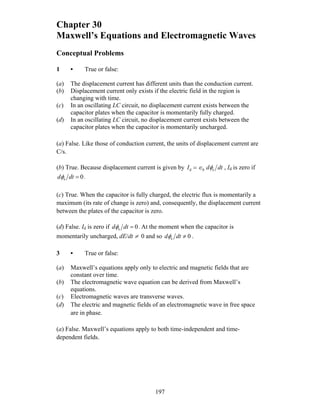
1 • True or false:
(a) The displacement current has different units than the conduction current.
(b) Displacement current only exists if the electric field in the region is
changing with time.
(c) In an oscillating LC circuit, no displacement current exists between the
capacitor plates when the capacitor is momentarily fully charged.
(d) In an oscillating LC circuit, no displacement current exists between the
capacitor plates when the capacitor is momentarily uncharged.
(a) False. Like those of conduction current, the units of displacement current are
C/s.
(b) True. Because displacement current is given by dtdI e0d φ∈= , Id is zero if
0e =dtdφ .
(c) True. When the capacitor is fully charged, the electric flux is momentarily a
maximum (its rate of change is zero) and, consequently, the displacement current
between the plates of the capacitor is zero.
(d) False. Id is zero if 0e =dtdφ . At the moment when the capacitor is
momentarily uncharged, dE/dt ≠ 0 and so 0e ≠dtdφ .
3 • True or false:
(a) Maxwell’s equations apply only to electric and magnetic fields that are
constant over time.
(b) The electromagnetic wave equation can be derived from Maxwell’s
equations.
(c) Electromagnetic waves are transverse waves.
(d) The electric and magnetic fields of an electromagnetic wave in free space
are in phase.
(a) False. Maxwell’s equations apply to both time-independent and time-
dependent fields.
197
Chapter 30198
(b) True. One can use Faraday’s law and the modified version of Ampere’s law to
derive the wave equation.
(c) True. Both the electric and magnetic fields of an electromagnetic wave
oscillate at right angles to the direction of propagation of the wave.
(d) True.
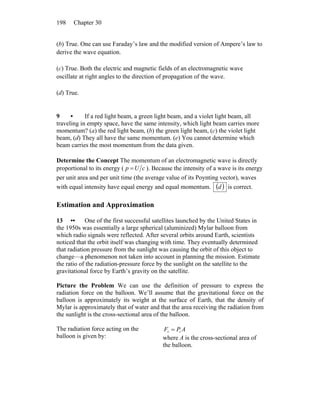
9 • If a red light beam, a green light beam, and a violet light beam, all
traveling in empty space, have the same intensity, which light beam carries more
momentum? (a) the red light beam, (b) the green light beam, (c) the violet light
beam, (d) They all have the same momentum. (e) You cannot determine which
beam carries the most momentum from the data given.
Determine the Concept The momentum of an electromagnetic wave is directly
proportional to its energy ( cUp = ). Because the intensity of a wave is its energy
per unit area and per unit time (the average value of its Poynting vector), waves
with equal intensity have equal energy and equal momentum. ( )d is correct.
Estimation and Approximation
13 •• One of the first successful satellites launched by the United States in
the 1950s was essentially a large spherical (aluminized) Mylar balloon from
which radio signals were reflected. After several orbits around Earth, scientists
noticed that the orbit itself was changing with time. They eventually determined
that radiation pressure from the sunlight was causing the orbit of this object to
change—a phenomenon not taken into account in planning the mission. Estimate
the ratio of the radiation-pressure force by the sunlight on the satellite to the
gravitational force by Earth’s gravity on the satellite.
Picture the Problem We can use the definition of pressure to express the
radiation force on the balloon. We’ll assume that the gravitational force on the
balloon is approximately its weight at the surface of Earth, that the density of
Mylar is approximately that of water and that the area receiving the radiation from
the sunlight is the cross-sectional area of the balloon.
The radiation force acting on the
balloon is given by:
APF rr =
where A is the cross-sectional area of
the balloon.
Maxwell’s Equations and Electromagnetic Waves 199
Because the radiation from the Sun is
reflected, the radiation pressure is
twice what it would be if it were
absorbed:
c
I
P
2
r =
Substituting for Pr and A yields: ( )
c
Id
c
dI
F
2
2 22
4
1
r
ππ
==
The gravitational force acting on the
balloon when it is in a near-Earth
orbit is approximately its weight at
the surface of Earth:
gtA
gVgmwF
ballonsurface,Mylar
MylarMylarballoonballoong
ρ
ρ
=
===
where t is the thickness of the Mylar
skin of the balloon.
Because the surface area of the
balloon is :22
4 dr ππ =
gtdF 2
Mylarg πρ=
Express the ratio of the radiation-
pressure force to the gravitational
force and simplify to obtain: gct
I
gtd
c
Id
F
F
Mylar
2
Mylar
2
g
r
2
2
ρπρ
π
==
Assuming the thickness of the Mylar skin of the balloon to be 1 mm, substitute
numerical values and evaluate Fr/Fg:
( )
7
8
23
3
2
g
r
102
s
m
10998.2mm1
s
m
81.9
m
kg
1000.12
m
kW
35.1
−
×≈
⎟
⎠
⎞
⎜
⎝
⎛
×⎟
⎠
⎞
⎜
⎝
⎛
⎟
⎠
⎞
⎜
⎝
⎛
×
=
F
F
Maxwell’s Displacement Current
15 • A parallel-plate capacitor has circular plates and no dielectric between
the plates. Each plate has a radius equal to 2.3 cm and the plates are separated by
1.1 mm. Charge is flowing onto the upper plate (and off of the lower plate) at a
rate of 5.0 A. (a) Find the rate of change of the electric field strength in the region
between the plates. (b) Compute the displacement current in the region between
the plates and show that it equals 5.0 A.
Picture the Problem We can differentiate the expression for the electric field
between the plates of a parallel-plate capacitor to find the rate of change of the
electric field strength and the definitions of the conduction current and electric
flux to compute Id.
Chapter 30200
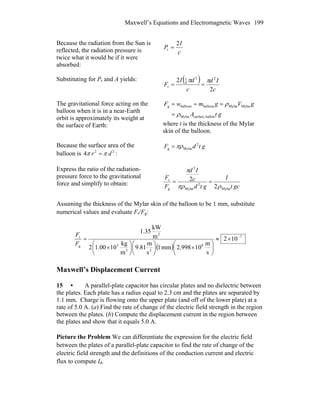
(a) Express the electric field strength
between the plates of the parallel-
plate capacitor:
A
Q
E
0∈
=
Differentiate this expression with
respect to time to obtain an
expression for the rate of change of
the electric field strength:
A
I
dt
dQ
AA
Q
dt
d
dt
dE
000
1
∈∈∈
==⎥
⎦
⎤
⎢
⎣
⎡
=
Substitute numerical values and evaluate dE/dt:
( ) ( )
sV/m104.3
sV/m1040.3
m023.0mN/C10854.8
A0.5
14
14
22212
⋅×=
⋅×=
⋅×
= −
πdt
dE
(b) Express the displacement current
Id: dt
d
I e
0d
φ
∈=
Substitute for the electric flux to
obtain:
[ ]
dt
dE
AEA
dt
d
I 00d ∈∈ ==
Substitute numerical values and evaluate Id:
( ) ( ) ( ) A0.5sV/m1040.3m023.0mN/C10854.8 1422212
d =⋅×⋅×= −
πI
19 •• There is a current of 10 A in a resistor that is connected in series with a
parallel plate capacitor. The plates of the capacitor have an area of 0.50 m2
, and
no dielectric exists between the plates. (a) What is the displacement current
between the plates? (b) What is the rate of change of the electric field strength
between the plates? (c) Find the value of the line integral ∫ ⋅
C
dB l
rr
, where the
integration path C is a 10-cm-radius circle that lies in a plane that is parallel with
the plates and is completely within the region between them.
Picture the Problem We can use the conservation of charge to find Id, the
definitions of the displacement current and electric flux to find dE/dt, and
Ampere’s law to evaluate l
rr
d⋅B around the given path.
(a) From conservation of charge we
know that:
A10d == II
Maxwell’s Equations and Electromagnetic Waves 201
(b) Express the displacement current
Id:
[ ]
dt
dE
AEA
dt
d
dt
d
I 00
e
0d ∈∈
φ
∈ ===
Substituting for dE/dt yields:
A
I
dt
dE
0
d
∈
=
Substitute numerical values and
evaluate dE/dt:
( )
sm
V
103.2
m50.0
mN
C
1085.8
A10
12
2
2
2
12
⋅
×=
⎟⎟
⎠
⎞
⎜⎜
⎝
⎛
⋅
×
=
−dt
dE
(c) Apply Ampere’s law to a circular
path of radius r between the plates
and parallel to their surfaces to
obtain:
enclosed0
C
Id μ=⋅∫ l
rr
B
Assuming that the displacement
current is uniformly distributed and
letting A represent the area of the
circular plates yields:
A
I
r
I d
2
enclosed
=
π
⇒ d
2
enclosed I
A
r
I
π
=
Substitute for to obtain:enclosedI
d
2
0
C
I
A
r
d
πμ
=⋅∫ l
rr
B
Substitute numerical values and evaluate ∫ ⋅
C
l
rr
dB :
( ) ( ) ( ) mT79.0
m50.0
A10m10.0A/N104
2
227
C
⋅=
×
=⋅
−
∫ μ
ππ
l
rr
dB
Electric Dipole Radiation
27 ••• A radio station that uses a vertical electric dipole antenna broadcasts at
a frequency of 1.20 MHz and has a total power output of 500 kW. Calculate the
intensity of the signal at a horizontal distance of 120 km from the station.
Picture the Problem The intensity of radiation from an electric dipole is given by
C(sin2
θ)/r2
, where C is a constant whose units are those of power, r is the distance
from the dipole to the point of interest, and θ is the angle between the antenna
and the position vector .r
r
We can integrate the intensity to express the total power
Chapter 30202
radiated by the antenna and use this result to evaluate C. Knowing C we can find
the intensity at a horizontal distance of 120 km.
Express the intensity of the signal as
a function of r and θ :
( ) 2
2
sin
,
r
CrI
θ
θ =
At a horizontal distance of 120 km
from the station:
( )
( )
( )2
2
2
km120
km120
90sin
90,km120
C
CI
=
°
=°
(1)
From the definition of intensity we
have:
IdAdP =
and
( )dArIP ∫∫= θ,tot
where, in polar coordinates,
φθθ ddrdA sin2
=
Substitute for dA to obtain:
( ) φθθθ
π π
ddrrIP sin, 2
2
0 0
tot ∫∫=
Substitute for I(r,θ):
φθθ
π π
ddCP ∫∫=
2
0 0
3
tot sin
From integral tables we find that:
( )] 3
4
2sincossin 0
2
3
1
0
3
=+−=∫
π
π
θθθθd
Substitute and integrate with respect
to φ to obtain:
[ ] CCdCP
3
8
3
4
3
4 2
0
2
0
tot
π
φφ π
π
=== ∫
Solving for C yields:
tot
8
3
PC
π
=
Substitute for Ptot and evaluate C to
obtain:
( ) kW68.59kW500
8
3
==
π
C
Substituting for C in equation (1)
and evaluating I(120 km,90°):
( )
( )
2
2
W/m14.4
km120
kW68.59
90,km120
μ=
=°I
Maxwell’s Equations and Electromagnetic Waves 203
Energy and Momentum in an Electromagnetic Wave
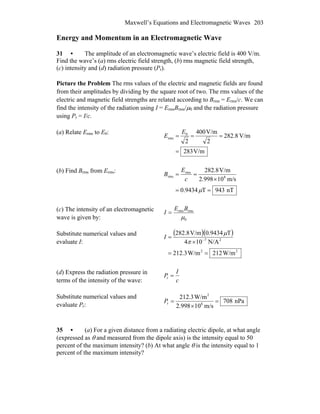
31 • The amplitude of an electromagnetic wave’s electric field is 400 V/m.
Find the wave’s (a) rms electric field strength, (b) rms magnetic field strength,
(c) intensity and (d) radiation pressure (Pr).
Picture the Problem The rms values of the electric and magnetic fields are found
from their amplitudes by dividing by the square root of two. The rms values of the
electric and magnetic field strengths are related according to BB
rms = Erms/c. We can
find the intensity of the radiation using I = ErmsBrmsB /μ0 and the radiation pressure
using Pr = I/c.
(a) Relate Erms to E0:
V/m283
V/m8.282
2
V/m400
2
0
rms
=
===
E
E
(b) Find BB
rms from Erms:
nT943T9434.0
m/s10998.2
V/m8.282
8
rms
rms
==
×
==
μ
c
E
B
(c) The intensity of an electromagnetic
wave is given by: 0
rmsrms
μ
BE
I =
Substitute numerical values and
evaluate I:
( )( )
22
27
W/m212W/m3.212
N/A104
T9434.0V/m8.282
==
×
= −
π
μ
I
(d) Express the radiation pressure in
terms of the intensity of the wave: c
I
P =r
Substitute numerical values and
evaluate Pr:
nPa708
m/s10998.2
W/m3.212
8
2
r =
×
=P
35 • (a) For a given distance from a radiating electric dipole, at what angle
(expressed as θ and measured from the dipole axis) is the intensity equal to 50
percent of the maximum intensity? (b) At what angle θ is the intensity equal to 1
percent of the maximum intensity?
Chapter 30204
Picture the Problem At a fixed distance from the electric dipole, the intensity of
radiation is a function θ alone.
(a) The intensity of the radiation
from the dipole is proportional to
sin2
θ:
( ) θθ 2
0 sinII = (1)
where I0 is the maximum intensity.
For 02
1
II = : θ2
002
1
sinII = ⇒ 2
12
sin =θ
Solving for θ yields: ( ) °== −
45sin 2
11
θ
(b) For :001.0 II = θ2
00 sin01.0 II = ⇒ 01.0sin2
=θ
Solving for θ yields: ( ) °== −
7.501.0sin 1
θ
37 •• An electromagnetic plane wave has an electric field that is parallel to
the y axis, and has a Poynting vector that is given by
, where x is in meters, k = 10.0 rad/m,( ) ( ) [ iS ˆcosW/m100, 22
tkxtx ω−=
r
]
ω = 3.00 × 10⁹
rad/s, and t is in seconds. (a) What is the direction of propagation
of the wave? (b) Find the wavelength and frequency of the wave. (c) Find the
electric and magnetic fields of the wave as functions of x and t.
Picture the Problem We can determine the direction of propagation of the wave,
its wavelength, and its frequency by examining the argument of the cosine
function. We can find E from cE 0
2
μ=S
r
and B from B = E/c. Finally, we can
use the definition of the Poynting vector and the given expression for to findS
r
E
r
and B
r
.
(a) Because the argument of the cosine function is of the form tkx ω− , the wave
propagates in the +x direction.
(b) Examining the argument of the
cosine function, we note that the
wave number k of the wave is:
1
m0.10
2 −
==
λ
π
k ⇒ m628.0=λ
Examining the argument of the
cosine function, we note that the
angular frequency ω of the wave is:
19
s1000.32 −
×== fπω
Maxwell’s Equations and Electromagnetic Waves 205
Solving for f yields:
MHz477
2
s1000.3 19
=
×
=
−
π
f
(c) Express the magnitude of S
r
in
terms of E: c
E
0
2
μ
=S
r
⇒ S
r
cE 0μ=
Substitute numerical values and evaluate E:
( )( )( ) V/m1.194W/m100m/s10998.2N/A104 2827
=××= −
πE
Because
and
( ) ( ) [ ] iS ˆcosW/m100, 22
tkxtx ω−=
r
BES
rrr
×=
0
1
μ
:
( ) ( ) [ ] jE ˆcosV/m194, tkxtx ω−=
r
where k = 10.0 rad/m and
ω = 3.00 × 10⁹
rad/s.
Use B = E/c to evaluate B: nT4.647
m/s10998.2
V/m1.194
8
=
×
=B
Because BES
rrr
×=
0
1
μ
, the direction
of B
r
must be such that the cross
product of E
r
with B
r
is in the
positive x direction:
( ) ( ) [ ]kB ˆcosnT647, tkxtx ω−=
r
where k = 10.0 rad/m and ω = 3.00 ×
109
rad/s.
39 •• A pulsed laser fires a 1000-MW pulse that has a 200-ns duration at a
small object that has a mass equal to 10.0 mg and is suspended by a fine fiber that
is 4.00 cm long. If the radiation is completely absorbed by the object, what is the
maximum angle of deflection of this pendulum? (Think of the system as a
ballistic pendulum and assume the small object was hanging vertically before the
radiation hit it.)
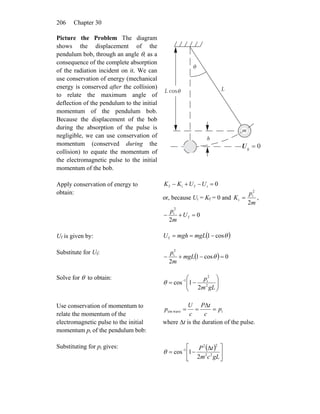
Chapter 30206
Picture the Problem The diagram
shows the displacement of the
pendulum bob, through an angle θ, as a
consequence of the complete absorption
of the radiation incident on it. We can
use conservation of energy (mechanical
energy is conserved after the collision)
to relate the maximum angle of
deflection of the pendulum to the initial
momentum of the pendulum bob.
Because the displacement of the bob
during the absorption of the pulse is
negligible, we can use conservation of
momentum (conserved during the
collision) to equate the momentum of
the electromagnetic pulse to the initial
momentum of the bob.
h
m
LL cos
θ
θ
0g =U
Apply conservation of energy to
obtain:
0ifif =−+− UUKK
or, because Ui = Kf = 0 and
m
p
K
2
2
i
i = ,
0
2
f
2
i
=+− U
m
p
Uf is given by: ( )θcos1f −== mgLmghU
Substitute for Uf:
( ) 0cos1
2
2
i
=−+− θmgL
m
p
Solve for θ to obtain:
⎟⎟
⎠
⎞
⎜⎜
⎝
⎛
−= −
gLm
p
2
2
i1
2
1cosθ
Use conservation of momentum to
relate the momentum of the
electromagnetic pulse to the initial
momentum pi of the pendulum bob:
iwaveem p
c
tP
c
U
p =
Δ
==
where Δt is the duration of the pulse.
Substituting for pi gives: ( )
⎥
⎦
⎤
⎢
⎣
⎡ Δ
−= −
gLcm
tP
22
22
1
2
1cosθ
Maxwell’s Equations and Electromagnetic Waves 207
Substitute numerical values and evaluate θ :
( ) ( )
( ) ( ) ( )( )
°=
⎥
⎥
⎦
⎤
⎢
⎢
⎣
⎡
×
−= −
10.6
m0400.0m/s81.9m/s10998.2mg0.102
ns200MW1000
1cos
2282
22
1
θ
Remarks: The solution presented here is valid only if the displacement of the
bob during the absorption of the pulse is negligible. (Otherwise, the
horizontal component of the momentum of the pulse-bob system is not
conserved during the collision.) We can show that the displacement during
the pulse-bob collision is small by solving for the speed of the bob after
absorbing the pulse. Applying conservation of momentum (mv = P(Δt)/c) and
solving for v gives v = 6.67 × 10⁻⁷
m/s. This speed is so slow compared to c,
we can conclude that the duration of the collision is extremely close to 200 ns
(the time for the pulse to travel its own length). Traveling at 6.67 × 10⁻⁷
m/s
for 200 ns, the bob would travel 1.33 × 10⁻¹³
m—a distance 1000 times
smaller that the diameter of a hydrogen atom. (Because 6.67×10⁻⁷
m/s is the
maximum speed of the bob during the collision, the bob would actually travel
less than 1.33 × 10⁻¹³
m during the collision.)
41 •• (a) Estimate the force on Earth due to the pressure of the radiation on
Earth by the Sun, and compare this force to the gravitational force of the Sun on
Earth. (At Earth’s orbit, the intensity of sunlight is 1.37 kW/m2
.) (b).
Repeat Part
(a) for Mars which is at an average distance of 2.28 × 10⁸
km from the Sun and
has a radius of 3.40 × 10³
km. (c) Which planet has the larger ratio of radiation
pressure to gravitational attraction.
Picture the Problem We can find the radiation pressure force from the definition
of pressure and the relationship between the radiation pressure and the intensity of
the radiation from the Sun. We can use Newton’s law of gravitation to find the
gravitational force the Sun exerts on Earth and Mars.
(a) The radiation pressure exerted on
Earth is given by: A
F
P
Earthr,
Earthr, = ⇒ APF Earthr,Earthr, =
where A is the cross-sectional area of
Earth.
Express the radiation pressure in
terms of the intensity of the
radiation I from the Sun:
c
I
P =Earthr,
Substituting for Pr, Earth and A yields:
c
RI
F
2
Earthr,
π
=
Chapter 30208
Substitute numerical values and
evaluate Fr:
( )( )
N1083.5
N10825.5
m/s10998.2
m1037.6kW/m37.1
8
8
8
262
Earthr,
×=
×=
×
×
=
π
F
The gravitational force exerted
on Earth by the Sun is given by: 2
earthsun
Earthg,
r
mGm
F =
where r is the radius of Earth’s orbit.
Substitute numerical values and evaluate Fg, Earth:
( )( )( )
( )
N10529.3
m1050.1
kg1098.5kg1099.1kg/mN10673.6 22
211
24302211
Earthg, ×=
×
××⋅×
=
−
F
Express the ratio of the force due to
radiation pressure Fr, Earth to the
gravitational force Fg, Earth:
14
22
8
Earthg,
Earthr,
1065.1
N10529.3
N10825.5 −
×=
×
×
=
F
F
or
( ) Earthg,
14
Earthr, 1065.1 FF −
×=
(b) The radiation pressure exerted
on Mars is given by: A
F
P
Marsr,
Marsr, = ⇒ APF Marsr,Marsr, =
where A is the cross-sectional area of
Mars.
Express the radiation pressure on
Mars in terms of the intensity of the
radiation IMars from the sun:
c
I
P Mars
Marsr, =
Substituting for Pr, Mars and A yields:
c
RI
F
2
MarsMars
Marsr,
π
=
Express the ratio of the solar
constant at Earth to the solar
constant at Mars:
2
Mars
earth
earth
Mars
⎟⎟
⎠
⎞
⎜⎜
⎝
⎛
=
r
r
I
I
⇒
2
Mars
earth
earthMars ⎟⎟
⎠
⎞
⎜⎜
⎝
⎛
=
r
r
II
Substitute for to obtain:MarsI 2
Mars
earth
2
Marsearth
Marsr, ⎟⎟
⎠
⎞
⎜⎜
⎝
⎛
=
r
r
c
RI
F
π
Maxwell’s Equations and Electromagnetic Waves 209
Substitute numerical values and evaluate Fr, Mars:
( )( ) N1018.7
m1028.2
m1050.1
m/s10998.2
km1040.3kW/m37.1 7
2
11
11
8
232
Marsr, ×=⎟⎟
⎠
⎞
⎜⎜
⎝
⎛
×
×
×
×
=
π
F
The gravitational force exerted on
Mars by the Sun is given by:
( )
2
Earthsun
2
Marssun
Marsg,
11.0
r
mGm
r
mGm
F ==
where r is the radius of Mars’ orbit.
Substitute numerical values and evaluate Fg
( )( )( )( )
( )
N1068.1
m1028.2
kg1098.511.0kg1099.1kg/mN10673.6
21
211
24302211
Marsg,
×=
×
××⋅×
=
−
F
Express the ratio of the force due to
radiation pressure Fr, Mars to the
gravitational force Fg, Mars:
14
21
7
Marsg,
Marsr,
1027.4
N1068.1
N1018.7 −
×=
×
×
=
F
F
or
( ) Marsg,
14
Marsr, 1027.4 FF −
×=
(c) Because the ratio of the radiation pressure force to the gravitational force is
1.65 × 10⁻¹⁴
for Earth and 4.27 × 10⁻¹⁴
for Mars, Mars has the larger ratio. The
reason that the ratio is higher for Mars is that the dependence of the radiation
pressure on the distance from the Sun is the same for both forces (r−2
), whereas
the dependence on the radii of the planets is different. Radiation pressure varies as
R2
, whereas the gravitational force varies as R3
(assuming that the two planets
have the same density, an assumption that is nearly true). Consequently, the ratio
of the forces goes as . Because Mars is smaller than Earth, the ratio
is larger.
132
/ −
= RRR
The Wave Equation for Electromagnetic Waves
45 •• Show that any function of the form y(x, t) = f(x – vt) or
y(x, t) = g(x + vt) satisfies the wave Equation 30-7
Picture the Problem We can show that these functions satisfy the wave
equations by differentiating them twice (using the chain rule) with respect to x
and t and equating the expressions for the second partial of f with respect to u.
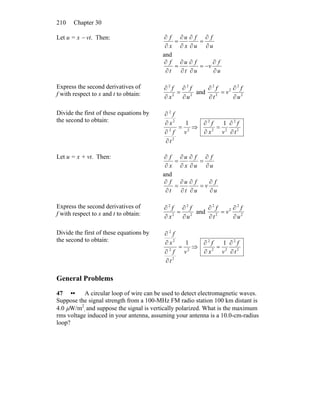
Chapter 30210
Let u = x − vt. Then:
u
f
u
f
x
u
x
f
∂
∂
=
∂
∂
∂
∂
=
∂
∂
and
u
f
v
u
f
t
u
t
f
∂
∂
−=
∂
∂
∂
∂
=
∂
∂
Express the second derivatives of
f with respect to x and t to obtain: 2
2
2
2
u
f
x
f
∂
∂
=
∂
∂
and 2
2
2
2
2
u
f
v
t
f
∂
∂
=
∂
∂
Divide the first of these equations by
the second to obtain:
2
2
2
2
2
1
v
t
f
x
f
=
∂
∂
∂
∂
⇒ 2
2
22
2
1
t
f
vx
f
∂
∂
=
∂
∂
Let u = x + vt. Then:
u
f
u
f
x
u
x
f
∂
∂
=
∂
∂
∂
∂
=
∂
∂
and
u
f
v
u
f
t
u
t
f
∂
∂
=
∂
∂
∂
∂
=
∂
∂
Express the second derivatives of
f with respect to x and t to obtain: 2
2
2
2
u
f
x
f
∂
∂
=
∂
∂
and 2
2
2
2
2
u
f
v
t
f
∂
∂
=
∂
∂
Divide the first of these equations by
the second to obtain:
2
2
2
2
2
1
v
t
f
x
f
=
∂
∂
∂
∂
⇒ 2
2
22
2
1
t
f
vx
f
∂
∂
=
∂
∂
General Problems
47 •• A circular loop of wire can be used to detect electromagnetic waves.
Suppose the signal strength from a 100-MHz FM radio station 100 km distant is
4.0 μW/m2
, and suppose the signal is vertically polarized. What is the maximum
rms voltage induced in your antenna, assuming your antenna is a 10.0-cm-radius
loop?
Maxwell’s Equations and Electromagnetic Waves 211
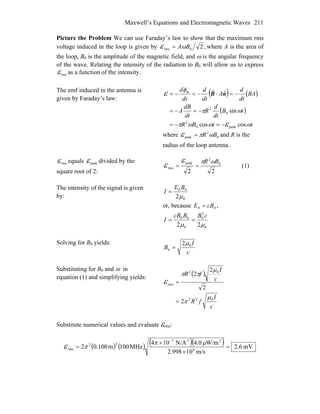
Picture the Problem We can use Faraday’s law to show that the maximum rms
voltage induced in the loop is given by ,20rms BAωε = where A is the area of
the loop, BB
0 is the amplitude of the magnetic field, and ω is the angular frequency
of the wave. Relating the intensity of the radiation to B0 will allow us to express
rmsε as a function of the intensity.
The emf induced in the antenna is
given by Faraday’s law:
( ) ( )
( )
ttBR
tB
dt
d
R
dt
dB
A
BA
dt
d
A
dt
d
dt
d
ωωωπ
ωπ
φ
ε
ε
coscos
sin
ˆ
peak0
2
0
2
m
−=−=
−=−=
−=⋅−=−= nB
r
where 0
2
peak BR ωπε = and R is the
radius of the loop antenna..
rmsε equals peakε divided by the
square root of 2: 22
0
2
peak
rms
BR ωπε
ε == (1)
The intensity of the signal is given
by: 0
00
2μ
BE
I =
or, because 00 cBE = ,
0
2
0
0
00
22 μμ
cBBcB
I ==
Solving for BB
0 yields:
c
I
B 0
0
2μ
=
Substituting for BB
0 and ω in
equation (1) and simplifying yields:
( )
c
I
fR
c
I
fR
022
02
rms
2
2
2
2
μ
π
μ
ππ
ε
=
=
Substitute numerical values and evaluate εrms:
( ) ( ) ( )( ) mV.62
m/s10998.2
W/m0.4N/A104
MHz100m100.02 8
227
22
rms =
×
×
=
−
μπ
πε
Chapter 30212
51 •• The electric fields of two harmonic electromagnetic waves of angular
frequency ω1 and ω2 are given by
r
E1 = E1,0 cos k1x − ω1t( )ˆj and by
. For the resultant of these two waves, find (a) the
instantaneous Poynting vector and (b) the time-averaged Poynting vector.
r
E2 = E2,0 cos k2x − ω2t +δ( ˆj)
(c) Repeat Parts (a) and (b) if the direction of propagation of the second wave is
reversed so that
r
E2 = E2,0 cos k2x +ω2t + δ( )ˆj .
Picture the Problem We can use the definition of the Poynting vector and the
relationship between B
r
and E
r
to find the instantaneous Poynting vectors for each
of the resultant wave motions and the fact that the time average of the cross
product term is zero for ω1 ≠ ω2, and ½ for the square of cosine function to find
the time-averaged Poynting vectors.
(a) Because both waves propagate in
the x direction:
iBE ˆ
0Sμ=×
rr
⇒ kB ˆB=
r
Express B in terms of E1 and E2:
( )21
1
EE
c
B +=
Substitute for E1 and E2 to obtain:
( ) ( ) ([ ]kB ˆcoscos
1
, 220,2110,1 δωω +−+−= txkEtxkE
c
tx )
r
The instantaneous Poynting vector for the resultant wave motion is given by:
( ) ( ) ( )( )
( ) ( )( )
( ) ( )( ) ( )
( )[ ( )
( ) ( )]i
kj
k
jS
ˆcoscos
cos2cos
1
ˆˆcoscos
1
ˆcoscos
1
ˆcoscos
1
,
22
22
0,222
110,20,111
22
0,1
0
2
220,2110,1
0
220,2110,1
220,2110,1
0
δωδω
ωω
μ
δωω
μ
δωω
δωω
μ
+−++−×
−+−
=
×+−+−=
+−+−×
+−+−=
txkEtxk
txkEEtxkE
c
txkEtxkE
c
txkEtxkE
c
txkEtxkEtx
r
(b) The time average of the cross
product term is zero for ω1 ≠ ω2, and
the time average of the square of the
cosine terms is ½:
[ ]iS ˆ
2
1 2
0,2
2
0,1
0
av EE
c
+=
μ
r
Maxwell’s Equations and Electromagnetic Waves 213
(c) In this case because the wave with k = kkB ˆ
2 B−=
r
2 propagates in the
direction. The magnetic field is then:iˆ−
( ) ( ) ([ ]kB ˆcoscos
1
, 220,2110,1 δωω ++−−= txkEtxkE
c
tx )
r
The instantaneous Poynting vector for the resultant wave motion is given by:
( ) ( ) ( )( )
( ) ( )( )
( ) ( )[ ]i
k
jS
ˆcoscos
1
ˆcoscos
1
ˆcoscos
1
,
22
22
0,211
22
0,1
0
220,2110,1
220,2110,1
0
δωω
μ
δωω
δωω
μ
++−−=
++−−×
+−+−=
txkEtxkE
c
txkEtxkE
c
txkEtxkEtx
r
The time average of the square of the
cosine terms is ½: [ ]iS ˆ
2
1 2
0,2
2
0,1
0
av EE
c
−=
μ
r
55 ••• A conductor in the shape of a long solid cylinder that has a length L, a
radius a, and a resistivity ρ carries a steady current I that is uniformly distributed
over its cross-section. (a) Use Ohm’s law to relate the electric field E
r
in the
conductor to I, ρ, and a. (b) Find the magnetic field B
r
just outside the conductor.
(c) Use the results from Part (a) and Part (b) to compute the Poynting vector
( ) 0μBES
rrr
×= at r = a (the edge of the conductor). In what direction is
r
S?
(d) Find the flux ∫ dASn through the surface of the cylinder, and use this flux to
show that the rate of energy flow into the conductor equals I2
R, where R is the
resistance of the cylinder.
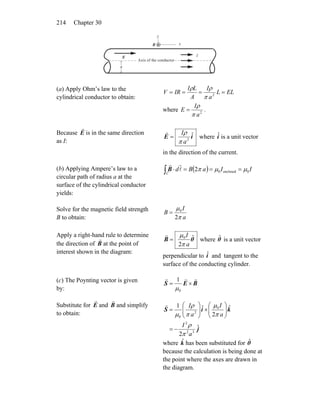
Picture the Problem A side view of the cylindrical conductor is shown in the
diagram. Let the current be to the right (in the +x direction) and choose a
coordinate system in which the +y direction is radially outward from the axis of
the conductor. Then the +z direction is tangent to cylindrical surfaces that are
concentric with the axis of the conductor (out of the plane of the diagram at the
location indicated in the diagram). We can use Ohm’s law to relate the electric
field strength E in the conductor to I, ρ, and a and Ampere’s law to find the
magnetic field strength B just outside the conductor. Knowing E
r
and B
r
we can
find S
r
and, using its normal component, show that the rate of energy flow into the
conductor equals I2
R, where R is the resistance.
Chapter 30214
E
r I
a
x
y
Axis of the conductor
B
r
(a) Apply Ohm’s law to the
cylindrical conductor to obtain:
ELL
a
I
A
LI
IRV ==== 2
π
ρρ
where 2
a
I
E
π
ρ
= .
Because E
r
is in the same direction
as I:
iE ˆ
2
a
I
π
ρ
=
r
where is a unit vector
in the direction of the current.
iˆ
(b) Applying Ampere’s law to a
circular path of radius a at the
surface of the cylindrical conductor
yields:
( ) IIaBd
C
0enclosed02 μμπ ===⋅∫ l
rr
B
Solve for the magnetic field strength
B to obtain: a
I
B
π
μ
2
0
=
Apply a right-hand rule to determine
the direction of B
r
at the point of
interest shown in the diagram:
θB ˆ
2
0
a
I
π
μ
=
r
where is a unit vector
perpendicular to and tangent to the
surface of the conducting cylinder.
θˆ
iˆ
(c) The Poynting vector is given
by:
BES
rrr
×=
0
1
μ
Substitute for E
r
and B
r
and simplify
to obtain:
j
kiS
ˆ
2
ˆ
2
ˆ1
32
2
0
2
0
a
I
a
I
a
I
π
ρ
π
μ
π
ρ
μ
−=
⎟⎟
⎠
⎞
⎜⎜
⎝
⎛
×⎟⎟
⎠
⎞
⎜⎜
⎝
⎛
=
r
where has been substituted for
because the calculation is being done at
the point where the axes are drawn in
the diagram.
kˆ θˆ
Maxwell’s Equations and Electromagnetic Waves 215
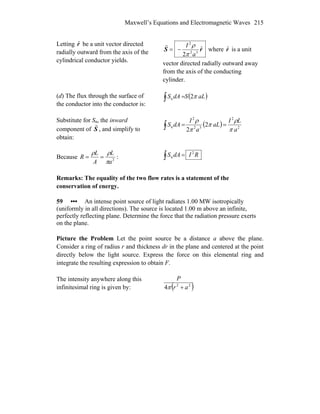
Letting rˆ be a unit vector directed
radially outward from the axis of the
cylindrical conductor yields.
rS ˆ
2 32
2
a
I
π
ρ
−=
r
where rˆ is a unit
vector directed radially outward away
from the axis of the conducting
cylinder.
(d) The flux through the surface of
the conductor into the conductor is:
( )aLSdAS π2n∫ =
Substitute for Sn, the inward
component of S
r
, and simplify to
obtain:
( ) 2
2
32
2
n 2
2 a
LI
aL
a
I
dAS
π
ρ
π
π
ρ
==∫
Because 2
a
L
A
L
R
π
ρρ
== : RIdAS 2
n∫ =
Remarks: The equality of the two flow rates is a statement of the
conservation of energy.
59 ••• An intense point source of light radiates 1.00 MW isotropically
(uniformly in all directions). The source is located 1.00 m above an infinite,
perfectly reflecting plane. Determine the force that the radiation pressure exerts
on the plane.
Picture the Problem Let the point source be a distance a above the plane.
Consider a ring of radius r and thickness dr in the plane and centered at the point
directly below the light source. Express the force on this elemental ring and
integrate the resulting expression to obtain F.
The intensity anywhere along this
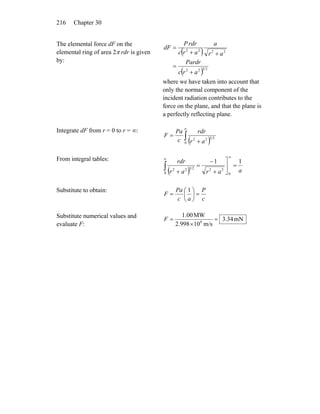
infinitesimal ring is given by: ( )22
4 ar
P
+π
Chapter 30216
The elemental force dF on the
elemental ring of area 2π rdr is given
by:
( )
( ) 2322
2222
arc
Pardr
ar
a
arc
rdrP
dF
+
=
++
=
where we have taken into account that
only the normal component of the
incident radiation contributes to the
force on the plane, and that the plane is
a perfectly reflecting plane.
Integrate dF from r = 0 to r = ∞:
( )∫
∞
+
=
0
2322
ar
rdr
c
Pa
F
From integral tables:
( ) aarar
rdr 11
0
22
0
2322
=⎥
⎦
⎤
+
−
=
+
∞∞
∫
Substitute to obtain:
c
P
ac
Pa
F =⎟
⎠
⎞
⎜
⎝
⎛
=
1
Substitute numerical values and
evaluate F:
mN34.3
m/s10998.2
MW00.1
8
=
×
=F

Ch30 ssm

  • 1.
    Chapter 30 Maxwell’s Equationsand Electromagnetic Waves Conceptual Problems 1 • True or false: (a) The displacement current has different units than the conduction current. (b) Displacement current only exists if the electric field in the region is changing with time. (c) In an oscillating LC circuit, no displacement current exists between the capacitor plates when the capacitor is momentarily fully charged. (d) In an oscillating LC circuit, no displacement current exists between the capacitor plates when the capacitor is momentarily uncharged. (a) False. Like those of conduction current, the units of displacement current are C/s. (b) True. Because displacement current is given by dtdI e0d φ∈= , Id is zero if 0e =dtdφ . (c) True. When the capacitor is fully charged, the electric flux is momentarily a maximum (its rate of change is zero) and, consequently, the displacement current between the plates of the capacitor is zero. (d) False. Id is zero if 0e =dtdφ . At the moment when the capacitor is momentarily uncharged, dE/dt ≠ 0 and so 0e ≠dtdφ . 3 • True or false: (a) Maxwell’s equations apply only to electric and magnetic fields that are constant over time. (b) The electromagnetic wave equation can be derived from Maxwell’s equations. (c) Electromagnetic waves are transverse waves. (d) The electric and magnetic fields of an electromagnetic wave in free space are in phase. (a) False. Maxwell’s equations apply to both time-independent and time- dependent fields. 197
  • 2.
    Chapter 30198 (b) True.One can use Faraday’s law and the modified version of Ampere’s law to derive the wave equation. (c) True. Both the electric and magnetic fields of an electromagnetic wave oscillate at right angles to the direction of propagation of the wave. (d) True. 9 • If a red light beam, a green light beam, and a violet light beam, all traveling in empty space, have the same intensity, which light beam carries more momentum? (a) the red light beam, (b) the green light beam, (c) the violet light beam, (d) They all have the same momentum. (e) You cannot determine which beam carries the most momentum from the data given. Determine the Concept The momentum of an electromagnetic wave is directly proportional to its energy ( cUp = ). Because the intensity of a wave is its energy per unit area and per unit time (the average value of its Poynting vector), waves with equal intensity have equal energy and equal momentum. ( )d is correct. Estimation and Approximation 13 •• One of the first successful satellites launched by the United States in the 1950s was essentially a large spherical (aluminized) Mylar balloon from which radio signals were reflected. After several orbits around Earth, scientists noticed that the orbit itself was changing with time. They eventually determined that radiation pressure from the sunlight was causing the orbit of this object to change—a phenomenon not taken into account in planning the mission. Estimate the ratio of the radiation-pressure force by the sunlight on the satellite to the gravitational force by Earth’s gravity on the satellite. Picture the Problem We can use the definition of pressure to express the radiation force on the balloon. We’ll assume that the gravitational force on the balloon is approximately its weight at the surface of Earth, that the density of Mylar is approximately that of water and that the area receiving the radiation from the sunlight is the cross-sectional area of the balloon. The radiation force acting on the balloon is given by: APF rr = where A is the cross-sectional area of the balloon.
  • 3.
    Maxwell’s Equations andElectromagnetic Waves 199 Because the radiation from the Sun is reflected, the radiation pressure is twice what it would be if it were absorbed: c I P 2 r = Substituting for Pr and A yields: ( ) c Id c dI F 2 2 22 4 1 r ππ == The gravitational force acting on the balloon when it is in a near-Earth orbit is approximately its weight at the surface of Earth: gtA gVgmwF ballonsurface,Mylar MylarMylarballoonballoong ρ ρ = === where t is the thickness of the Mylar skin of the balloon. Because the surface area of the balloon is :22 4 dr ππ = gtdF 2 Mylarg πρ= Express the ratio of the radiation- pressure force to the gravitational force and simplify to obtain: gct I gtd c Id F F Mylar 2 Mylar 2 g r 2 2 ρπρ π == Assuming the thickness of the Mylar skin of the balloon to be 1 mm, substitute numerical values and evaluate Fr/Fg: ( ) 7 8 23 3 2 g r 102 s m 10998.2mm1 s m 81.9 m kg 1000.12 m kW 35.1 − ×≈ ⎟ ⎠ ⎞ ⎜ ⎝ ⎛ ×⎟ ⎠ ⎞ ⎜ ⎝ ⎛ ⎟ ⎠ ⎞ ⎜ ⎝ ⎛ × = F F Maxwell’s Displacement Current 15 • A parallel-plate capacitor has circular plates and no dielectric between the plates. Each plate has a radius equal to 2.3 cm and the plates are separated by 1.1 mm. Charge is flowing onto the upper plate (and off of the lower plate) at a rate of 5.0 A. (a) Find the rate of change of the electric field strength in the region between the plates. (b) Compute the displacement current in the region between the plates and show that it equals 5.0 A. Picture the Problem We can differentiate the expression for the electric field between the plates of a parallel-plate capacitor to find the rate of change of the electric field strength and the definitions of the conduction current and electric flux to compute Id.
  • 4.
    Chapter 30200 (a) Expressthe electric field strength between the plates of the parallel- plate capacitor: A Q E 0∈ = Differentiate this expression with respect to time to obtain an expression for the rate of change of the electric field strength: A I dt dQ AA Q dt d dt dE 000 1 ∈∈∈ ==⎥ ⎦ ⎤ ⎢ ⎣ ⎡ = Substitute numerical values and evaluate dE/dt: ( ) ( ) sV/m104.3 sV/m1040.3 m023.0mN/C10854.8 A0.5 14 14 22212 ⋅×= ⋅×= ⋅× = − πdt dE (b) Express the displacement current Id: dt d I e 0d φ ∈= Substitute for the electric flux to obtain: [ ] dt dE AEA dt d I 00d ∈∈ == Substitute numerical values and evaluate Id: ( ) ( ) ( ) A0.5sV/m1040.3m023.0mN/C10854.8 1422212 d =⋅×⋅×= − πI 19 •• There is a current of 10 A in a resistor that is connected in series with a parallel plate capacitor. The plates of the capacitor have an area of 0.50 m2 , and no dielectric exists between the plates. (a) What is the displacement current between the plates? (b) What is the rate of change of the electric field strength between the plates? (c) Find the value of the line integral ∫ ⋅ C dB l rr , where the integration path C is a 10-cm-radius circle that lies in a plane that is parallel with the plates and is completely within the region between them. Picture the Problem We can use the conservation of charge to find Id, the definitions of the displacement current and electric flux to find dE/dt, and Ampere’s law to evaluate l rr d⋅B around the given path. (a) From conservation of charge we know that: A10d == II
  • 5.
    Maxwell’s Equations andElectromagnetic Waves 201 (b) Express the displacement current Id: [ ] dt dE AEA dt d dt d I 00 e 0d ∈∈ φ ∈ === Substituting for dE/dt yields: A I dt dE 0 d ∈ = Substitute numerical values and evaluate dE/dt: ( ) sm V 103.2 m50.0 mN C 1085.8 A10 12 2 2 2 12 ⋅ ×= ⎟⎟ ⎠ ⎞ ⎜⎜ ⎝ ⎛ ⋅ × = −dt dE (c) Apply Ampere’s law to a circular path of radius r between the plates and parallel to their surfaces to obtain: enclosed0 C Id μ=⋅∫ l rr B Assuming that the displacement current is uniformly distributed and letting A represent the area of the circular plates yields: A I r I d 2 enclosed = π ⇒ d 2 enclosed I A r I π = Substitute for to obtain:enclosedI d 2 0 C I A r d πμ =⋅∫ l rr B Substitute numerical values and evaluate ∫ ⋅ C l rr dB : ( ) ( ) ( ) mT79.0 m50.0 A10m10.0A/N104 2 227 C ⋅= × =⋅ − ∫ μ ππ l rr dB Electric Dipole Radiation 27 ••• A radio station that uses a vertical electric dipole antenna broadcasts at a frequency of 1.20 MHz and has a total power output of 500 kW. Calculate the intensity of the signal at a horizontal distance of 120 km from the station. Picture the Problem The intensity of radiation from an electric dipole is given by C(sin2 θ)/r2 , where C is a constant whose units are those of power, r is the distance from the dipole to the point of interest, and θ is the angle between the antenna and the position vector .r r We can integrate the intensity to express the total power
  • 6.
    Chapter 30202 radiated bythe antenna and use this result to evaluate C. Knowing C we can find the intensity at a horizontal distance of 120 km. Express the intensity of the signal as a function of r and θ : ( ) 2 2 sin , r CrI θ θ = At a horizontal distance of 120 km from the station: ( ) ( ) ( )2 2 2 km120 km120 90sin 90,km120 C CI = ° =° (1) From the definition of intensity we have: IdAdP = and ( )dArIP ∫∫= θ,tot where, in polar coordinates, φθθ ddrdA sin2 = Substitute for dA to obtain: ( ) φθθθ π π ddrrIP sin, 2 2 0 0 tot ∫∫= Substitute for I(r,θ): φθθ π π ddCP ∫∫= 2 0 0 3 tot sin From integral tables we find that: ( )] 3 4 2sincossin 0 2 3 1 0 3 =+−=∫ π π θθθθd Substitute and integrate with respect to φ to obtain: [ ] CCdCP 3 8 3 4 3 4 2 0 2 0 tot π φφ π π === ∫ Solving for C yields: tot 8 3 PC π = Substitute for Ptot and evaluate C to obtain: ( ) kW68.59kW500 8 3 == π C Substituting for C in equation (1) and evaluating I(120 km,90°): ( ) ( ) 2 2 W/m14.4 km120 kW68.59 90,km120 μ= =°I
  • 7.
    Maxwell’s Equations andElectromagnetic Waves 203 Energy and Momentum in an Electromagnetic Wave 31 • The amplitude of an electromagnetic wave’s electric field is 400 V/m. Find the wave’s (a) rms electric field strength, (b) rms magnetic field strength, (c) intensity and (d) radiation pressure (Pr). Picture the Problem The rms values of the electric and magnetic fields are found from their amplitudes by dividing by the square root of two. The rms values of the electric and magnetic field strengths are related according to BB rms = Erms/c. We can find the intensity of the radiation using I = ErmsBrmsB /μ0 and the radiation pressure using Pr = I/c. (a) Relate Erms to E0: V/m283 V/m8.282 2 V/m400 2 0 rms = === E E (b) Find BB rms from Erms: nT943T9434.0 m/s10998.2 V/m8.282 8 rms rms == × == μ c E B (c) The intensity of an electromagnetic wave is given by: 0 rmsrms μ BE I = Substitute numerical values and evaluate I: ( )( ) 22 27 W/m212W/m3.212 N/A104 T9434.0V/m8.282 == × = − π μ I (d) Express the radiation pressure in terms of the intensity of the wave: c I P =r Substitute numerical values and evaluate Pr: nPa708 m/s10998.2 W/m3.212 8 2 r = × =P 35 • (a) For a given distance from a radiating electric dipole, at what angle (expressed as θ and measured from the dipole axis) is the intensity equal to 50 percent of the maximum intensity? (b) At what angle θ is the intensity equal to 1 percent of the maximum intensity?
  • 8.
    Chapter 30204 Picture theProblem At a fixed distance from the electric dipole, the intensity of radiation is a function θ alone. (a) The intensity of the radiation from the dipole is proportional to sin2 θ: ( ) θθ 2 0 sinII = (1) where I0 is the maximum intensity. For 02 1 II = : θ2 002 1 sinII = ⇒ 2 12 sin =θ Solving for θ yields: ( ) °== − 45sin 2 11 θ (b) For :001.0 II = θ2 00 sin01.0 II = ⇒ 01.0sin2 =θ Solving for θ yields: ( ) °== − 7.501.0sin 1 θ 37 •• An electromagnetic plane wave has an electric field that is parallel to the y axis, and has a Poynting vector that is given by , where x is in meters, k = 10.0 rad/m,( ) ( ) [ iS ˆcosW/m100, 22 tkxtx ω−= r ] ω = 3.00 × 10⁹ rad/s, and t is in seconds. (a) What is the direction of propagation of the wave? (b) Find the wavelength and frequency of the wave. (c) Find the electric and magnetic fields of the wave as functions of x and t. Picture the Problem We can determine the direction of propagation of the wave, its wavelength, and its frequency by examining the argument of the cosine function. We can find E from cE 0 2 μ=S r and B from B = E/c. Finally, we can use the definition of the Poynting vector and the given expression for to findS r E r and B r . (a) Because the argument of the cosine function is of the form tkx ω− , the wave propagates in the +x direction. (b) Examining the argument of the cosine function, we note that the wave number k of the wave is: 1 m0.10 2 − == λ π k ⇒ m628.0=λ Examining the argument of the cosine function, we note that the angular frequency ω of the wave is: 19 s1000.32 − ×== fπω
  • 9.
    Maxwell’s Equations andElectromagnetic Waves 205 Solving for f yields: MHz477 2 s1000.3 19 = × = − π f (c) Express the magnitude of S r in terms of E: c E 0 2 μ =S r ⇒ S r cE 0μ= Substitute numerical values and evaluate E: ( )( )( ) V/m1.194W/m100m/s10998.2N/A104 2827 =××= − πE Because and ( ) ( ) [ ] iS ˆcosW/m100, 22 tkxtx ω−= r BES rrr ×= 0 1 μ : ( ) ( ) [ ] jE ˆcosV/m194, tkxtx ω−= r where k = 10.0 rad/m and ω = 3.00 × 10⁹ rad/s. Use B = E/c to evaluate B: nT4.647 m/s10998.2 V/m1.194 8 = × =B Because BES rrr ×= 0 1 μ , the direction of B r must be such that the cross product of E r with B r is in the positive x direction: ( ) ( ) [ ]kB ˆcosnT647, tkxtx ω−= r where k = 10.0 rad/m and ω = 3.00 × 10⁹ rad/s. 39 •• A pulsed laser fires a 1000-MW pulse that has a 200-ns duration at a small object that has a mass equal to 10.0 mg and is suspended by a fine fiber that is 4.00 cm long. If the radiation is completely absorbed by the object, what is the maximum angle of deflection of this pendulum? (Think of the system as a ballistic pendulum and assume the small object was hanging vertically before the radiation hit it.)
  • 10.
    Chapter 30206 Picture theProblem The diagram shows the displacement of the pendulum bob, through an angle θ, as a consequence of the complete absorption of the radiation incident on it. We can use conservation of energy (mechanical energy is conserved after the collision) to relate the maximum angle of deflection of the pendulum to the initial momentum of the pendulum bob. Because the displacement of the bob during the absorption of the pulse is negligible, we can use conservation of momentum (conserved during the collision) to equate the momentum of the electromagnetic pulse to the initial momentum of the bob. h m LL cos θ θ 0g =U Apply conservation of energy to obtain: 0ifif =−+− UUKK or, because Ui = Kf = 0 and m p K 2 2 i i = , 0 2 f 2 i =+− U m p Uf is given by: ( )θcos1f −== mgLmghU Substitute for Uf: ( ) 0cos1 2 2 i =−+− θmgL m p Solve for θ to obtain: ⎟⎟ ⎠ ⎞ ⎜⎜ ⎝ ⎛ −= − gLm p 2 2 i1 2 1cosθ Use conservation of momentum to relate the momentum of the electromagnetic pulse to the initial momentum pi of the pendulum bob: iwaveem p c tP c U p = Δ == where Δt is the duration of the pulse. Substituting for pi gives: ( ) ⎥ ⎦ ⎤ ⎢ ⎣ ⎡ Δ −= − gLcm tP 22 22 1 2 1cosθ
  • 11.
    Maxwell’s Equations andElectromagnetic Waves 207 Substitute numerical values and evaluate θ : ( ) ( ) ( ) ( ) ( )( ) °= ⎥ ⎥ ⎦ ⎤ ⎢ ⎢ ⎣ ⎡ × −= − 10.6 m0400.0m/s81.9m/s10998.2mg0.102 ns200MW1000 1cos 2282 22 1 θ Remarks: The solution presented here is valid only if the displacement of the bob during the absorption of the pulse is negligible. (Otherwise, the horizontal component of the momentum of the pulse-bob system is not conserved during the collision.) We can show that the displacement during the pulse-bob collision is small by solving for the speed of the bob after absorbing the pulse. Applying conservation of momentum (mv = P(Δt)/c) and solving for v gives v = 6.67 × 10⁻⁷ m/s. This speed is so slow compared to c, we can conclude that the duration of the collision is extremely close to 200 ns (the time for the pulse to travel its own length). Traveling at 6.67 × 10⁻⁷ m/s for 200 ns, the bob would travel 1.33 × 10⁻¹³ m—a distance 1000 times smaller that the diameter of a hydrogen atom. (Because 6.67×10⁻⁷ m/s is the maximum speed of the bob during the collision, the bob would actually travel less than 1.33 × 10⁻¹³ m during the collision.) 41 •• (a) Estimate the force on Earth due to the pressure of the radiation on Earth by the Sun, and compare this force to the gravitational force of the Sun on Earth. (At Earth’s orbit, the intensity of sunlight is 1.37 kW/m2 .) (b). Repeat Part (a) for Mars which is at an average distance of 2.28 × 10⁸ km from the Sun and has a radius of 3.40 × 10³ km. (c) Which planet has the larger ratio of radiation pressure to gravitational attraction. Picture the Problem We can find the radiation pressure force from the definition of pressure and the relationship between the radiation pressure and the intensity of the radiation from the Sun. We can use Newton’s law of gravitation to find the gravitational force the Sun exerts on Earth and Mars. (a) The radiation pressure exerted on Earth is given by: A F P Earthr, Earthr, = ⇒ APF Earthr,Earthr, = where A is the cross-sectional area of Earth. Express the radiation pressure in terms of the intensity of the radiation I from the Sun: c I P =Earthr, Substituting for Pr, Earth and A yields: c RI F 2 Earthr, π =
  • 12.
    Chapter 30208 Substitute numericalvalues and evaluate Fr: ( )( ) N1083.5 N10825.5 m/s10998.2 m1037.6kW/m37.1 8 8 8 262 Earthr, ×= ×= × × = π F The gravitational force exerted on Earth by the Sun is given by: 2 earthsun Earthg, r mGm F = where r is the radius of Earth’s orbit. Substitute numerical values and evaluate Fg, Earth: ( )( )( ) ( ) N10529.3 m1050.1 kg1098.5kg1099.1kg/mN10673.6 22 211 24302211 Earthg, ×= × ××⋅× = − F Express the ratio of the force due to radiation pressure Fr, Earth to the gravitational force Fg, Earth: 14 22 8 Earthg, Earthr, 1065.1 N10529.3 N10825.5 − ×= × × = F F or ( ) Earthg, 14 Earthr, 1065.1 FF − ×= (b) The radiation pressure exerted on Mars is given by: A F P Marsr, Marsr, = ⇒ APF Marsr,Marsr, = where A is the cross-sectional area of Mars. Express the radiation pressure on Mars in terms of the intensity of the radiation IMars from the sun: c I P Mars Marsr, = Substituting for Pr, Mars and A yields: c RI F 2 MarsMars Marsr, π = Express the ratio of the solar constant at Earth to the solar constant at Mars: 2 Mars earth earth Mars ⎟⎟ ⎠ ⎞ ⎜⎜ ⎝ ⎛ = r r I I ⇒ 2 Mars earth earthMars ⎟⎟ ⎠ ⎞ ⎜⎜ ⎝ ⎛ = r r II Substitute for to obtain:MarsI 2 Mars earth 2 Marsearth Marsr, ⎟⎟ ⎠ ⎞ ⎜⎜ ⎝ ⎛ = r r c RI F π
  • 13.
    Maxwell’s Equations andElectromagnetic Waves 209 Substitute numerical values and evaluate Fr, Mars: ( )( ) N1018.7 m1028.2 m1050.1 m/s10998.2 km1040.3kW/m37.1 7 2 11 11 8 232 Marsr, ×=⎟⎟ ⎠ ⎞ ⎜⎜ ⎝ ⎛ × × × × = π F The gravitational force exerted on Mars by the Sun is given by: ( ) 2 Earthsun 2 Marssun Marsg, 11.0 r mGm r mGm F == where r is the radius of Mars’ orbit. Substitute numerical values and evaluate Fg ( )( )( )( ) ( ) N1068.1 m1028.2 kg1098.511.0kg1099.1kg/mN10673.6 21 211 24302211 Marsg, ×= × ××⋅× = − F Express the ratio of the force due to radiation pressure Fr, Mars to the gravitational force Fg, Mars: 14 21 7 Marsg, Marsr, 1027.4 N1068.1 N1018.7 − ×= × × = F F or ( ) Marsg, 14 Marsr, 1027.4 FF − ×= (c) Because the ratio of the radiation pressure force to the gravitational force is 1.65 × 10⁻¹⁴ for Earth and 4.27 × 10⁻¹⁴ for Mars, Mars has the larger ratio. The reason that the ratio is higher for Mars is that the dependence of the radiation pressure on the distance from the Sun is the same for both forces (r−2 ), whereas the dependence on the radii of the planets is different. Radiation pressure varies as R2 , whereas the gravitational force varies as R3 (assuming that the two planets have the same density, an assumption that is nearly true). Consequently, the ratio of the forces goes as . Because Mars is smaller than Earth, the ratio is larger. 132 / − = RRR The Wave Equation for Electromagnetic Waves 45 •• Show that any function of the form y(x, t) = f(x – vt) or y(x, t) = g(x + vt) satisfies the wave Equation 30-7 Picture the Problem We can show that these functions satisfy the wave equations by differentiating them twice (using the chain rule) with respect to x and t and equating the expressions for the second partial of f with respect to u.
  • 14.
    Chapter 30210 Let u= x − vt. Then: u f u f x u x f ∂ ∂ = ∂ ∂ ∂ ∂ = ∂ ∂ and u f v u f t u t f ∂ ∂ −= ∂ ∂ ∂ ∂ = ∂ ∂ Express the second derivatives of f with respect to x and t to obtain: 2 2 2 2 u f x f ∂ ∂ = ∂ ∂ and 2 2 2 2 2 u f v t f ∂ ∂ = ∂ ∂ Divide the first of these equations by the second to obtain: 2 2 2 2 2 1 v t f x f = ∂ ∂ ∂ ∂ ⇒ 2 2 22 2 1 t f vx f ∂ ∂ = ∂ ∂ Let u = x + vt. Then: u f u f x u x f ∂ ∂ = ∂ ∂ ∂ ∂ = ∂ ∂ and u f v u f t u t f ∂ ∂ = ∂ ∂ ∂ ∂ = ∂ ∂ Express the second derivatives of f with respect to x and t to obtain: 2 2 2 2 u f x f ∂ ∂ = ∂ ∂ and 2 2 2 2 2 u f v t f ∂ ∂ = ∂ ∂ Divide the first of these equations by the second to obtain: 2 2 2 2 2 1 v t f x f = ∂ ∂ ∂ ∂ ⇒ 2 2 22 2 1 t f vx f ∂ ∂ = ∂ ∂ General Problems 47 •• A circular loop of wire can be used to detect electromagnetic waves. Suppose the signal strength from a 100-MHz FM radio station 100 km distant is 4.0 μW/m2 , and suppose the signal is vertically polarized. What is the maximum rms voltage induced in your antenna, assuming your antenna is a 10.0-cm-radius loop?
  • 15.
    Maxwell’s Equations andElectromagnetic Waves 211 Picture the Problem We can use Faraday’s law to show that the maximum rms voltage induced in the loop is given by ,20rms BAωε = where A is the area of the loop, BB 0 is the amplitude of the magnetic field, and ω is the angular frequency of the wave. Relating the intensity of the radiation to B0 will allow us to express rmsε as a function of the intensity. The emf induced in the antenna is given by Faraday’s law: ( ) ( ) ( ) ttBR tB dt d R dt dB A BA dt d A dt d dt d ωωωπ ωπ φ ε ε coscos sin ˆ peak0 2 0 2 m −=−= −=−= −=⋅−=−= nB r where 0 2 peak BR ωπε = and R is the radius of the loop antenna.. rmsε equals peakε divided by the square root of 2: 22 0 2 peak rms BR ωπε ε == (1) The intensity of the signal is given by: 0 00 2μ BE I = or, because 00 cBE = , 0 2 0 0 00 22 μμ cBBcB I == Solving for BB 0 yields: c I B 0 0 2μ = Substituting for BB 0 and ω in equation (1) and simplifying yields: ( ) c I fR c I fR 022 02 rms 2 2 2 2 μ π μ ππ ε = = Substitute numerical values and evaluate εrms: ( ) ( ) ( )( ) mV.62 m/s10998.2 W/m0.4N/A104 MHz100m100.02 8 227 22 rms = × × = − μπ πε
  • 16.
    Chapter 30212 51 ••The electric fields of two harmonic electromagnetic waves of angular frequency ω1 and ω2 are given by r E1 = E1,0 cos k1x − ω1t( )ˆj and by . For the resultant of these two waves, find (a) the instantaneous Poynting vector and (b) the time-averaged Poynting vector. r E2 = E2,0 cos k2x − ω2t +δ( ˆj) (c) Repeat Parts (a) and (b) if the direction of propagation of the second wave is reversed so that r E2 = E2,0 cos k2x +ω2t + δ( )ˆj . Picture the Problem We can use the definition of the Poynting vector and the relationship between B r and E r to find the instantaneous Poynting vectors for each of the resultant wave motions and the fact that the time average of the cross product term is zero for ω1 ≠ ω2, and ½ for the square of cosine function to find the time-averaged Poynting vectors. (a) Because both waves propagate in the x direction: iBE ˆ 0Sμ=× rr ⇒ kB ˆB= r Express B in terms of E1 and E2: ( )21 1 EE c B += Substitute for E1 and E2 to obtain: ( ) ( ) ([ ]kB ˆcoscos 1 , 220,2110,1 δωω +−+−= txkEtxkE c tx ) r The instantaneous Poynting vector for the resultant wave motion is given by: ( ) ( ) ( )( ) ( ) ( )( ) ( ) ( )( ) ( ) ( )[ ( ) ( ) ( )]i kj k jS ˆcoscos cos2cos 1 ˆˆcoscos 1 ˆcoscos 1 ˆcoscos 1 , 22 22 0,222 110,20,111 22 0,1 0 2 220,2110,1 0 220,2110,1 220,2110,1 0 δωδω ωω μ δωω μ δωω δωω μ +−++−× −+− = ×+−+−= +−+−× +−+−= txkEtxk txkEEtxkE c txkEtxkE c txkEtxkE c txkEtxkEtx r (b) The time average of the cross product term is zero for ω1 ≠ ω2, and the time average of the square of the cosine terms is ½: [ ]iS ˆ 2 1 2 0,2 2 0,1 0 av EE c += μ r
  • 17.
    Maxwell’s Equations andElectromagnetic Waves 213 (c) In this case because the wave with k = kkB ˆ 2 B−= r 2 propagates in the direction. The magnetic field is then:iˆ− ( ) ( ) ([ ]kB ˆcoscos 1 , 220,2110,1 δωω ++−−= txkEtxkE c tx ) r The instantaneous Poynting vector for the resultant wave motion is given by: ( ) ( ) ( )( ) ( ) ( )( ) ( ) ( )[ ]i k jS ˆcoscos 1 ˆcoscos 1 ˆcoscos 1 , 22 22 0,211 22 0,1 0 220,2110,1 220,2110,1 0 δωω μ δωω δωω μ ++−−= ++−−× +−+−= txkEtxkE c txkEtxkE c txkEtxkEtx r The time average of the square of the cosine terms is ½: [ ]iS ˆ 2 1 2 0,2 2 0,1 0 av EE c −= μ r 55 ••• A conductor in the shape of a long solid cylinder that has a length L, a radius a, and a resistivity ρ carries a steady current I that is uniformly distributed over its cross-section. (a) Use Ohm’s law to relate the electric field E r in the conductor to I, ρ, and a. (b) Find the magnetic field B r just outside the conductor. (c) Use the results from Part (a) and Part (b) to compute the Poynting vector ( ) 0μBES rrr ×= at r = a (the edge of the conductor). In what direction is r S? (d) Find the flux ∫ dASn through the surface of the cylinder, and use this flux to show that the rate of energy flow into the conductor equals I2 R, where R is the resistance of the cylinder. Picture the Problem A side view of the cylindrical conductor is shown in the diagram. Let the current be to the right (in the +x direction) and choose a coordinate system in which the +y direction is radially outward from the axis of the conductor. Then the +z direction is tangent to cylindrical surfaces that are concentric with the axis of the conductor (out of the plane of the diagram at the location indicated in the diagram). We can use Ohm’s law to relate the electric field strength E in the conductor to I, ρ, and a and Ampere’s law to find the magnetic field strength B just outside the conductor. Knowing E r and B r we can find S r and, using its normal component, show that the rate of energy flow into the conductor equals I2 R, where R is the resistance.
  • 18.
    Chapter 30214 E r I a x y Axisof the conductor B r (a) Apply Ohm’s law to the cylindrical conductor to obtain: ELL a I A LI IRV ==== 2 π ρρ where 2 a I E π ρ = . Because E r is in the same direction as I: iE ˆ 2 a I π ρ = r where is a unit vector in the direction of the current. iˆ (b) Applying Ampere’s law to a circular path of radius a at the surface of the cylindrical conductor yields: ( ) IIaBd C 0enclosed02 μμπ ===⋅∫ l rr B Solve for the magnetic field strength B to obtain: a I B π μ 2 0 = Apply a right-hand rule to determine the direction of B r at the point of interest shown in the diagram: θB ˆ 2 0 a I π μ = r where is a unit vector perpendicular to and tangent to the surface of the conducting cylinder. θˆ iˆ (c) The Poynting vector is given by: BES rrr ×= 0 1 μ Substitute for E r and B r and simplify to obtain: j kiS ˆ 2 ˆ 2 ˆ1 32 2 0 2 0 a I a I a I π ρ π μ π ρ μ −= ⎟⎟ ⎠ ⎞ ⎜⎜ ⎝ ⎛ ×⎟⎟ ⎠ ⎞ ⎜⎜ ⎝ ⎛ = r where has been substituted for because the calculation is being done at the point where the axes are drawn in the diagram. kˆ θˆ
  • 19.
    Maxwell’s Equations andElectromagnetic Waves 215 Letting rˆ be a unit vector directed radially outward from the axis of the cylindrical conductor yields. rS ˆ 2 32 2 a I π ρ −= r where rˆ is a unit vector directed radially outward away from the axis of the conducting cylinder. (d) The flux through the surface of the conductor into the conductor is: ( )aLSdAS π2n∫ = Substitute for Sn, the inward component of S r , and simplify to obtain: ( ) 2 2 32 2 n 2 2 a LI aL a I dAS π ρ π π ρ ==∫ Because 2 a L A L R π ρρ == : RIdAS 2 n∫ = Remarks: The equality of the two flow rates is a statement of the conservation of energy. 59 ••• An intense point source of light radiates 1.00 MW isotropically (uniformly in all directions). The source is located 1.00 m above an infinite, perfectly reflecting plane. Determine the force that the radiation pressure exerts on the plane. Picture the Problem Let the point source be a distance a above the plane. Consider a ring of radius r and thickness dr in the plane and centered at the point directly below the light source. Express the force on this elemental ring and integrate the resulting expression to obtain F. The intensity anywhere along this infinitesimal ring is given by: ( )22 4 ar P +π
  • 20.
    Chapter 30216 The elementalforce dF on the elemental ring of area 2π rdr is given by: ( ) ( ) 2322 2222 arc Pardr ar a arc rdrP dF + = ++ = where we have taken into account that only the normal component of the incident radiation contributes to the force on the plane, and that the plane is a perfectly reflecting plane. Integrate dF from r = 0 to r = ∞: ( )∫ ∞ + = 0 2322 ar rdr c Pa F From integral tables: ( ) aarar rdr 11 0 22 0 2322 =⎥ ⎦ ⎤ + − = + ∞∞ ∫ Substitute to obtain: c P ac Pa F =⎟ ⎠ ⎞ ⎜ ⎝ ⎛ = 1 Substitute numerical values and evaluate F: mN34.3 m/s10998.2 MW00.1 8 = × =F