Ch.1- Introduction
Contents
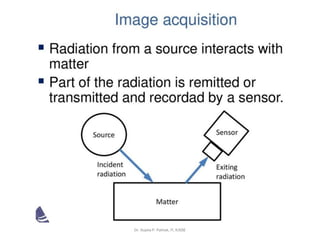
• Imaging systems, Objects and images, The digital image processing
system, Applications of digital image processing
• Fundamental models of image formation- Kinds of radiation and
imaged properties, The imaging system- Point spread function,
Imaging filters: Monochromatic, colour, multi-spectral and
hyperspectral images, Resolution (pixel, spatial,
radiometric/magnitude, spectral, temporal, super resolution)
• Image quality and uncertainties in image formation (digitization,
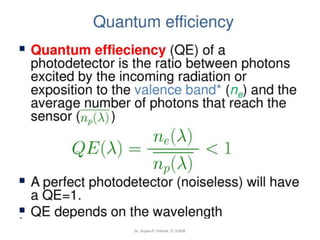
quantum efficiency, metamerism, calibration, CNR, SNR)
• Major imaging modalities- Magnetic Resonance Imaging, Optical
Imaging (inc. X-Ray, OCT, NIRS, microscopy, confocal imaging ,one
and two photon imaging, fluoroscopy, CT), Electrical and magnetic
imaging (inc. EEG/MEG, EMG, ECG, etc), Ultrasound
Dr. Sujata P. Pathak, IT, KJSSE
What is an Image?
• Image is a source of information according to
information theory
• An image may be defined as a two-dimensional
function f(x, y) where x and y are spatial
coordinates and amplitude of f at any pair of
coordinates (x, y) is called the intensity or Gray
level of the image at that point.
Dr. Sujata P. Pathak, IT, KJSSE
Digital Image
• When x, y and the amplitude values of f are all
finite, discrete quantities, we call the image a
Digital Image.
• A digital Image is composed of a finite number of
elements each of which has a particular
location and value
• These elements are referred to as Picture
Elements, Image Elements, Pels or Pixels.
Dr. Sujata P. Pathak, IT, KJSSE
Pixel
• In digital imaging, a pixel is the smallest piece of
information in an image.
• Pixels are normally arranged in a regular 2-dimensional
grid, and are often represented using dots or squares
• The intensity of each pixel is variable; in color systems,
each pixel has typically three or four components such as red,
green, and blue, or cyan, magenta, yellow, and black
Objects and images
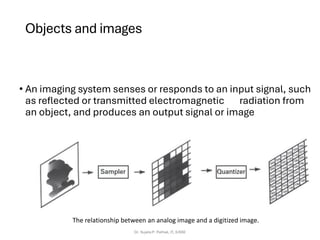
• An imaging system senses or responds to an input signal, such
as reflected or transmitted electromagnetic radiation from
an object, and produces an output signal or image
Dr. Sujata P. Pathak, IT, KJSSE
The relationship between an analog image and a digitized image.
Objects and images
• An imaging system →
• continuous-to-continuous system- responding to a
continuous input signal and producing a continuous or
analog output image
• continuous-to-discrete system- responding to the
continuous input signal by producing a discrete, digital
output image.
• Tomographic images are reconstructed from many, one-
dimensional, views or projections collected over the
exposure time.
• X-ray computed tomography (CT) imaging is an
example of a continuous-to-discrete imaging system,
using computer reconstruction to produce a digital
image from a set of projection data collected by
discrete sensors.
Dr. Sujata P. Pathak, IT, KJSSE
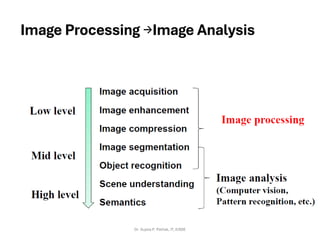
Image Processing →Image Analysis
Dr. Sujata P. Pathak, IT, KJSSE
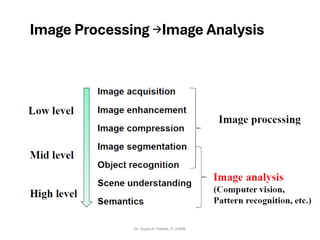
Image Processing →Image Analysis
Dr. Sujata P. Pathak, IT, KJSSE
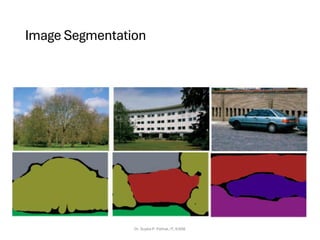
Image Segmentation
Dr. Sujata P. Pathak, IT, KJSSE
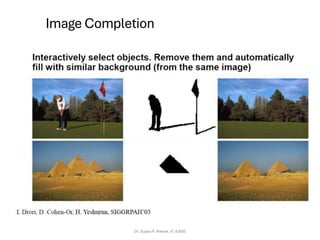
Image Completion
Dr. Sujata P. Pathak, IT, KJSSE
Image Completion
Dr. Sujata P. Pathak, IT, KJSSE
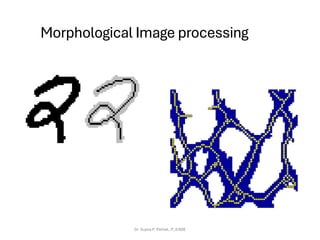
Morphological Image processing
Dr. Sujata P. Pathak, IT, KJSSE
Why do we Process Images?
Facilitate picture storage and transmission
Enhance and restore images
Extract information from images
Prepare for display or Printing
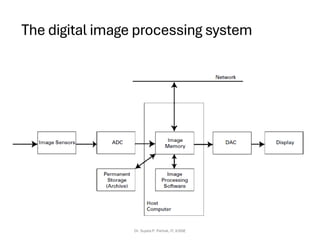
The digital image processing system
Dr. Sujata P. Pathak, IT, KJSSE
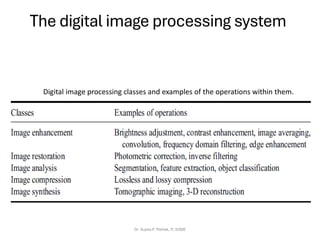
The digital image processing system
Dr. Sujata P. Pathak, IT, KJSSE
Digital image processing classes and examples of the operations within them.
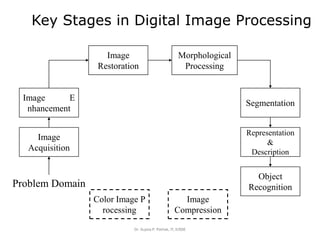
Key Stages in Digital Image Processing
Dr. Sujata P. Pathak, IT, KJSSE
Image
Acquisition
Image
Restoration
Morphological
Processing
Segmentation
Object
Recognition
Image E
nhancement
Representation
&
Description
Problem Domain
Color Image P
rocessing
Image
Compression
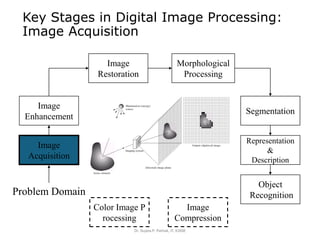
Key Stages in Digital Image Processing:
Image Acquisition
Dr. Sujata P. Pathak, IT, KJSSE
Image
Acquisition
Image
Restoration
Morphological
Processing
Segmentation
Object
Recognition
Image
Enhancement
Representation
&
Description
Problem Domain
Color Image P
rocessing
Image
Compression
Key Stages in Digital Image Processing:
Image Enhancement
Dr. Sujata P. Pathak, IT, KJSSE
Image
Acquisition
Image
Restoration
Morphological
Processing
Segmentation
Representation
&
Description
Image
Enhancement
Object
Recognition
Problem Domain
Color Image P
rocessing
Image
Compression
Key Stages in Digital Image Processing:
Image Restoration
Dr. Sujata P. Pathak, IT, KJSSE
Image
Acquisition
Image
Restoration
Morphological
Processing
Segmentation
Object
Recognition
Image
Enhancement
Representation
&
Description
Problem Domain
Color Image P
rocessing
Image
Compression
Key Stages in Digital Image Processing:
Morphological Processing
Dr. Sujata P. Pathak, IT, KJSSE
Image
Acquisition
Image
Restoration
Morphological P
rocessing
Segmentation
Representation
&
Description
Image
Enhancement
Object
Recognition
Problem Domain
Color Image
Processing
Image
Compression
Key Stages in Digital Image Processing:
Segmentation
Dr. Sujata P. Pathak, IT, KJSSE
Image
Acquisition
Image
Restoration
Morphological
Processing
Segmentation
Object
Recognition
Image
Enhancement
Representation
&
Description
Problem Domain
Color Image P
rocessing
Image
Compression
Key Stages in Digital Image Processing:
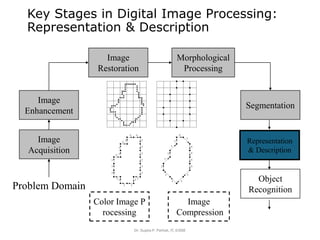
Representation & Description
Dr. Sujata P. Pathak, IT, KJSSE
Image
Acquisition
Image
Restoration
Morphological
Processing
Segmentation
Image
Enhancement
Problem Domain
Color Image P
rocessing
Image
Compression
Representation
& Description
Object
Recognition
Key Stages in Digital Image Processing:
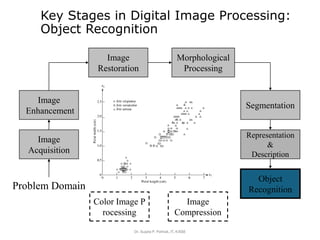
Object Recognition
Dr. Sujata P. Pathak, IT, KJSSE
Image
Acquisition
Image
Restoration
Morphological
Processing
Segmentation
Object
Recognition
Image
Enhancement
Representation
&
Description
Problem Domain
Color Image P
rocessing
Image
Compression
Key Stages in Digital Image Processing:
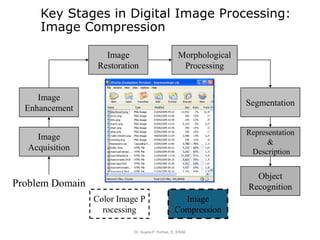
Image Compression
Dr. Sujata P. Pathak, IT, KJSSE
Image
Acquisition
Image
Restoration
Morphological
Processing
Segmentation
Object
Recognition
Image
Enhancement
Representation
&
Description
Problem Domain
Color Image P
rocessing
Image
Compression
Key Stages in Digital Image Processing:
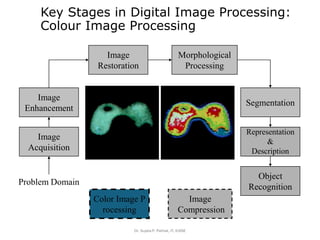
Colour Image Processing
Dr. Sujata P. Pathak, IT, KJSSE
Image
Acquisition
Image
Restoration
Morphological
Processing
Segmentation
Object
Recognition
Image
Enhancement
Representation
&
Description
Problem Domain
Color Image P
rocessing
Image
Compression
Applications of Image
Processing
Dr. Sujata P. Pathak, IT, KJSSE
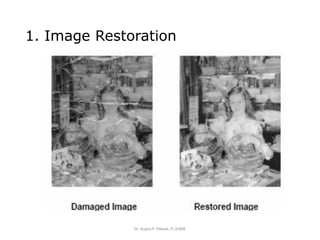
1. Image Restoration
Dr. Sujata P. Pathak, IT, KJSSE
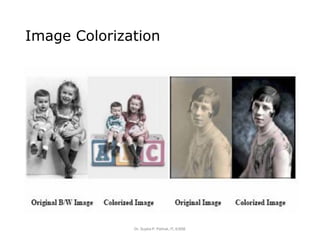
Image Colorization
Dr. Sujata P. Pathak, IT, KJSSE
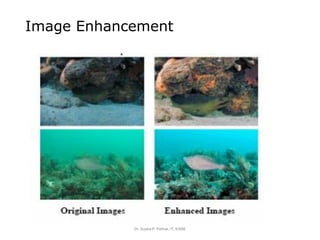
Image Enhancement
Dr. Sujata P. Pathak, IT, KJSSE
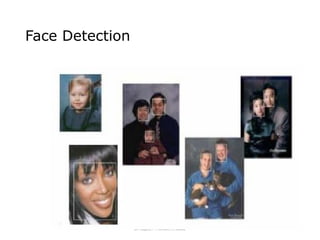
Face Detection
Dr. Sujata P. Pathak, IT, KJSSE
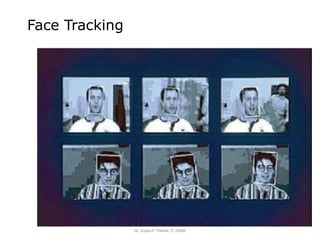
Face Tracking
Dr. Sujata P. Pathak, IT, KJSSE
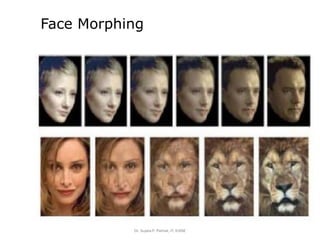
Face Morphing
Dr. Sujata P. Pathak, IT, KJSSE
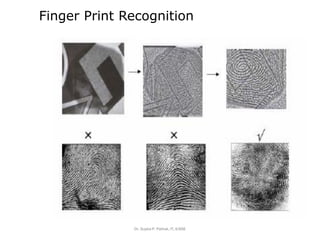
Finger Print Recognition
Dr. Sujata P. Pathak, IT, KJSSE
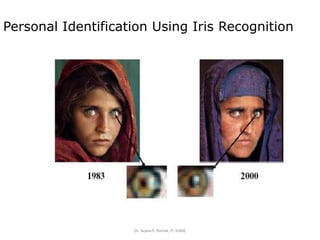
Personal Identification Using Iris Recognition
Fundamental models of image formation
Kinds of
radiation and imaged properties
Models of Image Formation
Dr. Sujata P. Pathak, IT, KJSSE
SimpleImageFormation Model
Dr. Sujata P. Pathak, IT, KJSSE
• An image is defined by two-dimensional function 𝑓(𝑥, 𝑦). The
value or amplitude of 𝑓 at spatial coordinates (𝑥, 𝑦) is a positive
scalar quantity.
• When an image is generated from a physical process, its values
are proportional to energy radiated by physical source
• Therefore, 𝑓(𝑥, 𝑦) must be nonzero and finite; that is,
0 < 𝑓(𝑥, 𝑦) < ∞
• The function 𝑓(𝑥, 𝑦) is characterized by two components
• The amount of source illumination incident on the scene
being viewed (Illumination).
• The amount of illumination reflected by the objects in the
scene (reflectance).
SimpleImageFormation Model
Dr. Sujata P. Pathak, IT, KJSSE
• A simple image model is
𝑓 (𝑥, 𝑦) = 𝑖(𝑥, 𝑦) . 𝑟(𝑥, 𝑦)
Where 0 <𝑖(𝑥, 𝑦) <∞ and 0< 𝑟(𝑥, 𝑦) <1
𝑟(𝑥, 𝑦) = 0 means total absorption
𝑟(𝑥, 𝑦) = 1 means total reflectance or transmittance
• The intensity of a monochrome image at any coordinates (𝑥,
𝑦) is the gray level (𝑙) of the image at that point.
• The interval of 𝑙 ranges from [0, 𝐿 − 1].
where 𝑙 = 0 indicates black and 𝑙 = 1 indicates white.
All the intermediate values are shades of gray varying from
black to white.
SimpleImageFormation Model
Dr. Sujata P. Pathak, IT, KJSSE
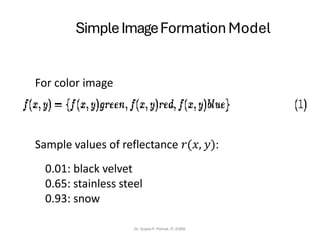
For color image
Sample values of reflectance 𝑟(𝑥, 𝑦):
0.01: black velvet
0.65: stainless steel
0.93: snow
SimpleImageFormationModel
Dr. Sujata P. Pathak, IT, KJSSE
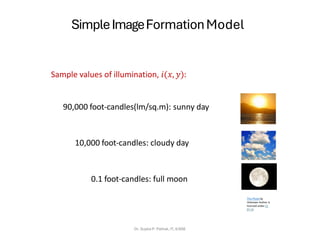
Sample values of illumination, 𝑖(𝑥, 𝑦):
90,000 foot-candles(lm/sq.m): sunny day
10,000 foot-candles: cloudy day
0.1 foot-candles: full moon
This Photo by
Unknown Author is
licensed under CC
BY-SA
ImageFormation Model
•Geometrical model-
•Describes how the 3 world dimensions
are translated into the dimensions of the
sensor.
•In the context of a TV or still camera
having a single 2D image plane,
perspective projection is the fundamental
mechanism whereby light is projected
into a single monocular view.
Dr. Sujata P. Pathak, IT, KJSSE
ImageFormation Model
Geometrical model-
•This type of projection does not yield direct
information about the z-coordinate
•Binocular imaging uses a system with two
viewpoints, in which the eyes do not normally
converge, i.e. the eyes are aimed in parallel at an
infinite point in the z direction.
•The depth information is encoded by it's different
positions ( disparity ) in the two images.
Dr. Sujata P. Pathak, IT, KJSSE
ImageFormation Model
Radiometric model –
•Illustrates the way in which the imaging geometry, the
light sources and the reflectance properties of objects
influence the light measured at the sensor.
•The brightness of the image at a point, the image
intensity or image irradiance where irradiance defines
the power per unit area falling on a surface depends
on the following factors-
•First, there is the radiant intensity of the source.
•Second there is the reflectance of the objects in the
scene, in terms of the proportion, spatial
distribution and spectral variation of light reflected.
Dr. Sujata P. Pathak, IT, KJSSE
ImageFormation Model
The digitizing model-
•Implies that the analogue scene data which varies
continuously in intensity and space, must be
transformed into a discrete representation.
•Digitized images are sampled, i.e. only recorded at
discrete locations, quantized , i.e. only recorded with
respect to the nearest amplitude level.
• for example: 256 levels of intensity, and windowed, i.e.
only recorded to a finite extent in x and y etc.
•All these processes change fundamentally the world
as seen by the camera or other sensor.
Dr. Sujata P. Pathak, IT, KJSSE
ImageFormation Model
Spatial frequency model-
•Describes how the spatial variations of the image
may be characterized in the spatial frequency
domain,
•The more rapid the variations in the image, the
higher the spatial frequency.
•This type of analysis is fundamental to image
processing.
Dr. Sujata P. Pathak, IT, KJSSE
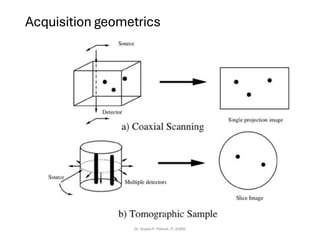
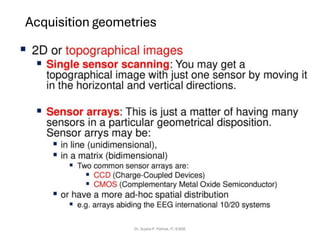
Acquisition geometrics
Dr. Sujata P. Pathak, IT, KJSSE
Acquisition geometries
Dr. Sujata P. Pathak, IT, KJSSE
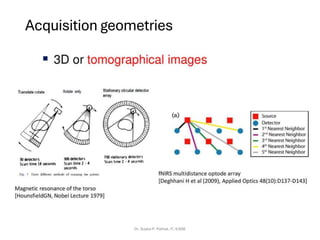
Acquisition geometries
Dr. Sujata P. Pathak, IT, KJSSE
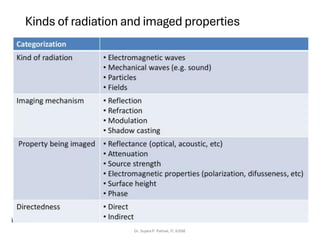
Kinds of radiation and imaged properties
Dr. Sujata P. Pathak, IT, KJSSE
THE IMAGING SYSTEM
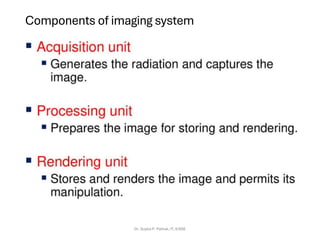
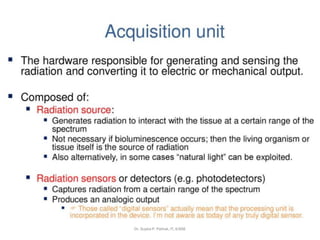
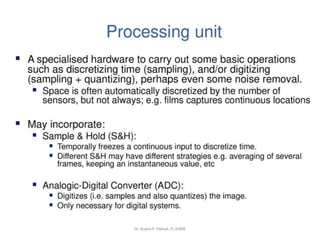
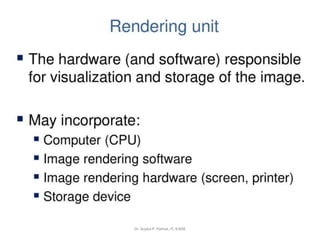
Components of imaging system
Dr. Sujata P. Pathak, IT, KJSSE
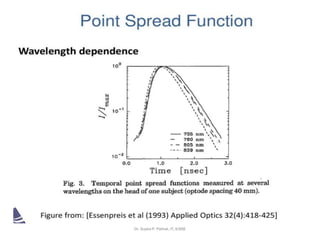
POINT SPREAD FUNCTION
Point Spread Function
Dr. Sujata P. Pathak, IT, KJSSE
Point Spread Function
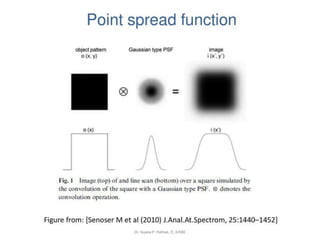
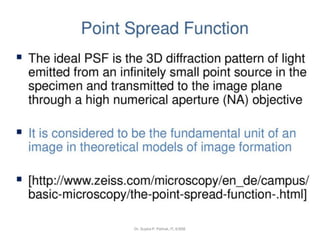
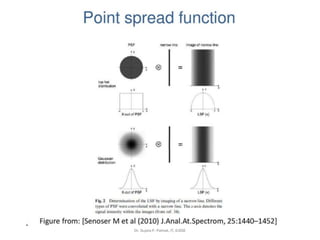
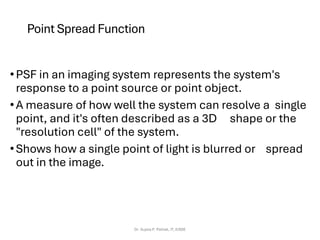
•PSF in an imaging system represents the system's
response to a point source or point object.
•A measure of how well the system can resolve a single
point, and it's often described as a 3D shape or the
"resolution cell" of the system.
•Shows how a single point of light is blurred or spread
out in the image.
Dr. Sujata P. Pathak, IT, KJSSE
Point Spread Function
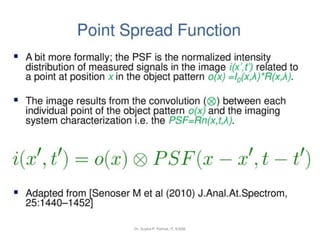
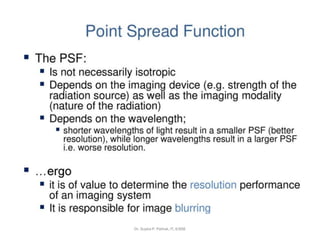
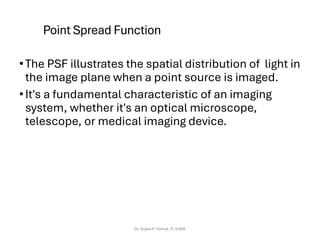
•The PSF illustrates the spatial distribution of light in
the image plane when a point source is imaged.
•It's a fundamental characteristic of an imaging
system, whether it's an optical microscope,
telescope, or medical imaging device.
Dr. Sujata P. Pathak, IT, KJSSE
Point Spread Function
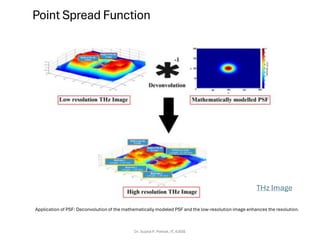
Application of PSF: Deconvolution of the mathematically modeled PSF and the low-resolution image enhances the resolution.
Dr. Sujata P. Pathak, IT, KJSSE
THz Image
Dr. Sujata P. Pathak, IT, KJSSE
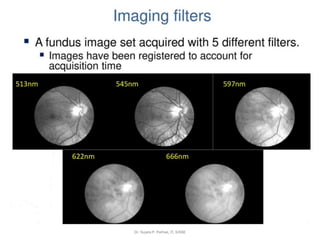
IMAGING FILTERS
Introduction to Imaging Filters
•Imaging filters are techniques used to
capture and process images based on the
spectral characteristics of light.
•They play a key role in various applications
including medical imaging, remote sensing,
and machine vision.
Dr. Sujata P. Pathak, IT, KJSSE
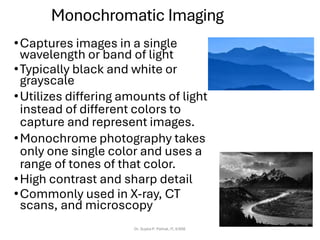
Monochromatic Imaging
•Captures images in a single
wavelength or band of light
•Typically black and white or
grayscale
•Utilizes differing amounts of light
instead of different colors to
capture and represent images.
•Monochrome photography takes
only one single color and uses a
range of tones of that color.
•High contrast and sharp detail
•Commonly used in X-ray, CT
scans, and microscopy
Dr. Sujata P. Pathak, IT, KJSSE
Colour Imaging
•- Captures images in multiple bands
corresponding to visible light (RGB)
•- Each channel (Red, Green, Blue) captures
specific wavelengths
•- Used in digital cameras, medical diagnostics,
and television
•- Enables visual realism and color differentiation
Dr. Sujata P. Pathak, IT, KJSSE
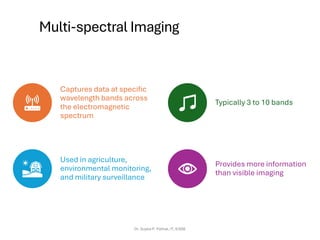
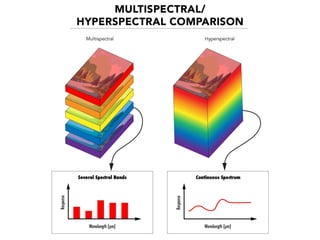
Multi-spectral Imaging
Captures data at specific
wavelength bands across
the electromagnetic
spectrum
Typically 3 to 10 bands
Used in agriculture,
environmental monitoring,
and military surveillance
Provides more information
than visible imaging
Dr. Sujata P. Pathak, IT, KJSSE
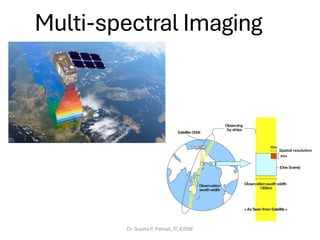
Multi-spectral Imaging
Dr. Sujata P. Pathak, IT, KJSSE
Multi-spectral Imaging
Dr. Sujata P. Pathak, IT, KJSSE
Hyperspectral Imaging
•Hyperspectral imaging (HSI) is a process used
to obtain high spectral resolution imagery by
dividing light into many narrow, contiguous
spectral bands.
•Captures images in hundreds of narrow and
contiguous spectral bands
•High spectral resolution
•Allows material identification and detailed
spectral analysis
•Used in mineralogy, medical diagnostics, and
food quality control
Dr. Sujata P. Pathak, IT, KJSSE
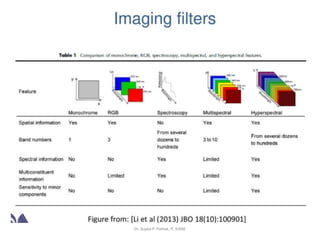
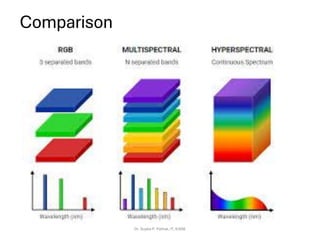
Comparison
Dr. Sujata P. Pathak, IT, KJSSE
Comparison of Imaging Techniques
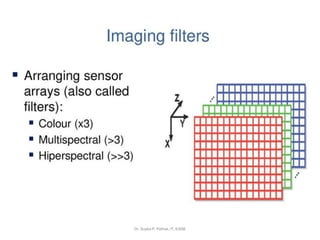
•Monochromatic: Single band, grayscale
•Colour: 3 bands (RGB), visible light
•Multi-spectral: 3–10 bands, discrete non-
continuous
•Hyperspectral: 100+ bands, continuous
spectrum
Dr. Sujata P. Pathak, IT, KJSSE
Applications of Imaging
•- Medical imaging (e.g., MRI, PET, dermatology)
•- Remote sensing and Earth observation
•- Agriculture and crop monitoring
•- Industrial inspection and quality control
•- Military and defense surveillance
Dr. Sujata P. Pathak, IT, KJSSE
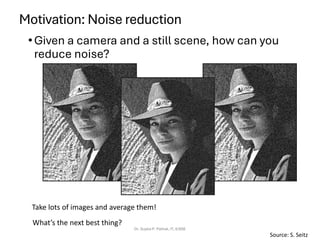
Motivation: Noise reduction
•Given a camera and a still scene, how can you
reduce noise?
Dr. Sujata P. Pathak, IT, KJSSE
Take lots of images and average them!
What’s the next best thing?
Source: S. Seitz
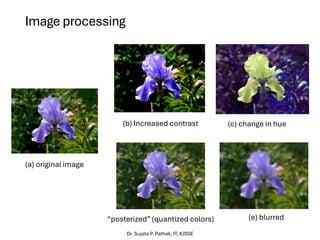
Image processing
Dr. Sujata P. Pathak, IT, KJSSE
(a) original image
(b) Increased contrast (c) change in hue
(e) blurred
“posterized” (quantized colors)
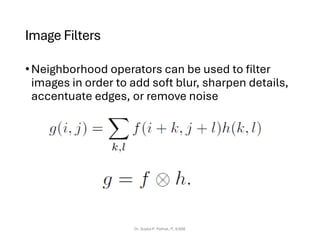
Image Filters
•Neighborhood operators can be used to filter
images in order to add soft blur, sharpen details,
accentuate edges, or remove noise
Dr. Sujata P. Pathak, IT, KJSSE
Image Filters
Dr. Sujata P. Pathak, IT, KJSSE
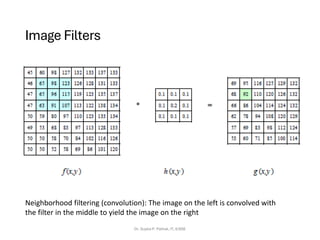
Neighborhood filtering (convolution): The image on the left is convolved with
the filter in the middle to yield the image on the right
Image Filters
Dr. Sujata P. Pathak, IT, KJSSE
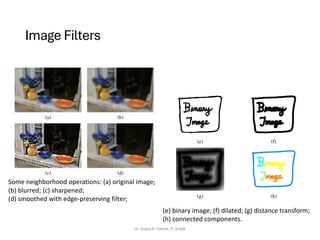
Some neighborhood operations: (a) original image;
(b) blurred; (c) sharpened;
(d) smoothed with edge-preserving filter;
(e) binary image; (f) dilated; (g) distance transform;
(h) connected components.
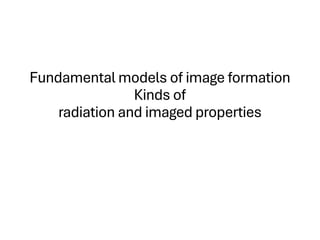
Image Filters
Moving average
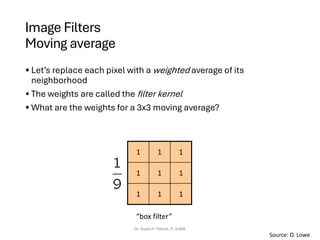
• Let’s replace each pixel with a weighted average of its
neighborhood
• The weights are called the filter kernel
• What are the weights for a 3x3 moving average?
Dr. Sujata P. Pathak, IT, KJSSE
1
1
1
1
1
1
1
1
1
“box filter”
Source: D. Lowe
Image Filters
Defining convolution
• Let f be the image and g be the kernel. The output of convolving f with
g is denoted f * g.
Dr. Sujata P. Pathak, IT, KJSSE
 −
−
=

l
k
l
k
g
l
n
k
m
f
n
m
g
f
,
]
,
[
]
,
[
]
,
)[
(
f
Source: F. Durand
• Convention: kernel is “flipped”
• MATLAB: conv2 vs. filter2 (also imfilter)
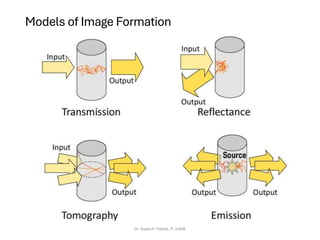
Image Filters
Key properties
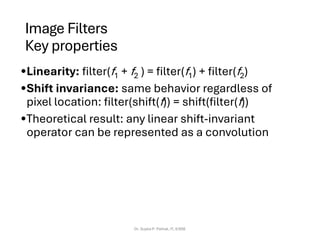
•Linearity: filter(f1 + f2 ) = filter(f1) + filter(f2)
•Shift invariance: same behavior regardless of
pixel location: filter(shift(f)) = shift(filter(f))
•Theoretical result: any linear shift-invariant
operator can be represented as a convolution
Dr. Sujata P. Pathak, IT, KJSSE
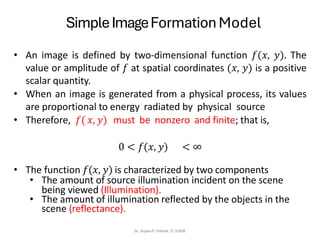
Image Filters
Properties in more detail
•Commutative: a * b = b * a
• Conceptually no difference between filter and signal
•Associative: a * (b * c) = (a * b) * c
• Often apply several filters one after another: (((a * b1) * b2) *
b3)
• This is equivalent to applying one filter: a * (b1 * b2 * b3)
•Distributes over addition: a * (b + c) = (a * b) + (a * c)
•Scalars factor out: ka *b = a *kb = k (a * b)
•Identity: unit impulse e = […, 0, 0, 1, 0, 0, …],
a * e = a
Dr. Sujata P. Pathak, IT, KJSSE
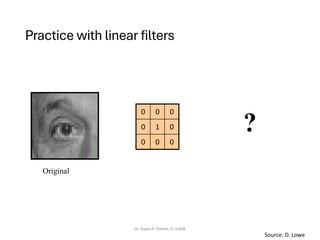
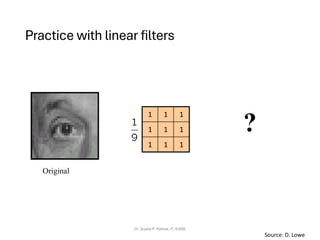
Practice with linear filters
Dr. Sujata P. Pathak, IT, KJSSE
0
0
0
0
1
0
0
0
0
Original
?
Source: D. Lowe
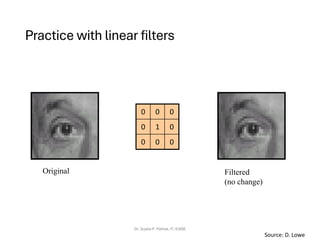
Practice with linear filters
Dr. Sujata P. Pathak, IT, KJSSE
0
0
0
0
1
0
0
0
0
Original Filtered
(no change)
Source: D. Lowe
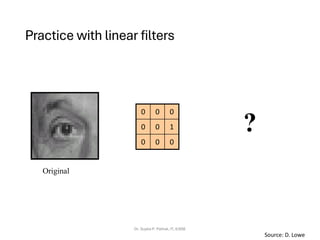
Practice with linear filters
Dr. Sujata P. Pathak, IT, KJSSE
0
0
0
1
0
0
0
0
0
Original
?
Source: D. Lowe
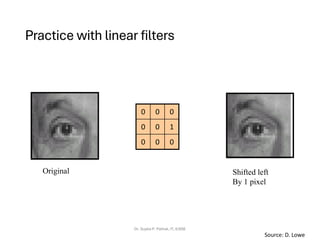
Practice with linear filters
Dr. Sujata P. Pathak, IT, KJSSE
0
0
0
1
0
0
0
0
0
Original Shifted left
By 1 pixel
Source: D. Lowe
Practice with linear filters
Dr. Sujata P. Pathak, IT, KJSSE
Original
?
1
1
1
1
1
1
1
1
1
Source: D. Lowe
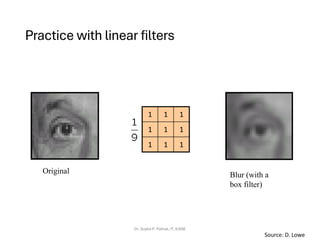
Practice with linear filters
Dr. Sujata P. Pathak, IT, KJSSE
Original
1
1
1
1
1
1
1
1
1
Blur (with a
box filter)
Source: D. Lowe
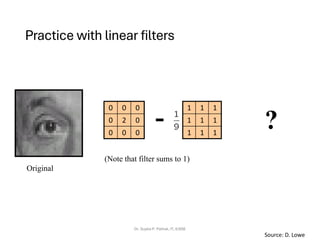
Practice with linear filters
Dr. Sujata P. Pathak, IT, KJSSE
Original
1
1
1
1
1
1
1
1
1
0
0
0
0
2
0
0
0
0
- ?
(Note that filter sums to 1)
Source: D. Lowe
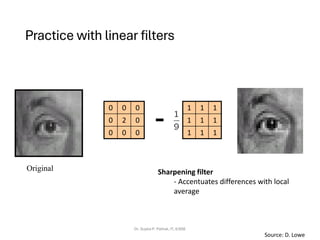
Practice with linear filters
Dr. Sujata P. Pathak, IT, KJSSE
Original
1
1
1
1
1
1
1
1
1
0
0
0
0
2
0
0
0
0
-
Sharpening filter
- Accentuates differences with local
average
Source: D. Lowe
Sharpening
Dr. Sujata P. Pathak, IT, KJSSE
Source: D. Lowe
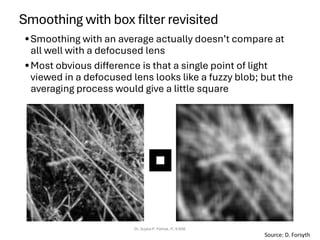
Smoothing with box filter revisited
•Smoothing with an average actually doesn’t compare at
all well with a defocused lens
•Most obvious difference is that a single point of light
viewed in a defocused lens looks like a fuzzy blob; but the
averaging process would give a little square
Dr. Sujata P. Pathak, IT, KJSSE
Source: D. Forsyth
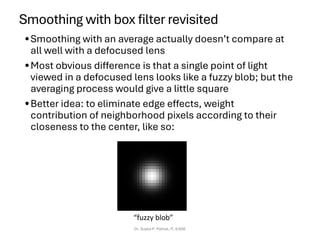
Smoothing with box filter revisited
•Smoothing with an average actually doesn’t compare at
all well with a defocused lens
•Most obvious difference is that a single point of light
viewed in a defocused lens looks like a fuzzy blob; but the
averaging process would give a little square
•Better idea: to eliminate edge effects, weight
contribution of neighborhood pixels according to their
closeness to the center, like so:
Dr. Sujata P. Pathak, IT, KJSSE
“fuzzy blob”
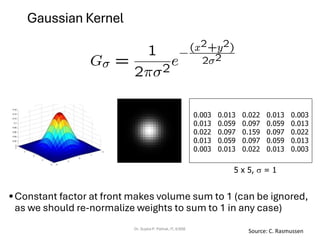
Gaussian Kernel
•Constant factor at front makes volume sum to 1 (can be ignored,
as we should re-normalize weights to sum to 1 in any case)
Dr. Sujata P. Pathak, IT, KJSSE
0.003 0.013 0.022 0.013 0.003
0.013 0.059 0.097 0.059 0.013
0.022 0.097 0.159 0.097 0.022
0.013 0.059 0.097 0.059 0.013
0.003 0.013 0.022 0.013 0.003
5 x 5,  = 1
Source: C. Rasmussen
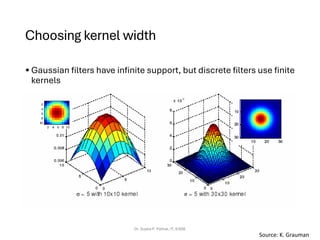
Choosing kernel width
• Gaussian filters have infinite support, but discrete filters use finite
kernels
Dr. Sujata P. Pathak, IT, KJSSE
Source: K. Grauman
Choosing kernel width
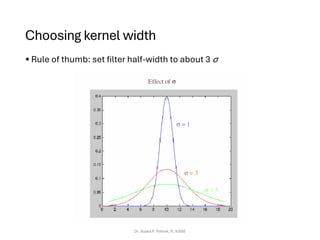
• Rule of thumb: set filter half-width to about 3 σ
Dr. Sujata P. Pathak, IT, KJSSE
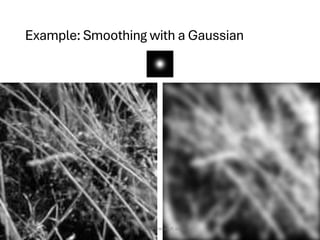
Example: Smoothing with a Gaussian
Dr. Sujata P. Pathak, IT, KJSSE
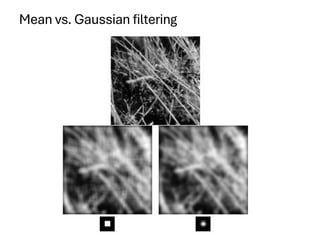
Mean vs. Gaussian filtering
Dr. Sujata P. Pathak, IT, KJSSE
Gaussian filters
•Remove “high-frequency” components from the
image (low-pass filter)
•Convolution with self is another Gaussian
• So can smooth with small-width kernel, repeat, and
get same result as larger-width kernel would have
• Convolving two times with Gaussian kernel of width σ
is same as convolving once with kernel of width σ√2
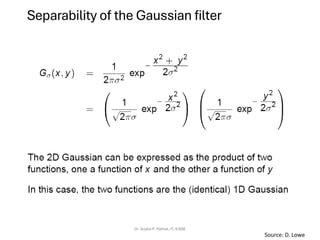
•Separable kernel
• Factors into product of two 1D Gaussians
Dr. Sujata P. Pathak, IT, KJSSE
Source: K. Grauman
Separability of the Gaussian filter
Dr. Sujata P. Pathak, IT, KJSSE
Source: D. Lowe
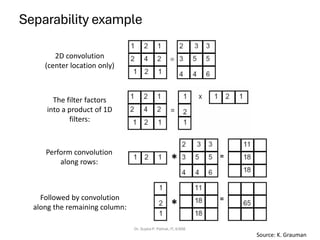
Separability example
Dr. Sujata P. Pathak, IT, KJSSE
*
*
=
=
2D convolution
(center location only)
Source: K. Grauman
The filter factors
into a product of 1D
filters:
Perform convolution
along rows:
Followed by convolution
along the remaining column:
Separability
• Why is separability useful in practice?
Dr. Sujata P. Pathak, IT, KJSSE
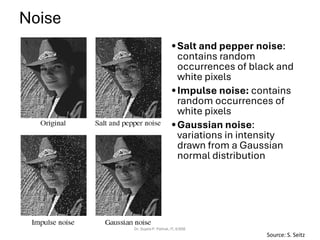
Noise
•Salt and pepper noise:
contains random
occurrences of black and
white pixels
•Impulse noise: contains
random occurrences of
white pixels
•Gaussian noise:
variations in intensity
drawn from a Gaussian
normal distribution
Dr. Sujata P. Pathak, IT, KJSSE
Source: S. Seitz
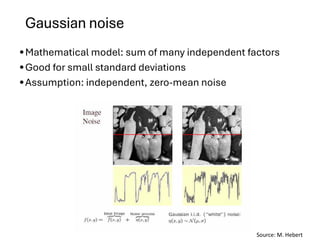
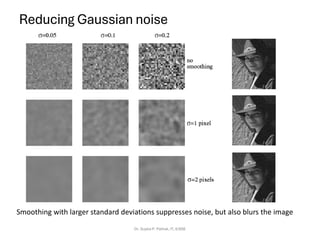
Gaussian noise
•Mathematical model: sum of many independent factors
•Good for small standard deviations
•Assumption: independent, zero-mean noise
Dr. Sujata P. Pathak, IT, KJSSE
Source: M. Hebert
Smoothing with larger standard deviations suppresses noise, but also blurs the image
Reducing Gaussian noise
Dr. Sujata P. Pathak, IT, KJSSE
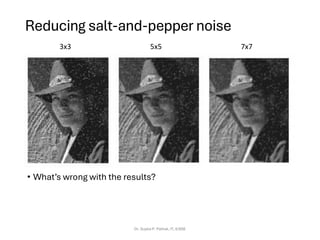
Reducing salt-and-pepper noise
• What’s wrong with the results?
Dr. Sujata P. Pathak, IT, KJSSE
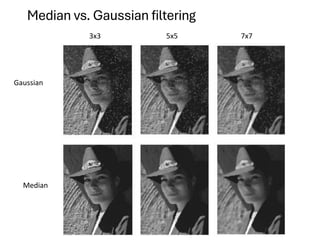
3x3 5x5 7x7
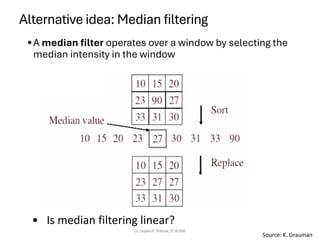
Alternative idea: Median filtering
•A median filter operates over a window by selecting the
median intensity in the window
Dr. Sujata P. Pathak, IT, KJSSE
• Is median filtering linear?
Source: K. Grauman
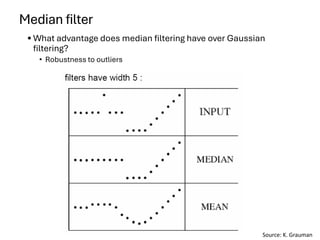
Median filter
• What advantage does median filtering have over Gaussian
filtering?
• Robustness to outliers
Dr. Sujata P. Pathak, IT, KJSSE
Source: K. Grauman
Median filter
• MATLAB: medfilt2(image, [h w])
Dr. Sujata P. Pathak, IT, KJSSE
Salt-and-pepper noise Median filtered
Source: M. Hebert
Median vs. Gaussian filtering
Dr. Sujata P. Pathak, IT, KJSSE
3x3 5x5 7x7
Gaussian
Median
Image Resolution
Dr. Sujata P. Pathak, IT, KJSSE
Image Quality and
Uncertainties in Image
Formation
Dr. Sujata P. Pathak, IT, KJSSE
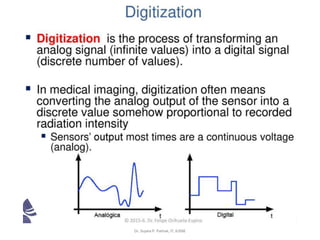
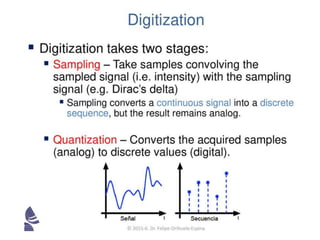
Digitization
Dr. Sujata P. Pathak, IT, KJSSE
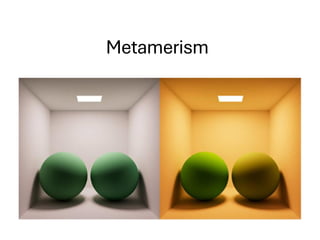
Metamerism
Metamerism
Dr. Sujata P. Pathak, IT, KJSSE
Metamerism
•Metamerism is more common with neutral colors
like grays, whites, and dark colors.
•Metamerism is less common with lighter or more
saturated colors.
•Color metamerism occurs when colors, having
different spectral compositions, appear the
same to a human eye.
• Spectral composition is the distribution of light
energy at each wavelength that is emitted,
transmitted, or reflected by a color sample.
Dr. Sujata P. Pathak, IT, KJSSE
Metamerism
•The phenomenon where two colors appear identical
under certain lighting conditions but differ under
others.
•Importance in Image Processing:
• Critical in color reproduction, color matching, and
accurate image rendering.
•Two different spectral power distributions producing
the same color sensation.
•Example: Matching colors using different pigments or
light sources.
Dr. Sujata P. Pathak, IT, KJSSE
Metamerism
•Color metamerism is caused by three
basic factors:
•Light source:
•Materials:
•Human color vision:
Dr. Sujata P. Pathak, IT, KJSSE
Metamerism
•Types of Metamerism
•Illuminant Metamerism: Color match under
one light source but not another.
•Observer Metamerism: Different observers
perceive colors differently due to variations in
vision.
•Device Metamerism: Differences in color
reproduction between devices.
Dr. Sujata P. Pathak, IT, KJSSE
Metamerism
•Metamerism in Image Processing Applications
• Color calibration
• Color management systems
• Digital imaging and printing
• Display technology
Dr. Sujata P. Pathak, IT, KJSSE
Metamerism
•Challenges Due to Metamerism-
• Maintaining color consistency across devices and
lighting conditions
• Impact on quality control in imaging workflows
•Methods to Handle Metamerism
• Using standardized light sources for viewing
• Spectral imaging and multispectral analysis
• Color profiling and device characterization
Dr. Sujata P. Pathak, IT, KJSSE
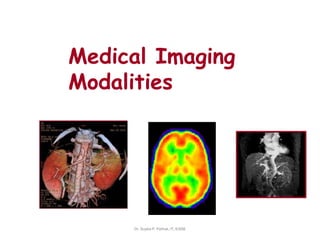
Medical Imaging
Modalities
Dr. Sujata P. Pathak, IT, KJSSE
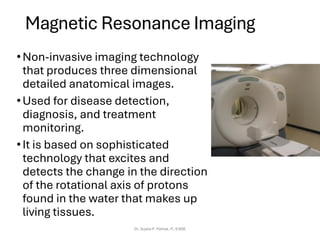
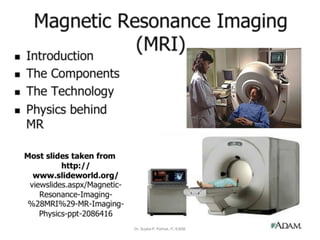
Magnetic Resonance Imaging
•Non-invasive imaging technology
that produces three dimensional
detailed anatomical images.
•Used for disease detection,
diagnosis, and treatment
monitoring.
•It is based on sophisticated
technology that excites and
detects the change in the direction
of the rotational axis of protons
found in the water that makes up
living tissues.
Dr. Sujata P. Pathak, IT, KJSSE
Magnetic Resonance Imaging
• MRIs employ powerful magnets which produce a strong
magnetic field that forces protons in the body to align with
that field. When a radiofrequency current is then pulsed
through the patient, the protons are stimulated, and spin
out of equilibrium, straining against the pull of the
magnetic field. When the radiofrequency field is turned off,
the MRI sensors are able to detect the energy released as
the protons realign with the magnetic field. The time it
takes for the protons to realign with the magnetic field, as
well as the amount of energy released, changes depending
on the environment and the chemical nature of the
molecules. Physicians are able to tell the difference
between various types of tissues based on these magnetic
properties.
Dr. Sujata P. Pathak, IT, KJSSE
https://youtu.be/1CGzk-nV06g
Magnetic Resonance Imaging
•To obtain an MRI image, a patient is placed
inside a large magnet and must remain very
still during the imaging process in order not to
blur the image.
•Contrast agents (often containing the element
Gadolinium) may be given to a patient
intravenously before or during the MRI to
increase the speed at which protons realign
with the magnetic field.
•The faster the protons realign, the brighter the
image.
Dr. Sujata P. Pathak, IT, KJSSE
Magnetic Resonance Imaging
What is MRI used for?
•MRI scanners are particularly well suited to
image the non-bony parts or soft tissues of the
body.
•They differ from computed tomography (CT), in
that they do not use the damaging ionizing
radiation of x-rays.
•The brain, spinal cord and nerves, as well as
muscles, ligaments, and tendons are seen much
more clearly with MRI than with regular x-rays
and CT
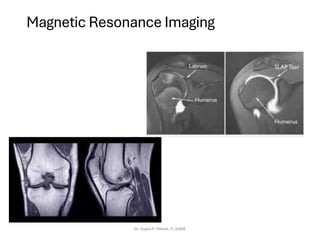
•for this reason MRI is often used to image knee
and shoulder injuries.
Dr. Sujata P. Pathak, IT, KJSSE
Magnetic Resonance Imaging
Dr. Sujata P. Pathak, IT, KJSSE
Magnetic
Resonance
Imaging
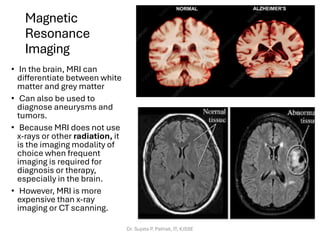
• In the brain, MRI can
differentiate between white
matter and grey matter
• Can also be used to
diagnose aneurysms and
tumors.
• Because MRI does not use
x-rays or other radiation, it
is the imaging modality of
choice when frequent
imaging is required for
diagnosis or therapy,
especially in the brain.
• However, MRI is more
expensive than x-ray
imaging or CT scanning.
Dr. Sujata P. Pathak, IT, KJSSE
Magnetic Resonance Imaging
•One kind of specialized MRI is functional
Magnetic Resonance Imaging (fMRI.)
•Used to observe brain structures and determine
which areas of the brain “activate” (consume
more oxygen) during various cognitive tasks.
•Used to advance the understanding of brain
organization and offers a potential new standard
for assessing neurological status and
neurosurgical risk.
Dr. Sujata P. Pathak, IT, KJSSE
Optical imaging
Optical imaging
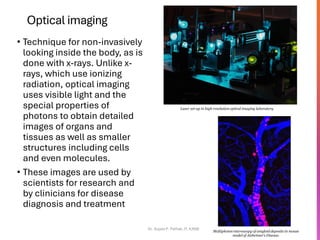
• Technique for non-invasively
looking inside the body, as is
done with x-rays. Unlike x-
rays, which use ionizing
radiation, optical imaging
uses visible light and the
special properties of
photons to obtain detailed
images of organs and
tissues as well as smaller
structures including cells
and even molecules.
• These images are used by
scientists for research and
by clinicians for disease
diagnosis and treatment
Dr. Sujata P. Pathak, IT, KJSSE
Laser set-up in high resolution optical imaging laboratory
Multiphoton microscopy of amyloid deposits in mouse
model of Alzheimer’s Disease.
Optical imaging
Advantages of optical imaging?
• Reduces patient exposure to harmful radiation by using non-
ionizing radiation, which includes visible, ultraviolet, and infrared
light.
• Much safer for patients, and significantly faster, optical imaging can
be used for lengthy and repeated procedures over time to monitor
the progression of disease or the results of treatment.
• Useful for visualizing soft tissues. Soft tissues can be easily
distinguished from one another due to the wide variety of ways
different tissues absorb and scatter light.
• Because it can obtain images of structures across a wide range of
sizes and types, optical imaging can be combined with other
imaging techniques, such as MRI or x-rays, to provide enhanced
information for doctors monitoring complex diseases or
researchers working on intricate experiments.
• Optical imaging takes advantage of the various colors of light in
order to see and measure many different properties of an organ or
tissue at the same time. Other imaging techniques are limited to
just one or two measurements
Dr. Sujata P. Pathak, IT, KJSSE
Optical imaging
Types of optical imaging-
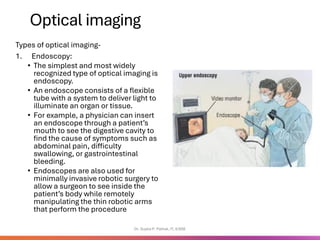
1. Endoscopy:
• The simplest and most widely
recognized type of optical imaging is
endoscopy.
• An endoscope consists of a flexible
tube with a system to deliver light to
illuminate an organ or tissue.
• For example, a physician can insert
an endoscope through a patient’s
mouth to see the digestive cavity to
find the cause of symptoms such as
abdominal pain, difficulty
swallowing, or gastrointestinal
bleeding.
• Endoscopes are also used for
minimally invasive robotic surgery to
allow a surgeon to see inside the
patient’s body while remotely
manipulating the thin robotic arms
that perform the procedure
Dr. Sujata P. Pathak, IT, KJSSE
Optical imaging
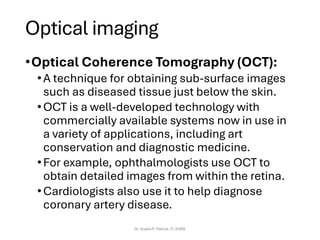
•Optical Coherence Tomography (OCT):
•A technique for obtaining sub-surface images
such as diseased tissue just below the skin.
•OCT is a well-developed technology with
commercially available systems now in use in
a variety of applications, including art
conservation and diagnostic medicine.
•For example, ophthalmologists use OCT to
obtain detailed images from within the retina.
•Cardiologists also use it to help diagnose
coronary artery disease.
Dr. Sujata P. Pathak, IT, KJSSE
Optical imaging
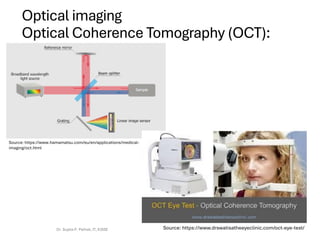
Optical Coherence Tomography (OCT):
Dr. Sujata P. Pathak, IT, KJSSE Source: https://www.drswatisatheeyeclinic.com/oct-eye-test/
Source: https://www.hamamatsu.com/eu/en/applications/medical-
imaging/oct.html
Optical imaging
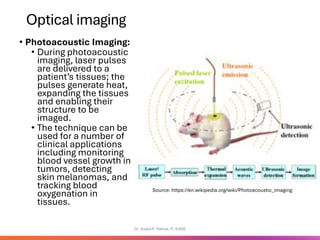
• Photoacoustic Imaging:
• During photoacoustic
imaging, laser pulses
are delivered to a
patient’s tissues; the
pulses generate heat,
expanding the tissues
and enabling their
structure to be
imaged.
• The technique can be
used for a number of
clinical applications
including monitoring
blood vessel growth in
tumors, detecting
skin melanomas, and
tracking blood
oxygenation in
tissues.
Dr. Sujata P. Pathak, IT, KJSSE
Source: https://en.wikipedia.org/wiki/Photoacoustic_imaging
Optical imaging
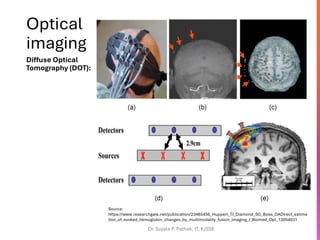
Diffuse Optical Tomography (DOT):
•Used to obtain information about brain activity.
•A laser that uses near-infrared light is positioned
on the scalp.
•The light goes through the scalp and harmlessly
traverses the brain.
•The absorption of light reveals information about
chemical concentrations in the brain.
•The scattering of the light reflects physiological
characteristics such as the swelling of a neuron
upon activation to pass on a neural signal.
Dr. Sujata P. Pathak, IT, KJSSE
Optical
imaging
Diffuse Optical
Tomography (DOT):
Dr. Sujata P. Pathak, IT, KJSSE
Source:
https://www.researchgate.net/publication/23485456_Huppert_TJ_Diamond_SG_Boas_DADirect_estima
tion_of_evoked_hemoglobin_changes_by_multimodality_fusion_imaging_J_Biomed_Opt_13054031
Optical imaging
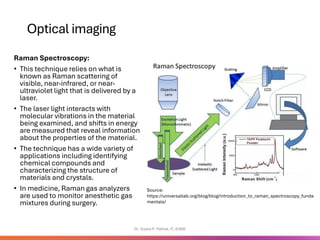
Raman Spectroscopy:
• This technique relies on what is
known as Raman scattering of
visible, near-infrared, or near-
ultraviolet light that is delivered by a
laser.
• The laser light interacts with
molecular vibrations in the material
being examined, and shifts in energy
are measured that reveal information
about the properties of the material.
• The technique has a wide variety of
applications including identifying
chemical compounds and
characterizing the structure of
materials and crystals.
• In medicine, Raman gas analyzers
are used to monitor anesthetic gas
mixtures during surgery.
Dr. Sujata P. Pathak, IT, KJSSE
Source:
https://universallab.org/blog/blog/introduction_to_raman_spectroscopy_funda
mentals/
Optical imaging
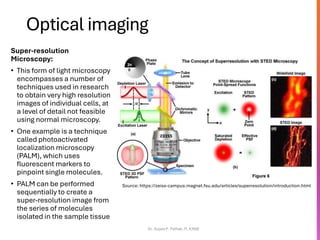
Super-resolution
Microscopy:
• This form of light microscopy
encompasses a number of
techniques used in research
to obtain very high resolution
images of individual cells, at
a level of detail not feasible
using normal microscopy.
• One example is a technique
called photoactivated
localization microscopy
(PALM), which uses
fluorescent markers to
pinpoint single molecules.
• PALM can be performed
sequentially to create a
super-resolution image from
the series of molecules
isolated in the sample tissue
Dr. Sujata P. Pathak, IT, KJSSE
Source: https://zeiss-campus.magnet.fsu.edu/articles/superresolution/introduction.html
Optical imaging
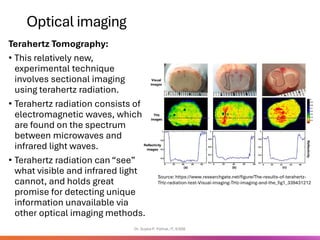
Terahertz Tomography:
• This relatively new,
experimental technique
involves sectional imaging
using terahertz radiation.
• Terahertz radiation consists of
electromagnetic waves, which
are found on the spectrum
between microwaves and
infrared light waves.
• Terahertz radiation can “see”
what visible and infrared light
cannot, and holds great
promise for detecting unique
information unavailable via
other optical imaging methods.
Dr. Sujata P. Pathak, IT, KJSSE
Source: https://www.researchgate.net/figure/The-results-of-terahertz-
THz-radiation-test-Visual-imaging-THz-imaging-and-the_fig1_339431212
Near-infrared spectroscopy (NIRS)
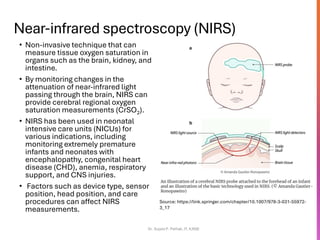
• Non-invasive technique that can
measure tissue oxygen saturation in
organs such as the brain, kidney, and
intestine.
• By monitoring changes in the
attenuation of near-infrared light
passing through the brain, NIRS can
provide cerebral regional oxygen
saturation measurements (CrSO2).
• NIRS has been used in neonatal
intensive care units (NICUs) for
various indications, including
monitoring extremely premature
infants and neonates with
encephalopathy, congenital heart
disease (CHD), anemia, respiratory
support, and CNS injuries.
• Factors such as device type, sensor
position, head position, and care
procedures can affect NIRS
measurements.
Dr. Sujata P. Pathak, IT, KJSSE
An illustration of a cerebral NIRS probe attached to the forehead of an infant
and an illustration of the basic technology used in NIRS. (© Amanda Gautier-
Ronopawiro)
Source: https://link.springer.com/chapter/10.1007/978-3-031-55972-
3_17
Near-infrared spectroscopy (NIRS)
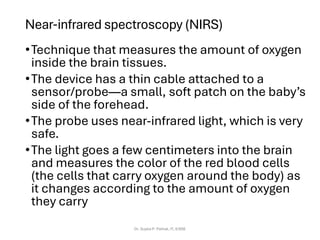
•Technique that measures the amount of oxygen
inside the brain tissues.
•The device has a thin cable attached to a
sensor/probe—a small, soft patch on the baby’s
side of the forehead.
•The probe uses near-infrared light, which is very
safe.
•The light goes a few centimeters into the brain
and measures the color of the red blood cells
(the cells that carry oxygen around the body) as
it changes according to the amount of oxygen
they carry
Dr. Sujata P. Pathak, IT, KJSSE
Microscopy
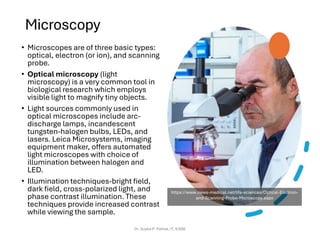
• Microscopes are of three basic types:
optical, electron (or ion), and scanning
probe.
• Optical microscopy (light
microscopy) is a very common tool in
biological research which employs
visible light to magnify tiny objects.
• Light sources commonly used in
optical microscopes include arc-
discharge lamps, incandescent
tungsten-halogen bulbs, LEDs, and
lasers. Leica Microsystems, imaging
equipment maker, offers automated
light microscopes with choice of
illumination between halogen and
LED.
• Illumination techniques-bright field,
dark field, cross-polarized light, and
phase contrast illumination. These
techniques provide increased contrast
while viewing the sample.
Dr. Sujata P. Pathak, IT, KJSSE
https://www.news-medical.net/life-sciences/Optical-Electron-
and-Scanning-Probe-Microscopy.aspx
Microscopy
Scanning probe microscopy
(SPM)-
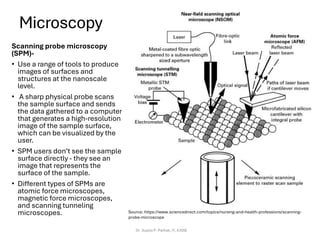
• Use a range of tools to produce
images of surfaces and
structures at the nanoscale
level.
• A sharp physical probe scans
the sample surface and sends
the data gathered to a computer
that generates a high-resolution
image of the sample surface,
which can be visualized by the
user.
• SPM users don’t see the sample
surface directly - they see an
image that represents the
surface of the sample.
• Different types of SPMs are
atomic force microscopes,
magnetic force microscopes,
and scanning tunneling
microscopes.
Dr. Sujata P. Pathak, IT, KJSSE
Source: https://www.sciencedirect.com/topics/nursing-and-health-professions/scanning-
probe-microscope
Microscopy
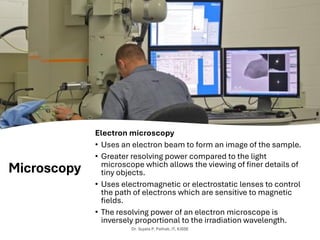
Electron microscopy
• Uses an electron beam to form an image of the sample.
• Greater resolving power compared to the light
microscope which allows the viewing of finer details of
tiny objects.
• Uses electromagnetic or electrostatic lenses to control
the path of electrons which are sensitive to magnetic
fields.
• The resolving power of an electron microscope is
inversely proportional to the irradiation wavelength.
Dr. Sujata P. Pathak, IT, KJSSE
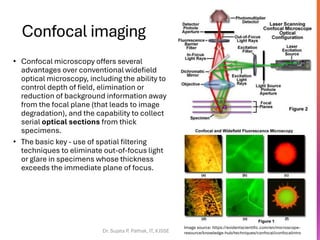
Confocal imaging
• Confocal microscopy offers several
advantages over conventional widefield
optical microscopy, including the ability to
control depth of field, elimination or
reduction of background information away
from the focal plane (that leads to image
degradation), and the capability to collect
serial optical sections from thick
specimens.
• The basic key - use of spatial filtering
techniques to eliminate out-of-focus light
or glare in specimens whose thickness
exceeds the immediate plane of focus.
Dr. Sujata P. Pathak, IT, KJSSE
Image source: https://evidentscientific.com/en/microscope-
resource/knowledge-hub/techniques/confocal/confocalintro
One and two photon imaging
•https://blog.biodock.ai/one-vs-two-
photon-microscopy/
Dr. Sujata P. Pathak, IT, KJSSE
Introduction
Dr. Sujata P. Pathak, IT, KJSSE
Introduction
Dr. Sujata P. Pathak, IT, KJSSE
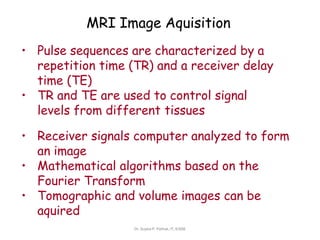
MRI Image Aquisition
• Pulse sequences are characterized by a
repetition time (TR) and a receiver delay
time (TE)
• TR and TE are used to control signal
levels from different tissues
• Receiver signals computer analyzed to form
an image
• Mathematical algorithms based on the
Fourier Transform
• Tomographic and volume images can be
aquired
Dr. Sujata P. Pathak, IT, KJSSE
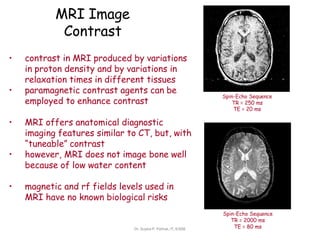
MRI Image
Contrast
Spin-Echo Sequence
TR = 250 ms
TE = 20 ms
• contrast in MRI produced by variations
in proton density and by variations in
relaxation times in different tissues
• paramagnetic contrast agents can be
employed to enhance contrast
• MRI offers anatomical diagnostic
imaging features similar to CT, but, with
“tuneable” contrast
• however, MRI does not image bone well
because of low water content
• magnetic and rf fields levels used in
MRI have no known biological risks
Spin-Echo Sequence
TR = 2000 ms
TE = 80 ms
Dr. Sujata P. Pathak, IT, KJSSE
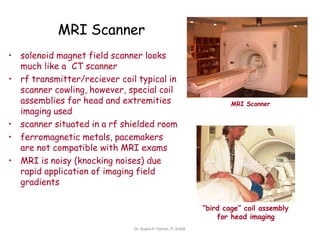
MRI Scanner
MRI Scanner
• solenoid magnet field scanner looks
much like a CT scanner
• rf transmitter/reciever coil typical in
scanner cowling, however, special coil
assemblies for head and extremities
imaging used
• scanner situated in a rf shielded room
• ferromagnetic metals, pacemakers
are not compatible with MRI exams
• MRI is noisy (knocking noises) due
rapid application of imaging field
gradients
“bird cage” coil assembly
for head imaging
Dr. Sujata P. Pathak, IT, KJSSE
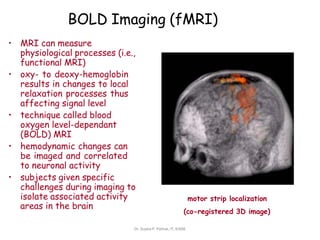
BOLD Imaging (fMRI)
• MRI can measure
physiological processes (i.e.,
functional MRI)
• oxy- to deoxy-hemoglobin
results in changes to local
relaxation processes thus
affecting signal level
• technique called blood
oxygen level-dependant
(BOLD) MRI
• hemodynamic changes can
be imaged and correlated
to neuronal activity
• subjects given specific
challenges during imaging to
isolate associated activity motor strip localization
(co-registered 3D image)
areas in the brain
Dr. Sujata P. Pathak, IT, KJSSE
Contrast
• imaging relies on contrast differences
• in diagnostic imaging, contrast must
distinguish anatomy, and/or physiological
processes
• different imaging modalities produce
contrast through differing physical
processes
• various modalities offer advantages and
disadvantages
Dr. Sujata P. Pathak, IT, KJSSE
X-Ray Modalities
• x-ray modalities are the most common
imaging modalities in medical diagnostic
imaging
• modalities include:
– Radiography
– Fluoroscopy
– Computed Tomography
Dr. Sujata P. Pathak, IT, KJSSE
X-Ray Contrast
• low energy x-rays produce contrast through
absorption in tissue
• relative absorption depends on tissue density
and atomic composition
• down-side: absorption and scattering results
in ionization (radiation dose) and potential
biological damage, however, benefit outweighs
risk
Dr. Sujata P. Pathak, IT, KJSSE
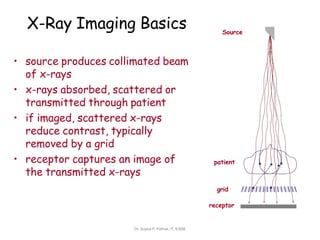
X-Ray Imaging Basics
patient
• source produces collimated beam
of x-rays
• x-rays absorbed, scattered or
transmitted through patient
• if imaged, scattered x-rays
reduce contrast, typically
removed by a grid
• receptor captures an image of
the transmitted x-rays
grid
receptor
Source
Dr. Sujata P. Pathak, IT, KJSSE
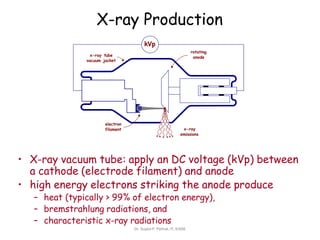
X-ray Production
• X-ray vacuum tube: apply an DC voltage (kVp) between
a cathode (electrode filament) and anode
• high energy electrons striking the anode produce
– heat (typically > 99% of electron energy),
– bremstrahlung radiations, and
– characteristic x-ray radiations
kVp
electron
filament x-ray
emissions
rotating
anode
x-ray tube
vacuum jacket
Dr. Sujata P. Pathak, IT, KJSSE
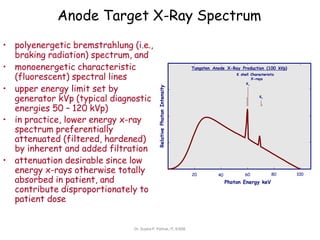
Anode Target X-Ray Spectrum
Relative
Photon
Intensity
100
80
60
Photon Energy keV
40
20
K
Tungsten Anode X-Ray Production (100 kVp)
K shell Characteristic
X-rays
K
• polyenergetic bremstrahlung (i.e.,
braking radiation) spectrum, and
• monoenergetic characteristic
(fluorescent) spectral lines
• upper energy limit set by
generator kVp (typical diagnostic
energies 50 – 120 kVp)
• in practice, lower energy x-ray
spectrum preferentially
attenuated (filtered, hardened)
by inherent and added filtration
• attenuation desirable since low
energy x-rays otherwise totally
absorbed in patient, and
contribute disproportionately to
patient dose
Dr. Sujata P. Pathak, IT, KJSSE
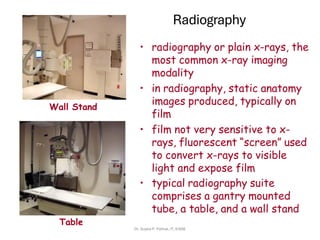
Radiography
• radiography or plain x-rays, the
most common x-ray imaging
modality
• in radiography, static anatomy
images produced, typically on
film
• film not very sensitive to x-
rays, fluorescent “screen” used
to convert x-rays to visible
light and expose film
• typical radiography suite
comprises a gantry mounted
tube, a table, and a wall stand
Table
Wall Stand
Dr. Sujata P. Pathak, IT, KJSSE
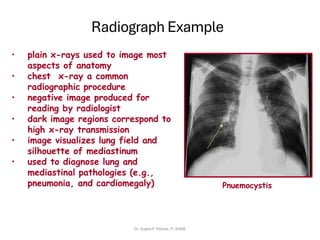
Radiograph Example
• plain x-rays used to image most
aspects of anatomy
• chest x-ray a common
radiographic procedure
• negative image produced for
reading by radiologist
• dark image regions correspond to
high x-ray transmission
• image visualizes lung field and
silhouette of mediastinum
• used to diagnose lung and
mediastinal pathologies (e.g.,
pneumonia, and cardiomegaly) Pnuemocystis
Dr. Sujata P. Pathak, IT, KJSSE
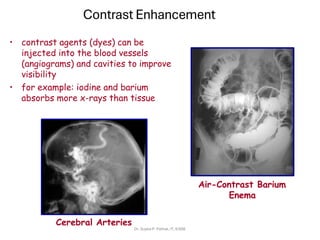
Contrast Enhancement
• contrast agents (dyes) can be
injected into the blood vessels
(angiograms) and cavities to improve
visibility
• for example: iodine and barium
absorbs more x-rays than tissue
Air-Contrast Barium
Enema
Cerebral Arteries
Dr. Sujata P. Pathak, IT, KJSSE
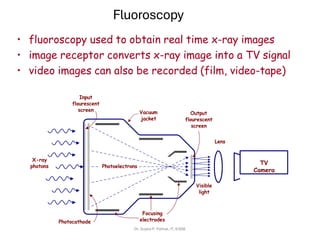
Fluoroscopy
• fluoroscopy used to obtain real time x-ray images
• image receptor converts x-ray image into a TV signal
• video images can also be recorded (film, video-tape)
Focusing
electrodes
Output
flourescent
screen
Vacuum
jacket
Input
flourescent
screen
X-ray
photons
Photocathode
Visible
light
Lens
Photoelectrons
TV
Camera
Dr. Sujata P. Pathak, IT, KJSSE
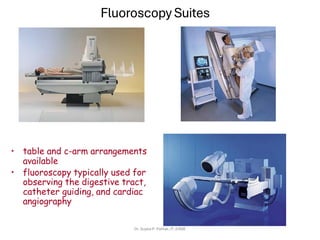
Fluoroscopy Suites
• table and c-arm arrangements
available
• fluoroscopy typically used for
observing the digestive tract,
catheter guiding, and cardiac
angiography
Dr. Sujata P. Pathak, IT, KJSSE
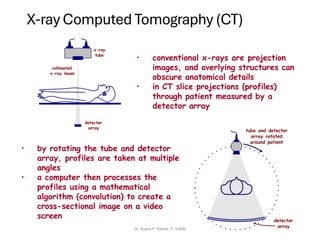
X-ray Computed Tomography (CT)
x-ray
tube
collimated
x-ray beam
detector
array
• conventional x-rays are projection
images, and overlying structures can
obscure anatomical details
• in CT slice projections (profiles)
through patient measured by a
detector array
tube and detector
array rotated
around patient
detector
array
• by rotating the tube and detector
array, profiles are taken at multiple
angles
• a computer then processes the
profiles using a mathematical
algorithm (convolution) to create a
cross-sectional image on a video
screen
Dr. Sujata P. Pathak, IT, KJSSE
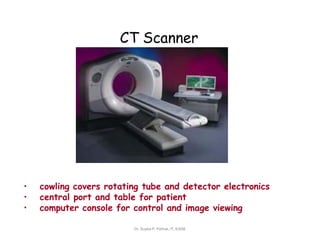
CT Scanner
• cowling covers rotating tube and detector electronics
• central port and table for patient
• computer console for control and image viewing
Dr. Sujata P. Pathak, IT, KJSSE
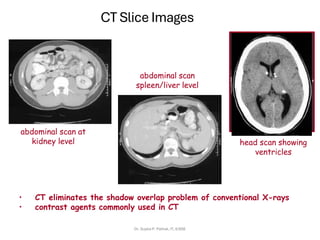
• CT eliminates the shadow overlap problem of conventional X-rays
• contrast agents commonly used in CT
CT Slice Images
abdominal scan
spleen/liver level
abdominal scan at
kidney level head scan showing
ventricles
Dr. Sujata P. Pathak, IT, KJSSE
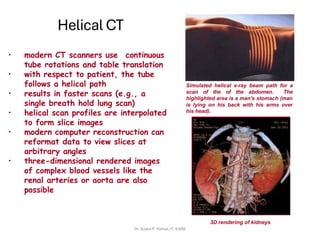
Helical CT
Simulated helical x-ray beam path for a
scan of the of the abdomen. The
highlighted area is a man's stomach (man
is lying on his back with his arms over
his head).
• modern CT scanners use continuous
tube rotations and table translation
• with respect to patient, the tube
follows a helical path
• results in faster scans (e.g., a
single breath hold lung scan)
• helical scan profiles are interpolated
to form slice images
• modern computer reconstruction can
reformat data to view slices at
arbitrary angles
• three-dimensional rendered images
of complex blood vessels like the
renal arteries or aorta are also
possible
3D rendering of kidneys
Dr. Sujata P. Pathak, IT, KJSSE
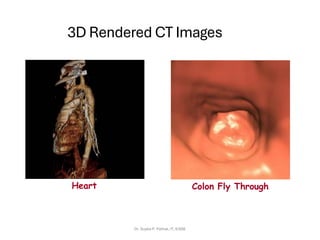
3D Rendered CT Images
Heart Colon Fly Through
Dr. Sujata P. Pathak, IT, KJSSE
Nuclear Medicine Imaging
• radio-isotopes are natural and artificially produced
unstable isotopes that decay through gamma-ray and/or
particulate emissions (e.g., positrons)
• ideal imaging isotopes feature low dose to the patient
(e.g., short physical and/or biological half lives)
• medical isotopes produced in nuclear reactors and by
particle accelerators
• nuclear medicine images visualize radioisotope
concentrations
• by “tagging” radio-isotopes to biological molecules,
physiological processes can be measured
• nuclear imaging is functional, not anatomic
Dr. Sujata P. Pathak, IT, KJSSE
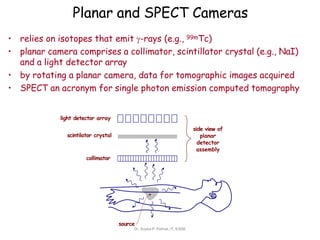
Planar and SPECT Cameras
• relies on isotopes that emit -rays (e.g., 99mTc)
• planar camera comprises a collimator, scintillator crystal (e.g., NaI)
and a light detector array
• by rotating a planar camera, data for tomographic images acquired
• SPECT an acronym for single photon emission computed tomography
source
collimator
scintilator crystal
light detector array
side view of
planar
detector
assembly
Dr. Sujata P. Pathak, IT, KJSSE
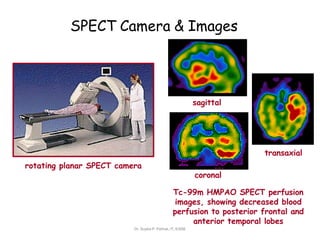
SPECT Camera & Images
sagittal
transaxial
rotating planar SPECT camera
coronal
Tc-99m HMPAO SPECT perfusion
images, showing decreased blood
perfusion to posterior frontal and
anterior temporal lobes
Dr. Sujata P. Pathak, IT, KJSSE
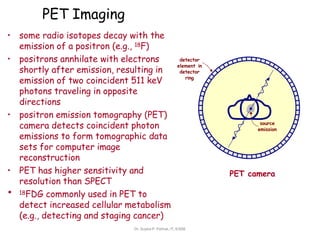
PET Imaging
PET camera
detector
element in
detector
ring
source
emission
• some radio isotopes decay with the
emission of a positron (e.g., 18F)
• positrons annhilate with electrons
shortly after emission, resulting in
emission of two coincident 511 keV
photons traveling in opposite
directions
• positron emission tomography (PET)
camera detects coincident photon
emissions to form tomographic data
sets for computer image
reconstruction
• PET has higher sensitivity and
resolution than SPECT
• 18FDG commonly used in PET to
detect increased cellular metabolism
(e.g., detecting and staging cancer)
Dr. Sujata P. Pathak, IT, KJSSE
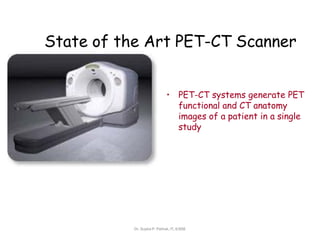
State of the Art PET-CT Scanner
• PET-CT systems generate PET
functional and CT anatomy
images of a patient in a single
study
Dr. Sujata P. Pathak, IT, KJSSE
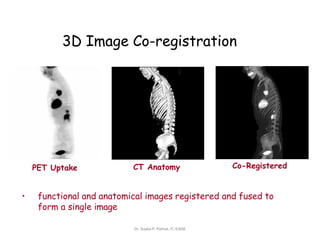
3D Image Co-registration
Co-Registered
CT Anatomy
PET Uptake
• functional and anatomical images registered and fused to
form a single image
Dr. Sujata P. Pathak, IT, KJSSE
EEG, ECG, EMG
Slide ref :Mitesh Shrestha
D
r
.S
u
j
a
t
aP
.P
a
t
h
a
k
,I
T
,K
J
S
S
E
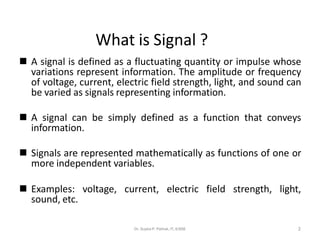
◼ A signal is defined as a fluctuating quantity or impulse whose
variations represent information. The amplitude or frequency
of voltage, current, electric field strength, light, and sound can
be varied as signals representing information.
◼ A signal can be simply defined as a function that conveys
information.
◼ Signals are represented mathematically as functions of one or
more independent variables.
◼ Examples: voltage, current, electric field strength, light,
sound, etc.
2
What is Signal ?
Dr. Sujata P. Pathak, IT, KJSSE
• Biomedical signals means the bio-signals which are generated
in biological systems only.
• Biomedical signals are observations of physiological activities
of organisms, ranging from gene and protein sequences, to
neural and cardiac rhythms, to tissue and organ images.
• Examples of biomedical signals:
ECG (Electrocardiogram) signal,
EEG (Electroencephalogram) signal, etc.
Biomedical signals
Dr. Sujata P. Pathak, IT, KJSSE
• Biomedical signals are electrical or magnetic signals generated
by some biological activity in the human body.
• Human body is composed of living tissues that can be
considered as a power station.
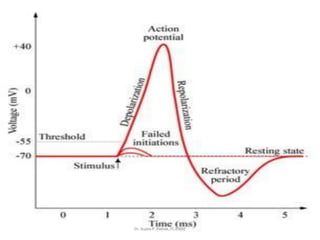
• Action of living tissues in terms of bioelectric potentials
generate multiple electric signals from two internal sources-
muscles and nerves system.
How biomedical signals are generated ?
Dr. Sujata P. Pathak, IT, KJSSE
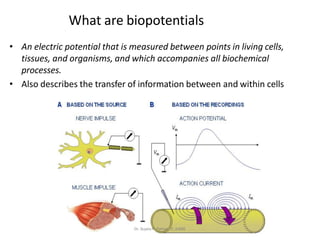
What are biopotentials
• An electric potential that is measured between points in living cells,
tissues, and organisms, and which accompanies all biochemical
processes.
• Also describes the transfer of information between and within cells
Dr. Sujata P. Pathak, IT, KJSSE
• Bioelectric Signal
• Bioacoustics Signal
• Biomechanical Signal
• Biochemical Signal
• Bio-magnetic Signal
• Bio- optical signal
Classification of Biomedical Signals
Dr. Sujata P. Pathak, IT, KJSSE
• The electrical signals which we can measure mainly
on the surface of the body is known as bioelectric
signal.
• It is generated by muscle cells and nerve cells.
• Basic source is the cell membrane potential.
• Examples: ECG, EEG, EMG, EOG
Bioelectric signal
Dr. Sujata P. Pathak, IT, KJSSE
Electrocardiography (ECG)
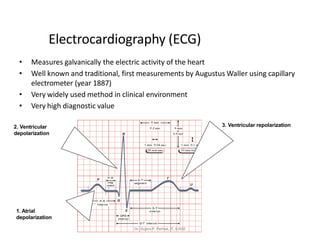
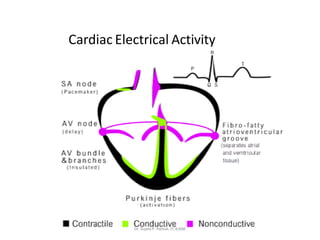
• Measures galvanically the electric activity of the heart
• Well known and traditional, first measurements by Augustus Waller using capillary
electrometer (year 1887)
• Very widely used method in clinical environment
• Very high diagnostic value
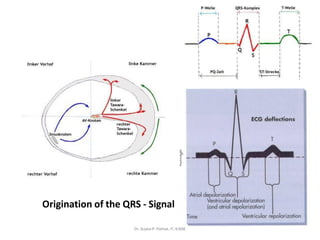
1. Atrial
depolarization
2. Ventricular
depolarization
3. Ventricular repolarization
Dr. Sujata P. Pathak, IT, KJSSE
Electrocardiography
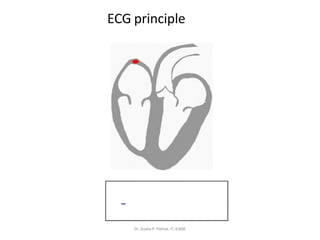
• The heart is an electrical organ, and its activity
can be measured non-invasively
• Wealth of information related to:
– The electrical patterns proper
– The geometry of the heart tissue
– The metabolic state of the heart
• Standard tool used in a wide-range of medical
evaluations
Dr. Sujata P. Pathak, IT, KJSSE
ECG principle
Dr. Sujata P. Pathak, IT, KJSSE
Cardiac Electrical Activity
Dr. Sujata P. Pathak, IT, KJSSE
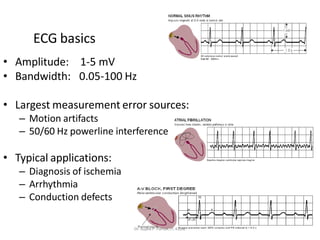
ECG basics
• Amplitude: 1-5 mV
• Bandwidth: 0.05-100 Hz
• Largest measurement error sources:
– Motion artifacts
– 50/60 Hz powerline interference
• Typical applications:
– Diagnosis of ischemia
– Arrhythmia
– Conduction defects
Dr. Sujata P. Pathak, IT, KJSSE
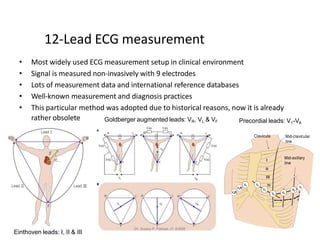
12-Lead ECG measurement
• Most widely used ECG measurement setup in clinical environment
• Signal is measured non-invasively with 9 electrodes
• Lots of measurement data and international reference databases
• Well-known measurement and diagnosis practices
• This particular method was adopted due to historical reasons, now it is already
rather obsolete
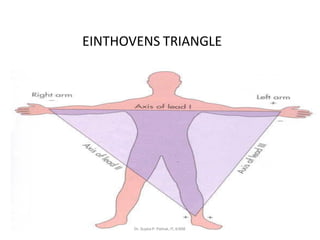
Einthoven leads: I, II & III
Goldberger augmented leads: VR, VL & VF Precordial leads: V1-V6
Dr. Sujata P. Pathak, IT, KJSSE
15
EINTHOVENS TRIANGLE
Dr. Sujata P. Pathak, IT, KJSSE
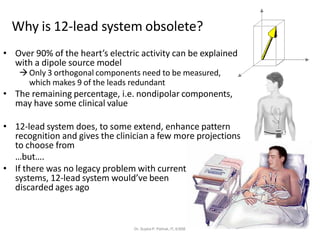
Why is 12-lead system obsolete?
• Over 90% of the heart’s electric activity can be explained
with a dipole source model
→Only 3 orthogonal components need to be measured,
which makes 9 of the leads redundant
• The remaining percentage, i.e. nondipolar components,
may have some clinical value
• 12-lead system does, to some extend, enhance pattern
recognition and gives the clinician a few more projections
to choose from
…but….
• If there was no legacy problem with current
systems, 12-lead system would’ve been
discarded ages ago
Dr. Sujata P. Pathak, IT, KJSSE
Origination of the QRS - Signal
Dr. Sujata P. Pathak, IT, KJSSE
ECG - applications
● Diagnostics
● Functional analysis
● Implants (pace maker)
● Biofeedback (Heartrate variability, HRV)
● Peak Performacne Training, Monitoring
Dr. Sujata P. Pathak, IT, KJSSE
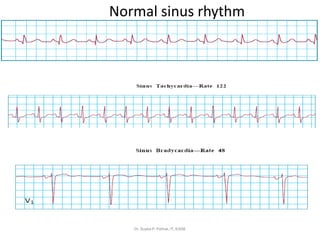
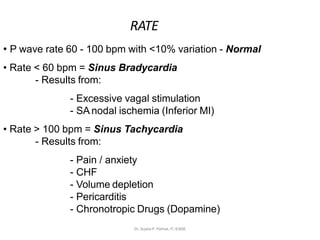
Normal sinus rhythm
Dr. Sujata P. Pathak, IT, KJSSE
RATE
• P wave rate 60 - 100 bpm with <10% variation - Normal
• Rate < 60 bpm = Sinus Bradycardia
- Results from:
- Excessive vagal stimulation
- SA nodal ischemia (Inferior MI)
• Rate > 100 bpm = Sinus Tachycardia
- Results from:
- Pain / anxiety
- CHF
- Volume depletion
- Pericarditis
- Chronotropic Drugs (Dopamine)
Dr. Sujata P. Pathak, IT, KJSSE
Electroencephalography (EEG)
• An electrophysiological monitoring method to record electrical activity of
the brain.
• Typically noninvasive, with the electrodes placed along the scalp, although
invasive electrodes are sometimes used in specific applications.
• EEG measures voltage fluctuations resulting from ionic current within the
neurons of the brain.
• In clinical contexts, EEG refers to the recording of the brain's spontaneous
electrical activity over a period of time, as recorded from multiple
electrodes placed on the scalp.
• Diagnostic applications generally focus on the spectral content of EEG, that
is, the type of neural oscillations (popularly called "brain waves") that can
be observed in EEG signals. Dr. Sujata P. Pathak, IT, KJSSE
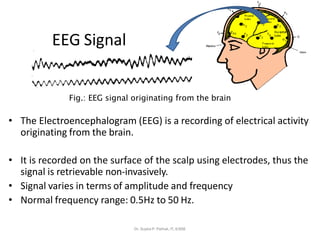
Fig.: EEG signal originating from the brain
• The Electroencephalogram (EEG) is a recording of electrical activity
originating from the brain.
• It is recorded on the surface of the scalp using electrodes, thus the
signal is retrievable non-invasively.
• Signal varies in terms of amplitude and frequency
• Normal frequency range: 0.5Hz to 50 Hz.
EEG Signal
Dr. Sujata P. Pathak, IT, KJSSE
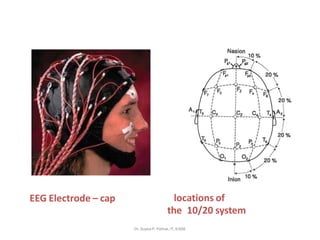
EEG Electrode – cap locations of
the 10/20 system
Dr. Sujata P. Pathak, IT, KJSSE
Electroencephalogram (EEG)
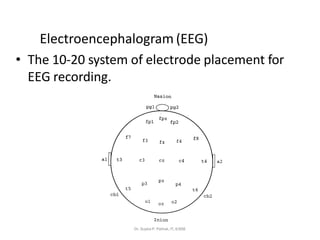
• The 10-20 system of electrode placement for
EEG recording.
Dr. Sujata P. Pathak, IT, KJSSE
Electroencephalogram (EEG)
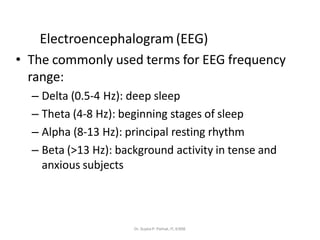
• The commonly used terms for EEG frequency
range:
– Delta (0.5-4 Hz): deep sleep
– Theta (4-8 Hz): beginning stages of sleep
– Alpha (8-13 Hz): principal resting rhythm
– Beta (>13 Hz): background activity in tense and
anxious subjects
Dr. Sujata P. Pathak, IT, KJSSE
Electroencephalogram (EEG)
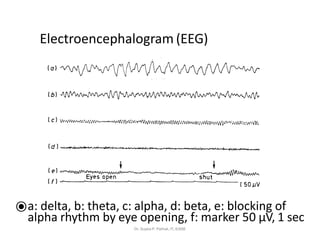
⦿a: delta, b: theta, c: alpha, d: beta, e: blocking of
alpha rhythm by eye opening, f: marker 50 μV, 1 sec
Dr. Sujata P. Pathak, IT, KJSSE
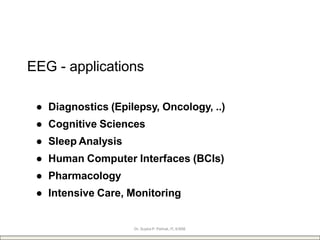
EEG - applications
● Diagnostics (Epilepsy, Oncology, ..)
● Cognitive Sciences
● Sleep Analysis
● Human Computer Interfaces (BCIs)
● Pharmacology
● Intensive Care, Monitoring
Dr. Sujata P. Pathak, IT, KJSSE
Electromyography(EMG)
• Electromyography (EMG) is a technique for
evaluating and recording the activation signal of
muscles.
• EMG is performed by an electromyograph,
which records an electromyogram.
• Electromyograph detects the electrical potential
generated by muscle cells when these cells
contract and relax.
Dr. Sujata P. Pathak, IT, KJSSE
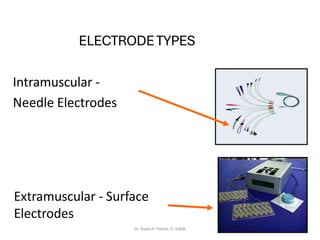
ELECTRODETYPES
Intramuscular -
Needle Electrodes
Extramuscular - Surface
Electrodes
Dr. Sujata P. Pathak, IT, KJSSE
EMG PROCEDURE
• Clean the site of application
of electrode;
• Insert needle/place surface
electrodes at muscle belly;
• Record muscle activity at rest;
• Record muscle activity upon
voluntary contraction of the
muscle.
Dr. Sujata P. Pathak, IT, KJSSE
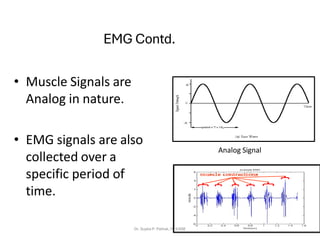
EMG Contd.
• Muscle Signals are
Analog in nature.
• EMG signals are also
collected over a
specific period of
time.
Analog Signal
Dr. Sujata P. Pathak, IT, KJSSE
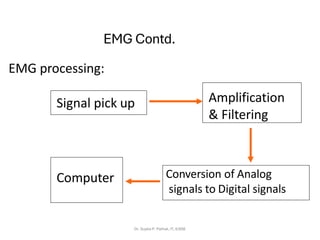
EMG Contd.
EMG processing:
Amplification
& Filtering
Signal pick up
Conversion of Analog
signals to Digital signals
Computer
Dr. Sujata P. Pathak, IT, KJSSE
Factors Influencing Signal Measured
• Geometrical & Anatomical Factors
– Electrode size
– Electrode shape
– Electrode separation distance with respect to muscle tendon junctions
– Thickness of skin and subcutaneous fat
– Misalignment between electrodes and fiber alignment
• Physiological Factors
– Blood flow and temperature
– Type and level of contraction
– Muscle fiber conduction velocity
– Number of motor units (MU)
– Degree of MU synchronization
Dr. Sujata P. Pathak, IT, KJSSE
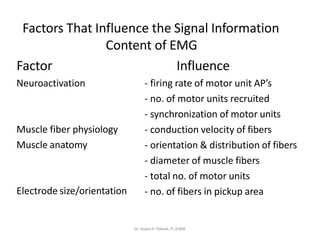
Factors That Influence the Signal Information
Content of EMG
Factor
Neuroactivation
Influence
- firing rate of motor unit AP’s
- no. of motor units recruited
- synchronization of motor units
- conduction velocity of fibers
- orientation & distribution of fibers
- diameter of muscle fibers
- total no. of motor units
- no. of fibers in pickup area
Muscle fiber physiology
Muscle anatomy
Electrode size/orientation
Dr. Sujata P. Pathak, IT, KJSSE
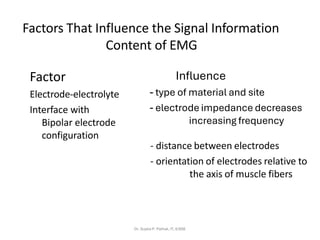
Factors That Influence the Signal Information
Content of EMG
Factor
Electrode-electrolyte
Interface with
Bipolar electrode
configuration
Influence
- type of material and site
- electrode impedance decreases
increasing frequency
- distance between electrodes
- orientation of electrodes relative to
the axis of muscle fibers
Dr. Sujata P. Pathak, IT, KJSSE
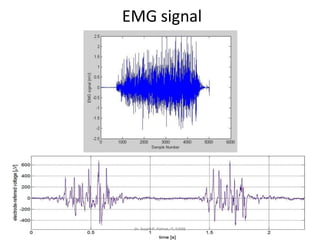
EMG signal
Dr. Sujata P. Pathak, IT, KJSSE
What can be learned from an EMG?
• Time course of muscle contraction
• Contraction force
• Coordination of several muscles in a movement
sequence
• These parameters are DERIVED from the amplitude, frequency,
and change of these over time of the EMG signal
• Field of Ergonomics: from the EMG conclusions
about muscle strain and the occurrence of muscular
fatigue can be derived as well
Dr. Sujata P. Pathak, IT, KJSSE
APPLICATION OF EMG
• EMG can be used for diagnosis of Neurogenic
or Myogenic Diseases.
• Rehabilitation
• Functional analysis
• Active Prothetics, Orthesis
• Biomechanics, Sports medicine
Dr. Sujata P. Pathak, IT, KJSSE
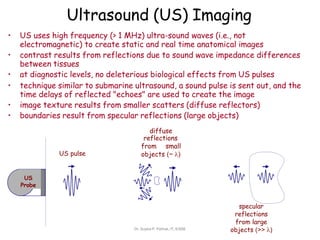
Ultrasound (US) Imaging
US
Probe
US pulse
• US uses high frequency (> 1 MHz) ultra-sound waves (i.e., not
electromagnetic) to create static and real time anatomical images
• contrast results from reflections due to sound wave impedance differences
between tissues
• at diagnostic levels, no deleterious biological effects from US pulses
• technique similar to submarine ultrasound, a sound pulse is sent out, and the
time delays of reflected "echoes" are used to create the image
• image texture results from smaller scatters (diffuse reflectors)
• boundaries result from specular reflections (large objects)
diffuse
reflections
from small
objects (~ )
specular
reflections
from large
objects (>> )
Dr. Sujata P. Pathak, IT, KJSSE
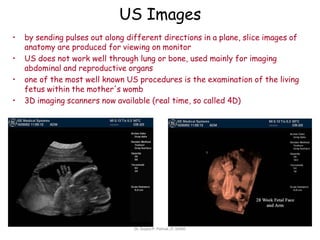
US Images
• by sending pulses out along different directions in a plane, slice images of
anatomy are produced for viewing on monitor
• US does not work well through lung or bone, used mainly for imaging
abdominal and reproductive organs
• one of the most well known US procedures is the examination of the living
fetus within the mother's womb
• 3D imaging scanners now available (real time, so called 4D)
Dr. Sujata P. Pathak, IT, KJSSE
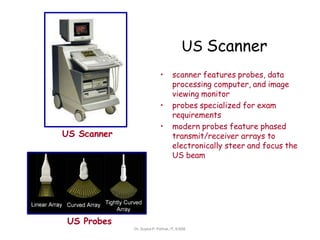
• scanner features probes, data
processing computer, and image
viewing monitor
• probes specialized for exam
requirements
• modern probes feature phased
transmit/receiver arrays to
electronically steer and focus the
US beam
US Scanner
US Scanner
US Probes
Dr. Sujata P. Pathak, IT, KJSSE
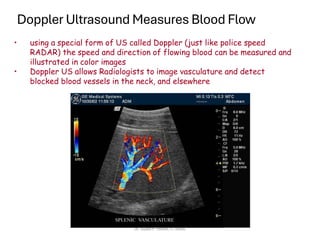
Doppler Ultrasound Measures Blood Flow
• using a special form of US called Doppler (just like police speed
RADAR) the speed and direction of flowing blood can be measured and
illustrated in color images
• Doppler US allows Radiologists to image vasculature and detect
blocked blood vessels in the neck, and elsewhere
Dr. Sujata P. Pathak, IT, KJSSE
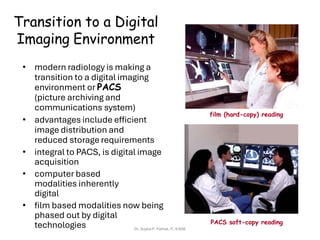
Transition to a Digital
Imaging Environment
film (hard-copy) reading
• modern radiology is making a
transition to a digital imaging
environment or PACS
(picture archiving and
communications system)
• advantages include efficient
image distribution and
reduced storage requirements
• integral to PACS, is digital image
acquisition
• computer based
modalities inherently
digital
• film based modalities now being
phased out by digital
technologies PACS soft-copy reading
Dr. Sujata P. Pathak, IT, KJSSE
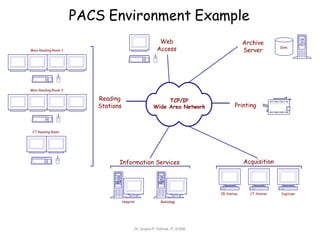
PACS Environment Example
Archive
Server
TCP/IP
Wide Area Network
Acquisition
Data
Reading
Stations
Main Reading Room 1
Main Reading Room 2
CT Reading Room
Printing
Information Services
Hospital Radiology
CR Station CT Station Digitizer
Web
Access
Dr. Sujata P. Pathak, IT, KJSSE
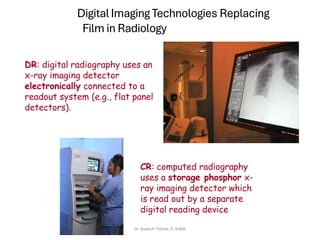
Digital Imaging Technologies Replacing
Film in Radiology
DR: digital radiography uses an
x-ray imaging detector
electronically connected to a
readout system (e.g., flat panel
detectors).
CR: computed radiography
uses a storage phosphor x-
ray imaging detector which
is read out by a separate
digital reading device
Dr. Sujata P. Pathak, IT, KJSSE
Role of the Physicist in Diagnostic Radiology (revenge
of the nerds)
• Ensure equipment is producing high quality
images
– image quality control
– periodic checks of equipment
– supervise preventive maintenance
• Reduce dose to patients and personnel
– monitor radiation dose records
– evaluate typical doses for procedures
– recommend equipment changes and/or dose
reduction strategies
Dr. Sujata P. Pathak, IT, KJSSE
SuggestedReferenceMaterial
• Physics of Radiology, A. B. Wolbarst,
Medical Physics Publishing (ISBN 0-
944838-95-2)
• Search the Internet
Dr. Sujata P. Pathak, IT, KJSSE
Useful Links
• https://www.youtube.com/watch?v=RYZ4daFwMa8
• https://www.youtube.com/watch?v=JSxd0UTt5gQ
Dr. Sujata P. Pathak, IT, KJSSE
Any question
Dr. Sujata P. Pathak, IT, KJSSE

CH1_INTRODUCTION TO DATABASE PROGRAMMING

  • 1.
  • 2.
    Contents • Imaging systems,Objects and images, The digital image processing system, Applications of digital image processing • Fundamental models of image formation- Kinds of radiation and imaged properties, The imaging system- Point spread function, Imaging filters: Monochromatic, colour, multi-spectral and hyperspectral images, Resolution (pixel, spatial, radiometric/magnitude, spectral, temporal, super resolution) • Image quality and uncertainties in image formation (digitization, quantum efficiency, metamerism, calibration, CNR, SNR) • Major imaging modalities- Magnetic Resonance Imaging, Optical Imaging (inc. X-Ray, OCT, NIRS, microscopy, confocal imaging ,one and two photon imaging, fluoroscopy, CT), Electrical and magnetic imaging (inc. EEG/MEG, EMG, ECG, etc), Ultrasound Dr. Sujata P. Pathak, IT, KJSSE
  • 3.
    What is anImage? • Image is a source of information according to information theory • An image may be defined as a two-dimensional function f(x, y) where x and y are spatial coordinates and amplitude of f at any pair of coordinates (x, y) is called the intensity or Gray level of the image at that point. Dr. Sujata P. Pathak, IT, KJSSE
  • 4.
    Digital Image • Whenx, y and the amplitude values of f are all finite, discrete quantities, we call the image a Digital Image. • A digital Image is composed of a finite number of elements each of which has a particular location and value • These elements are referred to as Picture Elements, Image Elements, Pels or Pixels. Dr. Sujata P. Pathak, IT, KJSSE
  • 5.
    Dr. Sujata P.Pathak, IT, KJSSE Pixel • In digital imaging, a pixel is the smallest piece of information in an image. • Pixels are normally arranged in a regular 2-dimensional grid, and are often represented using dots or squares • The intensity of each pixel is variable; in color systems, each pixel has typically three or four components such as red, green, and blue, or cyan, magenta, yellow, and black
  • 6.
    Objects and images •An imaging system senses or responds to an input signal, such as reflected or transmitted electromagnetic radiation from an object, and produces an output signal or image Dr. Sujata P. Pathak, IT, KJSSE The relationship between an analog image and a digitized image.
  • 7.
    Objects and images •An imaging system → • continuous-to-continuous system- responding to a continuous input signal and producing a continuous or analog output image • continuous-to-discrete system- responding to the continuous input signal by producing a discrete, digital output image. • Tomographic images are reconstructed from many, one- dimensional, views or projections collected over the exposure time. • X-ray computed tomography (CT) imaging is an example of a continuous-to-discrete imaging system, using computer reconstruction to produce a digital image from a set of projection data collected by discrete sensors. Dr. Sujata P. Pathak, IT, KJSSE
  • 8.
    Image Processing →ImageAnalysis Dr. Sujata P. Pathak, IT, KJSSE
  • 9.
    Image Processing →ImageAnalysis Dr. Sujata P. Pathak, IT, KJSSE
  • 10.
    Image Segmentation Dr. SujataP. Pathak, IT, KJSSE
  • 11.
    Image Completion Dr. SujataP. Pathak, IT, KJSSE
  • 12.
    Image Completion Dr. SujataP. Pathak, IT, KJSSE
  • 13.
    Morphological Image processing Dr.Sujata P. Pathak, IT, KJSSE
  • 14.
    Dr. Sujata P.Pathak, IT, KJSSE Why do we Process Images? Facilitate picture storage and transmission Enhance and restore images Extract information from images Prepare for display or Printing
  • 15.
    The digital imageprocessing system Dr. Sujata P. Pathak, IT, KJSSE
  • 16.
    The digital imageprocessing system Dr. Sujata P. Pathak, IT, KJSSE Digital image processing classes and examples of the operations within them.
  • 17.
    Key Stages inDigital Image Processing Dr. Sujata P. Pathak, IT, KJSSE Image Acquisition Image Restoration Morphological Processing Segmentation Object Recognition Image E nhancement Representation & Description Problem Domain Color Image P rocessing Image Compression
  • 18.
    Key Stages inDigital Image Processing: Image Acquisition Dr. Sujata P. Pathak, IT, KJSSE Image Acquisition Image Restoration Morphological Processing Segmentation Object Recognition Image Enhancement Representation & Description Problem Domain Color Image P rocessing Image Compression
  • 19.
    Key Stages inDigital Image Processing: Image Enhancement Dr. Sujata P. Pathak, IT, KJSSE Image Acquisition Image Restoration Morphological Processing Segmentation Representation & Description Image Enhancement Object Recognition Problem Domain Color Image P rocessing Image Compression
  • 20.
    Key Stages inDigital Image Processing: Image Restoration Dr. Sujata P. Pathak, IT, KJSSE Image Acquisition Image Restoration Morphological Processing Segmentation Object Recognition Image Enhancement Representation & Description Problem Domain Color Image P rocessing Image Compression
  • 21.
    Key Stages inDigital Image Processing: Morphological Processing Dr. Sujata P. Pathak, IT, KJSSE Image Acquisition Image Restoration Morphological P rocessing Segmentation Representation & Description Image Enhancement Object Recognition Problem Domain Color Image Processing Image Compression
  • 22.
    Key Stages inDigital Image Processing: Segmentation Dr. Sujata P. Pathak, IT, KJSSE Image Acquisition Image Restoration Morphological Processing Segmentation Object Recognition Image Enhancement Representation & Description Problem Domain Color Image P rocessing Image Compression
  • 23.
    Key Stages inDigital Image Processing: Representation & Description Dr. Sujata P. Pathak, IT, KJSSE Image Acquisition Image Restoration Morphological Processing Segmentation Image Enhancement Problem Domain Color Image P rocessing Image Compression Representation & Description Object Recognition
  • 24.
    Key Stages inDigital Image Processing: Object Recognition Dr. Sujata P. Pathak, IT, KJSSE Image Acquisition Image Restoration Morphological Processing Segmentation Object Recognition Image Enhancement Representation & Description Problem Domain Color Image P rocessing Image Compression
  • 25.
    Key Stages inDigital Image Processing: Image Compression Dr. Sujata P. Pathak, IT, KJSSE Image Acquisition Image Restoration Morphological Processing Segmentation Object Recognition Image Enhancement Representation & Description Problem Domain Color Image P rocessing Image Compression
  • 26.
    Key Stages inDigital Image Processing: Colour Image Processing Dr. Sujata P. Pathak, IT, KJSSE Image Acquisition Image Restoration Morphological Processing Segmentation Object Recognition Image Enhancement Representation & Description Problem Domain Color Image P rocessing Image Compression
  • 27.
    Applications of Image Processing Dr.Sujata P. Pathak, IT, KJSSE
  • 28.
    1. Image Restoration Dr.Sujata P. Pathak, IT, KJSSE
  • 29.
    Image Colorization Dr. SujataP. Pathak, IT, KJSSE
  • 30.
    Image Enhancement Dr. SujataP. Pathak, IT, KJSSE
  • 31.
    Face Detection Dr. SujataP. Pathak, IT, KJSSE
  • 32.
    Face Tracking Dr. SujataP. Pathak, IT, KJSSE
  • 33.
    Face Morphing Dr. SujataP. Pathak, IT, KJSSE
  • 34.
    Finger Print Recognition Dr.Sujata P. Pathak, IT, KJSSE
  • 35.
    Dr. Sujata P.Pathak, IT, KJSSE Personal Identification Using Iris Recognition
  • 36.
    Fundamental models ofimage formation Kinds of radiation and imaged properties
  • 37.
    Models of ImageFormation Dr. Sujata P. Pathak, IT, KJSSE
  • 38.
    SimpleImageFormation Model Dr. SujataP. Pathak, IT, KJSSE • An image is defined by two-dimensional function 𝑓(𝑥, 𝑦). The value or amplitude of 𝑓 at spatial coordinates (𝑥, 𝑦) is a positive scalar quantity. • When an image is generated from a physical process, its values are proportional to energy radiated by physical source • Therefore, 𝑓(𝑥, 𝑦) must be nonzero and finite; that is, 0 < 𝑓(𝑥, 𝑦) < ∞ • The function 𝑓(𝑥, 𝑦) is characterized by two components • The amount of source illumination incident on the scene being viewed (Illumination). • The amount of illumination reflected by the objects in the scene (reflectance).
  • 39.
    SimpleImageFormation Model Dr. SujataP. Pathak, IT, KJSSE • A simple image model is 𝑓 (𝑥, 𝑦) = 𝑖(𝑥, 𝑦) . 𝑟(𝑥, 𝑦) Where 0 <𝑖(𝑥, 𝑦) <∞ and 0< 𝑟(𝑥, 𝑦) <1 𝑟(𝑥, 𝑦) = 0 means total absorption 𝑟(𝑥, 𝑦) = 1 means total reflectance or transmittance • The intensity of a monochrome image at any coordinates (𝑥, 𝑦) is the gray level (𝑙) of the image at that point. • The interval of 𝑙 ranges from [0, 𝐿 − 1]. where 𝑙 = 0 indicates black and 𝑙 = 1 indicates white. All the intermediate values are shades of gray varying from black to white.
  • 40.
    SimpleImageFormation Model Dr. SujataP. Pathak, IT, KJSSE For color image Sample values of reflectance 𝑟(𝑥, 𝑦): 0.01: black velvet 0.65: stainless steel 0.93: snow
  • 41.
    SimpleImageFormationModel Dr. Sujata P.Pathak, IT, KJSSE Sample values of illumination, 𝑖(𝑥, 𝑦): 90,000 foot-candles(lm/sq.m): sunny day 10,000 foot-candles: cloudy day 0.1 foot-candles: full moon This Photo by Unknown Author is licensed under CC BY-SA
  • 42.
    ImageFormation Model •Geometrical model- •Describeshow the 3 world dimensions are translated into the dimensions of the sensor. •In the context of a TV or still camera having a single 2D image plane, perspective projection is the fundamental mechanism whereby light is projected into a single monocular view. Dr. Sujata P. Pathak, IT, KJSSE
  • 43.
    ImageFormation Model Geometrical model- •Thistype of projection does not yield direct information about the z-coordinate •Binocular imaging uses a system with two viewpoints, in which the eyes do not normally converge, i.e. the eyes are aimed in parallel at an infinite point in the z direction. •The depth information is encoded by it's different positions ( disparity ) in the two images. Dr. Sujata P. Pathak, IT, KJSSE
  • 44.
    ImageFormation Model Radiometric model– •Illustrates the way in which the imaging geometry, the light sources and the reflectance properties of objects influence the light measured at the sensor. •The brightness of the image at a point, the image intensity or image irradiance where irradiance defines the power per unit area falling on a surface depends on the following factors- •First, there is the radiant intensity of the source. •Second there is the reflectance of the objects in the scene, in terms of the proportion, spatial distribution and spectral variation of light reflected. Dr. Sujata P. Pathak, IT, KJSSE
  • 45.
    ImageFormation Model The digitizingmodel- •Implies that the analogue scene data which varies continuously in intensity and space, must be transformed into a discrete representation. •Digitized images are sampled, i.e. only recorded at discrete locations, quantized , i.e. only recorded with respect to the nearest amplitude level. • for example: 256 levels of intensity, and windowed, i.e. only recorded to a finite extent in x and y etc. •All these processes change fundamentally the world as seen by the camera or other sensor. Dr. Sujata P. Pathak, IT, KJSSE
  • 46.
    ImageFormation Model Spatial frequencymodel- •Describes how the spatial variations of the image may be characterized in the spatial frequency domain, •The more rapid the variations in the image, the higher the spatial frequency. •This type of analysis is fundamental to image processing. Dr. Sujata P. Pathak, IT, KJSSE
  • 47.
  • 48.
  • 49.
  • 50.
    Kinds of radiationand imaged properties Dr. Sujata P. Pathak, IT, KJSSE
  • 51.
  • 52.
    Components of imagingsystem Dr. Sujata P. Pathak, IT, KJSSE
  • 53.
    Dr. Sujata P.Pathak, IT, KJSSE
  • 54.
    Dr. Sujata P.Pathak, IT, KJSSE
  • 55.
    Dr. Sujata P.Pathak, IT, KJSSE
  • 56.
    Dr. Sujata P.Pathak, IT, KJSSE
  • 57.
  • 58.
    Point Spread Function Dr.Sujata P. Pathak, IT, KJSSE
  • 59.
    Dr. Sujata P.Pathak, IT, KJSSE
  • 60.
    Dr. Sujata P.Pathak, IT, KJSSE
  • 61.
    Dr. Sujata P.Pathak, IT, KJSSE
  • 62.
    Dr. Sujata P.Pathak, IT, KJSSE
  • 63.
    Dr. Sujata P.Pathak, IT, KJSSE
  • 64.
    Point Spread Function •PSFin an imaging system represents the system's response to a point source or point object. •A measure of how well the system can resolve a single point, and it's often described as a 3D shape or the "resolution cell" of the system. •Shows how a single point of light is blurred or spread out in the image. Dr. Sujata P. Pathak, IT, KJSSE
  • 65.
    Point Spread Function •ThePSF illustrates the spatial distribution of light in the image plane when a point source is imaged. •It's a fundamental characteristic of an imaging system, whether it's an optical microscope, telescope, or medical imaging device. Dr. Sujata P. Pathak, IT, KJSSE
  • 66.
    Point Spread Function Applicationof PSF: Deconvolution of the mathematically modeled PSF and the low-resolution image enhances the resolution. Dr. Sujata P. Pathak, IT, KJSSE THz Image
  • 67.
    Dr. Sujata P.Pathak, IT, KJSSE
  • 68.
    Dr. Sujata P.Pathak, IT, KJSSE
  • 69.
  • 70.
    Introduction to ImagingFilters •Imaging filters are techniques used to capture and process images based on the spectral characteristics of light. •They play a key role in various applications including medical imaging, remote sensing, and machine vision. Dr. Sujata P. Pathak, IT, KJSSE
  • 71.
    Dr. Sujata P.Pathak, IT, KJSSE
  • 72.
    Dr. Sujata P.Pathak, IT, KJSSE
  • 73.
    Monochromatic Imaging •Captures imagesin a single wavelength or band of light •Typically black and white or grayscale •Utilizes differing amounts of light instead of different colors to capture and represent images. •Monochrome photography takes only one single color and uses a range of tones of that color. •High contrast and sharp detail •Commonly used in X-ray, CT scans, and microscopy Dr. Sujata P. Pathak, IT, KJSSE
  • 74.
    Colour Imaging •- Capturesimages in multiple bands corresponding to visible light (RGB) •- Each channel (Red, Green, Blue) captures specific wavelengths •- Used in digital cameras, medical diagnostics, and television •- Enables visual realism and color differentiation Dr. Sujata P. Pathak, IT, KJSSE
  • 75.
    Multi-spectral Imaging Captures dataat specific wavelength bands across the electromagnetic spectrum Typically 3 to 10 bands Used in agriculture, environmental monitoring, and military surveillance Provides more information than visible imaging Dr. Sujata P. Pathak, IT, KJSSE
  • 76.
  • 77.
  • 78.
    Hyperspectral Imaging •Hyperspectral imaging(HSI) is a process used to obtain high spectral resolution imagery by dividing light into many narrow, contiguous spectral bands. •Captures images in hundreds of narrow and contiguous spectral bands •High spectral resolution •Allows material identification and detailed spectral analysis •Used in mineralogy, medical diagnostics, and food quality control Dr. Sujata P. Pathak, IT, KJSSE
  • 79.
    Dr. Sujata P.Pathak, IT, KJSSE
  • 80.
    Comparison Dr. Sujata P.Pathak, IT, KJSSE
  • 81.
    Comparison of ImagingTechniques •Monochromatic: Single band, grayscale •Colour: 3 bands (RGB), visible light •Multi-spectral: 3–10 bands, discrete non- continuous •Hyperspectral: 100+ bands, continuous spectrum Dr. Sujata P. Pathak, IT, KJSSE
  • 82.
    Applications of Imaging •-Medical imaging (e.g., MRI, PET, dermatology) •- Remote sensing and Earth observation •- Agriculture and crop monitoring •- Industrial inspection and quality control •- Military and defense surveillance Dr. Sujata P. Pathak, IT, KJSSE
  • 83.
    Dr. Sujata P.Pathak, IT, KJSSE
  • 84.
    Motivation: Noise reduction •Givena camera and a still scene, how can you reduce noise? Dr. Sujata P. Pathak, IT, KJSSE Take lots of images and average them! What’s the next best thing? Source: S. Seitz
  • 85.
    Image processing Dr. SujataP. Pathak, IT, KJSSE (a) original image (b) Increased contrast (c) change in hue (e) blurred “posterized” (quantized colors)
  • 86.
    Image Filters •Neighborhood operatorscan be used to filter images in order to add soft blur, sharpen details, accentuate edges, or remove noise Dr. Sujata P. Pathak, IT, KJSSE
  • 87.
    Image Filters Dr. SujataP. Pathak, IT, KJSSE Neighborhood filtering (convolution): The image on the left is convolved with the filter in the middle to yield the image on the right
  • 88.
    Image Filters Dr. SujataP. Pathak, IT, KJSSE Some neighborhood operations: (a) original image; (b) blurred; (c) sharpened; (d) smoothed with edge-preserving filter; (e) binary image; (f) dilated; (g) distance transform; (h) connected components.
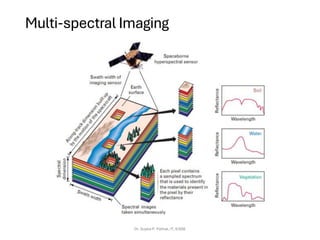
  • 89.
    Image Filters Moving average •Let’s replace each pixel with a weighted average of its neighborhood • The weights are called the filter kernel • What are the weights for a 3x3 moving average? Dr. Sujata P. Pathak, IT, KJSSE 1 1 1 1 1 1 1 1 1 “box filter” Source: D. Lowe
  • 90.
    Image Filters Defining convolution •Let f be the image and g be the kernel. The output of convolving f with g is denoted f * g. Dr. Sujata P. Pathak, IT, KJSSE  − − =  l k l k g l n k m f n m g f , ] , [ ] , [ ] , )[ ( f Source: F. Durand • Convention: kernel is “flipped” • MATLAB: conv2 vs. filter2 (also imfilter)
  • 91.
    Image Filters Key properties •Linearity:filter(f1 + f2 ) = filter(f1) + filter(f2) •Shift invariance: same behavior regardless of pixel location: filter(shift(f)) = shift(filter(f)) •Theoretical result: any linear shift-invariant operator can be represented as a convolution Dr. Sujata P. Pathak, IT, KJSSE
  • 92.
    Image Filters Properties inmore detail •Commutative: a * b = b * a • Conceptually no difference between filter and signal •Associative: a * (b * c) = (a * b) * c • Often apply several filters one after another: (((a * b1) * b2) * b3) • This is equivalent to applying one filter: a * (b1 * b2 * b3) •Distributes over addition: a * (b + c) = (a * b) + (a * c) •Scalars factor out: ka *b = a *kb = k (a * b) •Identity: unit impulse e = […, 0, 0, 1, 0, 0, …], a * e = a Dr. Sujata P. Pathak, IT, KJSSE
  • 93.
    Practice with linearfilters Dr. Sujata P. Pathak, IT, KJSSE 0 0 0 0 1 0 0 0 0 Original ? Source: D. Lowe
  • 94.
    Practice with linearfilters Dr. Sujata P. Pathak, IT, KJSSE 0 0 0 0 1 0 0 0 0 Original Filtered (no change) Source: D. Lowe
  • 95.
    Practice with linearfilters Dr. Sujata P. Pathak, IT, KJSSE 0 0 0 1 0 0 0 0 0 Original ? Source: D. Lowe
  • 96.
    Practice with linearfilters Dr. Sujata P. Pathak, IT, KJSSE 0 0 0 1 0 0 0 0 0 Original Shifted left By 1 pixel Source: D. Lowe
  • 97.
    Practice with linearfilters Dr. Sujata P. Pathak, IT, KJSSE Original ? 1 1 1 1 1 1 1 1 1 Source: D. Lowe
  • 98.
    Practice with linearfilters Dr. Sujata P. Pathak, IT, KJSSE Original 1 1 1 1 1 1 1 1 1 Blur (with a box filter) Source: D. Lowe
  • 99.
    Practice with linearfilters Dr. Sujata P. Pathak, IT, KJSSE Original 1 1 1 1 1 1 1 1 1 0 0 0 0 2 0 0 0 0 - ? (Note that filter sums to 1) Source: D. Lowe
  • 100.
    Practice with linearfilters Dr. Sujata P. Pathak, IT, KJSSE Original 1 1 1 1 1 1 1 1 1 0 0 0 0 2 0 0 0 0 - Sharpening filter - Accentuates differences with local average Source: D. Lowe
  • 101.
    Sharpening Dr. Sujata P.Pathak, IT, KJSSE Source: D. Lowe
  • 102.
    Smoothing with boxfilter revisited •Smoothing with an average actually doesn’t compare at all well with a defocused lens •Most obvious difference is that a single point of light viewed in a defocused lens looks like a fuzzy blob; but the averaging process would give a little square Dr. Sujata P. Pathak, IT, KJSSE Source: D. Forsyth
  • 103.
    Smoothing with boxfilter revisited •Smoothing with an average actually doesn’t compare at all well with a defocused lens •Most obvious difference is that a single point of light viewed in a defocused lens looks like a fuzzy blob; but the averaging process would give a little square •Better idea: to eliminate edge effects, weight contribution of neighborhood pixels according to their closeness to the center, like so: Dr. Sujata P. Pathak, IT, KJSSE “fuzzy blob”
  • 104.
    Gaussian Kernel •Constant factorat front makes volume sum to 1 (can be ignored, as we should re-normalize weights to sum to 1 in any case) Dr. Sujata P. Pathak, IT, KJSSE 0.003 0.013 0.022 0.013 0.003 0.013 0.059 0.097 0.059 0.013 0.022 0.097 0.159 0.097 0.022 0.013 0.059 0.097 0.059 0.013 0.003 0.013 0.022 0.013 0.003 5 x 5,  = 1 Source: C. Rasmussen
  • 105.
    Choosing kernel width •Gaussian filters have infinite support, but discrete filters use finite kernels Dr. Sujata P. Pathak, IT, KJSSE Source: K. Grauman
  • 106.
    Choosing kernel width •Rule of thumb: set filter half-width to about 3 σ Dr. Sujata P. Pathak, IT, KJSSE
  • 107.
    Example: Smoothing witha Gaussian Dr. Sujata P. Pathak, IT, KJSSE
  • 108.
    Mean vs. Gaussianfiltering Dr. Sujata P. Pathak, IT, KJSSE
  • 109.
    Gaussian filters •Remove “high-frequency”components from the image (low-pass filter) •Convolution with self is another Gaussian • So can smooth with small-width kernel, repeat, and get same result as larger-width kernel would have • Convolving two times with Gaussian kernel of width σ is same as convolving once with kernel of width σ√2 •Separable kernel • Factors into product of two 1D Gaussians Dr. Sujata P. Pathak, IT, KJSSE Source: K. Grauman
  • 110.
    Separability of theGaussian filter Dr. Sujata P. Pathak, IT, KJSSE Source: D. Lowe
  • 111.
    Separability example Dr. SujataP. Pathak, IT, KJSSE * * = = 2D convolution (center location only) Source: K. Grauman The filter factors into a product of 1D filters: Perform convolution along rows: Followed by convolution along the remaining column:
  • 112.
    Separability • Why isseparability useful in practice? Dr. Sujata P. Pathak, IT, KJSSE
  • 113.
    Noise •Salt and peppernoise: contains random occurrences of black and white pixels •Impulse noise: contains random occurrences of white pixels •Gaussian noise: variations in intensity drawn from a Gaussian normal distribution Dr. Sujata P. Pathak, IT, KJSSE Source: S. Seitz
  • 114.
    Gaussian noise •Mathematical model:sum of many independent factors •Good for small standard deviations •Assumption: independent, zero-mean noise Dr. Sujata P. Pathak, IT, KJSSE Source: M. Hebert
  • 115.
    Smoothing with largerstandard deviations suppresses noise, but also blurs the image Reducing Gaussian noise Dr. Sujata P. Pathak, IT, KJSSE
  • 116.
    Reducing salt-and-pepper noise •What’s wrong with the results? Dr. Sujata P. Pathak, IT, KJSSE 3x3 5x5 7x7
  • 117.
    Alternative idea: Medianfiltering •A median filter operates over a window by selecting the median intensity in the window Dr. Sujata P. Pathak, IT, KJSSE • Is median filtering linear? Source: K. Grauman
  • 118.
    Median filter • Whatadvantage does median filtering have over Gaussian filtering? • Robustness to outliers Dr. Sujata P. Pathak, IT, KJSSE Source: K. Grauman
  • 119.
    Median filter • MATLAB:medfilt2(image, [h w]) Dr. Sujata P. Pathak, IT, KJSSE Salt-and-pepper noise Median filtered Source: M. Hebert
  • 120.
    Median vs. Gaussianfiltering Dr. Sujata P. Pathak, IT, KJSSE 3x3 5x5 7x7 Gaussian Median
  • 121.
  • 122.
    Dr. Sujata P.Pathak, IT, KJSSE
  • 123.
    Dr. Sujata P.Pathak, IT, KJSSE
  • 124.
    Dr. Sujata P.Pathak, IT, KJSSE
  • 125.
    Dr. Sujata P.Pathak, IT, KJSSE
  • 126.
    Dr. Sujata P.Pathak, IT, KJSSE
  • 127.
    Dr. Sujata P.Pathak, IT, KJSSE
  • 128.
    Dr. Sujata P.Pathak, IT, KJSSE
  • 129.
    Dr. Sujata P.Pathak, IT, KJSSE
  • 130.
    Dr. Sujata P.Pathak, IT, KJSSE
  • 131.
    Dr. Sujata P.Pathak, IT, KJSSE
  • 132.
    Dr. Sujata P.Pathak, IT, KJSSE
  • 133.
    Dr. Sujata P.Pathak, IT, KJSSE
  • 134.
    Dr. Sujata P.Pathak, IT, KJSSE
  • 135.
    Dr. Sujata P.Pathak, IT, KJSSE
  • 136.
    Dr. Sujata P.Pathak, IT, KJSSE
  • 137.
    Dr. Sujata P.Pathak, IT, KJSSE
  • 138.
    Dr. Sujata P.Pathak, IT, KJSSE
  • 139.
    Dr. Sujata P.Pathak, IT, KJSSE
  • 140.
  • 141.
    Dr. Sujata P.Pathak, IT, KJSSE
  • 142.
    Digitization Dr. Sujata P.Pathak, IT, KJSSE
  • 143.
    Dr. Sujata P.Pathak, IT, KJSSE
  • 144.
    Dr. Sujata P.Pathak, IT, KJSSE
  • 145.
    Dr. Sujata P.Pathak, IT, KJSSE
  • 146.
  • 147.
    Metamerism Dr. Sujata P.Pathak, IT, KJSSE
  • 148.
    Dr. Sujata P.Pathak, IT, KJSSE
  • 149.
    Metamerism •Metamerism is morecommon with neutral colors like grays, whites, and dark colors. •Metamerism is less common with lighter or more saturated colors. •Color metamerism occurs when colors, having different spectral compositions, appear the same to a human eye. • Spectral composition is the distribution of light energy at each wavelength that is emitted, transmitted, or reflected by a color sample. Dr. Sujata P. Pathak, IT, KJSSE
  • 150.
    Metamerism •The phenomenon wheretwo colors appear identical under certain lighting conditions but differ under others. •Importance in Image Processing: • Critical in color reproduction, color matching, and accurate image rendering. •Two different spectral power distributions producing the same color sensation. •Example: Matching colors using different pigments or light sources. Dr. Sujata P. Pathak, IT, KJSSE
  • 151.
    Metamerism •Color metamerism iscaused by three basic factors: •Light source: •Materials: •Human color vision: Dr. Sujata P. Pathak, IT, KJSSE
  • 152.
    Metamerism •Types of Metamerism •IlluminantMetamerism: Color match under one light source but not another. •Observer Metamerism: Different observers perceive colors differently due to variations in vision. •Device Metamerism: Differences in color reproduction between devices. Dr. Sujata P. Pathak, IT, KJSSE
  • 153.
    Metamerism •Metamerism in ImageProcessing Applications • Color calibration • Color management systems • Digital imaging and printing • Display technology Dr. Sujata P. Pathak, IT, KJSSE
  • 154.
    Metamerism •Challenges Due toMetamerism- • Maintaining color consistency across devices and lighting conditions • Impact on quality control in imaging workflows •Methods to Handle Metamerism • Using standardized light sources for viewing • Spectral imaging and multispectral analysis • Color profiling and device characterization Dr. Sujata P. Pathak, IT, KJSSE
  • 155.
    Dr. Sujata P.Pathak, IT, KJSSE
  • 156.
  • 157.
    Magnetic Resonance Imaging •Non-invasiveimaging technology that produces three dimensional detailed anatomical images. •Used for disease detection, diagnosis, and treatment monitoring. •It is based on sophisticated technology that excites and detects the change in the direction of the rotational axis of protons found in the water that makes up living tissues. Dr. Sujata P. Pathak, IT, KJSSE
  • 158.
    Magnetic Resonance Imaging •MRIs employ powerful magnets which produce a strong magnetic field that forces protons in the body to align with that field. When a radiofrequency current is then pulsed through the patient, the protons are stimulated, and spin out of equilibrium, straining against the pull of the magnetic field. When the radiofrequency field is turned off, the MRI sensors are able to detect the energy released as the protons realign with the magnetic field. The time it takes for the protons to realign with the magnetic field, as well as the amount of energy released, changes depending on the environment and the chemical nature of the molecules. Physicians are able to tell the difference between various types of tissues based on these magnetic properties. Dr. Sujata P. Pathak, IT, KJSSE https://youtu.be/1CGzk-nV06g
  • 159.
    Magnetic Resonance Imaging •Toobtain an MRI image, a patient is placed inside a large magnet and must remain very still during the imaging process in order not to blur the image. •Contrast agents (often containing the element Gadolinium) may be given to a patient intravenously before or during the MRI to increase the speed at which protons realign with the magnetic field. •The faster the protons realign, the brighter the image. Dr. Sujata P. Pathak, IT, KJSSE
  • 160.
    Magnetic Resonance Imaging Whatis MRI used for? •MRI scanners are particularly well suited to image the non-bony parts or soft tissues of the body. •They differ from computed tomography (CT), in that they do not use the damaging ionizing radiation of x-rays. •The brain, spinal cord and nerves, as well as muscles, ligaments, and tendons are seen much more clearly with MRI than with regular x-rays and CT •for this reason MRI is often used to image knee and shoulder injuries. Dr. Sujata P. Pathak, IT, KJSSE
  • 161.
    Magnetic Resonance Imaging Dr.Sujata P. Pathak, IT, KJSSE
  • 162.
    Magnetic Resonance Imaging • In thebrain, MRI can differentiate between white matter and grey matter • Can also be used to diagnose aneurysms and tumors. • Because MRI does not use x-rays or other radiation, it is the imaging modality of choice when frequent imaging is required for diagnosis or therapy, especially in the brain. • However, MRI is more expensive than x-ray imaging or CT scanning. Dr. Sujata P. Pathak, IT, KJSSE
  • 163.
    Magnetic Resonance Imaging •Onekind of specialized MRI is functional Magnetic Resonance Imaging (fMRI.) •Used to observe brain structures and determine which areas of the brain “activate” (consume more oxygen) during various cognitive tasks. •Used to advance the understanding of brain organization and offers a potential new standard for assessing neurological status and neurosurgical risk. Dr. Sujata P. Pathak, IT, KJSSE
  • 164.
  • 165.
    Optical imaging • Techniquefor non-invasively looking inside the body, as is done with x-rays. Unlike x- rays, which use ionizing radiation, optical imaging uses visible light and the special properties of photons to obtain detailed images of organs and tissues as well as smaller structures including cells and even molecules. • These images are used by scientists for research and by clinicians for disease diagnosis and treatment Dr. Sujata P. Pathak, IT, KJSSE Laser set-up in high resolution optical imaging laboratory Multiphoton microscopy of amyloid deposits in mouse model of Alzheimer’s Disease.
  • 166.
    Optical imaging Advantages ofoptical imaging? • Reduces patient exposure to harmful radiation by using non- ionizing radiation, which includes visible, ultraviolet, and infrared light. • Much safer for patients, and significantly faster, optical imaging can be used for lengthy and repeated procedures over time to monitor the progression of disease or the results of treatment. • Useful for visualizing soft tissues. Soft tissues can be easily distinguished from one another due to the wide variety of ways different tissues absorb and scatter light. • Because it can obtain images of structures across a wide range of sizes and types, optical imaging can be combined with other imaging techniques, such as MRI or x-rays, to provide enhanced information for doctors monitoring complex diseases or researchers working on intricate experiments. • Optical imaging takes advantage of the various colors of light in order to see and measure many different properties of an organ or tissue at the same time. Other imaging techniques are limited to just one or two measurements Dr. Sujata P. Pathak, IT, KJSSE
  • 167.
    Optical imaging Types ofoptical imaging- 1. Endoscopy: • The simplest and most widely recognized type of optical imaging is endoscopy. • An endoscope consists of a flexible tube with a system to deliver light to illuminate an organ or tissue. • For example, a physician can insert an endoscope through a patient’s mouth to see the digestive cavity to find the cause of symptoms such as abdominal pain, difficulty swallowing, or gastrointestinal bleeding. • Endoscopes are also used for minimally invasive robotic surgery to allow a surgeon to see inside the patient’s body while remotely manipulating the thin robotic arms that perform the procedure Dr. Sujata P. Pathak, IT, KJSSE
  • 168.
    Optical imaging •Optical CoherenceTomography (OCT): •A technique for obtaining sub-surface images such as diseased tissue just below the skin. •OCT is a well-developed technology with commercially available systems now in use in a variety of applications, including art conservation and diagnostic medicine. •For example, ophthalmologists use OCT to obtain detailed images from within the retina. •Cardiologists also use it to help diagnose coronary artery disease. Dr. Sujata P. Pathak, IT, KJSSE
  • 169.
    Optical imaging Optical CoherenceTomography (OCT): Dr. Sujata P. Pathak, IT, KJSSE Source: https://www.drswatisatheeyeclinic.com/oct-eye-test/ Source: https://www.hamamatsu.com/eu/en/applications/medical- imaging/oct.html
  • 170.
    Optical imaging • PhotoacousticImaging: • During photoacoustic imaging, laser pulses are delivered to a patient’s tissues; the pulses generate heat, expanding the tissues and enabling their structure to be imaged. • The technique can be used for a number of clinical applications including monitoring blood vessel growth in tumors, detecting skin melanomas, and tracking blood oxygenation in tissues. Dr. Sujata P. Pathak, IT, KJSSE Source: https://en.wikipedia.org/wiki/Photoacoustic_imaging
  • 171.
    Optical imaging Diffuse OpticalTomography (DOT): •Used to obtain information about brain activity. •A laser that uses near-infrared light is positioned on the scalp. •The light goes through the scalp and harmlessly traverses the brain. •The absorption of light reveals information about chemical concentrations in the brain. •The scattering of the light reflects physiological characteristics such as the swelling of a neuron upon activation to pass on a neural signal. Dr. Sujata P. Pathak, IT, KJSSE
  • 172.
    Optical imaging Diffuse Optical Tomography (DOT): Dr.Sujata P. Pathak, IT, KJSSE Source: https://www.researchgate.net/publication/23485456_Huppert_TJ_Diamond_SG_Boas_DADirect_estima tion_of_evoked_hemoglobin_changes_by_multimodality_fusion_imaging_J_Biomed_Opt_13054031
  • 173.
    Optical imaging Raman Spectroscopy: •This technique relies on what is known as Raman scattering of visible, near-infrared, or near- ultraviolet light that is delivered by a laser. • The laser light interacts with molecular vibrations in the material being examined, and shifts in energy are measured that reveal information about the properties of the material. • The technique has a wide variety of applications including identifying chemical compounds and characterizing the structure of materials and crystals. • In medicine, Raman gas analyzers are used to monitor anesthetic gas mixtures during surgery. Dr. Sujata P. Pathak, IT, KJSSE Source: https://universallab.org/blog/blog/introduction_to_raman_spectroscopy_funda mentals/
  • 174.
    Optical imaging Super-resolution Microscopy: • Thisform of light microscopy encompasses a number of techniques used in research to obtain very high resolution images of individual cells, at a level of detail not feasible using normal microscopy. • One example is a technique called photoactivated localization microscopy (PALM), which uses fluorescent markers to pinpoint single molecules. • PALM can be performed sequentially to create a super-resolution image from the series of molecules isolated in the sample tissue Dr. Sujata P. Pathak, IT, KJSSE Source: https://zeiss-campus.magnet.fsu.edu/articles/superresolution/introduction.html
  • 175.
    Optical imaging Terahertz Tomography: •This relatively new, experimental technique involves sectional imaging using terahertz radiation. • Terahertz radiation consists of electromagnetic waves, which are found on the spectrum between microwaves and infrared light waves. • Terahertz radiation can “see” what visible and infrared light cannot, and holds great promise for detecting unique information unavailable via other optical imaging methods. Dr. Sujata P. Pathak, IT, KJSSE Source: https://www.researchgate.net/figure/The-results-of-terahertz- THz-radiation-test-Visual-imaging-THz-imaging-and-the_fig1_339431212
  • 176.
    Near-infrared spectroscopy (NIRS) •Non-invasive technique that can measure tissue oxygen saturation in organs such as the brain, kidney, and intestine. • By monitoring changes in the attenuation of near-infrared light passing through the brain, NIRS can provide cerebral regional oxygen saturation measurements (CrSO2). • NIRS has been used in neonatal intensive care units (NICUs) for various indications, including monitoring extremely premature infants and neonates with encephalopathy, congenital heart disease (CHD), anemia, respiratory support, and CNS injuries. • Factors such as device type, sensor position, head position, and care procedures can affect NIRS measurements. Dr. Sujata P. Pathak, IT, KJSSE An illustration of a cerebral NIRS probe attached to the forehead of an infant and an illustration of the basic technology used in NIRS. (© Amanda Gautier- Ronopawiro) Source: https://link.springer.com/chapter/10.1007/978-3-031-55972- 3_17
  • 177.
    Near-infrared spectroscopy (NIRS) •Techniquethat measures the amount of oxygen inside the brain tissues. •The device has a thin cable attached to a sensor/probe—a small, soft patch on the baby’s side of the forehead. •The probe uses near-infrared light, which is very safe. •The light goes a few centimeters into the brain and measures the color of the red blood cells (the cells that carry oxygen around the body) as it changes according to the amount of oxygen they carry Dr. Sujata P. Pathak, IT, KJSSE
  • 178.
    Microscopy • Microscopes areof three basic types: optical, electron (or ion), and scanning probe. • Optical microscopy (light microscopy) is a very common tool in biological research which employs visible light to magnify tiny objects. • Light sources commonly used in optical microscopes include arc- discharge lamps, incandescent tungsten-halogen bulbs, LEDs, and lasers. Leica Microsystems, imaging equipment maker, offers automated light microscopes with choice of illumination between halogen and LED. • Illumination techniques-bright field, dark field, cross-polarized light, and phase contrast illumination. These techniques provide increased contrast while viewing the sample. Dr. Sujata P. Pathak, IT, KJSSE https://www.news-medical.net/life-sciences/Optical-Electron- and-Scanning-Probe-Microscopy.aspx
  • 179.
    Microscopy Scanning probe microscopy (SPM)- •Use a range of tools to produce images of surfaces and structures at the nanoscale level. • A sharp physical probe scans the sample surface and sends the data gathered to a computer that generates a high-resolution image of the sample surface, which can be visualized by the user. • SPM users don’t see the sample surface directly - they see an image that represents the surface of the sample. • Different types of SPMs are atomic force microscopes, magnetic force microscopes, and scanning tunneling microscopes. Dr. Sujata P. Pathak, IT, KJSSE Source: https://www.sciencedirect.com/topics/nursing-and-health-professions/scanning- probe-microscope
  • 180.
    Microscopy Electron microscopy • Usesan electron beam to form an image of the sample. • Greater resolving power compared to the light microscope which allows the viewing of finer details of tiny objects. • Uses electromagnetic or electrostatic lenses to control the path of electrons which are sensitive to magnetic fields. • The resolving power of an electron microscope is inversely proportional to the irradiation wavelength. Dr. Sujata P. Pathak, IT, KJSSE
  • 181.
    Confocal imaging • Confocalmicroscopy offers several advantages over conventional widefield optical microscopy, including the ability to control depth of field, elimination or reduction of background information away from the focal plane (that leads to image degradation), and the capability to collect serial optical sections from thick specimens. • The basic key - use of spatial filtering techniques to eliminate out-of-focus light or glare in specimens whose thickness exceeds the immediate plane of focus. Dr. Sujata P. Pathak, IT, KJSSE Image source: https://evidentscientific.com/en/microscope- resource/knowledge-hub/techniques/confocal/confocalintro
  • 182.
    One and twophoton imaging •https://blog.biodock.ai/one-vs-two- photon-microscopy/ Dr. Sujata P. Pathak, IT, KJSSE
  • 183.
    Dr. Sujata P.Pathak, IT, KJSSE
  • 184.
    Introduction Dr. Sujata P.Pathak, IT, KJSSE
  • 185.
    Introduction Dr. Sujata P.Pathak, IT, KJSSE
  • 186.
    MRI Image Aquisition •Pulse sequences are characterized by a repetition time (TR) and a receiver delay time (TE) • TR and TE are used to control signal levels from different tissues • Receiver signals computer analyzed to form an image • Mathematical algorithms based on the Fourier Transform • Tomographic and volume images can be aquired Dr. Sujata P. Pathak, IT, KJSSE
  • 187.
    MRI Image Contrast Spin-Echo Sequence TR= 250 ms TE = 20 ms • contrast in MRI produced by variations in proton density and by variations in relaxation times in different tissues • paramagnetic contrast agents can be employed to enhance contrast • MRI offers anatomical diagnostic imaging features similar to CT, but, with “tuneable” contrast • however, MRI does not image bone well because of low water content • magnetic and rf fields levels used in MRI have no known biological risks Spin-Echo Sequence TR = 2000 ms TE = 80 ms Dr. Sujata P. Pathak, IT, KJSSE
  • 188.
    MRI Scanner MRI Scanner •solenoid magnet field scanner looks much like a CT scanner • rf transmitter/reciever coil typical in scanner cowling, however, special coil assemblies for head and extremities imaging used • scanner situated in a rf shielded room • ferromagnetic metals, pacemakers are not compatible with MRI exams • MRI is noisy (knocking noises) due rapid application of imaging field gradients “bird cage” coil assembly for head imaging Dr. Sujata P. Pathak, IT, KJSSE
  • 189.
    BOLD Imaging (fMRI) •MRI can measure physiological processes (i.e., functional MRI) • oxy- to deoxy-hemoglobin results in changes to local relaxation processes thus affecting signal level • technique called blood oxygen level-dependant (BOLD) MRI • hemodynamic changes can be imaged and correlated to neuronal activity • subjects given specific challenges during imaging to isolate associated activity motor strip localization (co-registered 3D image) areas in the brain Dr. Sujata P. Pathak, IT, KJSSE
  • 190.
    Contrast • imaging relieson contrast differences • in diagnostic imaging, contrast must distinguish anatomy, and/or physiological processes • different imaging modalities produce contrast through differing physical processes • various modalities offer advantages and disadvantages Dr. Sujata P. Pathak, IT, KJSSE
  • 191.
    X-Ray Modalities • x-raymodalities are the most common imaging modalities in medical diagnostic imaging • modalities include: – Radiography – Fluoroscopy – Computed Tomography Dr. Sujata P. Pathak, IT, KJSSE
  • 192.
    X-Ray Contrast • lowenergy x-rays produce contrast through absorption in tissue • relative absorption depends on tissue density and atomic composition • down-side: absorption and scattering results in ionization (radiation dose) and potential biological damage, however, benefit outweighs risk Dr. Sujata P. Pathak, IT, KJSSE
  • 193.
    X-Ray Imaging Basics patient •source produces collimated beam of x-rays • x-rays absorbed, scattered or transmitted through patient • if imaged, scattered x-rays reduce contrast, typically removed by a grid • receptor captures an image of the transmitted x-rays grid receptor Source Dr. Sujata P. Pathak, IT, KJSSE
  • 194.
    X-ray Production • X-rayvacuum tube: apply an DC voltage (kVp) between a cathode (electrode filament) and anode • high energy electrons striking the anode produce – heat (typically > 99% of electron energy), – bremstrahlung radiations, and – characteristic x-ray radiations kVp electron filament x-ray emissions rotating anode x-ray tube vacuum jacket Dr. Sujata P. Pathak, IT, KJSSE
  • 195.
    Anode Target X-RaySpectrum Relative Photon Intensity 100 80 60 Photon Energy keV 40 20 K Tungsten Anode X-Ray Production (100 kVp) K shell Characteristic X-rays K • polyenergetic bremstrahlung (i.e., braking radiation) spectrum, and • monoenergetic characteristic (fluorescent) spectral lines • upper energy limit set by generator kVp (typical diagnostic energies 50 – 120 kVp) • in practice, lower energy x-ray spectrum preferentially attenuated (filtered, hardened) by inherent and added filtration • attenuation desirable since low energy x-rays otherwise totally absorbed in patient, and contribute disproportionately to patient dose Dr. Sujata P. Pathak, IT, KJSSE
  • 196.
    Radiography • radiography orplain x-rays, the most common x-ray imaging modality • in radiography, static anatomy images produced, typically on film • film not very sensitive to x- rays, fluorescent “screen” used to convert x-rays to visible light and expose film • typical radiography suite comprises a gantry mounted tube, a table, and a wall stand Table Wall Stand Dr. Sujata P. Pathak, IT, KJSSE
  • 197.
    Radiograph Example • plainx-rays used to image most aspects of anatomy • chest x-ray a common radiographic procedure • negative image produced for reading by radiologist • dark image regions correspond to high x-ray transmission • image visualizes lung field and silhouette of mediastinum • used to diagnose lung and mediastinal pathologies (e.g., pneumonia, and cardiomegaly) Pnuemocystis Dr. Sujata P. Pathak, IT, KJSSE
  • 198.
    Contrast Enhancement • contrastagents (dyes) can be injected into the blood vessels (angiograms) and cavities to improve visibility • for example: iodine and barium absorbs more x-rays than tissue Air-Contrast Barium Enema Cerebral Arteries Dr. Sujata P. Pathak, IT, KJSSE
  • 199.
    Fluoroscopy • fluoroscopy usedto obtain real time x-ray images • image receptor converts x-ray image into a TV signal • video images can also be recorded (film, video-tape) Focusing electrodes Output flourescent screen Vacuum jacket Input flourescent screen X-ray photons Photocathode Visible light Lens Photoelectrons TV Camera Dr. Sujata P. Pathak, IT, KJSSE
  • 200.
    Fluoroscopy Suites • tableand c-arm arrangements available • fluoroscopy typically used for observing the digestive tract, catheter guiding, and cardiac angiography Dr. Sujata P. Pathak, IT, KJSSE
  • 201.
    X-ray Computed Tomography(CT) x-ray tube collimated x-ray beam detector array • conventional x-rays are projection images, and overlying structures can obscure anatomical details • in CT slice projections (profiles) through patient measured by a detector array tube and detector array rotated around patient detector array • by rotating the tube and detector array, profiles are taken at multiple angles • a computer then processes the profiles using a mathematical algorithm (convolution) to create a cross-sectional image on a video screen Dr. Sujata P. Pathak, IT, KJSSE
  • 202.
    CT Scanner • cowlingcovers rotating tube and detector electronics • central port and table for patient • computer console for control and image viewing Dr. Sujata P. Pathak, IT, KJSSE
  • 203.
    • CT eliminatesthe shadow overlap problem of conventional X-rays • contrast agents commonly used in CT CT Slice Images abdominal scan spleen/liver level abdominal scan at kidney level head scan showing ventricles Dr. Sujata P. Pathak, IT, KJSSE
  • 204.
    Helical CT Simulated helicalx-ray beam path for a scan of the of the abdomen. The highlighted area is a man's stomach (man is lying on his back with his arms over his head). • modern CT scanners use continuous tube rotations and table translation • with respect to patient, the tube follows a helical path • results in faster scans (e.g., a single breath hold lung scan) • helical scan profiles are interpolated to form slice images • modern computer reconstruction can reformat data to view slices at arbitrary angles • three-dimensional rendered images of complex blood vessels like the renal arteries or aorta are also possible 3D rendering of kidneys Dr. Sujata P. Pathak, IT, KJSSE
  • 205.
    3D Rendered CTImages Heart Colon Fly Through Dr. Sujata P. Pathak, IT, KJSSE
  • 206.
    Nuclear Medicine Imaging •radio-isotopes are natural and artificially produced unstable isotopes that decay through gamma-ray and/or particulate emissions (e.g., positrons) • ideal imaging isotopes feature low dose to the patient (e.g., short physical and/or biological half lives) • medical isotopes produced in nuclear reactors and by particle accelerators • nuclear medicine images visualize radioisotope concentrations • by “tagging” radio-isotopes to biological molecules, physiological processes can be measured • nuclear imaging is functional, not anatomic Dr. Sujata P. Pathak, IT, KJSSE
  • 207.
    Planar and SPECTCameras • relies on isotopes that emit -rays (e.g., 99mTc) • planar camera comprises a collimator, scintillator crystal (e.g., NaI) and a light detector array • by rotating a planar camera, data for tomographic images acquired • SPECT an acronym for single photon emission computed tomography source collimator scintilator crystal light detector array side view of planar detector assembly Dr. Sujata P. Pathak, IT, KJSSE
  • 208.
    SPECT Camera &Images sagittal transaxial rotating planar SPECT camera coronal Tc-99m HMPAO SPECT perfusion images, showing decreased blood perfusion to posterior frontal and anterior temporal lobes Dr. Sujata P. Pathak, IT, KJSSE
  • 209.
    PET Imaging PET camera detector elementin detector ring source emission • some radio isotopes decay with the emission of a positron (e.g., 18F) • positrons annhilate with electrons shortly after emission, resulting in emission of two coincident 511 keV photons traveling in opposite directions • positron emission tomography (PET) camera detects coincident photon emissions to form tomographic data sets for computer image reconstruction • PET has higher sensitivity and resolution than SPECT • 18FDG commonly used in PET to detect increased cellular metabolism (e.g., detecting and staging cancer) Dr. Sujata P. Pathak, IT, KJSSE
  • 210.
    State of theArt PET-CT Scanner • PET-CT systems generate PET functional and CT anatomy images of a patient in a single study Dr. Sujata P. Pathak, IT, KJSSE
  • 211.
    3D Image Co-registration Co-Registered CTAnatomy PET Uptake • functional and anatomical images registered and fused to form a single image Dr. Sujata P. Pathak, IT, KJSSE
  • 212.
    EEG, ECG, EMG Slideref :Mitesh Shrestha D r .S u j a t aP .P a t h a k ,I T ,K J S S E
  • 213.
    ◼ A signalis defined as a fluctuating quantity or impulse whose variations represent information. The amplitude or frequency of voltage, current, electric field strength, light, and sound can be varied as signals representing information. ◼ A signal can be simply defined as a function that conveys information. ◼ Signals are represented mathematically as functions of one or more independent variables. ◼ Examples: voltage, current, electric field strength, light, sound, etc. 2 What is Signal ? Dr. Sujata P. Pathak, IT, KJSSE
  • 214.
    • Biomedical signalsmeans the bio-signals which are generated in biological systems only. • Biomedical signals are observations of physiological activities of organisms, ranging from gene and protein sequences, to neural and cardiac rhythms, to tissue and organ images. • Examples of biomedical signals: ECG (Electrocardiogram) signal, EEG (Electroencephalogram) signal, etc. Biomedical signals Dr. Sujata P. Pathak, IT, KJSSE
  • 215.
    • Biomedical signalsare electrical or magnetic signals generated by some biological activity in the human body. • Human body is composed of living tissues that can be considered as a power station. • Action of living tissues in terms of bioelectric potentials generate multiple electric signals from two internal sources- muscles and nerves system. How biomedical signals are generated ? Dr. Sujata P. Pathak, IT, KJSSE
  • 216.
    Dr. Sujata P.Pathak, IT, KJSSE
  • 217.
    What are biopotentials •An electric potential that is measured between points in living cells, tissues, and organisms, and which accompanies all biochemical processes. • Also describes the transfer of information between and within cells Dr. Sujata P. Pathak, IT, KJSSE
  • 218.
    • Bioelectric Signal •Bioacoustics Signal • Biomechanical Signal • Biochemical Signal • Bio-magnetic Signal • Bio- optical signal Classification of Biomedical Signals Dr. Sujata P. Pathak, IT, KJSSE
  • 219.
    • The electricalsignals which we can measure mainly on the surface of the body is known as bioelectric signal. • It is generated by muscle cells and nerve cells. • Basic source is the cell membrane potential. • Examples: ECG, EEG, EMG, EOG Bioelectric signal Dr. Sujata P. Pathak, IT, KJSSE
  • 220.
    Electrocardiography (ECG) • Measuresgalvanically the electric activity of the heart • Well known and traditional, first measurements by Augustus Waller using capillary electrometer (year 1887) • Very widely used method in clinical environment • Very high diagnostic value 1. Atrial depolarization 2. Ventricular depolarization 3. Ventricular repolarization Dr. Sujata P. Pathak, IT, KJSSE
  • 221.
    Electrocardiography • The heartis an electrical organ, and its activity can be measured non-invasively • Wealth of information related to: – The electrical patterns proper – The geometry of the heart tissue – The metabolic state of the heart • Standard tool used in a wide-range of medical evaluations Dr. Sujata P. Pathak, IT, KJSSE
  • 222.
    ECG principle Dr. SujataP. Pathak, IT, KJSSE
  • 223.
    Cardiac Electrical Activity Dr.Sujata P. Pathak, IT, KJSSE
  • 224.
    ECG basics • Amplitude:1-5 mV • Bandwidth: 0.05-100 Hz • Largest measurement error sources: – Motion artifacts – 50/60 Hz powerline interference • Typical applications: – Diagnosis of ischemia – Arrhythmia – Conduction defects Dr. Sujata P. Pathak, IT, KJSSE
  • 225.
    12-Lead ECG measurement •Most widely used ECG measurement setup in clinical environment • Signal is measured non-invasively with 9 electrodes • Lots of measurement data and international reference databases • Well-known measurement and diagnosis practices • This particular method was adopted due to historical reasons, now it is already rather obsolete Einthoven leads: I, II & III Goldberger augmented leads: VR, VL & VF Precordial leads: V1-V6 Dr. Sujata P. Pathak, IT, KJSSE
  • 226.
  • 227.
    Why is 12-leadsystem obsolete? • Over 90% of the heart’s electric activity can be explained with a dipole source model →Only 3 orthogonal components need to be measured, which makes 9 of the leads redundant • The remaining percentage, i.e. nondipolar components, may have some clinical value • 12-lead system does, to some extend, enhance pattern recognition and gives the clinician a few more projections to choose from …but…. • If there was no legacy problem with current systems, 12-lead system would’ve been discarded ages ago Dr. Sujata P. Pathak, IT, KJSSE
  • 228.
    Origination of theQRS - Signal Dr. Sujata P. Pathak, IT, KJSSE
  • 229.
    ECG - applications ●Diagnostics ● Functional analysis ● Implants (pace maker) ● Biofeedback (Heartrate variability, HRV) ● Peak Performacne Training, Monitoring Dr. Sujata P. Pathak, IT, KJSSE
  • 230.
    Normal sinus rhythm Dr.Sujata P. Pathak, IT, KJSSE
  • 231.
    RATE • P waverate 60 - 100 bpm with <10% variation - Normal • Rate < 60 bpm = Sinus Bradycardia - Results from: - Excessive vagal stimulation - SA nodal ischemia (Inferior MI) • Rate > 100 bpm = Sinus Tachycardia - Results from: - Pain / anxiety - CHF - Volume depletion - Pericarditis - Chronotropic Drugs (Dopamine) Dr. Sujata P. Pathak, IT, KJSSE
  • 232.
    Electroencephalography (EEG) • Anelectrophysiological monitoring method to record electrical activity of the brain. • Typically noninvasive, with the electrodes placed along the scalp, although invasive electrodes are sometimes used in specific applications. • EEG measures voltage fluctuations resulting from ionic current within the neurons of the brain. • In clinical contexts, EEG refers to the recording of the brain's spontaneous electrical activity over a period of time, as recorded from multiple electrodes placed on the scalp. • Diagnostic applications generally focus on the spectral content of EEG, that is, the type of neural oscillations (popularly called "brain waves") that can be observed in EEG signals. Dr. Sujata P. Pathak, IT, KJSSE
  • 233.
    Fig.: EEG signaloriginating from the brain • The Electroencephalogram (EEG) is a recording of electrical activity originating from the brain. • It is recorded on the surface of the scalp using electrodes, thus the signal is retrievable non-invasively. • Signal varies in terms of amplitude and frequency • Normal frequency range: 0.5Hz to 50 Hz. EEG Signal Dr. Sujata P. Pathak, IT, KJSSE
  • 234.
    EEG Electrode –cap locations of the 10/20 system Dr. Sujata P. Pathak, IT, KJSSE
  • 235.
    Electroencephalogram (EEG) • The10-20 system of electrode placement for EEG recording. Dr. Sujata P. Pathak, IT, KJSSE
  • 236.
    Electroencephalogram (EEG) • Thecommonly used terms for EEG frequency range: – Delta (0.5-4 Hz): deep sleep – Theta (4-8 Hz): beginning stages of sleep – Alpha (8-13 Hz): principal resting rhythm – Beta (>13 Hz): background activity in tense and anxious subjects Dr. Sujata P. Pathak, IT, KJSSE
  • 237.
    Electroencephalogram (EEG) ⦿a: delta,b: theta, c: alpha, d: beta, e: blocking of alpha rhythm by eye opening, f: marker 50 μV, 1 sec Dr. Sujata P. Pathak, IT, KJSSE
  • 238.
    EEG - applications ●Diagnostics (Epilepsy, Oncology, ..) ● Cognitive Sciences ● Sleep Analysis ● Human Computer Interfaces (BCIs) ● Pharmacology ● Intensive Care, Monitoring Dr. Sujata P. Pathak, IT, KJSSE
  • 239.
    Electromyography(EMG) • Electromyography (EMG)is a technique for evaluating and recording the activation signal of muscles. • EMG is performed by an electromyograph, which records an electromyogram. • Electromyograph detects the electrical potential generated by muscle cells when these cells contract and relax. Dr. Sujata P. Pathak, IT, KJSSE
  • 240.
    ELECTRODETYPES Intramuscular - Needle Electrodes Extramuscular- Surface Electrodes Dr. Sujata P. Pathak, IT, KJSSE
  • 241.
    EMG PROCEDURE • Cleanthe site of application of electrode; • Insert needle/place surface electrodes at muscle belly; • Record muscle activity at rest; • Record muscle activity upon voluntary contraction of the muscle. Dr. Sujata P. Pathak, IT, KJSSE
  • 242.
    EMG Contd. • MuscleSignals are Analog in nature. • EMG signals are also collected over a specific period of time. Analog Signal Dr. Sujata P. Pathak, IT, KJSSE
  • 243.
    EMG Contd. EMG processing: Amplification &Filtering Signal pick up Conversion of Analog signals to Digital signals Computer Dr. Sujata P. Pathak, IT, KJSSE
  • 244.
    Factors Influencing SignalMeasured • Geometrical & Anatomical Factors – Electrode size – Electrode shape – Electrode separation distance with respect to muscle tendon junctions – Thickness of skin and subcutaneous fat – Misalignment between electrodes and fiber alignment • Physiological Factors – Blood flow and temperature – Type and level of contraction – Muscle fiber conduction velocity – Number of motor units (MU) – Degree of MU synchronization Dr. Sujata P. Pathak, IT, KJSSE
  • 245.
    Factors That Influencethe Signal Information Content of EMG Factor Neuroactivation Influence - firing rate of motor unit AP’s - no. of motor units recruited - synchronization of motor units - conduction velocity of fibers - orientation & distribution of fibers - diameter of muscle fibers - total no. of motor units - no. of fibers in pickup area Muscle fiber physiology Muscle anatomy Electrode size/orientation Dr. Sujata P. Pathak, IT, KJSSE
  • 246.
    Factors That Influencethe Signal Information Content of EMG Factor Electrode-electrolyte Interface with Bipolar electrode configuration Influence - type of material and site - electrode impedance decreases increasing frequency - distance between electrodes - orientation of electrodes relative to the axis of muscle fibers Dr. Sujata P. Pathak, IT, KJSSE
  • 247.
    EMG signal Dr. SujataP. Pathak, IT, KJSSE
  • 248.
    What can belearned from an EMG? • Time course of muscle contraction • Contraction force • Coordination of several muscles in a movement sequence • These parameters are DERIVED from the amplitude, frequency, and change of these over time of the EMG signal • Field of Ergonomics: from the EMG conclusions about muscle strain and the occurrence of muscular fatigue can be derived as well Dr. Sujata P. Pathak, IT, KJSSE
  • 249.
    APPLICATION OF EMG •EMG can be used for diagnosis of Neurogenic or Myogenic Diseases. • Rehabilitation • Functional analysis • Active Prothetics, Orthesis • Biomechanics, Sports medicine Dr. Sujata P. Pathak, IT, KJSSE
  • 250.
    Ultrasound (US) Imaging US Probe USpulse • US uses high frequency (> 1 MHz) ultra-sound waves (i.e., not electromagnetic) to create static and real time anatomical images • contrast results from reflections due to sound wave impedance differences between tissues • at diagnostic levels, no deleterious biological effects from US pulses • technique similar to submarine ultrasound, a sound pulse is sent out, and the time delays of reflected "echoes" are used to create the image • image texture results from smaller scatters (diffuse reflectors) • boundaries result from specular reflections (large objects) diffuse reflections from small objects (~ ) specular reflections from large objects (>> ) Dr. Sujata P. Pathak, IT, KJSSE
  • 251.
    US Images • bysending pulses out along different directions in a plane, slice images of anatomy are produced for viewing on monitor • US does not work well through lung or bone, used mainly for imaging abdominal and reproductive organs • one of the most well known US procedures is the examination of the living fetus within the mother's womb • 3D imaging scanners now available (real time, so called 4D) Dr. Sujata P. Pathak, IT, KJSSE
  • 252.
    • scanner featuresprobes, data processing computer, and image viewing monitor • probes specialized for exam requirements • modern probes feature phased transmit/receiver arrays to electronically steer and focus the US beam US Scanner US Scanner US Probes Dr. Sujata P. Pathak, IT, KJSSE
  • 253.
    Doppler Ultrasound MeasuresBlood Flow • using a special form of US called Doppler (just like police speed RADAR) the speed and direction of flowing blood can be measured and illustrated in color images • Doppler US allows Radiologists to image vasculature and detect blocked blood vessels in the neck, and elsewhere Dr. Sujata P. Pathak, IT, KJSSE
  • 254.
    Transition to aDigital Imaging Environment film (hard-copy) reading • modern radiology is making a transition to a digital imaging environment or PACS (picture archiving and communications system) • advantages include efficient image distribution and reduced storage requirements • integral to PACS, is digital image acquisition • computer based modalities inherently digital • film based modalities now being phased out by digital technologies PACS soft-copy reading Dr. Sujata P. Pathak, IT, KJSSE
  • 255.
    PACS Environment Example Archive Server TCP/IP WideArea Network Acquisition Data Reading Stations Main Reading Room 1 Main Reading Room 2 CT Reading Room Printing Information Services Hospital Radiology CR Station CT Station Digitizer Web Access Dr. Sujata P. Pathak, IT, KJSSE
  • 256.
    Digital Imaging TechnologiesReplacing Film in Radiology DR: digital radiography uses an x-ray imaging detector electronically connected to a readout system (e.g., flat panel detectors). CR: computed radiography uses a storage phosphor x- ray imaging detector which is read out by a separate digital reading device Dr. Sujata P. Pathak, IT, KJSSE
  • 257.
    Role of thePhysicist in Diagnostic Radiology (revenge of the nerds) • Ensure equipment is producing high quality images – image quality control – periodic checks of equipment – supervise preventive maintenance • Reduce dose to patients and personnel – monitor radiation dose records – evaluate typical doses for procedures – recommend equipment changes and/or dose reduction strategies Dr. Sujata P. Pathak, IT, KJSSE
  • 258.
    SuggestedReferenceMaterial • Physics ofRadiology, A. B. Wolbarst, Medical Physics Publishing (ISBN 0- 944838-95-2) • Search the Internet Dr. Sujata P. Pathak, IT, KJSSE
  • 259.
    Useful Links • https://www.youtube.com/watch?v=RYZ4daFwMa8 •https://www.youtube.com/watch?v=JSxd0UTt5gQ Dr. Sujata P. Pathak, IT, KJSSE
  • 260.
    Any question Dr. SujataP. Pathak, IT, KJSSE