Rise of Christianity
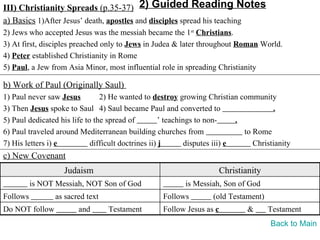
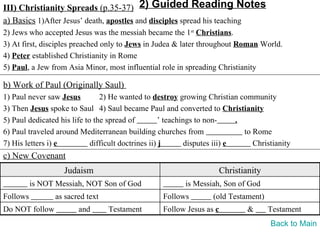
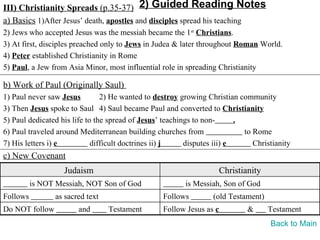
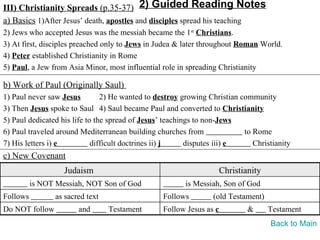
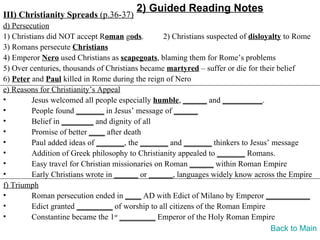
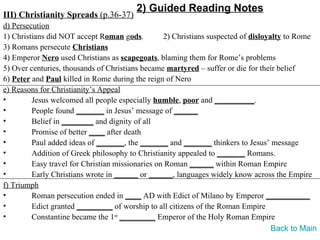
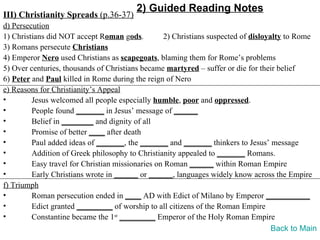
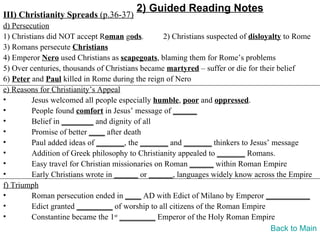
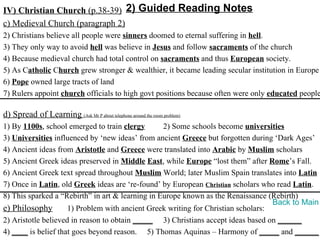
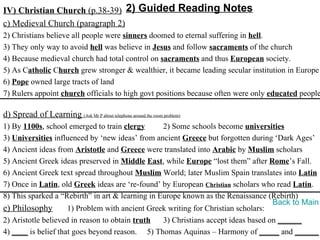
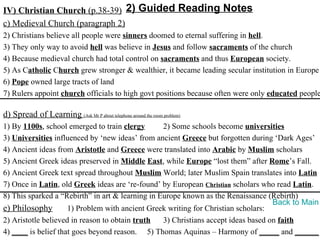
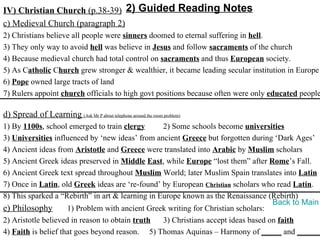
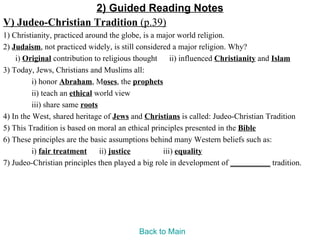
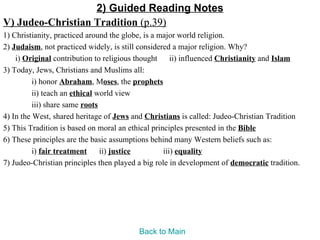
       P6            P9
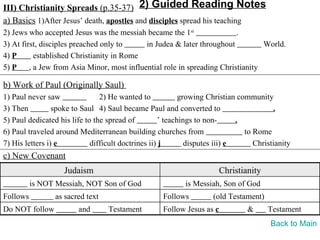
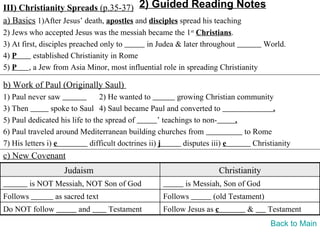
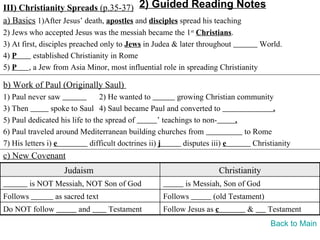
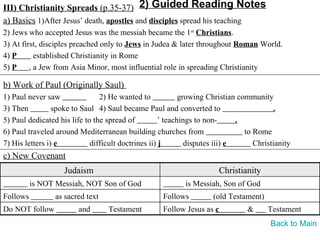
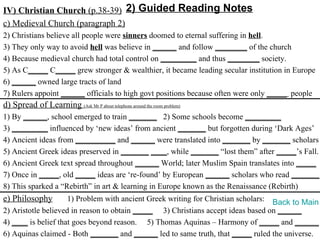
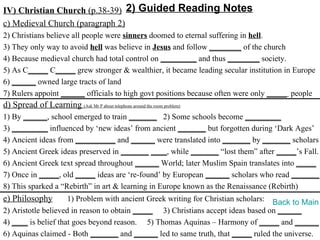
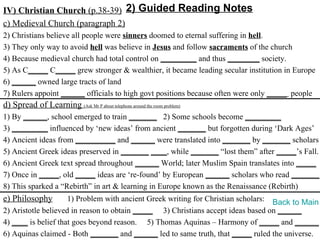
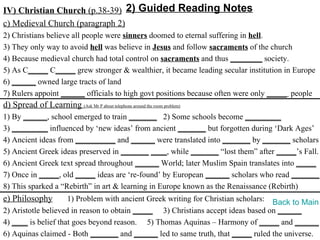
P1


P2                   P10
       P7

P3

P4
       P8            P11

P5
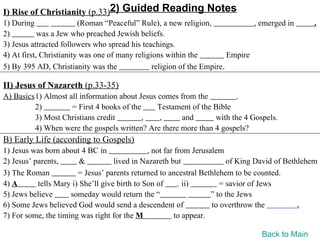
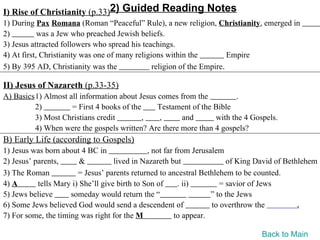
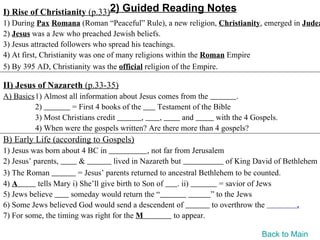
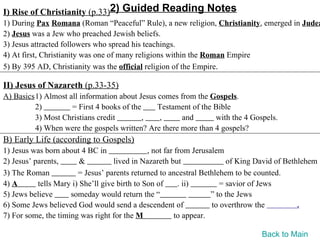
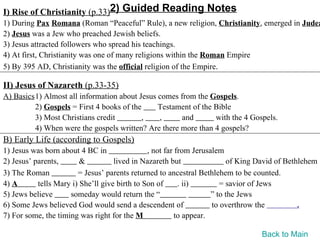
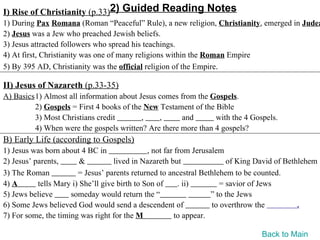
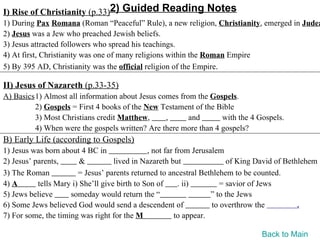
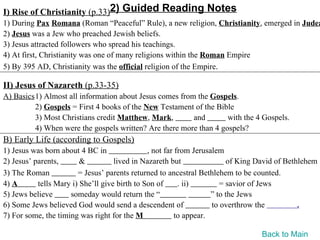
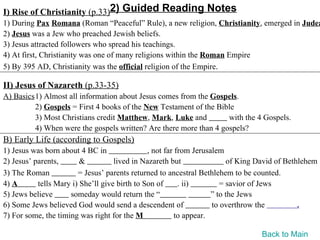
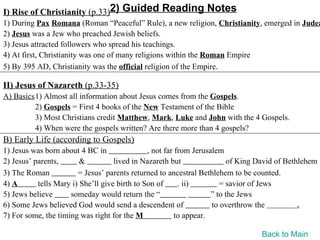
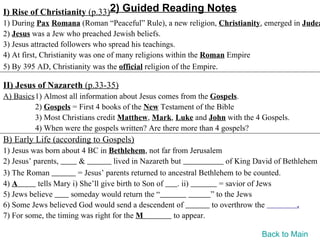
I) Rise of Christianity (p.33)2) Guided Reading Notes
1) During                (Roman “Peaceful” Rule), a new religion,              , emerged in       .
2)          was a Jew who preached Jewish beliefs.
3) Jesus attracted followers who spread his teachings.
4) At first, Christianity was one of many religions within the          Empire
5) By 395 AD, Christianity was the              religion of the Empire.

II) Jesus of Nazareth (p.33-35)
A) Basics1) Almost all information about Jesus comes from the          .
         2)         = First 4 books of the     Testament of the Bible
         3) Most Christians credit         ,   ,      and       with the 4 Gospels.
         4) When were the gospels written? Are there more than 4 gospels?
B) Early Life (according to Gospels)
1) Jesus was born about 4 BC in                , not far from Jerusalem
2) Jesus’ parents,       &          lived in Nazareth but                of King David of Bethlehem
3) The Roman            = Jesus’ parents returned to ancestral Bethlehem to be counted.
4) A       tells Mary i) She’ll give birth to Son of      . ii)        = savior of Jews
5) Jews believe      someday would return the “                     ” to the Jews
6) Some Jews believed God would send a descendent of                to overthrow the          .
7) For some, the timing was right for the M              to appear.

                                                                                 Back to Main
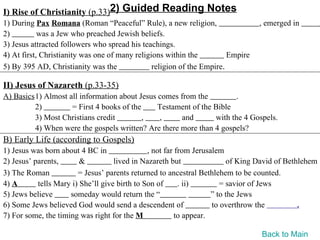
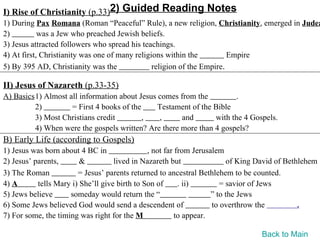
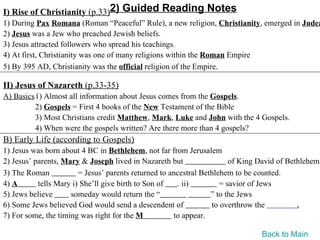
I) Rise of Christianity (p.33)2) Guided Reading Notes
1) During Pax Romana (Roman “Peaceful” Rule), a new religion,                    , emerged in         .
2)          was a Jew who preached Jewish beliefs.
3) Jesus attracted followers who spread his teachings.
4) At first, Christianity was one of many religions within the          Empire
5) By 395 AD, Christianity was the              religion of the Empire.

II) Jesus of Nazareth (p.33-35)
A) Basics1) Almost all information about Jesus comes from the          .
         2)         = First 4 books of the     Testament of the Bible
         3) Most Christians credit         ,   ,      and       with the 4 Gospels.
         4) When were the gospels written? Are there more than 4 gospels?
B) Early Life (according to Gospels)
1) Jesus was born about 4 BC in                , not far from Jerusalem
2) Jesus’ parents,       &          lived in Nazareth but                of King David of Bethlehem
3) The Roman            = Jesus’ parents returned to ancestral Bethlehem to be counted.
4) A       tells Mary i) She’ll give birth to Son of      . ii)        = savior of Jews
5) Jews believe      someday would return the “                     ” to the Jews
6) Some Jews believed God would send a descendent of                to overthrow the          .
7) For some, the timing was right for the M              to appear.

                                                                                 Back to Main
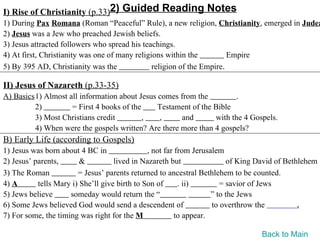
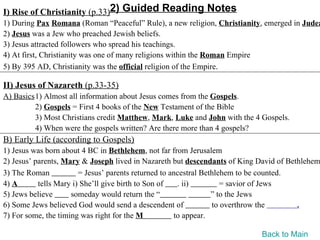
I) Rise of Christianity (p.33)2) Guided Reading Notes
1) During Pax Romana (Roman “Peaceful” Rule), a new religion, Christianity, emerged in
2)          was a Jew who preached Jewish beliefs.
3) Jesus attracted followers who spread his teachings.
4) At first, Christianity was one of many religions within the          Empire
5) By 395 AD, Christianity was the              religion of the Empire.

II) Jesus of Nazareth (p.33-35)
A) Basics1) Almost all information about Jesus comes from the          .
         2)         = First 4 books of the     Testament of the Bible
         3) Most Christians credit         ,   ,      and       with the 4 Gospels.
         4) When were the gospels written? Are there more than 4 gospels?
B) Early Life (according to Gospels)
1) Jesus was born about 4 BC in                , not far from Jerusalem
2) Jesus’ parents,       &          lived in Nazareth but                of King David of Bethlehem
3) The Roman            = Jesus’ parents returned to ancestral Bethlehem to be counted.
4) A       tells Mary i) She’ll give birth to Son of      . ii)        = savior of Jews
5) Jews believe      someday would return the “                     ” to the Jews
6) Some Jews believed God would send a descendent of                to overthrow the          .
7) For some, the timing was right for the M              to appear.

                                                                                 Back to Main
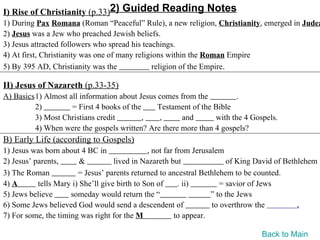
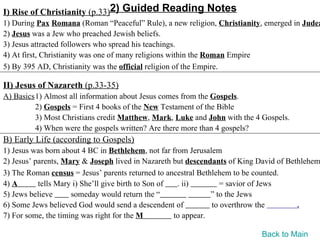
I) Rise of Christianity (p.33)2) Guided Reading Notes
1) During Pax Romana (Roman “Peaceful” Rule), a new religion, Christianity, emerged in Judea
2)          was a Jew who preached Jewish beliefs.
3) Jesus attracted followers who spread his teachings.
4) At first, Christianity was one of many religions within the          Empire
5) By 395 AD, Christianity was the              religion of the Empire.

II) Jesus of Nazareth (p.33-35)
A) Basics1) Almost all information about Jesus comes from the          .
         2)         = First 4 books of the     Testament of the Bible
         3) Most Christians credit         ,   ,      and       with the 4 Gospels.
         4) When were the gospels written? Are there more than 4 gospels?
B) Early Life (according to Gospels)
1) Jesus was born about 4 BC in                , not far from Jerusalem
2) Jesus’ parents,       &          lived in Nazareth but                of King David of Bethlehem
3) The Roman            = Jesus’ parents returned to ancestral Bethlehem to be counted.
4) A       tells Mary i) She’ll give birth to Son of      . ii)        = savior of Jews
5) Jews believe      someday would return the “                     ” to the Jews
6) Some Jews believed God would send a descendent of                to overthrow the          .
7) For some, the timing was right for the M              to appear.

                                                                                 Back to Main
I) Rise of Christianity (p.33)2) Guided Reading Notes
1) During Pax Romana (Roman “Peaceful” Rule), a new religion, Christianity, emerged in Judea
2) Jesus was a Jew who preached Jewish beliefs.
3) Jesus attracted followers who spread his teachings.
4) At first, Christianity was one of many religions within the          Empire
5) By 395 AD, Christianity was the              religion of the Empire.

II) Jesus of Nazareth (p.33-35)
A) Basics1) Almost all information about Jesus comes from the          .
         2)         = First 4 books of the     Testament of the Bible
         3) Most Christians credit         ,   ,      and       with the 4 Gospels.
         4) When were the gospels written? Are there more than 4 gospels?
B) Early Life (according to Gospels)
1) Jesus was born about 4 BC in                , not far from Jerusalem
2) Jesus’ parents,       &          lived in Nazareth but                of King David of Bethlehem
3) The Roman            = Jesus’ parents returned to ancestral Bethlehem to be counted.
4) A       tells Mary i) She’ll give birth to Son of      . ii)        = savior of Jews
5) Jews believe      someday would return the “                     ” to the Jews
6) Some Jews believed God would send a descendent of                to overthrow the          .
7) For some, the timing was right for the M              to appear.

                                                                                 Back to Main
I) Rise of Christianity (p.33)2) Guided Reading Notes
1) During Pax Romana (Roman “Peaceful” Rule), a new religion, Christianity, emerged in Judea
2) Jesus was a Jew who preached Jewish beliefs.
3) Jesus attracted followers who spread his teachings.
4) At first, Christianity was one of many religions within the Roman Empire
5) By 395 AD, Christianity was the              religion of the Empire.

II) Jesus of Nazareth (p.33-35)
A) Basics1) Almost all information about Jesus comes from the          .
         2)         = First 4 books of the     Testament of the Bible
         3) Most Christians credit         ,   ,      and       with the 4 Gospels.
         4) When were the gospels written? Are there more than 4 gospels?
B) Early Life (according to Gospels)
1) Jesus was born about 4 BC in                , not far from Jerusalem
2) Jesus’ parents,       &          lived in Nazareth but                of King David of Bethlehem
3) The Roman            = Jesus’ parents returned to ancestral Bethlehem to be counted.
4) A       tells Mary i) She’ll give birth to Son of      . ii)        = savior of Jews
5) Jews believe      someday would return the “                     ” to the Jews
6) Some Jews believed God would send a descendent of                to overthrow the          .
7) For some, the timing was right for the M              to appear.

                                                                                 Back to Main
I) Rise of Christianity (p.33)2) Guided Reading Notes
1) During Pax Romana (Roman “Peaceful” Rule), a new religion, Christianity, emerged in Judea
2) Jesus was a Jew who preached Jewish beliefs.
3) Jesus attracted followers who spread his teachings.
4) At first, Christianity was one of many religions within the Roman Empire
5) By 395 AD, Christianity was the official religion of the Empire.

II) Jesus of Nazareth (p.33-35)
A) Basics1) Almost all information about Jesus comes from the          .
         2)         = First 4 books of the     Testament of the Bible
         3) Most Christians credit         ,   ,      and       with the 4 Gospels.
         4) When were the gospels written? Are there more than 4 gospels?
B) Early Life (according to Gospels)
1) Jesus was born about 4 BC in                , not far from Jerusalem
2) Jesus’ parents,       &          lived in Nazareth but                of King David of Bethlehem
3) The Roman            = Jesus’ parents returned to ancestral Bethlehem to be counted.
4) A       tells Mary i) She’ll give birth to Son of      . ii)        = savior of Jews
5) Jews believe      someday would return the “                     ” to the Jews
6) Some Jews believed God would send a descendent of                to overthrow the          .
7) For some, the timing was right for the M              to appear.

                                                                                 Back to Main
I) Rise of Christianity (p.33)2) Guided Reading Notes
1) During Pax Romana (Roman “Peaceful” Rule), a new religion, Christianity, emerged in Judea
2) Jesus was a Jew who preached Jewish beliefs.
3) Jesus attracted followers who spread his teachings.
4) At first, Christianity was one of many religions within the Roman Empire
5) By 395 AD, Christianity was the official religion of the Empire.

II) Jesus of Nazareth (p.33-35)
A) Basics1) Almost all information about Jesus comes from the Gospels.
         2)         = First 4 books of the     Testament of the Bible
         3) Most Christians credit         ,   ,      and       with the 4 Gospels.
         4) When were the gospels written? Are there more than 4 gospels?
B) Early Life (according to Gospels)
1) Jesus was born about 4 BC in                , not far from Jerusalem
2) Jesus’ parents,       &          lived in Nazareth but                of King David of Bethlehem
3) The Roman            = Jesus’ parents returned to ancestral Bethlehem to be counted.
4) A       tells Mary i) She’ll give birth to Son of      . ii)        = savior of Jews
5) Jews believe      someday would return the “                     ” to the Jews
6) Some Jews believed God would send a descendent of                to overthrow the          .
7) For some, the timing was right for the M              to appear.

                                                                                 Back to Main
I) Rise of Christianity (p.33)2) Guided Reading Notes
1) During Pax Romana (Roman “Peaceful” Rule), a new religion, Christianity, emerged in Judea
2) Jesus was a Jew who preached Jewish beliefs.
3) Jesus attracted followers who spread his teachings.
4) At first, Christianity was one of many religions within the Roman Empire
5) By 395 AD, Christianity was the official religion of the Empire.

II) Jesus of Nazareth (p.33-35)
A) Basics1) Almost all information about Jesus comes from the Gospels.
         2) Gospels = First 4 books of the     Testament of the Bible
         3) Most Christians credit         ,   ,      and       with the 4 Gospels.
         4) When were the gospels written? Are there more than 4 gospels?
B) Early Life (according to Gospels)
1) Jesus was born about 4 BC in                , not far from Jerusalem
2) Jesus’ parents,       &          lived in Nazareth but                of King David of Bethlehem
3) The Roman            = Jesus’ parents returned to ancestral Bethlehem to be counted.
4) A       tells Mary i) She’ll give birth to Son of      . ii)        = savior of Jews
5) Jews believe      someday would return the “                     ” to the Jews
6) Some Jews believed God would send a descendent of                to overthrow the          .
7) For some, the timing was right for the M              to appear.

                                                                                 Back to Main
I) Rise of Christianity (p.33)2) Guided Reading Notes
1) During Pax Romana (Roman “Peaceful” Rule), a new religion, Christianity, emerged in Judea
2) Jesus was a Jew who preached Jewish beliefs.
3) Jesus attracted followers who spread his teachings.
4) At first, Christianity was one of many religions within the Roman Empire
5) By 395 AD, Christianity was the official religion of the Empire.

II) Jesus of Nazareth (p.33-35)
A) Basics1) Almost all information about Jesus comes from the Gospels.
         2) Gospels = First 4 books of the New Testament of the Bible
         3) Most Christians credit        ,    ,      and       with the 4 Gospels.
         4) When were the gospels written? Are there more than 4 gospels?
B) Early Life (according to Gospels)
1) Jesus was born about 4 BC in                , not far from Jerusalem
2) Jesus’ parents,       &          lived in Nazareth but                of King David of Bethlehem
3) The Roman            = Jesus’ parents returned to ancestral Bethlehem to be counted.
4) A       tells Mary i) She’ll give birth to Son of      . ii)        = savior of Jews
5) Jews believe      someday would return the “                     ” to the Jews
6) Some Jews believed God would send a descendent of                to overthrow the          .
7) For some, the timing was right for the M              to appear.

                                                                                 Back to Main
I) Rise of Christianity (p.33)2) Guided Reading Notes
1) During Pax Romana (Roman “Peaceful” Rule), a new religion, Christianity, emerged in Judea
2) Jesus was a Jew who preached Jewish beliefs.
3) Jesus attracted followers who spread his teachings.
4) At first, Christianity was one of many religions within the Roman Empire
5) By 395 AD, Christianity was the official religion of the Empire.

II) Jesus of Nazareth (p.33-35)
A) Basics1) Almost all information about Jesus comes from the Gospels.
         2) Gospels = First 4 books of the New Testament of the Bible
         3) Most Christians credit Matthew,      ,      and      with the 4 Gospels.
         4) When were the gospels written? Are there more than 4 gospels?
B) Early Life (according to Gospels)
1) Jesus was born about 4 BC in                , not far from Jerusalem
2) Jesus’ parents,       &          lived in Nazareth but                of King David of Bethlehem
3) The Roman            = Jesus’ parents returned to ancestral Bethlehem to be counted.
4) A       tells Mary i) She’ll give birth to Son of      . ii)        = savior of Jews
5) Jews believe      someday would return the “                     ” to the Jews
6) Some Jews believed God would send a descendent of                to overthrow the          .
7) For some, the timing was right for the M              to appear.

                                                                                 Back to Main
I) Rise of Christianity (p.33)2) Guided Reading Notes
1) During Pax Romana (Roman “Peaceful” Rule), a new religion, Christianity, emerged in Judea
2) Jesus was a Jew who preached Jewish beliefs.
3) Jesus attracted followers who spread his teachings.
4) At first, Christianity was one of many religions within the Roman Empire
5) By 395 AD, Christianity was the official religion of the Empire.

II) Jesus of Nazareth (p.33-35)
A) Basics1) Almost all information about Jesus comes from the Gospels.
         2) Gospels = First 4 books of the New Testament of the Bible
         3) Most Christians credit Matthew, Mark,        and       with the 4 Gospels.
         4) When were the gospels written? Are there more than 4 gospels?
B) Early Life (according to Gospels)
1) Jesus was born about 4 BC in                , not far from Jerusalem
2) Jesus’ parents,       &          lived in Nazareth but                of King David of Bethlehem
3) The Roman            = Jesus’ parents returned to ancestral Bethlehem to be counted.
4) A       tells Mary i) She’ll give birth to Son of      . ii)        = savior of Jews
5) Jews believe      someday would return the “                     ” to the Jews
6) Some Jews believed God would send a descendent of                to overthrow the          .
7) For some, the timing was right for the M              to appear.

                                                                                 Back to Main
I) Rise of Christianity (p.33)2) Guided Reading Notes
1) During Pax Romana (Roman “Peaceful” Rule), a new religion, Christianity, emerged in Judea
2) Jesus was a Jew who preached Jewish beliefs.
3) Jesus attracted followers who spread his teachings.
4) At first, Christianity was one of many religions within the Roman Empire
5) By 395 AD, Christianity was the official religion of the Empire.

II) Jesus of Nazareth (p.33-35)
A) Basics1) Almost all information about Jesus comes from the Gospels.
         2) Gospels = First 4 books of the New Testament of the Bible
         3) Most Christians credit Matthew, Mark, Luke and         with the 4 Gospels.
         4) When were the gospels written? Are there more than 4 gospels?
B) Early Life (according to Gospels)
1) Jesus was born about 4 BC in                , not far from Jerusalem
2) Jesus’ parents,       &          lived in Nazareth but                of King David of Bethlehem
3) The Roman            = Jesus’ parents returned to ancestral Bethlehem to be counted.
4) A       tells Mary i) She’ll give birth to Son of      . ii)        = savior of Jews
5) Jews believe      someday would return the “                     ” to the Jews
6) Some Jews believed God would send a descendent of                to overthrow the          .
7) For some, the timing was right for the M              to appear.

                                                                                 Back to Main
I) Rise of Christianity (p.33)2) Guided Reading Notes
1) During Pax Romana (Roman “Peaceful” Rule), a new religion, Christianity, emerged in Judea
2) Jesus was a Jew who preached Jewish beliefs.
3) Jesus attracted followers who spread his teachings.
4) At first, Christianity was one of many religions within the Roman Empire
5) By 395 AD, Christianity was the official religion of the Empire.

II) Jesus of Nazareth (p.33-35)
A) Basics1) Almost all information about Jesus comes from the Gospels.
         2) Gospels = First 4 books of the New Testament of the Bible
         3) Most Christians credit Matthew, Mark, Luke and John with the 4 Gospels.
         4) When were the gospels written? Are there more than 4 gospels?
B) Early Life (according to Gospels)
1) Jesus was born about 4 BC in                , not far from Jerusalem
2) Jesus’ parents,       &          lived in Nazareth but                of King David of Bethlehem
3) The Roman            = Jesus’ parents returned to ancestral Bethlehem to be counted.
4) A       tells Mary i) She’ll give birth to Son of      . ii)        = savior of Jews
5) Jews believe      someday would return the “                     ” to the Jews
6) Some Jews believed God would send a descendent of                to overthrow the          .
7) For some, the timing was right for the M              to appear.

                                                                                 Back to Main
I) Rise of Christianity (p.33)2) Guided Reading Notes
1) During Pax Romana (Roman “Peaceful” Rule), a new religion, Christianity, emerged in Judea
2) Jesus was a Jew who preached Jewish beliefs.
3) Jesus attracted followers who spread his teachings.
4) At first, Christianity was one of many religions within the Roman Empire
5) By 395 AD, Christianity was the official religion of the Empire.

II) Jesus of Nazareth (p.33-35)
A) Basics1) Almost all information about Jesus comes from the Gospels.
         2) Gospels = First 4 books of the New Testament of the Bible
         3) Most Christians credit Matthew, Mark, Luke and John with the 4 Gospels.
         4) When were the gospels written? Are there more than 4 gospels?
B) Early Life (according to Gospels)
1) Jesus was born about 4 BC in Bethlehem, not far from Jerusalem
2) Jesus’ parents,       &          lived in Nazareth but              of King David of Bethlehem
3) The Roman            = Jesus’ parents returned to ancestral Bethlehem to be counted.
4) A       tells Mary i) She’ll give birth to Son of    . ii)        = savior of Jews
5) Jews believe      someday would return the “                   ” to the Jews
6) Some Jews believed God would send a descendent of              to overthrow the          .
7) For some, the timing was right for the M            to appear.

                                                                               Back to Main
I) Rise of Christianity (p.33)2) Guided Reading Notes
1) During Pax Romana (Roman “Peaceful” Rule), a new religion, Christianity, emerged in Judea
2) Jesus was a Jew who preached Jewish beliefs.
3) Jesus attracted followers who spread his teachings.
4) At first, Christianity was one of many religions within the Roman Empire
5) By 395 AD, Christianity was the official religion of the Empire.

II) Jesus of Nazareth (p.33-35)
A) Basics1) Almost all information about Jesus comes from the Gospels.
         2) Gospels = First 4 books of the New Testament of the Bible
         3) Most Christians credit Matthew, Mark, Luke and John with the 4 Gospels.
         4) When were the gospels written? Are there more than 4 gospels?
B) Early Life (according to Gospels)
1) Jesus was born about 4 BC in Bethlehem, not far from Jerusalem
2) Jesus’ parents, Mary & Joseph lived in Nazareth but                  of King David of Bethlehem
3) The Roman            = Jesus’ parents returned to ancestral Bethlehem to be counted.
4) A       tells Mary i) She’ll give birth to Son of   . ii)         = savior of Jews
5) Jews believe      someday would return the “                   ” to the Jews
6) Some Jews believed God would send a descendent of              to overthrow the          .
7) For some, the timing was right for the M           to appear.

                                                                                Back to Main
I) Rise of Christianity (p.33)2) Guided Reading Notes
1) During Pax Romana (Roman “Peaceful” Rule), a new religion, Christianity, emerged in Judea
2) Jesus was a Jew who preached Jewish beliefs.
3) Jesus attracted followers who spread his teachings.
4) At first, Christianity was one of many religions within the Roman Empire
5) By 395 AD, Christianity was the official religion of the Empire.

II) Jesus of Nazareth (p.33-35)
A) Basics1) Almost all information about Jesus comes from the Gospels.
         2) Gospels = First 4 books of the New Testament of the Bible
         3) Most Christians credit Matthew, Mark, Luke and John with the 4 Gospels.
         4) When were the gospels written? Are there more than 4 gospels?
B) Early Life (according to Gospels)
1) Jesus was born about 4 BC in Bethlehem, not far from Jerusalem
2) Jesus’ parents, Mary & Joseph lived in Nazareth but descendants of King David of Bethlehem
3) The Roman            = Jesus’ parents returned to ancestral Bethlehem to be counted.
4) A       tells Mary i) She’ll give birth to Son of   . ii)         = savior of Jews
5) Jews believe      someday would return the “                   ” to the Jews
6) Some Jews believed God would send a descendent of              to overthrow the      .
7) For some, the timing was right for the M           to appear.

                                                                           Back to Main
I) Rise of Christianity (p.33)2) Guided Reading Notes
1) During Pax Romana (Roman “Peaceful” Rule), a new religion, Christianity, emerged in Judea
2) Jesus was a Jew who preached Jewish beliefs.
3) Jesus attracted followers who spread his teachings.
4) At first, Christianity was one of many religions within the Roman Empire
5) By 395 AD, Christianity was the official religion of the Empire.

II) Jesus of Nazareth (p.33-35)
A) Basics1) Almost all information about Jesus comes from the Gospels.
         2) Gospels = First 4 books of the New Testament of the Bible
         3) Most Christians credit Matthew, Mark, Luke and John with the 4 Gospels.
         4) When were the gospels written? Are there more than 4 gospels?
B) Early Life (according to Gospels)
1) Jesus was born about 4 BC in Bethlehem, not far from Jerusalem
2) Jesus’ parents, Mary & Joseph lived in Nazareth but descendants of King David of Bethlehem
3) The Roman census = Jesus’ parents returned to ancestral Bethlehem to be counted.
4) A       tells Mary i) She’ll give birth to Son of  . ii)        = savior of Jews
5) Jews believe      someday would return the “                 ” to the Jews
6) Some Jews believed God would send a descendent of            to overthrow the       .
7) For some, the timing was right for the M          to appear.

                                                                           Back to Main
I) Rise of Christianity (p.33)2) Guided Reading Notes
1) During Pax Romana (Roman “Peaceful” Rule), a new religion, Christianity, emerged in Judea
2) Jesus was a Jew who preached Jewish beliefs.
3) Jesus attracted followers who spread his teachings.
4) At first, Christianity was one of many religions within the Roman Empire
5) By 395 AD, Christianity was the official religion of the Empire.

II) Jesus of Nazareth (p.33-35)
A) Basics1) Almost all information about Jesus comes from the Gospels.
         2) Gospels = First 4 books of the New Testament of the Bible
         3) Most Christians credit Matthew, Mark, Luke and John with the 4 Gospels.
         4) When were the gospels written? Are there more than 4 gospels?
B) Early Life (according to Gospels)
1) Jesus was born about 4 BC in Bethlehem, not far from Jerusalem
2) Jesus’ parents, Mary & Joseph lived in Nazareth but descendants of King David of Bethlehem
3) The Roman census = Jesus’ parents returned to ancestral Bethlehem to be counted.
4) Angel tells Mary i) She’ll give birth to Son of . ii)        = savior of Jews
5) Jews believe      someday would return the “                ” to the Jews
6) Some Jews believed God would send a descendent of           to overthrow the        .
7) For some, the timing was right for the M        to appear.

                                                                           Back to Main
I) Rise of Christianity (p.33)2) Guided Reading Notes
1) During Pax Romana (Roman “Peaceful” Rule), a new religion, Christianity, emerged in Judea
2) Jesus was a Jew who preached Jewish beliefs.
3) Jesus attracted followers who spread his teachings.
4) At first, Christianity was one of many religions within the Roman Empire
5) By 395 AD, Christianity was the official religion of the Empire.

II) Jesus of Nazareth (p.33-35)
A) Basics1) Almost all information about Jesus comes from the Gospels.
         2) Gospels = First 4 books of the New Testament of the Bible
         3) Most Christians credit Matthew, Mark, Luke and John with the 4 Gospels.
         4) When were the gospels written? Are there more than 4 gospels?
B) Early Life (according to Gospels)
1) Jesus was born about 4 BC in Bethlehem, not far from Jerusalem
2) Jesus’ parents, Mary & Joseph lived in Nazareth but descendants of King David of Bethlehem
3) The Roman census = Jesus’ parents returned to ancestral Bethlehem to be counted.
4) Angel tells Mary i) She’ll give birth to Son of God. ii)        = savior of Jews
5) Jews believe      someday would return the “                 ” to the Jews
6) Some Jews believed God would send a descendent of            to overthrow the       .
7) For some, the timing was right for the M          to appear.

                                                                           Back to Main
I) Rise of Christianity (p.33)2) Guided Reading Notes
1) During Pax Romana (Roman “Peaceful” Rule), a new religion, Christianity, emerged in Judea
2) Jesus was a Jew who preached Jewish beliefs.
3) Jesus attracted followers who spread his teachings.
4) At first, Christianity was one of many religions within the Roman Empire
5) By 395 AD, Christianity was the official religion of the Empire.

II) Jesus of Nazareth (p.33-35)
A) Basics1) Almost all information about Jesus comes from the Gospels.
         2) Gospels = First 4 books of the New Testament of the Bible
         3) Most Christians credit Matthew, Mark, Luke and John with the 4 Gospels.
         4) When were the gospels written? Are there more than 4 gospels?
B) Early Life (according to Gospels)
1) Jesus was born about 4 BC in Bethlehem, not far from Jerusalem
2) Jesus’ parents, Mary & Joseph lived in Nazareth but descendants of King David of Bethlehem
3) The Roman census = Jesus’ parents returned to ancestral Bethlehem to be counted.
4) Angel tells Mary i) She’ll give birth to Son of God. ii) Messiah = savior of Jews
5) Jews believe      someday would return the “                  ” to the Jews
6) Some Jews believed God would send a descendent of              to overthrow the     .
7) For some, the timing was right for the M          to appear.

                                                                           Back to Main
I) Rise of Christianity (p.33)2) Guided Reading Notes
1) During Pax Romana (Roman “Peaceful” Rule), a new religion, Christianity, emerged in Judea
2) Jesus was a Jew who preached Jewish beliefs.
3) Jesus attracted followers who spread his teachings.
4) At first, Christianity was one of many religions within the Roman Empire
5) By 395 AD, Christianity was the official religion of the Empire.

II) Jesus of Nazareth (p.33-35)
A) Basics1) Almost all information about Jesus comes from the Gospels.
         2) Gospels = First 4 books of the New Testament of the Bible
         3) Most Christians credit Matthew, Mark, Luke and John with the 4 Gospels.
         4) When were the gospels written? Are there more than 4 gospels?
B) Early Life (according to Gospels)
1) Jesus was born about 4 BC in Bethlehem, not far from Jerusalem
2) Jesus’ parents, Mary & Joseph lived in Nazareth but descendants of King David of Bethlehem
3) The Roman census = Jesus’ parents returned to ancestral Bethlehem to be counted.
4) Angel tells Mary i) She’ll give birth to Son of God. ii) Messiah = savior of Jews
5) Jews believe God someday would return the “                    ” to the Jews
6) Some Jews believed God would send a descendent of              to overthrow the     .
7) For some, the timing was right for the M          to appear.

                                                                           Back to Main
I) Rise of Christianity (p.33)2) Guided Reading Notes
1) During Pax Romana (Roman “Peaceful” Rule), a new religion, Christianity, emerged in Judea
2) Jesus was a Jew who preached Jewish beliefs.
3) Jesus attracted followers who spread his teachings.
4) At first, Christianity was one of many religions within the Roman Empire
5) By 395 AD, Christianity was the official religion of the Empire.

II) Jesus of Nazareth (p.33-35)
A) Basics1) Almost all information about Jesus comes from the Gospels.
         2) Gospels = First 4 books of the New Testament of the Bible
         3) Most Christians credit Matthew, Mark, Luke and John with the 4 Gospels.
         4) When were the gospels written? Are there more than 4 gospels?
B) Early Life (according to Gospels)
1) Jesus was born about 4 BC in Bethlehem, not far from Jerusalem
2) Jesus’ parents, Mary & Joseph lived in Nazareth but descendants of King David of Bethlehem
3) The Roman census = Jesus’ parents returned to ancestral Bethlehem to be counted.
4) Angel tells Mary i) She’ll give birth to Son of God. ii) Messiah = savior of Jews
5) Jews believe God someday would return the “promise land” to the Jews
6) Some Jews believed God would send a descendent of              to overthrow the     .
7) For some, the timing was right for the M          to appear.

                                                                           Back to Main
I) Rise of Christianity (p.33)2) Guided Reading Notes
1) During Pax Romana (Roman “Peaceful” Rule), a new religion, Christianity, emerged in Judea
2) Jesus was a Jew who preached Jewish beliefs.
3) Jesus attracted followers who spread his teachings.
4) At first, Christianity was one of many religions within the Roman Empire
5) By 395 AD, Christianity was the official religion of the Empire.

II) Jesus of Nazareth (p.33-35)
A) Basics1) Almost all information about Jesus comes from the Gospels.
         2) Gospels = First 4 books of the New Testament of the Bible
         3) Most Christians credit Matthew, Mark, Luke and John with the 4 Gospels.
         4) When were the gospels written? Are there more than 4 gospels?
B) Early Life (according to Gospels)
1) Jesus was born about 4 BC in Bethlehem, not far from Jerusalem
2) Jesus’ parents, Mary & Joseph lived in Nazareth but descendants of King David of Bethlehem
3) The Roman census = Jesus’ parents returned to ancestral Bethlehem to be counted.
4) Angel tells Mary i) She’ll give birth to Son of God. ii) Messiah = savior of Jews
5) Jews believe God someday would return the “promise land” to the Jews
6) Some Jews believed God would send a descendent of David to overthrow the           .
7) For some, the timing was right for the M          to appear.

                                                                           Back to Main
I) Rise of Christianity (p.33)2) Guided Reading Notes
1) During Pax Romana (Roman “Peaceful” Rule), a new religion, Christianity, emerged in Judea
2) Jesus was a Jew who preached Jewish beliefs.
3) Jesus attracted followers who spread his teachings.
4) At first, Christianity was one of many religions within the Roman Empire
5) By 395 AD, Christianity was the official religion of the Empire.

II) Jesus of Nazareth (p.33-35)
A) Basics1) Almost all information about Jesus comes from the Gospels.
         2) Gospels = First 4 books of the New Testament of the Bible
         3) Most Christians credit Matthew, Mark, Luke and John with the 4 Gospels.
         4) When were the gospels written? Are there more than 4 gospels?
B) Early Life (according to Gospels)
1) Jesus was born about 4 BC in Bethlehem, not far from Jerusalem
2) Jesus’ parents, Mary & Joseph lived in Nazareth but descendants of King David of Bethlehem
3) The Roman census = Jesus’ parents returned to ancestral Bethlehem to be counted.
4) Angel tells Mary i) She’ll give birth to Son of God. ii) Messiah = savior of Jews
5) Jews believe God someday would return the “promise land” to the Jews
6) Some Jews believed God would send a descendent of David to overthrow the Romans
7) For some, the timing was right for the M          to appear.

                                                                           Back to Main
I) Rise of Christianity (p.33)2) Guided Reading Notes
1) During Pax Romana (Roman “Peaceful” Rule), a new religion, Christianity, emerged in Judea
2) Jesus was a Jew who preached Jewish beliefs.
3) Jesus attracted followers who spread his teachings.
4) At first, Christianity was one of many religions within the Roman Empire
5) By 395 AD, Christianity was the official religion of the Empire.

II) Jesus of Nazareth (p.33-35)
A) Basics1) Almost all information about Jesus comes from the Gospels.
         2) Gospels = First 4 books of the New Testament of the Bible
         3) Most Christians credit Matthew, Mark, Luke and John with the 4 Gospels.
         4) When were the gospels written? Are there more than 4 gospels?
B) Early Life (according to Gospels)
1) Jesus was born about 4 BC in Bethlehem, not far from Jerusalem
2) Jesus’ parents, Mary & Joseph lived in Nazareth but descendants of King David of Bethlehem
3) The Roman census = Jesus’ parents returned to ancestral Bethlehem to be counted.
4) Angel tells Mary i) She’ll give birth to Son of God. ii) Messiah = savior of Jews
5) Jews believe God someday would return the “promise land” to the Jews
6) Some Jews believed God would send a descendent of David to overthrow the Romans
7) For some, the timing was right for the Messiah to appear.

                                                                           Back to Main
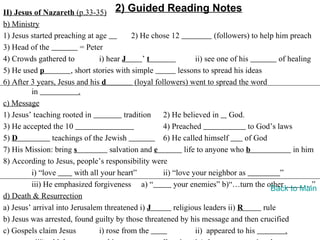
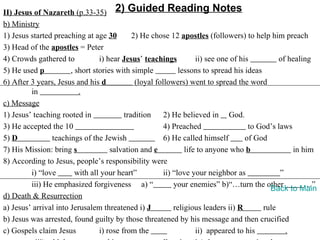
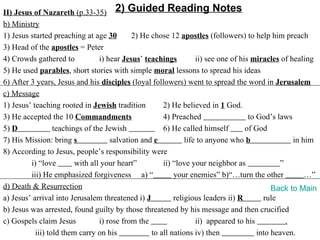
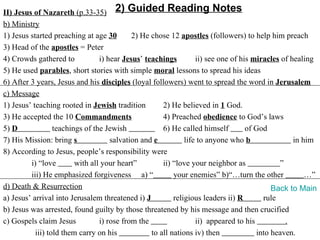
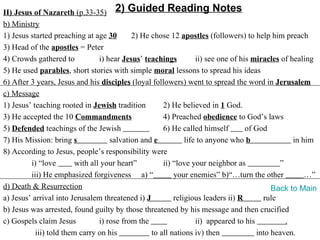
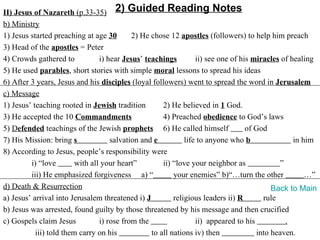
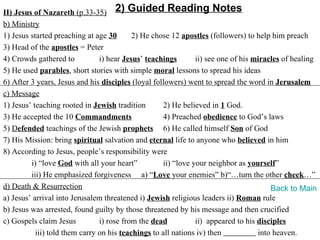
II) Jesus of Nazareth (p.33-35) 2) Guided Reading Notes
b) Ministry
1) Jesus started preaching at age            2) He chose 12                (followers) to help him preach
3) Head of the             = Peter
4) Crowds gathered to            i) hear J       ’t                 ii) see one of his          of healing
5) He used p           , short stories with simple            lessons to spread his ideas
6) After 3 years, Jesus and his d             (loyal followers) went to spread the word
         in               .
c) Message
1) Jesus’ teaching rooted in              tradition     2) He believed in God.
3) He accepted the 10                                   4) Preached                   to God’s laws
5) D            teachings of the Jewish                 6) He called himself         of God
7) His Mission: bring s              salvation and e            life to anyone who b                in him
8) According to Jesus, people’s responsibility were
         i) “love        with all your heart”           ii) “love your neighbor as              ”
         iii) He emphasized forgiveness a) “                your enemies” b)“…turn the other            …”
                                                                                             Back to Main
d) Death & Resurrection
a) Jesus’ arrival into Jerusalem threatened i) J            religious leaders ii) R        rule
b) Jesus was arrested, found guilty by those threatened by his message and then crucified
c) Gospels claim Jesus           i) rose from the                   ii) appeared to his           .
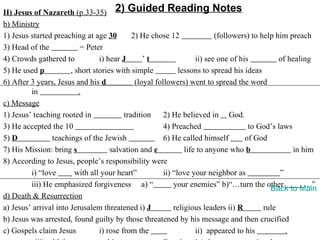
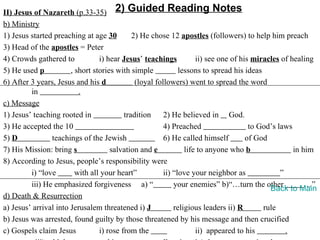
II) Jesus of Nazareth (p.33-35) 2) Guided Reading Notes
b) Ministry
1) Jesus started preaching at age 30         2) He chose 12                (followers) to help him preach
3) Head of the             = Peter
4) Crowds gathered to            i) hear J       ’t                 ii) see one of his          of healing
5) He used p           , short stories with simple            lessons to spread his ideas
6) After 3 years, Jesus and his d             (loyal followers) went to spread the word
         in               .
c) Message
1) Jesus’ teaching rooted in              tradition     2) He believed in God.
3) He accepted the 10                                   4) Preached                   to God’s laws
5) D            teachings of the Jewish                 6) He called himself         of God
7) His Mission: bring s              salvation and e            life to anyone who b                in him
8) According to Jesus, people’s responsibility were
         i) “love        with all your heart”           ii) “love your neighbor as              ”
         iii) He emphasized forgiveness a) “                your enemies” b)“…turn the other            …”
                                                                                             Back to Main
d) Death & Resurrection
a) Jesus’ arrival into Jerusalem threatened i) J            religious leaders ii) R        rule
b) Jesus was arrested, found guilty by those threatened by his message and then crucified
c) Gospels claim Jesus           i) rose from the                   ii) appeared to his           .
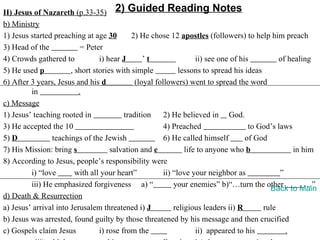
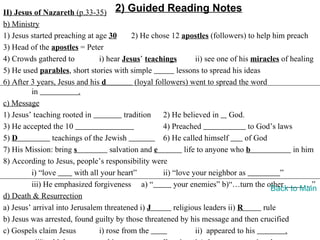
II) Jesus of Nazareth (p.33-35) 2) Guided Reading Notes
b) Ministry
1) Jesus started preaching at age 30         2) He chose 12 apostles (followers) to help him preach
3) Head of the             = Peter
4) Crowds gathered to            i) hear J       ’t                 ii) see one of his         of healing
5) He used p           , short stories with simple            lessons to spread his ideas
6) After 3 years, Jesus and his d             (loyal followers) went to spread the word
         in               .
c) Message
1) Jesus’ teaching rooted in              tradition     2) He believed in God.
3) He accepted the 10                                   4) Preached                   to God’s laws
5) D            teachings of the Jewish                 6) He called himself         of God
7) His Mission: bring s              salvation and e            life to anyone who b                in him
8) According to Jesus, people’s responsibility were
         i) “love        with all your heart”           ii) “love your neighbor as              ”
         iii) He emphasized forgiveness a) “                your enemies” b)“…turn the other            …”
                                                                                            Back to Main
d) Death & Resurrection
a) Jesus’ arrival into Jerusalem threatened i) J            religious leaders ii) R       rule
b) Jesus was arrested, found guilty by those threatened by his message and then crucified
c) Gospels claim Jesus           i) rose from the                   ii) appeared to his           .
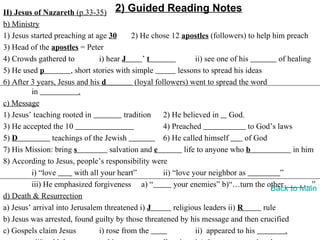
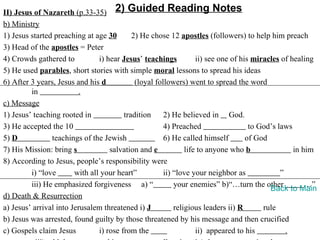
II) Jesus of Nazareth (p.33-35) 2) Guided Reading Notes
b) Ministry
1) Jesus started preaching at age 30         2) He chose 12 apostles (followers) to help him preach
3) Head of the apostles = Peter
4) Crowds gathered to            i) hear J       ’t                 ii) see one of his         of healing
5) He used p           , short stories with simple            lessons to spread his ideas
6) After 3 years, Jesus and his d             (loyal followers) went to spread the word
         in               .
c) Message
1) Jesus’ teaching rooted in              tradition     2) He believed in God.
3) He accepted the 10                                   4) Preached                   to God’s laws
5) D            teachings of the Jewish                 6) He called himself         of God
7) His Mission: bring s              salvation and e            life to anyone who b                in him
8) According to Jesus, people’s responsibility were
         i) “love        with all your heart”           ii) “love your neighbor as              ”
         iii) He emphasized forgiveness a) “                your enemies” b)“…turn the other            …”
                                                                                            Back to Main
d) Death & Resurrection
a) Jesus’ arrival into Jerusalem threatened i) J            religious leaders ii) R       rule
b) Jesus was arrested, found guilty by those threatened by his message and then crucified
c) Gospels claim Jesus           i) rose from the                   ii) appeared to his           .
II) Jesus of Nazareth (p.33-35) 2) Guided Reading Notes
b) Ministry
1) Jesus started preaching at age 30         2) He chose 12 apostles (followers) to help him preach
3) Head of the apostles = Peter
4) Crowds gathered to            i) hear Jesus’ teachings           ii) see one of his         of healing
5) He used p           , short stories with simple            lessons to spread his ideas
6) After 3 years, Jesus and his d             (loyal followers) went to spread the word
         in               .
c) Message
1) Jesus’ teaching rooted in              tradition     2) He believed in God.
3) He accepted the 10                                   4) Preached                   to God’s laws
5) D            teachings of the Jewish                 6) He called himself         of God
7) His Mission: bring s              salvation and e            life to anyone who b                in him
8) According to Jesus, people’s responsibility were
         i) “love        with all your heart”           ii) “love your neighbor as              ”
         iii) He emphasized forgiveness a) “                your enemies” b)“…turn the other            …”
                                                                                            Back to Main
d) Death & Resurrection
a) Jesus’ arrival into Jerusalem threatened i) J            religious leaders ii) R       rule
b) Jesus was arrested, found guilty by those threatened by his message and then crucified
c) Gospels claim Jesus           i) rose from the                   ii) appeared to his           .
II) Jesus of Nazareth (p.33-35) 2) Guided Reading Notes
b) Ministry
1) Jesus started preaching at age 30         2) He chose 12 apostles (followers) to help him preach
3) Head of the apostles = Peter
4) Crowds gathered to            i) hear Jesus’ teachings           ii) see one of his miracles of healing
5) He used p           , short stories with simple            lessons to spread his ideas
6) After 3 years, Jesus and his d             (loyal followers) went to spread the word
         in               .
c) Message
1) Jesus’ teaching rooted in              tradition     2) He believed in God.
3) He accepted the 10                                   4) Preached                   to God’s laws
5) D            teachings of the Jewish                 6) He called himself         of God
7) His Mission: bring s              salvation and e            life to anyone who b                in him
8) According to Jesus, people’s responsibility were
         i) “love        with all your heart”           ii) “love your neighbor as              ”
         iii) He emphasized forgiveness a) “                your enemies” b)“…turn the other            …”
                                                                                            Back to Main
d) Death & Resurrection
a) Jesus’ arrival into Jerusalem threatened i) J            religious leaders ii) R       rule
b) Jesus was arrested, found guilty by those threatened by his message and then crucified
c) Gospels claim Jesus           i) rose from the                   ii) appeared to his           .
II) Jesus of Nazareth (p.33-35) 2) Guided Reading Notes
b) Ministry
1) Jesus started preaching at age 30        2) He chose 12 apostles (followers) to help him preach
3) Head of the apostles = Peter
4) Crowds gathered to           i) hear Jesus’ teachings           ii) see one of his miracles of healing
5) He used parables, short stories with simple              lessons to spread his ideas
6) After 3 years, Jesus and his d            (loyal followers) went to spread the word
         in              .
c) Message
1) Jesus’ teaching rooted in             tradition     2) He believed in God.
3) He accepted the 10                                  4) Preached                   to God’s laws
5) D            teachings of the Jewish                6) He called himself         of God
7) His Mission: bring s             salvation and e            life to anyone who b                in him
8) According to Jesus, people’s responsibility were
         i) “love       with all your heart”           ii) “love your neighbor as              ”
         iii) He emphasized forgiveness a) “               your enemies” b)“…turn the other            …”
                                                                                           Back to Main
d) Death & Resurrection
a) Jesus’ arrival into Jerusalem threatened i) J           religious leaders ii) R       rule
b) Jesus was arrested, found guilty by those threatened by his message and then crucified
c) Gospels claim Jesus          i) rose from the                   ii) appeared to his           .
II) Jesus of Nazareth (p.33-35) 2) Guided Reading Notes
b) Ministry
1) Jesus started preaching at age 30        2) He chose 12 apostles (followers) to help him preach
3) Head of the apostles = Peter
4) Crowds gathered to           i) hear Jesus’ teachings           ii) see one of his miracles of healing
5) He used parables, short stories with simple moral lessons to spread his ideas
6) After 3 years, Jesus and his d            (loyal followers) went to spread the word
         in              .
c) Message
1) Jesus’ teaching rooted in             tradition     2) He believed in God.
3) He accepted the 10                                  4) Preached                   to God’s laws
5) D            teachings of the Jewish                6) He called himself         of God
7) His Mission: bring s             salvation and e            life to anyone who b                in him
8) According to Jesus, people’s responsibility were
         i) “love       with all your heart”           ii) “love your neighbor as              ”
         iii) He emphasized forgiveness a) “               your enemies” b)“…turn the other            …”
                                                                                           Back to Main
d) Death & Resurrection
a) Jesus’ arrival into Jerusalem threatened i) J           religious leaders ii) R       rule
b) Jesus was arrested, found guilty by those threatened by his message and then crucified
c) Gospels claim Jesus          i) rose from the                   ii) appeared to his           .
II) Jesus of Nazareth (p.33-35) 2) Guided Reading Notes
b) Ministry
1) Jesus started preaching at age 30         2) He chose 12 apostles (followers) to help him preach
3) Head of the apostles = Peter
4) Crowds gathered to            i) hear Jesus’ teachings           ii) see one of his miracles of healing
5) He used parables, short stories with simple moral lessons to spread his ideas
6) After 3 years, Jesus and his disciples (loyal followers) went to spread the word in                     .
c) Message
1) Jesus’ teaching rooted in              tradition     2) He believed in God.
3) He accepted the 10                                   4) Preached                   to God’s laws
5) D              teachings of the Jewish               6) He called himself         of God
7) His Mission: bring s              salvation and e            life to anyone who b                in him
8) According to Jesus, people’s responsibility were
         i) “love        with all your heart”           ii) “love your neighbor as              ”
         iii) He emphasized forgiveness a) “                your enemies” b)“…turn the other            …”
d) Death & Resurrection                                                                       Back to Main
a) Jesus’ arrival into Jerusalem threatened i) J            religious leaders ii) R        rule
b) Jesus was arrested, found guilty by those threatened by his message and then crucified
c) Gospels claim Jesus           i) rose from the                   ii) appeared to his           .
           iii) told them carry on his              to all nations iv) then              into heaven.
II) Jesus of Nazareth (p.33-35) 2) Guided Reading Notes
b) Ministry
1) Jesus started preaching at age 30         2) He chose 12 apostles (followers) to help him preach
3) Head of the apostles = Peter
4) Crowds gathered to            i) hear Jesus’ teachings           ii) see one of his miracles of healing
5) He used parables, short stories with simple moral lessons to spread his ideas
6) After 3 years, Jesus and his disciples (loyal followers) went to spread the word in Jerusalem
c) Message
1) Jesus’ teaching rooted in              tradition     2) He believed in God.
3) He accepted the 10                                   4) Preached                   to God’s laws
5) D              teachings of the Jewish               6) He called himself         of God
7) His Mission: bring s              salvation and e            life to anyone who b                in him
8) According to Jesus, people’s responsibility were
         i) “love        with all your heart”           ii) “love your neighbor as              ”
         iii) He emphasized forgiveness a) “                your enemies” b)“…turn the other            …”
d) Death & Resurrection                                                                       Back to Main
a) Jesus’ arrival into Jerusalem threatened i) J            religious leaders ii) R        rule
b) Jesus was arrested, found guilty by those threatened by his message and then crucified
c) Gospels claim Jesus           i) rose from the                   ii) appeared to his           .
           iii) told them carry on his              to all nations iv) then              into heaven.
II) Jesus of Nazareth (p.33-35) 2) Guided Reading Notes
b) Ministry
1) Jesus started preaching at age 30        2) He chose 12 apostles (followers) to help him preach
3) Head of the apostles = Peter
4) Crowds gathered to            i) hear Jesus’ teachings         ii) see one of his miracles of healing
5) He used parables, short stories with simple moral lessons to spread his ideas
6) After 3 years, Jesus and his disciples (loyal followers) went to spread the word in Jerusalem
c) Message
1) Jesus’ teaching rooted in Jewish tradition         2) He believed in God.
3) He accepted the 10                                 4) Preached                   to God’s laws
5) D              teachings of the Jewish             6) He called himself         of God
7) His Mission: bring s              salvation and e          life to anyone who b                in him
8) According to Jesus, people’s responsibility were
         i) “love        with all your heart”         ii) “love your neighbor as              ”
         iii) He emphasized forgiveness a) “              your enemies” b)“…turn the other            …”
d) Death & Resurrection                                                                     Back to Main
a) Jesus’ arrival into Jerusalem threatened i) J          religious leaders ii) R        rule
b) Jesus was arrested, found guilty by those threatened by his message and then crucified
c) Gospels claim Jesus           i) rose from the                 ii) appeared to his           .
           iii) told them carry on his            to all nations iv) then              into heaven.
II) Jesus of Nazareth (p.33-35) 2) Guided Reading Notes
b) Ministry
1) Jesus started preaching at age 30        2) He chose 12 apostles (followers) to help him preach
3) Head of the apostles = Peter
4) Crowds gathered to            i) hear Jesus’ teachings         ii) see one of his miracles of healing
5) He used parables, short stories with simple moral lessons to spread his ideas
6) After 3 years, Jesus and his disciples (loyal followers) went to spread the word in Jerusalem
c) Message
1) Jesus’ teaching rooted in Jewish tradition         2) He believed in 1 God.
3) He accepted the 10                                 4) Preached                   to God’s laws
5) D              teachings of the Jewish             6) He called himself         of God
7) His Mission: bring s              salvation and e          life to anyone who b                in him
8) According to Jesus, people’s responsibility were
         i) “love        with all your heart”         ii) “love your neighbor as              ”
         iii) He emphasized forgiveness a) “              your enemies” b)“…turn the other            …”
d) Death & Resurrection                                                                     Back to Main
a) Jesus’ arrival into Jerusalem threatened i) J          religious leaders ii) R        rule
b) Jesus was arrested, found guilty by those threatened by his message and then crucified
c) Gospels claim Jesus           i) rose from the                 ii) appeared to his           .
           iii) told them carry on his            to all nations iv) then              into heaven.
II) Jesus of Nazareth (p.33-35) 2) Guided Reading Notes
b) Ministry
1) Jesus started preaching at age 30        2) He chose 12 apostles (followers) to help him preach
3) Head of the apostles = Peter
4) Crowds gathered to            i) hear Jesus’ teachings         ii) see one of his miracles of healing
5) He used parables, short stories with simple moral lessons to spread his ideas
6) After 3 years, Jesus and his disciples (loyal followers) went to spread the word in Jerusalem
c) Message
1) Jesus’ teaching rooted in Jewish tradition         2) He believed in 1 God.
3) He accepted the 10 Commandments                    4) Preached                   to God’s laws
5) D              teachings of the Jewish             6) He called himself         of God
7) His Mission: bring s              salvation and e          life to anyone who b                in him
8) According to Jesus, people’s responsibility were
         i) “love        with all your heart”         ii) “love your neighbor as              ”
         iii) He emphasized forgiveness a) “              your enemies” b)“…turn the other            …”
d) Death & Resurrection                                                                     Back to Main
a) Jesus’ arrival into Jerusalem threatened i) J          religious leaders ii) R        rule
b) Jesus was arrested, found guilty by those threatened by his message and then crucified
c) Gospels claim Jesus           i) rose from the                 ii) appeared to his           .
           iii) told them carry on his            to all nations iv) then              into heaven.
II) Jesus of Nazareth (p.33-35) 2) Guided Reading Notes
b) Ministry
1) Jesus started preaching at age 30        2) He chose 12 apostles (followers) to help him preach
3) Head of the apostles = Peter
4) Crowds gathered to            i) hear Jesus’ teachings         ii) see one of his miracles of healing
5) He used parables, short stories with simple moral lessons to spread his ideas
6) After 3 years, Jesus and his disciples (loyal followers) went to spread the word in Jerusalem
c) Message
1) Jesus’ teaching rooted in Jewish tradition         2) He believed in 1 God.
3) He accepted the 10 Commandments                    4) Preached obedience to God’s laws
5) D              teachings of the Jewish             6) He called himself         of God
7) His Mission: bring s              salvation and e          life to anyone who b                in him
8) According to Jesus, people’s responsibility were
         i) “love        with all your heart”         ii) “love your neighbor as             ”
         iii) He emphasized forgiveness a) “              your enemies” b)“…turn the other            …”
d) Death & Resurrection                                                                    Back to Main
a) Jesus’ arrival into Jerusalem threatened i) J          religious leaders ii) R       rule
b) Jesus was arrested, found guilty by those threatened by his message and then crucified
c) Gospels claim Jesus           i) rose from the                 ii) appeared to his          .
           iii) told them carry on his            to all nations iv) then             into heaven.
II) Jesus of Nazareth (p.33-35) 2) Guided Reading Notes
b) Ministry
1) Jesus started preaching at age 30        2) He chose 12 apostles (followers) to help him preach
3) Head of the apostles = Peter
4) Crowds gathered to            i) hear Jesus’ teachings         ii) see one of his miracles of healing
5) He used parables, short stories with simple moral lessons to spread his ideas
6) After 3 years, Jesus and his disciples (loyal followers) went to spread the word in Jerusalem
c) Message
1) Jesus’ teaching rooted in Jewish tradition         2) He believed in 1 God.
3) He accepted the 10 Commandments                    4) Preached obedience to God’s laws
5) Defended teachings of the Jewish                   6) He called himself         of God
7) His Mission: bring s              salvation and e          life to anyone who b                in him
8) According to Jesus, people’s responsibility were
         i) “love        with all your heart”         ii) “love your neighbor as             ”
         iii) He emphasized forgiveness a) “              your enemies” b)“…turn the other            …”
d) Death & Resurrection                                                                    Back to Main
a) Jesus’ arrival into Jerusalem threatened i) J          religious leaders ii) R       rule
b) Jesus was arrested, found guilty by those threatened by his message and then crucified
c) Gospels claim Jesus           i) rose from the                 ii) appeared to his          .
           iii) told them carry on his            to all nations iv) then             into heaven.
II) Jesus of Nazareth (p.33-35) 2) Guided Reading Notes
b) Ministry
1) Jesus started preaching at age 30        2) He chose 12 apostles (followers) to help him preach
3) Head of the apostles = Peter
4) Crowds gathered to            i) hear Jesus’ teachings         ii) see one of his miracles of healing
5) He used parables, short stories with simple moral lessons to spread his ideas
6) After 3 years, Jesus and his disciples (loyal followers) went to spread the word in Jerusalem
c) Message
1) Jesus’ teaching rooted in Jewish tradition         2) He believed in 1 God.
3) He accepted the 10 Commandments                    4) Preached obedience to God’s laws
5) Defended teachings of the Jewish prophets 6) He called himself                  of God
7) His Mission: bring s              salvation and e          life to anyone who b                in him
8) According to Jesus, people’s responsibility were
         i) “love        with all your heart”         ii) “love your neighbor as             ”
         iii) He emphasized forgiveness a) “              your enemies” b)“…turn the other            …”
d) Death & Resurrection                                                                    Back to Main
a) Jesus’ arrival into Jerusalem threatened i) J          religious leaders ii) R       rule
b) Jesus was arrested, found guilty by those threatened by his message and then crucified
c) Gospels claim Jesus           i) rose from the                 ii) appeared to his          .
           iii) told them carry on his            to all nations iv) then             into heaven.
II) Jesus of Nazareth (p.33-35) 2) Guided Reading Notes
b) Ministry
1) Jesus started preaching at age 30        2) He chose 12 apostles (followers) to help him preach
3) Head of the apostles = Peter
4) Crowds gathered to            i) hear Jesus’ teachings         ii) see one of his miracles of healing
5) He used parables, short stories with simple moral lessons to spread his ideas
6) After 3 years, Jesus and his disciples (loyal followers) went to spread the word in Jerusalem
c) Message
1) Jesus’ teaching rooted in Jewish tradition         2) He believed in 1 God.
3) He accepted the 10 Commandments                    4) Preached obedience to God’s laws
5) Defended teachings of the Jewish prophets 6) He called himself Son of God
7) His Mission: bring s              salvation and e          life to anyone who b                in him
8) According to Jesus, people’s responsibility were
         i) “love        with all your heart”         ii) “love your neighbor as             ”
         iii) He emphasized forgiveness a) “              your enemies” b)“…turn the other            …”
d) Death & Resurrection                                                                    Back to Main
a) Jesus’ arrival into Jerusalem threatened i) J          religious leaders ii) R       rule
b) Jesus was arrested, found guilty by those threatened by his message and then crucified
c) Gospels claim Jesus           i) rose from the                 ii) appeared to his          .
           iii) told them carry on his            to all nations iv) then             into heaven.
II) Jesus of Nazareth (p.33-35) 2) Guided Reading Notes
b) Ministry
1) Jesus started preaching at age 30        2) He chose 12 apostles (followers) to help him preach
3) Head of the apostles = Peter
4) Crowds gathered to            i) hear Jesus’ teachings         ii) see one of his miracles of healing
5) He used parables, short stories with simple moral lessons to spread his ideas
6) After 3 years, Jesus and his disciples (loyal followers) went to spread the word in Jerusalem
c) Message
1) Jesus’ teaching rooted in Jewish tradition         2) He believed in 1 God.
3) He accepted the 10 Commandments                    4) Preached obedience to God’s laws
5) Defended teachings of the Jewish prophets 6) He called himself Son of God
7) His Mission: bring spiritual salvation and e             life to anyone who b                 in him
8) According to Jesus, people’s responsibility were
         i) “love        with all your heart”         ii) “love your neighbor as             ”
         iii) He emphasized forgiveness a) “              your enemies” b)“…turn the other            …”
d) Death & Resurrection                                                                    Back to Main
a) Jesus’ arrival into Jerusalem threatened i) J          religious leaders ii) R       rule
b) Jesus was arrested, found guilty by those threatened by his message and then crucified
c) Gospels claim Jesus           i) rose from the                 ii) appeared to his          .
           iii) told them carry on his            to all nations iv) then             into heaven.
II) Jesus of Nazareth (p.33-35) 2) Guided Reading Notes
b) Ministry
1) Jesus started preaching at age 30        2) He chose 12 apostles (followers) to help him preach
3) Head of the apostles = Peter
4) Crowds gathered to            i) hear Jesus’ teachings        ii) see one of his miracles of healing
5) He used parables, short stories with simple moral lessons to spread his ideas
6) After 3 years, Jesus and his disciples (loyal followers) went to spread the word in Jerusalem
c) Message
1) Jesus’ teaching rooted in Jewish tradition         2) He believed in 1 God.
3) He accepted the 10 Commandments                    4) Preached obedience to God’s laws
5) Defended teachings of the Jewish prophets 6) He called himself Son of God
7) His Mission: bring spiritual salvation and eternal life to anyone who b                    in him
8) According to Jesus, people’s responsibility were
         i) “love        with all your heart”         ii) “love your neighbor as            ”
         iii) He emphasized forgiveness a) “              your enemies” b)“…turn the other          …”
d) Death & Resurrection                                                                   Back to Main
a) Jesus’ arrival into Jerusalem threatened i) J          religious leaders ii) R      rule
b) Jesus was arrested, found guilty by those threatened by his message and then crucified
c) Gospels claim Jesus           i) rose from the                ii) appeared to his          .
           iii) told them carry on his            to all nations iv) then            into heaven.
II) Jesus of Nazareth (p.33-35) 2) Guided Reading Notes
b) Ministry
1) Jesus started preaching at age 30        2) He chose 12 apostles (followers) to help him preach
3) Head of the apostles = Peter
4) Crowds gathered to            i) hear Jesus’ teachings        ii) see one of his miracles of healing
5) He used parables, short stories with simple moral lessons to spread his ideas
6) After 3 years, Jesus and his disciples (loyal followers) went to spread the word in Jerusalem
c) Message
1) Jesus’ teaching rooted in Jewish tradition         2) He believed in 1 God.
3) He accepted the 10 Commandments                    4) Preached obedience to God’s laws
5) Defended teachings of the Jewish prophets 6) He called himself Son of God
7) His Mission: bring spiritual salvation and eternal life to anyone who believed in him
8) According to Jesus, people’s responsibility were
         i) “love        with all your heart”         ii) “love your neighbor as            ”
         iii) He emphasized forgiveness a) “              your enemies” b)“…turn the other          …”
d) Death & Resurrection                                                                   Back to Main
a) Jesus’ arrival into Jerusalem threatened i) J          religious leaders ii) R      rule
b) Jesus was arrested, found guilty by those threatened by his message and then crucified
c) Gospels claim Jesus           i) rose from the                ii) appeared to his          .
           iii) told them carry on his            to all nations iv) then            into heaven.
II) Jesus of Nazareth (p.33-35) 2) Guided Reading Notes
b) Ministry
1) Jesus started preaching at age 30       2) He chose 12 apostles (followers) to help him preach
3) Head of the apostles = Peter
4) Crowds gathered to           i) hear Jesus’ teachings        ii) see one of his miracles of healing
5) He used parables, short stories with simple moral lessons to spread his ideas
6) After 3 years, Jesus and his disciples (loyal followers) went to spread the word in Jerusalem
c) Message
1) Jesus’ teaching rooted in Jewish tradition        2) He believed in 1 God.
3) He accepted the 10 Commandments                   4) Preached obedience to God’s laws
5) Defended teachings of the Jewish prophets 6) He called himself Son of God
7) His Mission: bring spiritual salvation and eternal life to anyone who believed in him
8) According to Jesus, people’s responsibility were
         i) “love God with all your heart”           ii) “love your neighbor as            ”
         iii) He emphasized forgiveness a) “             your enemies” b)“…turn the other          …”
d) Death & Resurrection                                                                  Back to Main
a) Jesus’ arrival into Jerusalem threatened i) J         religious leaders ii) R      rule
b) Jesus was arrested, found guilty by those threatened by his message and then crucified
c) Gospels claim Jesus          i) rose from the                ii) appeared to his          .
           iii) told them carry on his           to all nations iv) then            into heaven.
II) Jesus of Nazareth (p.33-35) 2) Guided Reading Notes
b) Ministry
1) Jesus started preaching at age 30      2) He chose 12 apostles (followers) to help him preach
3) Head of the apostles = Peter
4) Crowds gathered to          i) hear Jesus’ teachings      ii) see one of his miracles of healing
5) He used parables, short stories with simple moral lessons to spread his ideas
6) After 3 years, Jesus and his disciples (loyal followers) went to spread the word in Jerusalem

c) Message
1) Jesus’ teaching rooted in Jewish tradition        2) He believed in 1 God.
3) He accepted the 10 Commandments                   4) Preached obedience to God’s laws
5) Defended teachings of the Jewish prophets 6) He called himself Son of God
7) His Mission: bring spiritual salvation and eternal life to anyone who believed in him
8) According to Jesus, people’s responsibility were
         i) “love God with all your heart”           ii) “love your neighbor as yourself”
         iii) He emphasized forgiveness a) “             your enemies” b)“…turn the other         …”
d) Death & Resurrection
a) Jesus’ arrival into Jerusalem threatened i) J         religious leaders ii) R      rule
b) Jesus was arrested, found guilty by those threatened by his message and then crucified
c) Gospels claim Jesus          i) rose from the                ii) appeared to his          .
           iii) told them carry on his           to all nations iv) then            into heaven.
                                                                                         Back to Main
II) Jesus of Nazareth (p.33-35) 2) Guided Reading Notes
b) Ministry
1) Jesus started preaching at age 30       2) He chose 12 apostles (followers) to help him preach
3) Head of the apostles = Peter
4) Crowds gathered to           i) hear Jesus’ teachings        ii) see one of his miracles of healing
5) He used parables, short stories with simple moral lessons to spread his ideas
6) After 3 years, Jesus and his disciples (loyal followers) went to spread the word in Jerusalem
c) Message
1) Jesus’ teaching rooted in Jewish tradition        2) He believed in 1 God.
3) He accepted the 10 Commandments                   4) Preached obedience to God’s laws
5) Defended teachings of the Jewish prophets 6) He called himself Son of God
7) His Mission: bring spiritual salvation and eternal life to anyone who believed in him
8) According to Jesus, people’s responsibility were
         i) “love God with all your heart”           ii) “love your neighbor as yourself”
         iii) He emphasized forgiveness a) “Love your enemies” b)“…turn the other                  …”
d) Death & Resurrection                                                                  Back to Main
a) Jesus’ arrival into Jerusalem threatened i) J         religious leaders ii) R      rule
b) Jesus was arrested, found guilty by those threatened by his message and then crucified
c) Gospels claim Jesus          i) rose from the                ii) appeared to his          .
           iii) told them carry on his           to all nations iv) then            into heaven.
II) Jesus of Nazareth (p.33-35) 2) Guided Reading Notes
b) Ministry
1) Jesus started preaching at age 30       2) He chose 12 apostles (followers) to help him preach
3) Head of the apostles = Peter
4) Crowds gathered to           i) hear Jesus’ teachings        ii) see one of his miracles of healing
5) He used parables, short stories with simple moral lessons to spread his ideas
6) After 3 years, Jesus and his disciples (loyal followers) went to spread the word in Jerusalem
c) Message
1) Jesus’ teaching rooted in Jewish tradition        2) He believed in 1 God.
3) He accepted the 10 Commandments                   4) Preached obedience to God’s laws
5) Defended teachings of the Jewish prophets 6) He called himself Son of God
7) His Mission: bring spiritual salvation and eternal life to anyone who believed in him
8) According to Jesus, people’s responsibility were
         i) “love God with all your heart”           ii) “love your neighbor as yourself”
         iii) He emphasized forgiveness a) “Love your enemies” b)“…turn the other cheek…”
d) Death & Resurrection                                                                  Back to Main
a) Jesus’ arrival into Jerusalem threatened i) J         religious leaders ii) R      rule
b) Jesus was arrested, found guilty by those threatened by his message and then crucified
c) Gospels claim Jesus          i) rose from the                ii) appeared to his          .
           iii) told them carry on his           to all nations iv) then            into heaven.
II) Jesus of Nazareth (p.33-35) 2) Guided Reading Notes
b) Ministry
1) Jesus started preaching at age 30       2) He chose 12 apostles (followers) to help him preach
3) Head of the apostles = Peter
4) Crowds gathered to           i) hear Jesus’ teachings        ii) see one of his miracles of healing
5) He used parables, short stories with simple moral lessons to spread his ideas
6) After 3 years, Jesus and his disciples (loyal followers) went to spread the word in Jerusalem
c) Message
1) Jesus’ teaching rooted in Jewish tradition        2) He believed in 1 God.
3) He accepted the 10 Commandments                   4) Preached obedience to God’s laws
5) Defended teachings of the Jewish prophets 6) He called himself Son of God
7) His Mission: bring spiritual salvation and eternal life to anyone who believed in him
8) According to Jesus, people’s responsibility were
         i) “love God with all your heart”           ii) “love your neighbor as yourself”
         iii) He emphasized forgiveness a) “Love your enemies” b)“…turn the other cheek…”
d) Death & Resurrection                                                                  Back to Main
a) Jesus’ arrival into Jerusalem threatened i) Jewish religious leaders ii) R         rule
b) Jesus was arrested, found guilty by those threatened by his message and then crucified
c) Gospels claim Jesus          i) rose from the                ii) appeared to his          .
           iii) told them carry on his           to all nations iv) then            into heaven.
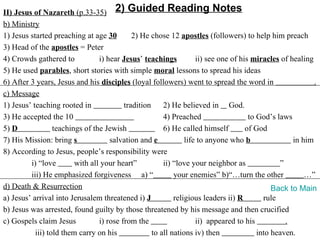
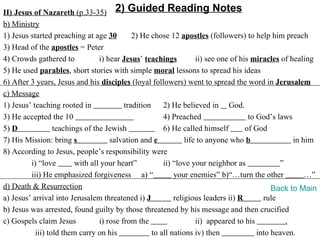
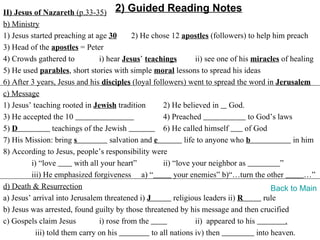
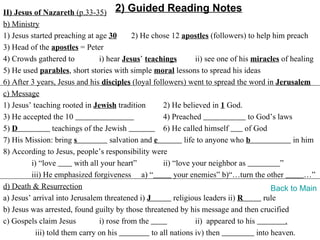
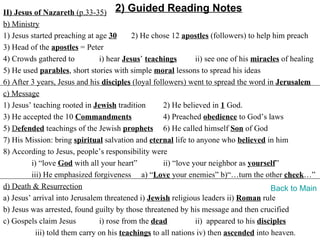
II) Jesus of Nazareth (p.33-35) 2) Guided Reading Notes
b) Ministry
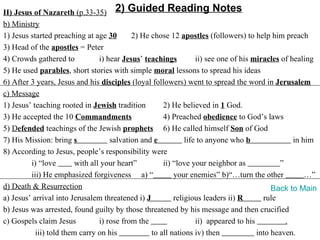
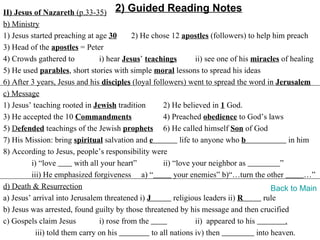
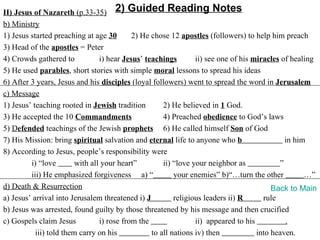
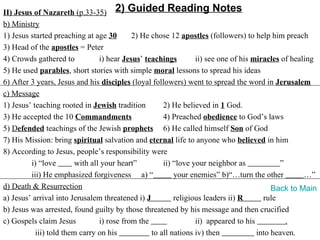
1) Jesus started preaching at age 30       2) He chose 12 apostles (followers) to help him preach
3) Head of the apostles = Peter
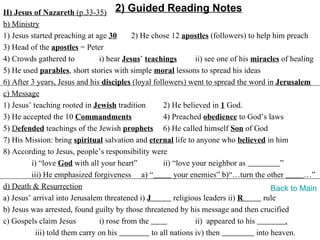
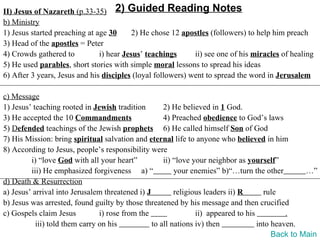
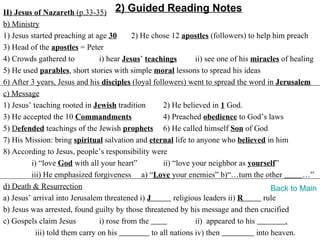
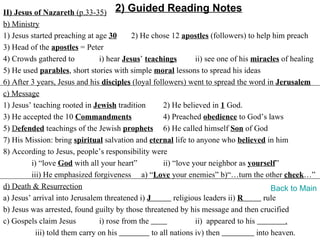
4) Crowds gathered to           i) hear Jesus’ teachings        ii) see one of his miracles of healing
5) He used parables, short stories with simple moral lessons to spread his ideas
6) After 3 years, Jesus and his disciples (loyal followers) went to spread the word in Jerusalem
c) Message
1) Jesus’ teaching rooted in Jewish tradition        2) He believed in 1 God.
3) He accepted the 10 Commandments                   4) Preached obedience to God’s laws
5) Defended teachings of the Jewish prophets 6) He called himself Son of God
7) His Mission: bring spiritual salvation and eternal life to anyone who believed in him
8) According to Jesus, people’s responsibility were
         i) “love God with all your heart”           ii) “love your neighbor as yourself”
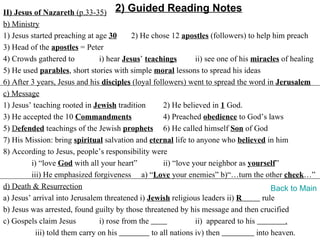
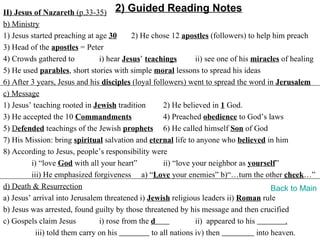
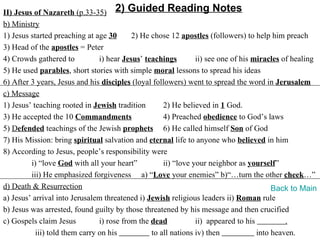
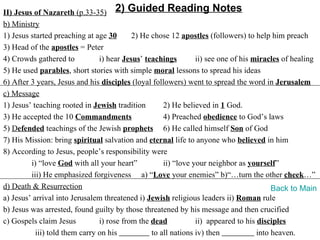
         iii) He emphasized forgiveness a) “Love your enemies” b)“…turn the other cheek…”
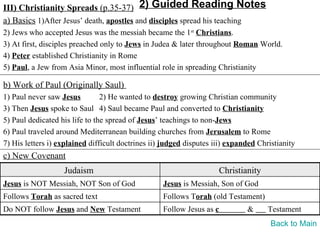
d) Death & Resurrection                                                                  Back to Main
a) Jesus’ arrival into Jerusalem threatened i) Jewish religious leaders ii) Roman rule
b) Jesus was arrested, found guilty by those threatened by his message and then crucified
c) Gospels claim Jesus          i) rose from the d              ii) appeared to his          .
           iii) told them carry on his           to all nations iv) then            into heaven.
II) Jesus of Nazareth (p.33-35) 2) Guided Reading Notes
b) Ministry
1) Jesus started preaching at age 30       2) He chose 12 apostles (followers) to help him preach
3) Head of the apostles = Peter
4) Crowds gathered to           i) hear Jesus’ teachings        ii) see one of his miracles of healing
5) He used parables, short stories with simple moral lessons to spread his ideas
6) After 3 years, Jesus and his disciples (loyal followers) went to spread the word in Jerusalem
c) Message
1) Jesus’ teaching rooted in Jewish tradition        2) He believed in 1 God.
3) He accepted the 10 Commandments                   4) Preached obedience to God’s laws
5) Defended teachings of the Jewish prophets 6) He called himself Son of God
7) His Mission: bring spiritual salvation and eternal life to anyone who believed in him
8) According to Jesus, people’s responsibility were
         i) “love God with all your heart”           ii) “love your neighbor as yourself”
         iii) He emphasized forgiveness a) “Love your enemies” b)“…turn the other cheek…”
d) Death & Resurrection                                                                  Back to Main
a) Jesus’ arrival into Jerusalem threatened i) Jewish religious leaders ii) Roman rule
b) Jesus was arrested, found guilty by those threatened by his message and then crucified
c) Gospels claim Jesus          i) rose from the dead           ii) appeared to his          .
           iii) told them carry on his           to all nations iv) then            into heaven.
II) Jesus of Nazareth (p.33-35) 2) Guided Reading Notes
b) Ministry
1) Jesus started preaching at age 30       2) He chose 12 apostles (followers) to help him preach
3) Head of the apostles = Peter
4) Crowds gathered to           i) hear Jesus’ teachings        ii) see one of his miracles of healing
5) He used parables, short stories with simple moral lessons to spread his ideas
6) After 3 years, Jesus and his disciples (loyal followers) went to spread the word in Jerusalem
c) Message
1) Jesus’ teaching rooted in Jewish tradition        2) He believed in 1 God.
3) He accepted the 10 Commandments                   4) Preached obedience to God’s laws
5) Defended teachings of the Jewish prophets 6) He called himself Son of God
7) His Mission: bring spiritual salvation and eternal life to anyone who believed in him
8) According to Jesus, people’s responsibility were
         i) “love God with all your heart”           ii) “love your neighbor as yourself”
         iii) He emphasized forgiveness a) “Love your enemies” b)“…turn the other cheek…”
d) Death & Resurrection                                                                  Back to Main
a) Jesus’ arrival into Jerusalem threatened i) Jewish religious leaders ii) Roman rule
b) Jesus was arrested, found guilty by those threatened by his message and then crucified
c) Gospels claim Jesus          i) rose from the dead           ii) appeared to his disciples
           iii) told them carry on his           to all nations iv) then            into heaven.
II) Jesus of Nazareth (p.33-35) 2) Guided Reading Notes
b) Ministry
1) Jesus started preaching at age 30       2) He chose 12 apostles (followers) to help him preach
3) Head of the apostles = Peter
4) Crowds gathered to           i) hear Jesus’ teachings        ii) see one of his miracles of healing
5) He used parables, short stories with simple moral lessons to spread his ideas
6) After 3 years, Jesus and his disciples (loyal followers) went to spread the word in Jerusalem
c) Message
1) Jesus’ teaching rooted in Jewish tradition        2) He believed in 1 God.
3) He accepted the 10 Commandments                   4) Preached obedience to God’s laws
5) Defended teachings of the Jewish prophets 6) He called himself Son of God
7) His Mission: bring spiritual salvation and eternal life to anyone who believed in him
8) According to Jesus, people’s responsibility were
         i) “love God with all your heart”           ii) “love your neighbor as yourself”
         iii) He emphasized forgiveness a) “Love your enemies” b)“…turn the other cheek…”
d) Death & Resurrection                                                                 Back to Main
a) Jesus’ arrival into Jerusalem threatened i) Jewish religious leaders ii) Roman rule
b) Jesus was arrested, found guilty by those threatened by his message and then crucified
c) Gospels claim Jesus          i) rose from the dead           ii) appeared to his disciples
           iii) told them carry on his teachings to all nations iv) then            into heaven.
II) Jesus of Nazareth (p.33-35) 2) Guided Reading Notes
b) Ministry
1) Jesus started preaching at age 30       2) He chose 12 apostles (followers) to help him preach
3) Head of the apostles = Peter
4) Crowds gathered to           i) hear Jesus’ teachings        ii) see one of his miracles of healing
5) He used parables, short stories with simple moral lessons to spread his ideas
6) After 3 years, Jesus and his disciples (loyal followers) went to spread the word in Jerusalem
c) Message
1) Jesus’ teaching rooted in Jewish tradition        2) He believed in 1 God.
3) He accepted the 10 Commandments                   4) Preached obedience to God’s laws
5) Defended teachings of the Jewish prophets 6) He called himself Son of God
7) His Mission: bring spiritual salvation and eternal life to anyone who believed in him
8) According to Jesus, people’s responsibility were
         i) “love God with all your heart”           ii) “love your neighbor as yourself”
         iii) He emphasized forgiveness a) “Love your enemies” b)“…turn the other cheek…”
d) Death & Resurrection                                                                 Back to Main
a) Jesus’ arrival into Jerusalem threatened i) Jewish religious leaders ii) Roman rule
b) Jesus was arrested, found guilty by those threatened by his message and then crucified
c) Gospels claim Jesus          i) rose from the dead           ii) appeared to his disciples
           iii) told them carry on his teachings to all nations iv) then ascended into heaven.
III) Christianity Spreads (p.35-37) III) Christianity Spreads (start)
a) Basics 1)After Jesus’ death, a   and d       spread his teaching
2) Jews who accepted Jesus was the messiah became the 1st                 .
3) At first, disciples preached only to      in Judea & later throughout          World.
4) P       established Christianity in Rome
5) P     , a Jew from Asia Minor, most influential role in spreading Christianity

b) Work of Paul (Originally Saul)
1) Paul never saw               2) He wanted to             growing Christian community
3) Then          spoke to Saul 4) Saul became Paul and converted to                      .
5) Paul dedicated his life to the spread of          ’ teachings to non-      .
6) Paul traveled around Mediterranean building churches from                    to Rome
7) His letters i) e          difficult doctrines ii) j        disputes iii) e      Christianity
c) New Covenant
                    Judaism                                             Christianity
          is NOT Messiah, NOT Son of God                    is Messiah, Son of God
Follows          as sacred text                     Follows          (old Testament)
Do NOT follow           and       Testament         Follow Jesus as c           &      Testament


                                                                                        Back to Main
III) Christianity Spreads (p.35-37) 2) Guided Reading Notes
a) Basics 1)After Jesus’ death, apostles and d spread his teaching
2) Jews who accepted Jesus was the messiah became the 1st                 .
3) At first, disciples preached only to      in Judea & later throughout          World.
4) P       established Christianity in Rome
5) P     , a Jew from Asia Minor, most influential role in spreading Christianity

b) Work of Paul (Originally Saul)
1) Paul never saw               2) He wanted to             growing Christian community
3) Then          spoke to Saul 4) Saul became Paul and converted to                      .
5) Paul dedicated his life to the spread of          ’ teachings to non-      .
6) Paul traveled around Mediterranean building churches from                    to Rome
7) His letters i) e          difficult doctrines ii) j        disputes iii) e      Christianity
c) New Covenant
                    Judaism                                             Christianity
          is NOT Messiah, NOT Son of God                    is Messiah, Son of God
Follows          as sacred text                     Follows          (old Testament)
Do NOT follow           and       Testament         Follow Jesus as c           &      Testament
                                                                                        Back to Main
III) Christianity Spreads (p.35-37) 2) Guided Reading Notes
a) Basics 1)After Jesus’ death, apostles and disciples spread his teaching
2) Jews who accepted Jesus was the messiah became the 1st                 .
3) At first, disciples preached only to      in Judea & later throughout          World.
4) P       established Christianity in Rome
5) P     , a Jew from Asia Minor, most influential role in spreading Christianity

b) Work of Paul (Originally Saul)
1) Paul never saw               2) He wanted to             growing Christian community
3) Then          spoke to Saul 4) Saul became Paul and converted to                      .
5) Paul dedicated his life to the spread of          ’ teachings to non-      .
6) Paul traveled around Mediterranean building churches from                    to Rome
7) His letters i) e          difficult doctrines ii) j        disputes iii) e      Christianity
c) New Covenant
                    Judaism                                             Christianity
          is NOT Messiah, NOT Son of God                    is Messiah, Son of God
Follows          as sacred text                     Follows          (old Testament)
Do NOT follow           and       Testament         Follow Jesus as c           &      Testament
                                                                                        Back to Main
III) Christianity Spreads (p.35-37) 2) Guided Reading Notes
a) Basics 1)After Jesus’ death, apostles and disciples spread his teaching
2) Jews who accepted Jesus was the messiah became the 1st Christians.
3) At first, disciples preached only to      in Judea & later throughout          World.
4) P       established Christianity in Rome
5) P     , a Jew from Asia Minor, most influential role in spreading Christianity

b) Work of Paul (Originally Saul)
1) Paul never saw               2) He wanted to             growing Christian community
3) Then          spoke to Saul 4) Saul became Paul and converted to                      .
5) Paul dedicated his life to the spread of          ’ teachings to non-      .
6) Paul traveled around Mediterranean building churches from                    to Rome
7) His letters i) e          difficult doctrines ii) j        disputes iii) e      Christianity
c) New Covenant
                    Judaism                                             Christianity
          is NOT Messiah, NOT Son of God                    is Messiah, Son of God
Follows          as sacred text                     Follows          (old Testament)
Do NOT follow           and       Testament         Follow Jesus as c           &      Testament
                                                                                        Back to Main
III) Christianity Spreads (p.35-37) 2) Guided Reading Notes
a) Basics 1)After Jesus’ death, apostles and disciples spread his teaching
2) Jews who accepted Jesus was the messiah became the 1st Christians.
3) At first, disciples preached only to Jews in Judea & later throughout          World.
4) P       established Christianity in Rome
5) P     , a Jew from Asia Minor, most influential role in spreading Christianity

b) Work of Paul (Originally Saul)
1) Paul never saw               2) He wanted to             growing Christian community
3) Then          spoke to Saul 4) Saul became Paul and converted to                      .
5) Paul dedicated his life to the spread of          ’ teachings to non-      .
6) Paul traveled around Mediterranean building churches from                    to Rome
7) His letters i) e          difficult doctrines ii) j        disputes iii) e      Christianity
c) New Covenant
                    Judaism                                             Christianity
          is NOT Messiah, NOT Son of God                    is Messiah, Son of God
Follows          as sacred text                     Follows          (old Testament)
Do NOT follow           and       Testament         Follow Jesus as c           &      Testament
                                                                                        Back to Main
III) Christianity Spreads (p.35-37) 2) Guided Reading Notes
a) Basics 1)After Jesus’ death, apostles and disciples spread his teaching
2) Jews who accepted Jesus was the messiah became the 1st Christians.
3) At first, disciples preached only to Jews in Judea & later throughout Roman World.
4) P       established Christianity in Rome
5) P     , a Jew from Asia Minor, most influential role in spreading Christianity

b) Work of Paul (Originally Saul)
1) Paul never saw               2) He wanted to             growing Christian community
3) Then          spoke to Saul 4) Saul became Paul and converted to                      .
5) Paul dedicated his life to the spread of          ’ teachings to non-      .
6) Paul traveled around Mediterranean building churches from                    to Rome
7) His letters i) e          difficult doctrines ii) j        disputes iii) e      Christianity
c) New Covenant
                    Judaism                                             Christianity
          is NOT Messiah, NOT Son of God                    is Messiah, Son of God
Follows          as sacred text                     Follows          (old Testament)
Do NOT follow           and       Testament         Follow Jesus as c           &      Testament
                                                                                        Back to Main
III) Christianity Spreads (p.35-37) 2) Guided Reading Notes
a) Basics 1)After Jesus’ death, apostles and disciples spread his teaching
2) Jews who accepted Jesus was the messiah became the 1st Christians.
3) At first, disciples preached only to Jews in Judea & later throughout Roman World.
4) Peter established Christianity in Rome
5) P     , a Jew from Asia Minor, most influential role in spreading Christianity

b) Work of Paul (Originally Saul)
1) Paul never saw               2) He wanted to             growing Christian community
3) Then          spoke to Saul 4) Saul became Paul and converted to                      .
5) Paul dedicated his life to the spread of          ’ teachings to non-      .
6) Paul traveled around Mediterranean building churches from                    to Rome
7) His letters i) e          difficult doctrines ii) j        disputes iii) e      Christianity
c) New Covenant
                    Judaism                                             Christianity
          is NOT Messiah, NOT Son of God                    is Messiah, Son of God
Follows          as sacred text                     Follows          (old Testament)
Do NOT follow           and       Testament         Follow Jesus as c           &      Testament
                                                                                        Back to Main
III) Christianity Spreads (p.35-37) 2) Guided Reading Notes
a) Basics 1)After Jesus’ death, apostles and disciples spread his teaching
2) Jews who accepted Jesus was the messiah became the 1st Christians.
3) At first, disciples preached only to Jews in Judea & later throughout Roman World.
4) Peter established Christianity in Rome
5) Paul, a Jew from Asia Minor, most influential role in spreading Christianity

b) Work of Paul (Originally Saul)
1) Paul never saw               2) He wanted to             growing Christian community
3) Then          spoke to Saul 4) Saul became Paul and converted to                      .
5) Paul dedicated his life to the spread of          ’ teachings to non-      .
6) Paul traveled around Mediterranean building churches from                    to Rome
7) His letters i) e          difficult doctrines ii) j        disputes iii) e      Christianity
c) New Covenant
                    Judaism                                             Christianity
          is NOT Messiah, NOT Son of God                    is Messiah, Son of God
Follows          as sacred text                     Follows          (old Testament)
Do NOT follow           and       Testament         Follow Jesus as c           &      Testament
                                                                                        Back to Main
III) Christianity Spreads (p.35-37) 2) Guided Reading Notes
a) Basics 1)After Jesus’ death, apostles and disciples spread his teaching
2) Jews who accepted Jesus was the messiah became the 1st Christians.
3) At first, disciples preached only to Jews in Judea & later throughout Roman World.
4) Peter established Christianity in Rome
5) Paul, a Jew from Asia Minor, most influential role in spreading Christianity

b) Work of Paul (Originally Saul)
1) Paul never saw Jesus         2) He wanted to             growing Christian community
3) Then          spoke to Saul 4) Saul became Paul and converted to                      .
5) Paul dedicated his life to the spread of          ’ teachings to non-      .
6) Paul traveled around Mediterranean building churches from                    to Rome
7) His letters i) e          difficult doctrines ii) j        disputes iii) e      Christianity
c) New Covenant
                    Judaism                                             Christianity
          is NOT Messiah, NOT Son of God                    is Messiah, Son of God
Follows          as sacred text                     Follows          (old Testament)
Do NOT follow           and       Testament         Follow Jesus as c           &      Testament
                                                                                        Back to Main
III) Christianity Spreads (p.35-37) 2) Guided Reading Notes
a) Basics 1)After Jesus’ death, apostles and disciples spread his teaching
2) Jews who accepted Jesus was the messiah became the 1st Christians.
3) At first, disciples preached only to Jews in Judea & later throughout Roman World.
4) Peter established Christianity in Rome
5) Paul, a Jew from Asia Minor, most influential role in spreading Christianity

b) Work of Paul (Originally Saul)
1) Paul never saw Jesus         2) He wanted to destroy growing Christian community
3) Then          spoke to Saul 4) Saul became Paul and converted to                      .
5) Paul dedicated his life to the spread of          ’ teachings to non-      .
6) Paul traveled around Mediterranean building churches from                    to Rome
7) His letters i) e          difficult doctrines ii) j        disputes iii) e      Christianity
c) New Covenant
                    Judaism                                             Christianity
          is NOT Messiah, NOT Son of God                    is Messiah, Son of God
Follows          as sacred text                     Follows          (old Testament)
Do NOT follow           and       Testament         Follow Jesus as c           &      Testament
                                                                                        Back to Main
III) Christianity Spreads (p.35-37) 2) Guided Reading Notes
a) Basics 1)After Jesus’ death, apostles and disciples spread his teaching
2) Jews who accepted Jesus was the messiah became the 1st Christians.
3) At first, disciples preached only to Jews in Judea & later throughout Roman World.
4) Peter established Christianity in Rome
5) Paul, a Jew from Asia Minor, most influential role in spreading Christianity

b) Work of Paul (Originally Saul)
1) Paul never saw Jesus         2) He wanted to destroy growing Christian community
3) Then Jesus spoke to Saul 4) Saul became Paul and converted to                         .
5) Paul dedicated his life to the spread of          ’ teachings to non-      .
6) Paul traveled around Mediterranean building churches from                    to Rome
7) His letters i) e          difficult doctrines ii) j        disputes iii) e      Christianity
c) New Covenant
                    Judaism                                             Christianity
          is NOT Messiah, NOT Son of God                    is Messiah, Son of God
Follows          as sacred text                     Follows          (old Testament)
Do NOT follow           and       Testament         Follow Jesus as c           &      Testament
                                                                                        Back to Main
III) Christianity Spreads (p.35-37) 2) Guided Reading Notes
a) Basics 1)After Jesus’ death, apostles and disciples spread his teaching
2) Jews who accepted Jesus was the messiah became the 1st Christians.
3) At first, disciples preached only to Jews in Judea & later throughout Roman World.
4) Peter established Christianity in Rome
5) Paul, a Jew from Asia Minor, most influential role in spreading Christianity

b) Work of Paul (Originally Saul)
1) Paul never saw Jesus         2) He wanted to destroy growing Christian community
3) Then Jesus spoke to Saul 4) Saul became Paul and converted to Christianity
5) Paul dedicated his life to the spread of          ’ teachings to non-      .
6) Paul traveled around Mediterranean building churches from                    to Rome
7) His letters i) e          difficult doctrines ii) j        disputes iii) e      Christianity
c) New Covenant
                    Judaism                                             Christianity
          is NOT Messiah, NOT Son of God                    is Messiah, Son of God
Follows          as sacred text                     Follows          (old Testament)
Do NOT follow           and       Testament         Follow Jesus as c           &      Testament
                                                                                        Back to Main
III) Christianity Spreads (p.35-37) 2) Guided Reading Notes
a) Basics 1)After Jesus’ death, apostles and disciples spread his teaching
2) Jews who accepted Jesus was the messiah became the 1st Christians.
3) At first, disciples preached only to Jews in Judea & later throughout Roman World.
4) Peter established Christianity in Rome
5) Paul, a Jew from Asia Minor, most influential role in spreading Christianity

b) Work of Paul (Originally Saul)
1) Paul never saw Jesus         2) He wanted to destroy growing Christian community
3) Then Jesus spoke to Saul 4) Saul became Paul and converted to Christianity
5) Paul dedicated his life to the spread of Jesus’ teachings to non-      .
6) Paul traveled around Mediterranean building churches from                to Rome
7) His letters i) e          difficult doctrines ii) j    disputes iii) e      Christianity
c) New Covenant
                   Judaism                                            Christianity
          is NOT Messiah, NOT Son of God                 is Messiah, Son of God
Follows         as sacred text                    Follows         (old Testament)
Do NOT follow          and       Testament        Follow Jesus as c           &      Testament
                                                                                     Back to Main
III) Christianity Spreads (p.35-37) 2) Guided Reading Notes
a) Basics 1)After Jesus’ death, apostles and disciples spread his teaching
2) Jews who accepted Jesus was the messiah became the 1st Christians.
3) At first, disciples preached only to Jews in Judea & later throughout Roman World.
4) Peter established Christianity in Rome
5) Paul, a Jew from Asia Minor, most influential role in spreading Christianity

b) Work of Paul (Originally Saul)
1) Paul never saw Jesus         2) He wanted to destroy growing Christian community
3) Then Jesus spoke to Saul 4) Saul became Paul and converted to Christianity
5) Paul dedicated his life to the spread of Jesus’ teachings to non-Jews
6) Paul traveled around Mediterranean building churches from               to Rome
7) His letters i) e          difficult doctrines ii) j    disputes iii) e     Christianity
c) New Covenant
                   Judaism                                            Christianity
          is NOT Messiah, NOT Son of God                 is Messiah, Son of God
Follows         as sacred text                    Follows        (old Testament)
Do NOT follow          and       Testament        Follow Jesus as c           &      Testament
                                                                                     Back to Main
III) Christianity Spreads (p.35-37) 2) Guided Reading Notes
a) Basics 1)After Jesus’ death, apostles and disciples spread his teaching
2) Jews who accepted Jesus was the messiah became the 1st Christians.
3) At first, disciples preached only to Jews in Judea & later throughout Roman World.
4) Peter established Christianity in Rome
5) Paul, a Jew from Asia Minor, most influential role in spreading Christianity

b) Work of Paul (Originally Saul)
1) Paul never saw Jesus         2) He wanted to destroy growing Christian community
3) Then Jesus spoke to Saul 4) Saul became Paul and converted to Christianity
5) Paul dedicated his life to the spread of Jesus’ teachings to non-Jews
6) Paul traveled around Mediterranean building churches from Jerusalem to Rome
7) His letters i) e          difficult doctrines ii) j    disputes iii) e    Christianity
c) New Covenant
                   Judaism                                           Christianity
          is NOT Messiah, NOT Son of God                is Messiah, Son of God
Follows         as sacred text                   Follows         (old Testament)
Do NOT follow          and       Testament       Follow Jesus as c           &      Testament
                                                                                    Back to Main
III) Christianity Spreads (p.35-37) 2) Guided Reading Notes
a) Basics 1)After Jesus’ death, apostles and disciples spread his teaching
2) Jews who accepted Jesus was the messiah became the 1st Christians.
3) At first, disciples preached only to Jews in Judea & later throughout Roman World.
4) Peter established Christianity in Rome
5) Paul, a Jew from Asia Minor, most influential role in spreading Christianity

b) Work of Paul (Originally Saul)
1) Paul never saw Jesus         2) He wanted to destroy growing Christian community
3) Then Jesus spoke to Saul 4) Saul became Paul and converted to Christianity
5) Paul dedicated his life to the spread of Jesus’ teachings to non-Jews
6) Paul traveled around Mediterranean building churches from Jerusalem to Rome
7) His letters i) explained difficult doctrines ii) j     disputes iii) e    Christianity
c) New Covenant
                   Judaism                                           Christianity
          is NOT Messiah, NOT Son of God                is Messiah, Son of God
Follows         as sacred text                   Follows         (old Testament)
Do NOT follow          and       Testament       Follow Jesus as c           &      Testament
                                                                                    Back to Main
III) Christianity Spreads (p.35-37) 2) Guided Reading Notes
a) Basics 1)After Jesus’ death, apostles and disciples spread his teaching
2) Jews who accepted Jesus was the messiah became the 1st Christians.
3) At first, disciples preached only to Jews in Judea & later throughout Roman World.
4) Peter established Christianity in Rome
5) Paul, a Jew from Asia Minor, most influential role in spreading Christianity

b) Work of Paul (Originally Saul)
1) Paul never saw Jesus         2) He wanted to destroy growing Christian community
3) Then Jesus spoke to Saul 4) Saul became Paul and converted to Christianity
5) Paul dedicated his life to the spread of Jesus’ teachings to non-Jews
6) Paul traveled around Mediterranean building churches from Jerusalem to Rome
7) His letters i) explained difficult doctrines ii) judged disputes iii) e   Christianity
c) New Covenant
                   Judaism                                           Christianity
          is NOT Messiah, NOT Son of God                is Messiah, Son of God
Follows         as sacred text                   Follows        (old Testament)
Do NOT follow          and       Testament       Follow Jesus as c           &      Testament
                                                                                    Back to Main
III) Christianity Spreads (p.35-37) 2) Guided Reading Notes
a) Basics 1)After Jesus’ death, apostles and disciples spread his teaching
2) Jews who accepted Jesus was the messiah became the 1st Christians.
3) At first, disciples preached only to Jews in Judea & later throughout Roman World.
4) Peter established Christianity in Rome
5) Paul, a Jew from Asia Minor, most influential role in spreading Christianity

b) Work of Paul (Originally Saul)
1) Paul never saw Jesus         2) He wanted to destroy growing Christian community
3) Then Jesus spoke to Saul 4) Saul became Paul and converted to Christianity
5) Paul dedicated his life to the spread of Jesus’ teachings to non-Jews
6) Paul traveled around Mediterranean building churches from Jerusalem to Rome
7) His letters i) explained difficult doctrines ii) judged disputes iii) expanded Christianity
c) New Covenant
                   Judaism                                             Christianity
          is NOT Messiah, NOT Son of God                  is Messiah, Son of God
Follows         as sacred text                     Follows         (old Testament)
Do NOT follow           and      Testament         Follow Jesus as c           &      Testament
                                                                                      Back to Main
III) Christianity Spreads (p.35-37) 2) Guided Reading Notes
a) Basics 1)After Jesus’ death, apostles and disciples spread his teaching
2) Jews who accepted Jesus was the messiah became the 1st Christians.
3) At first, disciples preached only to Jews in Judea & later throughout Roman World.
4) Peter established Christianity in Rome
5) Paul, a Jew from Asia Minor, most influential role in spreading Christianity

b) Work of Paul (Originally Saul)
1) Paul never saw Jesus         2) He wanted to destroy growing Christian community
3) Then Jesus spoke to Saul 4) Saul became Paul and converted to Christianity
5) Paul dedicated his life to the spread of Jesus’ teachings to non-Jews
6) Paul traveled around Mediterranean building churches from Jerusalem to Rome
7) His letters i) explained difficult doctrines ii) judged disputes iii) expanded Christianity
c) New Covenant
                   Judaism                                             Christianity
Jesus is NOT Messiah, NOT Son of God                      is Messiah, Son of God
Follows         as sacred text                     Follows         (old Testament)
Do NOT follow           and      Testament         Follow Jesus as c           &      Testament
                                                                                      Back to Main
III) Christianity Spreads (p.35-37) 2) Guided Reading Notes
a) Basics 1)After Jesus’ death, apostles and disciples spread his teaching
2) Jews who accepted Jesus was the messiah became the 1st Christians.
3) At first, disciples preached only to Jews in Judea & later throughout Roman World.
4) Peter established Christianity in Rome
5) Paul, a Jew from Asia Minor, most influential role in spreading Christianity

b) Work of Paul (Originally Saul)
1) Paul never saw Jesus         2) He wanted to destroy growing Christian community
3) Then Jesus spoke to Saul 4) Saul became Paul and converted to Christianity
5) Paul dedicated his life to the spread of Jesus’ teachings to non-Jews
6) Paul traveled around Mediterranean building churches from Jerusalem to Rome
7) His letters i) explained difficult doctrines ii) judged disputes iii) expanded Christianity
c) New Covenant
                   Judaism                                             Christianity
Jesus is NOT Messiah, NOT Son of God               Jesus is Messiah, Son of God
Follows         as sacred text                     Follows         (old Testament)
Do NOT follow           and      Testament         Follow Jesus as c           &      Testament
                                                                                      Back to Main
III) Christianity Spreads (p.35-37) 2) Guided Reading Notes
a) Basics 1)After Jesus’ death, apostles and disciples spread his teaching
2) Jews who accepted Jesus was the messiah became the 1st Christians.
3) At first, disciples preached only to Jews in Judea & later throughout Roman World.
4) Peter established Christianity in Rome
5) Paul, a Jew from Asia Minor, most influential role in spreading Christianity

b) Work of Paul (Originally Saul)
1) Paul never saw Jesus         2) He wanted to destroy growing Christian community
3) Then Jesus spoke to Saul 4) Saul became Paul and converted to Christianity
5) Paul dedicated his life to the spread of Jesus’ teachings to non-Jews
6) Paul traveled around Mediterranean building churches from Jerusalem to Rome
7) His letters i) explained difficult doctrines ii) judged disputes iii) expanded Christianity
c) New Covenant
                   Judaism                                             Christianity
Jesus is NOT Messiah, NOT Son of God               Jesus is Messiah, Son of God
Follows Torah as sacred text                       Follows         (old Testament)
Do NOT follow           and      Testament         Follow Jesus as c           &      Testament
                                                                                      Back to Main
III) Christianity Spreads (p.35-37) 2) Guided Reading Notes
a) Basics 1)After Jesus’ death, apostles and disciples spread his teaching
2) Jews who accepted Jesus was the messiah became the 1st Christians.
3) At first, disciples preached only to Jews in Judea & later throughout Roman World.
4) Peter established Christianity in Rome
5) Paul, a Jew from Asia Minor, most influential role in spreading Christianity

b) Work of Paul (Originally Saul)
1) Paul never saw Jesus         2) He wanted to destroy growing Christian community
3) Then Jesus spoke to Saul 4) Saul became Paul and converted to Christianity
5) Paul dedicated his life to the spread of Jesus’ teachings to non-Jews
6) Paul traveled around Mediterranean building churches from Jerusalem to Rome
7) His letters i) explained difficult doctrines ii) judged disputes iii) expanded Christianity
c) New Covenant
                   Judaism                                             Christianity
Jesus is NOT Messiah, NOT Son of God               Jesus is Messiah, Son of God
Follows Torah as sacred text                       Follows Torah (old Testament)
Do NOT follow           and      Testament         Follow Jesus as c           &      Testament
                                                                                      Back to Main
III) Christianity Spreads (p.35-37) 2) Guided Reading Notes
a) Basics 1)After Jesus’ death, apostles and disciples spread his teaching
2) Jews who accepted Jesus was the messiah became the 1st Christians.
3) At first, disciples preached only to Jews in Judea & later throughout Roman World.
4) Peter established Christianity in Rome
5) Paul, a Jew from Asia Minor, most influential role in spreading Christianity

b) Work of Paul (Originally Saul)
1) Paul never saw Jesus         2) He wanted to destroy growing Christian community
3) Then Jesus spoke to Saul 4) Saul became Paul and converted to Christianity
5) Paul dedicated his life to the spread of Jesus’ teachings to non-Jews
6) Paul traveled around Mediterranean building churches from Jerusalem to Rome
7) His letters i) explained difficult doctrines ii) judged disputes iii) expanded Christianity
c) New Covenant
                   Judaism                                             Christianity
Jesus is NOT Messiah, NOT Son of God               Jesus is Messiah, Son of God
Follows Torah as sacred text                       Follows Torah (old Testament)
Do NOT follow Jesus and New Testament              Follow Jesus as c           &      Testament
                                                                                      Back to Main
III) Christianity Spreads (p.35-37) 2) Guided Reading Notes
a) Basics 1)After Jesus’ death, apostles and disciples spread his teaching
2) Jews who accepted Jesus was the messiah became the 1st Christians.
3) At first, disciples preached only to Jews in Judea & later throughout Roman World.
4) Peter established Christianity in Rome
5) Paul, a Jew from Asia Minor, most influential role in spreading Christianity

b) Work of Paul (Originally Saul)
1) Paul never saw Jesus         2) He wanted to destroy growing Christian community
3) Then Jesus spoke to Saul 4) Saul became Paul and converted to Christianity
5) Paul dedicated his life to the spread of Jesus’ teachings to non-Jews
6) Paul traveled around Mediterranean building churches from Jerusalem to Rome
7) His letters i) explained difficult doctrines ii) judged disputes iii) expanded Christianity
c) New Covenant
                   Judaism                                           Christianity
Jesus is NOT Messiah, NOT Son of God               Jesus is Messiah, Son of God
Follows Torah as sacred text                       Follows Torah (old Testament)
Do NOT follow Jesus and New Testament              Follow Jesus as covenant & New Testament
                                                                                      Back to Main
2) Guided Reading Notes
III) Christianity Spreads (p.36-37)
d) Persecution
1) Christians did NOT accept R_____ ______. 2) Christians suspected of ________ to Rome
3) Romans persecute _________
4) Emperor _____ used Christians as _______, blaming them for Rome’s problems
5) Over centuries, thousands of Christians became ________ – suffer or die for their belief
6) _____ and _____ killed in Rome during the reign of Nero
e) Reasons for Christianity’s Appeal
•        Jesus welcomed all people especially _______, ______ and __________.
•        People found _______ in Jesus’ message of ______
•        Belief in ________ and dignity of all
•        Promise of better ____ after death
•        Paul added ideas of _______, the _______ and _______ thinkers to Jesus’ message
•        Addition of Greek philosophy to Christianity appealed to _______ Romans.
•        Easy travel for Christian missionaries on Roman ______ within Roman Empire
•        Early Christians wrote in ______ or ______, languages widely know across the Empire
f) Triumph
•        Roman persecution ended in ____ AD with Edict of Milano by Emperor ___________
•        Edict granted _________ of worship to all citizens of the Roman Empire
•        Constantine became the 1st _________ Emperor of the Holy Roman Empire
                                                                                   Back to Main
2) Guided Reading Notes
III) Christianity Spreads (p.36-37)
d) Persecution
1) Christians did NOT accept Roman _____.         2) Christians suspected of ________ to Rome
3) Romans persecute _________
4) Emperor _____ used Christians as _______, blaming them for Rome’s problems
5) Over centuries, thousands of Christians became ________ – suffer or die for their belief
6) _____ and _____ killed in Rome during the reign of Nero
e) Reasons for Christianity’s Appeal
•        Jesus welcomed all people especially _______, ______ and __________.
•        People found _______ in Jesus’ message of ______
•        Belief in ________ and dignity of all
•        Promise of better ____ after death
•        Paul added ideas of _______, the _______ and _______ thinkers to Jesus’ message
•        Addition of Greek philosophy to Christianity appealed to _______ Romans.
•        Easy travel for Christian missionaries on Roman ______ within Roman Empire
•        Early Christians wrote in ______ or ______, languages widely know across the Empire
f) Triumph
•        Roman persecution ended in ____ AD with Edict of Milano by Emperor ___________
•        Edict granted _________ of worship to all citizens of the Roman Empire
•        Constantine became the 1st _________ Emperor of the Holy Roman Empire
                                                                                   Back to Main
2) Guided Reading Notes
III) Christianity Spreads (p.36-37)
d) Persecution
1) Christians did NOT accept Roman gods.          2) Christians suspected of ________ to Rome
3) Romans persecute _________
4) Emperor _____ used Christians as _______, blaming them for Rome’s problems
5) Over centuries, thousands of Christians became ________ – suffer or die for their belief
6) _____ and _____ killed in Rome during the reign of Nero
e) Reasons for Christianity’s Appeal
•        Jesus welcomed all people especially _______, ______ and __________.
•        People found _______ in Jesus’ message of ______
•        Belief in ________ and dignity of all
•        Promise of better ____ after death
•        Paul added ideas of _______, the _______ and _______ thinkers to Jesus’ message
•        Addition of Greek philosophy to Christianity appealed to _______ Romans.
•        Easy travel for Christian missionaries on Roman ______ within Roman Empire
•        Early Christians wrote in ______ or ______, languages widely know across the Empire
f) Triumph
•        Roman persecution ended in ____ AD with Edict of Milano by Emperor ___________
•        Edict granted _________ of worship to all citizens of the Roman Empire
•        Constantine became the 1st _________ Emperor of the Holy Roman Empire
                                                                                   Back to Main
2) Guided Reading Notes
III) Christianity Spreads (p.36-37)
d) Persecution
1) Christians did NOT accept Roman gods.          2) Christians suspected of disloyalty to Rome
3) Romans persecute _________
4) Emperor _____ used Christians as _______, blaming them for Rome’s problems
5) Over centuries, thousands of Christians became ________ – suffer or die for their belief
6) _____ and _____ killed in Rome during the reign of Nero
e) Reasons for Christianity’s Appeal
•        Jesus welcomed all people especially _______, ______ and __________.
•        People found _______ in Jesus’ message of ______
•        Belief in ________ and dignity of all
•        Promise of better ____ after death
•        Paul added ideas of _______, the _______ and _______ thinkers to Jesus’ message
•        Addition of Greek philosophy to Christianity appealed to _______ Romans.
•        Easy travel for Christian missionaries on Roman ______ within Roman Empire
•        Early Christians wrote in ______ or ______, languages widely know across the Empire
f) Triumph
•        Roman persecution ended in ____ AD with Edict of Milano by Emperor ___________
•        Edict granted _________ of worship to all citizens of the Roman Empire
•        Constantine became the 1st _________ Emperor of the Holy Roman Empire
                                                                                    Back to Main
2) Guided Reading Notes
III) Christianity Spreads (p.36-37)
d) Persecution
1) Christians did NOT accept Roman gods.          2) Christians suspected of disloyalty to Rome
3) Romans persecute Christians
4) Emperor _____ used Christians as _______, blaming them for Rome’s problems
5) Over centuries, thousands of Christians became ________ – suffer or die for their belief
6) _____ and _____ killed in Rome during the reign of Nero
e) Reasons for Christianity’s Appeal
•        Jesus welcomed all people especially _______, ______ and __________.
•        People found _______ in Jesus’ message of ______
•        Belief in ________ and dignity of all
•        Promise of better ____ after death
•        Paul added ideas of _______, the _______ and _______ thinkers to Jesus’ message
•        Addition of Greek philosophy to Christianity appealed to _______ Romans.
•        Easy travel for Christian missionaries on Roman ______ within Roman Empire
•        Early Christians wrote in ______ or ______, languages widely know across the Empire
f) Triumph
•        Roman persecution ended in ____ AD with Edict of Milano by Emperor ___________
•        Edict granted _________ of worship to all citizens of the Roman Empire
•        Constantine became the 1st _________ Emperor of the Holy Roman Empire
                                                                                    Back to Main
2) Guided Reading Notes
III) Christianity Spreads (p.36-37)
d) Persecution
1) Christians did NOT accept Roman gods.          2) Christians suspected of disloyalty to Rome
3) Romans persecute Christians
4) Emperor Nero used Christians as _______, blaming them for Rome’s problems
5) Over centuries, thousands of Christians became ________ – suffer or die for their belief
6) _____ and _____ killed in Rome during the reign of Nero
e) Reasons for Christianity’s Appeal
•        Jesus welcomed all people especially _______, ______ and __________.
•        People found _______ in Jesus’ message of ______
•        Belief in ________ and dignity of all
•        Promise of better ____ after death
•        Paul added ideas of _______, the _______ and _______ thinkers to Jesus’ message
•        Addition of Greek philosophy to Christianity appealed to _______ Romans.
•        Easy travel for Christian missionaries on Roman ______ within Roman Empire
•        Early Christians wrote in ______ or ______, languages widely know across the Empire
f) Triumph
•        Roman persecution ended in ____ AD with Edict of Milano by Emperor ___________
•        Edict granted _________ of worship to all citizens of the Roman Empire
•        Constantine became the 1st _________ Emperor of the Holy Roman Empire
                                                                                    Back to Main
2) Guided Reading Notes
III) Christianity Spreads (p.36-37)
d) Persecution
1) Christians did NOT accept Roman gods.          2) Christians suspected of disloyalty to Rome
3) Romans persecute Christians
4) Emperor Nero used Christians as scapegoats, blaming them for Rome’s problems
5) Over centuries, thousands of Christians became ________ – suffer or die for their belief
6) _____ and _____ killed in Rome during the reign of Nero
e) Reasons for Christianity’s Appeal
•        Jesus welcomed all people especially _______, ______ and __________.
•        People found _______ in Jesus’ message of ______
•        Belief in ________ and dignity of all
•        Promise of better ____ after death
•        Paul added ideas of _______, the _______ and _______ thinkers to Jesus’ message
•        Addition of Greek philosophy to Christianity appealed to _______ Romans.
•        Easy travel for Christian missionaries on Roman ______ within Roman Empire
•        Early Christians wrote in ______ or ______, languages widely know across the Empire
f) Triumph
•        Roman persecution ended in ____ AD with Edict of Milano by Emperor ___________
•        Edict granted _________ of worship to all citizens of the Roman Empire
•        Constantine became the 1st _________ Emperor of the Holy Roman Empire
                                                                                    Back to Main
2) Guided Reading Notes
III) Christianity Spreads (p.36-37)
d) Persecution
1) Christians did NOT accept Roman gods.          2) Christians suspected of disloyalty to Rome
3) Romans persecute Christians
4) Emperor Nero used Christians as scapegoats, blaming them for Rome’s problems
5) Over centuries, thousands of Christians became martyred – suffer or die for their belief
6) _____ and _____ killed in Rome during the reign of Nero
e) Reasons for Christianity’s Appeal
•        Jesus welcomed all people especially _______, ______ and __________.
•        People found _______ in Jesus’ message of ______
•        Belief in ________ and dignity of all
•        Promise of better ____ after death
•        Paul added ideas of _______, the _______ and _______ thinkers to Jesus’ message
•        Addition of Greek philosophy to Christianity appealed to _______ Romans.
•        Easy travel for Christian missionaries on Roman ______ within Roman Empire
•        Early Christians wrote in ______ or ______, languages widely know across the Empire
f) Triumph
•        Roman persecution ended in ____ AD with Edict of Milano by Emperor ___________
•        Edict granted _________ of worship to all citizens of the Roman Empire
•        Constantine became the 1st _________ Emperor of the Holy Roman Empire
                                                                                    Back to Main
2) Guided Reading Notes
III) Christianity Spreads (p.36-37)
d) Persecution
1) Christians did NOT accept Roman gods.          2) Christians suspected of disloyalty to Rome
3) Romans persecute Christians
4) Emperor Nero used Christians as scapegoats, blaming them for Rome’s problems
5) Over centuries, thousands of Christians became martyred – suffer or die for their belief
6) Peter and _____ killed in Rome during the reign of Nero
e) Reasons for Christianity’s Appeal
•        Jesus welcomed all people especially _______, ______ and __________.
•        People found _______ in Jesus’ message of ______
•        Belief in ________ and dignity of all
•        Promise of better ____ after death
•        Paul added ideas of _______, the _______ and _______ thinkers to Jesus’ message
•        Addition of Greek philosophy to Christianity appealed to _______ Romans.
•        Easy travel for Christian missionaries on Roman ______ within Roman Empire
•        Early Christians wrote in ______ or ______, languages widely know across the Empire
f) Triumph
•        Roman persecution ended in ____ AD with Edict of Milano by Emperor ___________
•        Edict granted _________ of worship to all citizens of the Roman Empire
•        Constantine became the 1st _________ Emperor of the Holy Roman Empire
                                                                                    Back to Main
2) Guided Reading Notes
III) Christianity Spreads (p.36-37)
d) Persecution
1) Christians did NOT accept Roman gods.          2) Christians suspected of disloyalty to Rome
3) Romans persecute Christians
4) Emperor Nero used Christians as scapegoats, blaming them for Rome’s problems
5) Over centuries, thousands of Christians became martyred – suffer or die for their belief
6) Peter and Paul killed in Rome during the reign of Nero
e) Reasons for Christianity’s Appeal
•        Jesus welcomed all people especially _______, ______ and __________.
•        People found _______ in Jesus’ message of ______
•        Belief in ________ and dignity of all
•        Promise of better ____ after death
•        Paul added ideas of _______, the _______ and _______ thinkers to Jesus’ message
•        Addition of Greek philosophy to Christianity appealed to _______ Romans.
•        Easy travel for Christian missionaries on Roman ______ within Roman Empire
•        Early Christians wrote in ______ or ______, languages widely know across the Empire
f) Triumph
•        Roman persecution ended in ____ AD with Edict of Milano by Emperor ___________
•        Edict granted _________ of worship to all citizens of the Roman Empire
•        Constantine became the 1st _________ Emperor of the Holy Roman Empire
                                                                                    Back to Main
2) Guided Reading Notes
III) Christianity Spreads (p.36-37)
d) Persecution
1) Christians did NOT accept Roman gods.          2) Christians suspected of disloyalty to Rome
3) Romans persecute Christians
4) Emperor Nero used Christians as scapegoats, blaming them for Rome’s problems
5) Over centuries, thousands of Christians became martyred – suffer or die for their belief
6) Peter and Paul killed in Rome during the reign of Nero
e) Reasons for Christianity’s Appeal
•        Jesus welcomed all people especially humble, ______ and __________.
•        People found _______ in Jesus’ message of ______
•        Belief in ________ and dignity of all
•        Promise of better ____ after death
•        Paul added ideas of _______, the _______ and _______ thinkers to Jesus’ message
•        Addition of Greek philosophy to Christianity appealed to _______ Romans.
•        Easy travel for Christian missionaries on Roman ______ within Roman Empire
•        Early Christians wrote in ______ or ______, languages widely know across the Empire
f) Triumph
•        Roman persecution ended in ____ AD with Edict of Milano by Emperor ___________
•        Edict granted _________ of worship to all citizens of the Roman Empire
•        Constantine became the 1st _________ Emperor of the Holy Roman Empire
                                                                                    Back to Main
2) Guided Reading Notes
III) Christianity Spreads (p.36-37)
d) Persecution
1) Christians did NOT accept Roman gods.          2) Christians suspected of disloyalty to Rome
3) Romans persecute Christians
4) Emperor Nero used Christians as scapegoats, blaming them for Rome’s problems
5) Over centuries, thousands of Christians became martyred – suffer or die for their belief
6) Peter and Paul killed in Rome during the reign of Nero
e) Reasons for Christianity’s Appeal
•        Jesus welcomed all people especially humble, poor and __________.
•        People found _______ in Jesus’ message of ______
•        Belief in ________ and dignity of all
•        Promise of better ____ after death
•        Paul added ideas of _______, the _______ and _______ thinkers to Jesus’ message
•        Addition of Greek philosophy to Christianity appealed to _______ Romans.
•        Easy travel for Christian missionaries on Roman ______ within Roman Empire
•        Early Christians wrote in ______ or ______, languages widely know across the Empire
f) Triumph
•        Roman persecution ended in ____ AD with Edict of Milano by Emperor ___________
•        Edict granted _________ of worship to all citizens of the Roman Empire
•        Constantine became the 1st _________ Emperor of the Holy Roman Empire
                                                                                    Back to Main
2) Guided Reading Notes
III) Christianity Spreads (p.36-37)
d) Persecution
1) Christians did NOT accept Roman gods.          2) Christians suspected of disloyalty to Rome
3) Romans persecute Christians
4) Emperor Nero used Christians as scapegoats, blaming them for Rome’s problems
5) Over centuries, thousands of Christians became martyred – suffer or die for their belief
6) Peter and Paul killed in Rome during the reign of Nero
e) Reasons for Christianity’s Appeal
•        Jesus welcomed all people especially humble, poor and oppressed.
•        People found _______ in Jesus’ message of ______
•        Belief in ________ and dignity of all
•        Promise of better ____ after death
•        Paul added ideas of _______, the _______ and _______ thinkers to Jesus’ message
•        Addition of Greek philosophy to Christianity appealed to _______ Romans.
•        Easy travel for Christian missionaries on Roman ______ within Roman Empire
•        Early Christians wrote in ______ or ______, languages widely know across the Empire
f) Triumph
•        Roman persecution ended in ____ AD with Edict of Milano by Emperor ___________
•        Edict granted _________ of worship to all citizens of the Roman Empire
•        Constantine became the 1st _________ Emperor of the Holy Roman Empire
                                                                                    Back to Main
2) Guided Reading Notes
III) Christianity Spreads (p.36-37)
d) Persecution
1) Christians did NOT accept Roman gods.          2) Christians suspected of disloyalty to Rome
3) Romans persecute Christians
4) Emperor Nero used Christians as scapegoats, blaming them for Rome’s problems
5) Over centuries, thousands of Christians became martyred – suffer or die for their belief
6) Peter and Paul killed in Rome during the reign of Nero
e) Reasons for Christianity’s Appeal
•        Jesus welcomed all people especially humble, poor and oppressed.
•        People found comfort in Jesus’ message of ______
•        Belief in ________ and dignity of all
•        Promise of better ____ after death
•        Paul added ideas of _______, the _______ and _______ thinkers to Jesus’ message
•        Addition of Greek philosophy to Christianity appealed to _______ Romans.
•        Easy travel for Christian missionaries on Roman ______ within Roman Empire
•        Early Christians wrote in ______ or ______, languages widely know across the Empire
f) Triumph
•        Roman persecution ended in ____ AD with Edict of Milano by Emperor ___________
•        Edict granted _________ of worship to all citizens of the Roman Empire
•        Constantine became the 1st _________ Emperor of the Holy Roman Empire
                                                                                    Back to Main
2) Guided Reading Notes
III) Christianity Spreads (p.36-37)
d) Persecution
1) Christians did NOT accept Roman gods.          2) Christians suspected of disloyalty to Rome
3) Romans persecute Christians
4) Emperor Nero used Christians as scapegoats, blaming them for Rome’s problems
5) Over centuries, thousands of Christians became martyred – suffer or die for their belief
6) Peter and Paul killed in Rome during the reign of Nero
e) Reasons for Christianity’s Appeal
•        Jesus welcomed all people especially humble, poor and oppressed.
•        People found comfort in Jesus’ message of love
•        Belief in ________ and dignity of all
•        Promise of better ____ after death
•        Paul added ideas of _______, the _______ and _______ thinkers to Jesus’ message
•        Addition of Greek philosophy to Christianity appealed to _______ Romans.
•        Easy travel for Christian missionaries on Roman ______ within Roman Empire
•        Early Christians wrote in ______ or ______, languages widely know across the Empire
f) Triumph
•        Roman persecution ended in ____ AD with Edict of Milano by Emperor ___________
•        Edict granted _________ of worship to all citizens of the Roman Empire
•        Constantine became the 1st _________ Emperor of the Holy Roman Empire
                                                                                    Back to Main
2) Guided Reading Notes
III) Christianity Spreads (p.36-37)
d) Persecution
1) Christians did NOT accept Roman gods.          2) Christians suspected of disloyalty to Rome
3) Romans persecute Christians
4) Emperor Nero used Christians as scapegoats, blaming them for Rome’s problems
5) Over centuries, thousands of Christians became martyred – suffer or die for their belief
6) Peter and Paul killed in Rome during the reign of Nero
e) Reasons for Christianity’s Appeal
•        Jesus welcomed all people especially humble, poor and oppressed.
•        People found comfort in Jesus’ message of love
•        Belief in equality and dignity of all
•        Promise of better ____ after death
•        Paul added ideas of _______, the _______ and _______ thinkers to Jesus’ message
•        Addition of Greek philosophy to Christianity appealed to _______ Romans.
•        Easy travel for Christian missionaries on Roman ______ within Roman Empire
•        Early Christians wrote in ______ or ______, languages widely know across the Empire
f) Triumph
•        Roman persecution ended in ____ AD with Edict of Milano by Emperor ___________
•        Edict granted _________ of worship to all citizens of the Roman Empire
•        Constantine became the 1st _________ Emperor of the Holy Roman Empire
                                                                                    Back to Main
2) Guided Reading Notes
III) Christianity Spreads (p.36-37)
d) Persecution
1) Christians did NOT accept Roman gods.          2) Christians suspected of disloyalty to Rome
3) Romans persecute Christians
4) Emperor Nero used Christians as scapegoats, blaming them for Rome’s problems
5) Over centuries, thousands of Christians became martyred – suffer or die for their belief
6) Peter and Paul killed in Rome during the reign of Nero
e) Reasons for Christianity’s Appeal
•        Jesus welcomed all people especially humble, poor and oppressed.
•        People found comfort in Jesus’ message of love
•        Belief in equality and dignity of all
•        Promise of better life after death
•        Paul added ideas of _______, the _______ and _______ thinkers to Jesus’ message
•        Addition of Greek philosophy to Christianity appealed to _______ Romans.
•        Easy travel for Christian missionaries on Roman ______ within Roman Empire
•        Early Christians wrote in ______ or ______, languages widely know across the Empire
f) Triumph
•        Roman persecution ended in ____ AD with Edict of Milano by Emperor ___________
•        Edict granted _________ of worship to all citizens of the Roman Empire
•        Constantine became the 1st _________ Emperor of the Holy Roman Empire
                                                                                    Back to Main
2) Guided Reading Notes
III) Christianity Spreads (p.36-37)
d) Persecution
1) Christians did NOT accept Roman gods.          2) Christians suspected of disloyalty to Rome
3) Romans persecute Christians
4) Emperor Nero used Christians as scapegoats, blaming them for Rome’s problems
5) Over centuries, thousands of Christians became martyred – suffer or die for their belief
6) Peter and Paul killed in Rome during the reign of Nero
e) Reasons for Christianity’s Appeal
•        Jesus welcomed all people especially humble, poor and oppressed.
•        People found comfort in Jesus’ message of love
•        Belief in equality and dignity of all
•        Promise of better life after death
•        Paul added ideas of Plato, the _______ and _______ thinkers to Jesus’ message
•        Addition of Greek philosophy to Christianity appealed to _______ Romans.
•        Easy travel for Christian missionaries on Roman ______ within Roman Empire
•        Early Christians wrote in ______ or ______, languages widely know across the Empire
f) Triumph
•        Roman persecution ended in ____ AD with Edict of Milano by Emperor ___________
•        Edict granted _________ of worship to all citizens of the Roman Empire
•        Constantine became the 1st _________ Emperor of the Holy Roman Empire
                                                                                    Back to Main
2) Guided Reading Notes
III) Christianity Spreads (p.36-37)
d) Persecution
1) Christians did NOT accept Roman gods.          2) Christians suspected of disloyalty to Rome
3) Romans persecute Christians
4) Emperor Nero used Christians as scapegoats, blaming them for Rome’s problems
5) Over centuries, thousands of Christians became martyred – suffer or die for their belief
6) Peter and Paul killed in Rome during the reign of Nero
e) Reasons for Christianity’s Appeal
•        Jesus welcomed all people especially humble, poor and oppressed.
•        People found comfort in Jesus’ message of love
•        Belief in equality and dignity of all
•        Promise of better life after death
•        Paul added ideas of Plato, the Stoics and _______ thinkers to Jesus’ message
•        Addition of Greek philosophy to Christianity appealed to _______ Romans.
•        Easy travel for Christian missionaries on Roman ______ within Roman Empire
•        Early Christians wrote in ______ or ______, languages widely know across the Empire
f) Triumph
•        Roman persecution ended in ____ AD with Edict of Milano by Emperor ___________
•        Edict granted _________ of worship to all citizens of the Roman Empire
•        Constantine became the 1st _________ Emperor of the Holy Roman Empire
                                                                                    Back to Main
2) Guided Reading Notes
III) Christianity Spreads (p.36-37)
d) Persecution
1) Christians did NOT accept Roman gods.          2) Christians suspected of disloyalty to Rome
3) Romans persecute Christians
4) Emperor Nero used Christians as scapegoats, blaming them for Rome’s problems
5) Over centuries, thousands of Christians became martyred – suffer or die for their belief
6) Peter and Paul killed in Rome during the reign of Nero
e) Reasons for Christianity’s Appeal
•        Jesus welcomed all people especially humble, poor and oppressed.
•        People found comfort in Jesus’ message of love
•        Belief in equality and dignity of all
•        Promise of better life after death
•        Paul added ideas of Plato, the Stoics and Greek thinkers to Jesus’ message
•        Addition of Greek philosophy to Christianity appealed to _______ Romans.
•        Easy travel for Christian missionaries on Roman ______ within Roman Empire
•        Early Christians wrote in ______ or ______, languages widely know across the Empire
f) Triumph
•        Roman persecution ended in ____ AD with Edict of Milano by Emperor ___________
•        Edict granted _________ of worship to all citizens of the Roman Empire
•        Constantine became the 1st _________ Emperor of the Holy Roman Empire
                                                                                    Back to Main
2) Guided Reading Notes
III) Christianity Spreads (p.36-37)
d) Persecution
1) Christians did NOT accept Roman gods.          2) Christians suspected of disloyalty to Rome
3) Romans persecute Christians
4) Emperor Nero used Christians as scapegoats, blaming them for Rome’s problems
5) Over centuries, thousands of Christians became martyred – suffer or die for their belief
6) Peter and Paul killed in Rome during the reign of Nero
e) Reasons for Christianity’s Appeal
•        Jesus welcomed all people especially humble, poor and oppressed.
•        People found comfort in Jesus’ message of love
•        Belief in equality and dignity of all
•        Promise of better life after death
•        Paul added ideas of Plato, the Stoics and Greek thinkers to Jesus’ message
•        Addition of Greek philosophy to Christianity appealed to educated Romans.
•        Easy travel for Christian missionaries on Roman ______ within Roman Empire
•        Early Christians wrote in ______ or ______, languages widely know across the Empire
f) Triumph
•        Roman persecution ended in ____ AD with Edict of Milano by Emperor ___________
•        Edict granted _________ of worship to all citizens of the Roman Empire
•        Constantine became the 1st _________ Emperor of the Holy Roman Empire
                                                                                    Back to Main
2) Guided Reading Notes
III) Christianity Spreads (p.36-37)
d) Persecution
1) Christians did NOT accept Roman gods.          2) Christians suspected of disloyalty to Rome
3) Romans persecute Christians
4) Emperor Nero used Christians as scapegoats, blaming them for Rome’s problems
5) Over centuries, thousands of Christians became martyred – suffer or die for their belief
6) Peter and Paul killed in Rome during the reign of Nero
e) Reasons for Christianity’s Appeal
•        Jesus welcomed all people especially humble, poor and oppressed.
•        People found comfort in Jesus’ message of love
•        Belief in equality and dignity of all
•        Promise of better life after death
•        Paul added ideas of Plato, the Stoics and Greek thinkers to Jesus’ message
•        Addition of Greek philosophy to Christianity appealed to educated Romans.
•        Easy travel for Christian missionaries on Roman roads within Roman Empire
•        Early Christians wrote in ______ or ______, languages widely know across the Empire
f) Triumph
•        Roman persecution ended in ____ AD with Edict of Milano by Emperor ___________
•        Edict granted _________ of worship to all citizens of the Roman Empire
•        Constantine became the 1st _________ Emperor of the Holy Roman Empire
                                                                                    Back to Main
2) Guided Reading Notes
III) Christianity Spreads (p.36-37)
d) Persecution
1) Christians did NOT accept Roman gods.          2) Christians suspected of disloyalty to Rome
3) Romans persecute Christians
4) Emperor Nero used Christians as scapegoats, blaming them for Rome’s problems
5) Over centuries, thousands of Christians became martyred – suffer or die for their belief
6) Peter and Paul killed in Rome during the reign of Nero
e) Reasons for Christianity’s Appeal
•        Jesus welcomed all people especially humble, poor and oppressed.
•        People found comfort in Jesus’ message of love
•        Belief in equality and dignity of all
•        Promise of better life after death
•        Paul added ideas of Plato, the Stoics and Greek thinkers to Jesus’ message
•        Addition of Greek philosophy to Christianity appealed to educated Romans.
•        Easy travel for Christian missionaries on Roman roads within Roman Empire
•        Early Christians wrote in Greek or ______, languages widely know across the Empire
f) Triumph
•        Roman persecution ended in ____ AD with Edict of Milano by Emperor ___________
•        Edict granted _________ of worship to all citizens of the Roman Empire
•        Constantine became the 1st _________ Emperor of the Holy Roman Empire
                                                                                    Back to Main
2) Guided Reading Notes
III) Christianity Spreads (p.36-37)
d) Persecution
1) Christians did NOT accept Roman gods.          2) Christians suspected of disloyalty to Rome
3) Romans persecute Christians
4) Emperor Nero used Christians as scapegoats, blaming them for Rome’s problems
5) Over centuries, thousands of Christians became martyred – suffer or die for their belief
6) Peter and Paul killed in Rome during the reign of Nero
e) Reasons for Christianity’s Appeal
•        Jesus welcomed all people especially humble, poor and oppressed.
•        People found comfort in Jesus’ message of love
•        Belief in equality and dignity of all
•        Promise of better life after death
•        Paul added ideas of Plato, the Stoics and Greek thinkers to Jesus’ message
•        Addition of Greek philosophy to Christianity appealed to educated Romans.
•        Easy travel for Christian missionaries on Roman roads within Roman Empire
•        Early Christians wrote in Greek or Latin, languages widely know across the Empire
f) Triumph
•        Roman persecution ended in ____ AD with Edict of Milano by Emperor ___________
•        Edict granted _________ of worship to all citizens of the Roman Empire
•        Constantine became the 1st _________ Emperor of the Holy Roman Empire
                                                                                    Back to Main
2) Guided Reading Notes
III) Christianity Spreads (p.36-37)
d) Persecution
1) Christians did NOT accept Roman gods.          2) Christians suspected of disloyalty to Rome
3) Romans persecute Christians
4) Emperor Nero used Christians as scapegoats, blaming them for Rome’s problems
5) Over centuries, thousands of Christians became martyred – suffer or die for their belief
6) Peter and Paul killed in Rome during the reign of Nero
e) Reasons for Christianity’s Appeal
•        Jesus welcomed all people especially humble, poor and oppressed.
•        People found comfort in Jesus’ message of love
•        Belief in equality and dignity of all
•        Promise of better life after death
•        Paul added ideas of Plato, the Stoics and Greek thinkers to Jesus’ message
•        Addition of Greek philosophy to Christianity appealed to educated Romans.
•        Easy travel for Christian missionaries on Roman roads within Roman Empire
•        Early Christians wrote in Greek or Latin, languages widely know across the Empire
f) Triumph
•        Roman persecution ended in 313 AD with Edict of Milano by Emperor ___________
•        Edict granted _________ of worship to all citizens of the Roman Empire
•        Constantine became the 1st _________ Emperor of the Holy Roman Empire
                                                                                    Back to Main
2) Guided Reading Notes
III) Christianity Spreads (p.36-37)
d) Persecution
1) Christians did NOT accept Roman gods.          2) Christians suspected of disloyalty to Rome
3) Romans persecute Christians
4) Emperor Nero used Christians as scapegoats, blaming them for Rome’s problems
5) Over centuries, thousands of Christians became martyred – suffer or die for their belief
6) Peter and Paul killed in Rome during the reign of Nero
e) Reasons for Christianity’s Appeal
•        Jesus welcomed all people especially humble, poor and oppressed.
•        People found comfort in Jesus’ message of love
•        Belief in equality and dignity of all
•        Promise of better life after death
•        Paul added ideas of Plato, the Stoics and Greek thinkers to Jesus’ message
•        Addition of Greek philosophy to Christianity appealed to educated Romans.
•        Easy travel for Christian missionaries on Roman roads within Roman Empire
•        Early Christians wrote in Greek or Latin, languages widely know across the Empire
f) Triumph
•        Roman persecution ended in 313 AD with Edict of Milano by Emperor Constantine
•        Edict granted _________ of worship to all citizens of the Roman Empire
•        Constantine became the 1st _________ Emperor of the Holy Roman Empire
                                                                                    Back to Main
2) Guided Reading Notes
III) Christianity Spreads (p.36-37)
d) Persecution
1) Christians did NOT accept Roman gods.          2) Christians suspected of disloyalty to Rome
3) Romans persecute Christians
4) Emperor Nero used Christians as scapegoats, blaming them for Rome’s problems
5) Over centuries, thousands of Christians became martyred – suffer or die for their belief
6) Peter and Paul killed in Rome during the reign of Nero
e) Reasons for Christianity’s Appeal
•        Jesus welcomed all people especially humble, poor and oppressed.
•        People found comfort in Jesus’ message of love
•        Belief in equality and dignity of all
•        Promise of better life after death
•        Paul added ideas of Plato, the Stoics and Greek thinkers to Jesus’ message
•        Addition of Greek philosophy to Christianity appealed to educated Romans.
•        Easy travel for Christian missionaries on Roman roads within Roman Empire
•        Early Christians wrote in Greek or Latin, languages widely know across the Empire
f) Triumph
•        Roman persecution ended in 313 AD with Edict of Milano by Emperor Constantine
•        Edict granted freedom of worship to all citizens of the Roman Empire
•        Constantine became the 1st _________ Emperor of the Holy Roman Empire
                                                                                    Back to Main
2) Guided Reading Notes
III) Christianity Spreads (p.36-37)
d) Persecution
1) Christians did NOT accept Roman gods.          2) Christians suspected of disloyalty to Rome
3) Romans persecute Christians
4) Emperor Nero used Christians as scapegoats, blaming them for Rome’s problems
5) Over centuries, thousands of Christians became martyred – suffer or die for their belief
6) Peter and Paul killed in Rome during the reign of Nero
e) Reasons for Christianity’s Appeal
•        Jesus welcomed all people especially humble, poor and oppressed.
•        People found comfort in Jesus’ message of love
•        Belief in equality and dignity of all
•        Promise of better life after death
•        Paul added ideas of Plato, the Stoics and Greek thinkers to Jesus’ message
•        Addition of Greek philosophy to Christianity appealed to educated Romans.
•        Easy travel for Christian missionaries on Roman roads within Roman Empire
•        Early Christians wrote in Greek or Latin, languages widely know across the Empire
f) Triumph
•        Roman persecution ended in 313 AD with Edict of Milano by Emperor Constantine
•        Edict granted freedom of worship to all citizens of the Roman Empire
•        Constantine became the 1st Christian Emperor of the Holy Roman Empire
                                                                                    Back to Main
IV) Christian Church (p.37-39)          2) Guided Reading Notes
a) Basics
1) Early Christians shared common i) belief in Jesus’ Teachings ii) way of worship
2) Gradually scattered communities organized a church ________.
3) During Middle Ages (About ___-____), ______ ______ was most powerful force in Europe
b) Early Communities
1) Became a Christian thru sacrament of _______2) _______ ‘washed away’ sins of Christians
3) Christians considered all members _____.       4) Women led way to Christianity
5) Church promise “There is neither ___ or ____, neither ____ nor free, neither male nor female.”
6) ______ = people approved to do religious ceremonies
7) Each community had a ______          8) ______ were under authority of a _______
9) ______ = church official responsible for Christians in one area.
10) _______ traced their spiritual power to the ______ and on to Jesus himself.
11) Bishops in most important cities could gain more authority were ___________.
12) _________ controlled bishops in their region.
13) Patriarch in Rome, named the _____, began to claim authority over all ________
14) Authority of Bishops and other disputes led to disunited within the church
c) Medieval Church 1) Christianities’ Great Schism of 1054 – Split between East and West
                          East = ________ Christians        West = ______ ______ Christians
                          R_____, Greece, R______           West _______ (later worldly)
Back to Main              Patriarchs reject _____ as leader _____ in Rome is head of Church
IV) Christian Church (p.37-39)          2) Guided Reading Notes
a) Basics
1) Early Christians shared common i) belief in Jesus’ Teachings ii) way of worship
2) Gradually scattered communities organized a church hierarchy.
3) During Middle Ages (About ___-____), ______ ______ was most powerful force in Europe
b) Early Communities
1) Became a Christian thru sacrament of _______2) _______ ‘washed away’ sins of Christians
3) Christians considered all members _____.       4) Women led way to Christianity
5) Church promise “There is neither ___ or ____, neither ____ nor free, neither male nor female.”
6) ______ = people approved to do religious ceremonies
7) Each community had a ______          8) ______ were under authority of a _______
9) ______ = church official responsible for Christians in one area.
10) _______ traced their spiritual power to the ______ and on to Jesus himself.
11) Bishops in most important cities could gain more authority were ___________.
12) _________ controlled bishops in their region.
13) Patriarch in Rome, named the _____, began to claim authority over all ________
14) Authority of Bishops and other disputes led to disunited within the church
c) Medieval Church 1) Christianities’ Great Schism of 1054 – Split between East and West
                          East = ________ Christians        West = ______ ______ Christians
                          R_____, Greece, R______           West _______ (later worldly)
Back to Main              Patriarchs reject _____ as leader _____ in Rome is head of Church
IV) Christian Church (p.37-39)          2) Guided Reading Notes
a) Basics
1) Early Christians shared common i) belief in Jesus’ Teachings ii) way of worship
2) Gradually scattered communities organized a church hierarchy.
3) During Middle Ages (About 500-___), ______ ______ was most powerful force in Europe
b) Early Communities
1) Became a Christian thru sacrament of _______2) _______ ‘washed away’ sins of Christians
3) Christians considered all members _____.       4) Women led way to Christianity
5) Church promise “There is neither ___ or ____, neither ____ nor free, neither male nor female.”
6) ______ = people approved to do religious ceremonies
7) Each community had a ______          8) ______ were under authority of a _______
9) ______ = church official responsible for Christians in one area.
10) _______ traced their spiritual power to the ______ and on to Jesus himself.
11) Bishops in most important cities could gain more authority were ___________.
12) _________ controlled bishops in their region.
13) Patriarch in Rome, named the _____, began to claim authority over all ________
14) Authority of Bishops and other disputes led to disunited within the church
c) Medieval Church 1) Christianities’ Great Schism of 1054 – Split between East and West
                          East = ________ Christians        West = ______ ______ Christians
                          R_____, Greece, R______           West _______ (later worldly)
Back to Main              Patriarchs reject _____ as leader _____ in Rome is head of Church
IV) Christian Church (p.37-39)          2) Guided Reading Notes
a) Basics
1) Early Christians shared common i) belief in Jesus’ Teachings ii) way of worship
2) Gradually scattered communities organized a church hierarchy.
3) During Middle Ages (About 500-1500), ______ ______ was most powerful force in Europe
b) Early Communities
1) Became a Christian thru sacrament of _______2) _______ ‘washed away’ sins of Christians
3) Christians considered all members _____.       4) Women led way to Christianity
5) Church promise “There is neither ___ or ____, neither ____ nor free, neither male nor female.”
6) ______ = people approved to do religious ceremonies
7) Each community had a ______          8) ______ were under authority of a _______
9) ______ = church official responsible for Christians in one area.
10) _______ traced their spiritual power to the ______ and on to Jesus himself.
11) Bishops in most important cities could gain more authority were ___________.
12) _________ controlled bishops in their region.
13) Patriarch in Rome, named the _____, began to claim authority over all ________
14) Authority of Bishops and other disputes led to disunited within the church
c) Medieval Church 1) Christianities’ Great Schism of 1054 – Split between East and West
                          East = ________ Christians        West = ______ ______ Christians
                          R_____, Greece, R______           West _______ (later worldly)
Back to Main              Patriarchs reject _____ as leader _____ in Rome is head of Church
IV) Christian Church (p.37-39)          2) Guided Reading Notes
a) Basics
1) Early Christians shared common i) belief in Jesus’ Teachings ii) way of worship
2) Gradually scattered communities organized a church hierarchy.
3) During Middle Ages (About 500-1500), Christian ______ was most powerful force in Europe
b) Early Communities
1) Became a Christian thru sacrament of _______2) _______ ‘washed away’ sins of Christians
3) Christians considered all members _____.       4) Women led way to Christianity
5) Church promise “There is neither ___ or ____, neither ____ nor free, neither male nor female.”
6) ______ = people approved to do religious ceremonies
7) Each community had a ______          8) ______ were under authority of a _______
9) ______ = church official responsible for Christians in one area.
10) _______ traced their spiritual power to the ______ and on to Jesus himself.
11) Bishops in most important cities could gain more authority were ___________.
12) _________ controlled bishops in their region.
13) Patriarch in Rome, named the _____, began to claim authority over all ________
14) Authority of Bishops and other disputes led to disunited within the church
c) Medieval Church 1) Christianities’ Great Schism of 1054 – Split between East and West
                          East = ________ Christians        West = ______ ______ Christians
                          R_____, Greece, R______           West _______ (later worldly)
Back to Main              Patriarchs reject _____ as leader _____ in Rome is head of Church
IV) Christian Church (p.37-39)          2) Guided Reading Notes
a) Basics
1) Early Christians shared common i) belief in Jesus’ Teachings ii) way of worship
2) Gradually scattered communities organized a church hierarchy.
3) During Middle Ages (About 500-1500), Christian church was most powerful force in Europe
b) Early Communities
1) Became a Christian thru sacrament of _______2) _______ ‘washed away’ sins of Christians
3) Christians considered all members _____.       4) Women led way to Christianity
5) Church promise “There is neither ___ or ____, neither ____ nor free, neither male nor female.”
6) ______ = people approved to do religious ceremonies
7) Each community had a ______          8) ______ were under authority of a _______
9) ______ = church official responsible for Christians in one area.
10) _______ traced their spiritual power to the ______ and on to Jesus himself.
11) Bishops in most important cities could gain more authority were ___________.
12) _________ controlled bishops in their region.
13) Patriarch in Rome, named the _____, began to claim authority over all ________
14) Authority of Bishops and other disputes led to disunited within the church
c) Medieval Church 1) Christianities’ Great Schism of 1054 – Split between East and West
                          East = ________ Christians        West = ______ ______ Christians
                          R_____, Greece, R______           West _______ (later worldly)
Back to Main              Patriarchs reject _____ as leader _____ in Rome is head of Church
IV) Christian Church (p.37-39)          2) Guided Reading Notes
a) Basics
1) Early Christians shared common i) belief in Jesus’ Teachings ii) way of worship
2) Gradually scattered communities organized a church hierarchy.
3) During Middle Ages (About 500-1500), Christian church was most powerful force in Europe
b) Early Communities
1) Became a Christian thru sacrament of Baptism2) _______ ‘washed away’ sins of Christians
3) Christians considered all members _____.       4) Women led way to Christianity
5) Church promise “There is neither ___ or ____, neither ____ nor free, neither male nor female.”
6) ______ = people approved to do religious ceremonies
7) Each community had a ______          8) ______ were under authority of a _______
9) ______ = church official responsible for Christians in one area.
10) _______ traced their spiritual power to the ______ and on to Jesus himself.
11) Bishops in most important cities could gain more authority were ___________.
12) _________ controlled bishops in their region.
13) Patriarch in Rome, named the _____, began to claim authority over all ________
14) Authority of Bishops and other disputes led to disunited within the church
c) Medieval Church 1) Christianities’ Great Schism of 1054 – Split between East and West
                          East = ________ Christians        West = ______ ______ Christians
                          R_____, Greece, R______           West _______ (later worldly)
Back to Main              Patriarchs reject _____ as leader _____ in Rome is head of Church
IV) Christian Church (p.37-39)          2) Guided Reading Notes
a) Basics
1) Early Christians shared common i) belief in Jesus’ Teachings ii) way of worship
2) Gradually scattered communities organized a church hierarchy.
3) During Middle Ages (About 500-1500), Christian church was most powerful force in Europe
b) Early Communities
1) Became a Christian thru sacrament of Baptism2) Baptism ‘washed away’ sins of Christians
3) Christians considered all members _____.       4) Women led way to Christianity
5) Church promise “There is neither ___ or ____, neither ____ nor free, neither male nor female.”
6) ______ = people approved to do religious ceremonies
7) Each community had a ______          8) ______ were under authority of a _______
9) ______ = church official responsible for Christians in one area.
10) _______ traced their spiritual power to the ______ and on to Jesus himself.
11) Bishops in most important cities could gain more authority were ___________.
12) _________ controlled bishops in their region.
13) Patriarch in Rome, named the _____, began to claim authority over all ________
14) Authority of Bishops and other disputes led to disunited within the church
c) Medieval Church 1) Christianities’ Great Schism of 1054 – Split between East and West
                          East = ________ Christians        West = ______ ______ Christians
                          R_____, Greece, R______           West _______ (later worldly)
Back to Main              Patriarchs reject _____ as leader _____ in Rome is head of Church
IV) Christian Church (p.37-39)          2) Guided Reading Notes
a) Basics
1) Early Christians shared common i) belief in Jesus’ Teachings ii) way of worship
2) Gradually scattered communities organized a church hierarchy.
3) During Middle Ages (About 500-1500), Christian church was most powerful force in Europe
b) Early Communities
1) Became a Christian thru sacrament of Baptism2) Baptism ‘washed away’ sins of Christians
3) Christians considered all members equal.       4) Women led way to Christianity
5) Church promise “There is neither ___ or ____, neither ____ nor free, neither male nor female.”
6) ______ = people approved to do religious ceremonies
7) Each community had a ______          8) ______ were under authority of a _______
9) ______ = church official responsible for Christians in one area.
10) _______ traced their spiritual power to the ______ and on to Jesus himself.
11) Bishops in most important cities could gain more authority were ___________.
12) _________ controlled bishops in their region.
13) Patriarch in Rome, named the _____, began to claim authority over all ________
14) Authority of Bishops and other disputes led to disunited within the church
c) Medieval Church 1) Christianities’ Great Schism of 1054 – Split between East and West
                          East = ________ Christians        West = ______ ______ Christians
                          R_____, Greece, R______           West _______ (later worldly)
Back to Main              Patriarchs reject _____ as leader _____ in Rome is head of Church
IV) Christian Church (p.37-39)         2) Guided Reading Notes
a) Basics
1) Early Christians shared common i) belief in Jesus’ Teachings ii) way of worship
2) Gradually scattered communities organized a church hierarchy.
3) During Middle Ages (About 500-1500), Christian church was most powerful force in Europe
b) Early Communities
1) Became a Christian thru sacrament of Baptism2) Baptism ‘washed away’ sins of Christians
3) Christians considered all members equal.       4) Women led way to Christianity
5) Church promise “There is neither Jew or ____, neither ____ nor free, neither male nor female.”
6) ______ = people approved to do religious ceremonies
7) Each community had a ______          8) ______ were under authority of a _______
9) ______ = church official responsible for Christians in one area.
10) _______ traced their spiritual power to the ______ and on to Jesus himself.
11) Bishops in most important cities could gain more authority were ___________.
12) _________ controlled bishops in their region.
13) Patriarch in Rome, named the _____, began to claim authority over all ________
14) Authority of Bishops and other disputes led to disunited within the church
c) Medieval Church 1) Christianities’ Great Schism of 1054 – Split between East and West
                          East = ________ Christians        West = ______ ______ Christians
                          R_____, Greece, R______           West _______ (later worldly)
Back to Main              Patriarchs reject _____ as leader _____ in Rome is head of Church
IV) Christian Church (p.37-39)         2) Guided Reading Notes
a) Basics
1) Early Christians shared common i) belief in Jesus’ Teachings ii) way of worship
2) Gradually scattered communities organized a church hierarchy.
3) During Middle Ages (About 500-1500), Christian church was most powerful force in Europe
b) Early Communities
1) Became a Christian thru sacrament of Baptism2) Baptism ‘washed away’ sins of Christians
3) Christians considered all members equal.       4) Women led way to Christianity
5) Church promise “There is neither Jew or Greek, neither ____ nor free, neither male nor female.
6) ______ = people approved to do religious ceremonies
7) Each community had a ______          8) ______ were under authority of a _______
9) ______ = church official responsible for Christians in one area.
10) _______ traced their spiritual power to the ______ and on to Jesus himself.
11) Bishops in most important cities could gain more authority were ___________.
12) _________ controlled bishops in their region.
13) Patriarch in Rome, named the _____, began to claim authority over all ________
14) Authority of Bishops and other disputes led to disunited within the church
c) Medieval Church 1) Christianities’ Great Schism of 1054 – Split between East and West
                          East = ________ Christians        West = ______ ______ Christians
                          R_____, Greece, R______           West _______ (later worldly)
Back to Main              Patriarchs reject _____ as leader _____ in Rome is head of Church
IV) Christian Church (p.37-39)         2) Guided Reading Notes
a) Basics
1) Early Christians shared common i) belief in Jesus’ Teachings ii) way of worship
2) Gradually scattered communities organized a church hierarchy.
3) During Middle Ages (About 500-1500), Christian church was most powerful force in Europe
b) Early Communities
1) Became a Christian thru sacrament of Baptism2) Baptism ‘washed away’ sins of Christians
3) Christians considered all members equal.        4) Women led way to Christianity
5) Church promise “There is neither Jew or Greek, neither slave nor free, neither male nor
         female.”
6) ______ = people approved to do religious ceremonies
7) Each community had a ______           8) ______ were under authority of a _______
9) ______ = church official responsible for Christians in one area.
10) _______ traced their spiritual power to the ______ and on to Jesus himself.
11) Bishops in most important cities could gain more authority were ___________.
12) _________ controlled bishops in their region.
13) Patriarch in Rome, named the _____, began to claim authority over all ________
14) Authority of Bishops and other disputes led to disunited1054 – Split between East and West
                             Christianities’ Great Schism of within the church
c) Medieval Church 1) East = ________ Christians            West = ______ ______ Christians
                          R_____, Greece, R______           West _______ (later worldly)
Back to Main              Patriarchs reject _____ as leader _____ in Rome is head of Church
IV) Christian Church (p.37-39)         2) Guided Reading Notes
a) Basics
1) Early Christians shared common i) belief in Jesus’ Teachings ii) way of worship
2) Gradually scattered communities organized a church hierarchy.
3) During Middle Ages (About 500-1500), Christian church was most powerful force in Europe
b) Early Communities
1) Became a Christian thru sacrament of Baptism2) Baptism ‘washed away’ sins of Christians
3) Christians considered all members equal.        4) Women led way to Christianity
5) Church promise “There is neither Jew or Greek, neither slave nor free, neither male nor
         female.”
6) Clergy = people approved to do religious ceremonies
7) Each community had a ______           8) ______ were under authority of a _______
9) ______ = church official responsible for Christians in one area.
10) _______ traced their spiritual power to the ______ and on to Jesus himself.
11) Bishops in most important cities could gain more authority were ___________.
12) _________ controlled bishops in their region.
13) Patriarch in Rome, named the _____, began to claim authority over all ________
14) Authority of Bishops and other disputes led to disunited1054 – Split between East and West
                             Christianities’ Great Schism of within the church
c) Medieval Church 1) East = ________ Christians            West = ______ ______ Christians
                          R_____, Greece, R______           West _______ (later worldly)
Back to Main              Patriarchs reject _____ as leader _____ in Rome is head of Church
IV) Christian Church (p.37-39)         2) Guided Reading Notes
a) Basics
1) Early Christians shared common i) belief in Jesus’ Teachings ii) way of worship
2) Gradually scattered communities organized a church hierarchy.
3) During Middle Ages (About 500-1500), Christian church was most powerful force in Europe
b) Early Communities
1) Became a Christian thru sacrament of Baptism2) Baptism ‘washed away’ sins of Christians
3) Christians considered all members equal.        4) Women led way to Christianity
5) Church promise “There is neither Jew or Greek, neither slave nor free, neither male nor
         female.”
6) Clergy = people approved to do religious ceremonies
7) Each community had a priest           8) ______ were under authority of a _______
9) ______ = church official responsible for Christians in one area.
10) _______ traced their spiritual power to the ______ and on to Jesus himself.
11) Bishops in most important cities could gain more authority were ___________.
12) _________ controlled bishops in their region.
13) Patriarch in Rome, named the _____, began to claim authority over all ________
14) Authority of Bishops and other disputes led to disunited1054 – Split between East and West
                             Christianities’ Great Schism of within the church
c) Medieval Church 1) East = ________ Christians            West = ______ ______ Christians
                          R_____, Greece, R______           West _______ (later worldly)
Back to Main              Patriarchs reject _____ as leader _____ in Rome is head of Church
IV) Christian Church (p.37-39)         2) Guided Reading Notes
a) Basics
1) Early Christians shared common i) belief in Jesus’ Teachings ii) way of worship
2) Gradually scattered communities organized a church hierarchy.
3) During Middle Ages (About 500-1500), Christian church was most powerful force in Europe
b) Early Communities
1) Became a Christian thru sacrament of Baptism2) Baptism ‘washed away’ sins of Christians
3) Christians considered all members equal.        4) Women led way to Christianity
5) Church promise “There is neither Jew or Greek, neither slave nor free, neither male nor
         female.”
6) Clergy = people approved to do religious ceremonies
7) Each community had a priest           8) Priests were under authority of a _______
9) ______ = church official responsible for Christians in one area.
10) _______ traced their spiritual power to the ______ and on to Jesus himself.
11) Bishops in most important cities could gain more authority were ___________.
12) _________ controlled bishops in their region.
13) Patriarch in Rome, named the _____, began to claim authority over all ________
14) Authority of Bishops and other disputes led to disunited1054 – Split between East and West
                             Christianities’ Great Schism of within the church
c) Medieval Church 1) East = ________ Christians            West = ______ ______ Christians
                          R_____, Greece, R______           West _______ (later worldly)
Back to Main              Patriarchs reject _____ as leader _____ in Rome is head of Church
IV) Christian Church (p.37-39)         2) Guided Reading Notes
a) Basics
1) Early Christians shared common i) belief in Jesus’ Teachings ii) way of worship
2) Gradually scattered communities organized a church hierarchy.
3) During Middle Ages (About 500-1500), Christian church was most powerful force in Europe
b) Early Communities
1) Became a Christian thru sacrament of Baptism2) Baptism ‘washed away’ sins of Christians
3) Christians considered all members equal.        4) Women led way to Christianity
5) Church promise “There is neither Jew or Greek, neither slave nor free, neither male nor
         female.”
6) Clergy = people approved to do religious ceremonies
7) Each community had a priest           8) Priests were under authority of a bishop
9) ______ = church official responsible for Christians in one area.
10) _______ traced their spiritual power to the ______ and on to Jesus himself.
11) Bishops in most important cities could gain more authority were ___________.
12) _________ controlled bishops in their region.
13) Patriarch in Rome, named the _____, began to claim authority over all ________
14) Authority of Bishops and other disputes led to disunited1054 – Split between East and West
                             Christianities’ Great Schism of within the church
c) Medieval Church 1) East = ________ Christians            West = ______ ______ Christians
                          R_____, Greece, R______           West _______ (later worldly)
Back to Main              Patriarchs reject _____ as leader _____ in Rome is head of Church
IV) Christian Church (p.37-39)         2) Guided Reading Notes
a) Basics
1) Early Christians shared common i) belief in Jesus’ Teachings ii) way of worship
2) Gradually scattered communities organized a church hierarchy.
3) During Middle Ages (About 500-1500), Christian church was most powerful force in Europe
b) Early Communities
1) Became a Christian thru sacrament of Baptism2) Baptism ‘washed away’ sins of Christians
3) Christians considered all members equal.        4) Women led way to Christianity
5) Church promise “There is neither Jew or Greek, neither slave nor free, neither male nor
         female.”
6) Clergy = people approved to do religious ceremonies
7) Each community had a priest           8) Priests were under authority of a bishop
9) Bishop = church official responsible for Christians in one area.
10) _______ traced their spiritual power to the ______ and on to Jesus himself.
11) Bishops in most important cities could gain more authority were ___________.
12) _________ controlled bishops in their region.
13) Patriarch in Rome, named the _____, began to claim authority over all ________
14) Authority of Bishops and other disputes led to disunited1054 – Split between East and West
                             Christianities’ Great Schism of within the church
c) Medieval Church 1) East = ________ Christians            West = ______ ______ Christians
                          R_____, Greece, R______           West _______ (later worldly)
Back to Main              Patriarchs reject _____ as leader _____ in Rome is head of Church
IV) Christian Church (p.37-39)         2) Guided Reading Notes
a) Basics
1) Early Christians shared common i) belief in Jesus’ Teachings ii) way of worship
2) Gradually scattered communities organized a church hierarchy.
3) During Middle Ages (About 500-1500), Christian church was most powerful force in Europe
b) Early Communities
1) Became a Christian thru sacrament of Baptism2) Baptism ‘washed away’ sins of Christians
3) Christians considered all members equal.        4) Women led way to Christianity
5) Church promise “There is neither Jew or Greek, neither slave nor free, neither male nor
         female.”
6) Clergy = people approved to do religious ceremonies
7) Each community had a priest           8) Priests were under authority of a bishop
9) Bishop = church official responsible for Christians in one area.
10) Bishops traced their spiritual power to the ______ and on to Jesus himself.
11) Bishops in most important cities could gain more authority were ___________.
12) _________ controlled bishops in their region.
13) Patriarch in Rome, named the _____, began to claim authority over all ________
14) Authority of Bishops and other disputes led to disunited1054 – Split between East and West
                             Christianities’ Great Schism of within the church
c) Medieval Church 1) East = ________ Christians            West = ______ ______ Christians
                          R_____, Greece, R______           West _______ (later worldly)
Back to Main              Patriarchs reject _____ as leader _____ in Rome is head of Church
IV) Christian Church (p.37-39)         2) Guided Reading Notes
a) Basics
1) Early Christians shared common i) belief in Jesus’ Teachings ii) way of worship
2) Gradually scattered communities organized a church hierarchy.
3) During Middle Ages (About 500-1500), Christian church was most powerful force in Europe
b) Early Communities
1) Became a Christian thru sacrament of Baptism2) Baptism ‘washed away’ sins of Christians
3) Christians considered all members equal.        4) Women led way to Christianity
5) Church promise “There is neither Jew or Greek, neither slave nor free, neither male nor
         female.”
6) Clergy = people approved to do religious ceremonies
7) Each community had a priest           8) Priests were under authority of a bishop
9) Bishop = church official responsible for Christians in one area.
10) Bishops traced their spiritual power to the apostles and on to Jesus himself.
11) Bishops in most important cities could gain more authority were ___________.
12) _________ controlled bishops in their region.
13) Patriarch in Rome, named the _____, began to claim authority over all ________
14) Authority of Bishops and other disputes led to disunited1054 – Split between East and West
                             Christianities’ Great Schism of within the church
c) Medieval Church 1) East = ________ Christians            West = ______ ______ Christians
                          R_____, Greece, R______           West _______ (later worldly)
Back to Main              Patriarchs reject _____ as leader _____ in Rome is head of Church
IV) Christian Church (p.37-39)         2) Guided Reading Notes
a) Basics
1) Early Christians shared common i) belief in Jesus’ Teachings ii) way of worship
2) Gradually scattered communities organized a church hierarchy.
3) During Middle Ages (About 500-1500), Christian church was most powerful force in Europe
b) Early Communities
1) Became a Christian thru sacrament of Baptism2) Baptism ‘washed away’ sins of Christians
3) Christians considered all members equal.        4) Women led way to Christianity
5) Church promise “There is neither Jew or Greek, neither slave nor free, neither male nor
         female.”
6) Clergy = people approved to do religious ceremonies
7) Each community had a priest           8) Priests were under authority of a bishop
9) Bishop = church official responsible for Christians in one area.
10) Bishops traced their spiritual power to the apostles and on to Jesus himself.
11) Bishops in most important cities could gain more authority were Patriarch.
12) _________ controlled bishops in their region.
13) Patriarch in Rome, named the _____, began to claim authority over all ________
14) Authority of Bishops and other disputes led to disunited1054 – Split between East and West
                             Christianities’ Great Schism of within the church
c) Medieval Church 1) East = ________ Christians            West = ______ ______ Christians
                          R_____, Greece, R______           West _______ (later worldly)
Back to Main              Patriarchs reject _____ as leader _____ in Rome is head of Church
IV) Christian Church (p.37-39)         2) Guided Reading Notes
a) Basics
1) Early Christians shared common i) belief in Jesus’ Teachings ii) way of worship
2) Gradually scattered communities organized a church hierarchy.
3) During Middle Ages (About 500-1500), Christian church was most powerful force in Europe
b) Early Communities
1) Became a Christian thru sacrament of Baptism2) Baptism ‘washed away’ sins of Christians
3) Christians considered all members equal.        4) Women led way to Christianity
5) Church promise “There is neither Jew or Greek, neither slave nor free, neither male nor
         female.”
6) Clergy = people approved to do religious ceremonies
7) Each community had a priest           8) Priests were under authority of a bishop
9) Bishop = church official responsible for Christians in one area.
10) Bishops traced their spiritual power to the apostles and on to Jesus himself.
11) Bishops in most important cities could gain more authority were Patriarch.
12) Patriarch controlled bishops in their region.
13) Patriarch in Rome, named the _____, began to claim authority over all ________
14) Authority of Bishops and other disputes led to disunited1054 – Split between East and West
                             Christianities’ Great Schism of within the church
c) Medieval Church 1) East = ________ Christians            West = ______ ______ Christians
                          R_____, Greece, R______           West _______ (later worldly)
Back to Main              Patriarchs reject _____ as leader _____ in Rome is head of Church
IV) Christian Church (p.37-39)         2) Guided Reading Notes
a) Basics
1) Early Christians shared common i) belief in Jesus’ Teachings ii) way of worship
2) Gradually scattered communities organized a church hierarchy.
3) During Middle Ages (About 500-1500), Christian church was most powerful force in Europe
b) Early Communities
1) Became a Christian thru sacrament of Baptism2) Baptism ‘washed away’ sins of Christians
3) Christians considered all members equal.        4) Women led way to Christianity
5) Church promise “There is neither Jew or Greek, neither slave nor free, neither male nor
         female.”
6) Clergy = people approved to do religious ceremonies
7) Each community had a priest           8) Priests were under authority of a bishop
9) Bishop = church official responsible for Christians in one area.
10) Bishops traced their spiritual power to the apostles and on to Jesus himself.
11) Bishops in most important cities could gain more authority were Patriarch.
12) Patriarch controlled bishops in their region.
13) Patriarch in Rome, named the Pope, began to claim authority over all ________
14) Authority of Bishops and other disputes led to disunited1054 – Split between East and West
                             Christianities’ Great Schism of within the church
c) Medieval Church 1) East = ________ Christians            West = ______ ______ Christians
                          R_____, Greece, R______           West _______ (later worldly)
Back to Main              Patriarchs reject _____ as leader _____ in Rome is head of Church
IV) Christian Church (p.37-39)         2) Guided Reading Notes
a) Basics
1) Early Christians shared common i) belief in Jesus’ Teachings ii) way of worship
2) Gradually scattered communities organized a church hierarchy.
3) During Middle Ages (About 500-1500), Christian church was most powerful force in Europe
b) Early Communities
1) Became a Christian thru sacrament of Baptism2) Baptism ‘washed away’ sins of Christians
3) Christians considered all members equal.        4) Women led way to Christianity
5) Church promise “There is neither Jew or Greek, neither slave nor free, neither male nor
         female.”
6) Clergy = people approved to do religious ceremonies
7) Each community had a priest           8) Priests were under authority of a bishop
9) Bishop = church official responsible for Christians in one area.
10) Bishops traced their spiritual power to the apostles and on to Jesus himself.
11) Bishops in most important cities could gain more authority were Patriarch.
12) Patriarch controlled bishops in their region.
13) Patriarch in Rome, named the Pope, began to claim authority over all bishops
14) Authority of Bishops and other disputes led to disunited1054 – Split between East and West
                             Christianities’ Great Schism of within the church
c) Medieval Church 1) East = ________ Christians            West = ______ ______ Christians
                          R_____, Greece, R______           West _______ (later worldly)
Back to Main              Patriarchs reject _____ as leader _____ in Rome is head of Church
IV) Christian Church (p.37-39)         2) Guided Reading Notes
a) Basics
1) Early Christians shared common i) belief in Jesus’ Teachings ii) way of worship
2) Gradually scattered communities organized a church hierarchy.
3) During Middle Ages (About 500-1500), Christian church was most powerful force in Europe
b) Early Communities
1) Became a Christian thru sacrament of Baptism2) Baptism ‘washed away’ sins of Christians
3) Christians considered all members equal.        4) Women led way to Christianity
5) Church promise “There is neither Jew or Greek, neither slave nor free, neither male nor
         female.”
6) Clergy = people approved to do religious ceremonies
7) Each community had a priest           8) Priests were under authority of a bishop
9) Bishop = church official responsible for Christians in one area.
10) Bishops traced their spiritual power to the apostles and on to Jesus himself.
11) Bishops in most important cities could gain more authority were Patriarch.
12) Patriarch controlled bishops in their region.
13) Patriarch in Rome, named the Pope, began to claim authority over all bishops
14) Authority of Bishops and other disputes led to disunited1054 – Split between East and West
                             Christianities’ Great Schism of within the church
c) Medieval Church 1) East = Orthodox Christians            West = ______ ______ Christians
                          R_____, Greece, R______           West _______ (later worldly)
Back to Main              Patriarchs reject _____ as leader _____ in Rome is head of Church
IV) Christian Church (p.37-39)         2) Guided Reading Notes
a) Basics
1) Early Christians shared common i) belief in Jesus’ Teachings ii) way of worship
2) Gradually scattered communities organized a church hierarchy.
3) During Middle Ages (About 500-1500), Christian church was most powerful force in Europe
b) Early Communities
1) Became a Christian thru sacrament of Baptism2) Baptism ‘washed away’ sins of Christians
3) Christians considered all members equal.        4) Women led way to Christianity
5) Church promise “There is neither Jew or Greek, neither slave nor free, neither male nor
         female.”
6) Clergy = people approved to do religious ceremonies
7) Each community had a priest           8) Priests were under authority of a bishop
9) Bishop = church official responsible for Christians in one area.
10) Bishops traced their spiritual power to the apostles and on to Jesus himself.
11) Bishops in most important cities could gain more authority were Patriarch.
12) Patriarch controlled bishops in their region.
13) Patriarch in Rome, named the Pope, began to claim authority over all bishops
14) Authority of Bishops and other disputes led to disunited1054 – Split between East and West
                             Christianities’ Great Schism of within the church
c) Medieval Church 1) East = Orthodox Christians            West = Roman ______ Christians
                          R_____, Greece, R______           West _______ (later worldly)
Back to Main              Patriarchs reject _____ as leader _____ in Rome is head of Church
IV) Christian Church (p.37-39)         2) Guided Reading Notes
a) Basics
1) Early Christians shared common i) belief in Jesus’ Teachings ii) way of worship
2) Gradually scattered communities organized a church hierarchy.
3) During Middle Ages (About 500-1500), Christian church was most powerful force in Europe
b) Early Communities
1) Became a Christian thru sacrament of Baptism2) Baptism ‘washed away’ sins of Christians
3) Christians considered all members equal.        4) Women led way to Christianity
5) Church promise “There is neither Jew or Greek, neither slave nor free, neither male nor
         female.”
6) Clergy = people approved to do religious ceremonies
7) Each community had a priest           8) Priests were under authority of a bishop
9) Bishop = church official responsible for Christians in one area.
10) Bishops traced their spiritual power to the apostles and on to Jesus himself.
11) Bishops in most important cities could gain more authority were Patriarch.
12) Patriarch controlled bishops in their region.
13) Patriarch in Rome, named the Pope, began to claim authority over all bishops
14) Authority of Bishops and other disputes led to disunited1054 – Split between East and West
                             Christianities’ Great Schism of within the church
c) Medieval Church 1) East = Orthodox Christians            West = Roman Catholic Christians
                          R_____, Greece, R______           West _______ (later worldly)
Back to Main              Patriarchs reject _____ as leader _____ in Rome is head of Church
IV) Christian Church (p.37-39)         2) Guided Reading Notes
a) Basics
1) Early Christians shared common i) belief in Jesus’ Teachings ii) way of worship
2) Gradually scattered communities organized a church hierarchy.
3) During Middle Ages (About 500-1500), Christian church was most powerful force in Europe
b) Early Communities
1) Became a Christian thru sacrament of Baptism2) Baptism ‘washed away’ sins of Christians
3) Christians considered all members equal.        4) Women led way to Christianity
5) Church promise “There is neither Jew or Greek, neither slave nor free, neither male nor
         female.”
6) Clergy = people approved to do religious ceremonies
7) Each community had a priest           8) Priests were under authority of a bishop
9) Bishop = church official responsible for Christians in one area.
10) Bishops traced their spiritual power to the apostles and on to Jesus himself.
11) Bishops in most important cities could gain more authority were Patriarch.
12) Patriarch controlled bishops in their region.
13) Patriarch in Rome, named the Pope, began to claim authority over all bishops
14) Authority of Bishops and other disputes led to disunited1054 – Split between East and West
                             Christianities’ Great Schism of within the church
c) Medieval Church 1) East = Orthodox Christians            West = Roman Catholic Christians
                          Russia, Greece, R______           West _______ (later worldly)
Back to Main              Patriarchs reject _____ as leader _____ in Rome is head of Church
IV) Christian Church (p.37-39)         2) Guided Reading Notes
a) Basics
1) Early Christians shared common i) belief in Jesus’ Teachings ii) way of worship
2) Gradually scattered communities organized a church hierarchy.
3) During Middle Ages (About 500-1500), Christian church was most powerful force in Europe
b) Early Communities
1) Became a Christian thru sacrament of Baptism2) Baptism ‘washed away’ sins of Christians
3) Christians considered all members equal.        4) Women led way to Christianity
5) Church promise “There is neither Jew or Greek, neither slave nor free, neither male nor
         female.”
6) Clergy = people approved to do religious ceremonies
7) Each community had a priest           8) Priests were under authority of a bishop
9) Bishop = church official responsible for Christians in one area.
10) Bishops traced their spiritual power to the apostles and on to Jesus himself.
11) Bishops in most important cities could gain more authority were Patriarch.
12) Patriarch controlled bishops in their region.
13) Patriarch in Rome, named the Pope, began to claim authority over all bishops
14) Authority of Bishops and other disputes led to disunited1054 – Split between East and West
                             Christianities’ Great Schism of within the church
c) Medieval Church 1) East = Orthodox Christians            West = Roman Catholic Christians
                          Russia, Greece, Romania           West _______ (later worldly)
Back to Main              Patriarchs reject _____ as leader _____ in Rome is head of Church
IV) Christian Church (p.37-39)         2) Guided Reading Notes
a) Basics
1) Early Christians shared common i) belief in Jesus’ Teachings ii) way of worship
2) Gradually scattered communities organized a church hierarchy.
3) During Middle Ages (About 500-1500), Christian church was most powerful force in Europe
b) Early Communities
1) Became a Christian thru sacrament of Baptism2) Baptism ‘washed away’ sins of Christians
3) Christians considered all members equal.        4) Women led way to Christianity
5) Church promise “There is neither Jew or Greek, neither slave nor free, neither male nor
         female.”
6) Clergy = people approved to do religious ceremonies
7) Each community had a priest           8) Priests were under authority of a bishop
9) Bishop = church official responsible for Christians in one area.
10) Bishops traced their spiritual power to the apostles and on to Jesus himself.
11) Bishops in most important cities could gain more authority were Patriarch.
12) Patriarch controlled bishops in their region.
13) Patriarch in Rome, named the Pope, began to claim authority over all bishops
14) Authority of Bishops and other disputes led to disunited1054 – Split between East and West
                             Christianities’ Great Schism of within the church
c) Medieval Church 1) East = Orthodox Christians            West = Roman Catholic Christians
                          Russia, Greece, Romania           West Europe (later worldly)
Back to Main              Patriarchs reject _____ as leader _____ in Rome is head of Church
IV) Christian Church (p.37-39)          2) Guided Reading Notes
a) Basics
1) Early Christians shared common i) belief in Jesus’ Teachings ii) way of worship
2) Gradually scattered communities organized a church hierarchy.
3) During Middle Ages (About 500-1500), Christian church was most powerful force in Europe
b) Early Communities
1) Became a Christian thru sacrament of Baptism2) Baptism ‘washed away’ sins of Christians
3) Christians considered all members equal.        4) Women led way to Christianity
5) Church promise “There is neither Jew or Greek, neither slave nor free, neither male nor
         female.”
6) Clergy = people approved to do religious ceremonies
7) Each community had a priest           8) Priests were under authority of a bishop
9) Bishop = church official responsible for Christians in one area.
10) Bishops traced their spiritual power to the apostles and on to Jesus himself.
11) Bishops in most important cities could gain more authority were Patriarch.
12) Patriarch controlled bishops in their region.
13) Patriarch in Rome, named the Pope, began to claim authority over all bishops
14) Authority of Bishops and other disputes led to disunited1054 – Split between East and West
                             Christianities’ Great Schism of within the church
c) Medieval Church 1) East = Orthodox Christians             West = Roman Catholic Christians
                          Russia, Greece, Romania            West Europe (later worldly)
Back to Main              Patriarchs reject Pope as leader   _____ in Rome is head of Church
IV) Christian Church (p.37-39)         2) Guided Reading Notes
a) Basics
1) Early Christians shared common i) belief in Jesus’ Teachings ii) way of worship
2) Gradually scattered communities organized a church hierarchy.
3) During Middle Ages (About 500-1500), Christian church was most powerful force in Europe
b) Early Communities
1) Became a Christian thru sacrament of Baptism              2) Baptism ‘washed away’ sins of
         Christians
3) Christians considered all members equal.        4) Women led way to Christianity
5) Church promise “There is neither Jew or Greek, neither slave nor free, neither male nor
         female.”
6) Clergy = people approved to do religious ceremonies
7) Each community had a priest           8) Priests were under authority of a bishop
9) Bishop = church official responsible for Christians in one area.
10) Bishops traced their spiritual power to the apostles and on to Jesus himself.
11) Bishops in most important cities could gain more authority were Patriarch.
12) Patriarch controlled bishops in their region.
13) Patriarch in Rome, named the Pope, began to claim authority over all bishops
                             Christianities’ Great Schism of 1054 – Split between East and West
14) Authority of Bishops and other disputes led to disunited within the church
                           East = Orthodox Christians         West = Roman Catholic Christians
c) Medieval Church 1)
                         Russia, Greece, Romania            West Europe (later worldly)
Back to Main             Patriarchs reject Pope as leader   Pope in Rome is head of Church
IV) Christian Church (p.38-39) 2) Guided Reading Notes
c) Medieval Church (paragraph 2)
2) Christians believe all people were _______ doomed to eternal suffering in _____.
3) They only way to avoid _____ was believe in ______ and follow ________ of the church
4) Because medieval church had total control on _________ and thus ________ society.
5) As C_____ C_____ grew stronger & wealthier, it became leading secular institution in Europe
6) ______ owned large tracts of land
7) Rulers appoint ______ officials to high govt positions because often were only _____ people
d) Spread of Learning (Ask Mr P about telephone around the room problem)
1) By ______, school emerged to train _______ 2) Some schools become _________
3) _________ influenced by ‘new ideas’ from ancient _______ but forgotten during ‘Dark Ages’
4) Ancient ideas from __________ and ______ were translated into _______ by _______ scholars
5) Ancient Greek ideas preserved in _______ ____, while _______ “lost them” after _____’s Fall.
6) Ancient Greek text spread throughout ______ World; later Muslim Spain translates into _____
7) Once in _____, old _____ ideas are ‘re-found’ by European ______ scholars who read _______.
8) This sparked a “Rebirth” in art & learning in Europe known as the Renaissance (Rebirth)
e) Philosophy        1) Problem with ancient Greek writing for Christian scholars: Back to Main
2) Aristotle believed in reason to obtain _____ 3) Christians accept ideas based on ______
4) ____ is belief that goes beyond reason. 5) Thomas Aquinas – Harmony of _____ and ______
6) Aquinas claimed - Both _______ and ______ led to same truth, that _____ ruled the universe.
IV) Christian Church (p.38-39) 2) Guided Reading Notes
c) Medieval Church (paragraph 2)
2) Christians believe all people were sinners doomed to eternal suffering in _____.
3) They only way to avoid _____ was believe in ______ and follow ________ of the church
4) Because medieval church had total control on _________ and thus ________ society.
5) As C_____ C_____ grew stronger & wealthier, it became leading secular institution in Europe
6) ______ owned large tracts of land
7) Rulers appoint ______ officials to high govt positions because often were only _____ people
d) Spread of Learning (Ask Mr P about telephone around the room problem)
1) By ______, school emerged to train _______ 2) Some schools become _________
3) _________ influenced by ‘new ideas’ from ancient _______ but forgotten during ‘Dark Ages’
4) Ancient ideas from __________ and ______ were translated into _______ by _______ scholars
5) Ancient Greek ideas preserved in _______ ____, while _______ “lost them” after _____’s Fall.
6) Ancient Greek text spread throughout ______ World; later Muslim Spain translates into _____
7) Once in _____, old _____ ideas are ‘re-found’ by European ______ scholars who read _______.
8) This sparked a “Rebirth” in art & learning in Europe known as the Renaissance (Rebirth)
e) Philosophy        1) Problem with ancient Greek writing for Christian scholars: Back to Main
2) Aristotle believed in reason to obtain _____ 3) Christians accept ideas based on ______
4) ____ is belief that goes beyond reason. 5) Thomas Aquinas – Harmony of _____ and ______
6) Aquinas claimed - Both _______ and ______ led to same truth, that _____ ruled the universe.
IV) Christian Church (p.38-39) 2) Guided Reading Notes
c) Medieval Church (paragraph 2)
2) Christians believe all people were sinners doomed to eternal suffering in hell.
3) They only way to avoid _____ was believe in ______ and follow ________ of the church
4) Because medieval church had total control on _________ and thus ________ society.
5) As C_____ C_____ grew stronger & wealthier, it became leading secular institution in Europe
6) ______ owned large tracts of land
7) Rulers appoint ______ officials to high govt positions because often were only _____ people
d) Spread of Learning (Ask Mr P about telephone around the room problem)
1) By ______, school emerged to train _______ 2) Some schools become _________
3) _________ influenced by ‘new ideas’ from ancient _______ but forgotten during ‘Dark Ages’
4) Ancient ideas from __________ and ______ were translated into _______ by _______ scholars
5) Ancient Greek ideas preserved in _______ ____, while _______ “lost them” after _____’s Fall.
6) Ancient Greek text spread throughout ______ World; later Muslim Spain translates into _____
7) Once in _____, old _____ ideas are ‘re-found’ by European ______ scholars who read _______.
8) This sparked a “Rebirth” in art & learning in Europe known as the Renaissance (Rebirth)
e) Philosophy        1) Problem with ancient Greek writing for Christian scholars: Back to Main
2) Aristotle believed in reason to obtain _____ 3) Christians accept ideas based on ______
4) ____ is belief that goes beyond reason. 5) Thomas Aquinas – Harmony of _____ and ______
6) Aquinas claimed - Both _______ and ______ led to same truth, that _____ ruled the universe.
IV) Christian Church (p.38-39) 2) Guided Reading Notes
c) Medieval Church (paragraph 2)
2) Christians believe all people were sinners doomed to eternal suffering in hell.
3) They only way to avoid hell was believe in ______ and follow ________ of the church
4) Because medieval church had total control on _________ and thus ________ society.
5) As C_____ C_____ grew stronger & wealthier, it became leading secular institution in Europe
6) ______ owned large tracts of land
7) Rulers appoint ______ officials to high govt positions because often were only _____ people
d) Spread of Learning (Ask Mr P about telephone around the room problem)
1) By ______, school emerged to train _______ 2) Some schools become _________
3) _________ influenced by ‘new ideas’ from ancient _______ but forgotten during ‘Dark Ages’
4) Ancient ideas from __________ and ______ were translated into _______ by _______ scholars
5) Ancient Greek ideas preserved in _______ ____, while _______ “lost them” after _____’s Fall.
6) Ancient Greek text spread throughout ______ World; later Muslim Spain translates into _____
7) Once in _____, old _____ ideas are ‘re-found’ by European ______ scholars who read _______.
8) This sparked a “Rebirth” in art & learning in Europe known as the Renaissance (Rebirth)
e) Philosophy        1) Problem with ancient Greek writing for Christian scholars: Back to Main
2) Aristotle believed in reason to obtain _____ 3) Christians accept ideas based on ______
4) ____ is belief that goes beyond reason. 5) Thomas Aquinas – Harmony of _____ and ______
6) Aquinas claimed - Both _______ and ______ led to same truth, that _____ ruled the universe.
IV) Christian Church (p.38-39) 2) Guided Reading Notes
c) Medieval Church (paragraph 2)
2) Christians believe all people were sinners doomed to eternal suffering in hell.
3) They only way to avoid hell was believe in Jesus and follow ________ of the church
4) Because medieval church had total control on _________ and thus ________ society.
5) As C_____ C_____ grew stronger & wealthier, it became leading secular institution in Europe
6) ______ owned large tracts of land
7) Rulers appoint ______ officials to high govt positions because often were only _____ people
d) Spread of Learning (Ask Mr P about telephone around the room problem)
1) By ______, school emerged to train _______ 2) Some schools become _________
3) _________ influenced by ‘new ideas’ from ancient _______ but forgotten during ‘Dark Ages’
4) Ancient ideas from __________ and ______ were translated into _______ by _______ scholars
5) Ancient Greek ideas preserved in _______ ____, while _______ “lost them” after _____’s Fall.
6) Ancient Greek text spread throughout ______ World; later Muslim Spain translates into _____
7) Once in _____, old _____ ideas are ‘re-found’ by European ______ scholars who read _______.
8) This sparked a “Rebirth” in art & learning in Europe known as the Renaissance (Rebirth)
e) Philosophy        1) Problem with ancient Greek writing for Christian scholars: Back to Main
2) Aristotle believed in reason to obtain _____ 3) Christians accept ideas based on ______
4) ____ is belief that goes beyond reason. 5) Thomas Aquinas – Harmony of _____ and ______
6) Aquinas claimed - Both _______ and ______ led to same truth, that _____ ruled the universe.
IV) Christian Church (p.38-39) 2) Guided Reading Notes
c) Medieval Church (paragraph 2)
2) Christians believe all people were sinners doomed to eternal suffering in hell.
3) They only way to avoid hell was believe in Jesus and follow sacraments of the church
4) Because medieval church had total control on _________ and thus ________ society.
5) As C_____ C_____ grew stronger & wealthier, it became leading secular institution in Europe
6) ______ owned large tracts of land
7) Rulers appoint ______ officials to high govt positions because often were only _____ people
d) Spread of Learning (Ask Mr P about telephone around the room problem)
1) By ______, school emerged to train _______ 2) Some schools become _________
3) _________ influenced by ‘new ideas’ from ancient _______ but forgotten during ‘Dark Ages’
4) Ancient ideas from __________ and ______ were translated into _______ by _______ scholars
5) Ancient Greek ideas preserved in _______ ____, while _______ “lost them” after _____’s Fall.
6) Ancient Greek text spread throughout ______ World; later Muslim Spain translates into _____
7) Once in _____, old _____ ideas are ‘re-found’ by European ______ scholars who read _______.
8) This sparked a “Rebirth” in art & learning in Europe known as the Renaissance (Rebirth)
e) Philosophy        1) Problem with ancient Greek writing for Christian scholars: Back to Main
2) Aristotle believed in reason to obtain _____ 3) Christians accept ideas based on ______
4) ____ is belief that goes beyond reason. 5) Thomas Aquinas – Harmony of _____ and ______
6) Aquinas claimed - Both _______ and ______ led to same truth, that _____ ruled the universe.
IV) Christian Church (p.38-39) 2) Guided Reading Notes
c) Medieval Church (paragraph 2)
2) Christians believe all people were sinners doomed to eternal suffering in hell.
3) They only way to avoid hell was believe in Jesus and follow sacraments of the church
4) Because medieval church had total control on sacraments and thus ________ society.
5) As C_____ C_____ grew stronger & wealthier, it became leading secular institution in Europe
6) ______ owned large tracts of land
7) Rulers appoint ______ officials to high govt positions because often were only _____ people
d) Spread of Learning (Ask Mr P about telephone around the room problem)
1) By ______, school emerged to train _______ 2) Some schools become _________
3) _________ influenced by ‘new ideas’ from ancient _______ but forgotten during ‘Dark Ages’
4) Ancient ideas from __________ and ______ were translated into _______ by _______ scholars
5) Ancient Greek ideas preserved in _______ ____, while _______ “lost them” after _____’s Fall.
6) Ancient Greek text spread throughout ______ World; later Muslim Spain translates into _____
7) Once in _____, old _____ ideas are ‘re-found’ by European ______ scholars who read _______.
8) This sparked a “Rebirth” in art & learning in Europe known as the Renaissance (Rebirth)
e) Philosophy        1) Problem with ancient Greek writing for Christian scholars: Back to Main
2) Aristotle believed in reason to obtain _____ 3) Christians accept ideas based on ______
4) ____ is belief that goes beyond reason. 5) Thomas Aquinas – Harmony of _____ and ______
6) Aquinas claimed - Both _______ and ______ led to same truth, that _____ ruled the universe.
IV) Christian Church (p.38-39) 2) Guided Reading Notes
c) Medieval Church (paragraph 2)
2) Christians believe all people were sinners doomed to eternal suffering in hell.
3) They only way to avoid hell was believe in Jesus and follow sacraments of the church
4) Because medieval church had total control on sacraments and thus European society.
5) As C_____ C_____ grew stronger & wealthier, it became leading secular institution in Europe
6) ______ owned large tracts of land
7) Rulers appoint ______ officials to high govt positions because often were only _____ people
d) Spread of Learning (Ask Mr P about telephone around the room problem)
1) By ______, school emerged to train _______ 2) Some schools become _________
3) _________ influenced by ‘new ideas’ from ancient _______ but forgotten during ‘Dark Ages’
4) Ancient ideas from __________ and ______ were translated into _______ by _______ scholars
5) Ancient Greek ideas preserved in _______ ____, while _______ “lost them” after _____’s Fall.
6) Ancient Greek text spread throughout ______ World; later Muslim Spain translates into _____
7) Once in _____, old _____ ideas are ‘re-found’ by European ______ scholars who read _______.
8) This sparked a “Rebirth” in art & learning in Europe known as the Renaissance (Rebirth)
e) Philosophy        1) Problem with ancient Greek writing for Christian scholars: Back to Main
2) Aristotle believed in reason to obtain _____ 3) Christians accept ideas based on ______
4) ____ is belief that goes beyond reason. 5) Thomas Aquinas – Harmony of _____ and ______
6) Aquinas claimed - Both _______ and ______ led to same truth, that _____ ruled the universe.
IV) Christian Church (p.38-39) 2) Guided Reading Notes
c) Medieval Church (paragraph 2)
2) Christians believe all people were sinners doomed to eternal suffering in hell.
3) They only way to avoid hell was believe in Jesus and follow sacraments of the church
4) Because medieval church had total control on sacraments and thus European society.
5) As Catholic C_____ grew stronger & wealthier, it became leading secular institution in Europe
6) ______ owned large tracts of land
7) Rulers appoint ______ officials to high govt positions because often were only _____ people
d) Spread of Learning (Ask Mr P about telephone around the room problem)
1) By ______, school emerged to train _______ 2) Some schools become _________
3) _________ influenced by ‘new ideas’ from ancient _______ but forgotten during ‘Dark Ages’
4) Ancient ideas from __________ and ______ were translated into _______ by _______ scholars
5) Ancient Greek ideas preserved in _______ ____, while _______ “lost them” after _____’s Fall.
6) Ancient Greek text spread throughout ______ World; later Muslim Spain translates into _____
7) Once in _____, old _____ ideas are ‘re-found’ by European ______ scholars who read _______.
8) This sparked a “Rebirth” in art & learning in Europe known as the Renaissance (Rebirth)
e) Philosophy        1) Problem with ancient Greek writing for Christian scholars: Back to Main
2) Aristotle believed in reason to obtain _____ 3) Christians accept ideas based on ______
4) ____ is belief that goes beyond reason. 5) Thomas Aquinas – Harmony of _____ and ______
6) Aquinas claimed - Both _______ and ______ led to same truth, that _____ ruled the universe.
IV) Christian Church (p.38-39) 2) Guided Reading Notes
c) Medieval Church (paragraph 2)
2) Christians believe all people were sinners doomed to eternal suffering in hell.
3) They only way to avoid hell was believe in Jesus and follow sacraments of the church
4) Because medieval church had total control on sacraments and thus European society.
5) As Catholic Church grew stronger & wealthier, it became leading secular institution in Europe
6) ______ owned large tracts of land
7) Rulers appoint ______ officials to high govt positions because often were only _____ people
d) Spread of Learning (Ask Mr P about telephone around the room problem)
1) By ______, school emerged to train _______ 2) Some schools become _________
3) _________ influenced by ‘new ideas’ from ancient _______ but forgotten during ‘Dark Ages’
4) Ancient ideas from __________ and ______ were translated into _______ by _______ scholars
5) Ancient Greek ideas preserved in _______ ____, while _______ “lost them” after _____’s Fall.
6) Ancient Greek text spread throughout ______ World; later Muslim Spain translates into _____
7) Once in _____, old _____ ideas are ‘re-found’ by European ______ scholars who read _______.
8) This sparked a “Rebirth” in art & learning in Europe known as the Renaissance (Rebirth)
e) Philosophy        1) Problem with ancient Greek writing for Christian scholars: Back to Main
2) Aristotle believed in reason to obtain _____ 3) Christians accept ideas based on ______
4) ____ is belief that goes beyond reason. 5) Thomas Aquinas – Harmony of _____ and ______
6) Aquinas claimed - Both _______ and ______ led to same truth, that _____ ruled the universe.
IV) Christian Church (p.38-39) 2) Guided Reading Notes
c) Medieval Church (paragraph 2)
2) Christians believe all people were sinners doomed to eternal suffering in hell.
3) They only way to avoid hell was believe in Jesus and follow sacraments of the church
4) Because medieval church had total control on sacraments and thus European society.
5) As Catholic Church grew stronger & wealthier, it became leading secular institution in Europe
6) Pope owned large tracts of land
7) Rulers appoint ______ officials to high govt positions because often were only _____ people
d) Spread of Learning (Ask Mr P about telephone around the room problem)
1) By ______, school emerged to train _______ 2) Some schools become _________
3) _________ influenced by ‘new ideas’ from ancient _______ but forgotten during ‘Dark Ages’
4) Ancient ideas from __________ and ______ were translated into _______ by _______ scholars
5) Ancient Greek ideas preserved in _______ ____, while _______ “lost them” after _____’s Fall.
6) Ancient Greek text spread throughout ______ World; later Muslim Spain translates into _____
7) Once in _____, old _____ ideas are ‘re-found’ by European ______ scholars who read _______.
8) This sparked a “Rebirth” in art & learning in Europe known as the Renaissance (Rebirth)
e) Philosophy        1) Problem with ancient Greek writing for Christian scholars: Back to Main
2) Aristotle believed in reason to obtain _____ 3) Christians accept ideas based on ______
4) ____ is belief that goes beyond reason. 5) Thomas Aquinas – Harmony of _____ and ______
6) Aquinas claimed - Both _______ and ______ led to same truth, that _____ ruled the universe.
IV) Christian Church (p.38-39) 2) Guided Reading Notes
c) Medieval Church (paragraph 2)
2) Christians believe all people were sinners doomed to eternal suffering in hell.
3) They only way to avoid hell was believe in Jesus and follow sacraments of the church
4) Because medieval church had total control on sacraments and thus European society.
5) As Catholic Church grew stronger & wealthier, it became leading secular institution in Europe
6) Pope owned large tracts of land
7) Rulers appoint church officials to high govt positions because often were only _____ people
d) Spread of Learning (Ask Mr P about telephone around the room problem)
1) By ______, school emerged to train _______ 2) Some schools become _________
3) _________ influenced by ‘new ideas’ from ancient _______ but forgotten during ‘Dark Ages’
4) Ancient ideas from __________ and ______ were translated into _______ by _______ scholars
5) Ancient Greek ideas preserved in _______ ____, while _______ “lost them” after _____’s Fall.
6) Ancient Greek text spread throughout ______ World; later Muslim Spain translates into _____
7) Once in _____, old _____ ideas are ‘re-found’ by European ______ scholars who read _______.
8) This sparked a “Rebirth” in art & learning in Europe known as the Renaissance (Rebirth)
e) Philosophy        1) Problem with ancient Greek writing for Christian scholars: Back to Main
2) Aristotle believed in reason to obtain _____ 3) Christians accept ideas based on ______
4) ____ is belief that goes beyond reason. 5) Thomas Aquinas – Harmony of _____ and ______
6) Aquinas claimed - Both _______ and ______ led to same truth, that _____ ruled the universe.
IV) Christian Church (p.38-39) 2) Guided Reading Notes
c) Medieval Church (paragraph 2)
2) Christians believe all people were sinners doomed to eternal suffering in hell.
3) They only way to avoid hell was believe in Jesus and follow sacraments of the church
4) Because medieval church had total control on sacraments and thus European society.
5) As Catholic Church grew stronger & wealthier, it became leading secular institution in Europe
6) Pope owned large tracts of land
7) Rulers appoint church officials to high govt positions because often were only educated people

d) Spread of Learning (Ask Mr P about telephone around the room problem)
1) By ______, school emerged to train _______ 2) Some schools become _________
3) _________ influenced by ‘new ideas’ from ancient _______ but forgotten during ‘Dark Ages’
4) Ancient ideas from __________ and ______ were translated into _______ by _______ scholars
5) Ancient Greek ideas preserved in _______ ____, while _______ “lost them” after _____’s Fall.
6) Ancient Greek text spread throughout ______ World; later Muslim Spain translates into _____
7) Once in _____, old _____ ideas are ‘re-found’ by European ______ scholars who read _______.
8) This sparked a “Rebirth” in art & learning in Europe known as the Renaissance (Rebirth)
                                                                                   Back to Main
e) Philosophy        1) Problem with ancient Greek writing for Christian scholars:
2) Aristotle believed in reason to obtain _____ 3) Christians accept ideas based on ______
4) ____ is belief that goes beyond reason. 5) Thomas Aquinas – Harmony of _____ and ______
IV) Christian Church (p.38-39) 2) Guided Reading Notes
c) Medieval Church (paragraph 2)
2) Christians believe all people were sinners doomed to eternal suffering in hell.
3) They only way to avoid hell was believe in Jesus and follow sacraments of the church
4) Because medieval church had total control on sacraments and thus European society.
5) As Catholic Church grew stronger & wealthier, it became leading secular institution in Europe
6) Pope owned large tracts of land
7) Rulers appoint church officials to high govt positions because often were only educated people

d) Spread of Learning (Ask Mr P about telephone around the room problem)
1) By 1100s, school emerged to train _______ 2) Some schools become _________
3) _________ influenced by ‘new ideas’ from ancient _______ but forgotten during ‘Dark Ages’
4) Ancient ideas from __________ and ______ were translated into _______ by _______ scholars
5) Ancient Greek ideas preserved in _______ ____, while _______ “lost them” after _____’s Fall.
6) Ancient Greek text spread throughout ______ World; later Muslim Spain translates into _____
7) Once in _____, old _____ ideas are ‘re-found’ by European ______ scholars who read _______.
8) This sparked a “Rebirth” in art & learning in Europe known as the Renaissance (Rebirth)
                                                                                   Back to Main
e) Philosophy        1) Problem with ancient Greek writing for Christian scholars:
2) Aristotle believed in reason to obtain _____ 3) Christians accept ideas based on ______
4) ____ is belief that goes beyond reason. 5) Thomas Aquinas – Harmony of _____ and ______
IV) Christian Church (p.38-39) 2) Guided Reading Notes
c) Medieval Church (paragraph 2)
2) Christians believe all people were sinners doomed to eternal suffering in hell.
3) They only way to avoid hell was believe in Jesus and follow sacraments of the church
4) Because medieval church had total control on sacraments and thus European society.
5) As Catholic Church grew stronger & wealthier, it became leading secular institution in Europe
6) Pope owned large tracts of land
7) Rulers appoint church officials to high govt positions because often were only educated people

d) Spread of Learning (Ask Mr P about telephone around the room problem)
1) By 1100s, school emerged to train clergy       2) Some schools become _________
3) _________ influenced by ‘new ideas’ from ancient _______ but forgotten during ‘Dark Ages’
4) Ancient ideas from __________ and ______ were translated into _______ by _______ scholars
5) Ancient Greek ideas preserved in _______ ____, while _______ “lost them” after _____’s Fall.
6) Ancient Greek text spread throughout ______ World; later Muslim Spain translates into _____
7) Once in _____, old _____ ideas are ‘re-found’ by European ______ scholars who read _______.
8) This sparked a “Rebirth” in art & learning in Europe known as the Renaissance (Rebirth)
                                                                                   Back to Main
e) Philosophy        1) Problem with ancient Greek writing for Christian scholars:
2) Aristotle believed in reason to obtain _____ 3) Christians accept ideas based on ______
4) ____ is belief that goes beyond reason. 5) Thomas Aquinas – Harmony of _____ and ______
IV) Christian Church (p.38-39) 2) Guided Reading Notes
c) Medieval Church (paragraph 2)
2) Christians believe all people were sinners doomed to eternal suffering in hell.
3) They only way to avoid hell was believe in Jesus and follow sacraments of the church
4) Because medieval church had total control on sacraments and thus European society.
5) As Catholic Church grew stronger & wealthier, it became leading secular institution in Europe
6) Pope owned large tracts of land
7) Rulers appoint church officials to high govt positions because often were only educated people

d) Spread of Learning (Ask Mr P about telephone around the room problem)
1) By 1100s, school emerged to train clergy       2) Some schools become universities
3) _________ influenced by ‘new ideas’ from ancient _______ but forgotten during ‘Dark Ages’
4) Ancient ideas from __________ and ______ were translated into _______ by _______ scholars
5) Ancient Greek ideas preserved in _______ ____, while _______ “lost them” after _____’s Fall.
6) Ancient Greek text spread throughout ______ World; later Muslim Spain translates into _____
7) Once in _____, old _____ ideas are ‘re-found’ by European ______ scholars who read _______.
8) This sparked a “Rebirth” in art & learning in Europe known as the Renaissance (Rebirth)
                                                                                   Back to Main
e) Philosophy        1) Problem with ancient Greek writing for Christian scholars:
2) Aristotle believed in reason to obtain _____ 3) Christians accept ideas based on ______
4) ____ is belief that goes beyond reason. 5) Thomas Aquinas – Harmony of _____ and ______
IV) Christian Church (p.38-39) 2) Guided Reading Notes
c) Medieval Church (paragraph 2)
2) Christians believe all people were sinners doomed to eternal suffering in hell.
3) They only way to avoid hell was believe in Jesus and follow sacraments of the church
4) Because medieval church had total control on sacraments and thus European society.
5) As Catholic Church grew stronger & wealthier, it became leading secular institution in Europe
6) Pope owned large tracts of land
7) Rulers appoint church officials to high govt positions because often were only educated people

d) Spread of Learning (Ask Mr P about telephone around the room problem)
1) By 1100s, school emerged to train clergy       2) Some schools become universities
3) Universities influenced by ‘new ideas’ from ancient _______ but forgotten during ‘Dark Ages’
4) Ancient ideas from __________ and ______ were translated into _______ by _______ scholars
5) Ancient Greek ideas preserved in _______ ____, while _______ “lost them” after _____’s Fall.
6) Ancient Greek text spread throughout ______ World; later Muslim Spain translates into _____
7) Once in _____, old _____ ideas are ‘re-found’ by European ______ scholars who read _______.
8) This sparked a “Rebirth” in art & learning in Europe known as the Renaissance (Rebirth)
                                                                                   Back to Main
e) Philosophy        1) Problem with ancient Greek writing for Christian scholars:
2) Aristotle believed in reason to obtain _____ 3) Christians accept ideas based on ______
4) ____ is belief that goes beyond reason. 5) Thomas Aquinas – Harmony of _____ and ______
IV) Christian Church (p.38-39) 2) Guided Reading Notes
c) Medieval Church (paragraph 2)
2) Christians believe all people were sinners doomed to eternal suffering in hell.
3) They only way to avoid hell was believe in Jesus and follow sacraments of the church
4) Because medieval church had total control on sacraments and thus European society.
5) As Catholic Church grew stronger & wealthier, it became leading secular institution in Europe
6) Pope owned large tracts of land
7) Rulers appoint church officials to high govt positions because often were only educated people

d) Spread of Learning (Ask Mr P about telephone around the room problem)
1) By 1100s, school emerged to train clergy       2) Some schools become universities
3) Universities influenced by ‘new ideas’ from ancient Greece but forgotten during ‘Dark Ages’
4) Ancient ideas from __________ and ______ were translated into _______ by _______ scholars
5) Ancient Greek ideas preserved in _______ ____, while _______ “lost them” after _____’s Fall.
6) Ancient Greek text spread throughout ______ World; later Muslim Spain translates into _____
7) Once in _____, old _____ ideas are ‘re-found’ by European ______ scholars who read _______.
8) This sparked a “Rebirth” in art & learning in Europe known as the Renaissance (Rebirth)
                                                                                   Back to Main
e) Philosophy        1) Problem with ancient Greek writing for Christian scholars:
2) Aristotle believed in reason to obtain _____ 3) Christians accept ideas based on ______
4) ____ is belief that goes beyond reason. 5) Thomas Aquinas – Harmony of _____ and ______
IV) Christian Church (p.38-39) 2) Guided Reading Notes
c) Medieval Church (paragraph 2)
2) Christians believe all people were sinners doomed to eternal suffering in hell.
3) They only way to avoid hell was believe in Jesus and follow sacraments of the church
4) Because medieval church had total control on sacraments and thus European society.
5) As Catholic Church grew stronger & wealthier, it became leading secular institution in Europe
6) Pope owned large tracts of land
7) Rulers appoint church officials to high govt positions because often were only educated people

d) Spread of Learning (Ask Mr P about telephone around the room problem)
1) By 1100s, school emerged to train clergy       2) Some schools become universities
3) Universities influenced by ‘new ideas’ from ancient Greece but forgotten during ‘Dark Ages’
4) Ancient ideas from Aristotle and ______ were translated into _______ by _______ scholars
5) Ancient Greek ideas preserved in _______ ____, while _______ “lost them” after _____’s Fall.
6) Ancient Greek text spread throughout ______ World; later Muslim Spain translates into _____
7) Once in _____, old _____ ideas are ‘re-found’ by European ______ scholars who read _______.
8) This sparked a “Rebirth” in art & learning in Europe known as the Renaissance (Rebirth)
                                                                                   Back to Main
e) Philosophy        1) Problem with ancient Greek writing for Christian scholars:
2) Aristotle believed in reason to obtain _____ 3) Christians accept ideas based on ______
4) ____ is belief that goes beyond reason. 5) Thomas Aquinas – Harmony of _____ and ______
IV) Christian Church (p.38-39) 2) Guided Reading Notes
c) Medieval Church (paragraph 2)
2) Christians believe all people were sinners doomed to eternal suffering in hell.
3) They only way to avoid hell was believe in Jesus and follow sacraments of the church
4) Because medieval church had total control on sacraments and thus European society.
5) As Catholic Church grew stronger & wealthier, it became leading secular institution in Europe
6) Pope owned large tracts of land
7) Rulers appoint church officials to high govt positions because often were only educated people

d) Spread of Learning (Ask Mr P about telephone around the room problem)
1) By 1100s, school emerged to train clergy       2) Some schools become universities
3) Universities influenced by ‘new ideas’ from ancient Greece but forgotten during ‘Dark Ages’
4) Ancient ideas from Aristotle and Greece were translated into _______ by _______ scholars
5) Ancient Greek ideas preserved in _______ ____, while _______ “lost them” after _____’s Fall.
6) Ancient Greek text spread throughout ______ World; later Muslim Spain translates into _____
7) Once in _____, old _____ ideas are ‘re-found’ by European ______ scholars who read _______.
8) This sparked a “Rebirth” in art & learning in Europe known as the Renaissance (Rebirth)
                                                                                   Back to Main
e) Philosophy        1) Problem with ancient Greek writing for Christian scholars:
2) Aristotle believed in reason to obtain _____ 3) Christians accept ideas based on ______
4) ____ is belief that goes beyond reason. 5) Thomas Aquinas – Harmony of _____ and ______
IV) Christian Church (p.38-39) 2) Guided Reading Notes
c) Medieval Church (paragraph 2)
2) Christians believe all people were sinners doomed to eternal suffering in hell.
3) They only way to avoid hell was believe in Jesus and follow sacraments of the church
4) Because medieval church had total control on sacraments and thus European society.
5) As Catholic Church grew stronger & wealthier, it became leading secular institution in Europe
6) Pope owned large tracts of land
7) Rulers appoint church officials to high govt positions because often were only educated people

d) Spread of Learning (Ask Mr P about telephone around the room problem)
1) By 1100s, school emerged to train clergy       2) Some schools become universities
3) Universities influenced by ‘new ideas’ from ancient Greece but forgotten during ‘Dark Ages’
4) Ancient ideas from Aristotle and Greece were translated into Arabic by _______ scholars
5) Ancient Greek ideas preserved in _______ ____, while _______ “lost them” after _____’s Fall.
6) Ancient Greek text spread throughout ______ World; later Muslim Spain translates into _____
7) Once in _____, old _____ ideas are ‘re-found’ by European ______ scholars who read _______.
8) This sparked a “Rebirth” in art & learning in Europe known as the Renaissance (Rebirth)
                                                                                   Back to Main
e) Philosophy        1) Problem with ancient Greek writing for Christian scholars:
2) Aristotle believed in reason to obtain _____ 3) Christians accept ideas based on ______
4) ____ is belief that goes beyond reason. 5) Thomas Aquinas – Harmony of _____ and ______
IV) Christian Church (p.38-39) 2) Guided Reading Notes
c) Medieval Church (paragraph 2)
2) Christians believe all people were sinners doomed to eternal suffering in hell.
3) They only way to avoid hell was believe in Jesus and follow sacraments of the church
4) Because medieval church had total control on sacraments and thus European society.
5) As Catholic Church grew stronger & wealthier, it became leading secular institution in Europe
6) Pope owned large tracts of land
7) Rulers appoint church officials to high govt positions because often were only educated people

d) Spread of Learning (Ask Mr P about telephone around the room problem)
1) By 1100s, school emerged to train clergy       2) Some schools become universities
3) Universities influenced by ‘new ideas’ from ancient Greece but forgotten during ‘Dark Ages’
4) Ancient ideas from Aristotle and Greece were translated into Arabic by Muslim scholars
5) Ancient Greek ideas preserved in _______ ____, while _______ “lost them” after _____’s Fall.
6) Ancient Greek text spread throughout ______ World; later Muslim Spain translates into _____
7) Once in _____, old _____ ideas are ‘re-found’ by European ______ scholars who read _______.
8) This sparked a “Rebirth” in art & learning in Europe known as the Renaissance (Rebirth)
                                                                                   Back to Main
e) Philosophy        1) Problem with ancient Greek writing for Christian scholars:
2) Aristotle believed in reason to obtain _____ 3) Christians accept ideas based on ______
4) ____ is belief that goes beyond reason. 5) Thomas Aquinas – Harmony of _____ and ______
IV) Christian Church (p.38-39) 2) Guided Reading Notes
c) Medieval Church (paragraph 2)
2) Christians believe all people were sinners doomed to eternal suffering in hell.
3) They only way to avoid hell was believe in Jesus and follow sacraments of the church
4) Because medieval church had total control on sacraments and thus European society.
5) As Catholic Church grew stronger & wealthier, it became leading secular institution in Europe
6) Pope owned large tracts of land
7) Rulers appoint church officials to high govt positions because often were only educated people

d) Spread of Learning (Ask Mr P about telephone around the room problem)
1) By 1100s, school emerged to train clergy       2) Some schools become universities
3) Universities influenced by ‘new ideas’ from ancient Greece but forgotten during ‘Dark Ages’
4) Ancient ideas from Aristotle and Greece were translated into Arabic by Muslim scholars
5) Ancient Greek ideas preserved in Middle ____, while _______ “lost them” after _____’s Fall.
6) Ancient Greek text spread throughout ______ World; later Muslim Spain translates into _____
7) Once in _____, old _____ ideas are ‘re-found’ by European ______ scholars who read _______.
8) This sparked a “Rebirth” in art & learning in Europe known as the Renaissance (Rebirth)
                                                                                   Back to Main
e) Philosophy        1) Problem with ancient Greek writing for Christian scholars:
2) Aristotle believed in reason to obtain _____ 3) Christians accept ideas based on ______
4) ____ is belief that goes beyond reason. 5) Thomas Aquinas – Harmony of _____ and ______
IV) Christian Church (p.38-39) 2) Guided Reading Notes
c) Medieval Church (paragraph 2)
2) Christians believe all people were sinners doomed to eternal suffering in hell.
3) They only way to avoid hell was believe in Jesus and follow sacraments of the church
4) Because medieval church had total control on sacraments and thus European society.
5) As Catholic Church grew stronger & wealthier, it became leading secular institution in Europe
6) Pope owned large tracts of land
7) Rulers appoint church officials to high govt positions because often were only educated people

d) Spread of Learning (Ask Mr P about telephone around the room problem)
1) By 1100s, school emerged to train clergy       2) Some schools become universities
3) Universities influenced by ‘new ideas’ from ancient Greece but forgotten during ‘Dark Ages’
4) Ancient ideas from Aristotle and Greece were translated into Arabic by Muslim scholars
5) Ancient Greek ideas preserved in Middle East, while _______ “lost them” after _____’s Fall.
6) Ancient Greek text spread throughout ______ World; later Muslim Spain translates into _____
7) Once in _____, old _____ ideas are ‘re-found’ by European ______ scholars who read _______.
8) This sparked a “Rebirth” in art & learning in Europe known as the Renaissance (Rebirth)
                                                                                   Back to Main
e) Philosophy        1) Problem with ancient Greek writing for Christian scholars:
2) Aristotle believed in reason to obtain _____ 3) Christians accept ideas based on ______
4) ____ is belief that goes beyond reason. 5) Thomas Aquinas – Harmony of _____ and ______
IV) Christian Church (p.38-39) 2) Guided Reading Notes
c) Medieval Church (paragraph 2)
2) Christians believe all people were sinners doomed to eternal suffering in hell.
3) They only way to avoid hell was believe in Jesus and follow sacraments of the church
4) Because medieval church had total control on sacraments and thus European society.
5) As Catholic Church grew stronger & wealthier, it became leading secular institution in Europe
6) Pope owned large tracts of land
7) Rulers appoint church officials to high govt positions because often were only educated people

d) Spread of Learning (Ask Mr P about telephone around the room problem)
1) By 1100s, school emerged to train clergy       2) Some schools become universities
3) Universities influenced by ‘new ideas’ from ancient Greece but forgotten during ‘Dark Ages’
4) Ancient ideas from Aristotle and Greece were translated into Arabic by Muslim scholars
5) Ancient Greek ideas preserved in Middle East, while Europe “lost them” after _____’s Fall.
6) Ancient Greek text spread throughout ______ World; later Muslim Spain translates into _____
7) Once in _____, old _____ ideas are ‘re-found’ by European ______ scholars who read _______.
8) This sparked a “Rebirth” in art & learning in Europe known as the Renaissance (Rebirth)
                                                                                   Back to Main
e) Philosophy        1) Problem with ancient Greek writing for Christian scholars:
2) Aristotle believed in reason to obtain _____ 3) Christians accept ideas based on ______
4) ____ is belief that goes beyond reason. 5) Thomas Aquinas – Harmony of _____ and ______
IV) Christian Church (p.38-39) 2) Guided Reading Notes
c) Medieval Church (paragraph 2)
2) Christians believe all people were sinners doomed to eternal suffering in hell.
3) They only way to avoid hell was believe in Jesus and follow sacraments of the church
4) Because medieval church had total control on sacraments and thus European society.
5) As Catholic Church grew stronger & wealthier, it became leading secular institution in Europe
6) Pope owned large tracts of land
7) Rulers appoint church officials to high govt positions because often were only educated people

d) Spread of Learning (Ask Mr P about telephone around the room problem)
1) By 1100s, school emerged to train clergy       2) Some schools become universities
3) Universities influenced by ‘new ideas’ from ancient Greece but forgotten during ‘Dark Ages’
4) Ancient ideas from Aristotle and Greece were translated into Arabic by Muslim scholars
5) Ancient Greek ideas preserved in Middle East, while Europe “lost them” after Rome’s Fall.
6) Ancient Greek text spread throughout ______ World; later Muslim Spain translates into _____
7) Once in _____, old _____ ideas are ‘re-found’ by European ______ scholars who read _______.
8) This sparked a “Rebirth” in art & learning in Europe known as the Renaissance (Rebirth)
                                                                                   Back to Main
e) Philosophy        1) Problem with ancient Greek writing for Christian scholars:
2) Aristotle believed in reason to obtain _____ 3) Christians accept ideas based on ______
4) ____ is belief that goes beyond reason. 5) Thomas Aquinas – Harmony of _____ and ______
IV) Christian Church (p.38-39) 2) Guided Reading Notes
c) Medieval Church (paragraph 2)
2) Christians believe all people were sinners doomed to eternal suffering in hell.
3) They only way to avoid hell was believe in Jesus and follow sacraments of the church
4) Because medieval church had total control on sacraments and thus European society.
5) As Catholic Church grew stronger & wealthier, it became leading secular institution in Europe
6) Pope owned large tracts of land
7) Rulers appoint church officials to high govt positions because often were only educated people

d) Spread of Learning (Ask Mr P about telephone around the room problem)
1) By 1100s, school emerged to train clergy       2) Some schools become universities
3) Universities influenced by ‘new ideas’ from ancient Greece but forgotten during ‘Dark Ages’
4) Ancient ideas from Aristotle and Greece were translated into Arabic by Muslim scholars
5) Ancient Greek ideas preserved in Middle East, while Europe “lost them” after Rome’s Fall.
6) Ancient Greek text spread throughout Muslim World; later Muslim Spain translates into _____
7) Once in _____, old _____ ideas are ‘re-found’ by European ______ scholars who read _______.
8) This sparked a “Rebirth” in art & learning in Europe known as the Renaissance (Rebirth)
                                                                                   Back to Main
e) Philosophy        1) Problem with ancient Greek writing for Christian scholars:
2) Aristotle believed in reason to obtain _____ 3) Christians accept ideas based on ______
4) ____ is belief that goes beyond reason. 5) Thomas Aquinas – Harmony of _____ and ______
IV) Christian Church (p.38-39) 2) Guided Reading Notes
c) Medieval Church (paragraph 2)
2) Christians believe all people were sinners doomed to eternal suffering in hell.
3) They only way to avoid hell was believe in Jesus and follow sacraments of the church
4) Because medieval church had total control on sacraments and thus European society.
5) As Catholic Church grew stronger & wealthier, it became leading secular institution in Europe
6) Pope owned large tracts of land
7) Rulers appoint church officials to high govt positions because often were only educated people

d) Spread of Learning (Ask Mr P about telephone around the room problem)
1) By 1100s, school emerged to train clergy       2) Some schools become universities
3) Universities influenced by ‘new ideas’ from ancient Greece but forgotten during ‘Dark Ages’
4) Ancient ideas from Aristotle and Greece were translated into Arabic by Muslim scholars
5) Ancient Greek ideas preserved in Middle East, while Europe “lost them” after Rome’s Fall.
6) Ancient Greek text spread throughout Muslim World; later Muslim Spain translates into Latin
7) Once in _____, old _____ ideas are ‘re-found’ by European ______ scholars who read _______.
8) This sparked a “Rebirth” in art & learning in Europe known as the Renaissance (Rebirth)
                                                                                   Back to Main
e) Philosophy        1) Problem with ancient Greek writing for Christian scholars:
2) Aristotle believed in reason to obtain _____ 3) Christians accept ideas based on ______
4) ____ is belief that goes beyond reason. 5) Thomas Aquinas – Harmony of _____ and ______
IV) Christian Church (p.38-39) 2) Guided Reading Notes
c) Medieval Church (paragraph 2)
2) Christians believe all people were sinners doomed to eternal suffering in hell.
3) They only way to avoid hell was believe in Jesus and follow sacraments of the church
4) Because medieval church had total control on sacraments and thus European society.
5) As Catholic Church grew stronger & wealthier, it became leading secular institution in Europe
6) Pope owned large tracts of land
7) Rulers appoint church officials to high govt positions because often were only educated people

d) Spread of Learning (Ask Mr P about telephone around the room problem)
1) By 1100s, school emerged to train clergy       2) Some schools become universities
3) Universities influenced by ‘new ideas’ from ancient Greece but forgotten during ‘Dark Ages’
4) Ancient ideas from Aristotle and Greece were translated into Arabic by Muslim scholars
5) Ancient Greek ideas preserved in Middle East, while Europe “lost them” after Rome’s Fall.
6) Ancient Greek text spread throughout Muslim World; later Muslim Spain translates into Latin
7) Once in Latin, old _____ ideas are ‘re-found’ by European ______ scholars who read _______.
8) This sparked a “Rebirth” in art & learning in Europe known as the Renaissance (Rebirth)
                                                                                   Back to Main
e) Philosophy        1) Problem with ancient Greek writing for Christian scholars:
2) Aristotle believed in reason to obtain _____ 3) Christians accept ideas based on ______
4) ____ is belief that goes beyond reason. 5) Thomas Aquinas – Harmony of _____ and ______
IV) Christian Church (p.38-39) 2) Guided Reading Notes
c) Medieval Church (paragraph 2)
2) Christians believe all people were sinners doomed to eternal suffering in hell.
3) They only way to avoid hell was believe in Jesus and follow sacraments of the church
4) Because medieval church had total control on sacraments and thus European society.
5) As Catholic Church grew stronger & wealthier, it became leading secular institution in Europe
6) Pope owned large tracts of land
7) Rulers appoint church officials to high govt positions because often were only educated people

d) Spread of Learning (Ask Mr P about telephone around the room problem)
1) By 1100s, school emerged to train clergy       2) Some schools become universities
3) Universities influenced by ‘new ideas’ from ancient Greece but forgotten during ‘Dark Ages’
4) Ancient ideas from Aristotle and Greece were translated into Arabic by Muslim scholars
5) Ancient Greek ideas preserved in Middle East, while Europe “lost them” after Rome’s Fall.
6) Ancient Greek text spread throughout Muslim World; later Muslim Spain translates into Latin
7) Once in Latin, old Greek ideas are ‘re-found’ by European ______ scholars who read _______.
8) This sparked a “Rebirth” in art & learning in Europe known as the Renaissance (Rebirth)
                                                                                   Back to Main
e) Philosophy        1) Problem with ancient Greek writing for Christian scholars:
2) Aristotle believed in reason to obtain _____ 3) Christians accept ideas based on ______
4) ____ is belief that goes beyond reason. 5) Thomas Aquinas – Harmony of _____ and ______
IV) Christian Church (p.38-39) 2) Guided Reading Notes
c) Medieval Church (paragraph 2)
2) Christians believe all people were sinners doomed to eternal suffering in hell.
3) They only way to avoid hell was believe in Jesus and follow sacraments of the church
4) Because medieval church had total control on sacraments and thus European society.
5) As Catholic Church grew stronger & wealthier, it became leading secular institution in Europe
6) Pope owned large tracts of land
7) Rulers appoint church officials to high govt positions because often were only educated people

d) Spread of Learning (Ask Mr P about telephone around the room problem)
1) By 1100s, school emerged to train clergy       2) Some schools become universities
3) Universities influenced by ‘new ideas’ from ancient Greece but forgotten during ‘Dark Ages’
4) Ancient ideas from Aristotle and Greece were translated into Arabic by Muslim scholars
5) Ancient Greek ideas preserved in Middle East, while Europe “lost them” after Rome’s Fall.
6) Ancient Greek text spread throughout Muslim World; later Muslim Spain translates into Latin
7) Once in Latin, old Greek ideas are ‘re-found’ by European Christian scholars who read
         _______.
8) This sparked a “Rebirth” in art & learning in Europe known as the Renaissance (Rebirth) Main
                                                                                  Back to
e) Philosophy        1) Problem with ancient Greek writing for Christian scholars:
2) Aristotle believed in reason to obtain _____ 3) Christians accept ideas based on ______
IV) Christian Church (p.38-39) 2) Guided Reading Notes
c) Medieval Church (paragraph 2)
2) Christians believe all people were sinners doomed to eternal suffering in hell.
3) They only way to avoid hell was believe in Jesus and follow sacraments of the church
4) Because medieval church had total control on sacraments and thus European society.
5) As Catholic Church grew stronger & wealthier, it became leading secular institution in Europe
6) Pope owned large tracts of land
7) Rulers appoint church officials to high govt positions because often were only educated people

d) Spread of Learning (Ask Mr P about telephone around the room problem)
1) By 1100s, school emerged to train clergy       2) Some schools become universities
3) Universities influenced by ‘new ideas’ from ancient Greece but forgotten during ‘Dark Ages’
4) Ancient ideas from Aristotle and Greece were translated into Arabic by Muslim scholars
5) Ancient Greek ideas preserved in Middle East, while Europe “lost them” after Rome’s Fall.
6) Ancient Greek text spread throughout Muslim World; later Muslim Spain translates into Latin
7) Once in Latin, old Greek ideas are ‘re-found’ by European Christian scholars who read Latin.
8) This sparked a “Rebirth” in art & learning in Europe known as the Renaissance (Rebirth)
                                                                                   Back to Main
e) Philosophy        1) Problem with ancient Greek writing for Christian scholars:
2) Aristotle believed in reason to obtain _____ 3) Christians accept ideas based on ______
4) ____ is belief that goes beyond reason. 5) Thomas Aquinas – Harmony of _____ and ______
IV) Christian Church (p.38-39) 2) Guided Reading Notes
c) Medieval Church (paragraph 2)
2) Christians believe all people were sinners doomed to eternal suffering in hell.
3) They only way to avoid hell was believe in Jesus and follow sacraments of the church
4) Because medieval church had total control on sacraments and thus European society.
5) As Catholic Church grew stronger & wealthier, it became leading secular institution in Europe
6) Pope owned large tracts of land
7) Rulers appoint church officials to high govt positions because often were only educated people

d) Spread of Learning (Ask Mr P about telephone around the room problem)
1) By 1100s, school emerged to train clergy       2) Some schools become universities
3) Universities influenced by ‘new ideas’ from ancient Greece but forgotten during ‘Dark Ages’
4) Ancient ideas from Aristotle and Greece were translated into Arabic by Muslim scholars
5) Ancient Greek ideas preserved in Middle East, while Europe “lost them” after Rome’s Fall.
6) Ancient Greek text spread throughout Muslim World; later Muslim Spain translates into Latin
7) Once in Latin, old Greek ideas are ‘re-found’ by European Christian scholars who read Latin.
8) This sparked a “Rebirth” in art & learning in Europe known as the Renaissance (Rebirth)
                                                                                    Back to Main
e) Philosophy        1) Problem with ancient Greek writing for Christian scholars:
2) Aristotle believed in reason to obtain truth   3) Christians accept ideas based on ______
4) ____ is belief that goes beyond reason. 5) Thomas Aquinas – Harmony of _____ and ______
IV) Christian Church (p.38-39) 2) Guided Reading Notes
c) Medieval Church (paragraph 2)
2) Christians believe all people were sinners doomed to eternal suffering in hell.
3) They only way to avoid hell was believe in Jesus and follow sacraments of the church
4) Because medieval church had total control on sacraments and thus European society.
5) As Catholic Church grew stronger & wealthier, it became leading secular institution in Europe
6) Pope owned large tracts of land
7) Rulers appoint church officials to high govt positions because often were only educated people

d) Spread of Learning (Ask Mr P about telephone around the room problem)
1) By 1100s, school emerged to train clergy       2) Some schools become universities
3) Universities influenced by ‘new ideas’ from ancient Greece but forgotten during ‘Dark Ages’
4) Ancient ideas from Aristotle and Greece were translated into Arabic by Muslim scholars
5) Ancient Greek ideas preserved in Middle East, while Europe “lost them” after Rome’s Fall.
6) Ancient Greek text spread throughout Muslim World; later Muslim Spain translates into Latin
7) Once in Latin, old Greek ideas are ‘re-found’ by European Christian scholars who read Latin.
8) This sparked a “Rebirth” in art & learning in Europe known as the Renaissance (Rebirth)
                                                                                    Back to Main
e) Philosophy        1) Problem with ancient Greek writing for Christian scholars:
2) Aristotle believed in reason to obtain truth   3) Christians accept ideas based on faith
4) ____ is belief that goes beyond reason. 5) Thomas Aquinas – Harmony of _____ and ______
IV) Christian Church (p.38-39) 2) Guided Reading Notes
c) Medieval Church (paragraph 2)
2) Christians believe all people were sinners doomed to eternal suffering in hell.
3) They only way to avoid hell was believe in Jesus and follow sacraments of the church
4) Because medieval church had total control on sacraments and thus European society.
5) As Catholic Church grew stronger & wealthier, it became leading secular institution in Europe
6) Pope owned large tracts of land
7) Rulers appoint church officials to high govt positions because often were only educated people

d) Spread of Learning (Ask Mr P about telephone around the room problem)
1) By 1100s, school emerged to train clergy       2) Some schools become universities
3) Universities influenced by ‘new ideas’ from ancient Greece but forgotten during ‘Dark Ages’
4) Ancient ideas from Aristotle and Greece were translated into Arabic by Muslim scholars
5) Ancient Greek ideas preserved in Middle East, while Europe “lost them” after Rome’s Fall.
6) Ancient Greek text spread throughout Muslim World; later Muslim Spain translates into Latin
7) Once in Latin, old Greek ideas are ‘re-found’ by European Christian scholars who read Latin.
8) This sparked a “Rebirth” in art & learning in Europe known as the Renaissance (Rebirth)
                                                                                    Back to Main
e) Philosophy        1) Problem with ancient Greek writing for Christian scholars:
2) Aristotle believed in reason to obtain truth   3) Christians accept ideas based on faith
4) Faith is belief that goes beyond reason. 5) Thomas Aquinas – Harmony of _____ and ______
IV) Christian Church (p.38-39) 2) Guided Reading Notes
c) Medieval Church (paragraph 2)
2) Christians believe all people were sinners doomed to eternal suffering in hell.
3) They only way to avoid hell was believe in Jesus and follow sacraments of the church
4) Because medieval church had total control on sacraments and thus European society.
5) As Catholic Church grew stronger & wealthier, it became leading secular institution in Europe
6) Pope owned large tracts of land
7) Rulers appoint church officials to high govt positions because often were only educated people

d) Spread of Learning (Ask Mr P about telephone around the room problem)
1) By 1100s, school emerged to train clergy       2) Some schools become universities
3) Universities influenced by ‘new ideas’ from ancient Greece but forgotten during ‘Dark Ages’
4) Ancient ideas from Aristotle and Greece were translated into Arabic by Muslim scholars
5) Ancient Greek ideas preserved in Middle East, while Europe “lost them” after Rome’s Fall.
6) Ancient Greek text spread throughout Muslim World; later Muslim Spain translates into Latin
7) Once in Latin, old Greek ideas are ‘re-found’ by European Christian scholars who read Latin.
8) This sparked a “Rebirth” in art & learning in Europe known as the Renaissance (Rebirth)
                                                                                    Back to Main
e) Philosophy        1) Problem with ancient Greek writing for Christian scholars:
2) Aristotle believed in reason to obtain truth   3) Christians accept ideas based on faith
4) Faith is belief that goes beyond reason. 5) Thomas Aquinas – Harmony of faith and ______
IV) Christian Church (p.38-39) 2) Guided Reading Notes
c) Medieval Church (paragraph 2)
2) Christians believe all people were sinners doomed to eternal suffering in hell.
3) They only way to avoid hell was believe in Jesus and follow sacraments of the church
4) Because medieval church had total control on sacraments and thus European society.
5) As Catholic Church grew stronger & wealthier, it became leading secular institution in Europe
6) Pope owned large tracts of land
7) Rulers appoint church officials to high govt positions because often were only educated people

d) Spread of Learning (Ask Mr P about telephone around the room problem)
1) By 1100s, school emerged to train clergy       2) Some schools become universities
3) Universities influenced by ‘new ideas’ from ancient Greece but forgotten during ‘Dark Ages’
4) Ancient ideas from Aristotle and Greece were translated into Arabic by Muslim scholars
5) Ancient Greek ideas preserved in Middle East, while Europe “lost them” after Rome’s Fall.
6) Ancient Greek text spread throughout Muslim World; later Muslim Spain translates into Latin
7) Once in Latin, old Greek ideas are ‘re-found’ by European Christian scholars who read Latin.
8) This sparked a “Rebirth” in art & learning in Europe known as the Renaissance (Rebirth)
                                                                                    Back to Main
e) Philosophy        1) Problem with ancient Greek writing for Christian scholars:
2) Aristotle believed in reason to obtain truth   3) Christians accept ideas based on faith
4) Faith is belief that goes beyond reason. 5) Thomas Aquinas – Harmony of faith and reason
IV) Christian Church (p.38-39) 2) Guided Reading Notes
c) Medieval Church (paragraph 2)
2) Christians believe all people were sinners doomed to eternal suffering in hell.
3) They only way to avoid hell was believe in Jesus and follow sacraments of the church
4) Because medieval church had total control on sacraments and thus European society.
5) As Catholic Church grew stronger & wealthier, it became leading secular institution in Europe
6) Pope owned large tracts of land
7) Rulers appoint church officials to high govt positions because often were only educated people

d) Spread of Learning (Ask Mr P about telephone around the room problem)
1) By 1100s, school emerged to train clergy       2) Some schools become universities
3) Universities influenced by ‘new ideas’ from ancient Greece but forgotten during ‘Dark Ages’
4) Ancient ideas from Aristotle and Greece were translated into Arabic by Muslim scholars
5) Ancient Greek ideas preserved in Middle East, while Europe “lost them” after Rome’s Fall.
6) Ancient Greek text spread throughout Muslim World; later Muslim Spain translates into Latin
7) Once in Latin, old Greek ideas are ‘re-found’ by European Christian scholars who read Latin.
8) This sparked a “Rebirth” in art & learning in Europe known as the Renaissance (Rebirth)
                                                                                    Back to Main
e) Philosophy        1) Problem with ancient Greek writing for Christian scholars:
2) Aristotle believed in reason to obtain truth   3) Christians accept ideas based on faith
4) Faith is belief that goes beyond reason. 5) Thomas Aquinas – Harmony of faith and reason
IV) Christian Church (p.38-39) 2) Guided Reading Notes
c) Medieval Church (paragraph 2)
2) Christians believe all people were sinners doomed to eternal suffering in hell.
3) They only way to avoid hell was believe in Jesus and follow sacraments of the church
4) Because medieval church had total control on sacraments and thus European society.
5) As Catholic Church grew stronger & wealthier, it became leading secular institution in Europe
6) Pope owned large tracts of land
7) Rulers appoint church officials to high govt positions because often were only educated people

d) Spread of Learning (Ask Mr P about telephone around the room problem)
1) By 1100s, school emerged to train clergy       2) Some schools become universities
3) Universities influenced by ‘new ideas’ from ancient Greece but forgotten during ‘Dark Ages’
4) Ancient ideas from Aristotle and Greece were translated into Arabic by Muslim scholars
5) Ancient Greek ideas preserved in Middle East, while Europe “lost them” after Rome’s Fall.
6) Ancient Greek text spread throughout Muslim World; later Muslim Spain translates into Latin
7) Once in Latin, old Greek ideas are ‘re-found’ by European Christian scholars who read Latin.
8) This sparked a “Rebirth” in art & learning in Europe known as the Renaissance (Rebirth)
                                                                                    Back to Main
e) Philosophy        1) Problem with ancient Greek writing for Christian scholars:
2) Aristotle believed in reason to obtain truth   3) Christians accept ideas based on faith
4) Faith is belief that goes beyond reason. 5) Thomas Aquinas – Harmony of faith and reason
IV) Christian Church (p.38-39) 2) Guided Reading Notes
c) Medieval Church (paragraph 2)
2) Christians believe all people were sinners doomed to eternal suffering in hell.
3) They only way to avoid hell was believe in Jesus and follow sacraments of the church
4) Because medieval church had total control on sacraments and thus European society.
5) As Catholic Church grew stronger & wealthier, it became leading secular institution in Europe
6) Pope owned large tracts of land
7) Rulers appoint church officials to high govt positions because often were only educated people

d) Spread of Learning (Ask Mr P about telephone around the room problem)
1) By 1100s, school emerged to train clergy       2) Some schools become universities
3) Universities influenced by ‘new ideas’ from ancient Greece but forgotten during ‘Dark Ages’
4) Ancient ideas from Aristotle and Greece were translated into Arabic by Muslim scholars
5) Ancient Greek ideas preserved in Middle East, while Europe “lost them” after Rome’s Fall.
6) Ancient Greek text spread throughout Muslim World; later Muslim Spain translates into Latin
7) Once in Latin, old Greek ideas are ‘re-found’ by European Christian scholars who read Latin.
8) This sparked a “Rebirth” in art & learning in Europe known as the Renaissance (Rebirth)
                                                                                    Back to Main
e) Philosophy        1) Problem with ancient Greek writing for Christian scholars:
2) Aristotle believed in reason to obtain truth   3) Christians accept ideas based on faith
4) Faith is belief that goes beyond reason. 5) Thomas Aquinas – Harmony of faith and reason
2) Guided Reading Notes
V) Judeo-Christian Tradition (p.39)
1) Christianity, practiced around the globe, is a major world religion.
2) ________, not practiced widely, is still considered a major religion. Why?
    i) _______ contribution to religious thought      ii) influenced _________ and _______
3) Today, Jews, Christians and Muslims all:
          i) honor ________, M______, the __________
          ii) teach an ________ world view
          iii) share same _______
4) In the West, shared heritage of ______ and _______ is called: Judeo-Christian Tradition
5) This Tradition is based on moral an ethical principles presented in the ________
6) These principles are the basic assumptions behind many Western beliefs such as:
          i) __________        ii) __________      iii) ___________
7) Judeo-Christian principles then played a big role in development of __________ tradition.


                                         Back to Main
2) Guided Reading Notes
V) Judeo-Christian Tradition (p.39)
1) Christianity, practiced around the globe, is a major world religion.
2) Judaism, not practiced widely, is still considered a major religion. Why?
    i) _______ contribution to religious thought      ii) influenced _________ and _______
3) Today, Jews, Christians and Muslims all:
          i) honor ________, M______, the __________
          ii) teach an ________ world view
          iii) share same _______
4) In the West, shared heritage of ______ and _______ is called: Judeo-Christian Tradition
5) This Tradition is based on moral an ethical principles presented in the ________
6) These principles are the basic assumptions behind many Western beliefs such as:
          i) __________        ii) __________      iii) ___________
7) Judeo-Christian principles then played a big role in development of __________ tradition.


                                         Back to Main
2) Guided Reading Notes
V) Judeo-Christian Tradition (p.39)
1) Christianity, practiced around the globe, is a major world religion.
2) Judaism, not practiced widely, is still considered a major religion. Why?
    i) Original contribution to religious thought ii) influenced _________ and _______
3) Today, Jews, Christians and Muslims all:
          i) honor ________, M______, the __________
          ii) teach an ________ world view
          iii) share same _______
4) In the West, shared heritage of ______ and _______ is called: Judeo-Christian Tradition
5) This Tradition is based on moral an ethical principles presented in the ________
6) These principles are the basic assumptions behind many Western beliefs such as:
          i) __________        ii) __________      iii) ___________
7) Judeo-Christian principles then played a big role in development of __________ tradition.


                                         Back to Main
2) Guided Reading Notes
V) Judeo-Christian Tradition (p.39)
1) Christianity, practiced around the globe, is a major world religion.
2) Judaism, not practiced widely, is still considered a major religion. Why?
    i) Original contribution to religious thought ii) influenced Christianity and _______
3) Today, Jews, Christians and Muslims all:
          i) honor ________, M______, the __________
          ii) teach an ________ world view
          iii) share same _______
4) In the West, shared heritage of ______ and _______ is called: Judeo-Christian Tradition
5) This Tradition is based on moral an ethical principles presented in the ________
6) These principles are the basic assumptions behind many Western beliefs such as:
          i) __________        ii) __________      iii) ___________
7) Judeo-Christian principles then played a big role in development of __________ tradition.


                                         Back to Main
2) Guided Reading Notes
V) Judeo-Christian Tradition (p.39)
1) Christianity, practiced around the globe, is a major world religion.
2) Judaism, not practiced widely, is still considered a major religion. Why?
    i) Original contribution to religious thought ii) influenced Christianity and Islam
3) Today, Jews, Christians and Muslims all:
          i) honor ________, M______, the __________
          ii) teach an ________ world view
          iii) share same _______
4) In the West, shared heritage of ______ and _______ is called: Judeo-Christian Tradition
5) This Tradition is based on moral an ethical principles presented in the ________
6) These principles are the basic assumptions behind many Western beliefs such as:
          i) __________        ii) __________      iii) ___________
7) Judeo-Christian principles then played a big role in development of __________ tradition.


                                         Back to Main
2) Guided Reading Notes
V) Judeo-Christian Tradition (p.39)
1) Christianity, practiced around the globe, is a major world religion.
2) Judaism, not practiced widely, is still considered a major religion. Why?
    i) Original contribution to religious thought ii) influenced Christianity and Islam
3) Today, Jews, Christians and Muslims all:
          i) honor Abraham, M______, the __________
          ii) teach an ________ world view
          iii) share same _______
4) In the West, shared heritage of ______ and _______ is called: Judeo-Christian Tradition
5) This Tradition is based on moral an ethical principles presented in the ________
6) These principles are the basic assumptions behind many Western beliefs such as:
          i) __________        ii) __________      iii) ___________
7) Judeo-Christian principles then played a big role in development of __________ tradition.


                                         Back to Main
2) Guided Reading Notes
V) Judeo-Christian Tradition (p.39)
1) Christianity, practiced around the globe, is a major world religion.
2) Judaism, not practiced widely, is still considered a major religion. Why?
    i) Original contribution to religious thought ii) influenced Christianity and Islam
3) Today, Jews, Christians and Muslims all:
          i) honor Abraham, Moses, the __________
          ii) teach an ________ world view
          iii) share same _______
4) In the West, shared heritage of ______ and _______ is called: Judeo-Christian Tradition
5) This Tradition is based on moral an ethical principles presented in the ________
6) These principles are the basic assumptions behind many Western beliefs such as:
          i) __________        ii) __________      iii) ___________
7) Judeo-Christian principles then played a big role in development of __________ tradition.


                                         Back to Main
2) Guided Reading Notes
V) Judeo-Christian Tradition (p.39)
1) Christianity, practiced around the globe, is a major world religion.
2) Judaism, not practiced widely, is still considered a major religion. Why?
    i) Original contribution to religious thought ii) influenced Christianity and Islam
3) Today, Jews, Christians and Muslims all:
          i) honor Abraham, Moses, the prophets
          ii) teach an ________ world view
          iii) share same _______
4) In the West, shared heritage of ______ and _______ is called: Judeo-Christian Tradition
5) This Tradition is based on moral an ethical principles presented in the ________
6) These principles are the basic assumptions behind many Western beliefs such as:
          i) __________        ii) __________      iii) ___________
7) Judeo-Christian principles then played a big role in development of __________ tradition.


                                         Back to Main
2) Guided Reading Notes
V) Judeo-Christian Tradition (p.39)
1) Christianity, practiced around the globe, is a major world religion.
2) Judaism, not practiced widely, is still considered a major religion. Why?
    i) Original contribution to religious thought ii) influenced Christianity and Islam
3) Today, Jews, Christians and Muslims all:
          i) honor Abraham, Moses, the prophets
          ii) teach an ethical world view
          iii) share same _______
4) In the West, shared heritage of ______ and _______ is called: Judeo-Christian Tradition
5) This Tradition is based on moral an ethical principles presented in the ________
6) These principles are the basic assumptions behind many Western beliefs such as:
          i) __________         ii) __________     iii) ___________
7) Judeo-Christian principles then played a big role in development of __________ tradition.


                                         Back to Main
2) Guided Reading Notes
V) Judeo-Christian Tradition (p.39)
1) Christianity, practiced around the globe, is a major world religion.
2) Judaism, not practiced widely, is still considered a major religion. Why?
    i) Original contribution to religious thought ii) influenced Christianity and Islam
3) Today, Jews, Christians and Muslims all:
          i) honor Abraham, Moses, the prophets
          ii) teach an ethical world view
          iii) share same roots
4) In the West, shared heritage of ______ and _______ is called: Judeo-Christian Tradition
5) This Tradition is based on moral an ethical principles presented in the ________
6) These principles are the basic assumptions behind many Western beliefs such as:
          i) __________         ii) __________     iii) ___________
7) Judeo-Christian principles then played a big role in development of __________ tradition.


                                         Back to Main
2) Guided Reading Notes
V) Judeo-Christian Tradition (p.39)
1) Christianity, practiced around the globe, is a major world religion.
2) Judaism, not practiced widely, is still considered a major religion. Why?
    i) Original contribution to religious thought ii) influenced Christianity and Islam
3) Today, Jews, Christians and Muslims all:
          i) honor Abraham, Moses, the prophets
          ii) teach an ethical world view
          iii) share same roots
4) In the West, shared heritage of Jews and _______ is called: Judeo-Christian Tradition
5) This Tradition is based on moral an ethical principles presented in the ________
6) These principles are the basic assumptions behind many Western beliefs such as:
          i) __________         ii) __________     iii) ___________
7) Judeo-Christian principles then played a big role in development of __________ tradition.


                                         Back to Main
2) Guided Reading Notes
V) Judeo-Christian Tradition (p.39)
1) Christianity, practiced around the globe, is a major world religion.
2) Judaism, not practiced widely, is still considered a major religion. Why?
    i) Original contribution to religious thought ii) influenced Christianity and Islam
3) Today, Jews, Christians and Muslims all:
          i) honor Abraham, Moses, the prophets
          ii) teach an ethical world view
          iii) share same roots
4) In the West, shared heritage of Jews and Christians is called: Judeo-Christian Tradition
5) This Tradition is based on moral an ethical principles presented in the ________
6) These principles are the basic assumptions behind many Western beliefs such as:
          i) __________         ii) __________     iii) ___________
7) Judeo-Christian principles then played a big role in development of __________ tradition.


                                         Back to Main
2) Guided Reading Notes
V) Judeo-Christian Tradition (p.39)
1) Christianity, practiced around the globe, is a major world religion.
2) Judaism, not practiced widely, is still considered a major religion. Why?
    i) Original contribution to religious thought ii) influenced Christianity and Islam
3) Today, Jews, Christians and Muslims all:
          i) honor Abraham, Moses, the prophets
          ii) teach an ethical world view
          iii) share same roots
4) In the West, shared heritage of Jews and Christians is called: Judeo-Christian Tradition
5) This Tradition is based on moral an ethical principles presented in the Bible
6) These principles are the basic assumptions behind many Western beliefs such as:
          i) __________         ii) __________     iii) ___________
7) Judeo-Christian principles then played a big role in development of __________ tradition.


                                         Back to Main
2) Guided Reading Notes
V) Judeo-Christian Tradition (p.39)
1) Christianity, practiced around the globe, is a major world religion.
2) Judaism, not practiced widely, is still considered a major religion. Why?
    i) Original contribution to religious thought ii) influenced Christianity and Islam
3) Today, Jews, Christians and Muslims all:
          i) honor Abraham, Moses, the prophets
          ii) teach an ethical world view
          iii) share same roots
4) In the West, shared heritage of Jews and Christians is called: Judeo-Christian Tradition
5) This Tradition is based on moral an ethical principles presented in the Bible
6) These principles are the basic assumptions behind many Western beliefs such as:
          i) fair treatment     ii) __________     iii) ___________
7) Judeo-Christian principles then played a big role in development of __________ tradition.


                                         Back to Main
2) Guided Reading Notes
V) Judeo-Christian Tradition (p.39)
1) Christianity, practiced around the globe, is a major world religion.
2) Judaism, not practiced widely, is still considered a major religion. Why?
    i) Original contribution to religious thought ii) influenced Christianity and Islam
3) Today, Jews, Christians and Muslims all:
          i) honor Abraham, Moses, the prophets
          ii) teach an ethical world view
          iii) share same roots
4) In the West, shared heritage of Jews and Christians is called: Judeo-Christian Tradition
5) This Tradition is based on moral an ethical principles presented in the Bible
6) These principles are the basic assumptions behind many Western beliefs such as:
          i) fair treatment     ii) justice        iii) ___________
7) Judeo-Christian principles then played a big role in development of __________ tradition.


                                         Back to Main
2) Guided Reading Notes
V) Judeo-Christian Tradition (p.39)
1) Christianity, practiced around the globe, is a major world religion.
2) Judaism, not practiced widely, is still considered a major religion. Why?
    i) Original contribution to religious thought ii) influenced Christianity and Islam
3) Today, Jews, Christians and Muslims all:
          i) honor Abraham, Moses, the prophets
          ii) teach an ethical world view
          iii) share same roots
4) In the West, shared heritage of Jews and Christians is called: Judeo-Christian Tradition
5) This Tradition is based on moral an ethical principles presented in the Bible
6) These principles are the basic assumptions behind many Western beliefs such as:
          i) fair treatment     ii) justice        iii) equality
7) Judeo-Christian principles then played a big role in development of __________ tradition.


                                         Back to Main
2) Guided Reading Notes
V) Judeo-Christian Tradition (p.39)
1) Christianity, practiced around the globe, is a major world religion.
2) Judaism, not practiced widely, is still considered a major religion. Why?
    i) Original contribution to religious thought ii) influenced Christianity and Islam
3) Today, Jews, Christians and Muslims all:
          i) honor Abraham, Moses, the prophets
          ii) teach an ethical world view
          iii) share same roots
4) In the West, shared heritage of Jews and Christians is called: Judeo-Christian Tradition
5) This Tradition is based on moral an ethical principles presented in the Bible
6) These principles are the basic assumptions behind many Western beliefs such as:
          i) fair treatment     ii) justice        iii) equality
7) Judeo-Christian principles then played a big role in development of democratic tradition.


                                          Back to Main

Rise of Christianity

  • 1.
    Rise of Christianity P6 P9 P1 P2 P10 P7 P3 P4 P8 P11 P5
  • 2.
    I) Rise ofChristianity (p.33)2) Guided Reading Notes 1) During (Roman “Peaceful” Rule), a new religion, , emerged in . 2) was a Jew who preached Jewish beliefs. 3) Jesus attracted followers who spread his teachings. 4) At first, Christianity was one of many religions within the Empire 5) By 395 AD, Christianity was the religion of the Empire. II) Jesus of Nazareth (p.33-35) A) Basics1) Almost all information about Jesus comes from the . 2) = First 4 books of the Testament of the Bible 3) Most Christians credit , , and with the 4 Gospels. 4) When were the gospels written? Are there more than 4 gospels? B) Early Life (according to Gospels) 1) Jesus was born about 4 BC in , not far from Jerusalem 2) Jesus’ parents, & lived in Nazareth but of King David of Bethlehem 3) The Roman = Jesus’ parents returned to ancestral Bethlehem to be counted. 4) A tells Mary i) She’ll give birth to Son of . ii) = savior of Jews 5) Jews believe someday would return the “ ” to the Jews 6) Some Jews believed God would send a descendent of to overthrow the . 7) For some, the timing was right for the M to appear. Back to Main
  • 3.
    I) Rise ofChristianity (p.33)2) Guided Reading Notes 1) During Pax Romana (Roman “Peaceful” Rule), a new religion, , emerged in . 2) was a Jew who preached Jewish beliefs. 3) Jesus attracted followers who spread his teachings. 4) At first, Christianity was one of many religions within the Empire 5) By 395 AD, Christianity was the religion of the Empire. II) Jesus of Nazareth (p.33-35) A) Basics1) Almost all information about Jesus comes from the . 2) = First 4 books of the Testament of the Bible 3) Most Christians credit , , and with the 4 Gospels. 4) When were the gospels written? Are there more than 4 gospels? B) Early Life (according to Gospels) 1) Jesus was born about 4 BC in , not far from Jerusalem 2) Jesus’ parents, & lived in Nazareth but of King David of Bethlehem 3) The Roman = Jesus’ parents returned to ancestral Bethlehem to be counted. 4) A tells Mary i) She’ll give birth to Son of . ii) = savior of Jews 5) Jews believe someday would return the “ ” to the Jews 6) Some Jews believed God would send a descendent of to overthrow the . 7) For some, the timing was right for the M to appear. Back to Main
  • 4.
    I) Rise ofChristianity (p.33)2) Guided Reading Notes 1) During Pax Romana (Roman “Peaceful” Rule), a new religion, Christianity, emerged in 2) was a Jew who preached Jewish beliefs. 3) Jesus attracted followers who spread his teachings. 4) At first, Christianity was one of many religions within the Empire 5) By 395 AD, Christianity was the religion of the Empire. II) Jesus of Nazareth (p.33-35) A) Basics1) Almost all information about Jesus comes from the . 2) = First 4 books of the Testament of the Bible 3) Most Christians credit , , and with the 4 Gospels. 4) When were the gospels written? Are there more than 4 gospels? B) Early Life (according to Gospels) 1) Jesus was born about 4 BC in , not far from Jerusalem 2) Jesus’ parents, & lived in Nazareth but of King David of Bethlehem 3) The Roman = Jesus’ parents returned to ancestral Bethlehem to be counted. 4) A tells Mary i) She’ll give birth to Son of . ii) = savior of Jews 5) Jews believe someday would return the “ ” to the Jews 6) Some Jews believed God would send a descendent of to overthrow the . 7) For some, the timing was right for the M to appear. Back to Main
  • 5.
    I) Rise ofChristianity (p.33)2) Guided Reading Notes 1) During Pax Romana (Roman “Peaceful” Rule), a new religion, Christianity, emerged in Judea 2) was a Jew who preached Jewish beliefs. 3) Jesus attracted followers who spread his teachings. 4) At first, Christianity was one of many religions within the Empire 5) By 395 AD, Christianity was the religion of the Empire. II) Jesus of Nazareth (p.33-35) A) Basics1) Almost all information about Jesus comes from the . 2) = First 4 books of the Testament of the Bible 3) Most Christians credit , , and with the 4 Gospels. 4) When were the gospels written? Are there more than 4 gospels? B) Early Life (according to Gospels) 1) Jesus was born about 4 BC in , not far from Jerusalem 2) Jesus’ parents, & lived in Nazareth but of King David of Bethlehem 3) The Roman = Jesus’ parents returned to ancestral Bethlehem to be counted. 4) A tells Mary i) She’ll give birth to Son of . ii) = savior of Jews 5) Jews believe someday would return the “ ” to the Jews 6) Some Jews believed God would send a descendent of to overthrow the . 7) For some, the timing was right for the M to appear. Back to Main
  • 6.
    I) Rise ofChristianity (p.33)2) Guided Reading Notes 1) During Pax Romana (Roman “Peaceful” Rule), a new religion, Christianity, emerged in Judea 2) Jesus was a Jew who preached Jewish beliefs. 3) Jesus attracted followers who spread his teachings. 4) At first, Christianity was one of many religions within the Empire 5) By 395 AD, Christianity was the religion of the Empire. II) Jesus of Nazareth (p.33-35) A) Basics1) Almost all information about Jesus comes from the . 2) = First 4 books of the Testament of the Bible 3) Most Christians credit , , and with the 4 Gospels. 4) When were the gospels written? Are there more than 4 gospels? B) Early Life (according to Gospels) 1) Jesus was born about 4 BC in , not far from Jerusalem 2) Jesus’ parents, & lived in Nazareth but of King David of Bethlehem 3) The Roman = Jesus’ parents returned to ancestral Bethlehem to be counted. 4) A tells Mary i) She’ll give birth to Son of . ii) = savior of Jews 5) Jews believe someday would return the “ ” to the Jews 6) Some Jews believed God would send a descendent of to overthrow the . 7) For some, the timing was right for the M to appear. Back to Main
  • 7.
    I) Rise ofChristianity (p.33)2) Guided Reading Notes 1) During Pax Romana (Roman “Peaceful” Rule), a new religion, Christianity, emerged in Judea 2) Jesus was a Jew who preached Jewish beliefs. 3) Jesus attracted followers who spread his teachings. 4) At first, Christianity was one of many religions within the Roman Empire 5) By 395 AD, Christianity was the religion of the Empire. II) Jesus of Nazareth (p.33-35) A) Basics1) Almost all information about Jesus comes from the . 2) = First 4 books of the Testament of the Bible 3) Most Christians credit , , and with the 4 Gospels. 4) When were the gospels written? Are there more than 4 gospels? B) Early Life (according to Gospels) 1) Jesus was born about 4 BC in , not far from Jerusalem 2) Jesus’ parents, & lived in Nazareth but of King David of Bethlehem 3) The Roman = Jesus’ parents returned to ancestral Bethlehem to be counted. 4) A tells Mary i) She’ll give birth to Son of . ii) = savior of Jews 5) Jews believe someday would return the “ ” to the Jews 6) Some Jews believed God would send a descendent of to overthrow the . 7) For some, the timing was right for the M to appear. Back to Main
  • 8.
    I) Rise ofChristianity (p.33)2) Guided Reading Notes 1) During Pax Romana (Roman “Peaceful” Rule), a new religion, Christianity, emerged in Judea 2) Jesus was a Jew who preached Jewish beliefs. 3) Jesus attracted followers who spread his teachings. 4) At first, Christianity was one of many religions within the Roman Empire 5) By 395 AD, Christianity was the official religion of the Empire. II) Jesus of Nazareth (p.33-35) A) Basics1) Almost all information about Jesus comes from the . 2) = First 4 books of the Testament of the Bible 3) Most Christians credit , , and with the 4 Gospels. 4) When were the gospels written? Are there more than 4 gospels? B) Early Life (according to Gospels) 1) Jesus was born about 4 BC in , not far from Jerusalem 2) Jesus’ parents, & lived in Nazareth but of King David of Bethlehem 3) The Roman = Jesus’ parents returned to ancestral Bethlehem to be counted. 4) A tells Mary i) She’ll give birth to Son of . ii) = savior of Jews 5) Jews believe someday would return the “ ” to the Jews 6) Some Jews believed God would send a descendent of to overthrow the . 7) For some, the timing was right for the M to appear. Back to Main
  • 9.
    I) Rise ofChristianity (p.33)2) Guided Reading Notes 1) During Pax Romana (Roman “Peaceful” Rule), a new religion, Christianity, emerged in Judea 2) Jesus was a Jew who preached Jewish beliefs. 3) Jesus attracted followers who spread his teachings. 4) At first, Christianity was one of many religions within the Roman Empire 5) By 395 AD, Christianity was the official religion of the Empire. II) Jesus of Nazareth (p.33-35) A) Basics1) Almost all information about Jesus comes from the Gospels. 2) = First 4 books of the Testament of the Bible 3) Most Christians credit , , and with the 4 Gospels. 4) When were the gospels written? Are there more than 4 gospels? B) Early Life (according to Gospels) 1) Jesus was born about 4 BC in , not far from Jerusalem 2) Jesus’ parents, & lived in Nazareth but of King David of Bethlehem 3) The Roman = Jesus’ parents returned to ancestral Bethlehem to be counted. 4) A tells Mary i) She’ll give birth to Son of . ii) = savior of Jews 5) Jews believe someday would return the “ ” to the Jews 6) Some Jews believed God would send a descendent of to overthrow the . 7) For some, the timing was right for the M to appear. Back to Main
  • 10.
    I) Rise ofChristianity (p.33)2) Guided Reading Notes 1) During Pax Romana (Roman “Peaceful” Rule), a new religion, Christianity, emerged in Judea 2) Jesus was a Jew who preached Jewish beliefs. 3) Jesus attracted followers who spread his teachings. 4) At first, Christianity was one of many religions within the Roman Empire 5) By 395 AD, Christianity was the official religion of the Empire. II) Jesus of Nazareth (p.33-35) A) Basics1) Almost all information about Jesus comes from the Gospels. 2) Gospels = First 4 books of the Testament of the Bible 3) Most Christians credit , , and with the 4 Gospels. 4) When were the gospels written? Are there more than 4 gospels? B) Early Life (according to Gospels) 1) Jesus was born about 4 BC in , not far from Jerusalem 2) Jesus’ parents, & lived in Nazareth but of King David of Bethlehem 3) The Roman = Jesus’ parents returned to ancestral Bethlehem to be counted. 4) A tells Mary i) She’ll give birth to Son of . ii) = savior of Jews 5) Jews believe someday would return the “ ” to the Jews 6) Some Jews believed God would send a descendent of to overthrow the . 7) For some, the timing was right for the M to appear. Back to Main
  • 11.
    I) Rise ofChristianity (p.33)2) Guided Reading Notes 1) During Pax Romana (Roman “Peaceful” Rule), a new religion, Christianity, emerged in Judea 2) Jesus was a Jew who preached Jewish beliefs. 3) Jesus attracted followers who spread his teachings. 4) At first, Christianity was one of many religions within the Roman Empire 5) By 395 AD, Christianity was the official religion of the Empire. II) Jesus of Nazareth (p.33-35) A) Basics1) Almost all information about Jesus comes from the Gospels. 2) Gospels = First 4 books of the New Testament of the Bible 3) Most Christians credit , , and with the 4 Gospels. 4) When were the gospels written? Are there more than 4 gospels? B) Early Life (according to Gospels) 1) Jesus was born about 4 BC in , not far from Jerusalem 2) Jesus’ parents, & lived in Nazareth but of King David of Bethlehem 3) The Roman = Jesus’ parents returned to ancestral Bethlehem to be counted. 4) A tells Mary i) She’ll give birth to Son of . ii) = savior of Jews 5) Jews believe someday would return the “ ” to the Jews 6) Some Jews believed God would send a descendent of to overthrow the . 7) For some, the timing was right for the M to appear. Back to Main
  • 12.
    I) Rise ofChristianity (p.33)2) Guided Reading Notes 1) During Pax Romana (Roman “Peaceful” Rule), a new religion, Christianity, emerged in Judea 2) Jesus was a Jew who preached Jewish beliefs. 3) Jesus attracted followers who spread his teachings. 4) At first, Christianity was one of many religions within the Roman Empire 5) By 395 AD, Christianity was the official religion of the Empire. II) Jesus of Nazareth (p.33-35) A) Basics1) Almost all information about Jesus comes from the Gospels. 2) Gospels = First 4 books of the New Testament of the Bible 3) Most Christians credit Matthew, , and with the 4 Gospels. 4) When were the gospels written? Are there more than 4 gospels? B) Early Life (according to Gospels) 1) Jesus was born about 4 BC in , not far from Jerusalem 2) Jesus’ parents, & lived in Nazareth but of King David of Bethlehem 3) The Roman = Jesus’ parents returned to ancestral Bethlehem to be counted. 4) A tells Mary i) She’ll give birth to Son of . ii) = savior of Jews 5) Jews believe someday would return the “ ” to the Jews 6) Some Jews believed God would send a descendent of to overthrow the . 7) For some, the timing was right for the M to appear. Back to Main
  • 13.
    I) Rise ofChristianity (p.33)2) Guided Reading Notes 1) During Pax Romana (Roman “Peaceful” Rule), a new religion, Christianity, emerged in Judea 2) Jesus was a Jew who preached Jewish beliefs. 3) Jesus attracted followers who spread his teachings. 4) At first, Christianity was one of many religions within the Roman Empire 5) By 395 AD, Christianity was the official religion of the Empire. II) Jesus of Nazareth (p.33-35) A) Basics1) Almost all information about Jesus comes from the Gospels. 2) Gospels = First 4 books of the New Testament of the Bible 3) Most Christians credit Matthew, Mark, and with the 4 Gospels. 4) When were the gospels written? Are there more than 4 gospels? B) Early Life (according to Gospels) 1) Jesus was born about 4 BC in , not far from Jerusalem 2) Jesus’ parents, & lived in Nazareth but of King David of Bethlehem 3) The Roman = Jesus’ parents returned to ancestral Bethlehem to be counted. 4) A tells Mary i) She’ll give birth to Son of . ii) = savior of Jews 5) Jews believe someday would return the “ ” to the Jews 6) Some Jews believed God would send a descendent of to overthrow the . 7) For some, the timing was right for the M to appear. Back to Main
  • 14.
    I) Rise ofChristianity (p.33)2) Guided Reading Notes 1) During Pax Romana (Roman “Peaceful” Rule), a new religion, Christianity, emerged in Judea 2) Jesus was a Jew who preached Jewish beliefs. 3) Jesus attracted followers who spread his teachings. 4) At first, Christianity was one of many religions within the Roman Empire 5) By 395 AD, Christianity was the official religion of the Empire. II) Jesus of Nazareth (p.33-35) A) Basics1) Almost all information about Jesus comes from the Gospels. 2) Gospels = First 4 books of the New Testament of the Bible 3) Most Christians credit Matthew, Mark, Luke and with the 4 Gospels. 4) When were the gospels written? Are there more than 4 gospels? B) Early Life (according to Gospels) 1) Jesus was born about 4 BC in , not far from Jerusalem 2) Jesus’ parents, & lived in Nazareth but of King David of Bethlehem 3) The Roman = Jesus’ parents returned to ancestral Bethlehem to be counted. 4) A tells Mary i) She’ll give birth to Son of . ii) = savior of Jews 5) Jews believe someday would return the “ ” to the Jews 6) Some Jews believed God would send a descendent of to overthrow the . 7) For some, the timing was right for the M to appear. Back to Main
  • 15.
    I) Rise ofChristianity (p.33)2) Guided Reading Notes 1) During Pax Romana (Roman “Peaceful” Rule), a new religion, Christianity, emerged in Judea 2) Jesus was a Jew who preached Jewish beliefs. 3) Jesus attracted followers who spread his teachings. 4) At first, Christianity was one of many religions within the Roman Empire 5) By 395 AD, Christianity was the official religion of the Empire. II) Jesus of Nazareth (p.33-35) A) Basics1) Almost all information about Jesus comes from the Gospels. 2) Gospels = First 4 books of the New Testament of the Bible 3) Most Christians credit Matthew, Mark, Luke and John with the 4 Gospels. 4) When were the gospels written? Are there more than 4 gospels? B) Early Life (according to Gospels) 1) Jesus was born about 4 BC in , not far from Jerusalem 2) Jesus’ parents, & lived in Nazareth but of King David of Bethlehem 3) The Roman = Jesus’ parents returned to ancestral Bethlehem to be counted. 4) A tells Mary i) She’ll give birth to Son of . ii) = savior of Jews 5) Jews believe someday would return the “ ” to the Jews 6) Some Jews believed God would send a descendent of to overthrow the . 7) For some, the timing was right for the M to appear. Back to Main
  • 16.
    I) Rise ofChristianity (p.33)2) Guided Reading Notes 1) During Pax Romana (Roman “Peaceful” Rule), a new religion, Christianity, emerged in Judea 2) Jesus was a Jew who preached Jewish beliefs. 3) Jesus attracted followers who spread his teachings. 4) At first, Christianity was one of many religions within the Roman Empire 5) By 395 AD, Christianity was the official religion of the Empire. II) Jesus of Nazareth (p.33-35) A) Basics1) Almost all information about Jesus comes from the Gospels. 2) Gospels = First 4 books of the New Testament of the Bible 3) Most Christians credit Matthew, Mark, Luke and John with the 4 Gospels. 4) When were the gospels written? Are there more than 4 gospels? B) Early Life (according to Gospels) 1) Jesus was born about 4 BC in Bethlehem, not far from Jerusalem 2) Jesus’ parents, & lived in Nazareth but of King David of Bethlehem 3) The Roman = Jesus’ parents returned to ancestral Bethlehem to be counted. 4) A tells Mary i) She’ll give birth to Son of . ii) = savior of Jews 5) Jews believe someday would return the “ ” to the Jews 6) Some Jews believed God would send a descendent of to overthrow the . 7) For some, the timing was right for the M to appear. Back to Main
  • 17.
    I) Rise ofChristianity (p.33)2) Guided Reading Notes 1) During Pax Romana (Roman “Peaceful” Rule), a new religion, Christianity, emerged in Judea 2) Jesus was a Jew who preached Jewish beliefs. 3) Jesus attracted followers who spread his teachings. 4) At first, Christianity was one of many religions within the Roman Empire 5) By 395 AD, Christianity was the official religion of the Empire. II) Jesus of Nazareth (p.33-35) A) Basics1) Almost all information about Jesus comes from the Gospels. 2) Gospels = First 4 books of the New Testament of the Bible 3) Most Christians credit Matthew, Mark, Luke and John with the 4 Gospels. 4) When were the gospels written? Are there more than 4 gospels? B) Early Life (according to Gospels) 1) Jesus was born about 4 BC in Bethlehem, not far from Jerusalem 2) Jesus’ parents, Mary & Joseph lived in Nazareth but of King David of Bethlehem 3) The Roman = Jesus’ parents returned to ancestral Bethlehem to be counted. 4) A tells Mary i) She’ll give birth to Son of . ii) = savior of Jews 5) Jews believe someday would return the “ ” to the Jews 6) Some Jews believed God would send a descendent of to overthrow the . 7) For some, the timing was right for the M to appear. Back to Main
  • 18.
    I) Rise ofChristianity (p.33)2) Guided Reading Notes 1) During Pax Romana (Roman “Peaceful” Rule), a new religion, Christianity, emerged in Judea 2) Jesus was a Jew who preached Jewish beliefs. 3) Jesus attracted followers who spread his teachings. 4) At first, Christianity was one of many religions within the Roman Empire 5) By 395 AD, Christianity was the official religion of the Empire. II) Jesus of Nazareth (p.33-35) A) Basics1) Almost all information about Jesus comes from the Gospels. 2) Gospels = First 4 books of the New Testament of the Bible 3) Most Christians credit Matthew, Mark, Luke and John with the 4 Gospels. 4) When were the gospels written? Are there more than 4 gospels? B) Early Life (according to Gospels) 1) Jesus was born about 4 BC in Bethlehem, not far from Jerusalem 2) Jesus’ parents, Mary & Joseph lived in Nazareth but descendants of King David of Bethlehem 3) The Roman = Jesus’ parents returned to ancestral Bethlehem to be counted. 4) A tells Mary i) She’ll give birth to Son of . ii) = savior of Jews 5) Jews believe someday would return the “ ” to the Jews 6) Some Jews believed God would send a descendent of to overthrow the . 7) For some, the timing was right for the M to appear. Back to Main
  • 19.
    I) Rise ofChristianity (p.33)2) Guided Reading Notes 1) During Pax Romana (Roman “Peaceful” Rule), a new religion, Christianity, emerged in Judea 2) Jesus was a Jew who preached Jewish beliefs. 3) Jesus attracted followers who spread his teachings. 4) At first, Christianity was one of many religions within the Roman Empire 5) By 395 AD, Christianity was the official religion of the Empire. II) Jesus of Nazareth (p.33-35) A) Basics1) Almost all information about Jesus comes from the Gospels. 2) Gospels = First 4 books of the New Testament of the Bible 3) Most Christians credit Matthew, Mark, Luke and John with the 4 Gospels. 4) When were the gospels written? Are there more than 4 gospels? B) Early Life (according to Gospels) 1) Jesus was born about 4 BC in Bethlehem, not far from Jerusalem 2) Jesus’ parents, Mary & Joseph lived in Nazareth but descendants of King David of Bethlehem 3) The Roman census = Jesus’ parents returned to ancestral Bethlehem to be counted. 4) A tells Mary i) She’ll give birth to Son of . ii) = savior of Jews 5) Jews believe someday would return the “ ” to the Jews 6) Some Jews believed God would send a descendent of to overthrow the . 7) For some, the timing was right for the M to appear. Back to Main
  • 20.
    I) Rise ofChristianity (p.33)2) Guided Reading Notes 1) During Pax Romana (Roman “Peaceful” Rule), a new religion, Christianity, emerged in Judea 2) Jesus was a Jew who preached Jewish beliefs. 3) Jesus attracted followers who spread his teachings. 4) At first, Christianity was one of many religions within the Roman Empire 5) By 395 AD, Christianity was the official religion of the Empire. II) Jesus of Nazareth (p.33-35) A) Basics1) Almost all information about Jesus comes from the Gospels. 2) Gospels = First 4 books of the New Testament of the Bible 3) Most Christians credit Matthew, Mark, Luke and John with the 4 Gospels. 4) When were the gospels written? Are there more than 4 gospels? B) Early Life (according to Gospels) 1) Jesus was born about 4 BC in Bethlehem, not far from Jerusalem 2) Jesus’ parents, Mary & Joseph lived in Nazareth but descendants of King David of Bethlehem 3) The Roman census = Jesus’ parents returned to ancestral Bethlehem to be counted. 4) Angel tells Mary i) She’ll give birth to Son of . ii) = savior of Jews 5) Jews believe someday would return the “ ” to the Jews 6) Some Jews believed God would send a descendent of to overthrow the . 7) For some, the timing was right for the M to appear. Back to Main
  • 21.
    I) Rise ofChristianity (p.33)2) Guided Reading Notes 1) During Pax Romana (Roman “Peaceful” Rule), a new religion, Christianity, emerged in Judea 2) Jesus was a Jew who preached Jewish beliefs. 3) Jesus attracted followers who spread his teachings. 4) At first, Christianity was one of many religions within the Roman Empire 5) By 395 AD, Christianity was the official religion of the Empire. II) Jesus of Nazareth (p.33-35) A) Basics1) Almost all information about Jesus comes from the Gospels. 2) Gospels = First 4 books of the New Testament of the Bible 3) Most Christians credit Matthew, Mark, Luke and John with the 4 Gospels. 4) When were the gospels written? Are there more than 4 gospels? B) Early Life (according to Gospels) 1) Jesus was born about 4 BC in Bethlehem, not far from Jerusalem 2) Jesus’ parents, Mary & Joseph lived in Nazareth but descendants of King David of Bethlehem 3) The Roman census = Jesus’ parents returned to ancestral Bethlehem to be counted. 4) Angel tells Mary i) She’ll give birth to Son of God. ii) = savior of Jews 5) Jews believe someday would return the “ ” to the Jews 6) Some Jews believed God would send a descendent of to overthrow the . 7) For some, the timing was right for the M to appear. Back to Main
  • 22.
    I) Rise ofChristianity (p.33)2) Guided Reading Notes 1) During Pax Romana (Roman “Peaceful” Rule), a new religion, Christianity, emerged in Judea 2) Jesus was a Jew who preached Jewish beliefs. 3) Jesus attracted followers who spread his teachings. 4) At first, Christianity was one of many religions within the Roman Empire 5) By 395 AD, Christianity was the official religion of the Empire. II) Jesus of Nazareth (p.33-35) A) Basics1) Almost all information about Jesus comes from the Gospels. 2) Gospels = First 4 books of the New Testament of the Bible 3) Most Christians credit Matthew, Mark, Luke and John with the 4 Gospels. 4) When were the gospels written? Are there more than 4 gospels? B) Early Life (according to Gospels) 1) Jesus was born about 4 BC in Bethlehem, not far from Jerusalem 2) Jesus’ parents, Mary & Joseph lived in Nazareth but descendants of King David of Bethlehem 3) The Roman census = Jesus’ parents returned to ancestral Bethlehem to be counted. 4) Angel tells Mary i) She’ll give birth to Son of God. ii) Messiah = savior of Jews 5) Jews believe someday would return the “ ” to the Jews 6) Some Jews believed God would send a descendent of to overthrow the . 7) For some, the timing was right for the M to appear. Back to Main
  • 23.
    I) Rise ofChristianity (p.33)2) Guided Reading Notes 1) During Pax Romana (Roman “Peaceful” Rule), a new religion, Christianity, emerged in Judea 2) Jesus was a Jew who preached Jewish beliefs. 3) Jesus attracted followers who spread his teachings. 4) At first, Christianity was one of many religions within the Roman Empire 5) By 395 AD, Christianity was the official religion of the Empire. II) Jesus of Nazareth (p.33-35) A) Basics1) Almost all information about Jesus comes from the Gospels. 2) Gospels = First 4 books of the New Testament of the Bible 3) Most Christians credit Matthew, Mark, Luke and John with the 4 Gospels. 4) When were the gospels written? Are there more than 4 gospels? B) Early Life (according to Gospels) 1) Jesus was born about 4 BC in Bethlehem, not far from Jerusalem 2) Jesus’ parents, Mary & Joseph lived in Nazareth but descendants of King David of Bethlehem 3) The Roman census = Jesus’ parents returned to ancestral Bethlehem to be counted. 4) Angel tells Mary i) She’ll give birth to Son of God. ii) Messiah = savior of Jews 5) Jews believe God someday would return the “ ” to the Jews 6) Some Jews believed God would send a descendent of to overthrow the . 7) For some, the timing was right for the M to appear. Back to Main
  • 24.
    I) Rise ofChristianity (p.33)2) Guided Reading Notes 1) During Pax Romana (Roman “Peaceful” Rule), a new religion, Christianity, emerged in Judea 2) Jesus was a Jew who preached Jewish beliefs. 3) Jesus attracted followers who spread his teachings. 4) At first, Christianity was one of many religions within the Roman Empire 5) By 395 AD, Christianity was the official religion of the Empire. II) Jesus of Nazareth (p.33-35) A) Basics1) Almost all information about Jesus comes from the Gospels. 2) Gospels = First 4 books of the New Testament of the Bible 3) Most Christians credit Matthew, Mark, Luke and John with the 4 Gospels. 4) When were the gospels written? Are there more than 4 gospels? B) Early Life (according to Gospels) 1) Jesus was born about 4 BC in Bethlehem, not far from Jerusalem 2) Jesus’ parents, Mary & Joseph lived in Nazareth but descendants of King David of Bethlehem 3) The Roman census = Jesus’ parents returned to ancestral Bethlehem to be counted. 4) Angel tells Mary i) She’ll give birth to Son of God. ii) Messiah = savior of Jews 5) Jews believe God someday would return the “promise land” to the Jews 6) Some Jews believed God would send a descendent of to overthrow the . 7) For some, the timing was right for the M to appear. Back to Main
  • 25.
    I) Rise ofChristianity (p.33)2) Guided Reading Notes 1) During Pax Romana (Roman “Peaceful” Rule), a new religion, Christianity, emerged in Judea 2) Jesus was a Jew who preached Jewish beliefs. 3) Jesus attracted followers who spread his teachings. 4) At first, Christianity was one of many religions within the Roman Empire 5) By 395 AD, Christianity was the official religion of the Empire. II) Jesus of Nazareth (p.33-35) A) Basics1) Almost all information about Jesus comes from the Gospels. 2) Gospels = First 4 books of the New Testament of the Bible 3) Most Christians credit Matthew, Mark, Luke and John with the 4 Gospels. 4) When were the gospels written? Are there more than 4 gospels? B) Early Life (according to Gospels) 1) Jesus was born about 4 BC in Bethlehem, not far from Jerusalem 2) Jesus’ parents, Mary & Joseph lived in Nazareth but descendants of King David of Bethlehem 3) The Roman census = Jesus’ parents returned to ancestral Bethlehem to be counted. 4) Angel tells Mary i) She’ll give birth to Son of God. ii) Messiah = savior of Jews 5) Jews believe God someday would return the “promise land” to the Jews 6) Some Jews believed God would send a descendent of David to overthrow the . 7) For some, the timing was right for the M to appear. Back to Main
  • 26.
    I) Rise ofChristianity (p.33)2) Guided Reading Notes 1) During Pax Romana (Roman “Peaceful” Rule), a new religion, Christianity, emerged in Judea 2) Jesus was a Jew who preached Jewish beliefs. 3) Jesus attracted followers who spread his teachings. 4) At first, Christianity was one of many religions within the Roman Empire 5) By 395 AD, Christianity was the official religion of the Empire. II) Jesus of Nazareth (p.33-35) A) Basics1) Almost all information about Jesus comes from the Gospels. 2) Gospels = First 4 books of the New Testament of the Bible 3) Most Christians credit Matthew, Mark, Luke and John with the 4 Gospels. 4) When were the gospels written? Are there more than 4 gospels? B) Early Life (according to Gospels) 1) Jesus was born about 4 BC in Bethlehem, not far from Jerusalem 2) Jesus’ parents, Mary & Joseph lived in Nazareth but descendants of King David of Bethlehem 3) The Roman census = Jesus’ parents returned to ancestral Bethlehem to be counted. 4) Angel tells Mary i) She’ll give birth to Son of God. ii) Messiah = savior of Jews 5) Jews believe God someday would return the “promise land” to the Jews 6) Some Jews believed God would send a descendent of David to overthrow the Romans 7) For some, the timing was right for the M to appear. Back to Main
  • 27.
    I) Rise ofChristianity (p.33)2) Guided Reading Notes 1) During Pax Romana (Roman “Peaceful” Rule), a new religion, Christianity, emerged in Judea 2) Jesus was a Jew who preached Jewish beliefs. 3) Jesus attracted followers who spread his teachings. 4) At first, Christianity was one of many religions within the Roman Empire 5) By 395 AD, Christianity was the official religion of the Empire. II) Jesus of Nazareth (p.33-35) A) Basics1) Almost all information about Jesus comes from the Gospels. 2) Gospels = First 4 books of the New Testament of the Bible 3) Most Christians credit Matthew, Mark, Luke and John with the 4 Gospels. 4) When were the gospels written? Are there more than 4 gospels? B) Early Life (according to Gospels) 1) Jesus was born about 4 BC in Bethlehem, not far from Jerusalem 2) Jesus’ parents, Mary & Joseph lived in Nazareth but descendants of King David of Bethlehem 3) The Roman census = Jesus’ parents returned to ancestral Bethlehem to be counted. 4) Angel tells Mary i) She’ll give birth to Son of God. ii) Messiah = savior of Jews 5) Jews believe God someday would return the “promise land” to the Jews 6) Some Jews believed God would send a descendent of David to overthrow the Romans 7) For some, the timing was right for the Messiah to appear. Back to Main
  • 28.
    II) Jesus ofNazareth (p.33-35) 2) Guided Reading Notes b) Ministry 1) Jesus started preaching at age 2) He chose 12 (followers) to help him preach 3) Head of the = Peter 4) Crowds gathered to i) hear J ’t ii) see one of his of healing 5) He used p , short stories with simple lessons to spread his ideas 6) After 3 years, Jesus and his d (loyal followers) went to spread the word in . c) Message 1) Jesus’ teaching rooted in tradition 2) He believed in God. 3) He accepted the 10 4) Preached to God’s laws 5) D teachings of the Jewish 6) He called himself of God 7) His Mission: bring s salvation and e life to anyone who b in him 8) According to Jesus, people’s responsibility were i) “love with all your heart” ii) “love your neighbor as ” iii) He emphasized forgiveness a) “ your enemies” b)“…turn the other …” Back to Main d) Death & Resurrection a) Jesus’ arrival into Jerusalem threatened i) J religious leaders ii) R rule b) Jesus was arrested, found guilty by those threatened by his message and then crucified c) Gospels claim Jesus i) rose from the ii) appeared to his .
  • 29.
    II) Jesus ofNazareth (p.33-35) 2) Guided Reading Notes b) Ministry 1) Jesus started preaching at age 30 2) He chose 12 (followers) to help him preach 3) Head of the = Peter 4) Crowds gathered to i) hear J ’t ii) see one of his of healing 5) He used p , short stories with simple lessons to spread his ideas 6) After 3 years, Jesus and his d (loyal followers) went to spread the word in . c) Message 1) Jesus’ teaching rooted in tradition 2) He believed in God. 3) He accepted the 10 4) Preached to God’s laws 5) D teachings of the Jewish 6) He called himself of God 7) His Mission: bring s salvation and e life to anyone who b in him 8) According to Jesus, people’s responsibility were i) “love with all your heart” ii) “love your neighbor as ” iii) He emphasized forgiveness a) “ your enemies” b)“…turn the other …” Back to Main d) Death & Resurrection a) Jesus’ arrival into Jerusalem threatened i) J religious leaders ii) R rule b) Jesus was arrested, found guilty by those threatened by his message and then crucified c) Gospels claim Jesus i) rose from the ii) appeared to his .
  • 30.
    II) Jesus ofNazareth (p.33-35) 2) Guided Reading Notes b) Ministry 1) Jesus started preaching at age 30 2) He chose 12 apostles (followers) to help him preach 3) Head of the = Peter 4) Crowds gathered to i) hear J ’t ii) see one of his of healing 5) He used p , short stories with simple lessons to spread his ideas 6) After 3 years, Jesus and his d (loyal followers) went to spread the word in . c) Message 1) Jesus’ teaching rooted in tradition 2) He believed in God. 3) He accepted the 10 4) Preached to God’s laws 5) D teachings of the Jewish 6) He called himself of God 7) His Mission: bring s salvation and e life to anyone who b in him 8) According to Jesus, people’s responsibility were i) “love with all your heart” ii) “love your neighbor as ” iii) He emphasized forgiveness a) “ your enemies” b)“…turn the other …” Back to Main d) Death & Resurrection a) Jesus’ arrival into Jerusalem threatened i) J religious leaders ii) R rule b) Jesus was arrested, found guilty by those threatened by his message and then crucified c) Gospels claim Jesus i) rose from the ii) appeared to his .
  • 31.
    II) Jesus ofNazareth (p.33-35) 2) Guided Reading Notes b) Ministry 1) Jesus started preaching at age 30 2) He chose 12 apostles (followers) to help him preach 3) Head of the apostles = Peter 4) Crowds gathered to i) hear J ’t ii) see one of his of healing 5) He used p , short stories with simple lessons to spread his ideas 6) After 3 years, Jesus and his d (loyal followers) went to spread the word in . c) Message 1) Jesus’ teaching rooted in tradition 2) He believed in God. 3) He accepted the 10 4) Preached to God’s laws 5) D teachings of the Jewish 6) He called himself of God 7) His Mission: bring s salvation and e life to anyone who b in him 8) According to Jesus, people’s responsibility were i) “love with all your heart” ii) “love your neighbor as ” iii) He emphasized forgiveness a) “ your enemies” b)“…turn the other …” Back to Main d) Death & Resurrection a) Jesus’ arrival into Jerusalem threatened i) J religious leaders ii) R rule b) Jesus was arrested, found guilty by those threatened by his message and then crucified c) Gospels claim Jesus i) rose from the ii) appeared to his .
  • 32.
    II) Jesus ofNazareth (p.33-35) 2) Guided Reading Notes b) Ministry 1) Jesus started preaching at age 30 2) He chose 12 apostles (followers) to help him preach 3) Head of the apostles = Peter 4) Crowds gathered to i) hear Jesus’ teachings ii) see one of his of healing 5) He used p , short stories with simple lessons to spread his ideas 6) After 3 years, Jesus and his d (loyal followers) went to spread the word in . c) Message 1) Jesus’ teaching rooted in tradition 2) He believed in God. 3) He accepted the 10 4) Preached to God’s laws 5) D teachings of the Jewish 6) He called himself of God 7) His Mission: bring s salvation and e life to anyone who b in him 8) According to Jesus, people’s responsibility were i) “love with all your heart” ii) “love your neighbor as ” iii) He emphasized forgiveness a) “ your enemies” b)“…turn the other …” Back to Main d) Death & Resurrection a) Jesus’ arrival into Jerusalem threatened i) J religious leaders ii) R rule b) Jesus was arrested, found guilty by those threatened by his message and then crucified c) Gospels claim Jesus i) rose from the ii) appeared to his .
  • 33.
    II) Jesus ofNazareth (p.33-35) 2) Guided Reading Notes b) Ministry 1) Jesus started preaching at age 30 2) He chose 12 apostles (followers) to help him preach 3) Head of the apostles = Peter 4) Crowds gathered to i) hear Jesus’ teachings ii) see one of his miracles of healing 5) He used p , short stories with simple lessons to spread his ideas 6) After 3 years, Jesus and his d (loyal followers) went to spread the word in . c) Message 1) Jesus’ teaching rooted in tradition 2) He believed in God. 3) He accepted the 10 4) Preached to God’s laws 5) D teachings of the Jewish 6) He called himself of God 7) His Mission: bring s salvation and e life to anyone who b in him 8) According to Jesus, people’s responsibility were i) “love with all your heart” ii) “love your neighbor as ” iii) He emphasized forgiveness a) “ your enemies” b)“…turn the other …” Back to Main d) Death & Resurrection a) Jesus’ arrival into Jerusalem threatened i) J religious leaders ii) R rule b) Jesus was arrested, found guilty by those threatened by his message and then crucified c) Gospels claim Jesus i) rose from the ii) appeared to his .
  • 34.
    II) Jesus ofNazareth (p.33-35) 2) Guided Reading Notes b) Ministry 1) Jesus started preaching at age 30 2) He chose 12 apostles (followers) to help him preach 3) Head of the apostles = Peter 4) Crowds gathered to i) hear Jesus’ teachings ii) see one of his miracles of healing 5) He used parables, short stories with simple lessons to spread his ideas 6) After 3 years, Jesus and his d (loyal followers) went to spread the word in . c) Message 1) Jesus’ teaching rooted in tradition 2) He believed in God. 3) He accepted the 10 4) Preached to God’s laws 5) D teachings of the Jewish 6) He called himself of God 7) His Mission: bring s salvation and e life to anyone who b in him 8) According to Jesus, people’s responsibility were i) “love with all your heart” ii) “love your neighbor as ” iii) He emphasized forgiveness a) “ your enemies” b)“…turn the other …” Back to Main d) Death & Resurrection a) Jesus’ arrival into Jerusalem threatened i) J religious leaders ii) R rule b) Jesus was arrested, found guilty by those threatened by his message and then crucified c) Gospels claim Jesus i) rose from the ii) appeared to his .
  • 35.
    II) Jesus ofNazareth (p.33-35) 2) Guided Reading Notes b) Ministry 1) Jesus started preaching at age 30 2) He chose 12 apostles (followers) to help him preach 3) Head of the apostles = Peter 4) Crowds gathered to i) hear Jesus’ teachings ii) see one of his miracles of healing 5) He used parables, short stories with simple moral lessons to spread his ideas 6) After 3 years, Jesus and his d (loyal followers) went to spread the word in . c) Message 1) Jesus’ teaching rooted in tradition 2) He believed in God. 3) He accepted the 10 4) Preached to God’s laws 5) D teachings of the Jewish 6) He called himself of God 7) His Mission: bring s salvation and e life to anyone who b in him 8) According to Jesus, people’s responsibility were i) “love with all your heart” ii) “love your neighbor as ” iii) He emphasized forgiveness a) “ your enemies” b)“…turn the other …” Back to Main d) Death & Resurrection a) Jesus’ arrival into Jerusalem threatened i) J religious leaders ii) R rule b) Jesus was arrested, found guilty by those threatened by his message and then crucified c) Gospels claim Jesus i) rose from the ii) appeared to his .
  • 36.
    II) Jesus ofNazareth (p.33-35) 2) Guided Reading Notes b) Ministry 1) Jesus started preaching at age 30 2) He chose 12 apostles (followers) to help him preach 3) Head of the apostles = Peter 4) Crowds gathered to i) hear Jesus’ teachings ii) see one of his miracles of healing 5) He used parables, short stories with simple moral lessons to spread his ideas 6) After 3 years, Jesus and his disciples (loyal followers) went to spread the word in . c) Message 1) Jesus’ teaching rooted in tradition 2) He believed in God. 3) He accepted the 10 4) Preached to God’s laws 5) D teachings of the Jewish 6) He called himself of God 7) His Mission: bring s salvation and e life to anyone who b in him 8) According to Jesus, people’s responsibility were i) “love with all your heart” ii) “love your neighbor as ” iii) He emphasized forgiveness a) “ your enemies” b)“…turn the other …” d) Death & Resurrection Back to Main a) Jesus’ arrival into Jerusalem threatened i) J religious leaders ii) R rule b) Jesus was arrested, found guilty by those threatened by his message and then crucified c) Gospels claim Jesus i) rose from the ii) appeared to his . iii) told them carry on his to all nations iv) then into heaven.
  • 37.
    II) Jesus ofNazareth (p.33-35) 2) Guided Reading Notes b) Ministry 1) Jesus started preaching at age 30 2) He chose 12 apostles (followers) to help him preach 3) Head of the apostles = Peter 4) Crowds gathered to i) hear Jesus’ teachings ii) see one of his miracles of healing 5) He used parables, short stories with simple moral lessons to spread his ideas 6) After 3 years, Jesus and his disciples (loyal followers) went to spread the word in Jerusalem c) Message 1) Jesus’ teaching rooted in tradition 2) He believed in God. 3) He accepted the 10 4) Preached to God’s laws 5) D teachings of the Jewish 6) He called himself of God 7) His Mission: bring s salvation and e life to anyone who b in him 8) According to Jesus, people’s responsibility were i) “love with all your heart” ii) “love your neighbor as ” iii) He emphasized forgiveness a) “ your enemies” b)“…turn the other …” d) Death & Resurrection Back to Main a) Jesus’ arrival into Jerusalem threatened i) J religious leaders ii) R rule b) Jesus was arrested, found guilty by those threatened by his message and then crucified c) Gospels claim Jesus i) rose from the ii) appeared to his . iii) told them carry on his to all nations iv) then into heaven.
  • 38.
    II) Jesus ofNazareth (p.33-35) 2) Guided Reading Notes b) Ministry 1) Jesus started preaching at age 30 2) He chose 12 apostles (followers) to help him preach 3) Head of the apostles = Peter 4) Crowds gathered to i) hear Jesus’ teachings ii) see one of his miracles of healing 5) He used parables, short stories with simple moral lessons to spread his ideas 6) After 3 years, Jesus and his disciples (loyal followers) went to spread the word in Jerusalem c) Message 1) Jesus’ teaching rooted in Jewish tradition 2) He believed in God. 3) He accepted the 10 4) Preached to God’s laws 5) D teachings of the Jewish 6) He called himself of God 7) His Mission: bring s salvation and e life to anyone who b in him 8) According to Jesus, people’s responsibility were i) “love with all your heart” ii) “love your neighbor as ” iii) He emphasized forgiveness a) “ your enemies” b)“…turn the other …” d) Death & Resurrection Back to Main a) Jesus’ arrival into Jerusalem threatened i) J religious leaders ii) R rule b) Jesus was arrested, found guilty by those threatened by his message and then crucified c) Gospels claim Jesus i) rose from the ii) appeared to his . iii) told them carry on his to all nations iv) then into heaven.
  • 39.
    II) Jesus ofNazareth (p.33-35) 2) Guided Reading Notes b) Ministry 1) Jesus started preaching at age 30 2) He chose 12 apostles (followers) to help him preach 3) Head of the apostles = Peter 4) Crowds gathered to i) hear Jesus’ teachings ii) see one of his miracles of healing 5) He used parables, short stories with simple moral lessons to spread his ideas 6) After 3 years, Jesus and his disciples (loyal followers) went to spread the word in Jerusalem c) Message 1) Jesus’ teaching rooted in Jewish tradition 2) He believed in 1 God. 3) He accepted the 10 4) Preached to God’s laws 5) D teachings of the Jewish 6) He called himself of God 7) His Mission: bring s salvation and e life to anyone who b in him 8) According to Jesus, people’s responsibility were i) “love with all your heart” ii) “love your neighbor as ” iii) He emphasized forgiveness a) “ your enemies” b)“…turn the other …” d) Death & Resurrection Back to Main a) Jesus’ arrival into Jerusalem threatened i) J religious leaders ii) R rule b) Jesus was arrested, found guilty by those threatened by his message and then crucified c) Gospels claim Jesus i) rose from the ii) appeared to his . iii) told them carry on his to all nations iv) then into heaven.
  • 40.
    II) Jesus ofNazareth (p.33-35) 2) Guided Reading Notes b) Ministry 1) Jesus started preaching at age 30 2) He chose 12 apostles (followers) to help him preach 3) Head of the apostles = Peter 4) Crowds gathered to i) hear Jesus’ teachings ii) see one of his miracles of healing 5) He used parables, short stories with simple moral lessons to spread his ideas 6) After 3 years, Jesus and his disciples (loyal followers) went to spread the word in Jerusalem c) Message 1) Jesus’ teaching rooted in Jewish tradition 2) He believed in 1 God. 3) He accepted the 10 Commandments 4) Preached to God’s laws 5) D teachings of the Jewish 6) He called himself of God 7) His Mission: bring s salvation and e life to anyone who b in him 8) According to Jesus, people’s responsibility were i) “love with all your heart” ii) “love your neighbor as ” iii) He emphasized forgiveness a) “ your enemies” b)“…turn the other …” d) Death & Resurrection Back to Main a) Jesus’ arrival into Jerusalem threatened i) J religious leaders ii) R rule b) Jesus was arrested, found guilty by those threatened by his message and then crucified c) Gospels claim Jesus i) rose from the ii) appeared to his . iii) told them carry on his to all nations iv) then into heaven.
  • 41.
    II) Jesus ofNazareth (p.33-35) 2) Guided Reading Notes b) Ministry 1) Jesus started preaching at age 30 2) He chose 12 apostles (followers) to help him preach 3) Head of the apostles = Peter 4) Crowds gathered to i) hear Jesus’ teachings ii) see one of his miracles of healing 5) He used parables, short stories with simple moral lessons to spread his ideas 6) After 3 years, Jesus and his disciples (loyal followers) went to spread the word in Jerusalem c) Message 1) Jesus’ teaching rooted in Jewish tradition 2) He believed in 1 God. 3) He accepted the 10 Commandments 4) Preached obedience to God’s laws 5) D teachings of the Jewish 6) He called himself of God 7) His Mission: bring s salvation and e life to anyone who b in him 8) According to Jesus, people’s responsibility were i) “love with all your heart” ii) “love your neighbor as ” iii) He emphasized forgiveness a) “ your enemies” b)“…turn the other …” d) Death & Resurrection Back to Main a) Jesus’ arrival into Jerusalem threatened i) J religious leaders ii) R rule b) Jesus was arrested, found guilty by those threatened by his message and then crucified c) Gospels claim Jesus i) rose from the ii) appeared to his . iii) told them carry on his to all nations iv) then into heaven.
  • 42.
    II) Jesus ofNazareth (p.33-35) 2) Guided Reading Notes b) Ministry 1) Jesus started preaching at age 30 2) He chose 12 apostles (followers) to help him preach 3) Head of the apostles = Peter 4) Crowds gathered to i) hear Jesus’ teachings ii) see one of his miracles of healing 5) He used parables, short stories with simple moral lessons to spread his ideas 6) After 3 years, Jesus and his disciples (loyal followers) went to spread the word in Jerusalem c) Message 1) Jesus’ teaching rooted in Jewish tradition 2) He believed in 1 God. 3) He accepted the 10 Commandments 4) Preached obedience to God’s laws 5) Defended teachings of the Jewish 6) He called himself of God 7) His Mission: bring s salvation and e life to anyone who b in him 8) According to Jesus, people’s responsibility were i) “love with all your heart” ii) “love your neighbor as ” iii) He emphasized forgiveness a) “ your enemies” b)“…turn the other …” d) Death & Resurrection Back to Main a) Jesus’ arrival into Jerusalem threatened i) J religious leaders ii) R rule b) Jesus was arrested, found guilty by those threatened by his message and then crucified c) Gospels claim Jesus i) rose from the ii) appeared to his . iii) told them carry on his to all nations iv) then into heaven.
  • 43.
    II) Jesus ofNazareth (p.33-35) 2) Guided Reading Notes b) Ministry 1) Jesus started preaching at age 30 2) He chose 12 apostles (followers) to help him preach 3) Head of the apostles = Peter 4) Crowds gathered to i) hear Jesus’ teachings ii) see one of his miracles of healing 5) He used parables, short stories with simple moral lessons to spread his ideas 6) After 3 years, Jesus and his disciples (loyal followers) went to spread the word in Jerusalem c) Message 1) Jesus’ teaching rooted in Jewish tradition 2) He believed in 1 God. 3) He accepted the 10 Commandments 4) Preached obedience to God’s laws 5) Defended teachings of the Jewish prophets 6) He called himself of God 7) His Mission: bring s salvation and e life to anyone who b in him 8) According to Jesus, people’s responsibility were i) “love with all your heart” ii) “love your neighbor as ” iii) He emphasized forgiveness a) “ your enemies” b)“…turn the other …” d) Death & Resurrection Back to Main a) Jesus’ arrival into Jerusalem threatened i) J religious leaders ii) R rule b) Jesus was arrested, found guilty by those threatened by his message and then crucified c) Gospels claim Jesus i) rose from the ii) appeared to his . iii) told them carry on his to all nations iv) then into heaven.
  • 44.
    II) Jesus ofNazareth (p.33-35) 2) Guided Reading Notes b) Ministry 1) Jesus started preaching at age 30 2) He chose 12 apostles (followers) to help him preach 3) Head of the apostles = Peter 4) Crowds gathered to i) hear Jesus’ teachings ii) see one of his miracles of healing 5) He used parables, short stories with simple moral lessons to spread his ideas 6) After 3 years, Jesus and his disciples (loyal followers) went to spread the word in Jerusalem c) Message 1) Jesus’ teaching rooted in Jewish tradition 2) He believed in 1 God. 3) He accepted the 10 Commandments 4) Preached obedience to God’s laws 5) Defended teachings of the Jewish prophets 6) He called himself Son of God 7) His Mission: bring s salvation and e life to anyone who b in him 8) According to Jesus, people’s responsibility were i) “love with all your heart” ii) “love your neighbor as ” iii) He emphasized forgiveness a) “ your enemies” b)“…turn the other …” d) Death & Resurrection Back to Main a) Jesus’ arrival into Jerusalem threatened i) J religious leaders ii) R rule b) Jesus was arrested, found guilty by those threatened by his message and then crucified c) Gospels claim Jesus i) rose from the ii) appeared to his . iii) told them carry on his to all nations iv) then into heaven.
  • 45.
    II) Jesus ofNazareth (p.33-35) 2) Guided Reading Notes b) Ministry 1) Jesus started preaching at age 30 2) He chose 12 apostles (followers) to help him preach 3) Head of the apostles = Peter 4) Crowds gathered to i) hear Jesus’ teachings ii) see one of his miracles of healing 5) He used parables, short stories with simple moral lessons to spread his ideas 6) After 3 years, Jesus and his disciples (loyal followers) went to spread the word in Jerusalem c) Message 1) Jesus’ teaching rooted in Jewish tradition 2) He believed in 1 God. 3) He accepted the 10 Commandments 4) Preached obedience to God’s laws 5) Defended teachings of the Jewish prophets 6) He called himself Son of God 7) His Mission: bring spiritual salvation and e life to anyone who b in him 8) According to Jesus, people’s responsibility were i) “love with all your heart” ii) “love your neighbor as ” iii) He emphasized forgiveness a) “ your enemies” b)“…turn the other …” d) Death & Resurrection Back to Main a) Jesus’ arrival into Jerusalem threatened i) J religious leaders ii) R rule b) Jesus was arrested, found guilty by those threatened by his message and then crucified c) Gospels claim Jesus i) rose from the ii) appeared to his . iii) told them carry on his to all nations iv) then into heaven.
  • 46.
    II) Jesus ofNazareth (p.33-35) 2) Guided Reading Notes b) Ministry 1) Jesus started preaching at age 30 2) He chose 12 apostles (followers) to help him preach 3) Head of the apostles = Peter 4) Crowds gathered to i) hear Jesus’ teachings ii) see one of his miracles of healing 5) He used parables, short stories with simple moral lessons to spread his ideas 6) After 3 years, Jesus and his disciples (loyal followers) went to spread the word in Jerusalem c) Message 1) Jesus’ teaching rooted in Jewish tradition 2) He believed in 1 God. 3) He accepted the 10 Commandments 4) Preached obedience to God’s laws 5) Defended teachings of the Jewish prophets 6) He called himself Son of God 7) His Mission: bring spiritual salvation and eternal life to anyone who b in him 8) According to Jesus, people’s responsibility were i) “love with all your heart” ii) “love your neighbor as ” iii) He emphasized forgiveness a) “ your enemies” b)“…turn the other …” d) Death & Resurrection Back to Main a) Jesus’ arrival into Jerusalem threatened i) J religious leaders ii) R rule b) Jesus was arrested, found guilty by those threatened by his message and then crucified c) Gospels claim Jesus i) rose from the ii) appeared to his . iii) told them carry on his to all nations iv) then into heaven.
  • 47.
    II) Jesus ofNazareth (p.33-35) 2) Guided Reading Notes b) Ministry 1) Jesus started preaching at age 30 2) He chose 12 apostles (followers) to help him preach 3) Head of the apostles = Peter 4) Crowds gathered to i) hear Jesus’ teachings ii) see one of his miracles of healing 5) He used parables, short stories with simple moral lessons to spread his ideas 6) After 3 years, Jesus and his disciples (loyal followers) went to spread the word in Jerusalem c) Message 1) Jesus’ teaching rooted in Jewish tradition 2) He believed in 1 God. 3) He accepted the 10 Commandments 4) Preached obedience to God’s laws 5) Defended teachings of the Jewish prophets 6) He called himself Son of God 7) His Mission: bring spiritual salvation and eternal life to anyone who believed in him 8) According to Jesus, people’s responsibility were i) “love with all your heart” ii) “love your neighbor as ” iii) He emphasized forgiveness a) “ your enemies” b)“…turn the other …” d) Death & Resurrection Back to Main a) Jesus’ arrival into Jerusalem threatened i) J religious leaders ii) R rule b) Jesus was arrested, found guilty by those threatened by his message and then crucified c) Gospels claim Jesus i) rose from the ii) appeared to his . iii) told them carry on his to all nations iv) then into heaven.
  • 48.
    II) Jesus ofNazareth (p.33-35) 2) Guided Reading Notes b) Ministry 1) Jesus started preaching at age 30 2) He chose 12 apostles (followers) to help him preach 3) Head of the apostles = Peter 4) Crowds gathered to i) hear Jesus’ teachings ii) see one of his miracles of healing 5) He used parables, short stories with simple moral lessons to spread his ideas 6) After 3 years, Jesus and his disciples (loyal followers) went to spread the word in Jerusalem c) Message 1) Jesus’ teaching rooted in Jewish tradition 2) He believed in 1 God. 3) He accepted the 10 Commandments 4) Preached obedience to God’s laws 5) Defended teachings of the Jewish prophets 6) He called himself Son of God 7) His Mission: bring spiritual salvation and eternal life to anyone who believed in him 8) According to Jesus, people’s responsibility were i) “love God with all your heart” ii) “love your neighbor as ” iii) He emphasized forgiveness a) “ your enemies” b)“…turn the other …” d) Death & Resurrection Back to Main a) Jesus’ arrival into Jerusalem threatened i) J religious leaders ii) R rule b) Jesus was arrested, found guilty by those threatened by his message and then crucified c) Gospels claim Jesus i) rose from the ii) appeared to his . iii) told them carry on his to all nations iv) then into heaven.
  • 49.
    II) Jesus ofNazareth (p.33-35) 2) Guided Reading Notes b) Ministry 1) Jesus started preaching at age 30 2) He chose 12 apostles (followers) to help him preach 3) Head of the apostles = Peter 4) Crowds gathered to i) hear Jesus’ teachings ii) see one of his miracles of healing 5) He used parables, short stories with simple moral lessons to spread his ideas 6) After 3 years, Jesus and his disciples (loyal followers) went to spread the word in Jerusalem c) Message 1) Jesus’ teaching rooted in Jewish tradition 2) He believed in 1 God. 3) He accepted the 10 Commandments 4) Preached obedience to God’s laws 5) Defended teachings of the Jewish prophets 6) He called himself Son of God 7) His Mission: bring spiritual salvation and eternal life to anyone who believed in him 8) According to Jesus, people’s responsibility were i) “love God with all your heart” ii) “love your neighbor as yourself” iii) He emphasized forgiveness a) “ your enemies” b)“…turn the other …” d) Death & Resurrection a) Jesus’ arrival into Jerusalem threatened i) J religious leaders ii) R rule b) Jesus was arrested, found guilty by those threatened by his message and then crucified c) Gospels claim Jesus i) rose from the ii) appeared to his . iii) told them carry on his to all nations iv) then into heaven. Back to Main
  • 50.
    II) Jesus ofNazareth (p.33-35) 2) Guided Reading Notes b) Ministry 1) Jesus started preaching at age 30 2) He chose 12 apostles (followers) to help him preach 3) Head of the apostles = Peter 4) Crowds gathered to i) hear Jesus’ teachings ii) see one of his miracles of healing 5) He used parables, short stories with simple moral lessons to spread his ideas 6) After 3 years, Jesus and his disciples (loyal followers) went to spread the word in Jerusalem c) Message 1) Jesus’ teaching rooted in Jewish tradition 2) He believed in 1 God. 3) He accepted the 10 Commandments 4) Preached obedience to God’s laws 5) Defended teachings of the Jewish prophets 6) He called himself Son of God 7) His Mission: bring spiritual salvation and eternal life to anyone who believed in him 8) According to Jesus, people’s responsibility were i) “love God with all your heart” ii) “love your neighbor as yourself” iii) He emphasized forgiveness a) “Love your enemies” b)“…turn the other …” d) Death & Resurrection Back to Main a) Jesus’ arrival into Jerusalem threatened i) J religious leaders ii) R rule b) Jesus was arrested, found guilty by those threatened by his message and then crucified c) Gospels claim Jesus i) rose from the ii) appeared to his . iii) told them carry on his to all nations iv) then into heaven.
  • 51.
    II) Jesus ofNazareth (p.33-35) 2) Guided Reading Notes b) Ministry 1) Jesus started preaching at age 30 2) He chose 12 apostles (followers) to help him preach 3) Head of the apostles = Peter 4) Crowds gathered to i) hear Jesus’ teachings ii) see one of his miracles of healing 5) He used parables, short stories with simple moral lessons to spread his ideas 6) After 3 years, Jesus and his disciples (loyal followers) went to spread the word in Jerusalem c) Message 1) Jesus’ teaching rooted in Jewish tradition 2) He believed in 1 God. 3) He accepted the 10 Commandments 4) Preached obedience to God’s laws 5) Defended teachings of the Jewish prophets 6) He called himself Son of God 7) His Mission: bring spiritual salvation and eternal life to anyone who believed in him 8) According to Jesus, people’s responsibility were i) “love God with all your heart” ii) “love your neighbor as yourself” iii) He emphasized forgiveness a) “Love your enemies” b)“…turn the other cheek…” d) Death & Resurrection Back to Main a) Jesus’ arrival into Jerusalem threatened i) J religious leaders ii) R rule b) Jesus was arrested, found guilty by those threatened by his message and then crucified c) Gospels claim Jesus i) rose from the ii) appeared to his . iii) told them carry on his to all nations iv) then into heaven.
  • 52.
    II) Jesus ofNazareth (p.33-35) 2) Guided Reading Notes b) Ministry 1) Jesus started preaching at age 30 2) He chose 12 apostles (followers) to help him preach 3) Head of the apostles = Peter 4) Crowds gathered to i) hear Jesus’ teachings ii) see one of his miracles of healing 5) He used parables, short stories with simple moral lessons to spread his ideas 6) After 3 years, Jesus and his disciples (loyal followers) went to spread the word in Jerusalem c) Message 1) Jesus’ teaching rooted in Jewish tradition 2) He believed in 1 God. 3) He accepted the 10 Commandments 4) Preached obedience to God’s laws 5) Defended teachings of the Jewish prophets 6) He called himself Son of God 7) His Mission: bring spiritual salvation and eternal life to anyone who believed in him 8) According to Jesus, people’s responsibility were i) “love God with all your heart” ii) “love your neighbor as yourself” iii) He emphasized forgiveness a) “Love your enemies” b)“…turn the other cheek…” d) Death & Resurrection Back to Main a) Jesus’ arrival into Jerusalem threatened i) Jewish religious leaders ii) R rule b) Jesus was arrested, found guilty by those threatened by his message and then crucified c) Gospels claim Jesus i) rose from the ii) appeared to his . iii) told them carry on his to all nations iv) then into heaven.
  • 53.
    II) Jesus ofNazareth (p.33-35) 2) Guided Reading Notes b) Ministry 1) Jesus started preaching at age 30 2) He chose 12 apostles (followers) to help him preach 3) Head of the apostles = Peter 4) Crowds gathered to i) hear Jesus’ teachings ii) see one of his miracles of healing 5) He used parables, short stories with simple moral lessons to spread his ideas 6) After 3 years, Jesus and his disciples (loyal followers) went to spread the word in Jerusalem c) Message 1) Jesus’ teaching rooted in Jewish tradition 2) He believed in 1 God. 3) He accepted the 10 Commandments 4) Preached obedience to God’s laws 5) Defended teachings of the Jewish prophets 6) He called himself Son of God 7) His Mission: bring spiritual salvation and eternal life to anyone who believed in him 8) According to Jesus, people’s responsibility were i) “love God with all your heart” ii) “love your neighbor as yourself” iii) He emphasized forgiveness a) “Love your enemies” b)“…turn the other cheek…” d) Death & Resurrection Back to Main a) Jesus’ arrival into Jerusalem threatened i) Jewish religious leaders ii) Roman rule b) Jesus was arrested, found guilty by those threatened by his message and then crucified c) Gospels claim Jesus i) rose from the d ii) appeared to his . iii) told them carry on his to all nations iv) then into heaven.
  • 54.
    II) Jesus ofNazareth (p.33-35) 2) Guided Reading Notes b) Ministry 1) Jesus started preaching at age 30 2) He chose 12 apostles (followers) to help him preach 3) Head of the apostles = Peter 4) Crowds gathered to i) hear Jesus’ teachings ii) see one of his miracles of healing 5) He used parables, short stories with simple moral lessons to spread his ideas 6) After 3 years, Jesus and his disciples (loyal followers) went to spread the word in Jerusalem c) Message 1) Jesus’ teaching rooted in Jewish tradition 2) He believed in 1 God. 3) He accepted the 10 Commandments 4) Preached obedience to God’s laws 5) Defended teachings of the Jewish prophets 6) He called himself Son of God 7) His Mission: bring spiritual salvation and eternal life to anyone who believed in him 8) According to Jesus, people’s responsibility were i) “love God with all your heart” ii) “love your neighbor as yourself” iii) He emphasized forgiveness a) “Love your enemies” b)“…turn the other cheek…” d) Death & Resurrection Back to Main a) Jesus’ arrival into Jerusalem threatened i) Jewish religious leaders ii) Roman rule b) Jesus was arrested, found guilty by those threatened by his message and then crucified c) Gospels claim Jesus i) rose from the dead ii) appeared to his . iii) told them carry on his to all nations iv) then into heaven.
  • 55.
    II) Jesus ofNazareth (p.33-35) 2) Guided Reading Notes b) Ministry 1) Jesus started preaching at age 30 2) He chose 12 apostles (followers) to help him preach 3) Head of the apostles = Peter 4) Crowds gathered to i) hear Jesus’ teachings ii) see one of his miracles of healing 5) He used parables, short stories with simple moral lessons to spread his ideas 6) After 3 years, Jesus and his disciples (loyal followers) went to spread the word in Jerusalem c) Message 1) Jesus’ teaching rooted in Jewish tradition 2) He believed in 1 God. 3) He accepted the 10 Commandments 4) Preached obedience to God’s laws 5) Defended teachings of the Jewish prophets 6) He called himself Son of God 7) His Mission: bring spiritual salvation and eternal life to anyone who believed in him 8) According to Jesus, people’s responsibility were i) “love God with all your heart” ii) “love your neighbor as yourself” iii) He emphasized forgiveness a) “Love your enemies” b)“…turn the other cheek…” d) Death & Resurrection Back to Main a) Jesus’ arrival into Jerusalem threatened i) Jewish religious leaders ii) Roman rule b) Jesus was arrested, found guilty by those threatened by his message and then crucified c) Gospels claim Jesus i) rose from the dead ii) appeared to his disciples iii) told them carry on his to all nations iv) then into heaven.
  • 56.
    II) Jesus ofNazareth (p.33-35) 2) Guided Reading Notes b) Ministry 1) Jesus started preaching at age 30 2) He chose 12 apostles (followers) to help him preach 3) Head of the apostles = Peter 4) Crowds gathered to i) hear Jesus’ teachings ii) see one of his miracles of healing 5) He used parables, short stories with simple moral lessons to spread his ideas 6) After 3 years, Jesus and his disciples (loyal followers) went to spread the word in Jerusalem c) Message 1) Jesus’ teaching rooted in Jewish tradition 2) He believed in 1 God. 3) He accepted the 10 Commandments 4) Preached obedience to God’s laws 5) Defended teachings of the Jewish prophets 6) He called himself Son of God 7) His Mission: bring spiritual salvation and eternal life to anyone who believed in him 8) According to Jesus, people’s responsibility were i) “love God with all your heart” ii) “love your neighbor as yourself” iii) He emphasized forgiveness a) “Love your enemies” b)“…turn the other cheek…” d) Death & Resurrection Back to Main a) Jesus’ arrival into Jerusalem threatened i) Jewish religious leaders ii) Roman rule b) Jesus was arrested, found guilty by those threatened by his message and then crucified c) Gospels claim Jesus i) rose from the dead ii) appeared to his disciples iii) told them carry on his teachings to all nations iv) then into heaven.
  • 57.
    II) Jesus ofNazareth (p.33-35) 2) Guided Reading Notes b) Ministry 1) Jesus started preaching at age 30 2) He chose 12 apostles (followers) to help him preach 3) Head of the apostles = Peter 4) Crowds gathered to i) hear Jesus’ teachings ii) see one of his miracles of healing 5) He used parables, short stories with simple moral lessons to spread his ideas 6) After 3 years, Jesus and his disciples (loyal followers) went to spread the word in Jerusalem c) Message 1) Jesus’ teaching rooted in Jewish tradition 2) He believed in 1 God. 3) He accepted the 10 Commandments 4) Preached obedience to God’s laws 5) Defended teachings of the Jewish prophets 6) He called himself Son of God 7) His Mission: bring spiritual salvation and eternal life to anyone who believed in him 8) According to Jesus, people’s responsibility were i) “love God with all your heart” ii) “love your neighbor as yourself” iii) He emphasized forgiveness a) “Love your enemies” b)“…turn the other cheek…” d) Death & Resurrection Back to Main a) Jesus’ arrival into Jerusalem threatened i) Jewish religious leaders ii) Roman rule b) Jesus was arrested, found guilty by those threatened by his message and then crucified c) Gospels claim Jesus i) rose from the dead ii) appeared to his disciples iii) told them carry on his teachings to all nations iv) then ascended into heaven.
  • 58.
    III) Christianity Spreads(p.35-37) III) Christianity Spreads (start) a) Basics 1)After Jesus’ death, a and d spread his teaching 2) Jews who accepted Jesus was the messiah became the 1st . 3) At first, disciples preached only to in Judea & later throughout World. 4) P established Christianity in Rome 5) P , a Jew from Asia Minor, most influential role in spreading Christianity b) Work of Paul (Originally Saul) 1) Paul never saw 2) He wanted to growing Christian community 3) Then spoke to Saul 4) Saul became Paul and converted to . 5) Paul dedicated his life to the spread of ’ teachings to non- . 6) Paul traveled around Mediterranean building churches from to Rome 7) His letters i) e difficult doctrines ii) j disputes iii) e Christianity c) New Covenant Judaism Christianity is NOT Messiah, NOT Son of God is Messiah, Son of God Follows as sacred text Follows (old Testament) Do NOT follow and Testament Follow Jesus as c & Testament Back to Main
  • 59.
    III) Christianity Spreads(p.35-37) 2) Guided Reading Notes a) Basics 1)After Jesus’ death, apostles and d spread his teaching 2) Jews who accepted Jesus was the messiah became the 1st . 3) At first, disciples preached only to in Judea & later throughout World. 4) P established Christianity in Rome 5) P , a Jew from Asia Minor, most influential role in spreading Christianity b) Work of Paul (Originally Saul) 1) Paul never saw 2) He wanted to growing Christian community 3) Then spoke to Saul 4) Saul became Paul and converted to . 5) Paul dedicated his life to the spread of ’ teachings to non- . 6) Paul traveled around Mediterranean building churches from to Rome 7) His letters i) e difficult doctrines ii) j disputes iii) e Christianity c) New Covenant Judaism Christianity is NOT Messiah, NOT Son of God is Messiah, Son of God Follows as sacred text Follows (old Testament) Do NOT follow and Testament Follow Jesus as c & Testament Back to Main
  • 60.
    III) Christianity Spreads(p.35-37) 2) Guided Reading Notes a) Basics 1)After Jesus’ death, apostles and disciples spread his teaching 2) Jews who accepted Jesus was the messiah became the 1st . 3) At first, disciples preached only to in Judea & later throughout World. 4) P established Christianity in Rome 5) P , a Jew from Asia Minor, most influential role in spreading Christianity b) Work of Paul (Originally Saul) 1) Paul never saw 2) He wanted to growing Christian community 3) Then spoke to Saul 4) Saul became Paul and converted to . 5) Paul dedicated his life to the spread of ’ teachings to non- . 6) Paul traveled around Mediterranean building churches from to Rome 7) His letters i) e difficult doctrines ii) j disputes iii) e Christianity c) New Covenant Judaism Christianity is NOT Messiah, NOT Son of God is Messiah, Son of God Follows as sacred text Follows (old Testament) Do NOT follow and Testament Follow Jesus as c & Testament Back to Main
  • 61.
    III) Christianity Spreads(p.35-37) 2) Guided Reading Notes a) Basics 1)After Jesus’ death, apostles and disciples spread his teaching 2) Jews who accepted Jesus was the messiah became the 1st Christians. 3) At first, disciples preached only to in Judea & later throughout World. 4) P established Christianity in Rome 5) P , a Jew from Asia Minor, most influential role in spreading Christianity b) Work of Paul (Originally Saul) 1) Paul never saw 2) He wanted to growing Christian community 3) Then spoke to Saul 4) Saul became Paul and converted to . 5) Paul dedicated his life to the spread of ’ teachings to non- . 6) Paul traveled around Mediterranean building churches from to Rome 7) His letters i) e difficult doctrines ii) j disputes iii) e Christianity c) New Covenant Judaism Christianity is NOT Messiah, NOT Son of God is Messiah, Son of God Follows as sacred text Follows (old Testament) Do NOT follow and Testament Follow Jesus as c & Testament Back to Main
  • 62.
    III) Christianity Spreads(p.35-37) 2) Guided Reading Notes a) Basics 1)After Jesus’ death, apostles and disciples spread his teaching 2) Jews who accepted Jesus was the messiah became the 1st Christians. 3) At first, disciples preached only to Jews in Judea & later throughout World. 4) P established Christianity in Rome 5) P , a Jew from Asia Minor, most influential role in spreading Christianity b) Work of Paul (Originally Saul) 1) Paul never saw 2) He wanted to growing Christian community 3) Then spoke to Saul 4) Saul became Paul and converted to . 5) Paul dedicated his life to the spread of ’ teachings to non- . 6) Paul traveled around Mediterranean building churches from to Rome 7) His letters i) e difficult doctrines ii) j disputes iii) e Christianity c) New Covenant Judaism Christianity is NOT Messiah, NOT Son of God is Messiah, Son of God Follows as sacred text Follows (old Testament) Do NOT follow and Testament Follow Jesus as c & Testament Back to Main
  • 63.
    III) Christianity Spreads(p.35-37) 2) Guided Reading Notes a) Basics 1)After Jesus’ death, apostles and disciples spread his teaching 2) Jews who accepted Jesus was the messiah became the 1st Christians. 3) At first, disciples preached only to Jews in Judea & later throughout Roman World. 4) P established Christianity in Rome 5) P , a Jew from Asia Minor, most influential role in spreading Christianity b) Work of Paul (Originally Saul) 1) Paul never saw 2) He wanted to growing Christian community 3) Then spoke to Saul 4) Saul became Paul and converted to . 5) Paul dedicated his life to the spread of ’ teachings to non- . 6) Paul traveled around Mediterranean building churches from to Rome 7) His letters i) e difficult doctrines ii) j disputes iii) e Christianity c) New Covenant Judaism Christianity is NOT Messiah, NOT Son of God is Messiah, Son of God Follows as sacred text Follows (old Testament) Do NOT follow and Testament Follow Jesus as c & Testament Back to Main
  • 64.
    III) Christianity Spreads(p.35-37) 2) Guided Reading Notes a) Basics 1)After Jesus’ death, apostles and disciples spread his teaching 2) Jews who accepted Jesus was the messiah became the 1st Christians. 3) At first, disciples preached only to Jews in Judea & later throughout Roman World. 4) Peter established Christianity in Rome 5) P , a Jew from Asia Minor, most influential role in spreading Christianity b) Work of Paul (Originally Saul) 1) Paul never saw 2) He wanted to growing Christian community 3) Then spoke to Saul 4) Saul became Paul and converted to . 5) Paul dedicated his life to the spread of ’ teachings to non- . 6) Paul traveled around Mediterranean building churches from to Rome 7) His letters i) e difficult doctrines ii) j disputes iii) e Christianity c) New Covenant Judaism Christianity is NOT Messiah, NOT Son of God is Messiah, Son of God Follows as sacred text Follows (old Testament) Do NOT follow and Testament Follow Jesus as c & Testament Back to Main
  • 65.
    III) Christianity Spreads(p.35-37) 2) Guided Reading Notes a) Basics 1)After Jesus’ death, apostles and disciples spread his teaching 2) Jews who accepted Jesus was the messiah became the 1st Christians. 3) At first, disciples preached only to Jews in Judea & later throughout Roman World. 4) Peter established Christianity in Rome 5) Paul, a Jew from Asia Minor, most influential role in spreading Christianity b) Work of Paul (Originally Saul) 1) Paul never saw 2) He wanted to growing Christian community 3) Then spoke to Saul 4) Saul became Paul and converted to . 5) Paul dedicated his life to the spread of ’ teachings to non- . 6) Paul traveled around Mediterranean building churches from to Rome 7) His letters i) e difficult doctrines ii) j disputes iii) e Christianity c) New Covenant Judaism Christianity is NOT Messiah, NOT Son of God is Messiah, Son of God Follows as sacred text Follows (old Testament) Do NOT follow and Testament Follow Jesus as c & Testament Back to Main
  • 66.
    III) Christianity Spreads(p.35-37) 2) Guided Reading Notes a) Basics 1)After Jesus’ death, apostles and disciples spread his teaching 2) Jews who accepted Jesus was the messiah became the 1st Christians. 3) At first, disciples preached only to Jews in Judea & later throughout Roman World. 4) Peter established Christianity in Rome 5) Paul, a Jew from Asia Minor, most influential role in spreading Christianity b) Work of Paul (Originally Saul) 1) Paul never saw Jesus 2) He wanted to growing Christian community 3) Then spoke to Saul 4) Saul became Paul and converted to . 5) Paul dedicated his life to the spread of ’ teachings to non- . 6) Paul traveled around Mediterranean building churches from to Rome 7) His letters i) e difficult doctrines ii) j disputes iii) e Christianity c) New Covenant Judaism Christianity is NOT Messiah, NOT Son of God is Messiah, Son of God Follows as sacred text Follows (old Testament) Do NOT follow and Testament Follow Jesus as c & Testament Back to Main
  • 67.
    III) Christianity Spreads(p.35-37) 2) Guided Reading Notes a) Basics 1)After Jesus’ death, apostles and disciples spread his teaching 2) Jews who accepted Jesus was the messiah became the 1st Christians. 3) At first, disciples preached only to Jews in Judea & later throughout Roman World. 4) Peter established Christianity in Rome 5) Paul, a Jew from Asia Minor, most influential role in spreading Christianity b) Work of Paul (Originally Saul) 1) Paul never saw Jesus 2) He wanted to destroy growing Christian community 3) Then spoke to Saul 4) Saul became Paul and converted to . 5) Paul dedicated his life to the spread of ’ teachings to non- . 6) Paul traveled around Mediterranean building churches from to Rome 7) His letters i) e difficult doctrines ii) j disputes iii) e Christianity c) New Covenant Judaism Christianity is NOT Messiah, NOT Son of God is Messiah, Son of God Follows as sacred text Follows (old Testament) Do NOT follow and Testament Follow Jesus as c & Testament Back to Main
  • 68.
    III) Christianity Spreads(p.35-37) 2) Guided Reading Notes a) Basics 1)After Jesus’ death, apostles and disciples spread his teaching 2) Jews who accepted Jesus was the messiah became the 1st Christians. 3) At first, disciples preached only to Jews in Judea & later throughout Roman World. 4) Peter established Christianity in Rome 5) Paul, a Jew from Asia Minor, most influential role in spreading Christianity b) Work of Paul (Originally Saul) 1) Paul never saw Jesus 2) He wanted to destroy growing Christian community 3) Then Jesus spoke to Saul 4) Saul became Paul and converted to . 5) Paul dedicated his life to the spread of ’ teachings to non- . 6) Paul traveled around Mediterranean building churches from to Rome 7) His letters i) e difficult doctrines ii) j disputes iii) e Christianity c) New Covenant Judaism Christianity is NOT Messiah, NOT Son of God is Messiah, Son of God Follows as sacred text Follows (old Testament) Do NOT follow and Testament Follow Jesus as c & Testament Back to Main
  • 69.
    III) Christianity Spreads(p.35-37) 2) Guided Reading Notes a) Basics 1)After Jesus’ death, apostles and disciples spread his teaching 2) Jews who accepted Jesus was the messiah became the 1st Christians. 3) At first, disciples preached only to Jews in Judea & later throughout Roman World. 4) Peter established Christianity in Rome 5) Paul, a Jew from Asia Minor, most influential role in spreading Christianity b) Work of Paul (Originally Saul) 1) Paul never saw Jesus 2) He wanted to destroy growing Christian community 3) Then Jesus spoke to Saul 4) Saul became Paul and converted to Christianity 5) Paul dedicated his life to the spread of ’ teachings to non- . 6) Paul traveled around Mediterranean building churches from to Rome 7) His letters i) e difficult doctrines ii) j disputes iii) e Christianity c) New Covenant Judaism Christianity is NOT Messiah, NOT Son of God is Messiah, Son of God Follows as sacred text Follows (old Testament) Do NOT follow and Testament Follow Jesus as c & Testament Back to Main
  • 70.
    III) Christianity Spreads(p.35-37) 2) Guided Reading Notes a) Basics 1)After Jesus’ death, apostles and disciples spread his teaching 2) Jews who accepted Jesus was the messiah became the 1st Christians. 3) At first, disciples preached only to Jews in Judea & later throughout Roman World. 4) Peter established Christianity in Rome 5) Paul, a Jew from Asia Minor, most influential role in spreading Christianity b) Work of Paul (Originally Saul) 1) Paul never saw Jesus 2) He wanted to destroy growing Christian community 3) Then Jesus spoke to Saul 4) Saul became Paul and converted to Christianity 5) Paul dedicated his life to the spread of Jesus’ teachings to non- . 6) Paul traveled around Mediterranean building churches from to Rome 7) His letters i) e difficult doctrines ii) j disputes iii) e Christianity c) New Covenant Judaism Christianity is NOT Messiah, NOT Son of God is Messiah, Son of God Follows as sacred text Follows (old Testament) Do NOT follow and Testament Follow Jesus as c & Testament Back to Main
  • 71.
    III) Christianity Spreads(p.35-37) 2) Guided Reading Notes a) Basics 1)After Jesus’ death, apostles and disciples spread his teaching 2) Jews who accepted Jesus was the messiah became the 1st Christians. 3) At first, disciples preached only to Jews in Judea & later throughout Roman World. 4) Peter established Christianity in Rome 5) Paul, a Jew from Asia Minor, most influential role in spreading Christianity b) Work of Paul (Originally Saul) 1) Paul never saw Jesus 2) He wanted to destroy growing Christian community 3) Then Jesus spoke to Saul 4) Saul became Paul and converted to Christianity 5) Paul dedicated his life to the spread of Jesus’ teachings to non-Jews 6) Paul traveled around Mediterranean building churches from to Rome 7) His letters i) e difficult doctrines ii) j disputes iii) e Christianity c) New Covenant Judaism Christianity is NOT Messiah, NOT Son of God is Messiah, Son of God Follows as sacred text Follows (old Testament) Do NOT follow and Testament Follow Jesus as c & Testament Back to Main
  • 72.
    III) Christianity Spreads(p.35-37) 2) Guided Reading Notes a) Basics 1)After Jesus’ death, apostles and disciples spread his teaching 2) Jews who accepted Jesus was the messiah became the 1st Christians. 3) At first, disciples preached only to Jews in Judea & later throughout Roman World. 4) Peter established Christianity in Rome 5) Paul, a Jew from Asia Minor, most influential role in spreading Christianity b) Work of Paul (Originally Saul) 1) Paul never saw Jesus 2) He wanted to destroy growing Christian community 3) Then Jesus spoke to Saul 4) Saul became Paul and converted to Christianity 5) Paul dedicated his life to the spread of Jesus’ teachings to non-Jews 6) Paul traveled around Mediterranean building churches from Jerusalem to Rome 7) His letters i) e difficult doctrines ii) j disputes iii) e Christianity c) New Covenant Judaism Christianity is NOT Messiah, NOT Son of God is Messiah, Son of God Follows as sacred text Follows (old Testament) Do NOT follow and Testament Follow Jesus as c & Testament Back to Main
  • 73.
    III) Christianity Spreads(p.35-37) 2) Guided Reading Notes a) Basics 1)After Jesus’ death, apostles and disciples spread his teaching 2) Jews who accepted Jesus was the messiah became the 1st Christians. 3) At first, disciples preached only to Jews in Judea & later throughout Roman World. 4) Peter established Christianity in Rome 5) Paul, a Jew from Asia Minor, most influential role in spreading Christianity b) Work of Paul (Originally Saul) 1) Paul never saw Jesus 2) He wanted to destroy growing Christian community 3) Then Jesus spoke to Saul 4) Saul became Paul and converted to Christianity 5) Paul dedicated his life to the spread of Jesus’ teachings to non-Jews 6) Paul traveled around Mediterranean building churches from Jerusalem to Rome 7) His letters i) explained difficult doctrines ii) j disputes iii) e Christianity c) New Covenant Judaism Christianity is NOT Messiah, NOT Son of God is Messiah, Son of God Follows as sacred text Follows (old Testament) Do NOT follow and Testament Follow Jesus as c & Testament Back to Main
  • 74.
    III) Christianity Spreads(p.35-37) 2) Guided Reading Notes a) Basics 1)After Jesus’ death, apostles and disciples spread his teaching 2) Jews who accepted Jesus was the messiah became the 1st Christians. 3) At first, disciples preached only to Jews in Judea & later throughout Roman World. 4) Peter established Christianity in Rome 5) Paul, a Jew from Asia Minor, most influential role in spreading Christianity b) Work of Paul (Originally Saul) 1) Paul never saw Jesus 2) He wanted to destroy growing Christian community 3) Then Jesus spoke to Saul 4) Saul became Paul and converted to Christianity 5) Paul dedicated his life to the spread of Jesus’ teachings to non-Jews 6) Paul traveled around Mediterranean building churches from Jerusalem to Rome 7) His letters i) explained difficult doctrines ii) judged disputes iii) e Christianity c) New Covenant Judaism Christianity is NOT Messiah, NOT Son of God is Messiah, Son of God Follows as sacred text Follows (old Testament) Do NOT follow and Testament Follow Jesus as c & Testament Back to Main
  • 75.
    III) Christianity Spreads(p.35-37) 2) Guided Reading Notes a) Basics 1)After Jesus’ death, apostles and disciples spread his teaching 2) Jews who accepted Jesus was the messiah became the 1st Christians. 3) At first, disciples preached only to Jews in Judea & later throughout Roman World. 4) Peter established Christianity in Rome 5) Paul, a Jew from Asia Minor, most influential role in spreading Christianity b) Work of Paul (Originally Saul) 1) Paul never saw Jesus 2) He wanted to destroy growing Christian community 3) Then Jesus spoke to Saul 4) Saul became Paul and converted to Christianity 5) Paul dedicated his life to the spread of Jesus’ teachings to non-Jews 6) Paul traveled around Mediterranean building churches from Jerusalem to Rome 7) His letters i) explained difficult doctrines ii) judged disputes iii) expanded Christianity c) New Covenant Judaism Christianity is NOT Messiah, NOT Son of God is Messiah, Son of God Follows as sacred text Follows (old Testament) Do NOT follow and Testament Follow Jesus as c & Testament Back to Main
  • 76.
    III) Christianity Spreads(p.35-37) 2) Guided Reading Notes a) Basics 1)After Jesus’ death, apostles and disciples spread his teaching 2) Jews who accepted Jesus was the messiah became the 1st Christians. 3) At first, disciples preached only to Jews in Judea & later throughout Roman World. 4) Peter established Christianity in Rome 5) Paul, a Jew from Asia Minor, most influential role in spreading Christianity b) Work of Paul (Originally Saul) 1) Paul never saw Jesus 2) He wanted to destroy growing Christian community 3) Then Jesus spoke to Saul 4) Saul became Paul and converted to Christianity 5) Paul dedicated his life to the spread of Jesus’ teachings to non-Jews 6) Paul traveled around Mediterranean building churches from Jerusalem to Rome 7) His letters i) explained difficult doctrines ii) judged disputes iii) expanded Christianity c) New Covenant Judaism Christianity Jesus is NOT Messiah, NOT Son of God is Messiah, Son of God Follows as sacred text Follows (old Testament) Do NOT follow and Testament Follow Jesus as c & Testament Back to Main
  • 77.
    III) Christianity Spreads(p.35-37) 2) Guided Reading Notes a) Basics 1)After Jesus’ death, apostles and disciples spread his teaching 2) Jews who accepted Jesus was the messiah became the 1st Christians. 3) At first, disciples preached only to Jews in Judea & later throughout Roman World. 4) Peter established Christianity in Rome 5) Paul, a Jew from Asia Minor, most influential role in spreading Christianity b) Work of Paul (Originally Saul) 1) Paul never saw Jesus 2) He wanted to destroy growing Christian community 3) Then Jesus spoke to Saul 4) Saul became Paul and converted to Christianity 5) Paul dedicated his life to the spread of Jesus’ teachings to non-Jews 6) Paul traveled around Mediterranean building churches from Jerusalem to Rome 7) His letters i) explained difficult doctrines ii) judged disputes iii) expanded Christianity c) New Covenant Judaism Christianity Jesus is NOT Messiah, NOT Son of God Jesus is Messiah, Son of God Follows as sacred text Follows (old Testament) Do NOT follow and Testament Follow Jesus as c & Testament Back to Main
  • 78.
    III) Christianity Spreads(p.35-37) 2) Guided Reading Notes a) Basics 1)After Jesus’ death, apostles and disciples spread his teaching 2) Jews who accepted Jesus was the messiah became the 1st Christians. 3) At first, disciples preached only to Jews in Judea & later throughout Roman World. 4) Peter established Christianity in Rome 5) Paul, a Jew from Asia Minor, most influential role in spreading Christianity b) Work of Paul (Originally Saul) 1) Paul never saw Jesus 2) He wanted to destroy growing Christian community 3) Then Jesus spoke to Saul 4) Saul became Paul and converted to Christianity 5) Paul dedicated his life to the spread of Jesus’ teachings to non-Jews 6) Paul traveled around Mediterranean building churches from Jerusalem to Rome 7) His letters i) explained difficult doctrines ii) judged disputes iii) expanded Christianity c) New Covenant Judaism Christianity Jesus is NOT Messiah, NOT Son of God Jesus is Messiah, Son of God Follows Torah as sacred text Follows (old Testament) Do NOT follow and Testament Follow Jesus as c & Testament Back to Main
  • 79.
    III) Christianity Spreads(p.35-37) 2) Guided Reading Notes a) Basics 1)After Jesus’ death, apostles and disciples spread his teaching 2) Jews who accepted Jesus was the messiah became the 1st Christians. 3) At first, disciples preached only to Jews in Judea & later throughout Roman World. 4) Peter established Christianity in Rome 5) Paul, a Jew from Asia Minor, most influential role in spreading Christianity b) Work of Paul (Originally Saul) 1) Paul never saw Jesus 2) He wanted to destroy growing Christian community 3) Then Jesus spoke to Saul 4) Saul became Paul and converted to Christianity 5) Paul dedicated his life to the spread of Jesus’ teachings to non-Jews 6) Paul traveled around Mediterranean building churches from Jerusalem to Rome 7) His letters i) explained difficult doctrines ii) judged disputes iii) expanded Christianity c) New Covenant Judaism Christianity Jesus is NOT Messiah, NOT Son of God Jesus is Messiah, Son of God Follows Torah as sacred text Follows Torah (old Testament) Do NOT follow and Testament Follow Jesus as c & Testament Back to Main
  • 80.
    III) Christianity Spreads(p.35-37) 2) Guided Reading Notes a) Basics 1)After Jesus’ death, apostles and disciples spread his teaching 2) Jews who accepted Jesus was the messiah became the 1st Christians. 3) At first, disciples preached only to Jews in Judea & later throughout Roman World. 4) Peter established Christianity in Rome 5) Paul, a Jew from Asia Minor, most influential role in spreading Christianity b) Work of Paul (Originally Saul) 1) Paul never saw Jesus 2) He wanted to destroy growing Christian community 3) Then Jesus spoke to Saul 4) Saul became Paul and converted to Christianity 5) Paul dedicated his life to the spread of Jesus’ teachings to non-Jews 6) Paul traveled around Mediterranean building churches from Jerusalem to Rome 7) His letters i) explained difficult doctrines ii) judged disputes iii) expanded Christianity c) New Covenant Judaism Christianity Jesus is NOT Messiah, NOT Son of God Jesus is Messiah, Son of God Follows Torah as sacred text Follows Torah (old Testament) Do NOT follow Jesus and New Testament Follow Jesus as c & Testament Back to Main
  • 81.
    III) Christianity Spreads(p.35-37) 2) Guided Reading Notes a) Basics 1)After Jesus’ death, apostles and disciples spread his teaching 2) Jews who accepted Jesus was the messiah became the 1st Christians. 3) At first, disciples preached only to Jews in Judea & later throughout Roman World. 4) Peter established Christianity in Rome 5) Paul, a Jew from Asia Minor, most influential role in spreading Christianity b) Work of Paul (Originally Saul) 1) Paul never saw Jesus 2) He wanted to destroy growing Christian community 3) Then Jesus spoke to Saul 4) Saul became Paul and converted to Christianity 5) Paul dedicated his life to the spread of Jesus’ teachings to non-Jews 6) Paul traveled around Mediterranean building churches from Jerusalem to Rome 7) His letters i) explained difficult doctrines ii) judged disputes iii) expanded Christianity c) New Covenant Judaism Christianity Jesus is NOT Messiah, NOT Son of God Jesus is Messiah, Son of God Follows Torah as sacred text Follows Torah (old Testament) Do NOT follow Jesus and New Testament Follow Jesus as covenant & New Testament Back to Main
  • 82.
    2) Guided ReadingNotes III) Christianity Spreads (p.36-37) d) Persecution 1) Christians did NOT accept R_____ ______. 2) Christians suspected of ________ to Rome 3) Romans persecute _________ 4) Emperor _____ used Christians as _______, blaming them for Rome’s problems 5) Over centuries, thousands of Christians became ________ – suffer or die for their belief 6) _____ and _____ killed in Rome during the reign of Nero e) Reasons for Christianity’s Appeal • Jesus welcomed all people especially _______, ______ and __________. • People found _______ in Jesus’ message of ______ • Belief in ________ and dignity of all • Promise of better ____ after death • Paul added ideas of _______, the _______ and _______ thinkers to Jesus’ message • Addition of Greek philosophy to Christianity appealed to _______ Romans. • Easy travel for Christian missionaries on Roman ______ within Roman Empire • Early Christians wrote in ______ or ______, languages widely know across the Empire f) Triumph • Roman persecution ended in ____ AD with Edict of Milano by Emperor ___________ • Edict granted _________ of worship to all citizens of the Roman Empire • Constantine became the 1st _________ Emperor of the Holy Roman Empire Back to Main
  • 83.
    2) Guided ReadingNotes III) Christianity Spreads (p.36-37) d) Persecution 1) Christians did NOT accept Roman _____. 2) Christians suspected of ________ to Rome 3) Romans persecute _________ 4) Emperor _____ used Christians as _______, blaming them for Rome’s problems 5) Over centuries, thousands of Christians became ________ – suffer or die for their belief 6) _____ and _____ killed in Rome during the reign of Nero e) Reasons for Christianity’s Appeal • Jesus welcomed all people especially _______, ______ and __________. • People found _______ in Jesus’ message of ______ • Belief in ________ and dignity of all • Promise of better ____ after death • Paul added ideas of _______, the _______ and _______ thinkers to Jesus’ message • Addition of Greek philosophy to Christianity appealed to _______ Romans. • Easy travel for Christian missionaries on Roman ______ within Roman Empire • Early Christians wrote in ______ or ______, languages widely know across the Empire f) Triumph • Roman persecution ended in ____ AD with Edict of Milano by Emperor ___________ • Edict granted _________ of worship to all citizens of the Roman Empire • Constantine became the 1st _________ Emperor of the Holy Roman Empire Back to Main
  • 84.
    2) Guided ReadingNotes III) Christianity Spreads (p.36-37) d) Persecution 1) Christians did NOT accept Roman gods. 2) Christians suspected of ________ to Rome 3) Romans persecute _________ 4) Emperor _____ used Christians as _______, blaming them for Rome’s problems 5) Over centuries, thousands of Christians became ________ – suffer or die for their belief 6) _____ and _____ killed in Rome during the reign of Nero e) Reasons for Christianity’s Appeal • Jesus welcomed all people especially _______, ______ and __________. • People found _______ in Jesus’ message of ______ • Belief in ________ and dignity of all • Promise of better ____ after death • Paul added ideas of _______, the _______ and _______ thinkers to Jesus’ message • Addition of Greek philosophy to Christianity appealed to _______ Romans. • Easy travel for Christian missionaries on Roman ______ within Roman Empire • Early Christians wrote in ______ or ______, languages widely know across the Empire f) Triumph • Roman persecution ended in ____ AD with Edict of Milano by Emperor ___________ • Edict granted _________ of worship to all citizens of the Roman Empire • Constantine became the 1st _________ Emperor of the Holy Roman Empire Back to Main
  • 85.
    2) Guided ReadingNotes III) Christianity Spreads (p.36-37) d) Persecution 1) Christians did NOT accept Roman gods. 2) Christians suspected of disloyalty to Rome 3) Romans persecute _________ 4) Emperor _____ used Christians as _______, blaming them for Rome’s problems 5) Over centuries, thousands of Christians became ________ – suffer or die for their belief 6) _____ and _____ killed in Rome during the reign of Nero e) Reasons for Christianity’s Appeal • Jesus welcomed all people especially _______, ______ and __________. • People found _______ in Jesus’ message of ______ • Belief in ________ and dignity of all • Promise of better ____ after death • Paul added ideas of _______, the _______ and _______ thinkers to Jesus’ message • Addition of Greek philosophy to Christianity appealed to _______ Romans. • Easy travel for Christian missionaries on Roman ______ within Roman Empire • Early Christians wrote in ______ or ______, languages widely know across the Empire f) Triumph • Roman persecution ended in ____ AD with Edict of Milano by Emperor ___________ • Edict granted _________ of worship to all citizens of the Roman Empire • Constantine became the 1st _________ Emperor of the Holy Roman Empire Back to Main
  • 86.
    2) Guided ReadingNotes III) Christianity Spreads (p.36-37) d) Persecution 1) Christians did NOT accept Roman gods. 2) Christians suspected of disloyalty to Rome 3) Romans persecute Christians 4) Emperor _____ used Christians as _______, blaming them for Rome’s problems 5) Over centuries, thousands of Christians became ________ – suffer or die for their belief 6) _____ and _____ killed in Rome during the reign of Nero e) Reasons for Christianity’s Appeal • Jesus welcomed all people especially _______, ______ and __________. • People found _______ in Jesus’ message of ______ • Belief in ________ and dignity of all • Promise of better ____ after death • Paul added ideas of _______, the _______ and _______ thinkers to Jesus’ message • Addition of Greek philosophy to Christianity appealed to _______ Romans. • Easy travel for Christian missionaries on Roman ______ within Roman Empire • Early Christians wrote in ______ or ______, languages widely know across the Empire f) Triumph • Roman persecution ended in ____ AD with Edict of Milano by Emperor ___________ • Edict granted _________ of worship to all citizens of the Roman Empire • Constantine became the 1st _________ Emperor of the Holy Roman Empire Back to Main
  • 87.
    2) Guided ReadingNotes III) Christianity Spreads (p.36-37) d) Persecution 1) Christians did NOT accept Roman gods. 2) Christians suspected of disloyalty to Rome 3) Romans persecute Christians 4) Emperor Nero used Christians as _______, blaming them for Rome’s problems 5) Over centuries, thousands of Christians became ________ – suffer or die for their belief 6) _____ and _____ killed in Rome during the reign of Nero e) Reasons for Christianity’s Appeal • Jesus welcomed all people especially _______, ______ and __________. • People found _______ in Jesus’ message of ______ • Belief in ________ and dignity of all • Promise of better ____ after death • Paul added ideas of _______, the _______ and _______ thinkers to Jesus’ message • Addition of Greek philosophy to Christianity appealed to _______ Romans. • Easy travel for Christian missionaries on Roman ______ within Roman Empire • Early Christians wrote in ______ or ______, languages widely know across the Empire f) Triumph • Roman persecution ended in ____ AD with Edict of Milano by Emperor ___________ • Edict granted _________ of worship to all citizens of the Roman Empire • Constantine became the 1st _________ Emperor of the Holy Roman Empire Back to Main
  • 88.
    2) Guided ReadingNotes III) Christianity Spreads (p.36-37) d) Persecution 1) Christians did NOT accept Roman gods. 2) Christians suspected of disloyalty to Rome 3) Romans persecute Christians 4) Emperor Nero used Christians as scapegoats, blaming them for Rome’s problems 5) Over centuries, thousands of Christians became ________ – suffer or die for their belief 6) _____ and _____ killed in Rome during the reign of Nero e) Reasons for Christianity’s Appeal • Jesus welcomed all people especially _______, ______ and __________. • People found _______ in Jesus’ message of ______ • Belief in ________ and dignity of all • Promise of better ____ after death • Paul added ideas of _______, the _______ and _______ thinkers to Jesus’ message • Addition of Greek philosophy to Christianity appealed to _______ Romans. • Easy travel for Christian missionaries on Roman ______ within Roman Empire • Early Christians wrote in ______ or ______, languages widely know across the Empire f) Triumph • Roman persecution ended in ____ AD with Edict of Milano by Emperor ___________ • Edict granted _________ of worship to all citizens of the Roman Empire • Constantine became the 1st _________ Emperor of the Holy Roman Empire Back to Main
  • 89.
    2) Guided ReadingNotes III) Christianity Spreads (p.36-37) d) Persecution 1) Christians did NOT accept Roman gods. 2) Christians suspected of disloyalty to Rome 3) Romans persecute Christians 4) Emperor Nero used Christians as scapegoats, blaming them for Rome’s problems 5) Over centuries, thousands of Christians became martyred – suffer or die for their belief 6) _____ and _____ killed in Rome during the reign of Nero e) Reasons for Christianity’s Appeal • Jesus welcomed all people especially _______, ______ and __________. • People found _______ in Jesus’ message of ______ • Belief in ________ and dignity of all • Promise of better ____ after death • Paul added ideas of _______, the _______ and _______ thinkers to Jesus’ message • Addition of Greek philosophy to Christianity appealed to _______ Romans. • Easy travel for Christian missionaries on Roman ______ within Roman Empire • Early Christians wrote in ______ or ______, languages widely know across the Empire f) Triumph • Roman persecution ended in ____ AD with Edict of Milano by Emperor ___________ • Edict granted _________ of worship to all citizens of the Roman Empire • Constantine became the 1st _________ Emperor of the Holy Roman Empire Back to Main
  • 90.
    2) Guided ReadingNotes III) Christianity Spreads (p.36-37) d) Persecution 1) Christians did NOT accept Roman gods. 2) Christians suspected of disloyalty to Rome 3) Romans persecute Christians 4) Emperor Nero used Christians as scapegoats, blaming them for Rome’s problems 5) Over centuries, thousands of Christians became martyred – suffer or die for their belief 6) Peter and _____ killed in Rome during the reign of Nero e) Reasons for Christianity’s Appeal • Jesus welcomed all people especially _______, ______ and __________. • People found _______ in Jesus’ message of ______ • Belief in ________ and dignity of all • Promise of better ____ after death • Paul added ideas of _______, the _______ and _______ thinkers to Jesus’ message • Addition of Greek philosophy to Christianity appealed to _______ Romans. • Easy travel for Christian missionaries on Roman ______ within Roman Empire • Early Christians wrote in ______ or ______, languages widely know across the Empire f) Triumph • Roman persecution ended in ____ AD with Edict of Milano by Emperor ___________ • Edict granted _________ of worship to all citizens of the Roman Empire • Constantine became the 1st _________ Emperor of the Holy Roman Empire Back to Main
  • 91.
    2) Guided ReadingNotes III) Christianity Spreads (p.36-37) d) Persecution 1) Christians did NOT accept Roman gods. 2) Christians suspected of disloyalty to Rome 3) Romans persecute Christians 4) Emperor Nero used Christians as scapegoats, blaming them for Rome’s problems 5) Over centuries, thousands of Christians became martyred – suffer or die for their belief 6) Peter and Paul killed in Rome during the reign of Nero e) Reasons for Christianity’s Appeal • Jesus welcomed all people especially _______, ______ and __________. • People found _______ in Jesus’ message of ______ • Belief in ________ and dignity of all • Promise of better ____ after death • Paul added ideas of _______, the _______ and _______ thinkers to Jesus’ message • Addition of Greek philosophy to Christianity appealed to _______ Romans. • Easy travel for Christian missionaries on Roman ______ within Roman Empire • Early Christians wrote in ______ or ______, languages widely know across the Empire f) Triumph • Roman persecution ended in ____ AD with Edict of Milano by Emperor ___________ • Edict granted _________ of worship to all citizens of the Roman Empire • Constantine became the 1st _________ Emperor of the Holy Roman Empire Back to Main
  • 92.
    2) Guided ReadingNotes III) Christianity Spreads (p.36-37) d) Persecution 1) Christians did NOT accept Roman gods. 2) Christians suspected of disloyalty to Rome 3) Romans persecute Christians 4) Emperor Nero used Christians as scapegoats, blaming them for Rome’s problems 5) Over centuries, thousands of Christians became martyred – suffer or die for their belief 6) Peter and Paul killed in Rome during the reign of Nero e) Reasons for Christianity’s Appeal • Jesus welcomed all people especially humble, ______ and __________. • People found _______ in Jesus’ message of ______ • Belief in ________ and dignity of all • Promise of better ____ after death • Paul added ideas of _______, the _______ and _______ thinkers to Jesus’ message • Addition of Greek philosophy to Christianity appealed to _______ Romans. • Easy travel for Christian missionaries on Roman ______ within Roman Empire • Early Christians wrote in ______ or ______, languages widely know across the Empire f) Triumph • Roman persecution ended in ____ AD with Edict of Milano by Emperor ___________ • Edict granted _________ of worship to all citizens of the Roman Empire • Constantine became the 1st _________ Emperor of the Holy Roman Empire Back to Main
  • 93.
    2) Guided ReadingNotes III) Christianity Spreads (p.36-37) d) Persecution 1) Christians did NOT accept Roman gods. 2) Christians suspected of disloyalty to Rome 3) Romans persecute Christians 4) Emperor Nero used Christians as scapegoats, blaming them for Rome’s problems 5) Over centuries, thousands of Christians became martyred – suffer or die for their belief 6) Peter and Paul killed in Rome during the reign of Nero e) Reasons for Christianity’s Appeal • Jesus welcomed all people especially humble, poor and __________. • People found _______ in Jesus’ message of ______ • Belief in ________ and dignity of all • Promise of better ____ after death • Paul added ideas of _______, the _______ and _______ thinkers to Jesus’ message • Addition of Greek philosophy to Christianity appealed to _______ Romans. • Easy travel for Christian missionaries on Roman ______ within Roman Empire • Early Christians wrote in ______ or ______, languages widely know across the Empire f) Triumph • Roman persecution ended in ____ AD with Edict of Milano by Emperor ___________ • Edict granted _________ of worship to all citizens of the Roman Empire • Constantine became the 1st _________ Emperor of the Holy Roman Empire Back to Main
  • 94.
    2) Guided ReadingNotes III) Christianity Spreads (p.36-37) d) Persecution 1) Christians did NOT accept Roman gods. 2) Christians suspected of disloyalty to Rome 3) Romans persecute Christians 4) Emperor Nero used Christians as scapegoats, blaming them for Rome’s problems 5) Over centuries, thousands of Christians became martyred – suffer or die for their belief 6) Peter and Paul killed in Rome during the reign of Nero e) Reasons for Christianity’s Appeal • Jesus welcomed all people especially humble, poor and oppressed. • People found _______ in Jesus’ message of ______ • Belief in ________ and dignity of all • Promise of better ____ after death • Paul added ideas of _______, the _______ and _______ thinkers to Jesus’ message • Addition of Greek philosophy to Christianity appealed to _______ Romans. • Easy travel for Christian missionaries on Roman ______ within Roman Empire • Early Christians wrote in ______ or ______, languages widely know across the Empire f) Triumph • Roman persecution ended in ____ AD with Edict of Milano by Emperor ___________ • Edict granted _________ of worship to all citizens of the Roman Empire • Constantine became the 1st _________ Emperor of the Holy Roman Empire Back to Main
  • 95.
    2) Guided ReadingNotes III) Christianity Spreads (p.36-37) d) Persecution 1) Christians did NOT accept Roman gods. 2) Christians suspected of disloyalty to Rome 3) Romans persecute Christians 4) Emperor Nero used Christians as scapegoats, blaming them for Rome’s problems 5) Over centuries, thousands of Christians became martyred – suffer or die for their belief 6) Peter and Paul killed in Rome during the reign of Nero e) Reasons for Christianity’s Appeal • Jesus welcomed all people especially humble, poor and oppressed. • People found comfort in Jesus’ message of ______ • Belief in ________ and dignity of all • Promise of better ____ after death • Paul added ideas of _______, the _______ and _______ thinkers to Jesus’ message • Addition of Greek philosophy to Christianity appealed to _______ Romans. • Easy travel for Christian missionaries on Roman ______ within Roman Empire • Early Christians wrote in ______ or ______, languages widely know across the Empire f) Triumph • Roman persecution ended in ____ AD with Edict of Milano by Emperor ___________ • Edict granted _________ of worship to all citizens of the Roman Empire • Constantine became the 1st _________ Emperor of the Holy Roman Empire Back to Main
  • 96.
    2) Guided ReadingNotes III) Christianity Spreads (p.36-37) d) Persecution 1) Christians did NOT accept Roman gods. 2) Christians suspected of disloyalty to Rome 3) Romans persecute Christians 4) Emperor Nero used Christians as scapegoats, blaming them for Rome’s problems 5) Over centuries, thousands of Christians became martyred – suffer or die for their belief 6) Peter and Paul killed in Rome during the reign of Nero e) Reasons for Christianity’s Appeal • Jesus welcomed all people especially humble, poor and oppressed. • People found comfort in Jesus’ message of love • Belief in ________ and dignity of all • Promise of better ____ after death • Paul added ideas of _______, the _______ and _______ thinkers to Jesus’ message • Addition of Greek philosophy to Christianity appealed to _______ Romans. • Easy travel for Christian missionaries on Roman ______ within Roman Empire • Early Christians wrote in ______ or ______, languages widely know across the Empire f) Triumph • Roman persecution ended in ____ AD with Edict of Milano by Emperor ___________ • Edict granted _________ of worship to all citizens of the Roman Empire • Constantine became the 1st _________ Emperor of the Holy Roman Empire Back to Main
  • 97.
    2) Guided ReadingNotes III) Christianity Spreads (p.36-37) d) Persecution 1) Christians did NOT accept Roman gods. 2) Christians suspected of disloyalty to Rome 3) Romans persecute Christians 4) Emperor Nero used Christians as scapegoats, blaming them for Rome’s problems 5) Over centuries, thousands of Christians became martyred – suffer or die for their belief 6) Peter and Paul killed in Rome during the reign of Nero e) Reasons for Christianity’s Appeal • Jesus welcomed all people especially humble, poor and oppressed. • People found comfort in Jesus’ message of love • Belief in equality and dignity of all • Promise of better ____ after death • Paul added ideas of _______, the _______ and _______ thinkers to Jesus’ message • Addition of Greek philosophy to Christianity appealed to _______ Romans. • Easy travel for Christian missionaries on Roman ______ within Roman Empire • Early Christians wrote in ______ or ______, languages widely know across the Empire f) Triumph • Roman persecution ended in ____ AD with Edict of Milano by Emperor ___________ • Edict granted _________ of worship to all citizens of the Roman Empire • Constantine became the 1st _________ Emperor of the Holy Roman Empire Back to Main
  • 98.
    2) Guided ReadingNotes III) Christianity Spreads (p.36-37) d) Persecution 1) Christians did NOT accept Roman gods. 2) Christians suspected of disloyalty to Rome 3) Romans persecute Christians 4) Emperor Nero used Christians as scapegoats, blaming them for Rome’s problems 5) Over centuries, thousands of Christians became martyred – suffer or die for their belief 6) Peter and Paul killed in Rome during the reign of Nero e) Reasons for Christianity’s Appeal • Jesus welcomed all people especially humble, poor and oppressed. • People found comfort in Jesus’ message of love • Belief in equality and dignity of all • Promise of better life after death • Paul added ideas of _______, the _______ and _______ thinkers to Jesus’ message • Addition of Greek philosophy to Christianity appealed to _______ Romans. • Easy travel for Christian missionaries on Roman ______ within Roman Empire • Early Christians wrote in ______ or ______, languages widely know across the Empire f) Triumph • Roman persecution ended in ____ AD with Edict of Milano by Emperor ___________ • Edict granted _________ of worship to all citizens of the Roman Empire • Constantine became the 1st _________ Emperor of the Holy Roman Empire Back to Main
  • 99.
    2) Guided ReadingNotes III) Christianity Spreads (p.36-37) d) Persecution 1) Christians did NOT accept Roman gods. 2) Christians suspected of disloyalty to Rome 3) Romans persecute Christians 4) Emperor Nero used Christians as scapegoats, blaming them for Rome’s problems 5) Over centuries, thousands of Christians became martyred – suffer or die for their belief 6) Peter and Paul killed in Rome during the reign of Nero e) Reasons for Christianity’s Appeal • Jesus welcomed all people especially humble, poor and oppressed. • People found comfort in Jesus’ message of love • Belief in equality and dignity of all • Promise of better life after death • Paul added ideas of Plato, the _______ and _______ thinkers to Jesus’ message • Addition of Greek philosophy to Christianity appealed to _______ Romans. • Easy travel for Christian missionaries on Roman ______ within Roman Empire • Early Christians wrote in ______ or ______, languages widely know across the Empire f) Triumph • Roman persecution ended in ____ AD with Edict of Milano by Emperor ___________ • Edict granted _________ of worship to all citizens of the Roman Empire • Constantine became the 1st _________ Emperor of the Holy Roman Empire Back to Main
  • 100.
    2) Guided ReadingNotes III) Christianity Spreads (p.36-37) d) Persecution 1) Christians did NOT accept Roman gods. 2) Christians suspected of disloyalty to Rome 3) Romans persecute Christians 4) Emperor Nero used Christians as scapegoats, blaming them for Rome’s problems 5) Over centuries, thousands of Christians became martyred – suffer or die for their belief 6) Peter and Paul killed in Rome during the reign of Nero e) Reasons for Christianity’s Appeal • Jesus welcomed all people especially humble, poor and oppressed. • People found comfort in Jesus’ message of love • Belief in equality and dignity of all • Promise of better life after death • Paul added ideas of Plato, the Stoics and _______ thinkers to Jesus’ message • Addition of Greek philosophy to Christianity appealed to _______ Romans. • Easy travel for Christian missionaries on Roman ______ within Roman Empire • Early Christians wrote in ______ or ______, languages widely know across the Empire f) Triumph • Roman persecution ended in ____ AD with Edict of Milano by Emperor ___________ • Edict granted _________ of worship to all citizens of the Roman Empire • Constantine became the 1st _________ Emperor of the Holy Roman Empire Back to Main
  • 101.
    2) Guided ReadingNotes III) Christianity Spreads (p.36-37) d) Persecution 1) Christians did NOT accept Roman gods. 2) Christians suspected of disloyalty to Rome 3) Romans persecute Christians 4) Emperor Nero used Christians as scapegoats, blaming them for Rome’s problems 5) Over centuries, thousands of Christians became martyred – suffer or die for their belief 6) Peter and Paul killed in Rome during the reign of Nero e) Reasons for Christianity’s Appeal • Jesus welcomed all people especially humble, poor and oppressed. • People found comfort in Jesus’ message of love • Belief in equality and dignity of all • Promise of better life after death • Paul added ideas of Plato, the Stoics and Greek thinkers to Jesus’ message • Addition of Greek philosophy to Christianity appealed to _______ Romans. • Easy travel for Christian missionaries on Roman ______ within Roman Empire • Early Christians wrote in ______ or ______, languages widely know across the Empire f) Triumph • Roman persecution ended in ____ AD with Edict of Milano by Emperor ___________ • Edict granted _________ of worship to all citizens of the Roman Empire • Constantine became the 1st _________ Emperor of the Holy Roman Empire Back to Main
  • 102.
    2) Guided ReadingNotes III) Christianity Spreads (p.36-37) d) Persecution 1) Christians did NOT accept Roman gods. 2) Christians suspected of disloyalty to Rome 3) Romans persecute Christians 4) Emperor Nero used Christians as scapegoats, blaming them for Rome’s problems 5) Over centuries, thousands of Christians became martyred – suffer or die for their belief 6) Peter and Paul killed in Rome during the reign of Nero e) Reasons for Christianity’s Appeal • Jesus welcomed all people especially humble, poor and oppressed. • People found comfort in Jesus’ message of love • Belief in equality and dignity of all • Promise of better life after death • Paul added ideas of Plato, the Stoics and Greek thinkers to Jesus’ message • Addition of Greek philosophy to Christianity appealed to educated Romans. • Easy travel for Christian missionaries on Roman ______ within Roman Empire • Early Christians wrote in ______ or ______, languages widely know across the Empire f) Triumph • Roman persecution ended in ____ AD with Edict of Milano by Emperor ___________ • Edict granted _________ of worship to all citizens of the Roman Empire • Constantine became the 1st _________ Emperor of the Holy Roman Empire Back to Main
  • 103.
    2) Guided ReadingNotes III) Christianity Spreads (p.36-37) d) Persecution 1) Christians did NOT accept Roman gods. 2) Christians suspected of disloyalty to Rome 3) Romans persecute Christians 4) Emperor Nero used Christians as scapegoats, blaming them for Rome’s problems 5) Over centuries, thousands of Christians became martyred – suffer or die for their belief 6) Peter and Paul killed in Rome during the reign of Nero e) Reasons for Christianity’s Appeal • Jesus welcomed all people especially humble, poor and oppressed. • People found comfort in Jesus’ message of love • Belief in equality and dignity of all • Promise of better life after death • Paul added ideas of Plato, the Stoics and Greek thinkers to Jesus’ message • Addition of Greek philosophy to Christianity appealed to educated Romans. • Easy travel for Christian missionaries on Roman roads within Roman Empire • Early Christians wrote in ______ or ______, languages widely know across the Empire f) Triumph • Roman persecution ended in ____ AD with Edict of Milano by Emperor ___________ • Edict granted _________ of worship to all citizens of the Roman Empire • Constantine became the 1st _________ Emperor of the Holy Roman Empire Back to Main
  • 104.
    2) Guided ReadingNotes III) Christianity Spreads (p.36-37) d) Persecution 1) Christians did NOT accept Roman gods. 2) Christians suspected of disloyalty to Rome 3) Romans persecute Christians 4) Emperor Nero used Christians as scapegoats, blaming them for Rome’s problems 5) Over centuries, thousands of Christians became martyred – suffer or die for their belief 6) Peter and Paul killed in Rome during the reign of Nero e) Reasons for Christianity’s Appeal • Jesus welcomed all people especially humble, poor and oppressed. • People found comfort in Jesus’ message of love • Belief in equality and dignity of all • Promise of better life after death • Paul added ideas of Plato, the Stoics and Greek thinkers to Jesus’ message • Addition of Greek philosophy to Christianity appealed to educated Romans. • Easy travel for Christian missionaries on Roman roads within Roman Empire • Early Christians wrote in Greek or ______, languages widely know across the Empire f) Triumph • Roman persecution ended in ____ AD with Edict of Milano by Emperor ___________ • Edict granted _________ of worship to all citizens of the Roman Empire • Constantine became the 1st _________ Emperor of the Holy Roman Empire Back to Main
  • 105.
    2) Guided ReadingNotes III) Christianity Spreads (p.36-37) d) Persecution 1) Christians did NOT accept Roman gods. 2) Christians suspected of disloyalty to Rome 3) Romans persecute Christians 4) Emperor Nero used Christians as scapegoats, blaming them for Rome’s problems 5) Over centuries, thousands of Christians became martyred – suffer or die for their belief 6) Peter and Paul killed in Rome during the reign of Nero e) Reasons for Christianity’s Appeal • Jesus welcomed all people especially humble, poor and oppressed. • People found comfort in Jesus’ message of love • Belief in equality and dignity of all • Promise of better life after death • Paul added ideas of Plato, the Stoics and Greek thinkers to Jesus’ message • Addition of Greek philosophy to Christianity appealed to educated Romans. • Easy travel for Christian missionaries on Roman roads within Roman Empire • Early Christians wrote in Greek or Latin, languages widely know across the Empire f) Triumph • Roman persecution ended in ____ AD with Edict of Milano by Emperor ___________ • Edict granted _________ of worship to all citizens of the Roman Empire • Constantine became the 1st _________ Emperor of the Holy Roman Empire Back to Main
  • 106.
    2) Guided ReadingNotes III) Christianity Spreads (p.36-37) d) Persecution 1) Christians did NOT accept Roman gods. 2) Christians suspected of disloyalty to Rome 3) Romans persecute Christians 4) Emperor Nero used Christians as scapegoats, blaming them for Rome’s problems 5) Over centuries, thousands of Christians became martyred – suffer or die for their belief 6) Peter and Paul killed in Rome during the reign of Nero e) Reasons for Christianity’s Appeal • Jesus welcomed all people especially humble, poor and oppressed. • People found comfort in Jesus’ message of love • Belief in equality and dignity of all • Promise of better life after death • Paul added ideas of Plato, the Stoics and Greek thinkers to Jesus’ message • Addition of Greek philosophy to Christianity appealed to educated Romans. • Easy travel for Christian missionaries on Roman roads within Roman Empire • Early Christians wrote in Greek or Latin, languages widely know across the Empire f) Triumph • Roman persecution ended in 313 AD with Edict of Milano by Emperor ___________ • Edict granted _________ of worship to all citizens of the Roman Empire • Constantine became the 1st _________ Emperor of the Holy Roman Empire Back to Main
  • 107.
    2) Guided ReadingNotes III) Christianity Spreads (p.36-37) d) Persecution 1) Christians did NOT accept Roman gods. 2) Christians suspected of disloyalty to Rome 3) Romans persecute Christians 4) Emperor Nero used Christians as scapegoats, blaming them for Rome’s problems 5) Over centuries, thousands of Christians became martyred – suffer or die for their belief 6) Peter and Paul killed in Rome during the reign of Nero e) Reasons for Christianity’s Appeal • Jesus welcomed all people especially humble, poor and oppressed. • People found comfort in Jesus’ message of love • Belief in equality and dignity of all • Promise of better life after death • Paul added ideas of Plato, the Stoics and Greek thinkers to Jesus’ message • Addition of Greek philosophy to Christianity appealed to educated Romans. • Easy travel for Christian missionaries on Roman roads within Roman Empire • Early Christians wrote in Greek or Latin, languages widely know across the Empire f) Triumph • Roman persecution ended in 313 AD with Edict of Milano by Emperor Constantine • Edict granted _________ of worship to all citizens of the Roman Empire • Constantine became the 1st _________ Emperor of the Holy Roman Empire Back to Main
  • 108.
    2) Guided ReadingNotes III) Christianity Spreads (p.36-37) d) Persecution 1) Christians did NOT accept Roman gods. 2) Christians suspected of disloyalty to Rome 3) Romans persecute Christians 4) Emperor Nero used Christians as scapegoats, blaming them for Rome’s problems 5) Over centuries, thousands of Christians became martyred – suffer or die for their belief 6) Peter and Paul killed in Rome during the reign of Nero e) Reasons for Christianity’s Appeal • Jesus welcomed all people especially humble, poor and oppressed. • People found comfort in Jesus’ message of love • Belief in equality and dignity of all • Promise of better life after death • Paul added ideas of Plato, the Stoics and Greek thinkers to Jesus’ message • Addition of Greek philosophy to Christianity appealed to educated Romans. • Easy travel for Christian missionaries on Roman roads within Roman Empire • Early Christians wrote in Greek or Latin, languages widely know across the Empire f) Triumph • Roman persecution ended in 313 AD with Edict of Milano by Emperor Constantine • Edict granted freedom of worship to all citizens of the Roman Empire • Constantine became the 1st _________ Emperor of the Holy Roman Empire Back to Main
  • 109.
    2) Guided ReadingNotes III) Christianity Spreads (p.36-37) d) Persecution 1) Christians did NOT accept Roman gods. 2) Christians suspected of disloyalty to Rome 3) Romans persecute Christians 4) Emperor Nero used Christians as scapegoats, blaming them for Rome’s problems 5) Over centuries, thousands of Christians became martyred – suffer or die for their belief 6) Peter and Paul killed in Rome during the reign of Nero e) Reasons for Christianity’s Appeal • Jesus welcomed all people especially humble, poor and oppressed. • People found comfort in Jesus’ message of love • Belief in equality and dignity of all • Promise of better life after death • Paul added ideas of Plato, the Stoics and Greek thinkers to Jesus’ message • Addition of Greek philosophy to Christianity appealed to educated Romans. • Easy travel for Christian missionaries on Roman roads within Roman Empire • Early Christians wrote in Greek or Latin, languages widely know across the Empire f) Triumph • Roman persecution ended in 313 AD with Edict of Milano by Emperor Constantine • Edict granted freedom of worship to all citizens of the Roman Empire • Constantine became the 1st Christian Emperor of the Holy Roman Empire Back to Main
  • 110.
    IV) Christian Church(p.37-39) 2) Guided Reading Notes a) Basics 1) Early Christians shared common i) belief in Jesus’ Teachings ii) way of worship 2) Gradually scattered communities organized a church ________. 3) During Middle Ages (About ___-____), ______ ______ was most powerful force in Europe b) Early Communities 1) Became a Christian thru sacrament of _______2) _______ ‘washed away’ sins of Christians 3) Christians considered all members _____. 4) Women led way to Christianity 5) Church promise “There is neither ___ or ____, neither ____ nor free, neither male nor female.” 6) ______ = people approved to do religious ceremonies 7) Each community had a ______ 8) ______ were under authority of a _______ 9) ______ = church official responsible for Christians in one area. 10) _______ traced their spiritual power to the ______ and on to Jesus himself. 11) Bishops in most important cities could gain more authority were ___________. 12) _________ controlled bishops in their region. 13) Patriarch in Rome, named the _____, began to claim authority over all ________ 14) Authority of Bishops and other disputes led to disunited within the church c) Medieval Church 1) Christianities’ Great Schism of 1054 – Split between East and West East = ________ Christians West = ______ ______ Christians R_____, Greece, R______ West _______ (later worldly) Back to Main Patriarchs reject _____ as leader _____ in Rome is head of Church
  • 111.
    IV) Christian Church(p.37-39) 2) Guided Reading Notes a) Basics 1) Early Christians shared common i) belief in Jesus’ Teachings ii) way of worship 2) Gradually scattered communities organized a church hierarchy. 3) During Middle Ages (About ___-____), ______ ______ was most powerful force in Europe b) Early Communities 1) Became a Christian thru sacrament of _______2) _______ ‘washed away’ sins of Christians 3) Christians considered all members _____. 4) Women led way to Christianity 5) Church promise “There is neither ___ or ____, neither ____ nor free, neither male nor female.” 6) ______ = people approved to do religious ceremonies 7) Each community had a ______ 8) ______ were under authority of a _______ 9) ______ = church official responsible for Christians in one area. 10) _______ traced their spiritual power to the ______ and on to Jesus himself. 11) Bishops in most important cities could gain more authority were ___________. 12) _________ controlled bishops in their region. 13) Patriarch in Rome, named the _____, began to claim authority over all ________ 14) Authority of Bishops and other disputes led to disunited within the church c) Medieval Church 1) Christianities’ Great Schism of 1054 – Split between East and West East = ________ Christians West = ______ ______ Christians R_____, Greece, R______ West _______ (later worldly) Back to Main Patriarchs reject _____ as leader _____ in Rome is head of Church
  • 112.
    IV) Christian Church(p.37-39) 2) Guided Reading Notes a) Basics 1) Early Christians shared common i) belief in Jesus’ Teachings ii) way of worship 2) Gradually scattered communities organized a church hierarchy. 3) During Middle Ages (About 500-___), ______ ______ was most powerful force in Europe b) Early Communities 1) Became a Christian thru sacrament of _______2) _______ ‘washed away’ sins of Christians 3) Christians considered all members _____. 4) Women led way to Christianity 5) Church promise “There is neither ___ or ____, neither ____ nor free, neither male nor female.” 6) ______ = people approved to do religious ceremonies 7) Each community had a ______ 8) ______ were under authority of a _______ 9) ______ = church official responsible for Christians in one area. 10) _______ traced their spiritual power to the ______ and on to Jesus himself. 11) Bishops in most important cities could gain more authority were ___________. 12) _________ controlled bishops in their region. 13) Patriarch in Rome, named the _____, began to claim authority over all ________ 14) Authority of Bishops and other disputes led to disunited within the church c) Medieval Church 1) Christianities’ Great Schism of 1054 – Split between East and West East = ________ Christians West = ______ ______ Christians R_____, Greece, R______ West _______ (later worldly) Back to Main Patriarchs reject _____ as leader _____ in Rome is head of Church
  • 113.
    IV) Christian Church(p.37-39) 2) Guided Reading Notes a) Basics 1) Early Christians shared common i) belief in Jesus’ Teachings ii) way of worship 2) Gradually scattered communities organized a church hierarchy. 3) During Middle Ages (About 500-1500), ______ ______ was most powerful force in Europe b) Early Communities 1) Became a Christian thru sacrament of _______2) _______ ‘washed away’ sins of Christians 3) Christians considered all members _____. 4) Women led way to Christianity 5) Church promise “There is neither ___ or ____, neither ____ nor free, neither male nor female.” 6) ______ = people approved to do religious ceremonies 7) Each community had a ______ 8) ______ were under authority of a _______ 9) ______ = church official responsible for Christians in one area. 10) _______ traced their spiritual power to the ______ and on to Jesus himself. 11) Bishops in most important cities could gain more authority were ___________. 12) _________ controlled bishops in their region. 13) Patriarch in Rome, named the _____, began to claim authority over all ________ 14) Authority of Bishops and other disputes led to disunited within the church c) Medieval Church 1) Christianities’ Great Schism of 1054 – Split between East and West East = ________ Christians West = ______ ______ Christians R_____, Greece, R______ West _______ (later worldly) Back to Main Patriarchs reject _____ as leader _____ in Rome is head of Church
  • 114.
    IV) Christian Church(p.37-39) 2) Guided Reading Notes a) Basics 1) Early Christians shared common i) belief in Jesus’ Teachings ii) way of worship 2) Gradually scattered communities organized a church hierarchy. 3) During Middle Ages (About 500-1500), Christian ______ was most powerful force in Europe b) Early Communities 1) Became a Christian thru sacrament of _______2) _______ ‘washed away’ sins of Christians 3) Christians considered all members _____. 4) Women led way to Christianity 5) Church promise “There is neither ___ or ____, neither ____ nor free, neither male nor female.” 6) ______ = people approved to do religious ceremonies 7) Each community had a ______ 8) ______ were under authority of a _______ 9) ______ = church official responsible for Christians in one area. 10) _______ traced their spiritual power to the ______ and on to Jesus himself. 11) Bishops in most important cities could gain more authority were ___________. 12) _________ controlled bishops in their region. 13) Patriarch in Rome, named the _____, began to claim authority over all ________ 14) Authority of Bishops and other disputes led to disunited within the church c) Medieval Church 1) Christianities’ Great Schism of 1054 – Split between East and West East = ________ Christians West = ______ ______ Christians R_____, Greece, R______ West _______ (later worldly) Back to Main Patriarchs reject _____ as leader _____ in Rome is head of Church
  • 115.
    IV) Christian Church(p.37-39) 2) Guided Reading Notes a) Basics 1) Early Christians shared common i) belief in Jesus’ Teachings ii) way of worship 2) Gradually scattered communities organized a church hierarchy. 3) During Middle Ages (About 500-1500), Christian church was most powerful force in Europe b) Early Communities 1) Became a Christian thru sacrament of _______2) _______ ‘washed away’ sins of Christians 3) Christians considered all members _____. 4) Women led way to Christianity 5) Church promise “There is neither ___ or ____, neither ____ nor free, neither male nor female.” 6) ______ = people approved to do religious ceremonies 7) Each community had a ______ 8) ______ were under authority of a _______ 9) ______ = church official responsible for Christians in one area. 10) _______ traced their spiritual power to the ______ and on to Jesus himself. 11) Bishops in most important cities could gain more authority were ___________. 12) _________ controlled bishops in their region. 13) Patriarch in Rome, named the _____, began to claim authority over all ________ 14) Authority of Bishops and other disputes led to disunited within the church c) Medieval Church 1) Christianities’ Great Schism of 1054 – Split between East and West East = ________ Christians West = ______ ______ Christians R_____, Greece, R______ West _______ (later worldly) Back to Main Patriarchs reject _____ as leader _____ in Rome is head of Church
  • 116.
    IV) Christian Church(p.37-39) 2) Guided Reading Notes a) Basics 1) Early Christians shared common i) belief in Jesus’ Teachings ii) way of worship 2) Gradually scattered communities organized a church hierarchy. 3) During Middle Ages (About 500-1500), Christian church was most powerful force in Europe b) Early Communities 1) Became a Christian thru sacrament of Baptism2) _______ ‘washed away’ sins of Christians 3) Christians considered all members _____. 4) Women led way to Christianity 5) Church promise “There is neither ___ or ____, neither ____ nor free, neither male nor female.” 6) ______ = people approved to do religious ceremonies 7) Each community had a ______ 8) ______ were under authority of a _______ 9) ______ = church official responsible for Christians in one area. 10) _______ traced their spiritual power to the ______ and on to Jesus himself. 11) Bishops in most important cities could gain more authority were ___________. 12) _________ controlled bishops in their region. 13) Patriarch in Rome, named the _____, began to claim authority over all ________ 14) Authority of Bishops and other disputes led to disunited within the church c) Medieval Church 1) Christianities’ Great Schism of 1054 – Split between East and West East = ________ Christians West = ______ ______ Christians R_____, Greece, R______ West _______ (later worldly) Back to Main Patriarchs reject _____ as leader _____ in Rome is head of Church
  • 117.
    IV) Christian Church(p.37-39) 2) Guided Reading Notes a) Basics 1) Early Christians shared common i) belief in Jesus’ Teachings ii) way of worship 2) Gradually scattered communities organized a church hierarchy. 3) During Middle Ages (About 500-1500), Christian church was most powerful force in Europe b) Early Communities 1) Became a Christian thru sacrament of Baptism2) Baptism ‘washed away’ sins of Christians 3) Christians considered all members _____. 4) Women led way to Christianity 5) Church promise “There is neither ___ or ____, neither ____ nor free, neither male nor female.” 6) ______ = people approved to do religious ceremonies 7) Each community had a ______ 8) ______ were under authority of a _______ 9) ______ = church official responsible for Christians in one area. 10) _______ traced their spiritual power to the ______ and on to Jesus himself. 11) Bishops in most important cities could gain more authority were ___________. 12) _________ controlled bishops in their region. 13) Patriarch in Rome, named the _____, began to claim authority over all ________ 14) Authority of Bishops and other disputes led to disunited within the church c) Medieval Church 1) Christianities’ Great Schism of 1054 – Split between East and West East = ________ Christians West = ______ ______ Christians R_____, Greece, R______ West _______ (later worldly) Back to Main Patriarchs reject _____ as leader _____ in Rome is head of Church
  • 118.
    IV) Christian Church(p.37-39) 2) Guided Reading Notes a) Basics 1) Early Christians shared common i) belief in Jesus’ Teachings ii) way of worship 2) Gradually scattered communities organized a church hierarchy. 3) During Middle Ages (About 500-1500), Christian church was most powerful force in Europe b) Early Communities 1) Became a Christian thru sacrament of Baptism2) Baptism ‘washed away’ sins of Christians 3) Christians considered all members equal. 4) Women led way to Christianity 5) Church promise “There is neither ___ or ____, neither ____ nor free, neither male nor female.” 6) ______ = people approved to do religious ceremonies 7) Each community had a ______ 8) ______ were under authority of a _______ 9) ______ = church official responsible for Christians in one area. 10) _______ traced their spiritual power to the ______ and on to Jesus himself. 11) Bishops in most important cities could gain more authority were ___________. 12) _________ controlled bishops in their region. 13) Patriarch in Rome, named the _____, began to claim authority over all ________ 14) Authority of Bishops and other disputes led to disunited within the church c) Medieval Church 1) Christianities’ Great Schism of 1054 – Split between East and West East = ________ Christians West = ______ ______ Christians R_____, Greece, R______ West _______ (later worldly) Back to Main Patriarchs reject _____ as leader _____ in Rome is head of Church
  • 119.
    IV) Christian Church(p.37-39) 2) Guided Reading Notes a) Basics 1) Early Christians shared common i) belief in Jesus’ Teachings ii) way of worship 2) Gradually scattered communities organized a church hierarchy. 3) During Middle Ages (About 500-1500), Christian church was most powerful force in Europe b) Early Communities 1) Became a Christian thru sacrament of Baptism2) Baptism ‘washed away’ sins of Christians 3) Christians considered all members equal. 4) Women led way to Christianity 5) Church promise “There is neither Jew or ____, neither ____ nor free, neither male nor female.” 6) ______ = people approved to do religious ceremonies 7) Each community had a ______ 8) ______ were under authority of a _______ 9) ______ = church official responsible for Christians in one area. 10) _______ traced their spiritual power to the ______ and on to Jesus himself. 11) Bishops in most important cities could gain more authority were ___________. 12) _________ controlled bishops in their region. 13) Patriarch in Rome, named the _____, began to claim authority over all ________ 14) Authority of Bishops and other disputes led to disunited within the church c) Medieval Church 1) Christianities’ Great Schism of 1054 – Split between East and West East = ________ Christians West = ______ ______ Christians R_____, Greece, R______ West _______ (later worldly) Back to Main Patriarchs reject _____ as leader _____ in Rome is head of Church
  • 120.
    IV) Christian Church(p.37-39) 2) Guided Reading Notes a) Basics 1) Early Christians shared common i) belief in Jesus’ Teachings ii) way of worship 2) Gradually scattered communities organized a church hierarchy. 3) During Middle Ages (About 500-1500), Christian church was most powerful force in Europe b) Early Communities 1) Became a Christian thru sacrament of Baptism2) Baptism ‘washed away’ sins of Christians 3) Christians considered all members equal. 4) Women led way to Christianity 5) Church promise “There is neither Jew or Greek, neither ____ nor free, neither male nor female. 6) ______ = people approved to do religious ceremonies 7) Each community had a ______ 8) ______ were under authority of a _______ 9) ______ = church official responsible for Christians in one area. 10) _______ traced their spiritual power to the ______ and on to Jesus himself. 11) Bishops in most important cities could gain more authority were ___________. 12) _________ controlled bishops in their region. 13) Patriarch in Rome, named the _____, began to claim authority over all ________ 14) Authority of Bishops and other disputes led to disunited within the church c) Medieval Church 1) Christianities’ Great Schism of 1054 – Split between East and West East = ________ Christians West = ______ ______ Christians R_____, Greece, R______ West _______ (later worldly) Back to Main Patriarchs reject _____ as leader _____ in Rome is head of Church
  • 121.
    IV) Christian Church(p.37-39) 2) Guided Reading Notes a) Basics 1) Early Christians shared common i) belief in Jesus’ Teachings ii) way of worship 2) Gradually scattered communities organized a church hierarchy. 3) During Middle Ages (About 500-1500), Christian church was most powerful force in Europe b) Early Communities 1) Became a Christian thru sacrament of Baptism2) Baptism ‘washed away’ sins of Christians 3) Christians considered all members equal. 4) Women led way to Christianity 5) Church promise “There is neither Jew or Greek, neither slave nor free, neither male nor female.” 6) ______ = people approved to do religious ceremonies 7) Each community had a ______ 8) ______ were under authority of a _______ 9) ______ = church official responsible for Christians in one area. 10) _______ traced their spiritual power to the ______ and on to Jesus himself. 11) Bishops in most important cities could gain more authority were ___________. 12) _________ controlled bishops in their region. 13) Patriarch in Rome, named the _____, began to claim authority over all ________ 14) Authority of Bishops and other disputes led to disunited1054 – Split between East and West Christianities’ Great Schism of within the church c) Medieval Church 1) East = ________ Christians West = ______ ______ Christians R_____, Greece, R______ West _______ (later worldly) Back to Main Patriarchs reject _____ as leader _____ in Rome is head of Church
  • 122.
    IV) Christian Church(p.37-39) 2) Guided Reading Notes a) Basics 1) Early Christians shared common i) belief in Jesus’ Teachings ii) way of worship 2) Gradually scattered communities organized a church hierarchy. 3) During Middle Ages (About 500-1500), Christian church was most powerful force in Europe b) Early Communities 1) Became a Christian thru sacrament of Baptism2) Baptism ‘washed away’ sins of Christians 3) Christians considered all members equal. 4) Women led way to Christianity 5) Church promise “There is neither Jew or Greek, neither slave nor free, neither male nor female.” 6) Clergy = people approved to do religious ceremonies 7) Each community had a ______ 8) ______ were under authority of a _______ 9) ______ = church official responsible for Christians in one area. 10) _______ traced their spiritual power to the ______ and on to Jesus himself. 11) Bishops in most important cities could gain more authority were ___________. 12) _________ controlled bishops in their region. 13) Patriarch in Rome, named the _____, began to claim authority over all ________ 14) Authority of Bishops and other disputes led to disunited1054 – Split between East and West Christianities’ Great Schism of within the church c) Medieval Church 1) East = ________ Christians West = ______ ______ Christians R_____, Greece, R______ West _______ (later worldly) Back to Main Patriarchs reject _____ as leader _____ in Rome is head of Church
  • 123.
    IV) Christian Church(p.37-39) 2) Guided Reading Notes a) Basics 1) Early Christians shared common i) belief in Jesus’ Teachings ii) way of worship 2) Gradually scattered communities organized a church hierarchy. 3) During Middle Ages (About 500-1500), Christian church was most powerful force in Europe b) Early Communities 1) Became a Christian thru sacrament of Baptism2) Baptism ‘washed away’ sins of Christians 3) Christians considered all members equal. 4) Women led way to Christianity 5) Church promise “There is neither Jew or Greek, neither slave nor free, neither male nor female.” 6) Clergy = people approved to do religious ceremonies 7) Each community had a priest 8) ______ were under authority of a _______ 9) ______ = church official responsible for Christians in one area. 10) _______ traced their spiritual power to the ______ and on to Jesus himself. 11) Bishops in most important cities could gain more authority were ___________. 12) _________ controlled bishops in their region. 13) Patriarch in Rome, named the _____, began to claim authority over all ________ 14) Authority of Bishops and other disputes led to disunited1054 – Split between East and West Christianities’ Great Schism of within the church c) Medieval Church 1) East = ________ Christians West = ______ ______ Christians R_____, Greece, R______ West _______ (later worldly) Back to Main Patriarchs reject _____ as leader _____ in Rome is head of Church
  • 124.
    IV) Christian Church(p.37-39) 2) Guided Reading Notes a) Basics 1) Early Christians shared common i) belief in Jesus’ Teachings ii) way of worship 2) Gradually scattered communities organized a church hierarchy. 3) During Middle Ages (About 500-1500), Christian church was most powerful force in Europe b) Early Communities 1) Became a Christian thru sacrament of Baptism2) Baptism ‘washed away’ sins of Christians 3) Christians considered all members equal. 4) Women led way to Christianity 5) Church promise “There is neither Jew or Greek, neither slave nor free, neither male nor female.” 6) Clergy = people approved to do religious ceremonies 7) Each community had a priest 8) Priests were under authority of a _______ 9) ______ = church official responsible for Christians in one area. 10) _______ traced their spiritual power to the ______ and on to Jesus himself. 11) Bishops in most important cities could gain more authority were ___________. 12) _________ controlled bishops in their region. 13) Patriarch in Rome, named the _____, began to claim authority over all ________ 14) Authority of Bishops and other disputes led to disunited1054 – Split between East and West Christianities’ Great Schism of within the church c) Medieval Church 1) East = ________ Christians West = ______ ______ Christians R_____, Greece, R______ West _______ (later worldly) Back to Main Patriarchs reject _____ as leader _____ in Rome is head of Church
  • 125.
    IV) Christian Church(p.37-39) 2) Guided Reading Notes a) Basics 1) Early Christians shared common i) belief in Jesus’ Teachings ii) way of worship 2) Gradually scattered communities organized a church hierarchy. 3) During Middle Ages (About 500-1500), Christian church was most powerful force in Europe b) Early Communities 1) Became a Christian thru sacrament of Baptism2) Baptism ‘washed away’ sins of Christians 3) Christians considered all members equal. 4) Women led way to Christianity 5) Church promise “There is neither Jew or Greek, neither slave nor free, neither male nor female.” 6) Clergy = people approved to do religious ceremonies 7) Each community had a priest 8) Priests were under authority of a bishop 9) ______ = church official responsible for Christians in one area. 10) _______ traced their spiritual power to the ______ and on to Jesus himself. 11) Bishops in most important cities could gain more authority were ___________. 12) _________ controlled bishops in their region. 13) Patriarch in Rome, named the _____, began to claim authority over all ________ 14) Authority of Bishops and other disputes led to disunited1054 – Split between East and West Christianities’ Great Schism of within the church c) Medieval Church 1) East = ________ Christians West = ______ ______ Christians R_____, Greece, R______ West _______ (later worldly) Back to Main Patriarchs reject _____ as leader _____ in Rome is head of Church
  • 126.
    IV) Christian Church(p.37-39) 2) Guided Reading Notes a) Basics 1) Early Christians shared common i) belief in Jesus’ Teachings ii) way of worship 2) Gradually scattered communities organized a church hierarchy. 3) During Middle Ages (About 500-1500), Christian church was most powerful force in Europe b) Early Communities 1) Became a Christian thru sacrament of Baptism2) Baptism ‘washed away’ sins of Christians 3) Christians considered all members equal. 4) Women led way to Christianity 5) Church promise “There is neither Jew or Greek, neither slave nor free, neither male nor female.” 6) Clergy = people approved to do religious ceremonies 7) Each community had a priest 8) Priests were under authority of a bishop 9) Bishop = church official responsible for Christians in one area. 10) _______ traced their spiritual power to the ______ and on to Jesus himself. 11) Bishops in most important cities could gain more authority were ___________. 12) _________ controlled bishops in their region. 13) Patriarch in Rome, named the _____, began to claim authority over all ________ 14) Authority of Bishops and other disputes led to disunited1054 – Split between East and West Christianities’ Great Schism of within the church c) Medieval Church 1) East = ________ Christians West = ______ ______ Christians R_____, Greece, R______ West _______ (later worldly) Back to Main Patriarchs reject _____ as leader _____ in Rome is head of Church
  • 127.
    IV) Christian Church(p.37-39) 2) Guided Reading Notes a) Basics 1) Early Christians shared common i) belief in Jesus’ Teachings ii) way of worship 2) Gradually scattered communities organized a church hierarchy. 3) During Middle Ages (About 500-1500), Christian church was most powerful force in Europe b) Early Communities 1) Became a Christian thru sacrament of Baptism2) Baptism ‘washed away’ sins of Christians 3) Christians considered all members equal. 4) Women led way to Christianity 5) Church promise “There is neither Jew or Greek, neither slave nor free, neither male nor female.” 6) Clergy = people approved to do religious ceremonies 7) Each community had a priest 8) Priests were under authority of a bishop 9) Bishop = church official responsible for Christians in one area. 10) Bishops traced their spiritual power to the ______ and on to Jesus himself. 11) Bishops in most important cities could gain more authority were ___________. 12) _________ controlled bishops in their region. 13) Patriarch in Rome, named the _____, began to claim authority over all ________ 14) Authority of Bishops and other disputes led to disunited1054 – Split between East and West Christianities’ Great Schism of within the church c) Medieval Church 1) East = ________ Christians West = ______ ______ Christians R_____, Greece, R______ West _______ (later worldly) Back to Main Patriarchs reject _____ as leader _____ in Rome is head of Church
  • 128.
    IV) Christian Church(p.37-39) 2) Guided Reading Notes a) Basics 1) Early Christians shared common i) belief in Jesus’ Teachings ii) way of worship 2) Gradually scattered communities organized a church hierarchy. 3) During Middle Ages (About 500-1500), Christian church was most powerful force in Europe b) Early Communities 1) Became a Christian thru sacrament of Baptism2) Baptism ‘washed away’ sins of Christians 3) Christians considered all members equal. 4) Women led way to Christianity 5) Church promise “There is neither Jew or Greek, neither slave nor free, neither male nor female.” 6) Clergy = people approved to do religious ceremonies 7) Each community had a priest 8) Priests were under authority of a bishop 9) Bishop = church official responsible for Christians in one area. 10) Bishops traced their spiritual power to the apostles and on to Jesus himself. 11) Bishops in most important cities could gain more authority were ___________. 12) _________ controlled bishops in their region. 13) Patriarch in Rome, named the _____, began to claim authority over all ________ 14) Authority of Bishops and other disputes led to disunited1054 – Split between East and West Christianities’ Great Schism of within the church c) Medieval Church 1) East = ________ Christians West = ______ ______ Christians R_____, Greece, R______ West _______ (later worldly) Back to Main Patriarchs reject _____ as leader _____ in Rome is head of Church
  • 129.
    IV) Christian Church(p.37-39) 2) Guided Reading Notes a) Basics 1) Early Christians shared common i) belief in Jesus’ Teachings ii) way of worship 2) Gradually scattered communities organized a church hierarchy. 3) During Middle Ages (About 500-1500), Christian church was most powerful force in Europe b) Early Communities 1) Became a Christian thru sacrament of Baptism2) Baptism ‘washed away’ sins of Christians 3) Christians considered all members equal. 4) Women led way to Christianity 5) Church promise “There is neither Jew or Greek, neither slave nor free, neither male nor female.” 6) Clergy = people approved to do religious ceremonies 7) Each community had a priest 8) Priests were under authority of a bishop 9) Bishop = church official responsible for Christians in one area. 10) Bishops traced their spiritual power to the apostles and on to Jesus himself. 11) Bishops in most important cities could gain more authority were Patriarch. 12) _________ controlled bishops in their region. 13) Patriarch in Rome, named the _____, began to claim authority over all ________ 14) Authority of Bishops and other disputes led to disunited1054 – Split between East and West Christianities’ Great Schism of within the church c) Medieval Church 1) East = ________ Christians West = ______ ______ Christians R_____, Greece, R______ West _______ (later worldly) Back to Main Patriarchs reject _____ as leader _____ in Rome is head of Church
  • 130.
    IV) Christian Church(p.37-39) 2) Guided Reading Notes a) Basics 1) Early Christians shared common i) belief in Jesus’ Teachings ii) way of worship 2) Gradually scattered communities organized a church hierarchy. 3) During Middle Ages (About 500-1500), Christian church was most powerful force in Europe b) Early Communities 1) Became a Christian thru sacrament of Baptism2) Baptism ‘washed away’ sins of Christians 3) Christians considered all members equal. 4) Women led way to Christianity 5) Church promise “There is neither Jew or Greek, neither slave nor free, neither male nor female.” 6) Clergy = people approved to do religious ceremonies 7) Each community had a priest 8) Priests were under authority of a bishop 9) Bishop = church official responsible for Christians in one area. 10) Bishops traced their spiritual power to the apostles and on to Jesus himself. 11) Bishops in most important cities could gain more authority were Patriarch. 12) Patriarch controlled bishops in their region. 13) Patriarch in Rome, named the _____, began to claim authority over all ________ 14) Authority of Bishops and other disputes led to disunited1054 – Split between East and West Christianities’ Great Schism of within the church c) Medieval Church 1) East = ________ Christians West = ______ ______ Christians R_____, Greece, R______ West _______ (later worldly) Back to Main Patriarchs reject _____ as leader _____ in Rome is head of Church
  • 131.
    IV) Christian Church(p.37-39) 2) Guided Reading Notes a) Basics 1) Early Christians shared common i) belief in Jesus’ Teachings ii) way of worship 2) Gradually scattered communities organized a church hierarchy. 3) During Middle Ages (About 500-1500), Christian church was most powerful force in Europe b) Early Communities 1) Became a Christian thru sacrament of Baptism2) Baptism ‘washed away’ sins of Christians 3) Christians considered all members equal. 4) Women led way to Christianity 5) Church promise “There is neither Jew or Greek, neither slave nor free, neither male nor female.” 6) Clergy = people approved to do religious ceremonies 7) Each community had a priest 8) Priests were under authority of a bishop 9) Bishop = church official responsible for Christians in one area. 10) Bishops traced their spiritual power to the apostles and on to Jesus himself. 11) Bishops in most important cities could gain more authority were Patriarch. 12) Patriarch controlled bishops in their region. 13) Patriarch in Rome, named the Pope, began to claim authority over all ________ 14) Authority of Bishops and other disputes led to disunited1054 – Split between East and West Christianities’ Great Schism of within the church c) Medieval Church 1) East = ________ Christians West = ______ ______ Christians R_____, Greece, R______ West _______ (later worldly) Back to Main Patriarchs reject _____ as leader _____ in Rome is head of Church
  • 132.
    IV) Christian Church(p.37-39) 2) Guided Reading Notes a) Basics 1) Early Christians shared common i) belief in Jesus’ Teachings ii) way of worship 2) Gradually scattered communities organized a church hierarchy. 3) During Middle Ages (About 500-1500), Christian church was most powerful force in Europe b) Early Communities 1) Became a Christian thru sacrament of Baptism2) Baptism ‘washed away’ sins of Christians 3) Christians considered all members equal. 4) Women led way to Christianity 5) Church promise “There is neither Jew or Greek, neither slave nor free, neither male nor female.” 6) Clergy = people approved to do religious ceremonies 7) Each community had a priest 8) Priests were under authority of a bishop 9) Bishop = church official responsible for Christians in one area. 10) Bishops traced their spiritual power to the apostles and on to Jesus himself. 11) Bishops in most important cities could gain more authority were Patriarch. 12) Patriarch controlled bishops in their region. 13) Patriarch in Rome, named the Pope, began to claim authority over all bishops 14) Authority of Bishops and other disputes led to disunited1054 – Split between East and West Christianities’ Great Schism of within the church c) Medieval Church 1) East = ________ Christians West = ______ ______ Christians R_____, Greece, R______ West _______ (later worldly) Back to Main Patriarchs reject _____ as leader _____ in Rome is head of Church
  • 133.
    IV) Christian Church(p.37-39) 2) Guided Reading Notes a) Basics 1) Early Christians shared common i) belief in Jesus’ Teachings ii) way of worship 2) Gradually scattered communities organized a church hierarchy. 3) During Middle Ages (About 500-1500), Christian church was most powerful force in Europe b) Early Communities 1) Became a Christian thru sacrament of Baptism2) Baptism ‘washed away’ sins of Christians 3) Christians considered all members equal. 4) Women led way to Christianity 5) Church promise “There is neither Jew or Greek, neither slave nor free, neither male nor female.” 6) Clergy = people approved to do religious ceremonies 7) Each community had a priest 8) Priests were under authority of a bishop 9) Bishop = church official responsible for Christians in one area. 10) Bishops traced their spiritual power to the apostles and on to Jesus himself. 11) Bishops in most important cities could gain more authority were Patriarch. 12) Patriarch controlled bishops in their region. 13) Patriarch in Rome, named the Pope, began to claim authority over all bishops 14) Authority of Bishops and other disputes led to disunited1054 – Split between East and West Christianities’ Great Schism of within the church c) Medieval Church 1) East = Orthodox Christians West = ______ ______ Christians R_____, Greece, R______ West _______ (later worldly) Back to Main Patriarchs reject _____ as leader _____ in Rome is head of Church
  • 134.
    IV) Christian Church(p.37-39) 2) Guided Reading Notes a) Basics 1) Early Christians shared common i) belief in Jesus’ Teachings ii) way of worship 2) Gradually scattered communities organized a church hierarchy. 3) During Middle Ages (About 500-1500), Christian church was most powerful force in Europe b) Early Communities 1) Became a Christian thru sacrament of Baptism2) Baptism ‘washed away’ sins of Christians 3) Christians considered all members equal. 4) Women led way to Christianity 5) Church promise “There is neither Jew or Greek, neither slave nor free, neither male nor female.” 6) Clergy = people approved to do religious ceremonies 7) Each community had a priest 8) Priests were under authority of a bishop 9) Bishop = church official responsible for Christians in one area. 10) Bishops traced their spiritual power to the apostles and on to Jesus himself. 11) Bishops in most important cities could gain more authority were Patriarch. 12) Patriarch controlled bishops in their region. 13) Patriarch in Rome, named the Pope, began to claim authority over all bishops 14) Authority of Bishops and other disputes led to disunited1054 – Split between East and West Christianities’ Great Schism of within the church c) Medieval Church 1) East = Orthodox Christians West = Roman ______ Christians R_____, Greece, R______ West _______ (later worldly) Back to Main Patriarchs reject _____ as leader _____ in Rome is head of Church
  • 135.
    IV) Christian Church(p.37-39) 2) Guided Reading Notes a) Basics 1) Early Christians shared common i) belief in Jesus’ Teachings ii) way of worship 2) Gradually scattered communities organized a church hierarchy. 3) During Middle Ages (About 500-1500), Christian church was most powerful force in Europe b) Early Communities 1) Became a Christian thru sacrament of Baptism2) Baptism ‘washed away’ sins of Christians 3) Christians considered all members equal. 4) Women led way to Christianity 5) Church promise “There is neither Jew or Greek, neither slave nor free, neither male nor female.” 6) Clergy = people approved to do religious ceremonies 7) Each community had a priest 8) Priests were under authority of a bishop 9) Bishop = church official responsible for Christians in one area. 10) Bishops traced their spiritual power to the apostles and on to Jesus himself. 11) Bishops in most important cities could gain more authority were Patriarch. 12) Patriarch controlled bishops in their region. 13) Patriarch in Rome, named the Pope, began to claim authority over all bishops 14) Authority of Bishops and other disputes led to disunited1054 – Split between East and West Christianities’ Great Schism of within the church c) Medieval Church 1) East = Orthodox Christians West = Roman Catholic Christians R_____, Greece, R______ West _______ (later worldly) Back to Main Patriarchs reject _____ as leader _____ in Rome is head of Church
  • 136.
    IV) Christian Church(p.37-39) 2) Guided Reading Notes a) Basics 1) Early Christians shared common i) belief in Jesus’ Teachings ii) way of worship 2) Gradually scattered communities organized a church hierarchy. 3) During Middle Ages (About 500-1500), Christian church was most powerful force in Europe b) Early Communities 1) Became a Christian thru sacrament of Baptism2) Baptism ‘washed away’ sins of Christians 3) Christians considered all members equal. 4) Women led way to Christianity 5) Church promise “There is neither Jew or Greek, neither slave nor free, neither male nor female.” 6) Clergy = people approved to do religious ceremonies 7) Each community had a priest 8) Priests were under authority of a bishop 9) Bishop = church official responsible for Christians in one area. 10) Bishops traced their spiritual power to the apostles and on to Jesus himself. 11) Bishops in most important cities could gain more authority were Patriarch. 12) Patriarch controlled bishops in their region. 13) Patriarch in Rome, named the Pope, began to claim authority over all bishops 14) Authority of Bishops and other disputes led to disunited1054 – Split between East and West Christianities’ Great Schism of within the church c) Medieval Church 1) East = Orthodox Christians West = Roman Catholic Christians Russia, Greece, R______ West _______ (later worldly) Back to Main Patriarchs reject _____ as leader _____ in Rome is head of Church
  • 137.
    IV) Christian Church(p.37-39) 2) Guided Reading Notes a) Basics 1) Early Christians shared common i) belief in Jesus’ Teachings ii) way of worship 2) Gradually scattered communities organized a church hierarchy. 3) During Middle Ages (About 500-1500), Christian church was most powerful force in Europe b) Early Communities 1) Became a Christian thru sacrament of Baptism2) Baptism ‘washed away’ sins of Christians 3) Christians considered all members equal. 4) Women led way to Christianity 5) Church promise “There is neither Jew or Greek, neither slave nor free, neither male nor female.” 6) Clergy = people approved to do religious ceremonies 7) Each community had a priest 8) Priests were under authority of a bishop 9) Bishop = church official responsible for Christians in one area. 10) Bishops traced their spiritual power to the apostles and on to Jesus himself. 11) Bishops in most important cities could gain more authority were Patriarch. 12) Patriarch controlled bishops in their region. 13) Patriarch in Rome, named the Pope, began to claim authority over all bishops 14) Authority of Bishops and other disputes led to disunited1054 – Split between East and West Christianities’ Great Schism of within the church c) Medieval Church 1) East = Orthodox Christians West = Roman Catholic Christians Russia, Greece, Romania West _______ (later worldly) Back to Main Patriarchs reject _____ as leader _____ in Rome is head of Church
  • 138.
    IV) Christian Church(p.37-39) 2) Guided Reading Notes a) Basics 1) Early Christians shared common i) belief in Jesus’ Teachings ii) way of worship 2) Gradually scattered communities organized a church hierarchy. 3) During Middle Ages (About 500-1500), Christian church was most powerful force in Europe b) Early Communities 1) Became a Christian thru sacrament of Baptism2) Baptism ‘washed away’ sins of Christians 3) Christians considered all members equal. 4) Women led way to Christianity 5) Church promise “There is neither Jew or Greek, neither slave nor free, neither male nor female.” 6) Clergy = people approved to do religious ceremonies 7) Each community had a priest 8) Priests were under authority of a bishop 9) Bishop = church official responsible for Christians in one area. 10) Bishops traced their spiritual power to the apostles and on to Jesus himself. 11) Bishops in most important cities could gain more authority were Patriarch. 12) Patriarch controlled bishops in their region. 13) Patriarch in Rome, named the Pope, began to claim authority over all bishops 14) Authority of Bishops and other disputes led to disunited1054 – Split between East and West Christianities’ Great Schism of within the church c) Medieval Church 1) East = Orthodox Christians West = Roman Catholic Christians Russia, Greece, Romania West Europe (later worldly) Back to Main Patriarchs reject _____ as leader _____ in Rome is head of Church
  • 139.
    IV) Christian Church(p.37-39) 2) Guided Reading Notes a) Basics 1) Early Christians shared common i) belief in Jesus’ Teachings ii) way of worship 2) Gradually scattered communities organized a church hierarchy. 3) During Middle Ages (About 500-1500), Christian church was most powerful force in Europe b) Early Communities 1) Became a Christian thru sacrament of Baptism2) Baptism ‘washed away’ sins of Christians 3) Christians considered all members equal. 4) Women led way to Christianity 5) Church promise “There is neither Jew or Greek, neither slave nor free, neither male nor female.” 6) Clergy = people approved to do religious ceremonies 7) Each community had a priest 8) Priests were under authority of a bishop 9) Bishop = church official responsible for Christians in one area. 10) Bishops traced their spiritual power to the apostles and on to Jesus himself. 11) Bishops in most important cities could gain more authority were Patriarch. 12) Patriarch controlled bishops in their region. 13) Patriarch in Rome, named the Pope, began to claim authority over all bishops 14) Authority of Bishops and other disputes led to disunited1054 – Split between East and West Christianities’ Great Schism of within the church c) Medieval Church 1) East = Orthodox Christians West = Roman Catholic Christians Russia, Greece, Romania West Europe (later worldly) Back to Main Patriarchs reject Pope as leader _____ in Rome is head of Church
  • 140.
    IV) Christian Church(p.37-39) 2) Guided Reading Notes a) Basics 1) Early Christians shared common i) belief in Jesus’ Teachings ii) way of worship 2) Gradually scattered communities organized a church hierarchy. 3) During Middle Ages (About 500-1500), Christian church was most powerful force in Europe b) Early Communities 1) Became a Christian thru sacrament of Baptism 2) Baptism ‘washed away’ sins of Christians 3) Christians considered all members equal. 4) Women led way to Christianity 5) Church promise “There is neither Jew or Greek, neither slave nor free, neither male nor female.” 6) Clergy = people approved to do religious ceremonies 7) Each community had a priest 8) Priests were under authority of a bishop 9) Bishop = church official responsible for Christians in one area. 10) Bishops traced their spiritual power to the apostles and on to Jesus himself. 11) Bishops in most important cities could gain more authority were Patriarch. 12) Patriarch controlled bishops in their region. 13) Patriarch in Rome, named the Pope, began to claim authority over all bishops Christianities’ Great Schism of 1054 – Split between East and West 14) Authority of Bishops and other disputes led to disunited within the church East = Orthodox Christians West = Roman Catholic Christians c) Medieval Church 1) Russia, Greece, Romania West Europe (later worldly) Back to Main Patriarchs reject Pope as leader Pope in Rome is head of Church
  • 141.
    IV) Christian Church(p.38-39) 2) Guided Reading Notes c) Medieval Church (paragraph 2) 2) Christians believe all people were _______ doomed to eternal suffering in _____. 3) They only way to avoid _____ was believe in ______ and follow ________ of the church 4) Because medieval church had total control on _________ and thus ________ society. 5) As C_____ C_____ grew stronger & wealthier, it became leading secular institution in Europe 6) ______ owned large tracts of land 7) Rulers appoint ______ officials to high govt positions because often were only _____ people d) Spread of Learning (Ask Mr P about telephone around the room problem) 1) By ______, school emerged to train _______ 2) Some schools become _________ 3) _________ influenced by ‘new ideas’ from ancient _______ but forgotten during ‘Dark Ages’ 4) Ancient ideas from __________ and ______ were translated into _______ by _______ scholars 5) Ancient Greek ideas preserved in _______ ____, while _______ “lost them” after _____’s Fall. 6) Ancient Greek text spread throughout ______ World; later Muslim Spain translates into _____ 7) Once in _____, old _____ ideas are ‘re-found’ by European ______ scholars who read _______. 8) This sparked a “Rebirth” in art & learning in Europe known as the Renaissance (Rebirth) e) Philosophy 1) Problem with ancient Greek writing for Christian scholars: Back to Main 2) Aristotle believed in reason to obtain _____ 3) Christians accept ideas based on ______ 4) ____ is belief that goes beyond reason. 5) Thomas Aquinas – Harmony of _____ and ______ 6) Aquinas claimed - Both _______ and ______ led to same truth, that _____ ruled the universe.
  • 142.
    IV) Christian Church(p.38-39) 2) Guided Reading Notes c) Medieval Church (paragraph 2) 2) Christians believe all people were sinners doomed to eternal suffering in _____. 3) They only way to avoid _____ was believe in ______ and follow ________ of the church 4) Because medieval church had total control on _________ and thus ________ society. 5) As C_____ C_____ grew stronger & wealthier, it became leading secular institution in Europe 6) ______ owned large tracts of land 7) Rulers appoint ______ officials to high govt positions because often were only _____ people d) Spread of Learning (Ask Mr P about telephone around the room problem) 1) By ______, school emerged to train _______ 2) Some schools become _________ 3) _________ influenced by ‘new ideas’ from ancient _______ but forgotten during ‘Dark Ages’ 4) Ancient ideas from __________ and ______ were translated into _______ by _______ scholars 5) Ancient Greek ideas preserved in _______ ____, while _______ “lost them” after _____’s Fall. 6) Ancient Greek text spread throughout ______ World; later Muslim Spain translates into _____ 7) Once in _____, old _____ ideas are ‘re-found’ by European ______ scholars who read _______. 8) This sparked a “Rebirth” in art & learning in Europe known as the Renaissance (Rebirth) e) Philosophy 1) Problem with ancient Greek writing for Christian scholars: Back to Main 2) Aristotle believed in reason to obtain _____ 3) Christians accept ideas based on ______ 4) ____ is belief that goes beyond reason. 5) Thomas Aquinas – Harmony of _____ and ______ 6) Aquinas claimed - Both _______ and ______ led to same truth, that _____ ruled the universe.
  • 143.
    IV) Christian Church(p.38-39) 2) Guided Reading Notes c) Medieval Church (paragraph 2) 2) Christians believe all people were sinners doomed to eternal suffering in hell. 3) They only way to avoid _____ was believe in ______ and follow ________ of the church 4) Because medieval church had total control on _________ and thus ________ society. 5) As C_____ C_____ grew stronger & wealthier, it became leading secular institution in Europe 6) ______ owned large tracts of land 7) Rulers appoint ______ officials to high govt positions because often were only _____ people d) Spread of Learning (Ask Mr P about telephone around the room problem) 1) By ______, school emerged to train _______ 2) Some schools become _________ 3) _________ influenced by ‘new ideas’ from ancient _______ but forgotten during ‘Dark Ages’ 4) Ancient ideas from __________ and ______ were translated into _______ by _______ scholars 5) Ancient Greek ideas preserved in _______ ____, while _______ “lost them” after _____’s Fall. 6) Ancient Greek text spread throughout ______ World; later Muslim Spain translates into _____ 7) Once in _____, old _____ ideas are ‘re-found’ by European ______ scholars who read _______. 8) This sparked a “Rebirth” in art & learning in Europe known as the Renaissance (Rebirth) e) Philosophy 1) Problem with ancient Greek writing for Christian scholars: Back to Main 2) Aristotle believed in reason to obtain _____ 3) Christians accept ideas based on ______ 4) ____ is belief that goes beyond reason. 5) Thomas Aquinas – Harmony of _____ and ______ 6) Aquinas claimed - Both _______ and ______ led to same truth, that _____ ruled the universe.
  • 144.
    IV) Christian Church(p.38-39) 2) Guided Reading Notes c) Medieval Church (paragraph 2) 2) Christians believe all people were sinners doomed to eternal suffering in hell. 3) They only way to avoid hell was believe in ______ and follow ________ of the church 4) Because medieval church had total control on _________ and thus ________ society. 5) As C_____ C_____ grew stronger & wealthier, it became leading secular institution in Europe 6) ______ owned large tracts of land 7) Rulers appoint ______ officials to high govt positions because often were only _____ people d) Spread of Learning (Ask Mr P about telephone around the room problem) 1) By ______, school emerged to train _______ 2) Some schools become _________ 3) _________ influenced by ‘new ideas’ from ancient _______ but forgotten during ‘Dark Ages’ 4) Ancient ideas from __________ and ______ were translated into _______ by _______ scholars 5) Ancient Greek ideas preserved in _______ ____, while _______ “lost them” after _____’s Fall. 6) Ancient Greek text spread throughout ______ World; later Muslim Spain translates into _____ 7) Once in _____, old _____ ideas are ‘re-found’ by European ______ scholars who read _______. 8) This sparked a “Rebirth” in art & learning in Europe known as the Renaissance (Rebirth) e) Philosophy 1) Problem with ancient Greek writing for Christian scholars: Back to Main 2) Aristotle believed in reason to obtain _____ 3) Christians accept ideas based on ______ 4) ____ is belief that goes beyond reason. 5) Thomas Aquinas – Harmony of _____ and ______ 6) Aquinas claimed - Both _______ and ______ led to same truth, that _____ ruled the universe.
  • 145.
    IV) Christian Church(p.38-39) 2) Guided Reading Notes c) Medieval Church (paragraph 2) 2) Christians believe all people were sinners doomed to eternal suffering in hell. 3) They only way to avoid hell was believe in Jesus and follow ________ of the church 4) Because medieval church had total control on _________ and thus ________ society. 5) As C_____ C_____ grew stronger & wealthier, it became leading secular institution in Europe 6) ______ owned large tracts of land 7) Rulers appoint ______ officials to high govt positions because often were only _____ people d) Spread of Learning (Ask Mr P about telephone around the room problem) 1) By ______, school emerged to train _______ 2) Some schools become _________ 3) _________ influenced by ‘new ideas’ from ancient _______ but forgotten during ‘Dark Ages’ 4) Ancient ideas from __________ and ______ were translated into _______ by _______ scholars 5) Ancient Greek ideas preserved in _______ ____, while _______ “lost them” after _____’s Fall. 6) Ancient Greek text spread throughout ______ World; later Muslim Spain translates into _____ 7) Once in _____, old _____ ideas are ‘re-found’ by European ______ scholars who read _______. 8) This sparked a “Rebirth” in art & learning in Europe known as the Renaissance (Rebirth) e) Philosophy 1) Problem with ancient Greek writing for Christian scholars: Back to Main 2) Aristotle believed in reason to obtain _____ 3) Christians accept ideas based on ______ 4) ____ is belief that goes beyond reason. 5) Thomas Aquinas – Harmony of _____ and ______ 6) Aquinas claimed - Both _______ and ______ led to same truth, that _____ ruled the universe.
  • 146.
    IV) Christian Church(p.38-39) 2) Guided Reading Notes c) Medieval Church (paragraph 2) 2) Christians believe all people were sinners doomed to eternal suffering in hell. 3) They only way to avoid hell was believe in Jesus and follow sacraments of the church 4) Because medieval church had total control on _________ and thus ________ society. 5) As C_____ C_____ grew stronger & wealthier, it became leading secular institution in Europe 6) ______ owned large tracts of land 7) Rulers appoint ______ officials to high govt positions because often were only _____ people d) Spread of Learning (Ask Mr P about telephone around the room problem) 1) By ______, school emerged to train _______ 2) Some schools become _________ 3) _________ influenced by ‘new ideas’ from ancient _______ but forgotten during ‘Dark Ages’ 4) Ancient ideas from __________ and ______ were translated into _______ by _______ scholars 5) Ancient Greek ideas preserved in _______ ____, while _______ “lost them” after _____’s Fall. 6) Ancient Greek text spread throughout ______ World; later Muslim Spain translates into _____ 7) Once in _____, old _____ ideas are ‘re-found’ by European ______ scholars who read _______. 8) This sparked a “Rebirth” in art & learning in Europe known as the Renaissance (Rebirth) e) Philosophy 1) Problem with ancient Greek writing for Christian scholars: Back to Main 2) Aristotle believed in reason to obtain _____ 3) Christians accept ideas based on ______ 4) ____ is belief that goes beyond reason. 5) Thomas Aquinas – Harmony of _____ and ______ 6) Aquinas claimed - Both _______ and ______ led to same truth, that _____ ruled the universe.
  • 147.
    IV) Christian Church(p.38-39) 2) Guided Reading Notes c) Medieval Church (paragraph 2) 2) Christians believe all people were sinners doomed to eternal suffering in hell. 3) They only way to avoid hell was believe in Jesus and follow sacraments of the church 4) Because medieval church had total control on sacraments and thus ________ society. 5) As C_____ C_____ grew stronger & wealthier, it became leading secular institution in Europe 6) ______ owned large tracts of land 7) Rulers appoint ______ officials to high govt positions because often were only _____ people d) Spread of Learning (Ask Mr P about telephone around the room problem) 1) By ______, school emerged to train _______ 2) Some schools become _________ 3) _________ influenced by ‘new ideas’ from ancient _______ but forgotten during ‘Dark Ages’ 4) Ancient ideas from __________ and ______ were translated into _______ by _______ scholars 5) Ancient Greek ideas preserved in _______ ____, while _______ “lost them” after _____’s Fall. 6) Ancient Greek text spread throughout ______ World; later Muslim Spain translates into _____ 7) Once in _____, old _____ ideas are ‘re-found’ by European ______ scholars who read _______. 8) This sparked a “Rebirth” in art & learning in Europe known as the Renaissance (Rebirth) e) Philosophy 1) Problem with ancient Greek writing for Christian scholars: Back to Main 2) Aristotle believed in reason to obtain _____ 3) Christians accept ideas based on ______ 4) ____ is belief that goes beyond reason. 5) Thomas Aquinas – Harmony of _____ and ______ 6) Aquinas claimed - Both _______ and ______ led to same truth, that _____ ruled the universe.
  • 148.
    IV) Christian Church(p.38-39) 2) Guided Reading Notes c) Medieval Church (paragraph 2) 2) Christians believe all people were sinners doomed to eternal suffering in hell. 3) They only way to avoid hell was believe in Jesus and follow sacraments of the church 4) Because medieval church had total control on sacraments and thus European society. 5) As C_____ C_____ grew stronger & wealthier, it became leading secular institution in Europe 6) ______ owned large tracts of land 7) Rulers appoint ______ officials to high govt positions because often were only _____ people d) Spread of Learning (Ask Mr P about telephone around the room problem) 1) By ______, school emerged to train _______ 2) Some schools become _________ 3) _________ influenced by ‘new ideas’ from ancient _______ but forgotten during ‘Dark Ages’ 4) Ancient ideas from __________ and ______ were translated into _______ by _______ scholars 5) Ancient Greek ideas preserved in _______ ____, while _______ “lost them” after _____’s Fall. 6) Ancient Greek text spread throughout ______ World; later Muslim Spain translates into _____ 7) Once in _____, old _____ ideas are ‘re-found’ by European ______ scholars who read _______. 8) This sparked a “Rebirth” in art & learning in Europe known as the Renaissance (Rebirth) e) Philosophy 1) Problem with ancient Greek writing for Christian scholars: Back to Main 2) Aristotle believed in reason to obtain _____ 3) Christians accept ideas based on ______ 4) ____ is belief that goes beyond reason. 5) Thomas Aquinas – Harmony of _____ and ______ 6) Aquinas claimed - Both _______ and ______ led to same truth, that _____ ruled the universe.
  • 149.
    IV) Christian Church(p.38-39) 2) Guided Reading Notes c) Medieval Church (paragraph 2) 2) Christians believe all people were sinners doomed to eternal suffering in hell. 3) They only way to avoid hell was believe in Jesus and follow sacraments of the church 4) Because medieval church had total control on sacraments and thus European society. 5) As Catholic C_____ grew stronger & wealthier, it became leading secular institution in Europe 6) ______ owned large tracts of land 7) Rulers appoint ______ officials to high govt positions because often were only _____ people d) Spread of Learning (Ask Mr P about telephone around the room problem) 1) By ______, school emerged to train _______ 2) Some schools become _________ 3) _________ influenced by ‘new ideas’ from ancient _______ but forgotten during ‘Dark Ages’ 4) Ancient ideas from __________ and ______ were translated into _______ by _______ scholars 5) Ancient Greek ideas preserved in _______ ____, while _______ “lost them” after _____’s Fall. 6) Ancient Greek text spread throughout ______ World; later Muslim Spain translates into _____ 7) Once in _____, old _____ ideas are ‘re-found’ by European ______ scholars who read _______. 8) This sparked a “Rebirth” in art & learning in Europe known as the Renaissance (Rebirth) e) Philosophy 1) Problem with ancient Greek writing for Christian scholars: Back to Main 2) Aristotle believed in reason to obtain _____ 3) Christians accept ideas based on ______ 4) ____ is belief that goes beyond reason. 5) Thomas Aquinas – Harmony of _____ and ______ 6) Aquinas claimed - Both _______ and ______ led to same truth, that _____ ruled the universe.
  • 150.
    IV) Christian Church(p.38-39) 2) Guided Reading Notes c) Medieval Church (paragraph 2) 2) Christians believe all people were sinners doomed to eternal suffering in hell. 3) They only way to avoid hell was believe in Jesus and follow sacraments of the church 4) Because medieval church had total control on sacraments and thus European society. 5) As Catholic Church grew stronger & wealthier, it became leading secular institution in Europe 6) ______ owned large tracts of land 7) Rulers appoint ______ officials to high govt positions because often were only _____ people d) Spread of Learning (Ask Mr P about telephone around the room problem) 1) By ______, school emerged to train _______ 2) Some schools become _________ 3) _________ influenced by ‘new ideas’ from ancient _______ but forgotten during ‘Dark Ages’ 4) Ancient ideas from __________ and ______ were translated into _______ by _______ scholars 5) Ancient Greek ideas preserved in _______ ____, while _______ “lost them” after _____’s Fall. 6) Ancient Greek text spread throughout ______ World; later Muslim Spain translates into _____ 7) Once in _____, old _____ ideas are ‘re-found’ by European ______ scholars who read _______. 8) This sparked a “Rebirth” in art & learning in Europe known as the Renaissance (Rebirth) e) Philosophy 1) Problem with ancient Greek writing for Christian scholars: Back to Main 2) Aristotle believed in reason to obtain _____ 3) Christians accept ideas based on ______ 4) ____ is belief that goes beyond reason. 5) Thomas Aquinas – Harmony of _____ and ______ 6) Aquinas claimed - Both _______ and ______ led to same truth, that _____ ruled the universe.
  • 151.
    IV) Christian Church(p.38-39) 2) Guided Reading Notes c) Medieval Church (paragraph 2) 2) Christians believe all people were sinners doomed to eternal suffering in hell. 3) They only way to avoid hell was believe in Jesus and follow sacraments of the church 4) Because medieval church had total control on sacraments and thus European society. 5) As Catholic Church grew stronger & wealthier, it became leading secular institution in Europe 6) Pope owned large tracts of land 7) Rulers appoint ______ officials to high govt positions because often were only _____ people d) Spread of Learning (Ask Mr P about telephone around the room problem) 1) By ______, school emerged to train _______ 2) Some schools become _________ 3) _________ influenced by ‘new ideas’ from ancient _______ but forgotten during ‘Dark Ages’ 4) Ancient ideas from __________ and ______ were translated into _______ by _______ scholars 5) Ancient Greek ideas preserved in _______ ____, while _______ “lost them” after _____’s Fall. 6) Ancient Greek text spread throughout ______ World; later Muslim Spain translates into _____ 7) Once in _____, old _____ ideas are ‘re-found’ by European ______ scholars who read _______. 8) This sparked a “Rebirth” in art & learning in Europe known as the Renaissance (Rebirth) e) Philosophy 1) Problem with ancient Greek writing for Christian scholars: Back to Main 2) Aristotle believed in reason to obtain _____ 3) Christians accept ideas based on ______ 4) ____ is belief that goes beyond reason. 5) Thomas Aquinas – Harmony of _____ and ______ 6) Aquinas claimed - Both _______ and ______ led to same truth, that _____ ruled the universe.
  • 152.
    IV) Christian Church(p.38-39) 2) Guided Reading Notes c) Medieval Church (paragraph 2) 2) Christians believe all people were sinners doomed to eternal suffering in hell. 3) They only way to avoid hell was believe in Jesus and follow sacraments of the church 4) Because medieval church had total control on sacraments and thus European society. 5) As Catholic Church grew stronger & wealthier, it became leading secular institution in Europe 6) Pope owned large tracts of land 7) Rulers appoint church officials to high govt positions because often were only _____ people d) Spread of Learning (Ask Mr P about telephone around the room problem) 1) By ______, school emerged to train _______ 2) Some schools become _________ 3) _________ influenced by ‘new ideas’ from ancient _______ but forgotten during ‘Dark Ages’ 4) Ancient ideas from __________ and ______ were translated into _______ by _______ scholars 5) Ancient Greek ideas preserved in _______ ____, while _______ “lost them” after _____’s Fall. 6) Ancient Greek text spread throughout ______ World; later Muslim Spain translates into _____ 7) Once in _____, old _____ ideas are ‘re-found’ by European ______ scholars who read _______. 8) This sparked a “Rebirth” in art & learning in Europe known as the Renaissance (Rebirth) e) Philosophy 1) Problem with ancient Greek writing for Christian scholars: Back to Main 2) Aristotle believed in reason to obtain _____ 3) Christians accept ideas based on ______ 4) ____ is belief that goes beyond reason. 5) Thomas Aquinas – Harmony of _____ and ______ 6) Aquinas claimed - Both _______ and ______ led to same truth, that _____ ruled the universe.
  • 153.
    IV) Christian Church(p.38-39) 2) Guided Reading Notes c) Medieval Church (paragraph 2) 2) Christians believe all people were sinners doomed to eternal suffering in hell. 3) They only way to avoid hell was believe in Jesus and follow sacraments of the church 4) Because medieval church had total control on sacraments and thus European society. 5) As Catholic Church grew stronger & wealthier, it became leading secular institution in Europe 6) Pope owned large tracts of land 7) Rulers appoint church officials to high govt positions because often were only educated people d) Spread of Learning (Ask Mr P about telephone around the room problem) 1) By ______, school emerged to train _______ 2) Some schools become _________ 3) _________ influenced by ‘new ideas’ from ancient _______ but forgotten during ‘Dark Ages’ 4) Ancient ideas from __________ and ______ were translated into _______ by _______ scholars 5) Ancient Greek ideas preserved in _______ ____, while _______ “lost them” after _____’s Fall. 6) Ancient Greek text spread throughout ______ World; later Muslim Spain translates into _____ 7) Once in _____, old _____ ideas are ‘re-found’ by European ______ scholars who read _______. 8) This sparked a “Rebirth” in art & learning in Europe known as the Renaissance (Rebirth) Back to Main e) Philosophy 1) Problem with ancient Greek writing for Christian scholars: 2) Aristotle believed in reason to obtain _____ 3) Christians accept ideas based on ______ 4) ____ is belief that goes beyond reason. 5) Thomas Aquinas – Harmony of _____ and ______
  • 154.
    IV) Christian Church(p.38-39) 2) Guided Reading Notes c) Medieval Church (paragraph 2) 2) Christians believe all people were sinners doomed to eternal suffering in hell. 3) They only way to avoid hell was believe in Jesus and follow sacraments of the church 4) Because medieval church had total control on sacraments and thus European society. 5) As Catholic Church grew stronger & wealthier, it became leading secular institution in Europe 6) Pope owned large tracts of land 7) Rulers appoint church officials to high govt positions because often were only educated people d) Spread of Learning (Ask Mr P about telephone around the room problem) 1) By 1100s, school emerged to train _______ 2) Some schools become _________ 3) _________ influenced by ‘new ideas’ from ancient _______ but forgotten during ‘Dark Ages’ 4) Ancient ideas from __________ and ______ were translated into _______ by _______ scholars 5) Ancient Greek ideas preserved in _______ ____, while _______ “lost them” after _____’s Fall. 6) Ancient Greek text spread throughout ______ World; later Muslim Spain translates into _____ 7) Once in _____, old _____ ideas are ‘re-found’ by European ______ scholars who read _______. 8) This sparked a “Rebirth” in art & learning in Europe known as the Renaissance (Rebirth) Back to Main e) Philosophy 1) Problem with ancient Greek writing for Christian scholars: 2) Aristotle believed in reason to obtain _____ 3) Christians accept ideas based on ______ 4) ____ is belief that goes beyond reason. 5) Thomas Aquinas – Harmony of _____ and ______
  • 155.
    IV) Christian Church(p.38-39) 2) Guided Reading Notes c) Medieval Church (paragraph 2) 2) Christians believe all people were sinners doomed to eternal suffering in hell. 3) They only way to avoid hell was believe in Jesus and follow sacraments of the church 4) Because medieval church had total control on sacraments and thus European society. 5) As Catholic Church grew stronger & wealthier, it became leading secular institution in Europe 6) Pope owned large tracts of land 7) Rulers appoint church officials to high govt positions because often were only educated people d) Spread of Learning (Ask Mr P about telephone around the room problem) 1) By 1100s, school emerged to train clergy 2) Some schools become _________ 3) _________ influenced by ‘new ideas’ from ancient _______ but forgotten during ‘Dark Ages’ 4) Ancient ideas from __________ and ______ were translated into _______ by _______ scholars 5) Ancient Greek ideas preserved in _______ ____, while _______ “lost them” after _____’s Fall. 6) Ancient Greek text spread throughout ______ World; later Muslim Spain translates into _____ 7) Once in _____, old _____ ideas are ‘re-found’ by European ______ scholars who read _______. 8) This sparked a “Rebirth” in art & learning in Europe known as the Renaissance (Rebirth) Back to Main e) Philosophy 1) Problem with ancient Greek writing for Christian scholars: 2) Aristotle believed in reason to obtain _____ 3) Christians accept ideas based on ______ 4) ____ is belief that goes beyond reason. 5) Thomas Aquinas – Harmony of _____ and ______
  • 156.
    IV) Christian Church(p.38-39) 2) Guided Reading Notes c) Medieval Church (paragraph 2) 2) Christians believe all people were sinners doomed to eternal suffering in hell. 3) They only way to avoid hell was believe in Jesus and follow sacraments of the church 4) Because medieval church had total control on sacraments and thus European society. 5) As Catholic Church grew stronger & wealthier, it became leading secular institution in Europe 6) Pope owned large tracts of land 7) Rulers appoint church officials to high govt positions because often were only educated people d) Spread of Learning (Ask Mr P about telephone around the room problem) 1) By 1100s, school emerged to train clergy 2) Some schools become universities 3) _________ influenced by ‘new ideas’ from ancient _______ but forgotten during ‘Dark Ages’ 4) Ancient ideas from __________ and ______ were translated into _______ by _______ scholars 5) Ancient Greek ideas preserved in _______ ____, while _______ “lost them” after _____’s Fall. 6) Ancient Greek text spread throughout ______ World; later Muslim Spain translates into _____ 7) Once in _____, old _____ ideas are ‘re-found’ by European ______ scholars who read _______. 8) This sparked a “Rebirth” in art & learning in Europe known as the Renaissance (Rebirth) Back to Main e) Philosophy 1) Problem with ancient Greek writing for Christian scholars: 2) Aristotle believed in reason to obtain _____ 3) Christians accept ideas based on ______ 4) ____ is belief that goes beyond reason. 5) Thomas Aquinas – Harmony of _____ and ______
  • 157.
    IV) Christian Church(p.38-39) 2) Guided Reading Notes c) Medieval Church (paragraph 2) 2) Christians believe all people were sinners doomed to eternal suffering in hell. 3) They only way to avoid hell was believe in Jesus and follow sacraments of the church 4) Because medieval church had total control on sacraments and thus European society. 5) As Catholic Church grew stronger & wealthier, it became leading secular institution in Europe 6) Pope owned large tracts of land 7) Rulers appoint church officials to high govt positions because often were only educated people d) Spread of Learning (Ask Mr P about telephone around the room problem) 1) By 1100s, school emerged to train clergy 2) Some schools become universities 3) Universities influenced by ‘new ideas’ from ancient _______ but forgotten during ‘Dark Ages’ 4) Ancient ideas from __________ and ______ were translated into _______ by _______ scholars 5) Ancient Greek ideas preserved in _______ ____, while _______ “lost them” after _____’s Fall. 6) Ancient Greek text spread throughout ______ World; later Muslim Spain translates into _____ 7) Once in _____, old _____ ideas are ‘re-found’ by European ______ scholars who read _______. 8) This sparked a “Rebirth” in art & learning in Europe known as the Renaissance (Rebirth) Back to Main e) Philosophy 1) Problem with ancient Greek writing for Christian scholars: 2) Aristotle believed in reason to obtain _____ 3) Christians accept ideas based on ______ 4) ____ is belief that goes beyond reason. 5) Thomas Aquinas – Harmony of _____ and ______
  • 158.
    IV) Christian Church(p.38-39) 2) Guided Reading Notes c) Medieval Church (paragraph 2) 2) Christians believe all people were sinners doomed to eternal suffering in hell. 3) They only way to avoid hell was believe in Jesus and follow sacraments of the church 4) Because medieval church had total control on sacraments and thus European society. 5) As Catholic Church grew stronger & wealthier, it became leading secular institution in Europe 6) Pope owned large tracts of land 7) Rulers appoint church officials to high govt positions because often were only educated people d) Spread of Learning (Ask Mr P about telephone around the room problem) 1) By 1100s, school emerged to train clergy 2) Some schools become universities 3) Universities influenced by ‘new ideas’ from ancient Greece but forgotten during ‘Dark Ages’ 4) Ancient ideas from __________ and ______ were translated into _______ by _______ scholars 5) Ancient Greek ideas preserved in _______ ____, while _______ “lost them” after _____’s Fall. 6) Ancient Greek text spread throughout ______ World; later Muslim Spain translates into _____ 7) Once in _____, old _____ ideas are ‘re-found’ by European ______ scholars who read _______. 8) This sparked a “Rebirth” in art & learning in Europe known as the Renaissance (Rebirth) Back to Main e) Philosophy 1) Problem with ancient Greek writing for Christian scholars: 2) Aristotle believed in reason to obtain _____ 3) Christians accept ideas based on ______ 4) ____ is belief that goes beyond reason. 5) Thomas Aquinas – Harmony of _____ and ______
  • 159.
    IV) Christian Church(p.38-39) 2) Guided Reading Notes c) Medieval Church (paragraph 2) 2) Christians believe all people were sinners doomed to eternal suffering in hell. 3) They only way to avoid hell was believe in Jesus and follow sacraments of the church 4) Because medieval church had total control on sacraments and thus European society. 5) As Catholic Church grew stronger & wealthier, it became leading secular institution in Europe 6) Pope owned large tracts of land 7) Rulers appoint church officials to high govt positions because often were only educated people d) Spread of Learning (Ask Mr P about telephone around the room problem) 1) By 1100s, school emerged to train clergy 2) Some schools become universities 3) Universities influenced by ‘new ideas’ from ancient Greece but forgotten during ‘Dark Ages’ 4) Ancient ideas from Aristotle and ______ were translated into _______ by _______ scholars 5) Ancient Greek ideas preserved in _______ ____, while _______ “lost them” after _____’s Fall. 6) Ancient Greek text spread throughout ______ World; later Muslim Spain translates into _____ 7) Once in _____, old _____ ideas are ‘re-found’ by European ______ scholars who read _______. 8) This sparked a “Rebirth” in art & learning in Europe known as the Renaissance (Rebirth) Back to Main e) Philosophy 1) Problem with ancient Greek writing for Christian scholars: 2) Aristotle believed in reason to obtain _____ 3) Christians accept ideas based on ______ 4) ____ is belief that goes beyond reason. 5) Thomas Aquinas – Harmony of _____ and ______
  • 160.
    IV) Christian Church(p.38-39) 2) Guided Reading Notes c) Medieval Church (paragraph 2) 2) Christians believe all people were sinners doomed to eternal suffering in hell. 3) They only way to avoid hell was believe in Jesus and follow sacraments of the church 4) Because medieval church had total control on sacraments and thus European society. 5) As Catholic Church grew stronger & wealthier, it became leading secular institution in Europe 6) Pope owned large tracts of land 7) Rulers appoint church officials to high govt positions because often were only educated people d) Spread of Learning (Ask Mr P about telephone around the room problem) 1) By 1100s, school emerged to train clergy 2) Some schools become universities 3) Universities influenced by ‘new ideas’ from ancient Greece but forgotten during ‘Dark Ages’ 4) Ancient ideas from Aristotle and Greece were translated into _______ by _______ scholars 5) Ancient Greek ideas preserved in _______ ____, while _______ “lost them” after _____’s Fall. 6) Ancient Greek text spread throughout ______ World; later Muslim Spain translates into _____ 7) Once in _____, old _____ ideas are ‘re-found’ by European ______ scholars who read _______. 8) This sparked a “Rebirth” in art & learning in Europe known as the Renaissance (Rebirth) Back to Main e) Philosophy 1) Problem with ancient Greek writing for Christian scholars: 2) Aristotle believed in reason to obtain _____ 3) Christians accept ideas based on ______ 4) ____ is belief that goes beyond reason. 5) Thomas Aquinas – Harmony of _____ and ______
  • 161.
    IV) Christian Church(p.38-39) 2) Guided Reading Notes c) Medieval Church (paragraph 2) 2) Christians believe all people were sinners doomed to eternal suffering in hell. 3) They only way to avoid hell was believe in Jesus and follow sacraments of the church 4) Because medieval church had total control on sacraments and thus European society. 5) As Catholic Church grew stronger & wealthier, it became leading secular institution in Europe 6) Pope owned large tracts of land 7) Rulers appoint church officials to high govt positions because often were only educated people d) Spread of Learning (Ask Mr P about telephone around the room problem) 1) By 1100s, school emerged to train clergy 2) Some schools become universities 3) Universities influenced by ‘new ideas’ from ancient Greece but forgotten during ‘Dark Ages’ 4) Ancient ideas from Aristotle and Greece were translated into Arabic by _______ scholars 5) Ancient Greek ideas preserved in _______ ____, while _______ “lost them” after _____’s Fall. 6) Ancient Greek text spread throughout ______ World; later Muslim Spain translates into _____ 7) Once in _____, old _____ ideas are ‘re-found’ by European ______ scholars who read _______. 8) This sparked a “Rebirth” in art & learning in Europe known as the Renaissance (Rebirth) Back to Main e) Philosophy 1) Problem with ancient Greek writing for Christian scholars: 2) Aristotle believed in reason to obtain _____ 3) Christians accept ideas based on ______ 4) ____ is belief that goes beyond reason. 5) Thomas Aquinas – Harmony of _____ and ______
  • 162.
    IV) Christian Church(p.38-39) 2) Guided Reading Notes c) Medieval Church (paragraph 2) 2) Christians believe all people were sinners doomed to eternal suffering in hell. 3) They only way to avoid hell was believe in Jesus and follow sacraments of the church 4) Because medieval church had total control on sacraments and thus European society. 5) As Catholic Church grew stronger & wealthier, it became leading secular institution in Europe 6) Pope owned large tracts of land 7) Rulers appoint church officials to high govt positions because often were only educated people d) Spread of Learning (Ask Mr P about telephone around the room problem) 1) By 1100s, school emerged to train clergy 2) Some schools become universities 3) Universities influenced by ‘new ideas’ from ancient Greece but forgotten during ‘Dark Ages’ 4) Ancient ideas from Aristotle and Greece were translated into Arabic by Muslim scholars 5) Ancient Greek ideas preserved in _______ ____, while _______ “lost them” after _____’s Fall. 6) Ancient Greek text spread throughout ______ World; later Muslim Spain translates into _____ 7) Once in _____, old _____ ideas are ‘re-found’ by European ______ scholars who read _______. 8) This sparked a “Rebirth” in art & learning in Europe known as the Renaissance (Rebirth) Back to Main e) Philosophy 1) Problem with ancient Greek writing for Christian scholars: 2) Aristotle believed in reason to obtain _____ 3) Christians accept ideas based on ______ 4) ____ is belief that goes beyond reason. 5) Thomas Aquinas – Harmony of _____ and ______
  • 163.
    IV) Christian Church(p.38-39) 2) Guided Reading Notes c) Medieval Church (paragraph 2) 2) Christians believe all people were sinners doomed to eternal suffering in hell. 3) They only way to avoid hell was believe in Jesus and follow sacraments of the church 4) Because medieval church had total control on sacraments and thus European society. 5) As Catholic Church grew stronger & wealthier, it became leading secular institution in Europe 6) Pope owned large tracts of land 7) Rulers appoint church officials to high govt positions because often were only educated people d) Spread of Learning (Ask Mr P about telephone around the room problem) 1) By 1100s, school emerged to train clergy 2) Some schools become universities 3) Universities influenced by ‘new ideas’ from ancient Greece but forgotten during ‘Dark Ages’ 4) Ancient ideas from Aristotle and Greece were translated into Arabic by Muslim scholars 5) Ancient Greek ideas preserved in Middle ____, while _______ “lost them” after _____’s Fall. 6) Ancient Greek text spread throughout ______ World; later Muslim Spain translates into _____ 7) Once in _____, old _____ ideas are ‘re-found’ by European ______ scholars who read _______. 8) This sparked a “Rebirth” in art & learning in Europe known as the Renaissance (Rebirth) Back to Main e) Philosophy 1) Problem with ancient Greek writing for Christian scholars: 2) Aristotle believed in reason to obtain _____ 3) Christians accept ideas based on ______ 4) ____ is belief that goes beyond reason. 5) Thomas Aquinas – Harmony of _____ and ______
  • 164.
    IV) Christian Church(p.38-39) 2) Guided Reading Notes c) Medieval Church (paragraph 2) 2) Christians believe all people were sinners doomed to eternal suffering in hell. 3) They only way to avoid hell was believe in Jesus and follow sacraments of the church 4) Because medieval church had total control on sacraments and thus European society. 5) As Catholic Church grew stronger & wealthier, it became leading secular institution in Europe 6) Pope owned large tracts of land 7) Rulers appoint church officials to high govt positions because often were only educated people d) Spread of Learning (Ask Mr P about telephone around the room problem) 1) By 1100s, school emerged to train clergy 2) Some schools become universities 3) Universities influenced by ‘new ideas’ from ancient Greece but forgotten during ‘Dark Ages’ 4) Ancient ideas from Aristotle and Greece were translated into Arabic by Muslim scholars 5) Ancient Greek ideas preserved in Middle East, while _______ “lost them” after _____’s Fall. 6) Ancient Greek text spread throughout ______ World; later Muslim Spain translates into _____ 7) Once in _____, old _____ ideas are ‘re-found’ by European ______ scholars who read _______. 8) This sparked a “Rebirth” in art & learning in Europe known as the Renaissance (Rebirth) Back to Main e) Philosophy 1) Problem with ancient Greek writing for Christian scholars: 2) Aristotle believed in reason to obtain _____ 3) Christians accept ideas based on ______ 4) ____ is belief that goes beyond reason. 5) Thomas Aquinas – Harmony of _____ and ______
  • 165.
    IV) Christian Church(p.38-39) 2) Guided Reading Notes c) Medieval Church (paragraph 2) 2) Christians believe all people were sinners doomed to eternal suffering in hell. 3) They only way to avoid hell was believe in Jesus and follow sacraments of the church 4) Because medieval church had total control on sacraments and thus European society. 5) As Catholic Church grew stronger & wealthier, it became leading secular institution in Europe 6) Pope owned large tracts of land 7) Rulers appoint church officials to high govt positions because often were only educated people d) Spread of Learning (Ask Mr P about telephone around the room problem) 1) By 1100s, school emerged to train clergy 2) Some schools become universities 3) Universities influenced by ‘new ideas’ from ancient Greece but forgotten during ‘Dark Ages’ 4) Ancient ideas from Aristotle and Greece were translated into Arabic by Muslim scholars 5) Ancient Greek ideas preserved in Middle East, while Europe “lost them” after _____’s Fall. 6) Ancient Greek text spread throughout ______ World; later Muslim Spain translates into _____ 7) Once in _____, old _____ ideas are ‘re-found’ by European ______ scholars who read _______. 8) This sparked a “Rebirth” in art & learning in Europe known as the Renaissance (Rebirth) Back to Main e) Philosophy 1) Problem with ancient Greek writing for Christian scholars: 2) Aristotle believed in reason to obtain _____ 3) Christians accept ideas based on ______ 4) ____ is belief that goes beyond reason. 5) Thomas Aquinas – Harmony of _____ and ______
  • 166.
    IV) Christian Church(p.38-39) 2) Guided Reading Notes c) Medieval Church (paragraph 2) 2) Christians believe all people were sinners doomed to eternal suffering in hell. 3) They only way to avoid hell was believe in Jesus and follow sacraments of the church 4) Because medieval church had total control on sacraments and thus European society. 5) As Catholic Church grew stronger & wealthier, it became leading secular institution in Europe 6) Pope owned large tracts of land 7) Rulers appoint church officials to high govt positions because often were only educated people d) Spread of Learning (Ask Mr P about telephone around the room problem) 1) By 1100s, school emerged to train clergy 2) Some schools become universities 3) Universities influenced by ‘new ideas’ from ancient Greece but forgotten during ‘Dark Ages’ 4) Ancient ideas from Aristotle and Greece were translated into Arabic by Muslim scholars 5) Ancient Greek ideas preserved in Middle East, while Europe “lost them” after Rome’s Fall. 6) Ancient Greek text spread throughout ______ World; later Muslim Spain translates into _____ 7) Once in _____, old _____ ideas are ‘re-found’ by European ______ scholars who read _______. 8) This sparked a “Rebirth” in art & learning in Europe known as the Renaissance (Rebirth) Back to Main e) Philosophy 1) Problem with ancient Greek writing for Christian scholars: 2) Aristotle believed in reason to obtain _____ 3) Christians accept ideas based on ______ 4) ____ is belief that goes beyond reason. 5) Thomas Aquinas – Harmony of _____ and ______
  • 167.
    IV) Christian Church(p.38-39) 2) Guided Reading Notes c) Medieval Church (paragraph 2) 2) Christians believe all people were sinners doomed to eternal suffering in hell. 3) They only way to avoid hell was believe in Jesus and follow sacraments of the church 4) Because medieval church had total control on sacraments and thus European society. 5) As Catholic Church grew stronger & wealthier, it became leading secular institution in Europe 6) Pope owned large tracts of land 7) Rulers appoint church officials to high govt positions because often were only educated people d) Spread of Learning (Ask Mr P about telephone around the room problem) 1) By 1100s, school emerged to train clergy 2) Some schools become universities 3) Universities influenced by ‘new ideas’ from ancient Greece but forgotten during ‘Dark Ages’ 4) Ancient ideas from Aristotle and Greece were translated into Arabic by Muslim scholars 5) Ancient Greek ideas preserved in Middle East, while Europe “lost them” after Rome’s Fall. 6) Ancient Greek text spread throughout Muslim World; later Muslim Spain translates into _____ 7) Once in _____, old _____ ideas are ‘re-found’ by European ______ scholars who read _______. 8) This sparked a “Rebirth” in art & learning in Europe known as the Renaissance (Rebirth) Back to Main e) Philosophy 1) Problem with ancient Greek writing for Christian scholars: 2) Aristotle believed in reason to obtain _____ 3) Christians accept ideas based on ______ 4) ____ is belief that goes beyond reason. 5) Thomas Aquinas – Harmony of _____ and ______
  • 168.
    IV) Christian Church(p.38-39) 2) Guided Reading Notes c) Medieval Church (paragraph 2) 2) Christians believe all people were sinners doomed to eternal suffering in hell. 3) They only way to avoid hell was believe in Jesus and follow sacraments of the church 4) Because medieval church had total control on sacraments and thus European society. 5) As Catholic Church grew stronger & wealthier, it became leading secular institution in Europe 6) Pope owned large tracts of land 7) Rulers appoint church officials to high govt positions because often were only educated people d) Spread of Learning (Ask Mr P about telephone around the room problem) 1) By 1100s, school emerged to train clergy 2) Some schools become universities 3) Universities influenced by ‘new ideas’ from ancient Greece but forgotten during ‘Dark Ages’ 4) Ancient ideas from Aristotle and Greece were translated into Arabic by Muslim scholars 5) Ancient Greek ideas preserved in Middle East, while Europe “lost them” after Rome’s Fall. 6) Ancient Greek text spread throughout Muslim World; later Muslim Spain translates into Latin 7) Once in _____, old _____ ideas are ‘re-found’ by European ______ scholars who read _______. 8) This sparked a “Rebirth” in art & learning in Europe known as the Renaissance (Rebirth) Back to Main e) Philosophy 1) Problem with ancient Greek writing for Christian scholars: 2) Aristotle believed in reason to obtain _____ 3) Christians accept ideas based on ______ 4) ____ is belief that goes beyond reason. 5) Thomas Aquinas – Harmony of _____ and ______
  • 169.
    IV) Christian Church(p.38-39) 2) Guided Reading Notes c) Medieval Church (paragraph 2) 2) Christians believe all people were sinners doomed to eternal suffering in hell. 3) They only way to avoid hell was believe in Jesus and follow sacraments of the church 4) Because medieval church had total control on sacraments and thus European society. 5) As Catholic Church grew stronger & wealthier, it became leading secular institution in Europe 6) Pope owned large tracts of land 7) Rulers appoint church officials to high govt positions because often were only educated people d) Spread of Learning (Ask Mr P about telephone around the room problem) 1) By 1100s, school emerged to train clergy 2) Some schools become universities 3) Universities influenced by ‘new ideas’ from ancient Greece but forgotten during ‘Dark Ages’ 4) Ancient ideas from Aristotle and Greece were translated into Arabic by Muslim scholars 5) Ancient Greek ideas preserved in Middle East, while Europe “lost them” after Rome’s Fall. 6) Ancient Greek text spread throughout Muslim World; later Muslim Spain translates into Latin 7) Once in Latin, old _____ ideas are ‘re-found’ by European ______ scholars who read _______. 8) This sparked a “Rebirth” in art & learning in Europe known as the Renaissance (Rebirth) Back to Main e) Philosophy 1) Problem with ancient Greek writing for Christian scholars: 2) Aristotle believed in reason to obtain _____ 3) Christians accept ideas based on ______ 4) ____ is belief that goes beyond reason. 5) Thomas Aquinas – Harmony of _____ and ______
  • 170.
    IV) Christian Church(p.38-39) 2) Guided Reading Notes c) Medieval Church (paragraph 2) 2) Christians believe all people were sinners doomed to eternal suffering in hell. 3) They only way to avoid hell was believe in Jesus and follow sacraments of the church 4) Because medieval church had total control on sacraments and thus European society. 5) As Catholic Church grew stronger & wealthier, it became leading secular institution in Europe 6) Pope owned large tracts of land 7) Rulers appoint church officials to high govt positions because often were only educated people d) Spread of Learning (Ask Mr P about telephone around the room problem) 1) By 1100s, school emerged to train clergy 2) Some schools become universities 3) Universities influenced by ‘new ideas’ from ancient Greece but forgotten during ‘Dark Ages’ 4) Ancient ideas from Aristotle and Greece were translated into Arabic by Muslim scholars 5) Ancient Greek ideas preserved in Middle East, while Europe “lost them” after Rome’s Fall. 6) Ancient Greek text spread throughout Muslim World; later Muslim Spain translates into Latin 7) Once in Latin, old Greek ideas are ‘re-found’ by European ______ scholars who read _______. 8) This sparked a “Rebirth” in art & learning in Europe known as the Renaissance (Rebirth) Back to Main e) Philosophy 1) Problem with ancient Greek writing for Christian scholars: 2) Aristotle believed in reason to obtain _____ 3) Christians accept ideas based on ______ 4) ____ is belief that goes beyond reason. 5) Thomas Aquinas – Harmony of _____ and ______
  • 171.
    IV) Christian Church(p.38-39) 2) Guided Reading Notes c) Medieval Church (paragraph 2) 2) Christians believe all people were sinners doomed to eternal suffering in hell. 3) They only way to avoid hell was believe in Jesus and follow sacraments of the church 4) Because medieval church had total control on sacraments and thus European society. 5) As Catholic Church grew stronger & wealthier, it became leading secular institution in Europe 6) Pope owned large tracts of land 7) Rulers appoint church officials to high govt positions because often were only educated people d) Spread of Learning (Ask Mr P about telephone around the room problem) 1) By 1100s, school emerged to train clergy 2) Some schools become universities 3) Universities influenced by ‘new ideas’ from ancient Greece but forgotten during ‘Dark Ages’ 4) Ancient ideas from Aristotle and Greece were translated into Arabic by Muslim scholars 5) Ancient Greek ideas preserved in Middle East, while Europe “lost them” after Rome’s Fall. 6) Ancient Greek text spread throughout Muslim World; later Muslim Spain translates into Latin 7) Once in Latin, old Greek ideas are ‘re-found’ by European Christian scholars who read _______. 8) This sparked a “Rebirth” in art & learning in Europe known as the Renaissance (Rebirth) Main Back to e) Philosophy 1) Problem with ancient Greek writing for Christian scholars: 2) Aristotle believed in reason to obtain _____ 3) Christians accept ideas based on ______
  • 172.
    IV) Christian Church(p.38-39) 2) Guided Reading Notes c) Medieval Church (paragraph 2) 2) Christians believe all people were sinners doomed to eternal suffering in hell. 3) They only way to avoid hell was believe in Jesus and follow sacraments of the church 4) Because medieval church had total control on sacraments and thus European society. 5) As Catholic Church grew stronger & wealthier, it became leading secular institution in Europe 6) Pope owned large tracts of land 7) Rulers appoint church officials to high govt positions because often were only educated people d) Spread of Learning (Ask Mr P about telephone around the room problem) 1) By 1100s, school emerged to train clergy 2) Some schools become universities 3) Universities influenced by ‘new ideas’ from ancient Greece but forgotten during ‘Dark Ages’ 4) Ancient ideas from Aristotle and Greece were translated into Arabic by Muslim scholars 5) Ancient Greek ideas preserved in Middle East, while Europe “lost them” after Rome’s Fall. 6) Ancient Greek text spread throughout Muslim World; later Muslim Spain translates into Latin 7) Once in Latin, old Greek ideas are ‘re-found’ by European Christian scholars who read Latin. 8) This sparked a “Rebirth” in art & learning in Europe known as the Renaissance (Rebirth) Back to Main e) Philosophy 1) Problem with ancient Greek writing for Christian scholars: 2) Aristotle believed in reason to obtain _____ 3) Christians accept ideas based on ______ 4) ____ is belief that goes beyond reason. 5) Thomas Aquinas – Harmony of _____ and ______
  • 173.
    IV) Christian Church(p.38-39) 2) Guided Reading Notes c) Medieval Church (paragraph 2) 2) Christians believe all people were sinners doomed to eternal suffering in hell. 3) They only way to avoid hell was believe in Jesus and follow sacraments of the church 4) Because medieval church had total control on sacraments and thus European society. 5) As Catholic Church grew stronger & wealthier, it became leading secular institution in Europe 6) Pope owned large tracts of land 7) Rulers appoint church officials to high govt positions because often were only educated people d) Spread of Learning (Ask Mr P about telephone around the room problem) 1) By 1100s, school emerged to train clergy 2) Some schools become universities 3) Universities influenced by ‘new ideas’ from ancient Greece but forgotten during ‘Dark Ages’ 4) Ancient ideas from Aristotle and Greece were translated into Arabic by Muslim scholars 5) Ancient Greek ideas preserved in Middle East, while Europe “lost them” after Rome’s Fall. 6) Ancient Greek text spread throughout Muslim World; later Muslim Spain translates into Latin 7) Once in Latin, old Greek ideas are ‘re-found’ by European Christian scholars who read Latin. 8) This sparked a “Rebirth” in art & learning in Europe known as the Renaissance (Rebirth) Back to Main e) Philosophy 1) Problem with ancient Greek writing for Christian scholars: 2) Aristotle believed in reason to obtain truth 3) Christians accept ideas based on ______ 4) ____ is belief that goes beyond reason. 5) Thomas Aquinas – Harmony of _____ and ______
  • 174.
    IV) Christian Church(p.38-39) 2) Guided Reading Notes c) Medieval Church (paragraph 2) 2) Christians believe all people were sinners doomed to eternal suffering in hell. 3) They only way to avoid hell was believe in Jesus and follow sacraments of the church 4) Because medieval church had total control on sacraments and thus European society. 5) As Catholic Church grew stronger & wealthier, it became leading secular institution in Europe 6) Pope owned large tracts of land 7) Rulers appoint church officials to high govt positions because often were only educated people d) Spread of Learning (Ask Mr P about telephone around the room problem) 1) By 1100s, school emerged to train clergy 2) Some schools become universities 3) Universities influenced by ‘new ideas’ from ancient Greece but forgotten during ‘Dark Ages’ 4) Ancient ideas from Aristotle and Greece were translated into Arabic by Muslim scholars 5) Ancient Greek ideas preserved in Middle East, while Europe “lost them” after Rome’s Fall. 6) Ancient Greek text spread throughout Muslim World; later Muslim Spain translates into Latin 7) Once in Latin, old Greek ideas are ‘re-found’ by European Christian scholars who read Latin. 8) This sparked a “Rebirth” in art & learning in Europe known as the Renaissance (Rebirth) Back to Main e) Philosophy 1) Problem with ancient Greek writing for Christian scholars: 2) Aristotle believed in reason to obtain truth 3) Christians accept ideas based on faith 4) ____ is belief that goes beyond reason. 5) Thomas Aquinas – Harmony of _____ and ______
  • 175.
    IV) Christian Church(p.38-39) 2) Guided Reading Notes c) Medieval Church (paragraph 2) 2) Christians believe all people were sinners doomed to eternal suffering in hell. 3) They only way to avoid hell was believe in Jesus and follow sacraments of the church 4) Because medieval church had total control on sacraments and thus European society. 5) As Catholic Church grew stronger & wealthier, it became leading secular institution in Europe 6) Pope owned large tracts of land 7) Rulers appoint church officials to high govt positions because often were only educated people d) Spread of Learning (Ask Mr P about telephone around the room problem) 1) By 1100s, school emerged to train clergy 2) Some schools become universities 3) Universities influenced by ‘new ideas’ from ancient Greece but forgotten during ‘Dark Ages’ 4) Ancient ideas from Aristotle and Greece were translated into Arabic by Muslim scholars 5) Ancient Greek ideas preserved in Middle East, while Europe “lost them” after Rome’s Fall. 6) Ancient Greek text spread throughout Muslim World; later Muslim Spain translates into Latin 7) Once in Latin, old Greek ideas are ‘re-found’ by European Christian scholars who read Latin. 8) This sparked a “Rebirth” in art & learning in Europe known as the Renaissance (Rebirth) Back to Main e) Philosophy 1) Problem with ancient Greek writing for Christian scholars: 2) Aristotle believed in reason to obtain truth 3) Christians accept ideas based on faith 4) Faith is belief that goes beyond reason. 5) Thomas Aquinas – Harmony of _____ and ______
  • 176.
    IV) Christian Church(p.38-39) 2) Guided Reading Notes c) Medieval Church (paragraph 2) 2) Christians believe all people were sinners doomed to eternal suffering in hell. 3) They only way to avoid hell was believe in Jesus and follow sacraments of the church 4) Because medieval church had total control on sacraments and thus European society. 5) As Catholic Church grew stronger & wealthier, it became leading secular institution in Europe 6) Pope owned large tracts of land 7) Rulers appoint church officials to high govt positions because often were only educated people d) Spread of Learning (Ask Mr P about telephone around the room problem) 1) By 1100s, school emerged to train clergy 2) Some schools become universities 3) Universities influenced by ‘new ideas’ from ancient Greece but forgotten during ‘Dark Ages’ 4) Ancient ideas from Aristotle and Greece were translated into Arabic by Muslim scholars 5) Ancient Greek ideas preserved in Middle East, while Europe “lost them” after Rome’s Fall. 6) Ancient Greek text spread throughout Muslim World; later Muslim Spain translates into Latin 7) Once in Latin, old Greek ideas are ‘re-found’ by European Christian scholars who read Latin. 8) This sparked a “Rebirth” in art & learning in Europe known as the Renaissance (Rebirth) Back to Main e) Philosophy 1) Problem with ancient Greek writing for Christian scholars: 2) Aristotle believed in reason to obtain truth 3) Christians accept ideas based on faith 4) Faith is belief that goes beyond reason. 5) Thomas Aquinas – Harmony of faith and ______
  • 177.
    IV) Christian Church(p.38-39) 2) Guided Reading Notes c) Medieval Church (paragraph 2) 2) Christians believe all people were sinners doomed to eternal suffering in hell. 3) They only way to avoid hell was believe in Jesus and follow sacraments of the church 4) Because medieval church had total control on sacraments and thus European society. 5) As Catholic Church grew stronger & wealthier, it became leading secular institution in Europe 6) Pope owned large tracts of land 7) Rulers appoint church officials to high govt positions because often were only educated people d) Spread of Learning (Ask Mr P about telephone around the room problem) 1) By 1100s, school emerged to train clergy 2) Some schools become universities 3) Universities influenced by ‘new ideas’ from ancient Greece but forgotten during ‘Dark Ages’ 4) Ancient ideas from Aristotle and Greece were translated into Arabic by Muslim scholars 5) Ancient Greek ideas preserved in Middle East, while Europe “lost them” after Rome’s Fall. 6) Ancient Greek text spread throughout Muslim World; later Muslim Spain translates into Latin 7) Once in Latin, old Greek ideas are ‘re-found’ by European Christian scholars who read Latin. 8) This sparked a “Rebirth” in art & learning in Europe known as the Renaissance (Rebirth) Back to Main e) Philosophy 1) Problem with ancient Greek writing for Christian scholars: 2) Aristotle believed in reason to obtain truth 3) Christians accept ideas based on faith 4) Faith is belief that goes beyond reason. 5) Thomas Aquinas – Harmony of faith and reason
  • 178.
    IV) Christian Church(p.38-39) 2) Guided Reading Notes c) Medieval Church (paragraph 2) 2) Christians believe all people were sinners doomed to eternal suffering in hell. 3) They only way to avoid hell was believe in Jesus and follow sacraments of the church 4) Because medieval church had total control on sacraments and thus European society. 5) As Catholic Church grew stronger & wealthier, it became leading secular institution in Europe 6) Pope owned large tracts of land 7) Rulers appoint church officials to high govt positions because often were only educated people d) Spread of Learning (Ask Mr P about telephone around the room problem) 1) By 1100s, school emerged to train clergy 2) Some schools become universities 3) Universities influenced by ‘new ideas’ from ancient Greece but forgotten during ‘Dark Ages’ 4) Ancient ideas from Aristotle and Greece were translated into Arabic by Muslim scholars 5) Ancient Greek ideas preserved in Middle East, while Europe “lost them” after Rome’s Fall. 6) Ancient Greek text spread throughout Muslim World; later Muslim Spain translates into Latin 7) Once in Latin, old Greek ideas are ‘re-found’ by European Christian scholars who read Latin. 8) This sparked a “Rebirth” in art & learning in Europe known as the Renaissance (Rebirth) Back to Main e) Philosophy 1) Problem with ancient Greek writing for Christian scholars: 2) Aristotle believed in reason to obtain truth 3) Christians accept ideas based on faith 4) Faith is belief that goes beyond reason. 5) Thomas Aquinas – Harmony of faith and reason
  • 179.
    IV) Christian Church(p.38-39) 2) Guided Reading Notes c) Medieval Church (paragraph 2) 2) Christians believe all people were sinners doomed to eternal suffering in hell. 3) They only way to avoid hell was believe in Jesus and follow sacraments of the church 4) Because medieval church had total control on sacraments and thus European society. 5) As Catholic Church grew stronger & wealthier, it became leading secular institution in Europe 6) Pope owned large tracts of land 7) Rulers appoint church officials to high govt positions because often were only educated people d) Spread of Learning (Ask Mr P about telephone around the room problem) 1) By 1100s, school emerged to train clergy 2) Some schools become universities 3) Universities influenced by ‘new ideas’ from ancient Greece but forgotten during ‘Dark Ages’ 4) Ancient ideas from Aristotle and Greece were translated into Arabic by Muslim scholars 5) Ancient Greek ideas preserved in Middle East, while Europe “lost them” after Rome’s Fall. 6) Ancient Greek text spread throughout Muslim World; later Muslim Spain translates into Latin 7) Once in Latin, old Greek ideas are ‘re-found’ by European Christian scholars who read Latin. 8) This sparked a “Rebirth” in art & learning in Europe known as the Renaissance (Rebirth) Back to Main e) Philosophy 1) Problem with ancient Greek writing for Christian scholars: 2) Aristotle believed in reason to obtain truth 3) Christians accept ideas based on faith 4) Faith is belief that goes beyond reason. 5) Thomas Aquinas – Harmony of faith and reason
  • 180.
    IV) Christian Church(p.38-39) 2) Guided Reading Notes c) Medieval Church (paragraph 2) 2) Christians believe all people were sinners doomed to eternal suffering in hell. 3) They only way to avoid hell was believe in Jesus and follow sacraments of the church 4) Because medieval church had total control on sacraments and thus European society. 5) As Catholic Church grew stronger & wealthier, it became leading secular institution in Europe 6) Pope owned large tracts of land 7) Rulers appoint church officials to high govt positions because often were only educated people d) Spread of Learning (Ask Mr P about telephone around the room problem) 1) By 1100s, school emerged to train clergy 2) Some schools become universities 3) Universities influenced by ‘new ideas’ from ancient Greece but forgotten during ‘Dark Ages’ 4) Ancient ideas from Aristotle and Greece were translated into Arabic by Muslim scholars 5) Ancient Greek ideas preserved in Middle East, while Europe “lost them” after Rome’s Fall. 6) Ancient Greek text spread throughout Muslim World; later Muslim Spain translates into Latin 7) Once in Latin, old Greek ideas are ‘re-found’ by European Christian scholars who read Latin. 8) This sparked a “Rebirth” in art & learning in Europe known as the Renaissance (Rebirth) Back to Main e) Philosophy 1) Problem with ancient Greek writing for Christian scholars: 2) Aristotle believed in reason to obtain truth 3) Christians accept ideas based on faith 4) Faith is belief that goes beyond reason. 5) Thomas Aquinas – Harmony of faith and reason
  • 181.
    2) Guided ReadingNotes V) Judeo-Christian Tradition (p.39) 1) Christianity, practiced around the globe, is a major world religion. 2) ________, not practiced widely, is still considered a major religion. Why? i) _______ contribution to religious thought ii) influenced _________ and _______ 3) Today, Jews, Christians and Muslims all: i) honor ________, M______, the __________ ii) teach an ________ world view iii) share same _______ 4) In the West, shared heritage of ______ and _______ is called: Judeo-Christian Tradition 5) This Tradition is based on moral an ethical principles presented in the ________ 6) These principles are the basic assumptions behind many Western beliefs such as: i) __________ ii) __________ iii) ___________ 7) Judeo-Christian principles then played a big role in development of __________ tradition. Back to Main
  • 182.
    2) Guided ReadingNotes V) Judeo-Christian Tradition (p.39) 1) Christianity, practiced around the globe, is a major world religion. 2) Judaism, not practiced widely, is still considered a major religion. Why? i) _______ contribution to religious thought ii) influenced _________ and _______ 3) Today, Jews, Christians and Muslims all: i) honor ________, M______, the __________ ii) teach an ________ world view iii) share same _______ 4) In the West, shared heritage of ______ and _______ is called: Judeo-Christian Tradition 5) This Tradition is based on moral an ethical principles presented in the ________ 6) These principles are the basic assumptions behind many Western beliefs such as: i) __________ ii) __________ iii) ___________ 7) Judeo-Christian principles then played a big role in development of __________ tradition. Back to Main
  • 183.
    2) Guided ReadingNotes V) Judeo-Christian Tradition (p.39) 1) Christianity, practiced around the globe, is a major world religion. 2) Judaism, not practiced widely, is still considered a major religion. Why? i) Original contribution to religious thought ii) influenced _________ and _______ 3) Today, Jews, Christians and Muslims all: i) honor ________, M______, the __________ ii) teach an ________ world view iii) share same _______ 4) In the West, shared heritage of ______ and _______ is called: Judeo-Christian Tradition 5) This Tradition is based on moral an ethical principles presented in the ________ 6) These principles are the basic assumptions behind many Western beliefs such as: i) __________ ii) __________ iii) ___________ 7) Judeo-Christian principles then played a big role in development of __________ tradition. Back to Main
  • 184.
    2) Guided ReadingNotes V) Judeo-Christian Tradition (p.39) 1) Christianity, practiced around the globe, is a major world religion. 2) Judaism, not practiced widely, is still considered a major religion. Why? i) Original contribution to religious thought ii) influenced Christianity and _______ 3) Today, Jews, Christians and Muslims all: i) honor ________, M______, the __________ ii) teach an ________ world view iii) share same _______ 4) In the West, shared heritage of ______ and _______ is called: Judeo-Christian Tradition 5) This Tradition is based on moral an ethical principles presented in the ________ 6) These principles are the basic assumptions behind many Western beliefs such as: i) __________ ii) __________ iii) ___________ 7) Judeo-Christian principles then played a big role in development of __________ tradition. Back to Main
  • 185.
    2) Guided ReadingNotes V) Judeo-Christian Tradition (p.39) 1) Christianity, practiced around the globe, is a major world religion. 2) Judaism, not practiced widely, is still considered a major religion. Why? i) Original contribution to religious thought ii) influenced Christianity and Islam 3) Today, Jews, Christians and Muslims all: i) honor ________, M______, the __________ ii) teach an ________ world view iii) share same _______ 4) In the West, shared heritage of ______ and _______ is called: Judeo-Christian Tradition 5) This Tradition is based on moral an ethical principles presented in the ________ 6) These principles are the basic assumptions behind many Western beliefs such as: i) __________ ii) __________ iii) ___________ 7) Judeo-Christian principles then played a big role in development of __________ tradition. Back to Main
  • 186.
    2) Guided ReadingNotes V) Judeo-Christian Tradition (p.39) 1) Christianity, practiced around the globe, is a major world religion. 2) Judaism, not practiced widely, is still considered a major religion. Why? i) Original contribution to religious thought ii) influenced Christianity and Islam 3) Today, Jews, Christians and Muslims all: i) honor Abraham, M______, the __________ ii) teach an ________ world view iii) share same _______ 4) In the West, shared heritage of ______ and _______ is called: Judeo-Christian Tradition 5) This Tradition is based on moral an ethical principles presented in the ________ 6) These principles are the basic assumptions behind many Western beliefs such as: i) __________ ii) __________ iii) ___________ 7) Judeo-Christian principles then played a big role in development of __________ tradition. Back to Main
  • 187.
    2) Guided ReadingNotes V) Judeo-Christian Tradition (p.39) 1) Christianity, practiced around the globe, is a major world religion. 2) Judaism, not practiced widely, is still considered a major religion. Why? i) Original contribution to religious thought ii) influenced Christianity and Islam 3) Today, Jews, Christians and Muslims all: i) honor Abraham, Moses, the __________ ii) teach an ________ world view iii) share same _______ 4) In the West, shared heritage of ______ and _______ is called: Judeo-Christian Tradition 5) This Tradition is based on moral an ethical principles presented in the ________ 6) These principles are the basic assumptions behind many Western beliefs such as: i) __________ ii) __________ iii) ___________ 7) Judeo-Christian principles then played a big role in development of __________ tradition. Back to Main
  • 188.
    2) Guided ReadingNotes V) Judeo-Christian Tradition (p.39) 1) Christianity, practiced around the globe, is a major world religion. 2) Judaism, not practiced widely, is still considered a major religion. Why? i) Original contribution to religious thought ii) influenced Christianity and Islam 3) Today, Jews, Christians and Muslims all: i) honor Abraham, Moses, the prophets ii) teach an ________ world view iii) share same _______ 4) In the West, shared heritage of ______ and _______ is called: Judeo-Christian Tradition 5) This Tradition is based on moral an ethical principles presented in the ________ 6) These principles are the basic assumptions behind many Western beliefs such as: i) __________ ii) __________ iii) ___________ 7) Judeo-Christian principles then played a big role in development of __________ tradition. Back to Main
  • 189.
    2) Guided ReadingNotes V) Judeo-Christian Tradition (p.39) 1) Christianity, practiced around the globe, is a major world religion. 2) Judaism, not practiced widely, is still considered a major religion. Why? i) Original contribution to religious thought ii) influenced Christianity and Islam 3) Today, Jews, Christians and Muslims all: i) honor Abraham, Moses, the prophets ii) teach an ethical world view iii) share same _______ 4) In the West, shared heritage of ______ and _______ is called: Judeo-Christian Tradition 5) This Tradition is based on moral an ethical principles presented in the ________ 6) These principles are the basic assumptions behind many Western beliefs such as: i) __________ ii) __________ iii) ___________ 7) Judeo-Christian principles then played a big role in development of __________ tradition. Back to Main
  • 190.
    2) Guided ReadingNotes V) Judeo-Christian Tradition (p.39) 1) Christianity, practiced around the globe, is a major world religion. 2) Judaism, not practiced widely, is still considered a major religion. Why? i) Original contribution to religious thought ii) influenced Christianity and Islam 3) Today, Jews, Christians and Muslims all: i) honor Abraham, Moses, the prophets ii) teach an ethical world view iii) share same roots 4) In the West, shared heritage of ______ and _______ is called: Judeo-Christian Tradition 5) This Tradition is based on moral an ethical principles presented in the ________ 6) These principles are the basic assumptions behind many Western beliefs such as: i) __________ ii) __________ iii) ___________ 7) Judeo-Christian principles then played a big role in development of __________ tradition. Back to Main
  • 191.
    2) Guided ReadingNotes V) Judeo-Christian Tradition (p.39) 1) Christianity, practiced around the globe, is a major world religion. 2) Judaism, not practiced widely, is still considered a major religion. Why? i) Original contribution to religious thought ii) influenced Christianity and Islam 3) Today, Jews, Christians and Muslims all: i) honor Abraham, Moses, the prophets ii) teach an ethical world view iii) share same roots 4) In the West, shared heritage of Jews and _______ is called: Judeo-Christian Tradition 5) This Tradition is based on moral an ethical principles presented in the ________ 6) These principles are the basic assumptions behind many Western beliefs such as: i) __________ ii) __________ iii) ___________ 7) Judeo-Christian principles then played a big role in development of __________ tradition. Back to Main
  • 192.
    2) Guided ReadingNotes V) Judeo-Christian Tradition (p.39) 1) Christianity, practiced around the globe, is a major world religion. 2) Judaism, not practiced widely, is still considered a major religion. Why? i) Original contribution to religious thought ii) influenced Christianity and Islam 3) Today, Jews, Christians and Muslims all: i) honor Abraham, Moses, the prophets ii) teach an ethical world view iii) share same roots 4) In the West, shared heritage of Jews and Christians is called: Judeo-Christian Tradition 5) This Tradition is based on moral an ethical principles presented in the ________ 6) These principles are the basic assumptions behind many Western beliefs such as: i) __________ ii) __________ iii) ___________ 7) Judeo-Christian principles then played a big role in development of __________ tradition. Back to Main
  • 193.
    2) Guided ReadingNotes V) Judeo-Christian Tradition (p.39) 1) Christianity, practiced around the globe, is a major world religion. 2) Judaism, not practiced widely, is still considered a major religion. Why? i) Original contribution to religious thought ii) influenced Christianity and Islam 3) Today, Jews, Christians and Muslims all: i) honor Abraham, Moses, the prophets ii) teach an ethical world view iii) share same roots 4) In the West, shared heritage of Jews and Christians is called: Judeo-Christian Tradition 5) This Tradition is based on moral an ethical principles presented in the Bible 6) These principles are the basic assumptions behind many Western beliefs such as: i) __________ ii) __________ iii) ___________ 7) Judeo-Christian principles then played a big role in development of __________ tradition. Back to Main
  • 194.
    2) Guided ReadingNotes V) Judeo-Christian Tradition (p.39) 1) Christianity, practiced around the globe, is a major world religion. 2) Judaism, not practiced widely, is still considered a major religion. Why? i) Original contribution to religious thought ii) influenced Christianity and Islam 3) Today, Jews, Christians and Muslims all: i) honor Abraham, Moses, the prophets ii) teach an ethical world view iii) share same roots 4) In the West, shared heritage of Jews and Christians is called: Judeo-Christian Tradition 5) This Tradition is based on moral an ethical principles presented in the Bible 6) These principles are the basic assumptions behind many Western beliefs such as: i) fair treatment ii) __________ iii) ___________ 7) Judeo-Christian principles then played a big role in development of __________ tradition. Back to Main
  • 195.
    2) Guided ReadingNotes V) Judeo-Christian Tradition (p.39) 1) Christianity, practiced around the globe, is a major world religion. 2) Judaism, not practiced widely, is still considered a major religion. Why? i) Original contribution to religious thought ii) influenced Christianity and Islam 3) Today, Jews, Christians and Muslims all: i) honor Abraham, Moses, the prophets ii) teach an ethical world view iii) share same roots 4) In the West, shared heritage of Jews and Christians is called: Judeo-Christian Tradition 5) This Tradition is based on moral an ethical principles presented in the Bible 6) These principles are the basic assumptions behind many Western beliefs such as: i) fair treatment ii) justice iii) ___________ 7) Judeo-Christian principles then played a big role in development of __________ tradition. Back to Main
  • 196.
    2) Guided ReadingNotes V) Judeo-Christian Tradition (p.39) 1) Christianity, practiced around the globe, is a major world religion. 2) Judaism, not practiced widely, is still considered a major religion. Why? i) Original contribution to religious thought ii) influenced Christianity and Islam 3) Today, Jews, Christians and Muslims all: i) honor Abraham, Moses, the prophets ii) teach an ethical world view iii) share same roots 4) In the West, shared heritage of Jews and Christians is called: Judeo-Christian Tradition 5) This Tradition is based on moral an ethical principles presented in the Bible 6) These principles are the basic assumptions behind many Western beliefs such as: i) fair treatment ii) justice iii) equality 7) Judeo-Christian principles then played a big role in development of __________ tradition. Back to Main
  • 197.
    2) Guided ReadingNotes V) Judeo-Christian Tradition (p.39) 1) Christianity, practiced around the globe, is a major world religion. 2) Judaism, not practiced widely, is still considered a major religion. Why? i) Original contribution to religious thought ii) influenced Christianity and Islam 3) Today, Jews, Christians and Muslims all: i) honor Abraham, Moses, the prophets ii) teach an ethical world view iii) share same roots 4) In the West, shared heritage of Jews and Christians is called: Judeo-Christian Tradition 5) This Tradition is based on moral an ethical principles presented in the Bible 6) These principles are the basic assumptions behind many Western beliefs such as: i) fair treatment ii) justice iii) equality 7) Judeo-Christian principles then played a big role in development of democratic tradition. Back to Main