CMSC 203 - Discrete Structures 1
Let us switch to a new topic:
Graphs
CMSC 203 - Discrete Structures 2
Introduction to Graphs
Definition: A simple graph G = (V, E) consists of V,
a nonempty set of vertices, and E, a set of
unordered pairs of distinct elements of V called
edges.
For each eE, e = {u, v} where u, v  V.
An undirected graph (not simple) may contain loops.
An edge e is a loop if e = {u, u} for some uV.
CMSC 203 - Discrete Structures 3
Introduction to Graphs
Definition: A directed graph G = (V, E) consists of
a set V of vertices and a set E of edges that are
ordered pairs of elements in V.
For each eE, e = (u, v) where u, v  V.
An edge e is a loop if e = (u, u) for some uV.
A simple graph is just like a directed graph, but
with no specified direction of its edges.
CMSC 203 - Discrete Structures 4
Graph Models
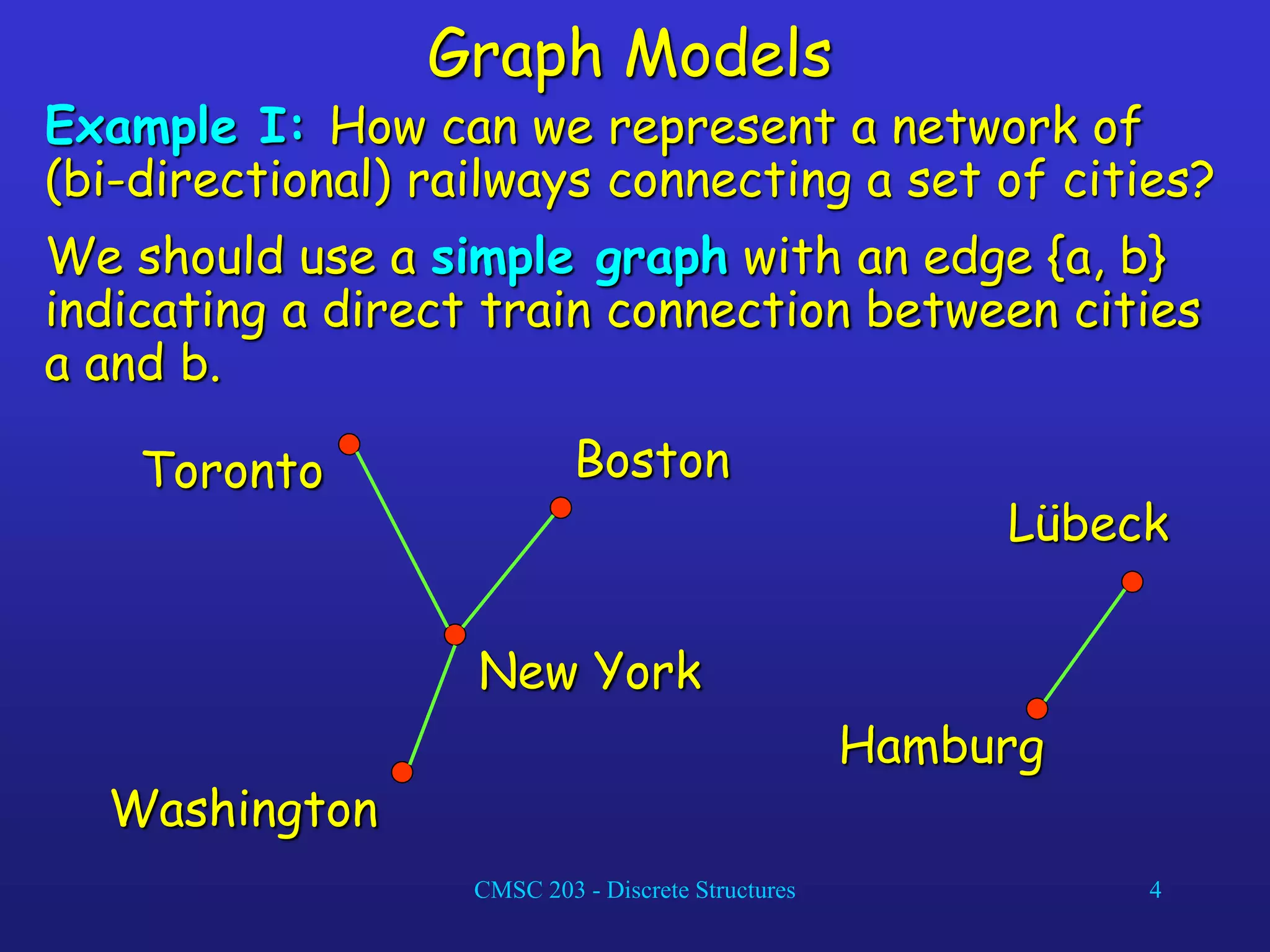
Example I: How can we represent a network of
(bi-directional) railways connecting a set of cities?
We should use a simple graph with an edge {a, b}
indicating a direct train connection between cities
a and b.
New York
Boston
Washington
Lübeck
Toronto
Hamburg
CMSC 203 - Discrete Structures 5
Graph Models
Example II: In a round-robin tournament, each
team plays against each other team exactly once.
How can we represent the results of the
tournament (which team beats which other team)?
We should use a directed graph with an edge (a, b)
indicating that team a beats team b.
Penguins
Bruins
Lübeck Giants
Maple Leafs
CMSC 203 - Discrete Structures 6
Graph Terminology
Definition: Two vertices u and v in an undirected
graph G are called adjacent (or neighbors) in G if
{u, v} is an edge in G.
If e = {u, v}, the edge e is called incident with the
vertices u and v. The edge e is also said to connect
u and v.
The vertices u and v are called endpoints of the
edge {u, v}.
CMSC 203 - Discrete Structures 7
Graph Terminology
Definition: The degree of a vertex in an
undirected graph is the number of edges incident
with it, except that a loop at a vertex contributes
twice to the degree of that vertex.
In other words, you can determine the degree of a
vertex in a displayed graph by counting the lines
that touch it.
The degree of the vertex v is denoted by deg(v).
CMSC 203 - Discrete Structures 8
Graph Terminology
A vertex of degree 0 is called isolated, since it is
not adjacent to any vertex.
Note: A vertex with a loop at it has at least
degree 2 and, by definition, is not isolated, even if
it is not adjacent to any other vertex.
A vertex of degree 1 is called pendant. It is
adjacent to exactly one other vertex.
CMSC 203 - Discrete Structures 9
Graph Terminology
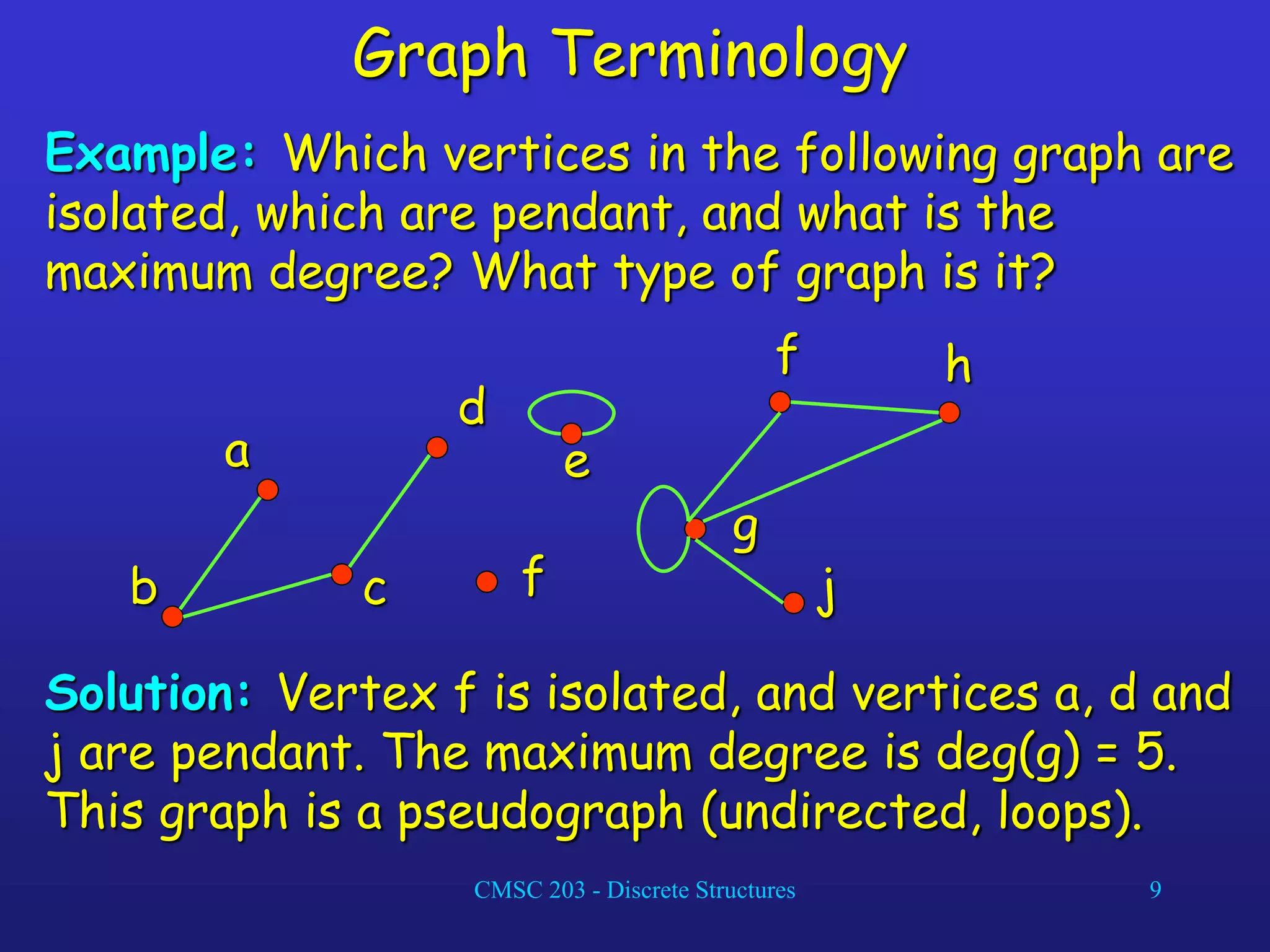
Example: Which vertices in the following graph are
isolated, which are pendant, and what is the
maximum degree? What type of graph is it?
a
b c
d
f h
g
j
f
e
Solution: Vertex f is isolated, and vertices a, d and
j are pendant. The maximum degree is deg(g) = 5.
This graph is a pseudograph (undirected, loops).
CMSC 203 - Discrete Structures 10
Graph Terminology
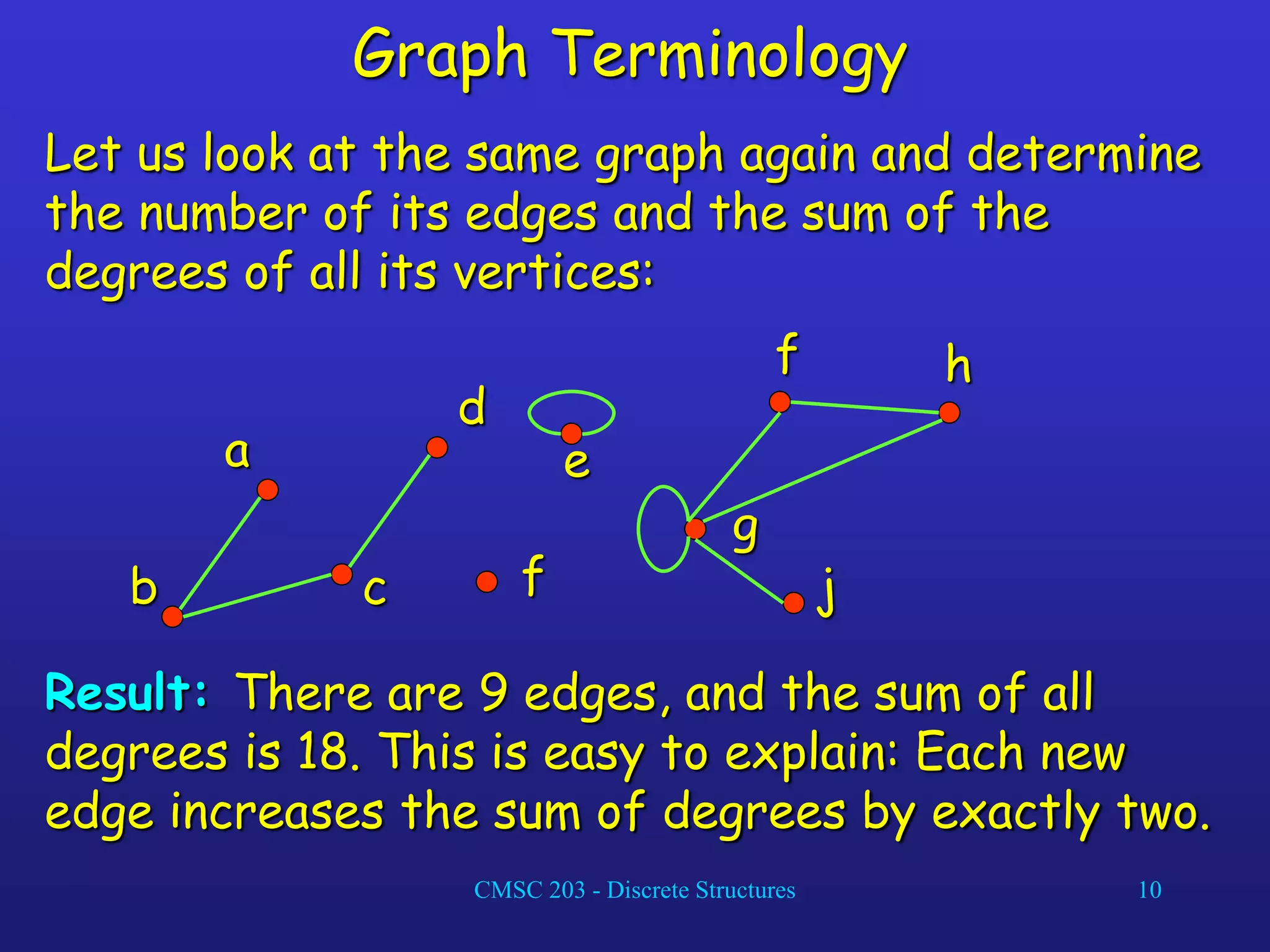
Let us look at the same graph again and determine
the number of its edges and the sum of the
degrees of all its vertices:
a
b c
d
f h
g
j
f
e
Result: There are 9 edges, and the sum of all
degrees is 18. This is easy to explain: Each new
edge increases the sum of degrees by exactly two.
CMSC 203 - Discrete Structures 11
Graph Terminology
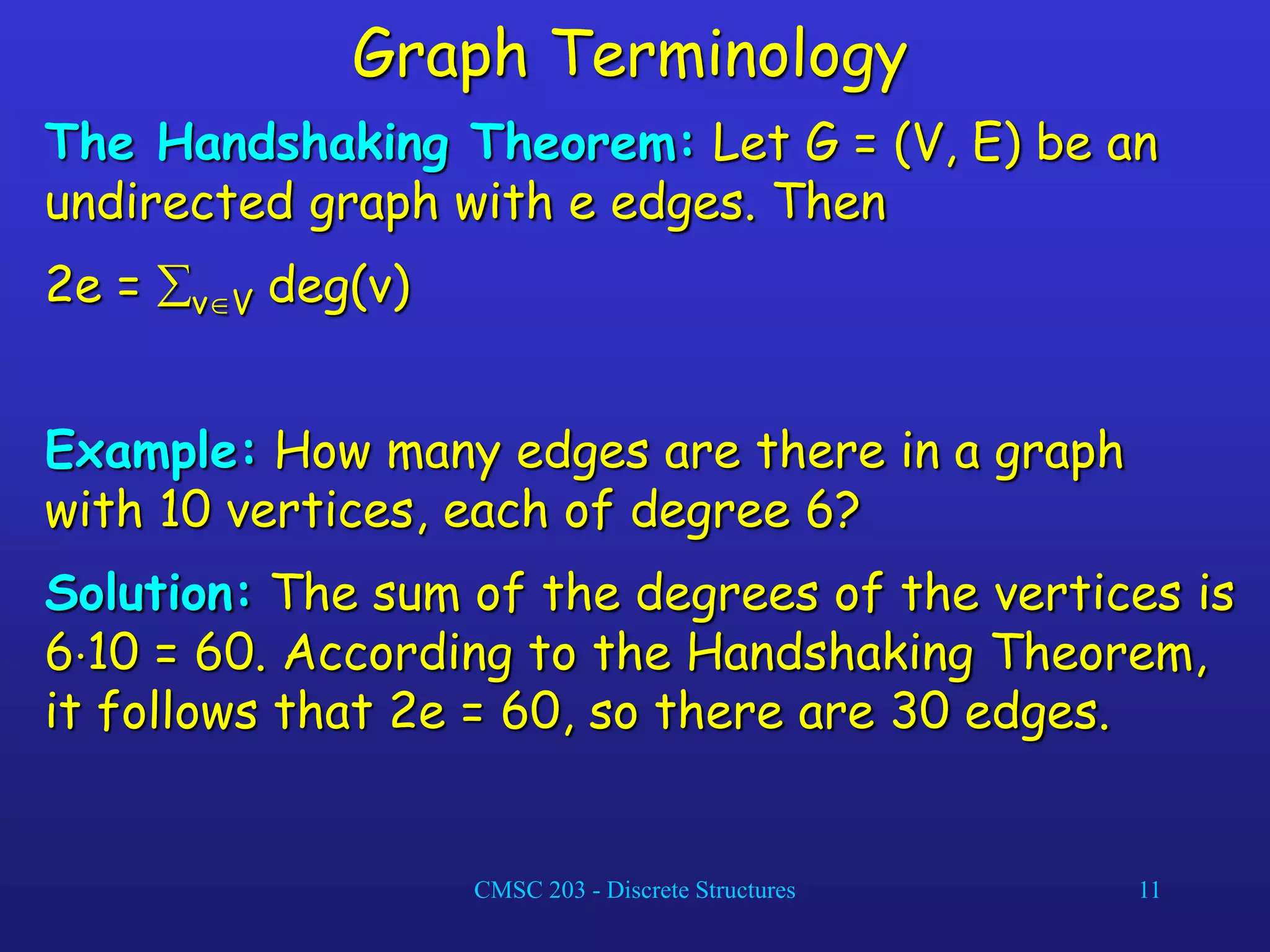
The Handshaking Theorem: Let G = (V, E) be an
undirected graph with e edges. Then
2e = vV deg(v)
Example: How many edges are there in a graph
with 10 vertices, each of degree 6?
Solution: The sum of the degrees of the vertices is
610 = 60. According to the Handshaking Theorem,
it follows that 2e = 60, so there are 30 edges.
CMSC 203 - Discrete Structures 12
Graph Terminology
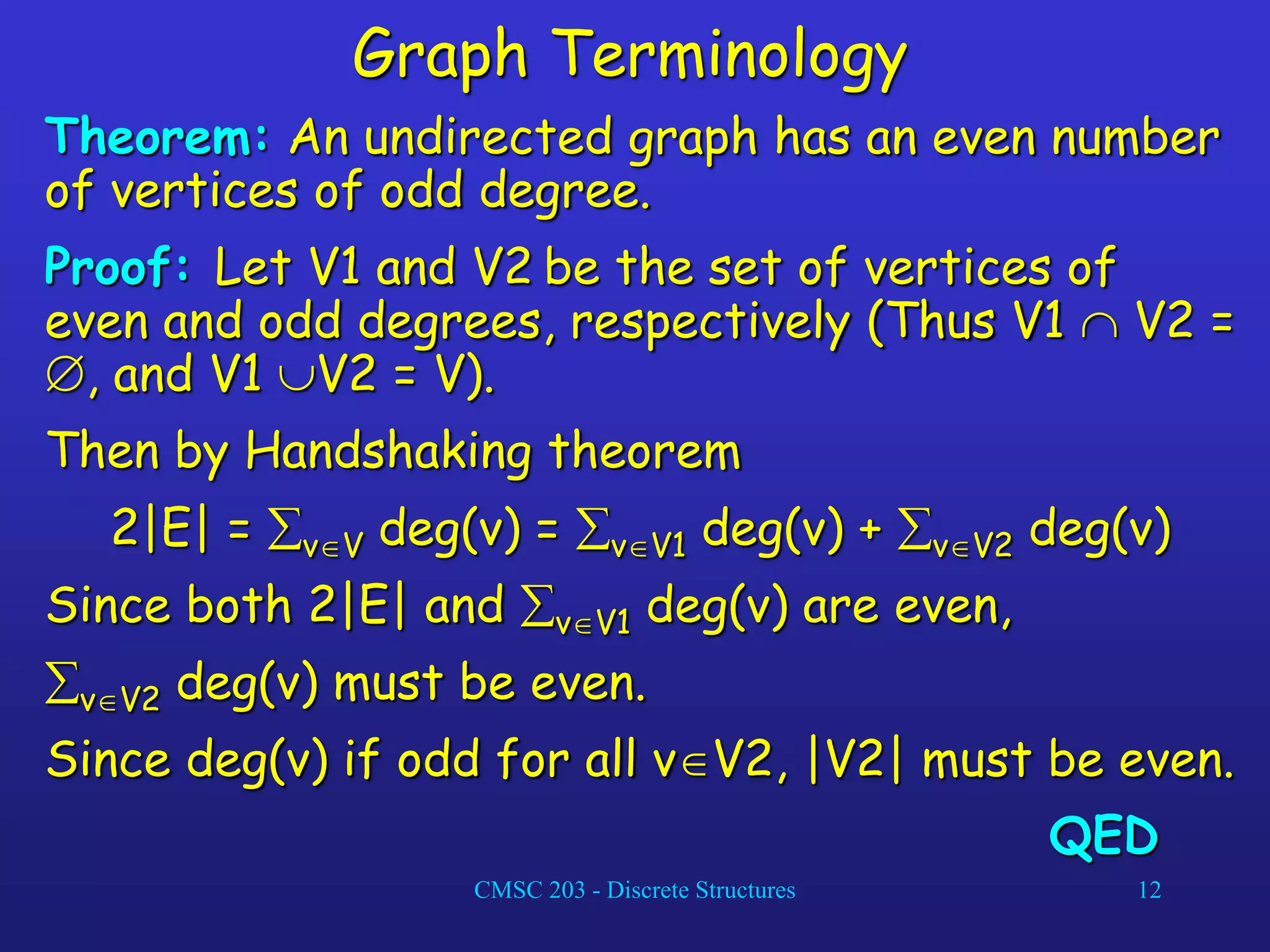
Theorem: An undirected graph has an even number
of vertices of odd degree.
Proof: Let V1 and V2 be the set of vertices of
even and odd degrees, respectively (Thus V1  V2 =
, and V1 V2 = V).
Then by Handshaking theorem
2|E| = vV deg(v) = vV1 deg(v) + vV2 deg(v)
Since both 2|E| and vV1 deg(v) are even,
vV2 deg(v) must be even.
Since deg(v) if odd for all vV2, |V2| must be even.
QED
CMSC 203 - Discrete Structures 13
Graph Terminology
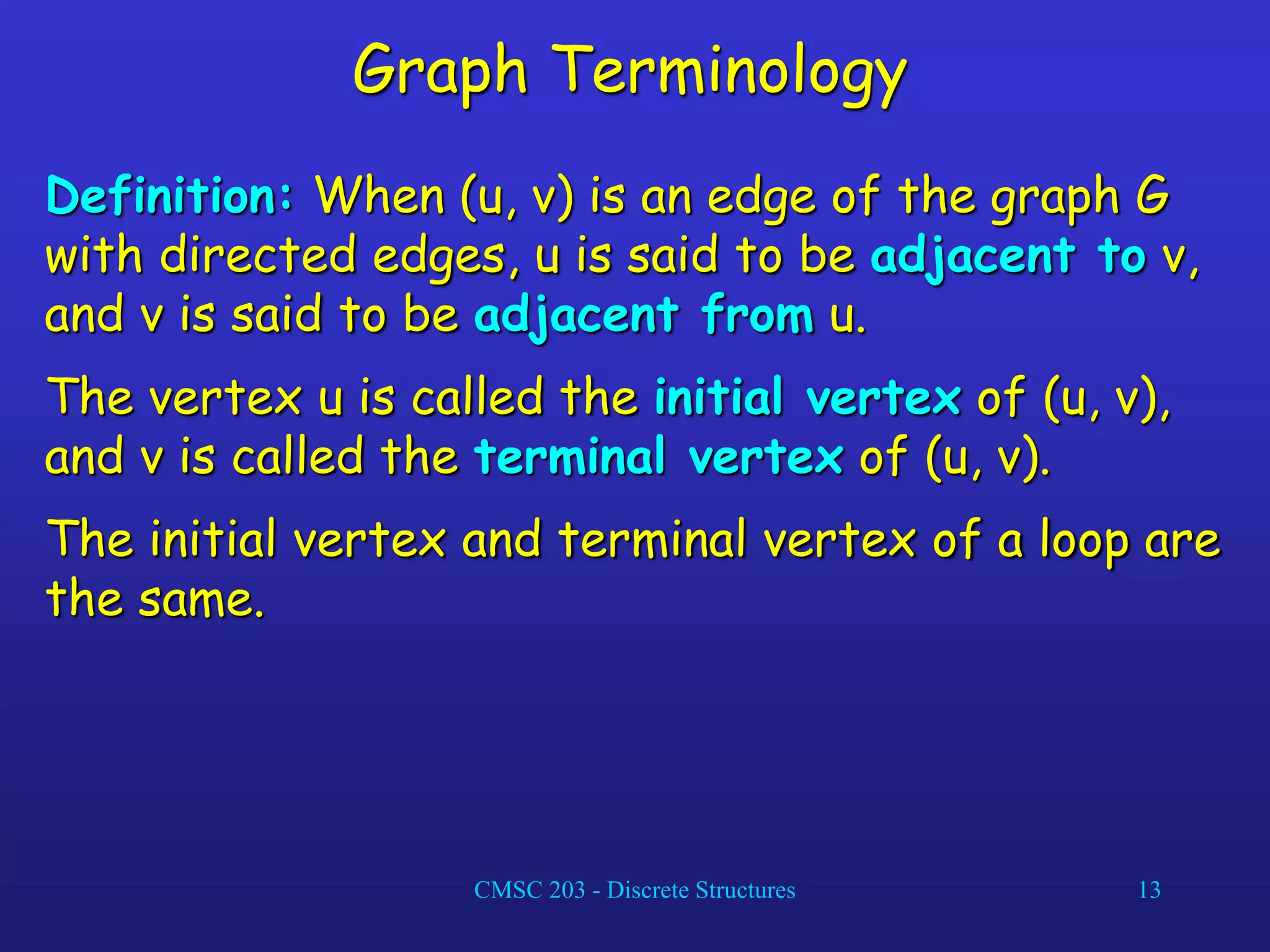
Definition: When (u, v) is an edge of the graph G
with directed edges, u is said to be adjacent to v,
and v is said to be adjacent from u.
The vertex u is called the initial vertex of (u, v),
and v is called the terminal vertex of (u, v).
The initial vertex and terminal vertex of a loop are
the same.
CMSC 203 - Discrete Structures 14
Graph Terminology
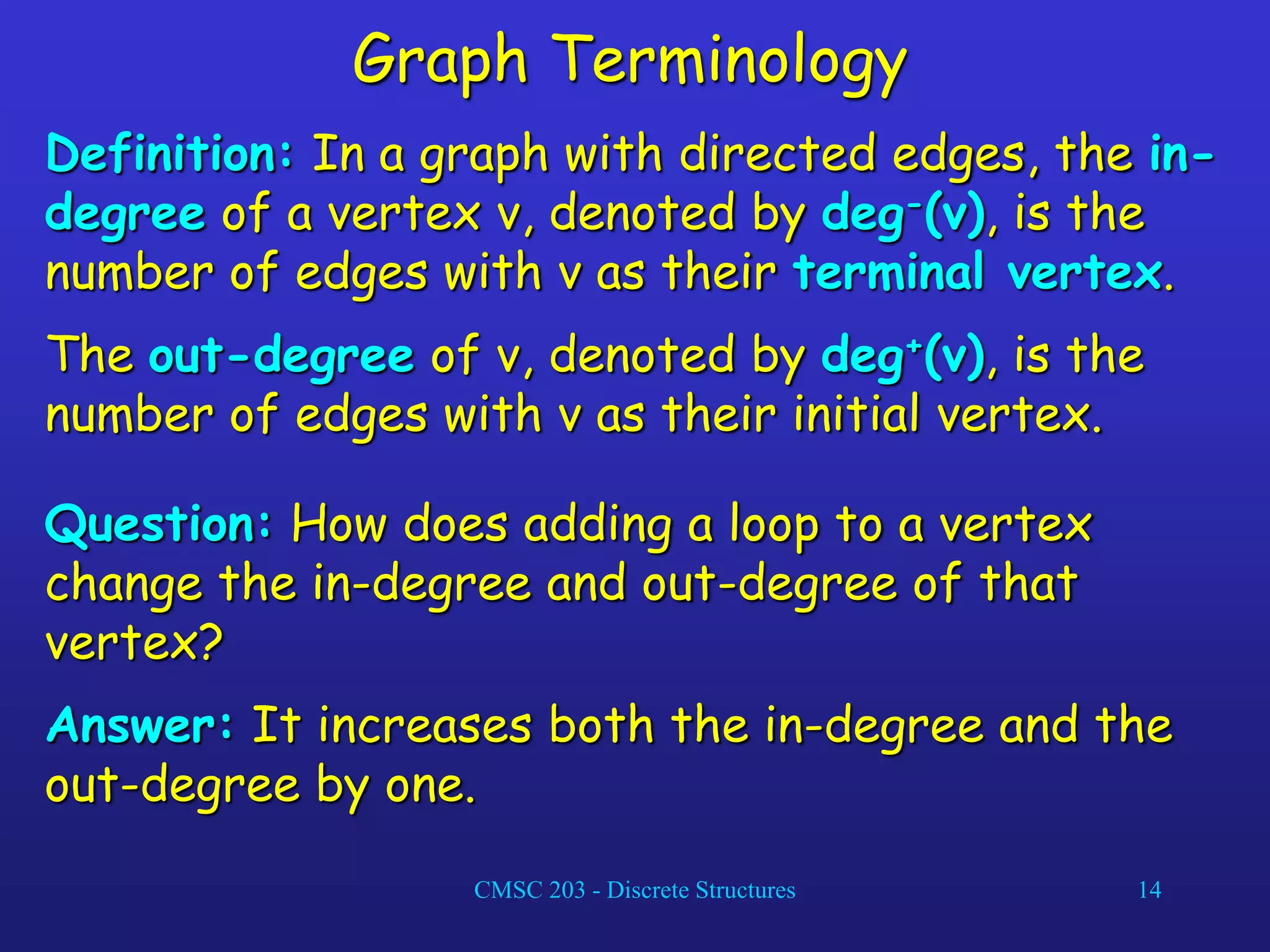
Definition: In a graph with directed edges, the in-
degree of a vertex v, denoted by deg-(v), is the
number of edges with v as their terminal vertex.
The out-degree of v, denoted by deg+(v), is the
number of edges with v as their initial vertex.
Question: How does adding a loop to a vertex
change the in-degree and out-degree of that
vertex?
Answer: It increases both the in-degree and the
out-degree by one.
CMSC 203 - Discrete Structures 15
Graph Terminology
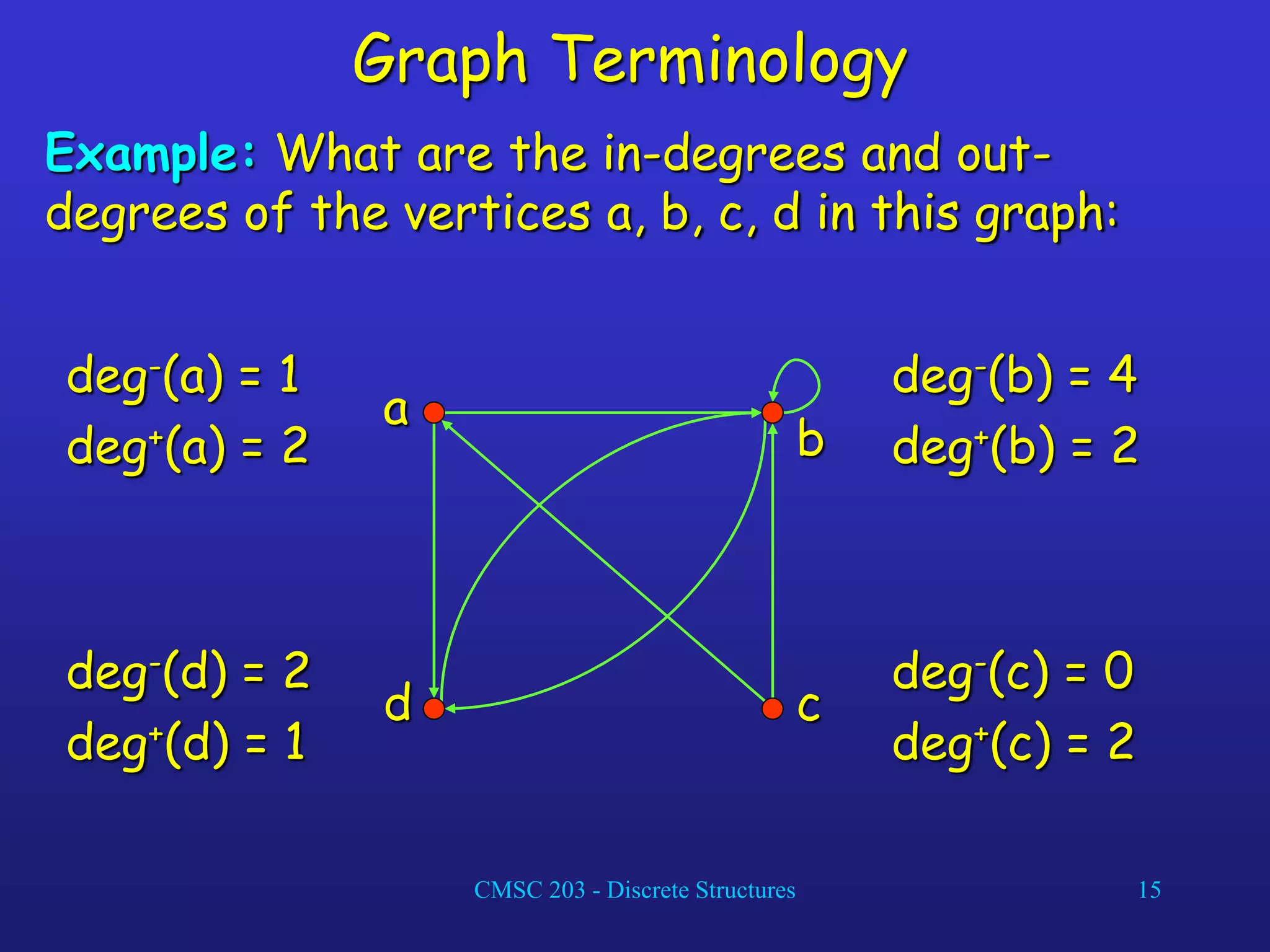
Example: What are the in-degrees and out-
degrees of the vertices a, b, c, d in this graph:
a
b
c
d
deg-(a) = 1
deg+(a) = 2
deg-(b) = 4
deg+(b) = 2
deg-(d) = 2
deg+(d) = 1
deg-(c) = 0
deg+(c) = 2
CMSC 203 - Discrete Structures 16
Graph Terminology
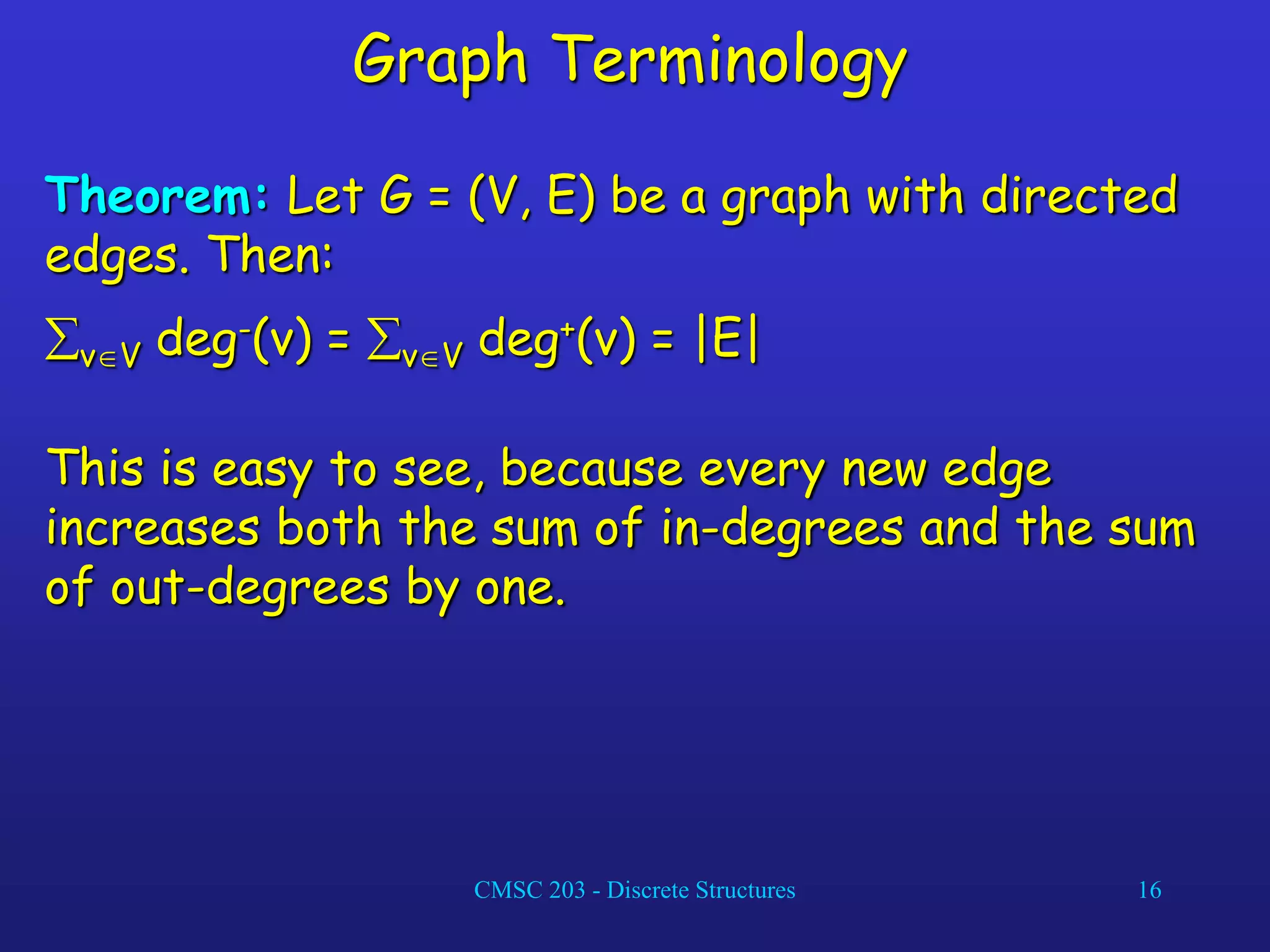
Theorem: Let G = (V, E) be a graph with directed
edges. Then:
vV deg-(v) = vV deg+(v) = |E|
This is easy to see, because every new edge
increases both the sum of in-degrees and the sum
of out-degrees by one.
CMSC 203 - Discrete Structures 17
Special Graphs
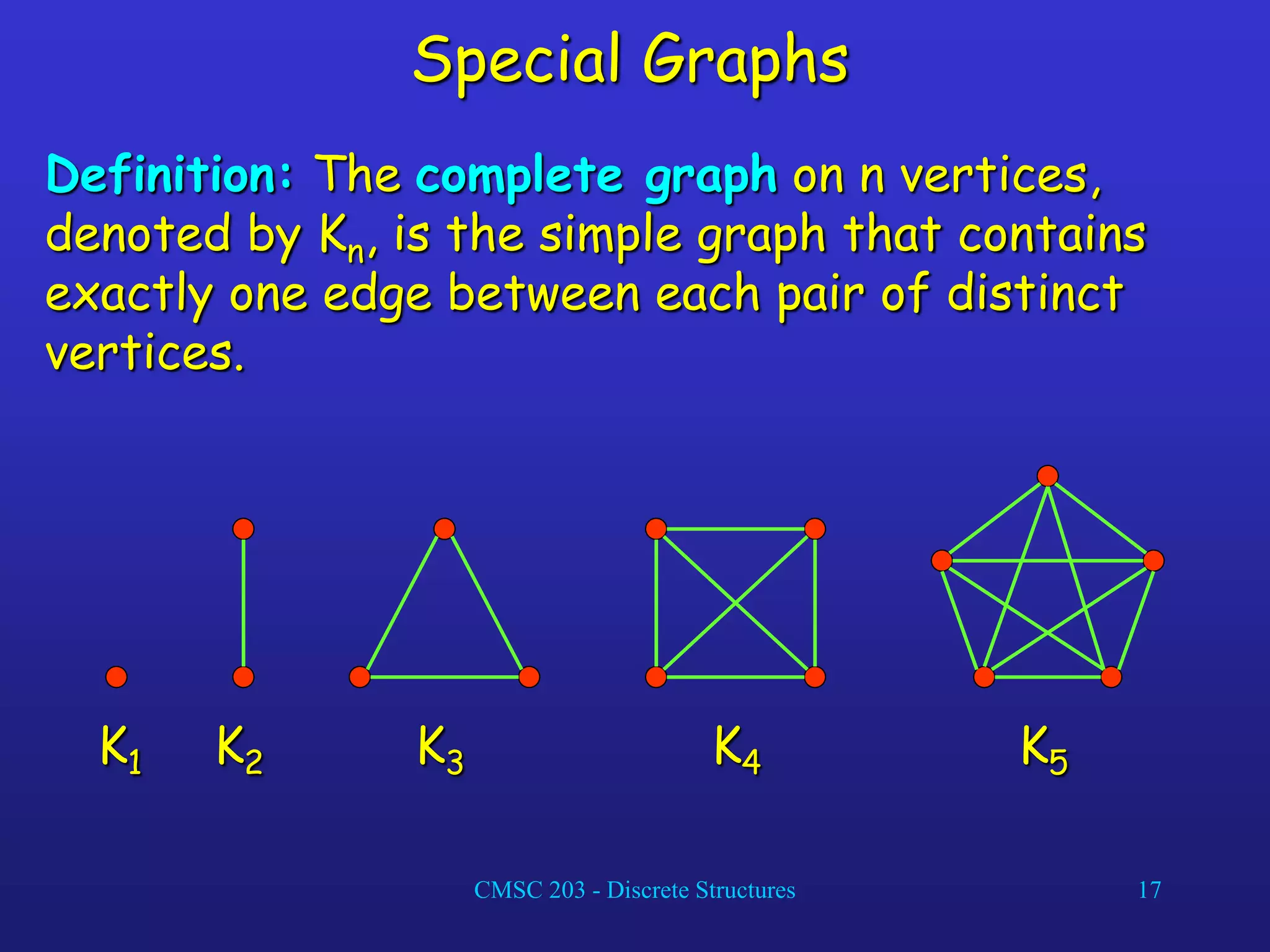
Definition: The complete graph on n vertices,
denoted by Kn, is the simple graph that contains
exactly one edge between each pair of distinct
vertices.
K1 K2 K3 K4 K5
CMSC 203 - Discrete Structures 18
Special Graphs
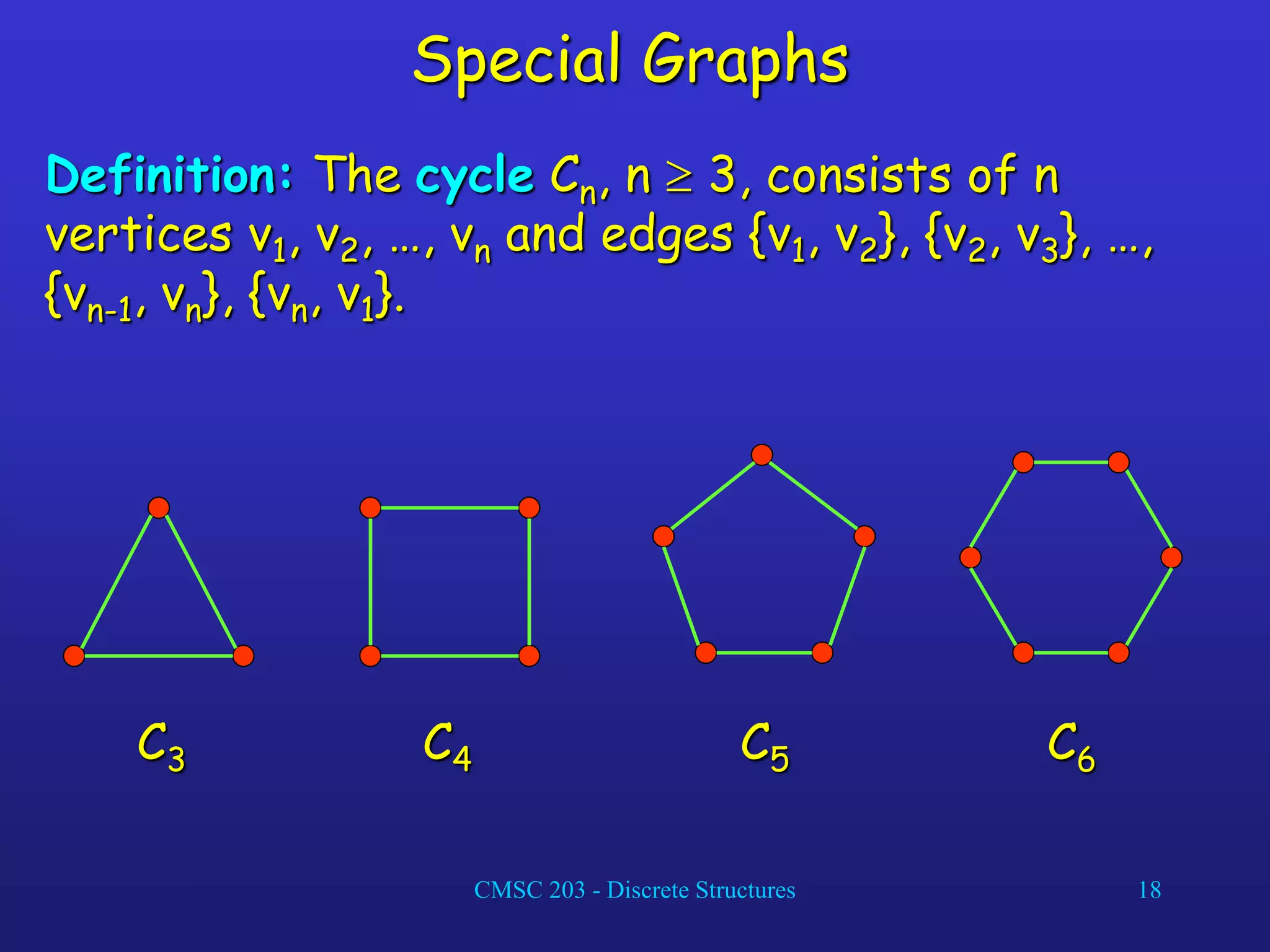
Definition: The cycle Cn, n  3, consists of n
vertices v1, v2, …, vn and edges {v1, v2}, {v2, v3}, …,
{vn-1, vn}, {vn, v1}.
C3 C4 C5 C6
CMSC 203 - Discrete Structures 19
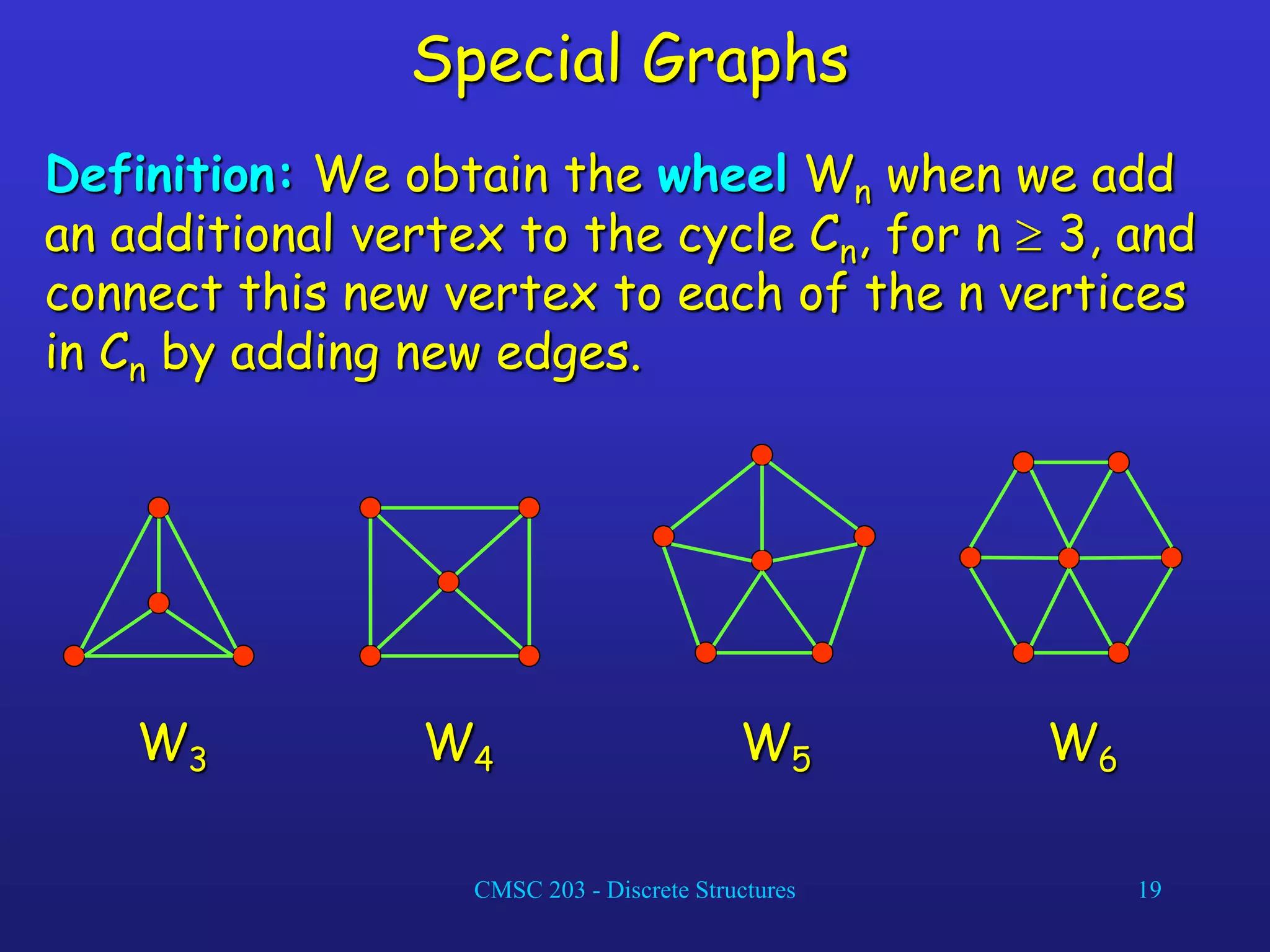
Special Graphs
Definition: We obtain the wheel Wn when we add
an additional vertex to the cycle Cn, for n  3, and
connect this new vertex to each of the n vertices
in Cn by adding new edges.
W3 W4 W5 W6
CMSC 203 - Discrete Structures 20
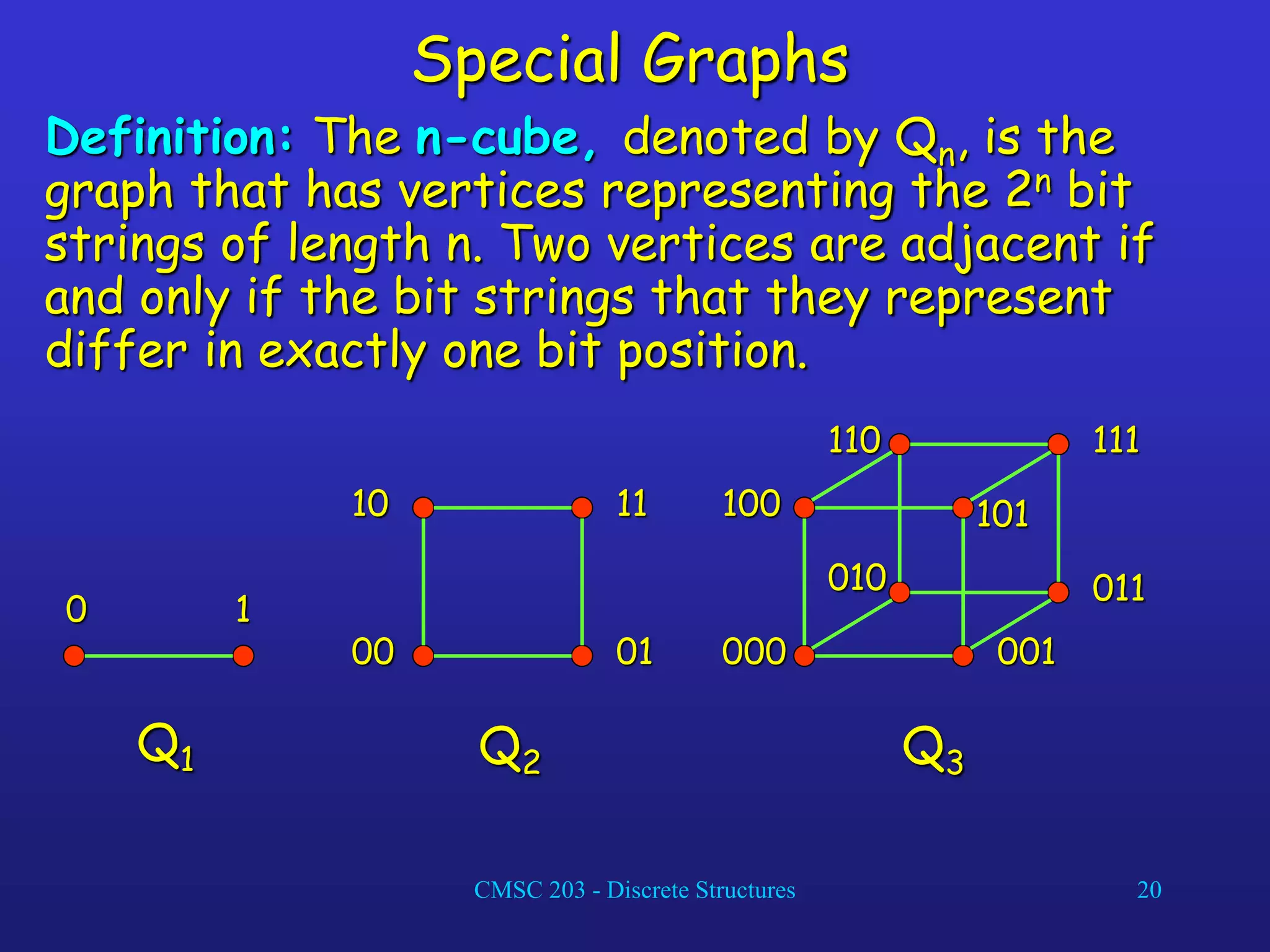
Special Graphs
Definition: The n-cube, denoted by Qn, is the
graph that has vertices representing the 2n bit
strings of length n. Two vertices are adjacent if
and only if the bit strings that they represent
differ in exactly one bit position.
Q1 Q2 Q3
0 1
00 01
11
10
000 001
101
100
010 011
111
110
CMSC 203 - Discrete Structures 21
Special Graphs
Definition: A simple graph is called bipartite if its
vertex set V can be partitioned into two disjoint
nonempty sets V1 and V2 such that every edge in
the graph connects a vertex in V1 with a vertex in
V2 (so that no edge in G connects either two
vertices in V1 or two vertices in V2).
For example, consider a graph that represents
each person in a village by a vertex and each
marriage by an edge.
This graph is bipartite, because each edge
connects a vertex in the subset of males with a
vertex in the subset of females (if we think of
traditional marriages).
CMSC 203 - Discrete Structures 22
Special Graphs
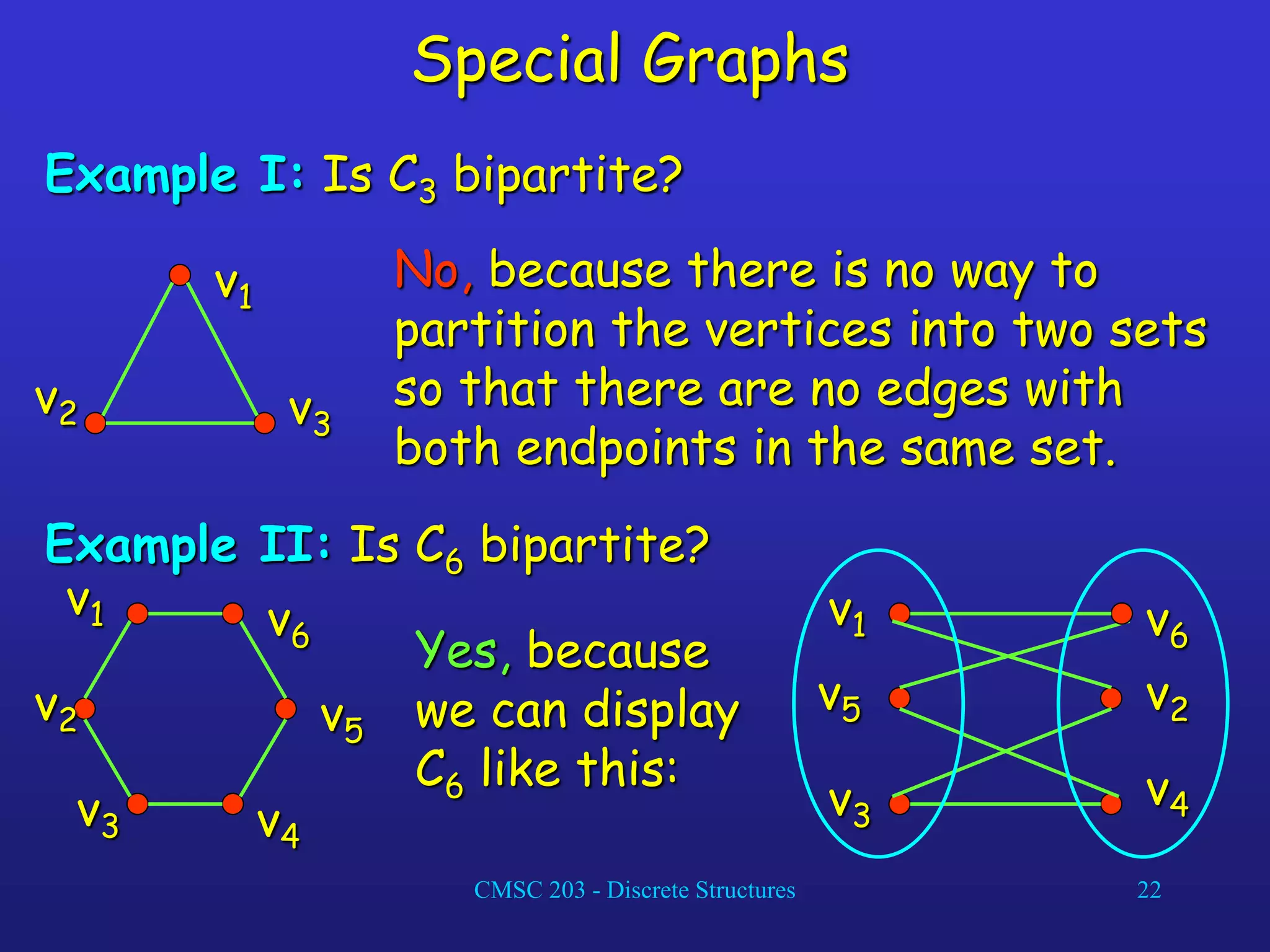
Example I: Is C3 bipartite?
v1
v2 v3
No, because there is no way to
partition the vertices into two sets
so that there are no edges with
both endpoints in the same set.
Example II: Is C6 bipartite?
v5
v1
v2
v3 v4
v6
v1 v6
v2
v5
v3
v4
Yes, because
we can display
C6 like this:
CMSC 203 - Discrete Structures 23
Special Graphs
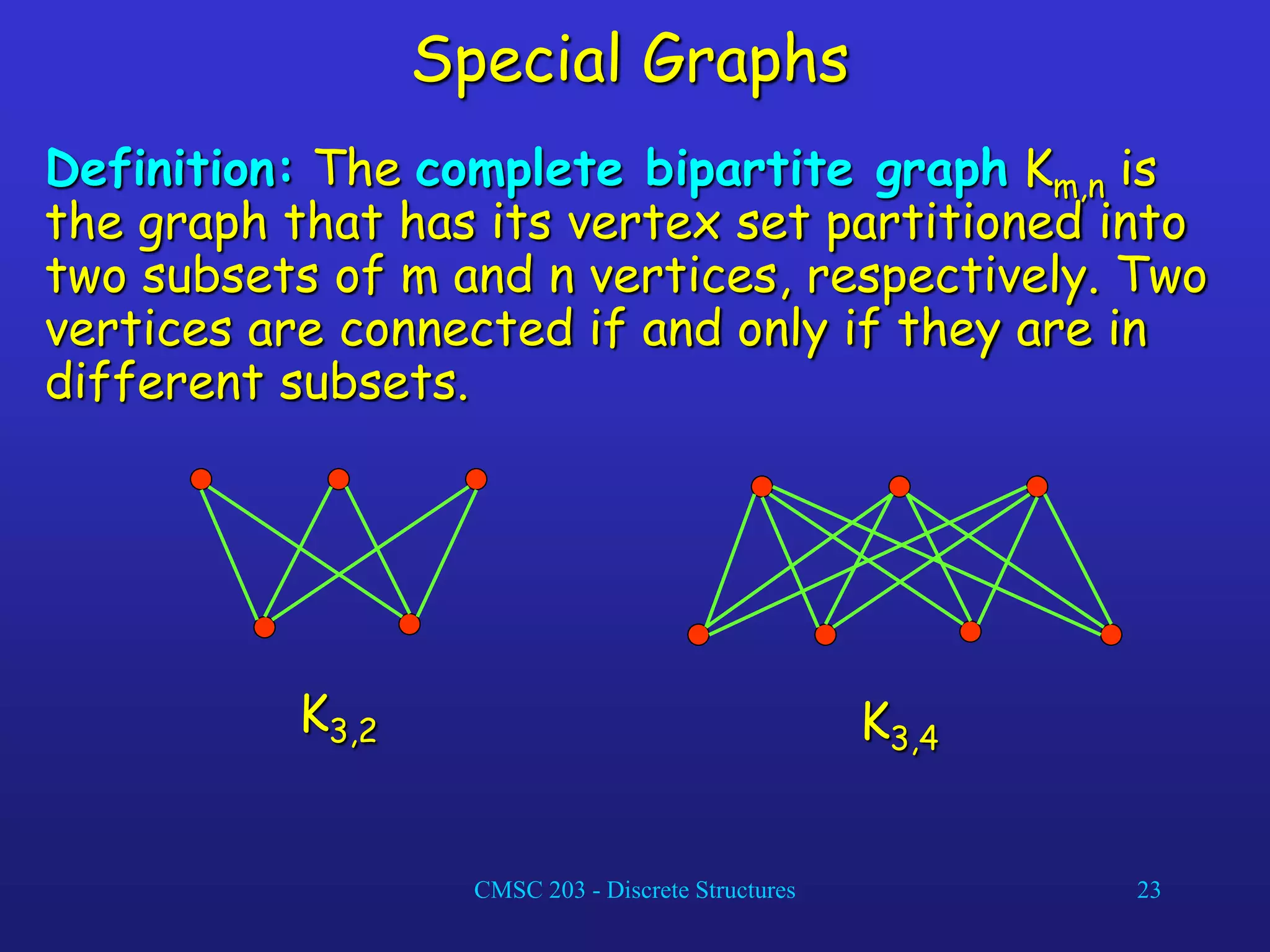
Definition: The complete bipartite graph Km,n is
the graph that has its vertex set partitioned into
two subsets of m and n vertices, respectively. Two
vertices are connected if and only if they are in
different subsets.
K3,2 K3,4
CMSC 203 - Discrete Structures 24
Operations on Graphs
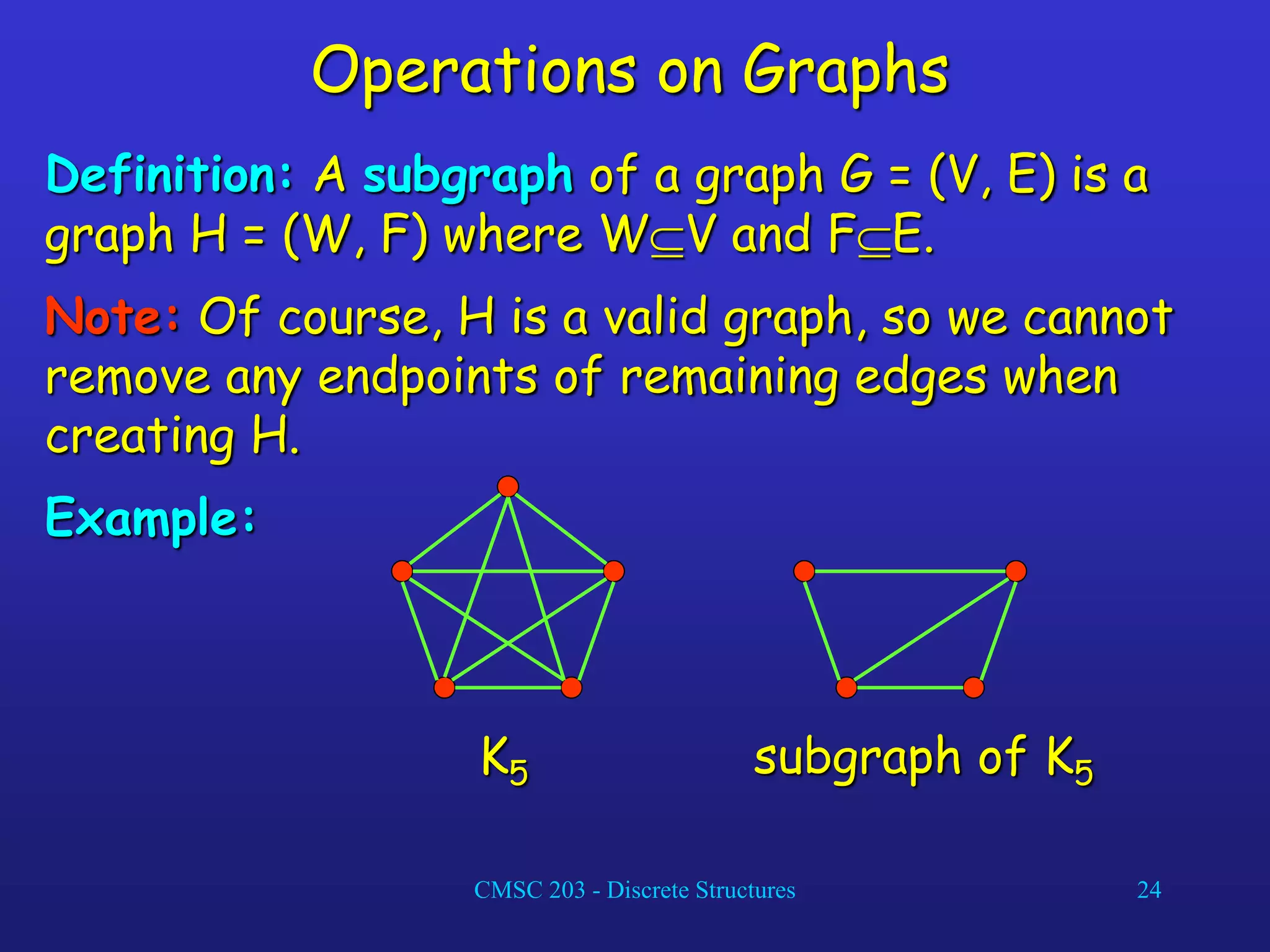
Definition: A subgraph of a graph G = (V, E) is a
graph H = (W, F) where WV and FE.
Note: Of course, H is a valid graph, so we cannot
remove any endpoints of remaining edges when
creating H.
Example:
K5 subgraph of K5
CMSC 203 - Discrete Structures 25
Operations on Graphs
Definition: The union of two simple graphs G1 =
(V1, E1) and G2 = (V2, E2) is the simple graph with
vertex set V1  V2 and edge set E1  E2.
The union of G1 and G2 is denoted by G1  G2.
G1 G2 G1  G2 = K5
CMSC 203 - Discrete Structures 26
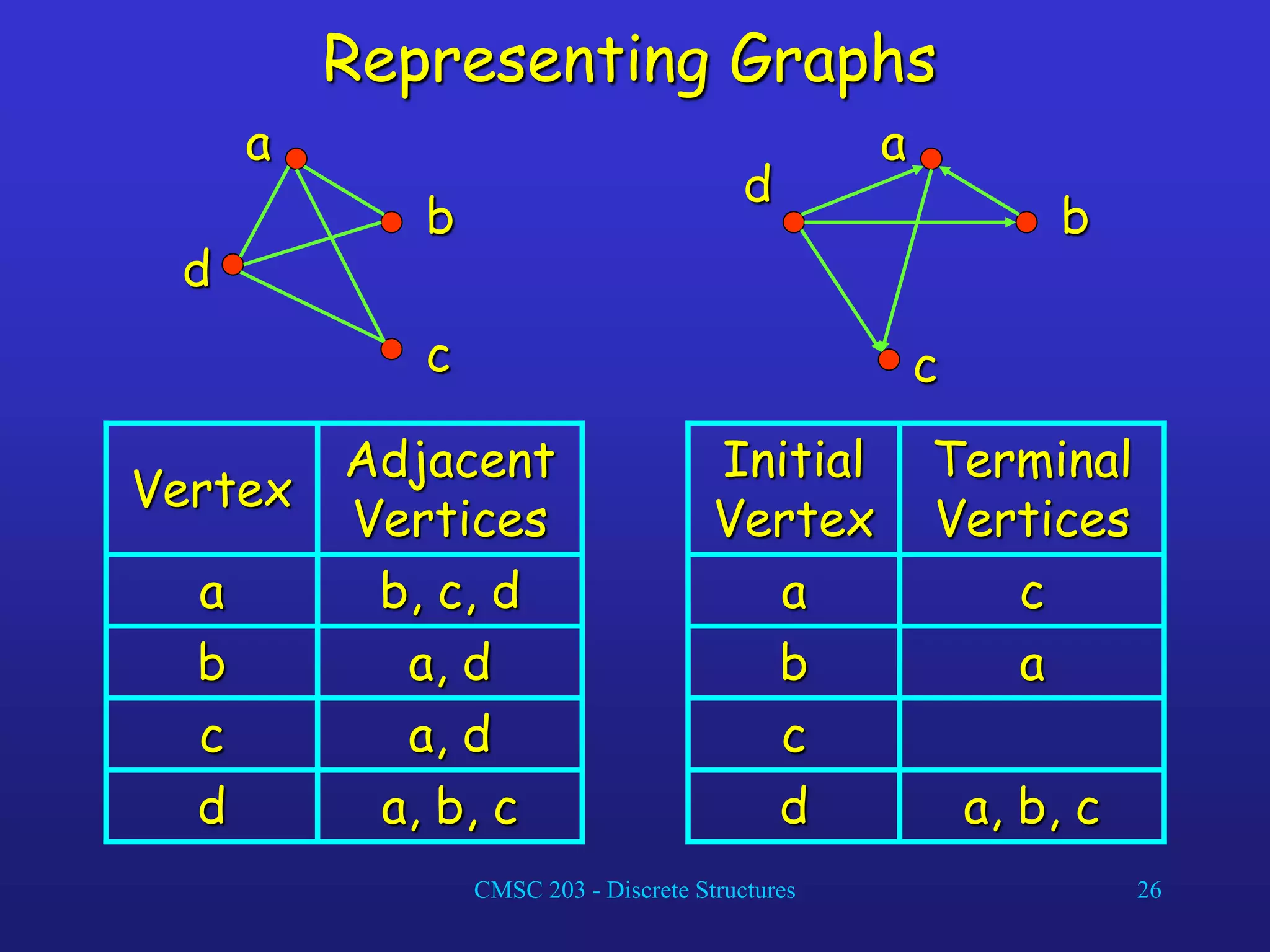
Representing Graphs
a
b
c
d
a
b
c
d
a, d
b
a, d
c
a, b, c
d
b, c, d
a
Adjacent
Vertices
Vertex
a
b
c
a, b, c
d
c
a
Terminal
Vertices
Initial
Vertex
CMSC 203 - Discrete Structures 27
Representing Graphs
Definition: Let G = (V, E) be a simple graph with
|V| = n. Suppose that the vertices of G are listed in
arbitrary order as v1, v2, …, vn.
The adjacency matrix A (or AG) of G, with respect
to this listing of the vertices, is the nn zero-one
matrix with 1 as its (i, j)th entry when vi and vj are
adjacent, and 0 otherwise.
In other words, for an adjacency matrix A = [aij],
aij = 1 if {vi, vj} is an edge of G,
aij = 0 otherwise.
CMSC 203 - Discrete Structures 28
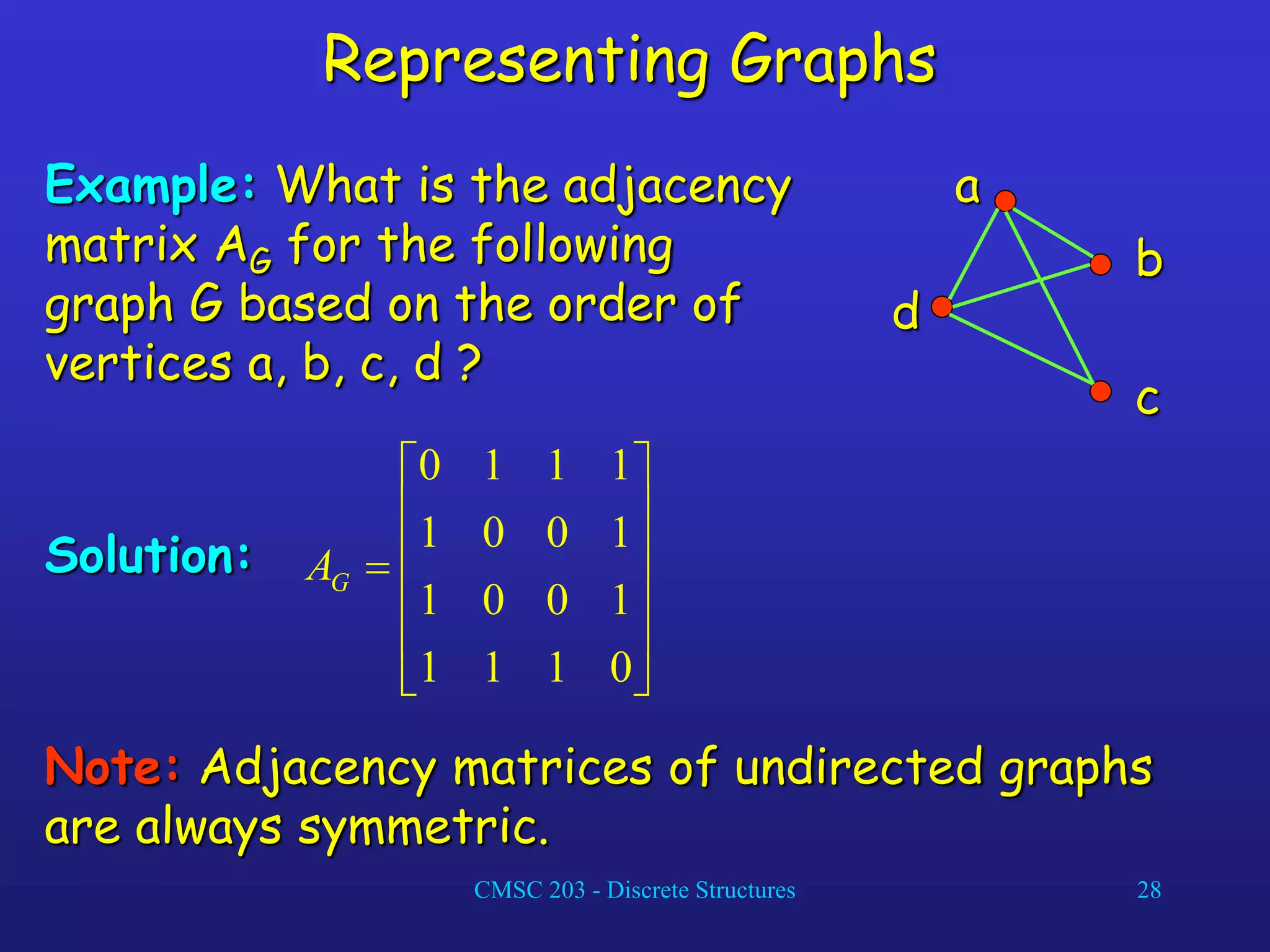
Representing Graphs
a
b
c
d
Example: What is the adjacency
matrix AG for the following
graph G based on the order of
vertices a, b, c, d ?
Solution:













0
1
1
1
1
0
0
1
1
0
0
1
1
1
1
0
G
A
Note: Adjacency matrices of undirected graphs
are always symmetric.
CMSC 203 - Discrete Structures 29
Representing Graphs
Definition: Let G = (V, E) be an undirected graph
with |V| = n. Suppose that the vertices and edges
of G are listed in arbitrary order as v1, v2, …, vn and
e1, e2, …, em, respectively.
The incidence matrix of G with respect to this
listing of the vertices and edges is the nm zero-
one matrix with 1 as its (i, j)th entry when edge ej
is incident with vi, and 0 otherwise.
In other words, for an incidence matrix M = [mij],
mij = 1 if edge ej is incident with vi
mij = 0 otherwise.
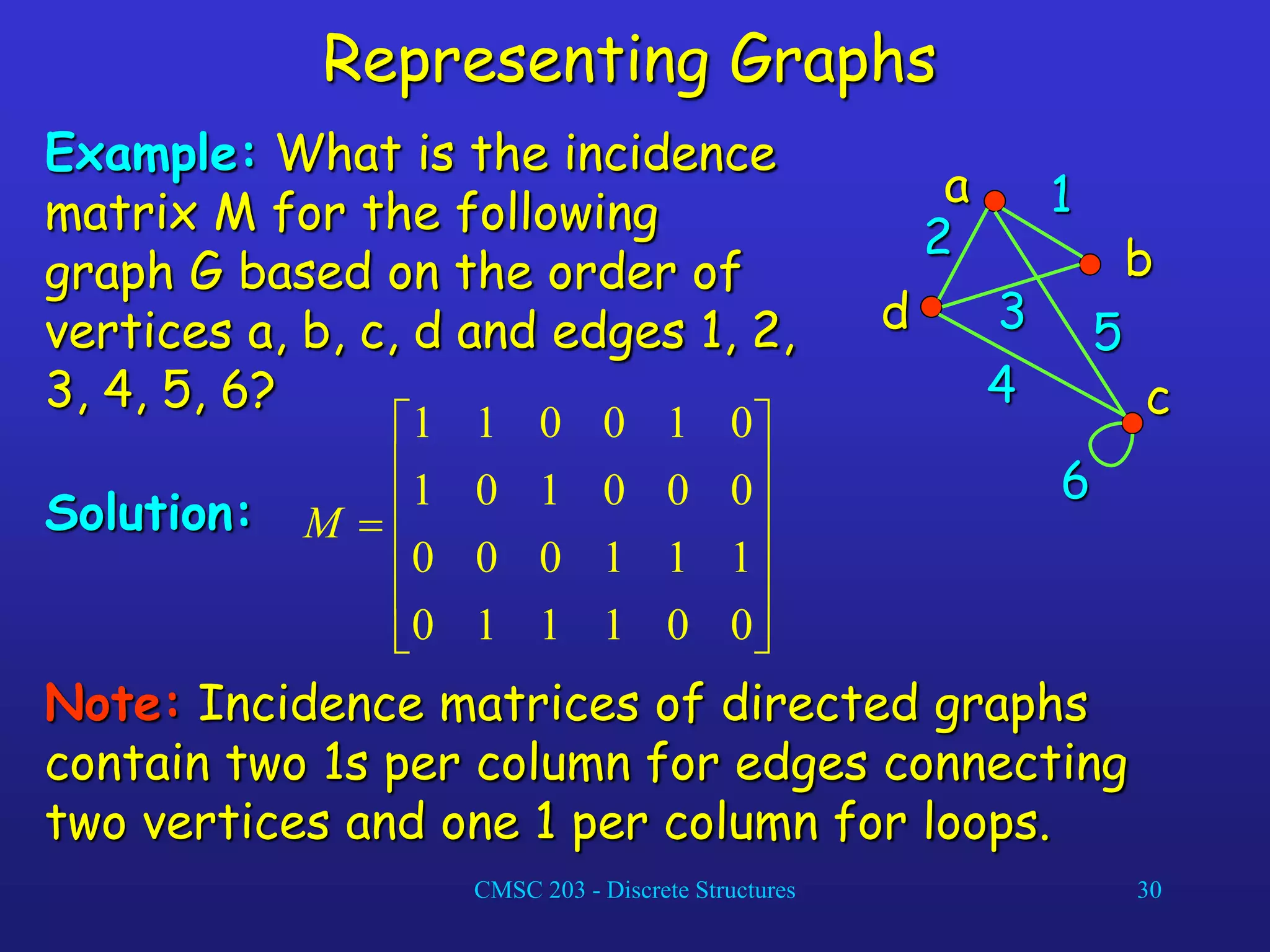
CMSC 203 - Discrete Structures 30
Representing Graphs
Example: What is the incidence
matrix M for the following
graph G based on the order of
vertices a, b, c, d and edges 1, 2,
3, 4, 5, 6?
Solution:













0
0
1
1
1
0
1
1
1
0
0
0
0
0
0
1
0
1
0
1
0
0
1
1
M
Note: Incidence matrices of directed graphs
contain two 1s per column for edges connecting
two vertices and one 1 per column for loops.
a
b
c
d
1
2
4
5
3
6
CMSC 203 - Discrete Structures 31
Isomorphism of Graphs
Definition: The simple graphs G1 = (V1, E1) and G2 =
(V2, E2) are isomorphic if there is a bijection (an
one-to-one and onto function) f from V1 to V2 with
the property that a and b are adjacent in G1 if and
only if f(a) and f(b) are adjacent in G2, for all a and
b in V1.
Such a function f is called an isomorphism.
In other words, G1 and G2 are isomorphic if their
vertices can be ordered in such a way that the
adjacency matrices MG1
and MG2
are identical.
CMSC 203 - Discrete Structures 32
Isomorphism of Graphs
From a visual standpoint, G1 and G2 are isomorphic
if they can be arranged in such a way that their
displays are identical (of course without changing
adjacency).
Unfortunately, for two simple graphs, each with n
vertices, there are n! possible isomorphisms that
we have to check in order to show that these
graphs are isomorphic.
However, showing that two graphs are not
isomorphic can be easy.
CMSC 203 - Discrete Structures 33
Isomorphism of Graphs
For this purpose we can check invariants, that is,
properties that two isomorphic simple graphs must
both have.
For example, they must have
• the same number of vertices,
• the same number of edges, and
• the same degrees of vertices.
Note that two graphs that differ in any of these
invariants are not isomorphic, but two graphs that
match in all of them are not necessarily isomorphic.
CMSC 203 - Discrete Structures 34
Isomorphism of Graphs
Example I: Are the following two graphs isomorphic?
d
a
b
c
e
d
a
b
c
e
Solution: Yes, they are isomorphic, because they
can be arranged to look identical. You can see this
if in the right graph you move vertex b to the left
of the edge {a, c}. Then the isomorphism f from
the left to the right graph is: f(a) = e, f(b) = a,
f(c) = b, f(d) = c, f(e) = d.
CMSC 203 - Discrete Structures 35
Isomorphism of Graphs
Example II: How about these two graphs?
d
a
b
c
e
d
a
b
c
e
Solution: No, they are not isomorphic, because
they differ in the degrees of their vertices.
Vertex d in right graph is of degree one, but there
is no such vertex in the left graph.
CMSC 203 - Discrete Structures 36
Connectivity
Definition: A path of length n from u to v, where n
is a positive integer, in an undirected graph is a
sequence of edges e1, e2, …, en of the graph such
that e1 = {x0, x1}, e2 = {x1, x2}, …, en = {xn-1, xn},
where x0 = u and xn = v.
When the graph is simple, we denote this path by
its vertex sequence x0, x1, …, xn, since it uniquely
determines the path.
The path is a circuit if it begins and ends at the
same vertex, that is, if u = v.
CMSC 203 - Discrete Structures 37
Connectivity
Definition (continued): The path or circuit is said
to pass through or traverse x1, x2, …, xn-1.
A path or circuit is simple if it does not contain the
same edge more than once.
CMSC 203 - Discrete Structures 38
Connectivity
Let us now look at something new:
Definition: An undirected graph is called connected
if there is a path between every pair of distinct
vertices in the graph.
For example, any two computers in a network can
communicate if and only if the graph of this
network is connected.
Note: A graph consisting of only one vertex is
always connected, because it does not contain any
pair of distinct vertices.
CMSC 203 - Discrete Structures 39
Connectivity
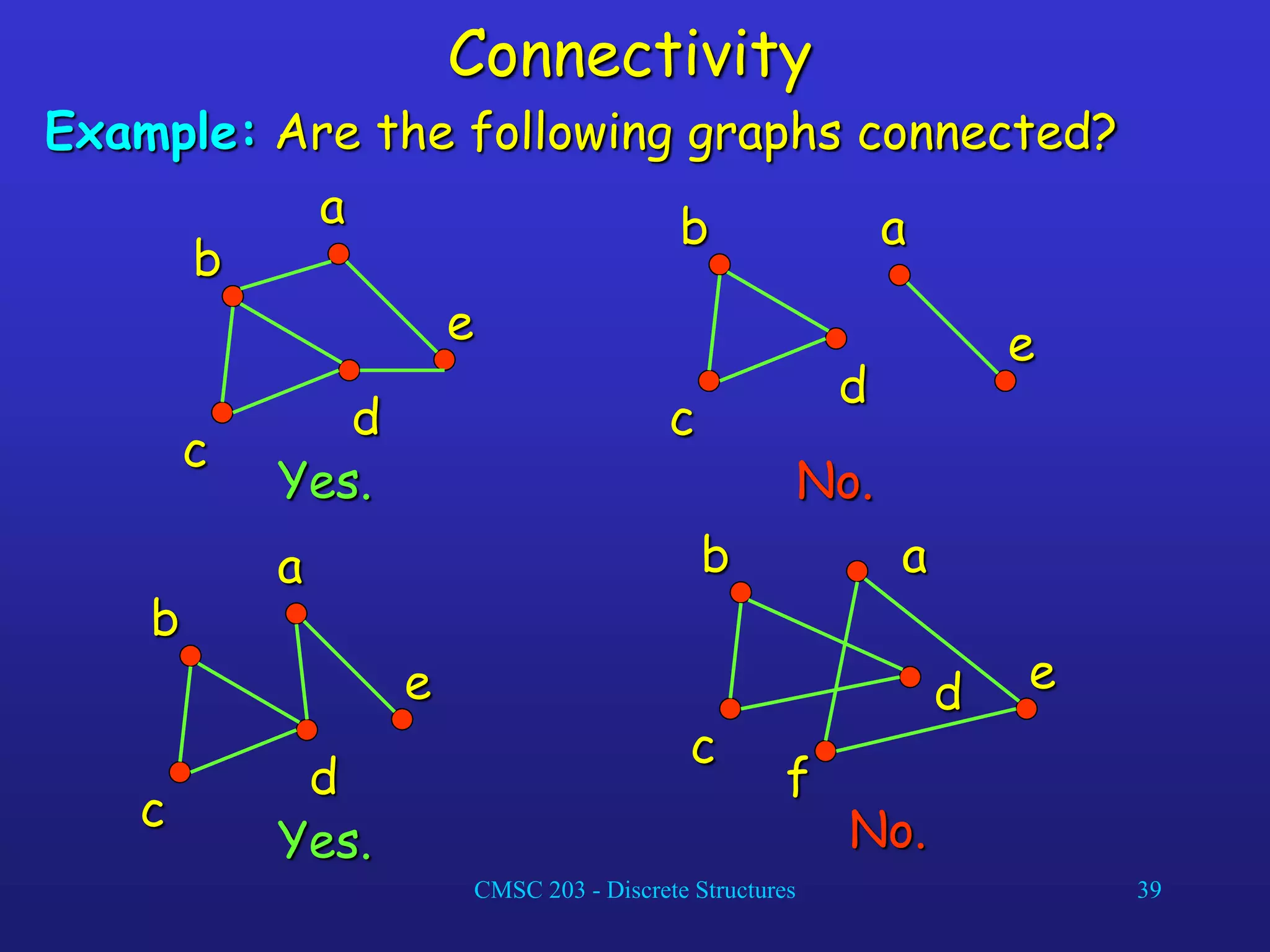
Example: Are the following graphs connected?
d
a
b
c
e
Yes.
d
a
b
c
e
No.
d
a
b
c
e
Yes.
d
a
b
c
e
f
No.
CMSC 203 - Discrete Structures 40
Connectivity
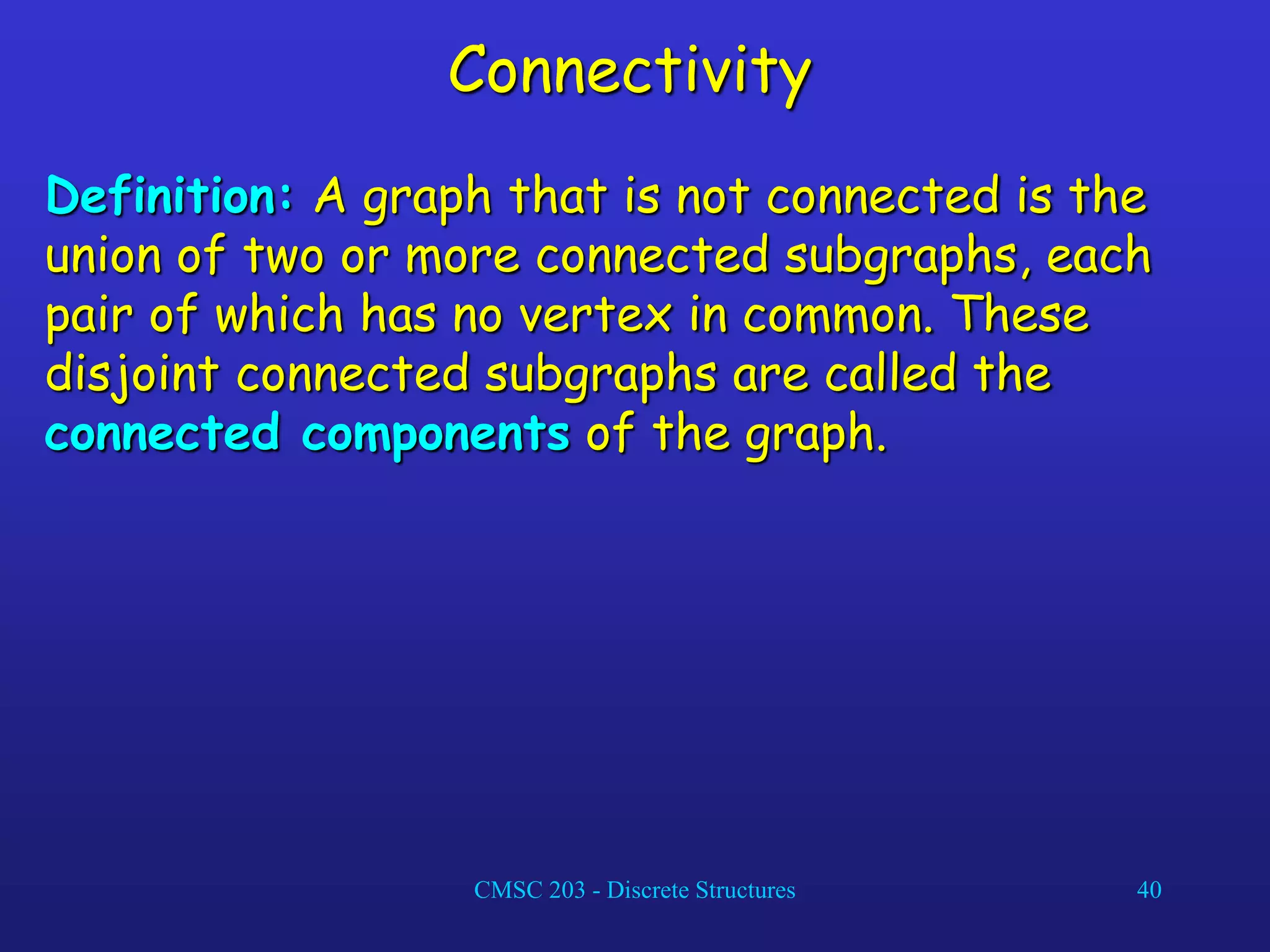
Definition: A graph that is not connected is the
union of two or more connected subgraphs, each
pair of which has no vertex in common. These
disjoint connected subgraphs are called the
connected components of the graph.
CMSC 203 - Discrete Structures 41
Connectivity
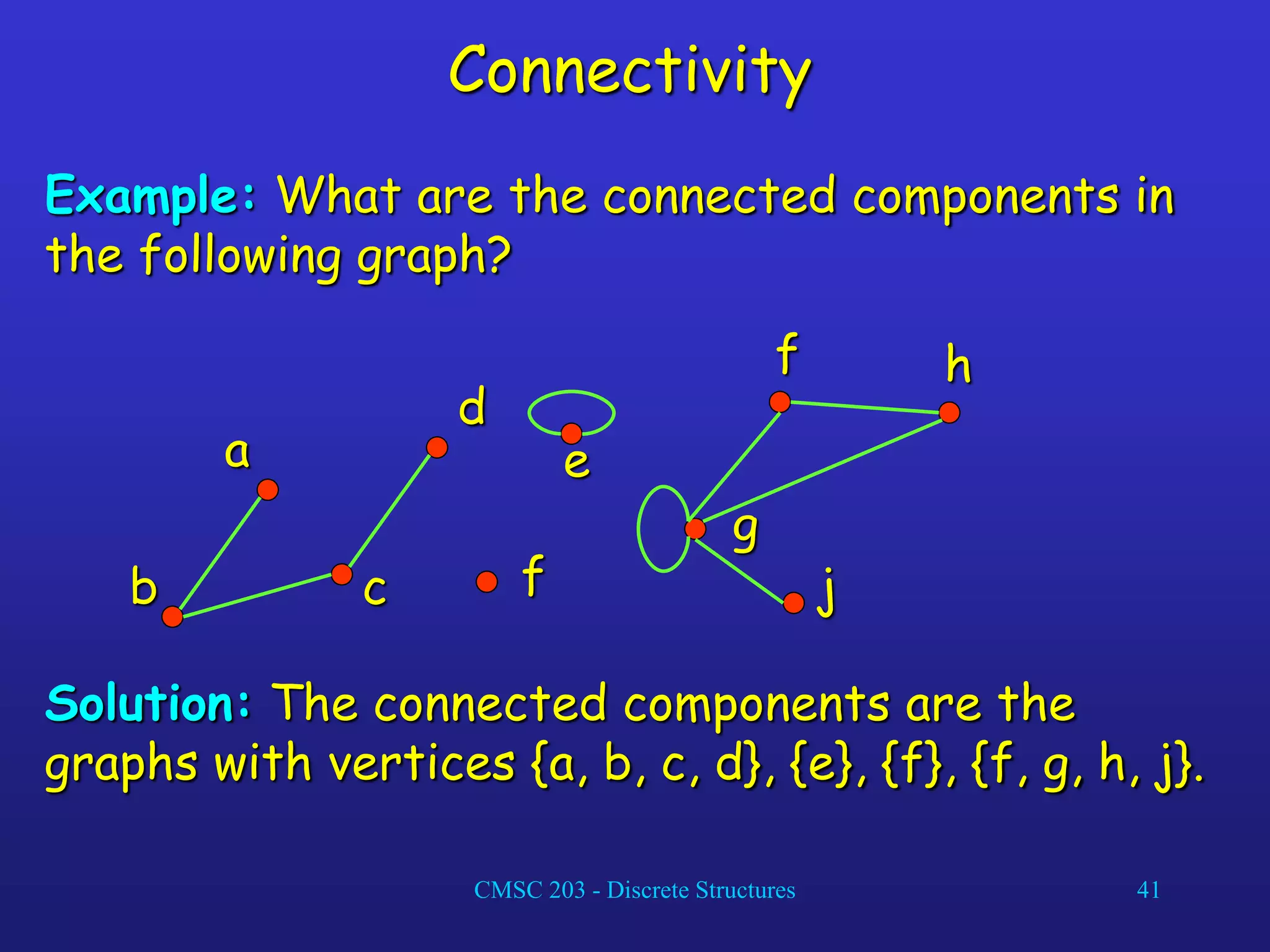
Example: What are the connected components in
the following graph?
a
b c
d
f h
g
j
f
e
Solution: The connected components are the
graphs with vertices {a, b, c, d}, {e}, {f}, {f, g, h, j}.
CMSC 203 - Discrete Structures 42
Connectivity
Definition: An directed graph is strongly
connected if there is a path from a to b and from b
to a whenever a and b are vertices in the graph.
Definition: An directed graph is weakly connected
if there is a path between any two vertices in the
underlying undirected graph.
CMSC 203 - Discrete Structures 43
Connectivity
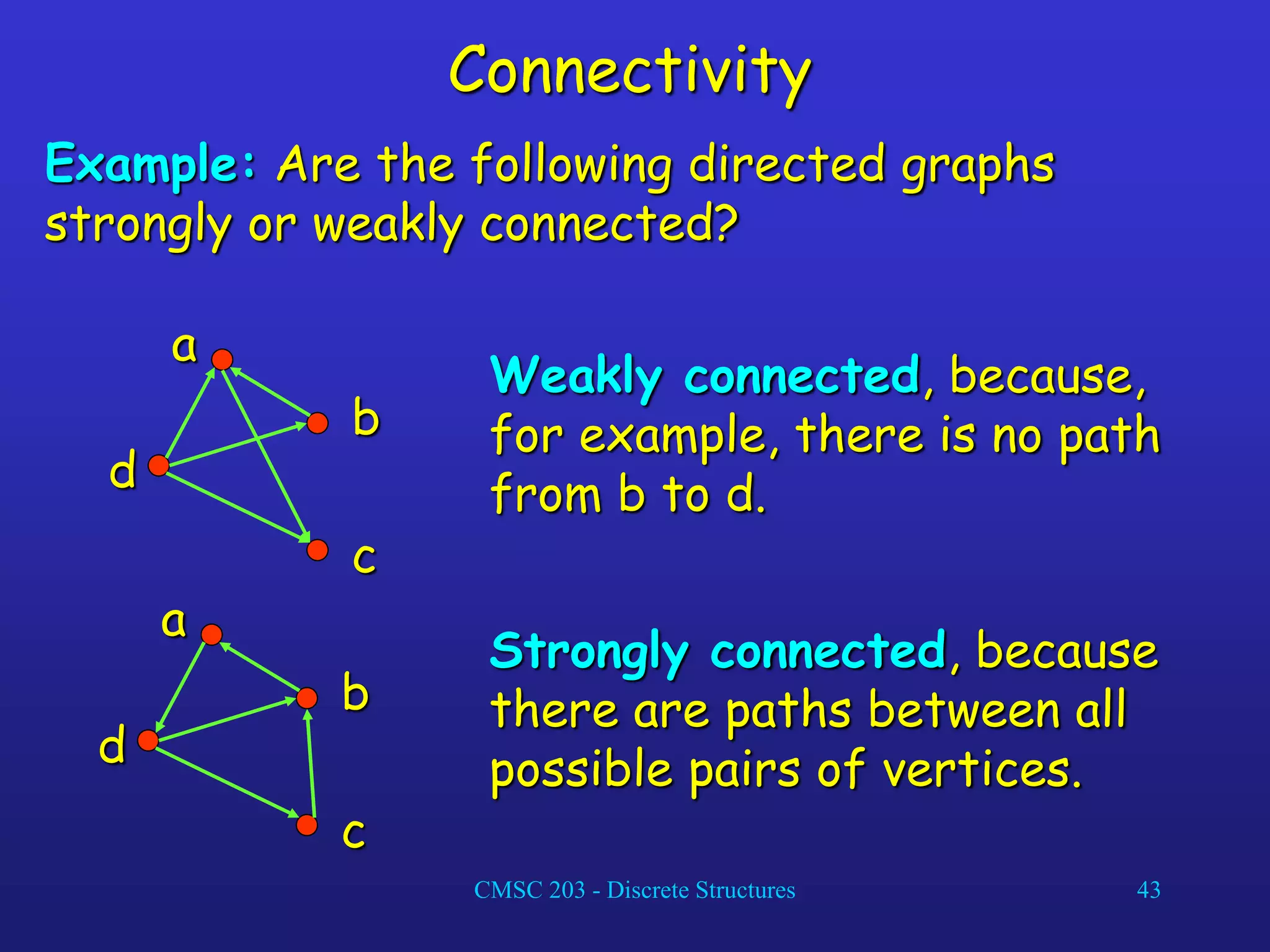
Example: Are the following directed graphs
strongly or weakly connected?
a
b
c
d
Weakly connected, because,
for example, there is no path
from b to d.
a
b
c
d
Strongly connected, because
there are paths between all
possible pairs of vertices.
CMSC 203 - Discrete Structures 44
Shortest Path Problems
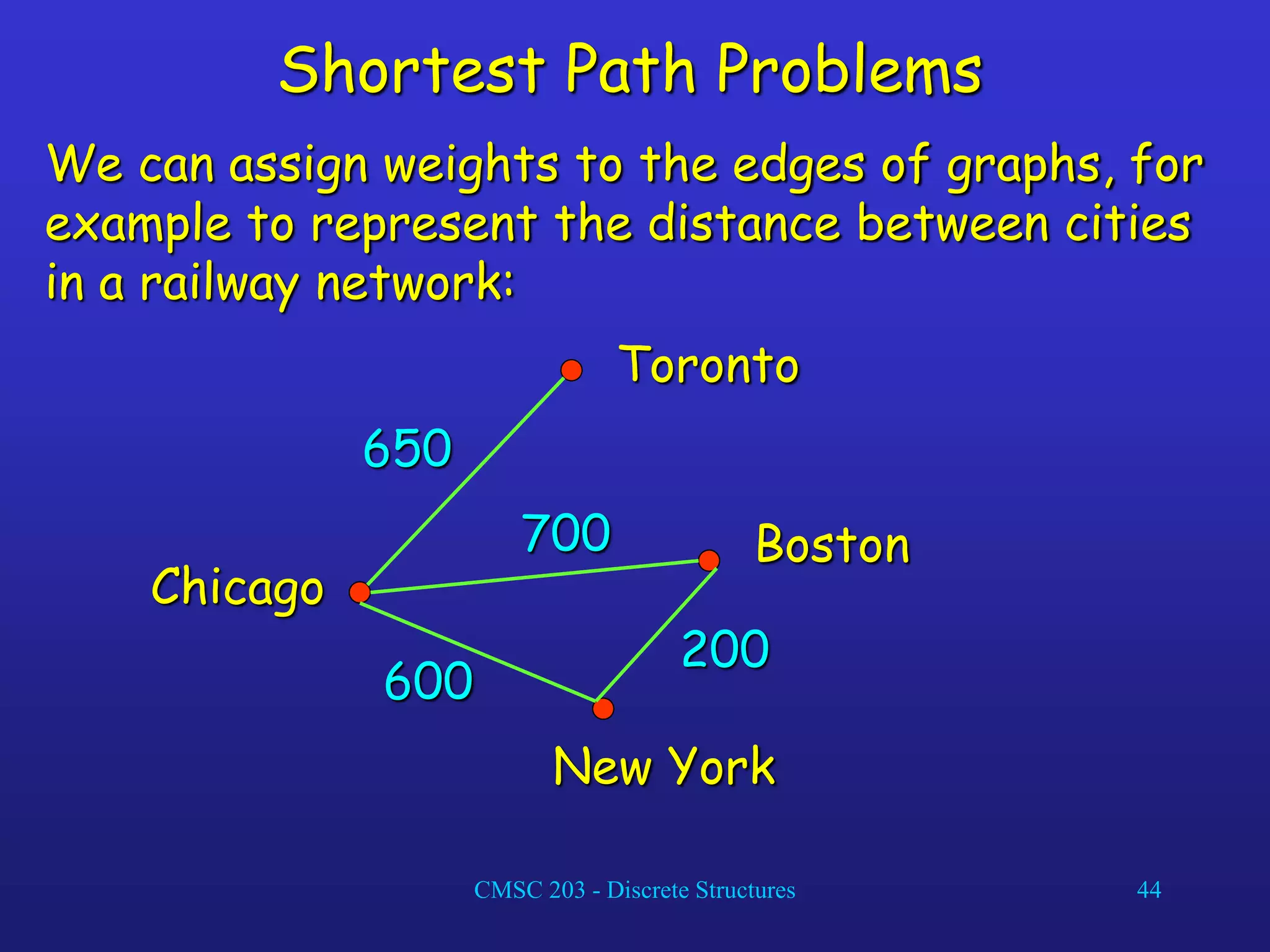
We can assign weights to the edges of graphs, for
example to represent the distance between cities
in a railway network:
Chicago
Toronto
New York
Boston
600
700
200
650
CMSC 203 - Discrete Structures 45
Shortest Path Problems
Such weighted graphs can also be used to model
computer networks with response times or costs
as weights.
One of the most interesting questions that we can
investigate with such graphs is:
What is the shortest path between two vertices
in the graph, that is, the path with the minimal
sum of weights along the way?
This corresponds to the shortest train connection
or the fastest connection in a computer network.
CMSC 203 - Discrete Structures 46
Dijkstra’s Algorithm
Dijkstra’s algorithm is an iterative procedure that
finds the shortest path between to vertices a and
z in a weighted graph.
It proceeds by finding the length of the shortest
path from a to successive vertices and adding
these vertices to a distinguished set of vertices S.
The algorithm terminates once it reaches the
vertex z.
CMSC 203 - Discrete Structures 47
The Traveling Salesman Problem
The traveling salesman problem is one of the
classical problems in computer science.
A traveling salesman wants to visit a number of
cities and then return to his starting point. Of
course he wants to save time and energy, so he
wants to determine the shortest path for his trip.
We can represent the cities and the distances
between them by a weighted, complete, undirected
graph.
The problem then is to find the circuit of minimum
total weight that visits each vertex exactly one.
CMSC 203 - Discrete Structures 48
The Traveling Salesman Problem
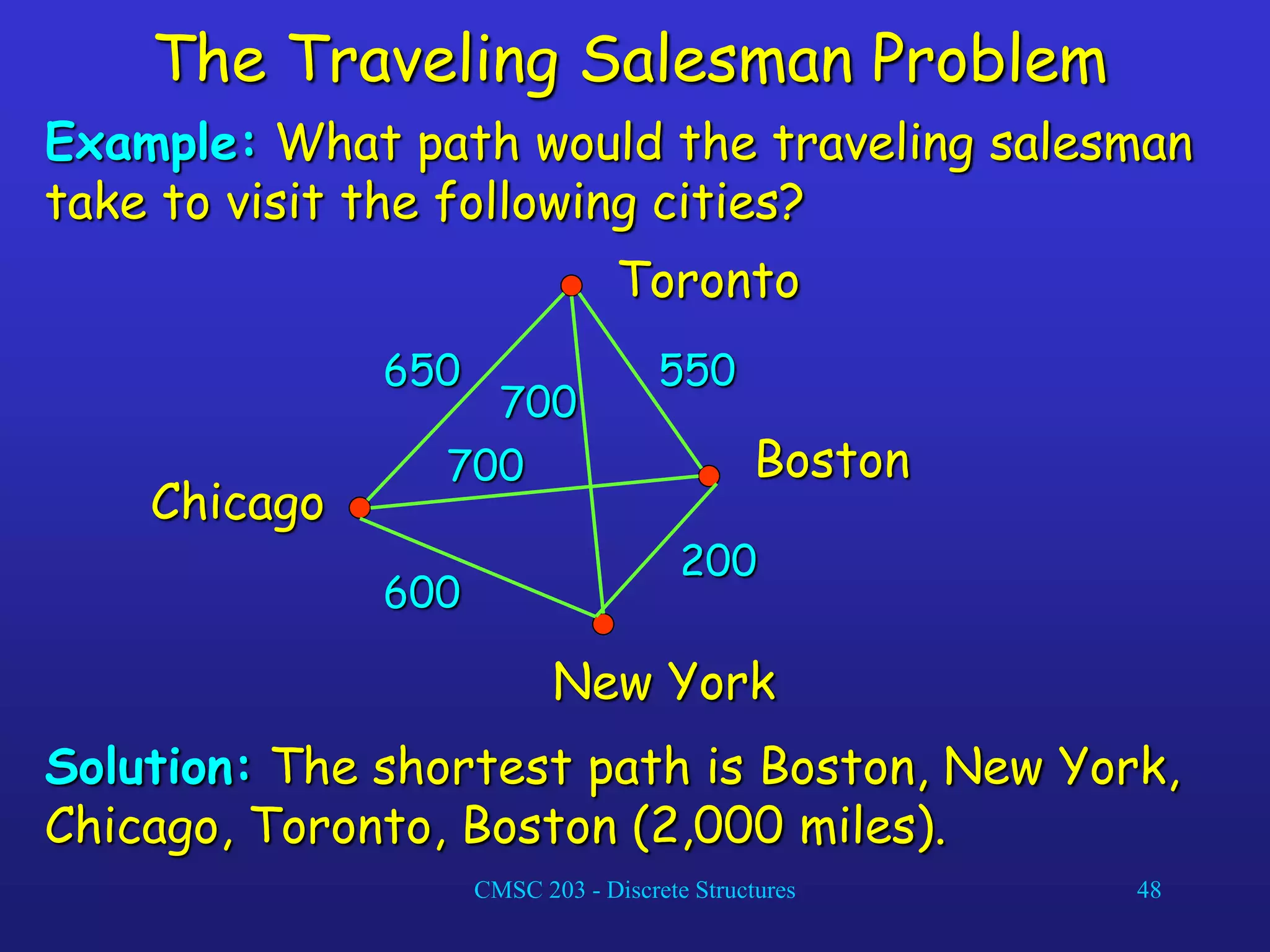
Example: What path would the traveling salesman
take to visit the following cities?
Chicago
Toronto
New York
Boston
600
700
200
650 550
700
Solution: The shortest path is Boston, New York,
Chicago, Toronto, Boston (2,000 miles).
CMSC 203 - Discrete Structures 49
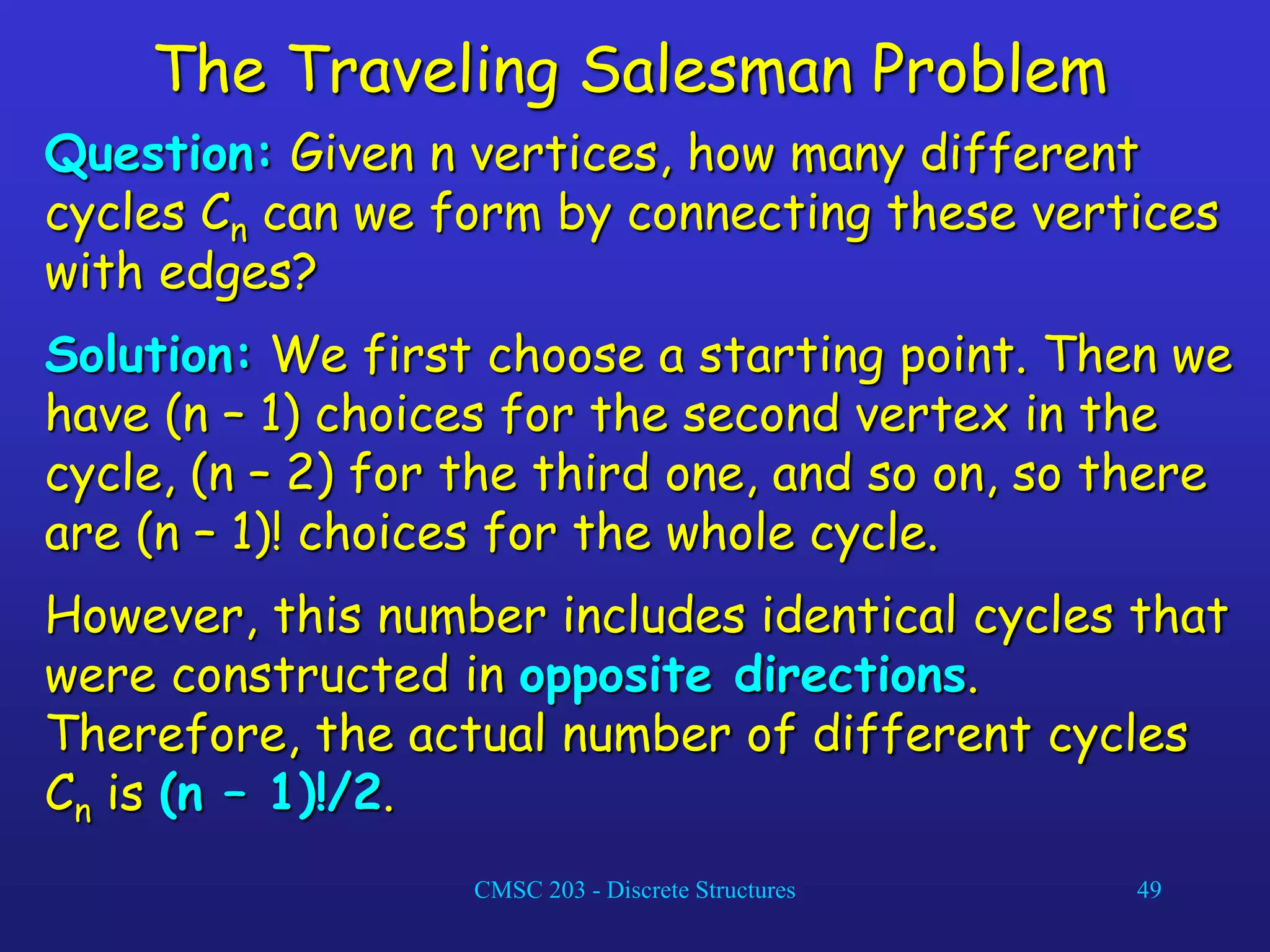
The Traveling Salesman Problem
Question: Given n vertices, how many different
cycles Cn can we form by connecting these vertices
with edges?
Solution: We first choose a starting point. Then we
have (n – 1) choices for the second vertex in the
cycle, (n – 2) for the third one, and so on, so there
are (n – 1)! choices for the whole cycle.
However, this number includes identical cycles that
were constructed in opposite directions.
Therefore, the actual number of different cycles
Cn is (n – 1)!/2.
CMSC 203 - Discrete Structures 50
The Traveling Salesman Problem
Unfortunately, no algorithm solving the traveling
salesman problem with polynomial worst-case time
complexity has been devised yet.
This means that for large numbers of vertices,
solving the traveling salesman problem is
impractical.
In these cases, we can use efficient approximation
algorithms that determine a path whose length may
be slightly larger than the traveling salesman’s
path, but
CMSC 203 - Discrete Structures 51
The
End

Ch08.ppt

  • 1.
    CMSC 203 -Discrete Structures 1 Let us switch to a new topic: Graphs
  • 2.
    CMSC 203 -Discrete Structures 2 Introduction to Graphs Definition: A simple graph G = (V, E) consists of V, a nonempty set of vertices, and E, a set of unordered pairs of distinct elements of V called edges. For each eE, e = {u, v} where u, v  V. An undirected graph (not simple) may contain loops. An edge e is a loop if e = {u, u} for some uV.
  • 3.
    CMSC 203 -Discrete Structures 3 Introduction to Graphs Definition: A directed graph G = (V, E) consists of a set V of vertices and a set E of edges that are ordered pairs of elements in V. For each eE, e = (u, v) where u, v  V. An edge e is a loop if e = (u, u) for some uV. A simple graph is just like a directed graph, but with no specified direction of its edges.
  • 4.
    CMSC 203 -Discrete Structures 4 Graph Models Example I: How can we represent a network of (bi-directional) railways connecting a set of cities? We should use a simple graph with an edge {a, b} indicating a direct train connection between cities a and b. New York Boston Washington Lübeck Toronto Hamburg
  • 5.
    CMSC 203 -Discrete Structures 5 Graph Models Example II: In a round-robin tournament, each team plays against each other team exactly once. How can we represent the results of the tournament (which team beats which other team)? We should use a directed graph with an edge (a, b) indicating that team a beats team b. Penguins Bruins Lübeck Giants Maple Leafs
  • 6.
    CMSC 203 -Discrete Structures 6 Graph Terminology Definition: Two vertices u and v in an undirected graph G are called adjacent (or neighbors) in G if {u, v} is an edge in G. If e = {u, v}, the edge e is called incident with the vertices u and v. The edge e is also said to connect u and v. The vertices u and v are called endpoints of the edge {u, v}.
  • 7.
    CMSC 203 -Discrete Structures 7 Graph Terminology Definition: The degree of a vertex in an undirected graph is the number of edges incident with it, except that a loop at a vertex contributes twice to the degree of that vertex. In other words, you can determine the degree of a vertex in a displayed graph by counting the lines that touch it. The degree of the vertex v is denoted by deg(v).
  • 8.
    CMSC 203 -Discrete Structures 8 Graph Terminology A vertex of degree 0 is called isolated, since it is not adjacent to any vertex. Note: A vertex with a loop at it has at least degree 2 and, by definition, is not isolated, even if it is not adjacent to any other vertex. A vertex of degree 1 is called pendant. It is adjacent to exactly one other vertex.
  • 9.
    CMSC 203 -Discrete Structures 9 Graph Terminology Example: Which vertices in the following graph are isolated, which are pendant, and what is the maximum degree? What type of graph is it? a b c d f h g j f e Solution: Vertex f is isolated, and vertices a, d and j are pendant. The maximum degree is deg(g) = 5. This graph is a pseudograph (undirected, loops).
  • 10.
    CMSC 203 -Discrete Structures 10 Graph Terminology Let us look at the same graph again and determine the number of its edges and the sum of the degrees of all its vertices: a b c d f h g j f e Result: There are 9 edges, and the sum of all degrees is 18. This is easy to explain: Each new edge increases the sum of degrees by exactly two.
  • 11.
    CMSC 203 -Discrete Structures 11 Graph Terminology The Handshaking Theorem: Let G = (V, E) be an undirected graph with e edges. Then 2e = vV deg(v) Example: How many edges are there in a graph with 10 vertices, each of degree 6? Solution: The sum of the degrees of the vertices is 610 = 60. According to the Handshaking Theorem, it follows that 2e = 60, so there are 30 edges.
  • 12.
    CMSC 203 -Discrete Structures 12 Graph Terminology Theorem: An undirected graph has an even number of vertices of odd degree. Proof: Let V1 and V2 be the set of vertices of even and odd degrees, respectively (Thus V1  V2 = , and V1 V2 = V). Then by Handshaking theorem 2|E| = vV deg(v) = vV1 deg(v) + vV2 deg(v) Since both 2|E| and vV1 deg(v) are even, vV2 deg(v) must be even. Since deg(v) if odd for all vV2, |V2| must be even. QED
  • 13.
    CMSC 203 -Discrete Structures 13 Graph Terminology Definition: When (u, v) is an edge of the graph G with directed edges, u is said to be adjacent to v, and v is said to be adjacent from u. The vertex u is called the initial vertex of (u, v), and v is called the terminal vertex of (u, v). The initial vertex and terminal vertex of a loop are the same.
  • 14.
    CMSC 203 -Discrete Structures 14 Graph Terminology Definition: In a graph with directed edges, the in- degree of a vertex v, denoted by deg-(v), is the number of edges with v as their terminal vertex. The out-degree of v, denoted by deg+(v), is the number of edges with v as their initial vertex. Question: How does adding a loop to a vertex change the in-degree and out-degree of that vertex? Answer: It increases both the in-degree and the out-degree by one.
  • 15.
    CMSC 203 -Discrete Structures 15 Graph Terminology Example: What are the in-degrees and out- degrees of the vertices a, b, c, d in this graph: a b c d deg-(a) = 1 deg+(a) = 2 deg-(b) = 4 deg+(b) = 2 deg-(d) = 2 deg+(d) = 1 deg-(c) = 0 deg+(c) = 2
  • 16.
    CMSC 203 -Discrete Structures 16 Graph Terminology Theorem: Let G = (V, E) be a graph with directed edges. Then: vV deg-(v) = vV deg+(v) = |E| This is easy to see, because every new edge increases both the sum of in-degrees and the sum of out-degrees by one.
  • 17.
    CMSC 203 -Discrete Structures 17 Special Graphs Definition: The complete graph on n vertices, denoted by Kn, is the simple graph that contains exactly one edge between each pair of distinct vertices. K1 K2 K3 K4 K5
  • 18.
    CMSC 203 -Discrete Structures 18 Special Graphs Definition: The cycle Cn, n  3, consists of n vertices v1, v2, …, vn and edges {v1, v2}, {v2, v3}, …, {vn-1, vn}, {vn, v1}. C3 C4 C5 C6
  • 19.
    CMSC 203 -Discrete Structures 19 Special Graphs Definition: We obtain the wheel Wn when we add an additional vertex to the cycle Cn, for n  3, and connect this new vertex to each of the n vertices in Cn by adding new edges. W3 W4 W5 W6
  • 20.
    CMSC 203 -Discrete Structures 20 Special Graphs Definition: The n-cube, denoted by Qn, is the graph that has vertices representing the 2n bit strings of length n. Two vertices are adjacent if and only if the bit strings that they represent differ in exactly one bit position. Q1 Q2 Q3 0 1 00 01 11 10 000 001 101 100 010 011 111 110
  • 21.
    CMSC 203 -Discrete Structures 21 Special Graphs Definition: A simple graph is called bipartite if its vertex set V can be partitioned into two disjoint nonempty sets V1 and V2 such that every edge in the graph connects a vertex in V1 with a vertex in V2 (so that no edge in G connects either two vertices in V1 or two vertices in V2). For example, consider a graph that represents each person in a village by a vertex and each marriage by an edge. This graph is bipartite, because each edge connects a vertex in the subset of males with a vertex in the subset of females (if we think of traditional marriages).
  • 22.
    CMSC 203 -Discrete Structures 22 Special Graphs Example I: Is C3 bipartite? v1 v2 v3 No, because there is no way to partition the vertices into two sets so that there are no edges with both endpoints in the same set. Example II: Is C6 bipartite? v5 v1 v2 v3 v4 v6 v1 v6 v2 v5 v3 v4 Yes, because we can display C6 like this:
  • 23.
    CMSC 203 -Discrete Structures 23 Special Graphs Definition: The complete bipartite graph Km,n is the graph that has its vertex set partitioned into two subsets of m and n vertices, respectively. Two vertices are connected if and only if they are in different subsets. K3,2 K3,4
  • 24.
    CMSC 203 -Discrete Structures 24 Operations on Graphs Definition: A subgraph of a graph G = (V, E) is a graph H = (W, F) where WV and FE. Note: Of course, H is a valid graph, so we cannot remove any endpoints of remaining edges when creating H. Example: K5 subgraph of K5
  • 25.
    CMSC 203 -Discrete Structures 25 Operations on Graphs Definition: The union of two simple graphs G1 = (V1, E1) and G2 = (V2, E2) is the simple graph with vertex set V1  V2 and edge set E1  E2. The union of G1 and G2 is denoted by G1  G2. G1 G2 G1  G2 = K5
  • 26.
    CMSC 203 -Discrete Structures 26 Representing Graphs a b c d a b c d a, d b a, d c a, b, c d b, c, d a Adjacent Vertices Vertex a b c a, b, c d c a Terminal Vertices Initial Vertex
  • 27.
    CMSC 203 -Discrete Structures 27 Representing Graphs Definition: Let G = (V, E) be a simple graph with |V| = n. Suppose that the vertices of G are listed in arbitrary order as v1, v2, …, vn. The adjacency matrix A (or AG) of G, with respect to this listing of the vertices, is the nn zero-one matrix with 1 as its (i, j)th entry when vi and vj are adjacent, and 0 otherwise. In other words, for an adjacency matrix A = [aij], aij = 1 if {vi, vj} is an edge of G, aij = 0 otherwise.
  • 28.
    CMSC 203 -Discrete Structures 28 Representing Graphs a b c d Example: What is the adjacency matrix AG for the following graph G based on the order of vertices a, b, c, d ? Solution:              0 1 1 1 1 0 0 1 1 0 0 1 1 1 1 0 G A Note: Adjacency matrices of undirected graphs are always symmetric.
  • 29.
    CMSC 203 -Discrete Structures 29 Representing Graphs Definition: Let G = (V, E) be an undirected graph with |V| = n. Suppose that the vertices and edges of G are listed in arbitrary order as v1, v2, …, vn and e1, e2, …, em, respectively. The incidence matrix of G with respect to this listing of the vertices and edges is the nm zero- one matrix with 1 as its (i, j)th entry when edge ej is incident with vi, and 0 otherwise. In other words, for an incidence matrix M = [mij], mij = 1 if edge ej is incident with vi mij = 0 otherwise.
  • 30.
    CMSC 203 -Discrete Structures 30 Representing Graphs Example: What is the incidence matrix M for the following graph G based on the order of vertices a, b, c, d and edges 1, 2, 3, 4, 5, 6? Solution:              0 0 1 1 1 0 1 1 1 0 0 0 0 0 0 1 0 1 0 1 0 0 1 1 M Note: Incidence matrices of directed graphs contain two 1s per column for edges connecting two vertices and one 1 per column for loops. a b c d 1 2 4 5 3 6
  • 31.
    CMSC 203 -Discrete Structures 31 Isomorphism of Graphs Definition: The simple graphs G1 = (V1, E1) and G2 = (V2, E2) are isomorphic if there is a bijection (an one-to-one and onto function) f from V1 to V2 with the property that a and b are adjacent in G1 if and only if f(a) and f(b) are adjacent in G2, for all a and b in V1. Such a function f is called an isomorphism. In other words, G1 and G2 are isomorphic if their vertices can be ordered in such a way that the adjacency matrices MG1 and MG2 are identical.
  • 32.
    CMSC 203 -Discrete Structures 32 Isomorphism of Graphs From a visual standpoint, G1 and G2 are isomorphic if they can be arranged in such a way that their displays are identical (of course without changing adjacency). Unfortunately, for two simple graphs, each with n vertices, there are n! possible isomorphisms that we have to check in order to show that these graphs are isomorphic. However, showing that two graphs are not isomorphic can be easy.
  • 33.
    CMSC 203 -Discrete Structures 33 Isomorphism of Graphs For this purpose we can check invariants, that is, properties that two isomorphic simple graphs must both have. For example, they must have • the same number of vertices, • the same number of edges, and • the same degrees of vertices. Note that two graphs that differ in any of these invariants are not isomorphic, but two graphs that match in all of them are not necessarily isomorphic.
  • 34.
    CMSC 203 -Discrete Structures 34 Isomorphism of Graphs Example I: Are the following two graphs isomorphic? d a b c e d a b c e Solution: Yes, they are isomorphic, because they can be arranged to look identical. You can see this if in the right graph you move vertex b to the left of the edge {a, c}. Then the isomorphism f from the left to the right graph is: f(a) = e, f(b) = a, f(c) = b, f(d) = c, f(e) = d.
  • 35.
    CMSC 203 -Discrete Structures 35 Isomorphism of Graphs Example II: How about these two graphs? d a b c e d a b c e Solution: No, they are not isomorphic, because they differ in the degrees of their vertices. Vertex d in right graph is of degree one, but there is no such vertex in the left graph.
  • 36.
    CMSC 203 -Discrete Structures 36 Connectivity Definition: A path of length n from u to v, where n is a positive integer, in an undirected graph is a sequence of edges e1, e2, …, en of the graph such that e1 = {x0, x1}, e2 = {x1, x2}, …, en = {xn-1, xn}, where x0 = u and xn = v. When the graph is simple, we denote this path by its vertex sequence x0, x1, …, xn, since it uniquely determines the path. The path is a circuit if it begins and ends at the same vertex, that is, if u = v.
  • 37.
    CMSC 203 -Discrete Structures 37 Connectivity Definition (continued): The path or circuit is said to pass through or traverse x1, x2, …, xn-1. A path or circuit is simple if it does not contain the same edge more than once.
  • 38.
    CMSC 203 -Discrete Structures 38 Connectivity Let us now look at something new: Definition: An undirected graph is called connected if there is a path between every pair of distinct vertices in the graph. For example, any two computers in a network can communicate if and only if the graph of this network is connected. Note: A graph consisting of only one vertex is always connected, because it does not contain any pair of distinct vertices.
  • 39.
    CMSC 203 -Discrete Structures 39 Connectivity Example: Are the following graphs connected? d a b c e Yes. d a b c e No. d a b c e Yes. d a b c e f No.
  • 40.
    CMSC 203 -Discrete Structures 40 Connectivity Definition: A graph that is not connected is the union of two or more connected subgraphs, each pair of which has no vertex in common. These disjoint connected subgraphs are called the connected components of the graph.
  • 41.
    CMSC 203 -Discrete Structures 41 Connectivity Example: What are the connected components in the following graph? a b c d f h g j f e Solution: The connected components are the graphs with vertices {a, b, c, d}, {e}, {f}, {f, g, h, j}.
  • 42.
    CMSC 203 -Discrete Structures 42 Connectivity Definition: An directed graph is strongly connected if there is a path from a to b and from b to a whenever a and b are vertices in the graph. Definition: An directed graph is weakly connected if there is a path between any two vertices in the underlying undirected graph.
  • 43.
    CMSC 203 -Discrete Structures 43 Connectivity Example: Are the following directed graphs strongly or weakly connected? a b c d Weakly connected, because, for example, there is no path from b to d. a b c d Strongly connected, because there are paths between all possible pairs of vertices.
  • 44.
    CMSC 203 -Discrete Structures 44 Shortest Path Problems We can assign weights to the edges of graphs, for example to represent the distance between cities in a railway network: Chicago Toronto New York Boston 600 700 200 650
  • 45.
    CMSC 203 -Discrete Structures 45 Shortest Path Problems Such weighted graphs can also be used to model computer networks with response times or costs as weights. One of the most interesting questions that we can investigate with such graphs is: What is the shortest path between two vertices in the graph, that is, the path with the minimal sum of weights along the way? This corresponds to the shortest train connection or the fastest connection in a computer network.
  • 46.
    CMSC 203 -Discrete Structures 46 Dijkstra’s Algorithm Dijkstra’s algorithm is an iterative procedure that finds the shortest path between to vertices a and z in a weighted graph. It proceeds by finding the length of the shortest path from a to successive vertices and adding these vertices to a distinguished set of vertices S. The algorithm terminates once it reaches the vertex z.
  • 47.
    CMSC 203 -Discrete Structures 47 The Traveling Salesman Problem The traveling salesman problem is one of the classical problems in computer science. A traveling salesman wants to visit a number of cities and then return to his starting point. Of course he wants to save time and energy, so he wants to determine the shortest path for his trip. We can represent the cities and the distances between them by a weighted, complete, undirected graph. The problem then is to find the circuit of minimum total weight that visits each vertex exactly one.
  • 48.
    CMSC 203 -Discrete Structures 48 The Traveling Salesman Problem Example: What path would the traveling salesman take to visit the following cities? Chicago Toronto New York Boston 600 700 200 650 550 700 Solution: The shortest path is Boston, New York, Chicago, Toronto, Boston (2,000 miles).
  • 49.
    CMSC 203 -Discrete Structures 49 The Traveling Salesman Problem Question: Given n vertices, how many different cycles Cn can we form by connecting these vertices with edges? Solution: We first choose a starting point. Then we have (n – 1) choices for the second vertex in the cycle, (n – 2) for the third one, and so on, so there are (n – 1)! choices for the whole cycle. However, this number includes identical cycles that were constructed in opposite directions. Therefore, the actual number of different cycles Cn is (n – 1)!/2.
  • 50.
    CMSC 203 -Discrete Structures 50 The Traveling Salesman Problem Unfortunately, no algorithm solving the traveling salesman problem with polynomial worst-case time complexity has been devised yet. This means that for large numbers of vertices, solving the traveling salesman problem is impractical. In these cases, we can use efficient approximation algorithms that determine a path whose length may be slightly larger than the traveling salesman’s path, but
  • 51.
    CMSC 203 -Discrete Structures 51 The End