8-1
Copyright © 2010 Pearson Education, Inc. Publishing as Prentice Hall
Project Management
Chapter 8 (Crashing)
8-2
Chapter 8 - Project Management
2
Project Crashing
Basic Concept
In last lecture, we studied on how to use CPM and
PERT to identify critical path for a project
problem
Now, the question is:
Question: Can we cut short its project completion
time?
If so, how!
8-3
3
Project Crashing
Solution!
Yes, the project duration can be reduced by
assigning more resources to project
activities. But, doing this would somehow
increase our project cost!
How do we strike a balance?
■ Project crashing is a method for shortening
project duration by reducing one or more
critical activities to a time less than normal
activity time.
8-4
4
Trade-off concept
Here, we adopt the “Trade-off” concept
 We attempt to “crash” some “critical”
events by allocating more resources to them,
so that the time of one or more critical
activities is reduced to a time that is less than
the normal activity time.
 How to do that:
 Question: What criteria should it be
based on when deciding to crashing
critical times?
8-5
5
Example – crashing (1)
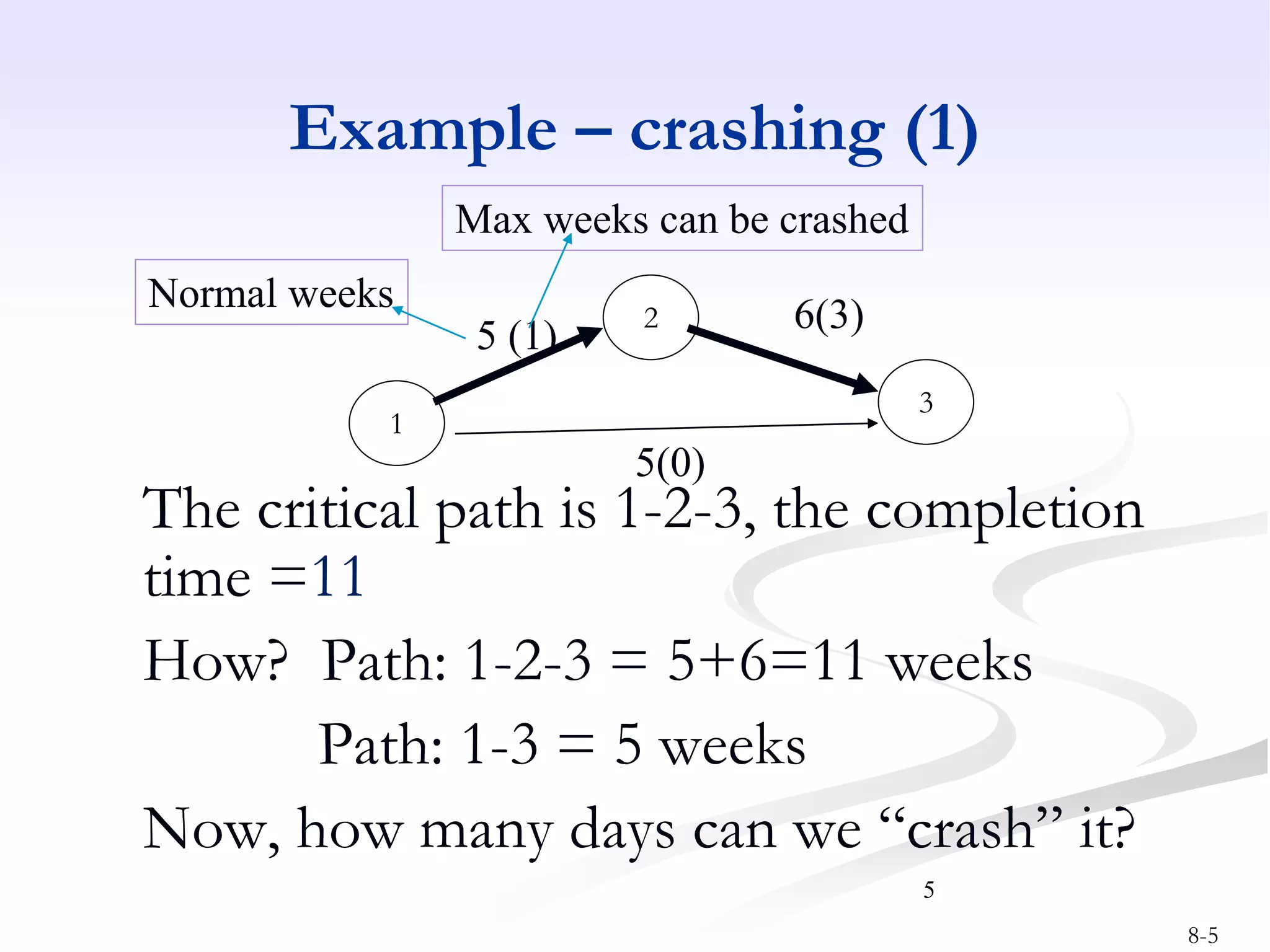
The critical path is 1-2-3, the completion
time =11
How? Path: 1-2-3 = 5+6=11 weeks
Path: 1-3 = 5 weeks
Now, how many days can we “crash” it?
1
3
2
5 (1)
6(3)
5(0)
Normal weeks
Max weeks can be crashed
8-6
6
Example – crashing (1)
1
3
2
5 (1)
6(3)
5(0)
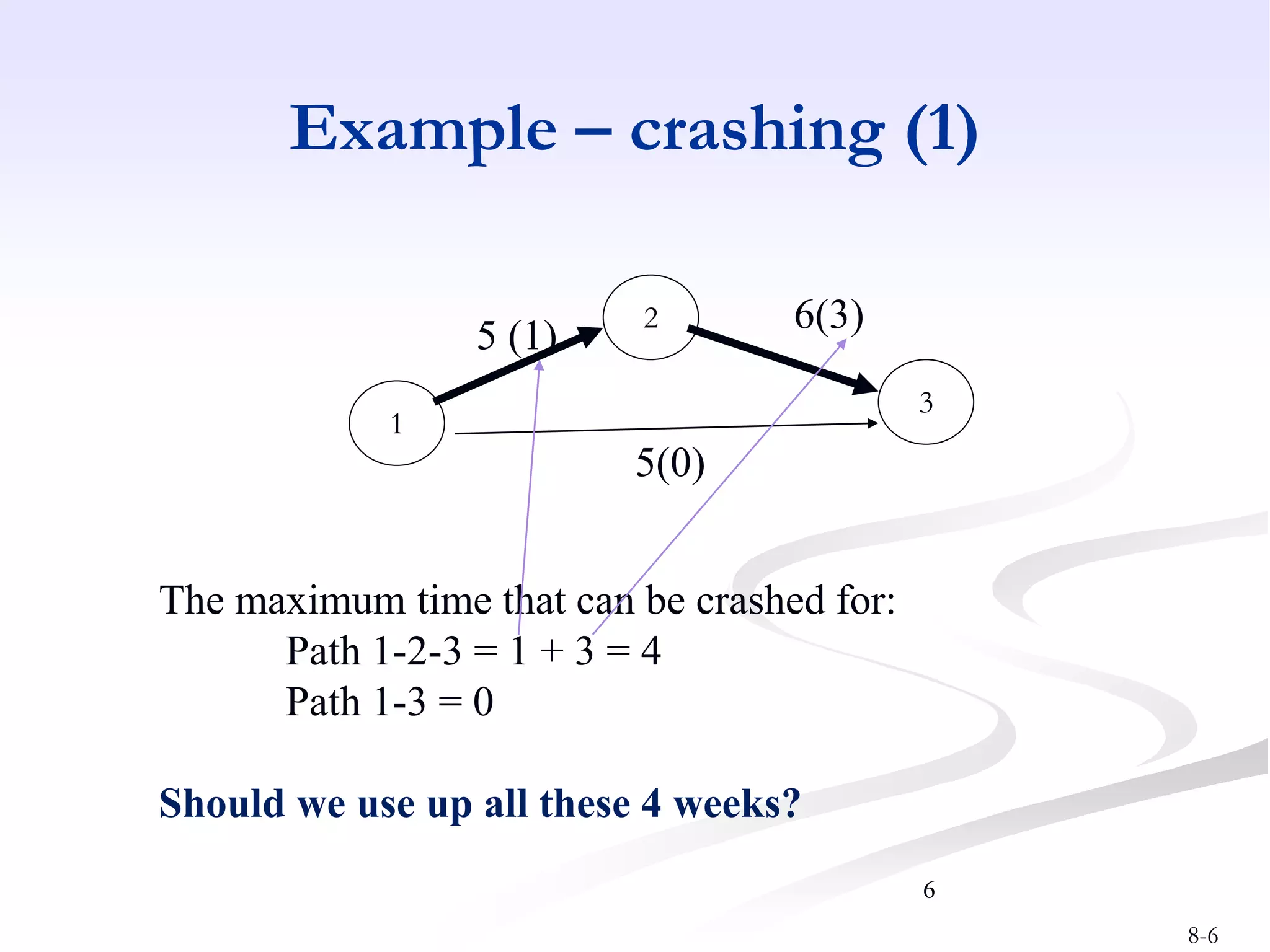
The maximum time that can be crashed for:
Path 1-2-3 = 1 + 3 = 4
Path 1-3 = 0
Should we use up all these 4 weeks?
8-7
7
Example – crashing (1)
1
3
2
5 (1)
6(3)
5(0)
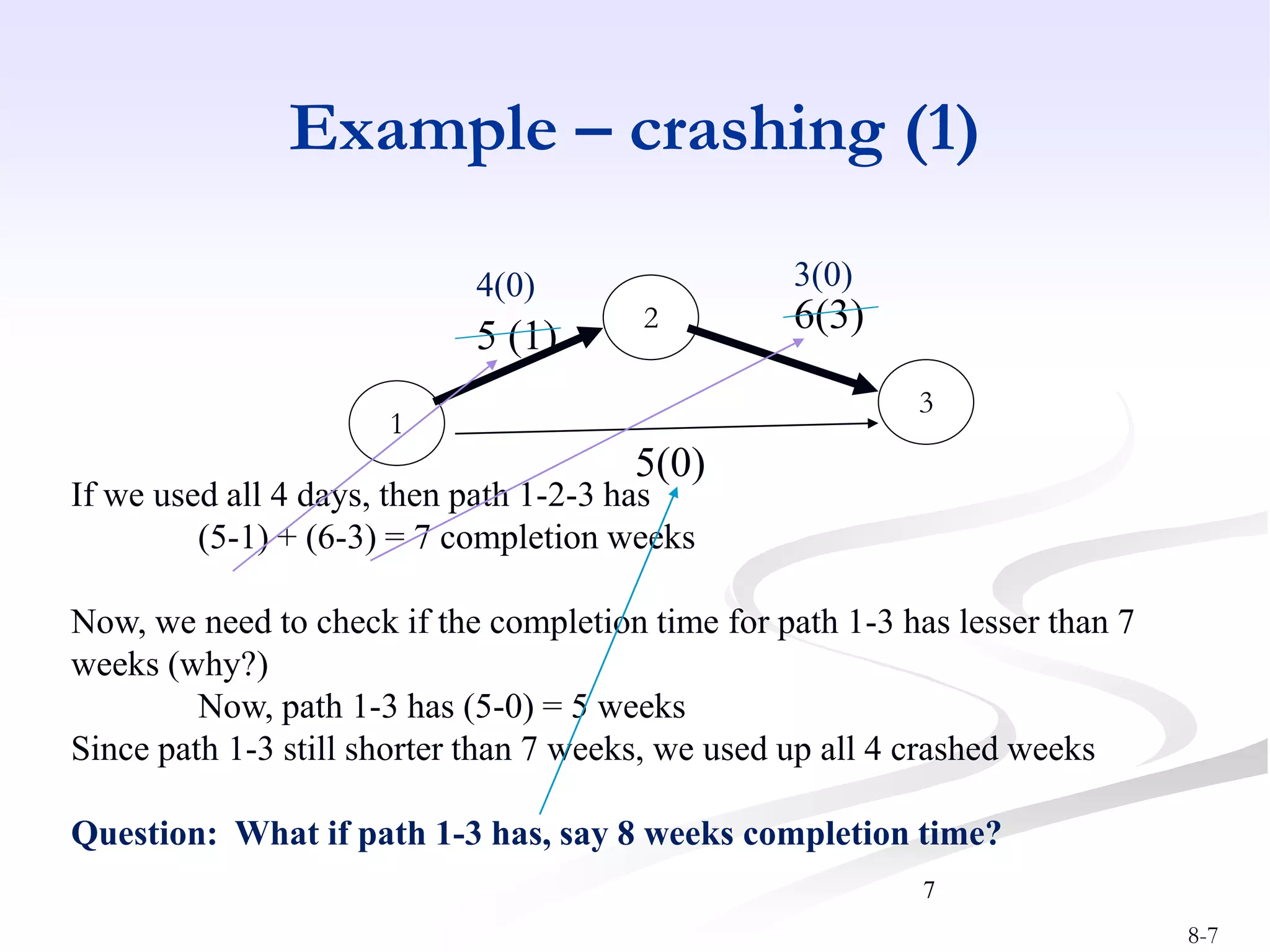
If we used all 4 days, then path 1-2-3 has
(5-1) + (6-3) = 7 completion weeks
Now, we need to check if the completion time for path 1-3 has lesser than 7
weeks (why?)
Now, path 1-3 has (5-0) = 5 weeks
Since path 1-3 still shorter than 7 weeks, we used up all 4 crashed weeks
Question: What if path 1-3 has, say 8 weeks completion time?
4(0) 3(0)
8-8
8
Example – crashing (1)
1
3
2
5 (1)
6(3)
8(0)
Such as
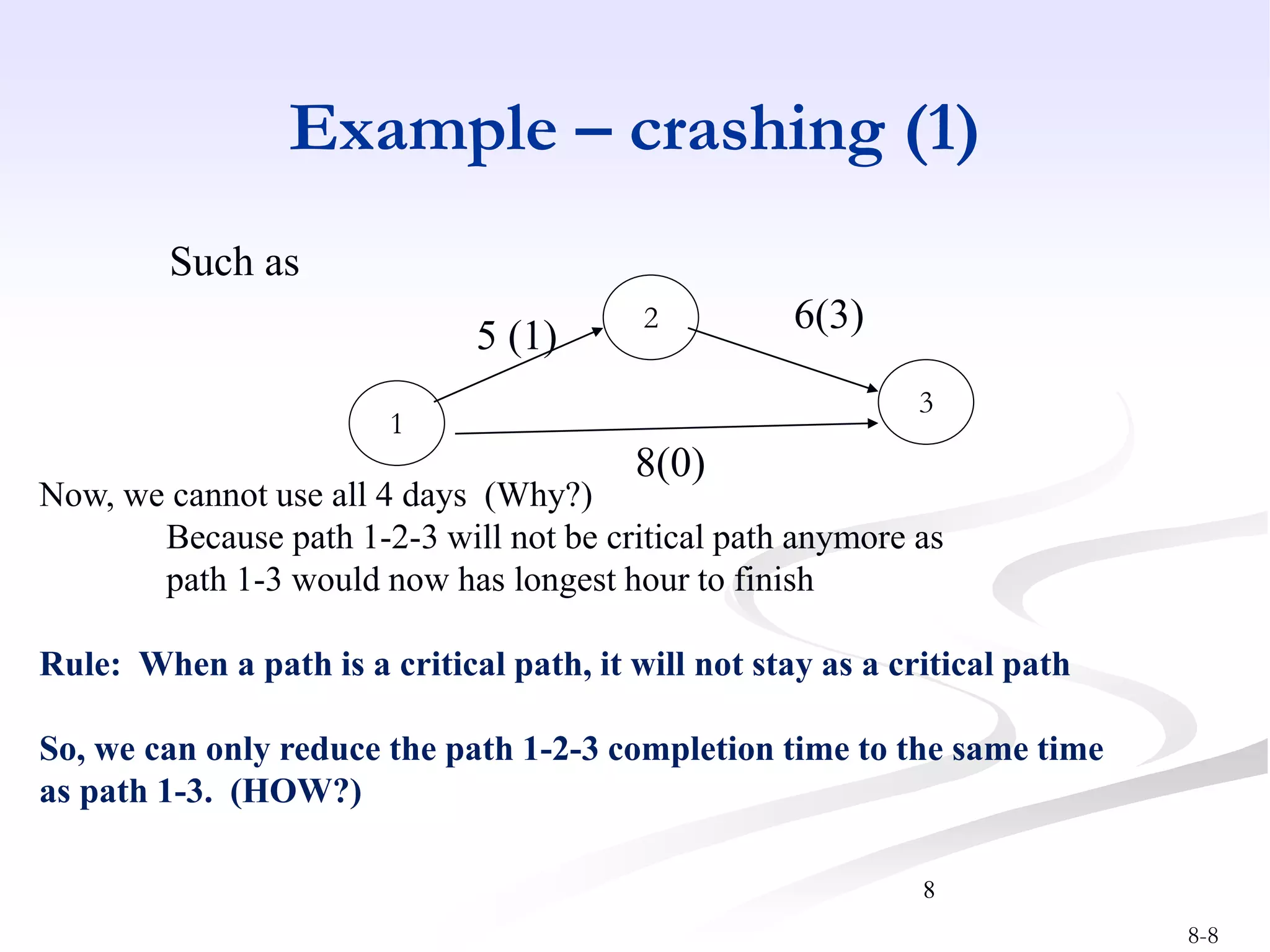
Now, we cannot use all 4 days (Why?)
Because path 1-2-3 will not be critical path anymore as
path 1-3 would now has longest hour to finish
Rule: When a path is a critical path, it will not stay as a critical path
So, we can only reduce the path 1-2-3 completion time to the same time
as path 1-3. (HOW?)
8-9
9
Example – crashing (1)
1
3
2
5 (1)
6(3)
8(0)
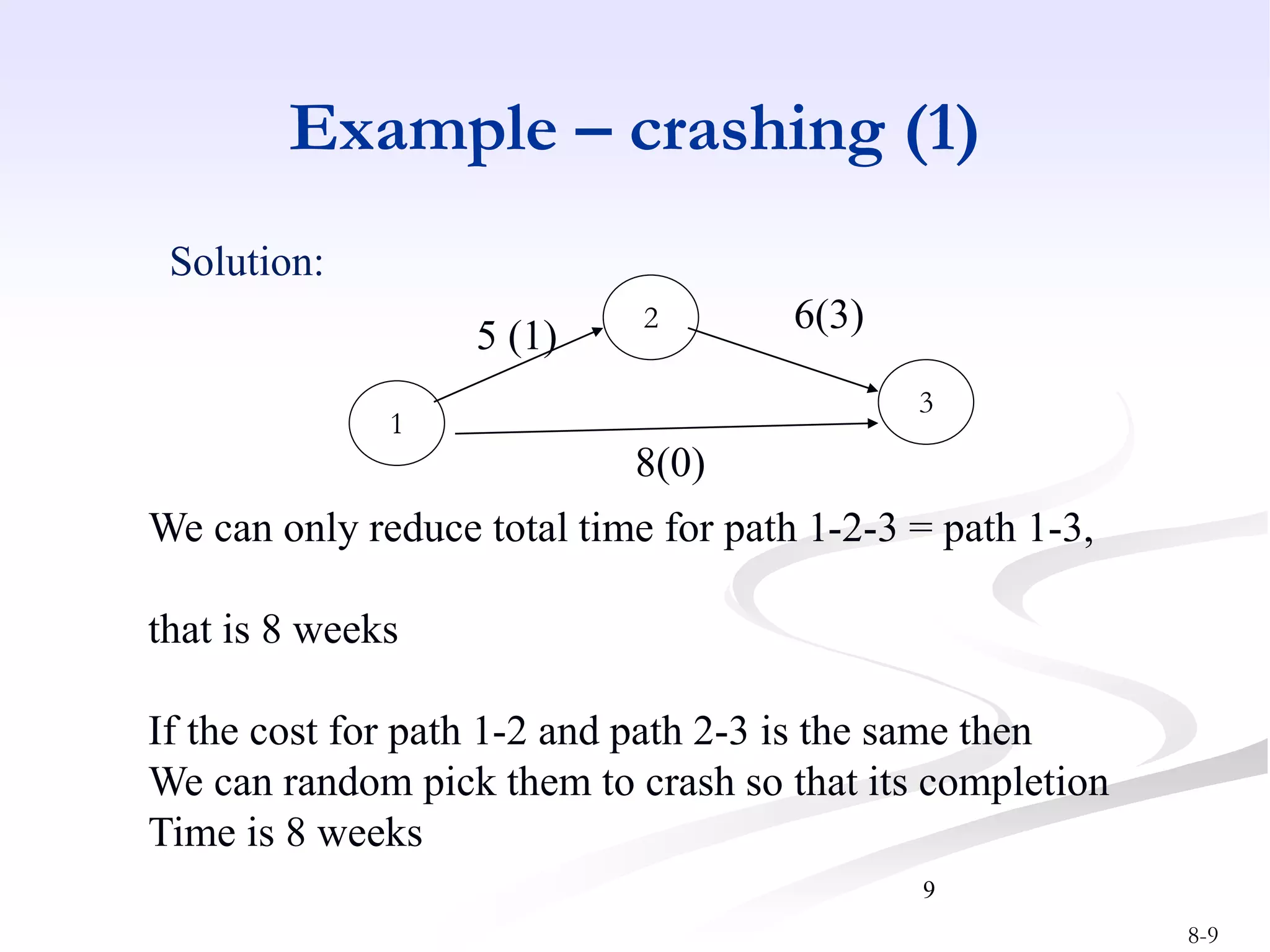
Solution:
We can only reduce total time for path 1-2-3 = path 1-3,
that is 8 weeks
If the cost for path 1-2 and path 2-3 is the same then
We can random pick them to crash so that its completion
Time is 8 weeks
8-10
10
Example – crashing (1)
1
3
2
5 (1)
6(3)
8(0)
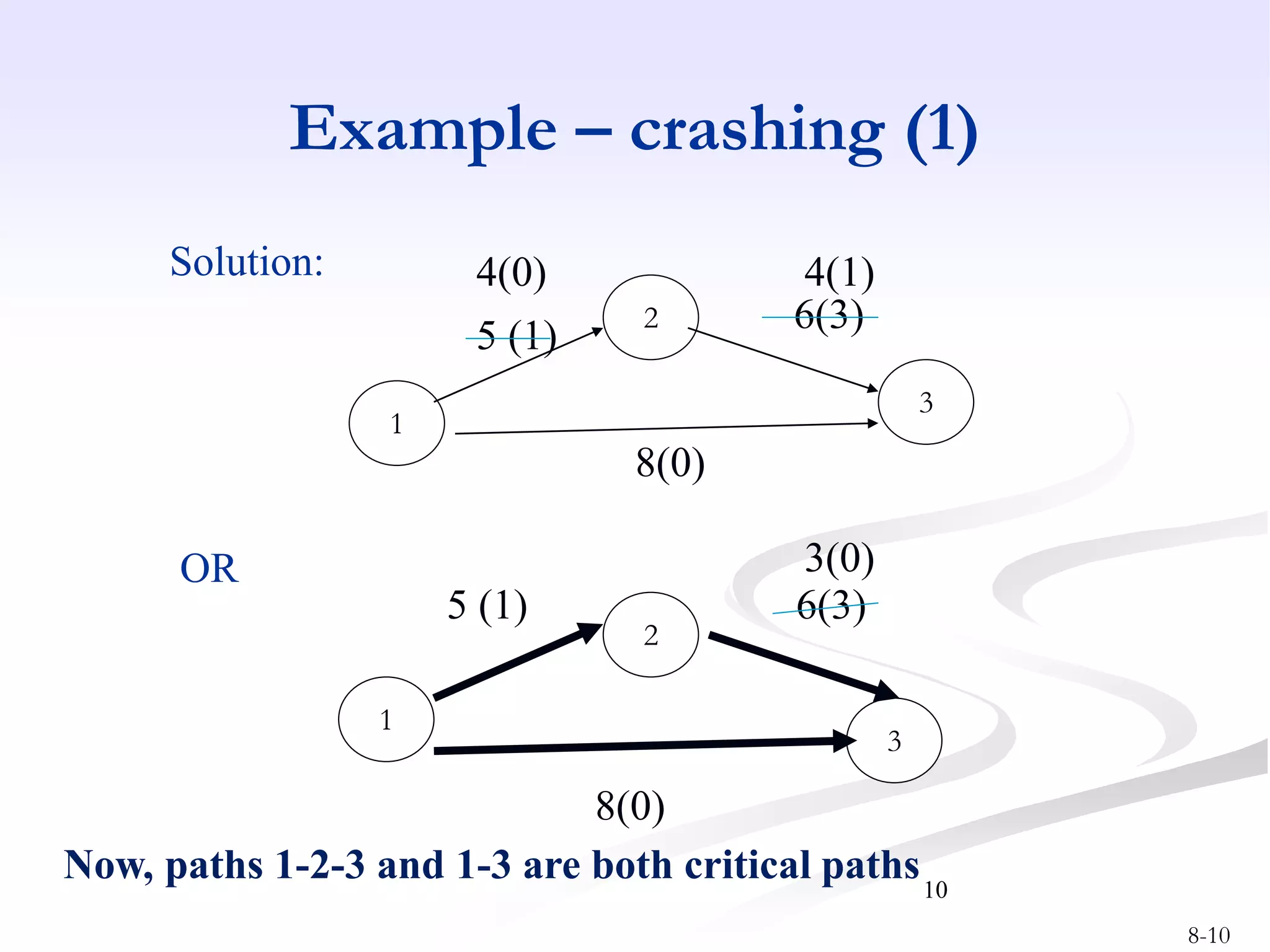
Solution:
1
2
3
5 (1) 6(3)
8(0)
OR
4(0) 4(1)
3(0)
Now, paths 1-2-3 and 1-3 are both critical paths
8-11
Project Crashing and Time-Cost Trade-Off
Example Problem (2 of 5)
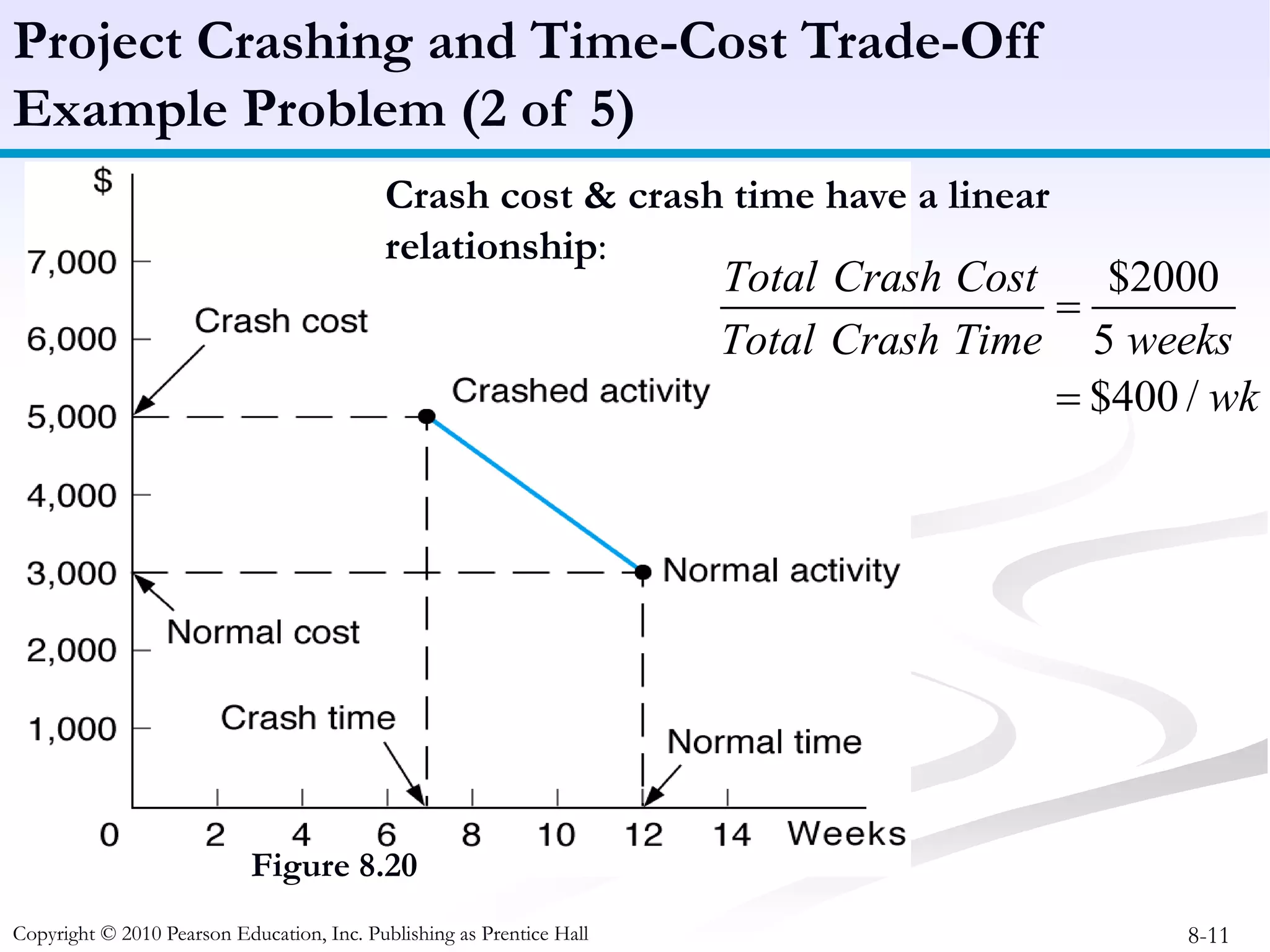
Figure 8.20
Copyright © 2010 Pearson Education, Inc. Publishing as Prentice Hall
Crash cost & crash time have a linear
relationship:
$2000
5
$400 /
Total Crash Cost
Total Crash Time weeks
wk


8-12
Project Crashing and Time-Cost Trade-Off
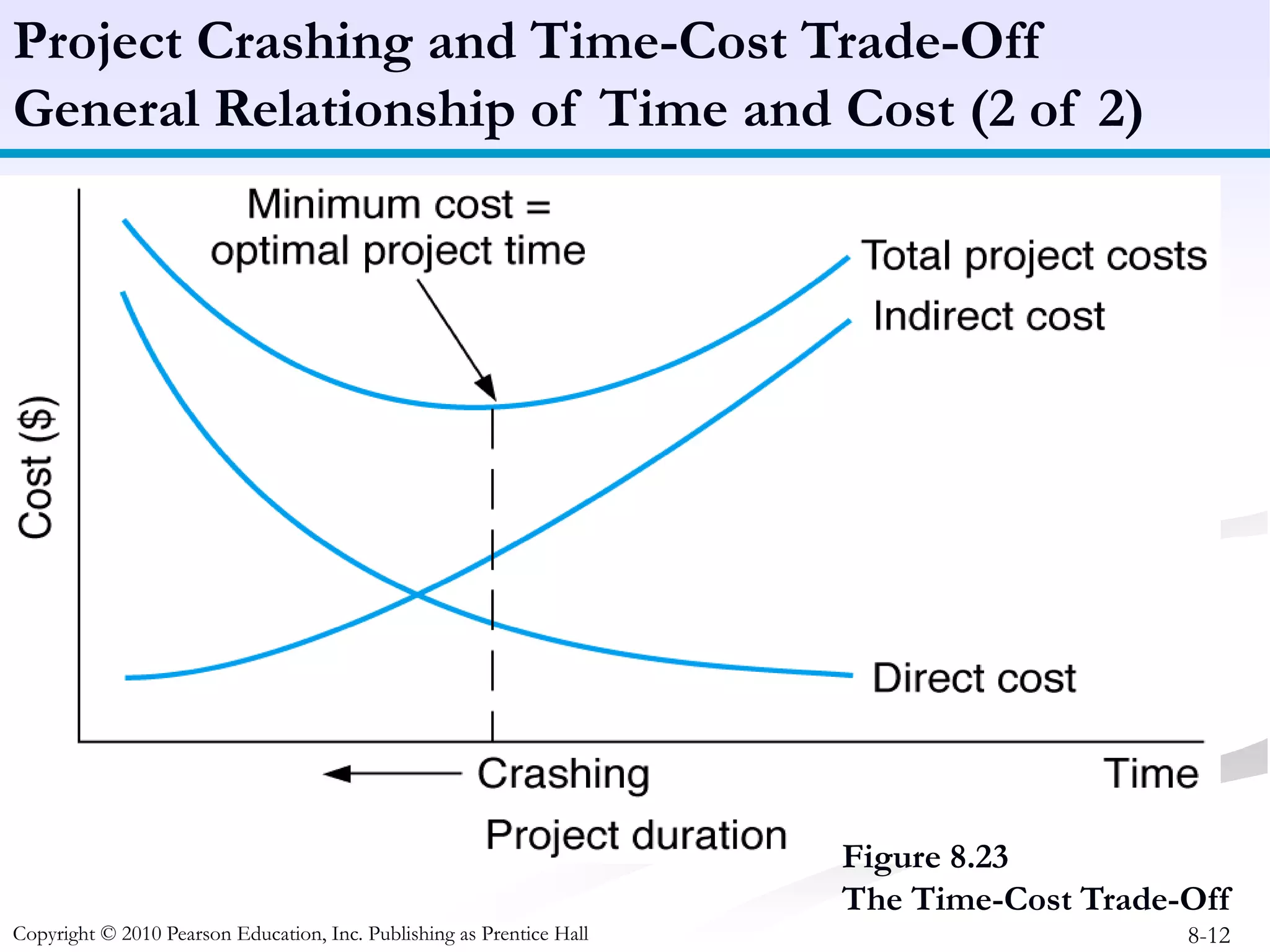
General Relationship of Time and Cost (2 of 2)
Figure 8.23
The Time-Cost Trade-Off
Copyright © 2010 Pearson Education, Inc. Publishing as Prentice Hall
8-13
Copyright © 2010 Pearson Education, Inc. Publishing as Prentice Hall
8-14
Copyright © 2010 Pearson Education, Inc. Publishing as Prentice Hall
8-15
Copyright © 2010 Pearson Education, Inc. Publishing as Prentice Hall
8-16
Copyright © 2010 Pearson Education, Inc. Publishing as Prentice Hall
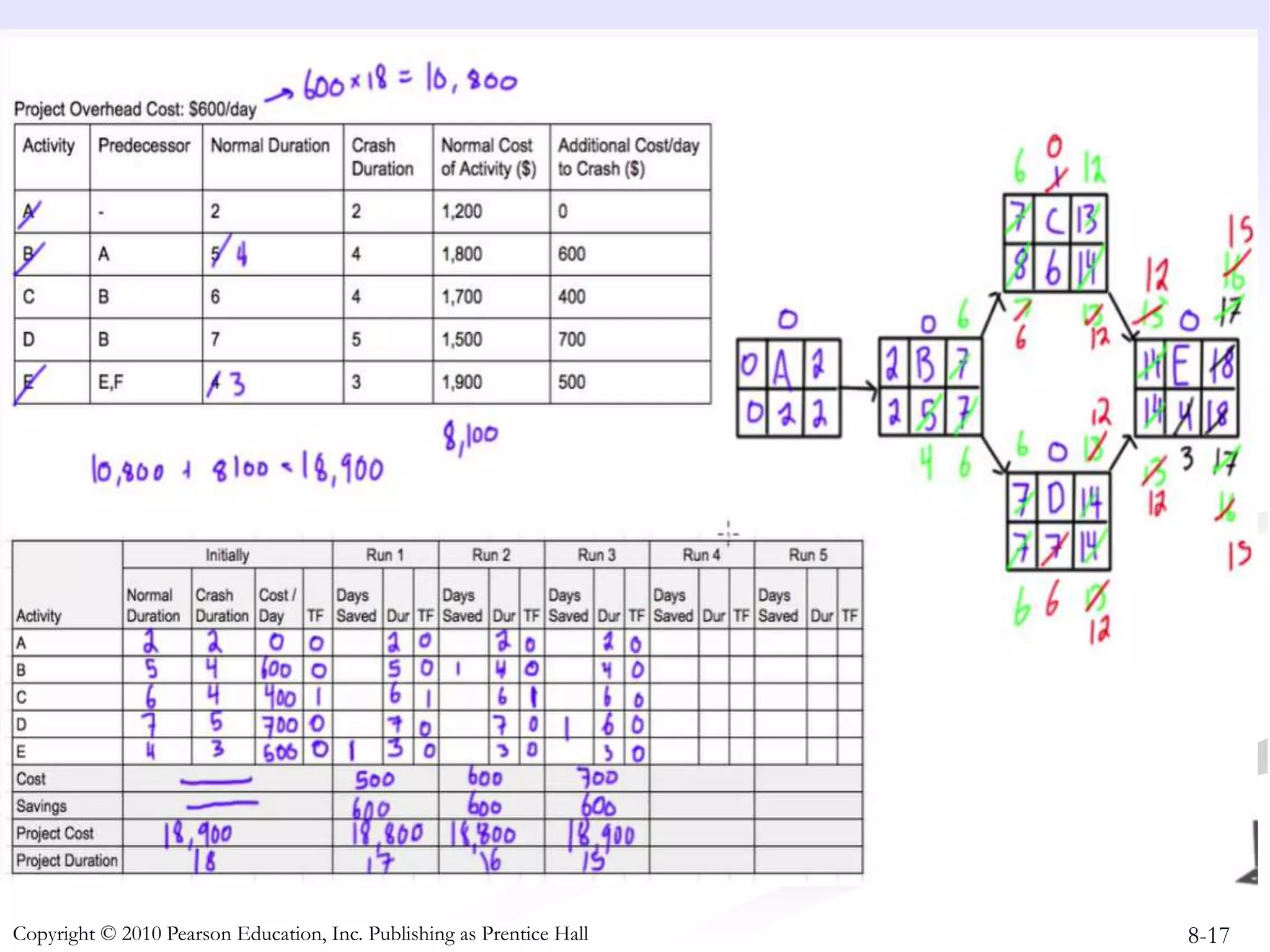
8-17
Copyright © 2010 Pearson Education, Inc. Publishing as Prentice Hall
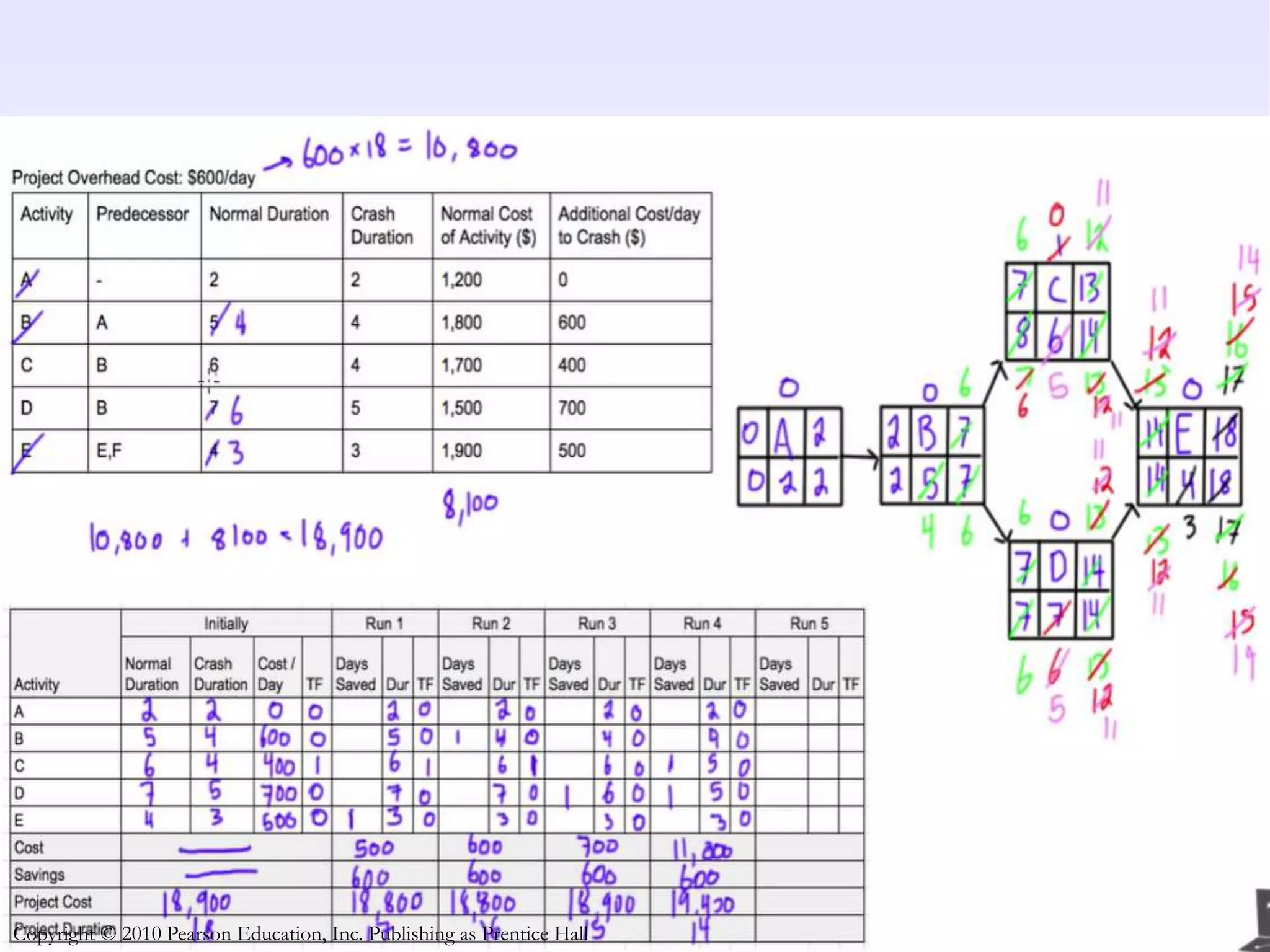
8-18
Copyright © 2010 Pearson Education, Inc. Publishing as Prentice Hall
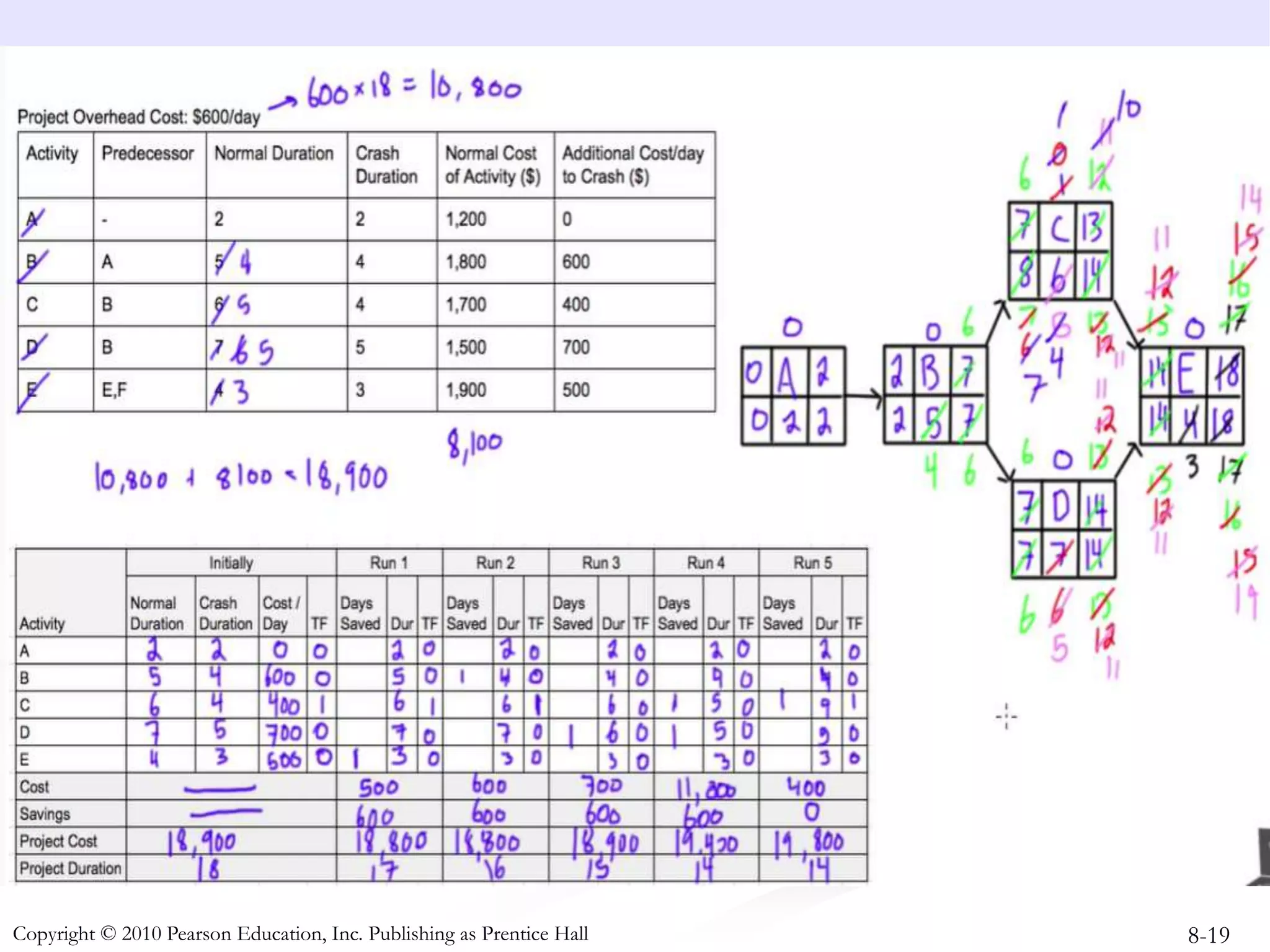
8-19
Copyright © 2010 Pearson Education, Inc. Publishing as Prentice Hall

ch05_crashing.ppt

  • 1.
    8-1 Copyright © 2010Pearson Education, Inc. Publishing as Prentice Hall Project Management Chapter 8 (Crashing)
  • 2.
    8-2 Chapter 8 -Project Management 2 Project Crashing Basic Concept In last lecture, we studied on how to use CPM and PERT to identify critical path for a project problem Now, the question is: Question: Can we cut short its project completion time? If so, how!
  • 3.
    8-3 3 Project Crashing Solution! Yes, theproject duration can be reduced by assigning more resources to project activities. But, doing this would somehow increase our project cost! How do we strike a balance? ■ Project crashing is a method for shortening project duration by reducing one or more critical activities to a time less than normal activity time.
  • 4.
    8-4 4 Trade-off concept Here, weadopt the “Trade-off” concept  We attempt to “crash” some “critical” events by allocating more resources to them, so that the time of one or more critical activities is reduced to a time that is less than the normal activity time.  How to do that:  Question: What criteria should it be based on when deciding to crashing critical times?
  • 5.
    8-5 5 Example – crashing(1) The critical path is 1-2-3, the completion time =11 How? Path: 1-2-3 = 5+6=11 weeks Path: 1-3 = 5 weeks Now, how many days can we “crash” it? 1 3 2 5 (1) 6(3) 5(0) Normal weeks Max weeks can be crashed
  • 6.
    8-6 6 Example – crashing(1) 1 3 2 5 (1) 6(3) 5(0) The maximum time that can be crashed for: Path 1-2-3 = 1 + 3 = 4 Path 1-3 = 0 Should we use up all these 4 weeks?
  • 7.
    8-7 7 Example – crashing(1) 1 3 2 5 (1) 6(3) 5(0) If we used all 4 days, then path 1-2-3 has (5-1) + (6-3) = 7 completion weeks Now, we need to check if the completion time for path 1-3 has lesser than 7 weeks (why?) Now, path 1-3 has (5-0) = 5 weeks Since path 1-3 still shorter than 7 weeks, we used up all 4 crashed weeks Question: What if path 1-3 has, say 8 weeks completion time? 4(0) 3(0)
  • 8.
    8-8 8 Example – crashing(1) 1 3 2 5 (1) 6(3) 8(0) Such as Now, we cannot use all 4 days (Why?) Because path 1-2-3 will not be critical path anymore as path 1-3 would now has longest hour to finish Rule: When a path is a critical path, it will not stay as a critical path So, we can only reduce the path 1-2-3 completion time to the same time as path 1-3. (HOW?)
  • 9.
    8-9 9 Example – crashing(1) 1 3 2 5 (1) 6(3) 8(0) Solution: We can only reduce total time for path 1-2-3 = path 1-3, that is 8 weeks If the cost for path 1-2 and path 2-3 is the same then We can random pick them to crash so that its completion Time is 8 weeks
  • 10.
    8-10 10 Example – crashing(1) 1 3 2 5 (1) 6(3) 8(0) Solution: 1 2 3 5 (1) 6(3) 8(0) OR 4(0) 4(1) 3(0) Now, paths 1-2-3 and 1-3 are both critical paths
  • 11.
    8-11 Project Crashing andTime-Cost Trade-Off Example Problem (2 of 5) Figure 8.20 Copyright © 2010 Pearson Education, Inc. Publishing as Prentice Hall Crash cost & crash time have a linear relationship: $2000 5 $400 / Total Crash Cost Total Crash Time weeks wk  
  • 12.
    8-12 Project Crashing andTime-Cost Trade-Off General Relationship of Time and Cost (2 of 2) Figure 8.23 The Time-Cost Trade-Off Copyright © 2010 Pearson Education, Inc. Publishing as Prentice Hall
  • 13.
    8-13 Copyright © 2010Pearson Education, Inc. Publishing as Prentice Hall
  • 14.
    8-14 Copyright © 2010Pearson Education, Inc. Publishing as Prentice Hall
  • 15.
    8-15 Copyright © 2010Pearson Education, Inc. Publishing as Prentice Hall
  • 16.
    8-16 Copyright © 2010Pearson Education, Inc. Publishing as Prentice Hall
  • 17.
    8-17 Copyright © 2010Pearson Education, Inc. Publishing as Prentice Hall
  • 18.
    8-18 Copyright © 2010Pearson Education, Inc. Publishing as Prentice Hall
  • 19.
    8-19 Copyright © 2010Pearson Education, Inc. Publishing as Prentice Hall