Product and Service StrategiesIntro to MarketingChapter 11
What is a Product?A bundle of physical, service and symbolic attributes designed to satisfy a customers wants and needs.Consumers purchase benefits when they buy a product.
What are Goods & Services?	Goods	Tangible Products Customers Can See, Hear, Smell, Taste or Touch
ServicesIntangibleInseparable from the providerPerishableNot easily standardizedUsually require frequent interaction between buyer and sellerQuality varies
Classifications - on basis of consumer buying habitsConvenience  - Products purchased frequently, immediately, with minimal effort.Impulse itemsStaplesEmergency	 items & services-- Slotting Allowances
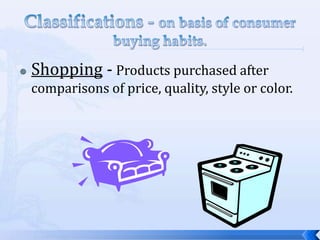
Classifications - on basis of consumer buying habits.Shopping -Products purchased after comparisons of price, quality, style or color.
Classifications - on basis of consumer buying habits.Specialty -Products 	that possess unique	characteristics.Behavior patterns vary for each type of product.
Types of Business ProductsClassified on the basis of useInstallations - long lived, expensive		Price isn’t important, downtime isAccessory Equipment - less expensive, short livedComponent Parts & Materials - products 	that become part of final productRaw MaterialsSuppliesBusiness Services
Development of Product LinesA series of related products offered by a companyFew firms today market only one product.Benefits of having product lines:growthuse of company resourcesenhancing the firms position in marketexploiting product life cycle
Product MixWidthNumber of product linesLengthNumber of products DepthVariations of each product
Product Life CycleProduct Life Cycle is different   from fashion and fad cycles.
Product Life Cycle -       extended by:Increase frequency of useIncrease number of usersFind new usesChange package sizes, labels, quality

Ch 11

  • 1.
    Product and ServiceStrategiesIntro to MarketingChapter 11
  • 2.
    What is aProduct?A bundle of physical, service and symbolic attributes designed to satisfy a customers wants and needs.Consumers purchase benefits when they buy a product.
  • 3.
    What are Goods& Services? Goods Tangible Products Customers Can See, Hear, Smell, Taste or Touch
  • 4.
    ServicesIntangibleInseparable from theproviderPerishableNot easily standardizedUsually require frequent interaction between buyer and sellerQuality varies
  • 5.
    Classifications - onbasis of consumer buying habitsConvenience - Products purchased frequently, immediately, with minimal effort.Impulse itemsStaplesEmergency items & services-- Slotting Allowances
  • 6.
    Classifications - onbasis of consumer buying habits.Shopping -Products purchased after comparisons of price, quality, style or color.
  • 7.
    Classifications - onbasis of consumer buying habits.Specialty -Products that possess unique characteristics.Behavior patterns vary for each type of product.
  • 8.
    Types of BusinessProductsClassified on the basis of useInstallations - long lived, expensive Price isn’t important, downtime isAccessory Equipment - less expensive, short livedComponent Parts & Materials - products that become part of final productRaw MaterialsSuppliesBusiness Services
  • 9.
    Development of ProductLinesA series of related products offered by a companyFew firms today market only one product.Benefits of having product lines:growthuse of company resourcesenhancing the firms position in marketexploiting product life cycle
  • 10.
    Product MixWidthNumber ofproduct linesLengthNumber of products DepthVariations of each product
  • 11.
    Product Life CycleProductLife Cycle is different from fashion and fad cycles.
  • 12.
    Product Life Cycle- extended by:Increase frequency of useIncrease number of usersFind new usesChange package sizes, labels, quality

Editor's Notes

  • #5 Homshoring – hiring contract workers to do job from home