The Path Forward
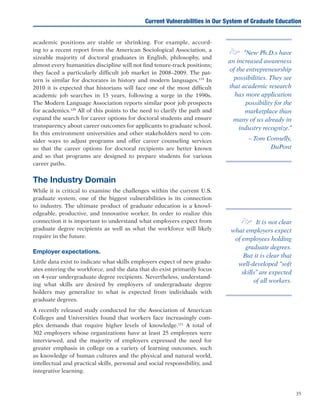
The Future of Graduate Education in the United States
The Path Forward
The Future of Graduate Education
in the United States
Suggested citation*: Council of Graduate Schools and
Educational Testing Service. (2010). The Path Forward: The
Future of Graduate Education in the United States. Report from
the Commission on the Future of Graduate Education in the
United States. Princeton, NJ: Educational Testing Service.
The report was written by Cathy Wendler, Brent Bridgeman,
Fred Cline, Catherine Millett, JoAnn Rock, Nathan Bell, and
Patricia McAllister.
A number of individuals contributed to the project. The ETS
team was led by Cathy Wendler and included Brent Bridgeman,
Catherine Millett, Fred Cline, David Payne, Shelly Punchatz,
JoAnn Rock, Namrata Tognatta, and interns Ross Markle and
Leslie Shaw. The CGS team was led by Debra Stewart and
included Patricia McAllister, Nathan Bell, Daniel Denecke,
and Belle Woods.
We thank Aina Daud, Nicole DiCrecchio, Thomas Ewing,
Cheryl Flagg, Stuart Heiser, Teresa Jackson, Mark McNutt,
William Petzinger, Rosalie Szabo, and Yuan Wang for their
support and help on the project.
* The above suggested citation replaces the citation provided in the first
printing of this report: “Wendler, C., Bridgeman, B., Cline, F., Millett, C.,
Rock, J., Bell, N., and McAllister, P. (2010). The Path Forward: The Future
of Graduate Education in the United States. Princeton, NJ: Educational
Testing Service.” No new data, information, or recommendations are
provided in this reprint of the report.
April 2010
Dear Colleague:
It has been argued that in the knowledge economy, a graduate degree will become the new bachelor’s
degree, the minimal education credential that high-skills employers require. If that is so, then the
United States is in peril of losing its competitive edge, with long-term consequences for our economy,
our quality of life, and our global standing. This report examines the data behind these assertions,
and proposes a set of recommendations to strengthen U.S. graduate education in partnership with
industry and government.
The United States’ system of graduate education is a strategic national asset. Like all valuable assets,
it must be attended to and nurtured in order to remain viable and strong. Other countries and regions
of the world have recognized the value of graduate education as a vital component of economic
development and are making investments accordingly. Europe already produces more doctorates
in science and engineering than are produced in the United States. China and India are making
substantial investments in their graduate education systems. A recent Wall Street Journal ranking of
accelerated MBA programs awarded six of the top 10 places to non-U.S. graduate programs.
Our competitiveness in the global economy hinges on our ability to produce sufficient numbers of
graduate-degree holders — people with the advanced knowledge and critical-thinking abilities to
devise solutions to grand challenges such as energy independence, affordable health care, climate
change and others. One of our greatest resources is our human talent, and as a nation we must invest
in educating more of our population at the graduate level to ensure our capacity to innovate and to
secure our intellectual leadership into the future.
Policymakers, institutions of higher education, and business leaders all have a stake in the process of
producing well-prepared graduate degree holders. People with graduate degrees teach in our schools
and universities, drive innovation, attract intellectual and commercial investment, and strengthen
American prestige and economic power. This report, a collaboration of the Council of Graduate
Schools and Educational Testing Service, provides a clear view of the roadblocks and the pathways
to a graduate degree and to an improved system of graduate education in the United States. We hope
that you find it illuminating, informative and useful.
Sincerely,
Debra W. Stewart				 Kurt M. Landgraf
President						President  CEO
Council of Graduate Schools			 Educational Testing Service
Commission on the Future of Graduate Education in the United States
Chair: William Russel, Dean, Graduate School, Princeton University
Vice Chair: Suzanne Ortega, Executive Vice President and Provost, University of New Mexico
Scott Bass, Provost, American University
Gene Block, Chancellor, University of California, Los Angeles
John Seely Brown, Visiting Scholar and Advisor to the Provost, University of Southern California
Thomas Connelly Jr., Executive Vice President and CIO, E.I. DuPont and Co.
Karen DePauw, Vice President and Dean for Graduate Education, Virginia Tech
Roger Ferguson, President and CEO, TIAA-CREF
Jeffery Gibeling, Dean, Graduate Studies, University of California, Davis
Stanley S. Litow, Vice President, Corporate Citizenship  Corporate Affairs, IBM and President,
IBM International Foundation
Ronald Mason, President, Jackson State University
Patrick Osmer, Vice Provost, Graduate Studies and Dean, Graduate School,
The Ohio State University
Richard J. Parsons, Executive Vice President, Global Staffing Executive, Bank of America
Liora Schmelkin, Senior Vice Provost for Academic Affairs and Dean of Graduate Studies,
Hofstra University
Susan Stites-Doe, Dean of Graduate Studies and Professor of Management,
The College at Brockport, State University of New York
Ronald Townsend, Executive Vice President of Global Laboratory Operations,
Battelle Memorial Institute
John Wiley, Academic Program Director and Professor, Graduate School,
University of Wisconsin-Madison
James Wimbush, Dean, University Graduate School, Indiana University
Ex Officio Members
Kurt Landgraf, President  CEO, Educational Testing Service
Debra Stewart, President, Council of Graduate Schools
We are especially indebted to the following individuals for their time and valuable insights:
Thomas Connelly Jr., E.I. DuPont and Co.; Norman Bradburn, National Opinion Research
Center, University of Chicago; T.J. Elliott, Educational Testing Service; Kathryn Kailikole, The
Louis Stokes Institute for Opportunity in STEM Education; Jeanie Mabie, IBM; Jane Oates,
U.S. Department of Labor; Richard J. Parsons, Bank of America; Eva Pell, Under Secretary for
Science at the Smithsonian Institution; Chandra Taylor Smith, The Pell Institute for the Study
of Opportunity in Higher Education; Eldna Smith, ExxonMobil; and Ronald Townsend, Thomas
Snowberger, and Richard Rosen, Battelle Memorial Institute.
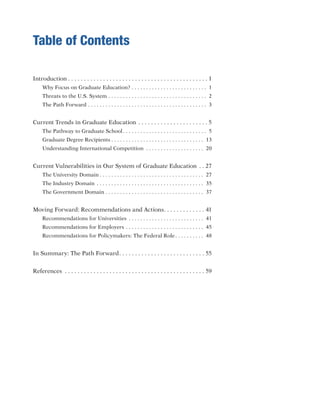
Table of Contents
Introduction. . . . . . . . . . . . . . . . . . . . . . . . . . . . . . . . . . . . . . . . . . . .   1
Why Focus on Graduate Education?. . . . . . . . . . . . . . . . . . . . . . . . . . .  1
Threats to the U.S. System. . . . . . . . . . . . . . . . . . . . . . . . . . . . . . . . . . .  2
The Path Forward. . . . . . . . . . . . . . . . . . . . . . . . . . . . . . . . . . . . . . . . . .  3
Current Trends in Graduate Education. . . . . . . . . . . . . . . . . . . . . .   5
The Pathway to Graduate School. . . . . . . . . . . . . . . . . . . . . . . . . . . . . .  5
Graduate Degree Recipients. . . . . . . . . . . . . . . . . . . . . . . . . . . . . . . . .  13
Understanding International Competition . . . . . . . . . . . . . . . . . . . . .  20
Current Vulnerabilities in Our System of Graduate Education . .   27
The University Domain. . . . . . . . . . . . . . . . . . . . . . . . . . . . . . . . . . . . .  27
The Industry Domain . . . . . . . . . . . . . . . . . . . . . . . . . . . . . . . . . . . . . .  35
The Government Domain. . . . . . . . . . . . . . . . . . . . . . . . . . . . . . . . . . .  37
Moving Forward: Recommendations and Actions. . . . . . . . . . . . .   41
Recommendations for Universities . . . . . . . . . . . . . . . . . . . . . . . . . . .  41
Recommendations for Employers . . . . . . . . . . . . . . . . . . . . . . . . . . . .  45
Recommendations for Policymakers: The Federal Role. . . . . . . . . . .  48
In Summary: The Path Forward. . . . . . . . . . . . . . . . . . . . . . . . . . .   55
References . . . . . . . . . . . . . . . . . . . . . . . . . . . . . . . . . . . . . . . . . . . .   59
1
Why Focus on Graduate Education?
The fruits of graduate education touch our lives in countless ways every
day. We ride in automobiles with systems designed by engineers having
graduate degrees; send our children to schools where a growing num-
ber of teachers have graduate degrees and were themselves trained by
people with advanced degrees; pick up prescriptions for drugs designed
and tested by scientists with graduate degrees; visit museums and view
displays arranged by curators with graduate degrees; and go to movies
enhanced by sophisticated computer-generated special effects designed
by men and women who have graduate degrees. 	
Recent figures show that students enrolled in graduate education repre-
sent 3% of the students enrolled in all levels of U.S. education.1
With the
ongoing debate on how to address the needs of K–12, 2-year colleges,
and 4-year colleges, is it premature to debate the virtues of obtaining
a graduate degree? We believe not—indeed, now is the critical time to
address and understand the value of graduate education. 	
Finding innovative solutions to many of the greatest challenges facing
this nation and the world in the 21st century will depend upon having
a highly skilled workforce. Tasks such as finding efficient alternative
energy sources, improving agricultural practices in developing coun-
tries to feed the growing world population, and understanding other
cultures that must coexist in the global village will require individuals
with graduate-level training. However, as Gary Locke, U.S. Secretary of
Commerce, remarked to the President’s Council of Advisors on Science
and Technology, “America has a broken innovation ecosystem that does
not efficiently create the right incentives or allocate enough resources
to generate new ideas; develop those ideas with focused research; and
turn them into businesses that can create good jobs.”
Undergraduate education is important to the creation of a stable econ-
omy, providing students with foundational knowledge and work skills
and offering college graduates a wide range of employment options. But
graduate education*
goes beyond just providing students with advanced
knowledge and skills—it also further develops critical thinking skills
and produces innovators. It is the application of knowledge and skills
in creative and innovative ways that will help ensure our country’s
future economic prosperity, influence social growth,2
and maintain our
leadership position in the global economy. The assumption underly-
ing this report is that the competitiveness of the United States and
*	 The focus of this report is on graduate education as defined by master’s and doctoral programs, not first-
professional degrees (e.g., dentistry, medicine, optometry, osteopathic medicine, pharmacy, podiatric
medicine, veterinary medicine, chiropractic, law, and theological professions).
Introduction
e The global
competitiveness of
the US and capacity
for innovation hinges
fundamentally on
a strong system of
graduate education.
2
The Path Forward
our capacity for innovation hinges fundamentally on a strong system of
graduate education.
Threats to the U.S. System
During the 20th century, U.S. graduate education rose to the top of the
international education enterprise.3
Despite the loss of manufacturing
jobs to lower-cost producers overseas, a high level of technical skills
and a capacity for innovation, fueled by the graduate education system,
have allowed the US to remain competitive and retain an important
role in global economic leadership.
Major cornerstones of U.S. graduate education have included the avail-
ability of world-renowned faculty, along with state-of-the-art research
facilities, libraries, laboratories, and specialized equipment that have
provided students with one-of-a-kind opportunities to study and work
in educational settings that stimulate their intellectual development.
The US has produced the vast majority of doctoral degrees conferred
around the globe. Our graduate schools and their research facilities
have been consistently ranked among the best in the world (e.g., the
Times of London Rankings and the Shanghai Jiao Tong University
Rankings), and from 1997 to 2009 over half of the Nobel Prize win-
ners in chemistry, physics, medicine, and economics had received their
graduate degrees in the US.
Graduate education in the US also has served as a critical component
for fostering international understanding. From the Fulbright Program
alone, 20 graduate scholars have gone on to become heads of state in
their native countries.
The dominant position of U.S. graduate education is now threatened
as the rest of the world rapidly catches up. Europe has made major
strides in restructuring its graduate education programs and by 2000
produced more doctorates in science and engineering than the US.4
Other countries, such as China and India, are investing substantially in
improving their graduate education systems and in the undergraduate
programs that feed those graduate programs. The growing competi-
tion points to the need for changes in U.S. graduate education so that
the US does not continue to fall behind in its production of graduate
degree recipients.
Against this backdrop of rapidly rising foreign competition are concerns
about inefficiencies in a graduate education system that once enjoyed
a virtual monopoly. In many fields more than 40% of the students
who start doctoral programs fail to complete them, and students who
do complete may take 8 to 10 years or more to obtain their degrees.
3
Students who might benefit both themselves and society by obtaining
a graduate degree are discouraged from applying or choose to leave
before obtaining a degree because of the long and uncertain road to
graduation. This not only drains financial resources of students and
institutions—it also is a significant opportunity cost for this country.
The Path Forward
As we consider the future path for U.S. graduate education, a number
of important considerations need to be examined. One of the most
obvious is the change in demographic trends. While we have a good
understanding of the racial, ethnic, and gender distributions that will
impact the potential applicant pool for graduate schools, other factors,
such as student skill levels and industry requirements for knowledge
workers, are more difficult to forecast. The changing mix of domestic
and international students in U.S. graduate education and the work-
force also must be considered. In a world where technology allows
global communication and interaction, we should not and cannot
consider these issues in isolation.
The members of the U.S. workforce who now are or soon will be retired
were able to lead a fairly good life with a high school education. Their
story is familiar to all of us: The manufacturing economy was built on
the shoulders of citizens who had a high school education and who
could rest assured that their livelihoods would be secure until they
retired. But times have changed, and the knowledge economy, which
is based on creating, evaluating, and trading knowledge and informa-
tion, has arrived.5
Predictions are that the U.S. economy will become
bifurcated, with one sector of the workforce performing services that
cannot easily be exported, such as hospitality services, construction,
car repair, and healthcare, while the other sector will perform work in
the knowledge industries. The production of goods and services such
as automobiles, electronic goods, and clothing is likely to continue to
take place in other countries where there are lower labor costs and
workers with lower literacy levels and educational attainment.
In many respects this is an issue of human capital replacement in our
workforce. How do we replace our workers who contribute high levels
of knowledge? How will our nation achieve this objective?
The U.S. public also is expressing the need for more advanced degrees.
In 2008 the Public Policy Institute of California polled the parents of
children 18 and under to ask what the highest level of education was
that they hoped their child would achieve. Nearly half, 46%, said a
graduate degree.6
Introduction
4
The Path Forward
While this report cannot answer every question related to the future
of graduate education in the US, we hope to provide a clear view of
the pathways and roadblocks to a graduate degree, the challenges of
globalization, and the changing needs of the workforce. Trends in
enrollment and completion rates at the graduate level are examined;
the threats and vulnerabilities that exist in our current graduate
education system, in government, and in industry are illuminated; and
an empirical basis for recommendations to institutions, policymakers,
and industry to ensure our continued national prosperity is provided.
H H H H H
5
“Education is a social process. Education is growth.
Education is not a preparation for life; education is life itself.”
John Dewey (Ph.D., Johns Hopkins; Professor, University of Michigan
and University of Chicago)
If we are to fully comprehend the issues facing the future of the
graduate education system in our country, the factors that affect
the inputs and outputs of the current system first must be understood.
It is important to examine both past and current factors that affect
graduate education in order to project their long-term impact.
This section does just that. The factors that impact inputs to the system
are first explored: the potential applicant pool, numbers enrolling in
graduate school and why they choose to go, and changes in the graduate
student population. Then factors impacting the outputs of the system
are examined: time to degree completion, the characteristics of degree
recipients, attrition/completion rates, and employment opportunities.
Finally, we evaluate changes in international graduate education that
present a challenge to U.S. graduate schools.
The Pathway to Graduate School
The route to graduate education should be thought of as a pathway
rather than a pipeline. A pipeline implies a system in which a student
enters at one end and comes out at the other. There is only one entry
point, and once a student leaves the pipeline there is no way back in. A
pathway, however, suggests a less linear approach in which a student
may meander at times, but where leaving the main path does not mean
that it will be impossible to reenter it later. The fact remains, though,
that the prerequisite, and hence the major pathway, to graduate educa-
tion comes from earning a bachelor’s degree.
The graduate applicant pool.
There is some good news. According to U.S. Census data7
from the
period 2000 to 2006, overall enrollment in colleges and graduate
schools increased from 15.3 million to 17.2 million. So too, the number
of students earning bachelor’s degrees has grown consistently since the
early 1980s (from 1.2 million to 1.5 million).8
While this overall increase seems positive, these numbers have not kept
up with increases in the general population of individuals of college
e There is some
good news. But while
higher education
enrollment is up across
all groups of students,
it may not be keeping
pace with increases in
the general population.
Current Trends in
Graduate Education
6
The Path Forward
age. While more than half of 2006 high school graduates enrolled in
some type of postsecondary education (a 2-year or 4-year college), as
seen in the far-left bar in Figure 1, great disparities remain in enroll-
ment levels by ethnicity and race. These U.S. Census data9
show that
while the majority of Asian and White non-Hispanic high school gradu-
ates ages 16–21 enrolled in some type of college, less than half of Black
and Hispanic high school graduates continued on to either a 2-year or
4-year college.
Projecting the size of the future domestic pool of potential graduate
students is complicated by the dropout problem at both high school and
undergraduate levels. When compared to other countries, the US clearly
is lagging behind; new figures*
indicate that only about three quarters
of the students who enter high school complete it.10
This number per-
sists despite the fact that, according to the Organisation for Economic
Cooperation and Development (OECD), the US spends more per pupil
than most other industrialized countries.11
Hungary, Japan, Finland,
France, Germany, Italy, Poland, the Slovak Republic, and Sweden all
graduate higher proportions of high school students than the US. And
while the proportion of students seeking post-secondary education also
has grown in most countries, similar trends are not evident in the US.
Because of the dropout rate, the number of students entering high
school is not a good indicator of the number of students who will
*	 While there is considerable disagreement on the exact number of students or the best way to calculate it, for our
purposes it is sufficient to note that high school graduation in this country is far from universal.
Source: Davis, W. J.,  Bauman, K. J. (2008). School enrollment in the United States: 2006. Washington, DC:
U.S. Census Bureau.
Figure 1
Who Goes to College?
7
actually graduate. Similarly, there is substantial attrition among
college freshman classes, with only about 60% of the students who
enter 4-year colleges graduating.12
Dropout rates also vary substan-
tially by gender, race, and ethnicity. In the recently published book,
Crossing the Finishing Line, the number of students who actually
obtain an undergraduate degree are shown to differ dramatically by
gender, race and ethnicity, type of college attended, and socioeconomic
status.13
Since bachelor’s degree recipients form the primary applicant
pool for graduate schools, differential completion rates point to the
challenge in creating a diverse pool of students who are available for
graduate education.
The college dropout problem is even more complicated because many
talented students apparently drop out for nonacademic reasons.14
These talented dropouts might be ideal candidates for graduate educa-
tion, if they could be persuaded to stay in college and complete their
undergraduate education.
Efforts to increase high school graduation rates need to continue. It
also is essential that efforts aimed at increasing student enrollment
in and completion of undergraduate education continue, especially
among minority groups, as these groups soon will outnumber White
non-Hispanic students in the K–12 school population.15
Without
increases in high school graduation rates, increases in the number of
Americans transitioning to college cannot occur, and without increases
in degree recipients at the undergraduate level, the pool of graduate
school applicants cannot be increased. But addressing high school and
undergraduate education issues are only the first step in the process.
The next critical question is who enrolls in—and who completes—
graduate education in the current system.
Enrollment trends at the graduate level.
While an average 2% annual increase in total graduate enrollment
occurred during the most recent decade, most recipients of bachelor’s
degrees still decide not to continue further with their education. For
example, as shown in Figure 2 only slightly more than one quarter
of students receiving an undergraduate degree in 1992–1993 had
earned a graduate degree, either master’s or doctorate, or a first profes-
sional degree 10 years later,16
despite the fact that graduate enrollments
have risen by about 50% since the early 1980s (from 1.4 million to
2.3 million).*
In addition, much of the growth in domestic graduate
enrollment over the last 10 years can be attributed to trends that may
not continue.
*	 The number of degrees awarded in a single year is not directly comparable to the total number of students in
graduate school in a particular year.
Current Trends in Graduate Education
e The US must
focus on increasing
high school and
undergraduate
completion. It is these
students who form
the pool of graduate
school applicants.
8
The Path Forward
As with undergraduate enrollment, the composition of students
enrolling in graduate school has shifted over the last several decades,
resulting in more diverse campuses. For example, the Council of
Graduate Schools (CGS) reports that since the mid-1980s the number
of women in graduate school has continued to exceed the number of
men, with women currently accounting for 59% of graduate students.
During the period 1998–2008, first-time enrollment grew at an aver-
age annual rate of 3.4% for men but 4.3% for women.17
However, with
women now representing well over half of graduate enrollment, it is
unlikely that the enrollment gains attributed to redressing the initial
underrepresentation of women will continue.
In addition, while women comprise the majority of graduate students,
much of this is due to the large number of women pursuing master’s
degrees, particularly in the education field. Changes in the representa-
tion of women in other fields are difficult to predict. Women currently
comprise the vast majority of graduate student enrollment in health
sciences, public administration, and education, but only a third in the
physical sciences and less than a quarter in engineering.18
Substantial
shifts have been seen in the traditionally male fields of law and medi-
cine, with women now comprising about half the enrollment in these
professional programs, but it is unclear whether these shifts will be
replicated in currently male-dominated fields such as engineering.
e While women
comprise the majority
of graduate students,
there is still under-
representation of
women in traditionally
male-dominated fields.
Figure 2
Highest degree attained in 2003
by 1992–1993 bachelor’s degree recipients.
Note: Bachelor’s degree percentage includes post-baccalaureate certificates.
Source: Bradburn, E. M., Nevill, S., Cataldi, E. F.,  Perry, K. (2006). Where are they now? A description of 1992–93
bachelor’s degree recipients 10 years later. (NCES No. 2007-159). Washington, DC: National Center for Education
Statistics, U.S. Department of Education.
9
Beginning in 1998, an average annual increase of about 4% was
also seen for all minority groups enrolling in graduate school, while
non-Hispanic White student enrollment stayed relatively flat.19
However,
growth in minority enrollments also may be limited by the size of the
applicant pool, since the percentage of underrepresented minority
college graduates already going on to graduate school is about equal to
their representation in the college graduate population.20
For example,
in 2008, 9.6% of college graduates were Black compared to 12% of
graduate students, and 7.5% of college graduates are Hispanic com-
pared to 6% of graduate students. However, while the representation
of minority students in graduate education is about equal to that in
undergraduate education, these figures are still below the representa-
tion of these groups in the U.S. population*
(13% for Black and 15% for
Hispanic), according to U.S. Census data.21
Growth in the number of graduate students also has not been uniform
across fields. Enrollments in science and engineering started to decline
in the mid-1990s but have been consistently rising in the 21st century
and are now at an all-time high. Most of this growth has resulted from
the enrollment of international students, with modest growth for U.S.
minority students and slight declines for non-Hispanic White men
and women.22
While the overall graduate enrollment trend appears to be positive,
it does not explain why such a large number of bachelor’s degree
recipients have not gone on to graduate school. Why do some of these
students apply and go on to graduate school while others do not? Some
information exists that may shed light on this question.
Who chooses to go to graduate school?
In a session at the 2007 CGS annual meeting, specific strategies for
motivating undergraduate students to apply to graduate school were
discussed.23
The strategies included those that undergraduate pro-
grams could implement, such as finding positive faculty role models
and encouraging increased contacts with undergraduate students;
encouraging research opportunities for undergraduates; and offering
orientations or seminars on the reality of graduate school life. However,
increasing graduate enrollment requires more than instituting new
programs at the undergraduate level; it requires an understanding of
the challenges that continue to face particular groups of students.
While the growth in undergraduate college enrollments has been
primarily due to increased numbers of women and those in minority
and low-income groups, these students still encounter many challenges
that are difficult to overcome when considering whether or not to apply
*	 Note that the federal government treats Hispanic origin and race as distinct concepts.
Current Trends in Graduate Education
10
The Path Forward
to graduate school. In the book, The Gender Gap in College: Reinforcing
Differences,24
it is suggested that there are three challenges women
face in undergraduate school that may impact the decision regarding
whether to continue on to graduate school. These are:
1.	 A confidence gap: Women tend to evaluate themselves lower
than men on measures of academic abilities, despite earning
better grades and being more likely to complete an undergradu-
ate degree.
2.	 A stress gap: Women display higher levels of stress and
depression than men, and those differences persist throughout
the undergraduate years.
3.	 An economic gap: Men express greater interest in careers that
pay well, better justifying the expense of college attendance.
Similarly, minority students face particular challenges regarding post-
secondary success. These challenges, especially relevant to success in
science and engineering higher education programs, have traditionally
included social bias and lack of support groups, flawed reward systems,
antiquated governance systems, resource constraints and inequities,
and inadequate outreach.25
Another influence on the choice to attend graduate school may be
related to students’ educational aspirations.26
As shown in Table 1,
when asked about their ultimate degree objective, a higher percentage
of non-Hispanic White (41%) and Asian (50%) high school sophomores
were likely to aspire to a graduate degree than were Black (30%) and
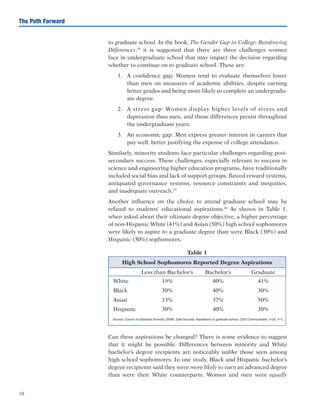
Hispanic (30%) sophomores.
Table 1
High School Sophomores Reported Degree Aspirations
Less than Bachelor’s Bachelor’s Graduate
White 19% 40% 41%
Black 30% 40% 30%
Asian 13% 37% 50%
Hispanic 30% 40% 30%
Can these aspirations be changed? There is some evidence to suggest
that it might be possible. Differences between minority and White
bachelor’s degree recipients are noticeably unlike those seen among
high school sophomores. In one study, Black and Hispanic bachelor’s
degree recipients said they were more likely to earn an advanced degree
than were their White counterparts. Women and men were equally
Source: Council of Graduate Schools. (2008). Data Sources: Aspirations to graduate school. CGS Communicator, 41(4), 4–5.
11
likely to say they would enroll in a graduate (or professional) program,
although there were differences in the types of degrees that would
be pursued.27
These figures certainly are influenced by those students who drop out
and leave only those students most inclined to complete their college
degree. However, they do suggest some possibilities to be considered.
As a first step it is reasonable that young students (high school and
below) be encouraged to think of college and graduate school as real-
istic, obtainable goals, because without that vision students will not
aspire to continue in higher education. In particular, young students
from underrepresented racial and ethnic groups need to understand
the value of pursuing college and graduate degrees.
While enrollment issues at the college and graduate levels historically
have focused on accessibility for women and students from minority
groups, there are a number of emerging social issues that will create
further challenges for the U.S. education system. These changes will
impact not only K–12 education, but ultimately the numbers of “tradi-
tional” students available for higher education as well.	
The influx of “nontraditional” students.
The population of the US is diverse and continues to grow even more
so. The U.S. Census Bureau estimates that between 2000 and 2015,
international migration will account for more than half of the nation’s
population growth. This growth will especially impact the Hispanic
and Asian populations, which are expected to triple over the next
half century.28
In the recent report, America’s Perfect Storm: Three Forces Changing Our
Nation’s Future, a number of emerging sociological and economical
forces that will present challenges to the U.S. educational system are
discussed. In particular, demographic shifts will result in a population
with less education and lower math and reading skill levels.29
As a result
the population of domestic students available to pursue higher educa-
tion will become more diverse and possibly less academically skilled.
More first-generation college students will emerge from this pool, and
many are likely to require additional language and skill resources. Thus
these students are less likely to resemble what has been historically the
“traditional” student populating the graduate school enrollment pool.
As the number of “traditional” students in the graduate applicant pool
declines, other types of “nontraditional” students are appearing on
the horizon. “Traditional” students typically apply to graduate school
within a few years of exiting an undergraduate program. Thus most
enter before their 30th birthday, are single, and have a moderate
level of income.30
A growing number of “nontraditional” students are
Current Trends in Graduate Education
e Students of
all ages need to
understand the value
of pursuing college
and graduate degrees.
e The “traditional”
graduate student is
changing in subtle
ways. This will require
a change in academic
expectations and
financial support.
12
The Path Forward
older, engage in work, family, and school activities at the same time,
and view graduate education as a means of changing or improving
their employability. While the majority of graduate students still fall
into the 30 and younger age group, a rapid increase has been seen
in the number of students 40 and older.31
In addition, the percentage
of doctoral students who are married and/or have children has also
slightly increased.32
These subtle alterations may impact outcomes such as degree comple-
tion rates. Evidence of this is seen in a longitudinal study33
by the
National Center for Education Statistics (NCES). This study found
that students who were single prior to entering graduate school were
more likely to have earned their degree (or to still be enrolled) 10 years
after receiving their bachelor’s degree, compared to their married
counterparts. As a result, how doctoral students are financially and
academically supported and how this impacts their expectations of
time to degree completion needs to be reconsidered.
There also is a growing trend to return to graduate school after having
spent time in the workforce. The current economy certainly contrib-
utes to this trend; a growing number of “career changers” or laid-off
workers are looking to graduate education in hopes that an advanced
degree will ensure continued employability and/or career advance-
ment.34
The desire to improve clinical or technical skills also seems to
be a major influence in the decision to return to graduate school for
workers in particular fields. Although limited to professional students
in the field of physical therapy, a recent study35
indicated that while
career opportunities and income advancement were important factors
in the decision to return to graduate education, the overwhelming
consideration was skill improvement.
To that end, employer-supported education benefits are very common.
A 2006 survey of 226 companies in the public and private sectors indi-
cated that nearly all of them (approximately 94%) said they offered
some form of education assistance to their employees.36
In order to
be responsive to and support the needs of part-time students and
“career changers” and their desire to acquire and enhance specific,
job-related skills, serious thought must be given to the current struc-
ture of and financial support for graduate education, especially at the
master’s level.
Why should these changes concern us?
Economists such as Paul Romer argue that economic growth is based
not on producing things but rather on producing ideas that lead to
technological progress.37
Furthermore, Romer contends that ideas
e Economic
growth is based not
on producing things
but producing ideas.
13
come from highly skilled individuals who are produced by doctoral
programs, and that continuing to produce adequate numbers of doc-
toral recipients in the science and engineering disciplines is vital to
ensuring the growth of new ideas.38
U.S. competitiveness in the global
economy hinges fundamentally on our capacity to innovate. Thus, if as
Romer suggests, graduate education is the main source for producing
these innovators, it is of vital importance to ensure that all sectors of
the U.S. public pursue higher education, especially graduate education.
In an interview given to Inventor’s Digest Sally Ride (Ph.D., Stanford
University, astronaut, and Professor at UC San Diego) points to this
need in science, technology, engineering, and mathematics (STEM)
fields, saying, “We’ve always thought of ourselves as an innovative
country that keeps at the forefront, a world leader for the last many,
many decades. We’ve always prided ourselves on innovation. In World
War II, the Cold War, the race to the moon—our self-image is being a
technologically superior country. Without the new generation having
some background or ability to enter engineering or science, we risk los-
ing that. It’s part of our identity. We’re pioneers. We’re innovators. And
we’re not producing engineers and scientists in the numbers we need.”
While it is important to ensure our country’s future economic prosper-
ity, higher education also has personal consequences for individual
prosperity. In 2008, while the median annual wage for workers with
a bachelor’s degree was $52,624, it was $64,116 for workers with a
master’s degree and $81,172 for workers with a doctorate.39
It has been posited that in a knowledge economy a graduate degree
will become the new bachelor’s. As economist Anthony Carnevale has
said, “if graduate educators cannot fulfill their economic mission to
help grow the economy and help youths and adults become successful
workers, they also will fail in their cultural and political missions to
create good neighbors, good citizens and lifelong learners.”40
Graduate Degree Recipients
Globally, the U.S. system of graduate education has been considered
the “gold standard.” While it is important to understand who enrolls in
graduate school (i.e., the inputs to the system), it is equally important
to understand the outputs of the system—who completes their degree,
who does not, and their place in the workforce—because it is at this
stage where the system seems to falter. 	
Types of graduate degrees.
Although graduate education is frequently thought of as preparing stu-
dents to earn doctoral degrees, it is important to recognize that many
Current Trends in Graduate Education
e Graduate
education’s mission:
to produce successful
workers, good
neighbors, good citizens,
and lifelong learners.
14
The Path Forward
more master’s degrees than doctoral degrees are awarded in the US. In
2007, 10 times the number of master’s degrees were awarded compared
to doctoral degrees (604,607 vs. 60,616, respectively).41
Master’s-level
education has been experiencing growth over the past decade, with
a 31% increase in the number of engineering master’s degrees and a
22% increase in social science master’s degrees. In comparison, the
increase in the corresponding age cohort in the general U.S. population
grew by just 7% during the same time period, demonstrating that the
growth in the number of master’s degrees clearly was meaningful. One
exception to this trend has been master’s degrees in computer science,
which have declined in number over the last several years.42
Obtaining a master’s degree as an end point, or terminal degree, is
much more common in some fields than in others. Much of this is due
to opportunities for employment in fields where only a master’s degree
is needed. For example, about a quarter of the students with bachelor’s
degrees in education earned master’s degrees (as the highest degree
earned) within 10 years, but only 1% went on to earn a doctoral degree.
The same is true for students with bachelor’s degrees in engineering:
About one quarter earned a master’s degree within 10 years, but only
3% earned a doctoral degree. However, the picture is different in the
natural sciences and mathematics fields where 19% of the students
received a master’s degree and 9% earned a doctoral degree.*
Thus it
is important to recognize differences across disciplines regarding the
types of degrees attained when examining where we are in graduate
degree attainment.
Trends in degrees awarded.
In its 2008 status report 43
the American Council on Education reported
that the number of postsecondary degrees awarded increased between
1995 and 2005. This was seen at both the undergraduate and graduate
levels. While the number of associate and bachelor’s degrees earned
grew by 35%, the number of master’s degrees earned increased even
more—by 47%—and the number of doctoral degrees increased by
26%. In this case the increase in the corresponding age cohort (under-
graduate- and graduate-aged individuals) in the general U.S. popula-
tion grew by just 13% during the same time period. This is another
instance where the growth in the number of awarded degrees clearly
was substantial, even when accounting for population changes.
The pattern of degree recipients varies by gender as well as by ethnic-
ity and race. For example, women accounted for 68% of the growth
in master’s degrees and 84% of the growth in doctorates. Despite this
increase, in 2005 women received 60% of master’s degrees but less than
*	 The estimates of the percent of students earning doctoral degrees are limited by the 10 year time horizon in
the Baccalaureate and Beyond Longitudinal Study database.
15
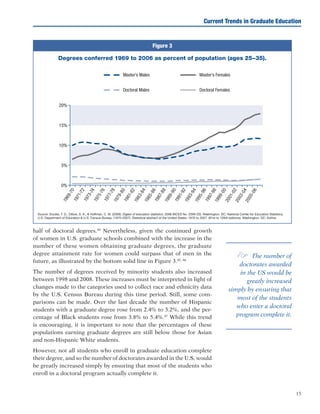
half of doctoral degrees.44
Nevertheless, given the continued growth
of women in U.S. graduate schools combined with the increase in the
number of these women obtaining graduate degrees, the graduate
degree attainment rate for women could surpass that of men in the
future, as illustrated by the bottom solid line in Figure 3.45, 46
The number of degrees received by minority students also increased
between 1998 and 2008. These increases must be interpreted in light of
changes made to the categories used to collect race and ethnicity data
by the U.S. Census Bureau during this time period. Still, some com-
parisons can be made. Over the last decade the number of Hispanic
students with a graduate degree rose from 2.4% to 3.2%, and the per-
centage of Black students rose from 3.8% to 5.4%.47
While this trend
is encouraging, it is important to note that the percentages of these
populations earning graduate degrees are still below those for Asian
and non-Hispanic White students.
However, not all students who enroll in graduate education complete
their degree, and so the number of doctorates awarded in the U.S. would
be greatly increased simply by ensuring that most of the students who
enroll in a doctoral program actually complete it.
Current Trends in Graduate Education
e The number of
doctorates awarded
in the US would be
greatly increased
simply by ensuring that
most of the students
who enter a doctoral
program complete it.
Figure 3
Degrees conferred 1969 to 2006 as percent of population (ages 25–35).
Source: Snyder, T. D., Dillow, S. A.,  Hoffman, C. M. (2009). Digest of education statistics: 2008 (NCES No. 2009-20). Washington, DC: National Center for Education Statistics,
U.S. Department of Education  U.S. Census Bureau. (1970-2007). Statistical abstract of the United States: 1970 to 2007. (91st to 126th editions). Washington, DC: Author.
16
The Path Forward
Why do students not complete their degree?
The most serious problem in generating the number of doctoral degree
holders needed is that many students fail to complete their degree.
Although the vast majority of students entering graduate programs
most likely have the ability to complete a degree, high numbers of
students fail to achieve that goal. In particular, research indicates that
for a majority of students, financial support is the most significant
factor contributing to the ability to complete the doctoral degree.48
Of
course many graduate students do manage to balance work, family,
and educational responsibilities simultaneously. For those who have
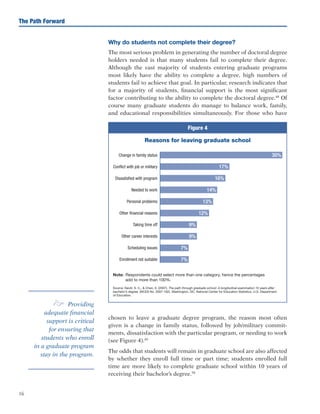
chosen to leave a graduate degree program, the reason most often
given is a change in family status, followed by job/military commit-
ments, dissatisfaction with the particular program, or needing to work
(see Figure 4).49
The odds that students will remain in graduate school are also affected
by whether they enroll full time or part time; students enrolled full
time are more likely to complete graduate school within 10 years of
receiving their bachelor’s degree.50
e Providing
adequate financial
support is critical
for ensuring that
students who enroll
in a graduate program
stay in the program.
Figure 4
Reasons for leaving graduate school
Source: Nevill, S. C.,  Chen, X. (2007). The path through graduate school: A longitudinal examination 10 years after
bachelor’s degree. (NCES No. 2007-162). Washington, DC: National Center for Education Statistics, U.S. Department
of Education.
Note: Respondents could select more than one category, hence the percentages
add to more than 100%.
17
Recent research at the undergraduate level demonstrates the need for
providing appropriate financial support for students.51
These data show
that providing support for student services—for admissions, registrar
activities, and activities which contribute to students’ emotional and
physical well-being—influences graduation and persistence rates. 	
Graduate degree recipients and the workforce.
If it is true, as Paul Romer contends, that our prosperity depends upon
educating individuals who produce and implement ideas, examining
where graduate degree holders work can illuminate the value of a
graduate degree in today’s knowledge-based economy. Projections of
workforce trends for graduate recipients are difficult to make, and at
times the results are conflicting.52
However, examining where graduate
degree holders work and in which occupations, and examining projec-
tions for these occupations, provides a useful perspective on the labor
force contributions of graduate degree holders.
Over the last 20 years the structure of the economy has shifted to a
knowledge-based economy favoring more educated and academically
skilled workers.53,54
One indicator of this shift is the earnings premium
associated with education and academic skills.55
This trend is expected
to continue, with growth in jobs in service-providing industries and
fewer jobs in the goods-producing sectors of the economy. More than
half of the new jobs projected over the next 10 years will be in profes-
sional and service occupations. For example, the scientific and techni-
cal consulting industry is projected to show significant employment
growth from 2008 to 2018.56
More and more workers will be asked to
think rather than produce in the traditional manner of manufacturing
industries of the past.57
While no definitive number can be provided,
jobs that typically require a master’s or doctoral degree are expected to
increase between 2008 and 2018, with a projected estimate of 2.5 mil-
lion additional jobs. It is projected that the number of jobs requiring a
master’s degree will increase by about 18% during this time period and
those requiring a doctoral degree by about 17%.58
Different occupations/different skills.
In what sectors and industries of the labor market are graduate degree
holders working? While recipients of master’s degrees have tradition-
ally worked outside of the university, doctoral recipients have generally
taken positions within academia. However, many doctoral degree hold-
ers are now working in industry, within sectors and occupations that
are expected to grow over the next 10 years.59
According to one estimate
about half of the doctoral recipients with post-graduation employment
commitments obtained jobs outside of the academy, but the percent-
ages vary widely by field (85% from engineering, 66% from physical
sciences, 38% from social sciences, and 14% from humanities).60
Current Trends in Graduate Education
e Between
2008 and 2018 it is
expected that many
new jobs – about 2.5
million – will require
a graduate degree.
18
The Path Forward
While not without flaws,*
one way to track the types of sectors and types
of jobs in which graduate degree recipients work is to use the Bureau
of Labor Statistics (BLS) classification of occupations that require
doctoral and master’s degrees. BLS classifies and tracks employment in
occupations stratified by education or training. Education and training
are defined by the credentials most workers need to become fully quali-
fied in that occupation. According to the BLS classification, a doctoral
degree is needed for full qualification in 11 occupations and a master’s
degree for 31 occupations. Despite its limitations this occupational
classification system provides a useful framework for examining the
current workforce participation of graduate degree holders.
Where do master’s degree holders work?
Master’s-level education is the largest segment of graduate education.
Over 75% of graduate students are in master’s programs, and 90% of
graduate degrees awarded are master’s.61
The occupations classified
as requiring a master’s degree for full qualification range from social
scientists, such as economists and anthropologists, to mental health
counselors and statisticians. Jobs requiring master’s degrees are
projected to grow at a substantial rate, 18%, from 2008 to 2018.62
In
addition, master’s programs often have the strongest connection to the
workforce, in that they teach students those skills required for par-
ticular fields, such as education, urban planning, library science, and
physical therapy.
Many master’s programs have shifted from having an arts and science
focus and become professional programs that prepare students for
careers in business, government, and nonprofit organizations.63
This
shift is one of the major factors contributing to the rapid growth in mas-
ter’s-level programs. An additional factor contributing to the growth in
master’s programs is employer demand, with more frequent preference
or requirement for a master’s degree for entry into many professions.
Professional master’s degree programs provide diverse knowledge
geared toward successful participation in the job market and combine
theory, practical application, and workplace skills such as communica-
tion, critical thinking, and management. According to higher education
researcher Judith Glazer-Raymo, the master’s degree has evolved into
an entrepreneurial credential that brings the university much closer
to the corporate world and provides diverse and marketable choices
for students.64
U.S. Department of Education postsecondary education statistics indi-
cate that the largest number of master’s degrees conferred continues
to be in the field of education. Job prospects for individuals with a
*	 It is known that this classification system underestimates the occupations that require a doctoral degree and,
subsequently, the workforce projections for graduate degree holders. In addition, not all workers in the jobs
listed in the doctoral category have a doctorate.
19
master’s degree in education also are very favorable. Currently, edu-
cational services are the second-largest industry in the US, and the
number of positions is expected to grow due to projected demographic
increases and compulsory school attendance at the K–12 levels.
Many positions in the service industry also require a master’s degree.
Many of these jobs are in healthcare and social assistance (e.g., social
workers); this area is expected to have the largest growth in jobs from
2008 to 2018. Two occupations in the master’s category—physical ther-
apist and physician assistant—are among the top 30 fastest growing
occupations.65
Master’s degree holders are working in a variety of other
areas as well. In 2008, nearly one quarter of master’s-level economists
were working in the professional science and technology sector, one
fifth in finance, and almost one third in the federal government.	
Where do doctoral degree holders work?
While doctoral recipients are often thought of as being groomed for
work in academia, a closer look suggests a different story. According
to the 2008 data from BLS, most doctoral degree holders work in
occupations in service industries—generally in professional, scientific,
and technical services or in government. Most of these industries and
occupations are projected to grow over the next 10 years. For example,
the largest projected growth of jobs is in the healthcare and social
assistance industry, followed by professional, scientific, and technical
service industries.66,67
While only 11 occupations are classified by the BLS as technically
requiring a doctorate, a doctoral degree is the de facto entry degree for
leadership in a wide array of fields. Biochemistry is one example of a
field demonstrating the diversity of sectors in which doctoral degree
holders work. In 2008, while almost half of doctoral-level biochemists
were working in professional, scientific, and technical service indus-
tries, more than one quarter worked in pharmaceutical and medicine
manufacturing, and one eighth worked in the education sector.68
Understanding the early employment plans of new doctoral recipients
provides another perspective on workforce trends. Among U.S. citizens,
most new doctoral recipients report having an employment or post-
doctoral plan*
soon after graduation.69
In 2006, across all fields, nearly
three quarters of new doctorate recipients said they had an assured
job or postdoctoral opportunity. This pattern has been relatively con-
sistent over time, with a small drop in 1996, possibly a reflection of the
economic recession in the early 1990s. The workforce pattern varied
somewhat across fields, with engineering doctorate degree holders and
those in the humanities reporting slightly fewer job commitments.
*	 A postdoctoral scholar has been awarded or has completed the requirements for a doctoral degree and is given a
fellowship or traineeship for studies at the postdoctoral level. In these positions, the scholar generally trains under
the direction of a research mentor and performs collaborative and independent research.
Current Trends in Graduate Education
e The largest growth
areas for master’s degree
holders are in healthcare
and social assistance.
Jobs in education are
also expected to show
continued growth.
e Individuals with
doctoral degrees work
in a wide range of
employment sectors,
not just academia.
20
The Path Forward
For those who reported having a job, positions were split between aca-
demia and industry, with about half of new doctoral recipients across all
fields having a position in academia. This pattern has been consistent
over the last 10 years, with some small decreases in the percentages of
doctoral degree holders reporting having a job in government.
The projection for postsecondary teachers is mixed. This occupation
is projected to grow over the next 10 years due to two factors. First,
an increase in student enrollment in higher education will reflect the
projected population increases of 18–24 year olds, with increased num-
bers of students in colleges requiring increased numbers of instructors.
Second, the expected retirement of current faculty hired in the 1960s
and 1970s will produce openings. However, much of this growth will not
be in full-time academic positions, which are a shrinking proportion of
the academic workforce, but rather in adjunct or nontenured positions.
Understanding International Competition
The past 10 years have seen significant changes internationally in
higher education. Cultural changes have resulted in increased access
to higher education in many countries, systemic changes in Europe
have resulted in more unified and consistent standards, and political
and economic changes have placed a focus on the economic benefits
of a highly trained workforce, leading to greater competition between
countries for available students.
For many years the US has been the world’s dominant nation in attract-
ing international students for graduate programs. While the proportion
of international students enrolled in U.S. colleges at the undergradu-
ate level is relatively small (3%), international doctoral and research
students make up 24% of the total graduate population, well above
the worldwide average of 19% reported by OECD.70
In 2004–2005 over
100,000 international students were enrolled in doctoral programs in
the US; the United Kingdom’s total as the next closest country was
about 20,000.71
Many factors have contributed to this, including:
•	 The emergence of English as the primary language for academic
discourse as well as international trade, resulting in a desire to
receive instruction in English among many science, engineer-
ing, and business students.
•	 The economic prospects in the US and the understanding
among international students that a graduate degree from a
U.S. institution was the most direct gateway to employment
and citizenship.
21
•	 The international reputation of the top U.S. graduate schools
as being the best in the world, with clearly defined degrees and
programs recognized around the world.
•	 The lack of available seats (relative to the population) in
graduate programs in the students’ own countries, particularly
in Asia.
The representation of international students in U.S. graduate institu-
tions is especially notable at the doctoral level.72
In 1977, 82% of doc-
toral degrees awarded in the U.S. were granted to U.S. citizens, but by
2007 this figure had fallen to 57%. In engineering only 29% of doctoral
degrees went to citizens (down from 56% in 1977), and the percentage
today in the physical sciences is 43% (down from 76% in 1977). Even
in the field of education, the percent of doctorates going to U.S. citizens
declined, from 91% in 1977 to 81% in 2007.73
Changes in international education.
None of these changes has resulted from an organized or concerted
effort on the part of the U.S. government to promote domestic gradu-
ate schools as the prime destination for international students.74
Instead, countries such as China have utilized the U.S. system to make
up for shortfalls in their own system capacities—shortfalls that China
now is aggressively trying to remedy. Indeed, many countries are now
actively engaged in organized efforts to provide alternatives to the US
for graduate education.75
The European Union (EU) goal of cooperation among its members to
achieve common standards and promote mobility extended to the field
of higher education with the 1999 “Bologna Declaration.”76
Disparate
higher education standards throughout Europe, in particular a lack
of consistency as to what constitutes course credits and degree levels,
made comparison of students’ education achievement complex. The
Bologna Declaration introduced a framework for achieving compat-
ibility by recommending a clear demarcation between undergraduate
(at least 3 years of coursework) and graduate (2 years of coursework
for a second-tier/master’s and an additional 3 years for a third-tier/
doctoral) degrees as well as a common system of credits. The purpose
of such changes was to promote increased mobility across the member
states for study and for employment.77
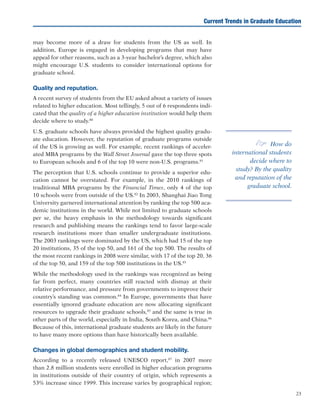
In 2000, EU countries already had the largest share of international
students in higher education (combining undergraduate and graduate
populations), nearly 39%.78
As seen in Figure 5 the US, in comparison,
had one quarter of the share.
Current Trends in Graduate Education
e The importance of
international students
in graduate education
is pronounced: almost
half of doctoral degrees
were awarded to
non-U.S. citizens.
22
The Path Forward
By 2006 the number of students attending an institution not in their
home country increased dramatically.79
Most likely driven by the
Bologna Declaration, the number of international students in EU
countries increased, preserving their lead in share. The number of
international students in the US also increased, but the US share fell.
Retaining share of international students.
Europe may not be as much of a threat as it appears in terms of
competition for graduate school enrollment. Much of the increase in
“international” students may ultimately be a zero-sum game for the
EU, because mobility across borders is occurring in all directions. For
example, as France attracts more international students from across
EU member states, it also may send more French nationals to other EU
countries. Since European students represent a smaller portion of all
the international students studying in the US compared to those from
Asia, the reality is that the competition for the same graduate students
may come from other English instruction countries, such as Australia,
New Zealand, Canada, and South Africa.
However, by developing a common and more transparent system of
degrees and credits that is reflective of the U.S. system, EU institutions
e The share of
international students
enrolled in U.S.
graduate institutions
declined between
2000 and 2006 and
continues to decline.
Figure 5
Share of international students in higher education
Source: Douglass, J. A.,  Edelstein, R. (2009). The global competition for talent: The rapidly changing market for international students and the need for a strategic approach in
the US (Research  Occasional Paper Series No. CSHE.8.09). Berkeley, CA: Center for Studies in Higher Education, University of California, Berkeley.
Note: Percentages represent combined undergraduate and graduate international students based on total counts of 1.9 million
students in 2000 and 2.9 million students in 2006.
20062000
23
may become more of a draw for students from the US as well. In
addition, Europe is engaged in developing programs that may have
appeal for other reasons, such as a 3-year bachelor’s degree, which also
might encourage U.S. students to consider international options for
graduate school.
Quality and reputation.
A recent survey of students from the EU asked about a variety of issues
related to higher education. Most tellingly, 5 out of 6 respondents indi-
cated that the quality of a higher education institution would help them
decide where to study.80
U.S. graduate schools have always provided the highest quality gradu-
ate education. However, the reputation of graduate programs outside
of the US is growing as well. For example, recent rankings of acceler-
ated MBA programs by the Wall Street Journal gave the top three spots
to European schools and 6 of the top 10 were non-U.S. programs.81
The perception that U.S. schools continue to provide a superior edu-
cation cannot be overstated. For example, in the 2010 rankings of
traditional MBA programs by the Financial Times, only 4 of the top
10 schools were from outside of the US.82
In 2003, Shanghai Jiao Tong
University garnered international attention by ranking the top 500 aca-
demic institutions in the world. While not limited to graduate schools
per se, the heavy emphasis in the methodology towards significant
research and publishing means the rankings tend to favor large-scale
research institutions more than smaller undergraduate institutions.
The 2003 rankings were dominated by the US, which had 15 of the top
20 institutions, 35 of the top 50, and 161 of the top 500. The results of
the most recent rankings in 2008 were similar, with 17 of the top 20, 36
of the top 50, and 159 of the top 500 institutions in the US.83
While the methodology used in the rankings was recognized as being
far from perfect, many countries still reacted with dismay at their
relative performance, and pressure from governments to improve their
country’s standing was common.84
In Europe, governments that have
essentially ignored graduate education are now allocating significant
resources to upgrade their graduate schools,85
and the same is true in
other parts of the world, especially in India, South Korea, and China.86
Because of this, international graduate students are likely in the future
to have many more options than have historically been available.
Changes in global demographics and student mobility.
According to a recently released UNESCO report,87
in 2007 more
than 2.8 million students were enrolled in higher education programs
in institutions outside of their country of origin, which represents a
53% increase since 1999. This increase varies by geographical region;
e How do
international students
decide where to
study? By the quality
and reputation of the
graduate school.
Current Trends in Graduate Education
24
The Path Forward
increasing numbers of students from Asian countries, a major source of
international graduate students, are attending universities within their
own region. In East Asia and the Pacific 42% of students remained in
their region in 2007, compared to 36% in 1999.
Within China, for example, many more opportunities now exist for
students to remain in their own country. In 1997 approximately 5,000
science and engineering doctoral degrees were awarded, and by 2004
this number had grown to 13,000 degrees.88
The number of international
students in China now exceeds the number of Chinese undergraduate
and graduate students sent abroad.89
	
At the same time the sheer number of international college gradu-
ates is also increasing. Even if a slightly lower proportion of this pool
chooses graduate education in the US, total graduate enrollments
could increase. All of the non-OECD nations together produce about 6
million college graduates each year. However, if those countries begin
to graduate college students at the same rate as the OECD states, that
number would double to 12 million per year.
China provides a good example of the impact changes in policy or focus
can have on graduate enrollments across the world. About one third
of international students currently earning doctoral degrees are from
China,90
and growth of undergraduate education in China has been
exponential. In 1998 there were 0.3 million Chinese undergraduates,
but by 2004 this number had swelled to 13.3 million.91
However, this
growth could begin to slow due to years of restricting the birth rate,
and India soon will take over as the country with the largest popula-
tion of college-age individuals. Whether this will translate into India
overtaking China in college and graduate school attendance is unclear.
As in many developing nations, the percentage of school-age children
receiving an education in India is much lower than in the US and
Europe, while China has rates closer to the US and Europe. Population
shifts are not limited to China; the trend for most of Europe will be a
decrease in school-age (and eventually college-age) populations over
the next decade.
Public policy and visas.
Policymakers appear to be undecided as to whether the national inter-
ests of the US are best served by increasing or decreasing the propor-
tion of international students generally or in specific fields. It also is
important to recognize that whatever trends develop internationally,
the impact will not be felt equally in all graduate fields. In the largest
field, education, only 4% of students are international (at the master’s
and doctoral level), and in the next largest field, business, 20% are
international. But in some fields the percentage of non-U.S. citizens
25
e Changes to
immigration laws and
visa processing will
impact the number of
available international
graduate students.
Current Trends in Graduate Education
is quite high. In engineering, for example, just above half of graduate
students are international, and just under half of students in the physi-
cal sciences are international.92
Immigration laws and visa processing procedures also play a role
in determining the influx of international students. For example, as
displayed in Table 2, following 9/11 there was a significant drop in the
number of student visas issued. At the same time graduate schools saw
decreases in the number of applications from international students.
While this number has rebounded over the last several years,93
future
changes in immigration policies may impact the volume of available
international graduate students.
Table 2
Number of Student Visas Issued, 2002 to 2006
Year Visas issued
2002 256,534
2003 235,580
2004 237,807
2005 255,993
2006 294,637
Employment opportunities.
The picture on employment is somewhat different for new doctoral
recipients who are temporary visa holders than it is for U.S. citizens.
In 1996, approximately one tenth of temporary visa holders reported
having a job shortly after graduating; in 2006 this percentage increased
to nearly a quarter.94
New doctoral degree holders with temporary visas
were much more likely to report having a position in industry than
in academia. For example, in 2006, across all fields, only 17% of U.S.
citizens reported their job commitment to be in industry, while among
those with temporary work visas this number was 55%.95
Most of the employment commitments of both citizens and non-
citizens with graduate degrees are in the US. A small percentage of
employment commitments are outside of the US, and this number
is greater for temporary visa holders. Recent data shown in Table 3
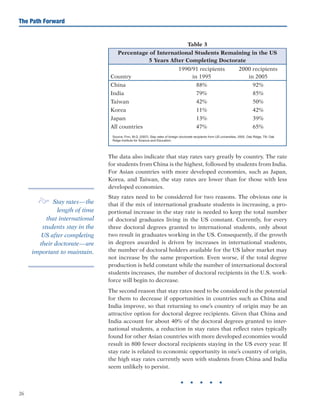
indicate that about two thirds of international students who obtained
a doctoral degree while studying in the US remain in the country for 5
years after completing their degree. Ten years earlier slightly less than
half of these students stayed in the US 5 years after graduation, indicat-
ing an increase in the “stay rate” of doctoral recipients.96
Source: Bureau of Consular Affairs. (2006). Report of the VISA office 2006. Washington, DC: U.S. Department of State.
26
The Path Forward
e Stay rates—the
length of time
that international
students stay in the
US after completing
their doctorate—are
important to maintain.
Table 3
Percentage of International Students Remaining in the US
5 Years After Completing Doctorate
Country
1990/91 recipients
in 1995
2000 recipients
in 2005
China 88% 92%
India 79% 85%
Taiwan 42% 50%
Korea 11% 42%
Japan 13% 39%
All countries 47% 65%
The data also indicate that stay rates vary greatly by country. The rate
for students from China is the highest, followed by students from India.
For Asian countries with more developed economies, such as Japan,
Korea, and Taiwan, the stay rates are lower than for those with less
developed economies.
Stay rates need to be considered for two reasons. The obvious one is
that if the mix of international graduate students is increasing, a pro-
portional increase in the stay rate is needed to keep the total number
of doctoral graduates living in the US constant. Currently, for every
three doctoral degrees granted to international students, only about
two result in graduates working in the US. Consequently, if the growth
in degrees awarded is driven by increases in international students,
the number of doctoral holders available for the US labor market may
not increase by the same proportion. Even worse, if the total degree
production is held constant while the number of international doctoral
students increases, the number of doctoral recipients in the U.S. work-
force will begin to decrease.
The second reason that stay rates need to be considered is the potential
for them to decrease if opportunities in countries such as China and
India improve, so that returning to one’s country of origin may be an
attractive option for doctoral degree recipients. Given that China and
India account for about 40% of the doctoral degrees granted to inter-
national students, a reduction in stay rates that reflect rates typically
found for other Asian countries with more developed economies would
result in 800 fewer doctoral recipients staying in the US every year. If
stay rate is related to economic opportunity in one’s country of origin,
the high stay rates currently seen with students from China and India
seem unlikely to persist.
H H H H H
Source: Finn, M.G. (2007). Stay rates of foreign doctorate recipients from US universities, 2005. Oak Ridge, TN: Oak
Ridge Institute for Science and Education.
27
“The object of education is not merely to draw out the powers of the
individual mind: it is rather its right object to draw all minds to a proper
adjustment to the physical and social world in which they are to have
their life and their development: to enlighten, strengthen and make fit.”
Woodrow Wilson (Ph.D., Johns Hopkins; 28th President of the United
States; President, Princeton University)
If the US is to remain competitive in the global economy, current vul-
nerabilities in our system of graduate education must be understood
and addressed. These vulnerabilities require creative solutions, some
of which may be contrary to how graduate education has historically
operated. We view these vulnerabilities as falling into three general
domains: (1) the university domain, (2) the industry domain, and (3)
the government domain.
The University Domain
In the previous section of this report we discussed enrollment numbers
and completion rates. We also addressed changes in international
graduate education that present challenges to U.S. graduate schools.
In this section we now focus on the vulnerabilities that exist in the
current university system—attrition, time to degree completion, and
career path transparency—and describe some efforts to address them.
Attrition in graduate education.
Failure to complete a degree is one of the most vexing problems facing
U.S. graduate education. Individuals often make considerable personal
sacrifices to enroll in graduate education, and institutions invest thou-
sands of dollars supporting candidates for graduate degrees. When
students fail to complete their degree there are not only direct costs
to the student and the university, but also opportunity costs, since the
student who left was filling a space that might have been occupied by a
student who would have graduated.
Despite the rigorous selection processes used for graduate admissions
and the high achievement level of those pursuing a graduate degree,
some estimates indicate that the attrition rate in doctoral education
is in the range of 40% to 50%.97
Even among doctoral students who
are awarded very competitive graduate research fellowships, such as
those from the Graduate Research Fellowship Program of the National
Science Foundation (NSF), the dropout rate is still a problem, being
about 25% among this rigorously selected set of students.
Current Vulnerabilities in Our
System of Graduate Education
28
The Path Forward
Calculating non-completion rates is difficult, and these data are some-
what “slippery.” For example, should part-time students be counted?
However the counting is done, it is clear that a significant proportion
of the students who enter graduate programs never obtain a degree.
If the graduate education system is to serve both students and
society more efficiently, we must try to understand why students leave
graduate programs.
Lewis Siegel, the former chair of the GRE Board and graduate dean at
Duke University, referred to the attrition problem as “the central issue
in doctoral education in the United States today.”98
Case studies are
valuable in documenting the powerful negative impact that dropping
out can have on individuals (for example, see Leaving the Ivory Tower:
The Causes and Consequences of Departure From Doctoral Study99
). In
addition, more systematic studies based on comprehensive census-like
surveys are needed.
Individual universities can provide more insight into the causes of non-
completion by doctoral students. For example, non-completion rates at
the University of California, Berkeley were shown to vary dramatically
by discipline—ranging from 29% for students enrolled in biology to
63% for students in languages and literature.100
Factors such as the
relationship between student and advisor/other faculty and student
involvement in program and institutional activities also appeared to
contribute to student persistence in doctoral programs at Berkeley.
Although much of the attention to the attrition problem has been
focused on doctoral programs, there is a clear need to better understand
attrition at the master’s level. Because of the number of students who
enroll part time in master’s programs while continuing with full-time
jobs, it is often difficult to determine whether a student has dropped
out or has simply slowed down to attend to other time demands. CGS
has a long history of studying attrition at the doctoral level, and is
now turning attention to understanding master’s program attrition as
well. Obtaining comprehensive data on why students leave master’s or
doctoral programs is essential as a first step in understanding how to
reduce attrition.
Rewards after graduation must be visible to graduate students. Helping
graduate students recognize the rewards of earning a degree may be
another way that graduate schools can increase degree completion.
Graduate schools must take attrition seriously, consider the academic
and social integration of all graduate students in their programs, and
provide adequate financial support to these students.101
e The central issue
in doctoral education
in the US is the
attrition problem.
29
Current Vulnerabilities in Our System of Graduate Education
Getting and keeping students in the university.
If the US is to continue to remain globally competitive in the 21st
century, students who could benefit from a graduate education and
who could contribute innovative ideas for improving society must be
proactively encouraged to enroll in graduate school. In addition, U.S.
graduate schools must actively stem attrition among those graduate
students who do enroll.
At the high school level, juniors and seniors are bombarded with
pamphlets and brochures from colleges urging them to attend college,
but there is no comparable effort to recruit undergraduate students
into graduate school. Students are frequently left on their own, with
little guidance as to the benefits of a graduate education and little help
in selecting an appropriate institution or program of study. Faculty
advisors play a limited role; for example, because they are typically
the product of a doctoral-level education, they may know little about
the opportunities available in master’s-level programs, the demands of
such programs, or opportunities for nonacademic career paths.
There are a limited number of programs that attempt to identify tal-
ented undergraduate students, especially those from underrepresented
groups, and prepare them for entry into graduate education. For
example, the University of California’s Leadership Excellence through
Advanced Degrees (UC LEADS) program focuses on students in the
STEM disciplines; the Meyerhoff Scholars Program at the University of
Maryland, Baltimore County (UMBC) works to help promising under-
graduates thrive and prepare themselves for graduate school in the
fields of science and engineering; and the Committee for Institutional
Cooperation (involving the Big Ten schools and the University of
Chicago), has provided opportunities for both students and faculty
as part of the Summer Research Opportunity Program (SROP). The
University of Texas at Austin also has established programs aimed
at helping undergraduates determine academic and career goals by
pairing them with graduate students or faculty members who act as
mentors. While these programs are promising they are few in number,
and more programs of this type are needed.
A number of efforts at the graduate level to increase both enrollment
and retention have been undertaken by some universities. Examples of
these programs include:
•	 In the mid-1990s Washington University in St. Louis found that
the graduate school completion rate in the humanities was only
about 34%. They addressed the problem by adjusting the size
of graduate departments to match the number of assistantships
available. By 2004 the completion rate in the humanities had
increased to 68%.102
30
The Path Forward
•	 Arizona State University (ASU) has developed programs to
improve graduate school retention by removing “barriers”
to graduate degree completion. These programs include men-
toring, research opportunities, and alumni interaction. This
project is a collaborative effort across the graduate and under-
graduate schools.
•	 The State University of New York supports a Graduate
Diversity Fellowship Program. This program assists in
recruiting and retaining a diverse graduate student pool.
The program provides tuition support and stipends across
all disciplines and graduate degree levels.
•	 The University of Missouri–Columbia created a leadership
development program for Directors of Graduate Studies
(DGS). This program provides ongoing training for DGS
who are responsible for recruiting and mentoring
graduate students.
•	 The University of California, Davis created a program that
focuses on enhancing faculty preparedness to mentor students
in areas affecting the academic socialization and success of a
diverse doctoral student population. The program targets the
critical transitions from applicant to student, coursework to
research, and research to professional career.
These are but a few examples of the types of programmatic changes
that could be considered at a university. These programs have been
shown to result in more diverse enrollment and greater levels of reten-
tion. However, financial support for such programs often presents
challenges to the institution. One solution might be for universities to
work in partnership with industry and government to establish and
fund such programs.
Why does it take so long?
There is no fixed time appropriate for every degree, and there always will
be a range of average times to degree based on different requirements
in different fields. The open-ended nature of original research that is
required to earn a doctorate is one contributing factor. However, since
degree attainment has both public and private benefits, it is important
that students complete degrees in as efficient a manner as possible.
Students envisioning an academic position in higher education may
find a strong fit with the long training of the doctoral student, with its
focus on acquiring expertise in a particular area and creating indepen-
dent research using rigorous methods of inquiry. For other students,
e An exemplary
program – “Mentoring
at Critical Transitions:
Faculty Readiness
from Admission to
Completion.”
UC Davis recently won
the inaugural ETS/CGS
Award for Innovation
in Promoting Success
in Graduate Education:
From Admission
through Completion.
The program targets
the critical transitions
from applicant to
student, coursework to
research, and research
to professional career.
e There is no fixed
time appropriate for
every degree, yet it is
important that students
complete their degrees
as efficiently as possible.
31
Current Vulnerabilities in Our System of Graduate Education
however, the length of time required to complete a degree may influ-
ence their willingness to enter a particular program.
The data on the years to complete a graduate degree have generally
focused on doctoral programs. CGS’s Ph.D. Completion Project103
pro-
vides some insight about the number of years that doctoral recipients
have taken to complete their degrees. Although the number of years
needed to complete a degree varied somewhat by discipline, gender,
race, and ethnicity, the clear message in these data is that the widely
held belief that most students are completing a doctoral degree in 5
years is unfounded. How long is it taking for graduate students to
complete their degree? Figure 6 provides some insight.
Less than one quarter of the students who enrolled in graduate pro-
grams in the humanities, mathematics and physical sciences, social
sciences, and life sciences completed degrees within 5 years. A 7-year
timeframe might appear to be more reasonable, but even this is too
short for some fields and subpopulations.
Figure 6
Doctoral completion rate, by field and number of years.
Source: Council of Graduate Schools. (2008). Ph.D. completion and attrition: Analysis of baseline program data from the Ph.D. Completion Project. Washington, DC: Author.
32
The Path Forward
Different conclusions concerning completion rates, especially with
respect to gender, race, and ethnic subgroups, would likely be reached
when examining a 10-year timeframe rather than a 7-year timeframe.
For example, the data reveal a 7 percentage point gap in completion
rate between men and women by year 7 (with men higher), but only a
3-point gap by year 10. Thus the conclusion from the 7-year data would
be that women are less likely to complete than men, but the conclu-
sion from the 10-year data is that women take longer to complete than
men but eventually complete at almost the same rate. Similarly, the
White–Hispanic completion gap of 10 points at year 7 (with the higher
rate among White students) is reduced to 4 points by year 10, and the
White–Black completion gap of 9 points at year 7 (with the White stu-
dent rate higher) is reduced to 8 points by year 10.
Because data beyond 10 years are not yet available, it is not known
whether this narrowing trend continues. What is clear, however, is that
obtaining a doctoral degree in the US is currently a lengthy process.
For all subpopulations, the percent graduating within 10 years was
more than double that of the 5-year completion rate and at least 10
percentage points higher than the 7-year completion rate.
The personal and economic sacrifices associated with this extended
training may be unattractive to many potential students. The length of
time required to complete the degree may delay entry of graduates into
the workforce until well into their 30s. For students in the humanities
who graduated from departments with high admission standards and
well-above-average financial support, the median age for entry into a
tenure-track position was 34; in less ideal circumstances the median
age would likely be 3 or 4 years higher.104
Students seeking academic
careers in the sciences may be further delayed by the necessity to com-
plete additional training as a postdoctoral scholar before they can be
seriously considered for tenure-track positions. Adding to this dilemma
is the fact that young scientists may be less able to obtain funding to
support research labs until later in their careers, delaying the capacity
to conduct independent research. Obtaining funding early on to sup-
port a research lab may be an important incentive for young scientists
as they face the long trajectory to completing the degree.
One way that universities and other stakeholders have responded to the
long trajectories required for doctorates in the sciences is the develop-
ment of professional master’s programs. For example, Professional
Science Master’s (PSM) programs provide a way for strong mathemat-
ics and science graduates to pursue science careers in public and
private enterprises without completing a doctorate. In these programs
the coursework and training is geared towards work in industry and
e Professional
Science Master’s
programs have
emerged in response
to workforce needs.
33
Current Vulnerabilities in Our System of Graduate Education
combines mathematics and science master’s-level courses with work in
business fundamentals and team building. The intention of such pro-
grams is not to dissuade students from entering a doctoral program,
but rather to provide another option for those who are interested in
using their undergraduate science degree at a higher level. This focus
also may be a better fit for the career path in industry, as compared to
the independent research training of many doctoral programs.
Providing career path transparency.
Understanding the career options available to graduate students may
be an important factor in building a diverse and strong cadre of gradu-
ate students. Many master’s programs are geared towards the needs
of the workplace and prepare students for careers in the business,
government, and non-profit sectors. This allows master’s programs to
be responsive to the marketplace. In addition, demands or preferences
from employers for more workers with master’s degrees contribute to
the increase in the number of master’s programs.
This is not necessarily true at the doctoral level. A clear picture of
career options that fit the large personal and economic investments
needed to complete doctorates is lacking. Such a picture is important
for attracting U.S. students to careers that require doctorates, espe-
cially in science and engineering.105
One view is that the expected career path for doctoral recipients may
be less straightforward than it was in the past.106,107,108,109
This may influ-
ence the way in which potential students weigh the opportunity costs
against the career benefits of the degree.110
For example, a National
Academy of Sciences report raised concerns that the key indicators of
employment and earning prospects for scientists and engineers may
not be providing the strong incentives needed to attract academically
talented students into the fields.111
Changes to the tenure track in higher education also may influence the
career path for potential doctoral students. Traditionally, an academic
instructional position in higher education that leads to tenure has
been an important career incentive for students pursuing a doctoral
program. Today, however, the career path for doctoral recipients is
less clear.
Three factors may be contributing to this situation. One is the change
in the composition of the higher education instructional workforce,
which now consists of more non-tenured faculty.112
A second factor,
described earlier, is the increased time to complete the degree and the
length of time for postdoctoral research necessary to secure a faculty
e While master’s
programs are often
geared toward the needs
of the workplace, this
is not necessarily true
at the doctoral level.
Clear career options
are often lacking.
e The move
toward adjunct and
non-tenured faculty at
the university call into
question the traditional
career aspiration of
the doctoral student.
34
The Path Forward
position in some fields. A third factor is the difficulty of guiding stu-
dents along the pathway that leads to jobs in government, industry,
and non-profit organizations by faculty who may not understand the
path themselves. These factors in combination may influence students’
career decisions.
Little is known about students’ willingness to invest in the type and
length of training for the doctorate if a tenure-track position is not the
light at the end of the tunnel. If the tenure-track position remains the
desired goal, students and faculty may have to adjust their mindset to
a more complex landscape.
While the numbers of postsecondary teachers are expected to grow
considerably over the next 10 years, the ways in which this will influ-
ence the job market for doctoral students vary.113
The instructional
workforce in higher education has increased over the last decade in
response to growing college enrollment. As the college-age popula-
tion in the US increased and the role of college became central in
preparation for work and adult life, more students enrolled in col-
lege.114
In response the number of positions in education increased
between 1997 to 2007, with the highest percentage of growth at private
research institutions.115
On the surface this is a good sign for the academic career paths for
doctorates. However, the story is more complicated and differs by sec-
tor. Much of the growth in instructional staff reflects the growth in
contingent staff, which includes part-time staff, adjuncts, and graduate
students. Obtaining an academic tenure-track position may be more
difficult in the future, as universities are less likely to replace departing
tenured faculty with tenure-track positions.116
This shift has resulted in a change in the overall mix in the proportion
of instructional staff that are in full-time tenure-track positions. The
move to using adjuncts, graduate students, and non-tenured lecturers
to teach the increasing college population is also reflected in a move to
hire new faculty off the tenure track. For example, in private research
institutions the proportion of full-time newly hired faculty positions
on the tenure track declined by 9 percentage points between 1997
and 2007.117
The picture is more promising in public 4-year institu-
tions, where the proportion of newly hired faculty on the tenure track
remained about the same, and also in public research institutions,
where there was a small increase in the proportion of full-time faculty
hired on the tenure track during this time period.118
For many doctoral students, however, explicitly preparing for a
career in the business, government, or non-profit realm will be the
most prudent path to take. This is especially pertinent in fields where
35
Current Vulnerabilities in Our System of Graduate Education
academic positions are stable or shrinking. For example, accord-
ing to a recent report from the American Sociological Association, a
sizeable majority of doctoral graduates in English, philosophy, and
almost every humanities discipline will not find tenure-track positions;
they faced a particularly difficult job market in 2008–2009. The pat-
tern is similar for doctorates in history and modern languages.119
In
2010 it is expected that historians will face one of the most difficult
academic job searches in 15 years, following a surge in the 1990s.
The Modern Language Association reports similar poor job prospects
for academics.120
All of this points to the need to clarify the path and
expand the search for career options for doctoral students and ensure
transparency about career outcomes for applicants to graduate school.
In this environment universities and other stakeholders need to con-
sider ways to adjust programs and offer career counseling services
so that the career options for doctoral recipients are better known
and so that programs are designed to prepare students for various
career paths.
The Industry Domain
While it is critical to examine the challenges within the current U.S.
graduate system, one of the biggest vulnerabilities is its connection
to industry. The ultimate product of graduate education is a knowl-
edgeable, productive, and innovative worker. In order to realize this
connection it is important to understand what employers expect from
graduate degree recipients as well as what the workforce will likely
require in the future.
Employer expectations.
Little data exist to indicate what skills employers expect of new gradu-
ates entering the workforce, and the data that do exist primarily focus
on 4-year undergraduate degree recipients. Nevertheless, understand-
ing what skills are desired by employers of undergraduate degree
holders may generalize to what is expected from individuals with
graduate degrees.
A recently released study conducted for the Association of American
Colleges and Universities found that workers face increasingly com-
plex demands that require higher levels of knowledge.121
A total of
302 employers whose organizations have at least 25 employees were
interviewed, and the majority of employers expressed the need for
greater emphasis in college on a variety of learning outcomes, such
as knowledge of human cultures and the physical and natural world,
intellectual and practical skills, personal and social responsibility, and
integrative learning.
e “New Ph.D.s have
an increased awareness
of the entrepreneurship
possibilities. They see
that academic research
has more application
possibility for the
marketplace than
many of us already in
industry recognize.”
– Tom Connelly,
DuPont
e It is not clear
what employers expect
of employees holding
graduate degrees.
But it is clear that
well-developed “soft
skills” are expected
of all workers.
36
The Path Forward
Results from another survey, The American Workforce, indicated the
growing need for employees with a higher level of skills and creden-
tials.122
In response to this survey, employers said their greatest need
will be for workers with technical skills, higher degrees, and well-
developed “soft skills,” such as professionalism, work ethic, and time
management. These results also indicate that most employers view the
role of industry in educating and training the workforce to be similar
to that of the college and university.
Another report on employers’ perspectives on skills of newly hired
employees revealed that, for students with a high school diploma or
undergraduate degree, in addition to requisite content knowledge five
types of skills were considered to be “very important”: (1) professional-
ism/work ethic; (2) oral and written communications; (3) teamwork/
collaboration; (4) critical thinking/problem solving; and (5) ethics/
social responsibility.123
These employer expectations illustrate the need
for the development of knowledge- and personal-based skills that are
common aspects of graduate education.
These results suggest the need for higher education and industry to
work closely together to ensure that graduates are well prepared for
the demands of the workforce. That is, as indicated in a report by The
Conference Board, “The education and business communities must
agree that applied skills integrated with core academic subjects are the
“design specs” for creating an educational system that will prepare our
high school and college graduates to succeed in the modern workplace
and community life. These skills are in demand for all students, regard-
less of their future plans …”124
Future jobs for graduate degree holders.
When pondering what the likely future of jobs that require graduate
education will be, Anthony Carnevale said that “There are only two
honest answers to questions about the future: I don’t know and it
all depends.”125
It cannot be denied that one major role of graduate
education is to prepare students for jobs and careers. But what is
difficult to predict is what the future job market holds for graduate
degree recipients.
The shift to a more knowledge-based economy which began in the 1980s
was precipitated by several factors, including a loss of manufacturing
jobs, the introduction of more sophisticated work technologies, and
a need for workers in the service economy. Carnevale posits that the
increasing wage discrepancy between recipients of college, graduate,
and professional degrees and nondegree holders is one indication that
the economy is demanding more knowledge workers.126
e What jobs will
require graduate
degrees in the future?
“I don’t know and
it all depends.”
– Anthony Carnevale,
The Georgetown
University Center
on Education and
the Workforce
37
Current Vulnerabilities in Our System of Graduate Education
In a knowledge-based economy, centered in the service industry and
driven by technology, graduate degree holders may play an important
role through the development and implementation of new knowledge
and innovation and the transfer of the knowledge to new generations
through teaching.127
How responsive is higher education to the needs
of the labor market? Perhaps not enough. Still, it has proven difficult
to project the workforce needs for graduate degree holders accu-
rately and consistently, due to quickly changing demographic, global,
and economic trends and the long trajectory toward completion of
doctoral degrees.128
The occupational groups that are expected to show increases in job
opportunities are more likely to require higher levels of educational
attainment.129
In comparison, those occupational groups projected
to decline or be among the slowest growing are currently more likely
to employ workers with lower levels of education (i.e., no education
beyond high school). While this does not mean that all workers must
have higher education degrees in order to find a job in the future, it
does reveal the increased “opportunity impact” of pursuing college and
graduate degrees.
The Government Domain
What is the role of government in graduate education? The chief
funder of higher education is the federal government. In some respects
it appears that we have become a federal system of higher education:
Between the periods 1996–1997 and 2006–2007, federal grant aid to
undergraduate and graduate students increased by 82% in inflation-
adjusted dollars. However, the federal aid portion of the total funds
used to support higher education actually declined (from 66% to 58%),
while alternative private loans increased four-fold.130
But even if more loan dollars were to become available, it is not clear
that increased student debt would solve the problem. Current data indi-
cate that master’s degree graduates who have debt carry a cumulative
debt load of $51,950 at graduation on average, and doctoral students
who have borrowed report an even steeper debt burden of $77,580.131
Clearly these debt loads may have a chilling effect on aspirations for
graduate school and may impact completion rates themselves.
The impact of financial support for graduate students is consistently
identified as one of the most important concerns of graduate deans.
The results of the Pressing Issues Survey conducted by the CGS in
2009 revealed that almost half of graduate deans report that gradu-
ate student financing is one of the most pressing issues they face.132
e Adequate financial
support of all levels of
graduate students is one
of the most important
concerns identified
by graduate deans.
38
The Path Forward
Graduate deans from both doctoral and public institutions were more
likely to indicate this to be a pressing issue than those respondents
from master’s or private institutions. Nevertheless, receiving appropri-
ate financial support has been shown to be one of the main factors
contributing to graduate students’ ability to complete their degree.133
Unfortunately, over 14% of doctoral students (about 81,000) currently
do not receive financial aid of any sort.
The National Postsecondary Student Aid Study (NPSAS) conducted by
the National Center for Education Statistics indicated that nearly 74%
of students enrolled in master’s degree programs and 86% of students
enrolled in doctoral programs received some type of financial aid in
2007–2008.134
But there are differences in the types of financial support
provided to master’s- versus doctoral-level students. Relatively small
percentages of students enrolled in a master’s program are provided
institutional support or assistantships. Instead, master’s students rely
more on loans and employer support. For doctoral students, financial
support is generally provided by or through the institution (assistant-
ships, traineeships) or by the student’s employer.
The impact of providing appropriate financial support at the student
and institutional level can be far-reaching. Recent data at the under-
graduate level show that providing support for instructional expendi-
tures and non-instructional student services influences graduation and
first-year persistence.135
In particular, the impact of student services
support on increasing graduation and persistence rates is greatest at
institutions with lower entrance test scores and higher Pell Grant
expenditures per student—in other words, those colleges that have low
current persistence and graduation rates.
Given current economic conditions, especially the high level of unem-
ployment, it is reasonable to expect that more students will elect to
continue with their education. But the increased costs*
to students
associated with higher education–ranging in 2007–2008 from an aver-
age of $28,375 to $38,665 per year for master’s and $32,966 to $46,029
for doctorates136
– may mean that some subpopulations will be unable
to consider graduate school as a viable option without the promise
of sufficient financial support. According to recent OECD figures137
,
the US ranks first in private investment support of higher education
costs—that is, family household contributions.
Increasing higher education expenses and reliance on household
contributions and loans have major financial implications, such as the
accumulation of loan debt, especially for students where household
contributions are limited. While the U.S. Department of Education
recently offered a repayment plan based on the graduate’s income, the
*		Figures reflect annual total cost of attendance, including tuition, fees, books, educational supplies, living expenses, and
other education-related charges.
39
Current Vulnerabilities in Our System of Graduate Education
concern still remains that many graduate students cannot afford to
add to the loan debt acquired as part of their undergraduate degree
attainment in order to pursue graduate school. A new pact between
government and graduate institutions is needed, to provide innovative
and alternative ways to financially support students interested in earn-
ing graduate degrees.
H H H H H
40
The Path Forward
41
“If knowledge can create problems, it is not through ignorance that we
can solve them.”
Isaac Asimov (Ph.D., Columbia; Author and Professor, Boston University)
The United States’ system of graduate education has long served
as the global gold standard. However, its strength going forward
is far from guaranteed, as recent discussions identifying current
vulnerabilities in U.S. graduate education by national leaders such as
James Duderstadt, Paul Courant, Edie Goldenberg, and others have
pointed out. Addressing vulnerabilities now will strengthen not only
graduate education but also our nation’s capacity for innovation and
our ability to compete in the global economy. A strong innovation
system for the US depends critically on a robust graduate education
system. Policymakers, institutions of higher education, and business
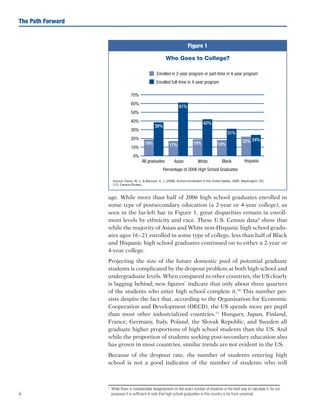
leaders all have a stake in the process of producing well-prepared
graduate degree holders. These individuals will be in the forefront of
addressing current challenges faced in the areas of healthcare, energy
independence, climate change, cyber security, human/social systems,
and the financial sector, as well as new challenges that cannot even be
imagined today. The following policy recommendations provide a path
forward to strengthen and support U.S. graduate education, a strategic
national asset.
Recommendations for Universities
Today all U.S. institutions of higher education, as well as many students,
are struggling under the weight of financial exigency. Most public insti-
tutions and many private ones have been forced to reduce expenses and
raise tuition and fees. In these challenging circumstances it must be
recognized that our nation’s colleges and universities are the key to our
long-term growth and the future of our innovation economy. Graduate
education programs in particular are essential to the preparation of
those who will innovate and lead in the global economy. Investing in
higher education and specifically graduate education is an investment
in our future. Failure to make investments now in the development of
highly skilled talent will have long-term negative effects on our coun-
try. Increased investments from federal and state governments must
be combined with increased accountability and the development of
innovative practices on the part of institutions of higher education.
Moving Forward:
Recommendations and Actions
42
The Path Forward
Some U.S. universities have adopted policies and practices designed
to enhance their role in transforming our society. In such cases there
is a focus on conducting use-inspired research that has purpose and
impact for the local community, the state, or the nation. But this
applied focus continues to be balanced in our research universities
by equal emphasis on fundamental research, historically the source
of countless innovative discoveries. Whether the focus is fundamental
or applied, the research training students receive is an essential ingre-
dient in ensuring our country’s future prosperity. For this reason the
key vulnerabilities in the current graduate education system need to
be addressed.
Improve completion rates.
President Obama’s proposal to increase the number of citizens with col-
lege degrees by 2020 has brought an important focus to undergraduate
completion rates as well as the need for additional university faculty to
teach undergraduate students. Universities and the graduate education
community are stepping up to the problem of attrition at the graduate
level as well. It could be argued that the single most important step U.S.
universities can take at both the undergraduate and graduate levels is
to improve student completion rates.
At the graduate level, significant work is underway on this issue
through the Ph.D. Completion Project centered at CGS. The institu-
tions involved in this effort have identified issues associated with attri-
tion and completion of doctoral programs and are implementing best
practices designed to improve completion rates. Institutions should
review and analyze their own completion and attrition patterns and
draw from the Ph.D. Completion Project findings to craft interventions
to improve completion and decrease attrition. Data from the upcoming
National Research Council study of the research doctorate will pro-
vide some comparative completion data for benchmarking purposes.
Completion and attrition should also be studied at the master’s level,
given the growth in the number of students pursuing master’s degrees
and the student investment that growth represents.
Clarify career pathways for graduate students.
An increasing number of graduate degree holders work outside of the
academy in business, government, and the nonprofit sector. Graduate
schools must embrace this reality and provide appropriate training,
mentoring, and information about such career opportunities to help
more students understand the career options available to them and
select graduate programs that will prepare them for their chosen
career goals.
e It could be argued
that the single most
important thing that
universities can do at
both the undergraduate
and graduate
levels is to improve
completion rates.
e Innovative
programs aimed at
increasing retention of
graduate students are
promising, but they
are few in number
and more are needed.
Mentoring and attention
to social and academic
needs of graduate
students seem to be key.
43
Moving Forward: Recommendations and Actions
Many graduate schools are integrating workplace training needs into
21st century graduate education programs. The Professional Science
Master’s degree previously described exemplifies a national program
that aligns graduate preparation with workforce needs. It is also impor-
tant to recognize that today many individuals have sequential careers,
rendering the need for training and retraining even more necessary.
Prepare future faculty.
The aging of the professoriate, combined with the current
Administration’s goal for the US to have the highest proportion of
college graduates in the world by 2020, has important implications
for how future faculty are prepared in our nation’s graduate schools.
Efforts to address the preparation of future faculty are underway in
many universities, but a renewed national effort to prepare the faculty
of the 21st century is needed.
CGS with several partners launched a Preparing Future Faculty (PFF)
project in 1993 that resulted in a national movement to transform the
way aspiring faculty members are prepared for their careers. Today
PFF programs provide doctoral students, as well as some master’s and
postdoctoral students, with opportunities to observe and experience
faculty responsibilities at a variety of academic institutions with vary-
ing missions, diverse student bodies, and different expectations for
faculty. One of the main goals of PFF programs is to enhance the qual-
ity of undergraduate teaching and learning at all types of institutions.
During the first decade of the initiative (1993–2003), PFF programs
were implemented at more than 45 doctoral degree-granting institu-
tions and nearly 300 “partner” institutions in the US, including com-
munity colleges, master’s-focused institutions, liberal arts colleges, and
institutions primarily serving minority groups. While the foundation
support for the funding of PFF has expired, CGS continues to provide
administrative support to existing programs and to those wishing to
develop new PFF programs or modify existing programs to address
new needs such as assessing student learning outcomes and teaching
the responsible and ethical conduct of research. Universities should
continue to develop and evolve strong PFF programs.
Prepare future professionals.
Much of the strength of U.S. graduate education has come from pro-
viding robust master’s education that often incorporates significant
professional development, as well as strong in-depth research training
at the doctoral level. However, doctoral education has not typically
included a strong professional development component. Countries
e It is critical
to provide career
transparency to
students, especially
to doctoral students.
Understanding available
career options is
important to building a
diverse and strong cadre
of graduate students.
44
The Path Forward
around the world have begun to recognize this deficiency in the
traditional research doctoral preparation, and some have initiated
strong government-supported efforts to fill this gap. The best example
is the Vitae program in the UK where, as a result of a study led by
Lord Roberts, a program was initiated to “make the UK world class
in supporting the personal, professional and career development of
researchers.” Responding to clear employer demand, professional
development programs concentrate on supporting the acquisition of
transferable skills by doctoral students to prepare them better for an
array of employment settings outside of the academy.
To be competitive globally, U.S. universities should develop profes-
sional development programs that:
•	 Encourage the development of creativity and entrepreneurship
in conjunction with core disciplinary attributes.
•	 Improve personal effectiveness including self-organization and
career development skills.
•	 Develop capacity for project management, understanding of
finance, funding and resource management.
•	 Cultivate a highly developed framework of professional and
research ethics.
•	 Encourage the development of skills that enhance research
impact, including communication, teamwork, relating work to
a broader context, and application of research to larger corpo-
rate or social purposes.
While there is no current U.S. government program similar to the one
described in the UK, U.S. graduate schools should make every effort
to develop these opportunities for their doctoral students. There are
some examples of institutions that are moving in this direction, but
professional development of this kind should become part of every
doctoral student’s experience. Federal agencies could favor such
programs in future grant solicitations, specifying that the programs
should not extend time to degree. In particular, attention to these pro-
fessional development activities should be included in new doctoral
traineeship programs.
Establish and expand programs to identify talented
undergraduate students.
Maintaining pathways to graduate school and into careers implies a
linking of K–12, undergraduate, and graduate education. A number of
outstanding programs in place identify promising undergraduate stu-
dents who have the interest and potential to pursue graduate training.
e To be competitive
globally, U.S. graduate
schools should
develop professional
development programs
that, among others,
develop career skills
and “soft skills.”
45
Moving Forward: Recommendations and Actions
One of the most successful is the Meyerhoff Scholars Program at the
University of Maryland, Baltimore County. For more than 20 years this
program has been a leading source of graduate students from under-
represented groups.
Another successful effort is the TRIO Ronald E. McNair Post-
baccalaureate Achievement Program whose purpose is to increase the
attainment of doctoral degrees by individuals who are first-generation,
low-income college students, and are traditionally underrepresented in
graduate education. The McNair program supports projects in institu-
tions of higher education designed to prepare students for doctoral
studies through involvement in research and other scholarly activities.
The McNair program helps to prepare students for doctoral study
but provides no financial aid for these students at the graduate level.
Consequently McNair students frequently cite financial constraints as
a key reason for not pursuing graduate education. Extending graduate
fellowships to McNair students would help overcome this obstacle and
safeguard the nation’s investment.
Another model program is the Leadership Alliance, a consortium of
33 institutions of higher learning having the goal of developing under-
represented students into outstanding leaders and role models. The
Leadership Alliance Summer Research Early Identification Program
offers undergraduates interested in pursuing a Ph.D. or M.D./Ph.D. 8 to
10 weeks of study under the guidance of a faculty or research mentor at
a participating institution. Through this one-on-one collaboration, stu-
dents gain fundamental knowledge and practical training in academic
research and scientific experimentation. The program is designed to
encourage students from groups traditionally underrepresented in the
sciences, social sciences, and humanities to consider research careers
in the academic, public, or private sectors.
State systems of higher education as well as individual universities
should develop policies and programs to link K–12, undergraduate,
and graduate programs so as to provide educational pathways for stu-
dents to enter fields that prepare them to address pressing challenges
in energy independence, climate change, healthcare, cyber security,
literacy, poverty, and the financial sector.
Recommendations for Employers
All sectors of our economy are faced with the need to innovate and
develop new products and services, many of which are based on tech-
nological advancements. In addition, there is a need to replenish an
aging workforce. This situation impacts industry, federal and state gov-
ernments, schools, universities, small businesses, healthcare providers,
e While high school
students are bombarded
with information from
colleges, there is no
comparable effort to
recruit students into
graduate school.
46
The Path Forward
and others. As stated by Jane Oates, Assistant Secretary, Department of
Labor, “There needs to be an organic connection between industry and
graduate education.”
All employers should consider the following issues to help clarify
employment and training needs. Recommendations include:
	 Establish endowed graduate school chairs. A wide range of
employers, including for-profit corporations, nonprofits, and
state and federal governments, should partner with individual
universities to establish a “Graduate School Chair” for a gradu-
ate student. Tuition and fees for the graduate student would
be covered for up to 5 years for doctoral students and 2 years
for master’s students. The sponsoring entity would also provide
an internship opportunity for the chosen graduate student. To
help the university understand the needs of the employer, a
faculty member and/or other employee of the university could
be eligible for a 1-month sabbatical to be spent at the internship
site. Conversely, the industry representative could spend time
in the academic environment to gain an understanding of the
coursework and research performed at the university.
	 Promote Lifelong Learning accounts. Employers in all sec-
tors should consider creating employer-matched, portable
individual accounts for purposes of financing employee educa-
tion and training. Such accounts would promote co-investment
in education and training. These accounts would be set up
much like a 401(k) retirement plan in that both employers and
employees would contribute to the account, and the programs
would provide a tax benefit for both employees and employers.
	 Provide tuition reimbursement programs for graduate
study. All employers should be encouraged to provide tuition
reimbursement programs for current employees who seek to
further their education and pursue graduate degrees.
	 Replicate established programs that address challenges
facing underrepresented groups. Employers across all sectors
should partner with universities and governments to develop
programs designed to promote the participation of students
from underrepresented groups in graduate programs to develop
the talent we need to address grand challenges in energy, cli-
mate change, healthcare, cyber security, and other areas. The
National Consortium for Graduate Degrees for Minorities in
Engineering and Science (GEM) provides a possible model for
replication. GEM has helped thousands of students overcome
one of the most pervasive barriers to pursuing an advanced
degree—identifying and securing student funding.
e Employers need
to clarify employment
and training needs.
Innovative programs
at the graduate level
supported by industry
are also called for.
47
	 Create industry-sponsored graduate fellowship programs.
Industry funding could be used to establish a parallel, industry-
specific program in conjunction with current successful fel-
lowship programs, including the NSF GRF program, the U.S.
Department of Education GAANN Program, and the Office of
Science Graduate Fellowships (SCGF) at the U.S. Department
of Energy, among others. This program would enable indus-
try funding for fellowship support in the broad disciplines of
their interest.
	 The advantages of setting up a parallel program include the
ability to define different stipend levels or other flexibilities
in a program intended to interface with industry. Industry
participation in such programs would require a commitment
from a company to support at least one fellowship at a time
at award levels that would entail approximately $125,000, to
cover the stipend itself plus the associated cost of education for
3 years, not including any administrative fees to the program.
Companies that sponsor fellows would be allowed to pool their
donations and to provide pooled job-related opportunities for
graduate fellows. Companies would hold interviews for avail-
able positions, but there would be no commitment to hire on
the part of an individual company and no commitment to a
particular job.
	 Create special incentives for small businesses to develop
talent. Small business owners, and national organizations that
represent them, should pursue tax breaks for their firms or their
employees to make graduate education more affordable and
appealing and to promote the development of talent to fuel the
small business enterprise. Thirty-six percent of paid employees
work for companies with 99 or fewer employees. Another 15%
work at companies that have between 100 and 499 employees,
making small businesses an important segment of the employer
sector.
	 Collaborate with universities to clarify entry points into
careers. All employers should communicate the educational
skills needed for 21st century jobs in the global economy.
Additionally, they should make this information widely known
from high school through graduate school so that students can
make informed judgments and plans about their educational
pathways in light of career opportunities.
	 Provide internships and work study opportunities for
graduate students. All sectors of the U.S. economy should
seek ways to provide internships and work study opportunities
Moving Forward: Recommendations and Actions
e “Internships
are important–they
are critical. It is a
hugely effective way to
assess talent and gives
students a view from
the inside to see if their
skills, interests and
values are a good fit.”
– Richard Parsons,
Bank of America
48
The Path Forward
for graduate students. For example, U.S. multinational corpo-
rations are in a position to create internship and work/study
opportunities for graduate students to provide cutting-edge
training and exposure to working in diverse cultures.
Recommendations for Policymakers:
The Federal Role
The US is now at a strategic point in terms of its ability to sustain
leadership in the global economy. A major new investment in graduate
education is required, or the country will be at serious risk of decline.
The federal government must ensure that graduate education is a
viable option for a growing number of U.S. citizens. The increasing
diversity of the domestic student population offers opportunities and
challenges in terms of producing future knowledge creators and lead-
ers. Broadening participation in graduate education and in the U.S.
workforce is and should remain a national priority and a key strategy
for increasing the number of advanced degree holders.
However, the odds that students will remain in graduate school are
affected by several factors, including appropriate financial support.
Nontraditional students may require new and different infrastructure
and financial support if we are to achieve the goal of increasing the
number of graduate degree holders. A focus on graduate degree com-
pletion is also important within the overall context of accountability
in higher education. Many universities are actively engaged in efforts
to improve completion rates for graduate students. Their graduate
schools are engaged in the development of effective models that sup-
port degree completion. Adequate financial support to meet the needs
of an increasingly diverse student body is crucial if graduate schools
and universities are to make progress on improving completion rates.
A major investment in graduate education is needed to maintain U.S.
leadership in the 21st century global economy. The key to revitalizing
our innovation system is to develop the U.S. domestic talent pool by
increasing investments in higher education, particularly graduate
education.
Federal government support for graduate education should be
increased dramatically through the authorization and implementation
of two major new initiatives to support doctoral and master’s educa-
tion. These are the COMPETES doctoral traineeship program and a
proposed program to strengthen U.S. master’s-level education.
COMPETES doctoral traineeship program.
A new federal program to support doctoral education associated with
areas of national need identified by the Administration should be
49
authorized. The program would cover direct student support of $30,000
stipends plus tuition and fees, other costs of education, and ancillary
fringe costs, for a total of $80,000 per student per year. Students would
be eligible for up to 5 years of support. The authorization would be for
6 years to ramp up the program, beginning with $2 billion in FY 2011
to accommodate approximately 25,000 students and building up to $10
billion in FY 2016 to accommodate approximately 125,000 students
as the program reaches its steady state. The size is keyed to the level
of investment in research and the associated benefits that the nation
derives from such an investment, as well as the diminished commit-
ment of the states to doctoral education.
Funds would be provided in response to proposals submitted by univer-
sities for graduate programs to support doctoral students in key areas.
Those submitting proposals would be required to provide data, includ-
ing enrollments, completion rates, and job placement information to
the funding agency as part of the ongoing accountability associated
with this funding.
This program is needed to develop highly skilled talent and is essential
if we are to revitalize the U.S. innovation system and keep the nation
competitive in the global economy. The looming retirement of the baby
boom generation in a variety of fields from technology-based industry
to teaching, also motivates investments in the development of highly
skilled human talent. In essence this is preparation for a succession
plan for intellectual leadership in government, industry, and the non-
profit sector. As one commentator has put it, “The United States is
like a company that hasn’t yet recruited enough new talent, let alone
trained it, even though its best and brightest managers are packing up
their mementos and heading to farewell dinners to collect their gold
watches. If this nation were a company, the human resources director
would be kicked out onto the street.”
The program should be directly tied to a national effort to develop the
U.S. domestic talent pool in recognition of the uncertainty surrounding
continued participation of international students in U.S. doctoral pro-
grams at current levels. International students, who now make up 50%
to 80% of doctoral students in the STEM fields, have increasing options
for pursuing their doctoral education as other countries and regions
of the world heavily invest in the graduate school enterprise. Because
there is a need for U.S. graduate schools to continue to attract the best
and brightest students from around the world, universities could apply
up to 20% of the total fellowship funding to support international stu-
dents. Permitting institutions to support some international students
while simultaneously building a robust pool of domestic students, with
the ultimate goal of redressing the imbalance between international
and domestic students in STEM fields, will ensure the influx of top
Moving Forward: Recommendations and Actions
e A new federal
program–the
COMPETES doctoral
traineeship program–
would provide support
for up to 5 years.
50
The Path Forward
talent in key fields such as electrical engineering, physics, math, and
computer science in the short term.
Master’s degree programs for the 21st century.
The federal government should authorize a new federal competitive
grant program across agencies to build capacity at universities to
inspire innovation in master’s degree programs and responsiveness
to workforce needs. Each successful program would be required to
demonstrate maintenance of enrollment, completion rates, and job
placement outcomes, as well as ongoing involvement by employers to
ensure that programs produce graduates for local, state, regional, and
national workforce needs. Programs will be required to secure at least
two thirds of program funding from sources other than the federal
government.
Universities would propose innovative new master’s programs or rein-
vigoration of existing programs, including professional master’s pro-
grams. These programs would include strategies to increase access and
create an academic pathway for students who are underrepresented in
master’s education programs, specifically unrepresented minority stu-
dents and those from economically disadvantaged backgrounds. Such
programs would be eligible for supplemental grants for need-based
aid. When fully implemented this program would support development
of 1,000 new or reinvented master’s programs, including professional
master’s programs, in key areas at a broad range of 4-year institutions
of higher education. Each institution would be eligible for a one-time
$500,000 5-year grant. The authorization would be for 200 grants per
year, for a total federal investment of $500 million over 5 years.
Funding for both the COMPETES and the new master’s programs is
designed to develop the human talent necessary to maintain U.S. lead-
ership in the global economy. The nation as well as individual states
stand to benefit from such an investment. According to NSF, nearly
two thirds of recent science and engineering master’s degree recipients
and 4 out of 10 of science and engineering doctorate recipients secure
initial employment in the state in which they received their degree.
Continuing federal government support for existing programs and
initiatives is also critical:
	 Federal graduate training/fellowship programs. Current
federal training and fellowship programs for graduate students
have not kept pace with the increasing cost of graduate educa-
tion. In addition to creating programs for doctoral and mas-
ter’s education to address challenges in particular key areas,
the federal government should increase the cost of education
e Innovative
master’s programs
would be designed
to increase access
and create an
academic pathway for
students, especially
those from diverse
and economically
disadvantaged
backgrounds.
51
allowance for existing traineeships and portable graduate stu-
dent fellowships for doctoral students. Federal agencies should
adopt a common standard for determining the amount and
criteria for allocating this cost of education. Increases should
come in established programs including the NSF-IGERT, NSF-
GRF, Department of Education Graduate Assistance in Areas
of National Need (GAANN), the Jacob K. Javits Fellowship
Program, the Department of Defense SMART program, NIH
NRSA graduate fellowship and training grant programs, and
the newly established Department of Energy Office of Science
Graduate Fellowship program. These funds are essential to
meeting current real costs and providing the flexibility to
address issues that compromise degree completion.
	 Loan forgiveness for graduate students (master’s and doc-
toral) in priority fields. A variety of loan forgiveness programs
are already in place for graduate students in certain critical
fields such as nursing and other areas related to healthcare.
The federal government should expand the number of fields
in which it permits loan forgiveness to students who complete
their graduate degree, in return for a certain period of employ-
ment in their chosen fields in the public or nonprofit service
sector. Policymakers should consult with graduate education
leaders to determine these critical fields.
	 Amend tax policies for graduate fellowships and scholar-
ships. Before 1986, all scholarship and fellowship income used
to cover the cost of attendance at postsecondary institutions
was tax exempt. In 1986 the federal tax code (Title 26, Section
117) was amended to provide a very narrow definition of quali-
fied scholarship or fellowship income, effectively disqualifying
most scholarships and fellowship money from exemption. The
tax code should be amended again to language similar to the
pre-1986 version to include: “Non-taxable graduate education
scholarships and fellowships are an amount paid or allowed
to, or for the benefit of, a student at an educational institution
in a graduate degree-seeking program. This includes scholar-
ships, fellowships, and grants at the institution. A graduate
degree is defined as a post baccalaureate, masters, doctorate, or
professional degree. The maximum non-taxable amount will be
limited to the projected cost of attendance reported annually by
the student’s institutions.”
	 Align federal and state research and graduate education
grant programs. State support for higher education nationwide
has been in decline in real terms for decades, but this decline
Moving Forward: Recommendations and Actions
e Loan forgiveness
programs should be
extended to include
other critical fields
and the non-profit
service sector.
52
The Path Forward
has recently accelerated to crisis proportions. The federal
government should encourage and adopt policies, practices,
and strategies designed to achieve increased alignment and
coordination of federal grant programs that support graduate
education and state programs that have the same or similar
goals. State grant programs that support graduate education
could be better aligned with some of the federal programs at
NSF, the U.S. Department of Education, and elsewhere. Better
alignment of university and state grant proposals with federal
programs would allow the universities and states to leverage
dollars proposed as part of the cost share in various proposals.
One goal would be the development of innovative and highly
competitive proposals that would not require new funds.
Federal agencies should encourage alignment of state programs
with federal ones as part of their grant solicitation processes.
International students and international
collaborative programs.
International students are a vital component of U.S. graduate education
and the nation’s highly skilled workforce, particularly in STEM fields.
Today international students have more choices about where to pursue
their graduate degrees. The US must adopt policies that welcome those
international students who desire to pursue graduate education as
well as future employment in our country. International collaborative
programs are also important for ensuring that U.S. domestic students
are prepared to thrive in the global research enterprise and global
workforce.
The federal government should:
•	 Continue to improve the visa process to make the pathway for
international students and scholars in high-priority fields more
efficient, allowing them to contribute to U.S. innovation and
global competitiveness.
•	 As part of any future immigration reform, create a new visa
category for international students who receive a doctorate in
a STEM field from a U.S. institution of higher education that
establishes a clear pathway to permanent residency for those
who desire to remain in the US and contribute to our economy.
•	 Encourage federal funding agencies to support collaborative
graduate degree programs with universities abroad—espe-
cially in strategically critical countries—in an effort to develop
sustainable pathways to ensure that an ongoing supply of the
world’s most talented students flows into U.S. graduate schools
and that there are strong educational opportunities for U.S.
e Improvements
in the visa process
will help ensure that
international students
in critical fields stay
and work in the US.
53
graduate students abroad. Graduate degree holders trained
in the US who return to their home countries often achieve
leadership positions and have a positive orientation toward
collaborating with the US on a variety of fronts.
•	 Encourage and support more U.S. graduate students to engage
in international experiences, such as the Fulbright or study
abroad programs.
Implement a Fund for the Improvement of Postsecondary
Education (FIPSE) competition to promote the application of
graduate student talents.
The U.S. Department of Education should undertake a FIPSE competi-
tion that would allow graduate students to apply their talents to issues
of national importance at the local, state, national, and international
levels. Universities would be encouraged to assemble interdisciplinary
teams to identify and address pressing issues or problems and would
provide a national presentation of the results of their work.
Federal support for recommended studies.
There is a need for the systematic gathering of data to help address the
challenges facing U.S. graduate education. Federal government support
of studies aimed at understanding and elaborating possible solutions is
essential to helping successfully meet this need. These studies include:
	 Understanding aspirations and creating career pathways for
students. The federal government should undertake a study to
understand what motivates or deters students from pursuing
studies at the graduate level in critical fields such as STEM dis-
ciplines and others that align with careers in areas of national
priority such as energy, healthcare, climate, and expertise in
understanding other cultures and regions of the world. There
is a pressing need to better understand what factors influ-
ence junior high, high school, and college students’ career
aspirations and to provide information as well as incentives to
students about careers and education pathways that lead to a
desired career. There is some evidence to suggest that factors
other than student preparation may be in play, such as market
forces, incentives, or other drivers.
	 Careers in the 21st century and the pathways that lead to them.
President Obama has said the “nation that out educates us will
out compete us.” In order to maintain the U.S. leadership posi-
tion in producing an educated citizenry, the U.S. Departments of
Moving Forward: Recommendations and Actions
54
The Path Forward
Education and Labor should collaborate on a study to examine
the country’s future workforce needs in critical areas including
education (K–12 and postsecondary teaching), energy, health-
care, financial services, emerging biomedical areas, and others.
These results should inform a national strategy to communicate
to students, families, and the general public information about
educational pathways, including graduate education, that lead
to careers vital to our national needs.
	 Humanities in the 21st century economy: The role of gradu-
ate education. The National Endowment for the Humanities
should undertake a study of the role of humanities in the 21st
century economy. Such a study should investigate the role of
graduate education in preparing future scholars and leaders.
Much of the policy on enhancing innovation and competitive-
ness has focused on STEM fields, but awareness of the role of
the humanities in our national culture is increasing, including
its impact on ethics and values, vitality, and competitiveness.
Humanists help us acquire other languages, understand other
cultures, and learn from the past. The role of graduate educa-
tion in preparing future scholars and leaders in the humanities
should be explored as part of the larger focus on national needs
in areas such as language and culture.
H H H H H
55
“Our progress as a nation can be no swifter than our progress in educa-
tion. The human mind is our fundamental resource.”
John F. Kennedy (35th President of the United States)
The U.S. graduate education system has served our nation well. But
it faces considerable internal challenges. Many students who have
the ability to obtain a graduate degree never enroll in a graduate pro-
gram, and many who do enroll leave without a degree. The system also
faces a number of external challenges. Demographic changes in the
US and internationally may affect the pool of potential applicants, and
efforts to increase access to graduate education in other countries may
limit the number and quality of international students seeking educa-
tion in the US. Such challenges present real threats to the dominant
position of the US in graduate education and the knowledge economy,
and now is the time to seek the path forward in this country.
Graduate education not only produces students with advanced knowl-
edge and skills, it produces critical thinkers and innovators. Such
individuals will be crucial to ensure our nation’s continuing ability to
compete in the global economy, foster international understanding,
and solve many of the greatest challenges that face our nation and
the world.
This report has outlined a number of issues that need to be further
explored and efforts that need to be redoubled. Students need to
understand the economic and social value of pursuing college and
graduate degrees. Increasing high school graduation rates must
remain a national priority. And it is essential to continue efforts aimed
at increasing student enrollment in and completion of undergraduate
education, especially among minority groups.
Enrollment rates at the undergraduate and graduate level continue to
increase. While this increase is evident across all groups of students, it
has not kept pace with growth rates in the general population. A num-
ber of innovative graduate school programs aimed at attracting the
most talented undergraduates are in progress. While these programs
represent a strong beginning, more can be done.
Further, it is important that we not limit our efforts to increasing
enrollment alone. Too many students who enroll in graduate education
fail to receive a degree. The doctoral degree, for example, represents
the highest level of academic preparation in the graduate education
In Summary: The Path Forward
56
The Path Forward
system, and yet the rates at which students leave doctoral study remain
a national problem. The number of doctorates awarded in the US
would be greatly increased simply by ensuring that the majority of
students who enter a doctoral program complete it. Addressing this
issue as a nation is not a matter of lowering academic standards, but of
recognizing the changing nature of the “traditional” graduate student.
Many graduate students must balance work, family, and educational
responsibilities simultaneously. A number of exemplary programs at
the graduate level have embraced this new graduate student through
changes in the student–advisor relationship, faculty mentoring, and
other social and academic requirements. More programs like these
are needed.
The reasons students leave graduate school before completing their
degrees are varied, but it is clear that adequate financial support is criti-
cal if we are to increase the number of successful graduates. A renewed
commitment to existing programs that already provide financial sup-
port to graduate students is needed at the federal level. But while this
commitment is needed, it is not enough—novel programs that provide
the financial support essential for graduate students to succeed must
also be developed. A few possibilities for such novel programs have
been suggested in this report.
Representation by international students in U.S. graduate education,
especially at the doctoral level, is strong. But the numbers of inter-
national students enrolled in U.S. graduate institutions continues to
decline as opportunities for quality education in their home countries
increase. The US must commit to keeping its doors open for interna-
tional talent.
Between 2008 and 2018 it is expected that more new professional
jobs—about 2.5 million—will require some level of graduate degree.
The largest occupational growth areas for master’s degree holders will
be in healthcare and education. For doctoral degree holders, occupa-
tional growth areas will be in service industries in the professional,
scientific, and technical arenas. While master’s programs are frequently
attuned to the needs of the workplace, this is not necessarily true at the
doctoral level. For many doctoral students clear career entry points
are lacking, and it is critical to provide career transparency to these
students. Professional development programs at the university that
provide doctoral students with transferable skills valued by employers
outside of the academy need to be considered. Innovative graduate
programs offering internships and financial support from industry also
are called for.
57
Changes at the university, industry, and government levels are essential.
But most of all, an understanding of the role of graduate education in
today’s world and in the future is required. Finding solutions for the
challenges that face our nation, ensuring continued future prosper-
ity, and maintaining our position in the global economy will require
a highly skilled, creative, and innovative workforce. These creative
innovators will be the product of the U.S. graduate education system.
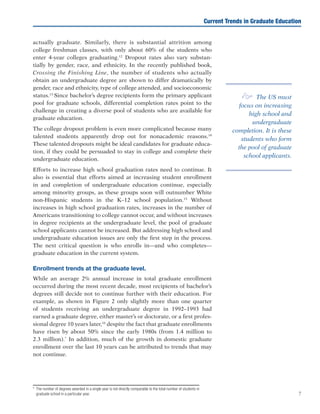
H H H H H
In Summary: The Path Forward
58
The Path Forward
59
References
1	
Snyder, T. D., Dillow, S. A.,  Hoffman, C. M. (2009). Digest of education statistics: 2008 (NCES No. 2009-20).
Washington, DC: National Center for Education Statistics, U.S. Department of Education.
2	
Council of Graduate Schools. (2009). Graduate education in 2020: What does the future hold? Washington,
DC: Author.
3	
Shanghai Ranking Consultancy. (2009). Academic rankings of world universities. Shanghai, China: Shanghai
Jiao Tong University. Retrieved from http://www.arwu.org/
4	
National Science Board. (2008). Science and engineering indicators 2008 (NSB No. 04-01). Arlington, VA:
National Science Foundation. Retrieved from http://www.nsf.gov/statistics/seind08/
5	
Knowledge economy. In BusinessDictionary.com. Retrieved from http://www.businessdictionary.com/definition/
knowledge-economy.html
6	
Baldassare, M., Bonner, D., Paluch, J.,  Petek, S. (2009). PPIC statewide survey: Californians and higher
education. San Francisco, CA: Public Policy Institute of California.
7	
Davis, W. J.,  Bauman, K. J. (2008). School enrollment in the United States: 2006. Washington, DC: U.S. Census
Bureau. Retrieved from http://www.census.gov/prod/2008pubs/p20-559.pdf
8	
Ibid.
9	
Ibid.
10	
Barton, P. E. (2009). Chasing the high school graduation rate: Getting the data we need and using it right (Policy
Information Perspective Report No. PIC-CHASING). Princeton, NJ: Educational Testing Service.
11	
Organisation for Economic Co-operation and Development. (2008). Education at a glance 2008: OECD
indicators. Paris, France: Author. Retrieved from http://www.oecd.org/edu/eag2008
12	
Adelman, C., Daniel, B., Berkovits, I.,  Owings, J. (2003). Postsecondary attainment, attendance, curriculum,
and performance: Selected results from the NELS:88/2000 Postsecondary Education Transcript Study (PETS),
2000. (NCES No. 2003-394). Washington, DC: National Center for Education Statistics, U.S. Department
of Education.
13	
Bowen, W. G., Chingos, M. M.,  McPherson, M. S. (2009). Crossing the finish line. Princeton, NJ: Princeton
University Press.
14	
Ibid.
15	
Kirsch, I., Braun, H., Yamamoto, K.,  Sum, A. (2007). America’s perfect storm: Three forces changing our
nation’s future (Policy Information Perspective Report No. PIC-STORM). Princeton, NJ: Educational
Testing Service.
16	
Bradburn, E. M., Nevill, S., Cataldi, E. F.,  Perry, K. (2006). Where are they now? A description of 1992–93
bachelor’s degree recipients 10 years later. (NCES No. 2007-159). Washington, DC: National Center for Education
Statistics, U.S. Department of Education.
17	
Bell, N. E. (2009). Graduate enrollment and degrees: 1998 to 2008. Washington, DC: Council of Graduate Schools.
18	
National Science Board.
19	
Bell.
20	
Snyder et al.
21	
U.S. Census Bureau. (2008). 2006-2008 American Community Survey 3-year estimates. Washington, DC: Author.
Retrieved from http://factfinder.census.gov/home/saff/main.html?_lang=en
22	
National Science Board.
23	
Kinney, D.,  Munro, J. H. (2007, December). Strategies for motivating undergraduates to attend graduate school.
Presented at the annual meeting of the Council of Graduate Schools. Seattle, WA.
60
The Path Forward
24	
Sax, L. J. (2008). The gender gap in college: Maximizing the developmental potential of women and men.
San Francisco, CA: Jossey-Bass.
25	
Building Engineering and Science Talent. (2004). The talent imperative: Diversifying America’s science and
engineering workforce. San Diego, CA: Author.
26	
Council of Graduate Schools. (2008). Data sources: Aspirations to graduate school. CGS Communicator, 41(4),
4-5.
27	
McCormick, A. C., Nunez, A., Shah, V.,  Choy, S. P. (1999). Life after college: A descriptive summary of
1992-93 bachelor’s degree recipients in 1997. (NCES Publication No. 1999-555). Washington, DC: National
Center for Education Statistics.
28	
U.S. Census Bureau. U.S. Interim Projections by Age, Sex, Race, and Hispanic Origin: 2000-2050 Washington,
DC: Author. Retrieved from http://www.census.gov/population/www/projections/usinterimproj/
29	
Kirsch et al.
30	
Council of Graduate Schools. (2007). Data sources: The rise of “older” graduate students. CGS Communicator,
40(10), 3-4.
31	
Ibid.
32	
Council of Graduate Schools. (2007). Data sources: Who is enrolling in doctoral programs? The changing
characteristics of doctoral students, 1996 to 2004. CGS Communicator, 40(1), 3-5.
33	
Nevill, S. C.,  Chen, X. (2007). The path through graduate school: A longitudinal examination 10 years after
bachelor’s degree. (NCES No. 2007-162). Washington, DC: National Center for Education Statistics, U.S.
Department of Education.
34	
University Continuing Education Association. (2009). Lifelong learning trends: The new face of higher education.
Washington, DC: The University Continuing Education Association.
35	
Stoecker, J. L. (1991). Factors influencing the decision to return to graduate school for professional students.
Research in Higher Education, 32(6), 689-701.
36	
International Foundation of Employee Benefit Plans. (2007). Education assistance plans 2006. Brookfield, WI:
Author.
37	
Bailey, R. (2001, December). Post-scarcity prophet: Paul Romer on growth, technological change, and an
unlimited human future. Reason Online. Retrieved from http://www.reason.com/news/show/28243.html
38	
Romer, P. (2000). Should the government subsidize supply or demand in the market for scientists and engineers?
(NBER Working Paper No. 7723). Cambridge, MA: National Bureau of Economic Research.
39	
U.S. Bureau of Labor Statistics. (2009). Employment projections: 2008-2018 summary. Washington, DC: U.S.
Department of Labor. Retrieved from http://www.bls.gov/
40	
Council of Graduate Schools. Graduate education in 2020: What does the future hold?
41	
Snyder et al.
42	
National Science Board.
43	
American Council on Education. (2008). Minorities in higher education 2008 twenty-third status report.
Washington, DC: Author.
44	
Ibid.
45	
Snyder et al.
46	
U.S. Census Bureau. (1970-2007). Statistical abstract of the United States: 1970 to 2007. (91st to 126th editions).
Washington, DC: Author.
47	
Council of Graduate Schools. (2009). Data sources: Graduate degree attainment of the U.S. population. CGS
Communicator, 42(6), 6-7.
48	
Council of Graduate Schools. (2009). Ph.D. completion and attrition: Findings from exit surveys of Ph.D.
completers. Washington, DC: Author.
61
49	
Nevill  Chen.
50	
Ibid.
51	
Webber, D.,  Ehrenberg, R. G. (2009). Do expenditures other than instructional expenditures affect graduation
and persistence rates in American higher education? (NBER Working Paper No. 15216). Cambridge, MA:
National Bureau of Economic Research.
52	
National Research Council. (2000). Forecasting demand and supply of doctoral scientists and engineers: Report
of a workshop on methodology. Washington, DC: National Academy Press.
53	
Katz, L. F.,  Murphy, K. M. (1992). Changes in relative wages, 1963-1987: Supply and demand factors. The
Quarterly Journal of Economics, 107(1), 35-78.
54	
Juhn, C. (1992). Decline of male labor market participation: The role of declining market opportunities. The
Quarterly Journal of Economics, 107(1), 79-121.
55	
Pencavel, J. (1991). Higher education, productivity and earnings: A review. Journal of Economic Education,
22(4), 331-359.
56	
U.S. Bureau of Labor Statistics. Employment projections: 2008-2018 summary.
57	
Council of Graduate Schools. Graduate education in 2020: What does the future hold?
58	
U.S. Bureau of Labor Statistics. Employment projections: 2008-2018 summary.
59	
University of California. (1999). Educating the next generation of Californians in a research university context:
University of California graduate and undergraduate enrollment planning through 2010. Oakland, CA: Planning
and Analysis, Academic Affairs, Office of the President.
60	
National Science Foundation. (2006). Survey of doctorate recipients. Arlington, VA: Author. Retrieved from
http://www.nsf.gov/statistics/srvydoctoratework/
61	
Council of Graduate Schools. (2009). Why should I get a master’s degree? Washington, DC: Author.
62	
U.S. Bureau of Labor Statistics. (2009). Occupational employment statistics. Washington, DC: U.S. Department
of Labor.
63	
Council of Graduate Schools. Why should I get a master’s degree?
64	
Glazer-Raymo, J. (2005). Professionalizing graduate education: The master’s degree in the marketplace. (ASHE
Higher Education Report Vol. 31, No. 4). San Francisco, CA: Jossey-Bass.
65	
U.S. Bureau of Labor Statistics. (2009). National employment matrix: 2008-18. Washington, DC: U.S. Department
of Labor.
66	
Woods, R. A.,  Figueroa, E. B. (2007). Industry output and employment projections to 2016. Monthly Labor
Review, 130(11).
67	
U.S. Bureau of Labor Statistics. (2009). National employment matrix: 2008-18. Washington, DC: U.S. Department
of Labor.
68	
Ibid.
69	
National Science Foundation.
70	
Organisation for Economic Co-operation and Development.
71	
Marginson, S.,  Wende van der, M. (2007). Globalisation and higher education. Paris, France: Organisation for
Economic Co-operation and Development.
72	
National Science Foundation.
73	
Welch, V., Jr. (2008). Doctorate recipients from United States universities: Selected tables 2007. Chicago: National
Opinion Research Center.
74	
Marginson et al.
75	
Ibid.
76	
The European Higher Education Area. (1999). The Bologna Declaration. Bologna, Italy: Author.
62
The Path Forward
77	
Ibid.
78	
Douglass, J. A.,  Edelstein, R. (2009). The global competition for talent: The rapidly changing market for
international students and the need for a strategic approach in the US (Research  Occasional Paper Series
No. CSHE.8.09). Berkeley, CA: Center for Studies in Higher Education, University of California, Berkeley.
79	
Ibid.
80	
The Gallup Organization. (2009). Students and higher education reform (Flash 81 Eurobarometer Series
No. 260). Brussels, Belgium: European Commission. Retrieved from http://ec.europa.eu/public_opinion/flash/
fl_260_en.pdf
81	
Middleton, D. (2009, September 16). The top M.B.A. programs if you’re in a hurry. Wall Street Journal. Retrieved
from http://online.wsj.com/article/SB10001424052970204251404574344594232539808.html
82	
Global MBA rankings. (2010). London, UK: The Financial Times Ltd. Retrieved from http://rankings.ft.com/
exportranking/global-mba-rankings/pdf
83	
Shanghai Ranking Consultancy. (2009). Academic rankings of world universities. Shanghai, China: Shanghai
Jiao Tong University. Retrieved from http://www.arwu.org/
84	
Usher, A. (2009, May). Ten years back and ten years forward: Developments and trends in higher education in
Europe region. Presented at UNESCO Forum on Higher Education in the Europe Region, Bucharest, Romania.
85	
Ibid.
86	
Bowen et al.
87	
UNESCO Institute for Statistics. (2009). Global education digest 2009. Montreal, Quebec: Author.
88	
National Science Board.
89	
Bowen et al.
90	
National Science Foundation.
91	
Hsiung, D. (2007). China’s evolving science and technology system. Arlington, VA: National Science Foundation.
92	
Redd, K. (2007). Graduate enrollment and degrees: 1996 to 2006. Washington, DC: Council of Graduate Schools.
93	
Bureau of Consular Affairs. (2006). Report of the visa office 2006. Washington, DC: U.S. Department of State.
Retrieved from http://travel.state.gov/visa/frvi/statistics/statistics_3163.html
94	
National Science Foundation.
95	
Ibid.
96	
Finn, M. G. (2007). Stay rates of foreign doctorate recipients from US universities, 2005. Oak Ridge, TN: Oak
Ridge Institute for Science and Education.
97	
Nettles, M. T.,  Millett, C. M. (2006). Three magic letters: Getting to Ph.D. Baltimore, MD: Johns Hopkins
University Press.
98	
Smallwood, S. (2004, January 16). Doctor dropout. The Chronicle of Higher Education, pp. A10-A12. Retrieved
from http://chronicle.com/article/Doctor-Dropout/33786/
99	
Lovitts, B. E. (2001). Leaving the ivory tower: The causes and consequences of departure from doctoral study.
Lanham, MD: Rowman  Littlefield Publishers, Inc.
100	
Nerad, M.,  Cerny, J. (1991, May). From facts to action: Expanding the educational role of the graduate
division. CGS Communicator, Special Edition.
101	
Nettles  Millett.
102	
Smallwood.
103	
Council of Graduate Schools. (2008). Ph.D. completion and attrition: Analysis of baseline program data from the
Ph.D. Completion Project. Washington, DC: Author.
104	
Ehrenberg, R. G., Zuckerman, H., Groen, J. A.,  Brucker, S. M. (2010). Educating scholars: Doctoral education
in the humanities. Princeton, NJ: Princeton University Press.
63
105	
Teitelbaum, M. (2003, Fall). Do we need more scientists? National Affairs, 153, 40-53.
106	
Roberts, L. (2009, July 10). Hot academic jobs of the future: Try these fields. The Chronicle of Higher Education,
pp. B22-B23. Retrieved from http://chronicle.com/article/Hot-Academic-Jobs-of-the-Fu/47008/ 	
107	
Kajitani, M.P.  Bryant, R. A. (2005, March 24). A Ph.D. and a failure. The Chronicle of Higher Education.
Retrieved from http://chronicle.com/article/A-PhDa-Failure/44884/
108	
Vick, J.M.  Furlong, J.S. (2005, October 7). Career Counseling for Ph.D.’s. The Chronicle of Higher Education.
Retrieved from http://chronicle.com/article/Career-Counseling-for-PhDs/44938/
109	
Jaschik, S. (2009, April 15). Matches and mismatches in producing Ph.D.’s. Inside Higher Ed. Retrieved from
http://www.insidehighered.com/news/2009/04/15/grad
110	
Galama, T.,  Hosek, J. (2008). U.S. Competitiveness in science and technology. Santa Monica, CA: RAND
Corporation.
111	
Fox, M. A. (2003). Government-university-industry research roundtable. Pan-Organizational summit on the
U.S. science and engineering workforce: Meeting summary. Washington, DC: The National Academies Press.
112	
Teitelbaum.
113	
U.S. Bureau of Labor Statistics. Employment projections: 2008-2018 summary.
114	
Carnevale, A. (2008 January/February). College for all? Change, 40(1), 23-29.
115	
AFT Higher Education. (2009). American academic: The state of the higher education workforce 1997-2007.
Washington, DC: American Federation of Teachers.
116	
U.S. Bureau of Labor Statistics. Employment projections: 2008-2018 summary.
117	
AFT Higher Education.
118	
Ibid.
119	
Spalter-Roth, R., Jacobs, J.,  Scelza, J. (2009). Down market? Findings from the 2008 ASA job bank survey.
Washington, DC: American Sociological Association.
120	
June, A. W. (2010, January 4). Job outlook for historians grow poorer. Chronicle of Higher Education. Retrieved
from http://chronicle.com/article/Job-Outlook-for-Historians-/63380/
121	
Hart Research Associates. (2010). Raising the bar: Employers’ views on college learning in the wake of the
economic downturn. Washington, DC: Author.
122	
Benenson Strategy Group. (2009). The American workforce survey (Springboard Project). Washington, DC:
Business Roundtable.
123	
Casner-Lotto, J.,  Barrington, L. (2006). Are they really ready to work? USA: The Conference Board, Partnership
for 21st Century Skills, Corporate Voices for Working Families  The Society for Human Resources
Management.
124	
Ibid.
125	
Council of Graduate Schools. Graduate education in 2020: What does the future hold?
126	
Ibid.
127	
Uhalde, R., Strohl, J.,  Simkins, Z. (2006). America in the global economy: A background paper for the New
Commission on the Skills of the American Workforce. Washington, DC: National Center on Education and
the Economy.
128	
University of California. (1999). Educating the next generation of Californians in a research university context:
University of California graduate and undergraduate enrollment planning through 2010. Oakland, CA: Planning
and Analysis, Academic Affairs, Office of the President.
129	
U.S. Bureau of Labor Statistics. Employment projections: 2008-2018 summary.
130	
The College Board. (2007). Trends in student aid. New York, NY: Author.
131	
Ibid.
64
The Path Forward
132	
Council of Graduate Schools. (2009). Data sources: Results from the 2009 CGS Pressing Issues Survey. CGS
Communicator, 42(4), 4-5.
133	
Council of Graduate Schools. (2009). Ph.D. completion project: Findings from the exit surveys of Ph.D.
completers. CGS Communicator, 42(4), 1-3, 7.
134	
Wei, C. C., Berkner, L., He, S., Lew, S., Cominole, M.,  Siegel, P. (2009). 2007-08 National postsecondary
student aid study (NPSAS:08): Student financial aid estimates for 2007-08. (NCES No. 2009-166). Washington
DC: National Center for Education Statistics, U.S. Department of Education.
135	
Webber, D.,  Ehrenberg, R. G. (2009). Do expenditures other than instructional expenditures affect graduation
and persistence rates in American higher education? Cambridge, MA: National Bureau of Economic Research.
136	
Council of Graduate Schools. (2009). Data sources: How graduate students finance their education.
CGS Communicator, 42(5), 5-6, 8.
137	
Organisation for Economic Co-operation and Development.
138	
Courant, P. N., Duderstadt, J. J.,  Goldenberg, E. N. (2010, January 3). Needed: A national strategy to preserve
public research universities. The Chronicle of Higher Education, p. A36. Retrieved from http://chronicle.com/
article/A-Plan-to-Save-Americas-Pu/63358/
139	
Reed, C. B.,  Alexander, F. K. (2009, March 30). We need a new kind of institutional aid. Inside Higher Ed.
Retrieved from http://www.insidehighered.com/views/2009/03/30/reed
140	
Stewart, D. W. (2010, January/February). “Important, if true”: Graduate education will drive America’s future
prosperity. Change. 42(1), 36-44.
141	
Kao, J. (2007). Innovation nation. New York, NY: Free Press.
The Commission on the Future of Graduate
Education in the United States is a joint
effort of the Council of Graduate Schools
(CGS) and Educational Testing Service (ETS).
It was charged with overseeing a research
effort to examine the political, demographic,
socioeconomic, educational, and financial
trends that impact participation in graduate
education. The assumption underlying this
work was that the global competitiveness of
the United States and capacity for innovation
hinges fundamentally on a strong system
of graduate education. The 18-member
Commission includes university presidents,
graduatedeans,provosts,industryleaders,and
higher education scholars. The Commission
guided the development of a report outlining
the research findings and recommendations to
universities, industry, and policymakers, and
will seek to create a national conversation on
how to increase graduate degree attainment
by all segments of the country’s population.
www.fgereport.org
Copyright © 2010 by Educational Testing Service. All rights reserved. ETS and the ETS logo are registered trademarks of Educational Testing Service (ETS). 26180
Copyright © 2010 Council of Graduate Schools and/or its suppliers. All rights reserved.

Cfge report

  • 1.
    The Path Forward TheFuture of Graduate Education in the United States
  • 2.
    The Path Forward TheFuture of Graduate Education in the United States
  • 3.
    Suggested citation*: Councilof Graduate Schools and Educational Testing Service. (2010). The Path Forward: The Future of Graduate Education in the United States. Report from the Commission on the Future of Graduate Education in the United States. Princeton, NJ: Educational Testing Service. The report was written by Cathy Wendler, Brent Bridgeman, Fred Cline, Catherine Millett, JoAnn Rock, Nathan Bell, and Patricia McAllister. A number of individuals contributed to the project. The ETS team was led by Cathy Wendler and included Brent Bridgeman, Catherine Millett, Fred Cline, David Payne, Shelly Punchatz, JoAnn Rock, Namrata Tognatta, and interns Ross Markle and Leslie Shaw. The CGS team was led by Debra Stewart and included Patricia McAllister, Nathan Bell, Daniel Denecke, and Belle Woods. We thank Aina Daud, Nicole DiCrecchio, Thomas Ewing, Cheryl Flagg, Stuart Heiser, Teresa Jackson, Mark McNutt, William Petzinger, Rosalie Szabo, and Yuan Wang for their support and help on the project. * The above suggested citation replaces the citation provided in the first printing of this report: “Wendler, C., Bridgeman, B., Cline, F., Millett, C., Rock, J., Bell, N., and McAllister, P. (2010). The Path Forward: The Future of Graduate Education in the United States. Princeton, NJ: Educational Testing Service.” No new data, information, or recommendations are provided in this reprint of the report.
  • 4.
    April 2010 Dear Colleague: Ithas been argued that in the knowledge economy, a graduate degree will become the new bachelor’s degree, the minimal education credential that high-skills employers require. If that is so, then the United States is in peril of losing its competitive edge, with long-term consequences for our economy, our quality of life, and our global standing. This report examines the data behind these assertions, and proposes a set of recommendations to strengthen U.S. graduate education in partnership with industry and government. The United States’ system of graduate education is a strategic national asset. Like all valuable assets, it must be attended to and nurtured in order to remain viable and strong. Other countries and regions of the world have recognized the value of graduate education as a vital component of economic development and are making investments accordingly. Europe already produces more doctorates in science and engineering than are produced in the United States. China and India are making substantial investments in their graduate education systems. A recent Wall Street Journal ranking of accelerated MBA programs awarded six of the top 10 places to non-U.S. graduate programs. Our competitiveness in the global economy hinges on our ability to produce sufficient numbers of graduate-degree holders — people with the advanced knowledge and critical-thinking abilities to devise solutions to grand challenges such as energy independence, affordable health care, climate change and others. One of our greatest resources is our human talent, and as a nation we must invest in educating more of our population at the graduate level to ensure our capacity to innovate and to secure our intellectual leadership into the future. Policymakers, institutions of higher education, and business leaders all have a stake in the process of producing well-prepared graduate degree holders. People with graduate degrees teach in our schools and universities, drive innovation, attract intellectual and commercial investment, and strengthen American prestige and economic power. This report, a collaboration of the Council of Graduate Schools and Educational Testing Service, provides a clear view of the roadblocks and the pathways to a graduate degree and to an improved system of graduate education in the United States. We hope that you find it illuminating, informative and useful. Sincerely, Debra W. Stewart Kurt M. Landgraf President President CEO Council of Graduate Schools Educational Testing Service
  • 5.
    Commission on theFuture of Graduate Education in the United States Chair: William Russel, Dean, Graduate School, Princeton University Vice Chair: Suzanne Ortega, Executive Vice President and Provost, University of New Mexico Scott Bass, Provost, American University Gene Block, Chancellor, University of California, Los Angeles John Seely Brown, Visiting Scholar and Advisor to the Provost, University of Southern California Thomas Connelly Jr., Executive Vice President and CIO, E.I. DuPont and Co. Karen DePauw, Vice President and Dean for Graduate Education, Virginia Tech Roger Ferguson, President and CEO, TIAA-CREF Jeffery Gibeling, Dean, Graduate Studies, University of California, Davis Stanley S. Litow, Vice President, Corporate Citizenship Corporate Affairs, IBM and President, IBM International Foundation Ronald Mason, President, Jackson State University Patrick Osmer, Vice Provost, Graduate Studies and Dean, Graduate School, The Ohio State University Richard J. Parsons, Executive Vice President, Global Staffing Executive, Bank of America Liora Schmelkin, Senior Vice Provost for Academic Affairs and Dean of Graduate Studies, Hofstra University Susan Stites-Doe, Dean of Graduate Studies and Professor of Management, The College at Brockport, State University of New York Ronald Townsend, Executive Vice President of Global Laboratory Operations, Battelle Memorial Institute John Wiley, Academic Program Director and Professor, Graduate School, University of Wisconsin-Madison James Wimbush, Dean, University Graduate School, Indiana University Ex Officio Members Kurt Landgraf, President CEO, Educational Testing Service Debra Stewart, President, Council of Graduate Schools We are especially indebted to the following individuals for their time and valuable insights: Thomas Connelly Jr., E.I. DuPont and Co.; Norman Bradburn, National Opinion Research Center, University of Chicago; T.J. Elliott, Educational Testing Service; Kathryn Kailikole, The Louis Stokes Institute for Opportunity in STEM Education; Jeanie Mabie, IBM; Jane Oates, U.S. Department of Labor; Richard J. Parsons, Bank of America; Eva Pell, Under Secretary for Science at the Smithsonian Institution; Chandra Taylor Smith, The Pell Institute for the Study of Opportunity in Higher Education; Eldna Smith, ExxonMobil; and Ronald Townsend, Thomas Snowberger, and Richard Rosen, Battelle Memorial Institute.
  • 6.
    Table of Contents Introduction.. . . . . . . . . . . . . . . . . . . . . . . . . . . . . . . . . . . . . . . . . . .  1 Why Focus on Graduate Education?. . . . . . . . . . . . . . . . . . . . . . . . . . .  1 Threats to the U.S. System. . . . . . . . . . . . . . . . . . . . . . . . . . . . . . . . . . .  2 The Path Forward. . . . . . . . . . . . . . . . . . . . . . . . . . . . . . . . . . . . . . . . . .  3 Current Trends in Graduate Education. . . . . . . . . . . . . . . . . . . . . .  5 The Pathway to Graduate School. . . . . . . . . . . . . . . . . . . . . . . . . . . . . .  5 Graduate Degree Recipients. . . . . . . . . . . . . . . . . . . . . . . . . . . . . . . . .  13 Understanding International Competition . . . . . . . . . . . . . . . . . . . . .  20 Current Vulnerabilities in Our System of Graduate Education . .  27 The University Domain. . . . . . . . . . . . . . . . . . . . . . . . . . . . . . . . . . . . .  27 The Industry Domain . . . . . . . . . . . . . . . . . . . . . . . . . . . . . . . . . . . . . .  35 The Government Domain. . . . . . . . . . . . . . . . . . . . . . . . . . . . . . . . . . .  37 Moving Forward: Recommendations and Actions. . . . . . . . . . . . .  41 Recommendations for Universities . . . . . . . . . . . . . . . . . . . . . . . . . . .  41 Recommendations for Employers . . . . . . . . . . . . . . . . . . . . . . . . . . . .  45 Recommendations for Policymakers: The Federal Role. . . . . . . . . . .  48 In Summary: The Path Forward. . . . . . . . . . . . . . . . . . . . . . . . . . .  55 References . . . . . . . . . . . . . . . . . . . . . . . . . . . . . . . . . . . . . . . . . . . .  59
  • 7.
    1 Why Focus onGraduate Education? The fruits of graduate education touch our lives in countless ways every day. We ride in automobiles with systems designed by engineers having graduate degrees; send our children to schools where a growing num- ber of teachers have graduate degrees and were themselves trained by people with advanced degrees; pick up prescriptions for drugs designed and tested by scientists with graduate degrees; visit museums and view displays arranged by curators with graduate degrees; and go to movies enhanced by sophisticated computer-generated special effects designed by men and women who have graduate degrees. Recent figures show that students enrolled in graduate education repre- sent 3% of the students enrolled in all levels of U.S. education.1 With the ongoing debate on how to address the needs of K–12, 2-year colleges, and 4-year colleges, is it premature to debate the virtues of obtaining a graduate degree? We believe not—indeed, now is the critical time to address and understand the value of graduate education. Finding innovative solutions to many of the greatest challenges facing this nation and the world in the 21st century will depend upon having a highly skilled workforce. Tasks such as finding efficient alternative energy sources, improving agricultural practices in developing coun- tries to feed the growing world population, and understanding other cultures that must coexist in the global village will require individuals with graduate-level training. However, as Gary Locke, U.S. Secretary of Commerce, remarked to the President’s Council of Advisors on Science and Technology, “America has a broken innovation ecosystem that does not efficiently create the right incentives or allocate enough resources to generate new ideas; develop those ideas with focused research; and turn them into businesses that can create good jobs.” Undergraduate education is important to the creation of a stable econ- omy, providing students with foundational knowledge and work skills and offering college graduates a wide range of employment options. But graduate education* goes beyond just providing students with advanced knowledge and skills—it also further develops critical thinking skills and produces innovators. It is the application of knowledge and skills in creative and innovative ways that will help ensure our country’s future economic prosperity, influence social growth,2 and maintain our leadership position in the global economy. The assumption underly- ing this report is that the competitiveness of the United States and * The focus of this report is on graduate education as defined by master’s and doctoral programs, not first- professional degrees (e.g., dentistry, medicine, optometry, osteopathic medicine, pharmacy, podiatric medicine, veterinary medicine, chiropractic, law, and theological professions). Introduction e The global competitiveness of the US and capacity for innovation hinges fundamentally on a strong system of graduate education.
  • 8.
    2 The Path Forward ourcapacity for innovation hinges fundamentally on a strong system of graduate education. Threats to the U.S. System During the 20th century, U.S. graduate education rose to the top of the international education enterprise.3 Despite the loss of manufacturing jobs to lower-cost producers overseas, a high level of technical skills and a capacity for innovation, fueled by the graduate education system, have allowed the US to remain competitive and retain an important role in global economic leadership. Major cornerstones of U.S. graduate education have included the avail- ability of world-renowned faculty, along with state-of-the-art research facilities, libraries, laboratories, and specialized equipment that have provided students with one-of-a-kind opportunities to study and work in educational settings that stimulate their intellectual development. The US has produced the vast majority of doctoral degrees conferred around the globe. Our graduate schools and their research facilities have been consistently ranked among the best in the world (e.g., the Times of London Rankings and the Shanghai Jiao Tong University Rankings), and from 1997 to 2009 over half of the Nobel Prize win- ners in chemistry, physics, medicine, and economics had received their graduate degrees in the US. Graduate education in the US also has served as a critical component for fostering international understanding. From the Fulbright Program alone, 20 graduate scholars have gone on to become heads of state in their native countries. The dominant position of U.S. graduate education is now threatened as the rest of the world rapidly catches up. Europe has made major strides in restructuring its graduate education programs and by 2000 produced more doctorates in science and engineering than the US.4 Other countries, such as China and India, are investing substantially in improving their graduate education systems and in the undergraduate programs that feed those graduate programs. The growing competi- tion points to the need for changes in U.S. graduate education so that the US does not continue to fall behind in its production of graduate degree recipients. Against this backdrop of rapidly rising foreign competition are concerns about inefficiencies in a graduate education system that once enjoyed a virtual monopoly. In many fields more than 40% of the students who start doctoral programs fail to complete them, and students who do complete may take 8 to 10 years or more to obtain their degrees.
  • 9.
    3 Students who mightbenefit both themselves and society by obtaining a graduate degree are discouraged from applying or choose to leave before obtaining a degree because of the long and uncertain road to graduation. This not only drains financial resources of students and institutions—it also is a significant opportunity cost for this country. The Path Forward As we consider the future path for U.S. graduate education, a number of important considerations need to be examined. One of the most obvious is the change in demographic trends. While we have a good understanding of the racial, ethnic, and gender distributions that will impact the potential applicant pool for graduate schools, other factors, such as student skill levels and industry requirements for knowledge workers, are more difficult to forecast. The changing mix of domestic and international students in U.S. graduate education and the work- force also must be considered. In a world where technology allows global communication and interaction, we should not and cannot consider these issues in isolation. The members of the U.S. workforce who now are or soon will be retired were able to lead a fairly good life with a high school education. Their story is familiar to all of us: The manufacturing economy was built on the shoulders of citizens who had a high school education and who could rest assured that their livelihoods would be secure until they retired. But times have changed, and the knowledge economy, which is based on creating, evaluating, and trading knowledge and informa- tion, has arrived.5 Predictions are that the U.S. economy will become bifurcated, with one sector of the workforce performing services that cannot easily be exported, such as hospitality services, construction, car repair, and healthcare, while the other sector will perform work in the knowledge industries. The production of goods and services such as automobiles, electronic goods, and clothing is likely to continue to take place in other countries where there are lower labor costs and workers with lower literacy levels and educational attainment. In many respects this is an issue of human capital replacement in our workforce. How do we replace our workers who contribute high levels of knowledge? How will our nation achieve this objective? The U.S. public also is expressing the need for more advanced degrees. In 2008 the Public Policy Institute of California polled the parents of children 18 and under to ask what the highest level of education was that they hoped their child would achieve. Nearly half, 46%, said a graduate degree.6 Introduction
  • 10.
    4 The Path Forward Whilethis report cannot answer every question related to the future of graduate education in the US, we hope to provide a clear view of the pathways and roadblocks to a graduate degree, the challenges of globalization, and the changing needs of the workforce. Trends in enrollment and completion rates at the graduate level are examined; the threats and vulnerabilities that exist in our current graduate education system, in government, and in industry are illuminated; and an empirical basis for recommendations to institutions, policymakers, and industry to ensure our continued national prosperity is provided. H H H H H
  • 11.
    5 “Education is asocial process. Education is growth. Education is not a preparation for life; education is life itself.” John Dewey (Ph.D., Johns Hopkins; Professor, University of Michigan and University of Chicago) If we are to fully comprehend the issues facing the future of the graduate education system in our country, the factors that affect the inputs and outputs of the current system first must be understood. It is important to examine both past and current factors that affect graduate education in order to project their long-term impact. This section does just that. The factors that impact inputs to the system are first explored: the potential applicant pool, numbers enrolling in graduate school and why they choose to go, and changes in the graduate student population. Then factors impacting the outputs of the system are examined: time to degree completion, the characteristics of degree recipients, attrition/completion rates, and employment opportunities. Finally, we evaluate changes in international graduate education that present a challenge to U.S. graduate schools. The Pathway to Graduate School The route to graduate education should be thought of as a pathway rather than a pipeline. A pipeline implies a system in which a student enters at one end and comes out at the other. There is only one entry point, and once a student leaves the pipeline there is no way back in. A pathway, however, suggests a less linear approach in which a student may meander at times, but where leaving the main path does not mean that it will be impossible to reenter it later. The fact remains, though, that the prerequisite, and hence the major pathway, to graduate educa- tion comes from earning a bachelor’s degree. The graduate applicant pool. There is some good news. According to U.S. Census data7 from the period 2000 to 2006, overall enrollment in colleges and graduate schools increased from 15.3 million to 17.2 million. So too, the number of students earning bachelor’s degrees has grown consistently since the early 1980s (from 1.2 million to 1.5 million).8 While this overall increase seems positive, these numbers have not kept up with increases in the general population of individuals of college e There is some good news. But while higher education enrollment is up across all groups of students, it may not be keeping pace with increases in the general population. Current Trends in Graduate Education
  • 12.
    6 The Path Forward age.While more than half of 2006 high school graduates enrolled in some type of postsecondary education (a 2-year or 4-year college), as seen in the far-left bar in Figure 1, great disparities remain in enroll- ment levels by ethnicity and race. These U.S. Census data9 show that while the majority of Asian and White non-Hispanic high school gradu- ates ages 16–21 enrolled in some type of college, less than half of Black and Hispanic high school graduates continued on to either a 2-year or 4-year college. Projecting the size of the future domestic pool of potential graduate students is complicated by the dropout problem at both high school and undergraduate levels. When compared to other countries, the US clearly is lagging behind; new figures* indicate that only about three quarters of the students who enter high school complete it.10 This number per- sists despite the fact that, according to the Organisation for Economic Cooperation and Development (OECD), the US spends more per pupil than most other industrialized countries.11 Hungary, Japan, Finland, France, Germany, Italy, Poland, the Slovak Republic, and Sweden all graduate higher proportions of high school students than the US. And while the proportion of students seeking post-secondary education also has grown in most countries, similar trends are not evident in the US. Because of the dropout rate, the number of students entering high school is not a good indicator of the number of students who will * While there is considerable disagreement on the exact number of students or the best way to calculate it, for our purposes it is sufficient to note that high school graduation in this country is far from universal. Source: Davis, W. J., Bauman, K. J. (2008). School enrollment in the United States: 2006. Washington, DC: U.S. Census Bureau. Figure 1 Who Goes to College?
  • 13.
    7 actually graduate. Similarly,there is substantial attrition among college freshman classes, with only about 60% of the students who enter 4-year colleges graduating.12 Dropout rates also vary substan- tially by gender, race, and ethnicity. In the recently published book, Crossing the Finishing Line, the number of students who actually obtain an undergraduate degree are shown to differ dramatically by gender, race and ethnicity, type of college attended, and socioeconomic status.13 Since bachelor’s degree recipients form the primary applicant pool for graduate schools, differential completion rates point to the challenge in creating a diverse pool of students who are available for graduate education. The college dropout problem is even more complicated because many talented students apparently drop out for nonacademic reasons.14 These talented dropouts might be ideal candidates for graduate educa- tion, if they could be persuaded to stay in college and complete their undergraduate education. Efforts to increase high school graduation rates need to continue. It also is essential that efforts aimed at increasing student enrollment in and completion of undergraduate education continue, especially among minority groups, as these groups soon will outnumber White non-Hispanic students in the K–12 school population.15 Without increases in high school graduation rates, increases in the number of Americans transitioning to college cannot occur, and without increases in degree recipients at the undergraduate level, the pool of graduate school applicants cannot be increased. But addressing high school and undergraduate education issues are only the first step in the process. The next critical question is who enrolls in—and who completes— graduate education in the current system. Enrollment trends at the graduate level. While an average 2% annual increase in total graduate enrollment occurred during the most recent decade, most recipients of bachelor’s degrees still decide not to continue further with their education. For example, as shown in Figure 2 only slightly more than one quarter of students receiving an undergraduate degree in 1992–1993 had earned a graduate degree, either master’s or doctorate, or a first profes- sional degree 10 years later,16 despite the fact that graduate enrollments have risen by about 50% since the early 1980s (from 1.4 million to 2.3 million).* In addition, much of the growth in domestic graduate enrollment over the last 10 years can be attributed to trends that may not continue. * The number of degrees awarded in a single year is not directly comparable to the total number of students in graduate school in a particular year. Current Trends in Graduate Education e The US must focus on increasing high school and undergraduate completion. It is these students who form the pool of graduate school applicants.
  • 14.
    8 The Path Forward Aswith undergraduate enrollment, the composition of students enrolling in graduate school has shifted over the last several decades, resulting in more diverse campuses. For example, the Council of Graduate Schools (CGS) reports that since the mid-1980s the number of women in graduate school has continued to exceed the number of men, with women currently accounting for 59% of graduate students. During the period 1998–2008, first-time enrollment grew at an aver- age annual rate of 3.4% for men but 4.3% for women.17 However, with women now representing well over half of graduate enrollment, it is unlikely that the enrollment gains attributed to redressing the initial underrepresentation of women will continue. In addition, while women comprise the majority of graduate students, much of this is due to the large number of women pursuing master’s degrees, particularly in the education field. Changes in the representa- tion of women in other fields are difficult to predict. Women currently comprise the vast majority of graduate student enrollment in health sciences, public administration, and education, but only a third in the physical sciences and less than a quarter in engineering.18 Substantial shifts have been seen in the traditionally male fields of law and medi- cine, with women now comprising about half the enrollment in these professional programs, but it is unclear whether these shifts will be replicated in currently male-dominated fields such as engineering. e While women comprise the majority of graduate students, there is still under- representation of women in traditionally male-dominated fields. Figure 2 Highest degree attained in 2003 by 1992–1993 bachelor’s degree recipients. Note: Bachelor’s degree percentage includes post-baccalaureate certificates. Source: Bradburn, E. M., Nevill, S., Cataldi, E. F., Perry, K. (2006). Where are they now? A description of 1992–93 bachelor’s degree recipients 10 years later. (NCES No. 2007-159). Washington, DC: National Center for Education Statistics, U.S. Department of Education.
  • 15.
    9 Beginning in 1998,an average annual increase of about 4% was also seen for all minority groups enrolling in graduate school, while non-Hispanic White student enrollment stayed relatively flat.19 However, growth in minority enrollments also may be limited by the size of the applicant pool, since the percentage of underrepresented minority college graduates already going on to graduate school is about equal to their representation in the college graduate population.20 For example, in 2008, 9.6% of college graduates were Black compared to 12% of graduate students, and 7.5% of college graduates are Hispanic com- pared to 6% of graduate students. However, while the representation of minority students in graduate education is about equal to that in undergraduate education, these figures are still below the representa- tion of these groups in the U.S. population* (13% for Black and 15% for Hispanic), according to U.S. Census data.21 Growth in the number of graduate students also has not been uniform across fields. Enrollments in science and engineering started to decline in the mid-1990s but have been consistently rising in the 21st century and are now at an all-time high. Most of this growth has resulted from the enrollment of international students, with modest growth for U.S. minority students and slight declines for non-Hispanic White men and women.22 While the overall graduate enrollment trend appears to be positive, it does not explain why such a large number of bachelor’s degree recipients have not gone on to graduate school. Why do some of these students apply and go on to graduate school while others do not? Some information exists that may shed light on this question. Who chooses to go to graduate school? In a session at the 2007 CGS annual meeting, specific strategies for motivating undergraduate students to apply to graduate school were discussed.23 The strategies included those that undergraduate pro- grams could implement, such as finding positive faculty role models and encouraging increased contacts with undergraduate students; encouraging research opportunities for undergraduates; and offering orientations or seminars on the reality of graduate school life. However, increasing graduate enrollment requires more than instituting new programs at the undergraduate level; it requires an understanding of the challenges that continue to face particular groups of students. While the growth in undergraduate college enrollments has been primarily due to increased numbers of women and those in minority and low-income groups, these students still encounter many challenges that are difficult to overcome when considering whether or not to apply * Note that the federal government treats Hispanic origin and race as distinct concepts. Current Trends in Graduate Education
  • 16.
    10 The Path Forward tograduate school. In the book, The Gender Gap in College: Reinforcing Differences,24 it is suggested that there are three challenges women face in undergraduate school that may impact the decision regarding whether to continue on to graduate school. These are: 1. A confidence gap: Women tend to evaluate themselves lower than men on measures of academic abilities, despite earning better grades and being more likely to complete an undergradu- ate degree. 2. A stress gap: Women display higher levels of stress and depression than men, and those differences persist throughout the undergraduate years. 3. An economic gap: Men express greater interest in careers that pay well, better justifying the expense of college attendance. Similarly, minority students face particular challenges regarding post- secondary success. These challenges, especially relevant to success in science and engineering higher education programs, have traditionally included social bias and lack of support groups, flawed reward systems, antiquated governance systems, resource constraints and inequities, and inadequate outreach.25 Another influence on the choice to attend graduate school may be related to students’ educational aspirations.26 As shown in Table 1, when asked about their ultimate degree objective, a higher percentage of non-Hispanic White (41%) and Asian (50%) high school sophomores were likely to aspire to a graduate degree than were Black (30%) and Hispanic (30%) sophomores. Table 1 High School Sophomores Reported Degree Aspirations Less than Bachelor’s Bachelor’s Graduate White 19% 40% 41% Black 30% 40% 30% Asian 13% 37% 50% Hispanic 30% 40% 30% Can these aspirations be changed? There is some evidence to suggest that it might be possible. Differences between minority and White bachelor’s degree recipients are noticeably unlike those seen among high school sophomores. In one study, Black and Hispanic bachelor’s degree recipients said they were more likely to earn an advanced degree than were their White counterparts. Women and men were equally Source: Council of Graduate Schools. (2008). Data Sources: Aspirations to graduate school. CGS Communicator, 41(4), 4–5.
  • 17.
    11 likely to saythey would enroll in a graduate (or professional) program, although there were differences in the types of degrees that would be pursued.27 These figures certainly are influenced by those students who drop out and leave only those students most inclined to complete their college degree. However, they do suggest some possibilities to be considered. As a first step it is reasonable that young students (high school and below) be encouraged to think of college and graduate school as real- istic, obtainable goals, because without that vision students will not aspire to continue in higher education. In particular, young students from underrepresented racial and ethnic groups need to understand the value of pursuing college and graduate degrees. While enrollment issues at the college and graduate levels historically have focused on accessibility for women and students from minority groups, there are a number of emerging social issues that will create further challenges for the U.S. education system. These changes will impact not only K–12 education, but ultimately the numbers of “tradi- tional” students available for higher education as well. The influx of “nontraditional” students. The population of the US is diverse and continues to grow even more so. The U.S. Census Bureau estimates that between 2000 and 2015, international migration will account for more than half of the nation’s population growth. This growth will especially impact the Hispanic and Asian populations, which are expected to triple over the next half century.28 In the recent report, America’s Perfect Storm: Three Forces Changing Our Nation’s Future, a number of emerging sociological and economical forces that will present challenges to the U.S. educational system are discussed. In particular, demographic shifts will result in a population with less education and lower math and reading skill levels.29 As a result the population of domestic students available to pursue higher educa- tion will become more diverse and possibly less academically skilled. More first-generation college students will emerge from this pool, and many are likely to require additional language and skill resources. Thus these students are less likely to resemble what has been historically the “traditional” student populating the graduate school enrollment pool. As the number of “traditional” students in the graduate applicant pool declines, other types of “nontraditional” students are appearing on the horizon. “Traditional” students typically apply to graduate school within a few years of exiting an undergraduate program. Thus most enter before their 30th birthday, are single, and have a moderate level of income.30 A growing number of “nontraditional” students are Current Trends in Graduate Education e Students of all ages need to understand the value of pursuing college and graduate degrees. e The “traditional” graduate student is changing in subtle ways. This will require a change in academic expectations and financial support.
  • 18.
    12 The Path Forward older,engage in work, family, and school activities at the same time, and view graduate education as a means of changing or improving their employability. While the majority of graduate students still fall into the 30 and younger age group, a rapid increase has been seen in the number of students 40 and older.31 In addition, the percentage of doctoral students who are married and/or have children has also slightly increased.32 These subtle alterations may impact outcomes such as degree comple- tion rates. Evidence of this is seen in a longitudinal study33 by the National Center for Education Statistics (NCES). This study found that students who were single prior to entering graduate school were more likely to have earned their degree (or to still be enrolled) 10 years after receiving their bachelor’s degree, compared to their married counterparts. As a result, how doctoral students are financially and academically supported and how this impacts their expectations of time to degree completion needs to be reconsidered. There also is a growing trend to return to graduate school after having spent time in the workforce. The current economy certainly contrib- utes to this trend; a growing number of “career changers” or laid-off workers are looking to graduate education in hopes that an advanced degree will ensure continued employability and/or career advance- ment.34 The desire to improve clinical or technical skills also seems to be a major influence in the decision to return to graduate school for workers in particular fields. Although limited to professional students in the field of physical therapy, a recent study35 indicated that while career opportunities and income advancement were important factors in the decision to return to graduate education, the overwhelming consideration was skill improvement. To that end, employer-supported education benefits are very common. A 2006 survey of 226 companies in the public and private sectors indi- cated that nearly all of them (approximately 94%) said they offered some form of education assistance to their employees.36 In order to be responsive to and support the needs of part-time students and “career changers” and their desire to acquire and enhance specific, job-related skills, serious thought must be given to the current struc- ture of and financial support for graduate education, especially at the master’s level. Why should these changes concern us? Economists such as Paul Romer argue that economic growth is based not on producing things but rather on producing ideas that lead to technological progress.37 Furthermore, Romer contends that ideas e Economic growth is based not on producing things but producing ideas.
  • 19.
    13 come from highlyskilled individuals who are produced by doctoral programs, and that continuing to produce adequate numbers of doc- toral recipients in the science and engineering disciplines is vital to ensuring the growth of new ideas.38 U.S. competitiveness in the global economy hinges fundamentally on our capacity to innovate. Thus, if as Romer suggests, graduate education is the main source for producing these innovators, it is of vital importance to ensure that all sectors of the U.S. public pursue higher education, especially graduate education. In an interview given to Inventor’s Digest Sally Ride (Ph.D., Stanford University, astronaut, and Professor at UC San Diego) points to this need in science, technology, engineering, and mathematics (STEM) fields, saying, “We’ve always thought of ourselves as an innovative country that keeps at the forefront, a world leader for the last many, many decades. We’ve always prided ourselves on innovation. In World War II, the Cold War, the race to the moon—our self-image is being a technologically superior country. Without the new generation having some background or ability to enter engineering or science, we risk los- ing that. It’s part of our identity. We’re pioneers. We’re innovators. And we’re not producing engineers and scientists in the numbers we need.” While it is important to ensure our country’s future economic prosper- ity, higher education also has personal consequences for individual prosperity. In 2008, while the median annual wage for workers with a bachelor’s degree was $52,624, it was $64,116 for workers with a master’s degree and $81,172 for workers with a doctorate.39 It has been posited that in a knowledge economy a graduate degree will become the new bachelor’s. As economist Anthony Carnevale has said, “if graduate educators cannot fulfill their economic mission to help grow the economy and help youths and adults become successful workers, they also will fail in their cultural and political missions to create good neighbors, good citizens and lifelong learners.”40 Graduate Degree Recipients Globally, the U.S. system of graduate education has been considered the “gold standard.” While it is important to understand who enrolls in graduate school (i.e., the inputs to the system), it is equally important to understand the outputs of the system—who completes their degree, who does not, and their place in the workforce—because it is at this stage where the system seems to falter. Types of graduate degrees. Although graduate education is frequently thought of as preparing stu- dents to earn doctoral degrees, it is important to recognize that many Current Trends in Graduate Education e Graduate education’s mission: to produce successful workers, good neighbors, good citizens, and lifelong learners.
  • 20.
    14 The Path Forward moremaster’s degrees than doctoral degrees are awarded in the US. In 2007, 10 times the number of master’s degrees were awarded compared to doctoral degrees (604,607 vs. 60,616, respectively).41 Master’s-level education has been experiencing growth over the past decade, with a 31% increase in the number of engineering master’s degrees and a 22% increase in social science master’s degrees. In comparison, the increase in the corresponding age cohort in the general U.S. population grew by just 7% during the same time period, demonstrating that the growth in the number of master’s degrees clearly was meaningful. One exception to this trend has been master’s degrees in computer science, which have declined in number over the last several years.42 Obtaining a master’s degree as an end point, or terminal degree, is much more common in some fields than in others. Much of this is due to opportunities for employment in fields where only a master’s degree is needed. For example, about a quarter of the students with bachelor’s degrees in education earned master’s degrees (as the highest degree earned) within 10 years, but only 1% went on to earn a doctoral degree. The same is true for students with bachelor’s degrees in engineering: About one quarter earned a master’s degree within 10 years, but only 3% earned a doctoral degree. However, the picture is different in the natural sciences and mathematics fields where 19% of the students received a master’s degree and 9% earned a doctoral degree.* Thus it is important to recognize differences across disciplines regarding the types of degrees attained when examining where we are in graduate degree attainment. Trends in degrees awarded. In its 2008 status report 43 the American Council on Education reported that the number of postsecondary degrees awarded increased between 1995 and 2005. This was seen at both the undergraduate and graduate levels. While the number of associate and bachelor’s degrees earned grew by 35%, the number of master’s degrees earned increased even more—by 47%—and the number of doctoral degrees increased by 26%. In this case the increase in the corresponding age cohort (under- graduate- and graduate-aged individuals) in the general U.S. popula- tion grew by just 13% during the same time period. This is another instance where the growth in the number of awarded degrees clearly was substantial, even when accounting for population changes. The pattern of degree recipients varies by gender as well as by ethnic- ity and race. For example, women accounted for 68% of the growth in master’s degrees and 84% of the growth in doctorates. Despite this increase, in 2005 women received 60% of master’s degrees but less than * The estimates of the percent of students earning doctoral degrees are limited by the 10 year time horizon in the Baccalaureate and Beyond Longitudinal Study database.
  • 21.
    15 half of doctoraldegrees.44 Nevertheless, given the continued growth of women in U.S. graduate schools combined with the increase in the number of these women obtaining graduate degrees, the graduate degree attainment rate for women could surpass that of men in the future, as illustrated by the bottom solid line in Figure 3.45, 46 The number of degrees received by minority students also increased between 1998 and 2008. These increases must be interpreted in light of changes made to the categories used to collect race and ethnicity data by the U.S. Census Bureau during this time period. Still, some com- parisons can be made. Over the last decade the number of Hispanic students with a graduate degree rose from 2.4% to 3.2%, and the per- centage of Black students rose from 3.8% to 5.4%.47 While this trend is encouraging, it is important to note that the percentages of these populations earning graduate degrees are still below those for Asian and non-Hispanic White students. However, not all students who enroll in graduate education complete their degree, and so the number of doctorates awarded in the U.S. would be greatly increased simply by ensuring that most of the students who enroll in a doctoral program actually complete it. Current Trends in Graduate Education e The number of doctorates awarded in the US would be greatly increased simply by ensuring that most of the students who enter a doctoral program complete it. Figure 3 Degrees conferred 1969 to 2006 as percent of population (ages 25–35). Source: Snyder, T. D., Dillow, S. A., Hoffman, C. M. (2009). Digest of education statistics: 2008 (NCES No. 2009-20). Washington, DC: National Center for Education Statistics, U.S. Department of Education U.S. Census Bureau. (1970-2007). Statistical abstract of the United States: 1970 to 2007. (91st to 126th editions). Washington, DC: Author.
  • 22.
    16 The Path Forward Whydo students not complete their degree? The most serious problem in generating the number of doctoral degree holders needed is that many students fail to complete their degree. Although the vast majority of students entering graduate programs most likely have the ability to complete a degree, high numbers of students fail to achieve that goal. In particular, research indicates that for a majority of students, financial support is the most significant factor contributing to the ability to complete the doctoral degree.48 Of course many graduate students do manage to balance work, family, and educational responsibilities simultaneously. For those who have chosen to leave a graduate degree program, the reason most often given is a change in family status, followed by job/military commit- ments, dissatisfaction with the particular program, or needing to work (see Figure 4).49 The odds that students will remain in graduate school are also affected by whether they enroll full time or part time; students enrolled full time are more likely to complete graduate school within 10 years of receiving their bachelor’s degree.50 e Providing adequate financial support is critical for ensuring that students who enroll in a graduate program stay in the program. Figure 4 Reasons for leaving graduate school Source: Nevill, S. C., Chen, X. (2007). The path through graduate school: A longitudinal examination 10 years after bachelor’s degree. (NCES No. 2007-162). Washington, DC: National Center for Education Statistics, U.S. Department of Education. Note: Respondents could select more than one category, hence the percentages add to more than 100%.
  • 23.
    17 Recent research atthe undergraduate level demonstrates the need for providing appropriate financial support for students.51 These data show that providing support for student services—for admissions, registrar activities, and activities which contribute to students’ emotional and physical well-being—influences graduation and persistence rates. Graduate degree recipients and the workforce. If it is true, as Paul Romer contends, that our prosperity depends upon educating individuals who produce and implement ideas, examining where graduate degree holders work can illuminate the value of a graduate degree in today’s knowledge-based economy. Projections of workforce trends for graduate recipients are difficult to make, and at times the results are conflicting.52 However, examining where graduate degree holders work and in which occupations, and examining projec- tions for these occupations, provides a useful perspective on the labor force contributions of graduate degree holders. Over the last 20 years the structure of the economy has shifted to a knowledge-based economy favoring more educated and academically skilled workers.53,54 One indicator of this shift is the earnings premium associated with education and academic skills.55 This trend is expected to continue, with growth in jobs in service-providing industries and fewer jobs in the goods-producing sectors of the economy. More than half of the new jobs projected over the next 10 years will be in profes- sional and service occupations. For example, the scientific and techni- cal consulting industry is projected to show significant employment growth from 2008 to 2018.56 More and more workers will be asked to think rather than produce in the traditional manner of manufacturing industries of the past.57 While no definitive number can be provided, jobs that typically require a master’s or doctoral degree are expected to increase between 2008 and 2018, with a projected estimate of 2.5 mil- lion additional jobs. It is projected that the number of jobs requiring a master’s degree will increase by about 18% during this time period and those requiring a doctoral degree by about 17%.58 Different occupations/different skills. In what sectors and industries of the labor market are graduate degree holders working? While recipients of master’s degrees have tradition- ally worked outside of the university, doctoral recipients have generally taken positions within academia. However, many doctoral degree hold- ers are now working in industry, within sectors and occupations that are expected to grow over the next 10 years.59 According to one estimate about half of the doctoral recipients with post-graduation employment commitments obtained jobs outside of the academy, but the percent- ages vary widely by field (85% from engineering, 66% from physical sciences, 38% from social sciences, and 14% from humanities).60 Current Trends in Graduate Education e Between 2008 and 2018 it is expected that many new jobs – about 2.5 million – will require a graduate degree.
  • 24.
    18 The Path Forward Whilenot without flaws,* one way to track the types of sectors and types of jobs in which graduate degree recipients work is to use the Bureau of Labor Statistics (BLS) classification of occupations that require doctoral and master’s degrees. BLS classifies and tracks employment in occupations stratified by education or training. Education and training are defined by the credentials most workers need to become fully quali- fied in that occupation. According to the BLS classification, a doctoral degree is needed for full qualification in 11 occupations and a master’s degree for 31 occupations. Despite its limitations this occupational classification system provides a useful framework for examining the current workforce participation of graduate degree holders. Where do master’s degree holders work? Master’s-level education is the largest segment of graduate education. Over 75% of graduate students are in master’s programs, and 90% of graduate degrees awarded are master’s.61 The occupations classified as requiring a master’s degree for full qualification range from social scientists, such as economists and anthropologists, to mental health counselors and statisticians. Jobs requiring master’s degrees are projected to grow at a substantial rate, 18%, from 2008 to 2018.62 In addition, master’s programs often have the strongest connection to the workforce, in that they teach students those skills required for par- ticular fields, such as education, urban planning, library science, and physical therapy. Many master’s programs have shifted from having an arts and science focus and become professional programs that prepare students for careers in business, government, and nonprofit organizations.63 This shift is one of the major factors contributing to the rapid growth in mas- ter’s-level programs. An additional factor contributing to the growth in master’s programs is employer demand, with more frequent preference or requirement for a master’s degree for entry into many professions. Professional master’s degree programs provide diverse knowledge geared toward successful participation in the job market and combine theory, practical application, and workplace skills such as communica- tion, critical thinking, and management. According to higher education researcher Judith Glazer-Raymo, the master’s degree has evolved into an entrepreneurial credential that brings the university much closer to the corporate world and provides diverse and marketable choices for students.64 U.S. Department of Education postsecondary education statistics indi- cate that the largest number of master’s degrees conferred continues to be in the field of education. Job prospects for individuals with a * It is known that this classification system underestimates the occupations that require a doctoral degree and, subsequently, the workforce projections for graduate degree holders. In addition, not all workers in the jobs listed in the doctoral category have a doctorate.
  • 25.
    19 master’s degree ineducation also are very favorable. Currently, edu- cational services are the second-largest industry in the US, and the number of positions is expected to grow due to projected demographic increases and compulsory school attendance at the K–12 levels. Many positions in the service industry also require a master’s degree. Many of these jobs are in healthcare and social assistance (e.g., social workers); this area is expected to have the largest growth in jobs from 2008 to 2018. Two occupations in the master’s category—physical ther- apist and physician assistant—are among the top 30 fastest growing occupations.65 Master’s degree holders are working in a variety of other areas as well. In 2008, nearly one quarter of master’s-level economists were working in the professional science and technology sector, one fifth in finance, and almost one third in the federal government. Where do doctoral degree holders work? While doctoral recipients are often thought of as being groomed for work in academia, a closer look suggests a different story. According to the 2008 data from BLS, most doctoral degree holders work in occupations in service industries—generally in professional, scientific, and technical services or in government. Most of these industries and occupations are projected to grow over the next 10 years. For example, the largest projected growth of jobs is in the healthcare and social assistance industry, followed by professional, scientific, and technical service industries.66,67 While only 11 occupations are classified by the BLS as technically requiring a doctorate, a doctoral degree is the de facto entry degree for leadership in a wide array of fields. Biochemistry is one example of a field demonstrating the diversity of sectors in which doctoral degree holders work. In 2008, while almost half of doctoral-level biochemists were working in professional, scientific, and technical service indus- tries, more than one quarter worked in pharmaceutical and medicine manufacturing, and one eighth worked in the education sector.68 Understanding the early employment plans of new doctoral recipients provides another perspective on workforce trends. Among U.S. citizens, most new doctoral recipients report having an employment or post- doctoral plan* soon after graduation.69 In 2006, across all fields, nearly three quarters of new doctorate recipients said they had an assured job or postdoctoral opportunity. This pattern has been relatively con- sistent over time, with a small drop in 1996, possibly a reflection of the economic recession in the early 1990s. The workforce pattern varied somewhat across fields, with engineering doctorate degree holders and those in the humanities reporting slightly fewer job commitments. * A postdoctoral scholar has been awarded or has completed the requirements for a doctoral degree and is given a fellowship or traineeship for studies at the postdoctoral level. In these positions, the scholar generally trains under the direction of a research mentor and performs collaborative and independent research. Current Trends in Graduate Education e The largest growth areas for master’s degree holders are in healthcare and social assistance. Jobs in education are also expected to show continued growth. e Individuals with doctoral degrees work in a wide range of employment sectors, not just academia.
  • 26.
    20 The Path Forward Forthose who reported having a job, positions were split between aca- demia and industry, with about half of new doctoral recipients across all fields having a position in academia. This pattern has been consistent over the last 10 years, with some small decreases in the percentages of doctoral degree holders reporting having a job in government. The projection for postsecondary teachers is mixed. This occupation is projected to grow over the next 10 years due to two factors. First, an increase in student enrollment in higher education will reflect the projected population increases of 18–24 year olds, with increased num- bers of students in colleges requiring increased numbers of instructors. Second, the expected retirement of current faculty hired in the 1960s and 1970s will produce openings. However, much of this growth will not be in full-time academic positions, which are a shrinking proportion of the academic workforce, but rather in adjunct or nontenured positions. Understanding International Competition The past 10 years have seen significant changes internationally in higher education. Cultural changes have resulted in increased access to higher education in many countries, systemic changes in Europe have resulted in more unified and consistent standards, and political and economic changes have placed a focus on the economic benefits of a highly trained workforce, leading to greater competition between countries for available students. For many years the US has been the world’s dominant nation in attract- ing international students for graduate programs. While the proportion of international students enrolled in U.S. colleges at the undergradu- ate level is relatively small (3%), international doctoral and research students make up 24% of the total graduate population, well above the worldwide average of 19% reported by OECD.70 In 2004–2005 over 100,000 international students were enrolled in doctoral programs in the US; the United Kingdom’s total as the next closest country was about 20,000.71 Many factors have contributed to this, including: • The emergence of English as the primary language for academic discourse as well as international trade, resulting in a desire to receive instruction in English among many science, engineer- ing, and business students. • The economic prospects in the US and the understanding among international students that a graduate degree from a U.S. institution was the most direct gateway to employment and citizenship.
  • 27.
    21 • The internationalreputation of the top U.S. graduate schools as being the best in the world, with clearly defined degrees and programs recognized around the world. • The lack of available seats (relative to the population) in graduate programs in the students’ own countries, particularly in Asia. The representation of international students in U.S. graduate institu- tions is especially notable at the doctoral level.72 In 1977, 82% of doc- toral degrees awarded in the U.S. were granted to U.S. citizens, but by 2007 this figure had fallen to 57%. In engineering only 29% of doctoral degrees went to citizens (down from 56% in 1977), and the percentage today in the physical sciences is 43% (down from 76% in 1977). Even in the field of education, the percent of doctorates going to U.S. citizens declined, from 91% in 1977 to 81% in 2007.73 Changes in international education. None of these changes has resulted from an organized or concerted effort on the part of the U.S. government to promote domestic gradu- ate schools as the prime destination for international students.74 Instead, countries such as China have utilized the U.S. system to make up for shortfalls in their own system capacities—shortfalls that China now is aggressively trying to remedy. Indeed, many countries are now actively engaged in organized efforts to provide alternatives to the US for graduate education.75 The European Union (EU) goal of cooperation among its members to achieve common standards and promote mobility extended to the field of higher education with the 1999 “Bologna Declaration.”76 Disparate higher education standards throughout Europe, in particular a lack of consistency as to what constitutes course credits and degree levels, made comparison of students’ education achievement complex. The Bologna Declaration introduced a framework for achieving compat- ibility by recommending a clear demarcation between undergraduate (at least 3 years of coursework) and graduate (2 years of coursework for a second-tier/master’s and an additional 3 years for a third-tier/ doctoral) degrees as well as a common system of credits. The purpose of such changes was to promote increased mobility across the member states for study and for employment.77 In 2000, EU countries already had the largest share of international students in higher education (combining undergraduate and graduate populations), nearly 39%.78 As seen in Figure 5 the US, in comparison, had one quarter of the share. Current Trends in Graduate Education e The importance of international students in graduate education is pronounced: almost half of doctoral degrees were awarded to non-U.S. citizens.
  • 28.
    22 The Path Forward By2006 the number of students attending an institution not in their home country increased dramatically.79 Most likely driven by the Bologna Declaration, the number of international students in EU countries increased, preserving their lead in share. The number of international students in the US also increased, but the US share fell. Retaining share of international students. Europe may not be as much of a threat as it appears in terms of competition for graduate school enrollment. Much of the increase in “international” students may ultimately be a zero-sum game for the EU, because mobility across borders is occurring in all directions. For example, as France attracts more international students from across EU member states, it also may send more French nationals to other EU countries. Since European students represent a smaller portion of all the international students studying in the US compared to those from Asia, the reality is that the competition for the same graduate students may come from other English instruction countries, such as Australia, New Zealand, Canada, and South Africa. However, by developing a common and more transparent system of degrees and credits that is reflective of the U.S. system, EU institutions e The share of international students enrolled in U.S. graduate institutions declined between 2000 and 2006 and continues to decline. Figure 5 Share of international students in higher education Source: Douglass, J. A., Edelstein, R. (2009). The global competition for talent: The rapidly changing market for international students and the need for a strategic approach in the US (Research Occasional Paper Series No. CSHE.8.09). Berkeley, CA: Center for Studies in Higher Education, University of California, Berkeley. Note: Percentages represent combined undergraduate and graduate international students based on total counts of 1.9 million students in 2000 and 2.9 million students in 2006. 20062000
  • 29.
    23 may become moreof a draw for students from the US as well. In addition, Europe is engaged in developing programs that may have appeal for other reasons, such as a 3-year bachelor’s degree, which also might encourage U.S. students to consider international options for graduate school. Quality and reputation. A recent survey of students from the EU asked about a variety of issues related to higher education. Most tellingly, 5 out of 6 respondents indi- cated that the quality of a higher education institution would help them decide where to study.80 U.S. graduate schools have always provided the highest quality gradu- ate education. However, the reputation of graduate programs outside of the US is growing as well. For example, recent rankings of acceler- ated MBA programs by the Wall Street Journal gave the top three spots to European schools and 6 of the top 10 were non-U.S. programs.81 The perception that U.S. schools continue to provide a superior edu- cation cannot be overstated. For example, in the 2010 rankings of traditional MBA programs by the Financial Times, only 4 of the top 10 schools were from outside of the US.82 In 2003, Shanghai Jiao Tong University garnered international attention by ranking the top 500 aca- demic institutions in the world. While not limited to graduate schools per se, the heavy emphasis in the methodology towards significant research and publishing means the rankings tend to favor large-scale research institutions more than smaller undergraduate institutions. The 2003 rankings were dominated by the US, which had 15 of the top 20 institutions, 35 of the top 50, and 161 of the top 500. The results of the most recent rankings in 2008 were similar, with 17 of the top 20, 36 of the top 50, and 159 of the top 500 institutions in the US.83 While the methodology used in the rankings was recognized as being far from perfect, many countries still reacted with dismay at their relative performance, and pressure from governments to improve their country’s standing was common.84 In Europe, governments that have essentially ignored graduate education are now allocating significant resources to upgrade their graduate schools,85 and the same is true in other parts of the world, especially in India, South Korea, and China.86 Because of this, international graduate students are likely in the future to have many more options than have historically been available. Changes in global demographics and student mobility. According to a recently released UNESCO report,87 in 2007 more than 2.8 million students were enrolled in higher education programs in institutions outside of their country of origin, which represents a 53% increase since 1999. This increase varies by geographical region; e How do international students decide where to study? By the quality and reputation of the graduate school. Current Trends in Graduate Education
  • 30.
    24 The Path Forward increasingnumbers of students from Asian countries, a major source of international graduate students, are attending universities within their own region. In East Asia and the Pacific 42% of students remained in their region in 2007, compared to 36% in 1999. Within China, for example, many more opportunities now exist for students to remain in their own country. In 1997 approximately 5,000 science and engineering doctoral degrees were awarded, and by 2004 this number had grown to 13,000 degrees.88 The number of international students in China now exceeds the number of Chinese undergraduate and graduate students sent abroad.89 At the same time the sheer number of international college gradu- ates is also increasing. Even if a slightly lower proportion of this pool chooses graduate education in the US, total graduate enrollments could increase. All of the non-OECD nations together produce about 6 million college graduates each year. However, if those countries begin to graduate college students at the same rate as the OECD states, that number would double to 12 million per year. China provides a good example of the impact changes in policy or focus can have on graduate enrollments across the world. About one third of international students currently earning doctoral degrees are from China,90 and growth of undergraduate education in China has been exponential. In 1998 there were 0.3 million Chinese undergraduates, but by 2004 this number had swelled to 13.3 million.91 However, this growth could begin to slow due to years of restricting the birth rate, and India soon will take over as the country with the largest popula- tion of college-age individuals. Whether this will translate into India overtaking China in college and graduate school attendance is unclear. As in many developing nations, the percentage of school-age children receiving an education in India is much lower than in the US and Europe, while China has rates closer to the US and Europe. Population shifts are not limited to China; the trend for most of Europe will be a decrease in school-age (and eventually college-age) populations over the next decade. Public policy and visas. Policymakers appear to be undecided as to whether the national inter- ests of the US are best served by increasing or decreasing the propor- tion of international students generally or in specific fields. It also is important to recognize that whatever trends develop internationally, the impact will not be felt equally in all graduate fields. In the largest field, education, only 4% of students are international (at the master’s and doctoral level), and in the next largest field, business, 20% are international. But in some fields the percentage of non-U.S. citizens
  • 31.
    25 e Changes to immigrationlaws and visa processing will impact the number of available international graduate students. Current Trends in Graduate Education is quite high. In engineering, for example, just above half of graduate students are international, and just under half of students in the physi- cal sciences are international.92 Immigration laws and visa processing procedures also play a role in determining the influx of international students. For example, as displayed in Table 2, following 9/11 there was a significant drop in the number of student visas issued. At the same time graduate schools saw decreases in the number of applications from international students. While this number has rebounded over the last several years,93 future changes in immigration policies may impact the volume of available international graduate students. Table 2 Number of Student Visas Issued, 2002 to 2006 Year Visas issued 2002 256,534 2003 235,580 2004 237,807 2005 255,993 2006 294,637 Employment opportunities. The picture on employment is somewhat different for new doctoral recipients who are temporary visa holders than it is for U.S. citizens. In 1996, approximately one tenth of temporary visa holders reported having a job shortly after graduating; in 2006 this percentage increased to nearly a quarter.94 New doctoral degree holders with temporary visas were much more likely to report having a position in industry than in academia. For example, in 2006, across all fields, only 17% of U.S. citizens reported their job commitment to be in industry, while among those with temporary work visas this number was 55%.95 Most of the employment commitments of both citizens and non- citizens with graduate degrees are in the US. A small percentage of employment commitments are outside of the US, and this number is greater for temporary visa holders. Recent data shown in Table 3 indicate that about two thirds of international students who obtained a doctoral degree while studying in the US remain in the country for 5 years after completing their degree. Ten years earlier slightly less than half of these students stayed in the US 5 years after graduation, indicat- ing an increase in the “stay rate” of doctoral recipients.96 Source: Bureau of Consular Affairs. (2006). Report of the VISA office 2006. Washington, DC: U.S. Department of State.
  • 32.
    26 The Path Forward eStay rates—the length of time that international students stay in the US after completing their doctorate—are important to maintain. Table 3 Percentage of International Students Remaining in the US 5 Years After Completing Doctorate Country 1990/91 recipients in 1995 2000 recipients in 2005 China 88% 92% India 79% 85% Taiwan 42% 50% Korea 11% 42% Japan 13% 39% All countries 47% 65% The data also indicate that stay rates vary greatly by country. The rate for students from China is the highest, followed by students from India. For Asian countries with more developed economies, such as Japan, Korea, and Taiwan, the stay rates are lower than for those with less developed economies. Stay rates need to be considered for two reasons. The obvious one is that if the mix of international graduate students is increasing, a pro- portional increase in the stay rate is needed to keep the total number of doctoral graduates living in the US constant. Currently, for every three doctoral degrees granted to international students, only about two result in graduates working in the US. Consequently, if the growth in degrees awarded is driven by increases in international students, the number of doctoral holders available for the US labor market may not increase by the same proportion. Even worse, if the total degree production is held constant while the number of international doctoral students increases, the number of doctoral recipients in the U.S. work- force will begin to decrease. The second reason that stay rates need to be considered is the potential for them to decrease if opportunities in countries such as China and India improve, so that returning to one’s country of origin may be an attractive option for doctoral degree recipients. Given that China and India account for about 40% of the doctoral degrees granted to inter- national students, a reduction in stay rates that reflect rates typically found for other Asian countries with more developed economies would result in 800 fewer doctoral recipients staying in the US every year. If stay rate is related to economic opportunity in one’s country of origin, the high stay rates currently seen with students from China and India seem unlikely to persist. H H H H H Source: Finn, M.G. (2007). Stay rates of foreign doctorate recipients from US universities, 2005. Oak Ridge, TN: Oak Ridge Institute for Science and Education.
  • 33.
    27 “The object ofeducation is not merely to draw out the powers of the individual mind: it is rather its right object to draw all minds to a proper adjustment to the physical and social world in which they are to have their life and their development: to enlighten, strengthen and make fit.” Woodrow Wilson (Ph.D., Johns Hopkins; 28th President of the United States; President, Princeton University) If the US is to remain competitive in the global economy, current vul- nerabilities in our system of graduate education must be understood and addressed. These vulnerabilities require creative solutions, some of which may be contrary to how graduate education has historically operated. We view these vulnerabilities as falling into three general domains: (1) the university domain, (2) the industry domain, and (3) the government domain. The University Domain In the previous section of this report we discussed enrollment numbers and completion rates. We also addressed changes in international graduate education that present challenges to U.S. graduate schools. In this section we now focus on the vulnerabilities that exist in the current university system—attrition, time to degree completion, and career path transparency—and describe some efforts to address them. Attrition in graduate education. Failure to complete a degree is one of the most vexing problems facing U.S. graduate education. Individuals often make considerable personal sacrifices to enroll in graduate education, and institutions invest thou- sands of dollars supporting candidates for graduate degrees. When students fail to complete their degree there are not only direct costs to the student and the university, but also opportunity costs, since the student who left was filling a space that might have been occupied by a student who would have graduated. Despite the rigorous selection processes used for graduate admissions and the high achievement level of those pursuing a graduate degree, some estimates indicate that the attrition rate in doctoral education is in the range of 40% to 50%.97 Even among doctoral students who are awarded very competitive graduate research fellowships, such as those from the Graduate Research Fellowship Program of the National Science Foundation (NSF), the dropout rate is still a problem, being about 25% among this rigorously selected set of students. Current Vulnerabilities in Our System of Graduate Education
  • 34.
    28 The Path Forward Calculatingnon-completion rates is difficult, and these data are some- what “slippery.” For example, should part-time students be counted? However the counting is done, it is clear that a significant proportion of the students who enter graduate programs never obtain a degree. If the graduate education system is to serve both students and society more efficiently, we must try to understand why students leave graduate programs. Lewis Siegel, the former chair of the GRE Board and graduate dean at Duke University, referred to the attrition problem as “the central issue in doctoral education in the United States today.”98 Case studies are valuable in documenting the powerful negative impact that dropping out can have on individuals (for example, see Leaving the Ivory Tower: The Causes and Consequences of Departure From Doctoral Study99 ). In addition, more systematic studies based on comprehensive census-like surveys are needed. Individual universities can provide more insight into the causes of non- completion by doctoral students. For example, non-completion rates at the University of California, Berkeley were shown to vary dramatically by discipline—ranging from 29% for students enrolled in biology to 63% for students in languages and literature.100 Factors such as the relationship between student and advisor/other faculty and student involvement in program and institutional activities also appeared to contribute to student persistence in doctoral programs at Berkeley. Although much of the attention to the attrition problem has been focused on doctoral programs, there is a clear need to better understand attrition at the master’s level. Because of the number of students who enroll part time in master’s programs while continuing with full-time jobs, it is often difficult to determine whether a student has dropped out or has simply slowed down to attend to other time demands. CGS has a long history of studying attrition at the doctoral level, and is now turning attention to understanding master’s program attrition as well. Obtaining comprehensive data on why students leave master’s or doctoral programs is essential as a first step in understanding how to reduce attrition. Rewards after graduation must be visible to graduate students. Helping graduate students recognize the rewards of earning a degree may be another way that graduate schools can increase degree completion. Graduate schools must take attrition seriously, consider the academic and social integration of all graduate students in their programs, and provide adequate financial support to these students.101 e The central issue in doctoral education in the US is the attrition problem.
  • 35.
    29 Current Vulnerabilities inOur System of Graduate Education Getting and keeping students in the university. If the US is to continue to remain globally competitive in the 21st century, students who could benefit from a graduate education and who could contribute innovative ideas for improving society must be proactively encouraged to enroll in graduate school. In addition, U.S. graduate schools must actively stem attrition among those graduate students who do enroll. At the high school level, juniors and seniors are bombarded with pamphlets and brochures from colleges urging them to attend college, but there is no comparable effort to recruit undergraduate students into graduate school. Students are frequently left on their own, with little guidance as to the benefits of a graduate education and little help in selecting an appropriate institution or program of study. Faculty advisors play a limited role; for example, because they are typically the product of a doctoral-level education, they may know little about the opportunities available in master’s-level programs, the demands of such programs, or opportunities for nonacademic career paths. There are a limited number of programs that attempt to identify tal- ented undergraduate students, especially those from underrepresented groups, and prepare them for entry into graduate education. For example, the University of California’s Leadership Excellence through Advanced Degrees (UC LEADS) program focuses on students in the STEM disciplines; the Meyerhoff Scholars Program at the University of Maryland, Baltimore County (UMBC) works to help promising under- graduates thrive and prepare themselves for graduate school in the fields of science and engineering; and the Committee for Institutional Cooperation (involving the Big Ten schools and the University of Chicago), has provided opportunities for both students and faculty as part of the Summer Research Opportunity Program (SROP). The University of Texas at Austin also has established programs aimed at helping undergraduates determine academic and career goals by pairing them with graduate students or faculty members who act as mentors. While these programs are promising they are few in number, and more programs of this type are needed. A number of efforts at the graduate level to increase both enrollment and retention have been undertaken by some universities. Examples of these programs include: • In the mid-1990s Washington University in St. Louis found that the graduate school completion rate in the humanities was only about 34%. They addressed the problem by adjusting the size of graduate departments to match the number of assistantships available. By 2004 the completion rate in the humanities had increased to 68%.102
  • 36.
    30 The Path Forward • Arizona State University (ASU) has developed programs to improve graduate school retention by removing “barriers” to graduate degree completion. These programs include men- toring, research opportunities, and alumni interaction. This project is a collaborative effort across the graduate and under- graduate schools. • The State University of New York supports a Graduate Diversity Fellowship Program. This program assists in recruiting and retaining a diverse graduate student pool. The program provides tuition support and stipends across all disciplines and graduate degree levels. • The University of Missouri–Columbia created a leadership development program for Directors of Graduate Studies (DGS). This program provides ongoing training for DGS who are responsible for recruiting and mentoring graduate students. • The University of California, Davis created a program that focuses on enhancing faculty preparedness to mentor students in areas affecting the academic socialization and success of a diverse doctoral student population. The program targets the critical transitions from applicant to student, coursework to research, and research to professional career. These are but a few examples of the types of programmatic changes that could be considered at a university. These programs have been shown to result in more diverse enrollment and greater levels of reten- tion. However, financial support for such programs often presents challenges to the institution. One solution might be for universities to work in partnership with industry and government to establish and fund such programs. Why does it take so long? There is no fixed time appropriate for every degree, and there always will be a range of average times to degree based on different requirements in different fields. The open-ended nature of original research that is required to earn a doctorate is one contributing factor. However, since degree attainment has both public and private benefits, it is important that students complete degrees in as efficient a manner as possible. Students envisioning an academic position in higher education may find a strong fit with the long training of the doctoral student, with its focus on acquiring expertise in a particular area and creating indepen- dent research using rigorous methods of inquiry. For other students, e An exemplary program – “Mentoring at Critical Transitions: Faculty Readiness from Admission to Completion.” UC Davis recently won the inaugural ETS/CGS Award for Innovation in Promoting Success in Graduate Education: From Admission through Completion. The program targets the critical transitions from applicant to student, coursework to research, and research to professional career. e There is no fixed time appropriate for every degree, yet it is important that students complete their degrees as efficiently as possible.
  • 37.
    31 Current Vulnerabilities inOur System of Graduate Education however, the length of time required to complete a degree may influ- ence their willingness to enter a particular program. The data on the years to complete a graduate degree have generally focused on doctoral programs. CGS’s Ph.D. Completion Project103 pro- vides some insight about the number of years that doctoral recipients have taken to complete their degrees. Although the number of years needed to complete a degree varied somewhat by discipline, gender, race, and ethnicity, the clear message in these data is that the widely held belief that most students are completing a doctoral degree in 5 years is unfounded. How long is it taking for graduate students to complete their degree? Figure 6 provides some insight. Less than one quarter of the students who enrolled in graduate pro- grams in the humanities, mathematics and physical sciences, social sciences, and life sciences completed degrees within 5 years. A 7-year timeframe might appear to be more reasonable, but even this is too short for some fields and subpopulations. Figure 6 Doctoral completion rate, by field and number of years. Source: Council of Graduate Schools. (2008). Ph.D. completion and attrition: Analysis of baseline program data from the Ph.D. Completion Project. Washington, DC: Author.
  • 38.
    32 The Path Forward Differentconclusions concerning completion rates, especially with respect to gender, race, and ethnic subgroups, would likely be reached when examining a 10-year timeframe rather than a 7-year timeframe. For example, the data reveal a 7 percentage point gap in completion rate between men and women by year 7 (with men higher), but only a 3-point gap by year 10. Thus the conclusion from the 7-year data would be that women are less likely to complete than men, but the conclu- sion from the 10-year data is that women take longer to complete than men but eventually complete at almost the same rate. Similarly, the White–Hispanic completion gap of 10 points at year 7 (with the higher rate among White students) is reduced to 4 points by year 10, and the White–Black completion gap of 9 points at year 7 (with the White stu- dent rate higher) is reduced to 8 points by year 10. Because data beyond 10 years are not yet available, it is not known whether this narrowing trend continues. What is clear, however, is that obtaining a doctoral degree in the US is currently a lengthy process. For all subpopulations, the percent graduating within 10 years was more than double that of the 5-year completion rate and at least 10 percentage points higher than the 7-year completion rate. The personal and economic sacrifices associated with this extended training may be unattractive to many potential students. The length of time required to complete the degree may delay entry of graduates into the workforce until well into their 30s. For students in the humanities who graduated from departments with high admission standards and well-above-average financial support, the median age for entry into a tenure-track position was 34; in less ideal circumstances the median age would likely be 3 or 4 years higher.104 Students seeking academic careers in the sciences may be further delayed by the necessity to com- plete additional training as a postdoctoral scholar before they can be seriously considered for tenure-track positions. Adding to this dilemma is the fact that young scientists may be less able to obtain funding to support research labs until later in their careers, delaying the capacity to conduct independent research. Obtaining funding early on to sup- port a research lab may be an important incentive for young scientists as they face the long trajectory to completing the degree. One way that universities and other stakeholders have responded to the long trajectories required for doctorates in the sciences is the develop- ment of professional master’s programs. For example, Professional Science Master’s (PSM) programs provide a way for strong mathemat- ics and science graduates to pursue science careers in public and private enterprises without completing a doctorate. In these programs the coursework and training is geared towards work in industry and e Professional Science Master’s programs have emerged in response to workforce needs.
  • 39.
    33 Current Vulnerabilities inOur System of Graduate Education combines mathematics and science master’s-level courses with work in business fundamentals and team building. The intention of such pro- grams is not to dissuade students from entering a doctoral program, but rather to provide another option for those who are interested in using their undergraduate science degree at a higher level. This focus also may be a better fit for the career path in industry, as compared to the independent research training of many doctoral programs. Providing career path transparency. Understanding the career options available to graduate students may be an important factor in building a diverse and strong cadre of gradu- ate students. Many master’s programs are geared towards the needs of the workplace and prepare students for careers in the business, government, and non-profit sectors. This allows master’s programs to be responsive to the marketplace. In addition, demands or preferences from employers for more workers with master’s degrees contribute to the increase in the number of master’s programs. This is not necessarily true at the doctoral level. A clear picture of career options that fit the large personal and economic investments needed to complete doctorates is lacking. Such a picture is important for attracting U.S. students to careers that require doctorates, espe- cially in science and engineering.105 One view is that the expected career path for doctoral recipients may be less straightforward than it was in the past.106,107,108,109 This may influ- ence the way in which potential students weigh the opportunity costs against the career benefits of the degree.110 For example, a National Academy of Sciences report raised concerns that the key indicators of employment and earning prospects for scientists and engineers may not be providing the strong incentives needed to attract academically talented students into the fields.111 Changes to the tenure track in higher education also may influence the career path for potential doctoral students. Traditionally, an academic instructional position in higher education that leads to tenure has been an important career incentive for students pursuing a doctoral program. Today, however, the career path for doctoral recipients is less clear. Three factors may be contributing to this situation. One is the change in the composition of the higher education instructional workforce, which now consists of more non-tenured faculty.112 A second factor, described earlier, is the increased time to complete the degree and the length of time for postdoctoral research necessary to secure a faculty e While master’s programs are often geared toward the needs of the workplace, this is not necessarily true at the doctoral level. Clear career options are often lacking. e The move toward adjunct and non-tenured faculty at the university call into question the traditional career aspiration of the doctoral student.
  • 40.
    34 The Path Forward positionin some fields. A third factor is the difficulty of guiding stu- dents along the pathway that leads to jobs in government, industry, and non-profit organizations by faculty who may not understand the path themselves. These factors in combination may influence students’ career decisions. Little is known about students’ willingness to invest in the type and length of training for the doctorate if a tenure-track position is not the light at the end of the tunnel. If the tenure-track position remains the desired goal, students and faculty may have to adjust their mindset to a more complex landscape. While the numbers of postsecondary teachers are expected to grow considerably over the next 10 years, the ways in which this will influ- ence the job market for doctoral students vary.113 The instructional workforce in higher education has increased over the last decade in response to growing college enrollment. As the college-age popula- tion in the US increased and the role of college became central in preparation for work and adult life, more students enrolled in col- lege.114 In response the number of positions in education increased between 1997 to 2007, with the highest percentage of growth at private research institutions.115 On the surface this is a good sign for the academic career paths for doctorates. However, the story is more complicated and differs by sec- tor. Much of the growth in instructional staff reflects the growth in contingent staff, which includes part-time staff, adjuncts, and graduate students. Obtaining an academic tenure-track position may be more difficult in the future, as universities are less likely to replace departing tenured faculty with tenure-track positions.116 This shift has resulted in a change in the overall mix in the proportion of instructional staff that are in full-time tenure-track positions. The move to using adjuncts, graduate students, and non-tenured lecturers to teach the increasing college population is also reflected in a move to hire new faculty off the tenure track. For example, in private research institutions the proportion of full-time newly hired faculty positions on the tenure track declined by 9 percentage points between 1997 and 2007.117 The picture is more promising in public 4-year institu- tions, where the proportion of newly hired faculty on the tenure track remained about the same, and also in public research institutions, where there was a small increase in the proportion of full-time faculty hired on the tenure track during this time period.118 For many doctoral students, however, explicitly preparing for a career in the business, government, or non-profit realm will be the most prudent path to take. This is especially pertinent in fields where
  • 41.
    35 Current Vulnerabilities inOur System of Graduate Education academic positions are stable or shrinking. For example, accord- ing to a recent report from the American Sociological Association, a sizeable majority of doctoral graduates in English, philosophy, and almost every humanities discipline will not find tenure-track positions; they faced a particularly difficult job market in 2008–2009. The pat- tern is similar for doctorates in history and modern languages.119 In 2010 it is expected that historians will face one of the most difficult academic job searches in 15 years, following a surge in the 1990s. The Modern Language Association reports similar poor job prospects for academics.120 All of this points to the need to clarify the path and expand the search for career options for doctoral students and ensure transparency about career outcomes for applicants to graduate school. In this environment universities and other stakeholders need to con- sider ways to adjust programs and offer career counseling services so that the career options for doctoral recipients are better known and so that programs are designed to prepare students for various career paths. The Industry Domain While it is critical to examine the challenges within the current U.S. graduate system, one of the biggest vulnerabilities is its connection to industry. The ultimate product of graduate education is a knowl- edgeable, productive, and innovative worker. In order to realize this connection it is important to understand what employers expect from graduate degree recipients as well as what the workforce will likely require in the future. Employer expectations. Little data exist to indicate what skills employers expect of new gradu- ates entering the workforce, and the data that do exist primarily focus on 4-year undergraduate degree recipients. Nevertheless, understand- ing what skills are desired by employers of undergraduate degree holders may generalize to what is expected from individuals with graduate degrees. A recently released study conducted for the Association of American Colleges and Universities found that workers face increasingly com- plex demands that require higher levels of knowledge.121 A total of 302 employers whose organizations have at least 25 employees were interviewed, and the majority of employers expressed the need for greater emphasis in college on a variety of learning outcomes, such as knowledge of human cultures and the physical and natural world, intellectual and practical skills, personal and social responsibility, and integrative learning. e “New Ph.D.s have an increased awareness of the entrepreneurship possibilities. They see that academic research has more application possibility for the marketplace than many of us already in industry recognize.” – Tom Connelly, DuPont e It is not clear what employers expect of employees holding graduate degrees. But it is clear that well-developed “soft skills” are expected of all workers.
  • 42.
    36 The Path Forward Resultsfrom another survey, The American Workforce, indicated the growing need for employees with a higher level of skills and creden- tials.122 In response to this survey, employers said their greatest need will be for workers with technical skills, higher degrees, and well- developed “soft skills,” such as professionalism, work ethic, and time management. These results also indicate that most employers view the role of industry in educating and training the workforce to be similar to that of the college and university. Another report on employers’ perspectives on skills of newly hired employees revealed that, for students with a high school diploma or undergraduate degree, in addition to requisite content knowledge five types of skills were considered to be “very important”: (1) professional- ism/work ethic; (2) oral and written communications; (3) teamwork/ collaboration; (4) critical thinking/problem solving; and (5) ethics/ social responsibility.123 These employer expectations illustrate the need for the development of knowledge- and personal-based skills that are common aspects of graduate education. These results suggest the need for higher education and industry to work closely together to ensure that graduates are well prepared for the demands of the workforce. That is, as indicated in a report by The Conference Board, “The education and business communities must agree that applied skills integrated with core academic subjects are the “design specs” for creating an educational system that will prepare our high school and college graduates to succeed in the modern workplace and community life. These skills are in demand for all students, regard- less of their future plans …”124 Future jobs for graduate degree holders. When pondering what the likely future of jobs that require graduate education will be, Anthony Carnevale said that “There are only two honest answers to questions about the future: I don’t know and it all depends.”125 It cannot be denied that one major role of graduate education is to prepare students for jobs and careers. But what is difficult to predict is what the future job market holds for graduate degree recipients. The shift to a more knowledge-based economy which began in the 1980s was precipitated by several factors, including a loss of manufacturing jobs, the introduction of more sophisticated work technologies, and a need for workers in the service economy. Carnevale posits that the increasing wage discrepancy between recipients of college, graduate, and professional degrees and nondegree holders is one indication that the economy is demanding more knowledge workers.126 e What jobs will require graduate degrees in the future? “I don’t know and it all depends.” – Anthony Carnevale, The Georgetown University Center on Education and the Workforce
  • 43.
    37 Current Vulnerabilities inOur System of Graduate Education In a knowledge-based economy, centered in the service industry and driven by technology, graduate degree holders may play an important role through the development and implementation of new knowledge and innovation and the transfer of the knowledge to new generations through teaching.127 How responsive is higher education to the needs of the labor market? Perhaps not enough. Still, it has proven difficult to project the workforce needs for graduate degree holders accu- rately and consistently, due to quickly changing demographic, global, and economic trends and the long trajectory toward completion of doctoral degrees.128 The occupational groups that are expected to show increases in job opportunities are more likely to require higher levels of educational attainment.129 In comparison, those occupational groups projected to decline or be among the slowest growing are currently more likely to employ workers with lower levels of education (i.e., no education beyond high school). While this does not mean that all workers must have higher education degrees in order to find a job in the future, it does reveal the increased “opportunity impact” of pursuing college and graduate degrees. The Government Domain What is the role of government in graduate education? The chief funder of higher education is the federal government. In some respects it appears that we have become a federal system of higher education: Between the periods 1996–1997 and 2006–2007, federal grant aid to undergraduate and graduate students increased by 82% in inflation- adjusted dollars. However, the federal aid portion of the total funds used to support higher education actually declined (from 66% to 58%), while alternative private loans increased four-fold.130 But even if more loan dollars were to become available, it is not clear that increased student debt would solve the problem. Current data indi- cate that master’s degree graduates who have debt carry a cumulative debt load of $51,950 at graduation on average, and doctoral students who have borrowed report an even steeper debt burden of $77,580.131 Clearly these debt loads may have a chilling effect on aspirations for graduate school and may impact completion rates themselves. The impact of financial support for graduate students is consistently identified as one of the most important concerns of graduate deans. The results of the Pressing Issues Survey conducted by the CGS in 2009 revealed that almost half of graduate deans report that gradu- ate student financing is one of the most pressing issues they face.132 e Adequate financial support of all levels of graduate students is one of the most important concerns identified by graduate deans.
  • 44.
    38 The Path Forward Graduatedeans from both doctoral and public institutions were more likely to indicate this to be a pressing issue than those respondents from master’s or private institutions. Nevertheless, receiving appropri- ate financial support has been shown to be one of the main factors contributing to graduate students’ ability to complete their degree.133 Unfortunately, over 14% of doctoral students (about 81,000) currently do not receive financial aid of any sort. The National Postsecondary Student Aid Study (NPSAS) conducted by the National Center for Education Statistics indicated that nearly 74% of students enrolled in master’s degree programs and 86% of students enrolled in doctoral programs received some type of financial aid in 2007–2008.134 But there are differences in the types of financial support provided to master’s- versus doctoral-level students. Relatively small percentages of students enrolled in a master’s program are provided institutional support or assistantships. Instead, master’s students rely more on loans and employer support. For doctoral students, financial support is generally provided by or through the institution (assistant- ships, traineeships) or by the student’s employer. The impact of providing appropriate financial support at the student and institutional level can be far-reaching. Recent data at the under- graduate level show that providing support for instructional expendi- tures and non-instructional student services influences graduation and first-year persistence.135 In particular, the impact of student services support on increasing graduation and persistence rates is greatest at institutions with lower entrance test scores and higher Pell Grant expenditures per student—in other words, those colleges that have low current persistence and graduation rates. Given current economic conditions, especially the high level of unem- ployment, it is reasonable to expect that more students will elect to continue with their education. But the increased costs* to students associated with higher education–ranging in 2007–2008 from an aver- age of $28,375 to $38,665 per year for master’s and $32,966 to $46,029 for doctorates136 – may mean that some subpopulations will be unable to consider graduate school as a viable option without the promise of sufficient financial support. According to recent OECD figures137 , the US ranks first in private investment support of higher education costs—that is, family household contributions. Increasing higher education expenses and reliance on household contributions and loans have major financial implications, such as the accumulation of loan debt, especially for students where household contributions are limited. While the U.S. Department of Education recently offered a repayment plan based on the graduate’s income, the * Figures reflect annual total cost of attendance, including tuition, fees, books, educational supplies, living expenses, and other education-related charges.
  • 45.
    39 Current Vulnerabilities inOur System of Graduate Education concern still remains that many graduate students cannot afford to add to the loan debt acquired as part of their undergraduate degree attainment in order to pursue graduate school. A new pact between government and graduate institutions is needed, to provide innovative and alternative ways to financially support students interested in earn- ing graduate degrees. H H H H H
  • 46.
  • 47.
    41 “If knowledge cancreate problems, it is not through ignorance that we can solve them.” Isaac Asimov (Ph.D., Columbia; Author and Professor, Boston University) The United States’ system of graduate education has long served as the global gold standard. However, its strength going forward is far from guaranteed, as recent discussions identifying current vulnerabilities in U.S. graduate education by national leaders such as James Duderstadt, Paul Courant, Edie Goldenberg, and others have pointed out. Addressing vulnerabilities now will strengthen not only graduate education but also our nation’s capacity for innovation and our ability to compete in the global economy. A strong innovation system for the US depends critically on a robust graduate education system. Policymakers, institutions of higher education, and business leaders all have a stake in the process of producing well-prepared graduate degree holders. These individuals will be in the forefront of addressing current challenges faced in the areas of healthcare, energy independence, climate change, cyber security, human/social systems, and the financial sector, as well as new challenges that cannot even be imagined today. The following policy recommendations provide a path forward to strengthen and support U.S. graduate education, a strategic national asset. Recommendations for Universities Today all U.S. institutions of higher education, as well as many students, are struggling under the weight of financial exigency. Most public insti- tutions and many private ones have been forced to reduce expenses and raise tuition and fees. In these challenging circumstances it must be recognized that our nation’s colleges and universities are the key to our long-term growth and the future of our innovation economy. Graduate education programs in particular are essential to the preparation of those who will innovate and lead in the global economy. Investing in higher education and specifically graduate education is an investment in our future. Failure to make investments now in the development of highly skilled talent will have long-term negative effects on our coun- try. Increased investments from federal and state governments must be combined with increased accountability and the development of innovative practices on the part of institutions of higher education. Moving Forward: Recommendations and Actions
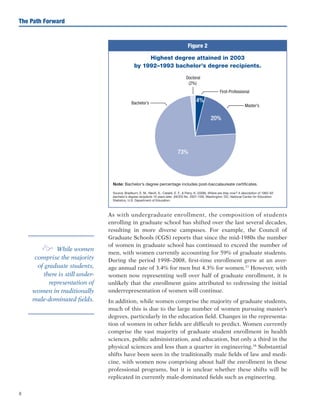
  • 48.
    42 The Path Forward SomeU.S. universities have adopted policies and practices designed to enhance their role in transforming our society. In such cases there is a focus on conducting use-inspired research that has purpose and impact for the local community, the state, or the nation. But this applied focus continues to be balanced in our research universities by equal emphasis on fundamental research, historically the source of countless innovative discoveries. Whether the focus is fundamental or applied, the research training students receive is an essential ingre- dient in ensuring our country’s future prosperity. For this reason the key vulnerabilities in the current graduate education system need to be addressed. Improve completion rates. President Obama’s proposal to increase the number of citizens with col- lege degrees by 2020 has brought an important focus to undergraduate completion rates as well as the need for additional university faculty to teach undergraduate students. Universities and the graduate education community are stepping up to the problem of attrition at the graduate level as well. It could be argued that the single most important step U.S. universities can take at both the undergraduate and graduate levels is to improve student completion rates. At the graduate level, significant work is underway on this issue through the Ph.D. Completion Project centered at CGS. The institu- tions involved in this effort have identified issues associated with attri- tion and completion of doctoral programs and are implementing best practices designed to improve completion rates. Institutions should review and analyze their own completion and attrition patterns and draw from the Ph.D. Completion Project findings to craft interventions to improve completion and decrease attrition. Data from the upcoming National Research Council study of the research doctorate will pro- vide some comparative completion data for benchmarking purposes. Completion and attrition should also be studied at the master’s level, given the growth in the number of students pursuing master’s degrees and the student investment that growth represents. Clarify career pathways for graduate students. An increasing number of graduate degree holders work outside of the academy in business, government, and the nonprofit sector. Graduate schools must embrace this reality and provide appropriate training, mentoring, and information about such career opportunities to help more students understand the career options available to them and select graduate programs that will prepare them for their chosen career goals. e It could be argued that the single most important thing that universities can do at both the undergraduate and graduate levels is to improve completion rates. e Innovative programs aimed at increasing retention of graduate students are promising, but they are few in number and more are needed. Mentoring and attention to social and academic needs of graduate students seem to be key.
  • 49.
    43 Moving Forward: Recommendationsand Actions Many graduate schools are integrating workplace training needs into 21st century graduate education programs. The Professional Science Master’s degree previously described exemplifies a national program that aligns graduate preparation with workforce needs. It is also impor- tant to recognize that today many individuals have sequential careers, rendering the need for training and retraining even more necessary. Prepare future faculty. The aging of the professoriate, combined with the current Administration’s goal for the US to have the highest proportion of college graduates in the world by 2020, has important implications for how future faculty are prepared in our nation’s graduate schools. Efforts to address the preparation of future faculty are underway in many universities, but a renewed national effort to prepare the faculty of the 21st century is needed. CGS with several partners launched a Preparing Future Faculty (PFF) project in 1993 that resulted in a national movement to transform the way aspiring faculty members are prepared for their careers. Today PFF programs provide doctoral students, as well as some master’s and postdoctoral students, with opportunities to observe and experience faculty responsibilities at a variety of academic institutions with vary- ing missions, diverse student bodies, and different expectations for faculty. One of the main goals of PFF programs is to enhance the qual- ity of undergraduate teaching and learning at all types of institutions. During the first decade of the initiative (1993–2003), PFF programs were implemented at more than 45 doctoral degree-granting institu- tions and nearly 300 “partner” institutions in the US, including com- munity colleges, master’s-focused institutions, liberal arts colleges, and institutions primarily serving minority groups. While the foundation support for the funding of PFF has expired, CGS continues to provide administrative support to existing programs and to those wishing to develop new PFF programs or modify existing programs to address new needs such as assessing student learning outcomes and teaching the responsible and ethical conduct of research. Universities should continue to develop and evolve strong PFF programs. Prepare future professionals. Much of the strength of U.S. graduate education has come from pro- viding robust master’s education that often incorporates significant professional development, as well as strong in-depth research training at the doctoral level. However, doctoral education has not typically included a strong professional development component. Countries e It is critical to provide career transparency to students, especially to doctoral students. Understanding available career options is important to building a diverse and strong cadre of graduate students.
  • 50.
    44 The Path Forward aroundthe world have begun to recognize this deficiency in the traditional research doctoral preparation, and some have initiated strong government-supported efforts to fill this gap. The best example is the Vitae program in the UK where, as a result of a study led by Lord Roberts, a program was initiated to “make the UK world class in supporting the personal, professional and career development of researchers.” Responding to clear employer demand, professional development programs concentrate on supporting the acquisition of transferable skills by doctoral students to prepare them better for an array of employment settings outside of the academy. To be competitive globally, U.S. universities should develop profes- sional development programs that: • Encourage the development of creativity and entrepreneurship in conjunction with core disciplinary attributes. • Improve personal effectiveness including self-organization and career development skills. • Develop capacity for project management, understanding of finance, funding and resource management. • Cultivate a highly developed framework of professional and research ethics. • Encourage the development of skills that enhance research impact, including communication, teamwork, relating work to a broader context, and application of research to larger corpo- rate or social purposes. While there is no current U.S. government program similar to the one described in the UK, U.S. graduate schools should make every effort to develop these opportunities for their doctoral students. There are some examples of institutions that are moving in this direction, but professional development of this kind should become part of every doctoral student’s experience. Federal agencies could favor such programs in future grant solicitations, specifying that the programs should not extend time to degree. In particular, attention to these pro- fessional development activities should be included in new doctoral traineeship programs. Establish and expand programs to identify talented undergraduate students. Maintaining pathways to graduate school and into careers implies a linking of K–12, undergraduate, and graduate education. A number of outstanding programs in place identify promising undergraduate stu- dents who have the interest and potential to pursue graduate training. e To be competitive globally, U.S. graduate schools should develop professional development programs that, among others, develop career skills and “soft skills.”
  • 51.
    45 Moving Forward: Recommendationsand Actions One of the most successful is the Meyerhoff Scholars Program at the University of Maryland, Baltimore County. For more than 20 years this program has been a leading source of graduate students from under- represented groups. Another successful effort is the TRIO Ronald E. McNair Post- baccalaureate Achievement Program whose purpose is to increase the attainment of doctoral degrees by individuals who are first-generation, low-income college students, and are traditionally underrepresented in graduate education. The McNair program supports projects in institu- tions of higher education designed to prepare students for doctoral studies through involvement in research and other scholarly activities. The McNair program helps to prepare students for doctoral study but provides no financial aid for these students at the graduate level. Consequently McNair students frequently cite financial constraints as a key reason for not pursuing graduate education. Extending graduate fellowships to McNair students would help overcome this obstacle and safeguard the nation’s investment. Another model program is the Leadership Alliance, a consortium of 33 institutions of higher learning having the goal of developing under- represented students into outstanding leaders and role models. The Leadership Alliance Summer Research Early Identification Program offers undergraduates interested in pursuing a Ph.D. or M.D./Ph.D. 8 to 10 weeks of study under the guidance of a faculty or research mentor at a participating institution. Through this one-on-one collaboration, stu- dents gain fundamental knowledge and practical training in academic research and scientific experimentation. The program is designed to encourage students from groups traditionally underrepresented in the sciences, social sciences, and humanities to consider research careers in the academic, public, or private sectors. State systems of higher education as well as individual universities should develop policies and programs to link K–12, undergraduate, and graduate programs so as to provide educational pathways for stu- dents to enter fields that prepare them to address pressing challenges in energy independence, climate change, healthcare, cyber security, literacy, poverty, and the financial sector. Recommendations for Employers All sectors of our economy are faced with the need to innovate and develop new products and services, many of which are based on tech- nological advancements. In addition, there is a need to replenish an aging workforce. This situation impacts industry, federal and state gov- ernments, schools, universities, small businesses, healthcare providers, e While high school students are bombarded with information from colleges, there is no comparable effort to recruit students into graduate school.
  • 52.
    46 The Path Forward andothers. As stated by Jane Oates, Assistant Secretary, Department of Labor, “There needs to be an organic connection between industry and graduate education.” All employers should consider the following issues to help clarify employment and training needs. Recommendations include: Establish endowed graduate school chairs. A wide range of employers, including for-profit corporations, nonprofits, and state and federal governments, should partner with individual universities to establish a “Graduate School Chair” for a gradu- ate student. Tuition and fees for the graduate student would be covered for up to 5 years for doctoral students and 2 years for master’s students. The sponsoring entity would also provide an internship opportunity for the chosen graduate student. To help the university understand the needs of the employer, a faculty member and/or other employee of the university could be eligible for a 1-month sabbatical to be spent at the internship site. Conversely, the industry representative could spend time in the academic environment to gain an understanding of the coursework and research performed at the university. Promote Lifelong Learning accounts. Employers in all sec- tors should consider creating employer-matched, portable individual accounts for purposes of financing employee educa- tion and training. Such accounts would promote co-investment in education and training. These accounts would be set up much like a 401(k) retirement plan in that both employers and employees would contribute to the account, and the programs would provide a tax benefit for both employees and employers. Provide tuition reimbursement programs for graduate study. All employers should be encouraged to provide tuition reimbursement programs for current employees who seek to further their education and pursue graduate degrees. Replicate established programs that address challenges facing underrepresented groups. Employers across all sectors should partner with universities and governments to develop programs designed to promote the participation of students from underrepresented groups in graduate programs to develop the talent we need to address grand challenges in energy, cli- mate change, healthcare, cyber security, and other areas. The National Consortium for Graduate Degrees for Minorities in Engineering and Science (GEM) provides a possible model for replication. GEM has helped thousands of students overcome one of the most pervasive barriers to pursuing an advanced degree—identifying and securing student funding. e Employers need to clarify employment and training needs. Innovative programs at the graduate level supported by industry are also called for.
  • 53.
    47 Create industry-sponsoredgraduate fellowship programs. Industry funding could be used to establish a parallel, industry- specific program in conjunction with current successful fel- lowship programs, including the NSF GRF program, the U.S. Department of Education GAANN Program, and the Office of Science Graduate Fellowships (SCGF) at the U.S. Department of Energy, among others. This program would enable indus- try funding for fellowship support in the broad disciplines of their interest. The advantages of setting up a parallel program include the ability to define different stipend levels or other flexibilities in a program intended to interface with industry. Industry participation in such programs would require a commitment from a company to support at least one fellowship at a time at award levels that would entail approximately $125,000, to cover the stipend itself plus the associated cost of education for 3 years, not including any administrative fees to the program. Companies that sponsor fellows would be allowed to pool their donations and to provide pooled job-related opportunities for graduate fellows. Companies would hold interviews for avail- able positions, but there would be no commitment to hire on the part of an individual company and no commitment to a particular job. Create special incentives for small businesses to develop talent. Small business owners, and national organizations that represent them, should pursue tax breaks for their firms or their employees to make graduate education more affordable and appealing and to promote the development of talent to fuel the small business enterprise. Thirty-six percent of paid employees work for companies with 99 or fewer employees. Another 15% work at companies that have between 100 and 499 employees, making small businesses an important segment of the employer sector. Collaborate with universities to clarify entry points into careers. All employers should communicate the educational skills needed for 21st century jobs in the global economy. Additionally, they should make this information widely known from high school through graduate school so that students can make informed judgments and plans about their educational pathways in light of career opportunities. Provide internships and work study opportunities for graduate students. All sectors of the U.S. economy should seek ways to provide internships and work study opportunities Moving Forward: Recommendations and Actions e “Internships are important–they are critical. It is a hugely effective way to assess talent and gives students a view from the inside to see if their skills, interests and values are a good fit.” – Richard Parsons, Bank of America
  • 54.
    48 The Path Forward forgraduate students. For example, U.S. multinational corpo- rations are in a position to create internship and work/study opportunities for graduate students to provide cutting-edge training and exposure to working in diverse cultures. Recommendations for Policymakers: The Federal Role The US is now at a strategic point in terms of its ability to sustain leadership in the global economy. A major new investment in graduate education is required, or the country will be at serious risk of decline. The federal government must ensure that graduate education is a viable option for a growing number of U.S. citizens. The increasing diversity of the domestic student population offers opportunities and challenges in terms of producing future knowledge creators and lead- ers. Broadening participation in graduate education and in the U.S. workforce is and should remain a national priority and a key strategy for increasing the number of advanced degree holders. However, the odds that students will remain in graduate school are affected by several factors, including appropriate financial support. Nontraditional students may require new and different infrastructure and financial support if we are to achieve the goal of increasing the number of graduate degree holders. A focus on graduate degree com- pletion is also important within the overall context of accountability in higher education. Many universities are actively engaged in efforts to improve completion rates for graduate students. Their graduate schools are engaged in the development of effective models that sup- port degree completion. Adequate financial support to meet the needs of an increasingly diverse student body is crucial if graduate schools and universities are to make progress on improving completion rates. A major investment in graduate education is needed to maintain U.S. leadership in the 21st century global economy. The key to revitalizing our innovation system is to develop the U.S. domestic talent pool by increasing investments in higher education, particularly graduate education. Federal government support for graduate education should be increased dramatically through the authorization and implementation of two major new initiatives to support doctoral and master’s educa- tion. These are the COMPETES doctoral traineeship program and a proposed program to strengthen U.S. master’s-level education. COMPETES doctoral traineeship program. A new federal program to support doctoral education associated with areas of national need identified by the Administration should be
  • 55.
    49 authorized. The programwould cover direct student support of $30,000 stipends plus tuition and fees, other costs of education, and ancillary fringe costs, for a total of $80,000 per student per year. Students would be eligible for up to 5 years of support. The authorization would be for 6 years to ramp up the program, beginning with $2 billion in FY 2011 to accommodate approximately 25,000 students and building up to $10 billion in FY 2016 to accommodate approximately 125,000 students as the program reaches its steady state. The size is keyed to the level of investment in research and the associated benefits that the nation derives from such an investment, as well as the diminished commit- ment of the states to doctoral education. Funds would be provided in response to proposals submitted by univer- sities for graduate programs to support doctoral students in key areas. Those submitting proposals would be required to provide data, includ- ing enrollments, completion rates, and job placement information to the funding agency as part of the ongoing accountability associated with this funding. This program is needed to develop highly skilled talent and is essential if we are to revitalize the U.S. innovation system and keep the nation competitive in the global economy. The looming retirement of the baby boom generation in a variety of fields from technology-based industry to teaching, also motivates investments in the development of highly skilled human talent. In essence this is preparation for a succession plan for intellectual leadership in government, industry, and the non- profit sector. As one commentator has put it, “The United States is like a company that hasn’t yet recruited enough new talent, let alone trained it, even though its best and brightest managers are packing up their mementos and heading to farewell dinners to collect their gold watches. If this nation were a company, the human resources director would be kicked out onto the street.” The program should be directly tied to a national effort to develop the U.S. domestic talent pool in recognition of the uncertainty surrounding continued participation of international students in U.S. doctoral pro- grams at current levels. International students, who now make up 50% to 80% of doctoral students in the STEM fields, have increasing options for pursuing their doctoral education as other countries and regions of the world heavily invest in the graduate school enterprise. Because there is a need for U.S. graduate schools to continue to attract the best and brightest students from around the world, universities could apply up to 20% of the total fellowship funding to support international stu- dents. Permitting institutions to support some international students while simultaneously building a robust pool of domestic students, with the ultimate goal of redressing the imbalance between international and domestic students in STEM fields, will ensure the influx of top Moving Forward: Recommendations and Actions e A new federal program–the COMPETES doctoral traineeship program– would provide support for up to 5 years.
  • 56.
    50 The Path Forward talentin key fields such as electrical engineering, physics, math, and computer science in the short term. Master’s degree programs for the 21st century. The federal government should authorize a new federal competitive grant program across agencies to build capacity at universities to inspire innovation in master’s degree programs and responsiveness to workforce needs. Each successful program would be required to demonstrate maintenance of enrollment, completion rates, and job placement outcomes, as well as ongoing involvement by employers to ensure that programs produce graduates for local, state, regional, and national workforce needs. Programs will be required to secure at least two thirds of program funding from sources other than the federal government. Universities would propose innovative new master’s programs or rein- vigoration of existing programs, including professional master’s pro- grams. These programs would include strategies to increase access and create an academic pathway for students who are underrepresented in master’s education programs, specifically unrepresented minority stu- dents and those from economically disadvantaged backgrounds. Such programs would be eligible for supplemental grants for need-based aid. When fully implemented this program would support development of 1,000 new or reinvented master’s programs, including professional master’s programs, in key areas at a broad range of 4-year institutions of higher education. Each institution would be eligible for a one-time $500,000 5-year grant. The authorization would be for 200 grants per year, for a total federal investment of $500 million over 5 years. Funding for both the COMPETES and the new master’s programs is designed to develop the human talent necessary to maintain U.S. lead- ership in the global economy. The nation as well as individual states stand to benefit from such an investment. According to NSF, nearly two thirds of recent science and engineering master’s degree recipients and 4 out of 10 of science and engineering doctorate recipients secure initial employment in the state in which they received their degree. Continuing federal government support for existing programs and initiatives is also critical: Federal graduate training/fellowship programs. Current federal training and fellowship programs for graduate students have not kept pace with the increasing cost of graduate educa- tion. In addition to creating programs for doctoral and mas- ter’s education to address challenges in particular key areas, the federal government should increase the cost of education e Innovative master’s programs would be designed to increase access and create an academic pathway for students, especially those from diverse and economically disadvantaged backgrounds.
  • 57.
    51 allowance for existingtraineeships and portable graduate stu- dent fellowships for doctoral students. Federal agencies should adopt a common standard for determining the amount and criteria for allocating this cost of education. Increases should come in established programs including the NSF-IGERT, NSF- GRF, Department of Education Graduate Assistance in Areas of National Need (GAANN), the Jacob K. Javits Fellowship Program, the Department of Defense SMART program, NIH NRSA graduate fellowship and training grant programs, and the newly established Department of Energy Office of Science Graduate Fellowship program. These funds are essential to meeting current real costs and providing the flexibility to address issues that compromise degree completion. Loan forgiveness for graduate students (master’s and doc- toral) in priority fields. A variety of loan forgiveness programs are already in place for graduate students in certain critical fields such as nursing and other areas related to healthcare. The federal government should expand the number of fields in which it permits loan forgiveness to students who complete their graduate degree, in return for a certain period of employ- ment in their chosen fields in the public or nonprofit service sector. Policymakers should consult with graduate education leaders to determine these critical fields. Amend tax policies for graduate fellowships and scholar- ships. Before 1986, all scholarship and fellowship income used to cover the cost of attendance at postsecondary institutions was tax exempt. In 1986 the federal tax code (Title 26, Section 117) was amended to provide a very narrow definition of quali- fied scholarship or fellowship income, effectively disqualifying most scholarships and fellowship money from exemption. The tax code should be amended again to language similar to the pre-1986 version to include: “Non-taxable graduate education scholarships and fellowships are an amount paid or allowed to, or for the benefit of, a student at an educational institution in a graduate degree-seeking program. This includes scholar- ships, fellowships, and grants at the institution. A graduate degree is defined as a post baccalaureate, masters, doctorate, or professional degree. The maximum non-taxable amount will be limited to the projected cost of attendance reported annually by the student’s institutions.” Align federal and state research and graduate education grant programs. State support for higher education nationwide has been in decline in real terms for decades, but this decline Moving Forward: Recommendations and Actions e Loan forgiveness programs should be extended to include other critical fields and the non-profit service sector.
  • 58.
    52 The Path Forward hasrecently accelerated to crisis proportions. The federal government should encourage and adopt policies, practices, and strategies designed to achieve increased alignment and coordination of federal grant programs that support graduate education and state programs that have the same or similar goals. State grant programs that support graduate education could be better aligned with some of the federal programs at NSF, the U.S. Department of Education, and elsewhere. Better alignment of university and state grant proposals with federal programs would allow the universities and states to leverage dollars proposed as part of the cost share in various proposals. One goal would be the development of innovative and highly competitive proposals that would not require new funds. Federal agencies should encourage alignment of state programs with federal ones as part of their grant solicitation processes. International students and international collaborative programs. International students are a vital component of U.S. graduate education and the nation’s highly skilled workforce, particularly in STEM fields. Today international students have more choices about where to pursue their graduate degrees. The US must adopt policies that welcome those international students who desire to pursue graduate education as well as future employment in our country. International collaborative programs are also important for ensuring that U.S. domestic students are prepared to thrive in the global research enterprise and global workforce. The federal government should: • Continue to improve the visa process to make the pathway for international students and scholars in high-priority fields more efficient, allowing them to contribute to U.S. innovation and global competitiveness. • As part of any future immigration reform, create a new visa category for international students who receive a doctorate in a STEM field from a U.S. institution of higher education that establishes a clear pathway to permanent residency for those who desire to remain in the US and contribute to our economy. • Encourage federal funding agencies to support collaborative graduate degree programs with universities abroad—espe- cially in strategically critical countries—in an effort to develop sustainable pathways to ensure that an ongoing supply of the world’s most talented students flows into U.S. graduate schools and that there are strong educational opportunities for U.S. e Improvements in the visa process will help ensure that international students in critical fields stay and work in the US.
  • 59.
    53 graduate students abroad.Graduate degree holders trained in the US who return to their home countries often achieve leadership positions and have a positive orientation toward collaborating with the US on a variety of fronts. • Encourage and support more U.S. graduate students to engage in international experiences, such as the Fulbright or study abroad programs. Implement a Fund for the Improvement of Postsecondary Education (FIPSE) competition to promote the application of graduate student talents. The U.S. Department of Education should undertake a FIPSE competi- tion that would allow graduate students to apply their talents to issues of national importance at the local, state, national, and international levels. Universities would be encouraged to assemble interdisciplinary teams to identify and address pressing issues or problems and would provide a national presentation of the results of their work. Federal support for recommended studies. There is a need for the systematic gathering of data to help address the challenges facing U.S. graduate education. Federal government support of studies aimed at understanding and elaborating possible solutions is essential to helping successfully meet this need. These studies include: Understanding aspirations and creating career pathways for students. The federal government should undertake a study to understand what motivates or deters students from pursuing studies at the graduate level in critical fields such as STEM dis- ciplines and others that align with careers in areas of national priority such as energy, healthcare, climate, and expertise in understanding other cultures and regions of the world. There is a pressing need to better understand what factors influ- ence junior high, high school, and college students’ career aspirations and to provide information as well as incentives to students about careers and education pathways that lead to a desired career. There is some evidence to suggest that factors other than student preparation may be in play, such as market forces, incentives, or other drivers. Careers in the 21st century and the pathways that lead to them. President Obama has said the “nation that out educates us will out compete us.” In order to maintain the U.S. leadership posi- tion in producing an educated citizenry, the U.S. Departments of Moving Forward: Recommendations and Actions
  • 60.
    54 The Path Forward Educationand Labor should collaborate on a study to examine the country’s future workforce needs in critical areas including education (K–12 and postsecondary teaching), energy, health- care, financial services, emerging biomedical areas, and others. These results should inform a national strategy to communicate to students, families, and the general public information about educational pathways, including graduate education, that lead to careers vital to our national needs. Humanities in the 21st century economy: The role of gradu- ate education. The National Endowment for the Humanities should undertake a study of the role of humanities in the 21st century economy. Such a study should investigate the role of graduate education in preparing future scholars and leaders. Much of the policy on enhancing innovation and competitive- ness has focused on STEM fields, but awareness of the role of the humanities in our national culture is increasing, including its impact on ethics and values, vitality, and competitiveness. Humanists help us acquire other languages, understand other cultures, and learn from the past. The role of graduate educa- tion in preparing future scholars and leaders in the humanities should be explored as part of the larger focus on national needs in areas such as language and culture. H H H H H
  • 61.
    55 “Our progress asa nation can be no swifter than our progress in educa- tion. The human mind is our fundamental resource.” John F. Kennedy (35th President of the United States) The U.S. graduate education system has served our nation well. But it faces considerable internal challenges. Many students who have the ability to obtain a graduate degree never enroll in a graduate pro- gram, and many who do enroll leave without a degree. The system also faces a number of external challenges. Demographic changes in the US and internationally may affect the pool of potential applicants, and efforts to increase access to graduate education in other countries may limit the number and quality of international students seeking educa- tion in the US. Such challenges present real threats to the dominant position of the US in graduate education and the knowledge economy, and now is the time to seek the path forward in this country. Graduate education not only produces students with advanced knowl- edge and skills, it produces critical thinkers and innovators. Such individuals will be crucial to ensure our nation’s continuing ability to compete in the global economy, foster international understanding, and solve many of the greatest challenges that face our nation and the world. This report has outlined a number of issues that need to be further explored and efforts that need to be redoubled. Students need to understand the economic and social value of pursuing college and graduate degrees. Increasing high school graduation rates must remain a national priority. And it is essential to continue efforts aimed at increasing student enrollment in and completion of undergraduate education, especially among minority groups. Enrollment rates at the undergraduate and graduate level continue to increase. While this increase is evident across all groups of students, it has not kept pace with growth rates in the general population. A num- ber of innovative graduate school programs aimed at attracting the most talented undergraduates are in progress. While these programs represent a strong beginning, more can be done. Further, it is important that we not limit our efforts to increasing enrollment alone. Too many students who enroll in graduate education fail to receive a degree. The doctoral degree, for example, represents the highest level of academic preparation in the graduate education In Summary: The Path Forward
  • 62.
    56 The Path Forward system,and yet the rates at which students leave doctoral study remain a national problem. The number of doctorates awarded in the US would be greatly increased simply by ensuring that the majority of students who enter a doctoral program complete it. Addressing this issue as a nation is not a matter of lowering academic standards, but of recognizing the changing nature of the “traditional” graduate student. Many graduate students must balance work, family, and educational responsibilities simultaneously. A number of exemplary programs at the graduate level have embraced this new graduate student through changes in the student–advisor relationship, faculty mentoring, and other social and academic requirements. More programs like these are needed. The reasons students leave graduate school before completing their degrees are varied, but it is clear that adequate financial support is criti- cal if we are to increase the number of successful graduates. A renewed commitment to existing programs that already provide financial sup- port to graduate students is needed at the federal level. But while this commitment is needed, it is not enough—novel programs that provide the financial support essential for graduate students to succeed must also be developed. A few possibilities for such novel programs have been suggested in this report. Representation by international students in U.S. graduate education, especially at the doctoral level, is strong. But the numbers of inter- national students enrolled in U.S. graduate institutions continues to decline as opportunities for quality education in their home countries increase. The US must commit to keeping its doors open for interna- tional talent. Between 2008 and 2018 it is expected that more new professional jobs—about 2.5 million—will require some level of graduate degree. The largest occupational growth areas for master’s degree holders will be in healthcare and education. For doctoral degree holders, occupa- tional growth areas will be in service industries in the professional, scientific, and technical arenas. While master’s programs are frequently attuned to the needs of the workplace, this is not necessarily true at the doctoral level. For many doctoral students clear career entry points are lacking, and it is critical to provide career transparency to these students. Professional development programs at the university that provide doctoral students with transferable skills valued by employers outside of the academy need to be considered. Innovative graduate programs offering internships and financial support from industry also are called for.
  • 63.
    57 Changes at theuniversity, industry, and government levels are essential. But most of all, an understanding of the role of graduate education in today’s world and in the future is required. Finding solutions for the challenges that face our nation, ensuring continued future prosper- ity, and maintaining our position in the global economy will require a highly skilled, creative, and innovative workforce. These creative innovators will be the product of the U.S. graduate education system. H H H H H In Summary: The Path Forward
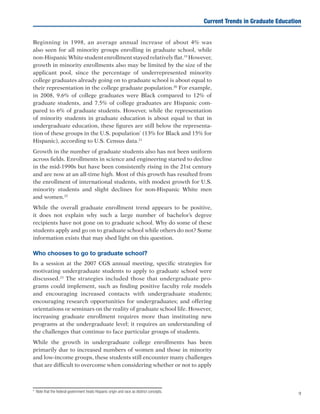
  • 64.
  • 65.
    59 References 1 Snyder, T. D.,Dillow, S. A., Hoffman, C. M. (2009). Digest of education statistics: 2008 (NCES No. 2009-20). Washington, DC: National Center for Education Statistics, U.S. Department of Education. 2 Council of Graduate Schools. (2009). Graduate education in 2020: What does the future hold? Washington, DC: Author. 3 Shanghai Ranking Consultancy. (2009). Academic rankings of world universities. Shanghai, China: Shanghai Jiao Tong University. Retrieved from http://www.arwu.org/ 4 National Science Board. (2008). Science and engineering indicators 2008 (NSB No. 04-01). Arlington, VA: National Science Foundation. Retrieved from http://www.nsf.gov/statistics/seind08/ 5 Knowledge economy. In BusinessDictionary.com. Retrieved from http://www.businessdictionary.com/definition/ knowledge-economy.html 6 Baldassare, M., Bonner, D., Paluch, J., Petek, S. (2009). PPIC statewide survey: Californians and higher education. San Francisco, CA: Public Policy Institute of California. 7 Davis, W. J., Bauman, K. J. (2008). School enrollment in the United States: 2006. Washington, DC: U.S. Census Bureau. Retrieved from http://www.census.gov/prod/2008pubs/p20-559.pdf 8 Ibid. 9 Ibid. 10 Barton, P. E. (2009). Chasing the high school graduation rate: Getting the data we need and using it right (Policy Information Perspective Report No. PIC-CHASING). Princeton, NJ: Educational Testing Service. 11 Organisation for Economic Co-operation and Development. (2008). Education at a glance 2008: OECD indicators. Paris, France: Author. Retrieved from http://www.oecd.org/edu/eag2008 12 Adelman, C., Daniel, B., Berkovits, I., Owings, J. (2003). Postsecondary attainment, attendance, curriculum, and performance: Selected results from the NELS:88/2000 Postsecondary Education Transcript Study (PETS), 2000. (NCES No. 2003-394). Washington, DC: National Center for Education Statistics, U.S. Department of Education. 13 Bowen, W. G., Chingos, M. M., McPherson, M. S. (2009). Crossing the finish line. Princeton, NJ: Princeton University Press. 14 Ibid. 15 Kirsch, I., Braun, H., Yamamoto, K., Sum, A. (2007). America’s perfect storm: Three forces changing our nation’s future (Policy Information Perspective Report No. PIC-STORM). Princeton, NJ: Educational Testing Service. 16 Bradburn, E. M., Nevill, S., Cataldi, E. F., Perry, K. (2006). Where are they now? A description of 1992–93 bachelor’s degree recipients 10 years later. (NCES No. 2007-159). Washington, DC: National Center for Education Statistics, U.S. Department of Education. 17 Bell, N. E. (2009). Graduate enrollment and degrees: 1998 to 2008. Washington, DC: Council of Graduate Schools. 18 National Science Board. 19 Bell. 20 Snyder et al. 21 U.S. Census Bureau. (2008). 2006-2008 American Community Survey 3-year estimates. Washington, DC: Author. Retrieved from http://factfinder.census.gov/home/saff/main.html?_lang=en 22 National Science Board. 23 Kinney, D., Munro, J. H. (2007, December). Strategies for motivating undergraduates to attend graduate school. Presented at the annual meeting of the Council of Graduate Schools. Seattle, WA.
  • 66.
    60 The Path Forward 24 Sax,L. J. (2008). The gender gap in college: Maximizing the developmental potential of women and men. San Francisco, CA: Jossey-Bass. 25 Building Engineering and Science Talent. (2004). The talent imperative: Diversifying America’s science and engineering workforce. San Diego, CA: Author. 26 Council of Graduate Schools. (2008). Data sources: Aspirations to graduate school. CGS Communicator, 41(4), 4-5. 27 McCormick, A. C., Nunez, A., Shah, V., Choy, S. P. (1999). Life after college: A descriptive summary of 1992-93 bachelor’s degree recipients in 1997. (NCES Publication No. 1999-555). Washington, DC: National Center for Education Statistics. 28 U.S. Census Bureau. U.S. Interim Projections by Age, Sex, Race, and Hispanic Origin: 2000-2050 Washington, DC: Author. Retrieved from http://www.census.gov/population/www/projections/usinterimproj/ 29 Kirsch et al. 30 Council of Graduate Schools. (2007). Data sources: The rise of “older” graduate students. CGS Communicator, 40(10), 3-4. 31 Ibid. 32 Council of Graduate Schools. (2007). Data sources: Who is enrolling in doctoral programs? The changing characteristics of doctoral students, 1996 to 2004. CGS Communicator, 40(1), 3-5. 33 Nevill, S. C., Chen, X. (2007). The path through graduate school: A longitudinal examination 10 years after bachelor’s degree. (NCES No. 2007-162). Washington, DC: National Center for Education Statistics, U.S. Department of Education. 34 University Continuing Education Association. (2009). Lifelong learning trends: The new face of higher education. Washington, DC: The University Continuing Education Association. 35 Stoecker, J. L. (1991). Factors influencing the decision to return to graduate school for professional students. Research in Higher Education, 32(6), 689-701. 36 International Foundation of Employee Benefit Plans. (2007). Education assistance plans 2006. Brookfield, WI: Author. 37 Bailey, R. (2001, December). Post-scarcity prophet: Paul Romer on growth, technological change, and an unlimited human future. Reason Online. Retrieved from http://www.reason.com/news/show/28243.html 38 Romer, P. (2000). Should the government subsidize supply or demand in the market for scientists and engineers? (NBER Working Paper No. 7723). Cambridge, MA: National Bureau of Economic Research. 39 U.S. Bureau of Labor Statistics. (2009). Employment projections: 2008-2018 summary. Washington, DC: U.S. Department of Labor. Retrieved from http://www.bls.gov/ 40 Council of Graduate Schools. Graduate education in 2020: What does the future hold? 41 Snyder et al. 42 National Science Board. 43 American Council on Education. (2008). Minorities in higher education 2008 twenty-third status report. Washington, DC: Author. 44 Ibid. 45 Snyder et al. 46 U.S. Census Bureau. (1970-2007). Statistical abstract of the United States: 1970 to 2007. (91st to 126th editions). Washington, DC: Author. 47 Council of Graduate Schools. (2009). Data sources: Graduate degree attainment of the U.S. population. CGS Communicator, 42(6), 6-7. 48 Council of Graduate Schools. (2009). Ph.D. completion and attrition: Findings from exit surveys of Ph.D. completers. Washington, DC: Author.
  • 67.
    61 49 Nevill Chen. 50 Ibid. 51 Webber,D., Ehrenberg, R. G. (2009). Do expenditures other than instructional expenditures affect graduation and persistence rates in American higher education? (NBER Working Paper No. 15216). Cambridge, MA: National Bureau of Economic Research. 52 National Research Council. (2000). Forecasting demand and supply of doctoral scientists and engineers: Report of a workshop on methodology. Washington, DC: National Academy Press. 53 Katz, L. F., Murphy, K. M. (1992). Changes in relative wages, 1963-1987: Supply and demand factors. The Quarterly Journal of Economics, 107(1), 35-78. 54 Juhn, C. (1992). Decline of male labor market participation: The role of declining market opportunities. The Quarterly Journal of Economics, 107(1), 79-121. 55 Pencavel, J. (1991). Higher education, productivity and earnings: A review. Journal of Economic Education, 22(4), 331-359. 56 U.S. Bureau of Labor Statistics. Employment projections: 2008-2018 summary. 57 Council of Graduate Schools. Graduate education in 2020: What does the future hold? 58 U.S. Bureau of Labor Statistics. Employment projections: 2008-2018 summary. 59 University of California. (1999). Educating the next generation of Californians in a research university context: University of California graduate and undergraduate enrollment planning through 2010. Oakland, CA: Planning and Analysis, Academic Affairs, Office of the President. 60 National Science Foundation. (2006). Survey of doctorate recipients. Arlington, VA: Author. Retrieved from http://www.nsf.gov/statistics/srvydoctoratework/ 61 Council of Graduate Schools. (2009). Why should I get a master’s degree? Washington, DC: Author. 62 U.S. Bureau of Labor Statistics. (2009). Occupational employment statistics. Washington, DC: U.S. Department of Labor. 63 Council of Graduate Schools. Why should I get a master’s degree? 64 Glazer-Raymo, J. (2005). Professionalizing graduate education: The master’s degree in the marketplace. (ASHE Higher Education Report Vol. 31, No. 4). San Francisco, CA: Jossey-Bass. 65 U.S. Bureau of Labor Statistics. (2009). National employment matrix: 2008-18. Washington, DC: U.S. Department of Labor. 66 Woods, R. A., Figueroa, E. B. (2007). Industry output and employment projections to 2016. Monthly Labor Review, 130(11). 67 U.S. Bureau of Labor Statistics. (2009). National employment matrix: 2008-18. Washington, DC: U.S. Department of Labor. 68 Ibid. 69 National Science Foundation. 70 Organisation for Economic Co-operation and Development. 71 Marginson, S., Wende van der, M. (2007). Globalisation and higher education. Paris, France: Organisation for Economic Co-operation and Development. 72 National Science Foundation. 73 Welch, V., Jr. (2008). Doctorate recipients from United States universities: Selected tables 2007. Chicago: National Opinion Research Center. 74 Marginson et al. 75 Ibid. 76 The European Higher Education Area. (1999). The Bologna Declaration. Bologna, Italy: Author.
  • 68.
    62 The Path Forward 77 Ibid. 78 Douglass,J. A., Edelstein, R. (2009). The global competition for talent: The rapidly changing market for international students and the need for a strategic approach in the US (Research Occasional Paper Series No. CSHE.8.09). Berkeley, CA: Center for Studies in Higher Education, University of California, Berkeley. 79 Ibid. 80 The Gallup Organization. (2009). Students and higher education reform (Flash 81 Eurobarometer Series No. 260). Brussels, Belgium: European Commission. Retrieved from http://ec.europa.eu/public_opinion/flash/ fl_260_en.pdf 81 Middleton, D. (2009, September 16). The top M.B.A. programs if you’re in a hurry. Wall Street Journal. Retrieved from http://online.wsj.com/article/SB10001424052970204251404574344594232539808.html 82 Global MBA rankings. (2010). London, UK: The Financial Times Ltd. Retrieved from http://rankings.ft.com/ exportranking/global-mba-rankings/pdf 83 Shanghai Ranking Consultancy. (2009). Academic rankings of world universities. Shanghai, China: Shanghai Jiao Tong University. Retrieved from http://www.arwu.org/ 84 Usher, A. (2009, May). Ten years back and ten years forward: Developments and trends in higher education in Europe region. Presented at UNESCO Forum on Higher Education in the Europe Region, Bucharest, Romania. 85 Ibid. 86 Bowen et al. 87 UNESCO Institute for Statistics. (2009). Global education digest 2009. Montreal, Quebec: Author. 88 National Science Board. 89 Bowen et al. 90 National Science Foundation. 91 Hsiung, D. (2007). China’s evolving science and technology system. Arlington, VA: National Science Foundation. 92 Redd, K. (2007). Graduate enrollment and degrees: 1996 to 2006. Washington, DC: Council of Graduate Schools. 93 Bureau of Consular Affairs. (2006). Report of the visa office 2006. Washington, DC: U.S. Department of State. Retrieved from http://travel.state.gov/visa/frvi/statistics/statistics_3163.html 94 National Science Foundation. 95 Ibid. 96 Finn, M. G. (2007). Stay rates of foreign doctorate recipients from US universities, 2005. Oak Ridge, TN: Oak Ridge Institute for Science and Education. 97 Nettles, M. T., Millett, C. M. (2006). Three magic letters: Getting to Ph.D. Baltimore, MD: Johns Hopkins University Press. 98 Smallwood, S. (2004, January 16). Doctor dropout. The Chronicle of Higher Education, pp. A10-A12. Retrieved from http://chronicle.com/article/Doctor-Dropout/33786/ 99 Lovitts, B. E. (2001). Leaving the ivory tower: The causes and consequences of departure from doctoral study. Lanham, MD: Rowman Littlefield Publishers, Inc. 100 Nerad, M., Cerny, J. (1991, May). From facts to action: Expanding the educational role of the graduate division. CGS Communicator, Special Edition. 101 Nettles Millett. 102 Smallwood. 103 Council of Graduate Schools. (2008). Ph.D. completion and attrition: Analysis of baseline program data from the Ph.D. Completion Project. Washington, DC: Author. 104 Ehrenberg, R. G., Zuckerman, H., Groen, J. A., Brucker, S. M. (2010). Educating scholars: Doctoral education in the humanities. Princeton, NJ: Princeton University Press.
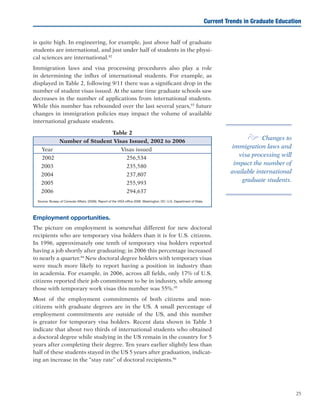
  • 69.
    63 105 Teitelbaum, M. (2003,Fall). Do we need more scientists? National Affairs, 153, 40-53. 106 Roberts, L. (2009, July 10). Hot academic jobs of the future: Try these fields. The Chronicle of Higher Education, pp. B22-B23. Retrieved from http://chronicle.com/article/Hot-Academic-Jobs-of-the-Fu/47008/ 107 Kajitani, M.P. Bryant, R. A. (2005, March 24). A Ph.D. and a failure. The Chronicle of Higher Education. Retrieved from http://chronicle.com/article/A-PhDa-Failure/44884/ 108 Vick, J.M. Furlong, J.S. (2005, October 7). Career Counseling for Ph.D.’s. The Chronicle of Higher Education. Retrieved from http://chronicle.com/article/Career-Counseling-for-PhDs/44938/ 109 Jaschik, S. (2009, April 15). Matches and mismatches in producing Ph.D.’s. Inside Higher Ed. Retrieved from http://www.insidehighered.com/news/2009/04/15/grad 110 Galama, T., Hosek, J. (2008). U.S. Competitiveness in science and technology. Santa Monica, CA: RAND Corporation. 111 Fox, M. A. (2003). Government-university-industry research roundtable. Pan-Organizational summit on the U.S. science and engineering workforce: Meeting summary. Washington, DC: The National Academies Press. 112 Teitelbaum. 113 U.S. Bureau of Labor Statistics. Employment projections: 2008-2018 summary. 114 Carnevale, A. (2008 January/February). College for all? Change, 40(1), 23-29. 115 AFT Higher Education. (2009). American academic: The state of the higher education workforce 1997-2007. Washington, DC: American Federation of Teachers. 116 U.S. Bureau of Labor Statistics. Employment projections: 2008-2018 summary. 117 AFT Higher Education. 118 Ibid. 119 Spalter-Roth, R., Jacobs, J., Scelza, J. (2009). Down market? Findings from the 2008 ASA job bank survey. Washington, DC: American Sociological Association. 120 June, A. W. (2010, January 4). Job outlook for historians grow poorer. Chronicle of Higher Education. Retrieved from http://chronicle.com/article/Job-Outlook-for-Historians-/63380/ 121 Hart Research Associates. (2010). Raising the bar: Employers’ views on college learning in the wake of the economic downturn. Washington, DC: Author. 122 Benenson Strategy Group. (2009). The American workforce survey (Springboard Project). Washington, DC: Business Roundtable. 123 Casner-Lotto, J., Barrington, L. (2006). Are they really ready to work? USA: The Conference Board, Partnership for 21st Century Skills, Corporate Voices for Working Families The Society for Human Resources Management. 124 Ibid. 125 Council of Graduate Schools. Graduate education in 2020: What does the future hold? 126 Ibid. 127 Uhalde, R., Strohl, J., Simkins, Z. (2006). America in the global economy: A background paper for the New Commission on the Skills of the American Workforce. Washington, DC: National Center on Education and the Economy. 128 University of California. (1999). Educating the next generation of Californians in a research university context: University of California graduate and undergraduate enrollment planning through 2010. Oakland, CA: Planning and Analysis, Academic Affairs, Office of the President. 129 U.S. Bureau of Labor Statistics. Employment projections: 2008-2018 summary. 130 The College Board. (2007). Trends in student aid. New York, NY: Author. 131 Ibid.
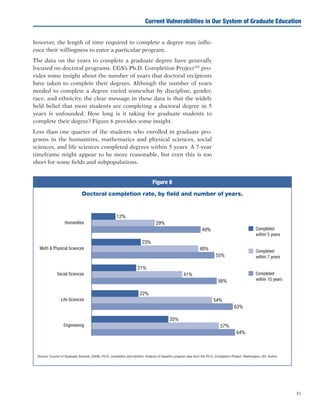
  • 70.
    64 The Path Forward 132 Councilof Graduate Schools. (2009). Data sources: Results from the 2009 CGS Pressing Issues Survey. CGS Communicator, 42(4), 4-5. 133 Council of Graduate Schools. (2009). Ph.D. completion project: Findings from the exit surveys of Ph.D. completers. CGS Communicator, 42(4), 1-3, 7. 134 Wei, C. C., Berkner, L., He, S., Lew, S., Cominole, M., Siegel, P. (2009). 2007-08 National postsecondary student aid study (NPSAS:08): Student financial aid estimates for 2007-08. (NCES No. 2009-166). Washington DC: National Center for Education Statistics, U.S. Department of Education. 135 Webber, D., Ehrenberg, R. G. (2009). Do expenditures other than instructional expenditures affect graduation and persistence rates in American higher education? Cambridge, MA: National Bureau of Economic Research. 136 Council of Graduate Schools. (2009). Data sources: How graduate students finance their education. CGS Communicator, 42(5), 5-6, 8. 137 Organisation for Economic Co-operation and Development. 138 Courant, P. N., Duderstadt, J. J., Goldenberg, E. N. (2010, January 3). Needed: A national strategy to preserve public research universities. The Chronicle of Higher Education, p. A36. Retrieved from http://chronicle.com/ article/A-Plan-to-Save-Americas-Pu/63358/ 139 Reed, C. B., Alexander, F. K. (2009, March 30). We need a new kind of institutional aid. Inside Higher Ed. Retrieved from http://www.insidehighered.com/views/2009/03/30/reed 140 Stewart, D. W. (2010, January/February). “Important, if true”: Graduate education will drive America’s future prosperity. Change. 42(1), 36-44. 141 Kao, J. (2007). Innovation nation. New York, NY: Free Press.
  • 71.
    The Commission onthe Future of Graduate Education in the United States is a joint effort of the Council of Graduate Schools (CGS) and Educational Testing Service (ETS). It was charged with overseeing a research effort to examine the political, demographic, socioeconomic, educational, and financial trends that impact participation in graduate education. The assumption underlying this work was that the global competitiveness of the United States and capacity for innovation hinges fundamentally on a strong system of graduate education. The 18-member Commission includes university presidents, graduatedeans,provosts,industryleaders,and higher education scholars. The Commission guided the development of a report outlining the research findings and recommendations to universities, industry, and policymakers, and will seek to create a national conversation on how to increase graduate degree attainment by all segments of the country’s population. www.fgereport.org Copyright © 2010 by Educational Testing Service. All rights reserved. ETS and the ETS logo are registered trademarks of Educational Testing Service (ETS). 26180 Copyright © 2010 Council of Graduate Schools and/or its suppliers. All rights reserved.