Paper highlights
• Yetanother distributed file system using
object storage devices
• Designed for scalability
• Main contributions
1. Uses hashing to achieve distributed dynamic
metadata management
2. Pseudo-random data distribution function
replaces object lists
3.
System objectives
• Excellentperformance and reliability
• Unparallel scalability thanks to
– Distribution of metadata workload inside
metadata cluster
– Use of object storage devices (OSDs)
• Designed for very large systems
– Petabyte scale (106
gigabytes)
4.
Characteristics of verylarge systems
• Built incrementally
• Node failures are the norm
• Quality and character of workload changes over
time
5.
SYSTEM OVERVIEW
• Systemarchitecture
• Key ideas
• Decoupling data and metadata
• Metadata management
• Autonomic distributed object storage
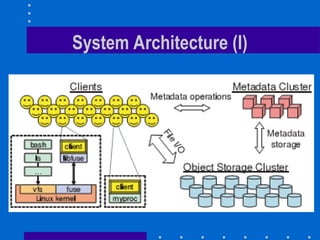
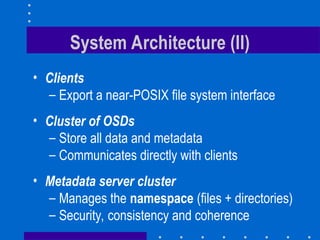
System Architecture (II)
•Clients
– Export a near-POSIX file system interface
• Cluster of OSDs
– Store all data and metadata
– Communicates directly with clients
• Metadata server cluster
– Manages the namespace (files + directories)
– Security, consistency and coherence
8.
Key ideas
• Separatedata and metadata management tasks
- Metadata cluster does not have object lists
• Dynamic partitioning of metadata data tasks
inside metadata cluster
– Avoids hot spots
• Let OSDs handle file migration and replication
tasks
9.
Decoupling data andmetadata
• Metadata cluster handles metadata operations
• Clients interact directly with OSD for all file I/O
• Low-level bloc allocation is delegated to OSDs
• Other OSD still require metadata cluster to hold
object lists
– Ceph uses a special pseudo-random data
distribution function (CRUSH)
10.
Metadata management
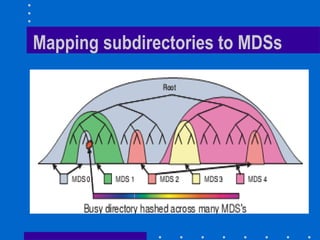
• DynamicSubtree Partitioning
– Lets Ceph dynamically share metadata
workload among tens or hundreds of metadata
servers (MDSs)
– Sharing is dynamic and based on current access
patterns
• Results in near-linear performance scaling in the
number of MDSs
11.
Autonomic distributed objectstorage
• Distributed storage handles data migration and
data replication tasks
• Leverages the computational resources of OSDs
• Achieves reliable highly-available scalable object
storage
• Reliable implies no data losses
• Highly available implies being accessible
almost all the time
Performing an I/O
•When client opens a file
– Sends a request to the MDS cluster
– Receives an i-node number, information about file
size and striping strategy and a capability
• Capability specifies authorized operations on file
(not yet encrypted )
– Client uses CRUSH to locate object replica
– Client releases capability at close time
14.
Client synchronization (I)
•POSIX requires
– One-copy serializability
– Atomicity of writes
• When MDS detects conflicting accesses by
different clients to the same file
– Revokes all caching and buffering permissions
– Requires synchronous I/O to that file
15.
Client synchronization (II)
•Synchronization handled by OSDs
– Locks can be used for writes spanning object
boundaries
• Synchronous I/O operations have huge latencies
• Many scientific workloads do significant amount
of read-write sharing
– POSIX extension lets applications
synchronize their concurrent accesses to a file
16.
Namespace operations
• Managedby the MDSs
– Read and update operations are all synchronously
applied to the metadata
• Optimized for common case
– readdir returns contents of whole directory (as
NFS readdirplus does)
• Guarantees serializability of all operations
– Can be relaxed by application
17.
THE MDS CLUSTER
•Storing metadata
• Dynamic subtree partitioning
• Mapping subdirectories to MDSs
18.
Storing metadata
• Mostrequests likely to be satisfied from MDS in-
memory cache
• Each MDS lodges its update operations in lazily-
flushed journal
– Facilitates recovery
• Directories
– Include i-nodes
– Stored on a OSD cluster
19.
Dynamic subtree partitioning
•Ceph uses primary copy approach to cached
metadata management
• Ceph adaptively distributes cached metadata
across MDS nodes
– Each MDS measures popularity of data
within a directory
– Ceph migrates and/or replicates hot spots
DISTRIBUTED OBJECT STORAGE
•Data distribution with CRUSH
• Replication
• Data safety
• Recovery and cluster updates
• EBOFS
22.
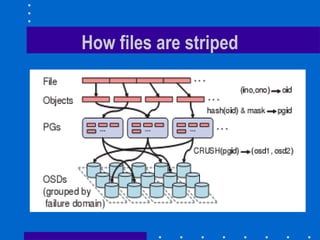
Data distribution withCRUSH (I)
• Wanted to avoid storing object addresses in
MDS cluster
• Ceph firsts maps objects into placement groups
(PG) using a hash function
• Placement groups are then assigned to OSDs
using a pseudo-random function (CRUSH)
– Clients know that function
23.
Data distribution withCRUSH (II)
• To access an object, client needs to know
– Its placement group
– The OSD cluster map
– The object placement rules used by CRUSH
• Replication level
• Placement constraints
Replication
• Ceph’s ReliableAutonomic Data Object Store
autonomously manages object replication
• First non-failed OSD in object’s replication list
acts as a primary copy
– Applies each update locally
– Increments object’s version number
– Propagates the update
26.
Data safety
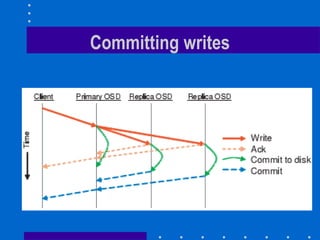
• Achievedby update process
1. Primary forwards updates to other replicas
2. Sends ACK to client once all replicas have
received the update
• Slower but safer
3. Replicas send final commit once they have
committed update to disk
Recovery and clusterupdates
• RADOS monitors OSDs to detect failures
• Recovery handled by same mechanism as
deployment of new storage
– Entirely driven by individual OSDs
29.
EBOFS
• Most DFSuse an existing local file system to
manage level-storage
• Each Ceph OSD manages its local object storage
with EBOFS (Extent and B-tree based Object File
System
– B-Tree service locates objects on disk
– Block allocation is conducted in term of extents
to keep metadata compact
30.
PERFORMANCE AND SCALABILITY
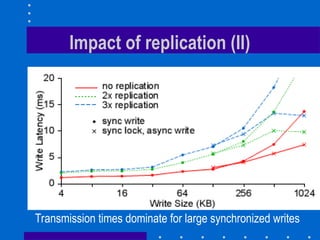
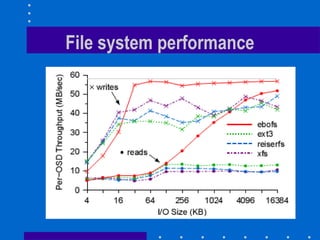
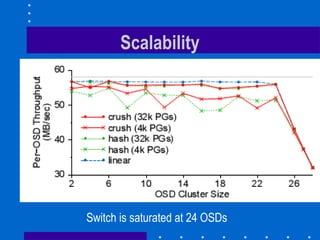
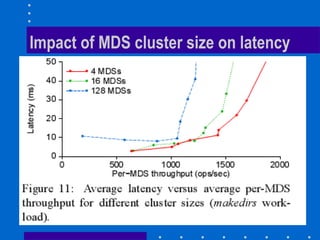
•Want to measure
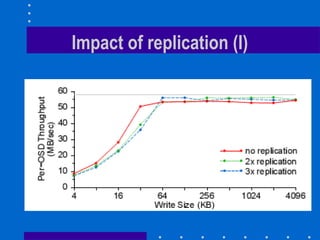
– Cost of updating replicated data
• Throughput and latency
– Overall system performance
– Scalability
– Impact of MDS cluster size on latency
Conclusion
• Ceph addressesthree critical challenges of
modern DFS
– Scalability
– Performance
– Reliability
• Achieved though reducing the workload of MDS
– CRUSH
– Autonomous repairs of OSD