

Community Group Discussion
Part II
 The gospel is not everything.
 The gospel is not everything;

“meaning it must be distinguished as an
announcement of news, distinct from its results and
implications”
 The gospel is not everything;

“meaning it must be distinguished as an
announcement of news, distinct from its results and
implications”
 The gospel is not a simple thing.
 The gospel is not everything;

“meaning it must be distinguished as an
announcement of news, distinct from its results and
implications”
 The gospel is not a simple thing.
“meaning it cannot be packaged in a single standard
form.”
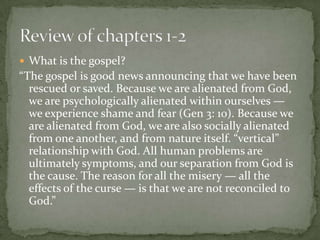
 What is the gospel?

“The gospel is good news announcing that we have been
rescued or saved. Because we are alienated from God,
we are psychologically alienated within ourselves —
we experience shame and fear (Gen 3: 10). Because we
are alienated from God, we are also socially alienated
from one another, and from nature itself. “vertical”
relationship with God. All human problems are
ultimately symptoms, and our separation from God is
the cause. The reason for all the misery — all the
effects of the curse — is that we are not reconciled to
God.”
 Keller writes, “The primary cause of all of our

alienations [is] our separation from God.”
 Keller writes, “The primary cause of all of our

alienations [is] our separation from God.”
 discouragement and depression
 love and relationships
 sexuality
 family and parental expectations
 self-control
 your motive for witness
 obedience to human authority
 guilt and self-image
 joy and humor
 Keller writes, “The primary cause of all of our

alienations [is] our separation from God.”
How has the gospel mended this primary ailment in
you and how has it helped curb the many other
symptoms that flow from it? How does this experience
prepare you to minister to alienated people?
 What is revival?
 What is revival?

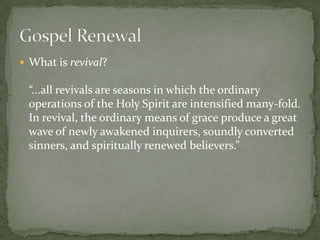
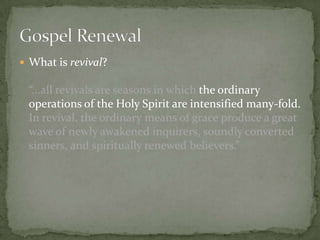
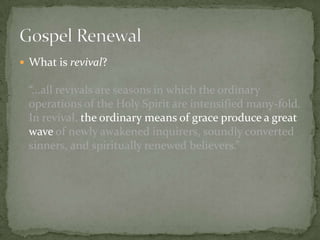
“...all revivals are seasons in which the ordinary
operations of the Holy Spirit are intensified many-fold.
In revival, the ordinary means of grace produce a great
wave of newly awakened inquirers, soundly converted
sinners, and spiritually renewed believers.”
 What is revival?

“...all revivals are seasons in which the ordinary
operations of the Holy Spirit are intensified many-fold.
In revival, the ordinary means of grace produce a great
wave of newly awakened inquirers, soundly converted
sinners, and spiritually renewed believers.”
 What is revival?

“...all revivals are seasons in which the ordinary
operations of the Holy Spirit are intensified many-fold.
In revival, the ordinary means of grace produce a great
wave of newly awakened inquirers, soundly converted
sinners, and spiritually renewed believers.”
 What is revival?

“...all revivals are seasons in which the ordinary
operations of the Holy Spirit are intensified many-fold.
In revival, the ordinary means of grace produce a great
wave of 1) newly awakened inquirers, 2) soundly
converted sinners, and 3) spiritually renewed
believers.”
 What is revival?

“...revival is not a historical curiosity; it is a consistent
pattern of how the Holy Spirit works in a community
to arrest and counteract the default mode of the
human heart. It is surely relevant to ministry in
twenty-first-century global cultures, as it is relevant in
every culture.”
 What is revival?

“...Revivalist ministry emphasizes conversion and
spiritual renewal, not only for those outside the
church, but also for those inside the church. Some
need to be converted from clear unbelief; others need
to see, to their surprise, that they’ve never been
converted; still others need to sense their spiritual
stagnation.
 Have you ever experienced spiritual renewal in a

corporate setting as described in this chapter? If so,
how would you describe it? How did it differ from a
more personal experience of renewal?
 How can you bring more of a gospel renewal focus to

your existing ministry?

Center church chapters 3 4

  • 1.
  • 2.
     The gospelis not everything.
  • 3.
     The gospelis not everything; “meaning it must be distinguished as an announcement of news, distinct from its results and implications”
  • 4.
     The gospelis not everything; “meaning it must be distinguished as an announcement of news, distinct from its results and implications”  The gospel is not a simple thing.
  • 5.
     The gospelis not everything; “meaning it must be distinguished as an announcement of news, distinct from its results and implications”  The gospel is not a simple thing. “meaning it cannot be packaged in a single standard form.”
  • 6.
     What isthe gospel?
  • 7.
     What isthe gospel? “The gospel is good news announcing that we have been rescued or saved. Because we are alienated from God, we are psychologically alienated within ourselves — we experience shame and fear (Gen 3: 10). Because we are alienated from God, we are also socially alienated from one another, and from nature itself. “vertical” relationship with God. All human problems are ultimately symptoms, and our separation from God is the cause. The reason for all the misery — all the effects of the curse — is that we are not reconciled to God.”
  • 10.
     Keller writes,“The primary cause of all of our alienations [is] our separation from God.”
  • 11.
     Keller writes,“The primary cause of all of our alienations [is] our separation from God.”  discouragement and depression  love and relationships  sexuality  family and parental expectations  self-control  your motive for witness  obedience to human authority  guilt and self-image  joy and humor
  • 12.
     Keller writes,“The primary cause of all of our alienations [is] our separation from God.” How has the gospel mended this primary ailment in you and how has it helped curb the many other symptoms that flow from it? How does this experience prepare you to minister to alienated people?
  • 13.
     What isrevival?
  • 14.
     What isrevival? “...all revivals are seasons in which the ordinary operations of the Holy Spirit are intensified many-fold. In revival, the ordinary means of grace produce a great wave of newly awakened inquirers, soundly converted sinners, and spiritually renewed believers.”
  • 15.
     What isrevival? “...all revivals are seasons in which the ordinary operations of the Holy Spirit are intensified many-fold. In revival, the ordinary means of grace produce a great wave of newly awakened inquirers, soundly converted sinners, and spiritually renewed believers.”
  • 16.
     What isrevival? “...all revivals are seasons in which the ordinary operations of the Holy Spirit are intensified many-fold. In revival, the ordinary means of grace produce a great wave of newly awakened inquirers, soundly converted sinners, and spiritually renewed believers.”
  • 17.
     What isrevival? “...all revivals are seasons in which the ordinary operations of the Holy Spirit are intensified many-fold. In revival, the ordinary means of grace produce a great wave of 1) newly awakened inquirers, 2) soundly converted sinners, and 3) spiritually renewed believers.”
  • 18.
     What isrevival? “...revival is not a historical curiosity; it is a consistent pattern of how the Holy Spirit works in a community to arrest and counteract the default mode of the human heart. It is surely relevant to ministry in twenty-first-century global cultures, as it is relevant in every culture.”
  • 19.
     What isrevival? “...Revivalist ministry emphasizes conversion and spiritual renewal, not only for those outside the church, but also for those inside the church. Some need to be converted from clear unbelief; others need to see, to their surprise, that they’ve never been converted; still others need to sense their spiritual stagnation.
  • 20.
     Have youever experienced spiritual renewal in a corporate setting as described in this chapter? If so, how would you describe it? How did it differ from a more personal experience of renewal?
  • 21.
     How canyou bring more of a gospel renewal focus to your existing ministry?