SUMBITTED BY:
MUKESH KUMAR
M.TECH(2010ECB1026)
Cellular Neural Network is a revolutionary concept
and an experimentally proven new computing
paradigm for analog computers. Looking at the
technological advancement in the last 50 years ;
we see the first revolution which led to pc
industry in 1980’s, second revolution led to
internet industry in 1990’s cheap sensors & mems
arrays in desired forms of artificial eyes, nose, ears
etc. this third revolution owes due to C.N.N. This
technology is implemented using CNN-UM. and
is also used in image processing. It can also
implement any Boolean functions.
 Cellular neural networks (CNN) are a regular, single
or multi-layer, parallel computing paradigm similar
to neural networks, with the difference that
communication is allowed between neighbouring
units only.
 processing structures with analog nonlinear dynamic
units (cells).
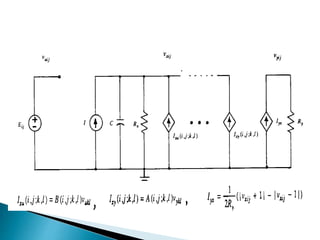
 Each cell is made up of linear capacitor, non linear
voltage controlled current source, resistive linear
circuit element.
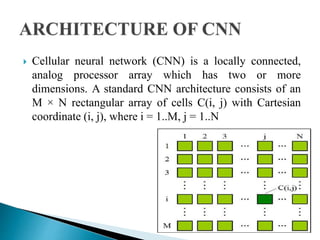
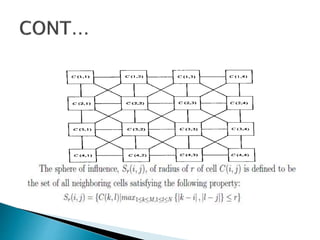
 Cellular neural network (CNN) is a locally connected,
analog processor array which has two or more
dimensions. A standard CNN architecture consists of an
M × N rectangular array of cells C(i, j) with Cartesian
coordinate (i, j), where i = 1..M, j = 1..N
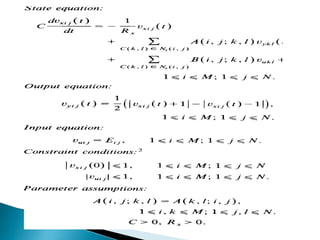
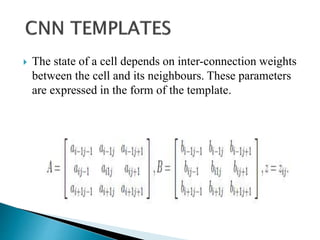
 The state of a cell depends on inter-connection weights
between the cell and its neighbours. These parameters
are expressed in the form of the template.
 The CNN Universal Machine (CNN-UM) is based on a
CNN.
 First programmable analog processor array computer with
its own language and operation system whose VLSI
implementation has the same computing power as a
supercomputer in image processing applications.
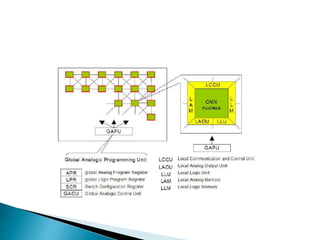
 The extended universal cells of CNN-UM are controlled by
global analogic programming unit (GAPU), which has
analog and logic parts: global analog program register,
global logic program register, switch configuration register
and global analogic control unit. Every cell has analog and
logical memory.
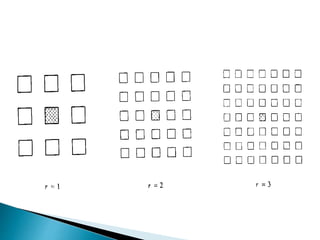
 The CNN can be defined as an M x N type array of identical
cells arranged in a rectangular grid. Each cell is locally
connected to its 8 nearest surrounding neighbors.
 Each cell is characterized by uij, yij and vij being the input,
the output and the state variable of the cell respectively.
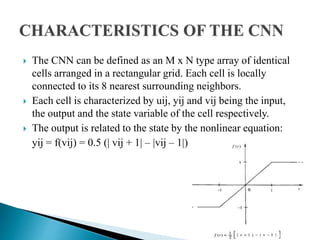
 The output is related to the state by the nonlinear equation:
yij = f(vij) = 0.5 (| vij + 1| – |vij – 1|)
 High speed target recognition, tracking.
 Real time visual inspection of manufacturing
processes.
 Cheap sensors and mems arrays are in the desired
forms of artificial eyes, nose, ears, taste & realization
of telepathy.
 Intelligent vision capable of recognition of context-
sensitive & moving scenes as well as applications
requiring real time fusing of multiple modalities such
as multi spectral images involving infrared, long
wave-infrared and polarized lights.
PDE based in modern image processing techniques are
becoming most challenging & important for analogic
C.N.N. computers. A major challenge yet not solved by
any existing technology is to build analogic adaptive
sensor computer where sensing & computing
understanding are fully integrated on a chip.
THANKS

Cellular neural

  • 1.
  • 2.
    Cellular Neural Networkis a revolutionary concept and an experimentally proven new computing paradigm for analog computers. Looking at the technological advancement in the last 50 years ; we see the first revolution which led to pc industry in 1980’s, second revolution led to internet industry in 1990’s cheap sensors & mems arrays in desired forms of artificial eyes, nose, ears etc. this third revolution owes due to C.N.N. This technology is implemented using CNN-UM. and is also used in image processing. It can also implement any Boolean functions.
  • 3.
     Cellular neuralnetworks (CNN) are a regular, single or multi-layer, parallel computing paradigm similar to neural networks, with the difference that communication is allowed between neighbouring units only.  processing structures with analog nonlinear dynamic units (cells).  Each cell is made up of linear capacitor, non linear voltage controlled current source, resistive linear circuit element.
  • 4.
     Cellular neuralnetwork (CNN) is a locally connected, analog processor array which has two or more dimensions. A standard CNN architecture consists of an M × N rectangular array of cells C(i, j) with Cartesian coordinate (i, j), where i = 1..M, j = 1..N
  • 9.
     The stateof a cell depends on inter-connection weights between the cell and its neighbours. These parameters are expressed in the form of the template.
  • 10.
     The CNNUniversal Machine (CNN-UM) is based on a CNN.  First programmable analog processor array computer with its own language and operation system whose VLSI implementation has the same computing power as a supercomputer in image processing applications.  The extended universal cells of CNN-UM are controlled by global analogic programming unit (GAPU), which has analog and logic parts: global analog program register, global logic program register, switch configuration register and global analogic control unit. Every cell has analog and logical memory.
  • 12.
     The CNNcan be defined as an M x N type array of identical cells arranged in a rectangular grid. Each cell is locally connected to its 8 nearest surrounding neighbors.  Each cell is characterized by uij, yij and vij being the input, the output and the state variable of the cell respectively.  The output is related to the state by the nonlinear equation: yij = f(vij) = 0.5 (| vij + 1| – |vij – 1|)
  • 13.
     High speedtarget recognition, tracking.  Real time visual inspection of manufacturing processes.  Cheap sensors and mems arrays are in the desired forms of artificial eyes, nose, ears, taste & realization of telepathy.  Intelligent vision capable of recognition of context- sensitive & moving scenes as well as applications requiring real time fusing of multiple modalities such as multi spectral images involving infrared, long wave-infrared and polarized lights.
  • 14.
    PDE based inmodern image processing techniques are becoming most challenging & important for analogic C.N.N. computers. A major challenge yet not solved by any existing technology is to build analogic adaptive sensor computer where sensing & computing understanding are fully integrated on a chip.
  • 15.