CELL STRUCTURE
RIBOSOME
2
GEORGE E. PALADE
The ribosome is a complex molecule made of ribosomal
RNA molecules and proteins that form a factory for protein
synthesis in cells. In 1955, George E. Palade discovered
ribosomes and described them as small particles in the
cytoplasm that preferentially associated with the endoplasmic
reticulum membrane.
3
RIBOSOME
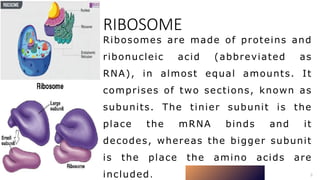
Ribosomes are made of proteins and
ribonucleic acid (abbreviated as
RNA), in almost equal amounts. It
comprises of two sections, known as
subunits. The tinier subunit is the
place the mRNA binds and it
decodes, whereas the bigger subunit
is the place the amino acids are
included.
4
4
RIBOSOME
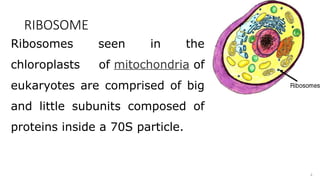
Ribosomes seen in the
chloroplasts of mitochondria of
eukaryotes are comprised of big
and little subunits composed of
proteins inside a 70S particle.
5
RIBOSOME OF PLANT CELL
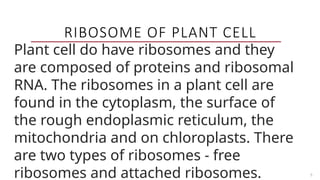
Plant cell do have ribosomes and they
are composed of proteins and ribosomal
RNA. The ribosomes in a plant cell are
found in the cytoplasm, the surface of
the rough endoplasmic reticulum, the
mitochondria and on chloroplasts. There
are two types of ribosomes - free
ribosomes and attached ribosomes.
6
6
RIBOSOME OF PLANT AND ANIMAL CELL
7
RIBOSOME OF ANIMAL CELL
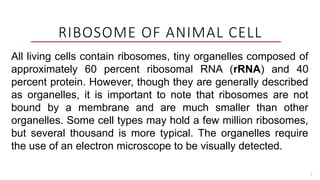
All living cells contain ribosomes, tiny organelles composed of
approximately 60 percent ribosomal RNA (rRNA) and 40
percent protein. However, though they are generally described
as organelles, it is important to note that ribosomes are not
bound by a membrane and are much smaller than other
organelles. Some cell types may hold a few million ribosomes,
but several thousand is more typical. The organelles require
the use of an electron microscope to be visually detected.
8
8
RIBOSOME OF PLANT AND ANIMAL CELL
9
RIBOSOME OF BACTERIAL CELL
All living cells contain ribosomes, tiny organelles composed of
approximately 60 percent ribosomal RNA (rRNA) and 40
percent protein. However, though they are generally described
as organelles, it is important to note that ribosomes are not
bound by a membrane and are much smaller than other
organelles. Some cell types may hold a few million ribosomes,
but several thousand is more typical. The organelles require the
use of an electron microscope to be visually detected.
10
10
RIBOSOME OF PLANT AND ANIMAL CELL
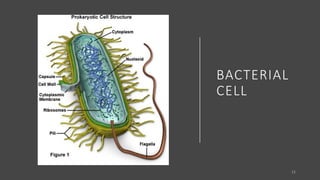
BACTERIAL
CELL
11
12
IMPORTANCE OF RIBOSOME
Ribosome Structure and RNA
Ribosomes consist of two basic components, a large
component and a small component, made up of RNA
molecules.
Codons and Protein Synthesis
The mRNA carries the genetic information encoded in
the original DNA, acting as a messenger to produce
the appropriate proteins, hence the name.
13
IMPORTANCE OF RIBOSOME
Free and Membrane-Bound Ribosomes
Ribosomes are found in two locations in the cell. Free ribosomes are
present in the cytosol, the watery fluid inside the cell and are not
attached to any other structure. Membrane-bound ribosomes are
attached to a structure known as rough endoplasmic reticulum.
Proteins Produced by Free Ribosomes
Ribosomes are important because they are responsible for
protein synthesis. Free ribosomes, in particular, are important
because they produce proteins essential for internal cellular
activity, which are not synthesized elsewhere.
14
FUNCTIONS OF RIBOSOME
1.It assembles amino acid to form proteins that are
essential to carry out cellular functions.
2.The DNA produces mRNA by the process of DNA
transcription.
3.The mRNA is synthesized in the nucleus and transported
to the cytoplasm for the process of protein synthesis.
4.The ribosomal subunits in the cytoplasm are bound
around mRNA polymers. The tRNA then synthesizes
proteins.
5.The proteins synthesized in the cytoplasm are utilized in
the cytoplasm itself, the proteins synthesized by bound
ribosomes are transported outside the cell.
15
COMPARISON OF STRUCTURE
Animal cells and plant cells are similar in that they are both
eukaryotic cells. These cells have a true nucleus, which houses DNA and is
separated from other cellular structures by a nuclear
membrane. Ribosomes are special because they are found in both
prokaryotes and eukaryotes. While a structure such as a nucleus is only
found in eukaryotes, every cell needs ribosomes to manufacture proteins.
Ribosomes in prokaryotes use a slightly different process to produce
proteins than do ribosomes in eukaryotes. Fortunately this difference
presents a window of molecular opportunity for attack by antibiotic drugs
such as streptomycin. Unfortunately some bacterial toxins and the polio
virus also use it to enable them to attack the translation mechanism.

Cell-structure powerpoint presentation.pptx

  • 1.
  • 2.
    2 GEORGE E. PALADE Theribosome is a complex molecule made of ribosomal RNA molecules and proteins that form a factory for protein synthesis in cells. In 1955, George E. Palade discovered ribosomes and described them as small particles in the cytoplasm that preferentially associated with the endoplasmic reticulum membrane.
  • 3.
    3 RIBOSOME Ribosomes are madeof proteins and ribonucleic acid (abbreviated as RNA), in almost equal amounts. It comprises of two sections, known as subunits. The tinier subunit is the place the mRNA binds and it decodes, whereas the bigger subunit is the place the amino acids are included.
  • 4.
    4 4 RIBOSOME Ribosomes seen inthe chloroplasts of mitochondria of eukaryotes are comprised of big and little subunits composed of proteins inside a 70S particle.
  • 5.
    5 RIBOSOME OF PLANTCELL Plant cell do have ribosomes and they are composed of proteins and ribosomal RNA. The ribosomes in a plant cell are found in the cytoplasm, the surface of the rough endoplasmic reticulum, the mitochondria and on chloroplasts. There are two types of ribosomes - free ribosomes and attached ribosomes.
  • 6.
    6 6 RIBOSOME OF PLANTAND ANIMAL CELL
  • 7.
    7 RIBOSOME OF ANIMALCELL All living cells contain ribosomes, tiny organelles composed of approximately 60 percent ribosomal RNA (rRNA) and 40 percent protein. However, though they are generally described as organelles, it is important to note that ribosomes are not bound by a membrane and are much smaller than other organelles. Some cell types may hold a few million ribosomes, but several thousand is more typical. The organelles require the use of an electron microscope to be visually detected.
  • 8.
    8 8 RIBOSOME OF PLANTAND ANIMAL CELL
  • 9.
    9 RIBOSOME OF BACTERIALCELL All living cells contain ribosomes, tiny organelles composed of approximately 60 percent ribosomal RNA (rRNA) and 40 percent protein. However, though they are generally described as organelles, it is important to note that ribosomes are not bound by a membrane and are much smaller than other organelles. Some cell types may hold a few million ribosomes, but several thousand is more typical. The organelles require the use of an electron microscope to be visually detected.
  • 10.
    10 10 RIBOSOME OF PLANTAND ANIMAL CELL
  • 11.
  • 12.
    12 IMPORTANCE OF RIBOSOME RibosomeStructure and RNA Ribosomes consist of two basic components, a large component and a small component, made up of RNA molecules. Codons and Protein Synthesis The mRNA carries the genetic information encoded in the original DNA, acting as a messenger to produce the appropriate proteins, hence the name.
  • 13.
    13 IMPORTANCE OF RIBOSOME Freeand Membrane-Bound Ribosomes Ribosomes are found in two locations in the cell. Free ribosomes are present in the cytosol, the watery fluid inside the cell and are not attached to any other structure. Membrane-bound ribosomes are attached to a structure known as rough endoplasmic reticulum. Proteins Produced by Free Ribosomes Ribosomes are important because they are responsible for protein synthesis. Free ribosomes, in particular, are important because they produce proteins essential for internal cellular activity, which are not synthesized elsewhere.
  • 14.
    14 FUNCTIONS OF RIBOSOME 1.Itassembles amino acid to form proteins that are essential to carry out cellular functions. 2.The DNA produces mRNA by the process of DNA transcription. 3.The mRNA is synthesized in the nucleus and transported to the cytoplasm for the process of protein synthesis. 4.The ribosomal subunits in the cytoplasm are bound around mRNA polymers. The tRNA then synthesizes proteins. 5.The proteins synthesized in the cytoplasm are utilized in the cytoplasm itself, the proteins synthesized by bound ribosomes are transported outside the cell.
  • 15.
    15 COMPARISON OF STRUCTURE Animalcells and plant cells are similar in that they are both eukaryotic cells. These cells have a true nucleus, which houses DNA and is separated from other cellular structures by a nuclear membrane. Ribosomes are special because they are found in both prokaryotes and eukaryotes. While a structure such as a nucleus is only found in eukaryotes, every cell needs ribosomes to manufacture proteins. Ribosomes in prokaryotes use a slightly different process to produce proteins than do ribosomes in eukaryotes. Fortunately this difference presents a window of molecular opportunity for attack by antibiotic drugs such as streptomycin. Unfortunately some bacterial toxins and the polio virus also use it to enable them to attack the translation mechanism.