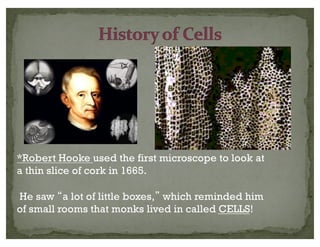
*Robert Hooke used the first microscope to look at
a thin slice of cork in 1665.
He saw a lot of little boxes, which reminded him
of small rooms that monks lived in called CELLS!
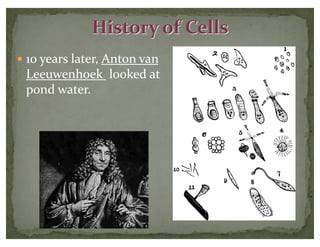
— 10 years later, Anton van
Leeuwenhoek looked at
pond water.
History of Cells
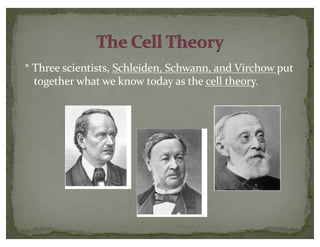
* Three scientists, Schleiden, Schwann, and Virchow put
together what we know today as the cell theory.
1. All living things are made of one or more cells.
2. Cells are the basic unit of structure and function in
living things.
3. All cells arise from existing cells.
— PROKARYOTES
— Earliest Type of cell
— No Nucleus
— Does not contain membrane bound
organelles.
— Found only in Bacteria
— Have a cell wall
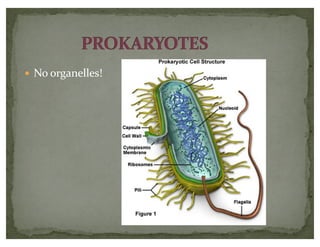
— No organelles!
— EUKARYOTES
— More complex cells
— Has a defined nucleus.
— Contains membrane bound organelles.
— Allows cell specialization – specific
function (blood cell vs nerve cell)
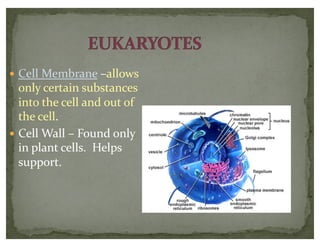
— Cell Membrane –allows
only certain substances
into the cell and out of
the cell.
— Cell Wall – Found only
in plant cells. Helps
support.
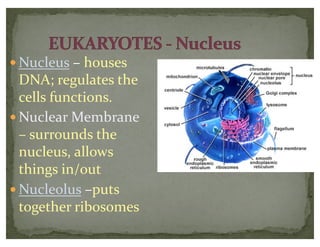
— Nucleus – houses
DNA; regulates the
cells functions.
— Nuclear Membrane
– surrounds the
nucleus, allows
things in/out
— Nucleolus –puts
together ribosomes
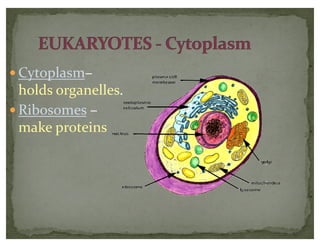
— Cytoplasm–
holds organelles.
— Ribosomes –
make proteins
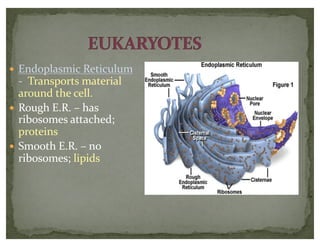
— Endoplasmic Reticulum
- Transports material
around the cell.
— Rough E.R. – has
ribosomes attached;
proteins
— Smooth E.R. – no
ribosomes; lipids
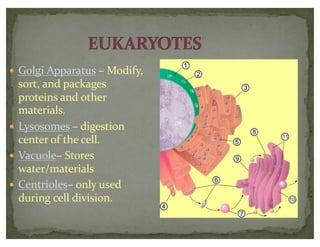
— Golgi Apparatus – Modify,
sort, and packages
proteins and other
materials.
— Lysosomes – digestion
center of the cell.
— Vacuole– Stores
water/materials
— Centrioles– only used
during cell division.
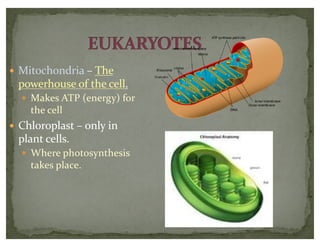
— Mitochondria – The
powerhouse of the cell.
— Makes ATP (energy) for
the cell
— Chloroplast – only in
plant cells.
— Where photosynthesis
takes place.

Cell+Notes.pdf that helps out students who CNA do suttf

  • 2.
    *Robert Hooke usedthe first microscope to look at a thin slice of cork in 1665. He saw a lot of little boxes, which reminded him of small rooms that monks lived in called CELLS!
  • 3.
    — 10 yearslater, Anton van Leeuwenhoek looked at pond water. History of Cells
  • 4.
    * Three scientists,Schleiden, Schwann, and Virchow put together what we know today as the cell theory.
  • 5.
    1. All livingthings are made of one or more cells. 2. Cells are the basic unit of structure and function in living things. 3. All cells arise from existing cells.
  • 6.
    — PROKARYOTES — EarliestType of cell — No Nucleus — Does not contain membrane bound organelles. — Found only in Bacteria — Have a cell wall
  • 7.
  • 8.
    — EUKARYOTES — Morecomplex cells — Has a defined nucleus. — Contains membrane bound organelles. — Allows cell specialization – specific function (blood cell vs nerve cell)
  • 10.
    — Cell Membrane–allows only certain substances into the cell and out of the cell. — Cell Wall – Found only in plant cells. Helps support.
  • 11.
    — Nucleus –houses DNA; regulates the cells functions. — Nuclear Membrane – surrounds the nucleus, allows things in/out — Nucleolus –puts together ribosomes
  • 12.
    — Cytoplasm– holds organelles. —Ribosomes – make proteins
  • 13.
    — Endoplasmic Reticulum -Transports material around the cell. — Rough E.R. – has ribosomes attached; proteins — Smooth E.R. – no ribosomes; lipids
  • 14.
    — Golgi Apparatus– Modify, sort, and packages proteins and other materials. — Lysosomes – digestion center of the cell. — Vacuole– Stores water/materials — Centrioles– only used during cell division.
  • 15.
    — Mitochondria –The powerhouse of the cell. — Makes ATP (energy) for the cell — Chloroplast – only in plant cells. — Where photosynthesis takes place.